Embracing Limitations: Lessons from the Asheville Half Marathon

God, grant me the serenity to accept the things I can not change, the courage to change the things I can, and the wisdom to know the difference.”–Prayer for serenity

The Blue Ridge Mountains outside of Asheville, NC.

“the mountains are Calling . . .” ⛰️

I had been training for months, despite the challenges winter threw at me. Cold? I can handle it. Snow? I can run in it. Gusty wind? I can run that too. However, after my husband, John, and I crested hill after hill making our way into Asheville, North Carolina, I knew the town’s half marathon would offer a whole new level of challenge. 

To be clear, participating in the Asheville Half Marathon was an insignificant hurdle compared to what the people in Asheville, and all of the other residents of the surrounding areas/towns along US 23, have been facing as they deal with the aftermath of Hurricane Helene.

Driving along US 23, John, and I were able to witness that six months after Hurricane Helene angrily chewed through a large portion of the western Appalachian region, the recovery is still ongoing. However, the willful, and not-to-be-deterred, spirit of the residents was unmistakable. 
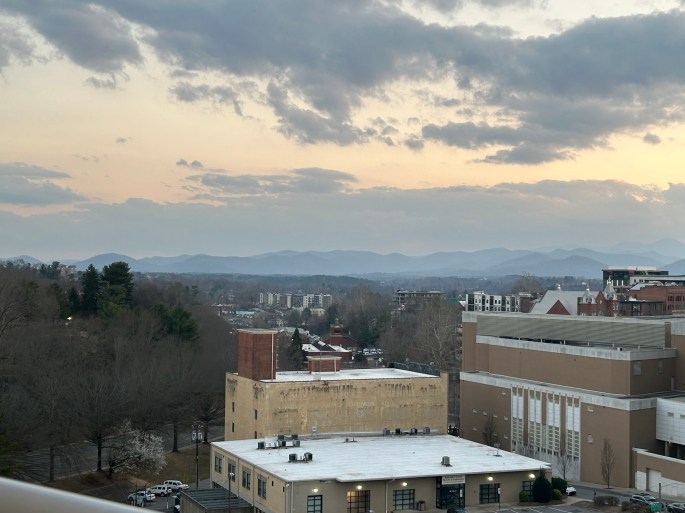
Rooftop view from Asheville of surrounding Blue Ridge Mountains.

A Tale of Two Sisters 👧 👧

This past fall, not long after Helene hit, the high school in which John and I work, welcomed two sisters into the student body.  They were from the Asheville area and were staying with relatives while their parents and older brother dealt with the devastation and destruction back home.

The girls were engaging and well-poised, especially considering their circumstances. Over the course of a couple months, I got to know them–not well due to the short duration of their stay–but well enough to swap personal stories from time to time. 

When they learned that like their dad, I often trained for half marathons, they immediately invited me to run the Asheville Half Marathon in March. They explained that by the time spring rolled around, the community would not be fully recovered, but the local economy would need the boost that runners and the accompanying spectators could bring. 

“You should definitely come, Ms. Hill.  You’d like the people of Asheville, especially the running community.” 

Once Asheville High School opened, the girls returned back home. And though I haven’t heard from them since, they planted a seed that grew into a shoot of curiosity. 
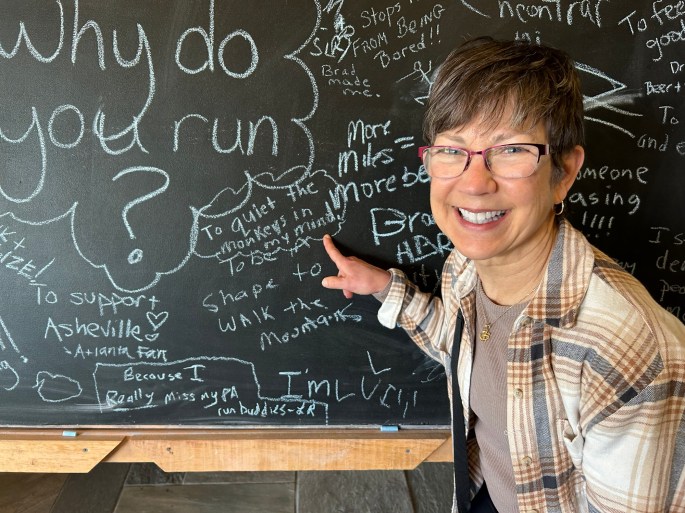
Runners were asked to sign the board stating why they ran.

Sign me up! 📝

Around Christmas, I checked the Asheville Marathon/Half Marathon website, and the powerful and persuasive prose describing the event increased my interest. The website’s editors artfully articulated the community’s belief in the significance of the annual running event. They stated the course’s route would not be “pristine or predictable.” Therefore, the event was for those who “thrive on resilience.” However, the line that sealed the deal stated, “If you’re ready to run in the face of adversity and be a part of Asheville’s comeback story, we can’t wait to see you on the start line!” 

John and I at gathering with other runners and spectators at the starting line before the race began.

Ready, set, Go! 🏁

Soon enough, on a chilly, dark March morning, I waited at the starting line with approximately 2,200 runners from 40 states and three countries who also heeded the call to help support Asheville, according to The Weather Channel. The positive vibe was palpable as runners mingled with spectators. Nonetheless, I was feeling a bit nervous as I recalled the half-marathon route’s elevation gain was nearly 800 feet, and its elevation loss was over 900.  

And, it was hilly.  From start to finish, there were no flat stretches. In the beginning, I read spectator signs claiming, “It’s all downhill from here,” with hope. It didn’t take long to realize those signs lied!  Even the finish line required running uphill, but I am “running” ahead of myself.

Running is a metaphor for living life, and it is always whispering (or sometimes shouting, as this event seemed to do) lessons to those of us willing to listen. Accepting limitations–was the lesson those relentless hills of Asheville taught me. Which makes sense since this is what many of the residents of Asheville and the western Appalachian area had to do during, and now after, the storm–accept and deal with limitations. 

Whether literal or metaphorical, storms of life cause us to suffer. As I repeatedly tried to power through those uphills during the first half, my ego kept telling me to push harder, creating suffering. However, as a late-in-life runner lacking inherent running talent, the reality is that race events for me are more about creating motivation and structure to consistently get me out the door to exercise. At the end of the day, I am not about to set any records; I am not even close to winning my age group, so why was I pushing so hard?

And so, it was on a hill, not long after milepost seven, that I decided to accept my limitations. Sure, I had trained on hills at home, but nothing like this. Why not power walk up the rest of the hills, and then run the downhill portions?
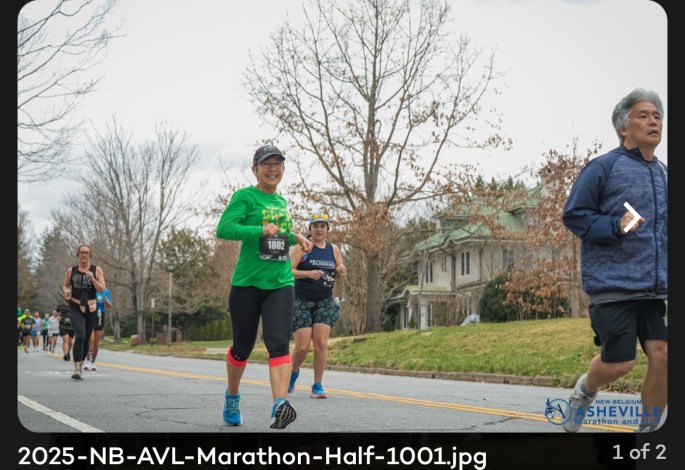
Asheville taught me to accept my limitations.

There is a newfound freedom in accepting one’s limitations 🏃‍♀️

Once I accepted my limitations, there was freedom. I had a new way of being present with the race challenges as they unfolded. This acceptance gave me permission to slow down, take in the sites, and feel a sense of gratitude for my health and ability to make this trip. 

Additionally, by walking the hills, I had more energy to offer encouragement to fellow runners I encountered who also seemed to be struggling. (After all, I run at the back of the pack, where we could all benefit from a little encouragement.) Furthermore, I was also able to offer thanks to the spectators who manned drink stations, rang cowbells, or waved motivating signs with clever phrases such as, “Touch here for power,” “You’re stronger than any storm,” or “You’re running better than our government.” 

By the time I crossed the uphill finish line, tears filled my eyes as I raised my hands in the air.  No, I wasn’t celebrating a personal record, but instead, I was able to celebrate that I crossed the finish line with grace, humility, and a lesson learned. 
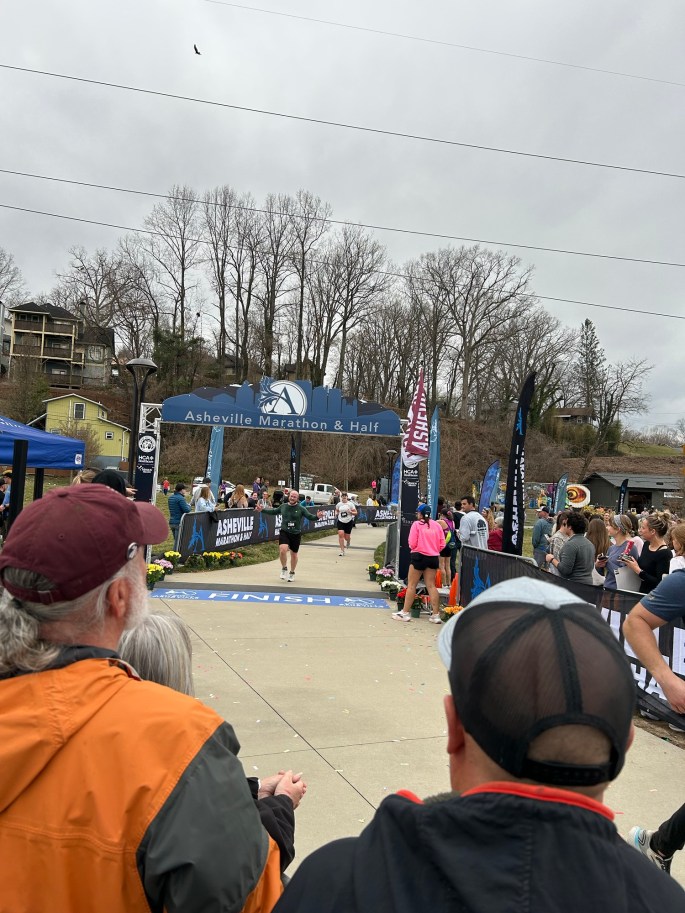
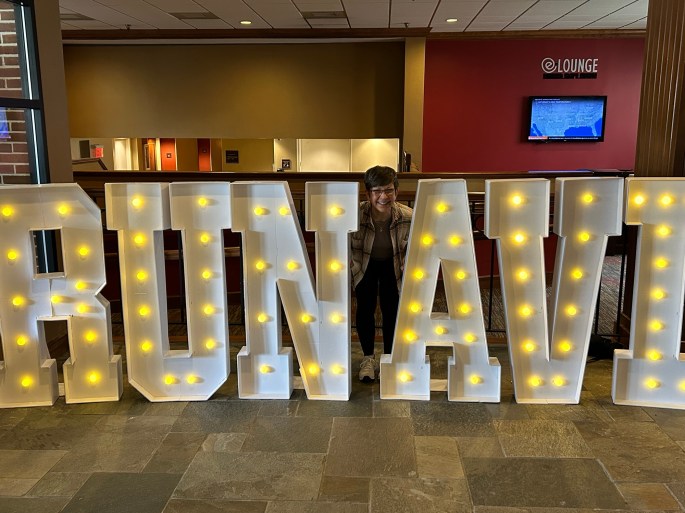
The AVL finish line of through which I would later cross humbled, and grateful, by another lesson running once more provided me.

The lesson? Transforming suffering can only occur if we are willing to be with it and accept the limitations it creates. Accepting limitations can be transformatively freeing, allowing us to lean into newly created possibilities we may not have been able to previously envision. I am not saying that accepting our limitations is not easy. However, once we let go of ego and embrace humility, it is possible to embrace the freedom that comes with focusing on what we CAN do.


Thank you , Asheville! I walk away from the finish line with grateful heart and a lesson learned. Furthermore, thank you, Hannah and Allison! I wish your family the best! 💜

Finding Peace Amid Life’s Storms

Incredible change happens in your life when you decide to take control of what you do have power over instead of craving control over what you don’t.”–Steve Maraboli

Photo by Pixabay on Pexels.com

WArning: Shifting Life weather ⛈️

My husband, John, and his sister, Jacki, have birthdays during the last days of February. This year, we celebrated both birthdays on the day in between their two respective birth dates. As John and I drove towards Jacki’s house, we revelled in the warm-ish, slanted sunlight of late February. However, a stiff, cold breeze hinted of a dramatic weather shift.

Soon enough, we observed layers of dark gray and black clouds encroaching from the northwest as if ready to aggressively lash out in a fit of rage.

By the time we arrived at Jacki’s house, the wind gathered more intensity. Layers of clouds silently slinked closer, blanketing the sunlight. Warning rain drops, heavy with intention, randomly fell at intermittent intervals. 

Our daughter met us in the parking lot of a restaurant as a menacing mass of mayhem loomed above us. The winds forcibly fought against our efforts to walk into the establishment. The restaurant door resisted opening against the wind and then likewise fought to be closed. Seconds after John struggled to shut the door, a hostile bolt of lightning loudly landed nearby, shaking the building.

After being seated, torrents of truculent rain burst forth from swirling chaotic clouds soaking the next few guests who entered through the front doors. 

Photo by Dan Prado on Pexels.com

Change The focus 🎁

Soon enough, however, we diverted our attention away from the storm, talking and swapping stories. John and Jacki opened gifts, and we spent the next hour and a half engrossed in one another’s company with little focus on the discord of the storm unfolding around us. The storm was there, lashing and railing against the walls and windows, but it no longer disturbed our peace of mind as we focused on the unfolding celebration.

Yet, how many times in life do we allow surrounding storms and worries to shake and distract us from the moment at hand?

Photo by Jo Kassis on Pexels.com

Rough Waters Ahead 🌊

Many years ago, our family visited the shores of the Outer Banks in North Carolina when our daughter was quite young. It was a last minute trip during the first week of August, just before the start of school. The three of us made daily trips to the shoreline with books, umbrella, cooler, and boogie boards in tow. 

Unfortunately, the temperatures were incredibly hot, even in the early morning. Therefore, we spent most of our time in the cool water on our boogie boards. We would wade out until our daughter was knee deep, then plop ourselves, belly down, on our boards. Next, we would paddle and kick to where the waves were breaking. When we saw what we thought was a “good wave,” we’d point our boogie boards back to the beach, start paddling and kicking, catch the wave, and ride it in towards the shore.

Each time we rode the wave in, we were taken a little further up the shoreline from where we had set up “camp” due to the strong undertow. Eventually, we would be taken so far north that we could no longer see our belongings, and we would lumber out of the water, walking back to our starting point. This would occur repeatedly as we had no control of the undertow.

Photo by Maria Orlova on Pexels.com

Possible strong Undertow 😵‍💫

The other thing that would happen is that one, or all, of us would get flipped off our boards by a rogue wave. The rough waters hurled us to the sandy, shell-covered bottom, and we would come up sputtering and coughing, completely disheveled–banged up and sand abraded. This often forced us to take a break in order to catch our breath. Nevertheless, it wouldn’t be long until we were right back out there again, trying to catch a wave in the wild surf, despite the fact we knew we would ultimately get dumped again.  

Yet, despite the extreme August heat, strong undertow, and often rough surf, we focused more on our laughter and the joy of being together, creating memories that still make my heart smile.

Photo by Tyler Lastovich on Pexels.com

You can choose your Response 🤔

Like the birthday storm and those long ago OBX waves, life has times when it rages with rough rains of hurt, blows wild winds of change, drifts us along an undertow of misleading information, or chucks us under waves to the bottom of mental anguish. If we choose to focus on the suffering, we will inevitably suffer more.  

We can, however, choose to direct our attention away from the storm and other difficulties. It doesn’t mean we’re not aware of the situation–or completely ignore it. Instead, we can focus on what we can control. The challenge will still be there, but we can choose to live with it, and in the meantime, redirect our attention like we would a toddler in a seaside gift shop drawn to the glass figurines. 

In the end, the chaos of life storms are often not controllable, but our responses and/or level of reactivity can be. Our minds, with practice, can be trained to ride those waves. By focusing on what we can do, such as stepping out of the fray, walking along the shores of self-care, choosing an alternate, renewing activity, and/or turning inward for reflection/prayer, we can redirect our mind in a more positive/productive manner until either when the stormy wave passes, or we are ready to begin kicking and paddling in the waters of life once more.

Finding Service and Joy in Every Job: Lessons from a cleaner

recalling unceasingly before our God and Father your work energized by faith, and your service motivated by love and unwavering hope . . .” 1 Thessalonians 1:3 (Amplified Bible)

What a difference one person can make😃

I had a feeling when I walked into my classroom one frosty January morning and observed the unswept floor, Mr. King (name changed for privacy) had not been in my classroom over Christmas break. Not that I typically permit my students to leave trash and debris on the classroom floor; however, I noticed there were a few pieces of notebook paper, pink pencil eraser dust, and a random pen lid dropped to the floor.  

Thanks, in large part to Mr. King, my classroom floor was usually immaculate. Was he sick? When I saw him, he appeared to be fighting some sort of virus. Picking up what I could off the floor, I thought of Mr. King, and the way he approached his work. However, students had begun to arrive, and I knew I would have to set aside my current strands of thought.

Later in the week, I ran across a quote that reminded me of Mr. King: “You are always doing spiritual work. It is not necessarily the action that is important, but how you do it.” (Satchidananda) I thought of his smile, his positive attitude, and the can-do energy he brought with him to his work. 

Photo by Liliana Drew on Pexels.com

Each Job is part of a Bigger Picture 🧹

I first met Mr. King during the summer before school started. He was part of a professional cleaning crew hired by our school. We occasionally chatted while we both worked, if he happened to be completing a task in my classroom. During one of those chats, we said his cleaning job mattered because he felt he was part of the team helping the students to have a successful school year.  

“If I don’t do my job, then you have to do my job, which means you don’t have as much time to focus on your students and that means their learning suffers.  It’s all a chain, y’see?”

Photo by RDNE Stock project on Pexels.com

Working with Joy 🎶

Once the school year was under way, I would often hear Mr. King, after school hours, singing/humming in the next classroom as he swept. It was a joyful energy, his voice pitching high and low as he worked. 

Some days, after students were dismissed and I remained getting caught up on work, Mr. King would respectfully knock and ask if I minded him coming in to sweep. Never wanting to interfere with his cleaning schedule, I welcomed him in. 

No matter how busy Mr. King was, he would take time to ask about my husband and me. Then, he tended to have some sort of question or story for me to ponder. It was a delightful give and take, and he was most interested in improving himself, body, mind, and spirit.

Though our conversations were never longer than three or four minutes, I was left with the impression that Mr. King was a deeply faith-filled man who had made mistakes, knew he wasn’t perfect, but still had the desire and heart to improve.

He especially seemed to want his life to be of good service. To this end, he once said, “I am working. Am I not? But how am I doing it? That’s what’s real.” 

Photo by Antoni Shkraba on Pexels.com

OUr Work Ethic speaks for us 🤓

Later in the month of January, another coworker said Mr. King went back to Florida, from where he was originally, in order to be closer to his family

Upon hearing this, I recalled he once took a phone call from his daughter while sweeping my classroom. Returning from the hallway into which he had stepped to talk with her, he looked wistful, adding, “I worry about her.”

Photo by Ivan Samkov on Pexels.com

simple ways we can be of SErvice to others: 😃

The memory of Mr. King’s work ethic now serves as a reminder to me that no matter what job we have, we can find ways for our work to be of service to others. Here are some of the ways, Mr. King demonstrated this:

Work with joy. It doesn’t mean that we don’t have challenging or difficult days. Rather, we can still have something for which to feel joyful IN SPITE of circumstances, and that joy can become contagious. Mr. King appeared to find and share joy by singing/humming and smiling outwardly. Even on those days where I could tell something was bothering him, he still offered me a smile and a sincere greeting. 

Find the meaning in your work. Mr. King believed his work was important because he was contributing to the overall well-being and success of students, teachers, and staff. He often spoke about how much he liked the teachers and students he met and was glad he could do his part to help our school. 

Work hard, but take time to pay attention to others. Mr. King was an efficient and effective cleaner, but he still took time to greet staff members by name. If he learned something special about someone, he would ask questions about that special-something and would later refer to it in passing conversations. He was the master of personalized small talk.

Remain flexible and responsive to the needs/priorities of the day. If a worker was out, or a new worker was being trained (which was often), I would frequently overhear Mr. King fielding calls to answer questions and/or offer help. He appeared to adapt his schedule in stride to accommodate necessary changes. Even then, if he saw John, my husband, or me, he’d pause with a “Y’all doin’ ok?” or “You and Mr. John take care this evenin’.” 

Be empathetic and compassionate. Throughout the time Mr. King worked at our school, I observed several occasions when he took time to interact with students who looked frustrated, down, or who simply seemed alone. He’d ask, “You doin’ ok, buddy?” or offer another kind phrase in an attempt to bring a smile to a kid’s face. Then he went right back to work, whistling or humming as he went.  

It’s not what you do, but how you do it. Mr. King epitomized this. A radiant smile never seemed to leave his face while working. Furthermore, he demonstrated to his coworkers, and those with whom he encountered, that he cared, was interested, and desired to uplift the small piece of world his work-life encompassed.  

Photo by Ketut Subiyanto on Pexels.com

final thoughts🤔

None of Mr. King’s skills are life shattering or new ideas. However, in a world where it currently appears acceptable to be ill-mannered, ill-tempered, non-empathetic, and even outright bully others to get your way, Mr. King’s skills and attitude were a refreshing change of pace. Imagine the amount of good that could be generated if more people thought about HOW they worked, spoke, and acted–if more people would choose to be truly service-driven, energized by faith and motivated by love and hope. How much more would be accomplished . . .if only.