Effective Teaching and Coaching: Cultivating Student Achievement and Self-Improvement

Lessons from a Lifetime of Teaching series, Part 3

“The road to success is not a path you find, but a trail you blaze.”–Robert Breault

Author’s Note: This is the third installment of stories from decades of teaching students grades K-12.  It is my hope that by sharing these stories, I will cultivate lessons of compassion, empathy, and understanding

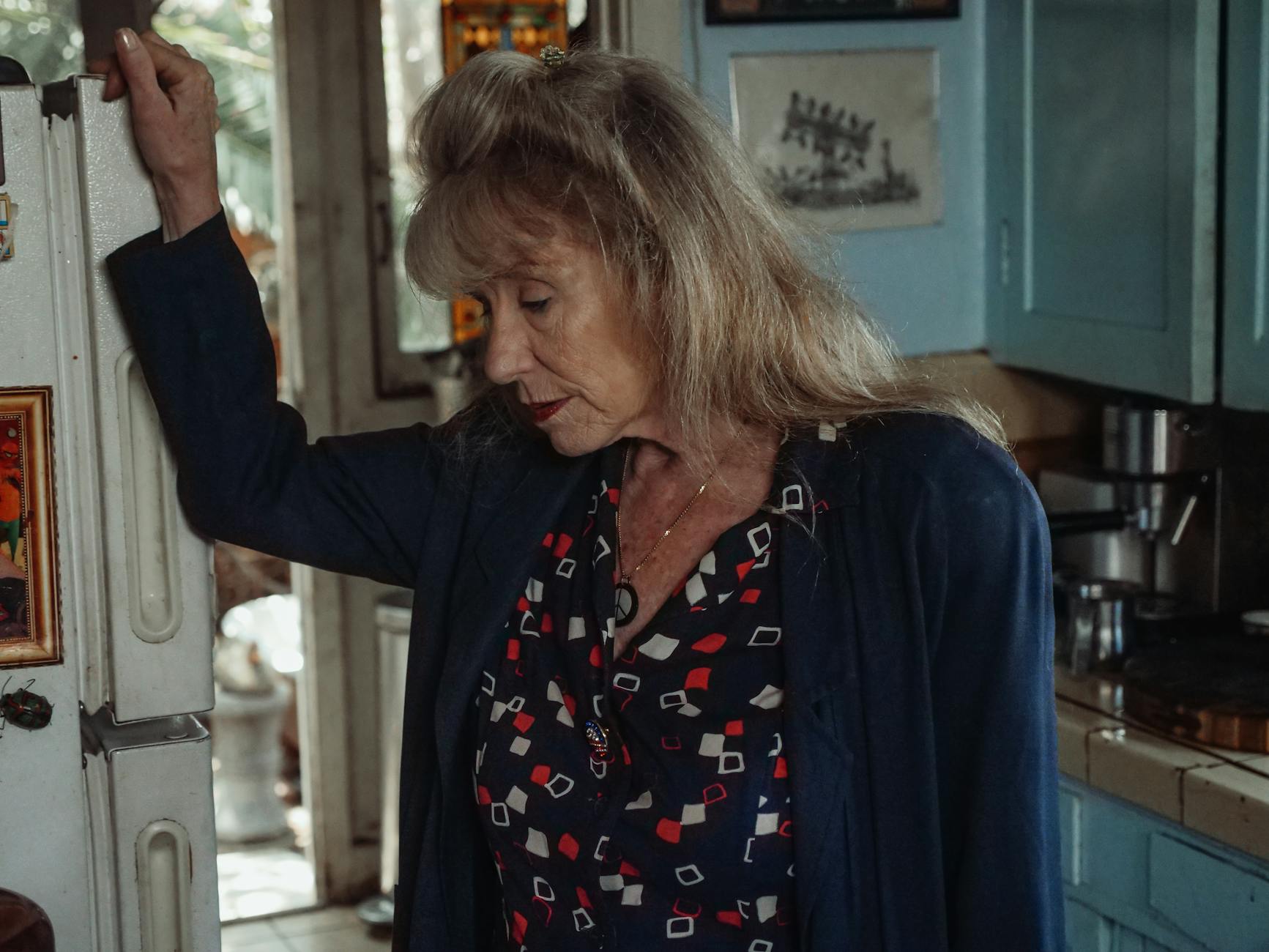
Photo by cottonbro studio on Pexels.com

Coaching requirement ⛹️‍♀️

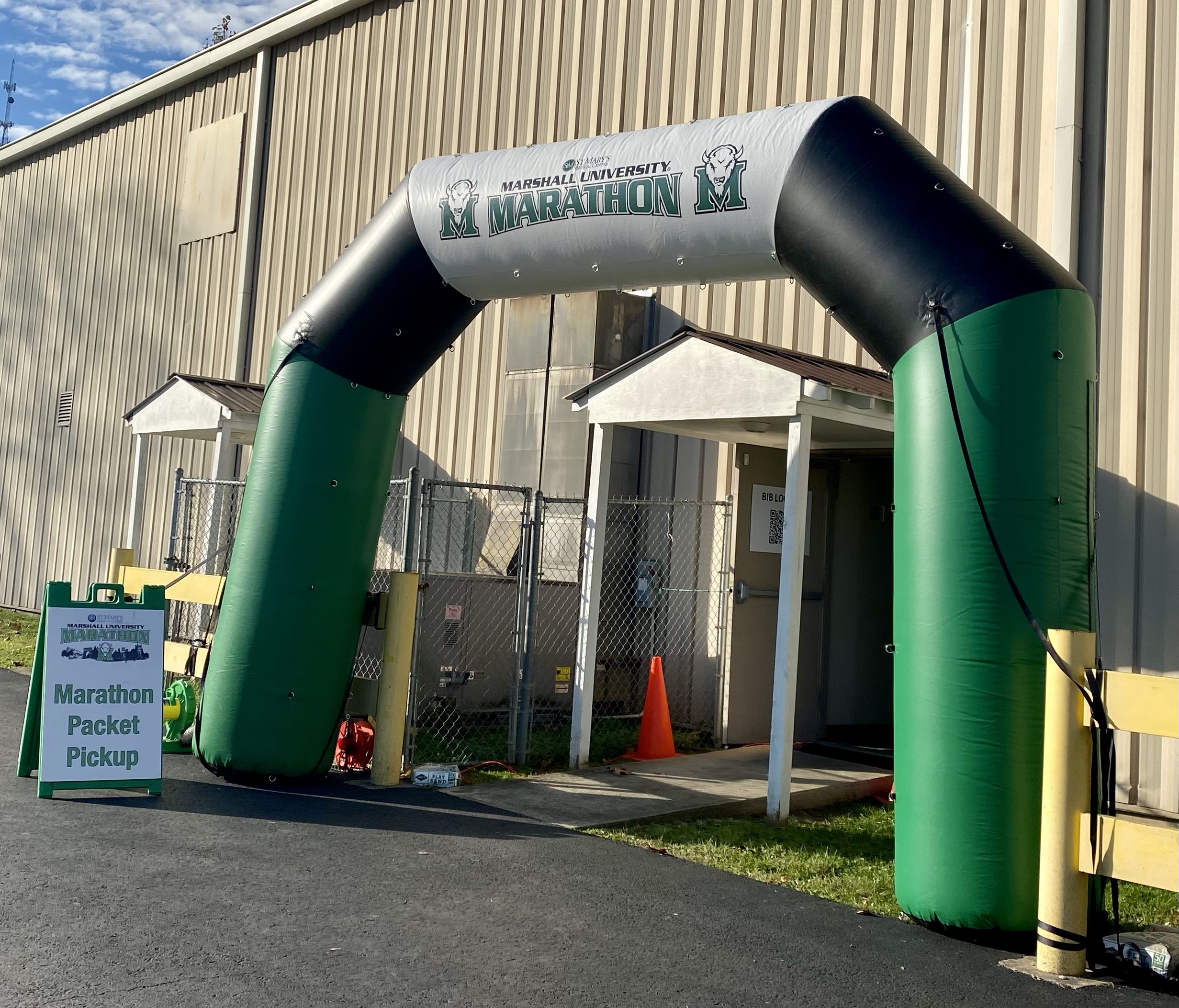
My educational career began at a rural Kentucky high school. I was one of five special education teachers. One of the requirements for teaching at this high school was coaching a team in some capacity. Therefore, I assisted with the women’s cross country and track teams. 

At the time, I didn’t know a thing about either sport, but the head coach of the cross country team was another special education teacher, Coach Bailey (name changed for privacy). I didn’t realize it when I first met him, but in the end, Bailey became a role model for me as an educator and coach.  

As luck would have it, our classrooms were side by side, divided only by a rolling chalkboard.  In the two years I worked with “Coach,” as everyone called him, I rarely heard him raise his voice, and if he did, you can bet he had a darn good reason. Mostly, Coach was a naturally soft-spoken man who could both nurture and challenge students and athletes alike.

Photo by cottonbro studio on Pexels.com

Meet the Coach 🏃‍♀️

Coach, in my mind, was “older” with salt and pepper straight hair parted down the center and a thick mustache.  His face was browned and weathered from years spent in the sun that contrasted his light aquamarine eyes.  His typical attire was khakis with a school logo polo shirt with a matching ball cap–the cap was only for sporting events. When the temperatures turned cold, he added a school logo v-neck polyester pullover that was popular with coaching staff in the late 80s.

On our first meeting, Coach gave me a tour of the “department facilities,” such as they were.  Three of the five special education classrooms were underneath the visitor side of the gym bleachers, and the other two classrooms were found at the end of the gym, just beyond the baseline.  As we walked, he politely introduced me to the faculty and staff we encountered. 

Later, when Coach discovered I had been assigned to “assist” him with the cross country team, he did not roll his eyes, sigh, or mutter under his breath upon hearing I had no coaching experience, which I feared he would do.  Instead, he said he was glad to have me as part of the team because the young ladies needed a female leader.

Photo by RUN 4 FFWPU on Pexels.com

Ladies Cross Country Team 🏃‍♀️🏃‍♀️

He then explained that the cross-country team had already begun practicing and invited me to join them that afternoon. It was then he asked if I ran.  Not wanting to disappoint him, I said that I did, which was sort of true. I had begun jogging during my last quarter of college just before graduating. I continued to jog two-three days per week around town after moving in with my grandparents that same summer, but I was by no means fast or knowledgeable about running beyond the basics. I knew I would have much to learn.

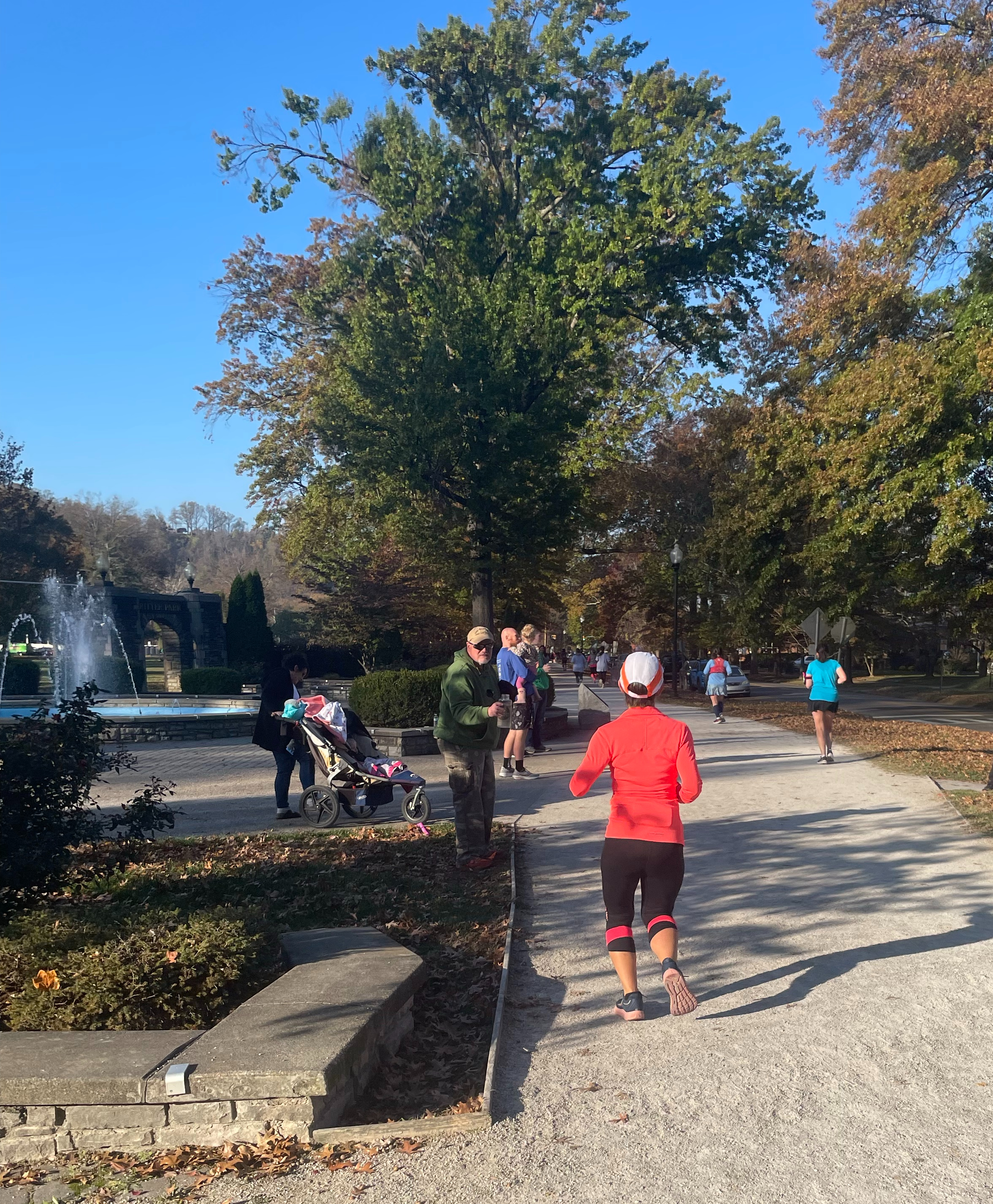
By 3:00 pm, I was on an access road along the Ohio River meeting the team. As Coach introduced me to the young ladies, they welcomed me with warm smiles.  As the weeks progressed, I would come to love these ladies, especially for the mature way they approached running, academics, and life in general. They were a driven group with gritty spirits, and they supported one another throughout the season even though they were competitors in races.

During this first practice, I learned that my job was to run, jog, or walk with whoever was at the back of the pack during the team’s long training runs while Coach rode his bike with the girls at the front of the group.  I was worried because I did not know if I had that level of fitness to keep up with even the so-called “slowest” runner.  

Photo by Tirachard Kumtanom on Pexels.com

The IMportance of Grit 💪

It turned out that there were two ladies who had joined the team with no running experience. Coach already knew they were not yet able to keep up with the other seasoned runners. Therefore, he asked that I remain steadfastly encouraging.  It was a role I relished. 

As the season progressed, one of the two newer runners was a “natural,” and was soon running with the rest of the team.  But Coach still insisted that I mostly focus on helping “Amy,” the runner who still struggled. He shared that while winning races was nice, developing stamina and perseverance were lifelong skills applicable to many settings, not just running.

Throughout the cross country season, Coach fostered a team attitude of, “You’re only in competition with your best time.”  His coaching style was gentle, but firm; supportive, but with high expectations.  However, those expectations were individualized to each runner, including Amy.  This philosophy was most evident after the regional meet.

Photo by Chiara Caldarola on Pexels.com

Individualized Success 🏅

We had two runners who finished in the top spots who qualified to move on to the sectional meet.  While Coach was happy with those two and praised their efforts, he also pointed out a few techniques they could use to improve their times for the next race.  

Additionally, since it was the last meet for the rest of the team, Coach took time to speak to each of the runners, showing them their running times from those hot days of August until the end of October.  All team members had improved significantly, and he made sure each runner knew how much they had achieved over the season. Coach conveyed heartfelt pride in each lady’s accomplishment, and he encouraged each one to run track in the spring.

Later, I watched Amy, who was always the last finisher for our team, walk over to her parents and chatter away about her improved times and how she couldn’t wait for spring track season.

Photo by Gerd Altmann on Pexels.com

Nudges of Success 🙌

Coach taught his students in the same manner in which he coached.  His expectations were high, but his capacity for compassion and empathy was deep. Coach was attentive and intentional when talking with students and athletes alike. He could be firm when needed, but mostly, he taught and coached with a gentle, kind, and encouraging spirit.

How fortunate was I to have taught with Coach for two years. He modeled that effective teaching–and coaching–is about the importance of each student–how you make them feel and the impact of motivating students to improve and stretch to be better versions of themselves. Every student’s best is different, and it is the job of a teacher and/or coach to see this and purposefully nudge each student forward to the next level in order for students to blaze their own trail of success.


Mindful Breathing for Inner Peace: Embracing the Wisdom of Native American Tradition

“We are what our thoughts have made us; so take care about what you think. Words are secondary. Thoughts live; they travel far.”–Swami Vivekananda 

Author note: A reader requested I write another meditation.  I hope this benefits not only that reader, but anyone else who may be in need of a quiet mind, even if only for a few moments.  

Photo by Rachel Claire on Pexels.com

Wakeful Worries 😏

As I rose early on a recent morning, thoughts were bouncing around on the trampoline of my mind.  I had a to-do list that was growing and several creative ideas sprouting.  Overriding all of this, however, were stresses and worries springing about like jackrabbits in the desert. In fact, those negative thoughts, I realized with a sudden clarity, had been vying for residency in my mind for several weeks to the point they were disrupting my sleep.

Feeling the inner war, I opened a window, sat down in a chair near it–cup of coffee in hand–and welcomed nature’s morning muzak.  I took in a deep inhale, and slowly let it out. 

Inhaling, I felt the expanse of my ribs. Exhaling, I sensed bits of tension releasing. Focusing on my breath, I gently closed my eyes in an attempt to relax my body and release the mind noise.  Inhale, soften. Exhale, dissolve.

Photo by Anete Lusina on Pexels.com

Focused Breathing 😮‍💨

I am unsure how long I remained in this focused state of breathing, but soon, my mind drifted–as it tends to do–back into thoughts.  Thoughts of past events, worries of future events, and pressing concerns for the day ahead kept popping up. I had to keep redirecting my mind back to my breath and gently pushed aside those niggling thoughts.  It wasn’t easy.  Like a curious toddler trying to tempt fate, my mind kept circling back to those all-consuming worries and concerns.  

Inhale, redirect the mind back to the breath.  Exhale.  Let go of the negative thoughts jostling for attention. 

As my mind engaged in this game of ping-pong, I was reminded of a story I heard years ago during my yoga teacher training.  

Inhale, notice how easily the body can breathe.  Exhale, notice how naturally the body releases. 

Photo by Shelby Waltz on Pexels.com

The Parable of the two Wolves 🐺

The story, as I recall, is based on a Native American parable.  An old tribal leader was teaching his grandson about life. The grandfather tells his grandson that there is a fight going on inside of him. He describes it as a terrible fight between two wolves.  

Inhale, notice the ease of breath.

One wolf is evil, the story goes. He is filled with anger, envy, superiority, regret, greed, arrogance, self-pity, guilt, resentment, inferiority, lies, false-pride, and ego.  

Exhale, let go more.

The other wolf is good. He is filled with joy, peace, love, hope, serenity, humility, kindness, benevolence, empathy, generosity, truth, and compassion.  

Inhale, lungs fill.

The grandson thought about it for a minute, and then asked his grandfather, “Which wolf will win?” 

Exhale, lungs release.

The old tribal leader smiled and replied, “The wolf you feed will win.”

Inhale truth; exhale falsities. 

Photo by Polina Tankilevitch on Pexels.com

our Thoughts can be shackling ⛓️

I sat with the story, returning to the ebb and flow of my breath. The nourishment of the inhale continued to fill me with a sense of peace.  The long, slow exhale showered the soul, washing away worries, fears, and anxieties.

Many of us have experienced moments when we feel shackled by memories and traumas of past events. For some of us, those past occurrences created deeply-rooted fears, planted in our minds like cancerous tumors. Those seeds of fear from long-ago have a tendency to create clouds of self-doubt, blocking rays of hope and joy that can be found in the present moment.

Inhale, strength.  Exhale, dread.

However, there are times when all the present can offer you is a stem full of thorny events as if the sweet blossoms of life have been stolen. Illness, disease, work-day stressors, financial struggles, and numerous other difficulties prickle and needle our days with seemingly no balm for the soul. At these times, it can be easy to dip into the waters of sorrow, the woe-is-me story.

Inhale, perseverance. Exhale, detachment from the story.

Photo by Gary Barnes on Pexels.com

mindful connections 😌

However, even when we are surrounded by the chaos of life, there is a place of peace and ease. All it takes is a moment to reconnect with our breath, the river of calm and life-giving force within us. By giving up the struggle for one moment, we can let go of the bubbles of tension held within our depths, and allow them to rise and release with each exhale.  With each inhalation, we strengthen our connection to our True Source, our Infinite Creator.  With each exhalation, we can surrender our illusion of control and trust that all is as it should be.  

Inhale, fortitude. Exhale, liberate the mind.

By watching the ebb and flow of each inhale and exhale, we can lay down our burdens of our fear, doubt, and pain for the time being, and allow the Universe to carry the load for us. We can inhale the peace, and with the exhale, perceive the lightness of nothing is weighing us down in the moment. We can allow ourselves to feel the Divine creations that we are, and have faith in the process.  All is well in this moment as we breathe.

Inhale, trust.  Exhale, believe.

Photo by Arthur Brognoli on Pexels.com

breathe. connect. have faith. 😌

  In the same way that we trust our lungs to breathe for us–even when we are not focused on them–so too must we put our trust in our Creator and the flow of our life.  It doesn’t mean all will be perfect, for life is not simple. However, when life, and/or those around you, choose to feed the bad wolf, take a breath, and remind yourself that you have the power to choose to feed the good wolf, simply by pausing and taking a few deep breaths. 

Inhale, faith. Exhale, peace. 

Cultivate Inner Joy and Watch It Spread: Lessons from a Lifetime of Teaching, part 2

“The soul’s joy lies in doing.”–Percy Bysshe Shelley

Author’s Note: This is the second installment of stories from decades of teaching a wide array of students from grades K-12.  It is my hope that by sharing these stories, I will cultivate lessons of compassion, empathy, and understanding

Photo by Surja Sen Das Raj on Pexels.com

Bus Ride 🚌

My first two professional years were spent teaching students placed in special education classrooms in a large rural high school that served an entire county in Kentucky.  Some of my students faced a two-hour ride each morning and afternoon to get to and from school.  Those students rode a “feeder line” out of their hollow, or “holler,” as it was locally pronounced, because the roads were deemed unsafe for school bus passage.  The feeder line drove students to the end of the hollow where the students would then board their school bus.

School began at 8:00 and ended at 3:00, and students could begin arriving as early as 7:30.  This meant several of my students left their house around 5:30 am and would not arrive home until after 5:00 pm.  Additionally, the “holler” roads were often impassable during bad weather.  Therefore, there was a high rate of absenteeism among those students, especially during the winter months.

Photo by Pavel Danilyuk on Pexels.com

Learning methods 📝

One of those students who rode a feeder line was named “Gladys.” (Name change for privacy) Gladys had been identified as having a lower IQ. Reading and math were not easy for her.  It was as if Gladys’ brain was wired to process at a slower pace and needed expanded time to practice and play with whatever new skill she was learning.  

However, what worked to Gladys’ advantage was that she was incredibly verbal. When learning something new, most students, after instruction, think through the steps or the words to complete a task, but not Gladys. She would speak through each step and/or say each word aloud as she worked through assignments.  It seemed she had to have a conversation with herself in order to learn. 

Photo by Mary Taylor on Pexels.com

Joy Filled Spirit 😁

What I most appreciated about Gladys, however, was her spirit.  She was naturally joyful, but when she learned a new skill, she became highly animated.  And her joy was expressed in a loud and eager voice.

“Miss Musick, Miss Musick!  Did you hear that?  I read that story!  Want me to tell you all about it?”

“Miss Musick, Miss Musick!  I made change correctly!  You think the store will hire me?  I’ve always wanted to work at a cash register and push all those buttons!”

“Miss Musick, Miss Musick . . .” she sang out with every microstep of progress she made, a smile wide across her face.

On and on, Gladys would talk from the time she entered the classroom until it was time to go home.  On days she was absent, there was a void in the classroom.  However, upon Gladys’ return after an absence, her habit of sing-songing my name twice before asking or telling me something seemed to be in overdrive as if she had been saving up all her questions and thoughts to deposit them into the bank of our classroom.

My grandparents house that was viewed as a “mansion.”

Hope Filled adventure 🚙

I had much hope for Gladys.  So much so that I wrote to her parents and invited Gladys to come home with me after school one evening. She had not ventured out much beyond her “holler” except for school, and I wanted her to practice “applying for a job”.  Her parents agreed to this as long as it occurred on a school night, so Gladys could ride to school with me the next day.

At the time, I lived with my grandparents, 20 or so minutes from the high school.  Talking the entire ride to my grandparents home, I listened as she narrated all of the new things she was seeing for the first time.  When we arrived at the house, Gladys declared that I lived in a “mansion,” which gave me pause to consider what type of home she must live in. 

Once she met my grandparents and deposited her meager bag in the bedroom where she would sleep, I drove her to the fairly new Huntington Mall.  Gladys’ eyes were wide with wonder the entire drive, but when we walked inside the mall, she was beside herself. 

A shopping trip like none other 🛍️

Sounds of  “Miss Musick, Miss Musick!” followed me everywhere we walked. 

While I made a meager salary at that time, I knew I was making more than most of my students’ families brought in.  Therefore, when I could afford it, I would get items of genuine needs for my students, such as socks, sanitary supplies, toiletries, and even clothing items.  It wasn’t unusual for my grandparents to pitch in. With their help, I was able to get Gladys a couple warmer shirts (She mostly wore t-shirts.) and a warm coat for winter.  Plus, a few “fun” items: a packet of hair scrunchies, lip gloss, and a packet of  plastic bracelets that were popular at the time.  

For dinner, I took her to the Big Loafer–classic teenage food at the time–where Gladys talked more than she ate. After dinner, we practiced walking into stores and asking for job applications. It was the first time I ever noticed Gladys appear sheepish or lacking confidence in her own voice.  However, by the end, she could make her request in a clear and competent voice, even asking about interviews.

 I took the applications we gathered and made copies at school for my students, including Gladys, in order for them to practice reading and completing job applications. They also rehearsed appropriate ways to respond to interview questions.  Not that I expected my students to make the two-hour trip to the Huntington Mall to seek employment.  Rather, I wanted them to feel confident enough to apply for nearby jobs once they left high school. 

Hopeful application ✍️

Most of my students’ parents did not work; therefore, one of my biggest dreams for my students was that they would ultimately become gainfully employed and feel a sense of pride that comes from hard work.  I knew that I was fighting a difficult battle, but students like Gladys, whom I taught for two years, filled me with hope. 

Years later, I ran into one of my former co-workers who said that Gladys did indeed have a job at a local convenience store and had saved enough money to buy a used car that someone in her family helped her maintain.  

Photo by Andrea Piacquadio on Pexels.com

Joy is contagious 🤓

If I close my eyes, I can imagine Gladys’ sing-song voice greeting customers and cheerily chirping her way through each customer’s purchase. Gladys found joy in doing.  As a result, her cup of life bubbled and overflowed with contagious delight. One couldn’t help but smile and feel joy when interacting with Gladys. 

Finding joy in our day-to-day tasks and the infectious nature of a smile were the two life lessons Gladys modeled.  How fortunate was I to be her teacher.

Simple Steps to Improve Brain Health and Reduce Risk for Alzheimer’s Disease and other forms of Dementia

with Tasty Thai-style Recipe to get you started

“A healthful, whole plant–based diet appears to yield the greatest risk reduction.”The Journal of Alzheimer’s Disease (published December 2023)

Photo by Kindel Media on Pexels.com

The statistics of Dementia 🔢

According to the World Health Organization, over 55 million people globally suffer from some form of dementia, and approximately 10 million new cases are identified each year. Of these cases, 60-70% of them will be identified as having Alzheimer’s Disease.  Additionally, women are most affected by dementia either directly or indirectly as a caregiver.

Family history and genetics are one obvious risk factor for dementia, but there are other contributing factors.  These include: age, head injury, high blood pressure, high cholesterol, cardiovascular disease, diabetes, smoking, social isolation, stress, and excess alcohol intake. As a further consideration, recent research points to the fact that a person’s diet can either increase or decrease risk of developing AD, and this is exciting news, especially on a personal level.

Family History of Dementia 👵🏼 👴🏻

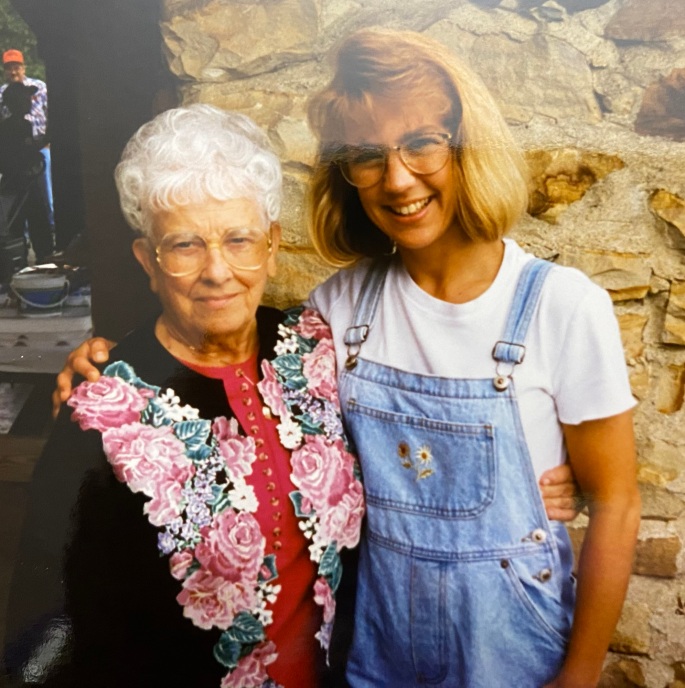
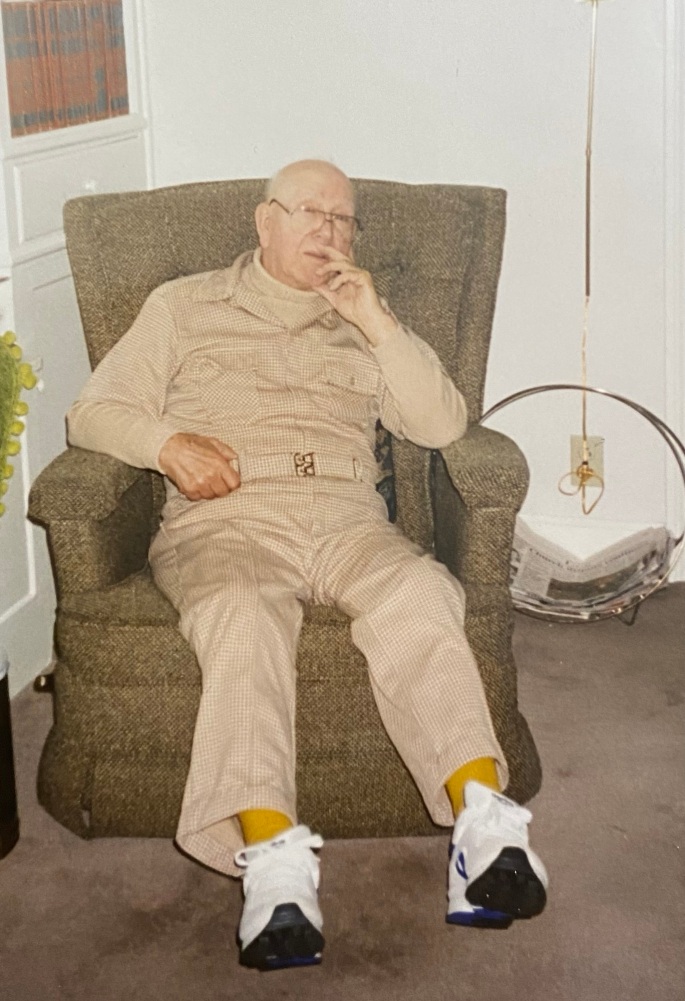
From a family lineage perspective, I am at high risk for developing some form of dementia, including Alzheimer’s Disease (AD).  My maternal grandfather (and his mother) suffered from AD, and my paternal grandmother lived with a form of dementia in her final years. This is of great concern to me for obvious reasons, but especially for my daughter. She is an only child, and I do not wish for my final years to be such a heavy lift for her without the support of siblings.

Therefore, I try to stay up to date on the latest developments for prevention as well as treatments. While there are dozens of promising treatments for AD currently researched around the world, at the time of writing this piece, there is still no known medical treatment to slow or stop the progression of AD.  It is considered fatal.

Dietary Habits can reduce or Increase Risk 🥦🍎🫛🍑

However, The Journal of Alzheimer’s Disease published, in December 2023, a comprehensive review of three decades worth of research that points to evidence that “dietary factors play important roles in the risk of AD.”  This review reveals that the dietary practice of reducing meat consumption, and increasing whole, plant-based food decreases one’s risk for AD.  Specific dietary approaches, such as MIND and DASH, appear to reduce one’s risk for AD  40-50%. However, the greatest reduction risk was found among those who did not include meat in their diet, and instead focused on whole grains, legumes, nuts/seeds, and plenty of fresh fruit and vegetables.

Photo by Centre for Ageing Better on Pexels.com

Lifestyle Habits that Reduce Risk of Dementia 🚶🚶🏽‍♀️

In addition to diet, there are other lifestyle habits that are also believed to reduce one’s risk for AD.  These include:

  • Not smoking
  • Daily physical activity for approximately 30 minutes per day
  • Maintaining a weight that is healthy for you
  • Consistent quality sleep, 7-8 hours worth
  • Social engagement
  • Mental/cognitive engagement
  • Limit alcohol consumption
  • Protection of head and protection from falls
Photo by Caio on Pexels.com

The Joy of a Plant-based Diet🍓🍆🫐🍠

Personally, I adopted a mostly whole food, plant-based diet nearly fifteen years ago for other health reasons. However, if eating this way also reduces my risk for AD, it is further motivation to continue.  

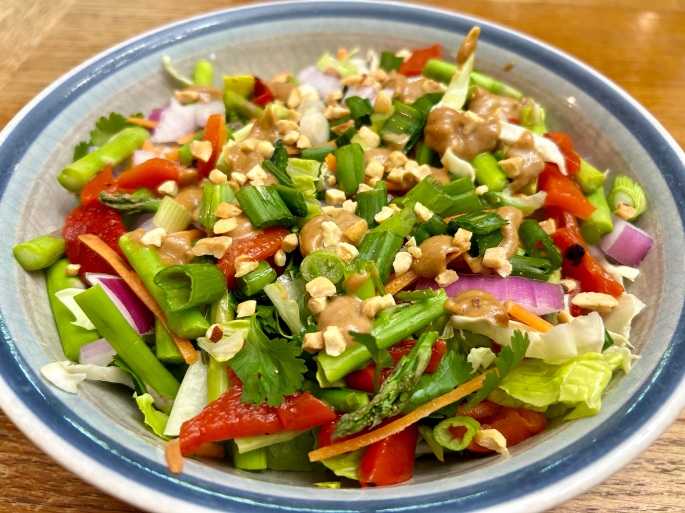
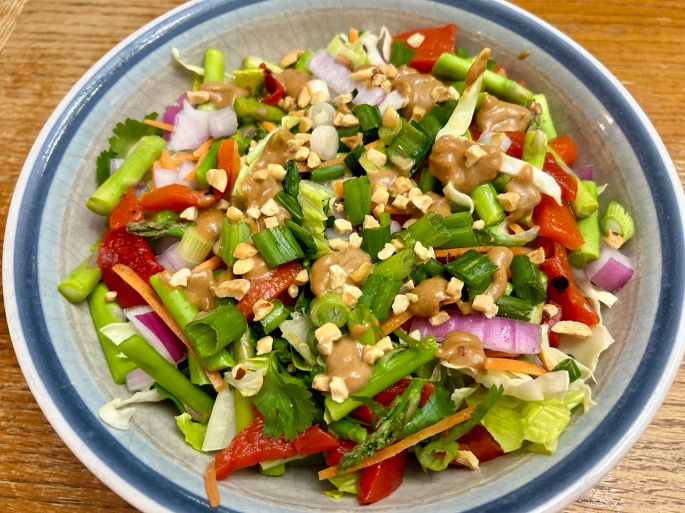
One of my greatest discoveries about a whole food, plant-based diet is that there are so many tasty ways to prepare foods.  I never feel deprived because my meals are full of an abundance of colorful, flavorful, and satiating foods.  A great example is the dip recipe below.  This peanut dressing/dip is beyond good!  It is tasty on salads (as shared here), but it is also wonderful mixed into stir-fry as a sauce, drizzled over a bowl or pasta recipes, and it makes a savory dip worthy for a crudités platter for a holiday cookout or social gathering.

Customizable REcipe🥗

The recipes below can easily be modified to suit personal taste or dietary preferences. For example, the peanut butter can be replaced with almond, cashew, or sunflower seed butter if desired.  The salad ingredients can be adapted too.  Don’t like cabbage?  Use all romaine.  Not a fan of asparagus?  Eliminate it.  Rather use red onion over scallions?  Go for it.

Anyway you prepare them, these recipes can be one tasty way to increase your consumption of healthful, whole, plant-based foods. Even if you are not willing to give up meat, research supports that consuming less meat and more plants will still provide some preventative measures against AD. Who knows? With the power of this type of research, you might even decide to try a few more recipes and incorporate even more plants into your diet! And the more you add, the more your body will benefit!

From my home to yours, here’s to your health, and especially preventing all forms of dementia to the degree possible! 

Recipes inspired by: Three Little Chickpeas, This Healthy Kitchen, and Detoxinista

Peanut Dressing/Dip (Thai style) (gluten free)

Ingredients:

½ cup natural peanut butter 

3 tablespoons tamari, liquid aminos, or soy sauce

2 tablespoons fresh lime juice

2 tablespoons maple syrup, honey, or agave

1 tablespoon rice wine vinegar

½ inch grated fresh ginger OR 1 ½ teaspoon ginger paste OR ¼ teaspoon ground ginger

1 teaspoon garlic powder

1 teaspoon onion powder

¼ teaspoon crushed red pepper or 2 teaspoon sriracha

3-5 tablespoons of water

Directions:

Either whisk together or use blender to blend all ingredients, gradually adding in water until reaching desired thickness, using less water for dip and more water for dressing 

Thai-style Salad (gluten free)

1 heart romaine lettuce, roughly chopped

3 cups slaw mix OR red & green cabbage, roughly chopped

1 red pepper, chopped

3-4 green onions, chopped

½ cup shredded carrots

½ cup fresh cilantro

5-6 stalks asparagus, chopped, optional

½ cup chopped peanuts or cashews, optional

Directions:

In a large bowl, toss together chopped lettuce, cabbage, red pepper, and green onion with shredded carrots.

Heat asparagus in microwave for 30-40 seconds and toss into salad

Drizzle with desired amount of dressing and top with chopped peanuts or cashews, if extra crunch is desired.

Makes 2 large servings or 4 small servings.

Store leftovers dressing in the refrigerator for up to two weeks.

See the soul and ignore the story: Lessons from a lifetime of teaching, part 1

Ignore the story and see the soul.  And remember to love. You’ll never regret it.–Seane Corn

First years of teaching 👩‍🏫

Over the decades of teaching, I have accrued numerous experiences.  Several of these stand-out memories occurred during my earlier years of education.  Therefore, in honor of another school year’s conclusion, I will share some of these memories over the coming weeks, and the many lessons these interactions provided. 

My first teaching position was at Kentucky high school in the late 80s.  Newly graduated and exceptionally young, I was ready to change the world.  Like all first year career experiences, the theoretical training of a university was quite different from the reality I faced.  

I was one of five special education teachers.  Our classrooms were separated from the rest of the school.  We were part of the gymnasium facilities, and my classroom was one of three under the visitor’s side of the bleachers. 

Lines of Separation 📚

In order to get to my “classroom,”  I had to walk through two other “classrooms.”  One wall was slanted because it was the underside of the bleachers, and one wall was a rolling chalkboard separating my classroom from another.  One wall was painted concrete block, and the other side was a giant metal wall with a locked door that stored the ROTC weapons.  The desks were mismatched leftovers from a previous era, and classroom supplies were limited.

My first day of school was filled with nerves, and the isolation of my situation led me to feel even more anxious. However, there was little time to dwell on it as the students began arriving.

The Encounter 🗣️

The last student to arrive stood over six feet in height and brawny.  (I would later learn he worked as a hired-hand at various tobacco farms across the county.)  With one cursory glance, he sized me up, spit tobacco on the floor, and picked me by my shirt collar.

“You ain’t teachin’ me nothin.  I ain’t here to learn.  Only here cause it’s the law.”

His startling blue eyes conveyed his disdain for me as we locked eyes.  I knew this was a make or break moment, and I was determined to not break. So I said the most brilliant set of words.

“Put. Me. Down.”

It was an intense moment.  On the inside, I was filled with fear.  Fear I would lose my job after only one day.  Fear I was about to get hurt.  Fear I wasn’t strong enough to withstand the discipline this job would require.

Wordless Truce ☮️

Outwardly, my eyes never wavered from his.  I would not be intimidated by him.  Seconds seemed to stretch, although I am certain this was not a long moment.  However, it was long enough for me to take in the acne scars on his face as well as a few other scars that looked as if he had experienced his fair share of altercations.  His blonde curly hair was cut in a mullet.

I was acutely aware of the other students’ quiet stares taking in the situation as I once more repeated, “Put. Me. Down.”

Through some act of Divine Intervention, or perhaps the I-am-not-messing-around look in my eye, the student put me down.  I recall the way he smugly looked around at the other students as if to convey he had shown me.  

Peace Offering 🕊️

I could have taken him to the office or written his behavior up, but I chose not to.  Even though I was inexperienced, I knew that would immediately build a wall between not only him, but the rest of the students and me.  Instead, I believed I needed to find out more about him, and work on building a relationship with him and the other students. But, I wasn’t sure how, or even if, it could be done.

In the meantime, once things cooled down, I gave him cleaning supplies and asked him to spit out his tobacco in the trashcan and clean up the floor. Then, I walked away and busied myself with other students.  It took several minutes before he started, but he did clean it up.

Seasons of Change 🍁❄️

By late fall, the young man would occasionally engage in conversations with me, especially if I focused on his knowledge of raising tobacco and his work ethic.  He explained that he had worked alongside his dad, but at some point that stopped.

By winter, I had learned that his father was disabled, and no longer worked, but apparently still knew how to lift his arm to drink and hit. This partly explained the young man’s tough-guy persona. The student often stayed overnight with buddies around the county, or during certain parts of the growing season, he’d stay over at the farms on which he was working.

Misdiagnosis 📖

By mid-year, I felt certain that the student was misidentified.  He was no doubt dyslexic, but that had nothing to do with his IQ or his abilities.  There were so many life and reading skills that I wanted to work with him on, but time was running out.  The young man was determined to quit school once he turned 18, even though he was only a junior. 

One class in which this young man thrived was shop.  He could build and repair seemingly anything.  One of the special education teachers often talked about the young man’s talent and sometimes hired this student for work on the teacher’s farm.

By March, I had established a good working relationship with the student.  I teased him about his haircut and cowboys boots, and he made jokes about my height and “easy” job. Along with the other students, he learned to read and complete job applications, manage a budget, how to dress/act during a job interview, and even how to plan, shop, and prepare a week’s worth of simple meals. He was even reading short books with adapted text about famous athletes. 

Rumor Has It 😔

One day in April, the young man did not show up for school.  That wasn’t unusual.  Many of my students had irregular attendance.  After his third consecutive day of absence, I went to see an administrator to inquire about the student’s absence. He said he would check into it, but the gossip among students said he wasn’t coming back. The young man had had his birthday.

I have no idea what became of this student.  I would like to think the best, but I am not so sure.  Maybe he has a job, family, and even grandkids by now.  I can only hope, but I’ll most likely never know..

Lessons learned 📝

Nevertheless, I am grateful for this student.  He was the first to teach me to ignore the bluster of the student’s story, and see their soul–see the person they can be at their best self and recognize their potential.  I accepted him as he was, envisioned a better future for him, and tried to help him see it too.  

He also taught me that no matter how hard I work with students, they are still individuals who will determine their own fate.  That was, and still remains, a hard lesson to swallow.  So instead, I will focus on his best, albeit unintentional, gift:  See the soul, not the story.  You will never regret it; I haven’t yet.

Educational Light: Reflections of a life of teaching

“Just as one candle lights another and can light thousands of other candles, so one heart illuminates another heart and can illuminate thousands of other hearts.”–Leo Tolstoy

Sweet Welcomes 🤗

By the time you read this, Dear Reader, National Teacher Appreciation Week will be coming to an end. However, mine began, in its own unique way, the week prior.  As I walked into the high school on a Friday  after being out for a few days, an early arriving student exclaimed, “Ms. Hill, you’re back!  I missed you!” Then, she surprised me with a hug.

Later, before the beginning of mass, our weekly church service, another student said she was happy to see me as I sat down beside her.  Two rows in front of me, an additional student, and his buddies, all started waving at me with smiles on their faces.  I was definitely touched.

The Dog Ate My Homework 🐶

There are many times, as an educator, especially in more recent years, where it feels I am engaged in a battle with a myriad of student-distraction, and I therefore wonder what kind, if any, impact I can make in my students’ lives.  Video games, travel sports, youtube, and phones are just a few of the numerous diversions vying for students’ attention. “The dog ate my homework” excuse has been replaced with more modern tales. 

 “I stayed up late playing video games with my friends and lost track of time.”  

“I didn’t come to class this morning (or yesterday) because I was so tired from playing in the tournament this weekend.”  

“I completely forgot to ________ (read, study, write) because there was phone drama last night with my ________ (friends, boyfriend, girlfriend).”

“I performed four shows (or competitions) this past weekend, and I completely forgot about __________ (assignment).”

None of their distractions are any better or worse than distractions of the earlier decades in my career.  They are simply different.

Therefore, I do empathize with my students’ level of fatigue and distractions.  My teenage world was vastly different from their current teen world, but I still recall the angst, the hormones, the emotions, and my own unique set of distractions. Plus, I am professional enough to recognize that their excuses are not personal; it’s just their reality, shaped by society, parents, and peers.  

checking in 😃

Which is why I try to work with, rather than against, the current tide, taking time to talk to the students in order to get to know them.  What makes them tick?  What are their interests?  I try to notice when one, or several, are having a bad day, so I can check in with them and offer help or a compassionate ear.

Still, I am not perfect–not by any means.  There are days where all the best-laid instructional plans go wrong, technology in the classroom doesn’t work, and/or multiple interruptions occur.  On those days, I look around the empty classroom after students have exited and wonder if I am making a difference?  Am I preparing the students, not only for the next level of English, but also, am I adequately conveying that I care even more about the type of people they are becoming?  Am I making that personal connection that communicates to them that their life matters and is important? 

Words Matter 🗣️

As a writer and educator, I know that words matter. Words are tools.  Words can be used to build up another person, encourage a hurting soul, and foster a healthy relationship.  Likewise, words can deeply wound, leaving scars that can be felt for years. Therefore, when those students used their words to tell me that I was missed, it felt as if, perhaps, I do make a difference, even in a small way.

Later, that same day, I ran into a national chain store to pick up a couple of items.  As I was darting to the self-checkout station, a young lady greeted me with, “Hey, gorgeous!”

Now, at my age, that is not a line I often hear, but I also know from being around teens that is a phrase females will sometimes use with one another.  The speaker’s face was familiar, but my brain struggled to match the face to the correct moment in time. Then, I looked at her name badge.

It was a former student of mine from over 20 years ago during the time period in which I taught kindergarten. We talked for several moments, and she shared pictures of her two sons.  She caught me up on the lives of her siblings and parents. Listening to her talk, I took in her smile and dancing eyes.  I could tell she was happy, which, in turn, made my heart smile because, ultimately, I want all of my students to have an overall happy and successful life, however they define it.

Unforgettable Moments 🙌

As I prepared to walk away, I thanked her for stopping me and marveled that she would even recognize me. 

“How could I forget you?”

Those five words may not seem like much. They won’t grab national headlines, and they won’t earn me a six figure income.  Nor will her words put my name in lights.  Still, those words lit me up from within. Her words touched  me in ways headlines, money, and fame could never feel.  To know I made a difference with at least one past student, and to hopefully continue to affect current students to feel empowered about their own future choices is what continues to motivate me all these years later.

Thank you, Teachers 👩‍🏫 👨‍🏫

To all the educators who taught me, thank you.  I don’t need National Teachers Recognition Week to remind me of the impact your teaching had on me.  I continue to carry the torch you lit within me in your classrooms of long ago.

To all the educators in the trenches with me, thank you. Teaching is a challenging and often undervalued role, but the light you bring to your students matters.  And that is why we teach–to pass on the light to our students that was given to us. 

Thank you, Students 🙇 🙇‍♀️

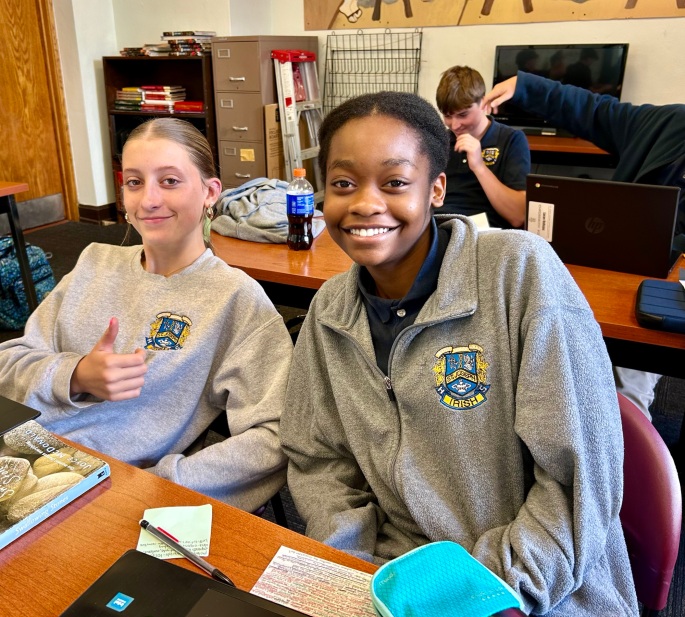
Finally, to all of my students, past and present, thank you.  Thank you for sharing your light with me. You make my life richer, more interesting, and definitely a more engaging experience!  Never hide your light, continue to shine it, and may you bless the future world with your many talents and gifts.  Heaven knows, this ol’ world needs more light.

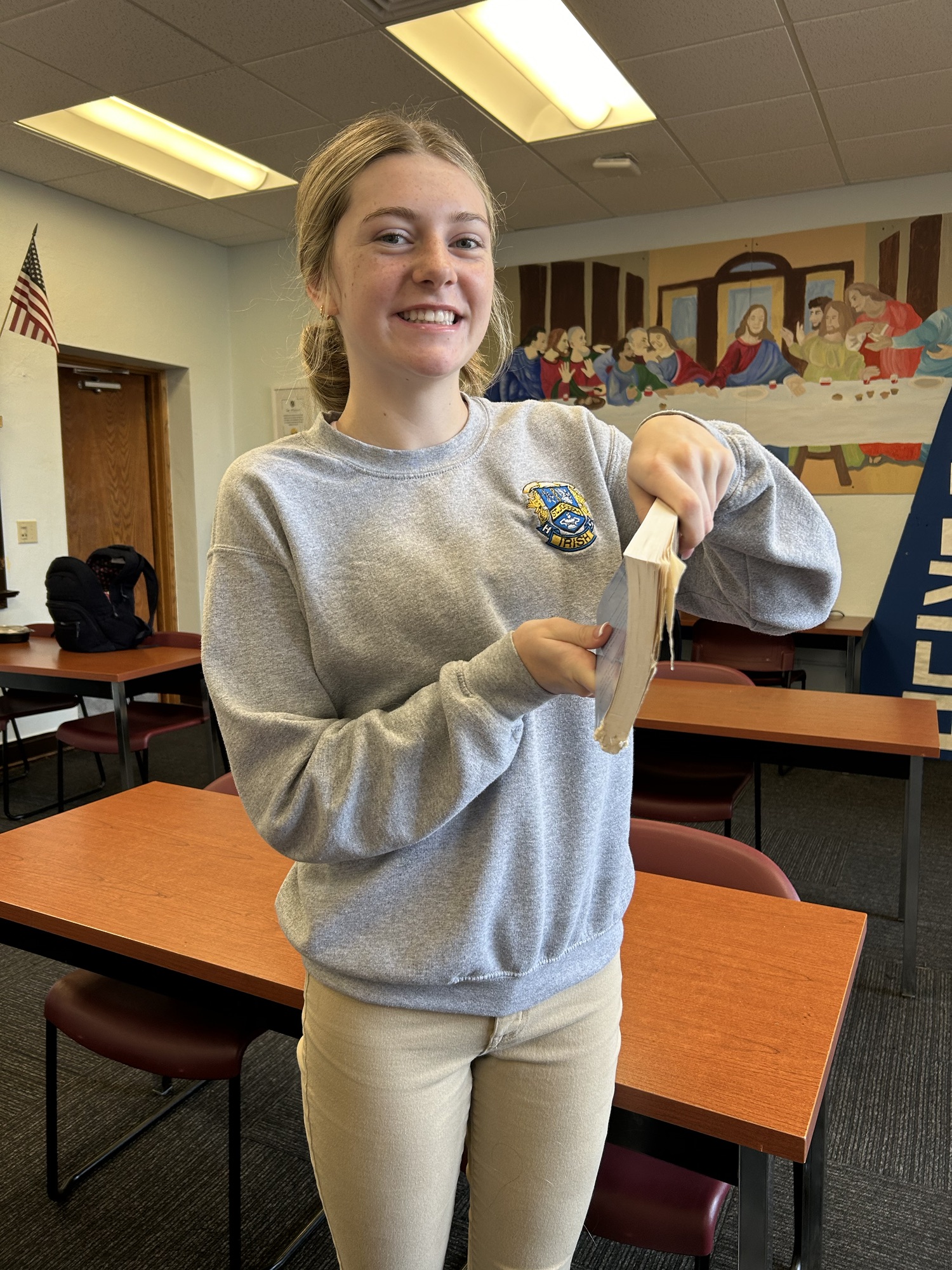
If you look closely, you can see, this student’s book, (Madelyn) was truly “eaten” by her dog. He took several bites out of the tops of the pages of the novel she was reading for my English 9 class.

One breath in, one breath out for peace and calm

 “We need to find God, and that cannot be found in noise and restlessness. God is a friend of silence. See how nature–trees, flowers, grass grows in silence . . . We need silence to be able to touch souls.” –Mother Teresa

Photo by John-Mark Smith on Pexels.com

The Miracle of EArly Morning 🌅

One of my favorite times of day is the stillness of the early morning.  Don’t get me wrong, depending upon how early I have to get up, it can be a chore to drag myself out of bed.  However, once I am up, enveloped by the hum of the house and the ambiance of the celebratory, daybreak birdsong, I feel a peace begin to zip up around me like my favorite hooded jacket. 

Now that daylight arrives earlier, it is especially delightful on the weekends to sit at my desk, steaming mug of coffee beside the laptop, and gaze out the open window as the birds continue their lilting praise of the arrival of daybreak. Sometimes I see the contrails from a jet writing across the sky.  Other times I observe the rustle of trees or my neighbor’s cat stalking some unseen prey. Regardless of what I notice, I take a deep breath, and invite the silence within.

Gazing out into the trees and grass of my backyard, there is a peacefulness of the Divine Presence.  Observing the continual miracle of seasonal change, I am bearing witness to the continuity, strength, and resiliency of nature.  With one breath in and one breath out, I can connect to Divine life force within, silently supplying me with continued strength.

Photo by Engin Akyurt on Pexels.com

Welcome the Silence 🤲

I continue to welcome the silence, and I allow it to wash over me, cleansing the stresses and worries of the night that interrupted my sleep.  I ask God to hold space for me within the silence as my soul settles into place. One breath in. One breath out. Each breath, rich in the silence, nourishing my peace of mind, if only for a few minutes.

Momentarily, I become part of the silence and my brain softens into the quiet, temporarily liberated from its continuous lists of things to do, notice, and concerns. One breath in. One breath out. I feel the silence breathing peace through me, filling my cells. I ask for the peace to live through me and to emanate from my actions, knowing even then, I will still stumble into mistakes.

The early morning silence centers and anchors me to the importance of being more mindful of the here and now.  One breath in. One breath out. I allow the silence to cultivate peace within that moment, and I ask that it remain with me as I move through my day, understanding that disturbances of my inner peace will also most likely occur throughout the day. I further pray the silence will infuse and imbue my day with moments of peace I can offer others, if only through the simple act of a smile or kind word.

Photo by Csankovszki Tibor on Pexels.com

Whispers of Silent Inspiration 🙏

If I am fortunate, the silence will sometimes whisper inspiration when I do encounter stress in a later moment. It only requires that I momentarily bring awareness to my breath, and once more, I can connect to the True Source filling my lungs, giving me life. One breath in.  One breath out. 

When the silent morning meditation begins to wind down, I become more aware of my surroundings and my own physical body.  I look for those poetic plane contrails, but they have usually vaporized, reminding me of the impermanence of struggles, strife, and life in general.  One breath in. One breath out. My words, my thoughts, my deeds are like those contrails, here, in this moment, but eventually given to the heavens.

Bringing awareness to the moment, I will feel the tendrils of morning silence loosening its grip, and I mourn briefly that I must leave its embrace. There are more words to be written, more students that need taught, and more people that need loved.  One breath in. One breath out. I remind myself that I can always come back to the comforting peace of the silence of my mind with one moment of conscious breathing. 

Photo by Dom J on Pexels.com

The antidote to noise and Chatter 🧘

It seems to me that we currently live in a world where many of us have forgotten, or even fear, silence.  Chatter and noise seem to flow in an endless supply, alongside daily routines filled with responsibilities and heaping portions of distractions. However, by seeking the solace of silence and focusing on your breath, if even for a few moments, we may discover our heart rate slows, racing thoughts may decrease, and the body may relax a bit.  One breath in.  One breath out. 

The older I get, the more my appreciation and need for silence grows.  If we listen too long to the noise of the media, news, traffic, screens, chatter, and so on, our stress increases, our worry increases, and our anxiety increases.  We forget that silence soothes our souls and brings us back to the presence of God within and around us. All it takes is one breath in and one breath out. 

Berry Immunity Boosting Smoothie aka Stress Less Smoothie

The greatest weapon against stress is our ability to choose one thought over another.”–William James

Photo by Pedro Figueras on Pexels.com

The challenge of work-life balance⚖️

It is not uncommon to engage in conversations centering around stress.  Attempting to balance the demands of work and life can be challenging. The combination of long work hours, while also juggling the needs of family, make it difficult to have time to do the things that would otherwise relieve stress, such as regular exercise, outings with friends, or even a relaxing soak in the tub. 
When stress ramps up, there is a chain-reaction in our bodies.  According to Harvard School of Public Health, when stress is high, the body’s demand for oxygen and energy increases, which in turn increases the demand for key nutrients.  Simultaneously, stress causes the body to eliminate other vital nutrients. This can take a toll on the body’s immune system.

As the chain reaction of stress continues, hormones become affected.  If the stress is acute, the body will secrete adrenaline, which suppresses appetite.  However, when the stress becomes more chronic, cortisol levels begin to rise, instigating food cravings.  Cortisol tends to create cravings for foods that are typically considered “comfort foods,” full of sugar, salt, and fat.  Unfortunately, if cortisol stays elevated, the chain reaction continues to wreak havoc upon our bodies, and this often influences our coping strategies.

Photo by cottonbro studio on Pexels.com

The body’s stress response 😰

Chronic high stress time periods, depletes the body of energy and can often reduce time available for decompression. This can inhibit the desire to prepare healthy, nutritious meals.  Sometimes, chronic stress causes us to skip meals.  The downside to skipping meals is that, as the cortisol levels rise, once there is an opportunity to eat, we tend to reach for those comfort foods that will not replenish the body’s stores of diminished nutrients.

Therefore, how we respond to stress matters.  With some situations, we can identify upcoming stressful time periods before they begin, and thus, we can be more proactive.  However, that isn’t always the case.  Nonetheless, there are a few basic guidelines, according to The University of North Carolina at Chapel Hill that are worth remembering.

Photo by Antoni Shkraba on Pexels.com

Tips for eating during times of stress 😣

  • Keep nutrient-dense grab-and-go snacks on hand at all times.  Foods like baby carrots, celery sticks, hummus cups, guacamole cups, apples, oranges, bananas, popcorn, almonds, walnuts, pistachios, low-sugar yogurt, low-sugar granola, low-sugar oatmeal packets, whole-grain crackers and so forth.
  • Eat at regular intervals when possible.  This will keep blood sugar stable, and keep the brain, which needs glucose, working at its best.
  • Eat high-fiber foods. Foods, such as fruits, vegetables, nuts, seeds, beans, oatmeal, and other whole grains, have been shown to decrease perceived stress levels and increase alertness.
  • Focus on eating fruits and vegetables, especially leafy greens, whenever possible.  These foods are filled with the vitamins and minerals your body needs to neutralize the harmful molecules our bodies produce when under stress. 
  • Foods rich in unsaturated fat also help. Think walnuts, flax seeds, chia seeds, and fish oil to name a few. These foods are associated with increased brain function; however, deficiencies in fatty acids can result in depression and/or anxiety. 
  • Be mindful of caffeine and/or alcohol intake. Both of these can disrupt sleep, which the body desperately needs during times of stress.  Additionally, both can increase blood pressure, which can increase feelings of anxiety.
  • Ensure your body is getting enough quality sleep. Getting enough sleep allows the body to reduce cortisol levels and other stress hormones, increasing the chances of remaining calmer in the face of stress.
  • Employ constructive coping strategies. Whether it is talking to a trusted friend or therapist, journaling, meditating, asking for help, or going for a walk–developing positive coping skills is a lifetime skill set. 
Photo by Wallace Chuck on Pexels.com

The reality of stress 😩

Stress is reality at different points in our lives.  While we cannot control when it will arise, we can control our response to it.  It is easy and understandable to seek comfort during times of stress.  However, when those sources of comfort become unhealthy coping mechanisms, such as over- or undereating, drinking alcohol in excess, going without sleep, and so forth, we risk using short-sighted solutions that could lead to developing long-term problems, creating even more stress.  

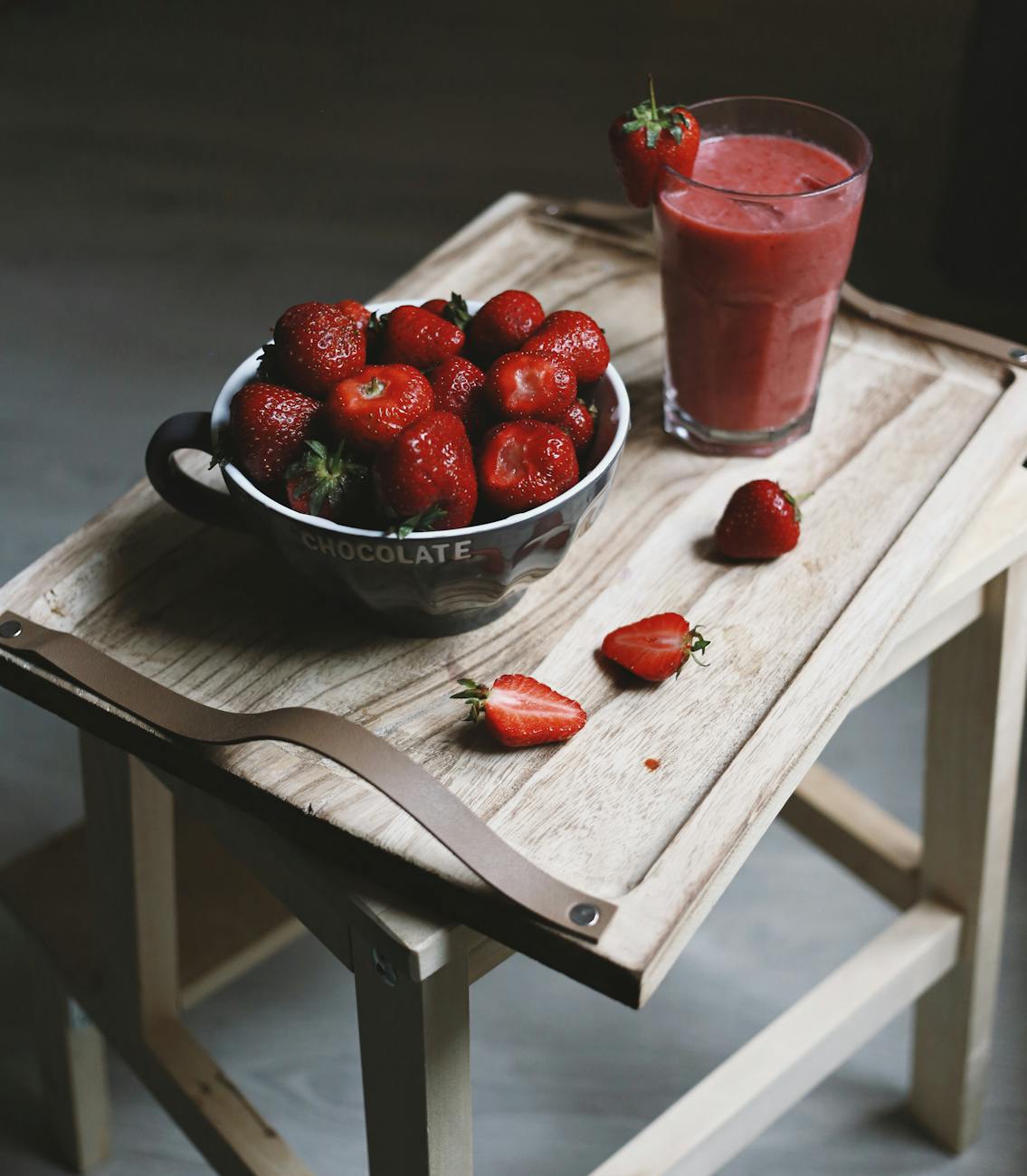
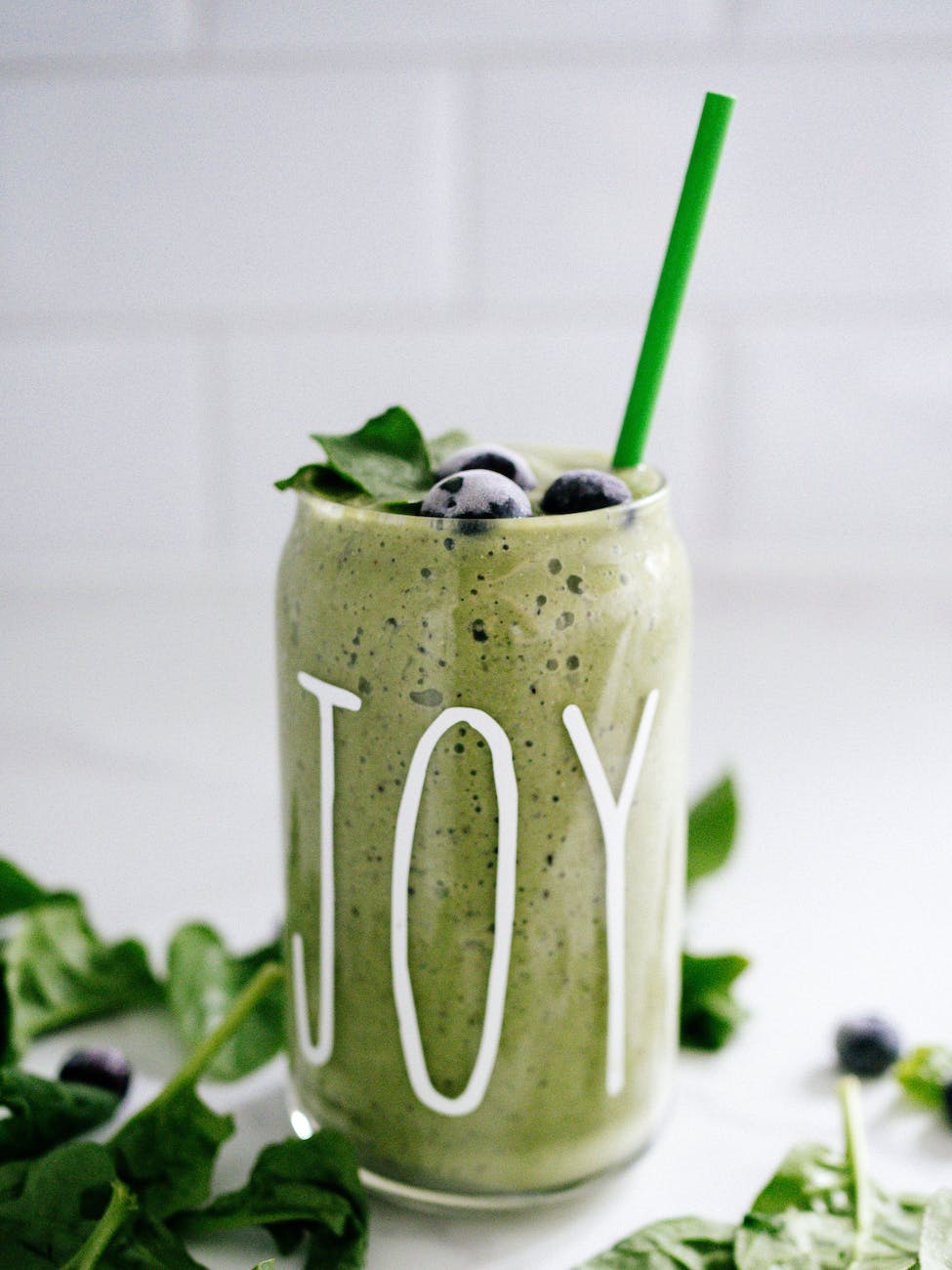
Stress less smoothie 🍓

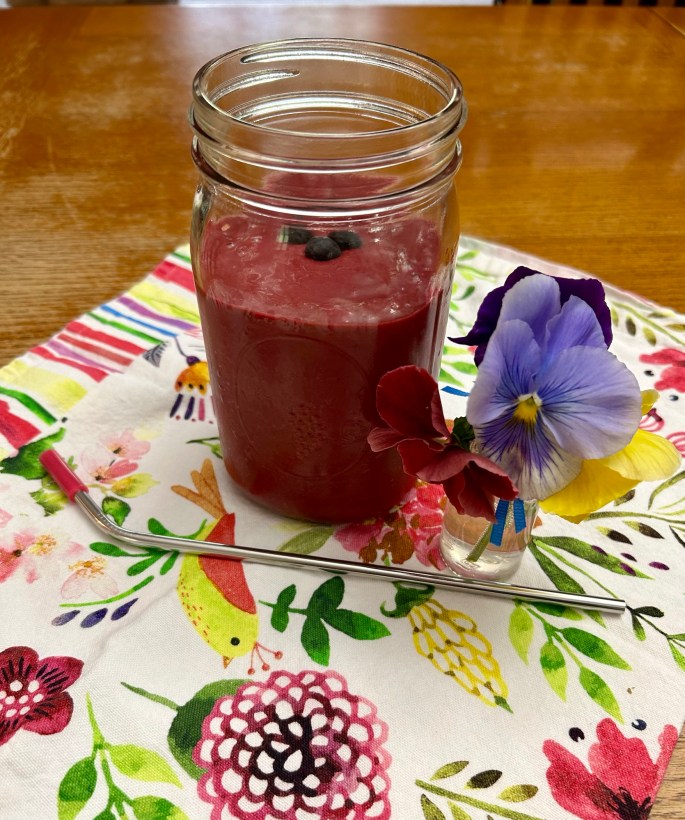
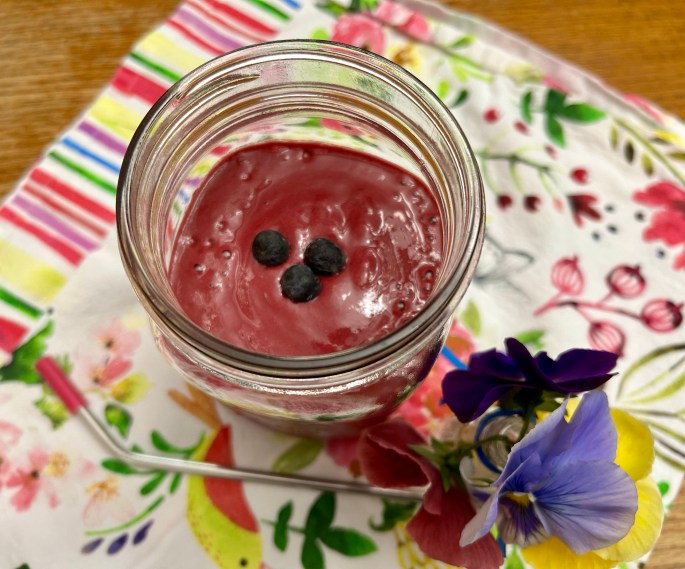
Below is my newest smoothie creation.  It is full of nutrient-rich foods that are high in fiber.  Some of the ingredients may cause you to raise an eye-brow in wonder, but I promise, it does taste great.  That said, feel free to adjust, add to, or eliminate ingredients that don’t suit your palate or dietary needs.

This recipe can be made ahead of time and frozen into individual servings.  They will stay fresh in the freezer for up to three months.  Then, whenever faced with a stressful day, take one smoothie out the night before, set it in the fridge to thaw, and then it’s grab-and-go convenience for the next workday. Sip on it through a lunch meeting, or if more time is available, pour it into a bowl and sprinkle on favorite fruit and nut/seed toppings, along with a bit of granola. 

I can’t promise that this recipe will change the stress around you. However, it does provide a powerful nutritional punch to help stave off the effects of stress, and offers one less thing to worry about.  Plus, it feels good knowing that if everything else goes wrong in the day, at least one small part of your day was stress-free.  

Cheers to one less thing to stress about!

Berry Stress Less Smoothie

Nutrient dense, stress combating meal replacement

Ingredients:

2 cup spinach, riced cauliflower, or kale (can be frozen)

½ cup strawberries, frozen

½ cup raspberries, frozen

½ cup cherries, frozen

1 apple

½ cup lentils

1 parsnips

2 tablespoon flax, chia seeds, or hemp seeds (or combination of any two)

2 tablespoons goji berries, OR 2 medjool dates, OR 2 prunes, optional

2 tablespoons cocoa or cacao powder, optional

2 scoops protein powder, optional

1 cup beet juice (can use pomegranate or cherry juice or simply use water)

1 cup milk  plant or dairy based variation)

½-1 cup of water, if too thick

Directions:

Put all ingredients in high powered blender

Blend until creamy and smooth

Makes 2 large servings 

Your Health Journey: It’s more than just taking a pill

“Take care of your body.  It’s the only place you have to live.”–Jim Rohn

Photo by nappy on Pexels.com

Listen to your Gut-Instincts🙇‍♀️

It’s been a little over a decade since I received the medical diagnosis that dramatically changed my life. I spent years battling upset stomach, gas, bloating, heartburn, and lower belly pain that only got worse with age. Pills had always been the answers.  In fact, at one point in my life, I had multiple timers set on my phone to remind me to take prescribed medications before and after eating.  

During a vacation near Boone, North Carolina, with my husband and daughter in which we had to plan our days around the timing of my medication, I finally decided I had had enough.  Call it “gut-instinct”, but I knew that whatever was going on inside my body, the prescriptions were not the answer.

Photo by MART PRODUCTION on Pexels.com

Finding a Doctor to listen 👂

Fortunately, I had a doctor at the time who took me seriously and listened. Together, we discussed a plan of action. Still, it took several months of waiting for tests and lab work to be completed, and more time waiting for results–the “hurry-up-and-wait” shuffle–as I fondly call it.  

I am not sure what I expected the results to be. However, when the letter arrived at my house stating I needed to schedule a follow-up appointment with my doctor (which was already on the books) due to indications of celiac disease and hiatal hernia, I was initially upset due to the dramatic lifestyle changes to manage both.

Photo by Alexas Fotos on Pexels.com

Change is Not Easy 😬

To state the obvious, change is not easy, so I faced a fair amount of challenges as I adjusted my diet.  Ultimately, though, as my symptoms subsided, and, one-by-one, the medications fell by the wayside, my motivation to continue increased.  I also came to see that compared to other potential prognosis, changing my diet was a minor task compared to invasive treatments, therapies, and surgeries.  

I’ve learned much, and continue to learn, along my health journey. Therefore, I share my experience as a point of encouragement when dealing with medical issues. 

Photo by Christina Morillo on Pexels.com

Advocate for Yourself 🗣️

First, I encourage you to trust your instincts, and advocate for yourself, especially if you are a person of color, a woman, a person with a higher BMI, or a LGBTQ+ person.  Unfortunately, as with any field, there are those medical professionals with internalized biases.  While I am confident not all doctors are bad actors, my own personal experience–and that of several others I know–have certainly informed me that if you belong to one of those categories, your complaints may not be given serious and thoughtful consideration. Therefore, you MUST advocate for yourself, even if it means changing doctors or traveling out of the area in which you live.

Photo by Pixabay on Pexels.com

Not every Health Issue requires a Pill

Secondly, sometimes medication is absolutely necessary; however, prescriptions are not end-all-be-all for every situation.  While I did have a doctor who truly listened to me, it still took me advocating for myself and not settling for what he prescribed based upon the medical system in which he worked. I am fortunate that when I questioned the medicine, that this doctor did not take it personally or as an assault on his professional judgment.  Nor did he try to use shame, or blame-the-patient tactics, as I had previously experienced.  He heard me out, asked numerous questions, and based upon those answers, set up a series of diagnostic tests. 

Photo by Brett Sayles on Pexels.com

Be Gentle with yourself as you navigate lifestyle changes 😊

Thirdly, be gentle with yourself if you have to make lifestyle changes. Once I received my results, overhauling my diet was scary–do you know how many things have gluten in them and/or cause reflux? I felt a huge amount of internal resistance to those changes in the beginning because it seemed like such an overwhelming task. 

Lifestyle changes are not easy, and it takes time to make the adjustments.  There are going to be setbacks, slipups, and mistakes along the way.  I know; I experienced them.  Completely changing the way I ate was a steep learning curve, and it was an eye-opening experience. Nonetheless, at the end of the day, I wanted to feel better and not live my life on a series of timers and pills.

Photo by Jack Sparrow on Pexels.com

Find your support 👯‍♀️

Enlist support for your changes. Join Facebook communities or other support groups to help you transition and navigate through the changes. Thankfully, I had support in the form of my family and friends.  Of course, they did not have to necessarily change the way they ate, but they absolutely made, and still continue to make, accommodations for my dietary needs.  This is especially true for when we dine out.  I have a limited number of restaurants in which I can safely eat.  Therefore, if I can’t eat at a certain location, friends and family will nearly always choose another option, so I can also enjoy the meal with them.

Photo by Krivec Ales on Pexels.com

health is a constant series of adjustments along the way 🛣️

Finally, know that your health journey is a continuous process.  Because I spent over four decades without a proper diagnosis, I am still encountering health difficulties.  One of the biggest obstacles I now face is a result of undiagnosed celiac disease.  Celiac causes the villi that make up the lining of the small intestines where nutrients are absorbed to become damaged. Over time, the villi atrophy and flatten due to inflammation from eating products that contain gluten.  

Despite overall healthy eating and consistent exercise, until I cleared the gluten in order to reduce the inflammation in my body, I was not able to absorb enough nutrients, specifically calcium, Vitamin D, and Vitamin K.  Additionally, due to  acid-reflux, I took proton-pump inhibitors for several years, which are also known to deplete magnesium, calcium, and other important minerals.  

Thus, I now have osteopenia.  As a result I have already had one surgery and may later need another one. However, I am doing all I can to keep that from happening, including completing the prescribed exercises, lifestyle changes, and appropriate supplementation of key nutrients.  Additionally, of course, I continue to maintain lifestyle changes with regards to a gluten-free diet, low-acid diet, and I am now more motivated to continue consistent weight-bearing exercise to keep my bones as healthy and strong as I can. 

Our health is truly a source of personal wealth.  Therefore, learning to advocate our own health needs is critical.  To be sure, doctors are highly educated, but that doesn’t mean they are fully educated when it comes to YOUR BODY and YOUR unique HEALTH needs.  

Photo by Yan Krukau on Pexels.com

IT’s your body. Treat it Well.

Speak up for yourself.  Trust your instincts.  If you need medication, take it, but don’t overlook lifestyle habits as well.  Educate yourself on lifestyle habits that can positively (and negatively) impact your health and make adjustments as needed.  Don’t be afraid to ask for support, and forgive yourself if you slip-up along your health journey.  

At the end of the day.  It is your body.  It is the only one you have.  Treat it like the sacred, precious gift that it is.

Get More Grounded: The Benefits and Lesson of Tree Pose

“Be like a tree. Stay grounded. Connect with your roots.  Turn over a new leaf. Bend before you break.  Enjoy your unique natural beauty. Keep growing.”–Joanne Raptis

Photo by SHVETS production on Pexels.com

The magic of Tree Pose 🌳

“Trees sway; get more grounded,” my husband chimed along with the yoga instructor on the DVD as we attempted tree pose on a Monday morning before work, the classic yoga balancing pose that requires standing on one leg. 

I appreciate tree pose for many reasons. It strengthens feet, spine, ankles, legs, and core.  Further, it opens the hip area, stretches the inner thigh and groin muscles.  Plus, it can improve one’s concentration and focus while simultaneously improving alignment of spine and posture.  Most of all, it is a pose of balance, which can help in a multitude of ways. 

Symbolically, tree pose serves up several lessons. However, one of the more literal lessons of tree pose is that of remaining in the present moment.  It’s nearly impossible to balance in tree pose and think into the future or reflect on the past because you end up falling out of the pose. I was reminded of those lessons this past Tuesday, or as I have come to know it as, “Twister (or Tornado) Tuesday.” 

Photo by Ralph W. lambrecht on Pexels.com

Shelter in Place 🌪️

As a veteran educator, I have experienced a wide-array of events, including those that require shelter-in-place. In fact, I can still recall the first time I experienced shelter-in-place with students 30+ years ago.  I was teaching in a mobile unit at a great distance from the main brick and mortar school building. The students under my care ranged from 5-12 years of age, and they had been identified as “severe behavior handicapped.”  

There were twelve students, ten boys and two girls.  Since this was the early 1990s, computers and cell phones were not widely available in the classroom setting. This classroom had an intercom type “phone” that only connected from the school office to the classroom.  It was through this “phone” that I received the message that the entire school was sheltering in place in the hallways.  The school received a call that a tornado had touched down in another part of the county and was heading our way. I was to gather my twelve, not-always-so-compliant students, and move them to the main building as quickly as possible.

By the time I received the “call,” a heavy metal concert of rain and wind had already begun, drumming and shaking the metal building rhymically with tantruming, angry torrents of sideways rain.  Quickly, the paraprofessionals and I helped the students into their school-issued red rain parkas, and that is when the resistance began.

“I am not going out in that rain.”

“I don’t like getting wet.”

“No, I won’t!”

“I’m scared!”

Whether it was the determined, I-am-not-kidding look in my eyes, Divine intervention, or a combination of both, the paraprofessionals and I miraculously gathered all of them in a line.  Holding hands as one unit, we began fighting our way through the class door that kept trying to swallow us back inside due to the enraged winds. Once outside, raindrops pelted any exposed skin, including the students’ face and heads as their hoods were immediately blown off.  We fought our way to the safety of the school while the passion of the rain and winds seemed to increase and determinedly tried to shove us backwards. 

By the time we made it to the school, none of us were dry as the pernicious storm found a way to penetrate even the sturdiest of rain coats.  Quickly, we hustled the students to the primary wing of the school, finding a piece of wall away from windows where they could drop to their knees and cover their heads, rivulets of water streaming over all of us, while adrenalin continued to accelerate my heart rate.

Photo by monicore on Pexels.com

Twister Tuesday 🪟

This memory bolted through my mind on “Twister Tuesday” as my classroom, and the surrounding classrooms, were filled with the strident sound of the emergency broadcast system sending an urgent message to seek shelter immediately. Our middle school classrooms are located on the top floor of our school building, and the entire middle school was directed to make their way to the first floor as quickly as possible. In order to do that, we had to run down three flights of stairs in a glass-lined stairwell. As we headed down, the irate storm quickly made its presence known.  Like Lyssa, a figure in Greek mythology who is said to drive others mad, the storm insanely clambered and clawed at the windows demanding to get inside, but meeting a wall of resistance.

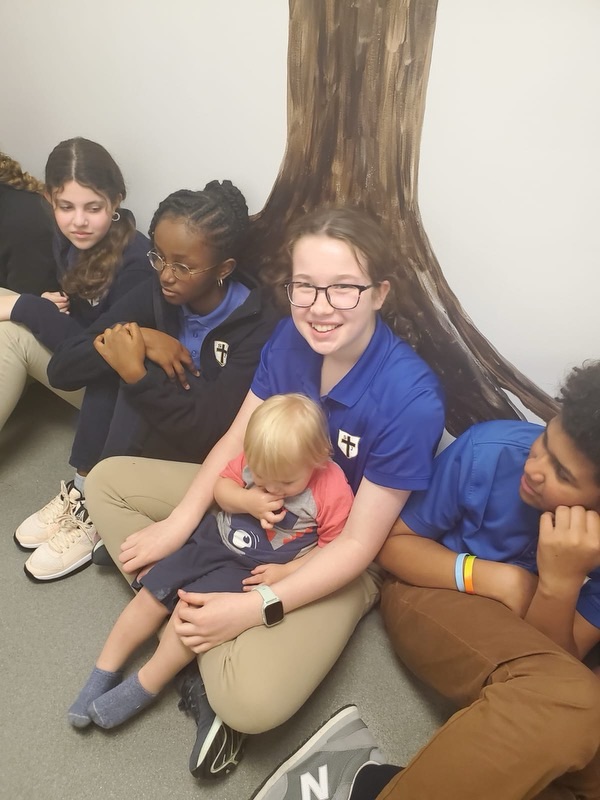
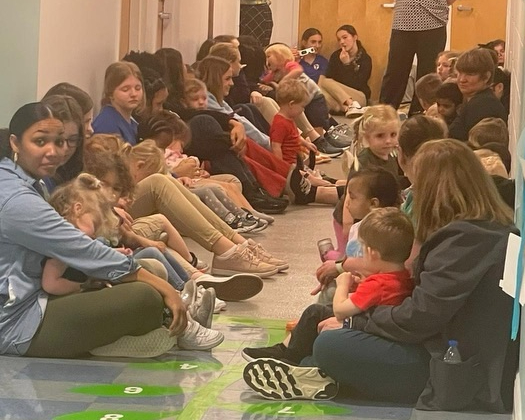
Once downstairs, it was hot, crowded, and overripe with the odor of sweaty, nervous bodies as we sheltered in place away from doors and windows alongside first and second graders as well as preschoolers from the two- and three- year old classes. At times, there were crescendos of anxious voices of students–or, in the case of some of the little ones–crying. During other moments, there were a few older students who experienced panic attacks, but there were many more who remained calm.  There were even those selfless students who chose to hold, cuddle, and comfort younger preschoolers, focusing on the needs of others, rather than themselves.

Middle school students caring for the needs of preschoolers during a shelter in place scenario.

And if you Fall . . . Pick yourself 🆙

As I walked among the students, checking on them, assuring some, answering questions of others, my mind echoed with the words from the previous day, “Trees sway; get more grounded.”  And so, I ground down into my faith.  If the students and staff of my previous school survived that former storm way back in the 90s, surely we would survive this one too.  My emotions could sway like the tree on the inside, but the more I swayed, the more I reminded myself to ground down and try to remain balanced in the present moment in order to better focus on those around me.  

It wasn’t easy, and I wasn’t perfect.  But here’s the thing about tree pose. It’s a great way to practice falling. If you fall out of tree pose, you pick yourself up, and try to return to the pose once more.  

Like my beloved tree-pose, Twister Tuesday provided another stretch and realignment personally and professionally as well as to my faith. It challenged my focus and concentration in order to remain balanced.  And when I “fell,” forgetting to remain focused on the present moment, all I had to do was “pick myself up” and try to return to it once more. Most of all, that Tuesday served as a powerful reminder of the power of the True Source dwelling within and around us, always available to keep us grounded. 

Another middle school student getting grounded in the present moment of another’s need.

Grief and Love–one story of surviving the loss

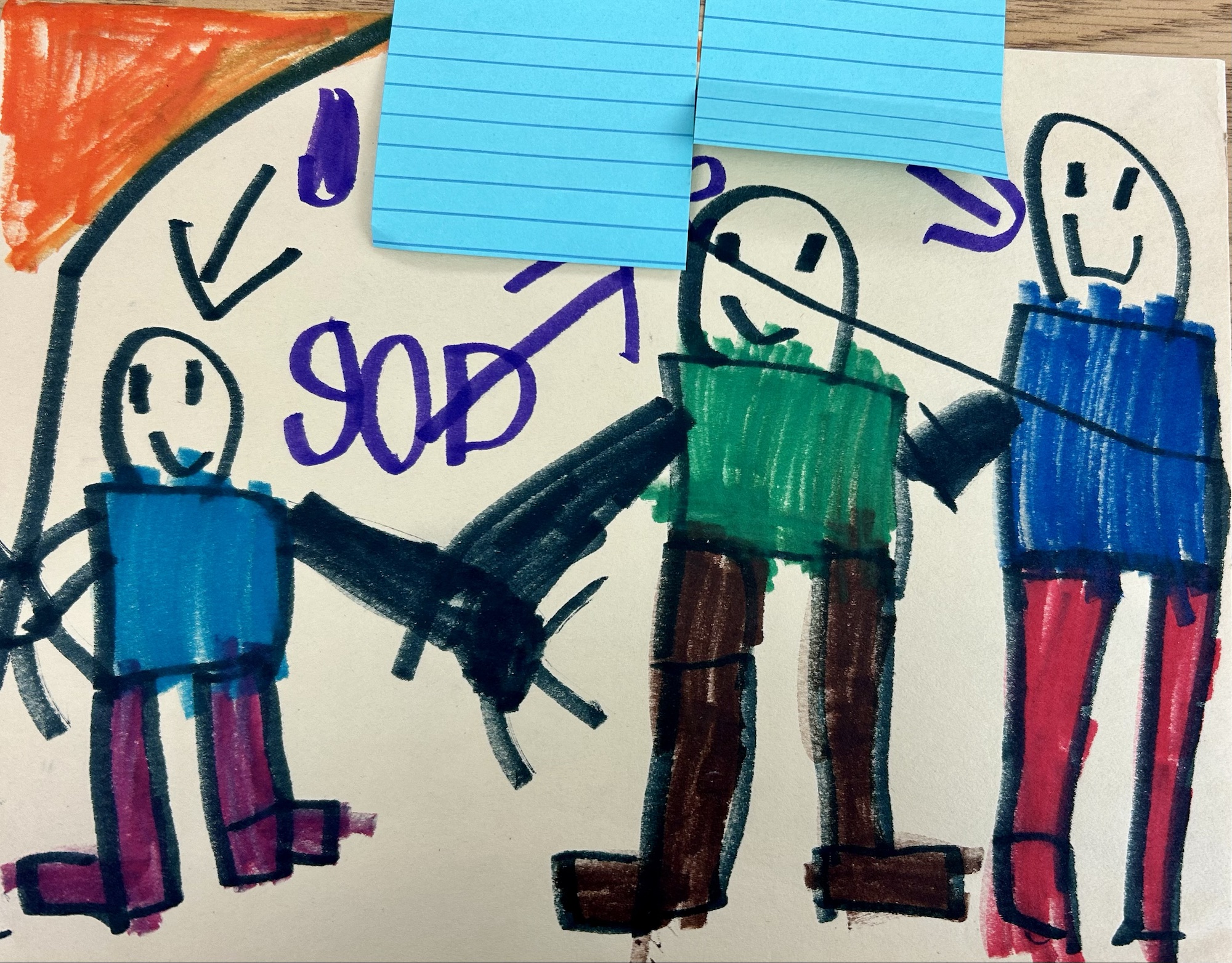
A picture created by one of my former Kindergarten students depicting what they believed was their former classmate’s ascent into heaven. The rainbow is what the heavenly friend is sending back to the friend still who is still alive. (Post-it notes are covering names.)

A story revisited 🥺

It was a spring day with wide cerulean skies and clouds of cotton puffs as I stepped out of my vehicle, as per usual, when I saw the employee approaching with my curbside grocery order.  I am a regular customer, so I tend to know the names and faces of the usual employees, but she was new to me.  Therefore, I was surprised when she asked if I was a teacher. I smiled, and said that I was. I could have never predicted what she would next say.

As she talked, there it was.  The wound, which I thought had healed, was painfully stabbed open. It is an unfortunate story, centering on a young family, a classroom of five-year-olds, their parents, and me–bound together by a loss too surreal to be true– yet it was. 

 She said she attended the funeral and saw me, and she added that she related to the family. Additionally, she added that all her kids attended that same school in which I once taught, now nearly 20 years later. As what appeared to be an after-thought she added, “You was a good teacher.” 

I asked about the surviving family and the sibling, who was only a baby at the time of the event.  The sibling, she reported, was now studying at a university.  This bit of information buoyed my spirit.  

Another picture drawn by another student depicting their deceased friend, holding hands with God and Jesus.

An event that forever changed me 😨

With over three and half decades in education, I can look back at certain points in my career and identify pivotal moments that forever changed me.  This loss of a five-year-old student was probably one of the most defining moments in my career. It sent me spiraling into a deep darkness for which I believed I should keep hidden from the world because it was my face those cherished students and their parents looked to for strength and stability–or at least that is how I perceived the situation at the time.  

On the inside, I was crumbling, questioning everything my faith had taught me.  Angry at that the Universe would allow such a senseless death, and angry at myself for what felt like was my “butterfly-effect” that seemingly set the wheels in motion for this tragedy.  Emotions, which I now know, can override logic during unexpected loss.

Outwardly for the world, I did the best I could, but none of my training had prepared me. While there were times, I felt led from within by a Source greater than myself. Other times, I felt I was driving a car without headlights after a severe storm, stumbling and bumping up against one roadblock after another.  

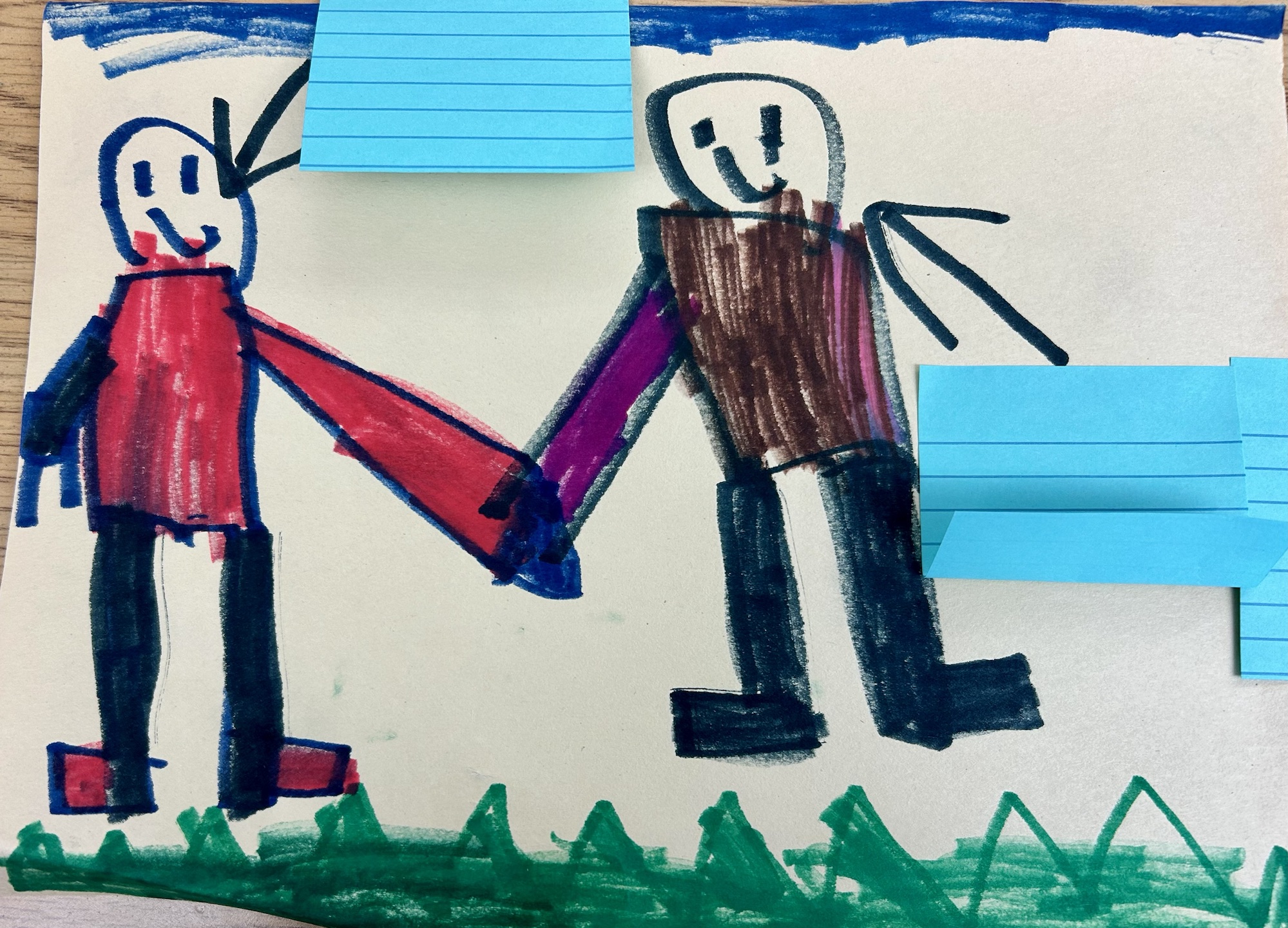
Another drawing depicting a student holding hands with the deceased classmate, adding that they missed their friend. (Names are covered with post-it notes.)

Days of Mourning 😢

There were countless days when my students would just cry, and so I let them, allowing their tears to express what they could not put into words.  I hugged them often, and permitted/encouraged them to express their feelings in a safe and productive ways.  They drew pictures, decorated their former classmates’ seat, and took turns holding and talking to a bear that had been built for them to help process their grief.

Some students, who weren’t as verbal as others, became noticeably aggressive as they moved through stages of grief.  This required much patience and tolerance.  While I understood they needed to get out their anger as they were not developmentally old enough to understand death, I could not let them harm other students.  Therefore, I had to come up with creative outlets for their feelings, such as allowing them to be the official “wrecking ball” if someone wanted their block creation knocked over or the official “paper shredder” of messed-up papers.

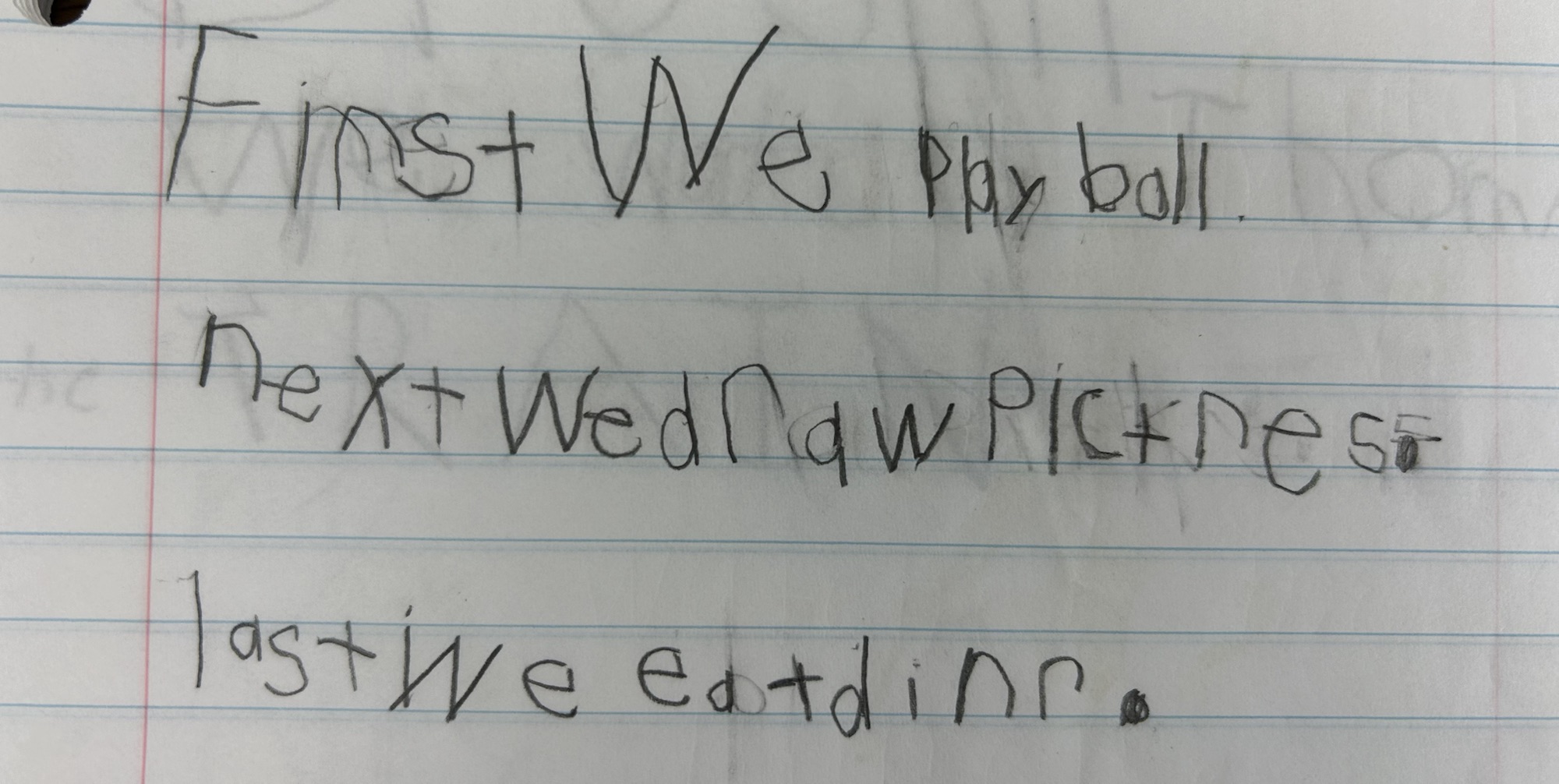
A “story” written by a student describing what happened when the student took home the grief therapy bear.

Sometimes, Life isn’t fair 😩

Thinking back to that tragedy, I wish I could go back to my younger self and say, “You’re doing ok,” in the same way I would have said to my students at the time.  Instead, I spent much time questioning what more I should be doing.  And, each night, when I went home to my own beloved daughter the exact same age, I felt simultaneously grateful and guilty.  Why did I get to keep my child, but someone else didn’t?  It wasn’t fair.

Another student’s experience with the grief therapy bear.

Nearly 20 years later . . .⏳

Now, nearly 20 years later, life continues to march on at a breathtaking pace. Those students are now in their 25th year of life.  They are all, I hope, making their way into their independence, exploring the edges of the kind of responsible adult they want to evolve into.  I pray they will each find their own version of success, however they define it. 

I especially hope the child’s family is well.  They were dealt a tragic blow for which I have no explanation.  I am certain it has not been easy for them, but I pray their hearts continue to mend to the degree possible. Most of all, I wish them peace.

Another drawing of expressing their feelings about their departed friend. (Name is covered by post-it notes.)

Does time Really heal? ❤️‍🩹

They say time heals all wounds, but I am not sure.  The wounds may heal, but the scar still remains.  Like all scars, they fade with the passing of time, but those scars remain as a reminder of who we once were.

 Once there was a young family of four, until suddenly there were three.  Once I was a kindergarten teacher with 15 students, and, in the blink of an eye, there were 14.  I wish I knew why, but that is not for me to understand.  Instead, I will forever be haunted by what more I could have done. 

Another student’s experience with the grief therapy bear.

Looking back on the love 💜

Nonetheless, looking back now, what I most recall is the love.  Love for the departed student, love for the other students of that class, and deep abiding appreciation for those students’ parents who unconditionally supported me and guided their children tirelessly through what had to be one of the darkest periods in their young and tender lives.

Their is beauty in life, even if short lived 🌸

On the day of writing this, I went for a run in a park.  It was early spring, and the air held the promise of warmer days.  All around me the wind blew off the white petals of flowering trees, and the petals danced around me like snowflakes, graceful on the currents of air.  I realized, the flowers will soon be replaced by the green leaves, and the cycle of life will continue through the seasons.  However, in that moment, I could not help but feel those petals were a heavenly reminder of the beauty that is possible in life–even if for only a short time.

Musician and writer, Nick Cave, is said to have written in a letter, “Grief and love are forever intertwined. Grief is the terrible reminder of the depths of our love and, like love, grief is non-negotiable.”  I couldn’t agree more.  

Another piece of artwork expressing the joy of friendship in spite of the loss. (Names covered with post-it notes.)
Another student’s experience with the bear.

Springtime Celebration Salad with Walnut Vinaigrette

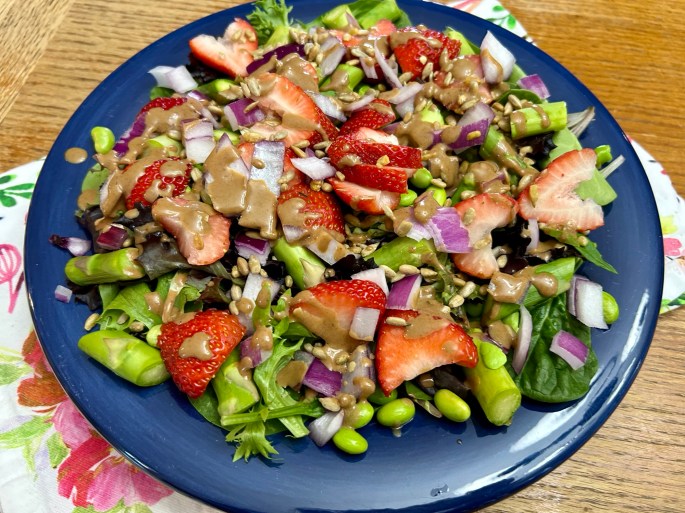
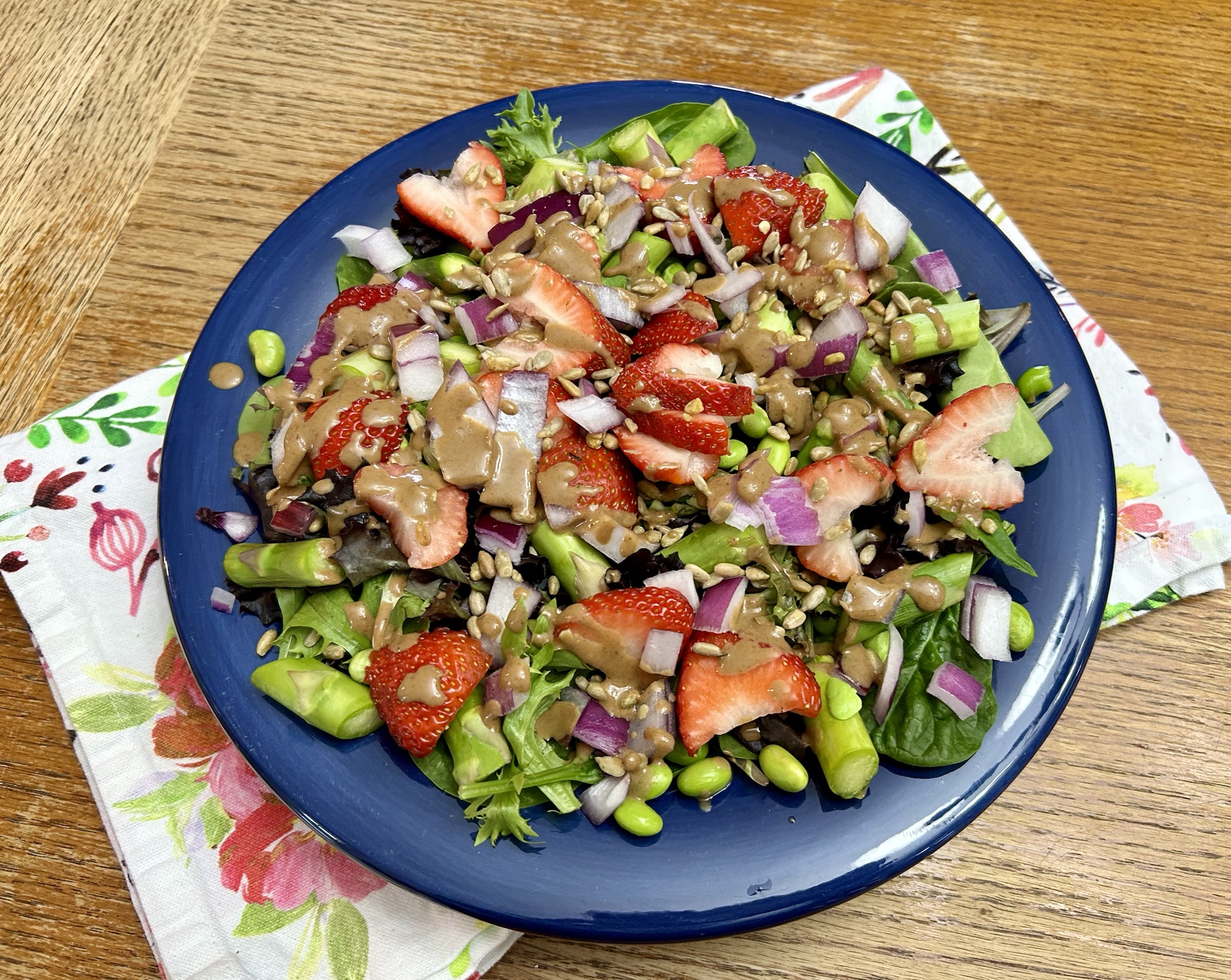
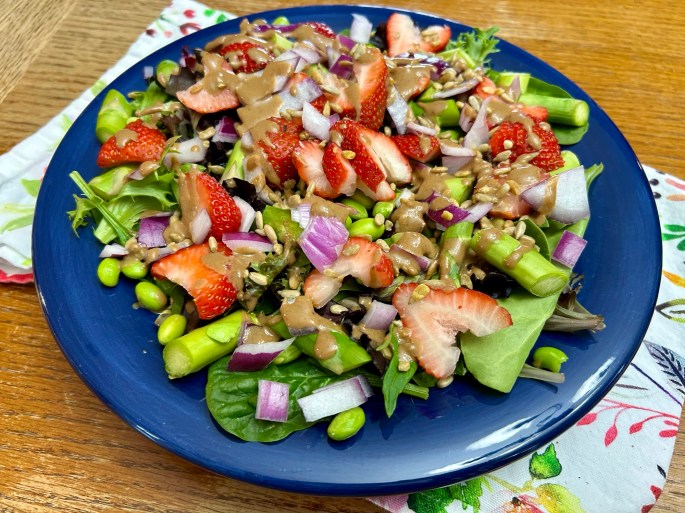
Featuring asparagus, strawberries, spring mix, and spinach

“Mother Nature’s powers cannot be stuffed into a pill.”–Dr. Micheal Gregor

Photo by Anna Shvets on Pexels.com

pill popping 💊

My husband, John, and I can’t help but giggle every time we see commercials touting the benefits of taking a certain brand of daily vitamins.  This company claims their product provides vitamins and minerals found in fruits and vegetables that we, the lowly consumer, don’t have time to eat.  It especially targets those of us who are older, espousing that by taking these pills, as many as six per day, we will infuse our frail, feeble frames with the vigor and vitality of our former, younger self. 

While there is nothing inherently wrong with taking a multivitamin and/or other key supplements, they should never replace our need for daily consumption of fruits and vegetables.  According to multiple sources, such as,  The Better Health Channel, National Institutes of Health, and Harvard’s T.H. Chan School of Public Health, regularly consuming fruits and vegetables provides the body with important vitamins, minerals, plant chemicals, and a significant source of fiber.  Furthermore, a diet rich in fruits and vegetables have been linked to “lowered blood pressure, reduced risk of heart disease and stroke, prevention of some types of cancers, lowered risk of eye and digestive problems, and have a positive effect on blood sugar . . . .”   These are benefits that can’t be bottled into a pill.

Photo by Pixabay on Pexels.com

Planted in Health 🌱

Of course, I am preaching to the choir, my dear readers.  If you are reading this, you are keenly aware of the benefits fruits and veggies offer.  And, yet, due to clever and slick marketing tactics, Americans have been spending billions in recent years on vitamins and other supplements according to Northwestern Now and Harvard Medical School.  While there are those who do need a few key supplements due to specific health issues, such as those with Crohn’s disease, celiac disease, and ulcerative colitis to name a few, the average healthy adult can get all the vitamins and minerals they need through a well-balanced diet.  Besides, there are numerous tasty and simple ways to incorporate fruit and veggies into your diet.

Photo by Michael Burrows on Pexels.com

Spring produce 🥬

Spring is the perfect time to take advantage of the fruits and vegetables that come into season early, such as greens, asparagus, and strawberries.  Many of these items are often available at local produce stands and markets.  Plus, they can also be found, usually at discounted prices when in-season, at local grocery stores.  Either way, from now until early June, is the perfect time to grab up these produce deals.

Springtime celebration salad

The salad recipe I am sharing with you is one delicious way to incorporate a variety of spring vegetables and at least one fruit into your day.  It is a bright and colorful salad, bursting with complimentary flavors and textures, and it can be made as a light main dish or a bright start to a meal.  Feel free to play with this recipe by using your favorite dressing, replacing the strawberries with another fruit, changing up the greens and vegetables, or by adding in a favorite protein, bean, or even a grain, such as quinoa.

Make it ahead of time 🥗

I made this salad recipe ahead of time without the fruit and dressing, divided it among Tupperware-type bowls, placed the fruit and poured the dressing into separate, small containers to add to the salad just before eating.  This allowed grab-and-go convenience for lunch.  In the morning, I popped open my lunch bag, filled it with salad, dressing, sliced fruit, and tossed in a handful of whole grain, gluten-free crackers. As I head out the door,  I can rest assured I have packed a nutritionally balanced lunch to fill my afternoon with energy, and I won’t need to worry about spending extra money on overpriced and over-advertised pills.

Celebrate Early Spring produce 🎉

Consider adding this salad into your weekly rotation of spring meals.  Serve it as a meal or as a side.  Toss it up ahead of time if you like– simply add in the fruit and pour on the dressing just before serving.  However and whenever you decide to make it, you are sure to reap the nutritional benefits of delicious spring produce without a pill!

Springtime Celebration Salad with Walnut Vinaigrette, 

Featuring: asparagus, strawberries, spring mix, and spinach

Make 2 large meal sized salads or 4 small dinner salads.

Ingredients for dressing:

½ cup water

½ cup balsamic vinegar

¼ cup chopped walnuts

¼ cup raisins or chopped dates

1 clove garlic or 1 teaspoon garlic powder

1 teaspoon dijon mustard

¼ teaspoon dried oregano (optional)

Salt and pepper to taste

Ingredients for salad:

10 asparagus spears, roughly cut

10 strawberries, sliced (can substitute chopped apple, blueberries, red grapes, or mandarin orange slices if preferred)

4 tablespoons chopped red onion

6 cups spring greens (I used 50/50 blend of spring mix and spinach)

½ cup (or more, depending on preference) shelled edamame beans, called mukimame or thawed frozen peas

½ cup shredded carrots (optional)

½ cup sliced celery (optional)

2-4 tablespoons raw sunflower seeds (or other favorite nut/seed)

½-1 cup feta or goat cheese (omit if vegan)

Directions for salad dressing:

Combine all ingredients in a high powered blender and blend approximately one minute or until smooth.

Store in a container until needed.  Will keep in the refrigerator for two or more weeks.

Directions for salad:

Set out shelled edamame (mukimame) beans or peas to thaw

Cut ends of asparagus, rinse, and then rough cut remaining. Lightly steam asparagus on a covered microwave dish, approximately 30-50 seconds.  (You want them bright green and crisp.)

Rinse and slice strawberries, set aside.

Chop red onion, set aside.

Arrange greens in a large salad bowl, adding in carrots and celery if using.

Top with asparagus, strawberries, and edamame or peas.

Sprinkle with chopped red onion, sunflower seeds (or nuts), and cheese, if using.

Drizzle with desired amount of dressing and serve.

Serve with whole grain baguette slices or whole grain crackers, if desired.

Anyone can complete a half-marathon: Tips to help you achieve this goal

Even when you have gone as far as you can, and everything hurts, and you are staring at a specter of self-doubt, you can find a bit more strength deep inside you, if you look closely enough.”–Hal Higdon

Virginia Beach Shamrock 1/2 Marathon 2024

Pace Yourself 👣

“Your pace on the last mile was spectacular.” Siri voiced my husband’s text into my ear. 

I had just passed mile marker 7 of the Virginia Beach Shamrock Half-marathon.  Up until that point, I wasn’t sure how this event would go for me.  While I had been officially training for this event for months, I had undergone fairly major surgery eleven prior, so I had only gradually returned to running beginning in June.  Even then, it was two months of walking/running, gradually increasing the time spent running.

In November, I participated in the Marshall University Half-Marathon.  Completing it felt like a huge victory since I had to start at ground zero, so-to-speak, post-surgery.  After my surgery at the beginning of April, my exercise consisted of walking around my house for 5-10 minutes at a time several times per day. Therefore, going from house-walking to running 13.2 miles, albeit slowly, within several months was a huge personal milestone. 

Ready to start!

Rethink your definition of Who Can finish a half-Marathon 🏁

Here’s the thing to know about me.  I am not what I would consider athletic.  I was the proverbial band-geek in high school.  Not that I define myself by long-ago standards, but I think many of us can get into our heads and define our athletic abilities based upon those past early experiences. The point is you don’t have to consider yourself “athletic” to participate in a half or full marathon. Anyone can do it.

Furthermore, you don’t have to be fast, and you don’t even have to run it.  You can walk the entire route, or you can mix it up, alternating bouts of walking with running. Others, those who I tend to define as “natural” runners, may spout out finish times and pace with a competitive spirit, but many others, like me, are simply proud of crossing that finish line.  That said, I do confess I notice my finish times, but I never let those times define my accomplishment.  Crossing a finish line is always a victory.

Photo by RUN 4 FFWPU on Pexels.com

Realistic Plans for Beginners ✅

To that end, my relationship with running, which began approximately ten years ago, has developed in fits and starts. When I first began, ten years younger, I was a bit faster than I am now, but I was still running at what competitive runners would consider a slow pace. During those early years, I would try to adhere to established standards of publications, and I always fell short.  I wasn’t experienced enough to fully understand those standards weren’t realistic for me. 

Ten years later, and it still seems like many publications and media outlets set unrealistic expectations for those who are TRULY newbies and need a gentle approach to running/walking.  However, that is gradually beginning to change, and I want to be part of those voices who speak to those so-called “nonathletes” who want to participate in a healthy community event, such as a 5K or half-marathon.  I have read and listened to a few authors who speak to that person with no athletic experience; plus, I have amassed my own personal experience. Therefore, I want to share a few tidbits of encouragement.

Photo by Ketut Subiyanto on Pexels.com

Focus on Increasing time on feet, Not Miles 🦶

First of all, nearly anyone can train to walk, walk/run, or run a half-marathon.  I have met too many people who say they’d love to do it, but believe they aren’t capable.  Yes. You. Are.  I have participated in enough events to know that there are numerous participants who walk the entire route.

Here’s the trick I learned, you do need to train and prepare the body for these events, but it doesn’t have to be extreme. It’s all about time spent on your feet engaged in walking and/or running and the weekly long run that gradually increases in length over 12-24 weeks, depending upon your goals and your starting level of fitness.  (Of course, always seek advice/approval from your healthcare provider before embarking on a program.)

For both Shamrock and the Marshall Half-marathon, my longest run was ten miles, and they were walk/run training sessions–run ten minutes, walk two minutes, and then I kept repeating this pattern for a certain length of time, rather than miles.  This took pressure off completing a certain distance, and it allowed me to better respond to how my body was feeling–adjusting the length of time walking or running.  If I felt rested and strong, I ran for longer periods; however, if I felt over-fatigued or not well, I ran for shorter periods and walked more. 

Photo by Kate Trifo on Pexels.com

Never Underestimate walking 🚶🏽‍♀️

As a general rule, true beginners typically start with walking.  Once you can successfully walk for 30 minutes without stopping–and it might take months to work up to that length of time, and that is ok– then you can begin to add a minute or two of easy jogging, such as walk for ten minutes, jog one minute; repeat two more times.  That is honestly how I moved from walking to running after surgery this past spring once I had clearance from the surgeon.

Photo by Ketut Subiyanto on Pexels.com

Intersperse time jogging 🏃‍♀️

Run Your Butt Off  is a great resource for a structured 12+ week  run/walk plan, but I suggest you disregard the diet information! Additionally, the Shamrock Half Marathon/Marathon website offers free training plans for running/walking an 8K, half, and full marathon. I have successfully used both and found them incredibly helpful and encouraging.

Week-by-week, you can slowly decrease your walking time and increase your running time.  Eventually, you may get to a point where you are happy alternating between running and walking, and that is fine!  Many people adhere to a run/walk practice.  In fact, Jeff Galloway has published numerous articles and books on this topic if you are looking for more guidance.  Therefore, if you want to complete a 5K, 8K, half-marathon, or even a full marathon, there are plans available that will fit your level of fitness. 

Two thumbs up for a personal best!

Sham-rocked! ☘️

As it turned out, I was ultimately able to finish this half-marathon with a personal best time. Once I passed mile marker 7 and my husband made me aware of my pace, I began to get excited and focus a bit more on maintaining my pace, realizing a PR was within reach.  In fact, I finished ten minutes faster than the previous year!  However, it wasn’t easy.  My mind kept telling me about different parts of my body that were hurting, so I had to keep combatting and replacing those negative thoughts with positive messages, such as  “I am getting stronger,” “I am so close now,” “Focus on the feeling of crossing the finish line,” and so forth. 

While it wasn’t my intention to run a PR, I think changing the way I more realistically approached training after surgery made it possible.  Giving myself permission to walk during my months of preparation and using a training plan appropriate for my skill level made a huge difference. Nonetheless, even if I had finished with a slower time, crossing that finish line is always a victory! 

You can do it! 😃

And, I want you to know, Dear Reader, that if you have ever dabbled with the idea of participating in a half-marathon, you can absolutely do it!  I am cheering for you! 

#runforglutenfreewaffle #bestsupport #pocahontaspancakes&wafflehouse #shamrockfinishline

Almost time to go!
And, we are off and running!
Crossing the finish line is such a feeling of accomplishment!

The Lost Art of Delayed Gratification

“The longer you have to wait for something, the more you will appreciate it when it finally arrives. . . .  All good things are worth waiting for . . .”–Susan Gale
Photo by Pixabay on Pexels.com

Window of opportunity ⏱️

One of the more popular health trends that continues to grab headlines is around time-restricted eating or TRE.  It is a form of intermittent fasting in which a person chooses a window of time within a day, typically 6-12 hours, in which they eat.  During the time outside of this window, those following a TRE protocol, do not consume any other calories and drink only water, although there are some following a TRE plan that consume unsweetened tea or coffee. 

The idea of TRE is to reduce the amount of overall calories consumed in a day and to reduce less-positive habits such as eating late at night or snacking too much early in the day.  Besides the obvious benefits of managing body weight, scientific research  into TRE continues to show promising results, including reducing insulin resistance, reduction of inflammation and oxidative stress, can alter and improve the composition of the microbiome, and improved sleep to name a few. 

Photo by Yan Krukau on Pexels.com

Time to Eat 🍱

Time restricted eating is nothing new to me. In fact, my childhood taught this.  I grew up with a natural TRE called breakfast, lunch, dinner and no snacking in between.  Furthermore, my parents believed that if we didn’t like what was offered at a certain meal; well, we wouldn’t starve because I could eat again at the next meal.  

I can recall sitting in elementary school feeling my stomach growl.  Sure, I had breakfast, but we ate early in order to make the school bus.  I would look at the large classroom clock on the wall, counting down the time until the teacher l lined us up and walked us to lunch. Standing in line waiting for everyone to go to the restroom, wash their hands, and line back up, my mouth would water in anticipation of food.  By the time I sat down with the other students who had packed their lunches, I thought I would perish from hunger! But, oh how good that simple food tasted when I could finally take a bite!

By the time I got home from school, my stomach would once more be begging for food, but there was a hard-fast rule.  No snacking before dinner because you’ll ruin your appetite.  This was made more challenging if my parents had ordered a tray lunch from the school cafeteria, and I didn’t like the food.  Still, there was no debating–wait until dinner.

Fortunately, we tended to eat between 5:00 and 6:00 pm, so I didn’t have to wait too long.  However, I tended to be persnickety about certain food items, so if the meal consisted of a food (or foods) that I didn’t like, too bad for me–or any of my siblings for that matter–there was always breakfast.  We weren’t going to starve–even if we thought we would. 

Photo by August de Richelieu on Pexels.com

Delayed Gratification ⌚︎

The beauty of my parent’s rules, whether they intended it or not, was two-fold.  First, food tastes better when truly hungry.  It felt downright wonderful to have a hearty appetite as I sat down for a meal. The other skill learned was the art of delayed gratification.

Sure, I’ve went through phases, such as camps, overnight stays with friends or family, and later in college and as a young adult, where I ate completely differently than how I was raised–eating at irregular times and noshing on foods I would have never been able to eat at home. 

As an adult, I have also likewise gone through similar phases. It is more challenging now to have those structured meal times since food is so widely available at all hours of the day.  No wonder TRE is so popular now.  It brings back that structure and discipline in which I was raised.

The art of delayed gratification, given the immediacy that technology brings, is perhaps becoming a bit of a lost skill set. The ability to resist an immediate reward for a greater or more favorable reward later requires self-regulation and impulse control, skills that often get lost while scrolling through our various screens. However, delayed gratification is a skill that can be learned at any age, but it is not easy.

Photo by Pixabay on Pexels.com

Benefits of Delayed Gratification 🎓

Delayed gratification is what some parents try to teach their children by insisting that all homework must be completed before the kids are given permission to choose a more preferred activity.  It is what adults practice when saving for an important item, such as buying a new car, house, or even something as simple as setting aside money for rent, groceries, utilities, and other bills.  In fact, anytime we choose not to be distracted from our goals or priorities, we are practicing delaying gratification. 

Success in any endeavor, from career to finances, to the most mundane such as cleaning house to choosing when and what to eat, requires the ability to resist the temptation to do something easier (the distraction) and instead, complete something harder, such as studying for that next level career exam or simply choosing, as my parents taught me oh-so-long ago, only eat at meal times. 

Photo by SevenStorm JUHASZIMRUS on Pexels.com

So how do we get better at delayed gratification? ⤵️

There are multiple books, articles, and youtube videos designed to provide various methods. Some people like big changes all at once, such as TRE, leaning into some variation of:  Here’s the rules, the parameters, and the start date.  For certain personalities, a total overhaul of their habits works great.  

However, I tend to prefer more gentle approaches such as:

  • Start with one small change (habit) and stack it with an already existing habit, i.e. I already drink coffee in the morning, why not drink 8-12 ounces of water beforehand?
  • Repeat that change again the next day
  • Set a goal for continuing that new change/habit for a set amount of days with a planned celebration/reward upon reaching the goal
  • If you’re really resistant to completing something, set a timer for two minutes.  At the end of those two minutes, get started. (It sounds silly, but for some people, it works.)
  • Try the “if-then” principle: “If I do this,” (clean kitchen, set up budget, exercise . .), “then I can do this” (scroll through social media, read, nap, etc. . .).
  • Play mind games and daydream (Instead of focusing on what you want to do, daydream about all of the positive feelings you will undergo sticking to and achieving your plan.  Likewise, focus on the negative feelings you will experience if you give-in to a distraction.)
  • Offer forgiveness to yourself when you slip-up (and we all do), but then return to your goal again the next day.
Photo by RUN 4 FFWPU on Pexels.com

Make Delayed Gratification work for you! 😄

Ultimately, whether you are trying to stick to TRE, save for new tires on your vehicle, or make that next big career step, employing the art of delayed gratification can help you keep your goals at the forefront of your mind.  By keeping those goals small and achievable, you can visualize the steps along the path to success (better health, cleaner house, better finances, etc . . .), make peace with your distractions, focus more on your plan/goal, and face challenges (aka distractions) with a bit more self-composure and kindness to self. 

Clouds attaching to my story of sunshine: A lesson on detaching from the plan and surrendering to your Higher Power

“When things don’t go as you planned, don’t be let down. Make new plans. The sun doesn’t stop shining just because of dark clouds.”–unknown

Photo by Jess Bailey Designs on Pexels.com

Who loves a good plan? 🙋‍♀️

Are you a planner?  I can be.  I love a good plan like a kid loves her teddy bear. I can say the same about a solid routine.  Various routines and/or plans give me structure, a scaffolding, to ensure I remember to do, find, and complete various short and long term tasks.  

Without plans and routines, I am a total right-brainer who just goes with the flow.  Free-styling is fine for many of my creative endeavors. Unfortunately, most of my creative endeavors bring little to no income to pay the bills.  However, I love my creative side.  It’s the joyful part of me.  Thus, creating structure and routine to my day, allows me to pay the bills and have fun too.

I will fully admit that I have different plans/routines for different compartments of my day/week, and I work hard to fit those various plans together into the patchwork quilt that is my life. Routines for my profession are obviously far more important and detailed than routines for household chores.  Nonetheless, no matter the plan’s level of so-called importance, if I create or find a plan that truly works, I prefer to stick to it, cling to it if I must . . . but . . .

Photo by Wendelin Jacober on Pexels.com

Uncooperative Plans 😩

Unfortunately, life isn’t always so cooperative.  It keeps flowing like a river reacting to the weather trends unphased by “Stephanie’s plan”.  Sometimes the river of life flows steady ‘round bends and curves.  Other times it is dried to a near trickle, and I wonder if the rains of inspiration will ever arrive.  Then there are those storms that wildly overflow the banks of life’s river sending its waters over rocky embankments and into uncharted territory.

As I sat at my writing desk this morning, contemplating how to begin writing, I spent time staring out the window.  Dawn’s light had broken upon clouds and fog. I could see peaks of brighter blue sky in between the gaps of the clouds overlaid with gauzy fog, and I realized that is often what happens to my plans.

Photo by Tim Mossholder on Pexels.com

planned laughter 😆

I often joke that I must make God laugh all the time by saying that I have a plan.  Despite the fact that I know I need plans to organize myself and my hot-mess of a mind, I also know I cannot attach too tightly to those plans because God and life are going to do what they are going to do with me. And that is exactly what I am now experiencing.

One of my plans for 2024 is to run a spring half-marathon–the Virginia Beach Shamrock.  It is one I ran last March weeks before having a fairly major surgery in April.  Months later, in November, I ran the Marshall University Half-Marathon as a celebration of recovery from that surgery. 

My training plan for the MUM was long and protracted in order to allow my body to heal and recover from surgery.  After returning to work in May, I began gradually increasing my walking endurance throughout May and into June.  

Then, in July and August, I gradually added bouts of jogging into my walking. Gradually, the running sections increased as the walking sections decreased, but there was always permission to walk at any time, and even for the entire work out time, if needed. Due to careful planning, I was able to build up to running the entire half-marathon in November.

Therefore, I thought why not continue training through winter and once more run the VB Shamrock Half-marathon.  I had a plan.  It was mapped out from Thanksgiving week until March 17, the day of the half-marathon.  It was a beautiful and doable plan–not too hard–and fully manageable with my work schedule. 

Photo by Adrien Olichon on Pexels.com

Who’s doing the Steering? 🛻

But as I said, I told God I had this plan, and He had a good ol’ belly laugh at it. I mean He must have enjoyed a real guffaw because very little of “my plan” has gone “as planned.” In fact, I have had to rework and adjust this plan so many times, I have finally, less than three weeks out, metaphorically thrown my hands in the air and surrendered because only Divine Providence knows what will happen on the day of the event. 

Therefore, as I sat at my desk staring at the clouds, the rising mist of the fog, and the interspersed glimpses of blue sky, I reflected on my so-called plan.  The plan included four days per week of running and/or walking, with one longer session per week, completed outside on the weekend, gradually increasing in distance. 

Most of the early weeks into the plan, I was able to complete four days, running outside (translated, not on a treadmill) at least two of those runs.  However, at some point after Christmas, I had to begin making adjustments.  Runs were missed due to conflicts in schedules, and numerous runs were completed inside of a gym on a treadmill due to inclement weather. Plus, I battled several colds and even a random ear infection, which is something I haven’t had since I was a child, so more running time was missed.

Photo by paul voie on Pexels.com

Cloudy thinking 🤔

The thing about running, or any workout journey for that matter, is that it is a microcosm of life.  Lessons learned on the running (walking, hiking, lifting etc) trail are often tangible life lessons.  My plan was those fluffy white clouds in the sky that, in my mind’s eye, I could step comfortably from cloud A to cloud B and so on.  The morning fog, however, was the realities of life. Sometimes my planned path was clear, but most often, there was some sort of, metaphorically speaking, weather event occurring preventing a smooth transition from one step to the next.  

The cerulean sky, to continue the metaphor, was (and is) the Universe, the great I-AM, and that is to whom, in the end, I must surrender.  As Carrie Underwood once sang, I need to let go of the steering wheel because clearly I am not the one in charge despite my illusions of control.

By taking a step back, away from the great “Stephanie-said-so-plan,” I can gain a new perspective.  Firstly, I am grateful for overall good health. Sure, I have had a few minor illnesses this past winter, but nothing life threatening.  

Furthermore, perhaps all those challenges and obstacles were Divine Providence’s way of giving my body the rest I wasn’t giving it. Perhaps, I have been pushing too hard for too long.  Maybe some rest and recovery, like I gave myself after surgery, is what my body needed–especially as a more, ah-hem, older adult.

Photo by Thirdman on Pexels.com

Surrender 🙏

Similarly to the way I witnessed the morning surrendering the events of the coming day to the Creator, I too must surrender the events of the future.  What will be, will be.  End of story.  As my grandmother used to say as a preface, “Lord willin’ and the creek don’t rise,” I will still have the opportunity to travel for a short trip to the shores of Virginia and live to tell another story.  And, where’s the joy in life without stories to tell and lessons to share?  

Surrender the plan

The chipped teapot: Seeing our “imperfections” for what they really are

“It’s made me realize that imperfect is perfectly comfortable to me. Whether it’s a city or my apartment, I feel most at home when things are somewhat flawed.”–Hoda Kotb

Chipped, but not broken.

I’m a Little TeaPot 🫖

I picked up the teapot.  It had a chip on the top of its deep navy shape. I could feel how simultaneously sad and angry I was.  The chip was my fault.  I had dropped the lid and broken a piece off revealing the original white unglazed pottery underneath.  

Suddenly, the spiral began.  Why am I such a clutz?  How could I be so stupid? What is wrong with me that I can’t simply hold on to a lid in soapy water?  Way to go, Steph.

I am familiar with that inner critical voice demanding so-called, “prefection.”  That voice is full of all of the things I should do, and it also lists all the ways I fail and fall short.  It is the voice that can sometimes make me cry when I sense I have let someone down or dropped the ball on something I “should” have done. 

Photo by Moe Magners on Pexels.com

coping skills 🥸

In my younger years, I tried a variety of coping mechanisms to quell that demanding, perfectionist voice. I attempted to ignore the inner critic, but until I was wise enough to know the difference, ignoring sometimes led to overlooking those helpful, intuitive signals.  I also tried projecting a big ego full of confidence to hide that voice of doubt–which, I quickly learned, was a sure way to epically fail.  Of course, there were the tried-and-not-so-true methods of numbing that critic with overeating, over drinking, or even overdoing, but that only made me more miserable. 

Listening to that inner critic has also led to procrastination. For example, if I know a specific big job/task needs to be completed, I can become paralyzed from completing it because my inner critic states it must be completed in a certain “perfect” manner, making the task seem more overwhelming than it is. This paralysis can lead to shame, guilt, and self-loathing because it points to “another failure” when left undone. 

Other times, it’s not so much about procrastination as much as it is that I am managing a wide array of interests, so I get side-tracked from one project to work on another. Nonetheless, focusing on those “other interests,” instead of the “one-big-thing,” can also instigate self-criticism because, “Why can’t I be more focused and stick to one thing?” 

Surely, there are others who fight this battle of perfectionism.  Right?  Based upon all of the various titles of best selling books centered around the topic of perfectionism, I certainly must not be alone in my battle.

A bowlful of encourage-mints!

Letting go of the Perfectionism script 📝

However, with age, my inner gaze, like my own vision, has changed. Letting go of perfection has, to a certain degree, been a natural part of the aging process.  Aging, and the life-wisdom that comes with it, empowers me to more closely see the reality of situations. 

For example, while writing this piece, I picked up an individually wrapped mint to pop in my mouth to allow it to slowly dissolve as I write.  Unfortunately, when I picked it up, I dropped the mint on the floor.  My first voice said, “Way to go, dork.  You broke the mint.  Now, you’ll end up crunching it, rather than slowly letting it dissolve.”  Fortunately, my wiser, older voice swiftly pointed out, “Now, you have two mints! Twice the enjoyment!”

Of course, this is a simple scenario, but it leads to my next point.  Learning to let go of the narrative of perfection is difficult, and it is more of a process than a destination.  Here’s the thing though.  My beautiful, albeit chipped, navy tea pot still works.  It still steeps my various teas perfectly, and it pours without spilling a drop. All I have to do is turn the lid, and no one has to see the chip. Thus, learning to turn, or flip, the narrative of that inner critical voice demanding “perfections” is likewise a great tool.

While there is nothing inherently wrong with setting high personal standards, leaving wiggle room for what is truly acceptable, is a much less stressful approach. It also helps deflate the bubble of shame often attached to rigid standards when we allow for a less-stringent approach.  

Photo by Karolina Grabowska on Pexels.com

Flawless 😎

Another strategy for releasing perfectionism’s grip is to observe that many of our so-called “personal flaws,” when viewed from a different perspective, are actually strengths.  For example, I might leave one task undone for a longer than “it should be” time period, but that is typically because I am pursuing a creative endeavor such as writing, cooking, or even planning how I will teach a concept to my students.  What’s wrong with that?  Like you, I also wear many hats, so why shouldn’t I give myself grace to focus on one task without pressure to do all tasks “now.”

The more we can learn to adapt an attitude of grace and self-acceptance the more likely the tentacles of perfectionism will begin to loosen.  By embracing our many strengths and talents, we can also feel the weight of shame lifting like a dark cloud shattering as sunlight breaks through. For example, in my own life, I am not the early bird at work in the morning, but that’s because I am a morning person.  I spend several hours completing numerous tasks at home before arriving at work, such as writing, exercising, grading papers, and so on.  Therefore, why should I feel ashamed of my productivity?  

Another skill that has also come with age is learning to focus less on so-called mistakes, and instead, making a point to respect the fact that any time I make a mistake, it fosters my own learning. Mistakes are, in reality, a path to learning to do something better and a tool for continuing to hone a skill.  One example of this was when I was adapting an old family recipe for pound cake to a gluten-free variation. I botched that cake twice before finally figuring out the best way to make it.  Even now, I continue to refine and improve not only that recipe, but also my own technique for baking gluten-free. It is through this acceptance and openness to allowing for mistakes that growth can occur.

Flip the narrative, like I flip the lid around on the teapot.

MUlishly imperfect ⭐️ 💫 🌟

In the end, that inner-critic with its attachment to being perfect is misleading and false. One look at nature reveals anomalies, asymmetries, and even accidents are all part of one big beautiful creation. 

Consider the mule.  It is the offspring of male donkey and a female horse.  It’s not a perfect horse, and it’s not a perfect donkey.  Instead, it possesses its own unique imperfect–some might even say, mulish– vibe, and so can we. 

While focusing less on our so-called flaws and more on strengths, leaving wiggle room for plan B (or C and D), and remaining open to the lessons of a mistake, may not lead to perfection, it sure can lead to a much more peaceful, approachable, and manageable way of living. It’s not easy, and it requires patient practice in the pursuit of learning to let go. However, with continued practice, we can begin to let go of that “perfect” narrative and become much more at ease with the “imperfect.”

Photo by Leeloo The First on Pexels.com

There is only room for love, not prejudice, even in the world of pet adoption

“How lucky I am to have something that makes saying goodbye so hard.” –Winnie The Pooh

Photo by Khangnht98 | u0274u1d0fu1d04u1d1bu1d07 on Pexels.com

Lucky cat 🐈‍⬛

He came into our lives as part of an abandoned litter of black cats. He was tall, long, and solid black; however, he was, along with his siblings, quite malnourished.  Our friends who discovered the passel of black kittens took them into their home and began caring for them.  Later, they asked if we would like the one they had already named LJ, which stood for Lucky Junior, named after one of their large black rescue cats named Lucky. We met him, and it was love at first sight. LJ came home with us, and the rest is feline history.

However, it was not an easy transition.  Although LJ was a lover-boy with any human who paid him the slightest bit of attention, he very early tried to establish his dominance over our female gray tuxedo cat. He was frequently caught stalking and/or jumping on her. If we did not intercede in time, the two cats would erupt in a rolling, screeching tumult of gray and black fur.  

Catching the morning sun’s rays.

Distant Friends 🐈 🦮 🐈‍⬛

There were times, more often than not, that peace reigned supreme and the two lived companionably. This peace most often fell in the light of the morning sun streaming through windows in which they both loved to lounge and loll side-by-side, but at a safe distance.  Other times, they sat together in our bay window for hours, each in their own cat beds in respective corners.  During recent years, they even began sitting with John, my husband, one on either side of his legs. 

Not too much longer after we adopted LJ, a stray dog showed up in our life.  He was a cocktail of chow, pitbull, and retriever.  It was clear he had been abused by a previous owner, and to this day, we can’t imagine why because he was such a gentle creature.  He was already house-trained, stayed close to the house when outside, and quickly became a loyal and loving family member. We named him Rusty due to the color of his fur, and it suited his old soul spirit.

However, there was one significant issue–he was not about to let LJ be the alpha pet.  He had adopted us, specifically John, my husband; and therefore, John was “his property.”  Anytime LJ attempted to sit with John, Rusty would not stand for it.  Rusty never tried to hurt LJ, but he would lay, sit, and sometimes stand, in front of John and growl, blocking LJ’s attempts at laptime. Furthermore, Rusty did not like it when LJ would start a row with Tippi, and occasionally he would growl and nip at LJ to stop his shenanigans. 

Rusty keeping LJ away from John.

Rusty Habits 🦮

Rusty had some other dog-like habits.  For example, any time Rusty would smell John cutting, cooking, and/or making a sandwich with meat, Rusty would enter the kitchen and patiently sit at John’s feet with a pitiful begging expression.  When John would sit down to eat, Rusty would be at his side looking up at John with imploring eyes desirous of scraps.

Many years later, after Rusty passed, LJ began exhibiting behaviors similar to Rusty.  He aggressively attempted to block Tippi’s attempts to sit with John. When John was in the kitchen working with meat or making a sandwich, LJ would dart into the kitchen and meow with great ferocity in hopes of fetching a few scraps. In the strangest twist of all, once Rusty was gone, whenever John would sit down to eat, LJ began to sit near John, pleading with passionate meows for scraps.  We joked that Rusty’s spirit lived on through LJ.

Who’s the alpha pet?

The Black Cat Myth 🐈‍⬛

We called LJ “our handsome boy” in our best pet voices because he was so dark and regal.  However, black cats, and even black dogs for that matter, are typically the last to be adopted, and they are the most often euthanized in animal shelters.  When completing research as to the whys of this phenomena, I discovered varied reasons. Some point to Pope Gregory IX who declared that cats bore Satan’s spirit. Others point to the middle ages when black cats were associated with witches. It is even reported that there were those who blamed cats for the spread of the bubonic plague–even though they ate the rodents that spread it. 

Regardless of the reasons, I personally find any prejudice regarding fur, or skin color for that matter, reprehensible. Cats (and dogs), like people, come in all shapes, colors, and sizes.  Each has their own personality.  Some cats, like people, are more loving.  Others are more aloof. There are those who have been mistreated, and as a result, may not yet have learned an appropriate way to behave–but, it doesn’t mean they can’t learn. 

We have had a total of four cats in our family (never more than two cats at a time though), two of which were black or mostly black.  Of the four, the two black cats were the most loving, each in their own way. Our first black cat was lovingly devoted to me, and later to our daughter, Maddie, after she was born.  However, LJ was one of a kind because he simply loved anyone and everyone who entered our house. 

A long ago Mother’s Day when my daughter, Maddie, served me breakfast in bed assisted by our two, now-passed cats, Bobbi (background) and Robbi (foreground).
LJ, being held like baby, this past Christmas by Maddie, our daughter.

Love and Loyalty 🐈‍⬛ ❤️ 🦮

LJ basked in any and all attention.  He allowed you to cradle him like a baby and rub his belly–all the while his motor would purr.  Pulling on his tail actually made him happy as long as it wasn’t too hard.  He was also proud, fastidiously cleaning any loose fur off his body. 

Best of all, he loved us.  All three of us–my husband, daughter, and me.  He had been fighting an unknown illness that no amount of blood tests or toxicology tests could determine other than to say it appeared to be some form of kidney disease.  He was prescribed a nutritional supplement which I gave him religiously.  It seemed to help until, suddenly, last Friday morning.

LJ’s swift demise occurred in less than 24 hours.  He was miserable during those last few hours, but he appeared to keep hanging on for us.  Even to the end, he was still trying to make his “motor” run for us.  During those final minutes, before the sedative kicked in, he still tried to find the strength to lift his head and look at us. He is now buried at one corner of our back porch, the opposite corner of our other beloved black cat, Bobbi.  

A separate peace.

Consider Adopting a Furry Friend 🐾

Every morning, LJ would meow for me to let him out onto this porch, so he could dutifully guard its inside perimeter.  He is no longer greeting me in this manner when I get up, and my heart still aches as a result.  Ironically, Tippi has begun meowing to visit the porch, visiting and sniffing “his corner.” She seems confused by the loss of her once rival, and often meows throughout our home in search of him. I suppose Tippi and LJ will now have a separate peace. 

When considering the decision of adopting a cat or dog, please do not allow fur color to deter you from a potential pet. Additionally, while adopting from “official” breeders is nice, please take time to consider all of the many worthy dogs and cats left at animal shelters, tossed aside at dumpsters, or dropped alongside a road that are full of an abundance love and devotion for that one special human willing to open their heart and home to them. 

In the meantime, rest in peace our handsome, handsome boy, LJ.

That’s not the sky! That’s the clouds–Lessons in the 90-second rule

“You are not your thoughts.  You are the observer of your thoughts.”–Amit Ray

Photo by Pixabay on Pexels.com

Feelings Come and Go ☁️

It was between classes on a Friday afternoon. A male student entered my classroom, set his books down, and sauntered across the room towards the windows that line the wall of our third floor room. 

He looked as if he was preparing for a quick chat with his buddy when he randomly exclaimed, “Wow, look at that.  The sky looks flat.”

“Dude, that’s not the sky.  That’s the clouds!” a girl retorted.

A debate then ensued as to whether or not the sky and the clouds were one in the same. Several other students joined in the conversation until one student added with great authority that the clouds aren’t always in the sky, but the sky is always there. 

Listening to the student’s debate reminded me of a saying attributed to Thich Nhat Hanh, “Feelings come and go like clouds in a windy sky.”  Hanh taught this, in part, to demonstrate that we have the ability to be an observer of our mind’s thoughts.  I often phrase it like this, “Just because you think it, doesn’t mean it’s true.”

Photo by Yan Krukau on Pexels.com

The 90-second Rule ⏰

In fact, I ran across an interesting fact regarding the duration of emotions.  Neuroscientist and best selling author, Dr. Jill Bolte Taylor, Harvard trained and published, established that emotions only last for approximately 90 seconds.  According to Taylor, “When a person has a reaction to something in their environment,” she says, “there’s a 90-second chemical process that happens in the body; after that, any remaining emotional response is just the person choosing to stay in that emotional loop.”

Upon reading that fact, I almost felt called out, especially with regards to any emotional response after 90-seconds is personal choice.  Wow! That notion is super-charged with opportunities for self-regulation.  However, we all know that regulating emotions isn’t always easy. In fact, I suspect this requires practice for most of us.

Therefore, I want to step back to the clouds and sky scenario. Identifying and recognizing when our mind has gone off into what I call “thinking or story mode” due to an emotional reaction requires a certain level of mindfulness.  This is where knowing the rest of Hanh’s quote is important. “Feelings come and go like clouds in a windy sky. Conscious breathing is my anchor.”

Photo by Stas Knop on Pexels.com

Time for a Mindful Break ⏳

Learning to breathe through difficult moments in order to allow the emotion(s) to pass requires the ability to self-select the pause button. This also requires a certain level of awareness.  Practicing mindfulness can increase this awareness. 

Therefore, let’s play a game.  Come on, what have you got to lose, but a few more seconds added to reading this piece?

Softly close your eyes for 20-30 seconds and listen. Notice what you hear? The hum of the refrigerator? Birds chirping? Heater running? After perceiving and identifying the sounds you hear, open your eyes.  Notice you were able to identify the sounds, but that did not make you the sounds.

Now that you are warmed up, let’s do another one.  This time, take a good look at your surroundings. Pick one item near you and focus on it for a few seconds. What color is it?  Describe its shape. Identify its size.  Describe its function. Bring awareness to the fact you are identifying what you see, but you are separate from it.

Let’s try one more.  (I promise it’s the last one.) Gently close your eyes. Focus on the sensations in your body.  Do you feel air moving against your skin? Is there a part of your skin that is itchy, warm, cold, etc.? How does the fabric against your skin feel? After about 20-30 seconds, open your eyes.  There were numerous sensations you were able to name in those few seconds, but those sensations are separate from who YOU are.

 Practicing aspects of mindfulness is as simple as those three exercises–fostering an awareness of a “something,” giving it a name, and then observing it without judging it as good or bad.  When you do this, you are engaging your “observer mind,” which is an important skill for taking advantage of the 90-second rule. 

Photo by Keenan Constance on Pexels.com

Swatting away those negative thoughts 🙇‍♀️

 I don’t know about you, but I happen to have a mind that, when triggered, is very good at sending waves of negative thoughts and messages.  These antagonistic ideas can quickly commandeer my mind, and it can sometimes take significant time for me to become aware, much less observe those emotions objectively. Once I finally do, I try to imagine that my difficult feelings/thoughts are a pesky mosquito or bee buzzing around in my mind.

  The image encourages me to gently swat away challenging thoughts or feelings by reminding myself that even if I am thinking a certain way, it doesn’t mean it’s true.  Sometimes, I stay trapped in the loop of emotions, and I am reminded that I am a work in progress.  Other times, I can name the story or feelings, and I have the ability to send it on its way. 

I usually have to remind myself to stop judging the experience as good or bad–which I also tend to do. Then, I have to engage my curiosity and ask myself why am I thinking/feeling/reacting a certain way.  This can take a long period of time, and sometimes, I have to tell myself to accept the feeling/thought for the time being, and I can figure out the reason for the feeling later.  

I often find, through reflection, that many of my emotional responses are often caused by certain triggers or trained reactions from long ago.  I am especially prone to messaging that tends to make me feel “less than” others, but everyone has their own unique triggers. I also find I am more likely to be sent into a negative spiral if I am especially fatigued. 

Other common triggers may include, patronizing behavior, micro-management, someone not pulling their weight, someone criticizing you or your work, and so forth.  The thing is to begin to get curious and see if you can begin to identify your personal triggers. 

Photo by Liza Summer on Pexels.com

Tools for Dealing with Difficult Emotions 🔨🪛🔧

In the end, when it comes to emotions, we have 90-seconds in which our bodies chemically react to our triggers and attempts to send us into the “flight, fight, or freeze ” mode.  After that, we have the power to continue with one of those modes, or choose another direction, but it won’t be as easy as snapping a finger.

Knowledge of the 90-second rule does not allow us to avoid challenging emotions.  Instead, it is my hopes that it gives you (and me) the power to:

  • Identify what you are feeling (tight stomach, red face, rising heat, etc.) 
  • Gently ask yourself why you are experiencing it (What was the trigger?)
  • Name the emotion(s) (fear, anger, embarrassment, resentment, etc.)
  • Accept and allow those feelings
  • Offer yourself compassion and see if you can redirect your energy into a more positive endeavor.

Remembering that you have a choice when feeling strong emotions can be empowering, but it is not all rainbows, sunshine, and unicorns. Nonetheless, having tools to navigate through challenging emotions can make a difference, allowing us to eventually see through our cloudy and distorted thinking and perhaps get to the other side with a bit more grace and equanimity.  

Take Care of Your Heart–February is Heart Health Awareness month

“You have the power to take action to protect yourself against heart disease.”–National Institutes of Health 

Photo by Pixabay on Pexels.com

The short list 👵🏼

I am often teased for my height.  To be sure, I am easy to overlook, especially with the way gravity and aging are currently in cunning cahoots with their persistent resolve to pull me closer to earth.  However, if you think I am short, you should have seen my Mamaw.

Mamaw was my Dad’s mom, and she was itty-bitty.  I am not sure of her pinnacle height, but once I reached my full, so-called, height, I was taller than her.  That’s ok.  What Mamaw did not have in height, she made up for in moxie.

I can recall spending the night with Mamaw.  Her house was modest, well-organized, and fastidiously tidy. Most guests entered through the backdoor entrance which led into the brightly lit kitchen filled with shades of yellow.  Through the sunny kitchen was a compact TV, or family room, with Mamaw’s sewing machine squarely positioned in front of the room’s only window. 

Mamaw was a quilter. It seemed as if every time I was there, she was working on a quilt.  These vast projects of art typically took her six months to a year–depending upon the size of the quilt.  Therefore, the TV room was often filled with pieces of brightly colored fabric, precisely arranged, laid out on the floor, and pinned together. I loved watching her work, especially once she got the large hoop out that held the fabric taut as her trained fingers worked the needle and thread like a fly buzzing above a soda can at a picnic. 

Photo by Pixabay on Pexels.com

Sweet Remembrances 🏡

In contrast to her diminutive stature, her footsteps came down with a heavy sound. You could hear her coming, no matter what part of the house she was in.  This was especially noticeable in what my kid’s mind perceived as “early morning.”  She tended to rise somewhere between 5:30 and 6:30.  Her size-five, narrow feet sounded as if she were a giant stepping through the house as she went about her morning routine and began making breakfast. 

Breakfast was typically simple most mornings. Sometimes she ate boxed cereal, such as Raisin Bran or Corn Flakes. Other times, she prepared poached eggs with toast.  However, her biggest go-to breakfast that I recall was oatmeal.  She made the oatmeal so thick and creamy that it often stuck to the pan, but boy was it ever good.

As best I can remember, she prepared our breakfast while I was still in bed. (She would check with me the night before to learn my breakfast preference.)  Then she would mix up a cup of Tang for each of us (An orange powder, fortified with Vitamin C that advertisers claimed astronauts drank.) and then heat up water for her cup of Nescafe. By the time I made it to the kitchen, the table was set, and she was waiting for me. Sometimes we talked while we ate; other times, we were quiet.  But there was a comfort just being with her in that bright kitchen, custom built to accommodate her petite size.

Photo by Andrea Piacquadio on Pexels.com

Walk This Way 🚶🏽‍♀️

 Mamaw was active and was known to walk at a local high school track.  I accompanied her on a few walks, and her pace was steady.  Typically, her goal was two laps, which equaled two miles.  If she was feeling good, we might walk a little more.  If the weather was overly hot or humid, we might walk less. 

Mamaw cleaned her own house weekly and cooked her own meals.  She went up and down steps to her basement regularly to do laundry, grab a jar of canned vegetables or fruit, or retrieve another needed item.  Grocery shopping was usually a once a week event–often coinciding with double-coupon day as she managed her budget tightly.  Mamaw attended her Old Regular Baptist Church when she could, and even at her funeral, they still lined their hymns in a mournful melody, a tradition dating back to a time-period when hymnals weren’t readily available. 

Mamaw never drank alcohol, and she never smoked.  And while she often fretted over having a bit of a belly (from which her laughter emanated so joyfully), she overall maintained a consistent and fairly healthy weight for her body type.  

Photo by Pixabay on Pexels.com

Unexpected Event ❤️‍🩹

I do imagine there were moments in the span of her life that caused her stress because I can remember her saying she felt “nervous.”  From a kid’s perspective though, she seemed happy enough.  However, I feel certain, after her husband, Papaw Musick, suddenly passed away from a heart attack when I was less than a year old, and she still had a son at home in high school, she must have carried many burdens and worries.

Despite her overall level of daily activity and seemingly determined mindset, many years later, Mamaw also suffered a heart attack at the age of 74.  I recall visiting her in the hospital and being stunned by the way her body had been temporally physically altered from emergency surgery.  She, like her passed husband, was not a person anyone would have thought of as being at-risk for heart attack, and yet, they both suffered from a cardiac event.

Photo by Karolina Grabowska on Pexels.com

February is Heart Health awareness♥️

Therefore, it is in honor of Mamaw and Papaw Musick that I write this piece.  Friday, February 2, 2024 is National Wear Red Day, also known as Go Red for Women as part of the overall campaign for Heart Health Awareness during the month of February. This heart-centered initiative dates back to Lyndon B. Johnson, in 1964, who first established this annual event after he had a heart attack. 

According to the CDC , “Over 60 million women (44%) in the United States are living with some form of heart disease.”  It is the leading cause of death in 1 out of 5 women. 

Regarding men and heart disease, the news is even more grim. The CDC also states that heart disease is the leading cause of death of US men, about 1 out of 4 men.  What’s worse, half of the men who died suddenly had no previous symptoms.  

Photo by Jessica Lewis ud83eudd8b thepaintedsquare on Pexels.com

Steps to maintain Heart Health 💕

Any way you slice it, heart disease is a silent killer of women and men, but there are some actions you can consider initiating this month to prevent heart disease according to the CDC and the Mayo Clinic:

  • Get moving: Aiming for 30+ minutes of movement per day, even short bouts of movement, incorporated throughout your day, are helpful
  • Quit smoking or using tobacco products
  • Moderate alcohol consumption 
  • Know and monitor your blood pressure, and work to control it
  • Eat whole foods that are heart healthy, specifically the Mayo Clinic recommends Dash or Mediterranean style of eating
  • Maintain a weight that is healthy for your unique body
  • Consider annual blood work to monitor cholesterol levels and triglycerides 
  • Manage your stress levels
  • Prioritize quality sleep
  • Take steps to prevent infections
  • Take steps to prevent and/or manage diabetes
Photo by Puwadon Sang-ngern on Pexels.com

take care of your one and only precious heart ❤️

After Mamaw’s cardiac event, she went on to live for nearly two more decades, and for that I am grateful. She was an excellent role model for me in the art of living simply, making due with what you have, and being grateful for it. Mamaw laughed often–a full-belly laugh that seemed to fill her entire body with glee.  Those dainty hands of hers kept busy most hours of the day, and she kept her body moving. Most of all her heart was kind and her spirit was gentle. 

I hope my Mamaw’s story will inspire you to take care of your heart, if not for your sake, for the sake of your loved ones. Your precious heart matters, and YOU make a difference in the life of others, whether you realize it or not, just as my Mamaw did for me.

Chocolate Cherry Berry Smoothie

“If you’re one of the many people who struggle to eat enough fruits and vegetables each day, adding smoothies to your diet may help.”–WebMD

Photo by PNW Production on Pexels.com

Why Make a smoothie? 🍓🍒🫐🥬

I love a good smoothie, but I am often questioned about why make a smoothie when I could eat the same foods for your breakfast or lunch? It’s a fair question. Personally, I enjoy eating a good meal.  However, if, like me, your morning is busy, the day’s schedule is packed, and even your lunch time is a working lunch, a smoothie might be one way to ensure a healthy dose of nutrition for at least one meal.

The key to a balanced and nourishing smoothie is whole food ingredients, with heavy emphasis on fruits and vegetables, in order to get a healthy mix of carbohydrates, protein, and fats.  This ensures your smoothie is full of fiber, has a wide variety of vitamins, minerals, antioxidants, and other beneficial nutrients. This is why I advocate for making your own smoothie, rather than buying it, so that you can control the ingredients.

customize your own creation 🍎🥭🍌

Photo by T Leish on Pexels.com

Smoothies are customizable; therefore, even though I am sharing my latest smoothie recipe, you can feel free to swap out one whole food ingredient for another.  For example, if you need to avoid seeds in your diet, but you want to maintain a dose of healthy fats, swap the seeds for an avocado. (Some grocery stores sell frozen bags of avocado cubes.)  If you don’t have one of the fruits on hand the recipe calls for, use what you have on hand. (I do this all of the time.) 

Sure, switching one ingredient for another, may somewhat vary the taste, texture, or nutritional content.  However, as long as you’re swapping out one fruit for another, one vegetable for another, and so forth, you are still overall increasing the consumption of fruits, vegetables, and other healthy nutrients–which is the goal. 

Smoothie benefits✨

Photo by Milada Vigerova on Pexels.com

Here are the benefits (the pixie dust) of the ingredients in this recipe:

Spinach or cauliflower:  These cruciferous vegetables are chock full of essential nutrients that are associated with lowering risk of chronic disease, such as cancer and heart disease.

Cherries: This fruit is full of polyphenol antioxidants which can protect our heart from cell damage and may reduce inflammation.

Blueberries: Full of flavonoids, especially anthocyanins which gives the fruit its gorgeous hue, blueberries are associated with reducing oxidative stress that can lead to inflammation among numerous other benefits. 

Banana: In addition to being an excellent source of potassium, bananas, especially when frozen, lend a creamy texture to smoothies.

Prunes: These luscious orbs are full of fiber, potassium, vitamin K, and boron.  The latter two ingredients are key to bone building health.

Cinnamon: The National Institutes of Health describes cinnamon as a “multifaceted medicinal plant that is “an antioxidant, anti-inflammatory, antidiabetic, antimicrobial, anticancer, lipid-lowering, and cardiovascular-disease-lowering compound, cinnamon has also been reported to have activities against neurological disorders, such as Parkinson’s and Alzheimer’s diseases.”

Cocoa powder:  This much beloved ingredient is also full of flavonoids, which have been shown to lower blood pressure and increase blood flow to heart and brain.

Protein powder: Obviously, this ingredient increases the protein content of your smoothie, but it affects texture by making it creamier.

Seeds: These tiny, but mighty ingredients, contain alpha linolenic acid (omega-3 fatty acid) which may increase brain function and boost the immune system.  In addition, they are full of fiber, protein, and a variety of minerals. 

Beet juice: Beets are rich in nitrates that the body converts to nitric oxide which helps with blood flow and lowers blood pressure.  Additionally, beets are full of other beneficial nutrients as they are also part of the cruciferous family. ( I rarely include juice in my smoothie recipes, but this is one juice I will add.)

Whole Food ingredients that can even be made ahead of time! 🍍🥝🍑

Photo by Lisa Fotios on Pexels.com

As you can see from the nutritional deconstruction of this recipe, smoothies made with whole food ingredients can be a healthy part of your daily dietary intake. They can be easily made from frozen fruits and vegetables, so you don’t have to waste what you don’t use. 

Furthermore, smoothies can be made ahead of time, such as the night before.  They can even be made several days ahead of time and frozen, which is what I often do.  Then, it’s simply a matter of removing one from the freezer the night before and placing it in the refrigerator.  The next morning, grab the container and go. It can either be sipped on the way to work or saved for later time in the day.   All that is required is to give the smoothie container a good shake, and you have a perfectly chilled, thick, and creamy delight that is not only tasty but is also contributing to the body’s overall health and well being.

High Quality Blenders can’t be beat 🍐🍇🍊

Photo by Mikhail Nilov on Pexels.com

One caveat I will mention is that it is worth investing in a quality, high powered blender if you are one who frequently makes smoothies as I do.  I actually purchased a certified reconditioned model, directly from the factory.  It automatically came with a five-year warranty, and the company’s customer service has been outstanding.  This is not only a cost-effective way to get a quality, high-powered blender, but it also promotes sustainability. Win. Win.  

From my home to yours, I wish you health, happiness, and peace.

Blend two at a time. Drink one, share one, or freeze for another day!

Chocolate Cherry Berry Smoothie

Ingredients:

2 cups frozen spinach or riced cauliflower 

1 cup frozen cherries

1 cup blueberries

1 ripe banana, frozen if possible

¼  lemon with its peel (remove seeds)

 2-4 prunes (can substitute medjool dates)

2 tablespoons cocoa powder

1 teaspoon cinnamon

vanilla protein powder

2-4 tablespoons flax, hemp, or chia seeds

2 cups water OR 1 cup beet juice + 1 cup water (Can substitute pomegranate juice for beet juice.)

Directions:

Place all ingredients in the order listed in a high powered blender and blend from one minute or until smooth and creamy.

Serves 2

Warm and toasty memories of grandparent’s kitchen

On average, a well-maintained pop-up toaster can last anywhere from 5 to 10 years.”–Storeable.com 

A toast to Love 🥂 🥯

“Bready” to work for 34 years!

My grandparents gave John, my husband, and me a wide-slotted toaster in 1989. We cannot remember if it was a wedding gift or a Christmas gift during our first year of marriage. Regardless, Grandmother and Papaw were so proud to give it to us because it was just like theirs, white with four slots wide enough for bagels. 

Here’s the thing, John and I didn’t use the toaster that often until our own daughter was born ten years later when it became used on a more regular basis.  It was one of the last tangible connections to my grandparents.  The gift was from a time period before Alzhiemer’s disease overtook Papaw’s brain; therefore, it was more likely the two of them chose the gift together.  

Who’s the Center of Attention? 🤩

I can remember how Papaw first greeted John.  He looked at John, sized him up, and shook his hand.  Then, he looked at John’s hair, and asked, “You got all those hairs numbered to get your part so perfect?”  

At the time, John had, as Papaw called it, “a head-full-of-hair.” Thus, it became Papaw’s default joke-of-a-greeting with John.  That was one of Papaw’s ways–teasing a person to let them know he liked him or her. 

Grandmother tended to let Papaw take the spotlight while she remained present, but in the background.  She was quite adept at allowing Papaw to soak up all the attention, so she was embarrassed easily–and yet loved it–when attention occasionally turned to her.  John knew how to use this to his advantage.

Papaw would give John a hard time about his hair, the way John was dressed, or the shoes John was wearing.  In turn, John would banter good-naturedly with Papaw for a few moments.  Then, John would pivot and turn his attention to Grandmother, asking her a question such as, “Helen, how do you put up with this man?”

Grandmother’s eyes would light up–probably because she secretly wondered that very thing herself from time-to-time when Papaw was carrying on, but she would usually deflect the comment good naturedly while laughing. 

Family dinner Rules 🍽️

During family dinners, Grandmother still remained in the shadow of Papaw’s entertaining ways; however, her food was center-stage.  She was a good cook in that hard-scrabble, Kentucky/Appalachian way–a woman who had been poor during her childhood and continuing through the Great Depression. Therefore, her cooking methodology was a mix of traditional Appalachian-style foods and popular recipes of the time, made in the most cost effective way. (I could probably write a book on her cooking alone.)

Therefore, John would tease her mercilessly about her cooking.  One moment he would tell her how much he loved something, and then next he’d quip, “Now, Helen, I am not sure who makes the better  __________, you or _________, (He’d usually insert his mother’s or my other grandmother’s names.) so I’d better have some more of that if you don’t mind.  It will help me decide who the better cook is.”

Oh, how she basked in that kind of banter.  “Now, John . . . ,” she’d say as her face reddened.  Then, she’d smile, realize there was food in her teeth, and cover her smile with a napkin.  She’d wave her hand as if batting his comment away, but she’d ensure he–and everyone else gathered around the table–got more food. 

Clean up and Dish up 👂

After special dinners, Papaw, who usually did help clean up the kitchen, was given “permission,” especially during football season, to go ahead and sit down, with any other men that were present, to “watch” football and/or read the Sunday paper.  I put quotes around “watch” because after eating, Papaw would typically doze off part way through the game.  Nonetheless, 20 or so minutes later, he’d perk back up, and command the rapt attention of those that remained in the room with him.

Meanwhile, the women would clean up the kitchen, often making more coffee. The conversations were rich as the coffee and somewhat “dishy” about this person or that.  Once I was old enough, I would hang out in the kitchen, offering to “help,” but mostly hovering between the TV room and the kitchen, so I could hear the tales from both rooms.  

There was an intimacy in Grandmother and Papaw’s kitchen area that was warm and inviting. During winter months, their single-paned windows would thickly frost, and as a child, I felt sheltered and safe in an often chaotic world in that room.  Later, when I lived with them for two years as a young adult, I came to realize that even when it was just the two of them, that presence of peace could still be felt in their kitchen.

During those early adult years when I lived with them, they graciously shared their kitchen with me, so I could explore my own cooking interests. Grandmother especially loved it when I cooked with a wok or made homemade pizza, so she could eat something different than her traditional fare.  Papaw would just walk out of the kitchen and mutter under his breath about my “concoctions” while Grandmother sat at the kitchen table asking me questions about the recipe as I worked.

It was also during this time period that I observed their steadfast devotion in the early morning hours, when they made breakfast together.  Their breakfasts were usually simple, but that didn’t matter.  It was how their presence made the space feel. 

Their presence remains 👴🏻👵🏼

 If I listen hard enough, I can still hear the metallic clank of the toaster popping and the rhythmic perk, splurt, sigh of Grandmother’s percolator, brewing her aromatic coffee, filling the kitchen with an ethereal presence, as they two of them sat side-by-side at their kitchen table, talking about the coming day, current aches and pains, or strategizing for an upcoming, double-coupon, shopping day.

Grandmother shared her love of cooking and baking with me, and Papaw taught me the importance of an appreciative eater.  They both offered wisdom on the art of not wasting food and cooking on a budget.  They were patient with my presence in their sacred space–the kitchen–when I lived with them for those two years.  And they modeled that a kitchen table–and the events around it–are often the heart of a home.

With the toaster they gave me, it felt like a small part of Grandmother and Papaw remained with my own family in our kitchen, but this past Thanksgiving, the toaster quit working–only months after our daughter moved out to begin her career and life as I once did with them. 

I know it is a miracle it lasted as long as it did, but I still mourn its loss.  However, as I write this piece, I realize that Grandmother and Papaw’s kitchen is not lost, but remains in my heart and in my hands.  Their love wraps around me when I bake or cook one of those traditional recipes and even when I explore new ones.  The echoes of Papaw making himself an endeared, center-of-attention and his gruntings about my “concoctions” still whisper.   Likewise, visions of Grandmother sitting at my own kitchen table, eating with me in spirit, asking about my recipes, and savoring each new taste as her clouded blue eyes shine their light on me seem almost real.  I suppose, in the end, these words are written as a toast to their lasting influence.

Thank you for your service, toaster. Rest in peace.

The Joys (and benefits) of Exercising Outside in the Winter

  • “The only other sound’s the sweep, Of easy wind and downy flake.”–Robert Frost
Photo by Julia Larson on Pexels.com

It begins with the First step 👣

My daughter and I began Thanksgiving morning with a run, and I was surprised by how invigorated I felt afterwards.  We were participating in a local 5K that raised money for a local non-profit that provides emergency assistance to those in need. The route was scenic and engaging as we made our way through a historic railroad town along the Ohio River. Fluffy pillows of white clouds floated on a canvas of cerulean with intermittent rays of golden sunshine warming the otherwise brisk air. 

When Christmas morning rolled around with temperatures in the mid-thirties and milky sunlight filtering through the clouds, I decided to once more begin that day with a run in a nearby park. This time I was alone, but I did encounter small clutches of people here and there, many with dogs.  With little traffic, and so few people, it was an idyllic opportunity to bask in an appreciation of my surroundings. 

The creek flowing alongside the path gurgled a peaceful tune. The rhythm of my own two feet kept time as my breathing matched their relaxed beat.  There were numerous animated squirrels, performing their own countermelody, scurrying across and along the path, mouths stuffed wide with nuts and other random fodder. Exposed trees revealed secrets they hide throughout the other seasons.

New Year’s morning was full of gunmetal gray clouds and snow flurries, but I wasn’t to be deterred. I once more donned my running shoes and headed to the park.  Energetic wind gusts embraced me once more, as I pitter-pattered along, keeping the beat–one-two, one-two–finding an easy pace. Only a few people stirred, and most of them were accompanied by their canine companion.   Traffic was nearly nonexistent. All was quiet.  My face was repeatedly pecked by diminutive flakes, and I was filled anew with a deep peace that comes from nature immersion.

Photo by Tim Gouw on Pexels.com

The Joy of being outside ❄️

There is joy in being outside with nature, and there is joy in movement.  Combine nature and movement together, and therein lies a sweet spot–a compatible coupling of energy. It doesn’t matter if you run, walk, bike, ski, snowboard, or hike, but getting outside in the winter is beneficial to body, mind, and, yes, soul.  

One of the more obvious benefits of moving outside is giving to your own health and wellness. Even if you are only out for 5-10 minutes, those few minutes can clear your mind, increase circulation, and, of course, increase calorie burn because the body has to work harder in cold weather.  However, there is so much more than the obvious.

Exercising brings a sense of camaraderie, even if you’re solo. I typically encounter other exercisers during my outings, and there is always a collective sense of “we’re in this cold weather together.”  Most will speak or wave in greeting, which I try to emulate, and I personally find a sense of connection in such a simple act.  However, if you have a buddy who can join you, then exercise is always more fun, goes by quicker, and both of you benefit from holding one another accountable!

Photo by cottonbro studio on Pexels.com

Benefits of Exercising Outdoors 👟

Outdoors exercise can reduce levels of cortisol, which in turn, reduces feelings of stress. Moving outside in the colder temperatures can boost your mood by increasing levels of serotonin, which can help alleviate symptoms of seasonal affective disorder. Winter exercise boosts the immune system, which may in turn prevent or reduce viruses, such as cold and flu. 

Being outside, even during the winter months, is a wonderful opportunity to practice mindfulness.  We can engage all five senses by observing your environment: listening to the sounds; feeling the rush of chilly air brushing against our cheeks; inhaling scents of winter; and, even tasting the frosty air. It provides our minds an opportunity to to slow down and clear the mental cobwebs or perhaps still incessant chatter of our thoughts.  

As I have discovered, there is a quiet in the winter months that isn’t present at other times of the year and not just the kind of hush I experienced on those holiday runs. It is a special stillness that allows me to feel connected with our Creator. Every step I am fortunate to make, every tree I am able to observe, the chirping of the winter birds, the  air, and the nippy air bring me closer to the Source of all that is.  God is ever-present, and I feel closest to that presence best when I am out-of-doors and in nature.

Photo by Yaroslav Shuraev on Pexels.com

It’s all about Mindset 🧠

The hardest part of getting outdoors in the winter is mindset. Our thoughts will tell us it’s too cold, it’s too uncomfortable, it will be miserable, and so forth.  However, if we can push past the resistance, dress for the weather, and step outside, we find that our bodies will adapt. Once past the first 5-15 minutes, depending upon what we’re doing and our own unique system, our bodies warms up, those endorphins kick in, and we begin to feel much better and warmer!

In fact, I often find that once I’m outside and moving, I wonder why I didn’t want to do it in the first place.  Still, I often have to fight past my own resistance in order to not “flake” out. (Get it? Snowflake; flake.) 

Photo by cottonbro studio on Pexels.com

Dress for the weather, but adjust for activity level 🧤🧣

Keep in mind that when we are engaged in activity outside, according to an NPR article, it will feel 15 to 20 degrees warmer than it actually is. Therefore, I personally saved a 2018 article from NBC  on my phone that breaks down the temperatures into zones–from the 40s-50s, 30s-40s, 20s-30s, and even 0-20s–and makes suggestions regarding what to wear, which I use as a dressing guide. I compared that 2018 article to a 2023 piece from the Mayo clinic, and found that both offered similar advice for dressing. The point is, there is plenty of information/advice with the stroke of a few keys.

Most experts advise dressing in layers made of dry-wicking fabric which can be taken off, if needed, as the body warms. Hats and gloves/mittens are also important, as is appropriate footwear. It is also advised to warm up the body for a longer period of time, and use caution, especially during dicey weather conditions.  

If it’s icy out, raining heavily, or temperatures are in the teens or lower, it may be advisable to avoid exercising outside during those time periods–especially if you do not have the proper gear/clothing. Therefore, it’s a good idea to check the weather forecast before heading out, so that you can ensure it’s safe and know how to dress for the conditions.  If your work schedule permits, consider switching up the time of day you exercise as temperatures can be significantly warmer in the afternoon hours. 

Photo by Ron Lach on Pexels.com

Dress Appropriately, Get outside, and get moving ⛄️

In the end, don’t allow the cold temperatures to keep you inside. Head outside when you can. Connecting with nature and moving outside is a great way to appreciate not only the wonders of creation all around us, but also appreciate the wonder that YOU are.  Of course, use caution and basic wisdom when deciding what temperatures and weather conditions are right for your unique circumstances.  Whether it’s a short jaunt to your mailbox or car, or a full exercise session, taking time to soak up the fresh air with a few extra steps could benefit you in surprising ways!

Wishing you health and happiness in 2024.  

Reflect on my runs on Christmas, New Years Day and so forth. 

A “Bear-able” story: The ‘safe’ car that was an accident magnet

“All sorrows can be borne if you put them in a story or tell a story about them.”–Isak Dinesen

It was May 2016, and safety ruled supreme

STatistic Tell a Story 📊

It was 2016, and my husband, John, texted me photos of a previously owned car he discovered for sale on a local lot.  The former owner rarely drove the car, and it was in pristine condition. However, it was white, a color that seemed bland to me. However, the price was right, and after a few test drives and conversations, we decided to buy it.

Turns out, it was a vehicle often used by police officers, a 2013 Ford Taurus SHO, a model no longer made. However, if you’re a car enthusiast, you will know the car.  It was only through driving the SHO and encountering car aficionados, that I began to appreciate what a following the car has due to its powerful and uniquely designed engine.  

In addition to the car’s engine, another advantage of the SHO, John explained, was its color. According to Autolist’s “Guide to Safest Cars,” AAA, and numerous large law firms, white is the safest car color. Statistics indicate white vehicles are 12-percent less likely to be in an accident because the color is such a contrast to its colorful surroundings.. Hmm. . . in the words of a former British politician,“There are three kinds of lies: lies, damned lies, and statistics.”

Tippi Tail needed a check-up. Little did she know that an evil force would find us there.

 “Oh well, bears will be bears.”–Michael Bond 🧸

Case in point, 2021.  I took our cat to a local veterinarian for her annual check up.  I parked away from other cars, farthest from the door.  Moments later, I was inside an interior exam room with the cat when the door popped open. “Do you own a white Ford SHO?”  

Turns out, another client, driving a full size SUV with a camper hitch, somehow managed to back into my car, despite my parking precautions.  The entire trunk area of the SHO was wrecked, seriously damaged by the hitch and size of her vehicle.  Did my white car, parked as far away from the entrance as possible, really safely stand out?  

Now consider 2023 . . . 

Off to the body shop, again and again!

“The best way of being kind to bears is not to be very close to them.”–Margaret Atwood

I was driving on a winding country state route on my way to a local gym around 4:45 on a cold February morning.  THWACK! A large buck, spooked–perhaps by my car–darted out from the woods onto the road behind me and collided into the driver-side rear bumper.  If my car was such a contrast, why did Mr. Bambi decide to leap towards it? 

This time it took months before the SHO was fully repaired due to an incredibly bad experience with a well-known, car repair shop.  Once we finally did get it back, a little over a week later, we were rear-ended in Charleston, WV by a person without insurance who transparently reported, “I don’t know if I fell asleep, or I zoned out when I hit you.” Back to the original, much more reliable, local body repair shop. who made the repairs after the veterinarian parking lot debacle.

Photo by Aaron Brewer on Pexels.com

“Bears are masters of survival.”–Catherine Lukas

All was right in the world once more.  Our car was repaired in a timely fashion, but we decided to search for a new vehicle–an HEV model similar to one we owned many years ago.  A few days before Thanksgiving 2023, we went to a local dealership, where I met a young, respectful sales associate named Austen, and I completed a test drive of a vehicle similar to the HEV model John and I researched.  After some back and forth, I sat down with Mr. Austen to order a 2024 “Dawning Red ” compact SUV that was an HEV with ALL of the top-of-the-line, high-tech safety features.  After my experiences with a white vehicle, I determined I might as well get a color I love AND be able to defend from would-be “assassins.” Unfortunately, it wasn’t slated to arrive until January or February 2024.  

Mid-December, 2023, John and I left Snowshoe Mountain Resort where we attended a wedding. We were driving along WV-39 when we entered the scenic Monongahela National Forest. We were listening to music and chatting, when suddenly, John and I both screamed, “BEAR!” 

A large black bear had “barreled” out from the woods and was running across the road in front of us. John braked hard, but there was no avoiding it.  In a split instance, I quickly did a survey of our circumstances. We were in the middle of nowhere with little to no cell phone service, night was falling quickly, and there was no traffic on the roadWe were doomed.

 THWACK! That sickening sound of impact, and perhaps, impending demise as we both exhaled, bracing ourselves for the worst.  However, by a Source greater than us, we were still driving.  In the rearview mirror, the bear was seen shaking its head and ambling back towards the side of the road from which it had originally darted.  

In a note of irony, and almost “unbearable” humor, the Maps App’s image revealed we were driving on “Bear Run Rd.”  It was at this point, John and I burst out laughing. Our cachinnation continued momentarily as tension slowly diffused into gratitude. We were safe. The car was still functioning with minor damage to the front, driver-side bumper, and the black bear appeared to be alive.

In the light of a convenient mart 50 or so miles away, we were able to photograph the damage the bear “bearly” made.

I once more contacted the local body repair shop regarding my damaged white vehicle.  However, before I could get it to the shop, Austen, the young sales associate, reached out to me.  The newly ordered vehicle, with all those safety features, had arrived early at the local dealership.  I could “bear-ly” contain my joy as Austen explained the new vehicle would have sensed the bear and automatically braked before we could have reacted!

In the same way the sun’s rise and fall creates beginning, middle, and end to the day, so too do stories bring structure to life events.

Stories can bring sense, structure, and sometimes, humor, to a world that I often struggle to fully understand.  Disjointed events rise in an arc of plot developments and somehow come full circle in the resolution of the narrative.  I have been fortunate to share these stories with you. By writing, I hope I am contributing to the understanding of our shared humanity as well as your own unique life story.  It is my hope to continue to share the untold stories yet to come as, together, we move into a new year. 

For those of you who take time out of your busy schedule to send emails, cards, letters, and messages to me, please know that I am sincerely appreciative for your kind words, generous spirit, thoughtful advice, and even corrections when I am wrong.  A writer needs a reader just as a cook needs someone to feed.  Thank you for being that reader for me.  You are why I write.  May the new year be gracious to you and yours; may it be filled with peace and, of course, stories!

P.S. Thank you Austen, Mark, Jacob, Gavin, Marvin, and all the other friendly guys at the local dealership.  You made our purchase feel like the beginning of the next adventurous chapter in our life story . . .

Here’s to the “dawning” of a new day.
“Dawning red” indeed!
Even though my eyes were shut for the picture, they were wide open with gratitude and joy for the new vehicle and the easy process with had with Austen, Mark, and all the other guys in Barboursville!

Cranberry Smoothie: Say “Cheers” to your health

“Packed with antioxidants, this fruit can help keep your teeth, heart, and gut healthy.”clevelandclinic.org

What a Saucy Idea💡

Over Thanksgiving week, I purchased fresh cranberries with the intention of cooking up some homemade cranberry sauce.  However, I never got around to making it, and I wondered if I could, instead, add them to a smoothie.  Turns out, not only could I add them to my morning smoothie, but by adding them, I could amp up my own nutrition! 

Okay, so I tried to eat them raw, and they are really tart, like suck-the-saliva-out-of-my-mouth-tart! Nonetheless, I wasn’t deterred, especially once I read numerous current articles about all their healthful benefits. In fact, cranberries are often classified as a superfood due to their high nutritional value and antioxidants properties. 

Are Cranberries a Berry?🍓🫐

Cranberries are related to blueberries, but grow on vine-like plants similar to strawberries. Like blueberries, cranberries, by definition, are not true berries.  Instead, they are what scientists call a “false berry” because their fruits grow below the flower.  Nonetheless, it appears that the food industry still tends to classify cranberries (and blueberries) in the same categories as other berries.  As a group, according to nutritionfacts.org, berries “average ten times more antioxidants than any other fruit or vegetable.” Specifically, cranberries have “the highest fresh weight concentration of polyphenols (a strong antioxidant that complements and adds to the function of antioxidants) among commonly consumed fruit in the U.S.,” according to The National Library of Medicine.

This concentration of polyphenols may be why cranberries possess beneficial properties unique to them.  Research  has shown that cranberries lower the risk of urinary tract infections (UTIs).  This may be due to their high levels of proanthocyanidins (PACs), which prevents certain types of bacteria from sticking to the walls of the urinary tract.  These same PACs may protect against a type of bacteria that causes tooth decay. Additionally, cranberries have been linked to reducing risk for certain types of cancer.  They are also known to boost the immune system, reduce inflammation, and improve blood pressure.  

Given these facts, it is clear to see why cranberries should be incorporated as part of a healthy diet.  This brings me full circle to my motivation for now incorporating them as part of the regular rotation of a variety of whole food ingredients I incorporate into my daily smoothies.  When using cranberries, I have learned to blend their tangy taste with other flavor profiles to round out their taste and also gain the most nutritional bang for the buck.   

Sippin’ up the goodness🥤

Below is a recipe I now blend up repeatedly as part of my weekly smoothie rotation–usually twice per week. It incorporates other berries too since, as a whole, berries are a solid nutritional choice.  My recipe  also incorporates the creamier and sweeter tastes of mango and banana–both of which are nutritious in their own right. I also like to add vanilla protein powder to not only round out the flavor, but to also boost my protein intake–an important consideration at my age. There are further ingredients–mostly spices–that I use for their unique and beneficial properties, but they are optional as they don’t enhance or detract from the overall taste.

Remember, most nutritionists encourage us to eat the rainbow when it comes to fruits and vegetables. Cranberries, with their dark red color, can definitely be one of those colorful choices.  Furthermore, smoothies are one easy way to contribute to your overall daily intake of that rainbow-array of fruits and vegetables as part of a well-rounded diet.  They can be made ahead of time, if desired, and refrigerated for up to three days, or frozen in tightly sealed containers for up to three months.

Manifest Good Health✨

Smoothies, like this one, are my own private health manifestation.  While I know they are not the end-all, be-all when it comes to nutrition, I do know the whole food, plant based ingredients that I put in mine are high in quality nutrition and not full of artificial ingredients or sweeteners.  They are also full of fiber to keep the digestive system operating, well, “smoothly.” Plus, they are an easy way to get a serving of both vegetables and fruit in one tasty, fell swoop.  

From my home to yours, I toast my smoothie glass to yours and wish you much health and happiness this holiday season. 

Drinking up the goodness!

The Recipe📝

Cranberry Smoothie

1 cup frozen riced cauliflower (You won’t taste it!)

1 cup frozen strawberry, mango, blueberry mix (or any other berry mix)

1 whole banana, can be frozen

½ fresh cranberries

1 whole medjool date, or other natural sweetener 

½ teaspoon cinnamon

2 scoops vanilla protein powder

2 cups water

Optional anti-inflammatory and immunity add-ins:

2 teaspoons black elderberry syrup

½  teaspoon ground ginger

½  teaspoon ground turmeric

⅛  teaspoon black pepper (only if adding tumeric)

Put everything in a high powered blender in the order listed.

Blend for one minute.

Serves 2

How to capture those perfect holiday images and still remember the event

“Taking photos can help us remember certain things, but if we are completely reliant upon them, it can also impair and spoil our memories.”–Susan Blackmore for BBC Science Focus

Oh Those Annual HOliday Pics 🎞️

As the holiday season is now upon us, I am reminded of those annual childhood photographs my parents, like many, used to take of us.  There was always one of my three siblings and me holding our empty Christmas stockings on Christmas Eve.  Snapshots of us dressed up before some sort of Christmas performance, and pictures of us in our pajamas, rubbing the sleep out of our eyes before we opened our presents were also part of the mix.  Throw in a few more shots of Christmas brunch, one of us opening a “big” present, or another one riding a new bike, and it is clear that my family took pictures to memorialize special holiday moments.

I grew up in the era of cameras with film, now referred to as “vintage”. Film was not cheap, nor was the price to pay for developing it, which often required the film to be mailed away in a special envelope to a developing center with a one to two week wait period before the pictures arrived back to you.  As a result, it seemed to me that photography was more precious because the act of taking pictures was mostly saved for special occasions, such as birthdays, graduations, vacations, holidays, and so forth.  Plus, by the time an entire roll of film was used, sent off to the developers, and returned, it often made for a great surprise to see the time-line range of images on one roll of film.

How and Why We Now Take Photos 📸

Photo by Nicole Michalou on Pexels.com

All of that has changed in the current era of digital photography.  According to a 2022 BBC article , many older adults like me, still tend to use photos to commemorate special events and document special family/friend events.  However, younger generations tend to take many more photos and use them as a way to “communicate with peers, form identity, and bolster social bonds.” 

Additionally, the article added that many young people snap pictures to make a statement about how they are feeling at the moment.  However, I would argue that given the age of social media, people of all ages take more pictures than ever for the explicit purpose of instantly sharing a moment on various platforms. Therefore, taking photos is more than a tool of memorialization of events.

However, this comes with a bit of downside.  According to a 2021 NPR article, research as early as 2014 and conducted again in 2022 , has firmly established that “snapping too many pictures can actually harm the brain’s ability to retain memories.” Thus, while you instantly have access and the ability to share all the photos we want, the downside is loss of memory of the actual event.

Offloading our recollections?

Photo by RDNE Stock project on Pexels.com

It seems as if our brain will either offload the responsibility of remembering the moment because we are taking the photo, or we are so distracted by the process of taking and/or posting photos that we aren’t soaking up the moment in order to form or retain memories.  Therefore, this is a bit of a cautionary tale as we approach annual traditional gatherings of which many of us participate in one form or another.  

If we spend most of an event photographing and posting on social media, our brains are not cognitively engaged in gathering information about the event–the sounds, the sights, the textures, and so forth.  Despite the fact we might have scores of pictures from the occurrence, it turns out that we will not remember many of the details.  This is because those cognitive skills typically used for storage of memories were disengaged from the actual event and surroundings in order to focus on the photos and the media posts.

However, all is not lost. A 2017 study indicated that while the act of taking pictures is distracting to the brain, the preparation of the photo, framing the picture, zooming in and out on details, can sometimes enhance memory.  By contrast, according to a 2022 article published by the British Psychology Society, taking too many pictures impairs the memory due to attentional disengagement.  The trick, it seems, is to find the middle ground.

Photo by Any Lane on Pexels.com

How to Prevent memory Offload 🧠

For the sake of our memories, I’ve gathered a few helpful tips for navigating those holiday gatherings of family and friends in which you may want to balance the art of taking pictures and still recall the event while also capturing the perfect post for social media. 

  • If possible, have someone take the photos for you, allowing you to be more immersed in the moment, such as a designated friend or spouse.
  • If it’s not possible for someone else to take the photos, then take a few key photos, and put your phone away.  For example, take pictures at the beginning of the gathering and/or at the end, focusing the majority of your time enjoying the moment.
  • Additionally, be deliberate about what and when you take photos.  For example, think about the key moments ahead of time, to the degree possible, that you plan to photograph, and stick to your plan.
  • Focus on details when photographing a scene, instead of randomly snapping shots.  Research indicates that when you take time to focus and frame to capture the moment, you help the brain remember events better.
  • Wait until the event is over before you post. This serves two purposes.  First, it allows you to be more present during the actual gathering, soaking up the details that form memories.  Secondly, the act of closely examining and selecting photos to post AFTER the event will further strengthen your memory 

Photographic memory 📷

In the end, we all want nice photos we can look back on with fondness, commemorating those special moments.  However, we also need to spend time engaged and immersed in the gathering around us in order to establish those memories in the first place.

Therefore, make this a holiday season of “presence” and not just presents and photos.  Consider taking a few key pictures to preserve these special times, but then challenge yourself to put down the phones and feel the pleasure of full immersion and connection with those around you. After all, it’s time you may never again get.

Saint Nicholas of Myra, a story of service and generosity

“The giver of every good and perfect gift has called upon us to mimic His giving, by grace, through faith, and this is not of ourselves.”–St. Nicholas of Myra

Photo by Andrea Piacquadio on Pexels.com

Heart-warming Stories . . . 📖

I have always appreciated heart-warming stories–you know the type.  The wronged protagonist, our underdog hero, faces one insurmountable challenge after another.  Just when you think the bad guys are truly going to get him or her, the protagonist finds a way to persevere, inspiring mere-mortals that we too can be like the protagonist.  

Those comforting stories are like cotton-candy, light, sweet, and sticky. Instead of needing to clean your hands, it’s the story that sticks around in your mind, inspiring you to perhaps make a change in your own life.  That sums up the legend of Saint Nicholas of Myra.

My interest in the story of Saint Nicholas was piqued when our school pastor, Rev. Monsignor Dean G. Borgmeyer, spoke of the upcoming Feast of Saint Nicholas at a school church service.  I wanted to learn a bit more about him and conducted a brief search. From Britannica to Farmer’s Almanac and from the Cincinnati Enquirer to National Today and a few others, my gleanings yielded a variety of lore associated with St. Nicholas.

By the time this is published, the Feast of Saint Nicholas will have already occurred in Western Christian countries on December 6, including the United States; however, it won’t occur in the Eastern Christian countries until December 19. Nonetheless, his legend, and all the variations of it, is a heartening story.  In fact, it inspired many of our current traditions and notions centered around the present-day conception of Santa Claus.

Photo by Andrea Piacquadio on Pexels.com

. . . Get Into your Head . . . 🧐

Some sources say that Nicholas was born to wealthy parents in the 3rd or 4th century in the Lycian seaport village of Patra, Turkey. It is believed that he traveled to Egypt and Palestine during his youth.  Tragically, however, according to one account, his parents died when he was quite young due to an epidemic sweeping the area.  This same report added that because he was raised Christian, Nicholas ultimately sold his belongings, dedicated his life to one of service, and then used his inheritance to help others.  At some point during his years of service to the church, he returned to Lycia, and there, he was made Bishop of Myra, one of the youngest men to be named bishop. 

Most sources emphasize his dedication to helping children in particular.  In fact, the one most often repeated stories are variations of how he helped a poor father keep his three daughters from a life of poverty, slavery, or prostitution by providing each of them with a dowry.  One account stated that stockings filled with gold coins were lobbed through a window of the family’s home and landed in shoes near the hearth.  Another account simply stated that gold coins were mysteriously found in their shoes.  In a similar fashion, unrelated to the three daughters, it is also claimed that children would find gold coins in their stockings that were left outside to dry after washing, and it was a widely held belief that this was the work of Bishop Nicholas.  

All sources agree that Nicholas was imprisoned for his good works and probably tortured during the Roman persecutions of Christians. Most likely he was released during the reign of Constantine the Great and continued his life devoted to helping those in need.  He was supposedly declared a saint on the same day he died at an estimated age of 73.

Photo by RDNE Stock project on Pexels.com

. . . Melt your heart . . . ♥️

His reputation for kindness and generosity grew because it is believed most of his gifts to others were given anonymously, and as a result, there are many wildly, unbelievable legends and miracles associated with Saint Nicholas. One such miracle was of a crazed butcher who chopped up three young kids and hid them in brine.  Supposedly, Nicholas was able to fully restore the lives of all three children and return them whole and healthy to their parents. Another story tells of a kidnapped son being returned to his family one year later, guided by Bishop Nicholas, years after his death. 

However, for me the greatest takeaway of the story of Saint Nicholas is the idea of practicing generosity and kindness to others, not just through the holiday season, but throughout the year–especially in an anonymous or low-key manner as part of a regular practice. In fact, during the recent funeral of Rosalynn Carter, her pastor talked about the fact that she understood the message of living a life of faith and service intellectually in her head.  That intellectual seed of understanding became planted in her heart, and the desire to share and love others grew from that planted seed of faith.  From her heart, a passion for generosity and service moved to her hands via actions.  Over time, these acts of service and kindness became a regular practice, thus creating a habit.  Head. Heart. Hands. Habit.

The story of St. Nicholas is quite similar, and you don’t have to believe all parts of his legend to get the message.  The protagonist understood at a young age the importance of faith and serving others.  Due to this belief, he soon learned to embrace and embody the idea of service into actions.  Then, the act of kindness and generosity became so ingrained in him that service, kindness, and generosity became the habit of his life–even if it meant facing persecution for it.  Head. Heart. Hands. Habit.

Photo by Brett Jordan on Pexels.com

. . .And move your hands to action 🤝

As 2023 winds down with the holiday season, it is so easy to get wrapped up (honestly, no pun intended, but it does fit) in commercial, marketing hype, which can lead to stress, over-obligating, and overspending–which creates even more stress and anxiety which is self-focused. While I am not saying you should not participate and enjoy the holiday season, rather I encourage all of us to also take time to reflect on our own head, heart, hands, and habits of 2023.  

How can we more often incorporate acts of service? Can we find ways to practice generosity and kindness regularly and/or anonymously? Can we carry that spirit of Saint Nicholas beyond the holiday season and look for ways to continue in 2024.  If we can intellectually convince ourselves of the value of service to others, however small, then maybe our hearts would soften and open to the idea. From that softened heart, we might find the audacity to commit our hands in 2024 to some form of humble service–not because we want others to know, or we want a tax-write off, but because it is simply the right thing to do. Could it, would it, become a habit?  What would happen if there were more people like Mrs. Carter or like the legendary St. Nicholas?   

Lewisburg, WV: A great town to visit anytime of the year, but especially during the holiday season

Having won a number of accolades over the past few years, Lewisburg, West Virginia continues to be an idyllic vacation destination for families, couples and groups alike.”–visitlewisburgwv.com

This door, found on an attorney’s office in Lewisburg, gave John and me a good giggle!

Sometimes, we Just Need to Recharge 🪫

 It was short and sweet, as the saying goes, but, wow, was it ever a relaxing getaway that was perfect for rejuvenating the spirit. My husband, John, and I decided to take a couple of days and head up the WV Turnpike to Lewisburg, WV.  While we had visited Lewisburg on previous trips, it had been several years since our last visit. Therefore, we were looking forward to experiencing the town and its surrounding picturesque countryside with new eyes.

Lewisburg, WV, once named one of Budget Travel’s “Coolest Small Towns” in America, has a vibrant energy you can feel whether you are simply strolling along its streets, visiting one of their unique shops, or dining in one of several locally-owned restaurants.  This was especially evident during the weekend in which we visited as it happened to coincide with the town’s kickoff to Christmas.

We arrived on the Saturday before Thanksgiving in the afternoon, which was the first day/night of what the town calls, “The Magic of Christmas in Lewisburg, ” and the town was on-point with its festive spirit.  Ambling through town, we noticed the outdoor Fresh, Hot Donuts and Coffee stand set up outside as part of their celebration.  Boy, did they smell great! The clip-clop of the horses’ hooves trotting along the streets of Lewisburg pulling a carriage of bundled passengers was quite the idyllic sound. Those seasonal carriages rides will continue every Friday and Saturday afternoon/evening until the 23rd of December.  (There’s even a Girl’s Day Out scheduled for December 10 in downtown Lewisburg as well to coincide with their seasonal celebration.)

Additionally, we were there for the town’s tree lighting ceremony on the town’s Center Green Space which occurred later in the evening, not long after the sunset. Prior to this event, Santa and Mrs. Claus walked throughout the town, graciously posing for pictures. Kids of all ages could be heard squealing with delight at the sight of this iconic pair, reminding John and I of when our own daughter was young. According to both Facebook and the Lewisburg website, Santa and Mrs. Clause will continue strolling through town on Saturdays throughout the month of December, from noon to 2:00 pm, with their last appearance occurring on the 23rd. 

Rest and Relaxation 😌

John and I thoroughly enjoyed staying in the heart of downtown in an AirBnB hosted by Anna and co-hosted by April.  We were able to easily access the shops, coffee shops, and restaurants with an easy walk. Additionally, it was also a great jumping off point for a little out-of-doors adventure. 

Greenbrier County, and its neighbor, Pocahontas County, we knew from previous trips, are full of scenic views. This trip was no different. We  loved the simple pleasure of driving through the countryside with its bucolic farmland valleys and mountainous surroundings as we made our way to Beartown State Park. Sadly, we did not take time to look at their website before driving to it. After making the panoramic drive up a winding mountain road, we arrived to find that it was closed for the season.  Even more regrettable was the fact that IF we had taken time to view the website, we might have noticed on the West Virginia State Park’s website that the park, “may be seen during the closed season by contacting the Superintendent of nearby Droop Mountain Battlefield State Park. No fee is charged.”  A lesson to remember for another visit.

GreenBrier River Trail 🥾

Since we were unable to walk/hike through Beartown, we decided to make a stop on the Greenbrier River Trail at Renick. While walking along a short portion of the 78-mile path of a former railroad track, we discovered a few interesting historical facts about Renick. We actually stood in the remains of what was once a former, thriving desk factory, viewed several of the buildings original to the town, and stopped by the Renick Community Center and Park, which was decorated for Christmas.  All-in-all this was a pleasant two-mile off-the-beaten-path experience.

The Welcoming Committee 😉

Lost World Caverns 🗺️ 🧭

Continuing back towards Lewisburg, we also decided it was high time we visited Lost World Caverns, located just outside of Lewisburg downtown. What a treat! It is located on a working farm with animals wandering the premises and contained within fenced areas of the parking lot. Additionally, there are plenty of picnic tables and space for walking about the property for those who want to make an afternoon of it.  

Once inside the facility, there is a fascinating museum that houses numerous fossils.  One fossil of interest is the complete remains of a prehistoric bear that was found on a ledge above the main cavern. This bear once roamed the area around 32,000 years ago, and its skull is 2.5 times the size of today’s black bear. Additionally, there are plenty of other replica fossils and items of geological interest.  Plus, for those that can’t get enough, there is also a museum shop, so you can bring home your own cavern treasure.

There are two ways to experience the caverns–the self-guided tour, which John and I took, or the “Wild Cave Tour.” The self-guided tour takes about 45-60 minutes to walk the ½ mile loop that includes about 350 steps as you move through the cavern. No matter the time of year, the cavern remains around 52 degrees. With beautiful passageways full of numerous stalactites and stalagmites, all playfully named, the tour is full of sights that will fill you with wonder and awe of the ever-changing world below ground.  The history of the cave is rich, and there is even an opportunity to hear a hidden spring flowing through the cavern. 

For those who enjoy a spicy adventure, there is a four-hour guided tour of the caverns that will definitely take you off the beaten path and even off your feet since there are spots in which you will be crawling, climbing, and getting muddy! The guides take care of the required gear in order to allow you to successfully navigate passageways and chambers.  Reservations are required.

Let’s Eat 🍽️

Old and New FAvorite Places to Dine 🍝

To fully round out our time in Lewisburg, John and I dined at a couple of new places and visited an old favorite.  Our dining highlights included, The Humble Tomato, The Wild Bean, and Hill and Holler. These restaurants offered delicious gluten-free and plant-based options for me as well as plenty of scrumptious eats for John. Additionally, tasty treats and exceptional wine were found at Bella The Corner Gourmet and Robert’s Antiques and Wine

All-in-all, our recent trip to the Lewisburg area provided John and me with new experiences for which to be thankful.  We were able to relax in comfortable surroundings, recharge our batteries with a walkable and welcoming community, and renew our spirits with plenty of fresh air and inspiring natural sights.  Lewisburg, WV, and its surrounding area, has much to offer visitors. John and I highly recommend it, and I am sure it will not be our last visit to the area!

The gift of single-mindedness–we tap into the present moment

“This very moment is the perfect teacher, and, lucky for us, it’s with us wherever we are.”–Pema Chödrön

REsistance is Futile🤯

I heard the thud and subsequent scattering of parts.  Then, I heard John, my husband, enunciate a few choice words.  Since I wasn’t in the same room of the house, I wasn’t sure what had happened.  Soon enough, John walked into the kitchen-dining room area and set an open socket and driver kit on the table.  Pieces of varying sizes were scattered around the kit like a collage of autumn leaves covering a walkway.

As a few more select words were uttered, John went to work. Watching him work reminded me of those long ago hidden picture pages in Highlights magazine that would entertain me as a young child anytime I visited the pediatrician’s office.  John focused intently as he matched pieces to their corresponding recessed area for storage.  Observing his level of attentiveness to the task at hand, I was struck by the fact he was exemplifying the power of single-minded focus.

Single-minded attention is not myopic 🔎

Bringing single-minded attention to a task is different than being so myopic on one thing, you fail to see the bigger picture of life.  Rather, single-mindedness is the ability to prioritize tasks, and then focusing solely on the most important task before moving on to the next.  This level of concentration requires the self-discipline to remove distractions and remain present with the task at hand.  By removing distractions and avoiding the temptation to multitask, the brain can more easily slip into a flow-state of productivity and/or presence. 

Sure enough, I noticed that in the beginning, when John was resisting the moment, as we have all done, by giving into anger and frustration–as evidenced by the colorful language–he was unable to correctly match the parts to their corresponding depressions.  However, as he let go of the resistance, surrendered to the task at hand, he began to more easily match each part to its recess.  A few moments later, John was into a flow-type state, with each successive match, the quicker the next match came.  Soon enough, albeit probably not soon enough for John, the kit was fully assembled, all parts righted into their nesting spot.

Photo by William Fortunato on Pexels.com

There’s nothing wrong with Mutli-tasking, but . . . 🎧

Many of us multi-task, and our busy, fast-paced world tends to promote multitasking as a regular practice. Obviously, there are merits to multitasking to “kill two birds with one stone” as the old expression goes.  However, there are limits to our focus.  When we are engaged with several tasks at once, no one task gets our full attention.  This is fine in the case of listening to a podcast or book while doing something else where the stakes are low–after all you don’t need to focus on every detail of the book or podcast to glean the overall message/meaning. Thus, nothing is majorly lost if we are not fully focused, and if it is, that’s what the rewind button is for.

In life, however, we don’t always get a rewind button.  Therefore, there are times when it is important to only focus on one thing at a time.  Most of us understand this.  For example, you most likely wouldn’t take a phone call during an important meeting at work or complete work tasks while attending an important doctor’s visit. (Well, maybe in the waiting room, but definitely not when the doctor or staff is in the room with you!)  Likewise, you would be offended and feel short-changed if you encountered either of these scenarios during an important work meeting or an urgent doctor’s appointment.  Nonetheless, how many other moments do we short-change by multitasking?

Photo by Andres Ayrton on Pexels.com

Single-mindedness can be applied to any moment in life 🍏

Any moment in life can be met with single-minded attention, and I do believe there is value in also practicing it.  Eating an apple, going for a walk, talking with a spouse, child, or loved one, even washing dishes after an evening meal can be completed with single-mindedness.  When we take time to solely and fully focus on one event, we are taking time to honor its importance in our lives.  For example, when eating a green apple, as we take a bite, we notice the crunch of the apple, the juice that seeps from the tender fruit with each successive bite, the sweet and tart taste on our tongue as our own mouth begins to dance with saliva.  As we fully taste the apple we can appreciate the nuance of flavors and texture experiencing pleasure, and perhaps, gratitude.

During the act of single-mindedly washing dishes, we are more readily able to take in the scent of the detergent bubbles filling our sink.  We notice the blue and red hues that skim the surface of each bubble.  Our hands warm and turn pink as we immerse them repeatedly in the silky water of soap.  Each dirty dish frees itself from the remains of the meal under the guidance of our hands, and it is rinsed shiny clean under a stream of water from our faucet.  As your mind enters into the flow of washing dishes, there might even be a moment when it occurs to you how fortunate you are to have running water and the opportunity to own enough dishes for everyone in your family.

Obviously, not every moment can be that idyllic, but I do think that practicing single-mindedness can offer numerous benefits.  When it comes to work productivity, focusing on one task well before moving onto the next, increases both productivity and accuracy.  For those in creative fields, single-mindedness can guide the brain into a desired flow-state where ideas begin to stream with ease.  Additionally, when applied to a conversation, single-mindedness not only conveys importance and value of the other person, but it also allows both parties to hear and be heard. 

Photo by Anna Shvets on Pexels.com

sprinkle it throughout your life like spice to enhance specific moments 🧂

Our time and energy for each day is limited. Thus, there will always be a time and a place for multitasking.  However, it is also important to recognize the preciousness of life. Therefore, it is a worthwhile endeavor to consider and prioritize certain tasks and events for which we will single-mindedly focus our attention. 

When we take time to give something or someone our full attention, we are also giving it our full appreciation. Giving an event our full appreciation leaves us open to feelings of gratitude. Our ability to perceive and appreciate details increases, and the event becomes more sacred as corny as that sounds. 

Practicing single-mindedness is not an all or nothing attitude.  It is a practice we can apply to specific moments in our daily lives.  The more we practice it, the more it is possible to feel the richness of our lives.  We have been endowed with special attributes, talents, and blessings, and it is only for a length of our short life on earth. Why not occasionally and single-mindedly take time to fully immerse ourselves in those gifts?

Five lessons that a post-surgery completion of a half-marathon taught me

. . . For truly I tell you, if you have faith the size of a mustard seed . . . nothing will be impossible for you.”–Matthew 17:20 (NRSVCE) 

Apple seed hopes 🍏

Back in April, my daughter, Maddie was having fun with the camera as we waited in a pre-operation room.

Recently, apples have been in season, and as I cut them up and deseed them, I can’t help but take notice of those small seeds–seeds full of possibility and hope.  And, while the seeds from those apples will no longer yield trees and fruit, the apple itself fuels my body as well as a hopeful attitude.

In fact, by the time you read this, Dear Reader, I can say with feelings of great joy that I completed the Marshall University Half-Marathon.  Albeit, that finish line was not quickly crossed, but because of seeds of hope, faith, and belief, it was nonetheless completed.  Besides, 13.1 miles is still the same distance, no matter the speed it takes to get there.

Walking into the pre-race packet pick-up, I was filled with hope.

For the record, I didn’t tell many people about my seed of hope outside of my husband and daughter because it was my own private manifestation of recovery.  In April, it seemed highly improbable.  However, as the months passed and my stamina improved, that seed of hope grew into a seedling and sprouted leaves of possibility.  

Fostering such a dream has taught me a thing, or five, as the case may be, and because running is really a metaphor for life, I thought I’d share those lessons with you.

Five Life Lessons from running 🏃‍♀️

The runners are off and running . . .

Lesson 1: Small beginnings can engender bigger accomplishments.  At the beginning of April, immediately following spinal surgery on my neck, I was told to walk every hour as part of my recovery.  Even “trips around the dining room table” added up, the nurses told me.  The first few days were not easy, but I followed their advice, walking every waking hour, 5-10 minutes.  Eventually, I worked up to 15, 20, and 30 minutes, a few times per day.  Even then, I was dreaming of one day recovering enough to complete another half-marathon, but I didn’t know if it would ever be possible.  Nonetheless, I tucked the dream into the pocket of my heart.

Lesson 2: Savor the good moments, but don’t let the not-so-great ones trip you up.

During recovery there were some pretty rough days.  I tried not to let on, or even name them, lest I give them power over me.  Instead, I kept thinking of Dory, in Finding Nemo, who taught all of us to “just keep swimming.”  And, that is what I did.  I kept swimming, even on the days it felt I was going against the current.  When Dr. Saulle and his staff gave me the green light to slowly, but gradually, add in bouts of running to my walking, I was cautiously optimistic.  Nevertheless, since I had not been running for over three months, it was painfully slow going, but I held fast to the dream tucked into the pocket of my heart.

Run your own race; set your own pace.

Lesson 3: Race your own race; set your own pace. Throughout the late summer, early fall months, I kept plodding-on, alternating bouts of walking with running.  Gradually, the time spent running increased while the time spent walking decreased.  Nonetheless, some days I just didn’t have it in me to run, so I just kept walking. 

By mid-October, only a few weeks before the actual event, I registered for the MU Half-marathon with my fingers crossed.  I continued my own plan of walking and running.  In fact, on the morning of the event, as my husband, John, and I crossed the bridge into town, a strategy came to mind: “Run your own race, Steph, and set your own pace.”  While I did plan to run with a pacing group, I also decided to listen to my body and not force anything once I hit the streets running as I held fast to the dream tucked into the pocket of my heart.

THE BEST SUPPORT TEAM EVER!

Lesson 4:  Allow yourself to be supported. Our daughter, Maddie, met John and me at MU stadium.  They offered to be my team of support early on.  John carried my special hydration mix–my stomach is super sensitive–and Maddie took charge of keeping up with where I was on the course, and ultimately ran mile nine and mile 13 with me.  

Additionally, I ran with pacers Chad Fischer and Aubrey Netzel (names from MU Marathon site) for the first three miles, but I found that I kept moving slightly ahead of them.  Therefore, I decided to take a leap of faith and continue to run on my own at a slightly faster pace. For several miles, I ran with a woman named Angie who was running the full marathon, but eventually, we separated. Therefore, I soaked up all the good energy surrounding the runners, allowing me to always feel supported as I held fast to the dream tucked into the pocket of my heart.  

Feeling grateful for the love and support! 💜

Lesson 5:  Feel and share your gratitude.  Throughout these past months, whenever I felt down or frustrated, I reminded myself to feel grateful.  This was especially true when running the actual event. There were scores of volunteers along the route, and I tried to verbally thank each one I encountered, although I am sure I missed some.  Many of those volunteers would cheer and clap for the runners, even though they had other jobs to do as well. There was an impressive police presence, keeping the runners safe. Plus, there were numerous organizations and clubs providing drink stations along the course.  Additionally, there were some really fun signs to read, such as, “You’re running better than our government,” and “Run like someone just called you a jogger.”  

By the last mile, running side-by-side with Maddie, my heart overflowed with gratitude. In April, I was walking 5-10 minutes at a time. Seven months and two days after the surgery, I ran a half-marathon with only one walk break.  There are so many people for whom I feel grateful who made my recovery and ultimately the half-marathon possible–family, friends, and co-workers. Most of all, I am eternally grateful for John and Maddie who never once doubted the dream tucked in the pocket of my heart.  

Nurturing seeds of hope pays off.

In the end, Dear Reader, if we plant seeds of hope, regularly water them with faith in our True Source, put in the effort and work, and, of course, “just keep swimming” with strokes of belief–even on the hardest of days, we can set our own pace for running our own race, however we define it, and watch as our those seeds of hope blossom into possibilities.

“I have fought the good fight, I have finished the race, I have kept the faith.”–2 Timothy 4:7-8 (NIV)

Run your race, whatever it may be, your way!

Surrender to the challenge and be liberated

“I’m noticing the difference between surrender and resignation.  One is a true letting go, the other is believing I am powerless.”–Andrea Scher

Balancing Act ⚖️

Like numerous other professions, my job in education brings with it unique challenges each year. It is not just the day-to-day, week-to-week dilemmas, but it’s the balancing act between the demands of work and the demands of life.  Additionally, like many jobs, the demands of work cannot be met within the confines of the scheduled work day.  While the work day may officially end at 3:30, there is no way to complete all the work within those hours. 

Thus, there is that predicament daily, and on weekends, of how to accommodate it all. Work and personal life demands are a jigsaw puzzle in which the pieces don’t always fit together.  If I put a piece into the frame of work, then it seems to take away from the frame of personal life.  Inside my head there is an image of how it should all blend seamlessly into one harmonious picture, but the reality is often an abstract palette of discordant images.

Photo by Andrea Piacquadio on Pexels.com

Solving the Puzzle of Time 🧩

How often do we feel the weight of: how to put the pieces together today?  One of the keys, I’ve discovered, to balancing work and life is to take it one day at a time. To be sure, that sounds cliché.  However, by focusing solely on one day, as part of the whole of the equation, it can often allow me to discern what must be done vs what needs to eventually be done.  Then it is a matter of focusing on one unfolding moment at a time.  If we can choose to surrender to the fact that we are facing challenges that cannot all be completed in one day, we can begin to let go of the attachment to “how it should be” and the picture-perfect image of “what it should look like.” 

  Attaching to that ideal image of “this is when and how it will be” is often the source of suffering and stress.  It is only human nature–especially in the current social media world in which we live–to visualize how “perfect” it will look/feel when we complete X, Y, and Z.  However, most of the time, at least in my experience, life tosses in some sort of unpredicted bollix, and suddenly that flawless finish is unattainable–as if it was ever possible to begin with! 

Photo by Elina Fairytale on Pexels.com

The Strength of Surrender 💪

I have found that the notion of “surrender”is often associated with giving up, giving in, or acquiescing to a lower standard, but that is just our ego talking.  Furthermore, surrender is not a resignation either, which can sometimes lead to feelings of bitterness, anger, and resentment because you can’t “have it all” as popular culture and social media would have us believe. Instead, surrendering to the fact that you “can’t do it all” actually takes strength.

Nonetheless, choosing to ignore the mind’s ego can feel vulnerable and scary. It takes a real act of courage to surrender, and let go of our attachments. But, once we decide to release the ego’s messaging, we begin to allow ourselves to be led inwardly by a higher power, our True Source.

The water of this creek winds and bends over its rocky bed demonstrating the difference between ease and easy.

Ease into the challenges one by one 😌

Surrendering lightens our load and allows our day to flow with more ease and much less tension. That is not to say our day will suddenly become easy, there will still be challenges, but we can feel free from the binds of stress that come with ego-driven motivation. When we let go of the ego’s attachments, we are recognizing our true personal worth–we so much more than what we do.  

Ignoring our ego is an act of love and faith, not only in our abilities, but it is also a willingness to recognize that all those perfect images are just that–images, not the reality that social media often leads us to believe. Letting go of that attachment is an act of faith and a willingness to believe that we will be inwardly led by our intuition in harmony with our higher power.  

Surrendering gives us permission to let go of all those perfect images our ego attaches to.  We can begin to recognize that we are safe, despite the ego’s messaging that can falsely have us believing that, if we don’t achieve said-thing by said-time, we are failing.  Instead, surrendering says, we are trusting the way will be provided; and therefore, we can and will choose wisely.  Surrendering allows us the freedom to walk the path of life’s pavestone moments, step-by-step, stone-by-stone, knowing that when the time is right, all will come together as it should.

There are times of the year when even the trees quietly and gently let go of their colorful adornment, demonstrating the art of detaching from ego.

The ARt of Detaching 🍂

It’s about letting go of control. (We never had it to begin with anyway.)  It’s as simple as breathing.  Inhale. Exhale.  One moment at a time.  One step at a time.  One priority at a time. Trusting that just as each breath provides us with life, our path will ultimately be paved in its due time

The power of surrender is not weak as our ego leads us to believe.  Instead, it liberates us to stand in our strength by expelling all the tension, fear, anxiety, stress, and suffering attached to the ego’s. “This is how and when it should be.” It is the difference between closed fists trying to muscle their way through a situation, versus relaxed hands, flexibly handing each moment as it comes.

The energy of surrendering is only a breath away. Inhale energy for life’s next moment. Exhale, and release the tension attached to how it should be.  Surrendering to the moment can really be that easy. It is our ego that makes it so hard.  Inhale. Exhale. Surrender to your inner-knowing. The Breath of Life will provide.  

Always wanting more? Try looking inward instead

Photo by Jensen R on Pexels.com

“Things are just that–things.  They don’t make us who we are.  They make us look better on the outside, even when we’re hollow on the inside.  They’re an illusion–the shiny objects that distract us from the really important things.”–Chelle Bliss 

Trapped in the Wax 🕯️

  The day had been cool and cloudy, and I had come home with a bit of fresh produce, including a variety of fruit.  Given the weather, I thought it seemed like the perfect time to light the fragrant candle, a gift from a student.  I did not think about the fact that fresh fruit, during certain times of the year, is often accompanied by tiny little flying insects.

There they were, though, tiny bugs trapped in the melted wax because they had been drawn to the light of the candle.  Their attraction to shiny things had caused their demise in the end.  I wonder what they sensed the candle light could offer them–if they felt the candle’s sparkling flame would somehow improve their lives.  

Did those bugs confuse the candlelight with sunlight or moonlight?  Did they think it would help them navigate through the otherwise overcast day?  Perhaps, those pests confused the candlelight with bright flowers that nourish insects with nectar?  Were they trying to escape some unseen predator and sense that the bright light would blind their predator from seeing them.  Then again, maybe they were the predators looking for a meal, or were they looking for a suitable mate?  

They were so attracted to the flames, they lost their way and became stuck in the melted wax.

Attracted to the Brilliance ✨

Even science doesn’t seem to know the exact reasons bugs are drawn to light, and it made me wonder why humans, likewise, are drawn to shiny things?  Big vehicles, the bigger and shinier the better.  Large homes filled with sparkling appliances, a multitude of large screens, and a variety of other collections, depending upon a person’s interests and means. Closets gorged on a feast of clothes and shoes. Not to mention the cultural attitude about prosperity: those with means have been “blessed.” (I’m not sure what that means for the rest of us.) 

Then there is the shininess of beauty, youth, and attractiveness, especially since our culture tends to place more value on the looks of youth over the experience and wisdom that comes with aging. Cosmetic injections, surgeries, and implants to change looks and/or stave off aging, no matter your gender.  Your face should be blemish-free–no saggy eyes, no droopy chin, and while a few laugh lines are acceptable on men, wrinkles are not so appealing on women. 

Photo by Jack Sparrow on Pexels.com

Window shopping 🛍️

We are attracted to the nectar of status, wealth, and beauty, and yet we are often as trapped as those insects, feeling as if what we have of it is not enough.  This drives us into a perpetual cycle of needing more things, needing more investments, needing more dressings to make us look shiny to others. We are window shopping the lives of others to see if our own shop window is as appealing and competitive-looking as our peers.

Do we, like insects, confuse the brilliance of status and/or youthful beauty with the light of inner peace that can help shine a path through life?  Do we sense that when times get overcast, the more things we have, the better able we will be to find our way through dark times?  Could our obsession with window dressings come from our own insatiable, ego-driven hunger?  Perhaps, we have an unspoken belief that we can protect ourselves from bad things happening to us if we attain a certain income status.  Then again, maybe these objects make us feel/seem more attractive to others, in the hope of luring some attention.

Photo by Pixabay on Pexels.com

Is it enough? 🤔

While I recognize that the words I write sound hyper-critical, please know that I am asking these same questions of myself.  Should I do more to “improve” my looks? Is my career enough at this point in my life? Afterall, I am choosing to remain an educator, rather than administrator, because I still find intrinsic value in what I do, even though it doesn’t have the same monetary value? 

My husband and I have a home, and it may not be the best.  But, it is dry, safe, and warm.  We have food on the table, and we certainly have clothes–albeit not necessarily the most up-to-date styles. At the end of my life, I often remind myself, I can’t take any of it with me.  Nonetheless, I also know I must save for those end-of-life years, for which I hope/think we are doing enough, but is it?  

Why do I sometimes feel I am not doing enough? Why do I feel like I should do more? Am I trapped in the wax of envy?  Am I trapped in the wax of our cultural beliefs of worth and value? Am I the only one with these questions/feelings? I don’t think so.

Photo by Arthur Brognoli on Pexels.com

Self-Reflection 🙏

I’ve concluded that it is only through self-reflection, contemplation, and meditative prayer that the answers are found.  What is right for me, may not be right for others.  By examining our attachments, we can begin to ask ourselves what things/what part of our lives are bringing us true fulfillment, and which are merely fueling our ego?  When we look deeply, we see that many, if not most of our things, paint an illusion of happiness for us.  

Much of what we have externally is impermanent.  Even our relationships, as much as we value them–have a limited time.  Therefore, through introspection, we can perhaps see the importance of living more fully in the present moment, completing our responsibilities without attaching to specific outcomes (because we really aren’t in as much control as we think we are) and surrendering the outcomes of our efforts to a higher power. 

By shifting our focus more frequently to our internal world, we can begin to detach more from our external trappings. Then, we can learn to dampen the sounds of our ego’s attachments to societal values, and discover richness and fulfillment that comes from fostering our own spiritual growth and the expanding sense of peace that comes with it. The more we shift to an internal focus, the less trapped we feel, and the more we can enjoy and appreciate this gift of living. 

Photo by James Wheeler on Pexels.com

Loneliness is a major health problem, and we can be part of the cure

“Be somebody who makes everyone feel like somebody.”–unknown

Photo by Bob Price on Pexels.com

The Write Stuff ✏️

It was supposed to be a creative writing piece.  A visual writing prompt given for the sole purpose of working with new vocabulary words.  On the white board, I projected a picture of a fully clothed person, leaning against the wall of what appeared to be a school, but the physical person was invisible.  The clothes the person was wearing were gender neutral.  I assigned no gender, race, religion, etc. to this person.  My directions were for the freshmen students to use their current vocabulary words to write this person’s story.  

Most of the time, when I assign such a piece, only a handful of students really get jazzed about the chosen topic/challenge of the week.  I am a realistic teacher and writer, so I get it. Not every topic can be inspiring.  

However, this past week was different.  Nearly every student was engaged, focused, and wanted more time to write.  This was unusual since I did not assign a required length to this writing assignment.  Rather, I required the correct use of all of the vocabulary words and that students fully write to the prompt. 

This picture of a student, Madeline Garcia, was taken with permission to demonstrate students’ feeling of loneliness. While she was not one who wrote that she felt invisible, she was happy to help out with the photo illustration.

Invisible Ink ✒️

Given the nature of my job and the number of students/grade levels I teach, it took me a couple of days before I read those creative writing responses. What surprised me the most was the repeated theme of feeling “invisible” to others.  Depending upon the student’s situation/perception, this included friends, social groups, family, and other important adults in their life such as teachers, pastors, and coaches. It was clear to me that social isolation and loneliness is a very real phenomena amongst an age group known for their social connectivity. 

To be sure, there were those students who wrote fantastical, fictional stories, and there were those who did the bare minimum with little creativity in order to complete the task.  However, a large number of students wrote heart-wrenching stories of feeling overlooked, disregarded, or ignored by people they consider to be important in their lives.  Many students spoke of possessing good qualities that went unnoticed or unappreciated by others.  They described the utter loneliness they felt inside, even when surrounded by others.

Photo by Anna Tarazevich on Pexels.com

Public Health Warning ⚠️

I was reminded of a couple of podcasts interviews I have listened to with the current U.S. Surgeon General, Vivek Murthy, in which he discussed an advisory he released this past spring (2023) proclaiming loneliness and social isolation a public health epidemic in the United States.  According to his findings, as seen in a release from the U.S. Department of Health and Human Services, loneliness is as bad as smoking on our health.  When we experience long-term loneliness and social isolation, it can put us at risk for heart disease, stroke, and dementia. 

However, for teens, this feeling of extreme loneliness, according to Murthy, predates COVID, despite all of the social media connections.  Murthy warns that loneliness and social isolation negatively affects the mental health of all who experience it, but he states that it is especially troubling for teens. In fact, Murthy went on to issue another advisory this past June (2023) regarding youth and their use of social media, warning that extreme exposure, defined as more than three hours per day, is a major contributor to the uptick of teen anxiety and depression.

Photo by cottonbro studio on Pexels.com

Face-to-face, heart-to-heart💖

Reflecting on my own student’s writing, it is clear, at least anecdotally, that loneliness is a very real feeling among teens. Of course, I do not want to totally dismiss the use of social media among teens as I know there are numerous benefits that can be found. However, it was interesting to note that when talking with all of my students, at all three grade levels (7, 8, 9), most stated they would rather spend time in person with their friends than text or connect with them via a social media platform.  Of course, there were a few outliers, but by and large, most spoke of the fact that since COVID, they place greater value on spending time with their friends and family face-to-face.

As it turns out, my students’ stories reinforce the fact that we all have the basic need to love and be loved.  We want to know that someone sees us, respects us, and truly “gets” us.  Knowing that we matter to someone, that we make a difference, is paramount to our mental health. 

When we engage with others face-to-face, we experience the nuances of communication–tone, facial expression, body language and so forth.  Eye contact can communicate so much without words, and it can be an even more powerful tool when combined with meaningful words. I imagine that our most successful earliest ancestors survived by staying with their pack–not venturing out on their own to face the dangers and predators of the world.  The same is true now, only our dangers and predators are more subtle and cunning.

Photo by Andrea Piacquadio on Pexels.com

Our problem; Our Solution

Of course, it’s easy to dismiss my students’ writing as the grievances of angsty youth.  In fact, Dear Reader, you could tell me, “It’s your problem, Stephanie.  I didn’t choose education as a career.”   However, have you ever noticed that when you peel the “y” off of the word your, you are left with the word our.  

This is our problem, and while I cannot pretend I have the answers for such a far-reaching issue, I do believe in the power of small acts of kindness.  We can look for ways to help others, and I don’t just mean the traditional “Give money to the City Mission” or “Work at the Salvation Army” serving Thanksgiving dinner.  Not that I am putting either of those down–they are worthwhile deeds.  Instead, I am referring to our day-to-day real-life interactions and encounters.  How can we make a difference daily?

Can we give our loved ones, including friends and family, more of our undivided attention for a few minutes with the cell phone put away?  Can we make more eye contact and speak a few kind words with the person who serves your coffee, lunch, or an employee at your favorite grocery store?  Can we take time to help another person with the door, or be more patient with that co-worker that honestly gets on your nerves?  

Photo by RDNE Stock project on Pexels.com

kindness matters😎

The list could go on, but my point is this. Small acts of service communicate to others that they matter and that they are not invisible to you. I know it is easier said than done, given the fast pace of life.  Believe me, I struggle with it too!  What I do know is that little acts of service or kindness makes us feel good, and more importantly, can also impact another person’s life.  At the very least, it allows us to feel our own agency in addressing the problem of loneliness.

I conclude, with a small prayer of hope.  May we begin to lead more people-centered lives, so we can truly see one another’s need to matter. 🙏

Stuck On Flat Ground

“What you do makes a difference.  And you have to decide what kind of difference you want to make.”–Jane Goodall

Photo by Christina Morillo on Pexels.com

Sweeping ArounD 🧹

During the pandemic, I purchased a Roomba, an iRobot vacuum for which I could set a schedule for regular sweepings of the house.  There were three of us at the time, working from home and interacting a whole lot more with our two cats.  Thus, there was more than the normal amount of traffic in the main areas of our house, so the Roomba seemed like a good investment. 

It was great fun watching that little disc, affectionately named “Spot,” zip around the house whisking away the hair and dust while we worked.  At first, it seemed to move throughout the house in no certain order.  However, once its internal navigating system became familiar with the layout of our house, it didn’t take long for it to begin trekking over the carpet in precise patterns. We watched it move with intention, seemingly knowing where it was, where it wanted to go, and where it wanted to end before the battery needed to be recharged.

Photo by Kindel Media on Pexels.com

Stuck AGain 🤔

Lately, however, it’s been sending me messages that it ended its job, “stuck.”  At first, I wondered how it was possible for Roomba to be stuck on a flat surface? I supposed its battery simply didn’t have the strength it once had. Now, the problem has grown even bigger, not only is it still sending me messages that it is “stuck,”  but it is also no longer functioning properly, pushing the cat hair into multiple mini-piles all over the carpet.  Now, we come home to find the Roomba, at a stand still in the middle of an open, flat area of our house.  It’s as if it is so focused on getting finished before its battery dies that it’s not taking to properly execute its job–sweep the dust and cat hair.

 This reminded me that sometime in life, it’s not necessarily the challenges that get us,  but instead, it’s the everyday routine that can cause us to get stuck in a rut.  Our own internal navigation system focuses so much on the destination–be it the end of the day, the end of the work-week, the number of days until a holiday/vacation, the number of years to retirement, and so forth–that we forget to pay attention to the road over which we travel. Navigation systems require two things: Knowing where you are, and where you want to be? However, if you don’t pay attention to the route, you won’t get to your destination.

No Stopping until We Reach our Destination ✈️

Too often we are so focused on our self-defined destination that we forget where we are and overlook not only the pothole in the road or traffic jam ahead, but we also ignore the beautiful scenery that lines the route. Our eyes become so fixated on “the end” that we will blunder and stumble through the motions of life, forgetting that we have a purpose in the here and now, not just once we reach our destination. In the same way that part of traveling is paying attention to the route in order to arrive safely, we too cannot fully and satisfactorily arrive at any self-determined destination without fully focusing on the route in between.

Photo by JESHOOTS.com on Pexels.com

Agency over Urgency🚘

As a young teenage driver, my parents often advised me to,  “Give yourself enough time to arrive safely at your destination.”  This is a great reminder for moving through life.  It reduces urgency, so that we can have agency.  Remembering that we have a certain level of agency in situations, no matter what our jobs/roles/responsibilities are, serves as a reminder that we have a certain level of choice as to where we put our attention and how we choose to react to the proverbial potholes in the road of life.

When we were new drivers, we needed to master small tasks, such as, navigating traffic, how/when to turn at a stop sign, how to safely pass another driver, and so forth. Working on these skills over time was part of the process to becoming a successful driver.  Likewise, as young adults, we approached life and our newly found adult role with the trepidation of a newly licensed driver.  Over time, just like with driving, the more we participate in our new roles, the more our knowledge increases.  It’s only natural that we begin to modify and adapt our navigational skills as we gain a better understanding of where we are and the direction our life is taking.

Photo by Anna Tarazevich on Pexels.com

Inner Tune Up 🔧

However, it is easy to get stuck in the routine and lose sight of the actual route over which we travel.  We go through the motions, driving through life, but not really engaging with it. That’s when, like my iRobot, we need to reach out for “I-support” and perhaps do some trouble shooting.  We can do this through meditation, self-examination/reflection and also by connecting with the faith-based community of our choice, a trusted friend, family-member, or fellow mentor.  Through the process of self-reflection and reaching out to a trusted group or person, we can tune-up our inner-GPS, ensuring we are focused on our values and traveling, aka working, in alignment with them.

People-Centered Living 😃

Photo by Andrea Piacquadio on Pexels.com

When we focus more on our values, it helps us adhere to our destination’s route, but with less emphasis on the journey’s end and more emphasis on what is in front of us in the here and now. By observing who, or what, is in our day-to-day encounters, we might begin to see that we are more than our work.  Instead, we begin to live a more people-centered life, and not just work-centered lives.

Additionally, when we truly take the time to refocus on our values, we are taking time to also tune-up and adjust our own inner world, our internal navigation system. In the same way a fully functioning navigation system gets our cars to our ultimate destination, our internal pilot will wander all over the place without a robust, healthy internal world.  When our internal navigating system is off, we, too, become stuck on flat ground like my Roomba.

There’s nothing wrong with a daily routine.  They are necessary to complete life tasks.  However, let us not allow their regularity to cause us to overlook the very things that can feed our souls and enrich our life.  Let us take time to remember our core values, so that we are mindful of the destination without urgency, and use our agency to engage with the opportunities along the way. 

The Stardust of Grandparents Twinkles like their eyes

Papaw, in the backyard of my childhood home, with my hand resting on his shoulder. I am not sure what the moment or occasion was, but this photo captured a moment between the two of us.

A Light from the tunnel of times past 💡

My mom found and gave to me a picture of her dad, Papaw, as I called him.  In the photo, he is in the foreground, sitting at a table on the patio of my childhood.  In the background of that picture are several small details of my childhood home.  Gazing for some time at that picture transported me backwards through a tunnel of times past.

To begin, I noticed the infamous backdoor that we weren’t supposed to slam as children heading out to play.  Then, there’s the wooden fence my dad built, which reminded me that he also designed and poured the concrete for that patio. Additionally, I can see part of our clothes line with its bag of clothespins.  I recall my mom teaching me the proper way to hang clothes, sheets, and towels to minimize wrinkles and shorten the drying time. 

He ultimately sold his grocery store business and worked for C & O Railroad.

Papaw 👴🏻

Once the surge of those background memories drifted down the stream of remembrances, another torrent of emotions began swelling–Papaw.  In the photo he sits in one of his classic jumpsuits that he wore nearly every day of his life except for yard work and church events. His smile is tender in this photo, and despite the not-so-great quality of the camera, the picture still manages to capture that twinkle in his eyes.

 I adored that man. Now, as an aging adult, I am certain that Papaw was full of flaws.  Family rumors of the daredevil antics of his youth, his hobo days after marrying my grandmother– leaving her for weeks at a time to raise two young boys and manage an independent grocery store with its own lunch counter by herself– his issues with depression, and perhaps even some philandering, were whispered stories among the family adults.  As kids, we gathered bits and pieces of these stories, as one does a torn up letter, but we were simply too young to put the pieces together.  He was simply our Papaw.

Papaw and me in his backyard.

Traveling Backwards through the Tunnel of time 🔙

Staring at the photo of this complicated man that I am only now beginning to see in a realistic light, I assess the other person in the photo.  She is a college student with her hand on Papaw’s shoulder–a habit I recognize because it is me.  I tend to place my hand on the shoulders of people who are seated at tables, or even desks in a classroom.  I suppose it is my way of saying I care about you; how can I help; or, can I get you anything?  It took my breath away upon first seeing it.  So much is captured in that frozen image of time.

Papaw often called me a Kewpie-doll or China-doll. I am sure this was because of my size.  I was small for my age for many of my younger years.  I was also often sick during this time period, and I recall being hospitalized at least twice.  Both memories are blurs of oxygen tents, IVs in my thighs, dimly lit hospital rooms, and Papaw’s worried face when I would wake with bleary eyes from sickness induced sleep.  

Papaw and me. I am sure I just “helped” him wash his car.

Purple Hazy memories 💜

I remember during one of these stays, he gave me a purple popsicle.  Purple was my favorite color–a color he hated because he associated it with Christ’s crucifixion–but when faced with two granddaughters (my cousin and I) who both loved purple, he came to terms with that color. But, I digress. 

Anyway, he gave me that half popsicle.  (Remember how adults would break those double-stick popsicles into two?)  I was lying on my side, with the hospital bed rail up, trying to lick the popsicle for him.  He said it would make me better, but I couldn’t keep my eyes open.  The popsicle melted, and I remember waking enough to experience a short burst of fear that I would get spanked for making a mess.  (Not that Papaw would have ever laid a hand on me, but I was sick, and logic eluded me.) 

There was another time I woke up in a hospital bed crying because there were needles in my legs (IVs) and I was scared.  Papaw patted my hand and told me not to be afraid as he wiped away his own tears. 

During one of those hospital stays he gave me a bouquet of pink plastic flowers that my grandmother sprayed with perfume.  Once home, I kept it in my bedroom for years, and I would sniff it countless times to see if I could still catch a whiff of that perfume.

Runaway Story 🏃‍♀️

Another time, Grandmother and Papaw came to stay at our childhood home while my parents were out of town.  I became mad at my grandmother for some reason–that part eludes me–but I decided to run away.  I lived on a small cul-de-sac in the country, surrounded by hills, so I am not sure where I thought I would go.  Nonetheless, I took off running in my headstrong way down the street until I got to the main road with fast moving cars and no real safe space to walk.

Tail tucked between my legs, I slowly trudged back to my house, and I slumped against one side of it, arms crossed, still mad, but losing steam.  Out of the house came Papaw. I don’t know how he knew I was there, but there he was.  I am not sure precisely what he said, but he did tell me a story about a time he ran away. He added, with great solemnity, that running away never solved problems.

Looking back on that now, I wonder if there was more he was confessing, but I would not have been old enough to catch the symbolism of his words.  I do recall Papaw encouraging me to be more understanding of my grandmother.  He further added that as the oldest child, he counted on me to be her biggest helper.  He wanted me to apologize to Grandmother and be “his girl” by being her helper from then on.

Even in high school, I still adored my Papaw.

A Grandfather’s Love 💖

And that is what it came down to.  When I studied that picture, I was reminded of being “Papaw’s girl,” something he probably also told all the other grandchildren.  Nevertheless, I believed he loved me most of all, and that made me feel special.  It now seems naive and silly, but that is how he could make me feel.  A feeling that has never left me, even now as I look at that image.

Young, handsome, and daring . . .

The Abundance of his legacy ✨

 Wiping away my reminiscing tears, I gaze at this man who was complex in ways I never knew. He only had a 5th grade education, but he still managed to educate himself through his endless curiosity. Papaw was complicated, and yet simple. He managed to ultimately live an abundant life. 

Papaw traveled all over the world with my grandmother visiting and staying with missionaries, and he also traveled through his hometown as a teen standing on his circa 1920s motorcycle. He was the trusted treasurer of his church for as long as I can remember.  Papaw played football before there was all the protective clothing, and he loved the game until Alzhiemer’s disease took his mind. He retired from C & O railroad, and he once owned a grocery store that was flooded twice by the Ohio River. It was the ‘37 flood that ended those retail days and inspired him to build a house on a hill.  Yet, this same man once swam across the Ohio River from South Shore, KY to somewhere near Portsmouth. 

He had three children, my mom being a late-in-life surprise, and he had nine grandchildren.  He loved us all. 

There are stars which I regard in the mornings when I walk or run.  They line heaven’s boulevard.  They twinkle their good mornings to me like Papaw’s eyes once twinkled his love.  I’d like to think he is part of their stardust. 

I wish I could give every child a grandfather like mine.

Pushing through limiting beliefs: the case for contemplative practice

“When I was a child, I spoke like a child, I thought like a child, I reasoned like a child; when I became an adult, I put an end to childish ways.”–Corinthians 13:11 NRSV

Photo by Pavel Danilyuk on Pexels.com

Push or pull 🚪

Years ago, when I first started dating my husband, we traveled to a local town center and parked in its parking garage.  In order to access the stairwell from the garage, you had to go through a set of glass doors, but we encountered a problem.  

The doors would not push open for us.  John tried.  I tried.  For the life of us, we could not get those doors to open.  We nervously stood there wondering if we would spend the entirety of our second date standing in a parking garage.  Finally, one of us, and by now, I do not remember who, read the sign on the door, “pull here.”  It was really that easy.  The doors opened as if by magic.

Sometimes we are focusing our energy on continuing to open doors that keep our beliefs limited.

This past week, I was reminded of that memory.  Throughout my workweek as an educator, I travel between the high school and the middle school, in order to teach classes.  Structurally, the two buildings are designed quite differently based upon the era in which they build.  Therefore, their doors are designed differently as well.

While I don’t have an issue, as you may have predicted, between pushing and pulling the doors open for either building, instead, it is remembering, on the high school side, which of the double doors leading to each floor is the correct door to pull to open.  Exiting any floor, both doors push open, but when entering the floor, only one door pulls open, and you guessed it, I tend to grab the wrong door and try to pull it open.  You’d think by now, I’d have it down.

When I once more tried to pull the wrong door open again this past Friday, I thought back to that second date with John, and I began to reflect on all the ways life can be like those doors.  How often do we continue to push through something in life, when really we only need to gently pull.  Or, how many times have we reached for the wrong door to open, when the “right” door was there all along?

How many times do we continue pull ourselves through the same doors in life, when all really need to do is pull open a new door.

Those unidentified LImiting Beliefs 🤔

Many of us, at one time or another, have allowed limiting beliefs to influence our choices and actions in life.  These beliefs could have been established in our childhood, steeped in the culture of our local environment, or even part of time-specific attitudes of a specific decade.  For example, you may have been raised in one set of faith practices and remained faithful to that belief system because it seemed like the “only one.”  Another example might be that you were raised in a community with a limited mindset, and therefore, that influenced a large portion of your choices in early adult years.  Then, again, due the decade or family situation in which you were raised, you may have only felt as if you could only pursue specific career paths.

None of the scenarios, or any of the other hundreds of examples, are inherently bad or wrong.  In fact, for many people, it works out just fine until one day it doesn’t.  Specifically, I recall a young lady I once knew. Throughout her young life, she was pushed by parents and their social group to focus on her looks, and she was encouraged to have boyfriends from a young age.  This young lady was beautiful, but she was also bright and kind hearted.  Still, the message she received was that her purpose was to finish high school, marry, and be a mother.

Again, there is nothing wrong with beauty, dating, marriage, and motherhood.  It was the fact that these ideas were valued and encouraged at a young, impressionable age, and indeed, she did what was expected of her. However, when she became pregnant by her senior year of high school and dropped out of school, she was suddenly the object of gossip and rumors.  Her parents were furious with her, unable to see their role in this situation.

Photo by Rafael Henrique on Pexels.com

Coming face to face with limited Beliefs 🧐

In one fell swoop, the young lady appeared to lose her support system, and her shift suddenly shifted from what she had been taught her whole life to the well-being of herself and her child. Eventually, she went to live with a friend and her family. 

It took her years of struggling, but eventually, I am told, the young woman moved out of the area, worked numerous part time jobs in an attempt to support herself and her child.  As her child grew, she began to take online classes.  First, she earned her GED, and later, she earned her associates degree in business.  Some years later, I learned this tenacious woman married and worked for a fairly large business firm.  She never had another child, and she rarely sees her family.  Her child, at last count, was in graduate school.

What I do remember about this young woman was that she once shared with me, early in her pregnancy, how she felt pushed to meet what she thought were the expectations of her.  She reflected that she had spent most of her teen years starving herself to maintain a certain size.  Her education was not prioritized, but rather her social life, specifically dating.  She was pushing through her youth to meet what she thought was her family and community expectation.

Photo by Ivan Bertolazzi on Pexels.com

Recognizing internalized beliefs 🤨

This is only one example. When we only know one way to push, that’s how we open doors in life.  Racism, sexism, bias against other religions or religious bias, prejudice, limiting beliefs about gender roles, and the list could continue, can be restrictive, and even detrimental, ideas that we may not realize we have internalized. These types of belief systems typically occur due to the way in which we were raised, the groups with whom we socialize, the community in which we live, or, the social media platforms we choose to follow.  

Many of us don’t recognize that we may have these internalized limited belief systems until something changes.  All of the sudden, we come face-to-face with a situation in which our beliefs will no longer open the proverbial life door.  For example, years after the young lady moved away, I ran into her mother.  Her mom was divorced, living in a different community, and added she was attending a completely different type of church.  

The mom openly shared with me her regrets about the way she raised and treated her daughter.  Hindsight–and a perspective shift–caused her to see life differently.  At that last encounter, she said she was trying to re-establish a relationship with her daughter, son-in-law, and grandchild.  I hope it worked out for her.

Photo by Matthias Zomer on Pexels.com

The case for Contemplative Practice 🙏

This is where having contemplative practice is important. Whether you do this through meditation, praying, formal scripture study with a trusted mentor, or simply set aside time to be with your own thoughts.  Self-examination and reflection of our actions and attitudes is critical for our personal growth as well as our spiritual growth. This includes taking time to identify areas in which we may still exhibit childish or limited beliefs, attitudes, and actions.  Once identified, the key is to consider the ways in which we can work to replace them with more mature, open-minded, and loving ways.

 In the end, we can keep moving through life pushing through doors based upon untested assumptions, or we can pause when we begin to feel resistance and ask ourselves if it’s time to pull, or at the very least, push open another door.  

Wounded Light: How our wounds, injuries, and hurts illuminate us

“The wound is the place where the light enters you.” Rumi, Sufi poet

Photo by Anastasiia Chaikovska on Pexels.com

Pain-handler 🔥

My daughter once made an off-hand remark about the way I handle pain. She said something to the effect that my legs could be broken, my hair on-fire, and I’d still claim to be fine because my arms were still working. Of course, she was exaggerating because I am definitely not immune to pain.

Photo by Andrea Piacquadio on Pexels.com

I do, however, possess the ability to distract and/or redirect my focus away from discomfort.  On first glance, this can seem like a good thing, and I suppose, at times, it is.  Tolerating pain and challenges is what allows humans to get through tough times.  And while I could offer plenty of examples of the benefits for “shouldering through the pain/trauma/difficulty,” I think it is important to also recognize that by “shouldering through,” not only is it possible to create a bigger issue, but we are also missing an opportunity to see the Light within.

Photo by Wallace Chuck on Pexels.com

Accepting Limits 🛑

There are times when it is necessary to acknowledge and accept our wounds/injuries.  The pain is signaling that, at least for the time being, we need to accept new limits and boundaries in order to enhance the healing process.  This is true not only for physical pain, but also true for mental health trauma.

However, for many of us, myself included, sitting with and accepting pain is often difficult. Whether it is genetics, environment, or society, many of us would much rather suffer through our pain with a smile painted on our faces, than truly feel and acknowledge that we are hurting.  For some, this is a matter of pride, for others, it may mean admitting defeat and/or imperfections–while for others it is simply an extension of their stoic nature.  

Then, there are those who know that to feel the pain would mean to feel their own brokenness, quite possibly forcing them to name their suffering.  This is often a result of the connotation society has attached to specific words associated with pain.  Words such as, injury, hurt, pain, broken, surgery, depression, anxiety, recovery, often have a negative association attached to them causing many to recoil in fear and resistance at such an identification.  For others, there is an association with weakness if identified as having one of those.

Photo by Kindel Media on Pexels.com

Self-Compassion ❣️

It is with that understanding, I encourage all of us, myself included, to take time to acknowledge our wounds, our injuries, and our mental anguishes, past or present. Additionally, it is important to acknowledge the limitations and/or pain those hurts created.  Finally, it is most important to do these while offering ourselves compassion.  If a loved one was suffering with an injury, we would want to help them in any way we can, so let us begin to treat our own pains with the same level of tender-heartedness.  Taking time for our own healing is not a selfish act, but an act of seeing the Divine Light working within us.

I came across a line in a poem that said, “We are wounded healers,” and it really gave me a moment of pause.  The poet had a point, we have all been injured in some way, from scraped knees and elbows when we were children, to broken bones, illnesses, or a mental health crisis as we moved through our teens years and continuing into our present adulthood. It is important to note that each hurtful event informed and shaped us, whether we realized it or not. Unfortunately, there are many of us who have and/or continue to suffer silently through multiple painful experiences and traumas, past and present. 

 Our bodies and mental health have limits. When pushed past our natural boundaries, our injury or trauma signals us with pain in an attempt to get us to take time to allow the body and/or mind to heal. Given certain situations, there are times, events, and circumstances in which we lack the power to grant time for healing. This is often the case in childhood trauma and abusive relationships.  

Other times, however, we prefer the quick-fix route–give me a pill and make it stop method–so I can move on with my life. However, quick-fixes don’t always create an optimal environment for healing. Instead, they tend to mask the underlying issue, allowing the injury/pain to fester in silence. 

Photo by JESHOOTS.com on Pexels.com

Wounded Healers ❤️‍🩹

This is regrettable because in those moments of injury, when we allow our bodies or minds time to heal and recover; we begin to bear witness to the miraculous creations that we are.  The same Source that created us is the same Source that can help heal us, in tangent with a healthy dose of prescribed treatment.  Our bodies and minds have been uniquely fashioned with astonishing proportions of resilience, strength, and fortitude.  We can be wounded, but we can be healed.  We are all, in the words of the poet, wounded healers.

Numerous writers and poets have written that our wounds and injuries allow the Light to enter us.  This Light enlightens us.  In fact, the more we have been scared by life’s injuries, the greater our understanding of the fragility and preciousness of life.  Further, our capacity for empathy with those who are suffering also increases, thereby granting us the added insight to words and actions that may provide comfort to those experiencing similar injuries and wounds.

Photo by Pixabay on Pexels.com

The Light within 🕯️

Our many wounds and scars offer us greater illumination from within. Our True Source of strength resides in those areas. Those old wounds serve as reminders of our survival, growth, and our own knowing.  The knowing of how it feels to truly hurt, and the full joy of knowing what it means to heal and recover.  There is the additional  knowing that healing can sometimes hurt as tissue and mental faculties are fashioned together in a new, often more durable manner.  And there is the ultimate knowing that nothing, not injury, not pain, and not even us, lasts forever.

Therefore, the next time injury, pain, or suffering comes calling, can we challenge ourselves to allow it?  Can we learn the lesson it may be offering us? To be sure, the process is not easy, and it requires patience as well as a heaping portion of trust, especially when the other side of healing may not mean a pain free life. However, in the same way sunlight can illuminate even the smallest of cracks, we too can hold tightly to the faith that the Light, our True Source, can heal and shine through our wounded selves. 

Photo by EKATERINA BOLOVTSOVA on Pexels.com

Melbourne, Florida, a GREAT Place to Visit Along the Space Coast of Florida

Melbourne is known as the “economic engine” of Brevard County and is regarded as one of the area’s most bustling cities.–Garden Communities FL Blog

Space Coast 🚀

When you think of Florida’s space coast, Cape Canaveral is often the first town to come to mind, and why not?  With its Kennedy Space Center, Cape Canaveral is rich with space history and full of attractions.  However, Florida’s space coast is a 72 mile long coast full of charming, family-friendly beach towns, including Melbourne, Florida.

Melbourne Beach🏝️

My husband, John, and I had the opportunity to visit Melbourne during late July in order to spend some time with my dad and step-mom, Pam.  Melbourne, Florida is approximately one hour east of the infamous Orlando, Florida, it is approximately 90 miles south of Daytona, and it is a mere 25 miles from the space king, Cape Canaveral. Although Dad and Pam technically live in Palm Bay, John and I stayed in an adorable AirBnB in Melbourne in order to be within walking distance to the ocean. This was our second visit to this walkable, historic beach town, and it won’t be our last! 

Of course, our main purpose for visiting Melbourne was to spend time with family; however, John and I both agree that it is definitely a town we recommend for anyone to visit–even if you don’t have family living in the nearby vicinity.  In addition to its close proximity to the Kennedy Space Center and beautiful beaches, there are numerous other reasons to visit the Melbourne area.  Furthermore, it has an interesting history to boot. 

But first, a Bit of History 📘

It is believed that Paleoindians were the first to enter and inhabit the area that is now considered Melbourne during the final glacial episodes. Time-travel forward thousands of years later, and one sees that the town was officially formed in 1867 by former slaves. One of the more colorful settlers include freedman Captain Peter Wright, known as the “sailing postman,” who sailed to and from the various riverside towns around the Melbourne area delivering mail. 

At first, the area was known as Crane Creek.  However, the name was later changed to Melbourne.  This name change was a nod at another early settler who also served as the first postmaster.  His name was Cornthwaite John Hector, and he had spent most of his life in Melbourne, Australia, before moving to Florida.  Therefore, Melbourne was ultimately chosen to honor Hector’s life.

Melbourne, Present Day 😎

Presently, Melbourne boasts a population of 86,678 residents, with its largest demographic being millennials. It is situated on the barrier island that separates the Indian River Lagoon from the Atlantic Ocean.  In fact, it is accessed by the Melbourne Causeway which crosses over the Indian River Lagoon. Despite being surrounded by all that water, Melbourne, and the surrounding area of Brevard County, is one location in Florida that is not prone to sinkholes.  Now that’s reassuring information to residents and tourists alike!

Did someone say Beach? 🏖️

Due to the fact that Melbourne is ideally located, there are many attractions for visitors to experience while staying. One obvious attraction is the beach.  In fact, there are numerous beautiful, less populated beaches throughout Brevard County and the space coast, but many consider Melbourne beaches to be some of the best.  Plus, Melbourne offers plenty of public parking, making it easy to access the beach if staying a little farther from the coast. 

Juan Ponce De León Landing is a popular choice among local residents for its surf fishing, paddle boarding, and surfing. This 25+ acre recreational beach park offers visitors plenty of parking, public restrooms, as well as two beach crossovers.  It also has a pavilion, which can be reserved for special occasions and events.  

Melbourne Beach Pier is located in Ryckman Park on Indian River in the historic section of Melbourne. The pier was built in 1889 and is an ideal location for an evening stroll, photography, or simply relaxing as you watch a spectacular sunset over the river after a day at the beach. This pier and park are considered a U.S. National Register of Historic places.  This same area also houses the community center, town hall, and several gazebos for unwinding.

For those who are fans of baseball, Space Coast Stadium is also located in Melbourne.  It is home to the Brevard County Manatees, a Class A Advanced Affiliate to the Atlanta Braves. Moreover, it is also the spring training home for MLB’s Washington Nationals.

If wildlife viewing is your thing, you might consider booking with Camp Holly Airboat Rides.  These airboat rides take visitors along the St. John River for a 40-minute wildlife viewing tour.  They also offer nighttime rides for those interested in viewing alligators up close.

Another popular local attraction is the Brevard Zoo. Built in 1994, the zoo serves as a conservation center where people can visit and learn about animals and the importance of preserving them as well as their natural habitat/environment. The zoo is home to over 900 animals, including 195 species from all over the world. It offers a center for sea turtle rehabilitation, and it is also involved in efforts to restore mangroves and native oyster beds to ensure cleaner waters and more stable shorelines.

This bird-of-paradise plant symbolizes the bit of paradise one can find in Melbourne, Florida.

Melbourne offers several historic sites including the Historic Rossetter House Museum and Gardens which is available for tour, but can also be reserved for private parties.  Additionally, there are several hotels in the area that are considered historic, including the Hotel Melby, in the Historic Downtown section.  The town is also home to Florida Institute of Technology, a school of engineering that started with a .37 cent donation in, but it is also known for its diverse and stunning botanical gardens open to the public for leisurely strolls.

Do ghosts haunt these shores?

Dem Bones, Ghosts, and a bit of Fame . . .

Other random bits of Melbourne, Florida information and trivia include the fact that it is situated on a bone bed of fossils 10,000 to 20,000 years old that includes mammoths, camels, and mastodons to name a few.  While staying in Melbourne, you can also visit a haunted business, Hell ‘n Blazes Brewery, which is said to be haunted by the building’s original owner from over 100 years ago.  Furthermore, Melbourne has its own airport that once served as a military base.  Finally, one final piece of Melbourne trivia includes two celebrities once calling it home. Jim Morrison, of The Doors, and American Author and filmmaker, Zora Neale Hurston both, at one time or another, lived in the area.

No trip to the Space Coast of Florida would be complete without a visit to the original and historic Ron Jon’s Surf Shop!

We’ll Be Back ☀️

Melbourne, Florida is rich with opportunities for golfing, walking, biking, shopping, dining, history, and art viewing in addition to its numerous, colorful points of interest.  It is a vibrant, inviting, and accessible town in which  John and I truly enjoyed spending our time.  There were so many dining options, and we had a one block walk to direct access to the beach.  Best of all, personally speaking, we were able to spend time with family with Melbourne as a lovely backdrop. We highly recommend this quaint town of seaside paradise and hope to travel back soon.  Perhaps, we will see you there!

Until then, I wish you safe and happy travel adventures.

P.S. Special thanks to Dad and Pam for the stunning pictures from Melbourne Pier at sunset!   

Downtown Melbourne from Melbourne Beach Pier

Grapefruit Smoothie: Refreshingly, tasty nutrition on the go

“In 1993, Texas chose the red grapefruit as its state fruit. The red grapefruit was chosen because it was the first fruit ‘invented’ in Texas, and grapefruit trees have built more revenue than any other fruit tree in Texas!”–Wintersweetz.com 

Photo by Laker on Pexels.com

The forbidden Fruit🏝️

I was absolutely surprised to learn that the grapefruit was once named the “forbidden fruit” in the mid-1700s by a reverend searching for the identity of the original tree of good and evil from the Garden of Eden in the Caribbean Sea.  Years later, that same “forbidden fruit” tree was brought to Texas by Spanish missionaries in the late 1800s and given to local farmers in the southern area of the state.  Little did those Texas missionaries know that the Rio Grande Valley possessed fertile soil and subtropical weather, creating ideal growing conditions for grapefruits. Now, Texas is the third largest citrus producer in the United States, and it is especially known for its red varieties of grapefruits, such as Rio Star and Ruby Sweet. 

Personally, ruby red grapefruit is one of my favorite fruits.  I especially appreciate its sweet tangy flavor.  Red grapefruit seems to bring my tastebuds to life with its clean, refreshing, and light taste.  

It is that sweet tart taste that adds extra zing when combined with other flavor profiles in recipes.  For example, spread ricotta cheese over toast, add a few slices of ruby red grapefruit, then drizzle a bit of honey over that, and you’ve got a light refreshing summer breakfast.  Toss slices of grapefruit, along with walnuts, goat cheese and a few slices of roasted beets, into a salad of leafy greens with a light vinaigrette, and you’ve got a tasty lunch or light dinner. You can even make delicious light desserts and baked goods with grapefruit, such as grapefruit buttermilk muffins, grapefruit bars, or even chocolate covered grapefruit slices!  

Photo by Nicola Barts on Pexels.com

Smooth Nutrition 🍍🍌🥝

Then again, grapefruit can be added to smoothie recipes for an instant burst of flavor AND nutrition.  I created the recipe I am sharing with you today during the weeks following neck surgery this past spring.  Despite the fact I am fully recovered, this is one smoothie recipe that I still frequently make.  

During my recovery process, I was hyper-fixated on the nutritional content of the foods to enhance healing, but I was having difficulty swallowing.  Smoothies, therefore, became a go-to source of nutrition, and this recipe is uber-refreshing and jam-packed vitamin, mineral, and fiber content.  Specifically, it combine the goodness of grapefruit, which is packed with vitamin C and fiber, with strawberries and one of three fruits–frozen pineapple, banana, or kiwi–depending upon what I have on hand at home.  

One half of a grapefruit contains six grams of fiber and the total daily amount of vitamin C needed by our bodies. The grapefruit gets tossed into a blender with strawberries, which are also high in vitamin C and fiber as well as antioxidants, magnesium and phosphorus.  Then, I take my pick of pineapple, banana, or kiwi, and pitch one of those into the blender. No matter which of the three of those fruits I choose, they are all full of potassium, fiber, and a whole slew of vitamins and minerals. 

Light and refreshing, grapefruit smoothies are perfect for nutrition on the go!

Blend and Go nutrition🥛

Sometimes, for a touch of sweetness, I add in a medjool date, a bit of maple syrup, or pomegranate juice as well as a bit of ginger for its antiinflammatory properties. Depending upon what I am eating that day, I may also add vanilla protein powder, which gives the smoothie a creamy, zesty-sweet taste.  Once all desired ingredients are in the blender, I give it a whirl for about one minute and divide between wide-mouth mason jars or smoothie containers.  And in less than five minutes, I have two refreshing, nutritionally dense smoothies.  Perfect for on-the-go nutrition or a quick, healthy snack.

While grapefruit was once known as the “forbidden fruit,” there is nothing forbidden or evil about it!  Grapefruit is budget friendly, full of tangy zest, and nutritional goodness for your body.  I hope you’ll give this recipe a try!  You just might be surprised!

Zesty sweet, budget-friendly goodness, bursting with flavor AND nutrition, in less than five minutes!

Grapefruit Smoothie

Serves 2

Ingredients:

1 cup frozen riced cauliflower 

1 large ruby red grapefruit, peeled (with some pith remaining), quartered 

1 cup strawberries, fresh or frozen

1 cup pineapple, fresh or frozen (or 1 banana or 2 kiwi)

1 medjool date (or 1 teaspoon maple syrup or ¼ cup pomegranate juice) for added sweetness 

¼  teaspoon ginger powder, if desired 

2 cups water (or other favorite liquid)

Optional: 1-2 servings favorite protein powder

Combine ingredients in a high powered blender, adding water last.

Blend for one minute.

Divide between two large smoothie containers or jars.

Can be stored in the refrigerator for up to 3 days; shake well before drinking.

Can also be frozen for up to 3 months, set in the refrigerator overnight to thaw ahead of time.

Like the broken pieces of a chocolate bar

“ It was a terrible, horrible, no good, very bad day.”–Judith Voirst

Photo by Oladimeji Ajegbile on Pexels.com

“It was a terrible, horrible, no good, very bad day” 😥

Years ago, when I taught Kindergarten students, I used to read to them a book entitled, “Alexander and the Terrible, Horrible, No Good, Very Bad Day,” by Judith Viorst.  It is the story of a boy, Alexander, who is really having a lousy day.  He wakes up with gum in his hair, slips on his skateboard, is corrected by his teacher at school, discovers he is only someone’s third best friend, and has no dessert in his lunch–to name only a few of the bad events of Alexander’s day.  As Alexander’s day worsens, he quips, “I think I’ll move to Australia.”

For my young students, the book provided a springboard for rich conversations centering around two concepts. First, students shared/compared their own bad day experiences. Through the process of hearing each other’s bad day examples, they discovered and affirmed that everyone has bad days. Secondly, it allowed students the opportunities to discuss strategies for handling, or at the very least, surviving terrible days.

This is not what you expect to see your chocolate bar when you slip the foil wrapper open.

Broken pieces💔

I am sometimes reminded of this story when I am having one of those “terrible, horrible” days.  This was the case, in fact, on an evening of a very long and disheartening day. By the time I arrived at home, I couldn’t wait to console myself with a few pieces of dark chocolate from a bar I kept squirreled away in a kitchen cabinet.  

The bar is typically divided into six rows of five pieces each.  I typically break off a row and put the rest of the bar away.  Then, I snap one piece off at a time, savoring each piece, allowing it to slowly melt in my mouth before moving on to the next.  It is a silly ritualistic habit, but one in which I take great comfort, especially at the end of a tough day.

Only on this particular evening, I slid my finger down the back side of the wrapper to remove the adhesive, folded back the paper and inner foil, only to discover that my beloved bar was shattered.  It was not symmetrically broken along the lines produced by the manufacturer.  Instead, the bar was broken in a random spider web of lines that could never be put back together–certainly not into the neat symmetrical rows to which my methodical habit was accustomed. 

I stood there for a stunned minute or two wondering if I could even eat such a mess, much less enjoy it. How would I know how much to eat?  What if I ate more (or less) than I normally would? Did I even want to eat it if I couldn’t break it into perfect little pieces?  I know, it sounds so silly and irrational, but at that moment, things were not going as I had hoped and expected.  Even my chocolate bar could not be relied upon on this day! Maybe, like Alexander, I should move to Australia!

Photo by Andrea Piacquadio on Pexels.com

Going for Broke🚦

After debating my dilemma, I took a leap of faith and decided to, ahem, go for broke! I grabbed a paper towel, folded it in half, and gently placed upon it a few oddly shaped pieces, all the while feeling conflicted if I still had the “right” amount.  Pushing the rest of the pieces together enough to refold the paper and foil, I stowed the remaining chocolate bar away for another time.  Then, I sat down with my herbal tea, sighed, and placed one of those broken, unsymmetrical pieces of chocolate in my mouth.

Much to my surprise, an alarm did not sound.  The couch, upon which I sat, did not collapse. A sinkhole did not open within my family room and send me, and the room’s furniture, spiraling down a black hole towards an alternate universe.  The world, in fact, kept spinning on its axis. Most surprising of all, the chocolate still tasted heavenly!

While this is all good dramatized fun, sometimes “no good very bad days” are not so silly. Life’s pieces can sometimes get broken like my chocolate bar with breaks that don’t seem to make any sense. These events feel like seismic jagged lines that you know from the onset will never be put back together. We rail against the unhappy change, resisting and pulling as if engaged in our own personal tug-of-war with life.  Often, we create so much strain, we physically, mentally, and/or emotionally hurt to the point of breaking ourselves.  We simply can’t see beyond the broken pieces.

Photo by Vie Studio on Pexels.com

Nudged in a new direction🔄

These are the times that force us to look at life with new eyes. We are nudged, not so gently, to rely upon our faith and listen to that inner voice urging us on. Life is still before us.  Only now,  it is now arranged differently than we had hoped and expected, but life remains nonetheless.

It is only when we release our grip and accept there is nothing to do–the pieces are broken and will not be reassembled.  This acceptance doesn’t mean we are powerless, it simply means we are moving forward, in faith, in a newly arranged direction that isn’t as straight as we had hoped, but travel-worthy nonetheless.  Gradually, one step, or one piece, at a time, we begin to see the pieces of life can still be assembled.

 It doesn’t happen overnight, but over time, a new way of being emerges that somehow begins to make a new kind of sense, one that had not been imagined, but can work. When the tug-of-war-with life rope is dropped and acceptance moves in, we begin to see that somehow the collection of the broken pieces can still taste sweet, perhaps not the same, but still sweet.  It is then that our hearts begin to mend, we find newfound strength in our new life-shape–even if we were to move to Australia.

Photo by Catarina Sousa on Pexels.com

Niagara Falls does not disappoint

“In 2022, According to Niagara Falls Tourism Association, Niagara Falls, Ontario, hosts approximately 13 million visitors per year, and according to New York State Parks, Niagara Falls State Park in New York received over 9 million visitors putting the total combined international visitor count at over 22 million visitors for Niagara Falls.”Falls guide

A view to remember from our hotel room.

Welcome to the World’s Greatest Livestream ⛲️

As a child, my parents had a large reference book about great wonders of the world.  I have a vague recollection of sitting with that tome covering my lap and gazing at stunning photographs of Niagara Falls. It was those images, along with a few others, that were romping around in my mind as we drove towards Niagara Falls, Canada, on our return trip home from a week-long stay in Canada.  Seeing the falls in person, however, proved to be an entirely different experience.

It was the evening energy, vibrating off the streets when we first entered the streets of Niagara Falls, Canada, that caught me by surprise.  Bumper to bumper traffic. Horns honking. Hoards of people milling about.  The flashing lights and signage. This was a tourist attraction for sure, but an attraction for people all over the world.  That was the thing. A sea of colorful people surrounded us; a wide variety of religious attire and accouterments; a profusion of languages; the heady miasma of cigarette, cigar, pipe, and marijana; stroller, wheelchairs, bicycles, mopeds; laughter, baby cries, shouting, talking–it was all there mixed up like one collective humanity stew. 

Up on the 18th floor–we dropped our luggage and walked straight to the window.  Before our eyes, in the air conditioned hush of our room, was the most awe-inspiring view I had ever before seen.  All three falls.  The American, Bridal Veil, and Horseshoe Falls flowed with a torrent of water that seemed nothing short of miraculous to me!

More views from our hotel. ⬆️

Niagara Gorge 🌊

Specifically, according to the Niagara Falls, Canada, website, it is the height and water flow that make the falls so breathtakingly beautiful. Horseshoe Falls, for example, is 180 feet tall (57m) and during the peak tourist hours, over 6 million cubic feet of water is falling over its crestline EVERY minute. These ancient creations are estimated to be over 12,000 years old and formed gradually over time, starting first as a river flowing over the Niagara escarpment (cliffs).  Eventually, the water wore back the rock, forming what is known today as the Niagara Gorge–the deep river basin at the bottom of the falls.  In fact, the falls are continuing to wear back the rock approximately one foot per year.

Niagara Gorge in foreground with double rainbows. Left to right: Niagara Falls International Rainbow Bridge. American Falls, Bridal Veil

Given we only had two nights, we had to make the most of our time.  We ambled along the full length of the upper walkway along Niagara Falls. Starting at the Love-Lock bridge across from Bridal Veil and Horseshoe Falls, John and I followed the walk’s full length until we were across from the American Falls, frequently pausing to take in the views of all three falls.

We chose not to add a 🔓 as there already seemed to be plenty! 😂
View from our first walk alongside the falls
Another view from that first stroll alongside the falls.

These gorgeous beauties lined the walks along Niagara Falls.

Food and Such 🌮 🥞

Afterwards, we walked to a locally owned, vibrant, upbeat eatery, Taco and Tequila. Once seated with frosty beverages and oh-so-tasty fresh food, we loosely planned for our upcoming one-and-only full day of Niagara adventure.

Taco and Tequila did not disappoint–so, so good!

After dinner, we enjoyed a nightcap across from Bridal Veil Falls.

Next morning, John and I were ready to go full-tilt tourist mode.  Therefore, our first stop was breakfast at an IHOP known for its panoramic view of the falls.  It did not disappoint; we felt as if we could reach out and touch the water.  Then, our, ahem, livestream adventure continued flowing!

Dining at IHOP with unbelievable views!

After breakfast, we head over towards the star of the show!

Going Down!⬇️

Crossing the Love-Lock bridge once more, we purchased two-way tickets for the Niagara Falls Incline Railway.  This falls’ view, year-round, climate-controlled ride, gave us easy access to all of the park’s attractions. The incline railway took us down to Bridge of Flowers pedestrian bridge, allowing us to walk across to the Table Rock Center , a perfect jumping off point for all things Niagara.

View from the Niagara Falls Incline Railway.

And still another view from the Incline Railway

Table Rock Welcome Center 🤓

Table Rock Center is spacious, welcoming, and full of dining and shopping opportunities for those who can’t walk away from souvenirs.  It also serves as an information and ticket center for various Niagara Parks attractions.  Plus, it housed the first attraction we wished to experience–Journey Behind the Falls.

Table Rock Welcome Center at Niagara Falls, Canada

Journey behind the Falls 💦

In order to get behind the falls, we queued up with hundreds of other visitors for our turn to ride an elevator 125 feet below in order to traverse through dimly lit dank tunnels that are over 130 years old.  We peered through a portal as Horseshoe Falls’ powerful profusion of water raced past, filling the bedrock around us with a thrumming sound that could not only be heard, but also felt.  Little did we know was only the beginning of the numerous sensory experiences the day had in store for us.

Yellow ponchos make us silly, as we spy through the portal behind the falls.

Take a look through the portal with us!

Moving away from the underground viewing portal and towards the upper deck, the sound of rushing water grew in its intensity.  We felt it before we saw it. The closer we moved, the faster our hearts beat.  Then, as if stepping behind the greatest of all water faucets, our ears were filled with the thunderous sound of water cascading down.  You could feel the falls’ potency vibrating throughout.  It was extraordinarily incredible.  Stepping down to the lower deck, we felt, saw, and heard the falls’ breathtaking force.

From the lower deck, taking in the combined force of Bridal Veil and Horseshoe Falls.
From the lower deck, American Falls were to our left as a rainbow began forming over the water.
Feel the power of Horseshoe Falls.
Short, but up-close clip of Horseshoe Falls
This clip to gives you a feel of the falls and the tourist energy of the lower deck of Horseshoe Falls.

Hornblower Cruise 🚢

An or so later, we headed out to the sunshiney walk, we made our way through the milieu of tourists ambling along walks, pausing for pictures, and reclining in the grassy lawns lining the Niagara walks.  After a long, but fantastically scenic, walk, we purchased tickets and lined up once more, this time for a ride on Hornblower Niagara Cruise.  (The U.S. has its version, Maid of the Mist.) What an adventure! 

And away we go . . . 🛳️

Our voyage to the falls lasted approximately 20 minutes, but our memories will last a lifetime. Our up close and personal views of Niagara Gorge, American Falls,                    and Bridal Veil Falls were astounding, filled with a continuous surround-sound of various degrees of intensity and volume as the boat thrashed about the water. However, it was the face-to-face encounter with the prodigious, pounding waters of Horseshoe Falls that left us vibrating from head to toe with its sheer volume of power.  By the end, we were soaked, and left feeling grateful for such an immersive, unforgettable experience.

American Falls from the deck of the Hornblower.
Heading towards Bridal Veil and Horseshoe Falls.

View from the deck of the Hornblower Cruise.

Parting view of American Falls.
Feel the cool rush of Horseshoe Falls.
See what it’s like to cruise in the gorge below Bridal Veil and Horseshoe Falls.
How awesome are Bridal Veil and Horseshoe Falls.

niagara’s Fury 💧

Once on solid ground, John and I retraced our footpath back to the beautiful, historic Table Rock Center where we started our day.  We decided we should go see one more tourist attraction– Niagara’s Fury.  

This 4D motion theater, in which visitors must don ponchos and hold onto bars, envelops viewers in the geological history of Niagara Falls.  Inside the theater, the temperature drops, the floor trembles, snow falls, rain falls in sync with what is occurring on the room-surrounding screen.  It is a family friendly attraction, but adults will enjoy it too.  This feature is highly entertaining, but also educates viewers about the formation of Niagara’s great fossil waters.

Time to put on blue ponchos from this immersive 4-D attraction

We wrapped up our day by taking our return trip on Niagara Falls Incline Railway. Once again, I sat upfront, like a child, drinking in the riveting view of the falls.

Inspired Turtle Thoughts 🐢

Over a quiet dinner at a restaurant called Turtle Jack’s, John and I reflected on the magic of the trip.   Having seen both Lake Huron and Lake Michigan on our extended trip north, and driven by run-off waters for Lake Ontario and Lake Erie, it made the following fact more meaningful: four of the five Great Lakes (Huron, Michigan, Superior, Erie) flow into the Niagara River.  Meanwhile, the Niagara River then empties into Lake Ontario. All told, the water of the five great lakes makes up one-fifth of the world’s freshwater supply, and we had the privilege of observing its vastness. 

Full of thoughts and food by the evening . . .

Memories remain 🧠

In the end, Niagara Falls was worth the price of admission.  I wish we could have stayed longer, as both the Canadian side and the American side had many more scenic attractions.  Maybe one day, we will return.  In the meantime, if you have never made the trip to Niagara Falls, I highly encourage you to take it.  You will not regret it!

Fireworks over Niagara Falls as viewed from our hotel room.


Live actions view of fireworks over the falls, colorfully lit in honor of Pride Month, that occurred on our last night at Niagara.

More live action views of Niagara fireworks over falls.

Sweet Summer Strawberry Cake

“Every cake has a story to tell.”–unknown

Sweet treat, strawberry cake

Family traditions🧑‍🍳

When I married into my husband’s family some thirty years ago, it was the merging of two families who enjoyed cooking, tried-and-true recipes, handed down from one generation to the next, typically accompanied by a story or two.  On my husband’s side, there were several excellent cooks, especially his mother, his sister, and her husband.  Whereas, in my own extended family, I grew up around three women–my grandmother, my mamaw, and my mom–who were great cooks in their own right.  Therefore, between the two families, there was a wealth of inspiration, ideas, and sources for recipes.  

To this day, many of those family recipes remain favorites.  However, since being diagnosed with celiac disease over ten years ago, I have been on a culinary quest to adapt many of those beloved recipes so that I can, forgive the pun, “have my cake and eat it too”! 

When I first saw my mother-in-law’s version of this recipe, I could help but notice the how thick and creamy the icing looked.

But First . . .🍰

The original Strawberry Cake recipe came from my mother-in-law, Colleen.  She and my grandmother were very similar when it came to their approach to cooking.  They both believed in the right to serve large portions, and both embraced the notion of going their own way instead of following recipes, step-by-step.  Therefore, when my grandmother, or Colleen, would share a written recipe, there was sure to be additional verbal directions and advice for best preparing the recipe.

Dressing it up with sprinkles and blueberries if desired.

Never shy away from making a recipe your own🥣

It is that familial cooking spirit of never shying away from the right to make a recipe uniquely your own that continues to inspire me. Gluten-free baking wasn’t a “thing” when Grandmother and Colleen were living, so if I want to still enjoy those cooking stories from my past, I have to forge my own cooking path.  Nonetheless, I think they would have enjoyed many of my modified recipes, including this one. 

Add some pomegranate arils, for a bit more color contrast!

The eyes have it first👀

I recall the first time I ate this cake at Colleen’s house.  It was a Sunday family dinner, and I immediately noticed this beautiful, thickly frosted pink cake.  Now, my grandmother taught, “Your eyes eat things before your mouth,” and from the first look at that cake until the last bite, my eyes and mouth were in agreement: the cake was every bit the tasty confection it looked to be.  

The icing is thick and rich

Make it Gluten-free if you want🥮

I am not sure if my recipe adaptation is on-par with Colleen’s, but I do know that my own family loved it.  In fact, my adult daughter, one who typically, and quickly, discerns if I have made something gluten-free, asked if the cake was really gluten-free because she could not taste the difference.  Even more telling was the fact that she told me she thought that it was my best gluten-free recipe to date, and I could “bake it for her anytime.”  

Homemade strawberry reduction takes a bit more time, but it is so worth the effort! And, the leftovers of this reduction can used as you would any other fruit sauce or jelly.

Strawberry Reduction🍓

In addition to making the recipe gluten-free, I eliminated strawberry gelatin as a main ingredient, and instead, I made a strawberry reduction with double the amount of strawberries the original recipe called for.  My variation is also dairy-free, as I used non-dairy milk and butter; however, I did use real eggs.  That said, if you need this recipe to be egg-free, there are plenty of egg-replacement products available.  

The cake is light and spongy.

Cupcake Crazy?🧁

I’ve included directions for baking cupcakes and several cake variations, so the recipe can be baked and assembled in a variety ways.  Additionally, any leftover strawberry reduction tastes terrific spread over toast, stirred into oatmeal, or added to a smoothie.  

From my Family to Yours🏠

From my home to yours, I hope this recipe allows you to create your own cake story and recipe lineage.  Who knows, maybe one day, your grandkids will make their own version of Strawberry Cake! 

Any way you slice it up, this strawberry cake is sure to please!

Strawberry Cake (or Cupcakes) 🍰

Ingredients

½  cup milk (plant-based, if desired)

2 teaspoons white or apple cider vinegar

1 package white or yellow cake mix (gluten free, if needed)

3 tablespoons all purpose flour (gluten free, if needed)

3 eggs or equivalent egg-replacement

⅓ cup oil, melted butter, or applesauce

½ water

1 teaspoon pure vanilla extract

1 ½ cup strawberry reduction, completely cooled (see below)

*Strawberry Reduction

Ingredients

2 pounds fresh or frozen strawberries (If frozen, be sure to thaw for at least 20 minutes)

4 tablespoons sugar

1 tablespoon lemon juice

Strawberry Buttercream Frosting

Ingredients

1 stick butter, softened (plant-based, if desired)

¼-½ cup strawberry reduction, depending upon how much flavor you want

1 teaspoon vanilla extract

⅛ teaspoon salt

4-6 cups confectioners sugar

Up to 4 tablespoons milk, if needed for creaminess

Directions

*Make Strawberry Reduction 12-24 hours+ in advance

Thaw and/or remove stems from strawberries, then cut in half

Puree strawberries, sugar, and lemon juice in food processor or blender

Pour into medium saucepan and bring to low boil over medium heat

Reduce heat, but continue to simmer over low heat for 30 or so minutes, stirring occasionally

Allow strawberries to reduce to texture similar to that of tomato sauce

Allow to cool, then store in an airtight container in the refrigerator until completely cooled and/or ready to use.

Make Cake or cupcakes

Add vinegar to milk, set in fridge for five minutes (making “buttermilk”)

Meanwhile, preheat oven to 350 degrees

Coat cake pan(s) with nonstick cooking spray or line muffin tins with parchment paper

In a large mixing bowl, stir together cake mix and flour

Beat in eggs, one at a time.

Then, stir in “buttermilk,” water, oil (or butter or applesauce), and vanilla extract.

Next, fold in strawberry reduction, scraping down the sides as needed

For cupcakes:  divide batter among cupcakes, using a greased ice cream scoop, if desired, filling cup ½ – ⅔  full

For cake:  pour batter into one 9 x 13 cake pan, a 10-cup bundt pan, or divide between two 8” or 9” inch round pans

Baking time:  Cupcakes = 20-25 minutes; 9 x 13 pan = 30-35 minutes; Bundt pan = 45-48 minutes; Two round pans = 30-35 minutes or until toothpick inserted in center comes out clean

Allow cake or cupcakes to cool completely before frosting (I even put mine in the refrigerator for a couple of hours before frosting.)

Make the Frosting

In a large bowl, cream butter, strawberry reduction, vanilla extract and salt

Add in confectioner sugar, one cup at a time, until icing is firm

Then, add in milk, one tablespoon at a time, whipping in between each addition until desired consistency is reached.

Pipe or spread over cake or cupcakes.

Decorate tops of cake or cupcakes with red, white, or pink sugar sprinkles or freshly sliced strawberries

Store in airtight container and refrigerate

Makes 24 cupcakes or 1 cake of your choosing

An adventure awaits you in Northeastern Ontario, Canada

“I believe the world needs more Canada,”–Bono

Despite the juxtaposition of the sounds from the overhead highway, the falls’ beauty cannot be denied.

What’s Not to Love about Northeastern Ontario?❤️

If you’re a fan of the great outdoors, especially hiking, fishing, hunting, canoeing/kayaking, cycling, motorcycling, camping, or even just traveling/visiting places with beautiful scenery, then Northeastern Ontario, the area north of Lake Huron and east of Lake Superior, is an area to consider visiting.  My husband, John, and I recently traveled to the area and discovered an abundance of remarkable surroundings filled with frosted quartzite mountains, carefully managed hiking trails, pristine lakes and rivers for fishing and/or canoeing/kayaking, and a variety of accommodations.  Not only that, this area is rich in art, natural history, varied attractions and cultural interests, as well as  historic sites.  Which is why we decided we need to return next year to further explore the wonders of this area.

A deer casually gazed at us as we searched for the trailhead for Whitefish Falls.

Charming Charlton Lake Camp🏕️

As mentioned in a previous piece, John and I stayed at Charlton Lake Camp–a camp we highly recommend–which prides itself on being a “housekeeping cottage resort for families, fisherman, artists, and adventurers.”  It is located in the heart of the La Cloche Mountains, with its stunning scenery, nearby hiking trails, charming nearby towns–such as nearby Espanola and Whitefish–and welcoming people. In addition to being able to walk out the door of our cottage and head directly to the water for fishing, boating (including kayaking/canoeing), and swimming, we were also a short driving distance to historic hiking trails, cultural centers, and landscapes that have inspired scores of great art, made particularly famous by a group known as the Group of Seven.

The La Cloche mountains provide constant the backdrop to the scenery in Northeastern Ontario.

Ring the Bells🗻

The La Cloche Mountains rose up out of the earth like glistening castles of white and offered a wondrous backdrop to everything we did while visiting this area of Ontario.  These mountains are believed to be over 3.5 billion years of age and consist of glistening quartzite and granite.  Once higher in elevation than the Himalayas before the glacier destruction but now rounded with age and erosion, the mountains were named “La Cloche,” which means “the bell” in French, because of the ringing sound that could be heard from a distance when struck.  It is said that First Nations used this sound as a warning signal.  Now these mountains are a source of inspiration for artists and outdoor enthusiasts alike.

Ready to climb a mountain’s rockface? Welcome to Willisville Mountain Fire Tower Trail!

With all of its mountainous topography, Northeastern Ontario is full of hiking trails. In the area in which we were staying were ten highly recommended trails; however, as you fan outward, there is a countless array of trails for all fitness levels.  Two trails John and I hiked within the local area of camp were Willisville Mountain Fire Tower Trail & Whitefish Falls. Additionally, we also visited Manitoulin Island and hiked the Cup and Saucer Trail.

Willisville Mountain Firetower Trail🥾

Willisville Mountain Fire Tower Trail is well-marked with red dots and arrows showing you the way straight up the mountain.

Part of the Escarpment Biosphere Conservancy (an Ontario-focused charitable land trust), Willisville Mountain Fire Tower Trail was first brought to our attention by Charlton Lake Camp owners, Dan and Lisa McGuire.  They recommended it for its panoramic views of the La Cloche range and the surrounding area.  According to Dan and Lisa, it was a hidden gem of trail.  The trail, once you realize where it is, (They did say ‘hidden’ after all.) is marked with red dots and arrows that are repainted every year.  Unlike many of the U.S. trails for which John and I are accustomed to hiking, this trail mostly consists of white quartzite, and it is steep–heading straight up the rock face of the mountain.  We definitely recommend hiking shoes or boots for this route, but the views are nothing short of spectacular, momentarily allowing hikers to experience the soaring eye view of the local golden and bald eagles.

What a view 🦅
In the heart of the La Cloche Mountains.🦅👀

Whitefish Falls Trail🌊

In contrast, Whitefish Falls trail does not rise straight up a mountain, but it too is a bit of a hidden gem.  Finding where the trail starts took John and I a second time driving by it before we figured out where it was located.  This out and back trail was partly an earthen/dirt path and, once more, partly quartzite, which can be slippery alongside the water’s edge.  Once you arrive, the view (and sounds) of the falls is stellar! However, I did find the juxtaposition of the falls’ wondrous beauty, and clamorous traffic passing overhead on the highway bridge above, a startling contrast.  Nonetheless, Whitefish Falls trail was a worthwhile experience.  

Whitefish Falls
I can only imagine the sound of these falls after a heavy rain or spring snowmelt.

Cup and Saucer Trail☕️

One other EBC trail John and I explored was the Cup and Saucer Trail located on Manitoulin Island.  This out and back trail is 8 km (4.97 miles) long and is not for the faint of heart!  Winding around a mountain with a wide variety of footing challenges (At one point, the trail has a rope for hikers to use to hoist themselves uphill!), this trail offers heavenly views from its cliffs.  Made of 400 million year old silurian deposits, the cliffs earned their name because higher, cup-shaped cliffs appear perched on top of the lower saucer-shaped cliffs.  While this trail kicked our, shall I say, boots, the views were outstanding, and the drive to and from the trail across Manitoulin Island was scenic, making the overall experience quite rewarding.

Manitoulin Island🏞️

The Manitoulin Information Center is full of historical pictures, artifacts, and information about the island.

 Another stop we made while visiting Manitoulin Island was to visit the town of Little Current. In order to explore the town, John and I walked part of the town’s official recreational walking trail which is approximately 7 km (about 4.3 miles) long. We walked along the walks of the pleasant downtown area and on to its attractive waterfront/marina area and continued on up a hill to an area known as Low Island Park.  The trail continued, but we headed back towards the downtown in order to have adequate time to hike the Cup and Saucer trail.  Nonetheless, we could feel the vibrancy of the town, its businesses, and its people.  We definitely hope to return for another visit.  

Group of Seven🎨

A piece about Northeastern Ontario would not be complete without a nod to the infamous Group of Seven Artists. According to Canadian Encyclopedia, this was a group of landscape painters, often known as the Algonquin School.  These self-proclaimed modern artists were officially established in 1920, but sadly disbanded by 1933. They were part of Canada’s first internationally recognized art movements.  While the styles of the seven artists greatly varied, the artists were united in their exploration of Canada’s rugged, windblown landscapes, spending a good deal of time painting and illustrating Northeastern, Ontario, as well as establishing a credible art school.  Due to the enduring work of these world renowned artists, travelers can embrace the Group of Seven Artists’ spirit by embarking upon road trips, much like John I did, in order to experience an immersive, 3D exploration of their indelible canvases. 

Immersing oneself into the natural beauty of Northeastern Ontario fosters a feeling of connection when viewing the various artworks created by the individual artists that made up the Group of Seven.

Nature’s Playground🌄

What’s not to love about Northeastern Ontario?

In the end, Northeastern Ontario, Canada is a playground for all types of adventure seekers.  With its glistening lakes, windswept woods, majestic milky mountains, rushing waterfalls, charming cities and towns, and a wide array of accommodations, it offers individuals, families, and groups multiple opportunities for exploration and great escapes.  Sure, the drive, or flight, may take a bit more time, but that’s all part of the great experience of traveling!  

Wishing you safe and happy travels!

Fishing for a Great Tale: Part 1 Charlton Lake Camp

 “The pull of nature, the peace of the forest and water couldn’t be ignored any longer . . .”–Dan McGuire, owner, Charlton Lake Camp 

There’s Something about CanadA🇨🇦

Smiles for miles.

It had been a long time since John, my husband, and I had been to Canada.  Unlike me, John began traveling to Canada for annual fishing trips in 1985.  At that time, he was the young one, newly initiated to the fishing group.  Thirty-five years later, many of those long ago fishing buddies have since departed to heavenly waters.  Others have lost interest in participating in a trip that requires such a long drive, and some no longer have the vacation time needed for a week of fishing plus an extra day or two for driving.  John gets it, but his heart was breaking with the thought of not returning to his beloved fishing playground.  

Therefore, after a bit of “mediation”, John and I sketched out a travel plan that included a trip to Canada, specifically to Charlton Lake Camp, but it also included a couple of other stops along the way. (One of those was Mackinaw City, MI for which I previously wrote about last week.)  Little did either of us know how very much we would enjoy Charlton Lake Camp and its lovely surrounding areas!

Charlton Lake Camp🏕️

Park your, ring up Dan and Lisa, and get ready to cross over the other side, releasing your day-to-day stress and immersing yourself in the laid-back, relaxing environment of Charlton Lake Camp.

Nestled in the La Cloche Mountains just beyond the hamlet of Willisville, Ontario.

Charlton Lake Camp, currently owned by Dan and Lisa McGuire, is a picturesque waterfront setting. With access to Frood Lake, Lake Charlton, Cranberry Bay, as well as canoe only portages leading to Grace Lake (made famous by the Canadian Group of Seven Artists) and Nellie Lake, Charlton Lake Camp offers a wide-array of adventures for family, individuals, or friends. Think of all your favorite summer activities–fishing, paddling (canoe, kayak, paddle board, and even peddle boat), hiking, boating, swimming, sunning, campfires, smores, lounging/reading/napping in hammock, and plenty of space to hike, write, paint, draw, or simply dream–and you’ll discover that Lake Charlton is the perfect place for all of these and more!

Bring your own or rent/use one of the camp’s many canoes, kayaks, peddle boat, pontoon boats, Lund aluminum boats

For those interested in fishing, Lake Charlton has access to over 1,700 connected acres of fishable lakes.  Their waters are filled with northern pike, small and largemouth bass, walleye, and a wide variety of panfish. Of course, they can’t turn the fish on for visitors, but during the week John and I were there, we landed scores of large and smallmouth bass while a group of guys staying in a nearby cabin caught their legal limit of walleye and several sizable northern pike. 

What about Boats?🛶

Visitors to the camp can bring their own boat; however, the camp offers a full fleet boats for rent, including 14’ Lund Aluminum fishing boats, three pontoon boats, as well as 16’ and 18.5’ tripping canoes.  All boats come with 9.9 Yamaha motors, and every cabin has its own private docking slip.  John and I merely stepped off the porch of the cabin in which we were staying and walked down a slight embankment directly to our dock.  The docking was sturdy and easy; plus the camp had an excellent launching ramp to get to and from the camp. 

Step out of your cabin and walk the pine-needle carpeted path to your own dock.

For those who like to keep and eat their fish, Charlton Lake Camp has a centrally located fish cleaning hut. It is well lit, screened-in, and it even has outlets for those who prefer to use electric fillet knives. I noticed several campers using this hut throughout the week.

Accomodations🏡

We stayed in cottage 7. John sits at our picnic table assembling fishing gear upon our arrival.

Charlton Lake Camp is made up of twelve symmetrically arranged cottages with one, two, or three bedrooms, and all have one bathroom. Every cabin faces the lake, a point John and I loved, and each one has its own tightly screened porch. The kitchens are well-equipped with all of your cooking and eating needs. There is also a propane BBQ and picnic table for each cabin. Most of all, Dan and Lisa work hard to ensure their cottages are scrubbed clean for your arrival, hence a 9:00 am check out time, and they even have their cabins treated monthly for pests.  As an added bonus, the camp’s water goes through a multi-step filtration process, and it is completely potable–no funny smell or weird taste, just pure, clean water.

Just splashing about🏊‍♀️

Swim platform and roped off swimming area in front of sandy beach to left of picture. Meanwhile, fish cleaning hut is center with one of the pontoon boats and more of the camp to the right.

For those who love to splash about, the camp has a roped off area for swimming with its own private sandy beach.  There is a swim platform for those cannonball splashes, and there are plenty of Adirondack style chairs for drying off or simply lounging about the water’s edge.  The swim area is centrally located in the camp making it easily accessible for those quick trips back to the cottage for snacks, beverages, or that bottle of sunscreen you may have forgotten.

Want to Hike?🥾

Map of hiking trails on Charlton Lake property, along with a few of my written notes regarding other nearby trails.

Did I mention that the camp also offers hiking? Both Dan and Lisa have plenty of outdoor expertise and experience.  Unfortunately, the management and day-to-day upkeep of running the camp leaves them very little room for that these days.  However, they have hiked all of the trails on their 50 acre property.  They will gladly give visitors maps and offer tips for finding the best views of the lakes or the La Cloche mountains.  John and I can attest to the fact that the trails are well-marked, but hikers will definitely want to bring along the bug spray when heading off into the woods!

a “Reel” gem of a Place!💎

John claims the fish look bigger when I catch them due to the fact I am under 5′ tall! 😂

Personally speaking, John and I fell in love with this gem-of-a-camp. Dan and Lisa are attentive and available hosts if/when guests need them to be, but they do not hover.  The camp fosters a laid back vibe that warmly welcomes family and friend groups as easily as it does couples and individuals.  The interests of guests while we were there varied–some were drawn to fishing, boating, and/or swimming while others were more drawn to quiet walks, card games, and reading.  Additionally, several of the cabins are pet friendly, and we certainly made friends with a few camp canine guests!

Pristine Waters🌊

The evening sun kisses the pristine waters of Charlton Lake goodnight

The lakes encompassing Lake Charlton Camp are pristine and do not appear overused.  Its surroundings are serene and filled with bird song, encouraging guests to unwind amidst the exquisite nature-centrentric setting–alabaster mountains; rising rock on wind-swept islands; pine-scented, needle-strewn forested paths; and plenty of rippling lake water.  Paradoxically, guests are a super-short boat-ride away from nearby Espanola, Whitefish Falls, and Manitoulin Island, but I’ll write more about that in my next piece.

We’ll Be Back

Now that’s one happy fisherman!

In conclusion, whether you are looking for a solo/couple nature retreat or you’re looking for a one-of-kind summer/fall adventure for family and/or friends, check out Charlton Lake Camp.  It provides the ideal setting for getting back to nature and all the simple goodness the great outdoors provides if only we are willing to venture there.  The cottages are clean and comfortable, the view of the lake is spectacular, especially with the setting of the sun, and the location is ideal–far enough away from all the sights/sounds of the city, but close enough if you need to get back to town for that one item you forgot to pack.  In fact, John and I have already tentatively booked our stay for next year.  Meanwhile, I am already dreaming of waking to the sound of the loon, listening to gentle sounds of lake waters lapping the shore, and the glint of evening sunlight as it kisses the lake goodnight. 

Here’s to safe and happy travels!

Important Note from Author

John and I only practice catch and release fishing. According to the U.S. National Park Service, this practice improves native fish populations by allowing more fish to remain and reproduce in the ecosystem. We make every attempt to handle the fish properly, photograph it quickly, and then gently release it into the waters to continue swimming another day. This also allows other anglers the opportunity to experience the joys of fishing and the great outdoors for years to come.

More images from Lake Charlton📷

We struggled to take a selfie of this event and this handle the fish carefully. However, on this trip, John and I landed three triples–we both caught a fish at the exact same time.
Our cabin for the week at Charlton Lake Camp.
Sun begins to set, as viewed through our screened in porch, marking the start of its waltz across the lake waters. I can only imagine how dazzling and golden this view must during the fall.

Until Next Year . . .🌅

Visit Mackinaw City, Michigan: It’s worth the drive

Discover Mackinaw City, gateway to the Upper Peninsula, it is one of the top-of-the-list places to see in Michigan.”–Pure Michigan website

Pristine Michigan shoreland

The Mitten State: America’s High Five✋

  It’s our neighbor, geographically speaking, and yet, as so often happens with neighbors, I have only had passing encounters with it, nodding as I passed by.  That is, until this year.  Recently, I had the opportunity to spend a small bit of time in the only state divided into two peninsulas, and I hope this positive encounter will lead to more return visits.

 I am talking about Michigan.  With its lower peninsula shaped like a left-hand oven mitt, and its upper peninsula shaped like a child’s rendering of a bird flying over water, Michigan is full of natural wonder.  With over 3,288 linear miles of coastline, according to Michigan.gov, the state considers itself steward to the nation’s longest freshwater coastline.  This is due in large part to the fact that Michigan is surrounded by four of the five great lakes, and I was able to catch a small glimpse of its aquatic glory on a recent trip with my husband, John.

Mackinac Bridge

Mackinaw City, MI: Crossroads to the Great Lakes⛴️

Driving from southern Ohio, north towards Toledo, OH, and continuing all the way to the top of Michigan’s mitt, as it were, we arrived in Mackinaw City just south of the Mackinac Bridge.  This stunning suspension bridge, the longest in the western hemisphere, connects the Upper and Lower peninsulas of Michigan.  It spans the Straits of Mackinac, the five mile channel that joins Lake Huron to Lake Michigan.  In fact, from the hotel window in which John and I stayed, Hamilton Inn, we could see Lake Huron, the Mackinac Bridge, and nearby Mackinac Island, a Michigan icon.  

Mackinaw City offers an abundance cozy spots for visitors. Many of which offer lakeside views.

No wonder, according to Mackinaw Visitors Bureau, the average vacation stay in Mackinaw City has lengthened over recent years.  It is not only the perfect jumping-off point due to its convenient location to major attractions, but also because Mackinaw City is home to three National Historic sites, Headlands International Dark Sky Park, three passenger boat lines to Mackinac Island, an abundance of local shopping and eateries, as well as numerous hotels, bed and breakfasts, and resorts.  Plus, the town itself is walkable and tourist friendly.

Photo by Irina Iriser on Pexels.com

Lilac Love💜

One unique feature of Mackinaw City, we observed when we arrived for an overnight stay in mid-June, were the scores of lilac bushes lining its walks.  As it turned out, we happened to arrive during the popular Mackinac Island Lilac Festival, an annual ten-day event that celebrates the bush’s unique local history and offers a wide array of activities. On the morning of our departure, John and I went for a walk through town, and we encountered large groups of people making their way towards the ferries ready to take them to Mackinac Island to enjoy the last weekend of the lilac celebration.  Meanwhile, John and I continued our early morning trek, enjoying the fragrant lilacs, as we headed towards Old Mackinac Point Lighthouse.

Town Trekking🚶🏽‍♀️

Following the walking directions given to us by an app on our phone, John and I began to encounter signposts with historical information along with a QR code.  We were inadvertently following part of the Mackinaw City Historic Pathway, a three mile loop through town that celebrates the town’s unique role as a crossroad of the Great Lakes. This self-guided tour with its audio guidance via cell phone includes 46 historical/informative kiosks, six historical wood carvings by Jerry Prior, and includes additional audio that can be used when visiting the Icebreaker Mackinaw Maritime Museum, Headlands International Dark Park, McGulpin Point Lighthouse, and Heritage Village.  Due to time constraints, however, we were not able to explore the full pathway, but we definitely have hopes of returning one day to complete the entire route.

Light the Way💡

We did follow the historic pathway long enough to take in the sights of Old Mackinac Point Lighthouse. Beginning its operation in 1889, this lighthouse served as a guiding beacon, safely helping ships navigate the treacherous waters and fog of the Straits of Mackinac for 67 years. Of note, Old Mackinac Point Lighthouse had only four head keepers during its years of operation.  Unfortunately, we weren’t able to spend much time at this well-kept site of history; however, we hope to return in order to visit the inside of the lighthouse keeper’s quarters, take in the two movies–Shipwrecks of the Straits and Old Mackinac Point Lighthouse Tower Tour, visit the Shipwreck museum, take a tour of the tower, and perhaps catch a demonstration of the Fog Signal Whistle led by a costumed interpreter. 

Old Mackinac Point Light Lighthouse overlooking Lake Huron.

Did someone say Pizza?🍕

While staying in Mackinaw City, we had time for one meal out, and there were certainly several worthy choices for dining options.  We decided to give Nonna Lisa’s Italian Ristorante a try. All of the restaurant’s tables, chairs, as well as its bar, were handcrafted from hardwoods and accented with juniper, creating a woodsy/rustic atmosphere. Nonna Lisa’s menu offered a plentitude of pasta dishes, wood-fired pizzas, full-service espresso bar, and classic Italian flavored sodas.  John and I experienced friendly service and good food.  It is certainly worth checking out when visiting this pleasant town.

Nonna Lisa’s one-of-a-kind, hand-carved furniture, friendly service, and good food is the just place to unwind after a day of exploring the “Tip of the Mitt”.

Is That A Katy Perry Song I Hear?🎆

Strolling the shop lined streets after dinner, we were told that Mackinaw City offers a spectacular fireworks display every Friday and Sunday night over Lake Huron that begins at dusk.  Since we happened to be staying in town on a Friday night, we were able to observe the colorful explosives from the comfort of our hotel room.  According to the town’s website, the fireworks will continue every Friday and Sunday (they began at the end of May) through the end of September.

Friday night fireworks over Lake Michigan in Mackinaw City

Places to Go and People to see🏙️

Hindsight, as the saying goes, is a wonderful thing.  Therefore, looking back on our short stay-over in Mackinaw City, I now wish that John and I would have allowed for more time to explore this scenic and historical area.  This unique area has a wide-array of offerings, appealing to many interests.  Sites we would consider visiting on a future trip include  Colonial Michilimackinac, Icebreaker Mackinaw Maritime Museum, Headlands International Dark Park, McGulpin Point Lighthouse, perhaps take Shepler’s Lighthouse Cruise, and we would definitely take the ferry over to visit Mackinac Island

For those traveling by boat, the Straits State Harbor is Clean Marina certified, and it is considered the greenest, most eco-friendly harbor using the power of eight wind turbines to generate a significant portion of the harbor’s electricity.

It’s a Shore Thing🌊

Regardless, I am so grateful to have visited this extraordinary and fascinating part of Michigan and the Great Lakes.  The shores of the lake in Mackinaw City were pristine–where Lake Huron seemed much more like an ocean than a lake–the town and its walks were well-kept, and its people were warm and welcoming.  Mackinaw City truly is, as their website claimed, the perfect jumping off point!  If you’re ever in the neighborhood, I encourage you to stop by this charming town for a visit!

Here’s to safe and happy travels! 

A few more images from Old Mackinac Point Lighthouse.

A few more images from Nonna Lisa’s featuring a gluten-free veggie pizza, a classic pepperoni and sausage pizza, and a side salad with creamy house-made dressing.

Great Go-togethers: The Power of Habit-stacking

Coming together is a beginning, staying together is progress, and working together is success.Henry Ford

Photo by Suzy Hazelwood on Pexels.com

Great Go-togethers

Let’s talk about great go-togethers.  Think: peanut butter and jelly, salsa and chips, holidays and fireworks, summer and picnics . . .  In life, there are certain things that go together, and often, one item “triggers” the desire for the other.  For some, coffee might trigger the desire for cream, while for others, that morning cup of java triggers the desire to read the morning news.  Most of us utilize the power of pairings without realizing it due to some positive association between the two linked items or habits.

Some paired items or habits are beneficial, such as soap and water or athletic shoes and walking.  While others may be less beneficial, or possibly detrimental, such as smoking and socializing or ice cream and fudge sauce. Paradoxically, consider how hard it can be to start a new desirable behavior/habit, but how easily poor habits can creep into our lives.  For example, what was once an ‘occasional’ chocolate indulgence has now evolved into a nightly routine after dinner.

I was reminded of the power of pairings when traveling with my husband, John, recently.  We began our trip with a cooler of fresh veggies, fruit, sandwiches, dried fruit, seeds, and oatmeal, but by the end of the trip, most of this was consumed. I couldn’t help but notice how hard it was on the return trip home to find fresh vegetables–part of my mid-day meal pairing.  Travel plazas were loaded with chips, candy, sodas, and so forth, but no veggies. 

Trying to find veggie sticks, part of my mid-day meal habit-stack, was difficult when recently traveling.

Another travel observation was the larger number of people who paired smoking with social situations.  I grew up in an era when smoking was still widely accepted and promoted; however, social smoking has been dramatically reduced, or so I thought until visiting an internationally popular tourist destination in which smoking appeared an ingrained part of the social setting among certain cultural groups.

The Power of Association, aka, the trigger

I share these examples to illustrate the power of association.  Sometimes, we acquire habits, for better or worse, because one habit reinforces, or triggers, another habit.  In other words, we’ve paired, or stacked, one habit with another.   And, that to me, is the key to acquiring new desired habits.

If there is one positive habit we are trying to do more of, why not try pairing it with one habit we are already doing daily?  Habit stacking, as it is popularly known, whether it is linking a new desired habit to an old habit, adding a beneficial behavior to an already established daily sequence or routine, or pairing two habits together, is an effective way to create, reinforce, and maintain a new desired behavior.  This is because the new habit is triggered by a current habit or becomes part of an already established routine, which helps you remain consistent without feeling overwhelmed.  The key is to start small.  

Set out two pieces of fruit in the morning while drinking your morning cup of joe as a habit-stacked reminder to eat those pieces of fruit by day’s end as way to increase your fruit intake.

Choose one desired beneficial habit and determine your trigger or the anchor habit to which you want to attach it. Then, remind yourself–even if this means using a post it note–.  “Before/after/during I ________ (current habit), I will ________ (new habit).”  However, make sure it is realistic. It is important that both your anchor/triggering habit and your new desired habit fit the realities of your daily life.  For example, if you have kids who are early risers, then trying to add a new habit to your morning routine may not be advisable.  Likewise, if you’re repeatedly kept late after work, then trying to add in a new habit at this time of day is probably not the best choice.

Examples of Habit stacking

Nonetheless, for many of us, the morning routine is typically the strongest routine of our day.  Therefore, morning may be the perfect place to start.  For example, if you know you already drink coffee every morning, but want to increase your water intake, why not set a glass or water bottle in front of the coffee pot as a reminder to start drinking more water first thing in the morning before sipping your morning cup of joe. Other examples throughout the day could include:

  • Use the time that it takes for the coffee or tea to brew or steep to read a scripture, sacred writing, or inspirational quote to start your day on a positive note.
  • Likewise, use that same brew/steep time for a few morning stretches or basic exercises such as squats, heel raises, wall push-ups, etc.
  • If you desire to cultivate a more grateful heart, consider using the time it takes to shower or brush your teeth, as the trigger for thinking of one to three things for which you feel grateful 
  • Want to increase your daily steps, but have to make a lot of phone calls throughout your work day? Consider using those calls as opportunities to walk or pace.
  • Use your morning or evening commute to listen to podcasts you’ve been meaning to listen to. 
  • After dinner clean-up, take 15 or so minutes to set up for the next day (pack lunch, set out clothes, organize commute bag, fill water bottle, and so forth)
  • Not getting enough fruits and veg, but pack your lunch daily? Why not start adding one piece of fruit or fresh vegetable to your daily lunch bag?
  • Already have a daily walking/running habit, but want more time to read?  Consider listening to audiobooks while walking/running.
Set your water bottle in front of your coffee station as a reminder to start your day with water, before coffee, and continue to drink more water throughout the day.

Unleash The Power of Habit STacking

If the power of association, or go-togethers, works for slowly incorporating less desirable behaviors, then it can certainly work for incorporating beneficial new habits.  Like anything else, however, it takes time, so take that into consideration.  You may successfully incorporate your new habit for several days in a row, only to “fall off the wagon” for a few days.  Therefore, be flexible and forgiving with yourself in those moments, and try again the next day.  With a fair amount of flexibility tempered with a dose of determination, it is possible to create a few beneficial go-togethers.  

Habit-stacking can be an effective way to use existing behaviors to trigger, and hopefully establish, new beneficial habits. Remember to start small, choose a realistic anchor behavior/routine, and give it your best shot.  Then, reap the benefits of your newly formed routine!

Wishing you the best in health! 

Photo by Mikhail Nilov on Pexels.com

Are you seasoned? Appreciating the finer points of aging

“It’s important to have a twinkle in your wrinkle.”–Anonymous

Green beans Days of summers past

Photo by Ravi Kant on Pexels.com

During the summer months, my grandparents typically made a weekly trip to the local produce market to buy fresh green beans.  Once home, they sat kitty-corner from one another, an open width of newspaper in front of each of them, a pile of green beans in the center of each, and a large bowl between them.  Then, they went to work.

Over an advertisement or yesterday’s news, they would string each side of a bean, break each one into two or three pieces, and toss the broken beans into the bowl. 

“Pinch, zip, crack, plink. Pinch, zip, crack, plink.” 

The bean strings would pile high like tangled pieces of a preschooler’s hair on the floor of a barber shop after their first haircut, and the bowl would gradually fill with broken, strung beans. Sometimes Grandmother and Papaw talked; other times, they simply tuned into the percussive beat of their efforts, but never for long.

Once Chessie, their large, solidly gray, and very temperamental cat, heard the pinch, zip, crack, plink of the beans, her head would raise from her designated napping spot, and she would come trip, trop, trotting into the kitchen, tail raised, and voice meowing. Grandmother and Papaw would both talk to Chessie in that unique sing-song quality used only with pets and children.  She would meow incessantly, rubbing and darting in and out of their ankles until given an unstrung bean with which to play.  Bean gently held between her upper and lower jaw, she pranced to the center of the kitchen, plopped the bean onto the floor, and proceeded to bat it around between her front paws, then pounce on it, pick it up in her mouth again, carry it to another area, drop it onto the floor again, and repeat the entire process enthusiastically entertaining herself for long periods of time.

Photo by cottonbro studio on Pexels.com

Once the beans were strung and rinsed, they were placed into a large pressure cooker pot on the stove, and the cooking commenced.  Steam would belch and burp out of the “jiggler,” aka the weighted valve that released pressure.  All the while, Chessie still toyed with her bean, often pausing to rest with her front paws on top of the bean, as if it were a treasure, while the redolent aroma of beans filled the air.

The scent saturation grew even stronger once the lid was removed and Grandmother  seasoned the beans, adding this and that from an unseen recipe forged into her mind over the years. Those green beans cooked all day, and by the time supper rolled around, Grandmother and Papaw made a meal that mostly consisted of those beans.  

What is ‘real’ seasoning?

Real magic occurred, according to my grandmother, once the beans were cooled and stored in the refrigerator.  That’s when the real seasoning began–over time.  I would see them eat on those beans all week long, heating them up each time, and diligently returning the leftovers to the fridge, declaring that the beans were better tasting as the week progressed.  

“They’re good and seasoned now,” Grandmother would say mid-way through the week.

Nothing like seasoned green beans when I am feeling a bit nostalgic for those seasoned summer green beans of my grandparents’ kitchen.

Meanwhile, Chessie’s green bean also became “seasoned.”  That bean would be hidden, seemingly lost, only to be found again, looking more ragged as the week progressed, but it appeared to grant her the same pleasure nonetheless.

I found myself smiling recently, reflecting on those green bean days of summer so long ago, when I heard someone say, “Oh, I am proud to say I’m a seasoned bean, I mean, seasoned being.  My gray hair and wrinkles remind me that I am seasoned like the best food on the table.”

The Gifts of Seasoning

I had stumbled across a podcast discussing the finer points of aging with the overall premise being that the definition and understanding of aging is changing.  The speaker pointed to the shifting of retirement age to later years for many healthy adults.  She further promoted the importance of wellness, preventative care, and longevity practices as a valid part of this cultural evolution in work life.  

Honestly, I tuned out a large portion of the podcast because I was so wrapped up in remembrances of Grandmother, Papaw, Chessie, and seasoned green beans.  Even so, the speaker had a point, wrinkles and gray hair don’t hurt–at least not physically.  Sure, the body does not respond like it once did–parts shift, aches and random discomforts are more frequent visitors–but would I really want to go back to my former self with all her insecurities and self-doubt?  Nah!  

Therefore, I must take the good with the not-so-good, and find the sweet-spot for which to be grateful. Afterall, the longer those beans were from their “birth” in a pressure cooker, the better their taste, and that, my friend, is true of so much in life.  

When I reflect over the years, and recall long-ago moments that will never return, such as time spent in my grandparents’ kitchen, I appreciate the seasoning that got me to this point–the good, the bad, and the oh-so-ugly. Each moment provided lessons–many of which I am still learning, but that’s part of the process–similar to the way in which Grandmother’s beans got better over time. With each year of seasoning, the more our knowledge, understanding, and patience expands.

Photo by Andrea Piacquadio on Pexels.com

Sure, not every day of life can be idyllic, but I find that with age, I want to capitalize on days, or even moments, that are good because I now better appreciate the value and rare exquisiteness of such moments.  I accept–most of the time–that there are going to be bad days and moments, sometimes as high pressure as that old pan of green beans cooking on Grandmother’s stove, but it’s the part of the seasoning process, albeit, sometimes wrinkles and gray hairs are sure to be a byproduct of those moments! 

The point of being a seasoned human-being is to realize and appreciate what we have been given, move on from mistakes of the past, and focus-forward on the goals still to be achieved.  Depending upon our stage in life, Dear Reader, some of us are more seasoned than others, but we can all use our current level of seasoning to help/mentor others, enjoy the way that extra-seasoning often enhances our understanding of numerous situations, and continue to sip enthusiastically from the life for which we are still living.

Here’s to our continued seasoning, my friend!

Photo by Mehmet Turgut Kirkgoz on Pexels.com

Let’s not allow adjectives to divide us: The lesson of bananas

“The adjective is the banana peel of the parts of speech.”–Clifton Fadiman

Photo by u042eu043bu0438u044f u0420u044fu0431u0447u0438u043du0441u043au0430u044f on Pexels.com

The Big Banana🍌

You don’t have to be in the grocery retail business to understand that when it comes to fruit, bananas are typically among the top three choices of American consumers. Sure, bananas are often the subject of jokes and pranks; nonetheless, there is something, well, a-peeling, about them.

Worldwide, it is believed that more than 100 billion bananas are consumed per year!  Depending upon the year, the average American consumes 22-27 pounds of this sweet, smiling fruit.  Clearly, this fruit is–I can’t help myself–top-banana!  

As I learned more about bananas, I began to contemplate some shared similarities it has with people. Now, don’t, a-hem, go bananas.  Just hang in there with me.

Bananas 101

Photo by Yoann Lechaux on Pexels.com

Bananas are harvested unripe when the individual fruits are dressed alike in the same dull, green color.  Each one is part of a huge cluster, called a hand–around 200–and separated into groups of 10-20, known as fingers.  This reminds me of people who live in or belong to a specific community, organization, or group of people that look, behave, and think alike.  

Once picked for market, green bananas begin to ripen throughout the process of traveling, and the hotter the temperature, the faster they ripen. 

How many of us are guilty of this?  We maintain that we will stand firm in our beliefs/convictions, and never fall prey to this thing or that  And, yet, when life gets hot, really desperately hot, we often reach for the low-hanging fruit, the quickest way to find relief.  Sometimes, these heated events pass without much effect.  Other times, life’s fire truly transforms us–sometimes for the better, and sometimes for the worse, depending upon the person and/or the situation.  

Pick of the Bunch

Photo by Eduardo Soares on Pexels.com

Once the bananas arrive in stores, they are often still green, albeit a lighter shade, and the inside fruit is often too firm and not yet sweet enough to be palatable.  By this point, bananas have been broken into smaller bunches to sell to consumers, who may break them into even smaller groups. Meanwhile, the ripening continues, slowly transforming the fruit inside. Funny, how, like bananas, we can sometimes allow others to define, divide, and transform us from the inside out, whether we realize it or not.

It is through this breaking apart and traveling to consumers’ homes that the final transformation occurs.  Many bananas will be individually peeled and used as a source of nutrition.  Peels may become part of the compost pile used to fertilize new plant life. Either way, bananas, and their peels, have left their look-alike world to fuel a life or inspire recipes.  How many of us are willing to break away from the group mentality in order to fuel new innovation, or feed a floundering heart?

Ripe for the Picking

Photo by ROMAN ODINTSOV on Pexels.com

Which leads me to the banana’s ultimate transformation–the mostly black/brown banana.  Often found in a grocer’s produce clearance section, reduced for quick sale, these ugly, soft bananas are often maligned as waste. However, those of us who bake, know that for the sweetest banana breads and muffins, you need the darkest, blackest banana.  

How alike overripe bananas are to those sweet souls society often writes-off or overlooks based upon how they look, where they live, the family/neighborhood/country they come from, the language they speak (or don’t speak), or any of the other number of ways in which we separate ourselves from those deemed “others.”  It is so easy to do when people seem so different from us.  What could we possibly have in common?  And, yet, what gem of knowledge, friendship, or alternative vision are we missing by writing off even one person, much less several groups?

Ripe with potential

 Looking in my fridge, there are often one or two dark bananas.  This is because once bananas reach a desired level of ripeness, I purposely store them in the refrigerator to slow the ripening process of the fruit on the inside.  Meanwhile, the skin will continue to darken, but the fruit inside will remain sweet and tasty with just the right texture for days to come.  If I still don’t use the banana(s), I peel and store them in the freezer to use in later recipes.  Sounds a lot like aging.  Our outside may change, but inside, we remain full of insight–a contributing part to a proverbial family/friend/community recipe.

Appealing Facts

Photo by FRANK MERIu00d1O on Pexels.com

There are more than 1,000 types of bananas, subdivided into 50 groups.  However, the bananas most often bought/sold in grocery stores essentially come from the same plant called the Cavendish.  When corporate farms need to grow more bananas, they remove part of another established tree by cutting off shoots, called suckers, or removing part of an underground root, called a corm. These cuttings are planted, and establish new plants genetically identical to the previous Cavendish tree, keeping the price low.  No wonder each generation seems to replicate the previous!  Sounds similar to ingrained generational human behaviors.

Isn’t it interesting to note that despite the available variety, most commercial farms continue producing the same type of banana.  There are some varieties known for their honey-like taste while others possess a sweet, creamy vanilla flavor. There is a variety with a tangy, lemon flavor and another that is described as tasting like apple.  However, unless we actually taste one, we will never know or understand them by continuously choosing the Cavendish. This also sounds similar to how some humans go through life.

Better nature Appeal

Photo by Diva Plavalaguna on Pexels.com

 We use adjectives to describe people, places, things, and even bananas.  Those words can divide us and cause us to stay divided unless we are willing to break apart from the bunch.  There is a rainbow world around–full of a wide variety of people, certainly more diverse than bananas, and yet we often limit our perspectives, our associations, and/or our actions to a small cluster of those most similar to us.  We can do better.  We must do better.  Let us not allow partisanship, divisiveness, ethnicity, religion, skin color, or any words, to create otherness.  

In the world of humanity, we are all offshoots from one origin–the same bunch, if you will. We may look, sound, speak, and act differently, but we are one.  At times, parts of humanity may look as bleak and dark as those ripe bananas sitting inside my fridge, but peel back the skin, and we are the same: cells, tissues, organs, and systems.  We are one, and we have only one life to live.  Will we let adjectives keep us bunched up and contribute to the continuation of the divide, or will we look beyond the adjectives and under the skin, see the oneness, and choose to make a sweet difference?  

Photo by RDNE Stock project on Pexels.com

The importance of fostering self-efficacy at any age

“Believe in yourself! Have faith in your abilities! Without a humble but reasonable confidence in your own powers you cannot be successful or happy.” –Norman Vincent Peale

Photo by William Fortunato on Pexels.com

Early in my career as an educator, I decided to complete a program that would increase my level of certification.  As part of this program, there was an expectation to complete a semester of student-teaching, however, I was already a full-time educator.  Therefore, the university “powers-that-be” decided that as an alternative, I would spend two days in a classroom and school outside of my own teaching district where I would be evaluated by a university representative and the cooperating classroom teacher.

It was established that on the first full day, I would observe the teacher and students.  Then, on the second full day, I would be in charge of all instruction while the university representative and the classroom teacher evaluated my performance. 

At first, I celebrated this plan.  I had been successfully teaching for over ten years.  My career, up to that point, had been exclusively completed in challenging classroom settings with students of multiple grade levels and various identities, such as ADHD, intellectual disabilities, as well as emotional and behavioral disability.  How hard could the evaluation be? Then, I read the fine print.

Photo by Pavel Danilyuk on Pexels.com

 This two-day evaluation period would occur mid-May. (You don’t have to be an educator to imagine what a May classroom is like.)  And, if I did not receive high marks on this evaluation, I would have to forgo my teacher salary fall semester in order to student-teach in another district.

The closer the evaluation date, the more my inner critic’s voice grew.  What if you and the unknown classroom teacher have diametrically opposed philosophies of teaching? What if the teacher doesn’t welcome/like you?  What if the students don’t like you? You know how students tend to behave with a substitute teacher. 

 On the day of the evaluation, my heart pounded, my stomach churned, and my nerves were tightly wound.  I soaked my clothes with sweat, not only because there was no air conditioning in this school, but also due to the immense pressure I felt.  By the end of the second day, I was physically exhausted from the stress.  Fortunately, I passed with flying colors, but what if I failed?  Where would I be now, and how would it have affected my future trajectory?

Photo by cottonbro studio on Pexels.com

Life is full of challenges similar, if not greater, to this experience.  I can’t help but wonder about the importance of self-esteem, self-confidence, and self-efficacy in determining the outcomes of such events.  While each term represents different concepts of “self,” the interplay of the three is one of the keys to personal growth throughout our adult years.

Specifically, self-esteem is more about personal feelings of value and worth. Self-confidence, in contrast, is a person’s overall belief in self across a wide-array of settings; whereas, self-efficacy is more context-specific. For example, a person can have a high degree of self-confidence in their role as a student, professional, or athlete, but have much lower levels of self-confidence when it comes to social situations or other areas of life.  Nonetheless, this same person could still overall have a fairly high level of self-esteem.  Why is that?

Photo by Alexander Suhorucov on Pexels.com

What is self-efficacy?

Research indicates that those with an overall higher sense of self-efficacy tend to have higher self-esteem, but what is self-efficacy? Self-efficacy, as defined by Abert Bandura, “is the belief in one’s capabilities to organize and execute the courses of action required to manage prospective situations.”  This belief in an individual’s own abilities plays a significant role in how one thinks, behaves, and feels about their place in the world.

A person with a high sense of self-efficacy:

  • Views challenges as something to be mastered rather than feared
  • Recovers faster from failure 
  • Believes they can control threatening situations   
  • Develops deep interests and stronger sense of commitment to their interests/activities
  • Are less likely to experience depression and typically have lower levels of stress.

Whereas, a person with a low sense of self-efficacy:

  • Views difficult tasks as threats, increasing their desire to avoid them  
  • Sees challenges as tasks that demonstrate their deficiencies rather than their strengths 
  • Lose faith in their own abilities after a perceived failure
  • Experience higher levels of depression, anxiety, and stress
Photo by Ketut Subiyanto on Pexels.com

Four Ways Self-Efficacy Develops


Therefore, it is important to find ways to boost self-efficacy, especially during those formative teen and young adult years.  Bandura identified four ways this can be accomplished:

  • Mastery experiences: Successfully completing challenging tasks.  While it is important to experience and learn from failure, successes boost self-confidence.
  • Vicarious experiences or social modeling: Watching another person, similar to you, complete a challenging task, increases a person’s belief that they can accomplish the same task modeling after that person
  • Social/verbal persuasion: Receiving sincere verbal encouragement raises a person’s belief that they can accomplish a challenge
  • Psychological and emotional responses: Negative emotions, physical responses, emotional state, mood, stress can all impact a person’s abilities to complete new tasks.  However, it is more how the responses are interpreted and perceived that can be a determining factor in successfully completing a difficult task.
Photo by Vlada Karpovich on Pexels.com

How to Strengthen Self-efficacy at Any age

For educators and parents, these are important considerations when interacting with children, teens, and young adults.  However, it is still important to strengthen one’s self-efficacy, even as we age, in order to better deal with new life challenges as they arise. 

Here are some suggested ways to foster self-efficacy at any age:

  •  Celebrate Successes no matter how small. Work on setting goals that force you to stretch, but are realistically achievable.  With each goal achieved, a stronger belief in your abilities is forged. 
  • Observe and connect with others. Seeing, engaging with, and modeling others who are either working towards similar goals as you, or who have completed similar goals, increases your belief that you can accomplish similar results.
  • Monitor mental health, thoughts, and emotions. Some people may need to work with a professional to manage positive mental health, while others simply need to hone a few mindfulness skills to manage thoughts and emotions. Determine tools and techniques that help manage feelings of anxiety and stress that arise during difficult tasks in order to feel more confident to achieve desired outcomes.
  • In a similar vein, practice self-compassion and positive self-talk. Words matter, even the ones silently spoken in our heads. Work on quieting the inner critic when it rears its ugly head with words, phrases, and mantras that promote self-belief.
  • Surround yourself with a solid support system who will offer genuine positive affirmations.  This can be tricky as you don’t want insincerity, flattery, and words spoken out of a sense of obligation.  Instead, connect with a few key mentors, friends, and allies who are reliable, know you, and will offer authentic feedback and affirmations.
Photo by Rebrand Cities on Pexels.com

Final Thoughts on Self-Efficacy

Traversing life’s ups and downs isn’t always easy, and it’s made more difficult for those with lower levels of self-efficacy.  By continuously developing a stronger sense of self-efficacy, the more we are able to handle life’s proverbial curve balls.  In fact, it might allow us to handle them with a bit more grace and equanimity. 

Photo by Andrea Piacquadio on Pexels.com

One pot walnut and mushroom penne, with gluten free option

“One pot meals make a lot of sense . . . because so much of what people hate about cooking is really the clean-up, the mess, the grease.”–Tom Douglas

Photo by Teona Swift on Pexels.com

Autoimmune diseases, according to John Hopkins University, unbelievably affect about 23.5 million Americans, 80% of which are women, of which I am one. While scientists are busy trying to understand the biological gender differences that contribute to this higher prevalence among females, one unexpected discovery is the contributions of the intestinal (gut) microbiome as a driver for these excessive numbers according to Scientific America. Furthermore, those identified with gut-centered autoimmune diseases, including irritable bowel disease (IBD), irritable bowel syndrome (IBS), ulcerative colitis, Crohn’s disease, and celiac disease, tend to have micronutrient deficiencies, in particular iron, folic acid, zinc, vitamins B6 and B12, copper, zinc, and vitamin D–which can really put the microbiome in dysbiosis.  

If left untreated, nutritional deficiencies can lead to an array of other health concerns, such as neurological complications, psychiatric symptoms, cancer, and bone health issues.  This is particularly of concern if adults have not been properly diagnosed.  For example, symptoms of celiac disease often vary from person to person; therefore, it is possible to go decades without identification as was the case with me.  I was in my late forties experiencing numerous unexplained, uncomfortable symptoms before one doctor finally suggested an endoscopy along with a blood test and a colonoscopy.  As it turned out, the endoscopy and blood work both identified celiac disease.

This dramatically changed my life, especially the way in which I eat.  In addition to eliminating gluten, the doctor advised a nutrient-rich, whole food diet, heavily emphasizing fruits, vegetables, whole grains (without wheat, barley, and rye), as well as legumes.  This is because I spent most of my life with malabsorption issues due to the damage of the lining of my small intestine as well as the inflammation and atrophying of the villi that absorb nutrients and minerals. Hence, the reason I was often sick as a young child.

Photo by Pixabay on Pexels.com

Specifically, vitamin D deficiencies are especially high with those who have celiac disease, which is crucial for growth of bones.  Chronic deficiency of vitamin D can lead to cancer, cardiovascular disease, and osteoporosis to name a few. Additionally, zinc is another nutrient often deficient in those with celiac disease. This nutrient promotes wound healing, virus recovery, growth, and development. 

Therefore, how I now choose to cook and eat is heavily influenced by this knowledge.  While, I can’t, per se, play catch up, I am aware of my need to focus on healthy eating and supplementing with a few key vitamins. The recipe below, based upon recipes by Simple Veganista and California Walnuts is reflective of this focus as it is chock full of nutritionally dense plant foods. 

In particular, this recipe emphasizes foods high in zinc, such as walnuts, mushrooms, spinach, and legumes as the pasta I use is made out of chickpea flour.  Mushrooms, especially those grown under UV light, are one of the few non-animal sources of vitamin D. Additionally, walnuts benefit gut, heart, and brain health while spinach (or other green vegetable I may use) is rich in flavonoid antioxidants and vitamins and possesses anti-inflammatory properties. 

With or without an autoimmune issue, we can all benefit from eating more healthy, homemade meals.  These meals don’t have to be complicated or time consuming and can even be completed in one pot as demonstrated in this recipe. Feel free to swap out the chopped walnuts with your favorite ground meat or meat alternative.  Don’t want spinach? Replace it with another favorite green vegetable. The point is eating healthfully doesn’t have to be hard, tasteless, or make clean-up challenging.  One pot and you’re done! 

From my home to yours, I wish you the best in health!

One pot Walnut and Mushroom Penne (with gluten free option)

Ingredients:

1 tablespoon olive oil

1 cup chopped onion

2 teaspoons minced garlic

1 pound mushrooms

1 tablespoon tomato paste

1 tablespoon balsamic vinegar

1 tablespoon dried oregano

1 tablespoon dried basil

¼ teaspoon black pepper

¼ red pepper

½ teaspoon fennel seed, options

1 28-ounce can crushed tomatoes

1 cup chopped walnuts*

1 cup chopped fresh or 14.5 ounce canned tomatoes

4 cups low sodium vegetable broth

1 pound penne pasta (I use gluten-free, chick-pea pasta.)

2 cups fresh spinach or other favorite green vegetable

Directions:

In a large pot, heat oil over medium heat. (Can also use ¼ cup water if you prefer oil-free cooking.)

Add in onion and garlic, saute until translucent. (If using water, you may need to add more water to prevent sticking.)

Stir-in mushrooms and cook until soft, stirring occasionally.

Stir-in tomato paste, balsamic vinegar, oregano, basil, black pepper, red pepper, and fennel, if using.

Add crushed tomatoes, walnuts, and chopped tomatoes and bring to a boil.

Reduce heat and stir in vegetable broth and pasta.

Allow to simmer and gently bubble for 15-20 minutes, stirring occasionally.

Remove from heat, stir in spinach or other green vegetable.

Allow to rest 3-5 minutes, then divide between 4 serving bowls.

Sprinkle with your favorite topping, such as parmesan or pecorino cheese, fresh parsley, and/or chopped scallions. 

Notes: 

*Walnuts can be swapped out with your favorite ground meat or meat alternative.

Surrender and Accept Change

“And when the night is cloudy, there is still a light that shines on me, shine until tomorrow, let it be.”–Paul McCartney

Photo by Zeeshaan Shabbir on Pexels.com

During the height of the pandemic, I cultivated the habit of a daily meditation practice.  In particular, I often used an app that was free of charge for those in the service careers, including educators.  In addition to offering guided meditations, it also offered short (3-5 minute) video clips designed to bolster spirits, inspire courage, and calm feelings of anxiousness.

While I can’t say I was a regular viewer of those videos, I did enjoy, and often learn, from the ones I did watch.  One video in particular, used time-lapse photography to demonstrate the ways in which light changes throughout the day.  It was one of my favorites, so much so, that I saved the link to my laptop to rewatch from time-to-time

During this video, the narrator explains the way our experience of color changes over the course of a day and the science behind it. Beyond the obvious point of light brightening at the beginning of the day and darkening at the end of the day, there is a daily light progression that we may not perceive.  It allows us to experience every color of the light spectrum within one 24 hour period.  Much of this progression has to do with the nitrogen and oxygen in the atmosphere scattering the light waves coming from the sun and making the sky appear blue.

Photo by Skitterphoto on Pexels.com

At sunrise, we see more reds and oranges, while other colors, like greens, blues, and purples, appear darker and more muted.  Then, as the morning progresses, yellow light becomes the dominant color we tend to associate with sunlight. Meanwhile, the “yellow” sunlight reflected upon the so-called blue of the sky intensifies the color of anything that is green up until noon.  Then this same light/color progression begins to reverse itself throughout the remainder of the day until the sun sets.  As the sun returns to its lowest point on the horizon, the light returns to a red-orange hue, and then gradually fades into the blues and violets associated with night, illuminated by what we perceive as the white light of the moon. 

And so it is with life. Change happens daily, from moment to moment, and life never stays the same.  Like the changing of light rays throughout the day, many of these changes are so subtle, they are often not observed in the moment, such as the growth of our children, or our own aging process.  For example, a parent may not clearly see the day-to-day growth occurring within the physical development of their own child, until one day, they happen to notice the child’s clothes are suddenly too short/small.   Likewise, we may not discern our own aging process until we see a picture of ourself from as few as five years prior, and suddenly we are face-to-face with our own change.  

As an educator, I sometimes measure life in terms of an August to July school year, rather than the typical January to December calendar year, depending upon what is being measured.  Nonetheless, I recognize, now more than ever, that time is fluid, and it matters not how I measure time because it continues to flow and stream like the daily progression of light.

That being said, these past 12 months have been full of joys, changes, and of course, challenges. Many of these changes were immediately as visible as a bright sunrise over the Ohio River. While others shifts were less visible, but nonetheless impactful. Then there were those challenging dull hue moments that accompany the colors of night that felt as long as evening shadows.  In fact, there were moments when it felt like I was riding life’s carousel, returning, again and again, to the same point as if progress was at a standstill.

And yet, now I can look back and see that, indeed, even if I wasn’t directly observing it, change was occurring.  While my eyes may not directly witness every sunrise, nor catch sight of all of  night’s blues and violets, these events still occur–without or without my direct detection. An invisible force, a guiding hand, if you will, greater than you and I can comprehend, maintains this on-going, ever-moving cycle of change.  It is ever present, even during those darkest, bluest nights when we often feel alone with the shadow-side of life and wonder if the darkness will ever abate.  

Ultimately, the darkness ebbs, and the light does begin to flow, but precisely as the light/colors of the day must go through their unique progression, so too must the solutions and resolutions to those dark and lonely life challenges.  Life, like light, will go on and will continue, along with the Source, the maker of light and life.  Therefore, we must surrender to this knowledge.  Surrender to the what is, and to what will be; surrender to the notion that we are not in-control.

The lesson for me this 2022-2023 year, and it is a tough morsel to swallow, is that the only guarantee of life, like the light progression of our day, is change.  While I can try to control certain factors, such as schedule and routine, the choices I make, or even how I measure time, for the most part, what will be, will be. 

Thus, as long as I wake up, whether I rise with the cool dark blue of the predawn hours, or I get up with the bright orange and red light of sunrise, there is a Source shining, not only within me, but throughout all of life.  Therefore, as the light surrenders, rather than falls, to its daily course of change, it is likewise my job to see the illuminated gift of each day as I ride the ups and downs of this carousel called life.  

The Transformative Power of Art: A Visit to Tamarack

“Do you still feel up for going to the Tamarack?” my husband asked.

A Heavy Heart and a Planned Escape 🚘

Days earlier, we had loosely planned a day trip. The goal was to stop in Charleston for brunch on the way to Beckley, to nose around the galleries and marketplace of the Tamarack, and then return home, making a couple of quick errand stops along the way. Unfortunately, my spirit had been bruised by life, as sometimes happens, but despite feeling down, I agreed to go in the hopes it would be a pleasant distraction.

The brunch and drive along the WV Turnpike were heavy, filled with somber, clarifying conversation as my husband tried to help me clean out the closet of my cluttered heart. Tumbled, but not fully dried from an onslaught of despair, I entered the Tamarack lightened by our discussion, but still damp with distress. My intention from the outset was not to make a purchase, but instead soak up the vibrant and creative energy of the art, and by proxy the artists, who created it. 

Echoing my own feelings, Stella Adler stated, “Life beats down and crushes the soul and art reminds you that you have one.

Entering the Tamarack: A Sensory Shift

Once through the doors, I observed a crowd of people and wondered if this had been a good idea after all. Meandering to the right of the entrance, I surfed the sensory wave. Aromas of Appalachian-inspired cooking filled the air. A long line of people snaked around the fast-casual dining room as I made my way to the ladies’ room. Tamarack’s signature circular shape surrounding an open courtyard created a light and spacious feeling, even during this busy, pre-holiday time period. A multitude of glass windows, adorned with locally designed, gemstone-colored stained glass pieces, radiated an additional cheery warmth. The animated energy of visitors’ conversation added a rhythmic pulse to a popular sing-along soundtrack playing in the background. 

Letting the Atmosphere Settle the Spirit

As I allowed the wave to immerse me, I soon noticed that my breathing and pulse had slowed, tensions were eased, and the emotional flames were beginning to quell. Despite my earlier qualms, I could feel the atmosphere offering a form of calming consolation. The simple act of getting lost in the admiration and appreciation for each artist, and the art pieces they created, nourished my spirit. 

Wandering the Galleries: Beauty in Every Craft 🖼️

Allowing the natural flow of the galleries to pull me along, I took in richly detailed textiles and exquisite, delicate glass pieces. There were complex and intricate woodworks and artisanal earthen and pottery wares. Tables of WV grown and/or crafted wines, beers, ciders, soaps, candles, and one-of-kind foods/beverages were also available. 

I also stopped by the book nook, filled with locally written fictional and nonfictional books, novellas, cook books, maps, travel guides, and other artfully written materials. Additionally, there was a separate gallery, bright with ample natural light, filled with one-of-a-kind WV paintings, sculptures, prints, and photographs. 

Art as Memory: Echoes of Loved Ones 👵🏼

Allowing the current of creativity to slowly move me at will, the art grounded me into the present moment as I mindfully soaked up the vibrant energy. Different pieces evoked precious memories of loved ones: quilts of my grandmother’s attic, pieces of furniture and toys handcrafted by my husband’s grandfathers, earthen dishes that were reminiscent of family holiday casseroles, paintings and photographs of forested hills during the fall and winter months similar to those I hiked with my siblings and father as a child, and hand sewn creations that my mother once made.

The Healing Power of Art 🎨

I was further reminded of the many art therapy majors with whom I had classes all those long ago years. They often described the important role of art in therapeutic and school settings, a truth supported by research. Creating art and observing art supports mental health and well-being.  It often helps with emotional regulation by creating an outlet in which emotions can be channeled. Art is known to reduce stress and is often used as a tool for creating a greater understanding of one’s emotional atmosphere. Works of art often create a connection/conversation between the creator and viewer, which can provide an opportunity for both personal and collective healing.

Creativity as Community Storytelling

This is because art, such as the works I viewed at Tamarack, is often a reflection of the emotional landscape of a community, region, or even country. How many colorful and varied life stories, events, and personalities, past and living, were being conveyed and connected all under one circular roof? Each stitch, stroke, cut, hammer strike, click, and spin breathed life into each creation that spoke to the heart and soul of human resilience and hope.

In the Company of Strangers: Shared Wonder

As I meandered through the gallery devoted to paintings and photographs, I often lingered on works that spoke to me. Simultaneously, I overheard a pair of women, who were gazing at a section of paintings by a Mingo County artist, speaking with near reverence about their own childhood experiences in the same area. Another couple whispered with one another at nearly every piece, laughing at the memories specific images seemed to evoke. 

Spaces of Belonging: More Than a Marketplace

It occurred to me that art galleries, like the Tamarack, create centers of belonging–gathering places that celebrate the human experience. These transactional spaces aren’t just about exchanging money; they also provide an interchange of ideas and stories between artist, piece, and viewer. Investing in these community hubs is an investment in one another, supporting each other emotionally and culturally. People leave the Tamarack with a taste of what it means to be Appalachian.

A Quiet Affirmation

Standing in that gallery, soaking up all of the intriguing and thought-provoking images, an employee shook me out of my reverie by asking if I was enjoying my visit. I nodded, stating that I was feeling lighter and more grounded than when I entered. She unpretentiously declared, “Art can do that for you.”

We chatted a bit more before I moved on to look through the prints outside the gallery. I still did not have any answers to my specific concerns, but I did have a sense of peace that comes from being heard. Not that I was literally heard; rather, the struggles and joys, the sadness and celebrations, and the wonder and the awe that went into creating these pieces “heard” and spoke to my own related emotions. It was the beginning of healing and hope that often happens when surrounded by reflections of inner beauty.

Leaving with Lightness and Hope

Thomas Merton is credited with stating, “Art enables us to find ourselves and lose ourselves at the same time.” My visit to Tamarack allowed such a juxtaposition: by surrendering myself to time spent with art, my capacity for healing renewal was possible. It served as a reminder. When we immerse ourselves in the present moment, we kindle the still, small voice within, our hearts and minds steady at the sound of this whispering inner-knowing, and we can rest assured we are being held even when the heaviness of life weighs us down. Perhaps that is the gentle promise held within art: when life seems overwhelming and hopeless, the beauty of art and/or the creative process is there to offer us wings of hope for rising once more.

Embracing Silence: The Owl’s Call to Mindful Listening

A wise old owl sat on an oak;
The more he saw the less he spoke;
The less he spoke the more he heard.” —old proverb

A wise-looking owl perched on a branch in a dark, wooded area, illuminated softly by moonlight.
Photo by Erik Karits on Pexels.com

Listening in the Dark 🌌

I am an early riser, typically awake before the sun. A few weeks ago, my ears perked at the haunting, penetrating call of an owl. Its “Hoo-hoo-hoo, hoo-hoo” echoed around our yard as I looked out into the murky dark. Since then, I intentionally listen for its steadfast call. It has become both a comfort and a mystery—an invitation to listen, reflect, and learn something new.

The owl’s call continues, I am certain, even when I am not listening; yet it requires my full attention in those predawn hours if I hope to notice it regularly. Its presence illustrates the importance of listening and discerning with care and purpose.

A grey and white owl perched on a branch with wings partially spread, showcasing its feathers and an alert expression against a green blurry background.
Photo by Petra Ryan on Pexels.com

What Owls Teach Us About Voice 🗣️

The autumnal hoots I hear, I learned after a bit of research, are used mostly to communicate territory and to call to potential mates. (It is worth noting that many owl species mate for life, finding another only if a partner dies or becomes separated.) Owls also use distinct calls to warn a mate, their nestlings, or even neighboring owls when danger is near. Only when the threat is imminent do they screech, hiss, or snap their beaks in defense of their young. Like the owl, we, too, can carefully choose when to use our voices amid the noise of the world, saving our own form of “screeching” for the rarest and most necessary moments.

Three barn owls perched on a branch in low light, showcasing their distinctive features against a dark background.
Photo by throughmylife_in_ INDIA on Pexels.com

Signals of Respect and Coexistence 🦉

As I read more, I couldn’t help admiring how owls communicate—practically, respectfully, almost as if to say, “I am here. You are there. Let us coexist with our shared resources and help ward off danger.” To be certain, I am personifying and simplifying their communication, but perhaps there is a lesson for us. In a world that often isn’t equitable in its distribution of resources, space, or power, maybe we can learn the art of signaling like owls—communicating truthfully and transparently without silencing others. What if we approached our conversations with presence, restraint, respect, and a shared awareness of the landscape we inhabit?

Holding Our Ground with Grace 🙏

Hearing the owl’s early morning “Hoo-hoo-hoo, hoo-hoo” reinforces the importance of holding our own ground—our principles, values, beliefs, and even compassions—without becoming loud or defensive. The owl does not insist on being seen; rather, it asserts its message with a reserved dignity. We, too, can claim our “territory” through composed conviction and fairness, standing firm without demeaning others. Faith in our tenets, like my unseen morning owl, calls us to trust what cannot be seen but can be discerned only in stillness.

A tall tree with orange leaves against a clear blue sky, surrounded by a grassy area and a house in the background.
Fall is a time of release and renewal.

Autumn’s Invitation to Adapt 🍂

Autumn is a season of release and preparation. Light softens, signaling leaves to fall as trees ready themselves for winter’s quiet work. Many creatures follow this rhythm, including the owl in my backyard adapting to the shifting season. We, too, are invited to adapt—to let go of what is no longer needed, recalibrate our priorities, and listen more deeply. The natural world thrives on balance, which is different from our human desire for “fairness.” It exists in a subtle harmony in which every being plays a role. I wonder what might happen if we focused more on harmony—the give-and-take of shared ecosystems and resources—paired with the wisdom of knowing when to listen and when to speak.

A woman in a pink hijab interacts playfully with a barn owl perched on her arm, pointing towards its face, with another owl visible in the background.
Photo by Rangga Aditya Armien on Pexels.com

The Harmony of Coexistence 🕊️

The autumn owl’s voice in my backyard is solitary, and yet it reflects community. It marks its presence while acknowledging the presence of others, including us. Coexistence, the owl teaches, requires more than hearing what others say; it requires listening to the silences. Of course, human coexistence is complicated, and life often isn’t what we would call fair.

Therefore, it becomes incumbent upon us to listen, act kindly, and withhold judgment—offering small or not-so-small acts of goodness to help restore balance. This may mean choosing gentleness, or even silence, over the need to be “right,” especially when a loved one, friend, or coworker says or posts something unkind or expresses an opinion we strongly oppose. Likewise, offering compassion instead of judgment when someone is rude or ill-behaved can shift a moment for the better, even if only because we have refused to be pulled into energy-sapping negativity.

A serene forest scene with tall trees bathed in soft rays of sunlight filtering through the branches, creating an ethereal atmosphere.
Photo by Atlantic Ambience on Pexels.com

Before the Light Returns 🌅

The owl still calls unseen in the dark predawn hours, reminding us that communication, connection, and hope often begin before the light returns. The owl does not question whether the sun will rise; it simply continues its call, trusting the rhythm of creation. Like my unseen neighbor, I pray we find the courage to speak fairly, listen deeply, and have faith in the unseen process—knowing that every voice lifted in love and fairness echoes far beyond what we can see.

Perhaps that is the heart of the owl’s lesson: when we listen more deeply, we create the conditions for fairness to grow. As I recently read, “Life isn’t fair. It isn’t, which is why people should endeavor to be more fair to one another, not less.” —Kate Quinn.

Running Toward Hope: A Marathon of Movement and Love

Every run is a work of art, a drawing on each day’s canvas. Some runs are shouts and some runs are whispers. Some runs are eulogies and others celebrations.”—Dagny Scott Barrios

A group of three people, including a man in a green hoodie, a woman in a bright orange top with a running bib, and a woman in a gray sweater, gather smiling at a running event in an outdoor setting with other runners in the background.
Just before the start of the marathon I took time to get a hug from my two biggest supporters throughout the training process: my husband, L, and my daughter, R.

A Morning of Reflection and Gratitude 🌅

A light mist fell as an overcast gray morning began to chase away the night. I stood quietly in a throng of animated runners, taking deep breaths as reflection and gratitude washed over me. Months of preparation had led to this moment, and I felt thankful not only for my health but for the loving support that carried me here—to this celebration of movement, resilience, and connection.

Running as an Act of Hope ✨

It had been ten years since I last pinned on a bib for this distance, and my body hummed with anticipation, hope, and belief—the belief that movement is for everyone at every age, and that it is, in itself, an act of hope. I was about to embark on an emotional 26.2-mile trail of faith that became more about the people who supported me than the miles themselves.

Discovering Joy in Gentle Movement 😄

I came to running later in life, and it wasn’t easy at first. Only when I learned to approach running gently—to let go of preconceived (and societal) notions of what running “should” be—did I discover paths full of freedom, clarity, and renewal. Movement, whether running, walking, dancing, or stretching, benefits body, mind, and spirit. It brings a sense of structure to an often chaotic world and offers a feeling of accomplishment—if nothing else goes right in a day, at least I moved my body. Movement brings us alive to ourselves, our spirit, and, in turn, to the world around us.

The joy, I’ve learned, is in the doing—not in attaching to a pace, distance, or goal. Those things can be part of the experience, but they aren’t required.

A man and a woman embrace warmly in a crowded setting, both smiling in a moment of connection before a marathon.
Maddie’s, my daughter, boyfriend, Connor, flew all the way from Austin, TX to be part of this event. Together, with Maddie, he helped plan the marathon surprise of a lifetime!

Redefining What It Means to Age 🧓

As I neared my 60th birthday, I began to notice messaging that framed this decade as one of limitation. I decided instead to flip the narrative and celebrate the 60s as a decade of possibilities. Why not run into this new decade the way I ran into my 50s—with eyes and arms wide to adventure?

Training with Gentleness and Grace 😌

Since I was already running regularly, I committed to training for a marathon, but this time with gentleness. Instead of a traditional four-month build-up, I created a ten-month plan that encouraged patience, routine, and presence. Twice-weekly strength training and yoga joined the schedule, as did listening to my body and using the run-walk-run method as needed. I also focused on proper hydration and fueling before, during, and after runs. Most of all, my husband and daughter supported me from the very beginning—their quiet, everyday encouragement becoming a steady foundation of strength.

A woman running on a street wearing a bright pink long-sleeve top, black leggings, and a cap, displaying a race number on her waist.
Gentleness was a large part of the 10-month training block that led to this moment of hope and celebration.

Adapting Through Life’s Curveballs 😰

Training for a marathon brings rhythm and structure to daily life—the early morning runs, the long weekend miles that lengthen gradually, and the sweet evening stretches after dinner. But life, of course, has its curveballs: weather shifts, fatigue, scheduling conflicts, unexpected events, and bouts of self-doubt. With age, though, I’ve learned to adapt rather than resist these realities, co-creating a practical, flexible approach to progress.

As my weekend long runs grew longer, my husband and daughter often appeared—driving by, stopping to cheer, or jogging beside me for a short distance. These small bursts of love in action fueled my heart and kept me going. Training, I realized, was less about mileage and more about cultivating fortitude, flexibility, and gratitude—along with a dash of fierceness—all essential life skills carried from the road.

A group of enthusiastic spectators cheer on runners during a marathon, surrounded by autumn foliage and a partly cloudy sky.
Maddie, and my husband, John, often showed up during the last few miles of my Saturday long runs to cheer me on as Maddie is seen here doing during the actual event itself.

Race Day: A Celebration of Love 💖

As the marathon began, the city of Huntington vibrant in energy, rebelling against the lackluster sky. Rhythmic footfalls and nervous chatter surrounded me as runners jostled for position. Warmly dressed spectators cheered, waving handmade signs against a backdrop of burnished orange, crimson, and yellow autumn trees. Little did I know that my daughter had turned this event into an outpouring of love.

Surprises Along the Course 🫢

At the start, my husband, daughter, and her boyfriend—who had flown in from Texas to surprise me—stood cheering. But that was only the beginning. Every few miles along the route, my daughter had arranged for friends, family, and coworkers to appear, waving signs and calling my name. I didn’t realize the scope of her plan until near the end, but each familiar face filled me with renewed energy, gratitude, and joy.

A female runner in a bright pink shirt crosses a street marked by traffic cones, while a supporter holds a sign nearby in a lively downtown setting.
The look of complete surprise when I see my sister, Traci, and her husband, David, around the 19-20 mile mark of the marathon. I had no idea they would show up along the route!
Two women running together on a city street during a marathon, with one holding a sign. They are surrounded by a lively atmosphere and shops in the background.
Of course, I had to veer off the path to give her hug, which helped uplift me over the next few miles.

Crossing the Finish Line 🏁

As I turned toward the final quarter mile, a group of race volunteers began singing “Happy Birthday” while my daughter’s boyfriend joined for a short burst of encouragement. My husband stood outside the stadium offering final words of encouragement, and my daughter met me at the bottom of the stadium ramp to run beside me as I approached the finish line. I wasn’t just completing a marathon; I was receiving the best birthday gift—a living reminder of love: a convergence of community, family, and friendship. It was a story of hope, purpose, generosity, and perseverance—the joy and power of a shared journey.

Two volunteers wearing bright reflective vests stand by a crosswalk in a park-like setting with blooming flowers and trees. In the background, a pathway leads towards a building under a cloudy sky.
This was the point, less than a quarter mile to go, when a group of race volunteers, led by an unknown female spectator and Conner, joined in to sing “Happy Birthday” to me as approached and rounded the corner to the finish line.

The Marathon as a Metaphor for Life 🪞

This journey mirrors life: we move forward by faith and grace, one step at a time, through both joy and challenge, supported by others who believe in us. That’s the power of movement—it connects us to our bodies, to others, and to something larger than ourselves. Choosing to move, to train, to keep going even when the path feels long, is an affirmation that with faith, growth and renewal are always possible—at any age.

Movement as a Lifelong Invitation 💌

Movement can take many forms: walking, stretching, dancing, or choosing to train for something big. The point is to move with intention and persistence, to embrace your own journey, and not attach to societal and social media messaging. Just move—and let movement open the door to new possibilities, both inner and outer.

A runner crosses the finish line at a sports stadium, with spectators in the stands and a clear blue sky overhead.
Maddie runs alongside me for the last few feet, just as she did in 2015, to encourage across the finish line. Once I was close to the finish line, she dropped back behind the rope to let me finish alone. However, I really wasn’t alone. I was surrounded by a giant embrace of joy, hope, and love of family, friends, and community!!

The Joy Continues ☺️

The rhythm of footsteps, the smiles for miles, and the faces of loved ones along the route are forever imprinted in my heart—all reminders that every step matters. The marathon finish line was crossed, but the renewed sense of possibility and joy continues. Whatever your pace or path, keep moving forward—heart, mind, and spirit. You never know what acts of hope and love may be waiting for you along life’s path.

A group of runners participating in a marathon on an overcast morning, with diverse individuals wearing colorful athletic clothing and cheerful expressions.
The joy, and the journey of love and hope, continues . . .

A Grateful Heart 💜

P.S. Thank you to the countless and nameless MUM volunteers who invested hours of time to ensure the safety and success of runners, walkers, and those beloved spectators. And, an extra special heartfelt thank you to my friends and family who celebrated this milestone with me. And to Maddie and John, I love you to the moon and back.

A group of three smiling individuals taking a selfie on a subway or train, with a map visible in the background.
I wonder where the next path of adventure will lead?
An assortment of hydration and energy products for runners, including electrolyte tablets and energy gels, arranged on a wooden surface.
Shout out to Precision Fuel and Hydration for the support during this training journey! I learned a lot from your team.

Pearls of Morning: Lessons from Spider Webs and Stillness

“Heavy dew this morning and every spider web in the garden is strong with pearls of moisture…. webs wherever I look, all shining things of silver beauty.–Edwin Way Teale

A close-up of a dewy spider web illuminated by streetlights in a quiet early morning setting, with blurred traffic lights in the background.

The Quiet Wonder Before Dawn 🌅

It was an early fall morning. Darkness still clung to the earth in a cool embrace. The traffic lights—green, yellow, red—continued their rhythm despite the empty streets. The air was cool and humid, and the hush before dawn rested easily upon the road. Pausing at the red light before continuing my jog, I noticed a spider web dappled with dew within the frame of the traffic light. I stopped in my tracks; upon closer inspection, I saw countless spider webs, draped with baubles of dew, hung from light poles and electric lines—even within the traffic lights themselves.

Hidden Beauty in Plain Sight🚦

I was awestruck by the beauty of the webs, looking ever-festive in the glow of lights—an unexpected wonder, shimmering high above me. After a few moments of appreciating the beauty, I jogged on through town, questions forming in my mind. How did they get so high? Why had I not previously noticed something so extraordinary hiding in plain sight? How many other marvels were hiding in plain sight, waiting for someone to notice?

A serene landscape featuring rolling hills partially obscured by a thick layer of fog, bathed in soft, diffused light, creating an ethereal atmosphere.

When We Slow Down Enough to See 🤓

It occurred to me that more often than not, we rush through the routine of life overlooking these mini-marvels—the ballet of fall leaves chasséing from tree to stream, then pirouetting along water currents; sinuous streamers of fog tendrils meandering around hilltops; or, the multiplicity of ice crystals frosting over a car’s windshield to name a few. These wonders are woven into daily life: from the cantaloupe-colored brilliance of sunrise over the Ohio River to the glimmer of moonlight on a frost-covered lawn; from flower-like fungi blooming on fallen logs to a puppy seeing its own reflection in a puddle. Beauty surrounds us, waiting to be noticed. Like the invisible art gallery of spider webs in traffic lights on my morning jog, most go unnoticed until the light hits just right. However, when we take time to pause and pay attention, beauty will often reveal itself in unexpected yet common places, including stoplights.

A close-up image of a brownish mushroom growing on a tree trunk, highlighting its textured surface and natural surroundings.
Flower-like fungi “blossoming” from fallen tree branch

The Power of Morning Stillness 😌

That early-morning observation turned meditation centered my day. It offered more than one lesson and served as a reminder that the morning placidity can bring a sense of calming clarity before the noise of the day. Making time for stillness in the morning, whether sipping coffee, walking a beloved pet, or sitting in prayer meditation—offers an opportunity for spaciousness at the day’s start. A moment to center, notice, reflect, and connect. Even a few minutes of stillness can offer us an opportunity to ground ourselves and recalibrate our perspective. If we grow quiet enough, we may remember that peace resides within us. That is not to say that peace is the absence of movement, purpose, or challenge, but rather it is a strong presence within us—much like the hidden strength within the delicate spider web. 

A close-up of a spider web adorned with dewdrops, creating a sparkling effect against a blurred green background.
Photo by Pixabay on Pexels.com

Lessons from the Web: Resilience and Renewal 🕸️

As I reflected on the morning jog through town, I realized that each web represented perseverance, fortitude, and tenacity–three key qualities essential for growth. Each morning, orb-weaving spiders consume their protein-rich webs to reclaim the silk for rebuilding. This ensures the new web they build in the evening is fresh, sticky, and strong enough to catch plenty of prey. Through practice, the spiders gain strength and instinctively how to rebuild after storms and strong wind.

The spiders’ resilience serves as a reminder that we, too, have the grit to rebuild after disappointments, setbacks, and loss. Like the spider, rebuilding our lives is often quiet work that begins only after we have nourished body, mind, and spirit. The spider’s persistence mirrors our own–delicate and determined–reconstructing through incremental, small steps. Life, like the spider’s web, is fragile, yet we too possess tensile strength—centered in faith—that guides us as we restore, renew, and rebuild. 

A close-up view of a spider web adorned with numerous droplets of dew, reflecting light and creating a sparkling effect against a dark background.

The Threads That Bind Us 🕷️

The spider’s web, where no thread stands alone, echoes the interconnectedness of our own lives. We are part of a collective. As the light shone through the webs, each dew drop caught the light, refracting color and seemingly creating miniature worlds. Just as the traffic/street lights played across the spider webs’ dew drops, our connected lives reflect multiple roles–friend, spouse/partner, worker, neighbor, parent, child, citizen . . . . Each strand of life possesses a quiet strength that is integral to the whole. In fact, the integrity of the web depends upon the strength and resiliency of every strand. Each facet of our lives holds and reveals meaning; together, the varied strands of our lives unite the whole, creating an array of meaningful relationships.

A close-up view of a beautifully intricate spider web adorned with dew droplets, creating a delicate display of nature's artistry in black and white.
Photo by don chowdhury on Pexels.com

Finding the Extraordinary in the Ordinary 🌃

In the end, the light changed, and I crossed the street as the sun rose, erasing the glimmer of those webs. Yet the image remains—reminding me to keep looking for the extraordinary in ordinary places. Perhaps it waits in the quietude before dawn, a pause at a red light, or the hush of nightfall. So many interlaced moments shimmer within the droplets of daily life, waiting for those willing to see. Those silky webs may vanish with daylight, but their pearls of wisdom still glimmer within me, reminding me that beauty often hides in ordinary light.  

May we all learn to look a little longer, to pause at life’s red lights, and to notice the silken threads of beauty connecting us in the quiet hours of dawn.

Embracing Life’s Unanswered Questions

“Be patient toward all that is unsolved in your heart and try to love the questions themselves. Live the questions now. Perhaps you will then gradually, without noticing it, live along some distant day into the answer.“–Rilke 

A vibrant sunrise with deep orange and golden hues peeking through soft clouds, symbolizing new beginnings and hope.
Photo by Bradley Hook on Pexels.com

When the Mind Won’t Stop Asking 😕

Those words of Rilke, written over a century ago, remind me that some of the hardest seasons in life are the ones that offer no answers—only questions that echo back in silence.

A silhouette of a person walking towards a bright sunrise, symbolizing hope and introspection.
Photo by Dom Gould on Pexels.com

Running into the Questions ⁉️

I was driving home Saturday morning after my weekly long run with a podcast playing in the background. The previous week had been difficult, and I had hoped the run would provide a reprieve from my worries. I started running well before the sun rose under the cloak of a starry sky, which served to keep my mind calm. Then, the rich crimson of dawn edged up the horizon, deepening from vermilion to the fiery orange of full sunrise. As if on cue, the monkeys in my mind began chattering—an endless loop of questions followed by equally endless, devastating possibilities. 

I tried to redirect my thoughts: “If only this or that would happen, then everything will be fine,” I told myself. The problem with this if–then principle is that it’s meant for building new habits or personal change; I can’t magically apply it to others—or to the world at large. Even after my run, the mind monkeys continued their spirals. Then a line from the podcast caught my attention, “What I think Rilke’s words are stating is that if we can learn to live in peace alongside the questions, this may allow us to witness the unfolding of the answers in some indeterminate future.” 

A hand reaching out towards a shimmering body of water under a bright sky.
Photo by Lukas on Pexels.com

An Invitation, Not a Reprimand 🙂

Of course, I had not heard Rilke’s words, so I had to rewind the podcast in order to focus on the original quote. Those words felt like an invitation to hope, rather than a reprimand for my monkey mind. To be clear, it did not feel like a promise of a positive outcome, but rather hope for a greater understanding one day. Rilke’s words seemed to affirm my questioning, as long as I let the questions simply “be,” like one ingredient in the stew of life. 

Hands holding a small, gift-wrapped box with a ribbon against a soft, patterned background.
Photo by Kim Stiver on Pexels.com

The Unsolved Nature of Life 🧐

While I cannot speak for everyone, I think many of us live with unanswered questions—and I’m probably in the camp that has more than a few. Seasons of life bring different questions, but they often center around themes of health, purpose, relationships, concern for others, and the future. It is often uncomfortable–the unsolved nature of life. We desire, like the fairy tales of our childhood, resolutions to problems in which we “all lived happily ever after.” We like knowing what is next; we desire to wrap up answers neatly and hand them over like a present. But life, as we eventually learn, isn’t wrapped in tidy endings. 

A serene landscape shrouded in fog, featuring two swans gliding on a calm body of water, with bare trees reflecting in the misty surroundings.
Photo by Karol Wiu015bniewski on Pexels.com

When Answers Refuse to Come 🤨

If you have ever encountered a personal crisis, or that of a loved one, you know the “hurry up and wait” sense of time that often accompanies these scenarios–appointments scheduled off into the distant future, followed up by more appointments with no answers, only more maybes and/or more questions or concerns. It can feel like an autumn fog settling over a town in the early morning hours. You can see outlines of various possibilities, but still not know what the future holds. And yet, even in that fog, life quietly continues. 

A chalk-drawn question mark on a black background, symbolizing uncertainty and curiosity.
Photo by Pixabay on Pexels.com

Coexisting with Uncertainty ❓

On one hand, Rilke seems to invite us to love the questions—an improbable ask, given the weight of so many of life’s uncertainties. Perhaps, as the podcaster suggested, Rilke’s words invite us to coexist with uncertainty rather than chase quick answers. Personally, when I face challenges, my first instinct is to “fix it,” whatever “it” may be. However, most of life’s bigger questions are not, per se “fixable” in a vacuum. There are many uncontrollable variables that often fill me with an anxious energy. 

This is when I tend to lean into writing, outdoor movement (especially running and walking), as well as reading–trying to learn as much as I can about the current challenge I am facing. Additionally, I will offer help (if I can be of service) to those for whom I am concerned. In this way, I feel like I am stretching and growing in understanding and empathy, rather than grasping and silently suffering. 

A close-up image of colorful daisies, featuring hues of pink, yellow, orange, and purple, surrounded by green foliage.
Photo by Leigh Patrick on Pexels.com

The Garden Rule: Sleep, Creep, and Leap 🪻

I’ve lived long enough to know that many answers only emerge with the sweet relief of distance and time—like the three-year rule of a perennial garden: sleep, creep, and leap. A long-ago biology professor once explained that in the first year of a newly planted garden, the plants appear to grow very little because they’re focused on developing and strengthening their roots. The following year, roots are still growing and establishing, but they do have enough energy to create a bit more growth above ground. However, by the third year, the roots are fully established and the plant appears to “leap” out of the ground with growth. So it can be with the answers to life’s questions. 

Three white blocks arranged to spell 'WHY' in black uppercase letters.
Photo by Ann H on Pexels.com

Growing Through What We Don’t Yet Understand 📈

There are times in life where we cannot figure out why we keep facing one roadblock and one challenge after another. We wonder how much more we can endure, why we are faced with a certain situation, or why things are not going the way we imagined. Like that early decorative landscaped garden, we cannot see that our experiences are developing roots of strength and stability. We may not see that our ability to empathize, our talents, our emotional well-being, and even our souls, are stretching and strengthening. Later, we may look back and see that those setbacks were quietly shaping us—building the strength we’d need for what came next. 

A person kayaking on a calm body of water during sunset, with vibrant pink and orange clouds reflected in the water.
Photo by Taryn Elliott on Pexels.com

The Ineffable Beauty of Living with Questions ✨

As I further reflected on Rilke’s words and my own lived experiences, I realized that there is a certain ineffable beauty that is created by living with questions because it asks us to rely upon faith and grace, granting us a greater purpose as a seeker and a doer. 

We are not here to solve life, but to live it—with curiosity, patience, and hope.

While hope does spring eternal, it is not the same as knowing the answers. Perhaps, that’s the point–it is more about trusting that our life story is continuing to unfold in its own time and season. 

A calm, reflective body of water at sunset, with vibrant streaks of orange and blue in the sky, and a small island featuring lush greenery and palm trees.
Photo by Johannes Plenio on Pexels.com

Light, Grace, and the Unfolding of Answers 💫

Finishing the drive home, I realized that Rilke had a point. As long as I have questions, as long as I seek answers, I am not only living, but I am living with an open, loving heart and a curious, empathetic mind. I have been fortunate to live to see questions answered, but I still have more questions to go–about loved ones, about the world, and about myself. 

Like the sunrise that began my run, the light of understanding will come again—slowly, beautifully, and in its own time. Until then, I feel grateful for life’s questions. They have strengthened my life in numerous ways and provided me with unpredicted opportunities for growth. In the words of John O’Donohue, “Perhaps the beauty of not knowing is that it keeps our hearts open enough to be surprised by grace.” I welcome that grace into my life—and I hope you do too.

Discovering Daily Delights: Boost Your Happiness Practice

Right in the difficult we must have our joys, our happiness, our dreams: there against the depth of this background, they stand out, there for the first time we see how beautiful they are.” —Rainer Maria Rilke

A night sky filled with stars, with a shooting star streaking across the horizon, silhouetted by trees and distant hills.
Photo by Erike Fusiki on Pexels.com

A Spark in the Sky 💫

I was on an early morning run. Orion and his dogs, Canis Major and Canis Minor, were hunting above me in the eastern sky. As I ran, I periodically glanced upward, marveling at the stars’ movement. Suddenly, a star appeared to shoot sparkling light through the predawn sky. Was it a satellite, the Perseid meteor shower, or another heavenly body? I am not sure, but something inside me shifted. I felt delighted. That event was my daily delight.

A doe and her fawn walking together along a sandy path, surrounded by vegetation.
Photo by Mehmet Turgut Kirkgoz on Pexels.com

How Daily Delights Began 🤔

A few weeks before that shooting star sighting, I began my ‘daily delight’ practice in August. Numerous uncontrollable negative events were filling me with worry, anxiety, and fear. Despite taking proactive steps to reduce the negativity I was exposing myself to, it still found ways to seep in—almost as if it permeated the very air I breathed. Then, at first light on a quiet Saturday morning, a doe and her fawn strolled out of the woods alongside my running path. Pausing for a moment, I watched the mother nudge the little one across the trail and toward a nearly dry creek. It felt sacred. Later, I described it to my family as my daily delight, and the concept was born.

A close-up of a vibrant pink rose surrounded by green foliage, showcasing its full bloom and delicate petals.

Why This Practice Matters 😌

From that moment, I began cultivating an intentional practice of looking for at least one daily delight each day. As a result, I noticed that my mindset shifted, and my stress began to ease. More importantly, these little delights reminded me that goodness still exists—even on the darkest days.

A steaming cup of coffee rests on an open book, symbolizing a moment of warmth and reflection.
Photo by lil artsy on Pexels.com

What Counts as a Daily Delight? ☑️

To me, daily delights are moments that cost nothing, big or small, that spark joy or wonder. They might be a kind word from a stranger, the first sip of bargain coffee that tastes surprisingly better than the pricey brand you had been purchasing, the symmetry of flowers along a walking route, or the brilliant explosion of color as the sun rises over the Ohio River while driving to work. Ordinary moments are transformed and elevated simply by the act of paying attention.

A close-up of a vibrant red rose in full bloom, surrounded by green leaves, capturing the beauty and intricate details of the petals.
Photo by lil artsy on Pexels.com

How to Find Them 🔎

The practice begins in the morning by setting an intention to look for the daily delight. As the day unfolds, I keep my mind’s eye alert—like a scavenger hunt—for hidden treasures, knowing that some days require more searching than others. The daily delight could be birdsong during my run, the sprawling sunlight lighting up the grain of my old oak desk, or a video of my daughter’s friend’s baby babbling and giggling at her new-found ability to pretend to cough. The practice is accessible, requires no extra time, and costs nothing but intention.

A close-up of a pink and white rose blossom surrounded by green leaves.

The Science Behind It 📖

Our brains, as a survival mechanism, are hardwired to notice threats. They fixate on bad events to help us avoid future peril. Unfortunately, in a 24-hour news cycle, this tendency takes a mental toll. Our brains often can’t distinguish real threats from repeated media images, leaving us anxious, restless, or fearful.

Intentionally noticing delights, however small, helps counterbalance this wiring. It reduces stress, builds resilience, and—most importantly—fosters hope. Practiced regularly, it becomes a bridge to gratitude and a more grateful outlook.

A couple sitting on a couch, wrapped in a blanket, smiling and laughing while playing with a light-colored dog.
Photo by Andres Ayrton on Pexels.com

Low-barrier Maintenance ✅

Fostering a daily delight practice is accessible to anyone, anytime, almost anywhere. It’s what I call a low-barrier activity—it doesn’t require journaling, a special setting, or money (no hidden fees or price hikes here!). You might keep a journal of delights or share them with friends or family. Personally, I enjoy sharing mine with others when appropriate because it amplifies positive feelings within. However, there are no other requirements beyond noticing and savoring the event.

A person gently touching foreheads with a cat in a sunlit room filled with plants.
Photo by Yuliya kota on Pexels.com

Even on Hard Days 😓

Of course, some days are less than stellar, especially when hardships pile up. In those times, it’s tempting to slip into cynicism. Yet even then, finding one joy—however small—can ease our uneasiness and calm our agitation. While we cannot erase challenging circumstances, we can coexist with them and still find good.

Two men laughing together outdoors, enjoying a moment of joy in a natural setting.
Photo by Ketut Subiyanto on Pexels.com

The Ripple Effects ↝

The ripple effects of this practice are profound: reduced tension, greater resilience, increased gratitude, and more positive interactions with others. Sharing a delight can spark connection, deepening bonds, and spreading positivity. Over time, this simple practice trains us to notice light even in the darkest corners of our world.

A close-up of a garden sign reading 'JUMP FOR JOY' with the word 'Floribunda' beneath it, surrounded by dried leaves and grass.

Shining Light in a Dark World 🔦

Like those hidden picture games of childhood, simple joys abound; they just need us to notice and color them in. They’re free, accessible, and powerful in shifting perspectives. Daily delights don’t excuse us from facing hard truths, but they open our eyes to possibilities—even on the hardest days.

A close-up of a pink rose flower blooming among green leaves.

Your Turn

So, what daily delight will you notice today??

Running with Purpose: The Charleston Distance Classic and My Marathon Journey

The West Virginia State Capitol building with a golden dome, surrounded by trees and a pastel sky at dawn.
The CDC starts in front of the state capitol of WV.

A Quote to Carry Me to the Start

Dean Karnazes is often credited with saying, “Run when you can, walk if you have to, crawl if you must; just never give up.” His words echoed in my mind while I was experiencing a case of collywobbles as my family and I drove to Charleston, WV, in the predawn hours of Labor Day weekend. Only weeks earlier, I had decided I had built enough base fitness to run the Charleston Distance Classic (CDC), “America’s 15-miler.”

A joyful runner in a race, wearing a white shirt with a 13.1 badge and black shorts, excitedly posing with a water bottle while making a peace sign.
Ready to run the CDC!

Returning to the Classic After Ten Years

It had been more than ten years since I last ran it. In my previous two runs of the CDC, the weather was formidable, with the typical August heat wave bringing high heat and humidity. In fact, it wasn’t unusual to see runners collapse on the course—or cross the finish line only to collapse into the arms of medics from heat exhaustion.

Two women pose together smiling in front of a large government building with a golden dome, one wearing a race bib and athletic attire while the other is in casual sportswear.
My daughter was texting me messages of support throughout the race, so Siri could read them to me in my ear as I ran.

How Running Has Changed for Me

Life was different ten years ago. Besides being younger, I was fairly new to running and relied heavily on veteran runners for guidance. On one hand, I was fortunate to have others with whom to train; on the other hand, I didn’t yet have the aerobic base they had built over years. Plus, when I started running, I gave up strength and flexibility exercises, which I now know would have helped me. Instead, I focused on keeping up with others and hitting the weekly mileage goals.

Runner stands on a swing-shaped structure in front of the West Virginia State Capitol, smiling and wearing a race bib, under a clear sky.
Ready to swing into action.

Building Balance and Training for a MarathoN

Over the past decade, I’ve taken breaks from running—first from burnout, when I missed other forms of exercise. I rotated through strength training, yoga, walking, and cycling, always circling back to running. The pandemic brought running back to the forefront, as gyms and studios were closed.

Since then—and one major surgery later—I’ve learned to build a more balanced approach to exercise that includes a wide array of modalities, running among them. I exercise now for the joy of movement, as well as overall wellness. Still, I enjoy the discipline of a challenge. This year, in honor of another decade milestone, I’m training for the Marshall University Marathon (MUM)—the full 26.2 miles. Rather than follow a standard 16-week plan, I began in January, gradually building my aerobic base.

Runners lined up at the starting line of a race on a road, with traffic lights and spectators in the background.
The starting line for the CDC.

A Perfect Day to Race

It was this extended training that gave me confidence to run the CDC again. In addition, the weather worked in my favor. Temperatures were in the 50s when the race began in front of the state capitol. Running along the Kanawha River in the first mile, runners quickly spread out as paces varied.

View of a bridge with steel beams and a roadway, featuring a few pedestrians in the distance.
The South Side bridge, which runners crossed twice–near mile 3 and again at mile 8.

“Capital Hill PUnishment” and the Course Challenge

Before long, we crossed the South Side Bridge and began the long trudge up Corridor G, aptly nicknamed “Capital Hill Punishment”—two miles of climbing. As if that weren’t enough, the course then wound through three hilly miles of Charleston’s South Hills neighborhoods. By the time we returned to the South Side Bridge, eight brutal miles were behind us. The final seven were mostly flat, except for one last incline near the end—just when our legs were good and toasted.

My Cheer Squad: John and Maddie

The CDC is a great spectator race, and I was lucky to have my husband, John, and daughter, Maddie, there. They were tireless cheerleaders, walking all over Charleston to encourage me. At the start, Maddie urged me on with excitement. At mile eight, as I crossed the South Side Bridge for the second time, she even ran alongside me for a short stretch, offering encouragement.

Between miles 11 and 12, they found me again, cheering and taking my empty handheld water bottle—by then more of an annoyance than a help. At Laidley Field, Maddie’s voice carried as soon as I stepped onto the track, her shouts of encouragement giving me the final push.

A person jogging on a city street with a garbage truck parked nearby and a multi-story building in the background.
This was mile 8. Afterwards, there was mostly flat course, EXCEPT for a last incline during the very last mile before the finish line. UGH!

Lessons from the Endless Last Mile

Honestly, that last mile seemed endless, and I learned a powerful lesson: even the final mile is still a mile long. My mental discipline slipped, and the fortitude that carried me there begged for rest. I grew whiny and irritable, which only amplified the aches and pains I had managed to ignore until then. It reminded me of my reaction in the last mile of a half marathon I ran this past spring in Asheville, NC.

Scenic view of a riverbank with lush greenery, walking path, and a bridge in the distance under a clear blue sky.
The beautiful Kanawha River that flows through Charleston, WV.

Strengthening My Fortitude

That last mile taught me what I must carry into the last weeks of marathon training: when the long runs get longest, I need to focus on strengthening my fortitude—especially at the very end. This, for me, is the hardest part. I try to follow the advice of Olympian Jeff Galloway (who is also credited with establishing the “Run-Walk-Run” method) to smile at each mile marker—since smiling releases those feel-good chemicals and helps relax the body. He also suggests repeating a mantra or power word. Perhaps I need to lean into this more.

Remembering My “Why”

I also need to remind myself of my “why” when the going gets tough. With the MUM, I hope to raise awareness for Branches Domestic Violence Shelter. Branches provides emergency shelter, legal assistance, counseling, case management, and even meal delivery for domestic violence survivors. Their work saves lives. If my miles can help encourage even a few people to support them, that will mean as much to me as crossing the finish line.

A smiling woman holding a medal, wearing athletic clothing, stands next to a post in a race finish area, with a crowd and tents in the background.
Feeling so grateful for my family, love, and support at the end of the CDC.

Running Differently, Running with Gratitude

Ten years later, I run differently. I take walk breaks when needed, and I’m grateful to still have my health. Running gives me energy, provides structure, and fills me with joy and purpose. Not every run is great, but each mile contributes to my community by keeping me connected to local races and to my own mental, physical, and spiritual well-being. Running also pulls me outdoors, connecting me with the Creator and with the delight of each season.

Never Give Up—In Running or in Life

Running the CDC reinforced the lesson of never giving up. I may be entering a new decade, but that doesn’t mean I have to give up striving for new goals—even if it means crawling to achieve them. Perhaps I’ll see you at the MUM. If not, I hope you’ll create your own journey. Either way, I invite you to celebrate with me—by supporting Branches or by committing to your own goal. Adjust as you must, but never give up. Step by step, with fortitude, tenacity, and a few deep breaths, you can do it.

A running event starting line with an inflatable arch labeled 'Appalachian Timing Group' on a red track, set against a clear blue sky and distant hills.
Never give up! You can cross whatever finish line in life you need to cross!

Exploring Meeks Mountain Trails: Miles of Magic

“Time spent among trees is never time wasted.” — Katrina Mayer

A Cool Morning in the Woods

The path is clearly marked.

It was one of those rare cool mornings in July after a long-held heat wave broke. The earthy summer scents of damp ground and musky moss filled the air. The crunch of detritus under our hiking shoes rose as the sounds of traffic on WV 34 faded into the background. 

My dad and I were in our happy place, discovering new trails hidden in plain sight in the woods.  However, it was clear from the start, we were not alone. Imprints of four-footed friends as well as knobby tire tracks indicated an array of outdoor enthusiasts were also enjoying these well-worn paths.

Discovering Meeks Mountain Trails

Welcome to Meeks Mountain Trails! (My Dad, Larry Musick, featured in this photo.)

We arrived at Hurricane Park to hike Meeks Mountain Trails, a printed map of all the trails in hand. However, we were unsure where to start since this was our first visit. As luck would have it, we encountered a park worker who enthusiastically explained the trail system—including the way the trails were marked and the level of challenge for each trail. He recommended the red and white trail on our first visit and offered advice for future, more challenging, hikes.

A Community-Built Gem

Photo by Philipp M on Pexels.com

Meeks Mountain Trails is a gem of a trail system close to home.  With more than 34 miles of trails, it is a haven for hikers, runners, mountain bikers, and primitive campers alike. Despite being interconnected, the trails are well-marked, with varying degrees of difficulty and length. It is easy to dip in for a short hike, commit to a long trail run, or tackle a challenging mountain bike route. 

According to the Meeks Mountain Trail Alliance website, the trail project began in 2018 with a desire to increase the health and well-being of the surrounding communities as well as increase opportunities for economic growth. Since then, over 600 volunteers have logged over 35,000 hours building and maintaining trails in cooperation with the city of Hurricane and private landowners, the Meeks family. 

Our First Hike: The Red and White Trail

A fallen log with beautiful, flower-like growth on it.

My dad and I followed the park worker’s advice and hiked the red and white trail–a gentle introduction to the Meeks Mountain Trails (MMT) system. This 3.2-mile trail offered us comfortable challenges, with exposed roots, rolling, rocky ascents and descents, a stream crossing, and switchbacks to keep things interesting. We thoroughly enjoyed the dappled morning sunlight as we made our way up, over, and around the trail. We marveled as a mountain biker powered up a sharp, twisting incline. A hesitant dog appeared to balk at the idea of crossing a stream while his running companion tried to coax the dog across, leaving us smiling.

Something for Everyone

Trail map that can be found online for Meeks Mountain Trails.

The MMTA offers a wide array of trail lengths and challenges, from one mile to over ten miles. It appears to be one of those places in which the more you visit, the more complex and nuanced you can make your outdoor adventure. The trails are well-marked by a color-coded system, but it’s advisable to look over the trail map and descriptions of each trail, found on the MMTA website, before embarking on a Meeks Mountain Trails adventure.

There are trails for beginner-friendly walks, which is what the Hurricane Park employee described to us as family-friendly trails, appropriate for parents with younger children. There are more moderate for those looking to elevate their running, hiking, or biking game, and challenging trails for the more adventurous and skilled. What I most noticed was the diversity of plant life: ferns, moss, lichen, colorful mushrooms and wildflowers, fallen trees teeming with insect life, and deciduous trees of all types reaching for the heavens amidst rocks of varying sizes. 

As my dad and I hiked, we marveled at the large amount of work hours it must have taken to not only build the trails, but also to maintain them.  We admired the work of local scout troops who provided benches in several scenic spots along the path we trod. Most of all, we simply enjoyed the trail, feeling grateful for its existence so close to home.

Tips for a Great Visit

Be sure to pack in water, snacks, bug repellant, or even a picnic lunch!

If you’ve never been to Meeks Mountain Trails, and you are considering visiting it for your next outdoor adventure, there are a few things to keep in mind. First of all, parking is free and easy to access as it is available at Hurricane City Park. The trailhead to all trails is only steps away from the parking lot. Restrooms are also available near the parking lot. 

Before entering the trails, consider bringing: 

  • Tick and mosquito repellent 
  • Proper trail shoes or bike gear 
  • Water, snacks, or even a picnic lunch 
  • Flashlights and/or headlamps if hiking early or late 

As a bonus, you can even support the MMTA by visiting their online shop to purchase official MM gear.

Sharing the Trail

Another one of those flower-like fungi that I found all along the trail.

Additionally, once out on the trail, as my dad and I learned, it is important to be aware of other hikers, runners, and mountain bikers. Maintaining appropriate etiquette allows all outdoor enthusiasts to share and enjoy the trails. This includes stepping aside for faster climbers and bikes, while offering a friendly wave or voiced greeting when passing by someone, especially when passing from behind as you don’t want to startle or scare a fellow adventurer. Lastly, remember to “leave no trace”: pack out whatever you pack in.

Finding Peace Close to Home

My Dad kept teasing me about how frequently I would pause along the trail to take a closer look at something that caught my eye.

You don’t have to be a serious trail runner, hiker, or mountain biker to enjoy Meeks Mountain Trails. These community trails welcome all levels of adventure while giving every visitor the opportunity for peace, solitude, and healthy movement. Best of all, they are right here in our own backyard. Whether you move on two feet or two wheels, consider visiting Meeks Mountain Trails this fall. After all, in the words of John Muir, “Keep close to Nature’s heart . . .and break clear away, once in a while, and climb a mountain or spend a week in the woods. Wash your spirit clean.” This is exactly how I felt as we drove away from our morning spent in the heart of the woods.

In the end, Dad and I agreed, it had been a very good hike, and we looked forward to returning again in the future.

Tamarack: A Cultural Day Trip in West Virginia

As those who have spent time in West Virginia know, this is truly a special place.”-Oliver Luck

A vibrant field of bright yellow wildflowers blooming in a grassy area.
Yellow wildflowers in bloom along the fields surrounding Tamarack.

A Day Trip Decision 🚗

What started as a casual idea on the drive quickly turned into a relaxing and memorable day in Beckley, WV.

A man stands next to a large fish sculpture on a circular concrete platform, surrounded by grass and trees, under a cloudy sky.
John is standing in front of one of several outdoor sculptures found at Tamarack.

“Do you know where I’d like to go — and not just because we need a restroom break?”

My husband, John, laughed and, of course, asked where.

“Tamarack!”

That choice turned into a relaxing day trip full of fun. We were fortunate to have clear skies as we began the less than two-hour drive to Beckley, WV. On our way, we stopped in Charleston for a tasty brunch at a local restaurant, then continued to Tamarack–discovering it to be so much more than the quick roadside stops we’d made on past trips.

Wildflowers, Swings, and Sculptures 🌸

From fields of yellow blossoms to playful swings and striking outdoor art, Tamarack’s grounds are an experience in themselves.

A field of vibrant yellow wildflowers blooming in a grassy area, with lush greenery surrounding the scene.

Upon arrival, wild flowers bloomed in the fields surrounding the Tamarack’s grounds. John and I wandered the paths, pausing playfully to enjoy one of the West Virginia swings–part of the collections of swings installed at scenic spots in WV. This one looked over bright yellow blossoms dancing in the breeze..

Nearby stood a number of outdoor sculptures, each one well-crafted, yet playful, celebrating the wonders and beauty of WV. These pieces, scattered along a walking path, drew plenty of attention from visitors and added to the sense that Tamarack is far more than a rest stop–it’s a vibrant center for state arts, crafts, and cuisines.

The Vision Behind Tamarack 👷‍♂️

Born from a 1989 initiative, Tamarack set out to showcase “The Best of West Virginia” — and it continues that mission today.

A sculptural tree installation with bare branches, situated on a circular stone base, with a descriptive plaque nearby.
One of several outdoor sculptures found around the entrance of Tamarack.

Envisioned in 1989 under Governor Gaston Caperton and opened in the mid-1990s, Tamarack was created as a way to promote and showcase WV artisans and boost local economy. Its mission is to feature the “Best of West Virginia” while fostering artistic excellence. Tamarack connects the Mountain State to the broader Appalachian community, celebrating heritage, pride, and craftsmanship. 

An Immersive Artistic Experience 🎨

Step inside and discover pottery, textiles, jewelry, woodworking, and edible creations — all crafted by local hands.

Showcase of handcrafted wooden tools and a chainsaw sculpture made by Matt Wilkinson from Boone County, WV, displayed in a glass case.
Amazing, one-of-a-kind craftsmanship can be found at Tamarack.

Inside, visitors are immersed in this time honored tradition. Displays feature pottery–including WV-made Fiestaware–woodworking, textiles, jewelry, painting, sketches, sculptures, and so much more. Locally produced treats abound: craft beers and ciders, wines, honey, syrups, jams, and even pet treats. Each item goes through a juried selection process, with artists submitting applications in hopes of earning the coveted title “Juried Artist of Tamarack.” Seasonal gallery exhibitions of local artists rotate by theme, each one planned months in advance.

Flavors of West Virginia 🥓

Whether it’s pepperoni rolls on the go or fried green tomatoes at the café, Tamarack serves up a true taste of the Mountain State.

A colorful outdoor metal sculpture featuring two spiral-shaped elements atop slender, twisting stems, set against a grassy landscape and cloudy sky.
An outdoor sculpture at Tamarck.

If you arrive hungry, you’re in luck!  The cafe and quick market stand offer plenty of options. The market stocks cold beverages, ice cream and other sweet treats, snacks–many of which are gluten free and/or vegan–and West Virginia’s beloved pepperoni rolls. The cafe’s talented culinary team serves regional and seasonal favorites, such as fried green tomatoes, chicken pot pie, and the classic fried bologna sandwich. Breakfast is served from 9-11 a.m., with lunch/dinner being served from 11 a.m.-7 p.m., Monday through Saturday.  Gluten free and vegan/vegetarian options are available.

Live Music and Events 🪕

From courtyard concerts to seasonal festivals, Tamarack is alive with performances, artist demos, and community celebrations.

Vibrant pink flowers blooming amidst green foliage.

Tamarack offers live events throughout the year. Upcoming dates include Courtyard Concerts (Aug. 23, 12-3 pm), Dueling Pianos (Aug. 29), Fall Festival (Sept. 14), plus numerous artist demonstrations and book signings. 

An Afternoon Well Spent 🛍️

Shopping, chatting with artisans, and soaking up the atmosphere made our visit both inspiring and fun.

A close-up view of white daisies with yellow centers growing in a garden, surrounded by dark mulch and green foliage.

All in all, John and I spent a lovely afternoon strolling the gallery halls, shopping local artisans’ booths, and chatting with artists and staff. We picked up a few gifts and enjoyed admiring the plethora of regional talent. We even decided it would be the perfect spot for one-stop Christmas shopping.

If you are looking for a day-trip adventure within easy driving distance, consider visiting the Tamarack. Whether you love shopping, savor good food, appreciate art, or simply enjoy soaking up the atmosphere as John and I do, Tamarack is a cultural and creative escape close to home! 

Beyond Tamarack: Exploring Beckley

Pair your visit with the New River Gorge, Glade Creek Trail, or the Exhibition Coal Mine for a full weekend of adventure.

A rustic wooden side table with a round design featuring a dark finish and metal accents, standing on a carpeted surface.
A table handcrafted from a bourbon barrel for sale at the Tamarack.

If you want to make the weekend of it, Beckley offers plenty nearby:  the stunning New River Gorge National Park, Glade Creek Trail, Exhibition Coal Mine, historic landmark of Foster’s Main Street Tavern,  unique and local restaurants, and The Resort at Glade Springs  All told, they make for a weekend full of fun, flavor, and Appalachian charm.


A Perfect Getaway: Discovering Acadia National Park

“Keep close to Nature’s heart . . . and break clear away, once in a while, and climb a mountain or spend a week in the woods. Wash your spirit clean.”–John Muir 

A Place Where Mountains Meet the Sea ⛰️

Rocky coastline of Acadia National Park with trees and calm sea under a cloudy sky.
One of the views along Park Loop Road in Acadia National Park.

“I heard that you’re heading to Acadia, too, this summer!  When are you going?”

That casual question was our first clue about Acadia’s dual nature—a place where the ocean meets the mountains and where natural wonder collides with popularity. John, my husband, and I hadn’t realized, when planning our trip, that Acadia National Park is one of the most visited parks in the U.S. 

Why Acadia Draws Millions 🌄

A group of hikers enjoying the scenic views from the summit of Cadillac Mountain in Acadia National Park, with lush greenery and ocean in the background under a cloudy sky.
View from atop Cadillac Mountain in Acadia National Park.

We now know why! With its dramatic coastlines, granite peaks, and network of trails, it’s no surprise Acadia draws over four million visitors a year, especially during July through September. Few places offer so much to do in a day: bike/jog/walk trails built by a millionaire at sunrise, summit a picturesque mountain, stroll a rocky shoreline, cross a tidal land bridge, and end the evening with a sunset dinner overlooking the bay

According to the National Park Service, Acadia ranks among the top-ten most visited national parks. Its compact size—about 50,000 acres—makes many attractions easily accessible. John and I spent five days exploring Acadia and Mount Desert Island, the largest island off the Maine coast encompassed within the park. Though we experienced several highlights, we left feeling we’d only scratched the surface. Therefore, we are already planning a return next summer.

A Cozy Stay in the Woods 🦌

Our cozy cabin in the woods of Mount Desert Island, perfectly situated to all things Acadia.

We stayed in a cozy cabin, we found on VRBO, surrounded by acres of woods. However, in less than a three-minute drive, we were driving along a major route central to Acadia and the surrounding areas. In fact, its central location gave us short, easy access to major attractions, trails, and dining options.

Scenic Drives and Iconic Sights 🚘

The views along Park Loop Road were spectacularly stunning.

One of our favorite parts of our trip was driving the scenic 27-mile Park Loop Road. We used a narrated app that provided directions, history, and geology of the surrounding areas as we drove, taking in spectacular vistas. Stops included Sand Beach, Thunder Hole, and Otter Cliffs to name a few. We spent the day hiking and sightseeing along the sublime beauty of the route—a perfect introduction for first-time visitors. The downside?  The park road is heavily trafficked, especially midday, so parking can be a challenge for some stops.

Peace and Solitude on the Carriage Roads 🌅

I was fortunate to run Eagle Lake Loop each morning, one of the numerous paths that make up the Carriage Roads of Acadia National Park.

Most mornings, I ran on the peaceful Carriage Roads—45 miles of tree-lined trails donated by John D. Rockefeller Jr. originally built for horse-drawn carriages. These 16-foot-wide gravel paths follow the land’s natural contours and were built to preserve the line of hillsides, protect trees, and align with the landscape contour. The trails offer scenic views and safe, car-free routes for walkers, joggers, cyclists, and cross-country skiers. Additionally, several trails permit horseback riding. The potential downside to these peaceful and winding trails is that parking is limited at some trailheads and fills up quickly. Additionally, cell service is spotty, so plan ahead with trail maps.

Reflections at Jordan Pond 🥾

The water of Jordan Pond, and its trails, were pristine despite the foot traffic.

Another favorite site John and I enjoyed was the 3.3-mile Jordan Pond loop—a mostly flat trail with boardwalks and views of the Bubble Mountains reflected in crystal-clear water. In fact, swimming is prohibited to preserve its purity. At the trail’s end is the popular Jordan Pond House, renowned for its quintessential popovers as well as other refreshments/snacks. As with many Acadia spots, prepare for long waits for food and crowded trails during peak hours.

Cadillac Mountain’s Unforgettable Views 🌄

The views from Cadillac Mountain were breathtakingly beautiful.

Cadillac Mountain, with its rocky, pink granite outcroppings, is the tallest peak on the eastern seaboard and a true gem of the park.  The summit offers stunning views of Frenchman Bay, Bar Harbor, and surrounding islands. Sunrise and sunset are especially popular times to visit, though weather can limit visibility. It is also a prominent spot for stargazing. Due to its popularity, the National Park Service requires advance reservations to drive the winding 3.5-mile summit road—an effective measure to reduce overcrowding.

Walking Across the Sea: Bar Island Trail 🚶🏽‍♀️🚶🏿‍♂️🚶

In the bottom center picture, I am standing at the edge of the path during high tide, the other pictures illustrate what the path looks like as the tide recedes. Notice the number of people waiting for the tide to fully recede in order to walk to the island.

One exceptionally unique trail in Acadia is the Bar Island Trail, a sand and gravel land bridge, which is only accessible at low tide. Visitors have about 90 minutes after low tide to cross and explore the short trail to the top of the island with views of Bar Harbor. Miss the low-tide window, and you’ll be stuck on the island for hours until the tide recedes again.

A Foodie’s Delight in Bar Harbor 🍦🍔🥗🍝🦞

Bar Harbor offers so many tasty places to eat!

Having unique and tasty dining experiences are a memorable part of most vacations, and the Bar Harbor/Mount Desert Island community does not disappoint. For such a small community, there is a diverse food scene: freshly caught seafood, lobster, and classic lobster rolls; decadent ice cream, baked goods, and sweets; pasta, pizza, steak, burgers, sandwiches as well as hearty breakfast options. What’s more, I was thrilled to find numerous restaurants offering gluten-free, vegetarian, and vegan options—plus staff who understood allergies and made dining easy. From cozy cafés to surf and turf spots, from pubs to roadside stands and burger joints, there are delectable treat possibilities for everyone.

The Spirit of Acadia

There are so many delightful places to visit on Mount Desert Island, Maine, in addition to Acadia National Park. It is definitely worth the trip!

Acadia National Park is absolutely worth visiting. While crowds, required park permits, occasional spotty cell service, and unpredictable weather can present challenges, they’re small trade-offs for what the park offers. Personally speaking, the scent of pristine pine, the crunch of gravel on quiet trails, the shimmer of granite in the sun, the morning mist over coastal shoreline, and the haunting call of a loon over a sparkling mountain lake left an indelible mark on my heart—one that refreshed my spirit and deepened my gratitude for our National Parks. I look forward to returning. Maybe I’ll see you there.