Discovering Daily Delights: Boost Your Happiness Practice

Right in the difficult we must have our joys, our happiness, our dreams: there against the depth of this background, they stand out, there for the first time we see how beautiful they are.” —Rainer Maria Rilke

A night sky filled with stars, with a shooting star streaking across the horizon, silhouetted by trees and distant hills.
Photo by Erike Fusiki on Pexels.com

A Spark in the Sky 💫

I was on an early morning run. Orion and his dogs, Canis Major and Canis Minor, were hunting above me in the eastern sky. As I ran, I periodically glanced upward, marveling at the stars’ movement. Suddenly, a star appeared to shoot sparkling light through the predawn sky. Was it a satellite, the Perseid meteor shower, or another heavenly body? I am not sure, but something inside me shifted. I felt delighted. That event was my daily delight.

A doe and her fawn walking together along a sandy path, surrounded by vegetation.
Photo by Mehmet Turgut Kirkgoz on Pexels.com

How Daily Delights Began 🤔

A few weeks before that shooting star sighting, I began my ‘daily delight’ practice in August. Numerous uncontrollable negative events were filling me with worry, anxiety, and fear. Despite taking proactive steps to reduce the negativity I was exposing myself to, it still found ways to seep in—almost as if it permeated the very air I breathed. Then, at first light on a quiet Saturday morning, a doe and her fawn strolled out of the woods alongside my running path. Pausing for a moment, I watched the mother nudge the little one across the trail and toward a nearly dry creek. It felt sacred. Later, I described it to my family as my daily delight, and the concept was born.
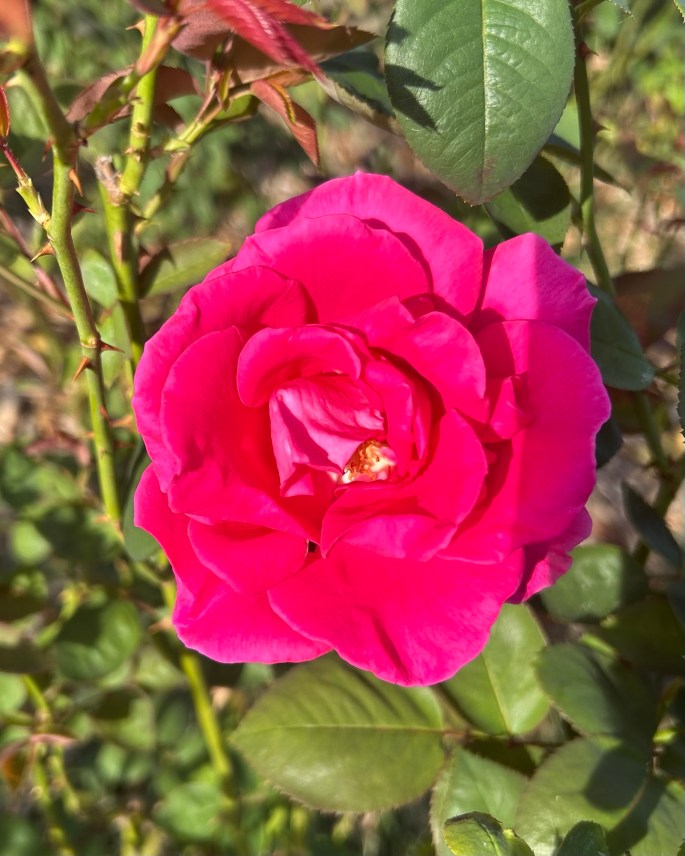
A close-up of a vibrant pink rose surrounded by green foliage, showcasing its full bloom and delicate petals.

Why This Practice Matters 😌

From that moment, I began cultivating an intentional practice of looking for at least one daily delight each day. As a result, I noticed that my mindset shifted, and my stress began to ease. More importantly, these little delights reminded me that goodness still exists—even on the darkest days.

A steaming cup of coffee rests on an open book, symbolizing a moment of warmth and reflection.
Photo by lil artsy on Pexels.com

What Counts as a Daily Delight? ☑️

To me, daily delights are moments that cost nothing, big or small, that spark joy or wonder. They might be a kind word from a stranger, the first sip of bargain coffee that tastes surprisingly better than the pricey brand you had been purchasing, the symmetry of flowers along a walking route, or the brilliant explosion of color as the sun rises over the Ohio River while driving to work. Ordinary moments are transformed and elevated simply by the act of paying attention.
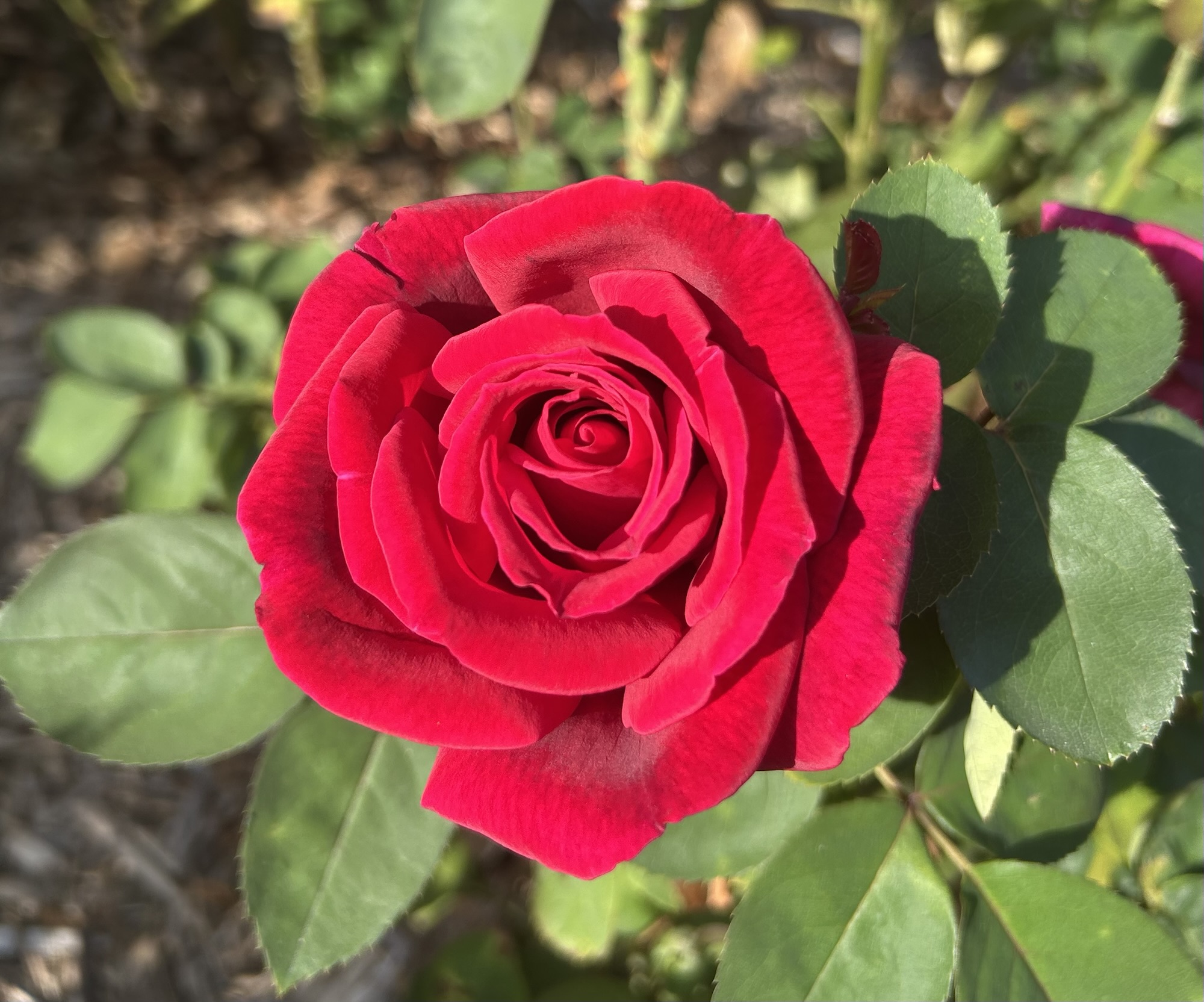
A close-up of a vibrant red rose in full bloom, surrounded by green leaves, capturing the beauty and intricate details of the petals.
Photo by lil artsy on Pexels.com

How to Find Them 🔎

The practice begins in the morning by setting an intention to look for the daily delight. As the day unfolds, I keep my mind’s eye alert—like a scavenger hunt—for hidden treasures, knowing that some days require more searching than others. The daily delight could be birdsong during my run, the sprawling sunlight lighting up the grain of my old oak desk, or a video of my daughter’s friend’s baby babbling and giggling at her new-found ability to pretend to cough. The practice is accessible, requires no extra time, and costs nothing but intention.

A close-up of a pink and white rose blossom surrounded by green leaves.

The Science Behind It 📖

Our brains, as a survival mechanism, are hardwired to notice threats. They fixate on bad events to help us avoid future peril. Unfortunately, in a 24-hour news cycle, this tendency takes a mental toll. Our brains often can’t distinguish real threats from repeated media images, leaving us anxious, restless, or fearful.

Intentionally noticing delights, however small, helps counterbalance this wiring. It reduces stress, builds resilience, and—most importantly—fosters hope. Practiced regularly, it becomes a bridge to gratitude and a more grateful outlook.

A couple sitting on a couch, wrapped in a blanket, smiling and laughing while playing with a light-colored dog.
Photo by Andres Ayrton on Pexels.com

Low-barrier Maintenance ✅

Fostering a daily delight practice is accessible to anyone, anytime, almost anywhere. It’s what I call a low-barrier activity—it doesn’t require journaling, a special setting, or money (no hidden fees or price hikes here!). You might keep a journal of delights or share them with friends or family. Personally, I enjoy sharing mine with others when appropriate because it amplifies positive feelings within. However, there are no other requirements beyond noticing and savoring the event.

A person gently touching foreheads with a cat in a sunlit room filled with plants.
Photo by Yuliya kota on Pexels.com

Even on Hard Days 😓

Of course, some days are less than stellar, especially when hardships pile up. In those times, it’s tempting to slip into cynicism. Yet even then, finding one joy—however small—can ease our uneasiness and calm our agitation. While we cannot erase challenging circumstances, we can coexist with them and still find good.

Two men laughing together outdoors, enjoying a moment of joy in a natural setting.
Photo by Ketut Subiyanto on Pexels.com

The Ripple Effects ↝

The ripple effects of this practice are profound: reduced tension, greater resilience, increased gratitude, and more positive interactions with others. Sharing a delight can spark connection, deepening bonds, and spreading positivity. Over time, this simple practice trains us to notice light even in the darkest corners of our world.

A close-up of a garden sign reading 'JUMP FOR JOY' with the word 'Floribunda' beneath it, surrounded by dried leaves and grass.

Shining Light in a Dark World 🔦

Like those hidden picture games of childhood, simple joys abound; they just need us to notice and color them in. They’re free, accessible, and powerful in shifting perspectives. Daily delights don’t excuse us from facing hard truths, but they open our eyes to possibilities—even on the hardest days.

A close-up of a pink rose flower blooming among green leaves.

Your Turn

So, what daily delight will you notice today??
Running with Purpose: The Charleston Distance Classic and My Marathon Journey

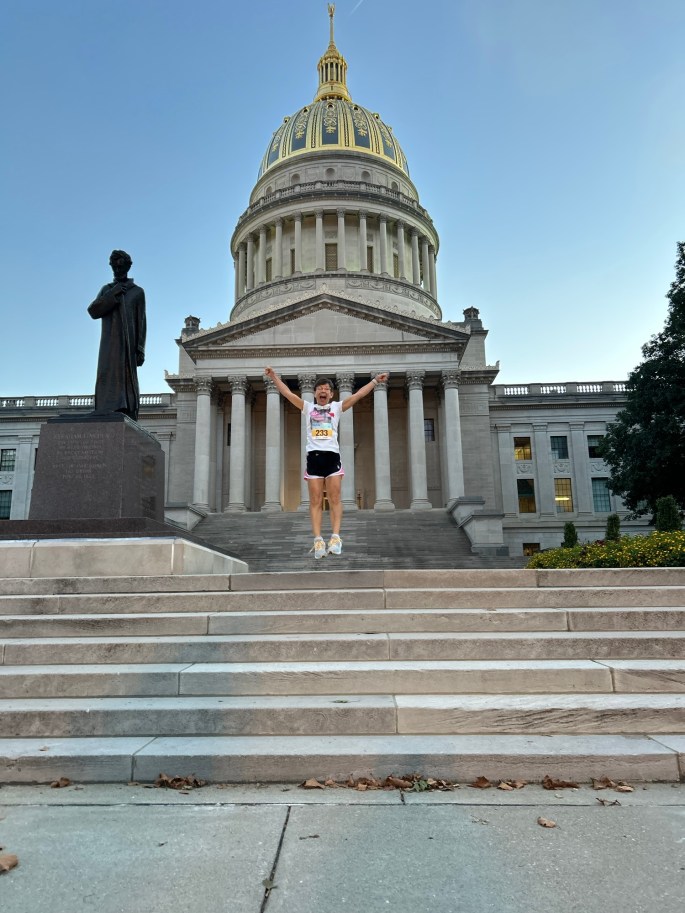
The West Virginia State Capitol building with a golden dome, surrounded by trees and a pastel sky at dawn.
The CDC starts in front of the state capitol of WV.

A Quote to Carry Me to the Start

Dean Karnazes is often credited with saying, “Run when you can, walk if you have to, crawl if you must; just never give up.” His words echoed in my mind while I was experiencing a case of collywobbles as my family and I drove to Charleston, WV, in the predawn hours of Labor Day weekend. Only weeks earlier, I had decided I had built enough base fitness to run the Charleston Distance Classic (CDC), “America’s 15-miler.”

A joyful runner in a race, wearing a white shirt with a 13.1 badge and black shorts, excitedly posing with a water bottle while making a peace sign.
Ready to run the CDC!

Returning to the Classic After Ten Years

It had been more than ten years since I last ran it. In my previous two runs of the CDC, the weather was formidable, with the typical August heat wave bringing high heat and humidity. In fact, it wasn’t unusual to see runners collapse on the course—or cross the finish line only to collapse into the arms of medics from heat exhaustion.

Two women pose together smiling in front of a large government building with a golden dome, one wearing a race bib and athletic attire while the other is in casual sportswear.
My daughter was texting me messages of support throughout the race, so Siri could read them to me in my ear as I ran.

How Running Has Changed for Me

Life was different ten years ago. Besides being younger, I was fairly new to running and relied heavily on veteran runners for guidance. On one hand, I was fortunate to have others with whom to train; on the other hand, I didn’t yet have the aerobic base they had built over years. Plus, when I started running, I gave up strength and flexibility exercises, which I now know would have helped me. Instead, I focused on keeping up with others and hitting the weekly mileage goals.

Runner stands on a swing-shaped structure in front of the West Virginia State Capitol, smiling and wearing a race bib, under a clear sky.
Ready to swing into action.

Building Balance and Training for a MarathoN

Over the past decade, I’ve taken breaks from running—first from burnout, when I missed other forms of exercise. I rotated through strength training, yoga, walking, and cycling, always circling back to running. The pandemic brought running back to the forefront, as gyms and studios were closed.

Since then—and one major surgery later—I’ve learned to build a more balanced approach to exercise that includes a wide array of modalities, running among them. I exercise now for the joy of movement, as well as overall wellness. Still, I enjoy the discipline of a challenge. This year, in honor of another decade milestone, I’m training for the Marshall University Marathon (MUM)—the full 26.2 miles. Rather than follow a standard 16-week plan, I began in January, gradually building my aerobic base.

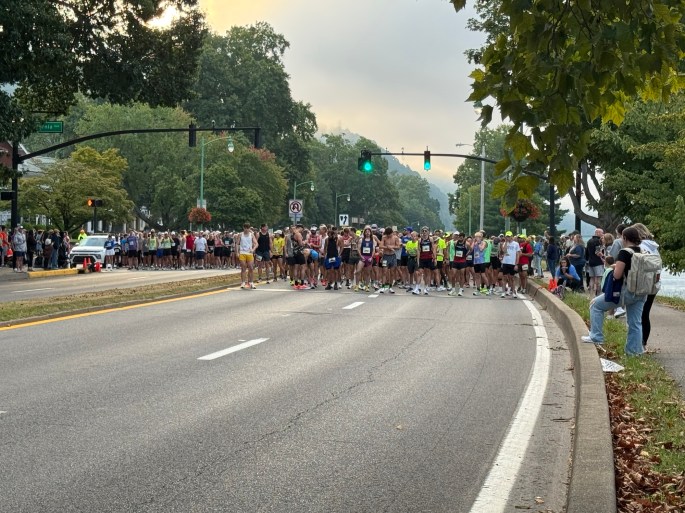
Runners lined up at the starting line of a race on a road, with traffic lights and spectators in the background.
The starting line for the CDC.

A Perfect Day to Race

It was this extended training that gave me confidence to run the CDC again. In addition, the weather worked in my favor. Temperatures were in the 50s when the race began in front of the state capitol. Running along the Kanawha River in the first mile, runners quickly spread out as paces varied.

View of a bridge with steel beams and a roadway, featuring a few pedestrians in the distance.
The South Side bridge, which runners crossed twice–near mile 3 and again at mile 8.

“Capital Hill PUnishment” and the Course Challenge

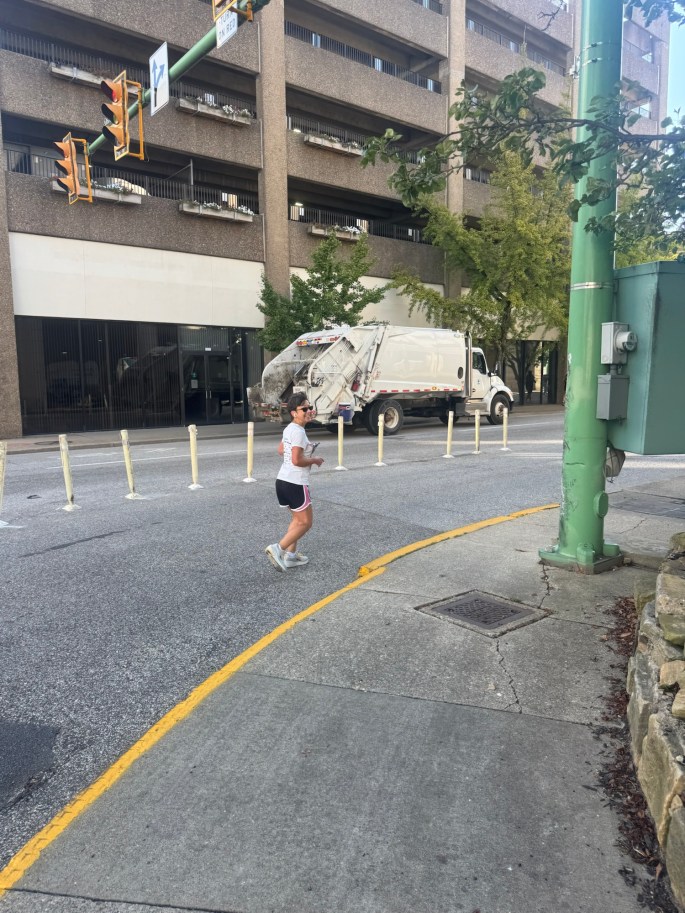
Before long, we crossed the South Side Bridge and began the long trudge up Corridor G, aptly nicknamed “Capital Hill Punishment”—two miles of climbing. As if that weren’t enough, the course then wound through three hilly miles of Charleston’s South Hills neighborhoods. By the time we returned to the South Side Bridge, eight brutal miles were behind us. The final seven were mostly flat, except for one last incline near the end—just when our legs were good and toasted.

My Cheer Squad: John and Maddie

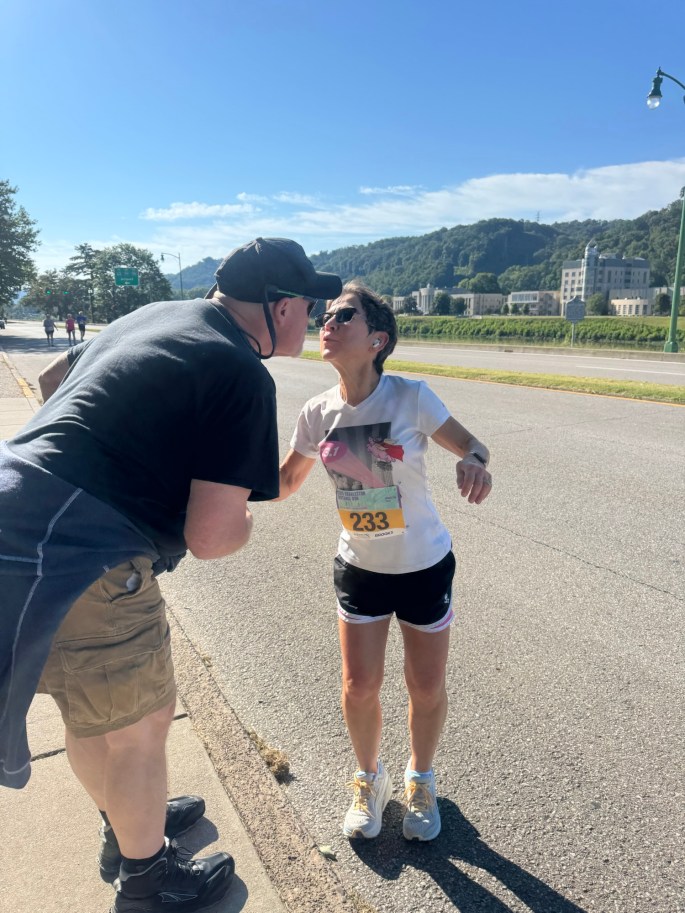
The CDC is a great spectator race, and I was lucky to have my husband, John, and daughter, Maddie, there. They were tireless cheerleaders, walking all over Charleston to encourage me. At the start, Maddie urged me on with excitement. At mile eight, as I crossed the South Side Bridge for the second time, she even ran alongside me for a short stretch, offering encouragement.

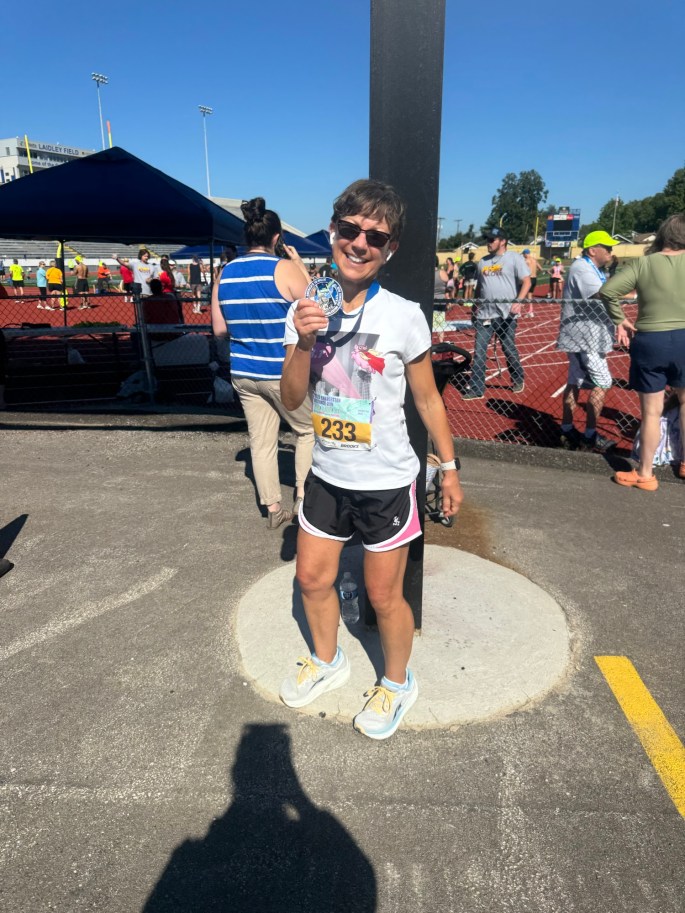
Between miles 11 and 12, they found me again, cheering and taking my empty handheld water bottle—by then more of an annoyance than a help. At Laidley Field, Maddie’s voice carried as soon as I stepped onto the track, her shouts of encouragement giving me the final push.

A person jogging on a city street with a garbage truck parked nearby and a multi-story building in the background.
This was mile 8. Afterwards, there was mostly flat course, EXCEPT for a last incline during the very last mile before the finish line. UGH!

Lessons from the Endless Last Mile

Honestly, that last mile seemed endless, and I learned a powerful lesson: even the final mile is still a mile long. My mental discipline slipped, and the fortitude that carried me there begged for rest. I grew whiny and irritable, which only amplified the aches and pains I had managed to ignore until then. It reminded me of my reaction in the last mile of a half marathon I ran this past spring in Asheville, NC.

Scenic view of a riverbank with lush greenery, walking path, and a bridge in the distance under a clear blue sky.
The beautiful Kanawha River that flows through Charleston, WV.

Strengthening My Fortitude

That last mile taught me what I must carry into the last weeks of marathon training: when the long runs get longest, I need to focus on strengthening my fortitude—especially at the very end. This, for me, is the hardest part. I try to follow the advice of Olympian Jeff Galloway (who is also credited with establishing the “Run-Walk-Run” method) to smile at each mile marker—since smiling releases those feel-good chemicals and helps relax the body. He also suggests repeating a mantra or power word. Perhaps I need to lean into this more.

Remembering My “Why”

I also need to remind myself of my “why” when the going gets tough. With the MUM, I hope to raise awareness for Branches Domestic Violence Shelter. Branches provides emergency shelter, legal assistance, counseling, case management, and even meal delivery for domestic violence survivors. Their work saves lives. If my miles can help encourage even a few people to support them, that will mean as much to me as crossing the finish line.

A smiling woman holding a medal, wearing athletic clothing, stands next to a post in a race finish area, with a crowd and tents in the background.
Feeling so grateful for my family, love, and support at the end of the CDC.

Running Differently, Running with Gratitude

Ten years later, I run differently. I take walk breaks when needed, and I’m grateful to still have my health. Running gives me energy, provides structure, and fills me with joy and purpose. Not every run is great, but each mile contributes to my community by keeping me connected to local races and to my own mental, physical, and spiritual well-being. Running also pulls me outdoors, connecting me with the Creator and with the delight of each season.

Never Give Up—In Running or in Life

Running the CDC reinforced the lesson of never giving up. I may be entering a new decade, but that doesn’t mean I have to give up striving for new goals—even if it means crawling to achieve them. Perhaps I’ll see you at the MUM. If not, I hope you’ll create your own journey. Either way, I invite you to celebrate with me—by supporting Branches or by committing to your own goal. Adjust as you must, but never give up. Step by step, with fortitude, tenacity, and a few deep breaths, you can do it.

A running event starting line with an inflatable arch labeled 'Appalachian Timing Group' on a red track, set against a clear blue sky and distant hills.
Never give up! You can cross whatever finish line in life you need to cross!