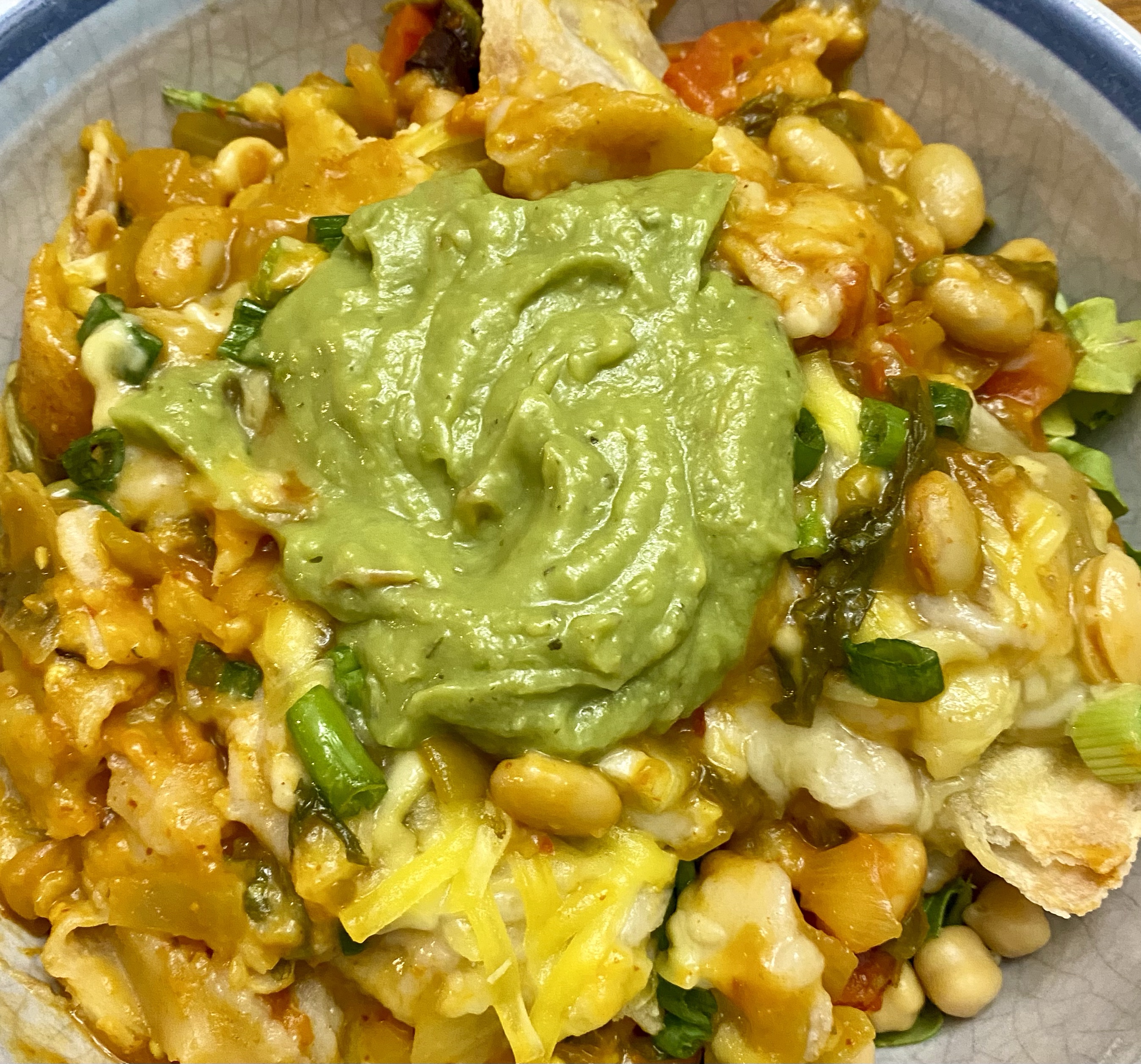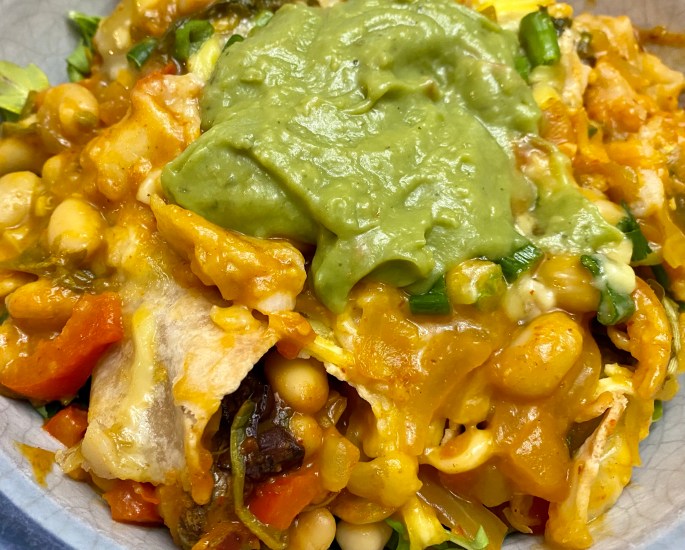
Green and White Enchilada Bake, featuring G-BOMBS, is a powerhouse of delicious nutrition

“Remember the acronym G-BOMBS, which stands for Greens, Beans, Onions, Mushrooms, Berries and Seeds. These foods fuel your body with protective micronutrients and phytochemicals that support your immune defenses and have a wide range of health-promoting effects. And here’s a bonus: They’re delicious!”–Joel Fuhrman, M.D.

Photo by Min An on Pexels.com

Beginning in December, I spent 16 weeks preparing to run, walk, or even crawl a half-marathon.  For those who are natural distance runners, completing a half-marathon is no big deal. However, for someone like me, it was a challenge, but it was an overall positive experience.

While preparing for this half marathon, I was battling an injury–one that did not affect my running, per se, but one that will ultimately require surgery.  Therefore, I knew I wanted my nutrition to solidly support the recovery of my middle-aged body.  However, for the sake of full disclosure, I still indulged my penchant for dark chocolate on a daily basis!

Photo by Pixabay on Pexels.com

I read, and continue to rely upon, the most up-to-date nutritional studies out of respected research institutes such as Harvard, Northwestern University, Cleveland Clinic, Mayo Clinic and so forth.  Additionally, I read more popularized sources of research such as Michael Pollan and National Geographic author/researcher, Dan Buettner, and his study of Blue Zones, as well as a few other noted sources.  The point is, I don’t make my food choices lightly, especially since I must also balance out these choices with my celiac disease and food sensitivities while still consuming food that looks great and tastes even better.

For a whole slew of reasons, I rely on a whole food, plant based diet 90% of the time, and this recipe–that I created during my half-marathon preparation–is an example of this.  I want my meals to be alive with color, texture, and balanced flavor, with a bit of spice thrown in.
Additionally, I try to regularly consume GBOMBS, greens, beans, onions, mushrooms, berries, and seeds, for the most nutritional bang for my buck, and this recipe has four of the six of them.  (I typically eat berries and some form of seeds–flax, chia, or hemp hearts–during an earlier meal of the day.)

Photo by Vanessa Loring on Pexels.com

If you prefer to add meat, my recipe can accommodate your preference.  You could choose to replace the beans with chicken or seafood, or keep the beans, and add in meat.  Spices are optional, and I have made a note regarding why I add them.  I typically serve these enchiladas on a bed of leafy-greens and top them with a dollop of guacamole and chopped scallions.  However, you could serve them on top of rice, quinoa, or simply as they are.  Feel free to get a little frisky with the toppings of your choice!

Personal food choices are the N = 1. Therefore, I would never presume to tell anyone what they should or should not eat.  Nonetheless, I think most of us can agree, you can’t go wrong consuming a bit more veg.

From my home to yours, I hope you enjoy this recipe!

Ready to broil a bit.
Add your favorite toppings . . .
Serve it up on a bed of greens and/or grains and add more of your favorite toppings, such as guacamole.

Green and White Enchilada Bake

Ingredients:

½ cup vegetable broth or water

1 teaspoon minced garlic

1 cup chopped onion

½ cup chopped mushrooms, any type, optional 

½ cup chopped red, yellow, or orange bell pepper

2 teaspoons nutritional yeast (can substitute equal amounts of grated parmesan or chickpea flour)

½ teaspoon onion powder

¼ teaspoon crushed *red pepper, optional

¼ teaspoon *turmeric powder, optional 

Dash of *black pepper, optional

1 15 ounce can great northern beans, drained

1 4-ounce can green chiles

1 package low-sodium taco seasoning

8 ounces frozen spinach, thawed and drained

1 can green enchilada sauce

6-8 tortillas, depending upon size (I used gluten-free tortillas.)

2 cups shredded cheese, your choice (I used a vegan substitute for photos, but I’ve also gone without it.)

Directions:

Preheat the oven to 350 degrees.

Prepare a small casserole dish with nonstick cooking spray.

Chop onion and bell pepper, if using.

Heat a saucepan over medium heat.

Add minced garlic and broth, stir.

Add in onion and bell pepper, stir well.

Allow to simmer until vegetables begin to soften, about 3-5 minutes.

While vegetables are cooking, stir in nutritional yeast and onion powder 

If using crushed red pepper, turmeric powder, and dash of black pepper, stir those in as well.

Meanwhile, open, drain, and rinse the beans; stir into the simmering vegetable mixture.

Stir in green chiles and taco seasoning into the simmering vegetable and bean mixture, and allow it all to simmer for another 3-5 minutes, continuing to stir.

While the vegetable/bean mixture is simmering, stir in the spinach and allow it to simmer and wilt into the rest of the ingredients.

While vegetables are simmering, set up all tortillas, taco style, in the casserole dish.

Remove vegetables from heat; then, divide and fill tortillas with vegetable/bean mixture, folding down one side over the other, and using a toothpick, if needed, to keep closed.

If there is any remaining vegetable/bean mixture, pour over the tops of the closed tortillas.

Pour a can of green enchilada sauce over the closed tortillas.

Top with desired cheese, if using.

Bake, uncovered in the oven for approximately 25 minutes until sauce is bubbling at the edges.

Feel free to turn on the broiler for the last minute or two to brown the top of the casserole if desired.

Remove from the oven and allow to cool for 5-10 minutes before serving.

Makes 3-4 servings, two enchiladas per serving.

Top as desired.

Refrigerate any leftovers for up to 5 days.

*Note: Spices are a personal preference, so you choose if you want to add these ingredients.  Here’s why I do.

  • I use turmeric daily as an anti-inflammatory agent.  When cooking with tumeric, I pair with a dash of pepper as the pepper enhances the absorption of turmeric in the body by up to 2,000%.  Together both spices reduce inflammation and improve digestion.
  • I also regularly use crushed red pepper flakes and red pepper for its ingredient, capsaicin, which soothes stomach issues, boosts heart health, and fortifies the immune system.

Move Into Health, Part 9: The Long Game

“ . . . To me, old age is always 15 years older than I am.”–Francis Bacon

I recently ran across an inspirational story that was being shared across a multitude of media outlets.  Jean Bailey, a 102-year old resident and fitness coach of Elk Ridge Senior Living in Omaha, Nebraska, has been leading fitness classes there, four times a week, for the past three years.  

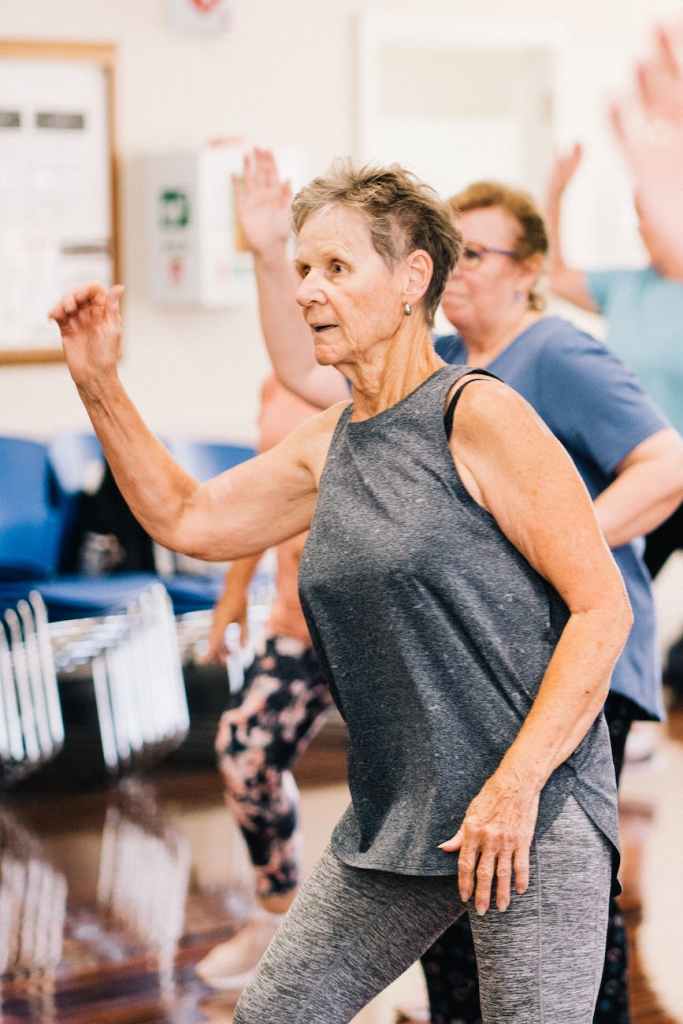
 Bailey’s classes consist of exercises that go through a wide range of motion, designed to get every part of the body moving, including activities such as overhead reach, arm circles, neck rotations, and seated toes touches to name a few.  Her classes last about 30 minutes.  Bailey realizes that, like her, many of her fellow exercisers have mobility limitations or their bodies are different from day to day; however, she believes that everyone, including herself, can benefit from doing what they can do.  

102 year old Jean Bailey leading an exercise class at Elk Ridge Senior Living in Omaha, Nebraska.

Bailey is redefining what it means to age.  She proudly proclaimed in a recent interview, “If you don’t keep your mind and body busy, then why are you here?” Friendships have blossomed and flourished since she first began leading the classes during the pandemic when Bailey invited her neighbors to bring chairs into the hall and exercise with her at a socially safe distance.  

Since COVID restrictions were lifted, Bailey has also been known to treat fellow exercisers with baked goods after class, especially in honor of someone’s birthday.  This is because, as Bailey points out, birthdays at their age are noteworthy. When asked if she’ll ever quit, she replied, “When I get old, I’ll quit!”

I share this story as part of the 9th installment of the “Move Into Health” series. Bailey’s story serves as a direct contrast to those limiting beliefs, which can easily entrap any one of us, regarding adopting or changing certain healthy lifestyle habits as we age. However, even though our bodies change with age, according to numerous scientific studies, there is very little difference between an 18-year old brain and a 100-year old brain from a cerebrovascular perspective; thus establishing, we are never too old to mentally adopt new habits or overcome poor habits that may have crept in over the years.

Bailey is most likely an example of what scientists call SuperAgers, those living into their eighth decade, and beyond, who possess cognitive function similar to that of a middle-aged adult.  In fact, neuroscientists at Northwestern University in Chicago have identified four specific habits of SuperAgers. Adopting these four SuperAgers’ healthy habits may help slow down the aging process within the brain (and the body), potentially staving off Alzheimer’s disease or other forms of dementia, while boosting overall health; thereby, spending less time at the doctor’s office and more time doing the things you love.  

Photo by Wellness Gallery Catalyst Foundation on Pexels.com

The four habits of SuperAgers are listed below. While I am not a proponent of changing everything all at once, I do sincerely believe that taking small steps towards any of these habits can have a positive impact upon personal health.

Daily Movement/Activity. You know the old adage, “Move it or lose it.”  Incorporating daily movement increases oxygen and blood flow–both of which benefit the brain.  Regular bouts of exercise, even as few as twice per week, strengthen not only the heart and lungs but can also strengthen muscles required for stability to avoid falling, help maintain a healthy weight, and reduce the risk for Alzheimer’s disease. As an added bonus, exercise can reduce the symptoms of depression and anxiety and lower your risk for heart disease, type 2 diabetes, high blood pressure, and even some cancers.

Photo by Tirachard Kumtanom on Pexels.com

Challenge yourself. Adopt habits of reading, puzzle solving, and learning. Experiencing the mild to moderate stress that often accompanies learning a new skill is good for creating and/or maintaining healthy neural pathways. Take classes, learn a new language, or choose any number of activities that get you out of your comfort zone.  Mental challenges are good for you and your brain.

Photo by Mathias Reding on Pexels.com

Get social.  Meeting regularly with friends, engaging with others via group settings, or partaking in family gatherings allow for the maintenance of healthy social relationships.  In fact, autopsies of SuperAgers reveals that the attention area of their brain has four to five times the amount of neurons responsible for social processing and awareness, when compared to others who lived into their 80s or later.

Photo by Kampus Production on Pexels.com

Drink, but in moderation. Moderate drinkers are less likely to develop memory issues, including Alzheimer’s disease.  However, too much alcohol creates the opposite effect on memory as well as increased belly fat (the most dangerous type), increased blood pressure, and numerous other health conditions.

Photo by cottonbro studio on Pexels.com

Two other beneficial habits worth considering that are also associated with aging well:

Adopt a MIND diet.  MIND, in addition to being a huge buzz word in current medical research for the prevention of Alzheimer’s disease and cognitive delays, is an acronym for Mediterranean-DASH Intervention for Neurodegenerative Delay.  It is a plant-based diet that combines the Mediterranean Diet and the DASH Diets. The MIND diet encourages the daily consumption of plenty of fruits (specifically berries), and vegetables (especially leafy greens), whole grains, legumes, nuts, as well as limited amounts of poultry, fish, and olive oil.  Not only are these foods good for overall brain health and cognitive function, but they also reduce inflammation and oxidative stress, two actions strongly associated with chronic health illnesses and disease. 

Photo by Yaroslav Shuraev on Pexels.com

Quit smoking. While I cannot pretend to know how hard it is to stop this habit, I do remember a nurse telling my mother-in-law during an emergency room visit that within 24 hours of quitting smoking, she would begin to reduce her risk of a heart-attack by 50% or more.  It still took her several more years before she quit; however, I will forever admire the way in which she finally gave up the habit at age 71. Although health issues related to a lifetime of smoking remained with her until the end, because she did quit, she added years to her life.  

Photo by Irina Iriser on Pexels.com

Who among us will be the next SuperAger?  No one can know for sure. To be certain, any one of us could follow all the so-called rules, and still develop Alzheimer’s disease, cancer, or other detrimental condition.  Nonetheless, watching Jean Bailey lead her exercise classes on Youtube and Twitter videos certainly persuades me to keep moving into my own health, and her story further motivates me to continue to share this valuable information. Adopting any or all of these healthy habits can’t hurt any of us, and they just might add a bit more quality to the quantity of years we have remaining.  Here’s to your health!

Photo by Jessica Lewis Creative on Pexels.com

Detaching from the illusions our attachments create

“Time is an illusion.  Lunchtime doubly so.–Douglas Adams

A coworker and I were talking after school one day about plans for the work week, the schedule, and what we were planning.  It was a brief exchange as he was preparing to leave for the day, and I was settling into grading papers. 

 I jokingly said, as he headed out of the door, “You know it’s all an illusion.  We can plan all we want, but who knows how it will really unfold.”  

Photo by energepic.com on Pexels.com

This made us both laugh and shake our heads because we both know as teachers no matter how much thought, effort, and time we put into planning for our students, things rarely go as predicted.  Schedules can change and/or students’ level of attention, understanding, or even behavior can completely alter our well–intended plans, creating the need to pivot quickly, adapt and modify plans.

Sure enough, the very next day, plans for the week had changed.  We rethought and restructured our plans.  The next day arrived with another change.  Before long, how the week actually turned out was very different from how it was originally conceived.

Photo by Kobe – on Pexels.com

I share this, not as a point of negativity, but rather as a point of reality.  Rarely does life unfold as we plan for it. Nonetheless, I still tend to cling to schedules and routines since I am not naturally organized.  However, I have learned to embrace the word “flux” over the years. In fact, I am realizing that my attachment to “how things should be” is all just one big illusion.

Furthermore, my illusion is due to my attachment to “control,” which, in fact, is also an illusion.  The desire for control is a gripping cycle for many of us.  Our attachment to ______ (how things were, how they should be, or how they could be) reflects our wish for control.  It also helps to create the illusion that we will be happy if everything “goes according to plans.”  However, when things don’t go as we had hoped, we can feel downhearted or disappointed. 

Photo by Ketut Subiyanto on Pexels.com

However, it’s not just schedules and outcomes to which we attach ourselves.  We can attach ourselves to friends, family, groups, teams, circumstances, positions, things and so forth.  We begin to identify with those people, those groups, those situations, and so forth.  Even our address becomes a point of attachment.  

Unfortunately, these attachments can sometimes allow stress to enter our lives when/if we lose one of these identifiers, things, or when circumstances change.  Sometimes a change can become nearly debilitating due to our grief and sense of loss.  Other times, our anxiety spirals out of control from the pressure we feel as a result of expectations caused by our attachments.

Photo by Suzy Hazelwood on Pexels.com

Again, none of this is inherently bad.  We are all human beings, experiencing the very human need for belonging, validation, and contribution.  However, it might be helpful to also allow for some amount of detachment as we move through life.  This is because when we attempt to only hold on to what feels familiar and comfortable, we can sometimes prevent ourselves from experiencing a newfound way to experience joy and happiness.  Therefore, it is worth remembering the importance of letting go, or at the very least, holding loosely, in order to allow for new, unimagined life experiences.

I was thinking more about this attachment-control-illusion cycle as I went for my weekly long run one morning along the tree lined paths of Ritter park. Jogging alongside those noble limbed sentinels, I realized that trees are not attached to one another.  Instead, they function independently, even though they are part of a collective landscape.  

Photo by Artur Roman on Pexels.com

Numerous dogs, people, and other creatures move in all directions under the shelter of the branches.  Chunky squirrels and round robins flit up, down, and all around outstretched tree arms. All the while, neither do the trees attach their identity to or make plans for any of this, nor do they try to control it.

The trees did not seek my attention, and yet I couldn’t help but notice them.  Neither did the trees seem to need my praise or approval.  Nonetheless, my mind kept marveling at the way their leaves were beginning to bud while at the same time birds were creating neighborhoods of  nestled nests. Likewise, without being attached to a certain group, I could still identify the various types of trees. 

The park trees, like all trees, are independently rooted in the soil and work with the circumstances in which they find themselves planted.  They do not, per se, have expectations or plans for how their growing season should unfold.  In fact, they can’t even count on predictable circumstances from year to year, so changeable is the weather.  

Photo by Mauriciooliveira109 on Pexels.com

No matter their situation, and without any attachments or attempts to control, trees still manage to contribute. They act as a refuge for food and shelter for birds and other animals/insects.  During warmer months, their well-dressed branches provide cooling shade for people and creatures alike. Trees even offer opportunities for raucous fun as squirrels chase one another all around their trunks and branches while birds play hide and seek, singing songs of tidings.

Near the end of my jog, the sun began to burn through the tapestry of clouds.  As the glistening light gradually emerged, the overcast dullness gave way.  Instantly, I felt less encumbered by tired legs, and a renewed vigor filled my heart and lungs.  

Photo by Adam Kontor on Pexels.com

I was then reminded of how cloudy our thinking can become when we fall prey to our self-inflicted illusions. Furthermore, I began to see that there is no pushing through attachments and the illusions our attachments create.  Rather, it is a practice we must intentionally pursue through patience, perseverance, and most of all gentleness, which is not easy. However, the more we can recognize when we are attaching, the more often we may be better able to lightly detach. 

Personally, I still like predictable plans as well as my coworker.  Nonetheless, similarly to the way the sunlight lifted my spirits as I jogged, I know that the more we can detach or grasp less to our so-called illusory plans/attachments, the more we can experience unexpected, and dare I say, unplanned, moments of joy! 

Photo by Sebastian Arie Voortman on Pexels.com

Use the RAINDROP technique to weather life’s emotional storms

“Peace is this moment without thinking that it should be some other way, that you should feel some other thing, that your life should unfold according to your plans.”–Dorothy Hunt

Several months ago, during the fall of the year, I was walking on a local, circular path.  Suddenly, I heard the loud rev of an engine.  VROOM!  I saw a large SUV type vehicle, careening, plowing, and then swerving off the road, straight towards the path over which I walked.   

My heart began to race, and my thoughts quickened, trying to process what I was witnessing.  The SUV drove along the slope that forms a ditch line surrounding the path.  KREECH! The sound of metal collapsing was ear-splitting as the vehicle crashed into a heavily staked, metal line, thick and entwined like a rope, that supported a power line pole.  Fear raced through my veins as I ran towards the vehicle to see if the person inside was ok while grabbing my phone to call 911.

Photo by Mike B on Pexels.com

I find this event to be an excellent illustration of what it means to witness.  I was the bystander.  My senses heard, saw, and even felt this scene as it unfolded in a surreal manner.  This same skill of witnessing as a bystander is a tool we can use to help navigate difficult emotions/feelings when they come crashing into our life path.  And, let’s be honest, difficult emotions can be a regular occurrence at all stages of life.

From anxiety to depression to life event stressors and work stressors, I daresay none of us are immune to challenging emotions such as anger, insecurity, sadness, fear, and numerous other less-than-kind emotions.  This is where tapping into the bystander part of the brain can help us navigate through the mental storm clouds with a technique called RAIN and its counterpart DROP, acronyms first coined by Michele McDonald, a mindfulness teacher.

Photo by Ron Lach on Pexels.com

There are times when we may not initially recognize that our emotions/feelings are impacting our thinking, but with a bit of practice, we can begin to recognize that they are.  Actions such as, lack of focus/feeling distracted; binge eating/drinking/scrolling/watching; avoidance/procrastination, and so forth can be indicators that something is awry.  Even seemingly positive actions can be a side effect of not-so-great feelings trying to bubble to the surface, such as busyness; continuously working; over-exercising; frequent napping, and so on.

This is when the RAIN technique can be effective.  RAIN gently asks us to become a bystander in our minds to determine what we are feeling or perhaps trying to avoid feeling.  Then, it takes us through a process of reflection to bring us to a point of compassionate self-awareness.  Like all techniques, however, it takes practice, and it is not a one-stop-fix-all solution. However, it can be one more tool in life’s toolkit for managing difficulties and suffering.

Here are the steps, based upon my interpretation and personal application of the technique. However, it is worth noting that there are numerous free apps, videos, books, and websites that offer guided versions of this technique that can be quite helpful, especially in the beginning.

Recognize what is going on and name it. “I’m feeling angry, hurt, lonely, sad . . . .”  Then you might also notice if you’re judging those feelings or feeling guilty for having the feelings in the first place.

Acknowledge and Allow. Once you’ve named it, begin to witness your feelings as a bystander would at the scene of an accident. If thoughts pop up that tell you that “shouldn’t feel this way,” gently tell yourself that it is ok to have this feeling.  

Investigate your emotion/feeling with curiosity and interest minus judgment or blaming self or others. What are you feeling and where are you feeling? Similarly to the way I experienced the accident–first in my heart, next in my mind, and finally in my body–where in your body do you feel this emotion? How is it affecting you?  Do you want to cry, eat, move, hide, nap, and so on?

Natural Awareness, Non-identification and Nurture.  This is where you can tell yourself that just because you feel it, doesn’t mean it defines who you are.  Instead, use this as a lesson for how ________ (name the emotion) feels like, similar to the way you feel symptoms of a cold, the flu and so on. Then, take time to offer yourself compassion just as you do when experiencing a cold or flu. You could even place a hand on your heart center or gently pat your cheek as an act of self-compassion.

Contrastly, each stage (letter) of DROP to a corresponding, often knee-jerk, reaction to each step (letter) of the RAIN process.  It creates a greater understanding of those monkey mind tendencies that want to interrupt or impede the RAIN process in order to confuse the bystander role of our brain. 

Distraction and Delusion. Our brains would often rather distract or delude us from the truth of the matter instead of allowing us to recognize and name what we are really experiencing. 

Resistance. Sometimes, this means, we have to push past our mind’s initial resistance in order to allow and accept the emotion we are experiencing.

Obliviousness. When you take time to honestly investigate a so-called negative feeling, you are overcoming the self-obliviousness, the “I lie to myself all the time, but I never believe me” habit, so many of us unwittingly practice.

Personalization. Your feelings do not have to be the narrative of your life.  You might feel angry, but it doesn’t mean you’re an angry person. You might cry when you feel insecure, but it doesn’t mean you’re unworthy.  In other words, don’t make the emotion/feeling personal, it just is.

Raindrops are going to come and go in life, and some time periods are cloudier than others. There are times when it seems those rain-filled clouds will not leave.  And so it can be with our emotions.  We cannot always control the stormy feelings and thoughts that we encounter throughout life’s ups and downs, but we can choose to change our relationship to them. With the RAIN practice, we can tap into our brain’s ability to witness the impending storm clouds and offer ourselves an umbrella of self-compassion and understanding to help us weather the storms of life with a greater sense of resilient grace.  

Rain and Umbrella by Fu00e9lix Hilaire Buhot (French, 1847u20131898) is licensed under CC-CC0 1.0

Crab Cake Delight with gluten-free option

“Do not be the proverbial crab in a bucket and make war with those around you! Work together and grow! Love! Live Life!”–Marvin Gaye 

I know, I know!  Why am I writing a piece about crab cakes when I personally don’t eat meat?  Furthermore, why would I create a recipe that not only has meat, but also has “glutinous” bread crumbs, when I have celiac disease? I have several valid reasons, but the biggest of all is that I live in a world with a wide-array of taste/dietary preferences.  

Besides, I do not have the proverbial “crab mentality” that says, “If I can’t have it, you can’t have it.”  Goodness gracious, not eating meat is my personal choice; whereas, avoiding gluten is a necessity.  Regardless, my choices and restrictions do not dictate my ability to create recipes and share.  What’s more, I am already fast at work, creating my own plant-based, gluten free version of the following recipe, but I am getting ahead of myself.

Photo by Mark Stebnicki on Pexels.com

John, my husband, recently said to me, “You know what I’ve been craving that you haven’t made in years?  Crab cakes.”

I was delighted to make them for him, but I had to first hunt up the 20+ year old recipe.  When it wasn’t saved on my computer, I thought I was in trouble.  Nevertheless, I persisted and found my original recipe for crab cakes tucked inside an old Longaberger recipe basket, given to us as a wedding gift, nearly 34 years old.

I created this recipe when our daughter, now an adult, was a toddler, before I had decided to give up meat, and well before I knew I had celiac disease.  The recipe was now faded, yellowed with age, and full of stains from heaven-knows-what ingredients as I tend to multitask while cooking.  Looking at the neatly penned recipe, I recalled the chicken-scratched incarnations of the recipe as I originally crafted it.  Once I settled on the final variation, it was a recipe I frequently made–I even made it, a time or two, using salmon.  Then, like so many family foods, the recipe faded into the past, and it was replaced with other family meal-time favorites.

The yellowed card covered with the stains of cooking ingredients, speaks to its original creation of over 20+ years.

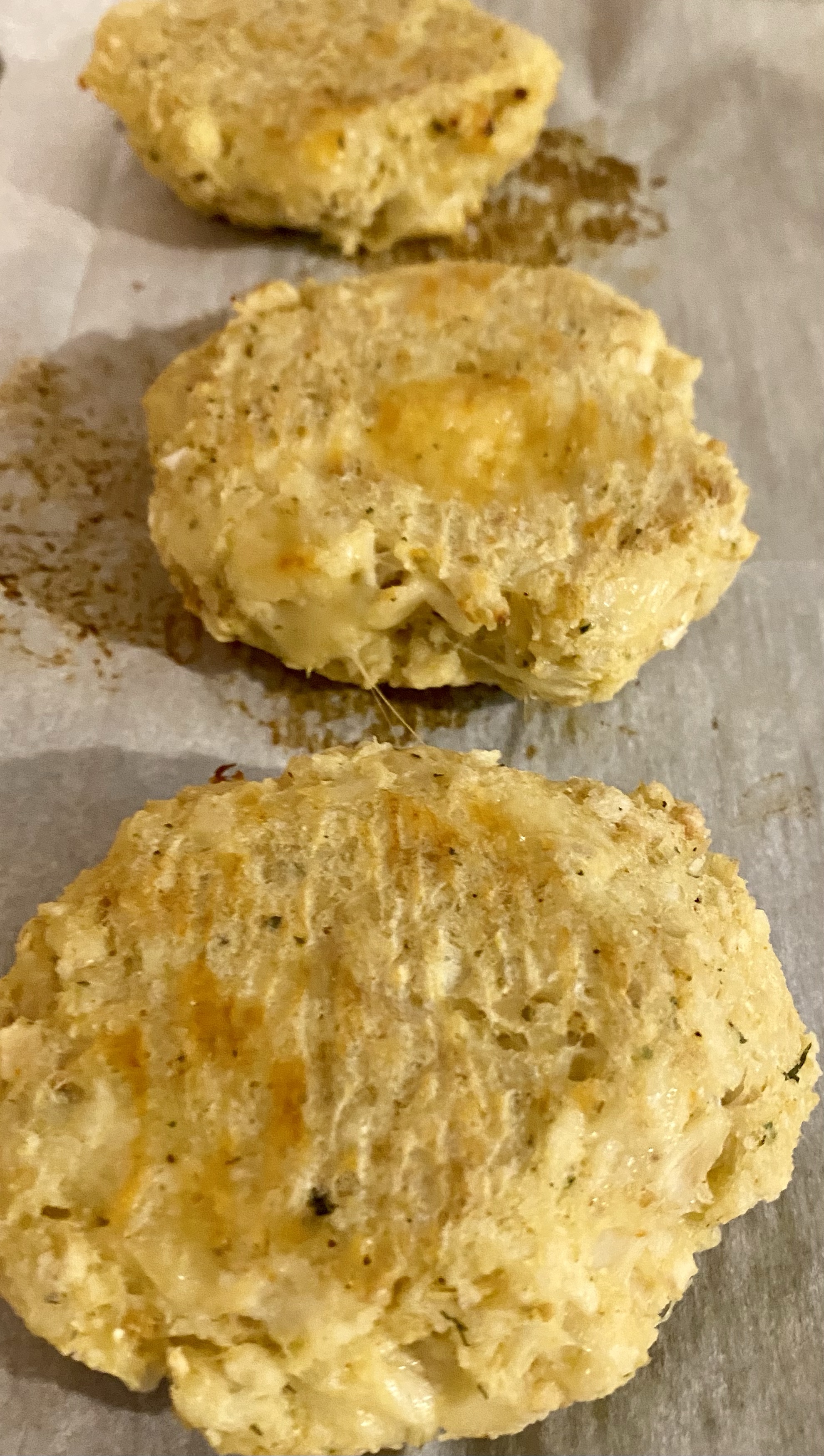
How was it this time?  Well, I didn’t taste them. What I can say is the cakes were super easy to make, and baked to a golden perfection, filling the house with the redolent scent of a seaside bistro. I did, however, make them with gluten-free Italian bread crumbs because I would be handling the ingredients. (Many people with celiac disease cannot touch/handle wheat products, or they break out in hives.  I typically don’t, but it wasn’t worth the risk.)  Nonetheless, John ate those crispy cakes with gusto throughout the week, often questioning why I ever stopped making them in the first place.

 Whether a person eats meat, or gluten for that matter, is a personal choice.   While I do sincerely believe that we all benefit from eating more whole plant-based foods, it is up to each individual to determine what foods are personally right for their unique body and life circumstances.  Regardless of dietary practices, I wholeheartedly believe that good food should be savored and enjoyed.  And, as a creative person who relishes the process of cobbling together new recipes, it is incredibly gratifying to see others smiling and enjoying the foods I create.

With that said, I hope you enjoy this recipe–whether for a Lenten supper or for lighter dinner fare.  Serve these crab cakes up with some grilled asparagus (as it will be coming into season soon), mango salsa, air-fried peppers and onions, rice pilaf or any number of side favorites.  The choice is yours!

Eat. Good. Food. Made. With. Love.

Steph’s No oil Crab Cakes

Ingredients:

1 egg (or liquid egg substitute)

1/4 cup ranch dressing

2 (6 oz) cans lump crab meat drained, flaked*

4 teaspoons lemon juice (juice from about half a lemon)

½ cup Italian breadcrumbs (gluten free, if needed)

⅓ cup shredded parmesan, romano, or asiago cheese

1 teaspoon dried minced onion (can substitute ground onion powder)

¼ teaspoon ground red pepper

Directions for oven:

Preheat the oven to 350 degrees.

Line a baking sheet with parchment paper.

Beat egg lightly with a fork in a medium bowl.

Stir the remaining ingredients until mixed well.

Divide mixture into six equal portions.

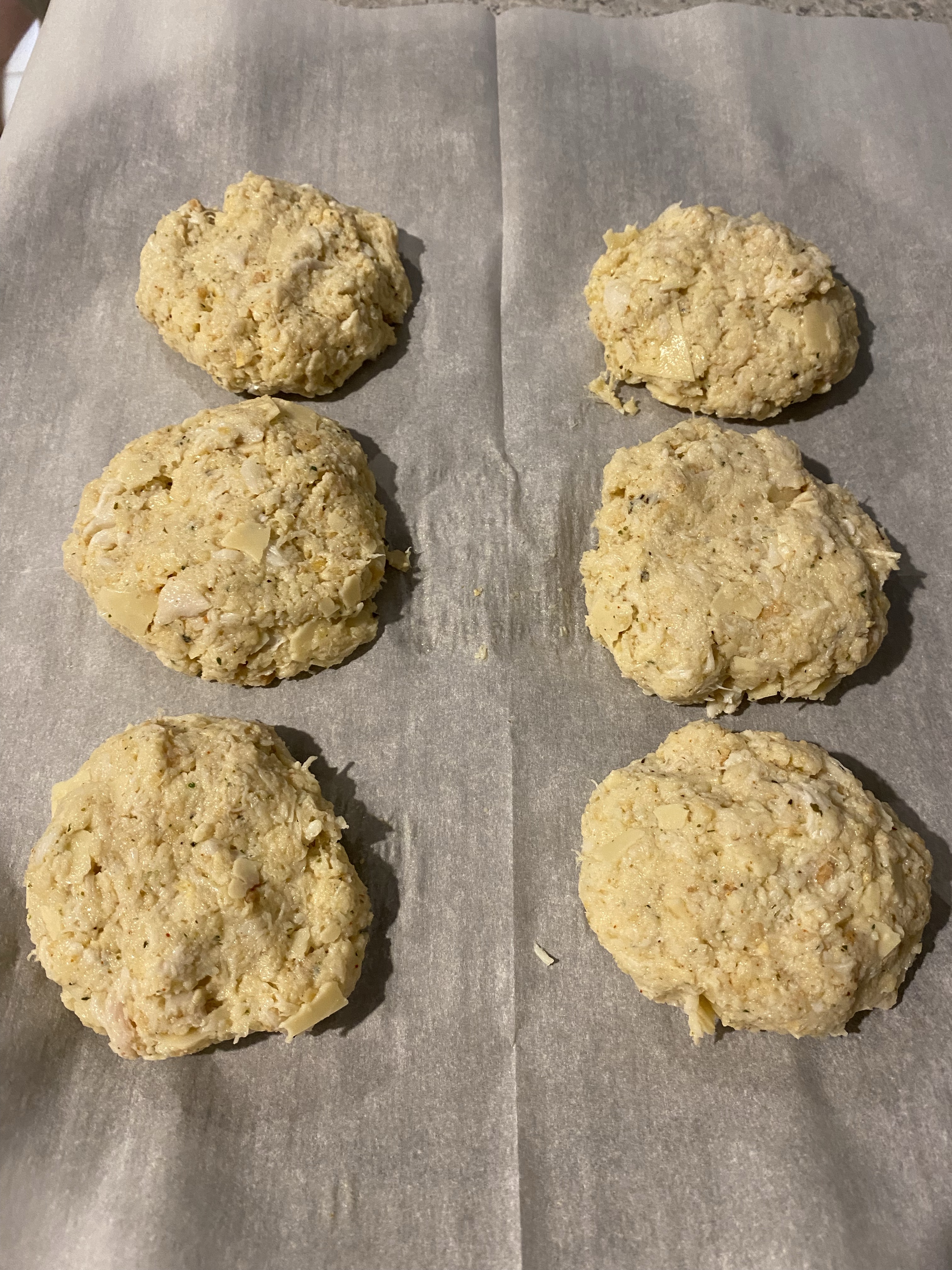
Roll each portion of crab mixture into a ball, flatten into a patty, and set on parchment paper.

Repeat process, allowing an inch or two of space between each crab cake patty.

Place in the oven and bake for 10-15 minutes on each side, or until golden brown.

Directions for air fryer:

Follow directions above for mixing and dividing crab mixture.

Lightly spray the air fryer basket with cooking spray.

Set the air-fryer to 375 degrees.

Place crab cakes, three to four at a time, in an air fryer, lightly spraying the top of each with cooking spray.

Cook approximately 8 minutes on each side.

Serve immediately or keep warm until ready to serve.

Makes six cakes.

Leftovers can be stored in the refrigerator for up to five days, and reheated as needed. 

Leftover crab cakes make great sandwiches and/or wraps.

Stir together all ingredients into a bowl. I didn’t have have shredded parmesan on hand, so I used freshly shaved parmesan instead.
Mix well until ingredients are well-incorporated.
Divide into six approximately equal sections.
Form each section into a ball, press into a patty, and place on parchment lined paper.
Bake them up, being sure to cook on both sides, until golden brown.
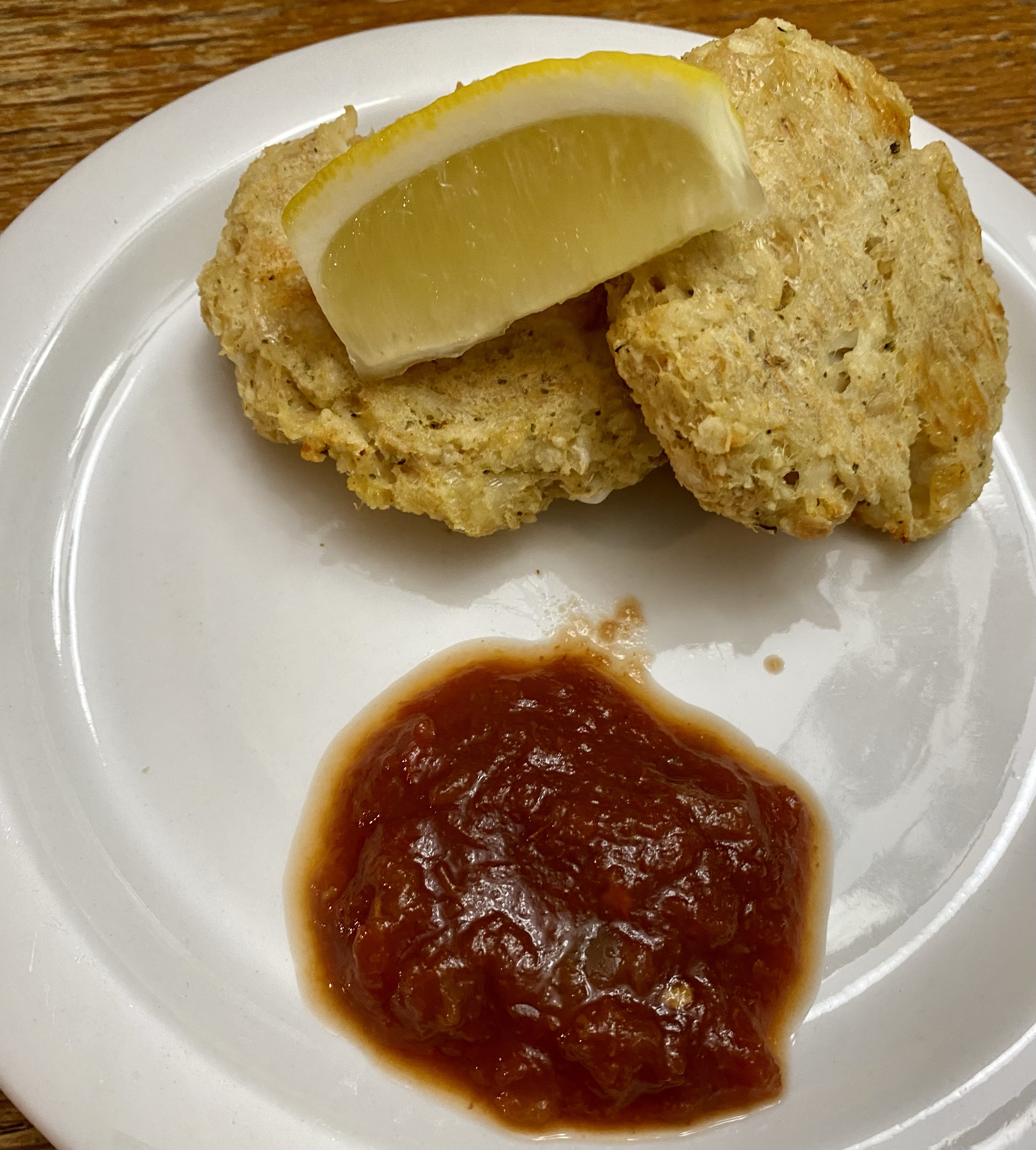
Serve them with fresh lemon and your favorite side or dip! You can also use them to make sandwiches or wraps!

Mind Over Matter: Mental Strategies to Push Towards Your Movement Goals

“Put all excuses aside and remember this:  You are capable.”–Zig Ziglar

During my Saturday morning run this past week, there were numerous times I wanted to quit. It had taken me nearly two hours to complete, and it had not felt nearly as good as my last run at the exact same distance.  Nonetheless, I kept employing different mental strategies I’ve learned over the years and, ultimately, completed my goal.

Photo by Volker Meyer on Pexels.com

That run got me thinking about the importance of mindset and the mental strategies/techniques we sometimes need to employ to incorporate more movement and exercise into our lives.  Therefore, in this 8th installment of my “Move into Health” series, I will share several research based mental strategies for exercise/movement for those days when we “aren’t feeling it.”  Moreover, many of these tips can be applied to other areas of life, such as tackling difficult tasks.

The mind-body connection is powerful. Whether discussing exercise, or tackling a difficult/challenging project, it is important to recognize the influence of the mind-body connection.  From having a churning stomach in response to an upside routine change, such as shift workers, to coming down with a cold after prolonged exposure to a stressful event, our bodies respond to the changes in our mind.  Therefore, by understanding this connection, we can unleash its potential to positively influence our attitudes and choices, especially with regards to movement goals.

Photo by SHVETS production on Pexels.com

Be patient; remember the long game, and avoid comparison: As my decades continue to stack, the long-game is most often at the forefront of my thoughts.  By prioritizing the fact that I want to remain injury free, healthy, mentally engaged, and purpose-driven for years to come, I’ve had to slow down, make moderation a priority, and avoid comparisons to my past self, previous workouts, and definitely not to others.  It’s important to be clear on long-term life goals and determine how movement/exercise can benefit that plan.  When we see how exercise and movement can contribute to and enhance our bigger life picture, it provides a bit more motivation to get out there, even when we don’t “feel like it.”

  Let go of attachments, especially to perfection and the all or nothing mindset: Our mind can be a bit of a trickster and convince us that exercise and movement should feel, be, or look a certain way. That’s all nonsense. Sometimes, it doesn’t feel great, but if nothing is hurt or injured, we have to keep going.  Other times, we may have little in the tank or reduced time. Rather than throw in the towel, try another workout or shorten your workout time.  Some form of added movement is always better than nothing!

Photo by SHVETS production on Pexels.com

Embrace the unknown, including discomfort: Along with letting go of attachments to how exercise/movement should be, it is important to embrace the unknown.  Whether it is going to a new gym, a new exercise class, or walking in a new area, accept that it will feel uncomfortable and new for the first few times.  Likewise, it is important to understand that with muscle growth comes some discomfort, including sore muscles.  This is where it is important to discern the good pain from the “I-might-be injured” pain.  Most of our pain is the good kind, but we do need to pay attention to unusual or persistent pain.

Muscle has memory:  The more we exercise/move, the fitter we become, and the “easier” it is for the body to move.  This is important for those of us who are not “naturally” gifted athletes, or no longer spring chicks for that matter!  As our fitness levels increase, our likewise energy increases, making even everyday movement tasks feel easier.  Now that’s motivating!

Photo by Timothy on Pexels.com

Break “large” workouts into smaller tasks and start easy: When I am faced with a long run, I think about it in chunks, and I start slowly with a walk to build success.  With each successfully completed chunk, I mentally celebrate, “One-third down, only two-thirds left to go!”  I continue in this manner until I attain my goal mileage.  Additionally, I’ve applied this mindset across a multitude of workouts and projects unrelated to exercise.  

Visualize the feeling of success that comes with finishing, and don’t underestimate the potency of a smile:  This is a tool I employ before and during a workout.  I think about how good it will feel to know I accomplished whatever it is I set out to do.  By focusing on that feeling, I automatically smile.  Smiling starts a chain reaction of positive feelings coursing throughout my body, but especially my brain.  It is those good vibes that keep me going, and they can keep you going too!

Photo by Pixabay on Pexels.com

Adapt a “no-fail” mindset.  Since we do have that mind-body connection, we can harness the power of words to move our bodies. Create a mantra, or saying, for when your workout or movement gets tough.  I often talk to myself during, especially hard workouts.  I’ll use phrases like, “You can do this, Steph.”  “You’ve got this, Steph.” Other times, I use one word, such as, “Fortitude,” “Perseverance,” and “Tenacity,” which are a few of my favorites.  The key is finding the motivating word(s) that strengthen your resolve.

Power up with music and songs: Music doesn’t motivate everyone, but it certainly does a large number of us.  The right playlist can motivate and move you into action.  

Photo by Ketut Subiyanto on Pexels.com

Create a reward system: I call it the if-then principal.  If you do this, then you get to do this. Have some sort of reward system in place for yourself, and focus on it during those challenging workouts.

Have a purpose for your run:  I often have a prayer/meditation that I repeatedly say.  Other times, I run in honor of a veteran (Team Red White & Blue and Wear Blue) by writing the name of a veteran on my hand, or creating a list of several vets and tucking the list into a tiny pocket in my tights.  The point is that by adding a higher purpose to my workout, I attach greater meaning to a workout that increases my motivation.

Everyday may not offer ideal situations for movement; therefore, having a toolkit of mental “hacks” can help us push past our own resistance and/or excuses.  Exercise not only works only our muscles, but also our mental strength and, ultimately, our overall well-being. Combining the power of the mind-body connection, especially over time, improves both our physical well being and creates a more disciplined and determined mind.  So grab your toolbelt, and learn to attach and switch out any of these various tools to motivate you to move into health, so you never have a reason to give up.

Photo by RUN 4 FFWPU on Pexels.com

While you’re scrolling, your life is rolling

“Social media is an amazing tool, but it’s really the face-to-face interaction that makes a long-term impact.”–Felicia Day

Most of us have been guilty of this.  I know I have.  However, having taken a huge step back for numerous months from my own personal use of social media, I often find it a point of fascination when I observe people in public who are engaged with the ¾-time dance of media consumption.  Scroll, scroll, tap.  Scroll, scroll, tap.  Scroll, scroll, tap.

Photo by Oleksandr Pidvalnyi on Pexels.com

Case in point, recently my husband, John, and I went to a nice restaurant for dinner.  We chose to sit at the small bar area for dinner–no waiting for a table and typically better, more attentive service.  Unfortunately, we picked the wrong night to go, and the restaurant–even the bar area–was slammed only minutes after we arrived.

While we waited (and waited) for food, the area in which we were seated became more and more crowded.  John and I were often bumped, jostled, and occasionally shoved in customers’ attempts to gain the bartender’s attention.  With so much background noise around us, it grew more difficult to talk, and I found myself drifting into people-watching mode.  

John calls this behavior, “Steph, the story writer mode.” This is because I will often lean in to him to share a narrative I’ve developed based upon my observations of others–nothing bad, just some made-up plot-line for a book that I could envision.  I like to think of it as one of my more creative and endearing habits, but I am not sure that John feels that way!  

But I digress . . .

Photo by Andrea Piacquadio on Pexels.com

On this particular evening, I noticed two types of people.  Those standing, or sitting, waiting for a table without talking while ceaselessly scrolling and tapping on their phones, with the occasional lean-over-to-another-person to share an image on their phone.  Then there were those whose heads were collectively bent over a communal phone, laughing and commenting on screen images. 

One such group was close to me, and their conversation was so loud that I could not tune them out.  They were repeatedly making particularly cruel comments about what sounded to be their so-called friends’ social media feeds.  While I am not niave to the ways with which humans can be cruel and/or talk to one another, I still found this groups’ negativity and harsh judgment of friends to be exceptionally mean-spirited.  I felt as if someone in the room had purposely roused up a nest of wasps, and the insects’ anger was being unleashed upon those within hearing distance of this conversation.

Photo by fauxels on Pexels.com

Ultimately, John and I decided to get our food to go, and leave the negative environment.  Nonetheless, the moment stayed with me the next few days as I tried to process and understand what I observed.  

To begin, my instinct was to immediately think, in a self-righteous manner, “See this is what social media does.  It promotes and reinforces nothing but negative, hyper-competitive, social-comparing, cyberbullying, anxiety-driven behaviors.”  However, I know that is an unfair assessment.

Social media can offer positives.  It can allow for people miles apart to remain connected and easily facilitate communication, especially across time zones.  Furthermore, there are a wealth of sites offering support and coping mechanisms for those fighting serious physical and mental health conditions.  Additionally, there are numerous affirming informative communities for a wide array of specialized interests including physical and mental wellness, books, music, religious/philosophical pursuits, self-help/betterment, to name a mere few.

Therefore, I realized quickly my issue had more to do with the negative way in which social media can be used. For example, some of those I observed waiting for a table in a crowded entryway, may have social anxiety.  Therefore, flipping mindlessly through cute kitten and puppy videos could help ease the discomfort of being surrounded by strangers.  Perhaps, others have a tendency to become angry or rude during extended waits, so mindlessly scrolling through sports clips or silly dance moves takes the edge of their impatience, allowing them to pass the time more peacefully.

There might have been others who had had a particularly bad day, so they may have needed some positive or humorous images to settle their minds.  Others might have been using their wait time as an opportunity to get caught up on required reading, personal reading, or even the news of the day.  All of these are seemingly perfectly valid reasons.

Photo by Andrea Piacquadio on Pexels.com

But here’s my two-part concern: One, the vicious cycle of comparison (either as a point for confirming that your life is better than others, or fostering the belief that your life is lesser than others); and two, inaction–ignoring the present moment, failing to appreciate your surroundings, and/or overlooking an opportunity for real time engagement with the people who are present with you (or perhaps only a phone call away).  

In fact, the next day, as I watched what was clearly a mother and daughter in a coffee shop in which mom was doing the “scroll, scroll, tap” on her phone as the daughter looked around the coffee shop, picking at her food, a phrase came to mind, “While you’re scrolling, your life is rolling.”  

I am not sure if I made up that phrase, or if it was a phrase I had previously heard.  However, at that moment, as I waited for my own to-go order, it seemed fitting. The mom had an opportunity for real-time conversation with her daughter, but the moment was tragically passing.  One day, the daughter will no longer have time to get coffee and cake with her mom, and cherished moments, like the very one they were experiencing, will have passed.

Photo by Victor Freitas on Pexels.com

Of course, this mom could have had a very valid reason for being on her phone. After all, I was only in the shop for no more than five minutes, so I have no way of knowing.  The point is this, social media and the internet are a lot like the opening line to Star Trek, “Space–the final frontier.”  Our phones and other devices are tools, full of limitless possibilities and discoveries, but just like the Star-Trek crew, they are not replacements for real-life interactions.  

Our bodies, minds, and souls have a limited amount of energy and time.  In fact, our time and energy are precious commodities.  Therefore, what I have concluded is the importance of mindful awareness–not only of our use of social media, but also of the very pricelessness of the life that is around us.  Positive social media engagement, in strategically planned doses, can absolutely be beneficial, but it cannot replace those real-time conversations, interactions, and opportunities that surround us.  Bringing awareness to those real-time, life-connecting, and affirming relationships should be a priority in our day-to-day life over social media, before those opportunities pass us by.

Photo by Askar Abayev on Pexels.com

Like Cereal Soaking up Milk

Gather ye rose-buds while ye may, 

Old Time is still a-flying . . .” –Robert Herrick

Photo by Brett Sayles on Pexels.com

I stepped out of the car and into the liquid sunshine pouring over the park.  Above me, a brilliant flash of red caught my eye.  A red-headed woodpecker landed near the top of an electric pole directly in front of me.  It cocked its head this way and that, scampered around the top of the pole in half a circle, and then, with a quick flap of its wings, darted back across the road to land on the trunk of a nearby evergreen tree.

Smiling, I made my way around my car toward the trunk to stow away my purse before my jog began. Rat-a-tat-tat. Rat-a-tat-tat.  The woodpecker found its morning rhythm; a reminder that I needed to do the same.

Along the sidewalk beside my car, a swishing caught my eye.  It was the friendly sway of a tail of a large shaggy dog of no particular breed, replete with long black and white bushy fur.  Hip-hop, hip-hop, scurried its four paws in a perfect cadence with its owner, leash amenably  loose.

Photo by Alotrobo on Pexels.com

Inhaling, the crisp morning air rushed in prickly through my nose, and hinted of the day’s warming to come.  Aromatic, earthy scents lingered in the air, a mix of damp earth, decaying leaves, and cold rocks.  Breathing in once more, the fragrant air brought to mind a word a student had recently run across in a book, petrichor, and had asked me to not only pronounce it, but also explain it. 

“Uhm, let’s see, the scent of walking along a wooded path after a rain.”

Inwardly smiling at that memory, in the geeky way of one who loves words, I closed the trunk, started a podcast, adjusted the volume low–in order to listen, but also hear the surrounding sounds–and away I went with my own pit-pat, pit-pat rhythm.

Photo by Jonathan Petersson on Pexels.com

It was the kind of rare winter day in the Tri-State area in which the chilly morning would give way to golden sunshine warming the air to a relatively toasty 50 degrees. In fact, it was predicted to be the kind of day in which I want to tilt my head back, spread my arms, and embrace the sun’s rays in the same way a small child reaches for a loved one’s arms.  Most January and February days, in our neck of the woods, are often cold, cloudy, and gray–wash and repeat–lacking little in the way of inspiration.  Therefore, gleaming days of full-on sunshine must be celebrated, soaked-up, and gathered like a flower cut for a spring vase.  

It reminded me of Saturday morning cereal as a teen.  During those years, when I tended to sleep late, it was my habit to eat cold, boxed cereal upon my late morning rousing.  Those were the days of pouring large bowls of cereal, hosing them down with milk, and reading the box as if it were a treasured novel.  

Wheaties was a particularly popular brand at the time. I loved the ritual of letting those gingerbread colored flakes soak up the milk, making them thicker, sweeter, and chewier.  Weird as it may sound, I savored each soaked spoonful, one ritualistic bite after another, in my attempt to lengthen the solitary solace of the morning. 

Photo by Pixabay on Pexels.com

 That was how I felt on this day.  Like cereal soaking up milk, I wanted to soak up the splendor of the rare, mid-winter sun sighting.  Heading down the path, the sun played hide-and-seek with me, using clouds of varying thickness to conceal its bright warmth.  Nonetheless, by my jog’s end, its rays were resplendent, warming the cab of my car as I lowered my bones inside.  So, so yummy.

How many moments do we have in life in which nothing in particular is happening; and yet, it is everything all at once.  All the simple sweetness of life wrapped up and twisted tootsie-roll tight, just waiting for us to take notice, sanguinely unwrap, and allow its taste to roll  around, lingering on our tongues as we soak up all its sugary goodness.  Those are the days where things flow, go right, feel good, but absolutely nothing special, per se, occurs.  These need to be plucked, gathered, and dried between the pages of life, so we can hold, admire, and even cling to them during our darkest moments.

Life, I am finding, is a vase.  A vase that cannot be filled with salaries, brand-names, large houses, or ranking status.  Instead, it is a vase waiting to be filled with stems topped with colorful petals of memories.  Memories of molten sunshine days, heads tossed back with laughter, tender kisses, and soft touches.  Moments of whispered words and words best left unspoken.  Memories and moments hand-picked over a period of time, arranged, rearranged, and replenished if only we take the time to gather them.

Like cereal soaking up milk, may you soak up all of the nourishment of an ordinary, every day moment.  Fill your vase with the blossoms of these moments.  May they nourish your spirit and feed your soul, even during the darkest days of winter. 

Photo by Francesco Paggiaro on Pexels.com

Overnight, Work Week Oatmeal with optional protein boost

I love oats!  Ask my family and coworkers, and they will all attest to the fact that I eat oats 6-7 days per week!  Why?  Well, oats are like a creamy white canvas waiting to be filled in with a multitude of vibrant colors and all varieties of yummy flavors. Plus, oats happen to benefit the body, and your budget, in a multitude of ways.  Due to the versatility of oats, and its low cost per day (about .45 cents per ½ cup rolled oats), you, like me, might consider making delicious and nutritious oats part of your daily menu rotation.   

If your idea of oatmeal is cooked plain with a smattering of brown sugar and cinnamon, you are missing out on the full potentiality of oats. Think of the ingredients of your favorite quick bread varieties, such as banana nut, peanut butter chocolate chip, strawberry pecan, to name a few, that can easily be stirred into oats. However, it doesn’t have to end there. 

Photo by Taryn Elliott on Pexels.com

One of my favorite steel cut oats recipes is made with spinach, mushrooms, and a few key spices cooked which is then cooked to savory perfection.  Then, there is another recipe for tropical rolled oats that includes coconut milk, mango, banana, and pineapple that make your taste buds want to tango. And, that’s just the tip of the, well, oat bowl.  

In addition to oats’ versatility, oats benefit your health in a number of ways as demonstrated in numerous studies and a wide array of articles. In fact, due to oats’ high nutritional value, the Food and Drug Administration permits the use of health claims on oat food-labels, boasting its ability to reduce coronary disease. However, the regular consumption of oats does more than benefit your heart.  It can also:

  • Manage type II diabetes
  • Lower LDL cholesterol
  • Offer high levels of antioxidants and anti-inflammatory properties
  • Help manage a healthy weight
  • Maintain a healthy gut bacteria
  • Reduce/ease constipation
  • Reduce colon cancer risk
Photo by RODNAE Productions on Pexels.com

Are you someone who practices intermittent fasting?

Oats can be a healthy part of that protocol as well!  For example, I mostly eat two meals a day at this point in my life.  My first meal of the day occurs around a typical lunch time, so I make it brunch!  I start with a cup of veggie sticks, followed by some sort of fresh fruit, and end with a bowl of warm, creamy oats.  This meal is incredibly tasty, oh-so-satisfying, and keeps me energized until dinner.

Does making oats daily seem like too much of a time commitment?

I understand!  I also lead a fairly busy and active life.  Therefore, I set aside one day per week for food prep, which is usually Sunday afternoon, but it can be any other day of the week as long as it works for your schedule. 

Photo by Alexander Mils on Pexels.com

On Sunday afternoon, I clean, cut, divide into containers, and stow away all my veggies in the crisper for the week.  I keep it simple, usually a mix of carrots, celery, and sugar snap peas, but it can honestly be any veggies you like that will remain fresh. Then, I typically take bags of frozen fruits and divvy them up into lunch containers, and also store them in the fridge. 

Next, I set out six containers for oats, and I begin filling them–first, with dry ingredients, followed by liquids. After liquids are added to each container, I give it a good shake, ensuring all ingredients are mixed well.  If using nut butter, I add a dollop of it to the top of the oat mixture after shaking, and reseal the lid. All six oat containers then get stored in the fridge.  The entire prep process, from veggies to fruit to oats, typically takes less than an hour, and I have a daily lunch ready to go for Monday through Saturday, which can often be a hectic day.

Photo by Taryn Elliott on Pexels.com

 Consider my recipe for Overnight Work Week Oats as scaffolding, and begin to experiment with building your own oat-bowl variations.  Typically, I try to have steel cut three days per week and old-fashioned rolled oats the other three.  My preferred oat bowl variations are mostly sweet, but I do branch out with other tasty profiles on occasion.

 I hope my approach to oats, and even weekly food prep, encourages and inspires you to create your own quick and easy formula for healthy workday meals that will scrumptiously nourish your body and benefit your budget too!

From my home to yours, I wish you health and vitality!

Overnight, Work Week Oatmeal cups, with optional protein boost

Be sure to use certified gluten-free oats if you have a gluten intolerance/allergy or have celiac disease

Ingredients:

½ cup old-fashioned rolled oats or ¼ cup steel cut oats

1-2 tablespoon seeds, such as, chia, flax, hemp seeds, pumpkin seeds . . . 

1-2 tablespoons nuts or nut butter, such as walnuts, slivered almonds, pecans, peanut butter, almond butter, and so forth

½-1 scoop protein powder, optional

½ teaspoon vanilla extract

1-2 teaspoon maple syrup; or, for less sugar, ½ teaspoon maple extract 

½ teaspoon cinnamon as well as ¼ teaspoon other desired spice(s)

1 cup favorite milk or water, add more or less, depending upon how thick you like your oatmeal

Optional toppings: Fresh fruits, such as, blueberries, strawberries, sliced banana, to name a few; dried fruits, such as, raisins, dried cranberries, goji berries; or sweet touches, such as, chocolate chips, honey drizzle, sprinkles, or any other sweet tastes you prefer

Directions:

In a single serving bowl, add in all ingredients, adjusting milk as needed.  (I prefer one cup, but you may like less or more.)

Stir or shake well.

Store in the fridge until ready to eat for up to a week. (The longer it is stored in the fridge, the creamier it gets.)

Can be eaten cold or heated in a microwave for 2-4 minutes.

Cover with lid or an inverted plate for 3+ minutes to allow absorption of liquid.

Remove and add any desired toppings.

Serves 1 

(Can be doubled or tripled or made ahead of time as described above.)

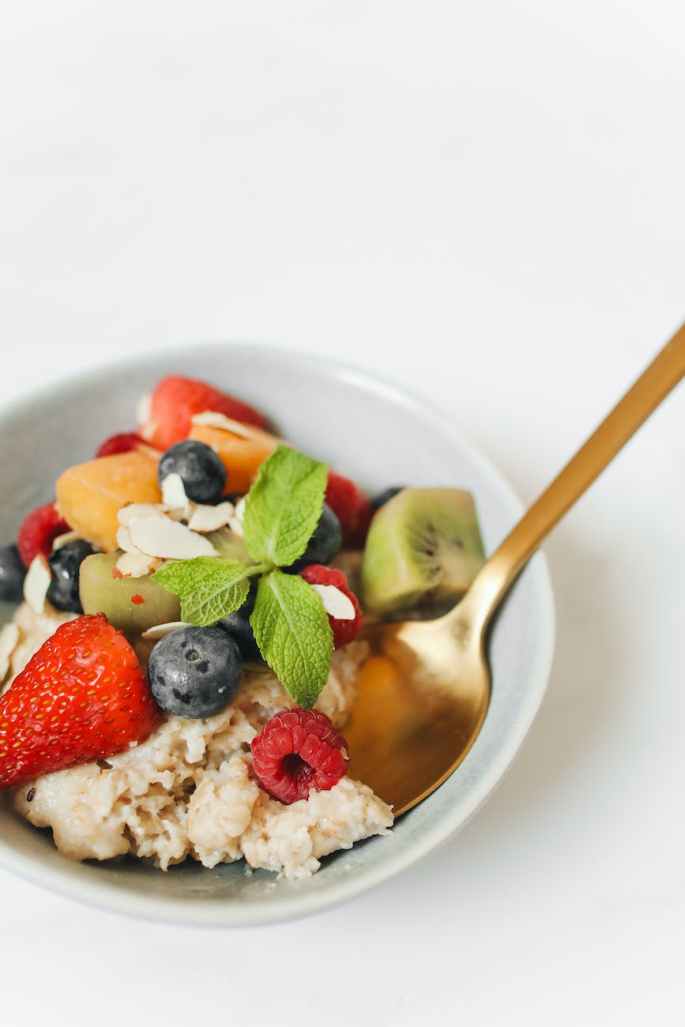
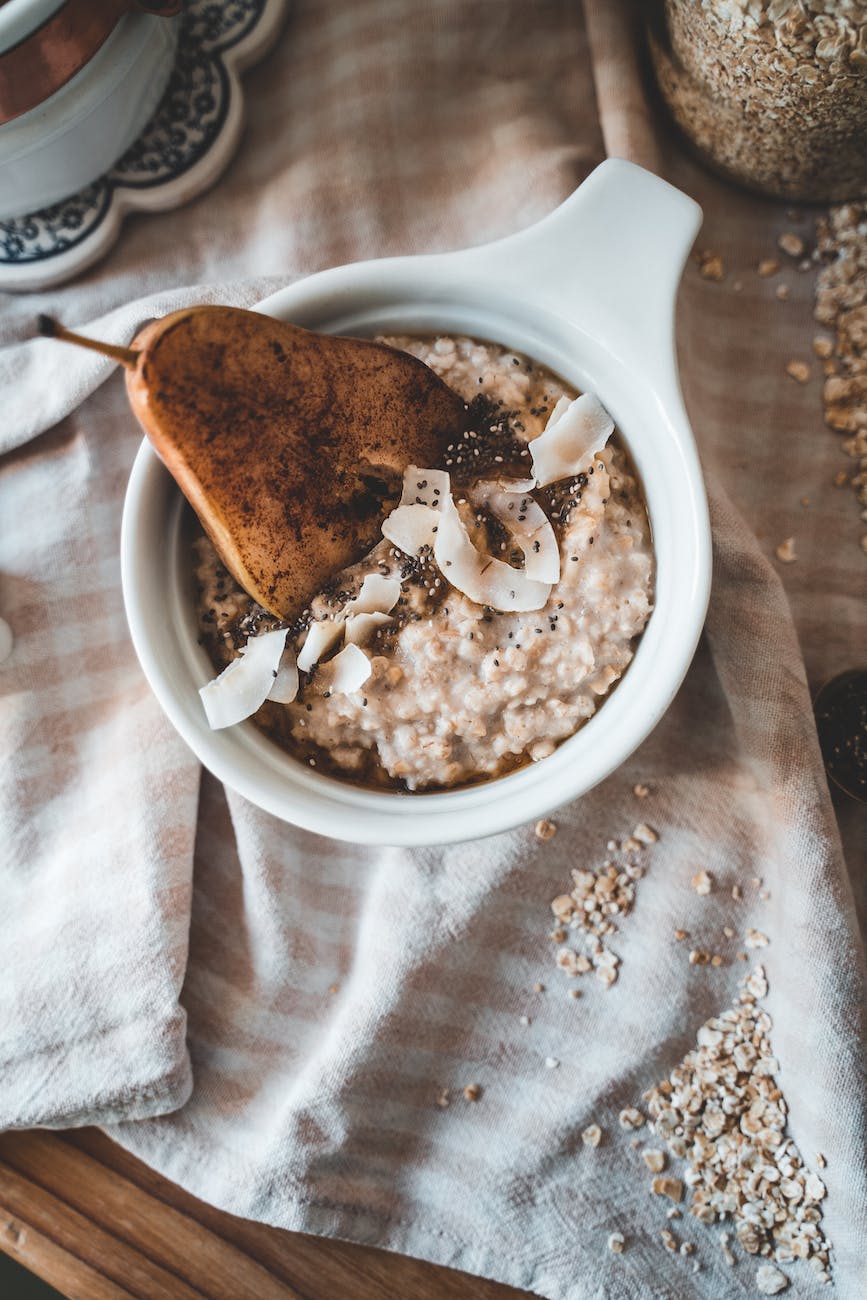
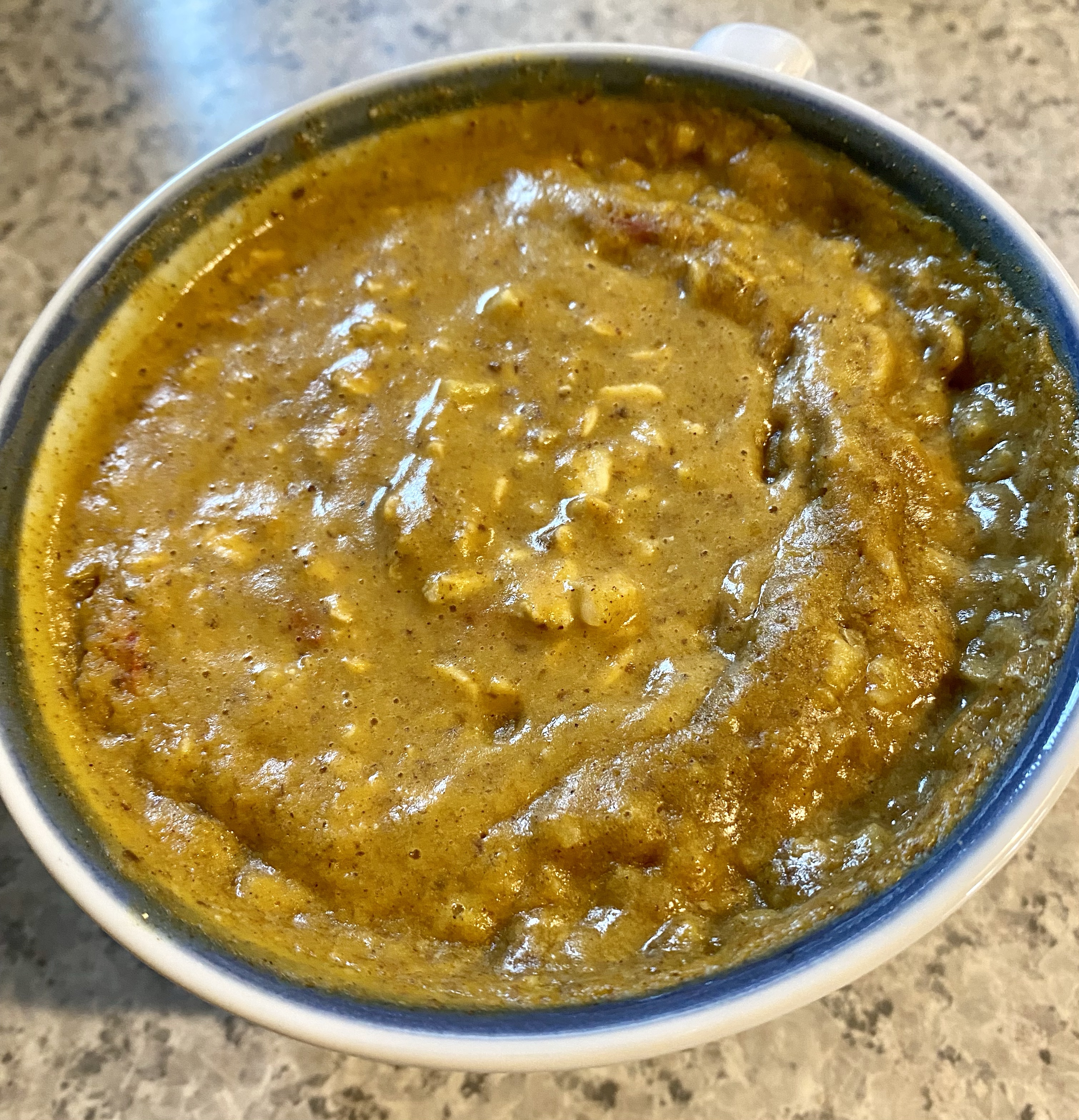
Note: For my photographs below, my oatmeal was made with: oats, ¼ cup frozen riced cauliflower, ¼ cup pumpkin puree, ½ cup blueberries, chia seed, vanilla protein powder, pumpkin pie spice, vanilla & maple extracts, soy milk, and topped with peanut butter & chocolate chips for a weekend treat

Pumpkin oatmeal flax oatmeal
Pumpkin blueberry oatmeal with buried goji berries
Banana, peanut butter, and chocolate chip oatmeal with hidden goji berries

Find your own way to increased movement: SMART steady steps

“Set goals not for the outcome itself, but for who you get to become in the process.”–Jim Rohn

My husband and daughter recently gifted me with a popular, updated fitness watch to replace the one that I have worn for over ten years. The new watch has numerous bells and whistles that can be quite motivational to encourage movement, healthy sleep, heart health, and so forth.  However, the updated icon, consistent with the former version, tends to focus on unrealistic, outcome-based goals that are not necessarily appropriate for my unique age, gender, body type, and fitness level.  

The gadget, and its programmers, don’t know ME, the individual.  And therein lies the problem in these well-intended gadgets as well as the thousands of fitness plans found, not only on fitness watches, but also found on-line and in-print.  Therefore, in this seventh installment of my “Move into Health” series, my focus is about setting SMART movement goals that focus on your unique health needs and lifestyle.

Photo by Karolina Grabowska on Pexels.com

It is so easy and tempting to be swept away by programs with tantalizing titles such as, “9-weeks to a bikini bod,” or “8-weeks to your fastest 5-K,” or “Walk your way into a new jeans size,” and so forth, often made popular in January.  While there is nothing inherently wrong with any of these types of plans, I have personally found they tend to set us up for failure when our bodies don’t look like the 19-year old willowy model used in the workout plan, our running pace doesn’t match the 5-K plan designed by a former professional runner, or our jeans still fit the same in spite of all of our best efforts.  

Instead, there needs to be a way to personalize plans in order to adapt to individual health goals, interests, schedule, lifestyle, body type, age, and current health circumstances.  Thankfully, there is! 

This year, consider setting SMART goals that focus on the process of promoting your distinct health needs as a way to focus your movement/exercise habit, rather than predetermined outcomes. There’s no need to make outlandish New Year’s resolutions, despite what the exercise industry would have you believe.  We simply need to take steady, SMART steps.

Photo by Leeloo Thefirst on Pexels.com

SMART stands for Specific, Measureable, Achievable, Relevant, Time-bound processes.  

This acronym has been used for years across a wide array of disciplines and settings.  However, I find it just as useful as a tool for leaning into personal movement and health processes. Personally, I find far more joy, and little to no guilt-ridden feelings of failure, when I focus on the process of a goal, rather than a specific outcome of that goal. 

For example, I am currently training for a half-marathon in March; however, this year, I’ve adopted a SMART approach.  Completing the half-marathon in March is specific, measurable, and based on my own current level of fitness, is achievable within the 16-weeks for which I have been using to prepare for it.  What my plan is NOT attached to is a specific finish time or whether I will run, walk, skip, or even crawl across the finish line.  Instead, my focus is about the measure of fitness I will gain in the process.  

Photo by Ketut Subiyanto on Pexels.com

I am no longer worrying about the pace of my jogging or walking; instead, the focus is how I FEEL before, during, and after each workout with a close eye on how my heart rate is responding.  If it takes me twice as long as it takes others to complete a certain mileage, I am absolutely ok with that.  This journey is about the scenery along my path as well as improved cardiovascular health, better sleep, reduced anxiety/stress, and the gift of time to listen to great playlists, podcasts, and audiobooks.

Your goal may not look like mine, but that is not the point.  Rather, think about what process you want to embrace?  Increased movement throughout your day? Improved cardiovascular health? Increased flexibility and range of motion?  Maybe a little bit of all three, or maybe something completely different.  Once you have decided, work through the SMART process to develop your approach.  Take time to write it down or type it up.  There is something about the power of slowing down your thinking, and then putting your thoughts down in some form of print that brings clarity to your ideas.

Photo by Polina Zimmerman on Pexels.com

Begin first by simply reflecting on your current health status as well as current lifestyle.  What could YOU realistically do to move the needle towards a gentle process of increased health.  Be honest in your self assessment, but NOT judgemental.  Once your idea is clear, write/type your thoughts using the SMART steps:

  • Be specific:  Is your goal clear and defined?  For example, the ability to walk for ____ minutes without stopping, or increased stamina to finish a 5K, or the strength to carry ____ grocery bags into the house independently.
  • Measurable: Can it be tracked or measured? How do you know if you are making progress? If your goal is to walk without stopping for a certain amount of time, perhaps each week you dedicate three days per week to walking, starting with the length of time you can comfortably walk now, and increasing that time by one minute each successive week as long as your body is comfortably recovering.
  • Achievable: Will the process be challenging but attainable?  This is the sweet spot that only you can determine.  For example, given your age and health status, walking a 5K may not be realistic, but perhaps focusing on the process of walking 15-20 minutes may be attainable with small incremental increases in walking time over several weeks or months.
  • Realistic: Is your goal relevant to your life purpose?  For example, my life purpose is to remain mobile, heart healthy, and mentally agile in order to make a positive contribution to others for as long as I possibly can. Therefore, challenging myself with a process of increased cardiovascular health is one of a handful of processes I can realistically develop.
  • Timely: Can you set a date in order to hold yourself accountable to the process? This is why the process of training for half-marathons works for me.  I can choose an event that fits my schedule, and gradually build towards that goal.  Plus, I make a monetary commitment, which I know will hold me accountable.  Along the way, I find ways to celebrate, enjoy, and embrace each little step in the process.  Once the date has come and gone, I will consider my next SMART process that will further my health and ultimately, life purpose.

You do not have to run/walk a half-marathon like me to embrace the process of SMART goals.  The point is to let go of certain outcomes established by others who don’t know you nor have your same values.  Rather, get clear on your life purpose, then ask yourself what you can do to improve your own health towards achieving that goal.  Don’t beat yourself up with unrealistic expectations of others.  Get quiet, get honest, and get “smart.”  With this clarity, you will be able to come up with the best approach for you.

Here’s to your smart version of healthy in 2023.  May you continue to fulfill your own life purpose with vitality!  And, don’t hesitate to reach out, and let me know how it’s going!  I am cheering for you!

Photo by Andrea Piacquadio on Pexels.com