The Art of Loving Unconditionally: Lessons from A River Runs Through It

A scenic view of a river meandering through lush greenery under a blue sky with clouds.
The flow of a river.

Words of Wisdom From a Classic read 📖

One of my favorite stories is A River Runs Through It by Norman Maclean. It is an exquisitely written, semi-biographical account of Maclean, and his brother, Paul, growing up in Montana as sons of a Presbyterian minister who taught his boys the art of fly-fishing. The movie version, directed by Robert Redford, captures the earnest beauty of Maclean’s prose. Both pieces weave together a tapestry of thought-provoking life themes centered around family love and connection (including unconditional love for a family member), grace, the fragility and brevity of life, and the eternal nature of time, with the art of fly-fishing as a metaphor as the unifying thread. 

The story’s emphasis on the complicated nature of the brothers’ relationship make it especially compelling and heart-wrenching. Therefore, I have revisited both works on numerous occasions. Each time I reread the story, (and subsequently watch the film) I discover a new gem and/or am reminded of a favorite part, such as a well-written phrase, a turn of words, a point of symbolism, and so forth. My most recent encounter with Maclean’s work was towards the end of December. 

There is a set of lines that stirs my heart every time I read them: 

“So it is . . .that we can seldom help anybody.  Either we don’t know what part to give or maybe we don’t like to give any part of ourselves.  Then, more often than not, the part that is needed is not wanted. And, even more often, we do not have the part that is needed.”

“We are willing to help, Lord, but what if anything is needed?”

Two boys hiking together by a river, wearing casual outdoor clothing and smiling at each other.
AI generated by WordPress.

How do we help others? 🧍🧍‍♂️

As I once more read each word, underlining and contemplating them in the quiet hours of morning, I reflected upon how, with each reading, those words still ring true, but their meaning evolves as I progress in age and life experience. Those bittersweet words bring to mind loved ones and students over the years for whom I have tried to help.

More recently, students of one of my classes and I were discussing their currently assigned book. The main character in their book grew up in a rough set of circumstances, and through a series of unfortunate events, wound up incarcerated in a juvenile detention center. One of the questions that book raises is: Can someone overcome their circumstances and change with the right intervention/outside help? 

The students debated valid points. Some endorsed the possibility that people can overcome their environment and change for the better. Others pointed out the difficulty of changing what has been hard wired into you. 

As the discussion continued, a student asked me what I thought. All eyes in the circle turned to me.

A silhouetted hand reaching out, symbolizing support and connection.
Photo by lalesh aldarwish on Pexels.com

Bittersweet reminder 🤔

Maclean’s words echoed in my mind as I carefully considered my response. Memories flooded my mind–former students and more personal situations in which I have been truly willing to help– offering extra time, extra care, and extra love. In many cases I have researched and offered suggestions of help–probably way too many with the presumption of, “I can help them fix it,” whatever “it ” may be.  I’ve further ridden the waves of the person’s ups and downs as they strive to overcome and change. I have been, and I still am, willing to help; Lord knows, but as Maclean so eloquently articulated, “{I}we can seldom help anybody.”

Helping others is a complicated process for which our hearts may be in the right place. However, as Maclean points out: most change within another person is not in our control.  Perhaps being willing to help is the best any of us can do unless asked–and even then–we can only offer our support; it is the person who must do the work within.  

Maybe, our support and love will help instigate the needed change, but there’s a strong chance that it won’t. Therefore, it is not our job to “fix” others; it is, instead, our job to love them.  Of course, we can still sincerely believe in the person and continue to pray and hope that the person will overcome their difficult situation or change for the better, but in the meantime we must accept them as they are. 

 Rather than say all of this to my students, I kept it simple. I shared my belief that by nature, hope springs eternal for me when it comes to believing in my students’ (and others’) capabilities for growth and change. I don’t think I could have remained an educator for nearly four decades if I did not believe that change and growth is possible for all of my students. 

A woman with long hair, dressed in dark clothing, is shown in a contemplative pose with her hands clasped together in front of her, against a dark background illuminated with red and blue lighting.
Photo by Mikhail Nilov on Pexels.com

Be Present 🙏

And, while I didn’t share this with my students, my belief and hope flows into my own personal life, too. However, my profession and personal experiences continue to inform me that overcoming what has been ingrained into you at a young age, be it genetic, environmental, or both, is difficult, even with the best help and support.  Furthermore, my experience has also humbly informed me that assuming the person wants help or wants to change is arrogant and so is thinking that we know how to help them.

This doesn’t mean we have to give up; rather, I am beginning to believe it’s about presence. We can be there for them by simply spending time with them as appropriate.  Likewise, we can provide positive support and encouragement, such as, answering the phone when they call, replying to a text they send, or being available to chat. 

Likewise, it doesn’t mean we go overboard using up all of our time and resources, leaving us emotionally, physically, or financially spent. Rather it’s important to find that fine line of being there, but not too much; having firm boundaries, but a welcoming heart/spirit. Mostly though, it seems important that we allow love to flow from us, like the waters of Big Blackfoot River in Maclean’s novella, so maybe on the person’s worst day, they will at least know that they are loved.  They. Are. Loved.
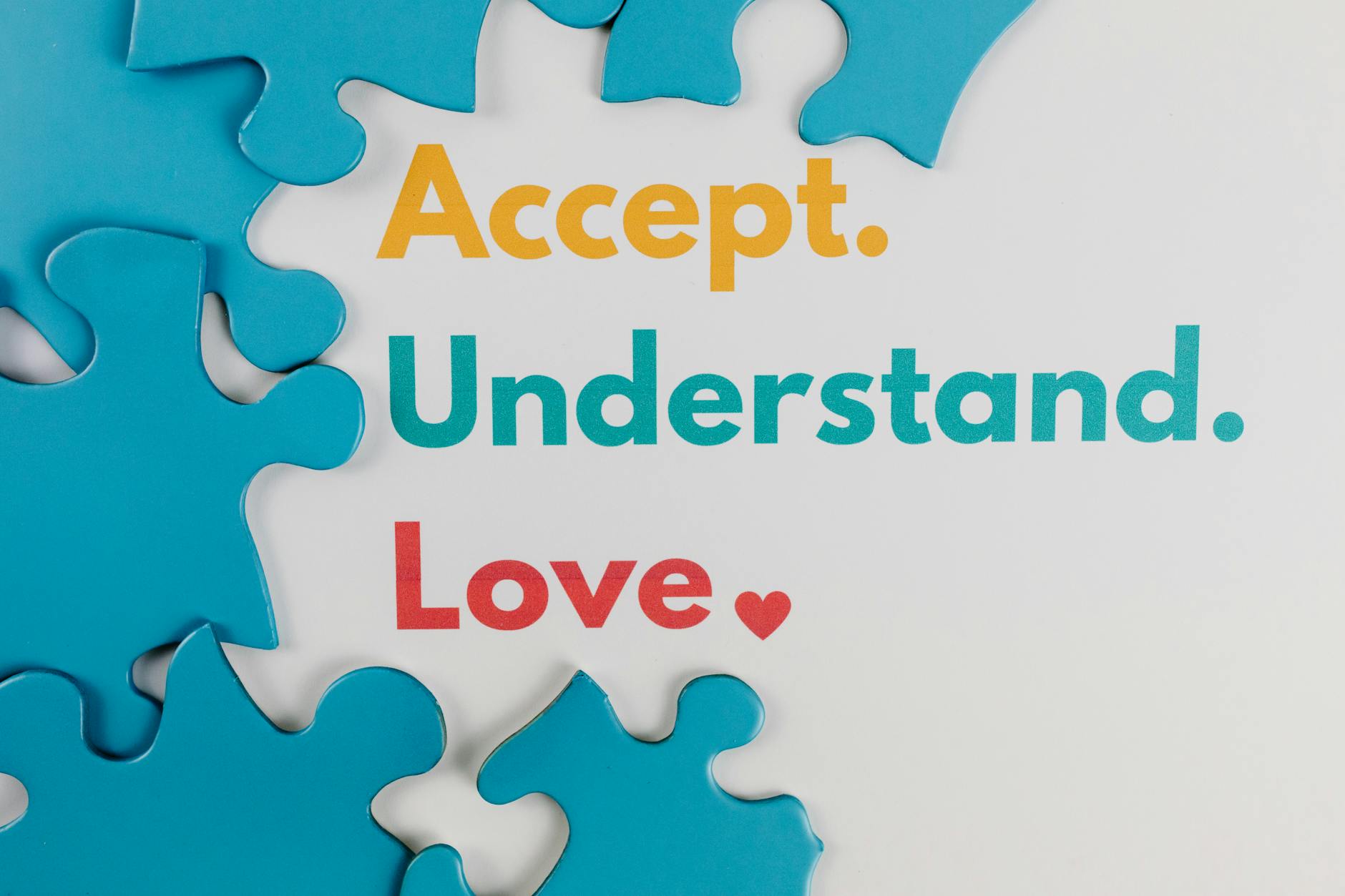
A close-up view of colorful puzzle pieces surrounding the words 'Accept. Understand. Love.' on a white background.
Photo by Tara Winstead on Pexels.com

Unconditional love 💜

In the words of thought-leader and influencer, Brené Brown, we must come to peace with the fact that “When you love someone unconditionally, you accept them for who they are, flaws and all.” And that, in the end, just as Maclean had to learn, must be enough. We can only change ourselves, no matter how much we want to help another. 
A chalkboard with the words 'HERE TO HELP' written in white letters on a black background.
Photo by Anna Tarazevich on Pexels.com

Embracing Limitations: Lessons from the Asheville Half Marathon

God, grant me the serenity to accept the things I can not change, the courage to change the things I can, and the wisdom to know the difference.”–Prayer for serenity

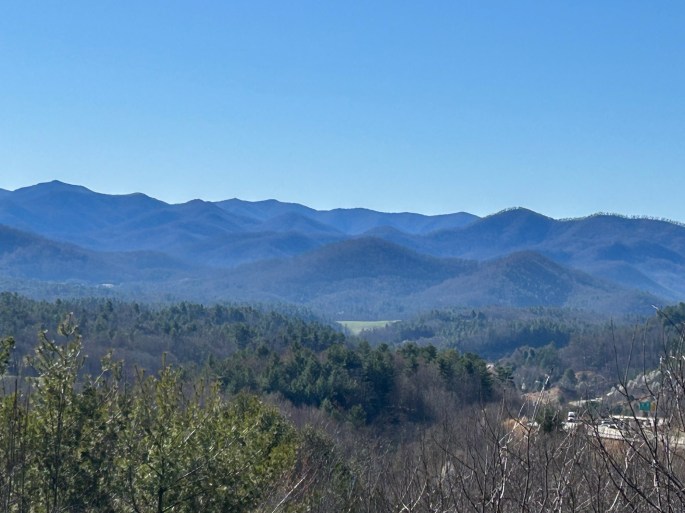
The Blue Ridge Mountains outside of Asheville, NC.

“the mountains are Calling . . .” ⛰️

I had been training for months, despite the challenges winter threw at me. Cold? I can handle it. Snow? I can run in it. Gusty wind? I can run that too. However, after my husband, John, and I crested hill after hill making our way into Asheville, North Carolina, I knew the town’s half marathon would offer a whole new level of challenge. 

To be clear, participating in the Asheville Half Marathon was an insignificant hurdle compared to what the people in Asheville, and all of the other residents of the surrounding areas/towns along US 23, have been facing as they deal with the aftermath of Hurricane Helene.

Driving along US 23, John, and I were able to witness that six months after Hurricane Helene angrily chewed through a large portion of the western Appalachian region, the recovery is still ongoing. However, the willful, and not-to-be-deterred, spirit of the residents was unmistakable. 

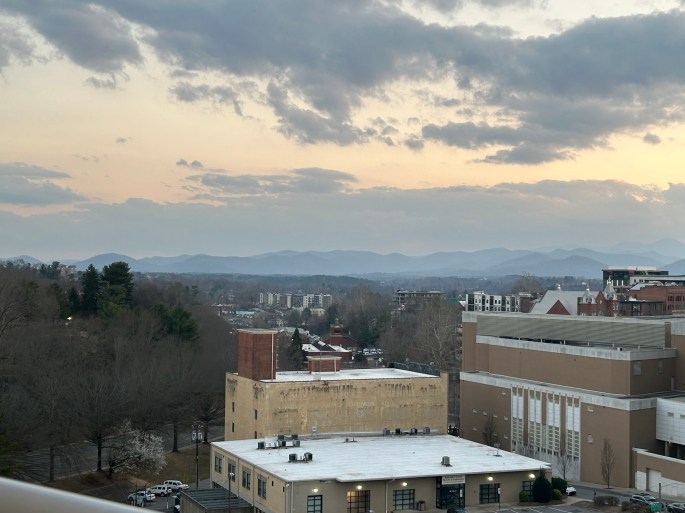
Rooftop view from Asheville of surrounding Blue Ridge Mountains.

A Tale of Two Sisters 👧 👧

This past fall, not long after Helene hit, the high school in which John and I work, welcomed two sisters into the student body.  They were from the Asheville area and were staying with relatives while their parents and older brother dealt with the devastation and destruction back home.

The girls were engaging and well-poised, especially considering their circumstances. Over the course of a couple months, I got to know them–not well due to the short duration of their stay–but well enough to swap personal stories from time to time. 

When they learned that like their dad, I often trained for half marathons, they immediately invited me to run the Asheville Half Marathon in March. They explained that by the time spring rolled around, the community would not be fully recovered, but the local economy would need the boost that runners and the accompanying spectators could bring. 

“You should definitely come, Ms. Hill.  You’d like the people of Asheville, especially the running community.” 

Once Asheville High School opened, the girls returned back home. And though I haven’t heard from them since, they planted a seed that grew into a shoot of curiosity. 

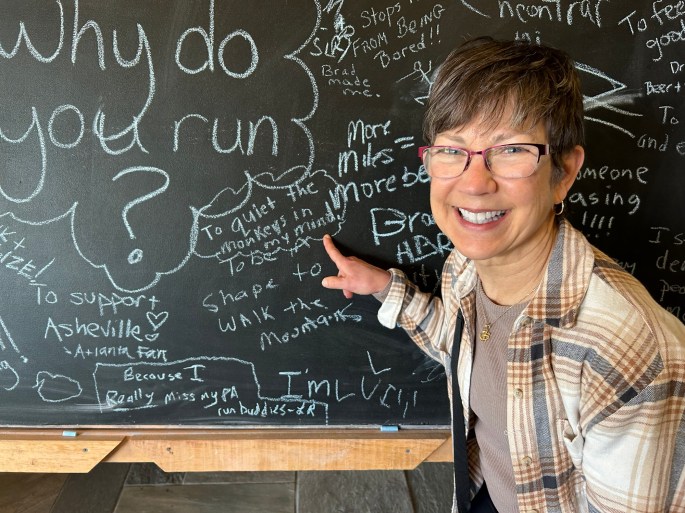
Runners were asked to sign the board stating why they ran.

Sign me up! 📝

Around Christmas, I checked the Asheville Marathon/Half Marathon website, and the powerful and persuasive prose describing the event increased my interest. The website’s editors artfully articulated the community’s belief in the significance of the annual running event. They stated the course’s route would not be “pristine or predictable.” Therefore, the event was for those who “thrive on resilience.” However, the line that sealed the deal stated, “If you’re ready to run in the face of adversity and be a part of Asheville’s comeback story, we can’t wait to see you on the start line!” 

John and I at gathering with other runners and spectators at the starting line before the race began.

Ready, set, Go! 🏁

Soon enough, on a chilly, dark March morning, I waited at the starting line with approximately 2,200 runners from 40 states and three countries who also heeded the call to help support Asheville, according to The Weather Channel. The positive vibe was palpable as runners mingled with spectators. Nonetheless, I was feeling a bit nervous as I recalled the half-marathon route’s elevation gain was nearly 800 feet, and its elevation loss was over 900.  

And, it was hilly.  From start to finish, there were no flat stretches. In the beginning, I read spectator signs claiming, “It’s all downhill from here,” with hope. It didn’t take long to realize those signs lied!  Even the finish line required running uphill, but I am “running” ahead of myself.

Running is a metaphor for living life, and it is always whispering (or sometimes shouting, as this event seemed to do) lessons to those of us willing to listen. Accepting limitations–was the lesson those relentless hills of Asheville taught me. Which makes sense since this is what many of the residents of Asheville and the western Appalachian area had to do during, and now after, the storm–accept and deal with limitations. 

Whether literal or metaphorical, storms of life cause us to suffer. As I repeatedly tried to power through those uphills during the first half, my ego kept telling me to push harder, creating suffering. However, as a late-in-life runner lacking inherent running talent, the reality is that race events for me are more about creating motivation and structure to consistently get me out the door to exercise. At the end of the day, I am not about to set any records; I am not even close to winning my age group, so why was I pushing so hard?

And so, it was on a hill, not long after milepost seven, that I decided to accept my limitations. Sure, I had trained on hills at home, but nothing like this. Why not power walk up the rest of the hills, and then run the downhill portions?

Asheville taught me to accept my limitations.

There is a newfound freedom in accepting one’s limitations 🏃‍♀️

Once I accepted my limitations, there was freedom. I had a new way of being present with the race challenges as they unfolded. This acceptance gave me permission to slow down, take in the sites, and feel a sense of gratitude for my health and ability to make this trip. 

Additionally, by walking the hills, I had more energy to offer encouragement to fellow runners I encountered who also seemed to be struggling. (After all, I run at the back of the pack, where we could all benefit from a little encouragement.) Furthermore, I was also able to offer thanks to the spectators who manned drink stations, rang cowbells, or waved motivating signs with clever phrases such as, “Touch here for power,” “You’re stronger than any storm,” or “You’re running better than our government.” 

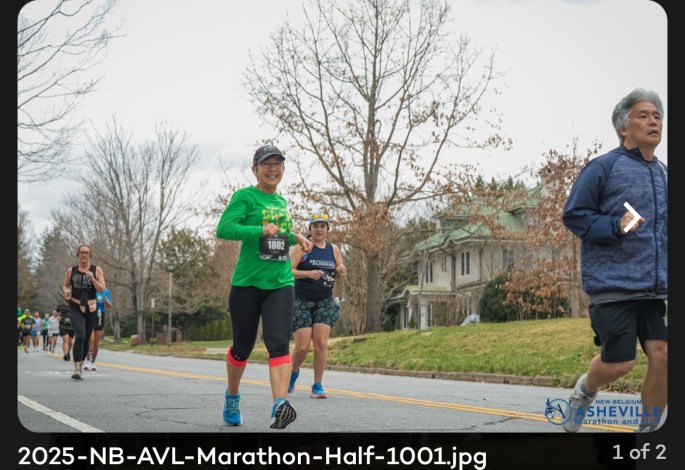
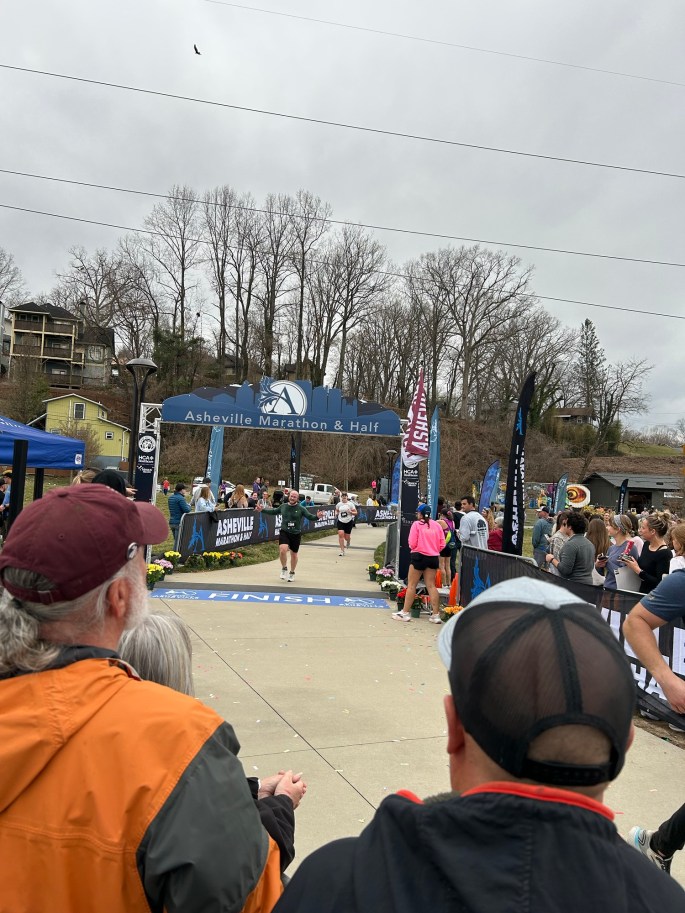
By the time I crossed the uphill finish line, tears filled my eyes as I raised my hands in the air.  No, I wasn’t celebrating a personal record, but instead, I was able to celebrate that I crossed the finish line with grace, humility, and a lesson learned. 

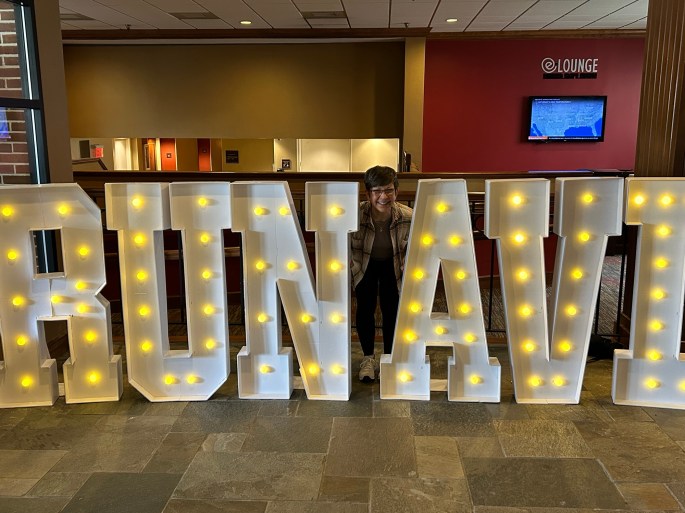
The AVL finish line of through which I would later cross humbled, and grateful, by another lesson running once more provided me.

The lesson? Transforming suffering can only occur if we are willing to be with it and accept the limitations it creates. Accepting limitations can be transformatively freeing, allowing us to lean into newly created possibilities we may not have been able to previously envision. I am not saying that accepting our limitations is not easy. However, once we let go of ego and embrace humility, it is possible to embrace the freedom that comes with focusing on what we CAN do.

Thank you , Asheville! I walk away from the finish line with grateful heart and a lesson learned. Furthermore, thank you, Hannah and Allison! I wish your family the best! 💜

Surrender and Accept Change

“And when the night is cloudy, there is still a light that shines on me, shine until tomorrow, let it be.”–Paul McCartney

Photo by Zeeshaan Shabbir on Pexels.com

During the height of the pandemic, I cultivated the habit of a daily meditation practice.  In particular, I often used an app that was free of charge for those in the service careers, including educators.  In addition to offering guided meditations, it also offered short (3-5 minute) video clips designed to bolster spirits, inspire courage, and calm feelings of anxiousness.

While I can’t say I was a regular viewer of those videos, I did enjoy, and often learn, from the ones I did watch.  One video in particular, used time-lapse photography to demonstrate the ways in which light changes throughout the day.  It was one of my favorites, so much so, that I saved the link to my laptop to rewatch from time-to-time

During this video, the narrator explains the way our experience of color changes over the course of a day and the science behind it. Beyond the obvious point of light brightening at the beginning of the day and darkening at the end of the day, there is a daily light progression that we may not perceive.  It allows us to experience every color of the light spectrum within one 24 hour period.  Much of this progression has to do with the nitrogen and oxygen in the atmosphere scattering the light waves coming from the sun and making the sky appear blue.

Photo by Skitterphoto on Pexels.com

At sunrise, we see more reds and oranges, while other colors, like greens, blues, and purples, appear darker and more muted.  Then, as the morning progresses, yellow light becomes the dominant color we tend to associate with sunlight. Meanwhile, the “yellow” sunlight reflected upon the so-called blue of the sky intensifies the color of anything that is green up until noon.  Then this same light/color progression begins to reverse itself throughout the remainder of the day until the sun sets.  As the sun returns to its lowest point on the horizon, the light returns to a red-orange hue, and then gradually fades into the blues and violets associated with night, illuminated by what we perceive as the white light of the moon. 

And so it is with life. Change happens daily, from moment to moment, and life never stays the same.  Like the changing of light rays throughout the day, many of these changes are so subtle, they are often not observed in the moment, such as the growth of our children, or our own aging process.  For example, a parent may not clearly see the day-to-day growth occurring within the physical development of their own child, until one day, they happen to notice the child’s clothes are suddenly too short/small.   Likewise, we may not discern our own aging process until we see a picture of ourself from as few as five years prior, and suddenly we are face-to-face with our own change.  

As an educator, I sometimes measure life in terms of an August to July school year, rather than the typical January to December calendar year, depending upon what is being measured.  Nonetheless, I recognize, now more than ever, that time is fluid, and it matters not how I measure time because it continues to flow and stream like the daily progression of light.

That being said, these past 12 months have been full of joys, changes, and of course, challenges. Many of these changes were immediately as visible as a bright sunrise over the Ohio River. While others shifts were less visible, but nonetheless impactful. Then there were those challenging dull hue moments that accompany the colors of night that felt as long as evening shadows.  In fact, there were moments when it felt like I was riding life’s carousel, returning, again and again, to the same point as if progress was at a standstill.

And yet, now I can look back and see that, indeed, even if I wasn’t directly observing it, change was occurring.  While my eyes may not directly witness every sunrise, nor catch sight of all of  night’s blues and violets, these events still occur–without or without my direct detection. An invisible force, a guiding hand, if you will, greater than you and I can comprehend, maintains this on-going, ever-moving cycle of change.  It is ever present, even during those darkest, bluest nights when we often feel alone with the shadow-side of life and wonder if the darkness will ever abate.  

Ultimately, the darkness ebbs, and the light does begin to flow, but precisely as the light/colors of the day must go through their unique progression, so too must the solutions and resolutions to those dark and lonely life challenges.  Life, like light, will go on and will continue, along with the Source, the maker of light and life.  Therefore, we must surrender to this knowledge.  Surrender to the what is, and to what will be; surrender to the notion that we are not in-control.

The lesson for me this 2022-2023 year, and it is a tough morsel to swallow, is that the only guarantee of life, like the light progression of our day, is change.  While I can try to control certain factors, such as schedule and routine, the choices I make, or even how I measure time, for the most part, what will be, will be. 

Thus, as long as I wake up, whether I rise with the cool dark blue of the predawn hours, or I get up with the bright orange and red light of sunrise, there is a Source shining, not only within me, but throughout all of life.  Therefore, as the light surrenders, rather than falls, to its daily course of change, it is likewise my job to see the illuminated gift of each day as I ride the ups and downs of this carousel called life.