Cultivating Compassion in a Clamorous World

Your work is not to drag the world kicking and screaming into a new awareness.  Your job is to simply do your work . . .sacredly, secretly, silently . . .and those with ‘eyes to see and ears to hear’ will respond.”–Unknown

A row of shopping carts with red seats lined up in a parking area, creating a visual of retail readiness.
Photo by Ulrick Trappschuh on Pexels.com

A Quiet Act of Compassion 🤫

I was recently in a local dollar store. There was a person checking out that was $5.00 short of the total amount needed to pay their bill.  The clerk patiently waited while the person checking out asked their companion if they had cash on them. When the companion did have any cash, the clerk quietly offered to give the person the $5.00 stating, “I know what it’s like to come up short when it comes to money.”

This act of unpretentious compassion remained with me for days. The clerk was not doing it for recognition, she spoke too discreetly for that. If I had not been nearby when she offered the money, no one would have witnessed her act of generosity.  

In stark contrast to this sales clerk, however, we are enmeshed in a clamorous, overstimulating, attention-seeking era. Loud-speaking voices vye for our attention as do flashy images, catchy phrases, and repeated catch phrases–all playing the game of who can garner the most attention, especially on social media platforms, news outlets, and marketing campaigns. In fact, it often seems to me that bullying, arrogance, and even superficiality are now considered acceptable, if not desired, traits. While characteristics such as humility, deep listening, and thoughtful consideration are undervalued or overlooked. 

A man in a suit appears to be angrily shouting or expressing frustration while leaning over a wooden table.
Photo by Andrea Piacquadio on Pexels.com

The Clamor of Modern Society 📢

Furthermore, the use of repetitive, often vitriolic, messaging can undermine our own belief systems if we are not careful and purposeful with our daily habits. In fact, popular messaging and marketing, if exposed to it often enough, can even degrade the way we choose to comport ourselves on a daily basis. Our ability to remain authentically aligned to our core beliefs and values can be further degraded with continued exposure.

How do we remain steadfast in our core values, much less act as an agent of civility, courtesy, and even compassion with others, like that store clerk, in the midst of a popularized contrarianism?  Do we completely avoid social media, news outlets, and other outside sources of information and entertainment?  Do we cut ourselves off from the outside world and live as hermit?  Certainly not. 

Scrabble tiles arranged to spell 'WE RISE BY LIFTING OTHERS' against a plain white background.
Photo by Brett Jordan on Pexels.com

Cultivating Grounding Practices 🙏

I do believe it is possible to stay true and aligned to a path of decency and decorum. It does, however, require acting with a certain level of discipline, such as limiting time spent on social media, watching/reading news, streaming services, and so forth.  Additionally, it further requires creating habits/regular practices that support and deepen our foundational beliefs, such as prayer/meditation, regularly reading scriptures or sacred texts, and/or connecting with like-minded people that enhance, strengthen, and support our values. These deliberate habits of personal energy keeps us grounded and moving forward along a path of integrity.

A smiling woman in a black sleeveless top seated in a modern setting with green plants in the background.
Photo by Alexander Suhorucov on Pexels.com

Leading through authenticity 😃

By living authentically and intentionally, we don’t need a megaphone or platform to share our message.  Instead, we can focus on our primary responsibility, which is to cultivate our own work and/or calling in order to positively contribute to the world around us.  It is not necessary to proselytize and strive for attention in order to do this; our actions can speak for themselves.

If we choose to live and work from a place of inner strength, we can foster the power of a quiet presence, leading by example rather than boasting and posting all of the ways others should live/act/work. This doesn’t mean that we don’t set expectations for ourselves, or for others, if we happen to be in a leadership position, it just means we don’t publicly berate others who don’t meet those standards, nor do we boast about our own accomplishments. Rather, we can strive to strike a balance between leading by example and fostering an attitude of support in order to lift up others, so that they, too, can reach their potential. Helping others reach expectations can be achieved without a bully-pulpit.

A family walking by a lake, with an adult female holding a camera and interacting with a young child on a balance bike, while another adult male walks alongside them.
Photo by RDNE Stock project on Pexels.com

Trust the process

Of course, there will always be times of resistance and discouragement, both personally and when working with others. However, forcing or attempting to control often leads to more resistance.  I know as a teacher, and on a personal level, when asking a child–or myself for that matter–to learn a new and difficult task, the more I push the child, or myself, the more resistance I often encounter. 

Sometimes, we have to step back and trust the natural unfolding of awareness, which isn’t easy.  It often takes time, space, and many attempts that end in failure before the a-ha moment arrives. However, by allowing others, or ourselves, to awaken at their (our) own pace, we create a more sustainable and respectful relationship with others and/or with our own work

Two hands engaged in a handshake, symbolizing connection and support, with a group of people in the background.
Photo by RDNE Stock project on Pexels.com

Be a catalyst for change

The power to be a catalyst for change resides within ourselves and within others, but it doesn’t require force or brash tactics. Instead of being rude, loud, or stridently trying to convince or control others, we can choose instead to live with consistent habits that foster our integrity, allowing us to lead by example, and work for change through our actions, choosing to empower, encourage, and uplift those around us. By quietly setting an example, embodying our core values, faith, and beliefs, our presence can inspire and affect the world around us.

Generosity Ripples

Witnessing that one small act, served as a reminder that our energy and intentions have the power to make an impact. It further illustrates the importance of humble generosity–doing the right and/or kind thing quietly and habitually, without fanfare or need for attention, can still have a positive influence that spreads. Just as a spring petal falls from its tree and gently floats on currents of air until it lands on the waters of a nearby stream, creating ripples from the center of the stream to its banks, so do deeds of goodness and mercy continue on.
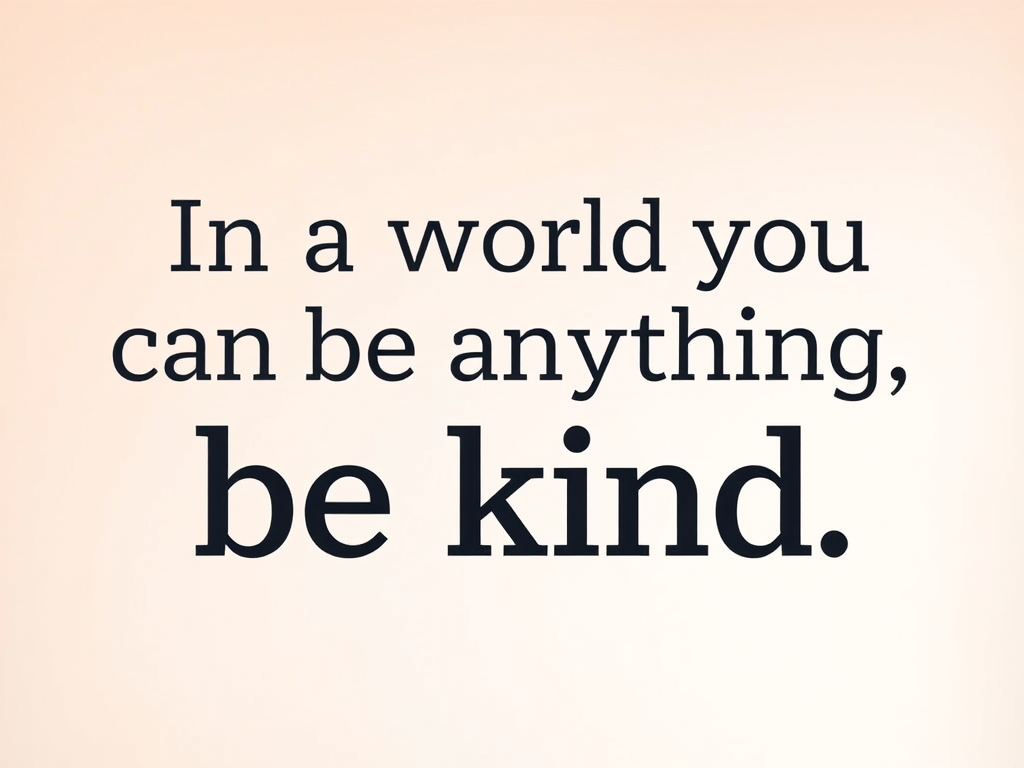
A quote encouraging kindness in a simple, elegant font on a light background.

Under Pressure

“Pressure pushing down on me

Pressing down on you, no man ask for . . .

Splits a family in two

Puts people on streets . . .” from the lyrics of “Under Pressure” as written by members of Queen and David Bowie

Photo by Free Nature Stock on Pexels.com

 It was still dark as I drove alongside the glinting waters of the Ohio River, but I could see the sky lighting towards day.  I tried to listen to the news when I first left home, but on this particular day the stories were making me feel way too anxious.  Thus, I switched to a favorite satellite radio music channel as I made my way onto the 6th Street Bridge heading into Huntington, WV.  As I took the exit ramp and began motoring towards the school in which I am currently an educator, I heard the unmistakable beat drop for one of my favorite teen anthem songs, “Under Pressure,” written and performed by Queen and David Bowie.

As is my habit when I hear an old favorite, my hand automatically went to my heart.  It was late fall of 1981 when this song was wildly popular.  As a teen, I was attracted to socially compelling song lyrics, and the words of “Under Pressure” certainly were thought-provoking.  While I cannot pretend to recall my exact mental state in 1981, I do remember feeling the song’s lyrics resonating with me on a visceral level . . . and, boy do they ever resonate now.

“ . . .It’s the terror of knowing what this world is about

Watching some good friends screaming

‘Let me out!’

 . . .these are the days it never rains but it pours . . .”

Photo by Aleksandar Pasaric on Pexels.com

In the 80s, from my know-it-all teen perspective, I thought the world was incredibly messed up!  From the rallying cries and images of “Tear down the wall” to songs calling for us to “Feed the World,” and from the music and message of “Farm Aid” to the drama and news headlines surrounding the AIDS/HIV crisis alongside all of the other world/political problems that created newspaper headlines, it seemed in my young mind that the older generations were creating a world of chaos that the younger people would have to fix.  How ironic now!  

“ . . . Ee do ba be

Ee da ba ba ba

Um bo bo

Be lap . . .”

Shaking my head out of my 80s remembrances, I observed what once must have been a beautiful young lady, now bedraggled and disheveled in appearance, stumbling along the sidewalk next to the traffic light at which I was stopped.  Across the street, an older man, wet down the front of his pants as if he had unknowingly (or knowingly?) urinated on himself, began screaming curses at the woman.  She shouted incoherent phrases back to him as she attempted to stumble, bumble, fumble ahead at a faster pace, and I drove on, but the image still haunts my very human heart . . .

Photo by Grevin Kivi on Pexels.com

“ . . . People on streets

Ee da de da de

People on streets

Ee da de da de da de da . . .”

Images from my life flashed before me as I continued to drive.  Images from childhood, teen years, college years, early adult years, parenting images, teaching images, images from past world events through where I have lived, and images from on-going current events.  Words seemed to fly through the mental space of my brain. COVID. PANDEMIC. CHAOS. QUARANTINE. DIVIDE. HATE. DIVISION. HURT. DIVISIVENESS. PAIN. DISORDER. DEATH TOLL. VIRTUAL. MISTRUST. . .

 “ . . .Turned away from it all like a blind man

Sat on a fence but it don’t work

Keep coming up with love but it’s so slashed and torn

Why, why, why?

Love, love, love, love, love

Insanity laughs under pressure we’re breaking . . .”

Photo by cottonbro on Pexels.com

Am I the only one with a heart that is breaking?  It seems as if we often become wrapped up in minutiae of policies, partisanship, and even personal egos that we lose focus of our commonalities and the lives, the real lives of people.  Why is it now okay to speak, post, tweet, and write rudely?  Why does the concept of compromise seem unacceptable and/or unattainable.  Why is mountains of completed paperwork for health care workers, educators, law-enforcement, and all other humanity-based career fields more important than actual time focused on real people-to-people interaction?  Why is society as a whole burning bridges of connection? 

“ . . . Can’t we give ourselves one more chance?

Why can’t we give love that one more chance?

Why can’t we give love, give love, give love, give love

Give love, give love, give love, give love, give love?

As a young girl in the 80s, I was a hopeless romantic who believed that words like love, empathy, compassion, and understanding were the answer to all world problems.  My grandfather used to teach the importance of  “walking a mile in another man’s shoes.”  In fact, it was a consistent message I heard throughout my childhood from the adults in my life.   While my grandfather was far from perfect, he certainly tried to apply this expression to his own life.  He, along with my grandmother, would take food to those in need, offer rides to the elderly who could no longer drive, and were overall kind and pleasant with all those they encountered–even if they didn’t agree with their personal views.  Am I naive to think this aphorism should still be practiced today?

Photo by Ylanite Koppens on Pexels.com

“ . . . Cause love’s such an old fashioned word

And love dares you to care for

The people on the edge of the night

And love (people on streets) dares you to change our way of

Caring about ourselves . . .”

Currently, I feel “under pressure” in a number of ways, and I suspect, I am not the only one.  First, and foremost, I feel the pressure to remain healthy and behave safely for the sake of all others with whom I have contact, but even more so for my loved ones. I am not sure I could live with myself if I caused another person to become sick.  

Additionally, I feel professional pressure. Like most other careers, education has had to dramatically change and respond in the wake of a pandemic. Teaching simultaneously in-person students and virtual students, as I try to meet the needs of both groups, challenges me in ways for which I never dreamed nor was prepared.  Then, there is the additional pressure of keeping the in-person students safe, their environment sanitized, and still allow them to be kids.  It is a delicate balance of walking along a tightrope with strong crosswinds of politics, policies, and personal egos abounding.  

Finally, I feel pressure as a responsible citizen.  How do I separate the wheat from the chaff?  How do I parse out the truth from the half-truths and outright lies?  And, what, if anything, can I do about the people suffering in the streets, in the hospitals and other health care facilities, at their work-sites, or currently in their own home?  Anxiety, depression, and other mental illnesses seem at an all-time high with negative coping mechanisms providing easy and quick relief, but not solving problems long term. Meanwhile compassion, concern, and care seem harder to find.  

“ . . . This is our last dance

This is our last dance

This is ourselves under pressure

Under pressure

Pressure”

Photo by Helena Lopes on Pexels.com

My grandmother used to tell me that things had to get worse, before they could get better.  Meanwhile, my grandfather used to say that diamonds form under pressure. I have a Ninja pressure cooker in my kitchen. As the pressure builds, the food inside is cooked and transformed into a tasty treat.  In order not to overcook the food,  I must release the pressure valve, allowing the steam to rise as the temperature and pressure inside reduces.  I pray for the pressure valve to release soon.  I pray this isn’t “our last dance.”  I pray that love will dare us to care, once more, for others, and that we will soon dare to “change our ways” . . . .