Three Pauses: On breath, attention, and the quiet work of returning to ourselves

Almost everything will work again if you unplug it for a few minutes… including you.”–Anne Lamott

A Reminder to Pause

I was driving to work this past Monday after an extended break, thinking about my to-do list for the day, when an alarm on my phone began a soothing piano melody. Bringing my car to a rolling stop as I fell in line with traffic at a stop sign, I tapped the alarm off. I wanted to ignore it. Instead, I reminded myself this would help me complete those “to-do” lists with a more calm mind, so I paused my thinking and took three slow, deep breaths–the first of the day.

How a Friend Planted the Idea

This practice of setting a gentle sounding alarm as a reminder to take three deep breaths was a serendipitous seed of an idea that a friend unintentionally planted within me. We met for lunch one day, well before I returned to school from winter break. During the course of a deep conversation, her phone alarm accidentally went off. Surprised that it was going off, she quickly turned off the alarm and then–seemingly on a whim–said “Let’s take three deep breaths.” She shut her eyes and began inhaling, so I followed suit. Our conversation resumed afterwards and nothing more was said.

Turning an Accidental Moment into a Daily Practice

However, on the way home, I reflected upon how much better I felt after we took those three deep breaths. I further examined a few of the benefits that I knew regarding deep breathing. What would happen, I wondered, if I took time more often to take three deep breaths daily like I did with my friend? As I reflected over my typical work week and subsequent weekend, I identified three common times of the day, whether at work or not, in which pausing for three deep breaths would be beneficial. 

I realized that I would never remember to take time to do that without a reminder, which meant setting an alarm. Not any ol’ alarm sound would do.  Once home, I took a few moments, played around with various tones. My intention was to make the alarm sound invitational, not demanding. I knew if it felt like a chore, I would feel more resistant. Plus, the reality was I knew I wouldn’t be “perfect,” especially in the beginning and given the unpredictabilities that can occur on any given day.

Three Breaths, Three Times a Day

When the piano melody alarm now subtly tinkles, I pause what I am doing, close my eyes (if alone or not driving), and take three deep, expansive belly breaths. The alarms are set to ring before the arrival of students, during lunch, and at the end of the day, right after students leave. On the weekends, when I am busy with household chores and errands, the times still work well. 

Creating a Practice That Feels Gentle, Not Demanding

If I am alone, and not driving, I sometimes place one hand on my low belly and another hand on my heart. The hand placement reminds me to initiate the breath from my diaphragm and allow the air to expand the belly, then expand the ribs fully, and allow the inhale all the way up into the heart space. 

Other times, especially if I feel stressed or worried I place both hands on my heart in a gesture of self-care. Most of the time, however, I am not alone, given the nature of my job, but I can still pause and take three deep breaths without drawing any attention to myself. 

What Happens in the Body When We Breathe Deeply

Our bodies are miraculously created. They are designed, when properly cared for, to function like a high-performance team–each system working synergistically with other systems for the ultimate benefit of the whole. Pausing to take three deep breaths is my way of working with my body. The body responds by lowering the heart rate, decreasing blood pressure, and increasing a sense of calm. The body already knows how to do this. Taking deep breaths cooperates with the body’s natural process and simply allows it to intentionally happen.

When the Mind Begins to Follow the Breath

Our minds naturally follow the breath. If our breathing is short, shallow, or choppy, our mind readies itself for a stress-inducing event. Consistently setting aside time throughout the day to breathe in a relaxed, calm manner, even for a couple of minutes, incrementally creates a shift in our mind. While I wouldn’t say my practice has been transformative, per se, I would say that there are days my stress and anxiety are decreased, other days I notice a bit more mental clarity and focus, and other times I feel a subtle, but real, shift in my energy and vitality. While I cannot say I have eliminated all of the negative thoughts in mind, I am noticing that I am better able to handle my emotional response to a difficult moment with a bit more grace.

A Quiet Conversation Within

Another benefit I have observed is sometimes when I pause, I feel a connection to the “still, small voice within,” that source of wisdom that hovers beneath all of the distractions and noise. It is as if, for the briefest of moments during my busy day, my body, mind, and heart are at peace. I momentarily feel an overall sense of gratitude, a reminder of the positives in my life, despite those negatives that remain. There’s also a sense of connection to other hearts and souls moving in, around, and throughout my day. All told, it provides me with an overall feeling of solace.

Why Three Times a Day Matters

One thing I did not realize before starting this small practice is that by setting aside three times per day to take three deep breaths, it harnesses the power of the “rule of three.” The “rule of three”, I learned by happenstance a few days into my practice while I was listening to a podcast. This rule employs the principles of habit formation to increase focus, productivity, and well-being. The frequency of three breaths, three times per day is enough to establish the habit without it feeling overwhelming, which, lucky for me, is an important consideration. 

Imperfect Practice, Faithful Returning

Are there times I don’t heed the timer? There certainly are. I am not perfect, and I am not pretending it is easy to create a new habit. But I do continue to return to the practice, even if I miss a timer, or three, throughout the week. I know that when I do take time for that brief pause to nurture myself with a few deep breaths, I will show up better, more fully for myself and others.  

An Invitation, Not a Prescription

Perhaps there is a pause waiting for you too.

Rocks in Your Head?

“It isn’t the mountains ahead to climb that wears you out; it’s the pebble in your shoe.”–Muhammad Ali

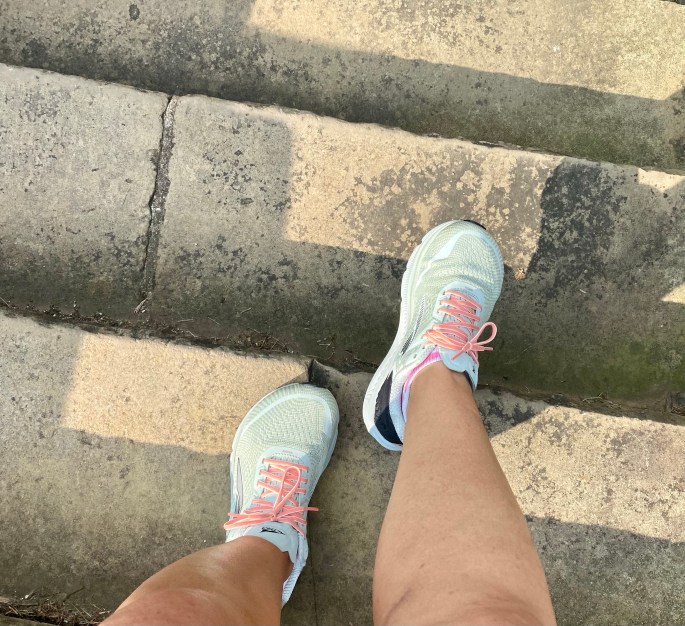
Have you ever been walking along and discovered a rock in your shoe?  It doesn’t seem to matter how small it is, suddenly, it is all that you can think about.  This is especially true if you are on a solo walk or run.  With each step, that multi-faceted, miniscule rock pokes and prods your foot until it becomes your sole focus. Likewise, if you are walking or running with another person, try as you might to ignore the aggravating rock, it remains in the periphery niggling away at your attention in spite of your best effort to focus on the unfolding conversation. 

Have you ever noticed how much more free and spacious your mind becomes if you pause long enough to take the rock out of your shoe?  If you’re with a friend, your concentration easily returns, and if you’re exercising alone, your mind relaxes and resumes its free-flow thought.  When this happens to me, I often ask myself, why did I take so long to shake that rock out of my shoe?  Why did I allow myself to be tormented by such a small thing?  

Photo by Matheus Natan on Pexels.com

Oddly enough, there are times that I will go an entire run or walk, and complete an errand or two, before I take time to slip off my shoe. Once home, I’ll sit down on the front stoop of my porch, take off my shoe and shake out scanty pebbles and/or debris. Slipping the shoe back on, it’s like putting on new footwear–all because I had been too stubborn, lazy, or petulant to take off my shoes and toss out the rocks.

After a recent moment of emptying the rocks out of my shoes, it occurred to me that those crushed rocks were quite a bit like thoughts that can sometimes run through my head.  These are often circular notions of self-doubt, self-criticism, or self-reproach.  Depending upon the day, situation, and/or context, the narrative can vary, but the ongoing, well-rehearsed mental skirmish between Naysayer Nellie and Wetblanket Wanda certainly know how to prick and needle my grey matter like the crushed detritus poking and prodding my foot when trapped in my shoe.

These pessimistic pests tend to most often join forces during times of stress, change, and/or increase in workload.  Sometimes, all it takes is one moment of so-called failure, frustration, or new challenge to inspire those two negative allies to vie for my attention as they quickly assemble a barrage of heated messages designed.  Then, like a challenging adolescent, they turn up the volume, in case I didn’t hear their propaganda the first hundred times!  

Ironically, I know their stories aren’t true. I recognize the disinformation for what it is; and yet, like the proverbial pebble in the shoe, I don’t quickly empty the shoe, or in this case, the prodding thoughts.  Instead, I allow those irksome ideas to create a foothold in consciousness, and repeatedly nettle away. It’s as if these defeatist messages have hijacked my brain.  

Photo by Kindel Media on Pexels.com

If I allow those obstructive thoughts to remain around long enough, like the shoe-bound pea gravel chafing my skin until blisters form, the negative mental chatter can create so much inflammation that my brain will begin its not-so-subtle messages of flight, fight, or freeze.  My head and heart will begin to pound, I will hold my breath, tighten parts of my body, such as my belly, back, or neck, and sleep becomes elusive or filled with nightmares.

What can I do?  Duh! Take off the proverbial shoe and shake out the rocks.  Not that it is easy, but I have to remind myself that thoughts are like clouds.  Even on the most overcast day, when all is gray and cloud-covered, the blue sky and the bright sun are still there–they have merely been hidden.  The sky is not the clouds, and I am not my thoughts–and neither are you, Dear Reader!  In fact, we are so much more than any negative messages sticking around in our heads. 

Photo by NEOSiAM 2021 on Pexels.com

 As I understand it, the emotional center of our brain is housed in the part of the area that evolved quite early in order to determine important life saving decisions such as, “Is this food poisonous or not?” or “Will this animal eat me?”  Once this area of the brain perceives something as dangerous–even if created by our own thoughts–this part of the brain won’t shut off until it feels safe.  (It is also worth noting that the same is true when this area of the brain experiences pleasure–it wants more and more.) 

However, we have another, more advanced part of the brain that allows humans to think, reason, make decisions, and plan.  Therefore, with practice, we can be aware of when the emotional center of the brain launches into its overwhelming fear-mongering.  We further have the capacity to choose whether or not we believe those negative stories, and we can also plan how to treat those thoughts when they do occur.  Furthermore, we can take daily actions to further reduce the rumbling rocky voices which are most often a product of fear . . . fear of failure, fear of success, fear of change, and fear of the unknown

“Remove the rock from your shoe rather than learn to limp comfortably.”–Stephen C. Paul

One of the best pieces of advice an acquaintance once shared with me:  “Stop yelling at yourself.”  She went on to ask if I would yell at my own daughter the way I think about myself.  When I said, no, she simply encouraged me to “play nice,” call fear by its rightful name, and then take steps to calm it down as you would with your own child.  

Many of the actions that can be taken to reduce negative/anxious thinking are not new suggestions.  Deep breathing, exercise, or simply walking away from a stressful situation for a specific time period are all actually quite helpful.  Other suggestions include: 

*Remind yourself of your past successes.

*Take small steps towards learning a new task. 

*Be willing to ask for help to reduce or understand new/heavy workloads.

*Talk to a trusted friend or family member–sometimes just naming your fears begins to tame them. 

*Write your problem on a piece of paper–dump it all, like you’re emptying your brain of pea gravel. The act of writing slows down the thoughts, relaxes your brains, and allows you to see things differently.  I’ve literally taken that written problem, slipped it under my pillow at night, and literally slept on it.  It never fails to surprise me how a little faith and trust that a solution will be found allows it to gradually unfold.  

Photo by Lisa on Pexels.com

*Learn to nurture and protect your thoughts. 

*Cultivate affirmative thoughts.

*Take preemptive action if you know certain situations trigger a strong emotional reaction. 

*Be gentle and kind with yourself. 

If you begin to notice your brain is launching into story mode, each time a thought attempts to pop into your head, try to mentally swipe it away like a fly at a picnic before it can grow.

The point is, just because you think something, doesn’t mean it’s true.  Sometimes the solution is as simple as shaking out rocks.  I’m not saying it’s easy; it’s not.  Nonetheless, it is worth remembering that emotions come and go, like ever changing weather, but they don’t have to permanently hijack your brain.  

Photo by Kelvin Valerio on Pexels.com