Running Toward Hope: A Marathon of Movement and Love

Every run is a work of art, a drawing on each day’s canvas. Some runs are shouts and some runs are whispers. Some runs are eulogies and others celebrations.”—Dagny Scott Barrios

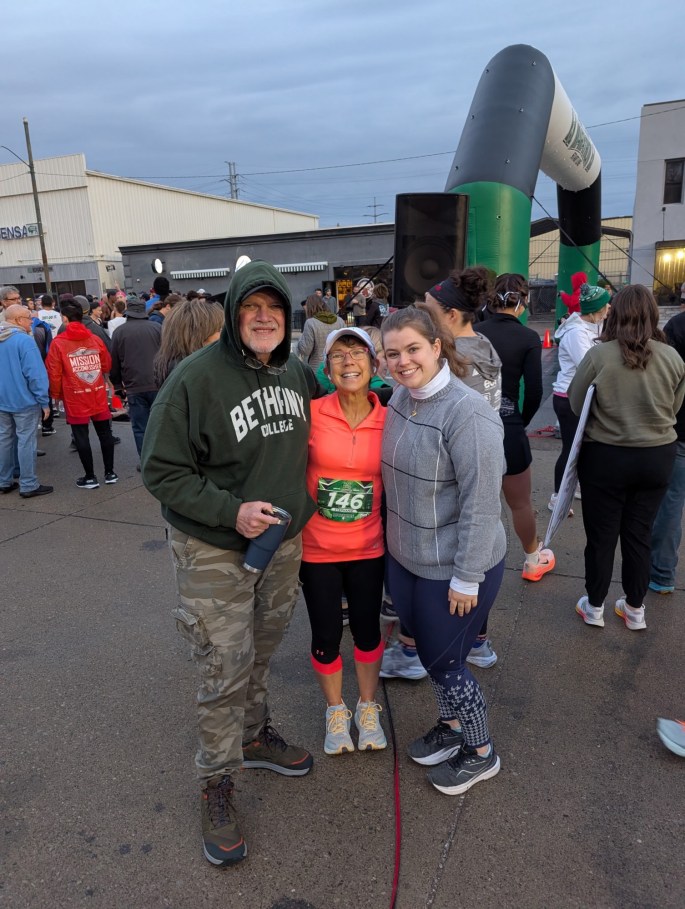
A group of three people, including a man in a green hoodie, a woman in a bright orange top with a running bib, and a woman in a gray sweater, gather smiling at a running event in an outdoor setting with other runners in the background.
Just before the start of the marathon I took time to get a hug from my two biggest supporters throughout the training process: my husband, L, and my daughter, R.

A Morning of Reflection and Gratitude 🌅

A light mist fell as an overcast gray morning began to chase away the night. I stood quietly in a throng of animated runners, taking deep breaths as reflection and gratitude washed over me. Months of preparation had led to this moment, and I felt thankful not only for my health but for the loving support that carried me here—to this celebration of movement, resilience, and connection.

Running as an Act of Hope ✨

It had been ten years since I last pinned on a bib for this distance, and my body hummed with anticipation, hope, and belief—the belief that movement is for everyone at every age, and that it is, in itself, an act of hope. I was about to embark on an emotional 26.2-mile trail of faith that became more about the people who supported me than the miles themselves.

Discovering Joy in Gentle Movement 😄

I came to running later in life, and it wasn’t easy at first. Only when I learned to approach running gently—to let go of preconceived (and societal) notions of what running “should” be—did I discover paths full of freedom, clarity, and renewal. Movement, whether running, walking, dancing, or stretching, benefits body, mind, and spirit. It brings a sense of structure to an often chaotic world and offers a feeling of accomplishment—if nothing else goes right in a day, at least I moved my body. Movement brings us alive to ourselves, our spirit, and, in turn, to the world around us.

The joy, I’ve learned, is in the doing—not in attaching to a pace, distance, or goal. Those things can be part of the experience, but they aren’t required.

A man and a woman embrace warmly in a crowded setting, both smiling in a moment of connection before a marathon.
Maddie’s, my daughter, boyfriend, Connor, flew all the way from Austin, TX to be part of this event. Together, with Maddie, he helped plan the marathon surprise of a lifetime!
Redefining What It Means to Age 🧓

As I neared my 60th birthday, I began to notice messaging that framed this decade as one of limitation. I decided instead to flip the narrative and celebrate the 60s as a decade of possibilities. Why not run into this new decade the way I ran into my 50s—with eyes and arms wide to adventure?

Training with Gentleness and Grace 😌

Since I was already running regularly, I committed to training for a marathon, but this time with gentleness. Instead of a traditional four-month build-up, I created a ten-month plan that encouraged patience, routine, and presence. Twice-weekly strength training and yoga joined the schedule, as did listening to my body and using the run-walk-run method as needed. I also focused on proper hydration and fueling before, during, and after runs. Most of all, my husband and daughter supported me from the very beginning—their quiet, everyday encouragement becoming a steady foundation of strength.

A woman running on a street wearing a bright pink long-sleeve top, black leggings, and a cap, displaying a race number on her waist.

Gentleness was a large part of the 10-month training block that led to this moment of hope and celebration.
Adapting Through Life’s Curveballs 😰

Training for a marathon brings rhythm and structure to daily life—the early morning runs, the long weekend miles that lengthen gradually, and the sweet evening stretches after dinner. But life, of course, has its curveballs: weather shifts, fatigue, scheduling conflicts, unexpected events, and bouts of self-doubt. With age, though, I’ve learned to adapt rather than resist these realities, co-creating a practical, flexible approach to progress.

As my weekend long runs grew longer, my husband and daughter often appeared—driving by, stopping to cheer, or jogging beside me for a short distance. These small bursts of love in action fueled my heart and kept me going. Training, I realized, was less about mileage and more about cultivating fortitude, flexibility, and gratitude—along with a dash of fierceness—all essential life skills carried from the road.

A group of enthusiastic spectators cheer on runners during a marathon, surrounded by autumn foliage and a partly cloudy sky.
Maddie, and my husband, John, often showed up during the last few miles of my Saturday long runs to cheer me on as Maddie is seen here doing during the actual event itself.

Race Day: A Celebration of Love 💖

As the marathon began, the city of Huntington vibrant in energy, rebelling against the lackluster sky. Rhythmic footfalls and nervous chatter surrounded me as runners jostled for position. Warmly dressed spectators cheered, waving handmade signs against a backdrop of burnished orange, crimson, and yellow autumn trees. Little did I know that my daughter had turned this event into an outpouring of love.

Surprises Along the Course 🫢

At the start, my husband, daughter, and her boyfriend—who had flown in from Texas to surprise me—stood cheering. But that was only the beginning. Every few miles along the route, my daughter had arranged for friends, family, and coworkers to appear, waving signs and calling my name. I didn’t realize the scope of her plan until near the end, but each familiar face filled me with renewed energy, gratitude, and joy.

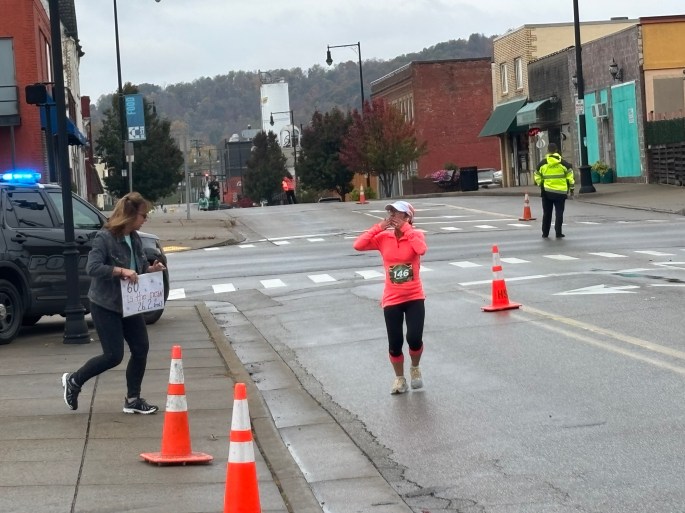
A female runner in a bright pink shirt crosses a street marked by traffic cones, while a supporter holds a sign nearby in a lively downtown setting.
The look of complete surprise when I see my sister, Traci, and her husband, David, around the 19-20 mile mark of the marathon. I had no idea they would show up along the route!
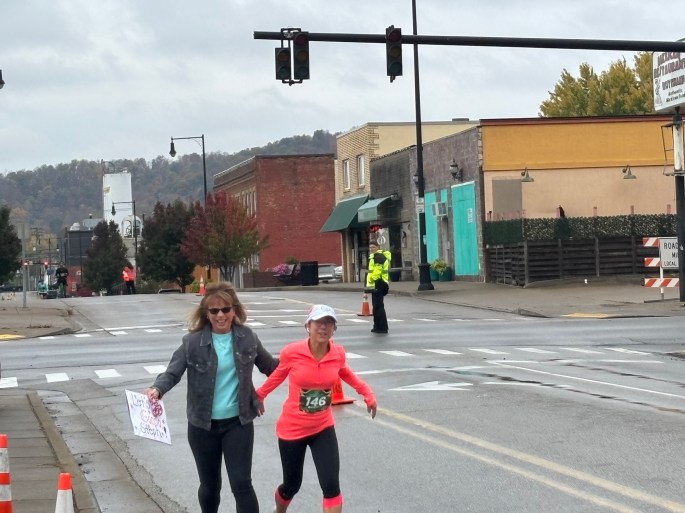
Two women running together on a city street during a marathon, with one holding a sign. They are surrounded by a lively atmosphere and shops in the background.
Of course, I had to veer off the path to give her hug, which helped uplift me over the next few miles.

Crossing the Finish Line 🏁

As I turned toward the final quarter mile, a group of race volunteers began singing “Happy Birthday” while my daughter’s boyfriend joined for a short burst of encouragement. My husband stood outside the stadium offering final words of encouragement, and my daughter met me at the bottom of the stadium ramp to run beside me as I approached the finish line. I wasn’t just completing a marathon; I was receiving the best birthday gift—a living reminder of love: a convergence of community, family, and friendship. It was a story of hope, purpose, generosity, and perseverance—the joy and power of a shared journey.

Two volunteers wearing bright reflective vests stand by a crosswalk in a park-like setting with blooming flowers and trees. In the background, a pathway leads towards a building under a cloudy sky.
This was the point, less than a quarter mile to go, when a group of race volunteers, led by an unknown female spectator and Conner, joined in to sing “Happy Birthday” to me as approached and rounded the corner to the finish line.

The Marathon as a Metaphor for Life 🪞

This journey mirrors life: we move forward by faith and grace, one step at a time, through both joy and challenge, supported by others who believe in us. That’s the power of movement—it connects us to our bodies, to others, and to something larger than ourselves. Choosing to move, to train, to keep going even when the path feels long, is an affirmation that with faith, growth and renewal are always possible—at any age.

Movement as a Lifelong Invitation 💌

Movement can take many forms: walking, stretching, dancing, or choosing to train for something big. The point is to move with intention and persistence, to embrace your own journey, and not attach to societal and social media messaging. Just move—and let movement open the door to new possibilities, both inner and outer.

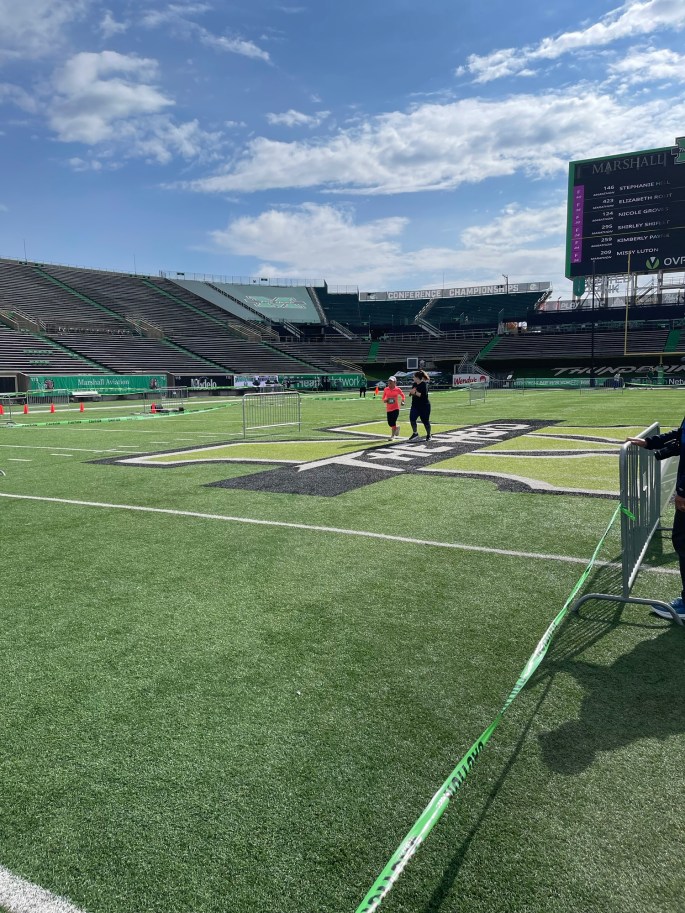
A runner crosses the finish line at a sports stadium, with spectators in the stands and a clear blue sky overhead.
Maddie runs alongside me for the last few feet, just as she did in 2015, to encourage across the finish line. Once I was close to the finish line, she dropped back behind the rope to let me finish alone. However, I really wasn’t alone. I was surrounded by a giant embrace of joy, hope, and love of family, friends, and community!!

The Joy Continues ☺️

The rhythm of footsteps, the smiles for miles, and the faces of loved ones along the route are forever imprinted in my heart—all reminders that every step matters. The marathon finish line was crossed, but the renewed sense of possibility and joy continues. Whatever your pace or path, keep moving forward—heart, mind, and spirit. You never know what acts of hope and love may be waiting for you along life’s path.

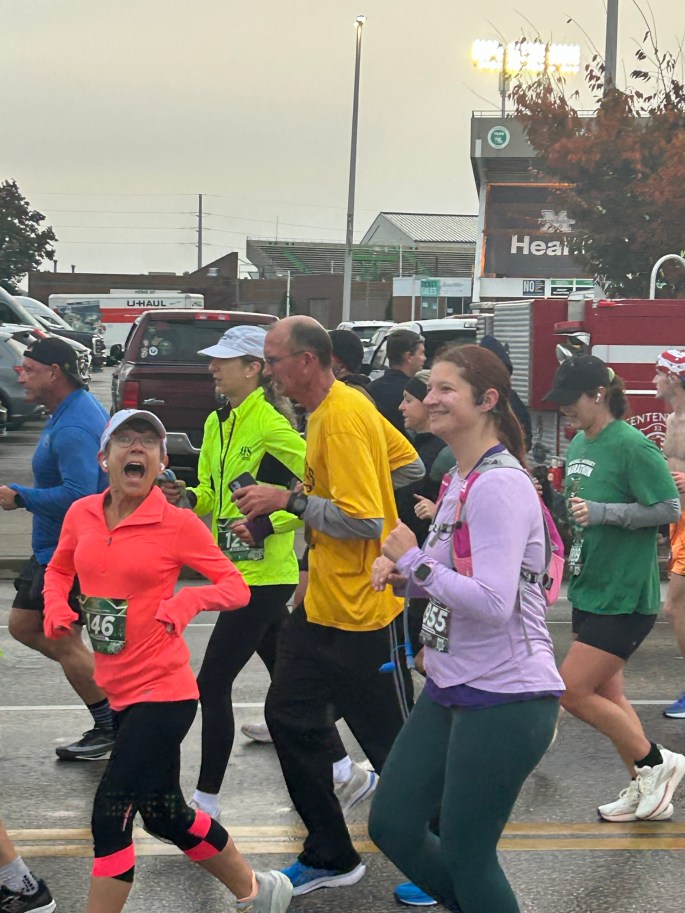
A group of runners participating in a marathon on an overcast morning, with diverse individuals wearing colorful athletic clothing and cheerful expressions.
The joy, and the journey of love and hope, continues . . .

A Grateful Heart 💜

P.S. Thank you to the countless and nameless MUM volunteers who invested hours of time to ensure the safety and success of runners, walkers, and those beloved spectators. And, an extra special heartfelt thank you to my friends and family who celebrated this milestone with me. And to Maddie and John, I love you to the moon and back.

A group of three smiling individuals taking a selfie on a subway or train, with a map visible in the background.
I wonder where the next path of adventure will lead?
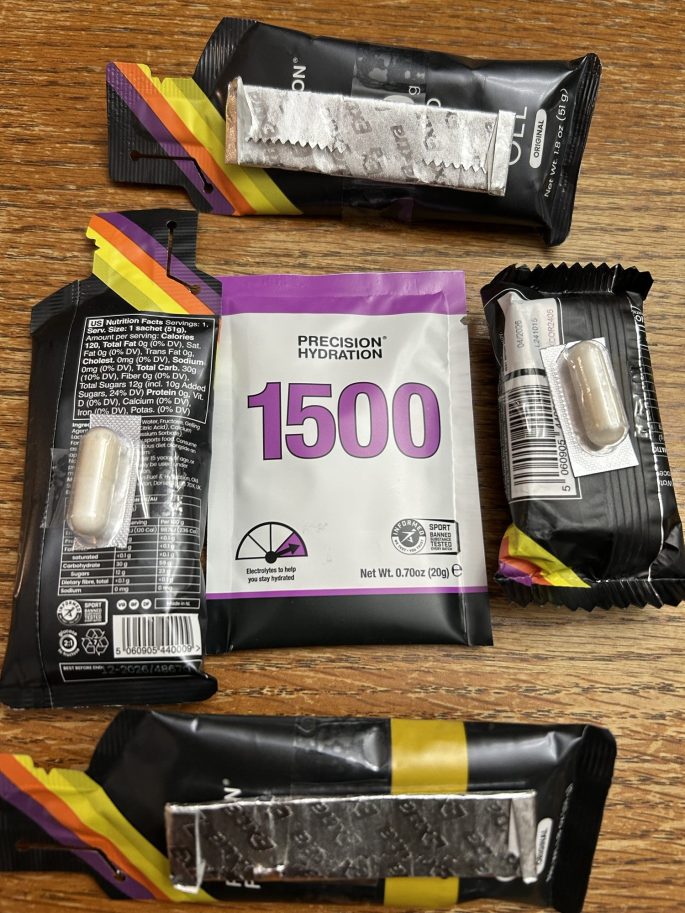
An assortment of hydration and energy products for runners, including electrolyte tablets and energy gels, arranged on a wooden surface.
Shout out to Precision Fuel and Hydration for the support during this training journey! I learned a lot from your team.

Running with Purpose: The Charleston Distance Classic and My Marathon Journey

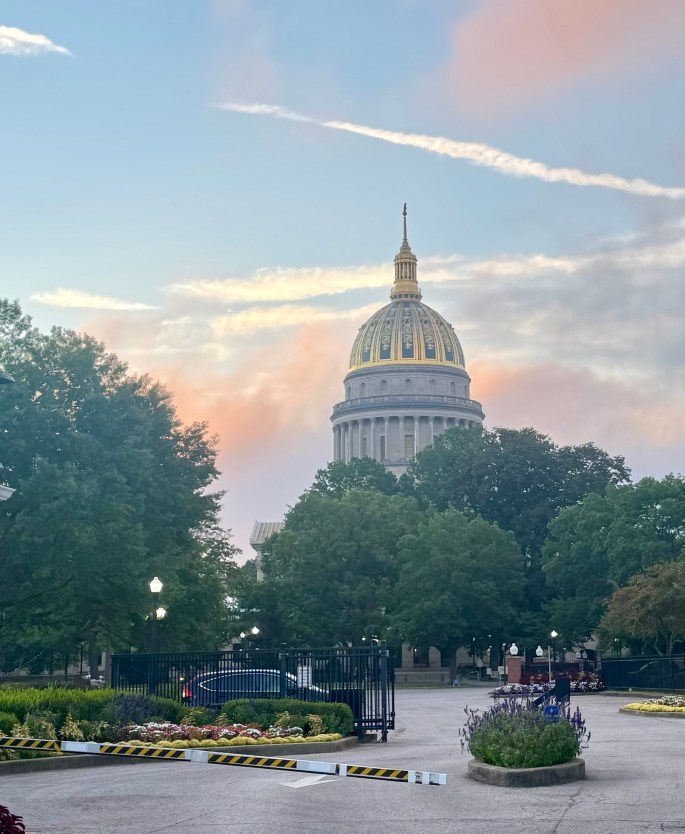
The West Virginia State Capitol building with a golden dome, surrounded by trees and a pastel sky at dawn.
The CDC starts in front of the state capitol of WV.

A Quote to Carry Me to the Start

Dean Karnazes is often credited with saying, “Run when you can, walk if you have to, crawl if you must; just never give up.” His words echoed in my mind while I was experiencing a case of collywobbles as my family and I drove to Charleston, WV, in the predawn hours of Labor Day weekend. Only weeks earlier, I had decided I had built enough base fitness to run the Charleston Distance Classic (CDC), “America’s 15-miler.”

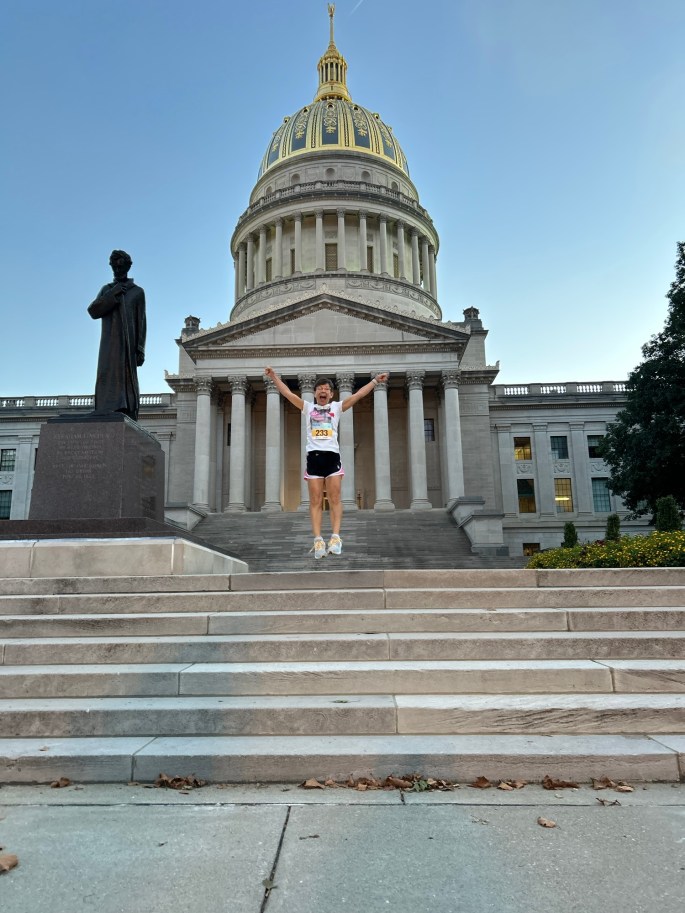
A joyful runner in a race, wearing a white shirt with a 13.1 badge and black shorts, excitedly posing with a water bottle while making a peace sign.
Ready to run the CDC!

Returning to the Classic After Ten Years

It had been more than ten years since I last ran it. In my previous two runs of the CDC, the weather was formidable, with the typical August heat wave bringing high heat and humidity. In fact, it wasn’t unusual to see runners collapse on the course—or cross the finish line only to collapse into the arms of medics from heat exhaustion.

Two women pose together smiling in front of a large government building with a golden dome, one wearing a race bib and athletic attire while the other is in casual sportswear.
My daughter was texting me messages of support throughout the race, so Siri could read them to me in my ear as I ran.

How Running Has Changed for Me

Life was different ten years ago. Besides being younger, I was fairly new to running and relied heavily on veteran runners for guidance. On one hand, I was fortunate to have others with whom to train; on the other hand, I didn’t yet have the aerobic base they had built over years. Plus, when I started running, I gave up strength and flexibility exercises, which I now know would have helped me. Instead, I focused on keeping up with others and hitting the weekly mileage goals.

Runner stands on a swing-shaped structure in front of the West Virginia State Capitol, smiling and wearing a race bib, under a clear sky.
Ready to swing into action.

Building Balance and Training for a MarathoN

Over the past decade, I’ve taken breaks from running—first from burnout, when I missed other forms of exercise. I rotated through strength training, yoga, walking, and cycling, always circling back to running. The pandemic brought running back to the forefront, as gyms and studios were closed.

Since then—and one major surgery later—I’ve learned to build a more balanced approach to exercise that includes a wide array of modalities, running among them. I exercise now for the joy of movement, as well as overall wellness. Still, I enjoy the discipline of a challenge. This year, in honor of another decade milestone, I’m training for the Marshall University Marathon (MUM)—the full 26.2 miles. Rather than follow a standard 16-week plan, I began in January, gradually building my aerobic base.

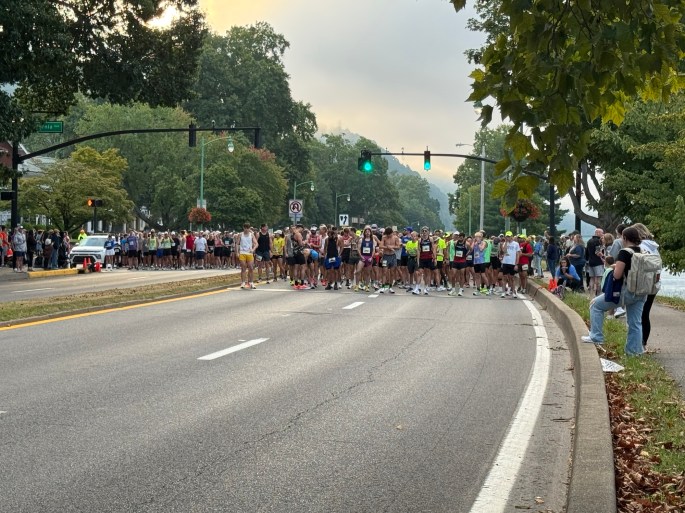
Runners lined up at the starting line of a race on a road, with traffic lights and spectators in the background.
The starting line for the CDC.

A Perfect Day to Race

It was this extended training that gave me confidence to run the CDC again. In addition, the weather worked in my favor. Temperatures were in the 50s when the race began in front of the state capitol. Running along the Kanawha River in the first mile, runners quickly spread out as paces varied.

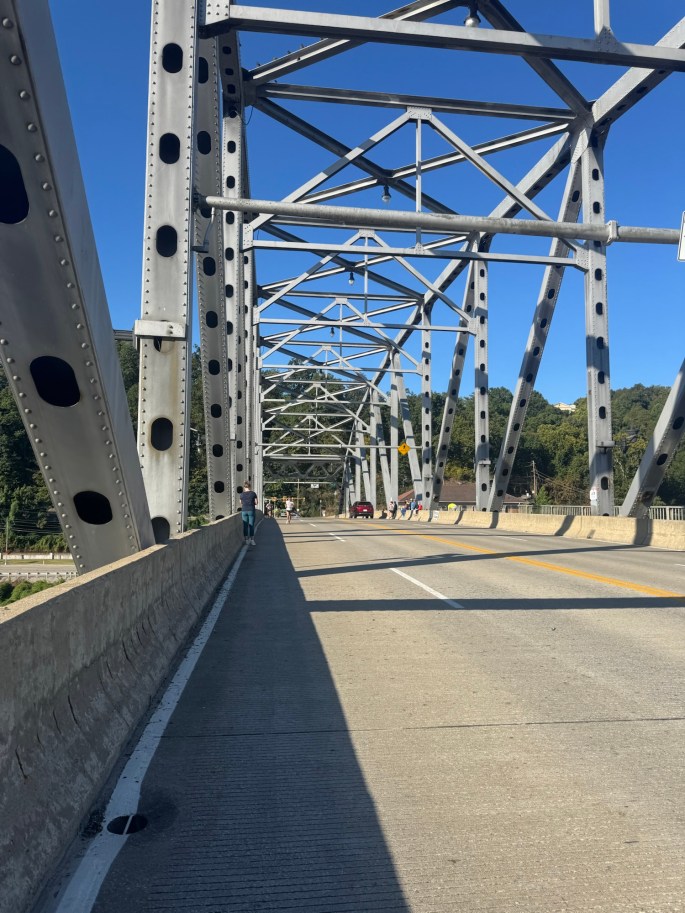
View of a bridge with steel beams and a roadway, featuring a few pedestrians in the distance.
The South Side bridge, which runners crossed twice–near mile 3 and again at mile 8.

“Capital Hill PUnishment” and the Course Challenge

Before long, we crossed the South Side Bridge and began the long trudge up Corridor G, aptly nicknamed “Capital Hill Punishment”—two miles of climbing. As if that weren’t enough, the course then wound through three hilly miles of Charleston’s South Hills neighborhoods. By the time we returned to the South Side Bridge, eight brutal miles were behind us. The final seven were mostly flat, except for one last incline near the end—just when our legs were good and toasted.

My Cheer Squad: John and Maddie

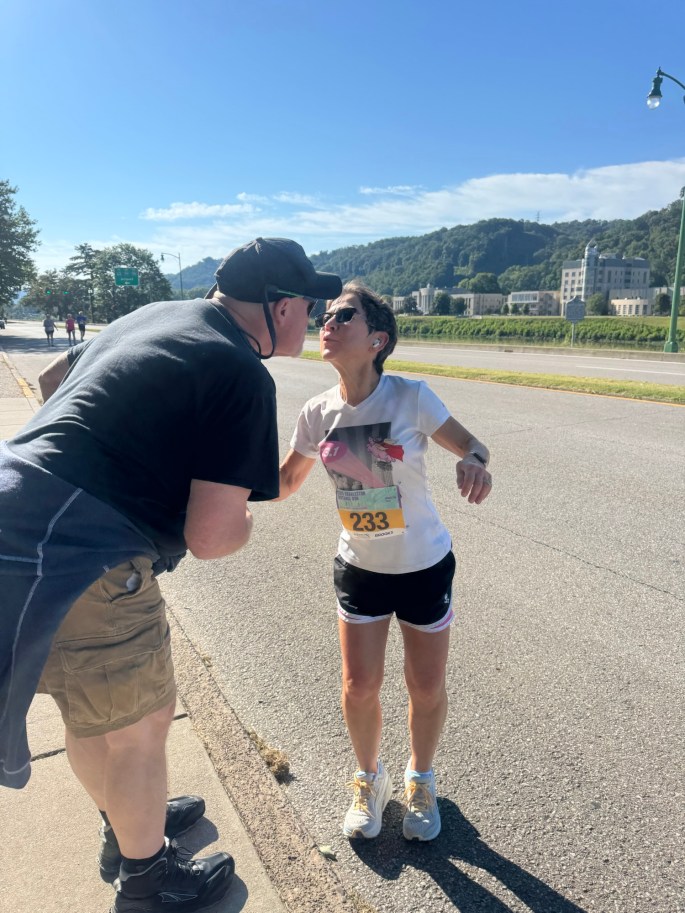
The CDC is a great spectator race, and I was lucky to have my husband, John, and daughter, Maddie, there. They were tireless cheerleaders, walking all over Charleston to encourage me. At the start, Maddie urged me on with excitement. At mile eight, as I crossed the South Side Bridge for the second time, she even ran alongside me for a short stretch, offering encouragement.

Between miles 11 and 12, they found me again, cheering and taking my empty handheld water bottle—by then more of an annoyance than a help. At Laidley Field, Maddie’s voice carried as soon as I stepped onto the track, her shouts of encouragement giving me the final push.

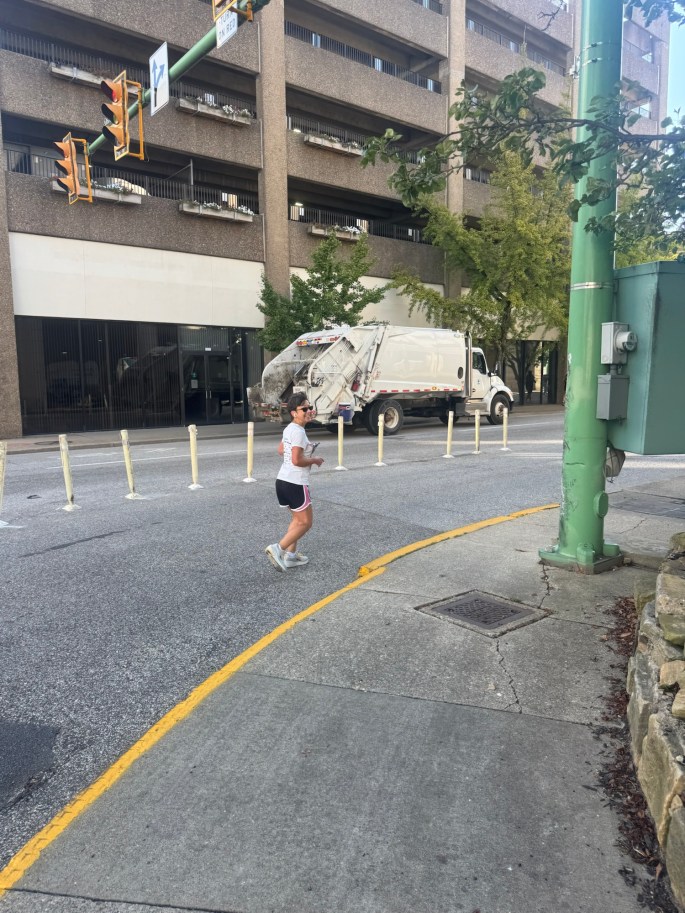
A person jogging on a city street with a garbage truck parked nearby and a multi-story building in the background.
This was mile 8. Afterwards, there was mostly flat course, EXCEPT for a last incline during the very last mile before the finish line. UGH!

Lessons from the Endless Last Mile

Honestly, that last mile seemed endless, and I learned a powerful lesson: even the final mile is still a mile long. My mental discipline slipped, and the fortitude that carried me there begged for rest. I grew whiny and irritable, which only amplified the aches and pains I had managed to ignore until then. It reminded me of my reaction in the last mile of a half marathon I ran this past spring in Asheville, NC.

Scenic view of a riverbank with lush greenery, walking path, and a bridge in the distance under a clear blue sky.
The beautiful Kanawha River that flows through Charleston, WV.

Strengthening My Fortitude

That last mile taught me what I must carry into the last weeks of marathon training: when the long runs get longest, I need to focus on strengthening my fortitude—especially at the very end. This, for me, is the hardest part. I try to follow the advice of Olympian Jeff Galloway (who is also credited with establishing the “Run-Walk-Run” method) to smile at each mile marker—since smiling releases those feel-good chemicals and helps relax the body. He also suggests repeating a mantra or power word. Perhaps I need to lean into this more.

Remembering My “Why”

I also need to remind myself of my “why” when the going gets tough. With the MUM, I hope to raise awareness for Branches Domestic Violence Shelter. Branches provides emergency shelter, legal assistance, counseling, case management, and even meal delivery for domestic violence survivors. Their work saves lives. If my miles can help encourage even a few people to support them, that will mean as much to me as crossing the finish line.

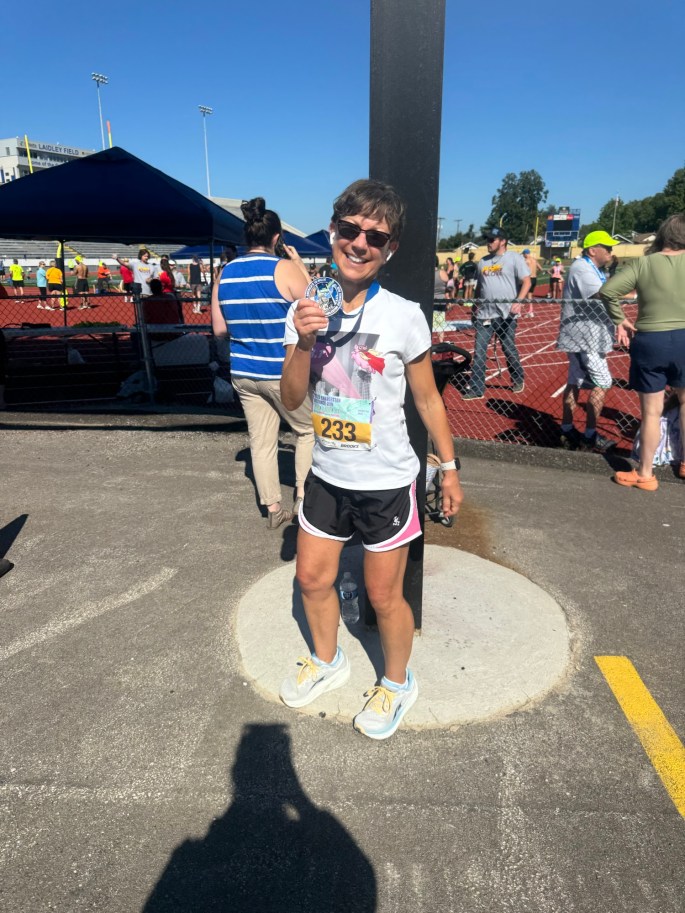
A smiling woman holding a medal, wearing athletic clothing, stands next to a post in a race finish area, with a crowd and tents in the background.
Feeling so grateful for my family, love, and support at the end of the CDC.

Running Differently, Running with Gratitude

Ten years later, I run differently. I take walk breaks when needed, and I’m grateful to still have my health. Running gives me energy, provides structure, and fills me with joy and purpose. Not every run is great, but each mile contributes to my community by keeping me connected to local races and to my own mental, physical, and spiritual well-being. Running also pulls me outdoors, connecting me with the Creator and with the delight of each season.

Never Give Up—In Running or in Life

Running the CDC reinforced the lesson of never giving up. I may be entering a new decade, but that doesn’t mean I have to give up striving for new goals—even if it means crawling to achieve them. Perhaps I’ll see you at the MUM. If not, I hope you’ll create your own journey. Either way, I invite you to celebrate with me—by supporting Branches or by committing to your own goal. Adjust as you must, but never give up. Step by step, with fortitude, tenacity, and a few deep breaths, you can do it.

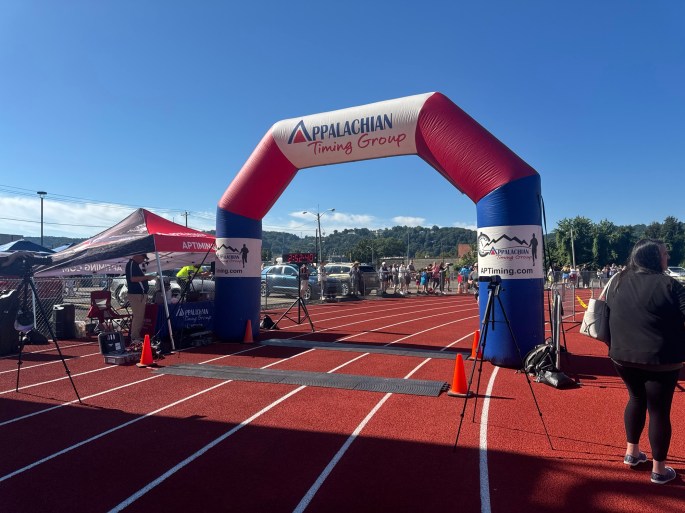
A running event starting line with an inflatable arch labeled 'Appalachian Timing Group' on a red track, set against a clear blue sky and distant hills.
Never give up! You can cross whatever finish line in life you need to cross!

Running Beyond Age: Embracing Health and Freedom in Every Step

“Running is an act of creative self expression”–Lawrence van Lingen on Extramilest podcast

A Familiar Morning Scene: Defying the Stereotype 👟👟

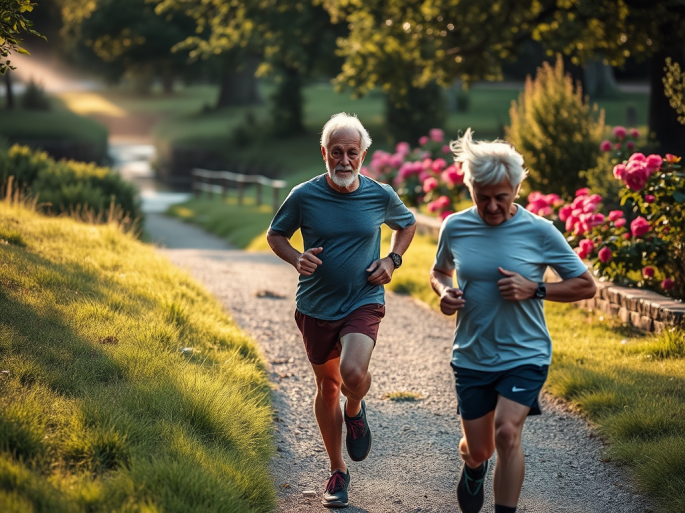
Two older runners jogging together on a path surrounded by grass and wildflowers in a park during early morning.
Photo by Anastasia Shuraeva on Pexels.com

Picture this. It’s early on a warm Saturday morning in your local park. The sun is low on the horizon, and mist is rising above the grass and a meandering stream that runs alongside a crushed gravel path. The scent of a nearby rose garden is heady as two runners descend the hill following the path. Moving at a steady clip, one runner has a full head of white hair while the other is more salt than pepper. They are relaxed and chatting as they pass by.

This is a routine sighting for me on my weekend jogs. Numerous older runners, walkers, and run/walkers defying the stereotype through exercise, that aging equals physical decline. In fact, according to AARP, beginning in 2023, the average age of runners has risen. Some of the biggest gains are those 55 years and older, with numerous runners sticking to it well into their 60s, 70s, and 80s as witnessed in the ages of Boston Marathon finishers in recent years as well as other major marathons around the world. Of course, there’s no denying aging does change the body, so why do I see numbers of people my age and older consistently outside running and/or walking?

Running as Personal Ritual and Liberation 🏃‍♀️

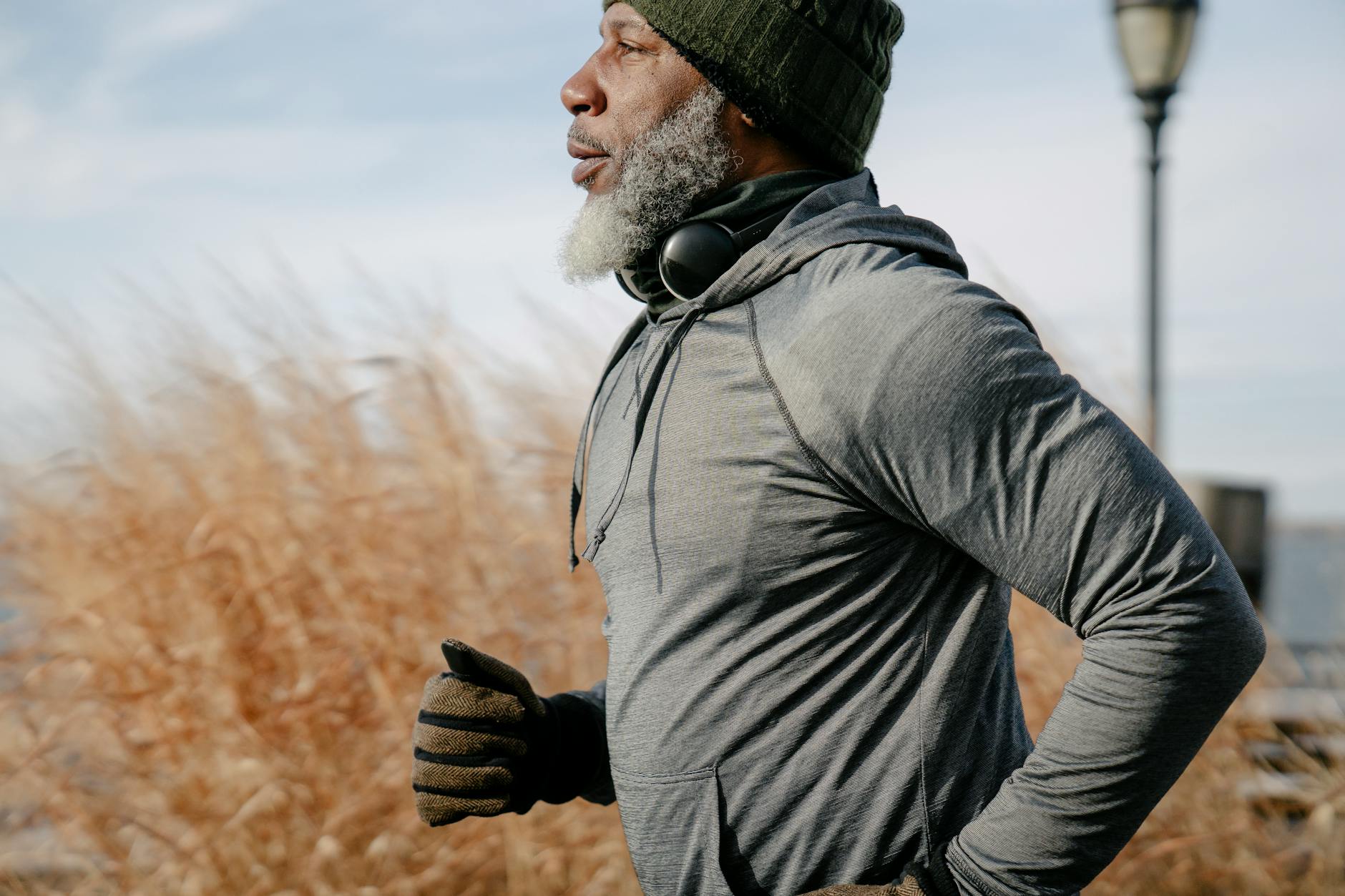
Older man jogging outdoors in a gray hoodie and gloves, surrounded by tall grass with a calm sky in the background.
Photo by Barbara Olsen on Pexels.com

For many older individuals, like myself, running or run/walking becomes a personal manifestation of life–a ritualistic form of imaginative self expression that allows us to reconnect with our inner rhythm, identity, and self-determination. It creates a sense of freedom and play that we once had as a child. Additionally, running offers numerous benefits, including improved physical health, enhanced mental well-being, social connections, and a renewed sense of personal meaning, to name a few. 

The Science-Backed Physical Benefits of Running 🏃‍♂️

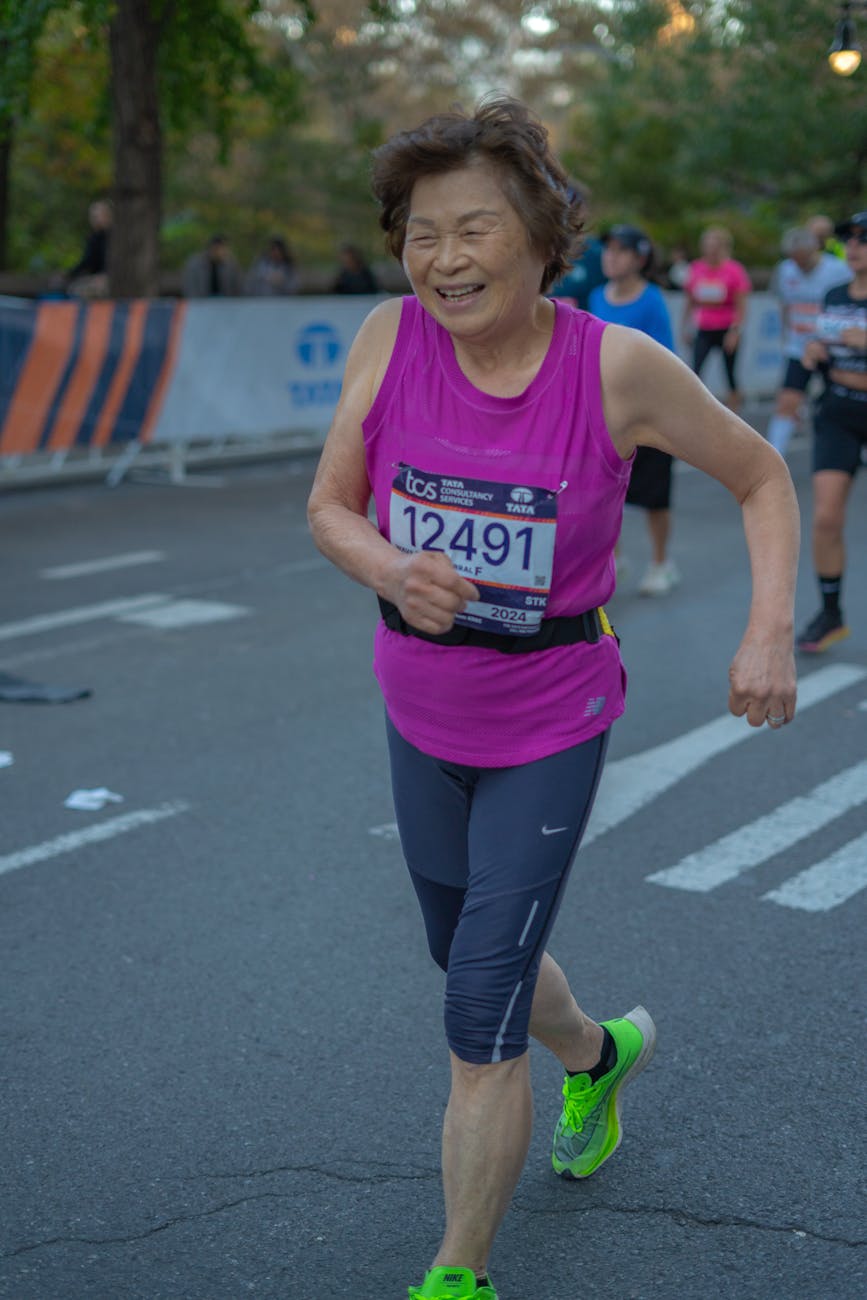
An older female runner smiling while participating in a race, wearing a bright pink tank top and bib number 12491, with greenery and other runners in the background.
Photo by khaoula Bkm on Pexels.com

I occasionally encounter critics who question the safety of running at “my age,” (a term used by my students); however, according to another 2023 AARP article, older runners just have to be “smart about it.” This is why many running groups often point beginners, including seniors, to using a run-walk-run method to establish a strong aerobic base. In fact, Cleveland Clinic, in a 2024 article, points to numerous physical health advantages to walking and/or running for all ages, but especially seniors. These advantages include:

  • Strengthens heart and improves circulation
  • Reduces risk of heart disease and stroke
  • Increases bone density, helping prevent osteoporosis 
  • Improves joint flexibility and maintains muscle function
  • Boosts metabolism and supports healthy aging
  • Improves blood sugar regulation and lowers risk for type 2 diabetes
  • Reduces risk of dementia and Alzheimer’s disease

Mental Health Gains: Silence the Inner Critic 🙉

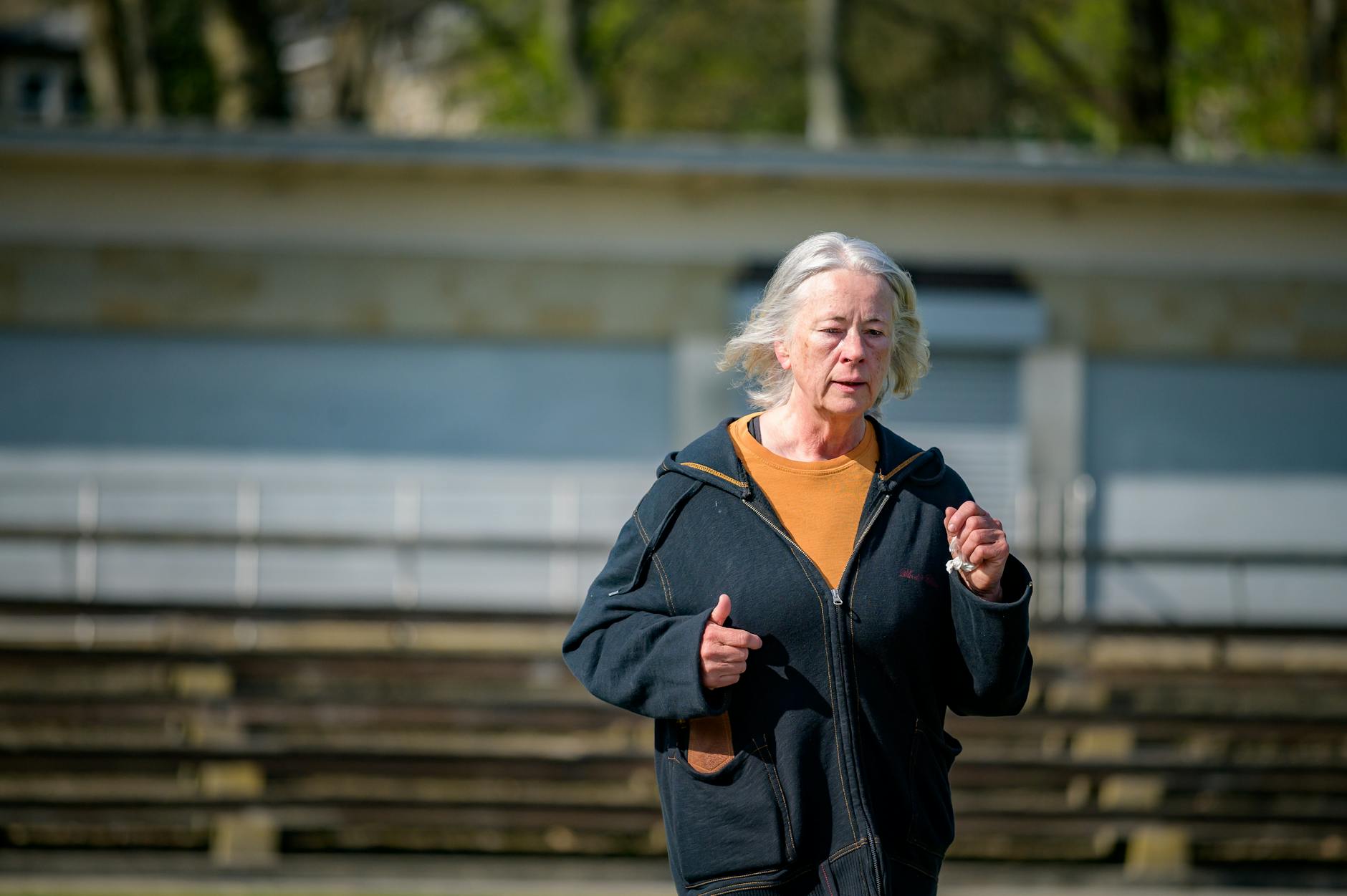
An older woman running outdoors in a black hoodie and orange shirt, focused on her exercise, with a blurred background of benches and greenery.
Photo by Centre for Ageing Better on Pexels.com

Certainly, the physical health benefits of running are important to me; however, one of the greatest advantages is the feelings of improved mental health and well-being. I often refer to monkeys living in my mind, and running allows me to rise above the swirling negative chatter that often clouds my mind. On days when it seems everything goes sideways, if I have completed my morning run, I can take solace in the fact that I completed at least one positive act, thereby helping me to keep symptoms of depression and anxiety at arm’s length. 

I also find running clears my head, improves thinking, and increases memory, which is a bonus as I age. In fact, running–and exercise in general–is like meditation in motion because it deeply connects me to my breath. Plus, it is a great source of stress reduction.

The Artistry of Movement: Running as a Creative Outlet ✍️

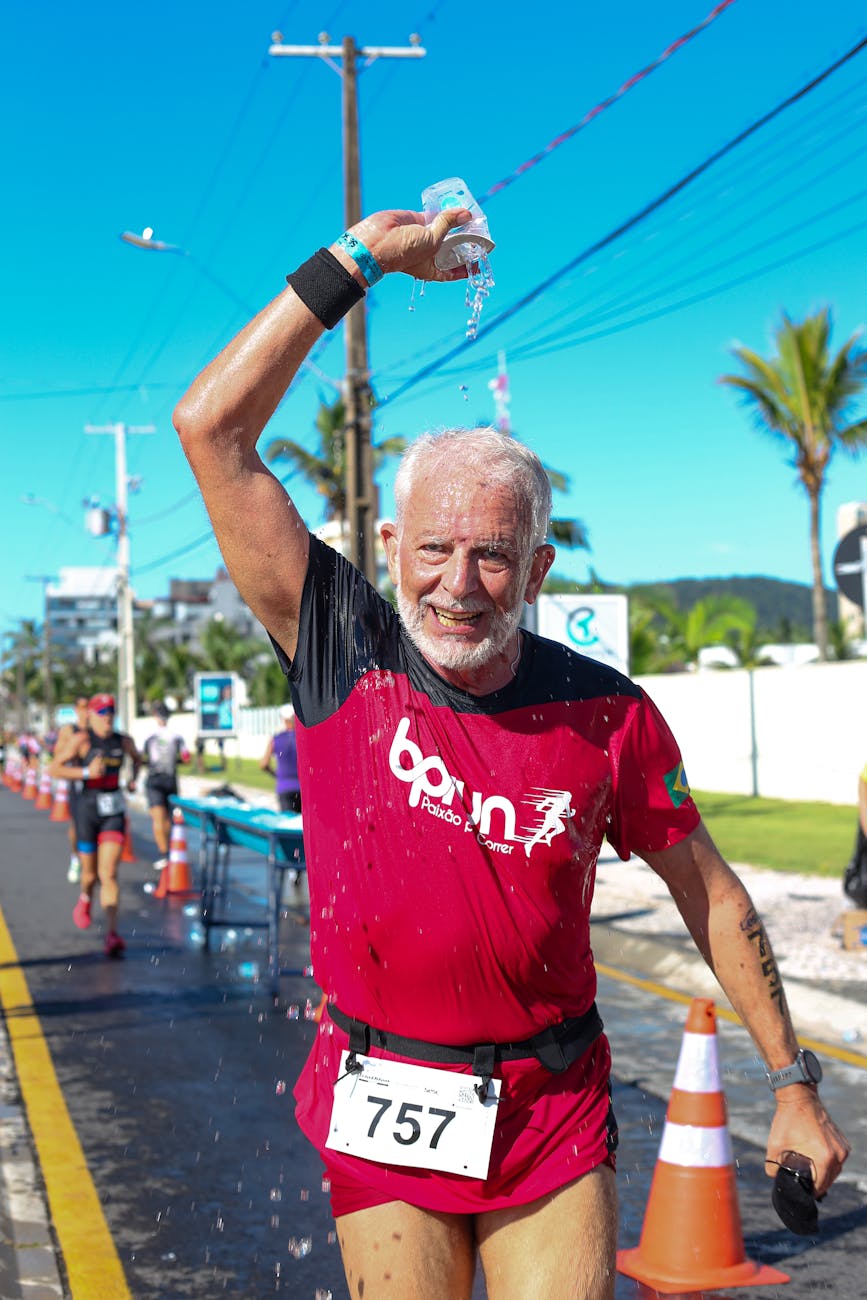
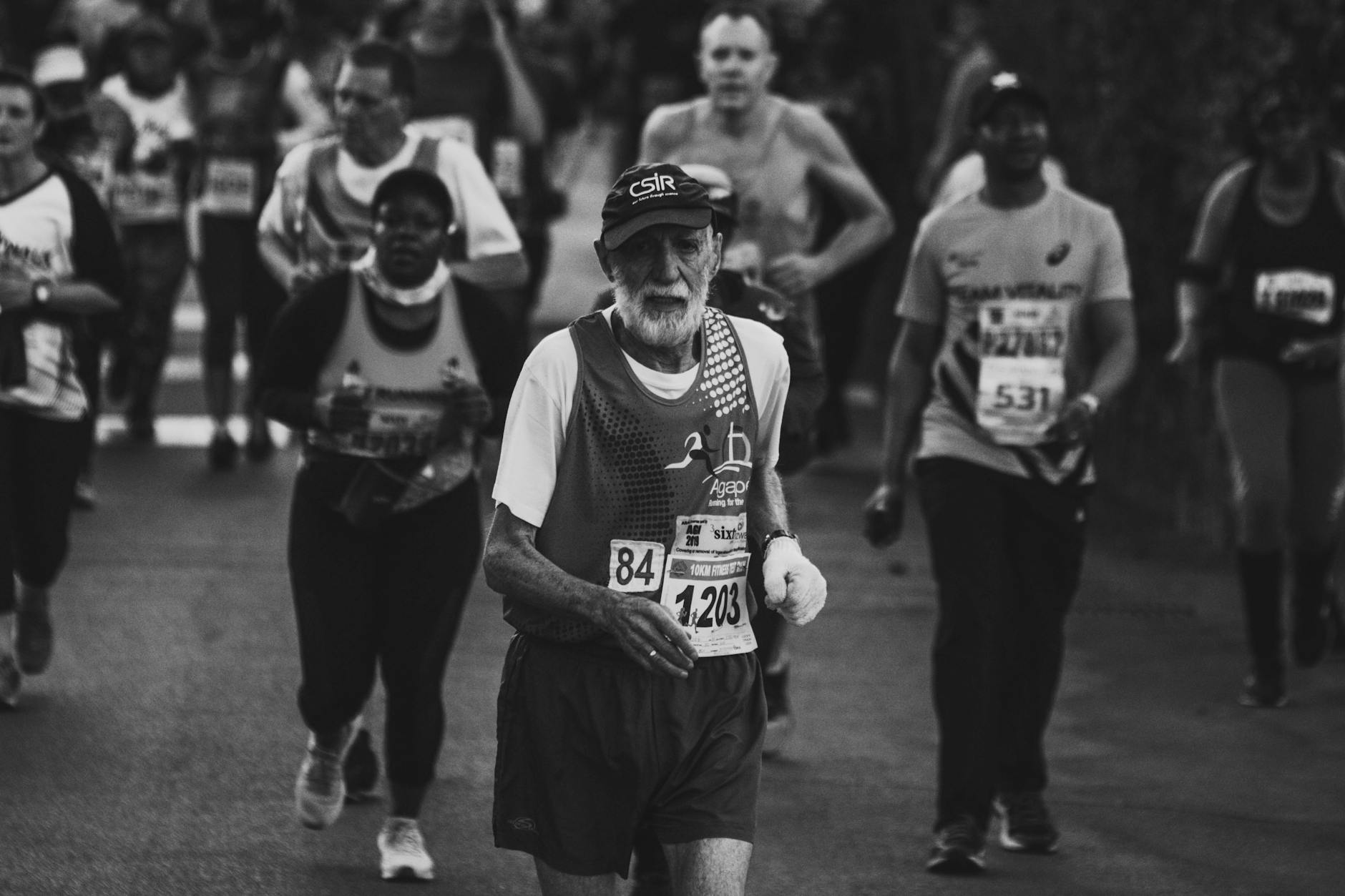
An older man with a full head of gray hair is pouring water from a cup over his head while running in a sunny outdoor setting. He wears a bright red athletic shirt and a race bib number 757. In the background, other runners can be seen along a palm tree-lined street.
Photo by Jou00e3o Godoy on Pexels.com

Running is also a form of innovative self-expression, for young and old alike. Like crafting one’s own piece of art, running showcases the beauty of a body in motion. It offers time for inspiration and reflection. Each run, like a canvas, offers the opportunity to tell a story, footstep-by-footstep. Personally, time spent running also allows me to process life as well as difficult, often buried, emotions, and it even sparks inspiration. My running, albeit slow, feels like an act of liberation, hope, and a tribute to the many obstacles I have overcome along the way. It is a symbol of inner strength, resilience, and freedom to be me–in a world that has often felt as if it boxed me in.

Spirituality, Solitude, and Social Connection 🙏

An older man running on a path surrounded by tall grass and trees on a sunny day.
Photo by Thomas Shockey on Pexels.com

For many runners, older and young, running offers an opportunity to hang out with other runners and socialize. However, some find that running solo, instead, creates a sacred space in which they can connect to their Higher Power, feeling that sense of peace and ease. Still others appreciate the opportunity to spend time in nature, soaking up fresh air and the beauty of Mother Earth.

A Healthy Routine for a Vibrant Life 🙌

Two female runners in matching orange and red jerseys sprint together, holding hands as they approach the finish line. They display expressions of determination and joy during a race.
Photo by RUN 4 FFWPU on Pexels.com

Running, for many, including myself, forms a meaningful structure to the day, a time set aside for one’s personal well-being and health.  This is important because there are numerous obligations and responsibilities that life often demands, even as we age. By setting aside regular time to run, sleep typically improves, which can be so elusive in older adults. Furthermore, those who run typically tend to eat better and don’t tend to abuse substances in order to better support their ability to run.

Staying Safe and Smart with Age 🤔

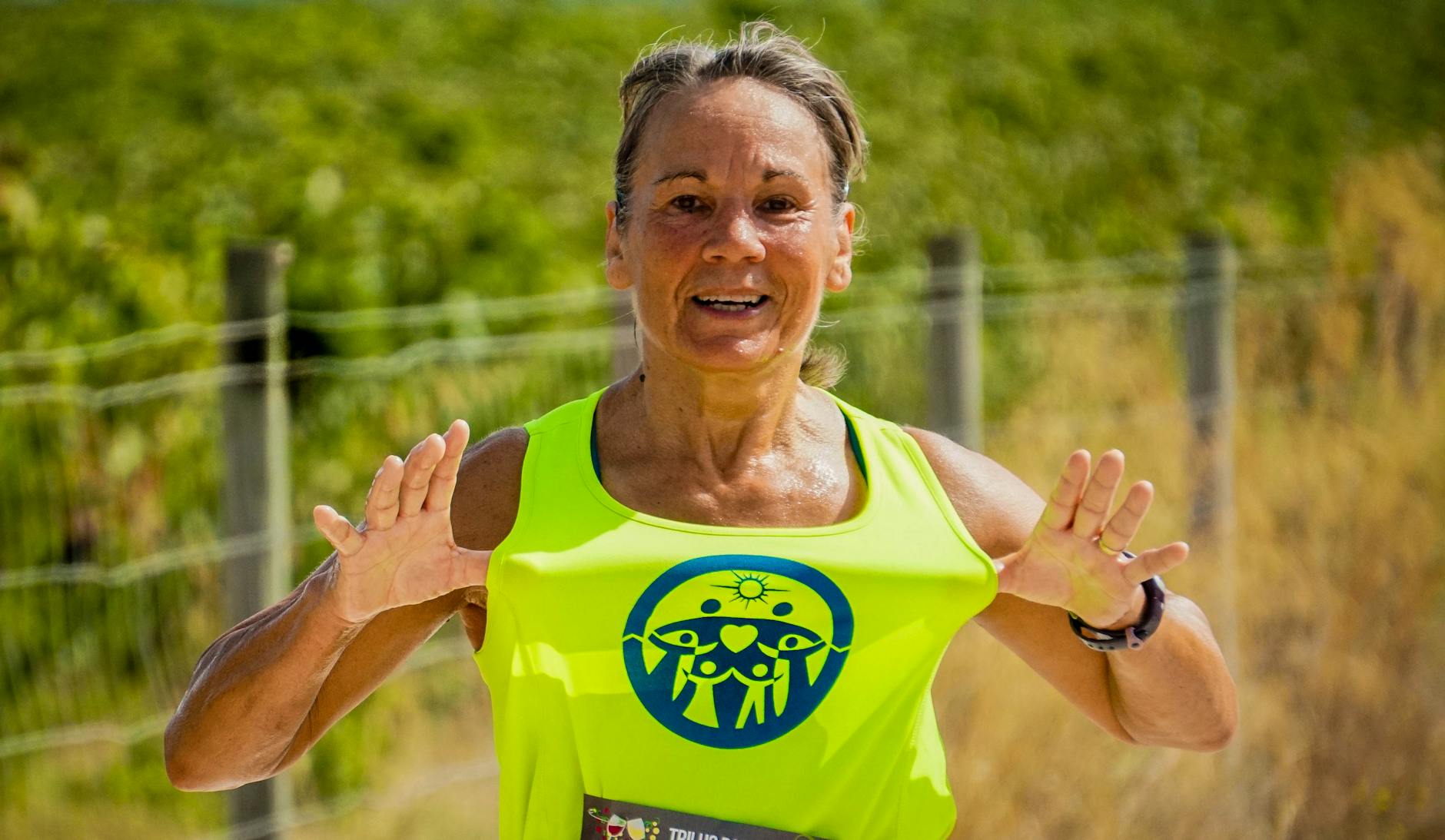
An older woman running outdoors, wearing a bright yellow tank top with a blue logo, smiling and gesturing with her hands. The background features greenery and a sunlit path.
Photo by RUN 4 FFWPU on Pexels.com

Of course, as we age, we do have to be safe about our exercise habits, which often begins with checking-in with a health-care provider. Additionally, I highly recommend finding good footwear that works for your own personal gait/foot-type; a local running store expert can help with this. Furthermore, as AARP points out, older runners should not go from “zero to 60.” Warm-ups and cool-downs are essential, and for those wanting to start running, a good walk-run program like Run Your Butt Off or the Run-walk-run training plans are two great ways to start. (I have personally used both and can attest to their gentle nature.) 

Other considerations as we age include running less on concrete and asphalt, if possible, and spending more time on softer surfaces, like the paths at local parks. Treadmills also offer a more cushioned surface, and they are a great option when weather is too hot, too cold, or otherwise uncomfortable. If you run at night or early morning, it is important to wear a headlamp and reflective vest for safety’s sake. Additionally, if you run alone, it is a good idea to let someone know where you are running and for how long. 

Every Run Is a Story: Movement as Becoming 🏃

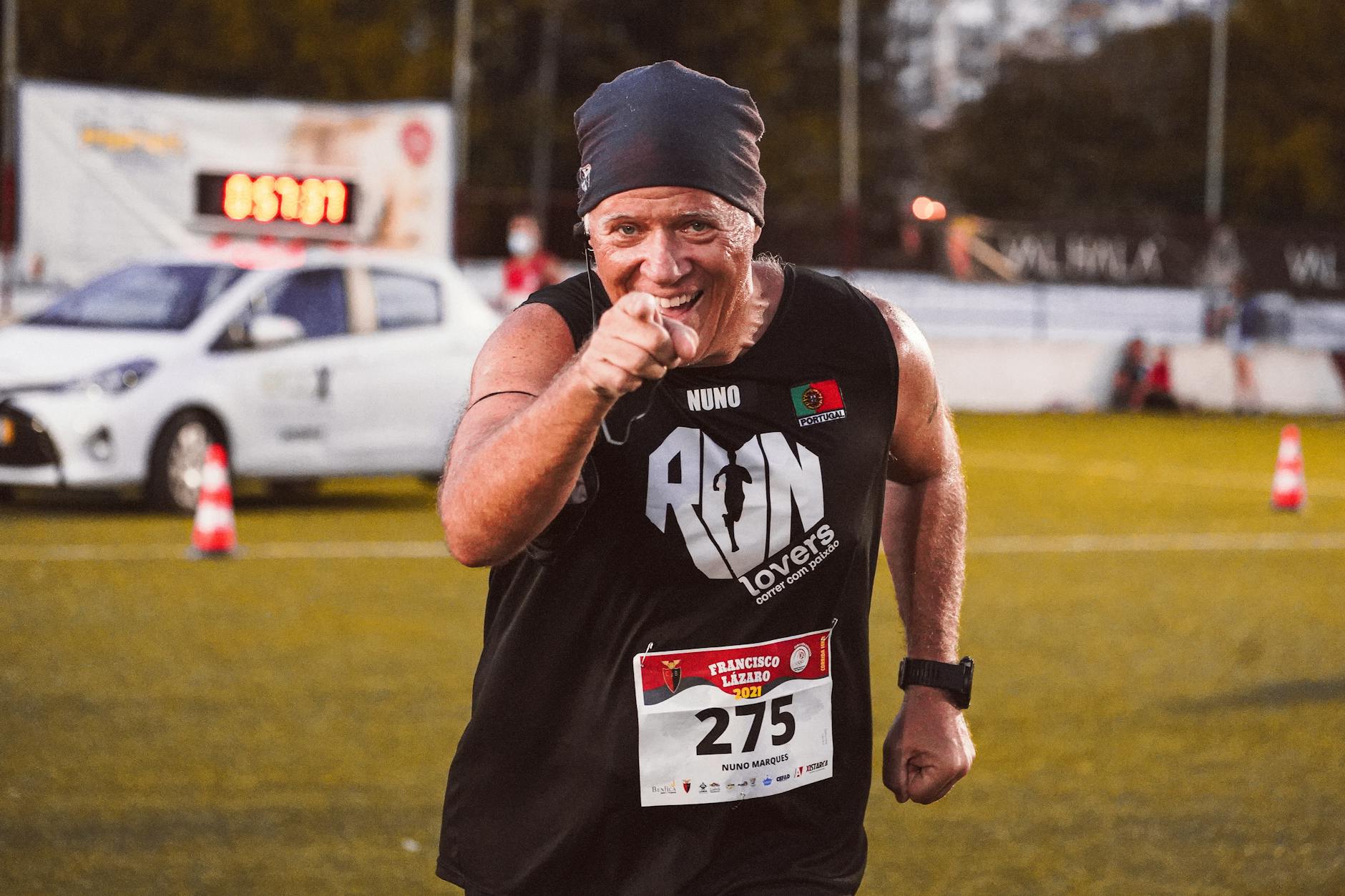
A runner with a confident expression points at the camera while sporting a black sleeveless shirt with 'RUN lovers' printed on it, a race bib, and a headband, during an event in a sporting field.
Photo by RUN 4 FFWPU on Pexels.com

Bottom line, each run or run/walk/run is an adventure. Sure, some runs are less adventurous than others, but those moments offer an opportunity to learn about ourselves if we remain open and curious. Running (and walking) is accessible and fairly low-cost, and it is an effective way for older (and even younger) adults to improve their mental, physical, emotional, and even spiritual well-being. 

Beyond these benefits, running, for me, continues to remain a quiet act of self-expression. With each step and stride I take, I am writing a story, reclaiming my space and time, and paying homage to The Creator, celebrating this gift that is life. In this way, running transcends exercise and becomes a personal journey of becoming, no matter my age. 

With the right approach and mindset, whether you run, run-walk-run, or mostly walk, moving our bodies regularly can create joy and empower older adults to age well—proving that vitality truly has no age limit!

An older man with white hair smiles while wearing a jacket and a medal, standing among a group of people in a blurred background.
Photo by Roman Biernacki on Pexels.com

Embracing Limitations: Lessons from the Asheville Half Marathon

God, grant me the serenity to accept the things I can not change, the courage to change the things I can, and the wisdom to know the difference.”–Prayer for serenity

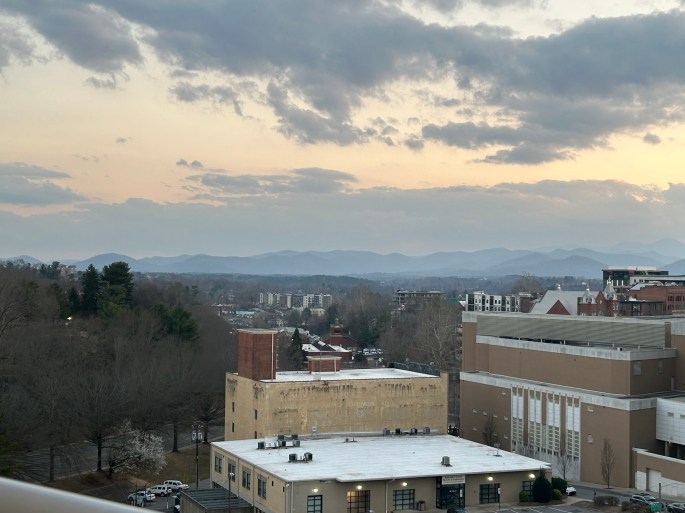
The Blue Ridge Mountains outside of Asheville, NC.

“the mountains are Calling . . .” ⛰️

I had been training for months, despite the challenges winter threw at me. Cold? I can handle it. Snow? I can run in it. Gusty wind? I can run that too. However, after my husband, John, and I crested hill after hill making our way into Asheville, North Carolina, I knew the town’s half marathon would offer a whole new level of challenge. 

To be clear, participating in the Asheville Half Marathon was an insignificant hurdle compared to what the people in Asheville, and all of the other residents of the surrounding areas/towns along US 23, have been facing as they deal with the aftermath of Hurricane Helene.

Driving along US 23, John, and I were able to witness that six months after Hurricane Helene angrily chewed through a large portion of the western Appalachian region, the recovery is still ongoing. However, the willful, and not-to-be-deterred, spirit of the residents was unmistakable. 

Rooftop view from Asheville of surrounding Blue Ridge Mountains.

A Tale of Two Sisters 👧 👧

This past fall, not long after Helene hit, the high school in which John and I work, welcomed two sisters into the student body.  They were from the Asheville area and were staying with relatives while their parents and older brother dealt with the devastation and destruction back home.

The girls were engaging and well-poised, especially considering their circumstances. Over the course of a couple months, I got to know them–not well due to the short duration of their stay–but well enough to swap personal stories from time to time. 

When they learned that like their dad, I often trained for half marathons, they immediately invited me to run the Asheville Half Marathon in March. They explained that by the time spring rolled around, the community would not be fully recovered, but the local economy would need the boost that runners and the accompanying spectators could bring. 

“You should definitely come, Ms. Hill.  You’d like the people of Asheville, especially the running community.” 

Once Asheville High School opened, the girls returned back home. And though I haven’t heard from them since, they planted a seed that grew into a shoot of curiosity. 

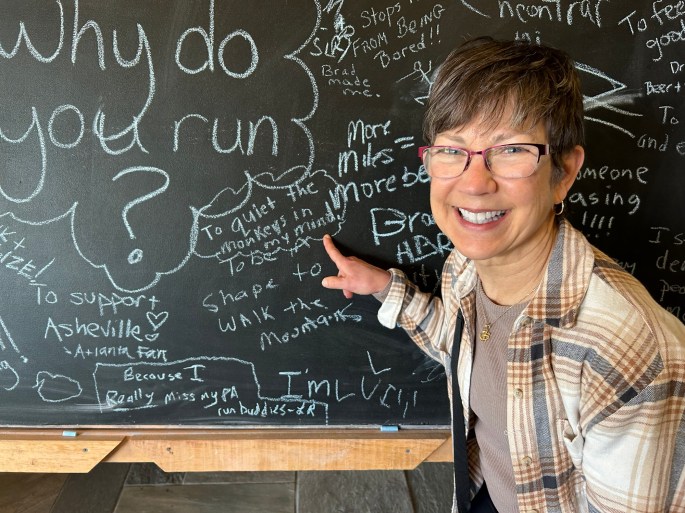
Runners were asked to sign the board stating why they ran.

Sign me up! 📝

Around Christmas, I checked the Asheville Marathon/Half Marathon website, and the powerful and persuasive prose describing the event increased my interest. The website’s editors artfully articulated the community’s belief in the significance of the annual running event. They stated the course’s route would not be “pristine or predictable.” Therefore, the event was for those who “thrive on resilience.” However, the line that sealed the deal stated, “If you’re ready to run in the face of adversity and be a part of Asheville’s comeback story, we can’t wait to see you on the start line!” 

John and I at gathering with other runners and spectators at the starting line before the race began.

Ready, set, Go! 🏁

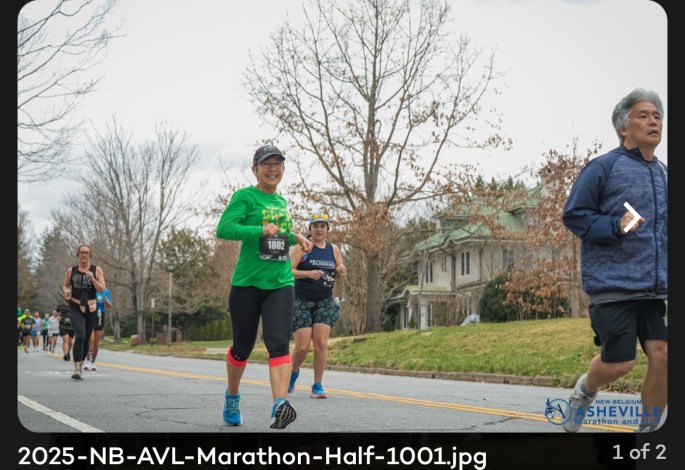
Soon enough, on a chilly, dark March morning, I waited at the starting line with approximately 2,200 runners from 40 states and three countries who also heeded the call to help support Asheville, according to The Weather Channel. The positive vibe was palpable as runners mingled with spectators. Nonetheless, I was feeling a bit nervous as I recalled the half-marathon route’s elevation gain was nearly 800 feet, and its elevation loss was over 900.  

And, it was hilly.  From start to finish, there were no flat stretches. In the beginning, I read spectator signs claiming, “It’s all downhill from here,” with hope. It didn’t take long to realize those signs lied!  Even the finish line required running uphill, but I am “running” ahead of myself.

Running is a metaphor for living life, and it is always whispering (or sometimes shouting, as this event seemed to do) lessons to those of us willing to listen. Accepting limitations–was the lesson those relentless hills of Asheville taught me. Which makes sense since this is what many of the residents of Asheville and the western Appalachian area had to do during, and now after, the storm–accept and deal with limitations. 

Whether literal or metaphorical, storms of life cause us to suffer. As I repeatedly tried to power through those uphills during the first half, my ego kept telling me to push harder, creating suffering. However, as a late-in-life runner lacking inherent running talent, the reality is that race events for me are more about creating motivation and structure to consistently get me out the door to exercise. At the end of the day, I am not about to set any records; I am not even close to winning my age group, so why was I pushing so hard?

And so, it was on a hill, not long after milepost seven, that I decided to accept my limitations. Sure, I had trained on hills at home, but nothing like this. Why not power walk up the rest of the hills, and then run the downhill portions?

Asheville taught me to accept my limitations.

There is a newfound freedom in accepting one’s limitations 🏃‍♀️

Once I accepted my limitations, there was freedom. I had a new way of being present with the race challenges as they unfolded. This acceptance gave me permission to slow down, take in the sites, and feel a sense of gratitude for my health and ability to make this trip. 

Additionally, by walking the hills, I had more energy to offer encouragement to fellow runners I encountered who also seemed to be struggling. (After all, I run at the back of the pack, where we could all benefit from a little encouragement.) Furthermore, I was also able to offer thanks to the spectators who manned drink stations, rang cowbells, or waved motivating signs with clever phrases such as, “Touch here for power,” “You’re stronger than any storm,” or “You’re running better than our government.” 

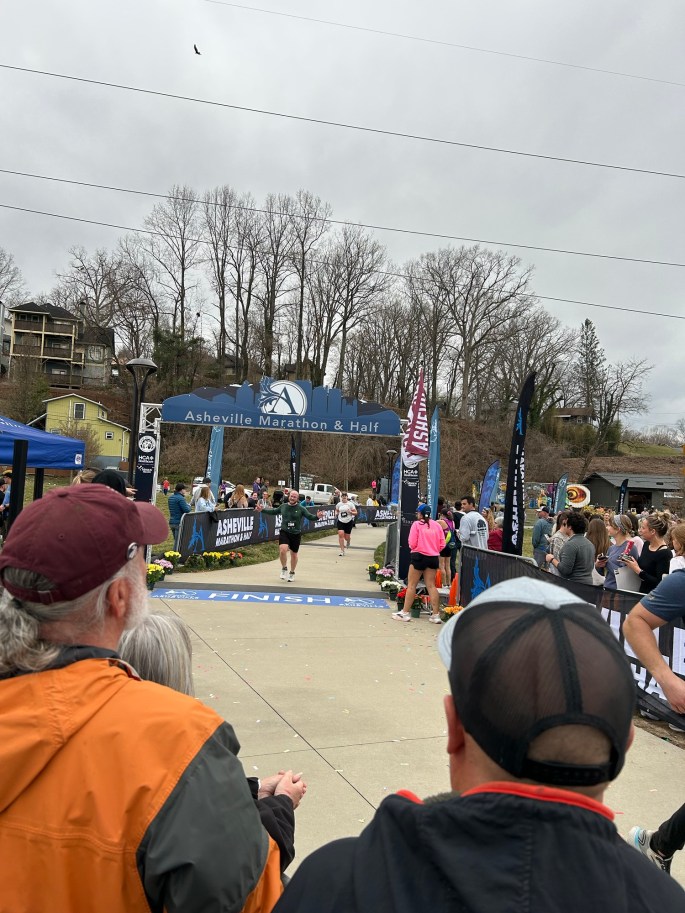
By the time I crossed the uphill finish line, tears filled my eyes as I raised my hands in the air.  No, I wasn’t celebrating a personal record, but instead, I was able to celebrate that I crossed the finish line with grace, humility, and a lesson learned. 

The AVL finish line of through which I would later cross humbled, and grateful, by another lesson running once more provided me.

The lesson? Transforming suffering can only occur if we are willing to be with it and accept the limitations it creates. Accepting limitations can be transformatively freeing, allowing us to lean into newly created possibilities we may not have been able to previously envision. I am not saying that accepting our limitations is not easy. However, once we let go of ego and embrace humility, it is possible to embrace the freedom that comes with focusing on what we CAN do.

Thank you , Asheville! I walk away from the finish line with grateful heart and a lesson learned. Furthermore, thank you, Hannah and Allison! I wish your family the best! 💜

Movement as Medicine: Staying Active in Your Older Adult Years

“Movement is medicine for creating change in a person’s physical, emotional, and mental states.”–Carol Welch

Photo by Roman Biernacki on Pexels.com

Let’s get Ready to Move! 🏃‍♀️

By the time you read this, I will be close to one week out from running (ok, jogging, “slogging”, whatever you want to call it) the Marshall University Half-Marathon. This annual community event motivates and inspires hundreds of locals and nonlocals to train, improve their current fitness level, and participate in the 5K, the half-, or the full-marathon distance.  Plus, it brings together a whole host of volunteers who support participants along the way.

Each year that I’ve participated, I hear numerous stories about those who haven’t trained for MUM, still participate, and do well.  My hats off to them; I appreciate that they can do that.  However, I find the training, and the build-up to the event, are part of the excitement and joy of the journey that includes completing the event.

Photo by RUN 4 FFWPU on Pexels.com

Giving meaning and purpose to Exercise through signing up ✍️

It typically takes weeks, or even months, of deliberation before I decide to sign up for a running event–even an annual event such as the MUM. Therefore, once I make the decision to pay the entry fee for an event, I am fully committed to a training plan. This is not because I have any desire to place or set records, but because signing up for an event is the extra motivation that gives meaning and purpose to my exercise.  Plus, it keeps me simultaneously excited and nervous in a good way.

Photo by RUN 4 FFWPU on Pexels.com

Exercise at any age! 👵🏼

Still, I have those who ask me if running is still safe for someone at “my age.” News alert! There is no milestone-age at which you should cut-off exercise.  In fact, exercise and/or movement can, and probably should, be embraced across all ages, including those of us in the AARP years, which is anyone over the age of 50. That said, you do have to manage your expectations, but movement and/or structured exercise can be a healthy part of the “golden years.”

That said, of course, if you have had an injury or have certain health conditions, you must respect your body’s limits and boundaries, but it doesn’t mean you give up on exercise and/or purposeful movement forever.  By working with a healthcare professional, you can find ways to adapt, modify, and/or create your own exercise plan that fits your body’s unique needs.  

Photo by Vincent Peters on Pexels.com

Tips for moving through those senior years 🚶🏿‍♂️

Here are some key tips and pointers I’ve learned along the way, gathered from other senior exercisers, as well as a few I researched, when thinking about exercise/movement in the, a-hem, “senior” years.

  1. Establish meaningful AND realistic goals appropriate for where your body is now that motivate and excite you.  This is why I enjoy signing up for a half-marathon.  My mantra is: “Set your own pace, and run your race.”  I don’t put pressure on myself that running has to be or look a certain way.  No time is too slow, and I can take as many walk breaks as I need.  That said, you can approach ANY form of exercise in a similar manner 
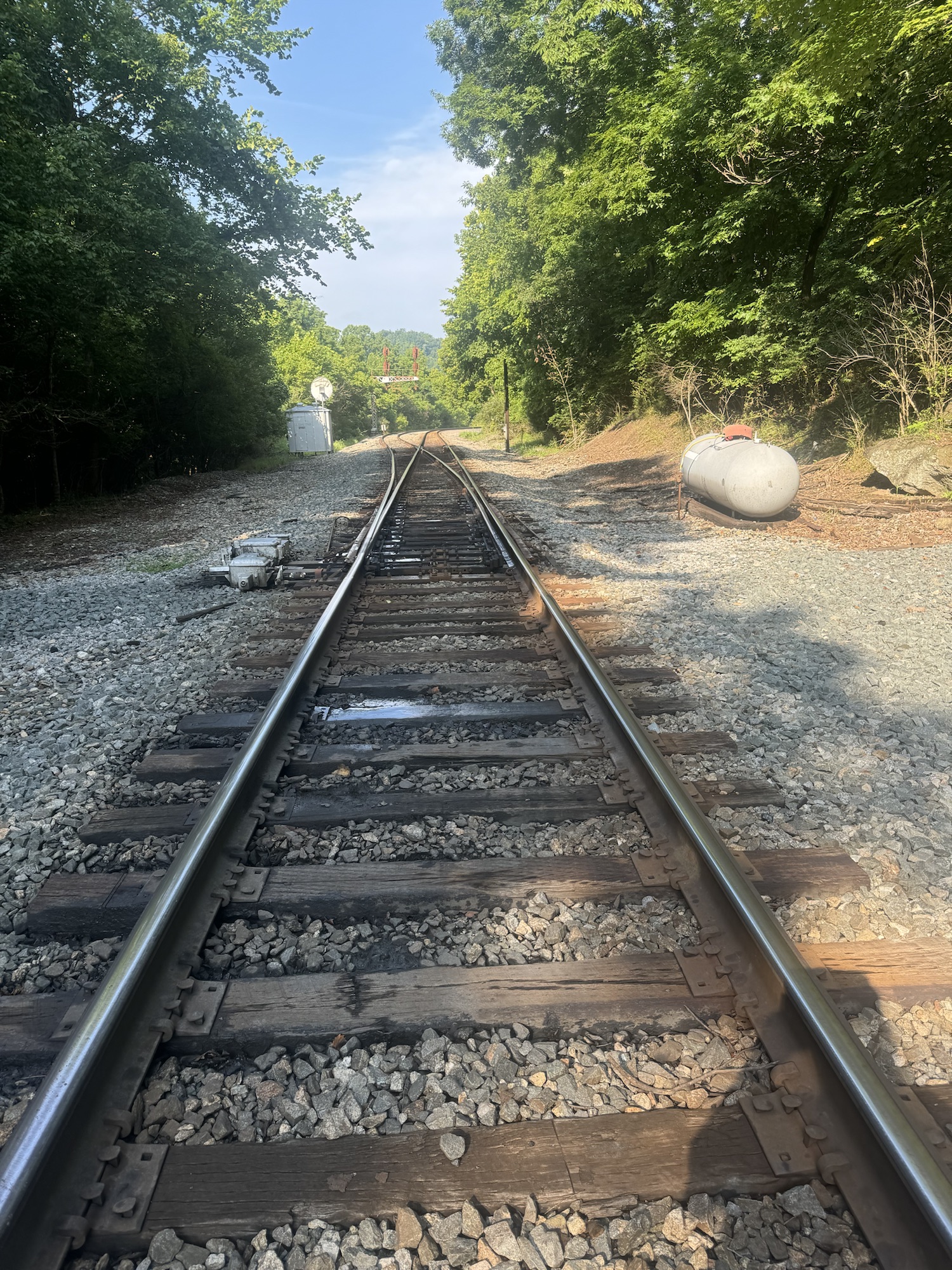
Set off in your own unique direction down the the tracks towards empowering your own health and fitness.
  1. Notice your narratives.  This is something that I have begun to notice more frequently. Reflect on how you talk/think about age with peers/friends/family AND self.  Is there often negative talk and thoughts associated with your current age and/or exercise?  Perhaps, you can begin to reframe those thoughts/chatter by leading by example.  Furthermore, look to role-models that motivate you to move more.  I personally often look at my Dad who still walks or hikes daily anywhere from 2-8 miles per day.
  1.  Find your edge. Whatever form of exercise we choose should challenge us, but not too much.  If something changes, and you sense you can do a little bit more, then do so.  But if doing a bit more causes serious discomfort, then back off, and try again another time. 
Map out your own fitness challenge.
  1. Strength train, stretch, and work on balance through practices such as yoga. The CDC in an article entitled,  “Older Adult Activity: An Overview,” states that in addition to cardiovascular exercise, such as jogging and walking, older adults also need to strength train and work on balance.  In fact, AARP offers a 10-minute, strength-training video that can be completed daily, seated or standing. 
  1. Manage your sleep and nutrition: There is a reason these two are often spoken/written about due to the fact both contribute positively, or negatively, towards your own health.  That said, one bad night’s sleep, one indulgent meal, or a day of eating very little, will not necessarily impact your overall health; however, consistently not getting enough sleep and not consuming proper nutrition will gradually, and negatively, begin to impact your physical and mental well-being. 
  1. Find your support or pave your own way.  There’s no one right fitness plan that works for everyone.  Find the type of movement/exercise that best suits your body and motivates you, which may mean exercising with a group, a friend, or at a club. That said, don’t be afraid to go it alone either and share the experience with others later.
Find your support!
  1. Exercise can be therapy. Personally, I know my mental health greatly benefits from movement. The National Institutes of Health, The Mayo Clinic, Mount Sinai, and numerous other institutions all point to the fact that exercise is a mood and mental health booster.
  1.  Tune in to your body’s needs with honesty and integrity. If you’re sick, tired, and/or run down, then maybe a day or two of rest may be what you need. If a joint, such as knee, elbow, wrist, or ankle begins to feel irritated.  Be curious about it.  Are you pushing a certain exercise too hard, too often? Or, are you not moving enough? Learning to listen to the signals our bodies send us is an important part of the exercise/movement journey.
Photo by RUN 4 FFWPU on Pexels.com

movement is medicine! 💊

When it comes to movement, no matter your age, focus on the positives of the experience–whether it is spending time with friends, benefiting your mental health, or feeling more overall strength, steadiness, and/or energy. To be sure, it is often hard to get started, but it is often that feeling of accomplishment you have afterwards that can keep you going. Finally, for those in the official AARP years, keep in mind, “older” doesn’t have to mean sitting on the sidelines. Becoming and staying active, however you define it, truly is medicine for imbuing well-being: socially, mentally, and emotionally. 

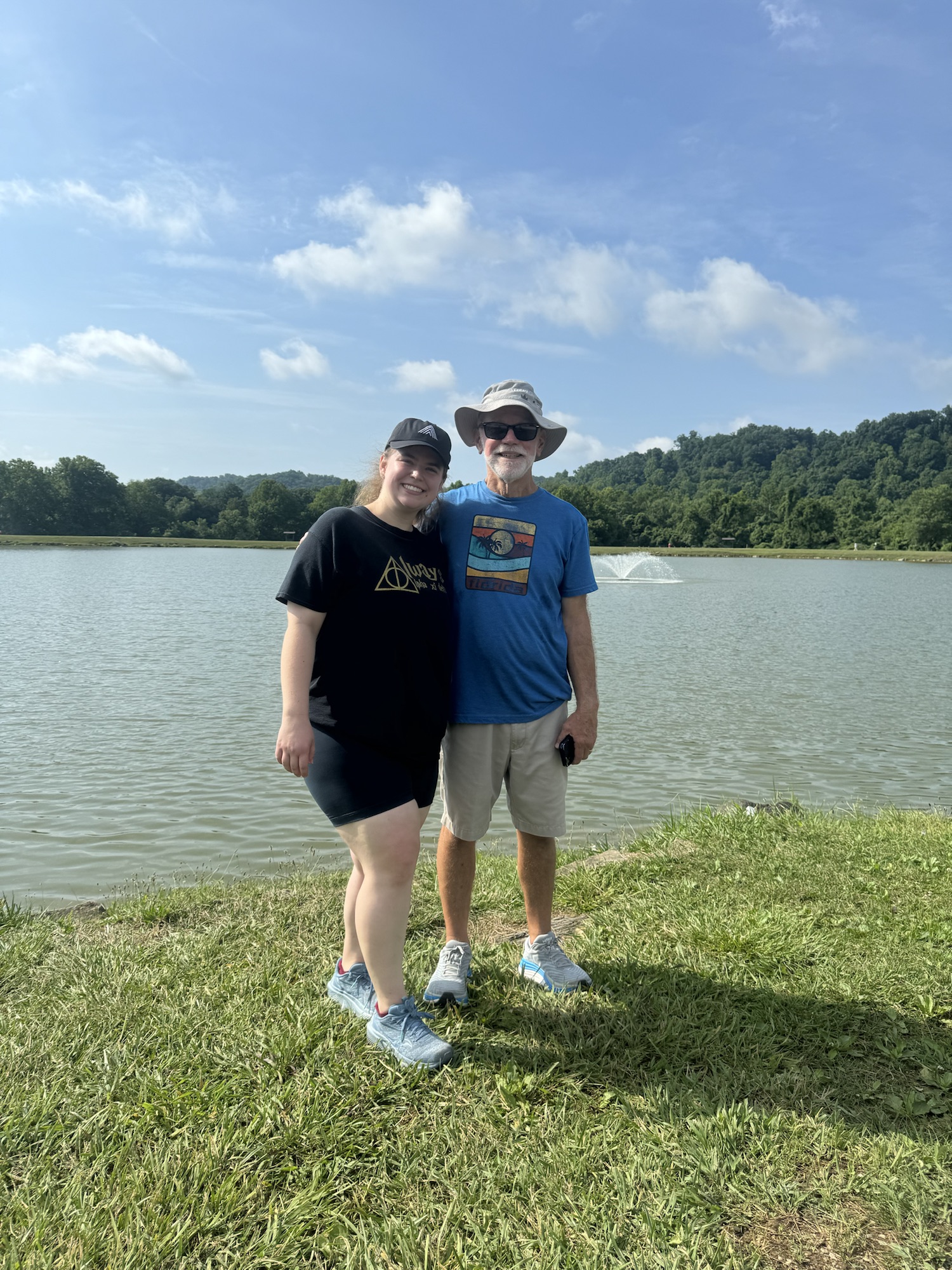
Dad and I pausing for a moment during hike this past summer at Barboursville Park.


Get More Grounded: The Benefits and Lesson of Tree Pose

“Be like a tree. Stay grounded. Connect with your roots.  Turn over a new leaf. Bend before you break.  Enjoy your unique natural beauty. Keep growing.”–Joanne Raptis

Photo by SHVETS production on Pexels.com

The magic of Tree Pose 🌳

“Trees sway; get more grounded,” my husband chimed along with the yoga instructor on the DVD as we attempted tree pose on a Monday morning before work, the classic yoga balancing pose that requires standing on one leg. 

I appreciate tree pose for many reasons. It strengthens feet, spine, ankles, legs, and core.  Further, it opens the hip area, stretches the inner thigh and groin muscles.  Plus, it can improve one’s concentration and focus while simultaneously improving alignment of spine and posture.  Most of all, it is a pose of balance, which can help in a multitude of ways. 

Symbolically, tree pose serves up several lessons. However, one of the more literal lessons of tree pose is that of remaining in the present moment.  It’s nearly impossible to balance in tree pose and think into the future or reflect on the past because you end up falling out of the pose. I was reminded of those lessons this past Tuesday, or as I have come to know it as, “Twister (or Tornado) Tuesday.” 

Photo by Ralph W. lambrecht on Pexels.com

Shelter in Place 🌪️

As a veteran educator, I have experienced a wide-array of events, including those that require shelter-in-place. In fact, I can still recall the first time I experienced shelter-in-place with students 30+ years ago.  I was teaching in a mobile unit at a great distance from the main brick and mortar school building. The students under my care ranged from 5-12 years of age, and they had been identified as “severe behavior handicapped.”  

There were twelve students, ten boys and two girls.  Since this was the early 1990s, computers and cell phones were not widely available in the classroom setting. This classroom had an intercom type “phone” that only connected from the school office to the classroom.  It was through this “phone” that I received the message that the entire school was sheltering in place in the hallways.  The school received a call that a tornado had touched down in another part of the county and was heading our way. I was to gather my twelve, not-always-so-compliant students, and move them to the main building as quickly as possible.

By the time I received the “call,” a heavy metal concert of rain and wind had already begun, drumming and shaking the metal building rhymically with tantruming, angry torrents of sideways rain.  Quickly, the paraprofessionals and I helped the students into their school-issued red rain parkas, and that is when the resistance began.

“I am not going out in that rain.”

“I don’t like getting wet.”

“No, I won’t!”

“I’m scared!”

Whether it was the determined, I-am-not-kidding look in my eyes, Divine intervention, or a combination of both, the paraprofessionals and I miraculously gathered all of them in a line.  Holding hands as one unit, we began fighting our way through the class door that kept trying to swallow us back inside due to the enraged winds. Once outside, raindrops pelted any exposed skin, including the students’ face and heads as their hoods were immediately blown off.  We fought our way to the safety of the school while the passion of the rain and winds seemed to increase and determinedly tried to shove us backwards. 

By the time we made it to the school, none of us were dry as the pernicious storm found a way to penetrate even the sturdiest of rain coats.  Quickly, we hustled the students to the primary wing of the school, finding a piece of wall away from windows where they could drop to their knees and cover their heads, rivulets of water streaming over all of us, while adrenalin continued to accelerate my heart rate.

Photo by monicore on Pexels.com

Twister Tuesday 🪟

This memory bolted through my mind on “Twister Tuesday” as my classroom, and the surrounding classrooms, were filled with the strident sound of the emergency broadcast system sending an urgent message to seek shelter immediately. Our middle school classrooms are located on the top floor of our school building, and the entire middle school was directed to make their way to the first floor as quickly as possible. In order to do that, we had to run down three flights of stairs in a glass-lined stairwell. As we headed down, the irate storm quickly made its presence known.  Like Lyssa, a figure in Greek mythology who is said to drive others mad, the storm insanely clambered and clawed at the windows demanding to get inside, but meeting a wall of resistance.

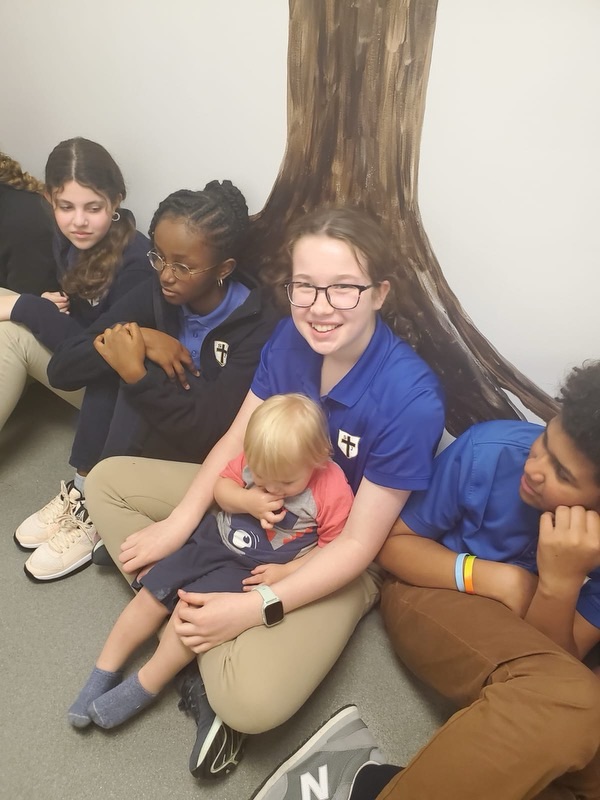
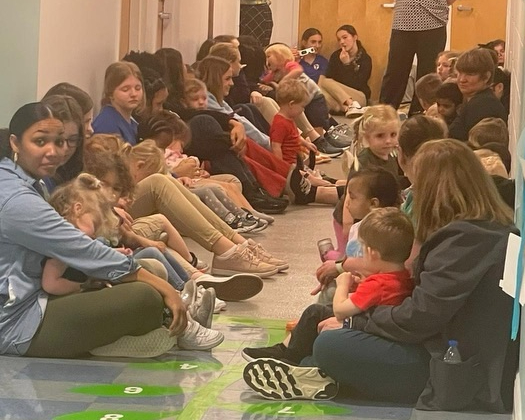
Once downstairs, it was hot, crowded, and overripe with the odor of sweaty, nervous bodies as we sheltered in place away from doors and windows alongside first and second graders as well as preschoolers from the two- and three- year old classes. At times, there were crescendos of anxious voices of students–or, in the case of some of the little ones–crying. During other moments, there were a few older students who experienced panic attacks, but there were many more who remained calm.  There were even those selfless students who chose to hold, cuddle, and comfort younger preschoolers, focusing on the needs of others, rather than themselves.

Middle school students caring for the needs of preschoolers during a shelter in place scenario.

And if you Fall . . . Pick yourself 🆙

As I walked among the students, checking on them, assuring some, answering questions of others, my mind echoed with the words from the previous day, “Trees sway; get more grounded.”  And so, I ground down into my faith.  If the students and staff of my previous school survived that former storm way back in the 90s, surely we would survive this one too.  My emotions could sway like the tree on the inside, but the more I swayed, the more I reminded myself to ground down and try to remain balanced in the present moment in order to better focus on those around me.  

It wasn’t easy, and I wasn’t perfect.  But here’s the thing about tree pose. It’s a great way to practice falling. If you fall out of tree pose, you pick yourself up, and try to return to the pose once more.  

Like my beloved tree-pose, Twister Tuesday provided another stretch and realignment personally and professionally as well as to my faith. It challenged my focus and concentration in order to remain balanced.  And when I “fell,” forgetting to remain focused on the present moment, all I had to do was “pick myself up” and try to return to it once more. Most of all, that Tuesday served as a powerful reminder of the power of the True Source dwelling within and around us, always available to keep us grounded. 

Another middle school student getting grounded in the present moment of another’s need.

Anyone can complete a half-marathon: Tips to help you achieve this goal

Even when you have gone as far as you can, and everything hurts, and you are staring at a specter of self-doubt, you can find a bit more strength deep inside you, if you look closely enough.”–Hal Higdon

Virginia Beach Shamrock 1/2 Marathon 2024

Pace Yourself 👣

“Your pace on the last mile was spectacular.” Siri voiced my husband’s text into my ear. 

I had just passed mile marker 7 of the Virginia Beach Shamrock Half-marathon.  Up until that point, I wasn’t sure how this event would go for me.  While I had been officially training for this event for months, I had undergone fairly major surgery eleven prior, so I had only gradually returned to running beginning in June.  Even then, it was two months of walking/running, gradually increasing the time spent running.

In November, I participated in the Marshall University Half-Marathon.  Completing it felt like a huge victory since I had to start at ground zero, so-to-speak, post-surgery.  After my surgery at the beginning of April, my exercise consisted of walking around my house for 5-10 minutes at a time several times per day. Therefore, going from house-walking to running 13.2 miles, albeit slowly, within several months was a huge personal milestone. 

Ready to start!

Rethink your definition of Who Can finish a half-Marathon 🏁

Here’s the thing to know about me.  I am not what I would consider athletic.  I was the proverbial band-geek in high school.  Not that I define myself by long-ago standards, but I think many of us can get into our heads and define our athletic abilities based upon those past early experiences. The point is you don’t have to consider yourself “athletic” to participate in a half or full marathon. Anyone can do it.

Furthermore, you don’t have to be fast, and you don’t even have to run it.  You can walk the entire route, or you can mix it up, alternating bouts of walking with running. Others, those who I tend to define as “natural” runners, may spout out finish times and pace with a competitive spirit, but many others, like me, are simply proud of crossing that finish line.  That said, I do confess I notice my finish times, but I never let those times define my accomplishment.  Crossing a finish line is always a victory.

Photo by RUN 4 FFWPU on Pexels.com

Realistic Plans for Beginners ✅

To that end, my relationship with running, which began approximately ten years ago, has developed in fits and starts. When I first began, ten years younger, I was a bit faster than I am now, but I was still running at what competitive runners would consider a slow pace. During those early years, I would try to adhere to established standards of publications, and I always fell short.  I wasn’t experienced enough to fully understand those standards weren’t realistic for me. 

Ten years later, and it still seems like many publications and media outlets set unrealistic expectations for those who are TRULY newbies and need a gentle approach to running/walking.  However, that is gradually beginning to change, and I want to be part of those voices who speak to those so-called “nonathletes” who want to participate in a healthy community event, such as a 5K or half-marathon.  I have read and listened to a few authors who speak to that person with no athletic experience; plus, I have amassed my own personal experience. Therefore, I want to share a few tidbits of encouragement.

Photo by Ketut Subiyanto on Pexels.com

Focus on Increasing time on feet, Not Miles 🦶

First of all, nearly anyone can train to walk, walk/run, or run a half-marathon.  I have met too many people who say they’d love to do it, but believe they aren’t capable.  Yes. You. Are.  I have participated in enough events to know that there are numerous participants who walk the entire route.

Here’s the trick I learned, you do need to train and prepare the body for these events, but it doesn’t have to be extreme. It’s all about time spent on your feet engaged in walking and/or running and the weekly long run that gradually increases in length over 12-24 weeks, depending upon your goals and your starting level of fitness.  (Of course, always seek advice/approval from your healthcare provider before embarking on a program.)

For both Shamrock and the Marshall Half-marathon, my longest run was ten miles, and they were walk/run training sessions–run ten minutes, walk two minutes, and then I kept repeating this pattern for a certain length of time, rather than miles.  This took pressure off completing a certain distance, and it allowed me to better respond to how my body was feeling–adjusting the length of time walking or running.  If I felt rested and strong, I ran for longer periods; however, if I felt over-fatigued or not well, I ran for shorter periods and walked more. 

Photo by Kate Trifo on Pexels.com

Never Underestimate walking 🚶🏽‍♀️

As a general rule, true beginners typically start with walking.  Once you can successfully walk for 30 minutes without stopping–and it might take months to work up to that length of time, and that is ok– then you can begin to add a minute or two of easy jogging, such as walk for ten minutes, jog one minute; repeat two more times.  That is honestly how I moved from walking to running after surgery this past spring once I had clearance from the surgeon.

Photo by Ketut Subiyanto on Pexels.com

Intersperse time jogging 🏃‍♀️

Run Your Butt Off  is a great resource for a structured 12+ week  run/walk plan, but I suggest you disregard the diet information! Additionally, the Shamrock Half Marathon/Marathon website offers free training plans for running/walking an 8K, half, and full marathon. I have successfully used both and found them incredibly helpful and encouraging.

Week-by-week, you can slowly decrease your walking time and increase your running time.  Eventually, you may get to a point where you are happy alternating between running and walking, and that is fine!  Many people adhere to a run/walk practice.  In fact, Jeff Galloway has published numerous articles and books on this topic if you are looking for more guidance.  Therefore, if you want to complete a 5K, 8K, half-marathon, or even a full marathon, there are plans available that will fit your level of fitness. 

Two thumbs up for a personal best!

Sham-rocked! ☘️

As it turned out, I was ultimately able to finish this half-marathon with a personal best time. Once I passed mile marker 7 and my husband made me aware of my pace, I began to get excited and focus a bit more on maintaining my pace, realizing a PR was within reach.  In fact, I finished ten minutes faster than the previous year!  However, it wasn’t easy.  My mind kept telling me about different parts of my body that were hurting, so I had to keep combatting and replacing those negative thoughts with positive messages, such as  “I am getting stronger,” “I am so close now,” “Focus on the feeling of crossing the finish line,” and so forth. 

While it wasn’t my intention to run a PR, I think changing the way I more realistically approached training after surgery made it possible.  Giving myself permission to walk during my months of preparation and using a training plan appropriate for my skill level made a huge difference. Nonetheless, even if I had finished with a slower time, crossing that finish line is always a victory! 

You can do it! 😃

And, I want you to know, Dear Reader, that if you have ever dabbled with the idea of participating in a half-marathon, you can absolutely do it!  I am cheering for you! 

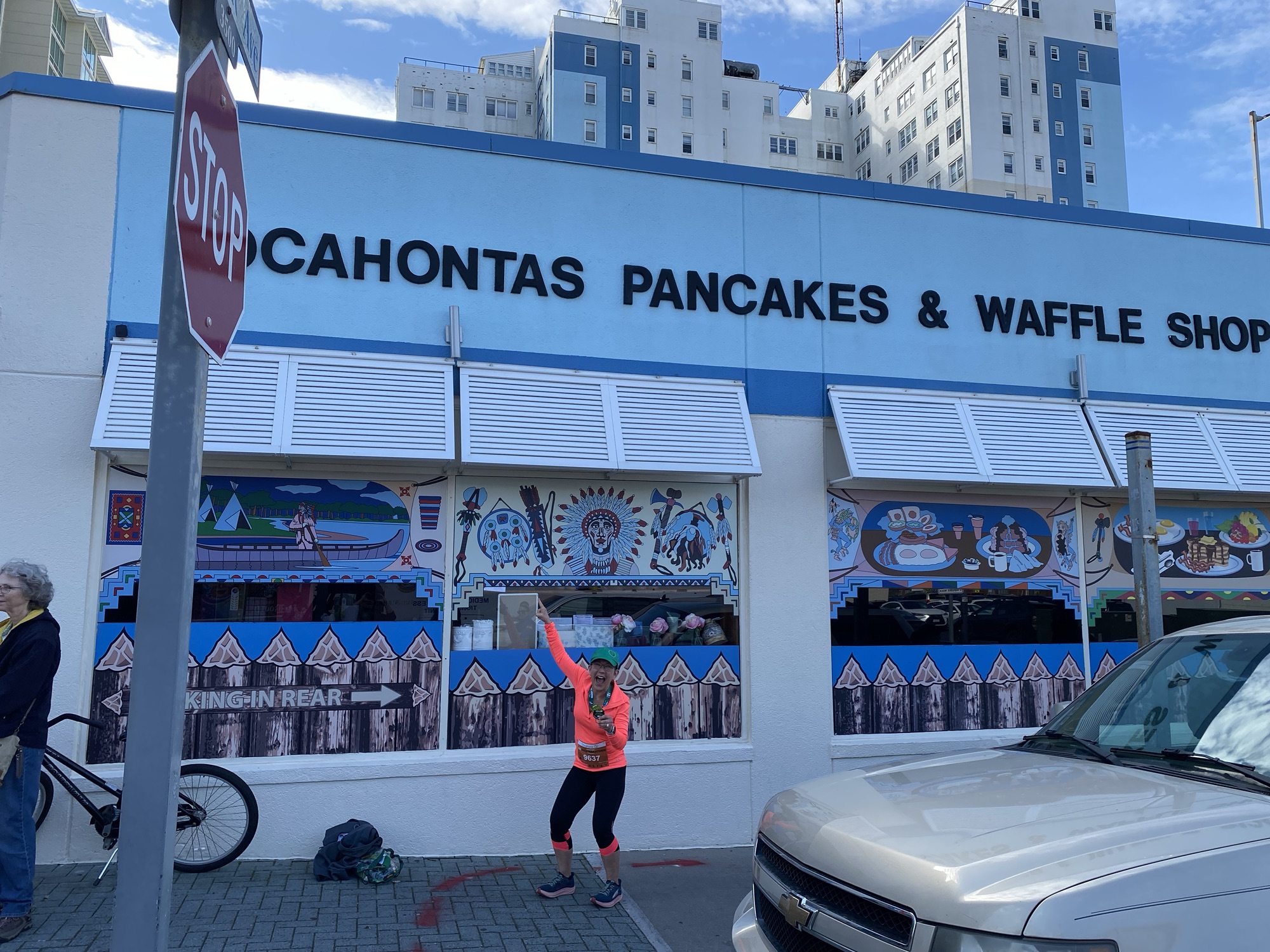
#runforglutenfreewaffle #bestsupport #pocahontaspancakes&wafflehouse #shamrockfinishline

Almost time to go!
And, we are off and running!
Crossing the finish line is such a feeling of accomplishment!

Move into Health, Part 10: Create a fitness plan that meets you where you are

Photo by MART PRODUCTION on Pexels.com

I came across a quote only days after my recent ACDF surgery by Oprah Winfrey that read, “Challenges are gifts that force us to search for a new center of gravity. Don’t fight them. Just find a new way to stand.” It accurately summed up what I have been trying to do as I recover.  Find new ways to stand, sit, sleep, work, walk, etc. . . Of course, I am blessed that my surgery did not require more than one night’s stay in the hospital, and wasn’t more serious.  Nonetheless, surgery is no joke and recovery is for real.

My movement was limited for days following surgery.  I had to learn to turn at the waist, rather than use my neck. Additionally, I had to focus on using my stomach muscles to get in and out of bed to avoid straining my neck. And, all forms of exercise, except for walking, was eliminated per staunch medical advice that my family took to heart with frequent reminders. (They didn’t need to worry, I truly wasn’t feeling like doing much during those first few days.)

Photo by SHVETS production on Pexels.com

Walking, I was told by the release nurse, was to be completed every hour, even if it meant only completing one lap around the dining room table before I sat back down.  However, I was encouraged, once I got past what the nurse called the “recliner days”–days when swelling and inflammation (aka pain) was at the highest level–to try to walk 10-15 minutes each hour.  I had just completed a half-marathon, albeit slowly, only weeks earlier, and now this was my new fitness plan. What a shift!

So why was walking so important, even on those days when I didn’t feel like moving?  Well, it turns out there are numerous valid reasons according to my doctor and as described in countless studies out of the Mayo Clinic, University of Wisconsin, and in a 2020 US News and World Report article. Here are a few of the reasons cited:

  • Prevention of post-surgery complications
  • Enhances blood flow throughout the body
  • Increases the flow of oxygen throughout the body
  • Accelerates wound healing
  • Strengthens muscles and bones
  • Improves digestion (aka ability to poop) and the function of urinary tract while reducing bloating and gas
  • Reduces risk for blood clots, infections, and lung issues, such as pneumonia
  • Boosts mood and self-esteem  

Why do I share all of this?  To make the point that my old fitness plan was, and currently is, no longer appropriate for me.  I had to adopt a fitness plan that meets my body’s needs where it is.  Therefore, my current movement plan consists of short segments of walking completed throughout the day as I remain home recovering, which complies with medical advice from my doctor and best meets the needs of my body.  

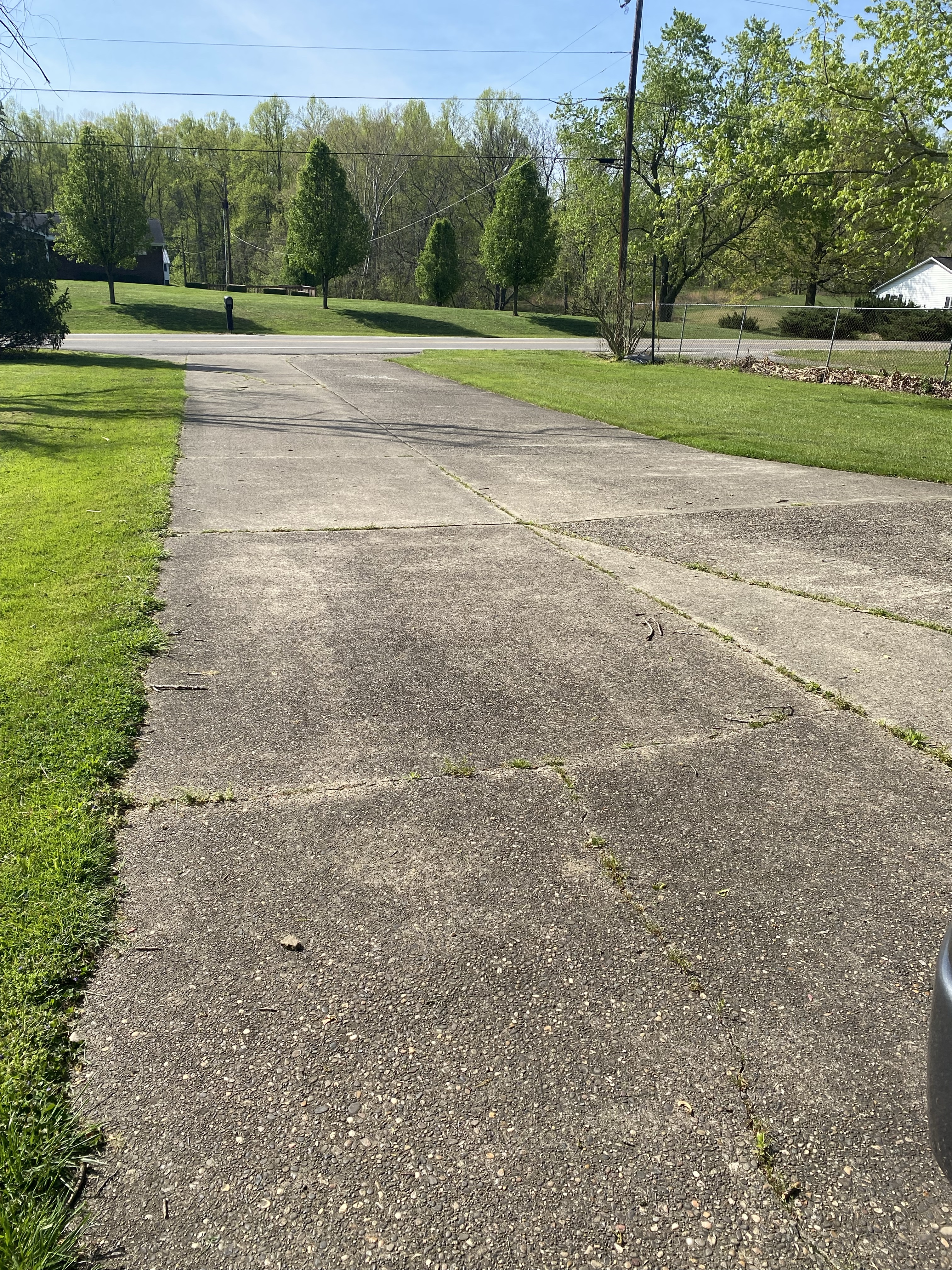
Gentle walking on my driveway or in my house is part of the slow and steady recovery plan.

At the time of writing this, I am entering my third week of recovery. After my two-week, post-operative appointment, I now have permission to begin to gently explore a few  strengthening exercises and stretches that can be completed without forward bending.  Additionally, I can begin to explore my neck range of motion with a few doctor approved neck stretches and strengthening exercises, but nothing more.  Slow and steady helps me find my new center of gravity.

Due to this experience, I want to continue to encourage you, Dear Reader, to carefully plan how you will enter, or reenter, your own exercise/movement plan this spring.  Create a plan that meets your needs, and commit to doing it–even if you don’t “feel like it.”  Personally speaking, I could feel angry and convince myself that if I can’t exercise the way I once did, then I won’t do anything at all. After all, it would be easy for me to sit around all day and use my surgery as an excuse to do nothing.  Conversely, I could try to push too hard with the delusion that, “The staff doesn’t really know ME,” and begin overdoing it with images of former, younger me dancing in my head

Instead, I have accepted the reality of my situation, rather than reject the medical advice I have been given.  They are the professionals, not me.  I have to meet my body where it’s at when it comes to fitness.  Sure, I have dreams of hiking again, walking (or jogging) the entire bike path of Ritter Park, and even practicing yoga with regularity, but none of those will ever happen if I don’t recover first.  And my first step in recovery is walking, so my body can focus on the miraculous work of healing.

Welcome walking into your life! You might be surprised by the benefits!

Therefore, no matter where you are, what shape you are in, or any other personal obstacles that you may be facing unbeknownst to me, I still encourage you to never give up on regularly incorporating movement into your day. Avoid the temptation to make excuses for yourself, but at the same time, don’t start off with a complicated plan.  Talk to your health care provider, and then start.

Start where you are.  If you don’t regularly move, then begin, like me, with short walks around your home, or up and down your driveway or sidewalk.  Do that 3-4 times per week.  The following week, add one more lap, or add five more minutes to your walk, and complete it 3-4 times per week.  Gradually, you will build up your time and the distance covered.  By keeping this up over several weeks, you will create the habit of moving.  Your body, lungs, and heart will be stronger, and I wouldn’t be surprised if you find you are reaping other unexpected benefits!

Think about this, my friends, if walking is scientifically established as one of the best tools for recovery after surgery, what can it do for you?  Don’t beat yourself up because you are no longer what you once were, you didn’t exercise over winter due to the cold weather, you’ve never really tried to exercise previously, or you’re somewhere in between, like me.  Start where you are at, and move one step at a time.  Rome wasn’t built in a day, and neither is fitness, but you have to take the first step, and spring is a great time to start.  

Here we go my friend, take my hand, let’s find that new center of gravity, and cross this bridge together, one healing step at a time.

Open the door to spring, and find your new center of gravity one small step at a time!

May Her Steps Be Remembered

“Nothing is impossible: The word itself says “I’m possible!”–Audrey Hepburn

“Your body will argue that there is no justifiable reason to continue. Your only recourse is to call on your spirit, which fortunately functions independently of logic.”–Tim Noakes

Photo by Daria Shevtsova on Pexels.com

I am so cold.  I’m freezing.  

I was shaking so badly as I stepped out of bed during this nocturnal, chilly wake up call;  my legs did not want to hold me up.

What is happening?

Waves of nausea immediately flooded my middle, and I became suddenly aware of the sharp tinges of a headache that reminded me of an illness, but I couldn’t think clearly enough to define the association.  Did I have a stomach bug? The flu, or something else? 

In the bathroom, I retrieved sweatpants and a sweatshirt and donned them in protection of my pervasive cold shivers.  On wobbly legs, I humbly returned to my bed knowing that something was off.  Trembling under the covers, sleep came in fitful waves, with bouts of shuddering wakefulness and nausea in between. Tossing about from side to side, my left shoulder was noticeable tender each time I rolled onto it.  The injection site. Images danced dreamily around in my head.

Photo by Karolina Grabowska on Pexels.com

“You have the hardest arm to stick,” the young pharmacy student stated with a grimace as she pushed harder to get the vaccine needle inserted into my arm. 

Across the way, I watched as another pharmacy student injected my husband, John, as if his arm were a stick of room temperature butter, despite the fact he has spent years exercising with weights.  John winked at me as I winced at the second effort of pushing by the pharmacy student into my arm.

Oh, yes, I had my second dose of the COVID-19 vaccine.  My arm was sore last time; it is sore again. 

When the alarm eventually did go off at its usual Saturday morning time of 5:30, I groggily reset a new alarm for 6:00.  This was followed with a 6:30 alarm, and a final 7:00 am alarm.  

I never sleep this late on a Saturday.  Must. Be. A. Stomach. Bug. Surely, it’s not a reaction to the vaccine.  Can’t be, right?

Saturday was also the day I was to run my first 10 miler in preparation for my first virtual half-marathon since my back injury five years ago, and I could barely walk due to my convulsing shivers.  With sudden clarity, it occurred to me that I could take acetaminophen to mitigate the symptoms.  

Why hadn’t I thought of that during the night?

Opening the childproof medicine bottle, I discovered that I had five pills.  Great.  I decided to start with two and see what happens. 

Photo by Anna Shvets on Pexels.com

Making my way into the kitchen area, I started a pot of coffee, guzzled down several ounces of water, although my stomach protested, and sat staring out the window.  The nausea was pervasive, my headed pounded, and the chills were ever-present as I pondered the day ahead.  I felt extremely thankful that it was Saturday, and I did not have to work. Otherwise,  I would already be at school preparing for the arrival of students at 7:30.

Slowing sipping coffee–not sure if my stomach would revolt or not, a plan for the day began to take shape–assuming the acetaminophen kicked in.  By 8:15 am, the chills had mostly subsided, the nausea and headache were present, but felt more the muzak of years ago softly played in elevators.  I made the decision; I was going to try to run.  First, however, I needed to locate a name to honor from the Honor the Fallen website. 

A few clicks later, there came a name.  Sgt. Christina M. Schoenecker, a  26-year-old was an Army Reserve soldier assigned to the 89th Sustainment Brigade, out of Wichita, Kansas.  She was so young looking.  Her eyes were bright and full of empathy, but her slightly crooked smile looked wry–as if engaging in conversation with her was sure to be filled with quick-witted, sharp comments.  As I read her story, I felt a surge of inspiration. 

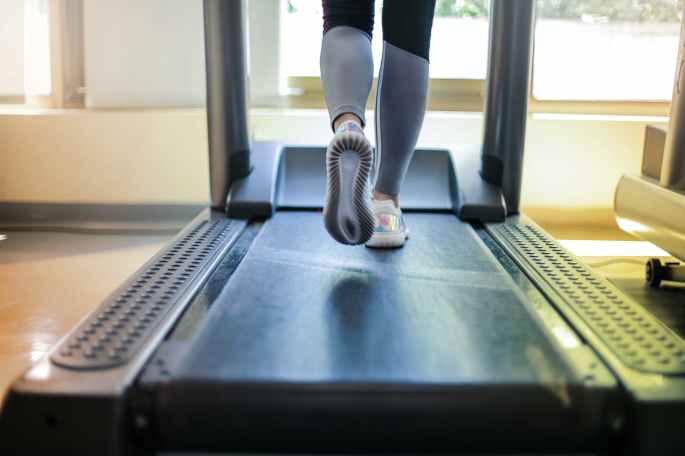
Given my suppressed chills, I ruled out running outside and opted instead for the treadmill. Besides, I told myself, the treadmill offers less impact on my back. An hour or so later, I was on the treadmill hoping for the best, but ready to abandon the training plan if needed.  

Don’t look down at the numbers.  Eyes straight ahead, arms at right angles, melt those shoulders away from your ears, keep the speed slow and steady.  One mile at a time, Steph.  One mile at a time.  Focus on the name:  Sgt. Christina M. Schoenecker.  Pretend her name is written on the wall.

Podcast playing, my mind semi-focused on its content as my stomach continued its somersaults.  I decided to save walk breaks until later, when all of my reserves might be running low. Walk breaks would be the reward for early efforts.

Photo by Bogdan R. Anton on Pexels.com

As a teenage girl, I often rode my bike to and from summer bandcamp. There was a hill on the way home that was steep and wound round a hill. At that time, a childhood jingle would enter my mind, “Just think you can, and know you can just like the engine that could.”  This same jingle entered my mind as I jogged on the revolving belt of the dreadmill, I mean, treadmill.  Sgt. Christina M. Schoenecker.   Sgt. Christina M. Schoenecker.   Sgt. Christina M. Schoenecker.

One mile turned into another and another.  One hour passed, and one podcast was over.  Walk break taken long enough to start a new one.  Thirty more minutes passed; another walk break began.  Can’t take another moment of the incessant talking.  Time for the power button–music.  A driving playlist of beats began its encouraging cadence.  Nausea grew greater and legs grew wobbly again.  So close now.  Increase the determined self-talk.  More nausea, more achiness. . . keep pushing.  Sgt. Christina M. Schoenecker.   Sgt. Christina M. Schoenecker.   Sgt. Christina M. Schoenecker.

It wasn’t pretty.  It wasn’t fast, but it was purposeful. My struggle was nothing compared to the struggle of those who have served in our military. Christina M. Schoenecker, the name I found on the website, served during Operation Inherent Resolve. Assigned to the 89th Sustainment Brigade, Christina was an Army Reserve soldier out of Wichita, Kansas. This young woman died in a non-combat incident in Baghdad, Iraq.  She was the third casualty of this operation at the tender age of 26. 

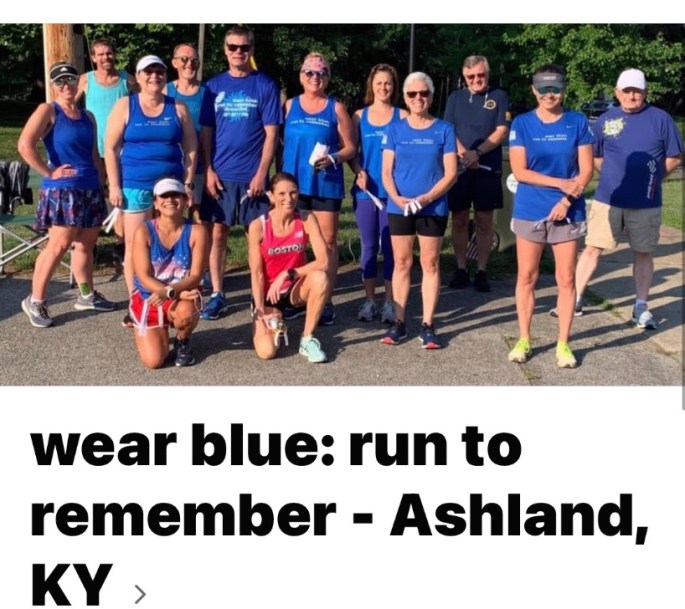
It is through the mission of wear blue: run to remember that I often run, “in honor of the service and sacrifice of American military.”  My contribution is minimal.  There are local and national groups who do so much more work and efforts to increase awareness and honor the fallen and their families.  My only contribution occurs each Saturday, when I search the name of a fallen person–someone’s family member–write their name on a post-it note, place that paper the zippered pocket of my running tights, and send up words of gratitude to the heavens for this person’s service as well as to the family each one left behind.  My steps, no matter how challenging, still do not equate to the service of those brave men and women freely gave to our country.  It is my hope though, in some minor way, I honor their memory and offer their family some form of unseen comfort.

Thank you, Christina, for your service.  Thank you, for your ultimate sacrifice.  Thank you, Christina’s parents.  Your daughter was remembered this past Saturday, step by step.  Her memory truly inspired me to finish.

For more information regarding wearblue: run to remember, visit their national website, or look/join the local Ashland community, found on Facebook, or via email:  Ashlandcommunity@wearblueruntoremember.org.