Running Toward Hope: A Marathon of Movement and Love

Every run is a work of art, a drawing on each day’s canvas. Some runs are shouts and some runs are whispers. Some runs are eulogies and others celebrations.”—Dagny Scott Barrios

A group of three people, including a man in a green hoodie, a woman in a bright orange top with a running bib, and a woman in a gray sweater, gather smiling at a running event in an outdoor setting with other runners in the background.
Just before the start of the marathon I took time to get a hug from my two biggest supporters throughout the training process: my husband, L, and my daughter, R.

A Morning of Reflection and Gratitude 🌅

A light mist fell as an overcast gray morning began to chase away the night. I stood quietly in a throng of animated runners, taking deep breaths as reflection and gratitude washed over me. Months of preparation had led to this moment, and I felt thankful not only for my health but for the loving support that carried me here—to this celebration of movement, resilience, and connection.

Running as an Act of Hope ✨

It had been ten years since I last pinned on a bib for this distance, and my body hummed with anticipation, hope, and belief—the belief that movement is for everyone at every age, and that it is, in itself, an act of hope. I was about to embark on an emotional 26.2-mile trail of faith that became more about the people who supported me than the miles themselves.

Discovering Joy in Gentle Movement 😄

I came to running later in life, and it wasn’t easy at first. Only when I learned to approach running gently—to let go of preconceived (and societal) notions of what running “should” be—did I discover paths full of freedom, clarity, and renewal. Movement, whether running, walking, dancing, or stretching, benefits body, mind, and spirit. It brings a sense of structure to an often chaotic world and offers a feeling of accomplishment—if nothing else goes right in a day, at least I moved my body. Movement brings us alive to ourselves, our spirit, and, in turn, to the world around us.

The joy, I’ve learned, is in the doing—not in attaching to a pace, distance, or goal. Those things can be part of the experience, but they aren’t required.

A man and a woman embrace warmly in a crowded setting, both smiling in a moment of connection before a marathon.
Maddie’s, my daughter, boyfriend, Connor, flew all the way from Austin, TX to be part of this event. Together, with Maddie, he helped plan the marathon surprise of a lifetime!

Redefining What It Means to Age 🧓

As I neared my 60th birthday, I began to notice messaging that framed this decade as one of limitation. I decided instead to flip the narrative and celebrate the 60s as a decade of possibilities. Why not run into this new decade the way I ran into my 50s—with eyes and arms wide to adventure?

Training with Gentleness and Grace 😌

Since I was already running regularly, I committed to training for a marathon, but this time with gentleness. Instead of a traditional four-month build-up, I created a ten-month plan that encouraged patience, routine, and presence. Twice-weekly strength training and yoga joined the schedule, as did listening to my body and using the run-walk-run method as needed. I also focused on proper hydration and fueling before, during, and after runs. Most of all, my husband and daughter supported me from the very beginning—their quiet, everyday encouragement becoming a steady foundation of strength.

A woman running on a street wearing a bright pink long-sleeve top, black leggings, and a cap, displaying a race number on her waist.
Gentleness was a large part of the 10-month training block that led to this moment of hope and celebration.

Adapting Through Life’s Curveballs 😰

Training for a marathon brings rhythm and structure to daily life—the early morning runs, the long weekend miles that lengthen gradually, and the sweet evening stretches after dinner. But life, of course, has its curveballs: weather shifts, fatigue, scheduling conflicts, unexpected events, and bouts of self-doubt. With age, though, I’ve learned to adapt rather than resist these realities, co-creating a practical, flexible approach to progress.

As my weekend long runs grew longer, my husband and daughter often appeared—driving by, stopping to cheer, or jogging beside me for a short distance. These small bursts of love in action fueled my heart and kept me going. Training, I realized, was less about mileage and more about cultivating fortitude, flexibility, and gratitude—along with a dash of fierceness—all essential life skills carried from the road.

A group of enthusiastic spectators cheer on runners during a marathon, surrounded by autumn foliage and a partly cloudy sky.
Maddie, and my husband, John, often showed up during the last few miles of my Saturday long runs to cheer me on as Maddie is seen here doing during the actual event itself.

Race Day: A Celebration of Love 💖

As the marathon began, the city of Huntington vibrant in energy, rebelling against the lackluster sky. Rhythmic footfalls and nervous chatter surrounded me as runners jostled for position. Warmly dressed spectators cheered, waving handmade signs against a backdrop of burnished orange, crimson, and yellow autumn trees. Little did I know that my daughter had turned this event into an outpouring of love.

Surprises Along the Course 🫢

At the start, my husband, daughter, and her boyfriend—who had flown in from Texas to surprise me—stood cheering. But that was only the beginning. Every few miles along the route, my daughter had arranged for friends, family, and coworkers to appear, waving signs and calling my name. I didn’t realize the scope of her plan until near the end, but each familiar face filled me with renewed energy, gratitude, and joy.
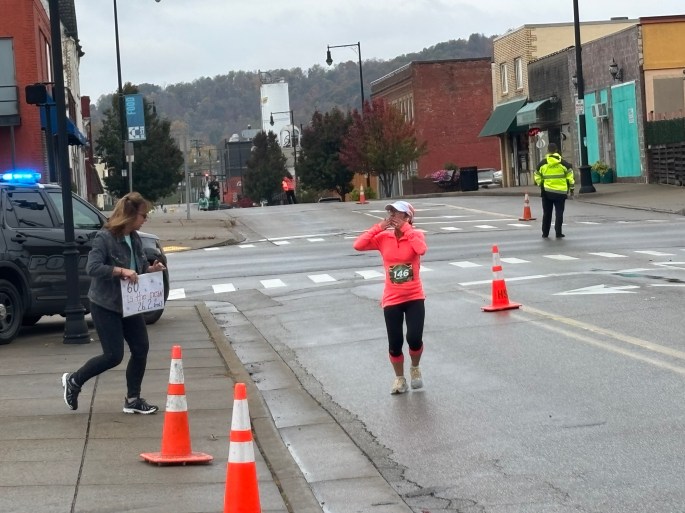
A female runner in a bright pink shirt crosses a street marked by traffic cones, while a supporter holds a sign nearby in a lively downtown setting.
The look of complete surprise when I see my sister, Traci, and her husband, David, around the 19-20 mile mark of the marathon. I had no idea they would show up along the route!
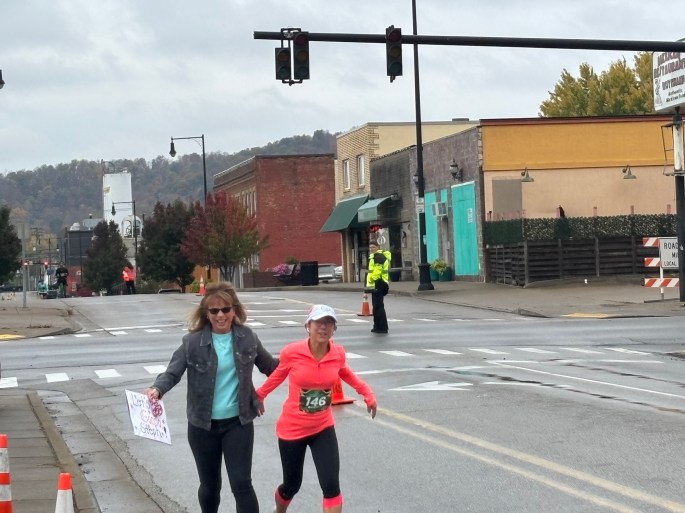
Two women running together on a city street during a marathon, with one holding a sign. They are surrounded by a lively atmosphere and shops in the background.
Of course, I had to veer off the path to give her hug, which helped uplift me over the next few miles.

Crossing the Finish Line 🏁

As I turned toward the final quarter mile, a group of race volunteers began singing “Happy Birthday” while my daughter’s boyfriend joined for a short burst of encouragement. My husband stood outside the stadium offering final words of encouragement, and my daughter met me at the bottom of the stadium ramp to run beside me as I approached the finish line. I wasn’t just completing a marathon; I was receiving the best birthday gift—a living reminder of love: a convergence of community, family, and friendship. It was a story of hope, purpose, generosity, and perseverance—the joy and power of a shared journey.

Two volunteers wearing bright reflective vests stand by a crosswalk in a park-like setting with blooming flowers and trees. In the background, a pathway leads towards a building under a cloudy sky.
This was the point, less than a quarter mile to go, when a group of race volunteers, led by an unknown female spectator and Conner, joined in to sing “Happy Birthday” to me as approached and rounded the corner to the finish line.

The Marathon as a Metaphor for Life 🪞

This journey mirrors life: we move forward by faith and grace, one step at a time, through both joy and challenge, supported by others who believe in us. That’s the power of movement—it connects us to our bodies, to others, and to something larger than ourselves. Choosing to move, to train, to keep going even when the path feels long, is an affirmation that with faith, growth and renewal are always possible—at any age.

Movement as a Lifelong Invitation 💌

Movement can take many forms: walking, stretching, dancing, or choosing to train for something big. The point is to move with intention and persistence, to embrace your own journey, and not attach to societal and social media messaging. Just move—and let movement open the door to new possibilities, both inner and outer.

A runner crosses the finish line at a sports stadium, with spectators in the stands and a clear blue sky overhead.
Maddie runs alongside me for the last few feet, just as she did in 2015, to encourage across the finish line. Once I was close to the finish line, she dropped back behind the rope to let me finish alone. However, I really wasn’t alone. I was surrounded by a giant embrace of joy, hope, and love of family, friends, and community!!

The Joy Continues ☺️

The rhythm of footsteps, the smiles for miles, and the faces of loved ones along the route are forever imprinted in my heart—all reminders that every step matters. The marathon finish line was crossed, but the renewed sense of possibility and joy continues. Whatever your pace or path, keep moving forward—heart, mind, and spirit. You never know what acts of hope and love may be waiting for you along life’s path.

A group of runners participating in a marathon on an overcast morning, with diverse individuals wearing colorful athletic clothing and cheerful expressions.
The joy, and the journey of love and hope, continues . . .

A Grateful Heart 💜

P.S. Thank you to the countless and nameless MUM volunteers who invested hours of time to ensure the safety and success of runners, walkers, and those beloved spectators. And, an extra special heartfelt thank you to my friends and family who celebrated this milestone with me. And to Maddie and John, I love you to the moon and back.


A group of three smiling individuals taking a selfie on a subway or train, with a map visible in the background.
I wonder where the next path of adventure will lead?
An assortment of hydration and energy products for runners, including electrolyte tablets and energy gels, arranged on a wooden surface.
Shout out to Precision Fuel and Hydration for the support during this training journey! I learned a lot from your team.

Pearls of Morning: Lessons from Spider Webs and Stillness

“Heavy dew this morning and every spider web in the garden is strong with pearls of moisture…. webs wherever I look, all shining things of silver beauty.–Edwin Way Teale

A close-up of a dewy spider web illuminated by streetlights in a quiet early morning setting, with blurred traffic lights in the background.

The Quiet Wonder Before Dawn 🌅

It was an early fall morning. Darkness still clung to the earth in a cool embrace. The traffic lights—green, yellow, red—continued their rhythm despite the empty streets. The air was cool and humid, and the hush before dawn rested easily upon the road. Pausing at the red light before continuing my jog, I noticed a spider web dappled with dew within the frame of the traffic light. I stopped in my tracks; upon closer inspection, I saw countless spider webs, draped with baubles of dew, hung from light poles and electric lines—even within the traffic lights themselves.

Hidden Beauty in Plain Sight🚦

I was awestruck by the beauty of the webs, looking ever-festive in the glow of lights—an unexpected wonder, shimmering high above me. After a few moments of appreciating the beauty, I jogged on through town, questions forming in my mind. How did they get so high? Why had I not previously noticed something so extraordinary hiding in plain sight? How many other marvels were hiding in plain sight, waiting for someone to notice?

A serene landscape featuring rolling hills partially obscured by a thick layer of fog, bathed in soft, diffused light, creating an ethereal atmosphere.

When We Slow Down Enough to See 🤓

It occurred to me that more often than not, we rush through the routine of life overlooking these mini-marvels—the ballet of fall leaves chasséing from tree to stream, then pirouetting along water currents; sinuous streamers of fog tendrils meandering around hilltops; or, the multiplicity of ice crystals frosting over a car’s windshield to name a few. These wonders are woven into daily life: from the cantaloupe-colored brilliance of sunrise over the Ohio River to the glimmer of moonlight on a frost-covered lawn; from flower-like fungi blooming on fallen logs to a puppy seeing its own reflection in a puddle. Beauty surrounds us, waiting to be noticed. Like the invisible art gallery of spider webs in traffic lights on my morning jog, most go unnoticed until the light hits just right. However, when we take time to pause and pay attention, beauty will often reveal itself in unexpected yet common places, including stoplights.

A close-up image of a brownish mushroom growing on a tree trunk, highlighting its textured surface and natural surroundings.
Flower-like fungi “blossoming” from fallen tree branch

The Power of Morning Stillness 😌

That early-morning observation turned meditation centered my day. It offered more than one lesson and served as a reminder that the morning placidity can bring a sense of calming clarity before the noise of the day. Making time for stillness in the morning, whether sipping coffee, walking a beloved pet, or sitting in prayer meditation—offers an opportunity for spaciousness at the day’s start. A moment to center, notice, reflect, and connect. Even a few minutes of stillness can offer us an opportunity to ground ourselves and recalibrate our perspective. If we grow quiet enough, we may remember that peace resides within us. That is not to say that peace is the absence of movement, purpose, or challenge, but rather it is a strong presence within us—much like the hidden strength within the delicate spider web. 

A close-up of a spider web adorned with dewdrops, creating a sparkling effect against a blurred green background.
Photo by Pixabay on Pexels.com

Lessons from the Web: Resilience and Renewal 🕸️

As I reflected on the morning jog through town, I realized that each web represented perseverance, fortitude, and tenacity–three key qualities essential for growth. Each morning, orb-weaving spiders consume their protein-rich webs to reclaim the silk for rebuilding. This ensures the new web they build in the evening is fresh, sticky, and strong enough to catch plenty of prey. Through practice, the spiders gain strength and instinctively how to rebuild after storms and strong wind.

The spiders’ resilience serves as a reminder that we, too, have the grit to rebuild after disappointments, setbacks, and loss. Like the spider, rebuilding our lives is often quiet work that begins only after we have nourished body, mind, and spirit. The spider’s persistence mirrors our own–delicate and determined–reconstructing through incremental, small steps. Life, like the spider’s web, is fragile, yet we too possess tensile strength—centered in faith—that guides us as we restore, renew, and rebuild. 

A close-up view of a spider web adorned with numerous droplets of dew, reflecting light and creating a sparkling effect against a dark background.

The Threads That Bind Us 🕷️

The spider’s web, where no thread stands alone, echoes the interconnectedness of our own lives. We are part of a collective. As the light shone through the webs, each dew drop caught the light, refracting color and seemingly creating miniature worlds. Just as the traffic/street lights played across the spider webs’ dew drops, our connected lives reflect multiple roles–friend, spouse/partner, worker, neighbor, parent, child, citizen . . . . Each strand of life possesses a quiet strength that is integral to the whole. In fact, the integrity of the web depends upon the strength and resiliency of every strand. Each facet of our lives holds and reveals meaning; together, the varied strands of our lives unite the whole, creating an array of meaningful relationships.

A close-up view of a beautifully intricate spider web adorned with dew droplets, creating a delicate display of nature's artistry in black and white.
Photo by don chowdhury on Pexels.com

Finding the Extraordinary in the Ordinary 🌃

In the end, the light changed, and I crossed the street as the sun rose, erasing the glimmer of those webs. Yet the image remains—reminding me to keep looking for the extraordinary in ordinary places. Perhaps it waits in the quietude before dawn, a pause at a red light, or the hush of nightfall. So many interlaced moments shimmer within the droplets of daily life, waiting for those willing to see. Those silky webs may vanish with daylight, but their pearls of wisdom still glimmer within me, reminding me that beauty often hides in ordinary light.  

May we all learn to look a little longer, to pause at life’s red lights, and to notice the silken threads of beauty connecting us in the quiet hours of dawn.

Discovering Daily Delights: Boost Your Happiness Practice

Right in the difficult we must have our joys, our happiness, our dreams: there against the depth of this background, they stand out, there for the first time we see how beautiful they are.” —Rainer Maria Rilke

A night sky filled with stars, with a shooting star streaking across the horizon, silhouetted by trees and distant hills.
Photo by Erike Fusiki on Pexels.com

A Spark in the Sky 💫

I was on an early morning run. Orion and his dogs, Canis Major and Canis Minor, were hunting above me in the eastern sky. As I ran, I periodically glanced upward, marveling at the stars’ movement. Suddenly, a star appeared to shoot sparkling light through the predawn sky. Was it a satellite, the Perseid meteor shower, or another heavenly body? I am not sure, but something inside me shifted. I felt delighted. That event was my daily delight.

A doe and her fawn walking together along a sandy path, surrounded by vegetation.
Photo by Mehmet Turgut Kirkgoz on Pexels.com

How Daily Delights Began 🤔

A few weeks before that shooting star sighting, I began my ‘daily delight’ practice in August. Numerous uncontrollable negative events were filling me with worry, anxiety, and fear. Despite taking proactive steps to reduce the negativity I was exposing myself to, it still found ways to seep in—almost as if it permeated the very air I breathed. Then, at first light on a quiet Saturday morning, a doe and her fawn strolled out of the woods alongside my running path. Pausing for a moment, I watched the mother nudge the little one across the trail and toward a nearly dry creek. It felt sacred. Later, I described it to my family as my daily delight, and the concept was born.

A close-up of a vibrant pink rose surrounded by green foliage, showcasing its full bloom and delicate petals.

Why This Practice Matters 😌

From that moment, I began cultivating an intentional practice of looking for at least one daily delight each day. As a result, I noticed that my mindset shifted, and my stress began to ease. More importantly, these little delights reminded me that goodness still exists—even on the darkest days.

A steaming cup of coffee rests on an open book, symbolizing a moment of warmth and reflection.
Photo by lil artsy on Pexels.com

What Counts as a Daily Delight? ☑️

To me, daily delights are moments that cost nothing, big or small, that spark joy or wonder. They might be a kind word from a stranger, the first sip of bargain coffee that tastes surprisingly better than the pricey brand you had been purchasing, the symmetry of flowers along a walking route, or the brilliant explosion of color as the sun rises over the Ohio River while driving to work. Ordinary moments are transformed and elevated simply by the act of paying attention.

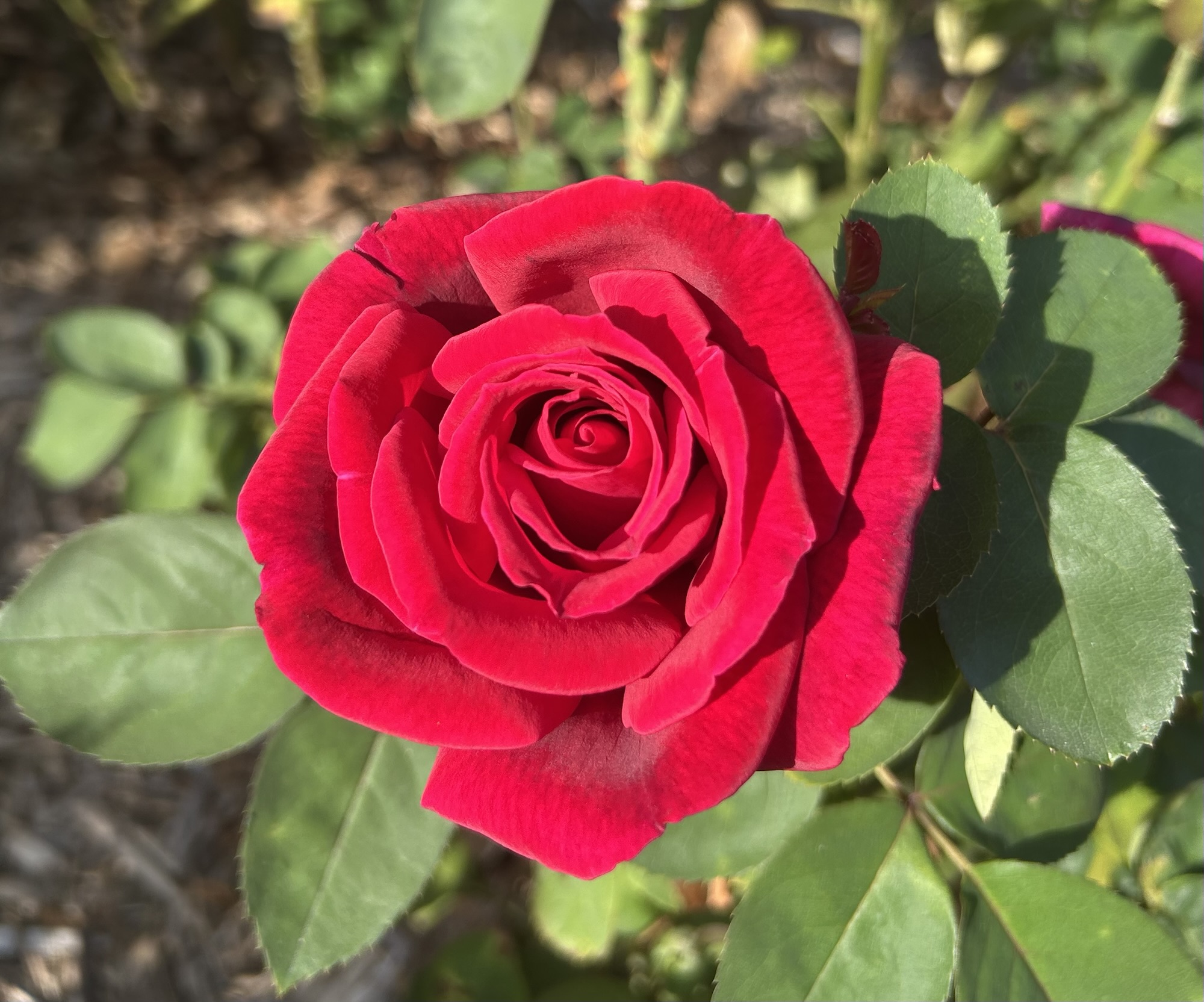
A close-up of a vibrant red rose in full bloom, surrounded by green leaves, capturing the beauty and intricate details of the petals.
Photo by lil artsy on Pexels.com

How to Find Them 🔎

The practice begins in the morning by setting an intention to look for the daily delight. As the day unfolds, I keep my mind’s eye alert—like a scavenger hunt—for hidden treasures, knowing that some days require more searching than others. The daily delight could be birdsong during my run, the sprawling sunlight lighting up the grain of my old oak desk, or a video of my daughter’s friend’s baby babbling and giggling at her new-found ability to pretend to cough. The practice is accessible, requires no extra time, and costs nothing but intention.

A close-up of a pink and white rose blossom surrounded by green leaves.

The Science Behind It 📖

Our brains, as a survival mechanism, are hardwired to notice threats. They fixate on bad events to help us avoid future peril. Unfortunately, in a 24-hour news cycle, this tendency takes a mental toll. Our brains often can’t distinguish real threats from repeated media images, leaving us anxious, restless, or fearful.

Intentionally noticing delights, however small, helps counterbalance this wiring. It reduces stress, builds resilience, and—most importantly—fosters hope. Practiced regularly, it becomes a bridge to gratitude and a more grateful outlook.

A couple sitting on a couch, wrapped in a blanket, smiling and laughing while playing with a light-colored dog.
Photo by Andres Ayrton on Pexels.com

Low-barrier Maintenance ✅

Fostering a daily delight practice is accessible to anyone, anytime, almost anywhere. It’s what I call a low-barrier activity—it doesn’t require journaling, a special setting, or money (no hidden fees or price hikes here!). You might keep a journal of delights or share them with friends or family. Personally, I enjoy sharing mine with others when appropriate because it amplifies positive feelings within. However, there are no other requirements beyond noticing and savoring the event.

A person gently touching foreheads with a cat in a sunlit room filled with plants.
Photo by Yuliya kota on Pexels.com

Even on Hard Days 😓

Of course, some days are less than stellar, especially when hardships pile up. In those times, it’s tempting to slip into cynicism. Yet even then, finding one joy—however small—can ease our uneasiness and calm our agitation. While we cannot erase challenging circumstances, we can coexist with them and still find good.

Two men laughing together outdoors, enjoying a moment of joy in a natural setting.
Photo by Ketut Subiyanto on Pexels.com

The Ripple Effects ↝

The ripple effects of this practice are profound: reduced tension, greater resilience, increased gratitude, and more positive interactions with others. Sharing a delight can spark connection, deepening bonds, and spreading positivity. Over time, this simple practice trains us to notice light even in the darkest corners of our world.

A close-up of a garden sign reading 'JUMP FOR JOY' with the word 'Floribunda' beneath it, surrounded by dried leaves and grass.

Shining Light in a Dark World 🔦

Like those hidden picture games of childhood, simple joys abound; they just need us to notice and color them in. They’re free, accessible, and powerful in shifting perspectives. Daily delights don’t excuse us from facing hard truths, but they open our eyes to possibilities—even on the hardest days.

A close-up of a pink rose flower blooming among green leaves.

Your Turn

So, what daily delight will you notice today??

The gift of single-mindedness–we tap into the present moment

“This very moment is the perfect teacher, and, lucky for us, it’s with us wherever we are.”–Pema Chödrön

REsistance is Futile🤯

I heard the thud and subsequent scattering of parts.  Then, I heard John, my husband, enunciate a few choice words.  Since I wasn’t in the same room of the house, I wasn’t sure what had happened.  Soon enough, John walked into the kitchen-dining room area and set an open socket and driver kit on the table.  Pieces of varying sizes were scattered around the kit like a collage of autumn leaves covering a walkway.

As a few more select words were uttered, John went to work. Watching him work reminded me of those long ago hidden picture pages in Highlights magazine that would entertain me as a young child anytime I visited the pediatrician’s office.  John focused intently as he matched pieces to their corresponding recessed area for storage.  Observing his level of attentiveness to the task at hand, I was struck by the fact he was exemplifying the power of single-minded focus.

Single-minded attention is not myopic 🔎

Bringing single-minded attention to a task is different than being so myopic on one thing, you fail to see the bigger picture of life.  Rather, single-mindedness is the ability to prioritize tasks, and then focusing solely on the most important task before moving on to the next.  This level of concentration requires the self-discipline to remove distractions and remain present with the task at hand.  By removing distractions and avoiding the temptation to multitask, the brain can more easily slip into a flow-state of productivity and/or presence. 

Sure enough, I noticed that in the beginning, when John was resisting the moment, as we have all done, by giving into anger and frustration–as evidenced by the colorful language–he was unable to correctly match the parts to their corresponding depressions.  However, as he let go of the resistance, surrendered to the task at hand, he began to more easily match each part to its recess.  A few moments later, John was into a flow-type state, with each successive match, the quicker the next match came.  Soon enough, albeit probably not soon enough for John, the kit was fully assembled, all parts righted into their nesting spot.

Photo by William Fortunato on Pexels.com

There’s nothing wrong with Mutli-tasking, but . . . 🎧

Many of us multi-task, and our busy, fast-paced world tends to promote multitasking as a regular practice. Obviously, there are merits to multitasking to “kill two birds with one stone” as the old expression goes.  However, there are limits to our focus.  When we are engaged with several tasks at once, no one task gets our full attention.  This is fine in the case of listening to a podcast or book while doing something else where the stakes are low–after all you don’t need to focus on every detail of the book or podcast to glean the overall message/meaning. Thus, nothing is majorly lost if we are not fully focused, and if it is, that’s what the rewind button is for.

In life, however, we don’t always get a rewind button.  Therefore, there are times when it is important to only focus on one thing at a time.  Most of us understand this.  For example, you most likely wouldn’t take a phone call during an important meeting at work or complete work tasks while attending an important doctor’s visit. (Well, maybe in the waiting room, but definitely not when the doctor or staff is in the room with you!)  Likewise, you would be offended and feel short-changed if you encountered either of these scenarios during an important work meeting or an urgent doctor’s appointment.  Nonetheless, how many other moments do we short-change by multitasking?

Photo by Andres Ayrton on Pexels.com

Single-mindedness can be applied to any moment in life 🍏

Any moment in life can be met with single-minded attention, and I do believe there is value in also practicing it.  Eating an apple, going for a walk, talking with a spouse, child, or loved one, even washing dishes after an evening meal can be completed with single-mindedness.  When we take time to solely and fully focus on one event, we are taking time to honor its importance in our lives.  For example, when eating a green apple, as we take a bite, we notice the crunch of the apple, the juice that seeps from the tender fruit with each successive bite, the sweet and tart taste on our tongue as our own mouth begins to dance with saliva.  As we fully taste the apple we can appreciate the nuance of flavors and texture experiencing pleasure, and perhaps, gratitude.

During the act of single-mindedly washing dishes, we are more readily able to take in the scent of the detergent bubbles filling our sink.  We notice the blue and red hues that skim the surface of each bubble.  Our hands warm and turn pink as we immerse them repeatedly in the silky water of soap.  Each dirty dish frees itself from the remains of the meal under the guidance of our hands, and it is rinsed shiny clean under a stream of water from our faucet.  As your mind enters into the flow of washing dishes, there might even be a moment when it occurs to you how fortunate you are to have running water and the opportunity to own enough dishes for everyone in your family.

Obviously, not every moment can be that idyllic, but I do think that practicing single-mindedness can offer numerous benefits.  When it comes to work productivity, focusing on one task well before moving onto the next, increases both productivity and accuracy.  For those in creative fields, single-mindedness can guide the brain into a desired flow-state where ideas begin to stream with ease.  Additionally, when applied to a conversation, single-mindedness not only conveys importance and value of the other person, but it also allows both parties to hear and be heard. 

Photo by Anna Shvets on Pexels.com

sprinkle it throughout your life like spice to enhance specific moments 🧂

Our time and energy for each day is limited. Thus, there will always be a time and a place for multitasking.  However, it is also important to recognize the preciousness of life. Therefore, it is a worthwhile endeavor to consider and prioritize certain tasks and events for which we will single-mindedly focus our attention. 

When we take time to give something or someone our full attention, we are also giving it our full appreciation. Giving an event our full appreciation leaves us open to feelings of gratitude. Our ability to perceive and appreciate details increases, and the event becomes more sacred as corny as that sounds. 

Practicing single-mindedness is not an all or nothing attitude.  It is a practice we can apply to specific moments in our daily lives.  The more we practice it, the more it is possible to feel the richness of our lives.  We have been endowed with special attributes, talents, and blessings, and it is only for a length of our short life on earth. Why not occasionally and single-mindedly take time to fully immerse ourselves in those gifts?

Through the eyes of a child

“Chin up, chin up. Everybody loves a happy face.’–E. B. White, Charlotte’s Web

“If in our daily life we can smile, if we can be peaceful and happy, not only we, but everyone will profit from it. This is the most basic kind of peace work.”–Thich Nhat Hanh

Landon and Grayson often greet me in the morning with bright-eyed smiles and plenty of discoveries about the morning.

One of the special joys in my life are the smiles of toddlers and young children at the school in which I work.  As an educator working on a school campus setting that provides care/education for children, ages 6-weeks through 12th grade in different buildings, I often see parents and other educators dropping off their children for daycare or preschool.  Some of the little ones are sleepy in the morning, others are crying, some are shy, and others walk in–or are carried in—with a smile on their face and a twinkle in their eye.  They jabber, babble, talk, or even sing with joy, depending upon their age/stage of development.  

I could be having a rough start to my day, but if I happen to walk through the campus parking lot alongside a staff member’s bright-eyed child, smile as wide as the sky itself, I can’t help but smile too.  Before long, the child has engaged me into a conversation, and all the previous negative energy of the morning fades.  I share in the delight of their discovery of a rock or a piece of mulch, and smile back enthusiastically when they show me their shoes, their mittens, or their hat.  They find happiness in the very things I tend to overlook or take for granted.

Then there are the babies–wrapped, swaddled, and layered into their parent’s arms.  Face peeking out over their caretaker’s shoulder, eyes blinking in the morning air.  Those large round orbs, of all shades, take me in, and then, as if I were a royal subject, reward me with a smile.  I can’t help but smile back.

Photo by Shanice McKenzie on Pexels.com

The babies, toddlers, and young children look at me and the scenario unfolding around them with fresh eyes and innate good cheer.  Eyes that are free from judgment.  Eyes that do see my age, my skin color, my size, or care about my socioeconomic status, religious/political affiliation, and so forth.  They only see me smiling back at them and hear my affirming voice.  

Possessing the ability to look at the world and others without motive is a powerful concept.  This is the lesson young children and babies teach, but because we are so busy, or our lives are so removed from young children, we miss the lesson.  Imagine, looking at each new day, event, person, even the great outdoors with fresh eyes.  What magic, what wonders, what friendly people do we miss because our brains have a tendency to be drawn to to-do lists, work, worries, irritations, conflicts, gossip, bad news, and so forth. 

However, children, until we teach them otherwise, are inherently open and accepting. They have no preconceptions about all the things we, as adults, begin to define, discern, and draw lines of division around.  A dog’s tail is a thing of wonder to a child.  Common dandelions are flower puffs to be plucked, sniffed, touched, and held as an object of fascination.  Birds are special creatures who fly and sing for their amusement. Time is of no consequence, and space is meant to be explored–be the space a sidewalk, yard, a floor, or even cabinets of a kitchen.

Miss Evalynn often greets me in the morning with bright, inquisitive eyes.

Of course, as adults, we cannot conduct ourselves exactly in the same manner as young children.  However, there are certain behaviors for which we can adopt and put into practice more often.  The first of which is smiling.  

The late Thich Nhat Hahn was once asked why someone should smile when they weren’t feeling happy.  He responded that smiling was a practice.  Hahn went on to explain that when we smile, we release tension from our face muscles which in turn releases body tension.  The less tension we have, the more we smile. And the more we smile, the more others notice, and in turn, they smile back, often initiating a chain event of others smiling too.  A smile, he explained, is “an ambassador of goodwill”.

The act of smiling is contagious, as Hahn pointed out, and a sincere smile has the potential to change the trajectory of a moment.  Imagine the power of one person smiling, which triggers another person to smile in response.  Then that person’s smile causes another person to smile, and so the chain continues.  This is the first lesson of young children.

Photo by Atsahyel Aaron on Pexels.com

Another lesson of young children is viewing the world and others with an open mind:  Looking widely, listening carefully, and taking in your surroundings without jumping to conclusions and immediately passing judgment.  Obviously, there are certain situations in which quick judgements/decisions are required; however, by remaining a calm, lucid, and observant presence, the more likely a pragmatic outcome can be achieved.  

Appreciation for the small things is another lesson provided by children.  When my own daughter was young, we would sometimes walk through the woods.  Her dad’s pant’s pockets would get weighed down from all of the “treasures” she would find along the way.  From sparkling rocks to a kaleidoscope of leaves–crimson, gold, and burnt orange, and from a discarded snail shell to a special stick perfect for digging, it was those little delights that added up to big pockets of joy!  The world continues to be full of small treasured moments that we too can collect along life’s path, if we view the world as a child. 

Photo by Ron Lach on Pexels.com

Finally, there is the lesson of the restorative power of laughter and the healing power of love.  One needs only to observe–or recall–the ease with which a child can transition from tears to laughter with the embrace of a trusted loved one, and then the way in which they can explode into laughter, when afterwards, an adult gives them a raspberry.  Laughter and love are also contagious, and as the children demonstrate to me on a regular basis, can be the salve to a world full of hurt and sorrow.

Therefore, I encourage you to try, if only for one day, or part of a day, to practice viewing the world with the eyes of a child.  Smile at others and even to yourself.  Observe events and others with openness and without motive.  Notice and gather the small blessings. Enjoy a good belly laugh, or five, and, like a child offering you a flower, offer love to others (think: generosity, gentleness, patience . . .), and see what happens.  Who knows how many lives/situations your child-like focus will affect . . . including your own!  

Photo by Darina Belonogova on Pexels.com

Gratitude over Attitude

“Gratitude is one of the strongest and most transformative states of being. It shifts your perspective from lack to abundance and allows you to focus on the good in your life, which in turn pulls more goodness into your reality.”–Jen Sincero

I caught myself complaining, AGAIN, about an irritant within my life. While I was doing this in the safe company of a trusted person, it was a habit I was beginning to recognize and for which I was beginning to feel I needed to personally address.  Therefore, I began to ponder why I have such a strong tendency to bellyache, fuss, and grumble?   Does my complaining make anything better?  Does it benefit anyone?

Furthermore, why is it our nature to yammer on about all the so called wrongs in our life?  Part of the reason, I know, is that in a polite world, we often bottle our frustrated feelings inside and continue to wear a smile on the outside.  This often leads to our complaints exploding out of our mouths with the first opportunity to release them in like-minded/sympathetic company. It plain ol’ feels good to liberate the tension–which, on one hand, is a healthy coping mechanism.  

Photo by Keira Burton on Pexels.com

But what happens when we keep going on?  Telling anyone and everyone who will listen to us about the perceived infractions.  As our audience changes and expands, so does the story, expanding in power and hijacking our brains. We might even post our complaint on social media, magnifying the story and giving us the impression that we are truly supported, and most of all, righteous, in our indignation.

What does this gain us?  Is it a sense of control?  A sense of support?  A sense of community?  Perhaps all of that and more, but since I am not a psychologist, I’ll leave that answer to the professionals.  Instead, all of these ponderings brought me to the importance of mindset. 

Photo by RODNAE Productions on Pexels.com

One of the more inspired lines that I’ve run across, previously written about, and regularly applied in my own life, is “mood follows action.”  It is a phrase I implement when I don’t feel like doing a particular task, such as getting up early, tackling a workout, or instigating work/chores.  Those three words remind me that once I complete the task, I will feel a sense of accomplishment, and my mood will lift as a result.  It is the dread that is often worse than the actual doing. I began to wonder if something similar was true with regards to complaining . . .

action = increased complaining = decreased gratefulness = negative mood

If I continue to choose the action of frequently complaining, particularly about the same thing, am I creating my own negative mood?  And if so, am I creating a bias towards these so-called “terrible” events, making them out to be more grievous than they actually were?  What if instead, like the eye doctor asking me if I preferred A or B,  I flipped my daily lens so that it was tinted with more gratitude and shaded less with attitude? 

action = reduced complaints + increased gratefulness = happier mood

Photo by Anna Shvets on Pexels.com

I took this thought even further and researched what the science said. It turns out that complaining can actually negatively harm your health, not to mention serve as a repellent to others.  First of all, it turns out that every time we complain, our brain rewires itself to produce more negative thinking. According to neuroscience, synapses that fire in the production of the complaint, wire together, making it easier, over time to react, complain, and think negatively with more frequency.

Negative thinking/stressing and complaining can damage the hippocampus, which is responsible for overall cognitive function, problem solving, and critical thinking.  The smaller the hippocampus, the greater our decline in memory and the less adaptive we are to change. The more we complain and/or focus on the negative, the more we increase our levels of stress, and, in turn, cortisol.  High cortisol levels decrease immune function and make us more susceptible to a wide variety of health problems such as sleep disruptions, digestive dysfunction, depression, and high blood pressure to name a few.

Photo by MART PRODUCTION on Pexels.com

Complaining, and an overall pessimistic attitude, can shorten our lifespan.  Research indicates that optimistic thinkers tend to live longer than proverbial pessimists. Additionally, like attracts like. The more positive or negative we are, the more we tend to attract others who do the same. In fact, our brains naturally mimic those with whom we most often associate through a process called neuronal mirroring. This is often due to our ability to feel empathy, which can be a positive thing, but it can backfire on us if we repeatedly surround ourselves with negative people.

Nonetheless, there is a time and place for complaining, but it is how you frame it, and to whom you speak, that makes a difference. If something is truly worthy of a complaint, think constructively when talking (or writing) about it.  Identify, before initiating the conversation or written evaluation begins, a clear purpose about the specific goal/desired behavior. Then behavioral experts encourage us to deliver the complaint like a sandwich.

Photo by Suzy Hazelwood on Pexels.com

Start positive, with a true and affirming comment. (This first step may require some thought and some reframing, but it is worth the time to get the listener/reader to pay attention.) Next, state the desired outcome/behavior in a matter-of-fact tone without accusation.  Then, follow this with another positive, but true, statement.  Below is a highly simplistic example, but it illustrates the point.  

“I really love shopping at this store because the employees are so friendly and helpful.  However, lately, I encountered issues with the pick-up system in which numerous items in my order are not bagged.  I’d like to continue shopping here, so I am wondering if there is a way to ensure my order is properly bagged on my next visit.”

If, however, someone is directing the criticism to you; own it, and empower yourself as an agent of change rather than victim. By taking ownership of the issue, we have the power to create a solution that works for us. In the end, we earn more respect for owning up to our own mistakes, flaws, or misperceptions. Furthermore, it allows us to be perceived as a problem solver with integrity.

Photo by RODNAE Productions on Pexels.com

One point worth remembering is that, while complaining can be a healthy way to relieve stress, we want to be careful with whom we confide, who is around us when we make these comments, and how often we are complaining.  If you know that you will feel better to get a grievance off  your chest, do-so with trustworthy companions in a private location–rather than on a platform for everyone to read or in an area in which anyone can hear.  Then move on, let it go, and identify at least one positive about your day/situation on which to focus, including your controlables–one of which is your attitude.  

By training ourselves to choose gratitude over attitude, we are more likely to see our blessings, promote our own mental and physical well-being, and increase our ability to perform tasks.  Furthermore, we may ultimately attract more good to our life by merely opening our eyes to seeing it.  For many of us, however, this takes practice and time.  Therefore, the next time you find yourself complaining, be like the eye doctor, flip the lens, determine the better view, and find something for which to be grateful.  

.  

If you must complain, do so. Then, flip the lens and look for the points for which to feel grateful.

Marble Jar Living

“When you get tired, learn to rest, not quit.”–Bansky

I have a photo of myself from early in my teaching career.  It was taken in an old portable classroom, located a good distance from the rest of the K-5 elementary school in which I worked with students with severe behavioral problems.  Filled mostly with odds and ends of what the custodians and myself could piece together, and a few study carrols that a special education resource center provided, I was tasked to help students whose behavior was considered far too disruptive/dangerous for the so-called, “regular” classroom.  These students came from diverse backgrounds across the entirety of our rural county, rather than solely the local school community, and were aged five through twelve.  Complicating matters further, roughly 75 percent of the students had been affected by drugs and/or alcohol while in the womb.  The challenge to remediate behavior while educating these students was overwhelming at times.  As a look back, it was a good thing I was young and naive! 

While behavior management is not without its criticism, I found these techniques to be effective in this particular classroom setting.  One such practice that I employed was the marble jar.  Using an empty jar, I set a clear behavior goal, such as students engaged in on-task classwork for 15 minutes (without outbursts or tantrums).  Using a timer as a clear measure of time, I added a predetermined number of marbles to the jar each time the goal was successfully reached.  Students would then be praised, take a short three to five minute break, and then resume work again for another time period. However, if the behavior goal was not reached, I would remove that same number from the jar and remind students of their goal.  As the length of time increased for appropriate on-task behavior, the more marbles could be earned or detracted.  Once the jar was filled, we celebrated with a “reward” as determined by the students, such as an extra or longer recess, a “dance party,” extended storytime, popcorn party, and so forth.

Photo by Anthony on Pexels.com

I worked to make the marble jar, and other behavior management procedures, more class-owned.  Holding group meetings, students discussed and selected group and individual behavior goals.  We talked about red light, yellow light, and green light behaviors that detracted or benefitted their own learning and the classroom community as well as the power of personal choice/accountability of behavior.  

Writing about it now, it seems like such a simplistic, idyllic world.  It was FAR from that.  The developmental, emotional, and cognitive functioning levels in this K-5 classroom were an incredibly wide gulf. Furthermore, since it was the early 1990s, I recognize now that several of my students had been misidentified/misunderstood and were actually on the autism spectrum, but that was not as recognized as it is now.

If you ask my husband, John, he will tell you of the long hours this class demanded of me.  He will further tell you the physical toll it took upon me as the job often required the instructional aides and me to restrain students who were acting out.  Emotionally, I did not leave my job at the door.  Many students–not all–were impoverished, lacked resources, and/or returned to homes that were the source of their behavior issues in which to begin.

Photo by Grafixart_photo Samir BELHAMRA on Pexels.com

“It is not the mountain we conquer but ourselves.”–Edmund Hillary

I can recall days, and even weeks in that former special classroom, in which there were no more marbles to remove and none had been added.  These were discouraging time periods for me because, in my youth and arrogance, I could not understand why I could not make a difference.  Why couldn’t I make them want to change their behavior?  Why couldn’t I do this or do that?  It was a bitter pill to swallow; to know that no matter how much I loved and cared for these students, I could not make them change. In fact, while I could provide a safe and consistent classroom environment with clear procedures and boundaries as well as maintain a professional, caring, and calm demeanor, I could not control the chemistry in their body, the functioning of their brain, or their environment outside of the classroom.  However, I could choose to adapt my thinking. It wasn’t easy, and it took a long time.

My students were with me due to multiple negative events in their personal lives and/or educational history.  They did not need a visible representation of another failure, another negative.  Instead, they needed a visual representation of their success–a reminder that they can “do good.”  Therefore, I made the adaptation to quit removing marbles from the class jar–life was already doing that for them.  I added weekly “positive meetings” in which each student, staff, and me had to state at least one positive behavior/event/thing that they witnessed, thought, or chose to do.  We added at least one marble per positive observation during this pause in our week, and celebrated the good, no matter how small.  These meetings were difficult in the beginning, but with practice and grace, we all began to take notice throughout the week of the acts of “good” we needed to remember for our weekly meetings.  

Reflecting on those marble years, I realize that many of us (myself included) have spent much of 2020 and have continued into 2021 focusing on the marbles taken from our life jar.  One negative event upon another has left many of us, at times, feeling as if our life jar is empty. However, if we allow our minds/hearts to open, there has also been at least one–if not more–positive event(s) that have occurred during this same time period, and they need to be honored/remembered.

Therefore, I realize that like my early marble jar days of education, continually focusing on the losses of our proverbial life jars only reinforces the negative.  While the losses need to be remembered for perspective, and those lives lost need to be held within cherished memories, there remain many positive events that currently fill our life jars, such as family, friends, and life itself.  Additionally, COVID numbers are dropping, more vaccines are rolling out, and daily life is beginning to feel closer to normal, it is important to recognize and feel grateful for positive steps and events, no matter how small. 

“Practice makes permanent.”–Bobby Robson

Like those weekly positive meetings of long ago, let us likewise take time to pause, reflect/look for items/events/people for which to feel grateful, acknowledge these, and perhaps even offer a “positive statement” to at least one other person–even during those days & weeks when it feels as if no marbles other are being added.  It takes practice and patience as the brain seems to automatically focus on the negatives–at least mine does.  However, with regular pauses of gratitude and appreciation, we can begin to feel, well, more “pause-i-tive,” if not every day, then at least, with greater frequency.  

Gazing at that old classroom photo, I was reminded that seeing those marble moments is about practice, not perfection.  That is what I had to learn then, and it remains true today.  Positivity and gratitude take time to foster, and, like me, for many people, it is not easy, especially after so-called negative, life-altering experiences.  

Spring eventually arrives after winter; and yet, even spring has rainy days and downpours.  There is good and bad, light and dark in every season, every year, and sometimes every day.  If we only focus on the rains of spring, we miss the birdsong and blooms.  If we only focus on the darkness of night, we fail to see the brilliance of the sunrise that follows.  Plink, plink, marbles are available if only we take time to see them.

“God brings men into deep waters, not to drown them, but to cleanse them.”–John Aughey