Exploring Meeks Mountain Trails: Miles of Magic

“Time spent among trees is never time wasted.” — Katrina Mayer

A Cool Morning in the Woods

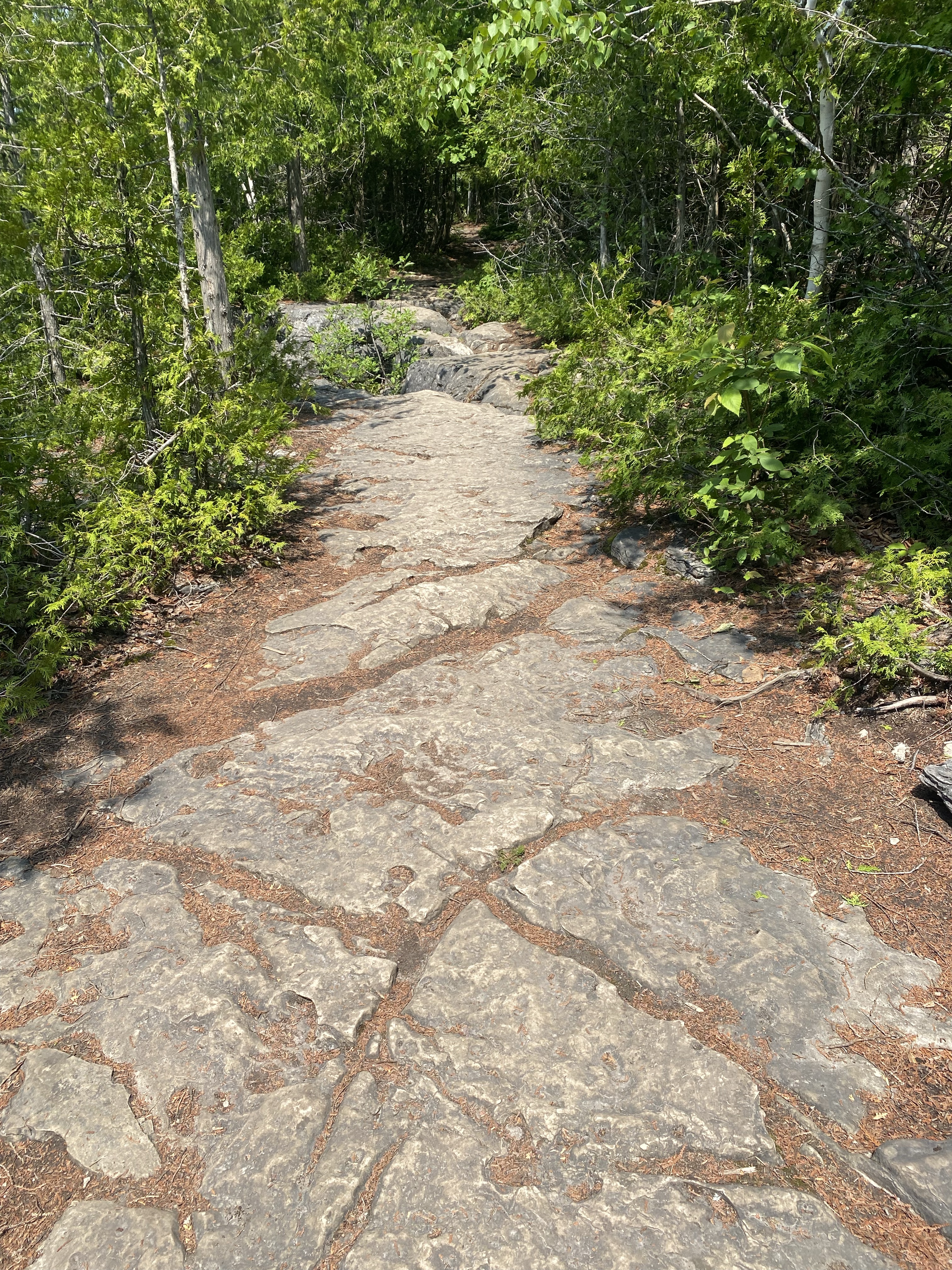
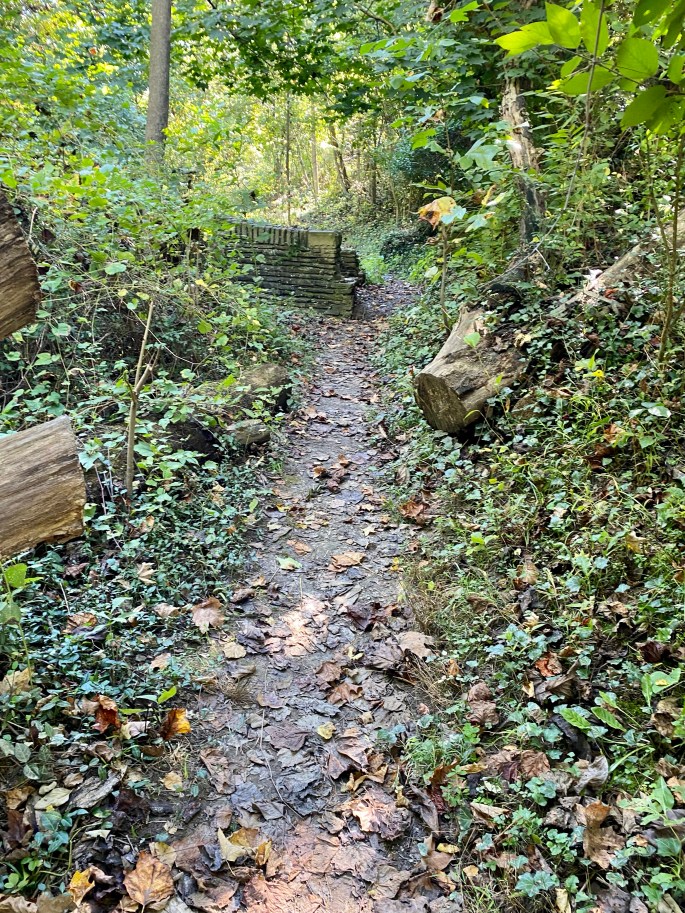
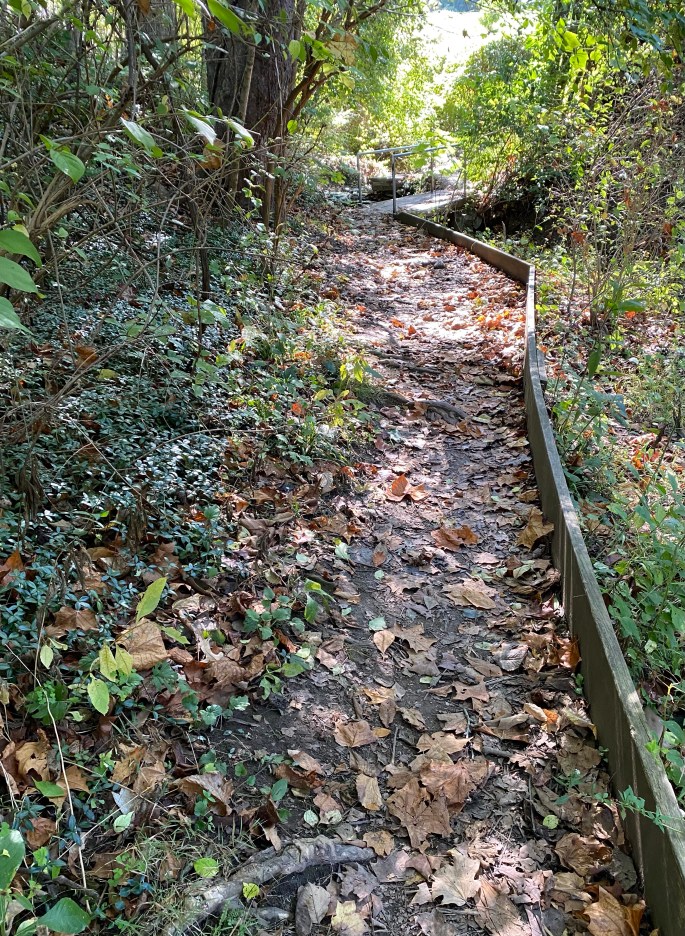
The path is clearly marked.

It was one of those rare cool mornings in July after a long-held heat wave broke. The earthy summer scents of damp ground and musky moss filled the air. The crunch of detritus under our hiking shoes rose as the sounds of traffic on WV 34 faded into the background. 

My dad and I were in our happy place, discovering new trails hidden in plain sight in the woods.  However, it was clear from the start, we were not alone. Imprints of four-footed friends as well as knobby tire tracks indicated an array of outdoor enthusiasts were also enjoying these well-worn paths.

Discovering Meeks Mountain Trails

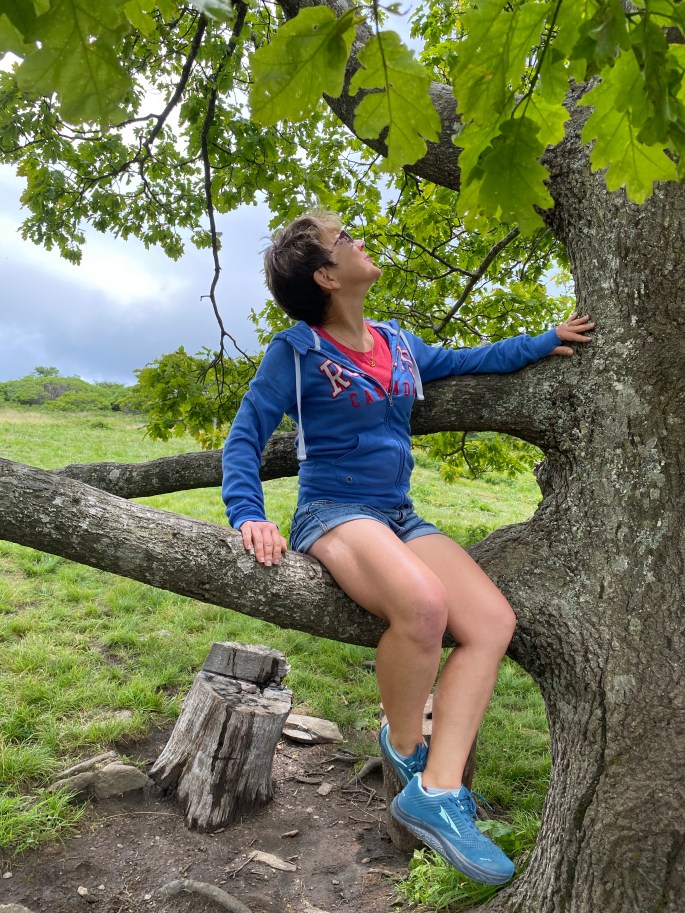
Welcome to Meeks Mountain Trails! (My Dad, Larry Musick, featured in this photo.)

We arrived at Hurricane Park to hike Meeks Mountain Trails, a printed map of all the trails in hand. However, we were unsure where to start since this was our first visit. As luck would have it, we encountered a park worker who enthusiastically explained the trail system—including the way the trails were marked and the level of challenge for each trail. He recommended the red and white trail on our first visit and offered advice for future, more challenging, hikes.

A Community-Built Gem

Photo by Philipp M on Pexels.com

Meeks Mountain Trails is a gem of a trail system close to home.  With more than 34 miles of trails, it is a haven for hikers, runners, mountain bikers, and primitive campers alike. Despite being interconnected, the trails are well-marked, with varying degrees of difficulty and length. It is easy to dip in for a short hike, commit to a long trail run, or tackle a challenging mountain bike route. 

According to the Meeks Mountain Trail Alliance website, the trail project began in 2018 with a desire to increase the health and well-being of the surrounding communities as well as increase opportunities for economic growth. Since then, over 600 volunteers have logged over 35,000 hours building and maintaining trails in cooperation with the city of Hurricane and private landowners, the Meeks family. 

Our First Hike: The Red and White Trail
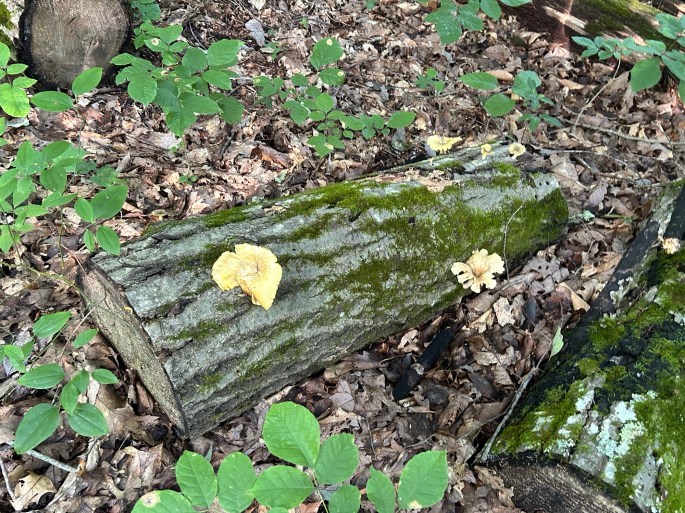
A fallen log with beautiful, flower-like growth on it.

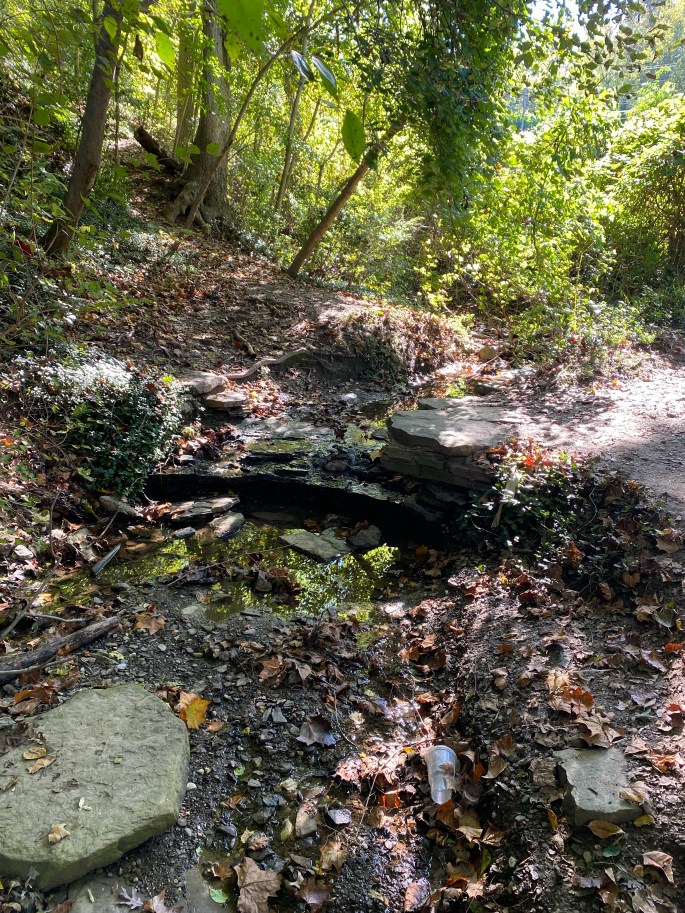
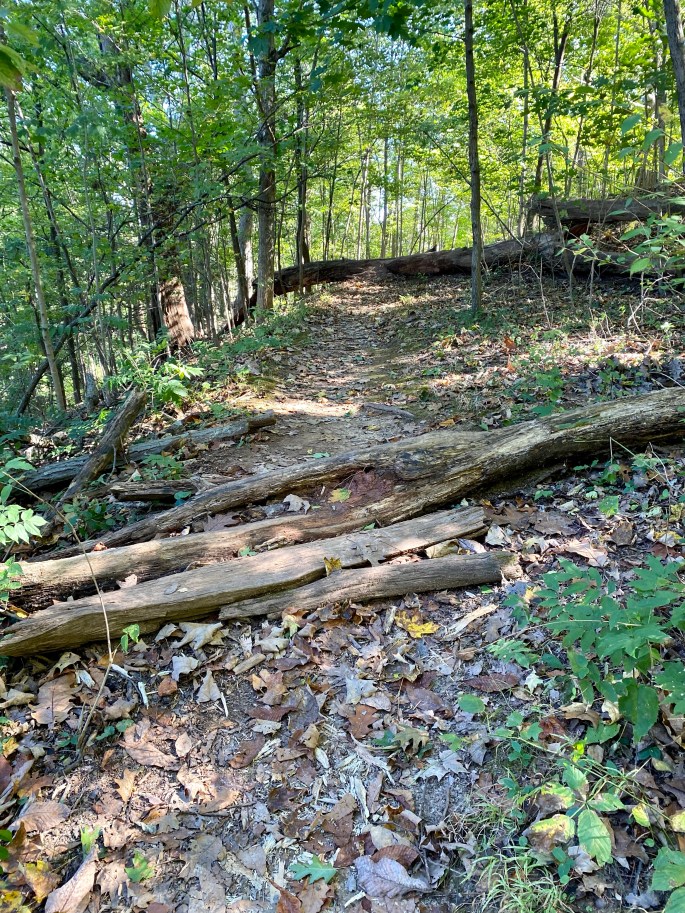
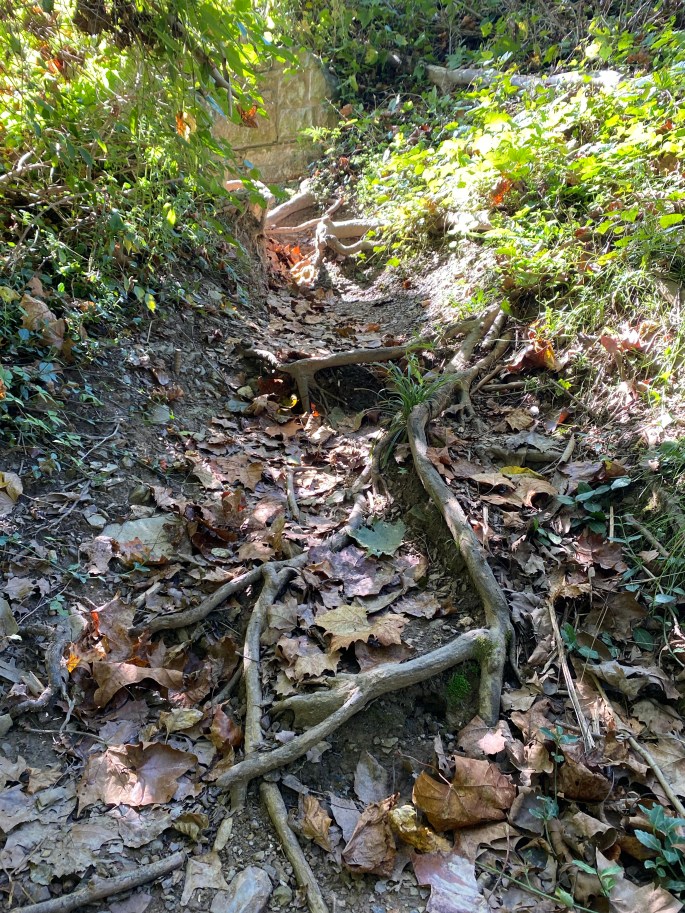
My dad and I followed the park worker’s advice and hiked the red and white trail–a gentle introduction to the Meeks Mountain Trails (MMT) system. This 3.2-mile trail offered us comfortable challenges, with exposed roots, rolling, rocky ascents and descents, a stream crossing, and switchbacks to keep things interesting. We thoroughly enjoyed the dappled morning sunlight as we made our way up, over, and around the trail. We marveled as a mountain biker powered up a sharp, twisting incline. A hesitant dog appeared to balk at the idea of crossing a stream while his running companion tried to coax the dog across, leaving us smiling.

Something for Everyone
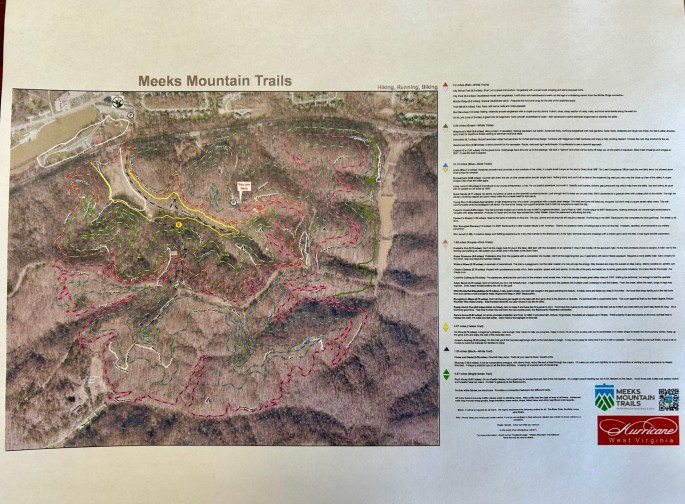
Trail map that can be found online for Meeks Mountain Trails.

The MMTA offers a wide array of trail lengths and challenges, from one mile to over ten miles. It appears to be one of those places in which the more you visit, the more complex and nuanced you can make your outdoor adventure. The trails are well-marked by a color-coded system, but it’s advisable to look over the trail map and descriptions of each trail, found on the MMTA website, before embarking on a Meeks Mountain Trails adventure.

There are trails for beginner-friendly walks, which is what the Hurricane Park employee described to us as family-friendly trails, appropriate for parents with younger children. There are more moderate for those looking to elevate their running, hiking, or biking game, and challenging trails for the more adventurous and skilled. What I most noticed was the diversity of plant life: ferns, moss, lichen, colorful mushrooms and wildflowers, fallen trees teeming with insect life, and deciduous trees of all types reaching for the heavens amidst rocks of varying sizes. 

As my dad and I hiked, we marveled at the large amount of work hours it must have taken to not only build the trails, but also to maintain them.  We admired the work of local scout troops who provided benches in several scenic spots along the path we trod. Most of all, we simply enjoyed the trail, feeling grateful for its existence so close to home.

Tips for a Great Visit
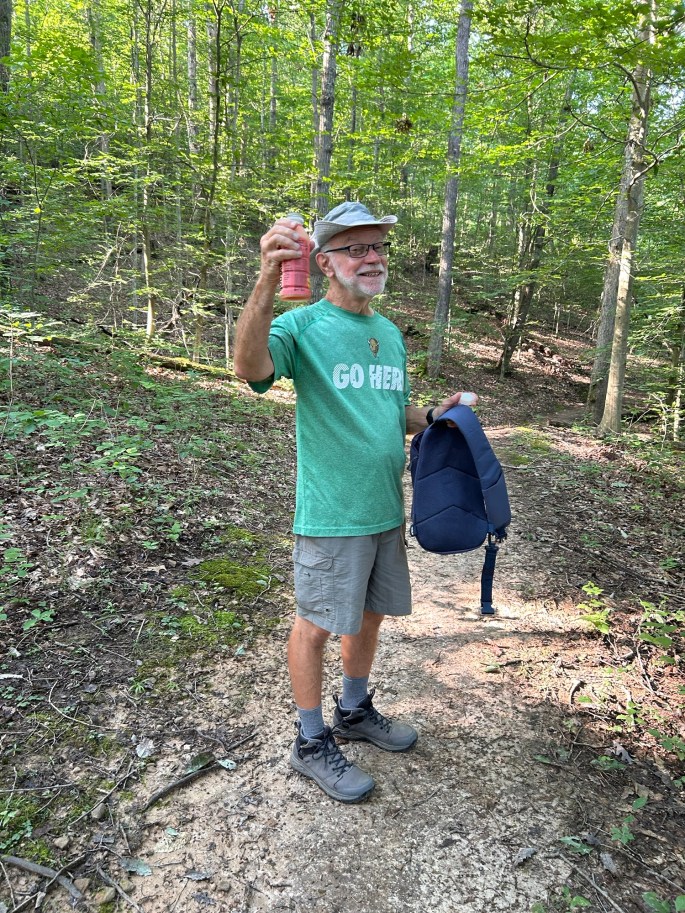
Be sure to pack in water, snacks, bug repellant, or even a picnic lunch!

If you’ve never been to Meeks Mountain Trails, and you are considering visiting it for your next outdoor adventure, there are a few things to keep in mind. First of all, parking is free and easy to access as it is available at Hurricane City Park. The trailhead to all trails is only steps away from the parking lot. Restrooms are also available near the parking lot. 

Before entering the trails, consider bringing: 

  • Tick and mosquito repellent 
  • Proper trail shoes or bike gear 
  • Water, snacks, or even a picnic lunch 
  • Flashlights and/or headlamps if hiking early or late 

As a bonus, you can even support the MMTA by visiting their online shop to purchase official MM gear.

Sharing the Trail
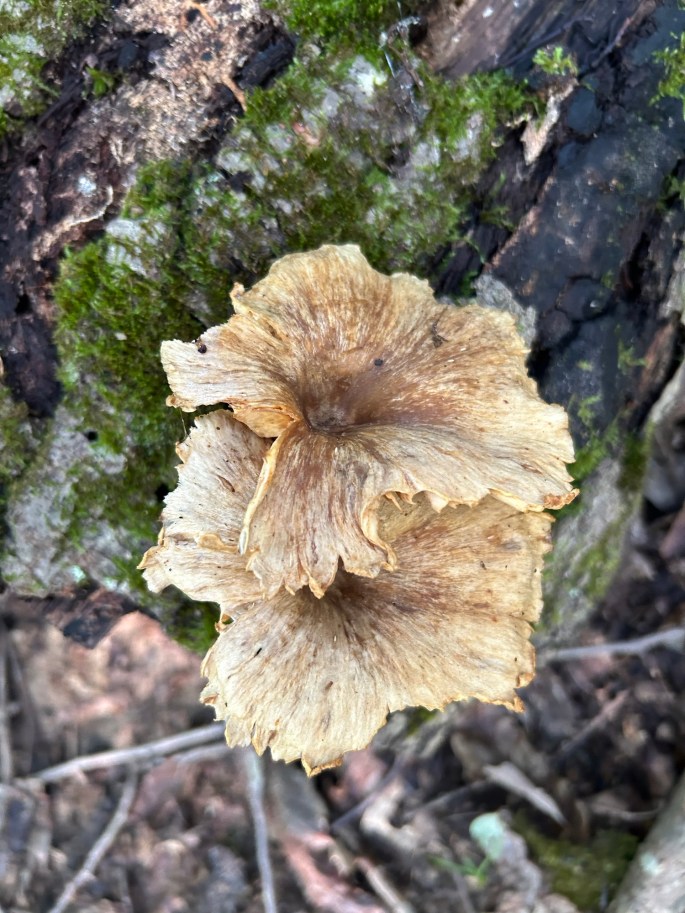
Another one of those flower-like fungi that I found all along the trail.

Additionally, once out on the trail, as my dad and I learned, it is important to be aware of other hikers, runners, and mountain bikers. Maintaining appropriate etiquette allows all outdoor enthusiasts to share and enjoy the trails. This includes stepping aside for faster climbers and bikes, while offering a friendly wave or voiced greeting when passing by someone, especially when passing from behind as you don’t want to startle or scare a fellow adventurer. Lastly, remember to “leave no trace”: pack out whatever you pack in.

Finding Peace Close to Home
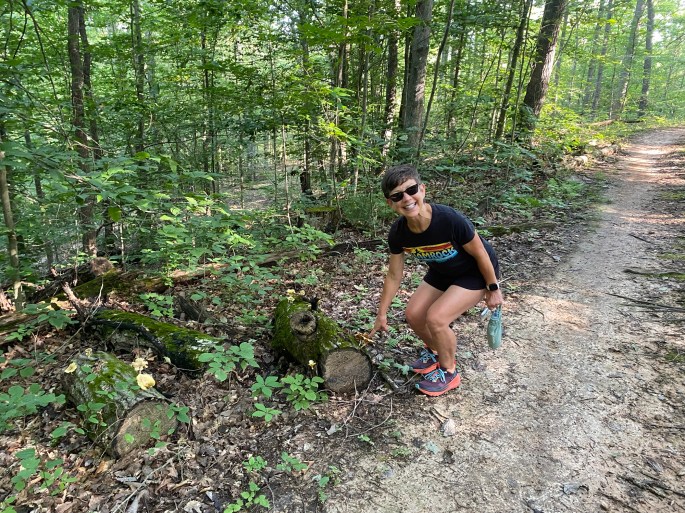
My Dad kept teasing me about how frequently I would pause along the trail to take a closer look at something that caught my eye.

You don’t have to be a serious trail runner, hiker, or mountain biker to enjoy Meeks Mountain Trails. These community trails welcome all levels of adventure while giving every visitor the opportunity for peace, solitude, and healthy movement. Best of all, they are right here in our own backyard. Whether you move on two feet or two wheels, consider visiting Meeks Mountain Trails this fall. After all, in the words of John Muir, “Keep close to Nature’s heart . . .and break clear away, once in a while, and climb a mountain or spend a week in the woods. Wash your spirit clean.” This is exactly how I felt as we drove away from our morning spent in the heart of the woods.
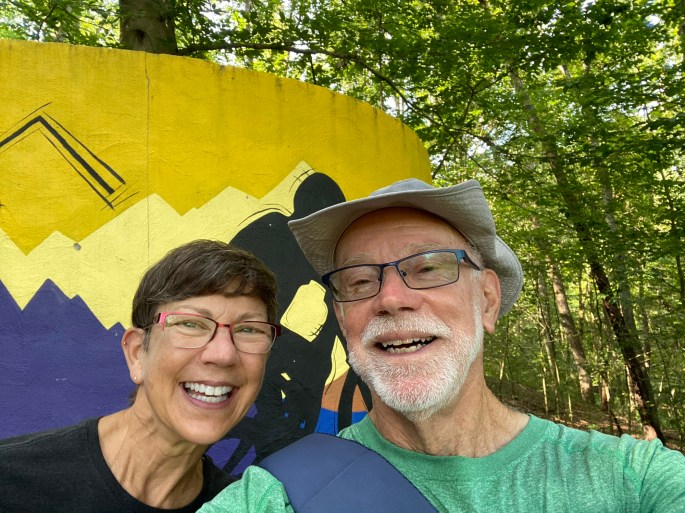
In the end, Dad and I agreed, it had been a very good hike, and we looked forward to returning again in the future.

An adventure awaits you in Northeastern Ontario, Canada

“I believe the world needs more Canada,”–Bono

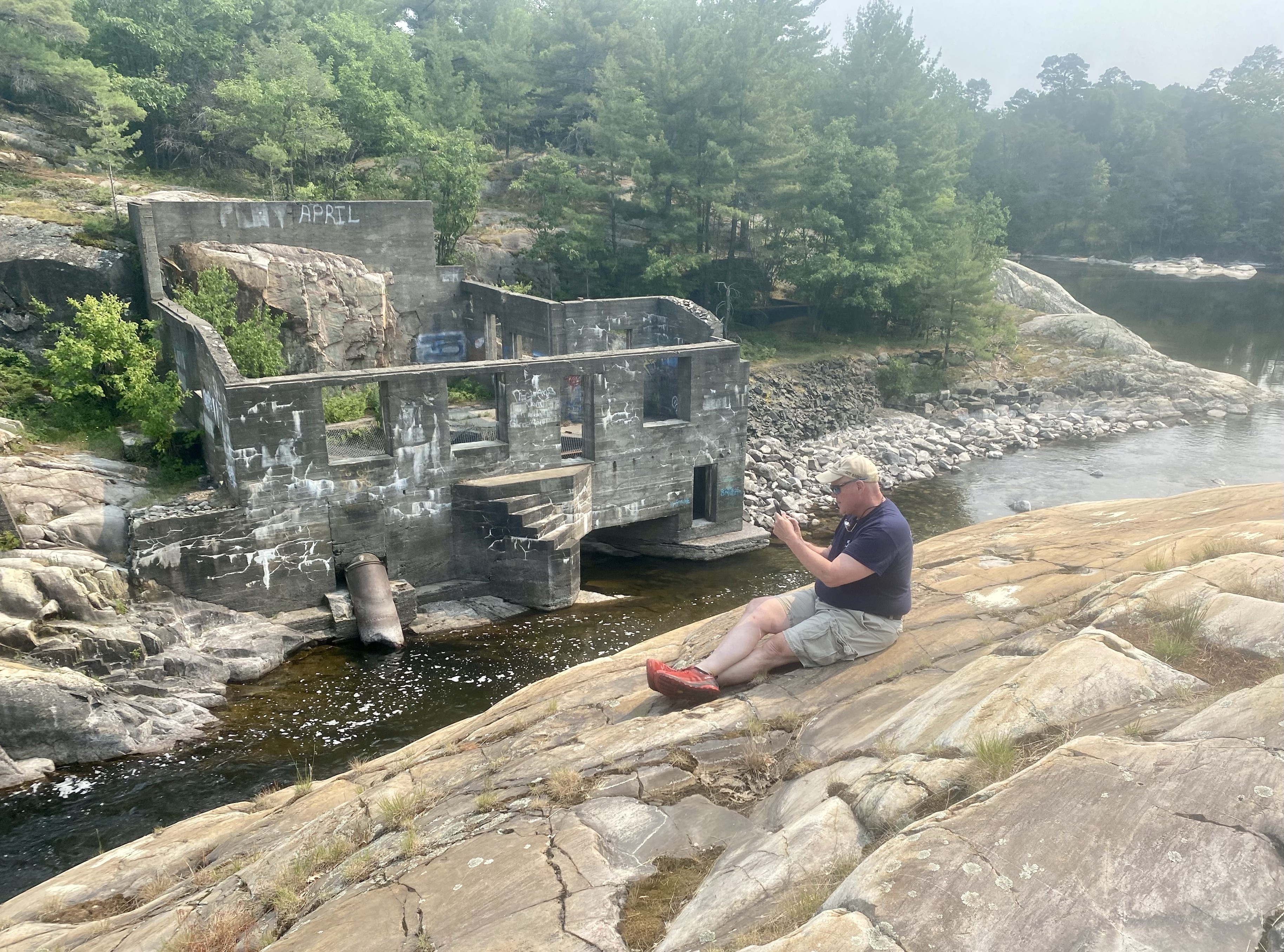
Despite the juxtaposition of the sounds from the overhead highway, the falls’ beauty cannot be denied.

What’s Not to Love about Northeastern Ontario?❤️

If you’re a fan of the great outdoors, especially hiking, fishing, hunting, canoeing/kayaking, cycling, motorcycling, camping, or even just traveling/visiting places with beautiful scenery, then Northeastern Ontario, the area north of Lake Huron and east of Lake Superior, is an area to consider visiting.  My husband, John, and I recently traveled to the area and discovered an abundance of remarkable surroundings filled with frosted quartzite mountains, carefully managed hiking trails, pristine lakes and rivers for fishing and/or canoeing/kayaking, and a variety of accommodations.  Not only that, this area is rich in art, natural history, varied attractions and cultural interests, as well as  historic sites.  Which is why we decided we need to return next year to further explore the wonders of this area.

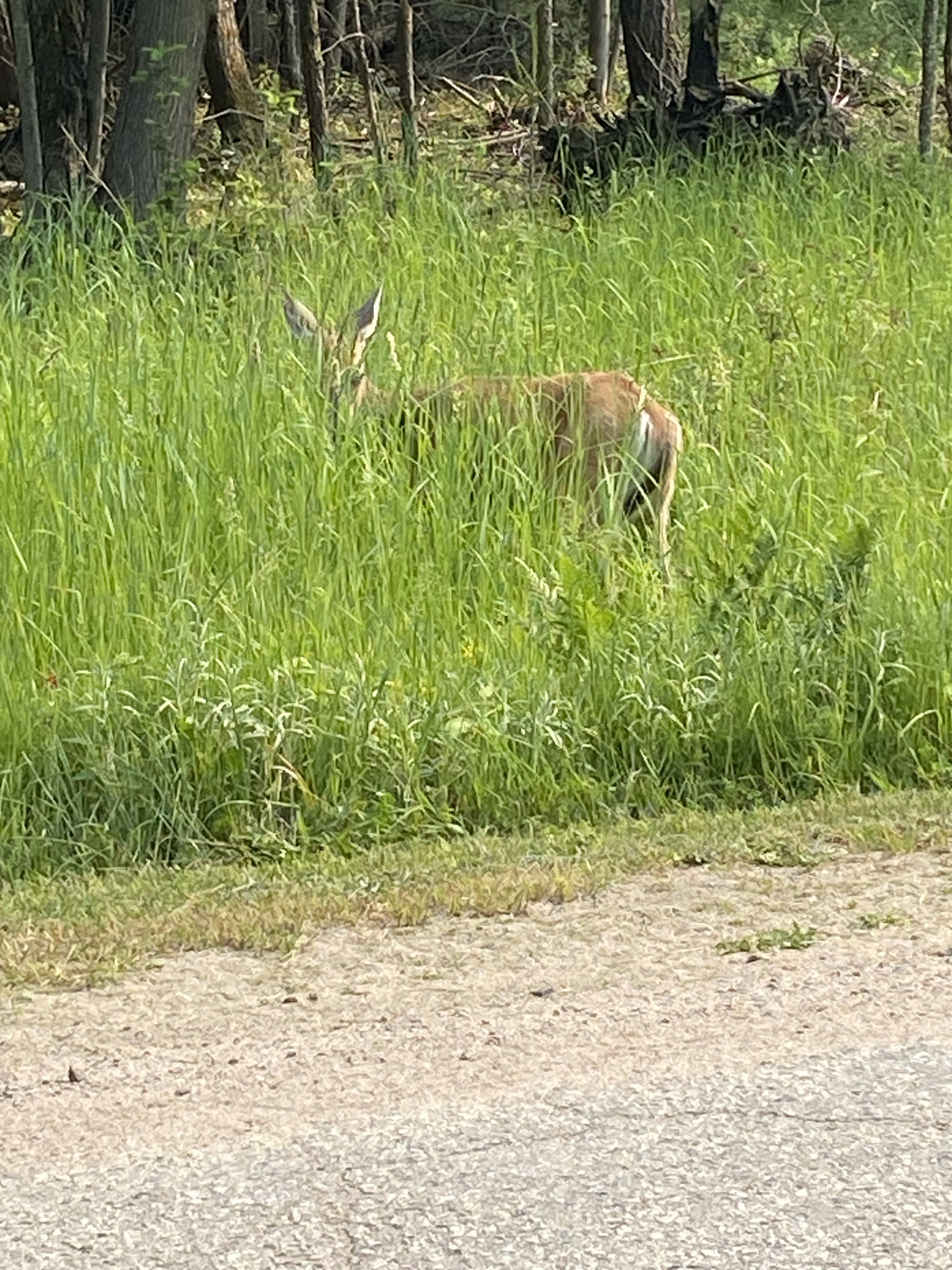
A deer casually gazed at us as we searched for the trailhead for Whitefish Falls.

Charming Charlton Lake Camp🏕️

As mentioned in a previous piece, John and I stayed at Charlton Lake Camp–a camp we highly recommend–which prides itself on being a “housekeeping cottage resort for families, fisherman, artists, and adventurers.”  It is located in the heart of the La Cloche Mountains, with its stunning scenery, nearby hiking trails, charming nearby towns–such as nearby Espanola and Whitefish–and welcoming people. In addition to being able to walk out the door of our cottage and head directly to the water for fishing, boating (including kayaking/canoeing), and swimming, we were also a short driving distance to historic hiking trails, cultural centers, and landscapes that have inspired scores of great art, made particularly famous by a group known as the Group of Seven.

The La Cloche mountains provide constant the backdrop to the scenery in Northeastern Ontario.

Ring the Bells🗻

The La Cloche Mountains rose up out of the earth like glistening castles of white and offered a wondrous backdrop to everything we did while visiting this area of Ontario.  These mountains are believed to be over 3.5 billion years of age and consist of glistening quartzite and granite.  Once higher in elevation than the Himalayas before the glacier destruction but now rounded with age and erosion, the mountains were named “La Cloche,” which means “the bell” in French, because of the ringing sound that could be heard from a distance when struck.  It is said that First Nations used this sound as a warning signal.  Now these mountains are a source of inspiration for artists and outdoor enthusiasts alike.

Ready to climb a mountain’s rockface? Welcome to Willisville Mountain Fire Tower Trail!

With all of its mountainous topography, Northeastern Ontario is full of hiking trails. In the area in which we were staying were ten highly recommended trails; however, as you fan outward, there is a countless array of trails for all fitness levels.  Two trails John and I hiked within the local area of camp were Willisville Mountain Fire Tower Trail & Whitefish Falls. Additionally, we also visited Manitoulin Island and hiked the Cup and Saucer Trail.

Willisville Mountain Firetower Trail🥾

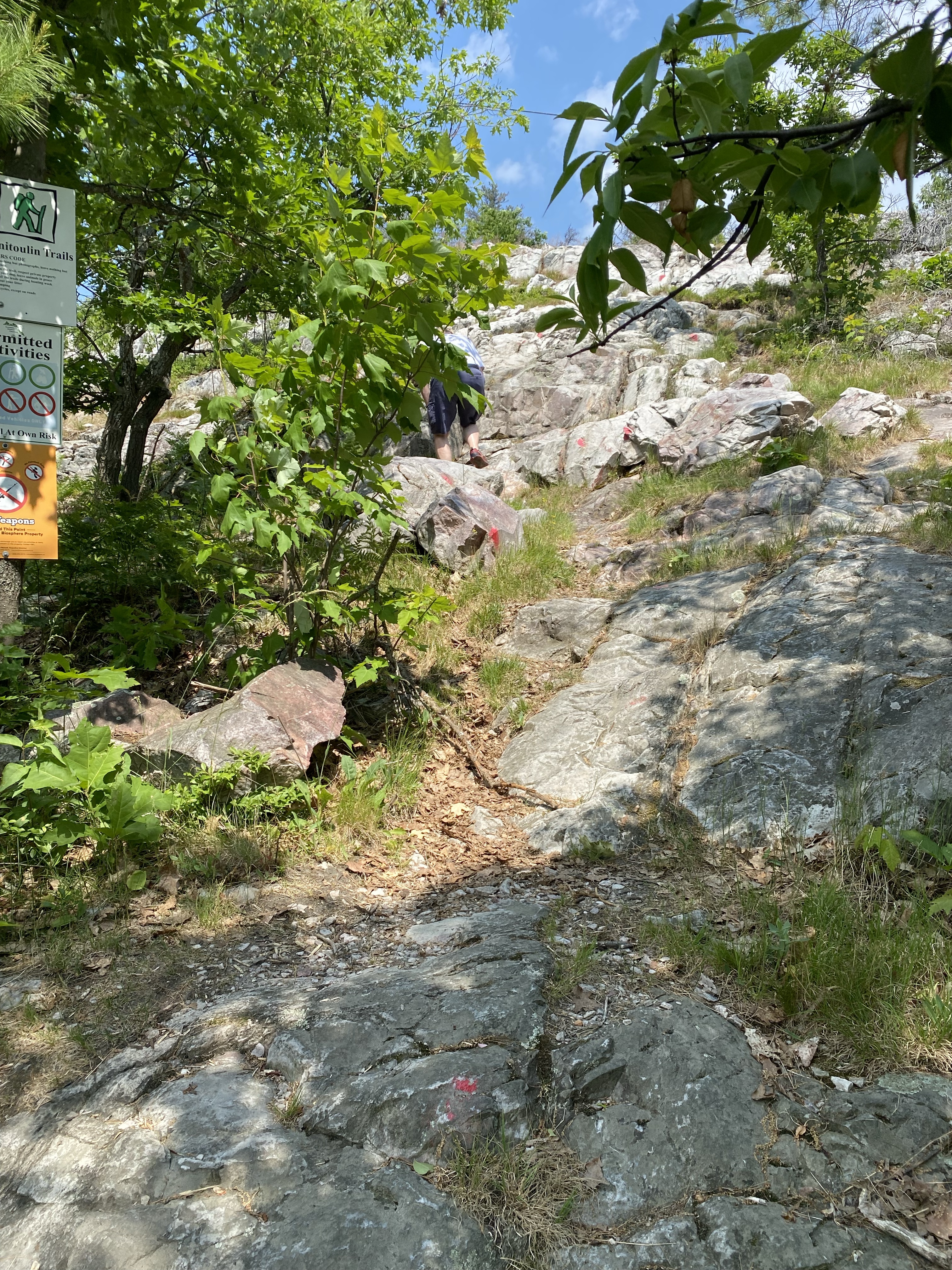
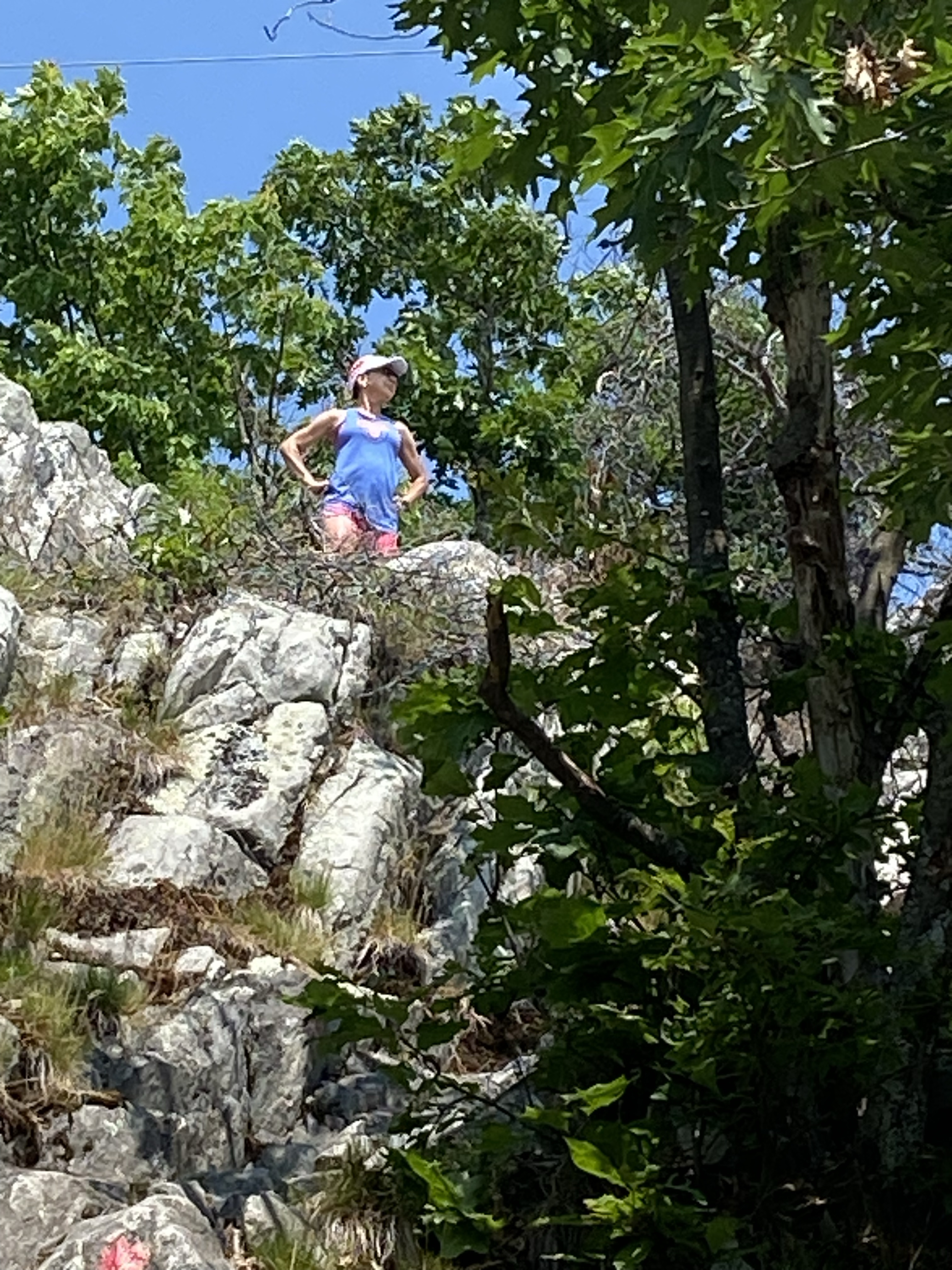
Willisville Mountain Fire Tower Trail is well-marked with red dots and arrows showing you the way straight up the mountain.

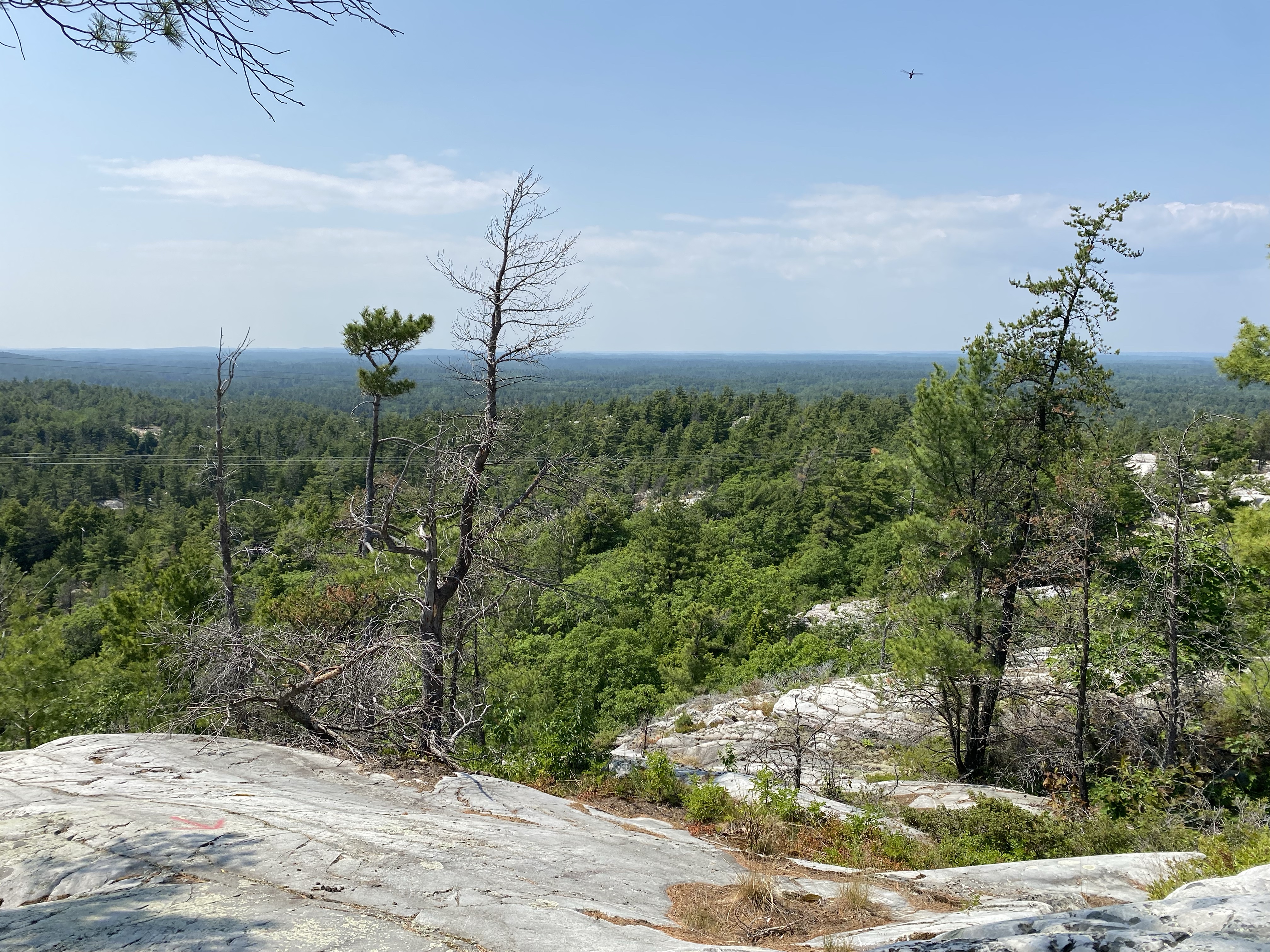
Part of the Escarpment Biosphere Conservancy (an Ontario-focused charitable land trust), Willisville Mountain Fire Tower Trail was first brought to our attention by Charlton Lake Camp owners, Dan and Lisa McGuire.  They recommended it for its panoramic views of the La Cloche range and the surrounding area.  According to Dan and Lisa, it was a hidden gem of trail.  The trail, once you realize where it is, (They did say ‘hidden’ after all.) is marked with red dots and arrows that are repainted every year.  Unlike many of the U.S. trails for which John and I are accustomed to hiking, this trail mostly consists of white quartzite, and it is steep–heading straight up the rock face of the mountain.  We definitely recommend hiking shoes or boots for this route, but the views are nothing short of spectacular, momentarily allowing hikers to experience the soaring eye view of the local golden and bald eagles.

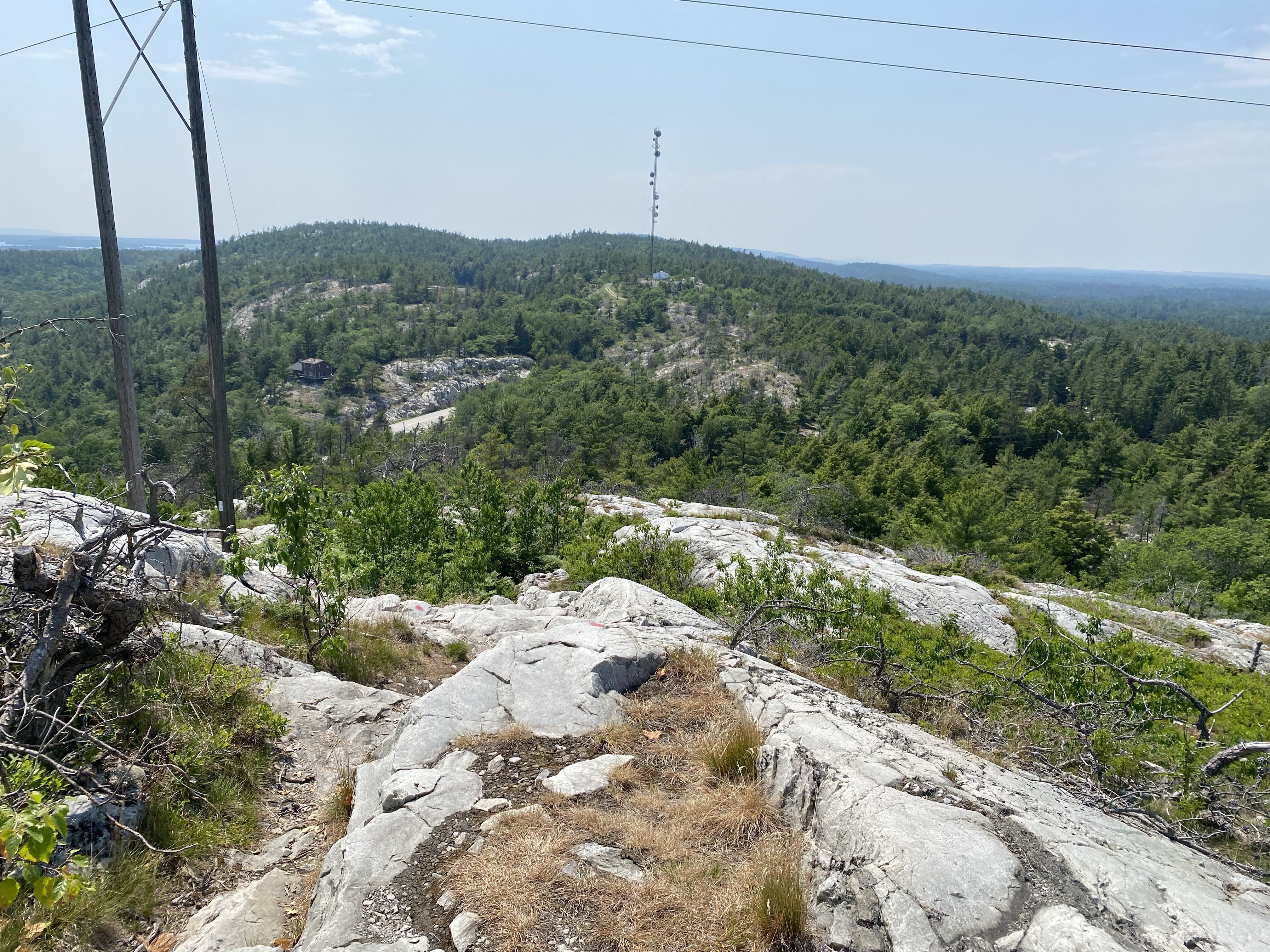
What a view 🦅
In the heart of the La Cloche Mountains.🦅👀

Whitefish Falls Trail🌊

In contrast, Whitefish Falls trail does not rise straight up a mountain, but it too is a bit of a hidden gem.  Finding where the trail starts took John and I a second time driving by it before we figured out where it was located.  This out and back trail was partly an earthen/dirt path and, once more, partly quartzite, which can be slippery alongside the water’s edge.  Once you arrive, the view (and sounds) of the falls is stellar! However, I did find the juxtaposition of the falls’ wondrous beauty, and clamorous traffic passing overhead on the highway bridge above, a startling contrast.  Nonetheless, Whitefish Falls trail was a worthwhile experience.  

Whitefish Falls
I can only imagine the sound of these falls after a heavy rain or spring snowmelt.

Cup and Saucer Trail☕️

One other EBC trail John and I explored was the Cup and Saucer Trail located on Manitoulin Island.  This out and back trail is 8 km (4.97 miles) long and is not for the faint of heart!  Winding around a mountain with a wide variety of footing challenges (At one point, the trail has a rope for hikers to use to hoist themselves uphill!), this trail offers heavenly views from its cliffs.  Made of 400 million year old silurian deposits, the cliffs earned their name because higher, cup-shaped cliffs appear perched on top of the lower saucer-shaped cliffs.  While this trail kicked our, shall I say, boots, the views were outstanding, and the drive to and from the trail across Manitoulin Island was scenic, making the overall experience quite rewarding.

Manitoulin Island🏞️

The Manitoulin Information Center is full of historical pictures, artifacts, and information about the island.

 Another stop we made while visiting Manitoulin Island was to visit the town of Little Current. In order to explore the town, John and I walked part of the town’s official recreational walking trail which is approximately 7 km (about 4.3 miles) long. We walked along the walks of the pleasant downtown area and on to its attractive waterfront/marina area and continued on up a hill to an area known as Low Island Park.  The trail continued, but we headed back towards the downtown in order to have adequate time to hike the Cup and Saucer trail.  Nonetheless, we could feel the vibrancy of the town, its businesses, and its people.  We definitely hope to return for another visit.  

Group of Seven🎨

A piece about Northeastern Ontario would not be complete without a nod to the infamous Group of Seven Artists. According to Canadian Encyclopedia, this was a group of landscape painters, often known as the Algonquin School.  These self-proclaimed modern artists were officially established in 1920, but sadly disbanded by 1933. They were part of Canada’s first internationally recognized art movements.  While the styles of the seven artists greatly varied, the artists were united in their exploration of Canada’s rugged, windblown landscapes, spending a good deal of time painting and illustrating Northeastern, Ontario, as well as establishing a credible art school.  Due to the enduring work of these world renowned artists, travelers can embrace the Group of Seven Artists’ spirit by embarking upon road trips, much like John I did, in order to experience an immersive, 3D exploration of their indelible canvases. 

Immersing oneself into the natural beauty of Northeastern Ontario fosters a feeling of connection when viewing the various artworks created by the individual artists that made up the Group of Seven.

Nature’s Playground🌄

What’s not to love about Northeastern Ontario?

In the end, Northeastern Ontario, Canada is a playground for all types of adventure seekers.  With its glistening lakes, windswept woods, majestic milky mountains, rushing waterfalls, charming cities and towns, and a wide array of accommodations, it offers individuals, families, and groups multiple opportunities for exploration and great escapes.  Sure, the drive, or flight, may take a bit more time, but that’s all part of the great experience of traveling!  

Wishing you safe and happy travels!

Like a Prayer

“Why must people kneel down to pray? If I really wanted to pray I’ll tell you what I’d do. I’d go out into a great big field all alone or in the deep, deep woods and I’d look up into the sky—up—up—up—into that lovely blue sky that looks as if there was no end to its blueness. And then I’d just feel a prayer.”–L. M. Montgomery, Anne of the Green Gables

“Ms. Hill, don’t you like doing healthy stuff like hiking and running?”

The 6th grader looked at me with sincerity written across his face.  He was in my homeroom, the group of students with whom I start and end the school day.  By this point in the school year, I have come to know most of the students in this group fairly well, and this particular young man, in spite of his energetic youthfulness, has an uncommonly thoughtful side.  

The group of boys with whom he was talking and joking around at the end of the day, all turned to look at me.  I affirmed that I did indeed like both of those activities, but that I also enjoyed walking or simply being outside equally as much.

Nodding, seemingly with understanding, the same young man further inquired, prodding as to why I liked being outside.  After pausing to gather my thoughts, I explained that it made me feel happy, at peace, and connected to God. 

“So it’s kinda like a prayer, huh?” 

Out of the mouths of babes, or in this case, a 6th grader . . . 

Then, in typical middle-school fashion, the young man’s conversation quickly pivoted back to his buddies, so I returned to my routine end-of-the day tasks.  However, his words remained with me.  In fact, his words have often returned to me on a number of occasions for the past several weeks, especially during moments when I am out-of-doors. 

Scanning through photos of my recent trip to the Blueridge Parkway as well as past out-of-doors experiences, it is clearly evident from the large number of nature-centric images that I relish time spent outside.  From images of wispy cloud billows to leaf-scattered earthen trails; from layers of cerulean blue mountainous peaks to emerald green moss dressing up a boulder, and a great many variations in between, I have collected hundreds of images of Mother Earth. Nonetheless, my fondness of nature is so much more than taking photographs.

Time spent outside is like pouring soothing salve over my weathered soul.  One deep inhalation of fresh air, and I can instantly feel more calm and grounded.  In fact, I have an overall sense of vigor, not just in my body, but in my mind and soul when I am outside in the natural world.  It is as if my whole being comes alive.  

Therefore, it was no surprise for me to learn that numerous research bodies and scientific communities corroborate my personal experiences with nature.  As I scanned through several research pieces published by well-respected groups such as the American Psychological Association, Yale School of  the Environment, Harvard Health, and Scientific Reports, to name a few, there were some variations as to what defines “nature” and how long one needs to spend time in nature to reap the benefits; however, all pointed to the fact that spending time out-of-doors is overall beneficial to good health and mental well being.  Some of the commonly cited perks of spending time in nature include: improved mood, increased cognitive and memory function, reduced stress levels, improved mental health, boosted immune system, and overall reduction of blood pressure and heart rates.  

While I whole-heartedly appreciate and welcome ALL of those benefits, it has been my experience that there are also other, more ethereal, benefits of spending time in nature.  I find that when I bear witness to the brilliant rise of the sun, gaze upward as sunlight dapples through a canopy of leafy green, or catch sight of sunbeams streaming across dark silhouettes of towering tree trunks, naked in their winter respite, I feel a sense of awe and wonder.  The wide array of colors, lines, shapes, sizes, and the symmetry rivals great artists of our time–our world is a marvel!

The more I observe nature, the more curious and inquisitive I become.  How did all of this happen?  How do I, a person so small and insignificant in the face of all this wonder, fit into the grand scheme of the great I AM?  How am I to comprehend Divine Providence and this wondrous creation called earth?  I have no answers, nor do I feel a need for answers.  Rather I am in a state of being–being appreciative and feeling adoration for the great playground that is nature. After all, we are called human beings.

Francis Bacon, often cited as the father of science and ironically attributed to have invented the essay form, is quoted as once stating that God wrote two books: The Scripture and “a second book called creation.”  Time spent with the “second book” offers me tangible, first hand reminders of the greatness of our Creator.  Standing in the presence of a lofty range of mountains, floating across a lakeshore rippling with life, strolling through the rhythmical edge of ocean tide waters, or simply jogging alongside streams and trees on an earthen park trail, my heart and soul are at ease.  There are no timelines, no demands for my attention, no to-do lists, or looming deadlines.  Instead, there is a softness that envelops my soul, a well-worn quilt of comfort, that is available to all.

I suppose my student said it best after all. Spending time in the majesty of nature opens my heart and mind, allowing me to feel as if I have been gathered into an embrace by a loved one happy to see me once more as God’s peace settles over me.  My spirit is more serene, and I feel as if I am part of something larger than myself.  Something so large, I cannot fathom it, but it is something like a prayer.  

Greybeard Overlook and Douglas Falls–Stepping into Faith

The real voyage of discovery consists not in seeking new landscapes, but in having new eyes.–Marcel Proust

There are times in life when you have no idea where the path onto which you have stepped will lead.  For example, if you have been married for a number of years, think back to the day you said, “I do.”  When you examine the innumerable moments between the “I do” to the present day, it is sometimes astonishing the ways in which the life journey of a marriage meanders and leads.  Even if you aren’t married, or haven’t been married long, once you hit a certain age of awareness, you begin to witness how very unpredictable life can be with all of its plot-twists, side paths, and meandering stops, starts, and–SURPRISE–unpredicted events. 

The weekend before Thanksgiving, my husband, John, and I, spent a few days in the Black Mountain/Asheville area of North Carolina.  Our intent was to take a break from the work routine and spend some time hiking through the picturesque Blue Ridge Mountains.  We had researched a few hiking trail options we thought we would enjoy tackling, but we had also selected a couple back-up alternatives in case those didn’t work out.  

We had hoped to hike to the top of Craggy Pinnacle, instead we ended up hiking the area around it.

Typically, another part of our travel habits is mindfully allowing time to relax and not adhering to a said schedule since our work life as school teachers is very schedule driven.  Therefore, when traveling, we usually try not to rush through our mornings to get out of the door.  Additionally, we both enjoy experiencing new dining venues as part of the fun during out-of-town expeditions.  This often means that part of our relaxed morning is savoring a late morning meal (sort of a brunch). The downside to this habit, when hiking, is that it can cause us to arrive at a trailhead anywhere between the hours of 11:00 am and 2:00 when numerous other relaxed hikers are likewise arriving.  This is why we’ve learned to have several hiking paths in mind for any given day as many trailheads have limited parking.

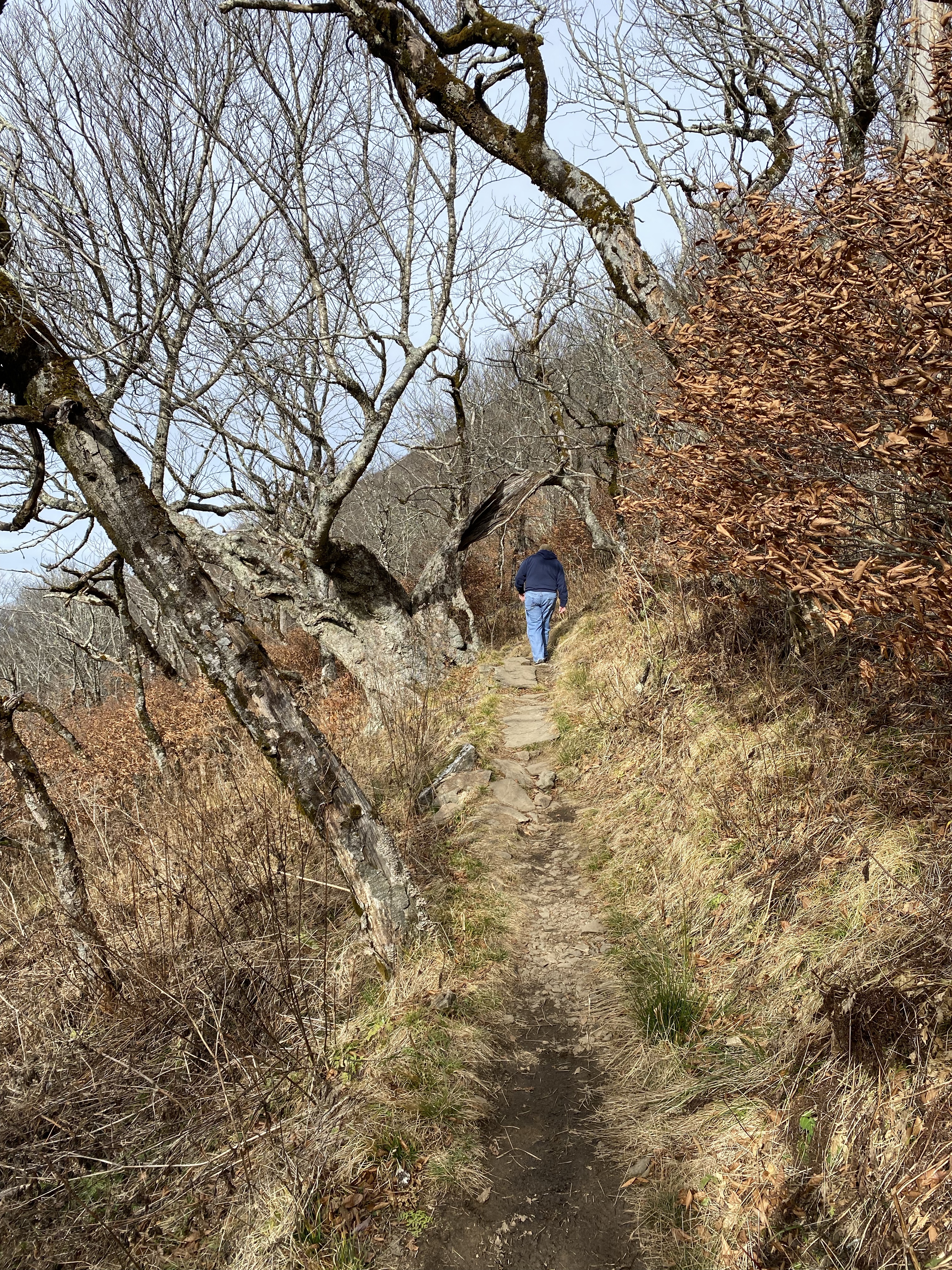
Other than one other couple, John and I encountered no one on this meandering part of the MTS trail.

There were two trails at the top of our list of preferred hiking experiences–one that led to Rattlesnake Lodge and another to the top of Craggy Pinnacle. Unfortunately, we were not able to hike either one.  Instead, on one of the afternoons during our trip, we found ourselves at the closed-for-the-season Craggy Garden Visitor Center, with its ample parking area and scenic views, staring at a map of hiking trails that could all be accessed from the parking lot.  We picked one that wasn’t part of our so-called list-for-the-day and headed off down the trail without conducting any research. Why not, right? After all, we had already successfully hiked one of the trails shown on the map on a previous trip; therefore, how much more difficult could another trail in the same area be? 

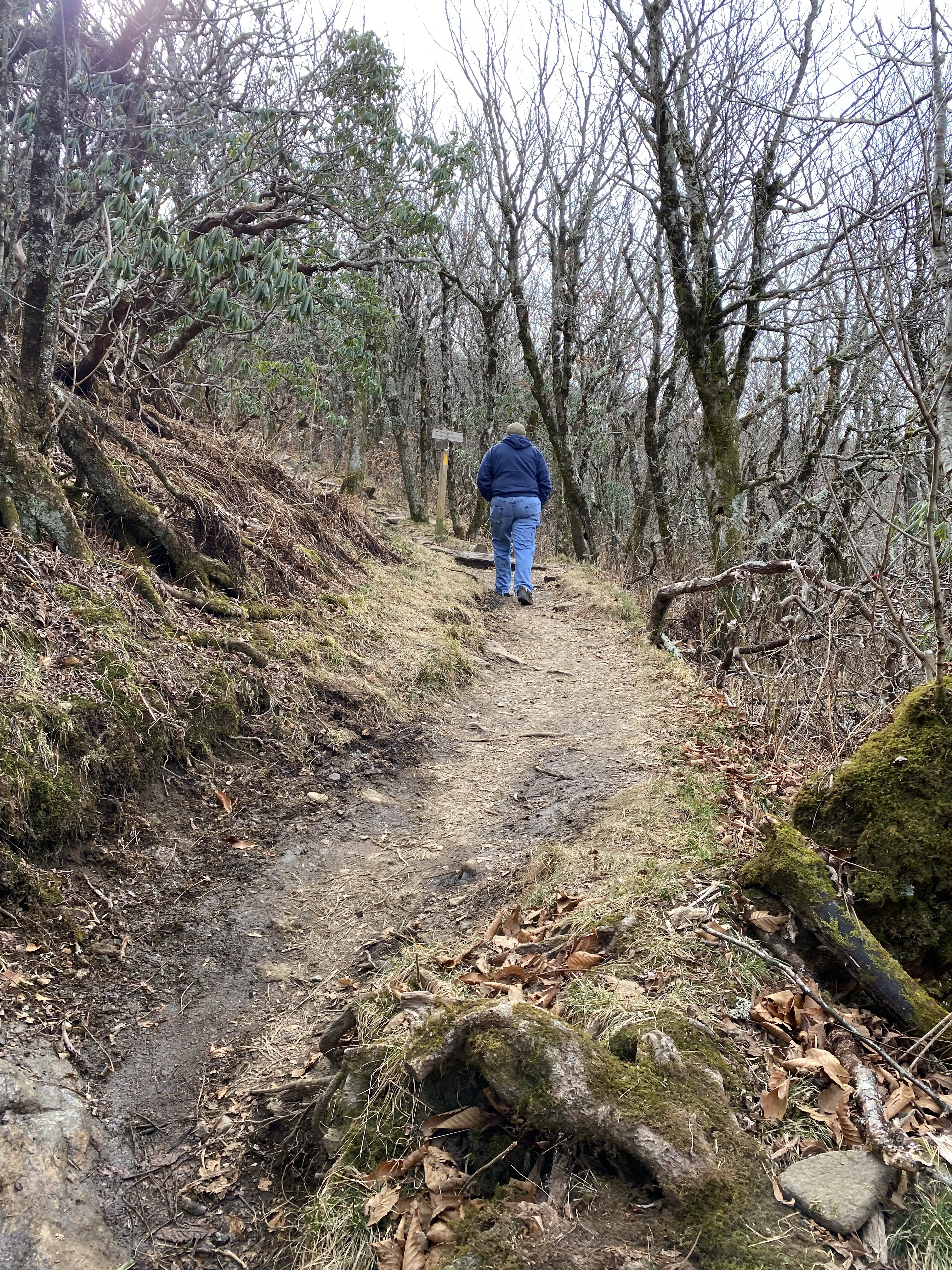
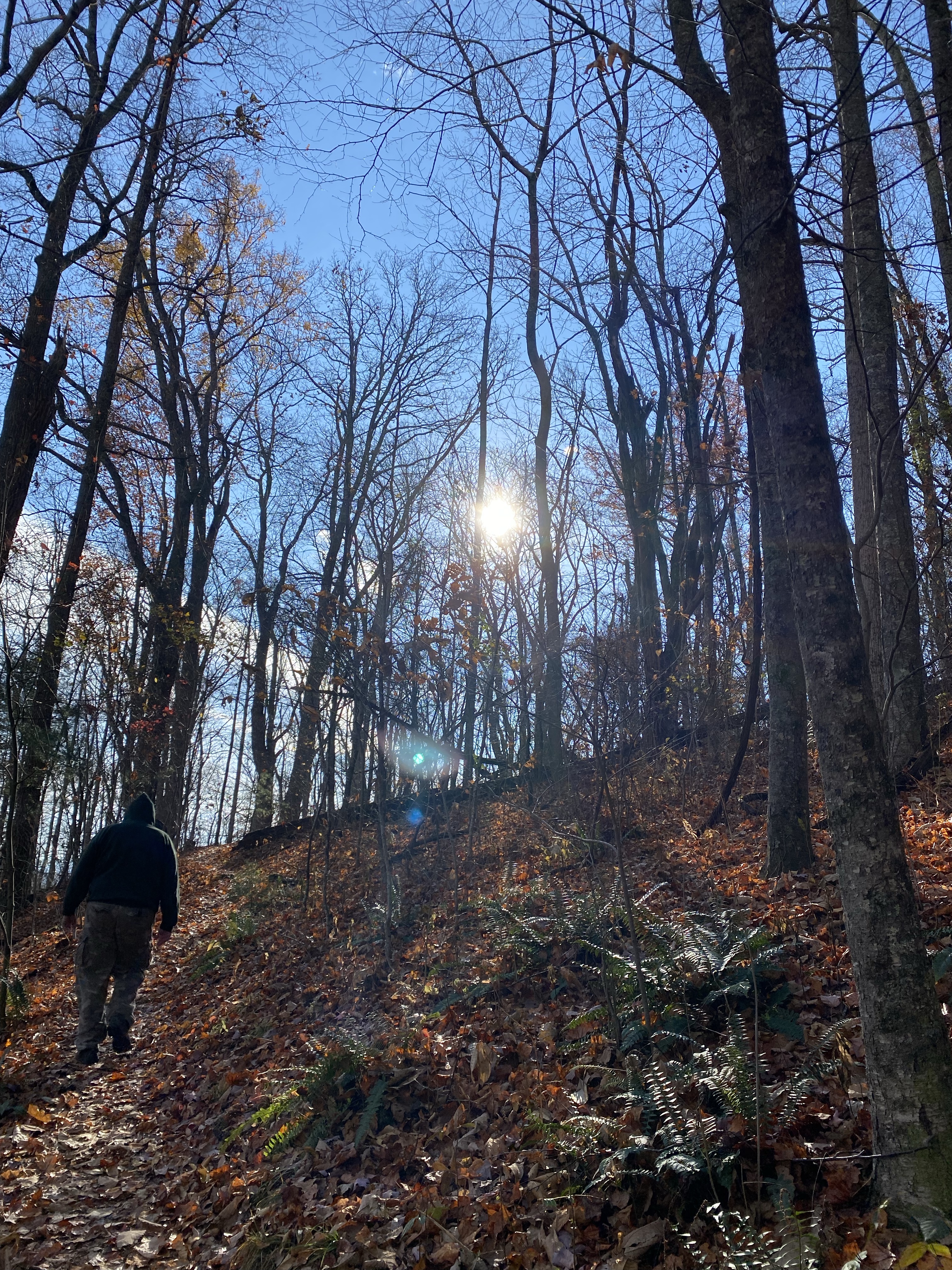
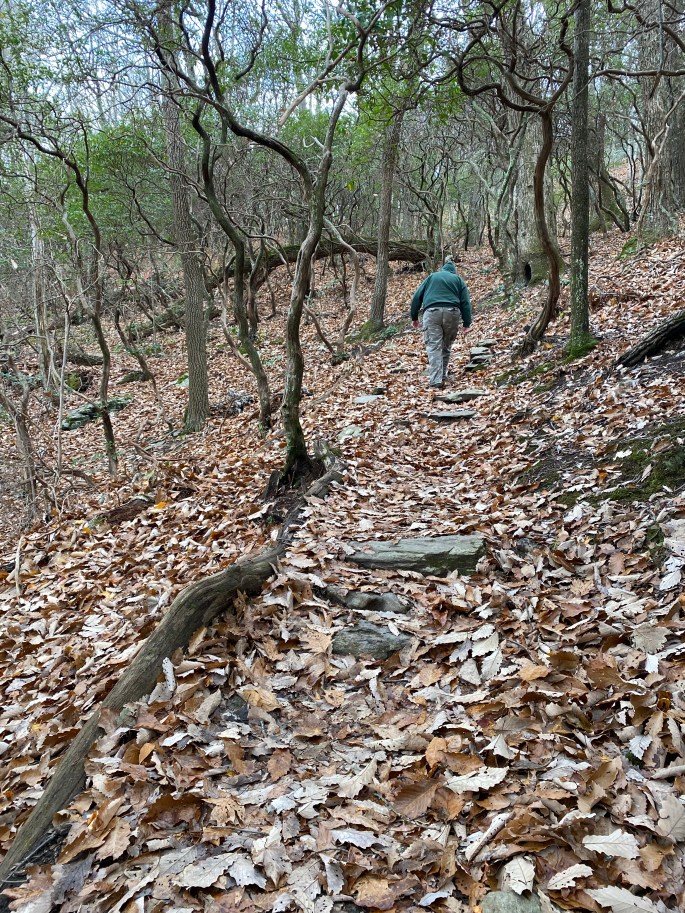
John led the way during this uphill section

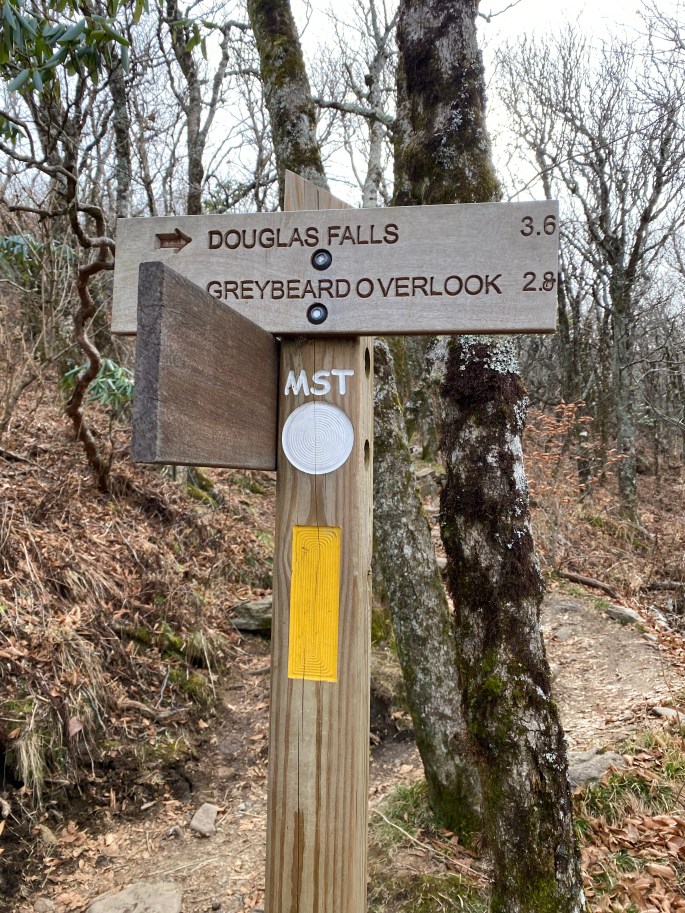
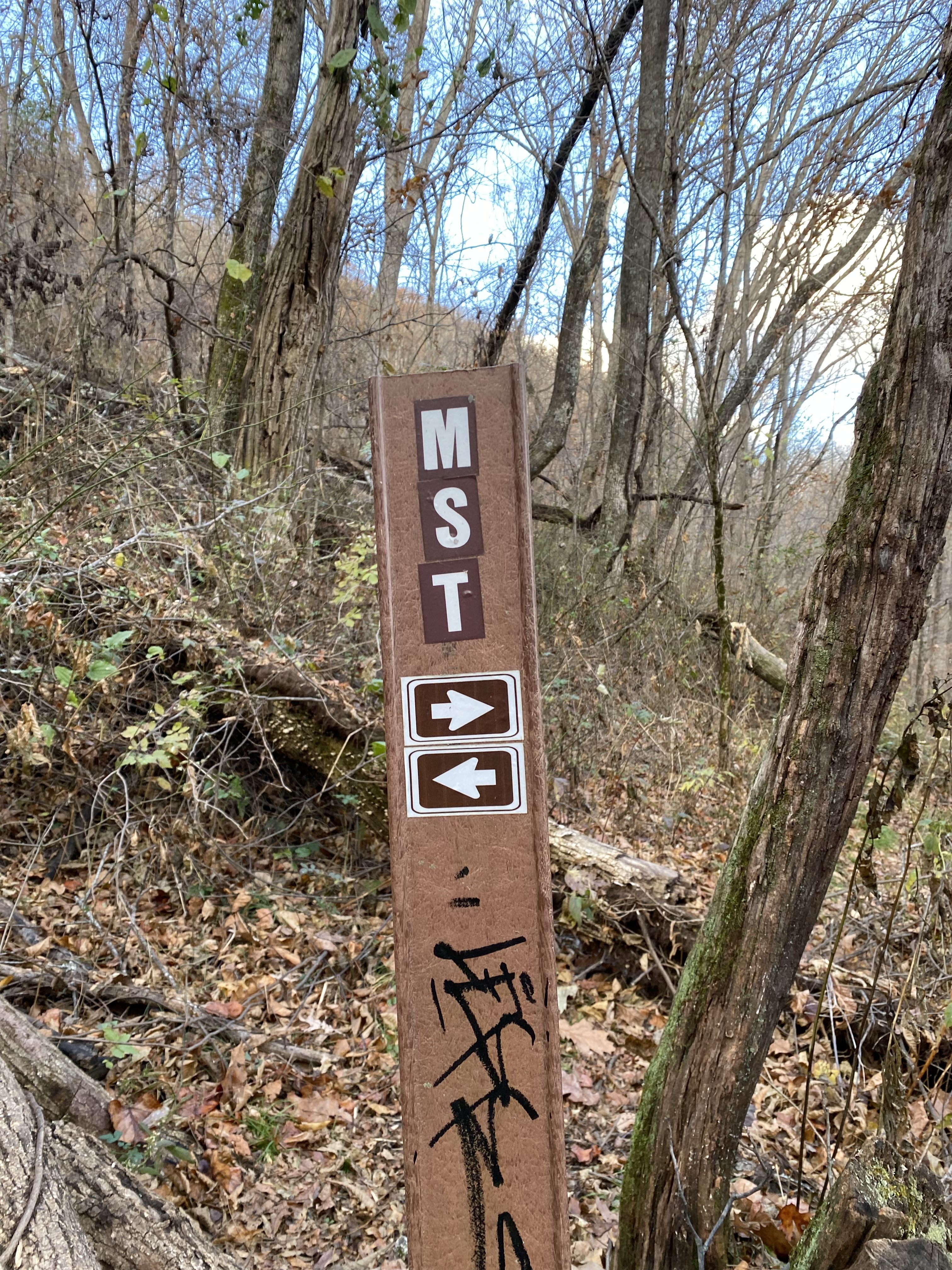
Stepping onto the trail, which was part of the 1,174 mile long Mountain to Sea Trail that crosses North Carolina, we saw a trail marker indicating that Greybeard Mountain Overlook was a “mere” 2.8 mile hike and Douglas Falls was only 3.6 miles away.  Perfect! We had plenty of time, as it was early in the afternoon, and the mileage didn’t seem insurmountable–silly, unsuspecting fools that we were!

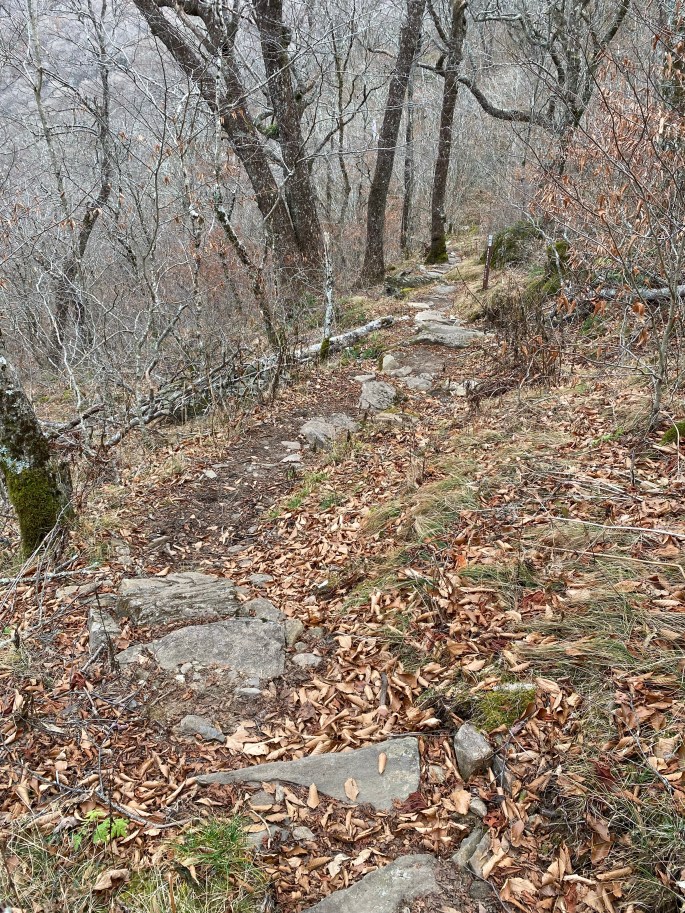
Without prior research, we were completely ignorant of the level of effort required on this section of the MTS trail.  In hindsight, we would later learn this section of the MTS trail was rated at a difficulty level of 5, across a multitude of hiking platforms–on a scale of 1 to 5, with 1 being the easiest and 5 the most difficult. Plus, let’s be honest, John and I are definitely not spring chicks.  While we both maintain overall good health, we are not near as young and fit as we once were.  Nonetheless, we knew nothing of the trail’s ranking, so we persevered on, writing off the exacting switchbacks, arduous ascents, and demanding descents to our age–oblivious to the fact that the segment of MTS over which we hiked would challenge even the most fit.

Up and down, over and around, slipping and sliding, grasping and pulling, we made our way over the craggy, uneven, and mountainous terrain. We paused here and there to catch our breath and/or rest our legs–especially John’s right knee, which no longer has a meniscus thanks to an injury and requisite surgery a little over a year prior to the writing of this piece. In spite of it all, the quietude we experienced on this trail was serene and surreal, even when our hearts were often pounding in our ears!  With each pause and rest, we would gaze all around at the wondrous mountain scenery and soak up the calmness that accompanies the whisperings of nature. 

Nearly two hours later, we encountered a trail marker at a fork in the footpath informing us that Greybeard Overlook was still 1.1 miles away down one fork, and Douglas Falls was still more than 2 miles away along the other fork.  What?  Surely, this was not possible.  Had we accidentally wandered off the trail, or were we really moving that slowly?  Cloud cover, throughout our hike, had gradually been increasing, which meant that darkness would envelop the mountains sooner than the predicted 5:20 sunset.  It was already after 3:00, we were deep into a cavernous crevasse, so we felt the safest choice was to turn around without reaching either destination.  

I wavered.  I wanted to see more.  Therefore, John, used to my enduring curiosity and energy level, said he would wait while I explored ahead a bit more. While he sat down to rest on a large rock, I carried on to the Greybeard fork which began climbing once more. Continuing further along, the path became more wet and somewhat less rocky. I stepped through muck and oozing mud as small rivulets trickled along this part of the path. To my left, through statuesque trees, I spied those aegean tinged Blue Ridge Mountains, sentinels of the BRP, standing watch over it all.  I wanted to continue further, but visions of being trapped in a rocky ravine overnight surrounded by bears and numerous other critters kept me from straying too much further up the path, perhaps only hiking a ¼ of a mile more!

Turning back without having reached our destination was heartbreaking at first.  What was the point of hike without some sort of distinctive destination?  Nonetheless, as we made our way back up, over, and around the formidable trail, John and I reflected upon the rewards of this trail’s experience–from the scenic views to the tranquil stillness and from the heart thumping ascents to the balance-demanding descents–we challenged our mind, body, and spirit in new and unpredictable ways.  We hiked by faith, and our faith grew as God met us there on the mountain path.  Isn’t that like life?

Life finds ways to force us out of our comfort zone in order to step out into the unknown.  Through living, we experience mountain top high life events, endure darkened valley can’t-see-the-sun-for-days-on-end time-periods, and live through all manner of ups, downs, and unforeseeable meanderings.  Life is not about the destination, but about gathering experiences. Furthermore, life is best met through faith, appreciation for all the Creator has given us, and a recognition that the great Sentinel stands watch over us, no matter the path we trod.  

How blessed we are to live in a world with mountains, valleys, and an assortment of craggy paths!


South toward Grassy Branch–Traveling in the footsteps of those who have gone before us

Still round the corner, there may wait, a new road or a secret gate.–J. R. Tolkien

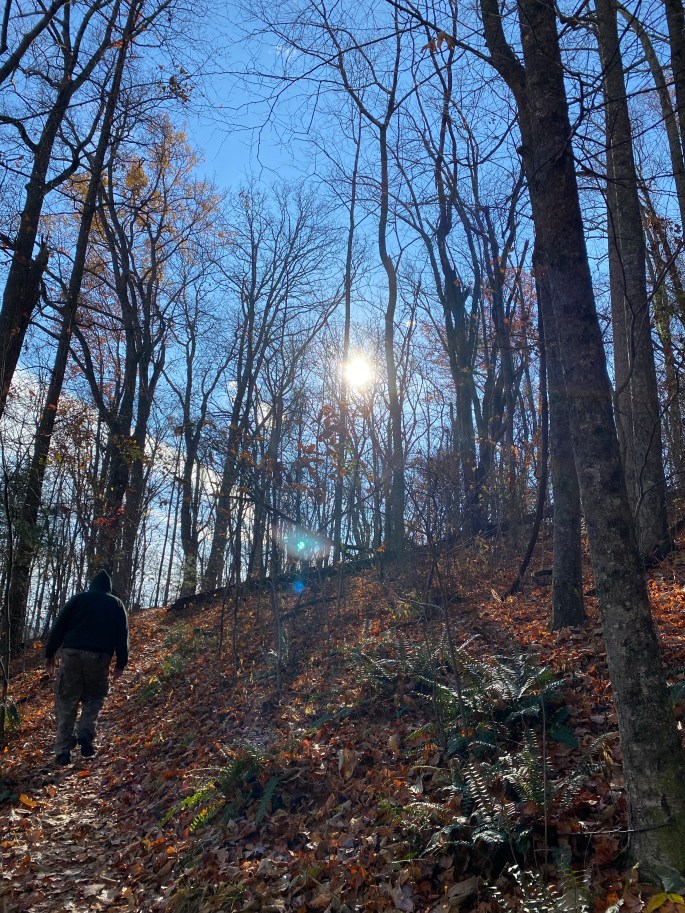
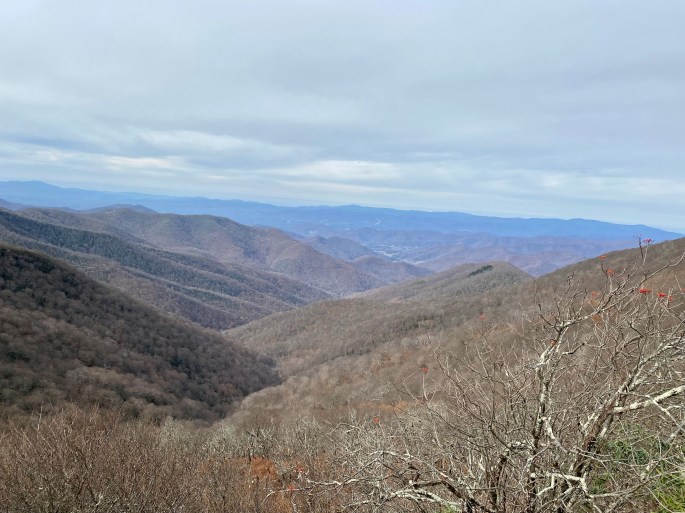
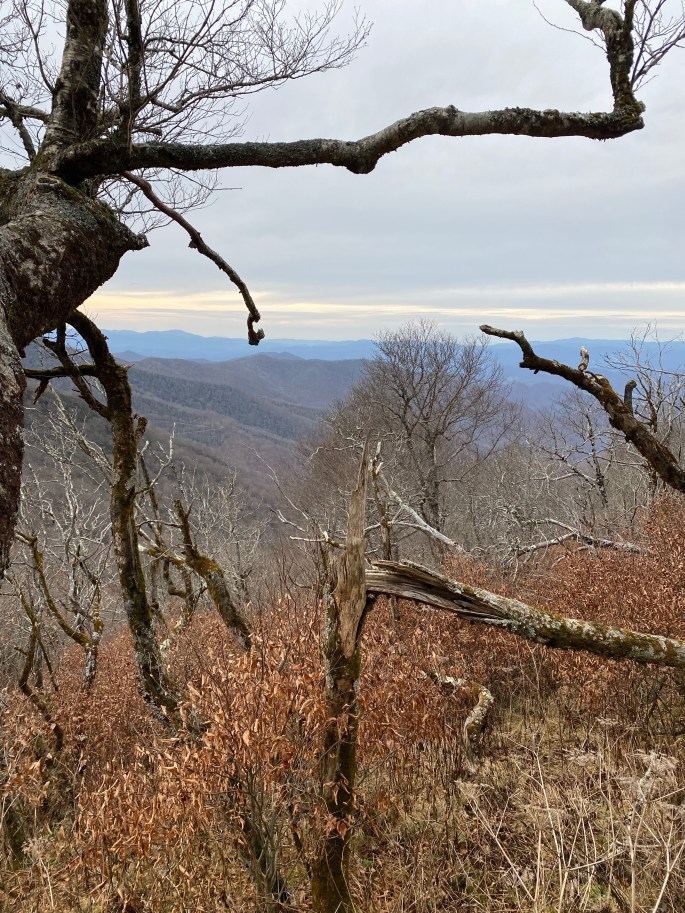
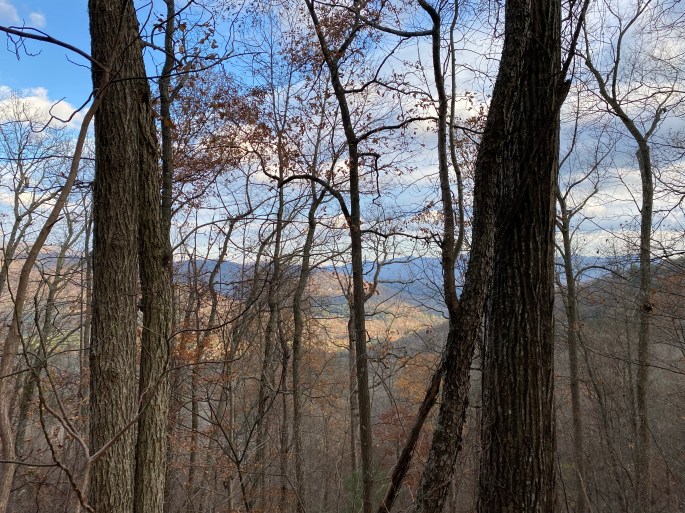
Hearts-pumping, legs moving, a brisk wind periodically scoured at our cheeks as John, my husband, and I began our hike into the autumnal colored woods just outside of Asheville, North Carolina.  Porcelain blue skies interspersed with frothy, opaque clouds expanded above the deciduous tree line.  To our left, as we made our way along the trail, was an expansive valley enclosed by the cerulean heights of the Blueridge Mountains–a 550 mile expanse of the Appalachian Mountains.  To our right, and above our heads, was the Blueridge Ridge Parkway, but we were moving lower and lower into the gap further away from any sounds of traffic.  I couldn’t help but smile.

Sunshines from porcelain blue skies as part of the path we hike was once an old wagon road to Rattlesnake Lodge.

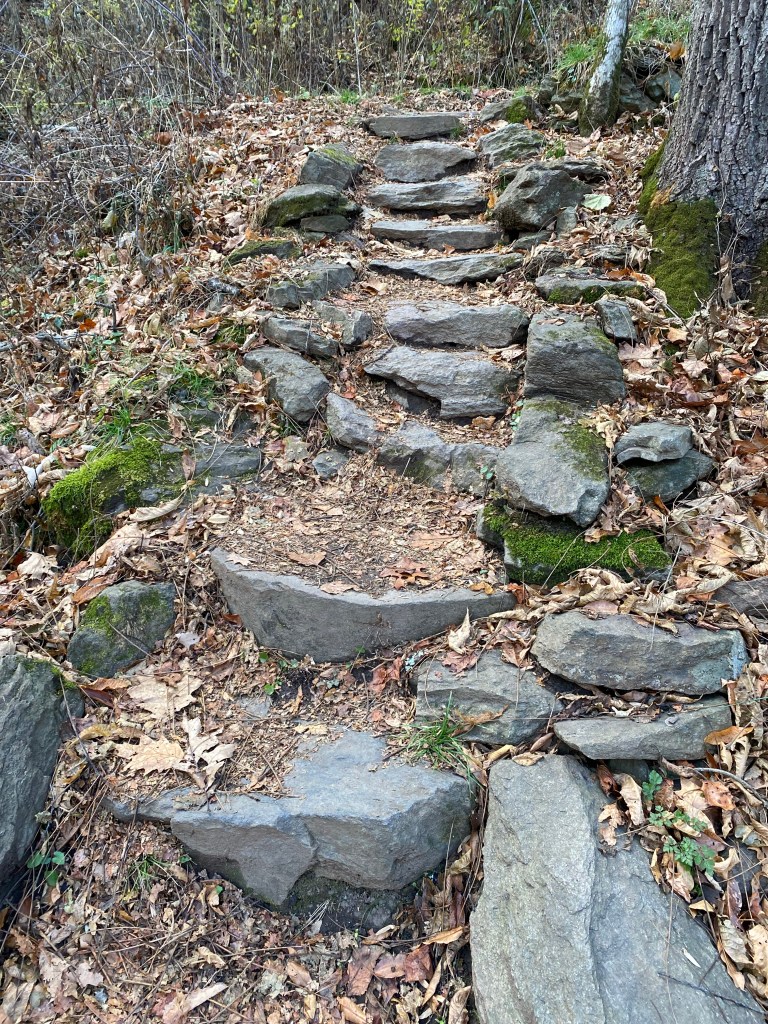
Our hike had actually begun by parking in a small lot at Craven Gap and walking across the BRP.  Fortunately, due to either the Thanksgiving holiday week or the chilly temperatures–although to John and me, the mid-40 fahrenheit range was perfect hiking temperature–the BRP wasn’t too busy, allowing us to safely cross.  We followed the stoney steps down the beginning of the trail that eased our gradual descent into the ridge-hugging trail.  Before taking a more serious turn and further drop, we crossed over a large log that had been allowed to remain across the path, but had been roughly hewed half-way down mid-way up its trunk to allow easier access across.

As we walked, my mind roamed, and my senses soaked up my surroundings: the occasional call of a bird, the scuffling of our feet along the path, the aromatic scent of damp earth, and the multi-hued assemblage of leaves in all shapes, colors, and sizes.  I was reminded of the expression, forest bathing, often used by the health and wellness industry, to encourage people to spend more time in nature.  Despite its marketing association, I was certainly benefiting from this scenic Blue Ridge immersion.

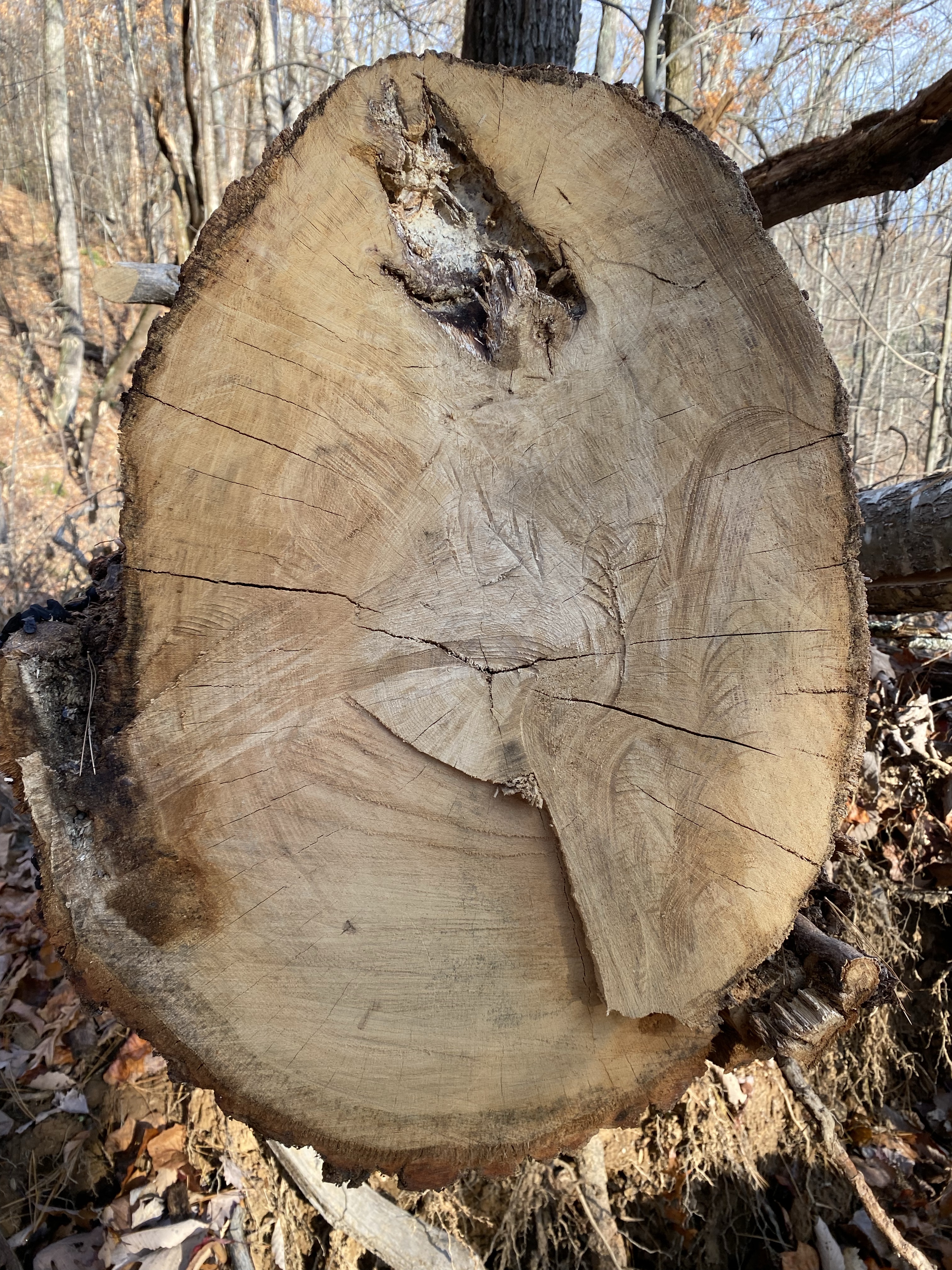
How many years had this tree stood as a witness to life?

John and I paused to admire an expansive trunk that had been a victim of ice, lightning, landslide, or other natural calamity.  We admired the seemingly countless lines of growth circling the inside of the tree’s trunk.  Its age had to be more than one hundred years old.  Running my hands across those lines, I couldn’t help but wonder how many different lives this tree had touched.  How many families, dogs, squirrels, birds, insects, and other creatures either traveled past this tree or even called it home?  It felt as if I was touching a piece of unspoken history. 

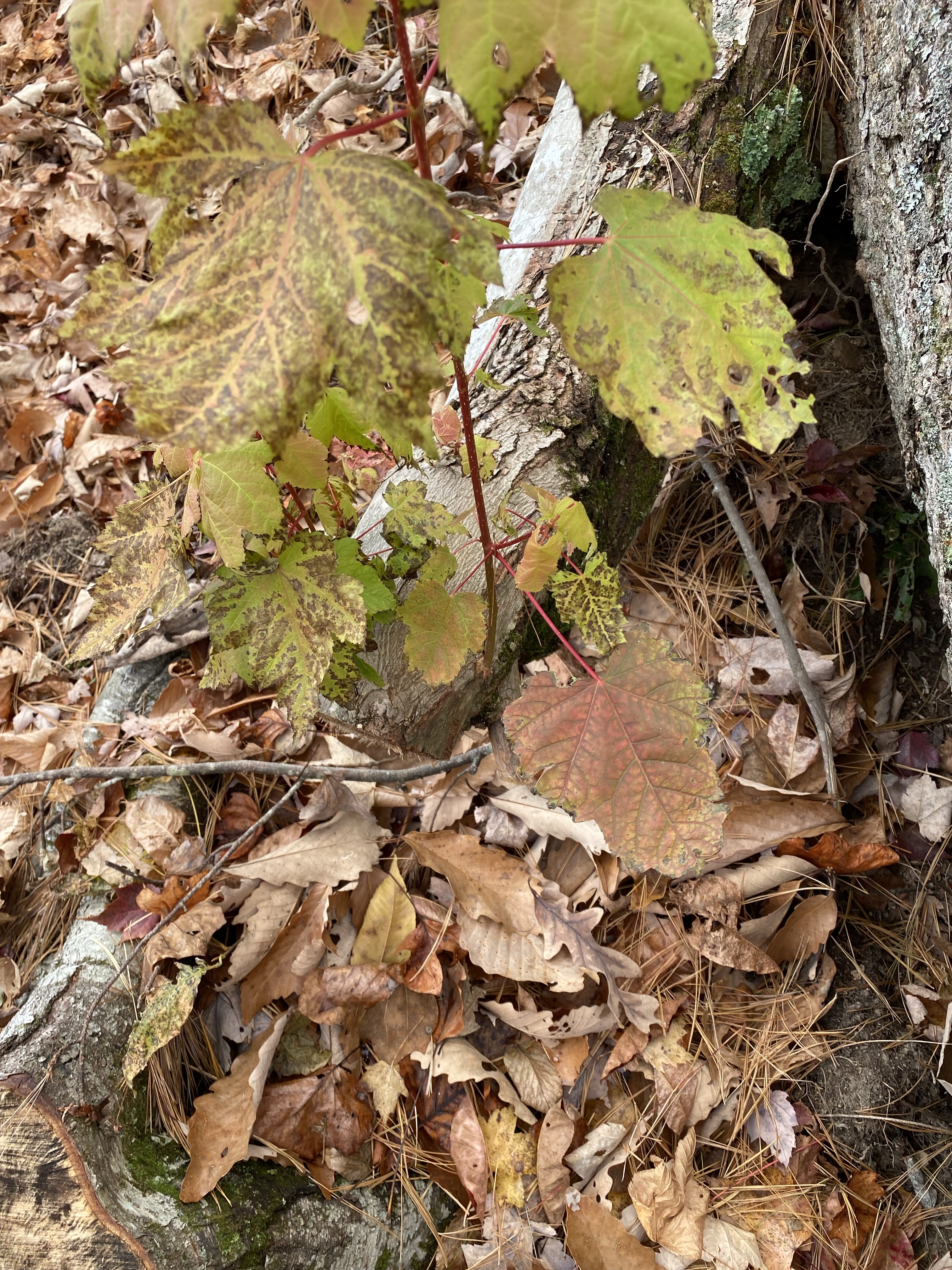
Life finds a way.

Walking deeper into the wooded crevasse, John pointed out another fallen tree.  While it was much smaller in circumference than the previous downed tree, there was a unique start of what appeared to be a maple tree attempting to grow from its trunk. The leaves on it numbered less than 20, but they were changing into their fall coats of colors.  What a marvelous example of life finding a way to continue even in the midst of decay.  

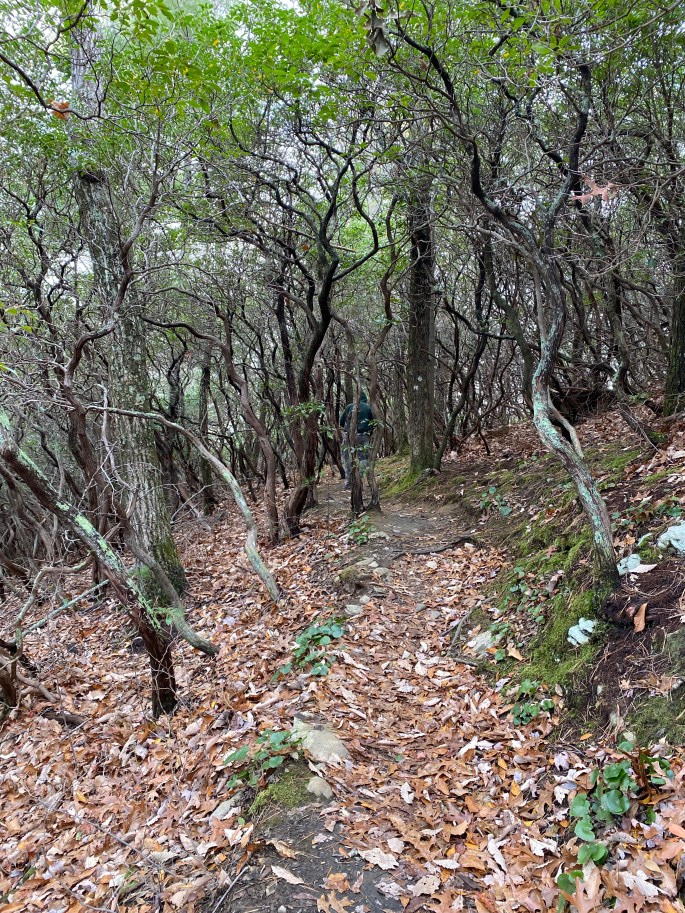
Further down the path, we entered a darkened area lined with bare trees whose branches looked like works of twisted, wire art stretching out into wandering, curving lines.  This part of the path was also carpeted with aromatic, long, thin, and tan pine needles, which was unlike any other part of the path.  It felt as if we were entering a page out of a fantasy novel, and at any moment, elves, hobbits, dwarfs, or maybe even a unicorn, would enter onto the path in front of us and send us on a discovery quest. 

Christmas green ferns sprouted here and there near large rocks sank deep into Mother Earth.  Random leaves of striated emerald green emerged from piles of tawny leaves discarded from the bondage of their former trees. Moss, in shades of pistachio, pickles, and pears blanketed rocks and trunks of trees–live and fallen.

The headwaters of a spring flowing down the mountain.

Trickling headwaters of small, silver springs melodically spilled over rocks, debris, and other forest detritus on its way down the mountain.  Oozing mud, slick and thick, filled gaps between rocks on the footpath crossing these singing waters. Sucking sounds slurped at the bottom of our hiking shoes.  Above our heads the backup singing wind, provided three-part harmony, as the layers of air moved over us, rustling the tree branches, and echoing over the Grassy Creek Valley below.

Throughout the footpath, gem-stone colored leaves dotted the path with images of once per year beauty.  Blackberry jam tinged stars, mustard-stained clusters, garnet and black tear drops, mahogany and green points, butterscotch lined with granola bristles–the hues seemingly painted on the leaves were as varied as the shapes of the leaves. It was as if God left a jigsaw puzzle scattered across the forest floor.  

Sunshines from porcelain blue skies as part of the path we hike was once an old wagon road to Rattlesnake Lodge.

At one point along the pathway, John pointed to what appeared to be a game trail.  This began a quiet discussion and subsequent ponderings of the first people who traversed this particular area.  Had they been following game trails to make their way through the dense forest and rocky mountain side?  What did the mountain look like for them?  What challenges must they have faced in order to travel over and through such rugged terrain?

Mountain to Sea Trail Marker

Later, when John and I made our way back to the home in which we were staying in Black Mountain, NC for a short getaway before Thanksgiving, I did a bit of research about the route we hiked.  We had covered over five miles moving south towards Grassy Branch, as part of the 1,200 mile long Mountain to Sea Trail that stretches across North Carolina.  This unique trail begins at Clingman’s Dome in the Great Smoky Mountains, and it ends at Jockey’s Ridge on the Outer Banks.  Having visited both places on separate trips, years apart, I had to marvel at the trail’s length and diverse terrain.

However, there was more.  A wide section of the path John and I hiked, according to early maps of the area, was part of an old road bed that appeared to be part of a bygone wagon road to Rattlesnake Lodge, a summer home built in 1904 by Dr. Chase Ambler for his family. Named for its infamous living room ceiling that was covered in rattlesnake skins, the home was eventually sold, and it is believed that the lodge was destroyed in the 1920s due to lightning strike.  However, its remains can still be visited via another hiking trail–a footpath John and I hope to travel on another trip.

It is remarkable to think about all of those who had traversed those paths before us, and it is made further marvelous to consider those whose feet first touched its ground hundreds, if not thousands, of years ago. Did those who originally made their way through the Blueridge Mountains have the same thoughts of appreciation and awe as John and I did as we hiked on that magnificent day in November?  What were their thoughts, their experiences, and their intentions?  What stories must that one path hold?  How many more stories do those mountains and all the other paths keep secret?

 There were others who blazed the way, and there will be more who follow us.  Beyond all of that, however, is the Creator, the ultimate source of all creation.  Perhaps, it is that ultimate commune–communing with nature, our ancestors, and our Creator, in addition to all the natural beauty, adornment, and seasonal dressing, that beckons me again and again into the forest, in mountains, onto wooded paths, or near peaceful bodies of water.

Hiking Forward Into the Season of Now

“There is something in October sets the gypsy blood astir: we must rise and follow her , when from every hill of flame she calls, and calls each vagabond by name.”–William Bliss

Fall is the perfect time for hiking, walking, or simply heading out-of-doors for any sort of physical activity.  The changing landscape, crisp air, and the earthy scents of damp soil, decaying plant matter, and the musky-sweet scent of drifted piles of discarded leaves invigorate the soul.  After sluggish months of heat and humidity, autumn’s sudden drop in temperature is enough to not only add bounce to our step and inspire movement, but also create stirrings within.

Fresh air has a way of plowing the mental landscape into a bucolic pasture of peace and positivity–if only for a short while.  What miraculous logic lies in this seasonal change.  It is as if, by Divine design, that fall provides us with an opportunity to elevate the spirit, boost the body, and clear the consciousness in preparation for the impending darkness of winter months.  

Walking this weekend along a favorite wooded path, I couldn’t help but follow these seasonal musings of my mind.  After a long, exceptionally challenging week, it felt both cleansing and healing to immerse myself in the quietude of nature.  No headset, nor blathering talk; no tedious tasks, nor irksome situations.  Like soaking in a warm, scented bubble bath, stepping onto the wooded path, I immediately felt submerged in the tranquil bathwater of autumn.

Before long, I was lost in the sounds of restless tree branches bouncing in the fall breeze, the humus scent of mulched debris, and the changing hues of leaves and grass.  Of course, my mind does not like to be quiet for long, and soon enough, childlike tantrums for attention interrupted my equanimity.  Without any warning, my mind began stumbling and bumbling through past events instead of anchoring to the present and peace of the surrounding natural world.

“I cannot endure to waste anything so precious as autumnal sunshine by staying in the house.”–Nathaniel Hawthorne

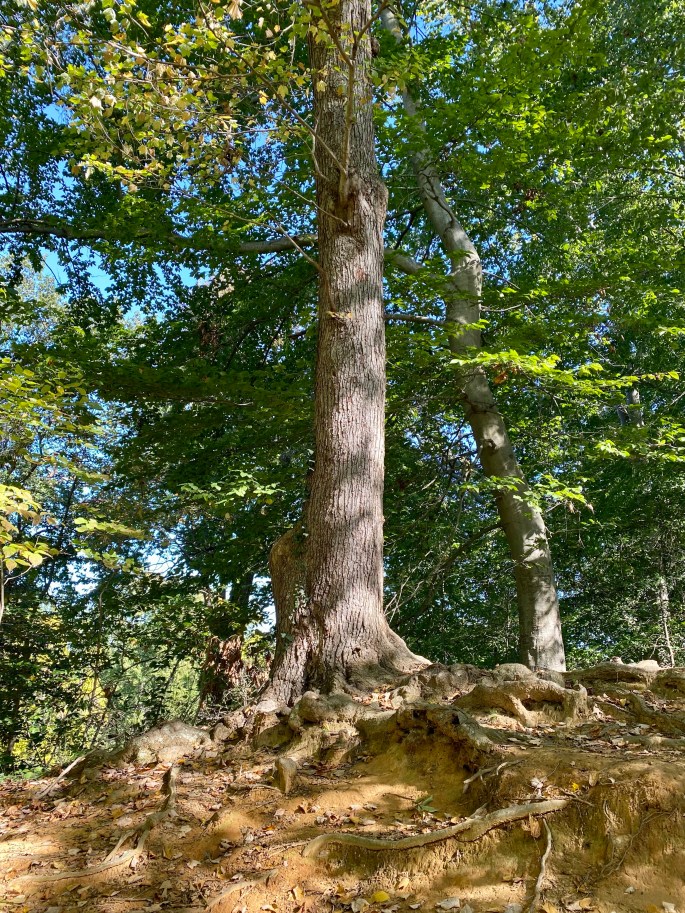
Isn’t memory a curious process?  You can forget about an event, experience, or moment. Then suddenly, as if tripping over a tree root along a smooth forest pathway, you tumble head first right into the past.  Like the long roots of trees, past episodes can be found along our life path, but often we are so focused on moving forward, we overlook those rooted memories that make up the tree of our life. This isn’t necessarily a bad thing, unless we haven’t made peace with certain past events.

In the ideal world, falterings into the past can be easily side-stepped, allowing us to keep moving ahead with ease.  Like the broken limb of a tree, these past happenings may have left us feeling as if a piece of our life was fragmented.  Sometimes, these can be small, mendable, events. Other times they are life-altering occurrences that sever ties with a friend, love, or even family member.  Divorce, death, loss of job/home/income, and other hurts can all leave us feeling as splintered as a proverbial tree trunk. 

At the time, it feels as if we will never be whole again; never able to grow, much less thrive.  However, like the maple tree that lost a major branch in a winter ice storm, our hearts, given time, do heal at the source of the break.  It may take several seasons to fully recover, but similarly to the mighty maple, once recovered, we find we can tap into the sweetness of life again.

Some triggered memories, like a fallen log across the path, can seemingly be foreseen well ahead of time.  It could be a special celebration, a family or friend gathering/reunion, a party, or other organized event.  We see it well in advance–the potential to bump into branches of our past.  Therefore, we deliberate, strategize, and plan how we will not allow ourselves to be tripped up, to fall into past, negative behaviors, or other self-defeating notions.  If we’re fortunate, we trek through the event without a single obstacle tripping us up, and we wonder why we wasted all that time worrying. At other moments, we repeatedly flounder through multiple encounters without ever gaining a steady foothold due to overthinking or over-efforting.

Other memories we stumble across can be simple knee and/or palm scrapers–just a little momentary scuffle.  They are the unforeseen life encounters in which we come face-to-face with our past.  Like that hidden rock along a regular walking path, unearthed by heavy rainfall, we’re confidently moving forward when suddenly a buried memory triggers a brief, but sharp tumble.  Momentarily we are once more wounded, lost in the temporary feeling of pain, but quickly rise, wipe off the proverbial dirt of the past, and keep hiking on.

Then there are those rocky memories.  Those awkward, cringe-worthy moments of impulse, illogical, or otherwise preposterous life hiccups.  Like the rough part of a well-worn rocky path, all lives have these times. In fact, these memories, when randomly run across, can sometimes leave you doubled over with laughter as you fumble through recollections of those bumpy reminiscences. 

Aw, the path of life, like any good hike in the woods, is full of thorny patches, toppling obstructions, and adversarial pitfalls.  Nonetheless, our trails also meander through lush fields of golden moments, wound ‘round bends of colorful times, and over walkways of unexpected joy and bliss.  Through the seasons of memories, all the good and the bad, our life paths keep moving us forward. Thrusting us into the now of our lives. 

Clearing my mind, and shaking out its detritus of the past, I once more returned to the present moment of the autumnal walk. I felt the air brush softly against my cheek and watched a chubby, round-eyed raccoon waddle away from me. I left the past behind on that trail, decided to let the future take of itself, and began to once more soak up the present moment of the fall goodness, one glorious step at a time.  Oh, how I love October.

“I’m so glad we live in a world where there are Octobers.”–L. C. Montgomery, Anne of the Green Gables

Craggy Life Lessons

“Yonder were the mountains:  The sunlight revealed their tiny heads and wide shoulders, craggy and purple, with small black trees, delicate as eyelashes, on their slopes.”–Paul Theroux 

It never ceases to amaze me the ways in which life can manage to not only survive, but thrive.  As an experienced educator, I have worked with countless students, including those who come from the most anemic of backgrounds–impoverished in experiences, impoverished in love/emotional support, or impoverished financially.  Miraculously, many of those disadvantaged students still manage to not only survive their hardscrabble circumstances, but also find enough sustenance outside of their own rocky homelife for growth.  These kids are like camels–able to soak up enough goodness and nutrition from one or two smaller sources, such as a church, school, sports, and so forth, that allow them to flourish through long stints of inadequate and insubstantial living situations.

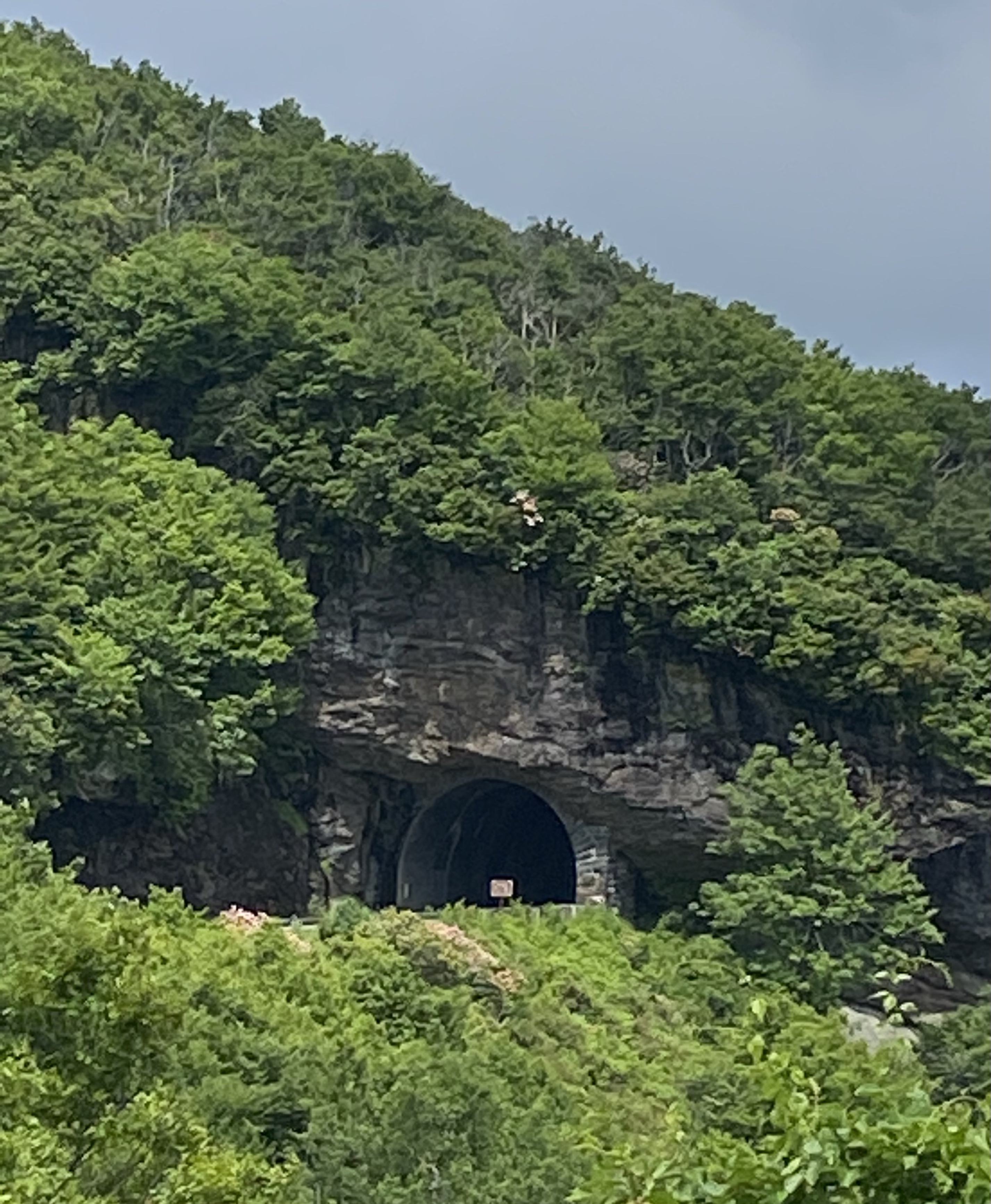
Craggy Pinnacle, elevation 5,817′, can be driven through via Blue Ridge Parkway tunnel or hiked to the top for epic 360 degree views.

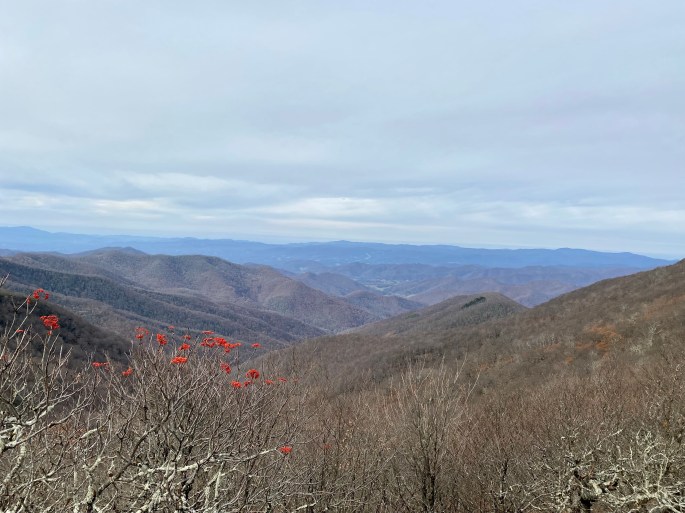
Visiting Craggy Gardens, north of Asheville, NC and just off the Blue Ridge Parkway, I was reminded that not only can humans survive ramshackle environments, but also a wide array of plant life can likewise do the same. Craggy Gardens are part of the Great Craggy Mountains, or “the Craggies,” which is a rock-filled area of approximately 194 square miles in the Blue Ridge Mountains that border the Black Mountains.  The highest point of the Craggies is Craggy Dome rising at an elevation of 6,105 feet, but there are several other high peaks of interest in this unique geological and botanical habitat, including Craggy Pinnacle, through which visitors can drive and/or hike to the top along the scenic BRP. 

A few ancient symmetrical trees dot the bald of Craggy Flats which is mostly covered in grasses, shrubs, rocks, and few flowering plants.

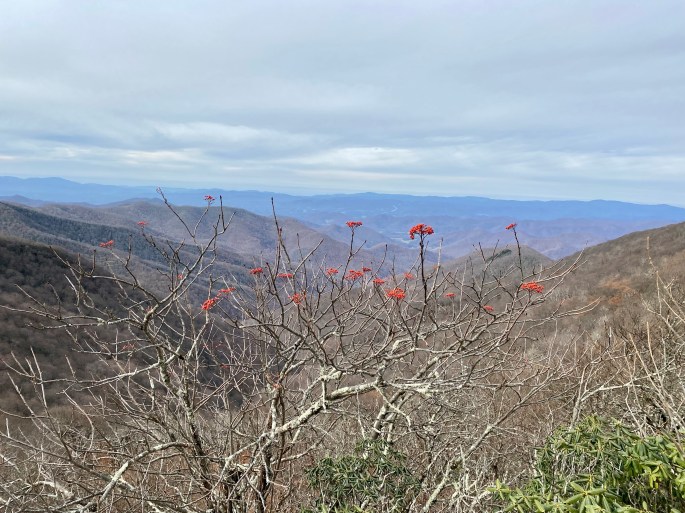
The Great Craggy Mountains are known for its exposed rocky, aka “craggy,” surfaces, high altitudes with spectacular vistas, and an elevated bald known for its rhododendrons, mountain laurel, flame azalea, other colorful wildflowers, and heath.  There is both a picnic area at milepost 367.6 and the Craggy Garden Visitor’s Center at milepost 264.4; plus, there are several hiking trails for a variety of hiking skill levels. Additionally, the Craggy Mountains are known for its twisted trees, May-apple flowers, Turkscap lilies, autumnal leaf colors, the clusters of red berries that decorate the Ash trees in the fall, and its rare and endangered plant life.  In fact, according to the Blue Ridge Parkway Guide, “Craggy Gardens has been recognized by the state of North Carolina as a Natural Heritage Area and has also been recommended as a National Natural Landmark.”

During our visit to the Craggy Mountains, John, my husband, and I stopped at the Craggy Garden Visitor Center.  At an elevation of 5,497 feet, the air was significantly cooler than when we left town, hovering in the high 50s.  Inside the visitor center, a warm fire blazed in a wood burning stove in a far corner with several rocking chairs around its hearth.  Outside, posted along the front wall, was a map of the different hiking trails in the vicinity.  

The Craggy Pinnacle Tunnel as seen from the Craggy Garden Visitor Center.

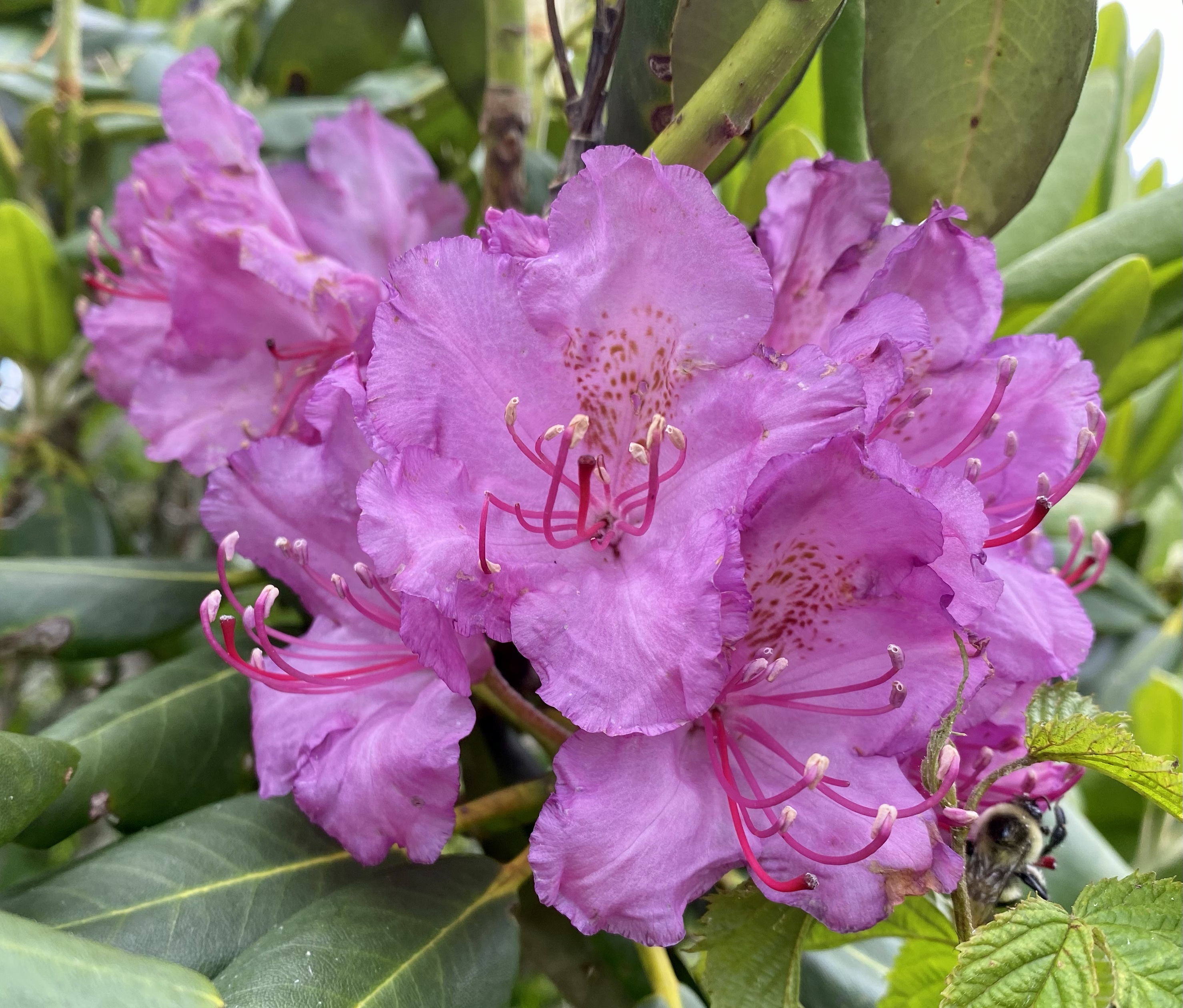
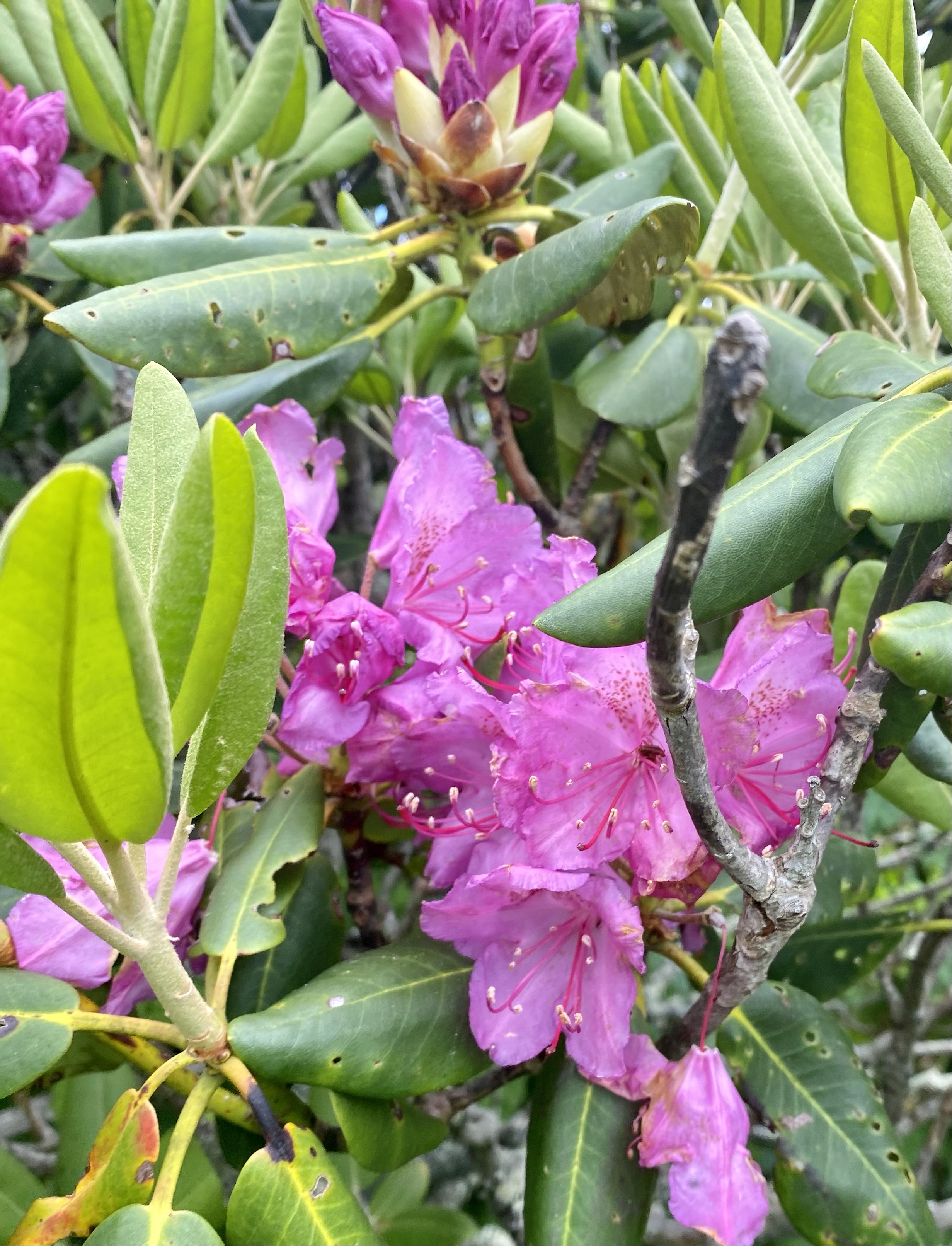
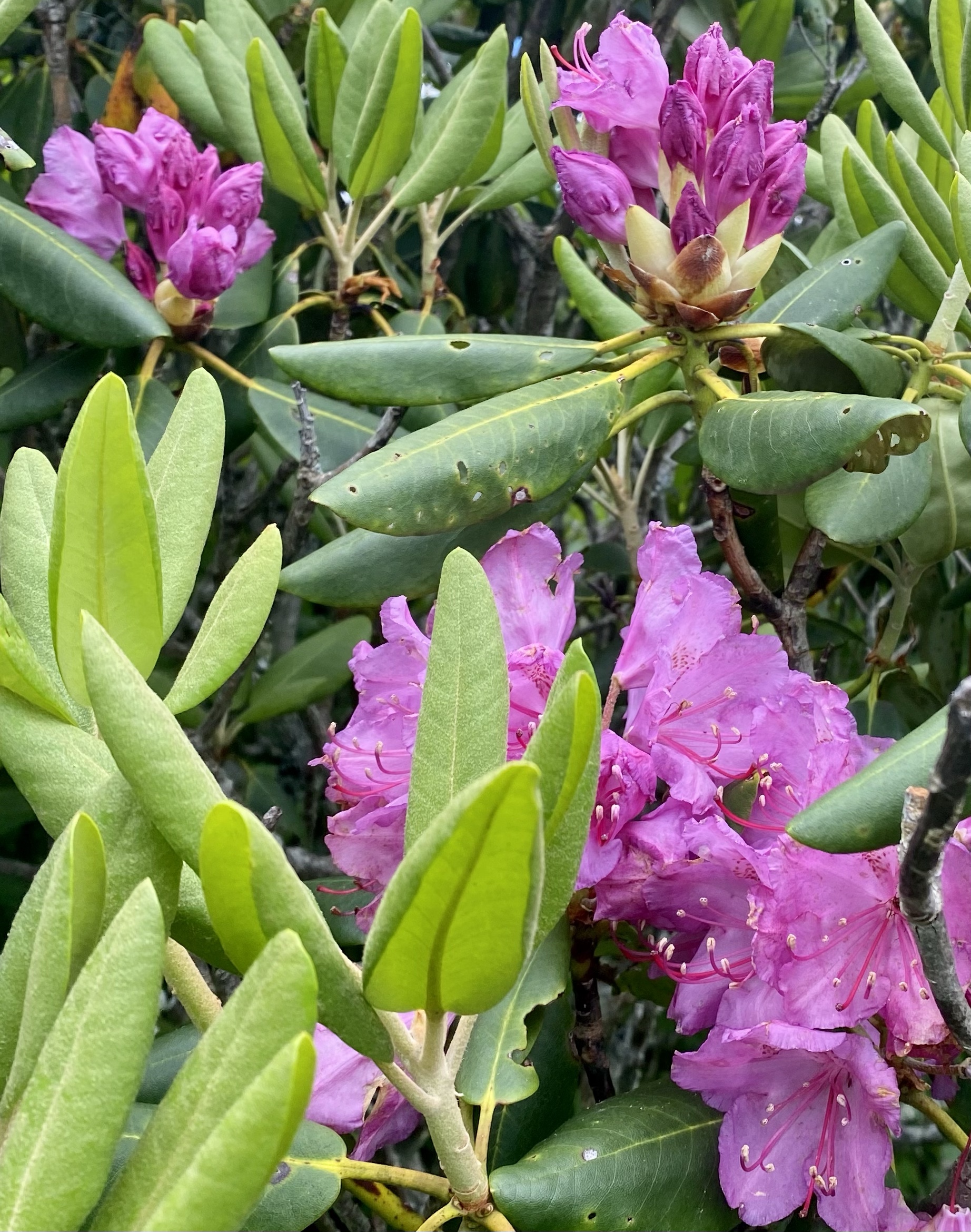
As newbies, we decided our first hiking experience in the Craggies should be uphill along Craggy Gardens Trail which led to the Craggy Flats at an elevation of 5,892 feet.  Since our visit was in late June, we were hoping to see the renowned Catawba rhododendron; however, John had already been warned that these infamous flowering pink and purple shrubs had come and gone with little fanfare.  Nonetheless, I was not to be deterred in my enthusiasm for the potential adventure that awaited along the trail.

Craggy Garden Trail

  “Nature is a book of many pages and each page tells a fascinating story to him who learns her language. Our fertile valleys and craggy mountains recite an epic poem of geologic conflicts. The starry sky reveals gigantic suns and space and time without end.”–A. E. Douglass

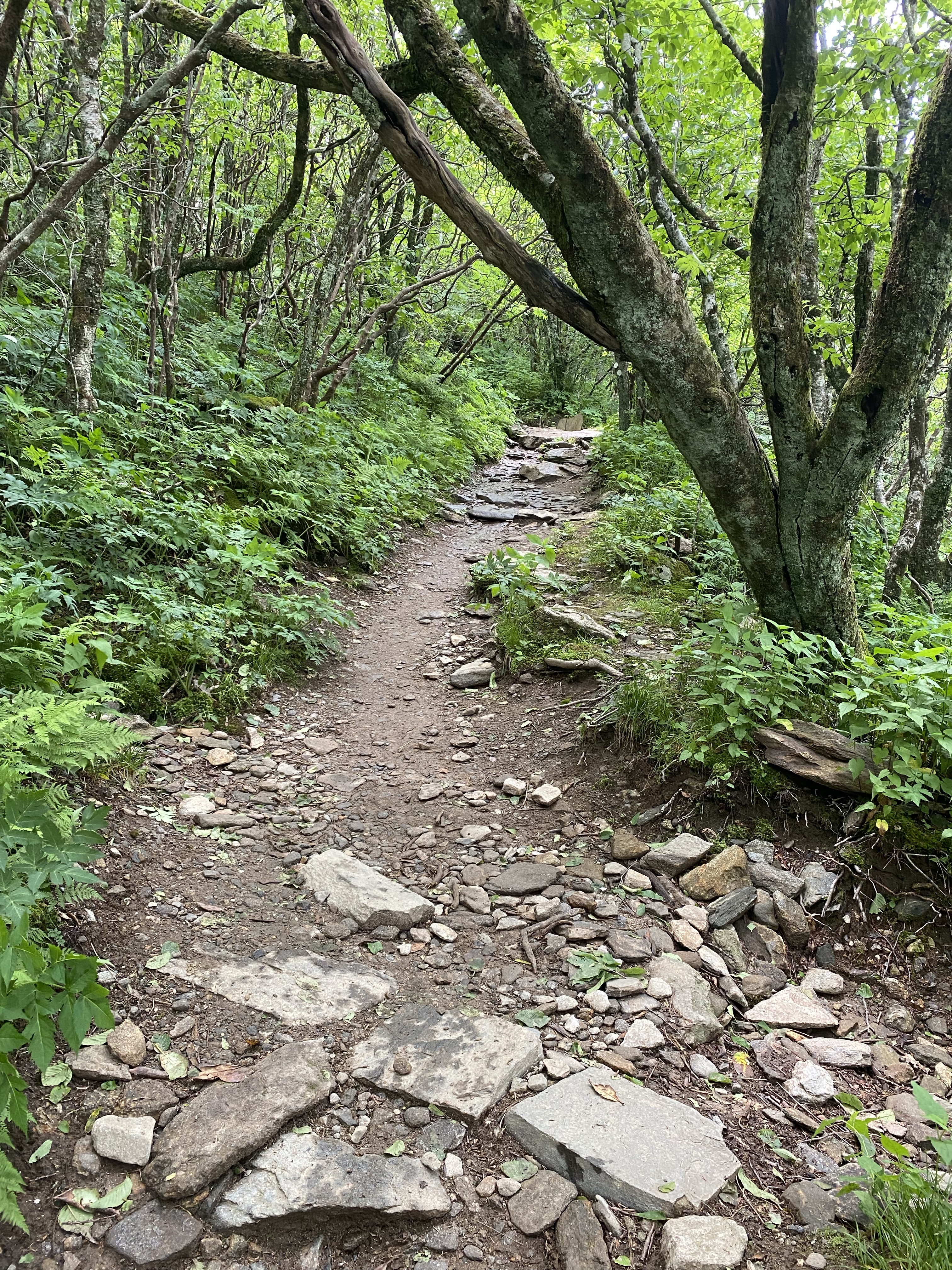
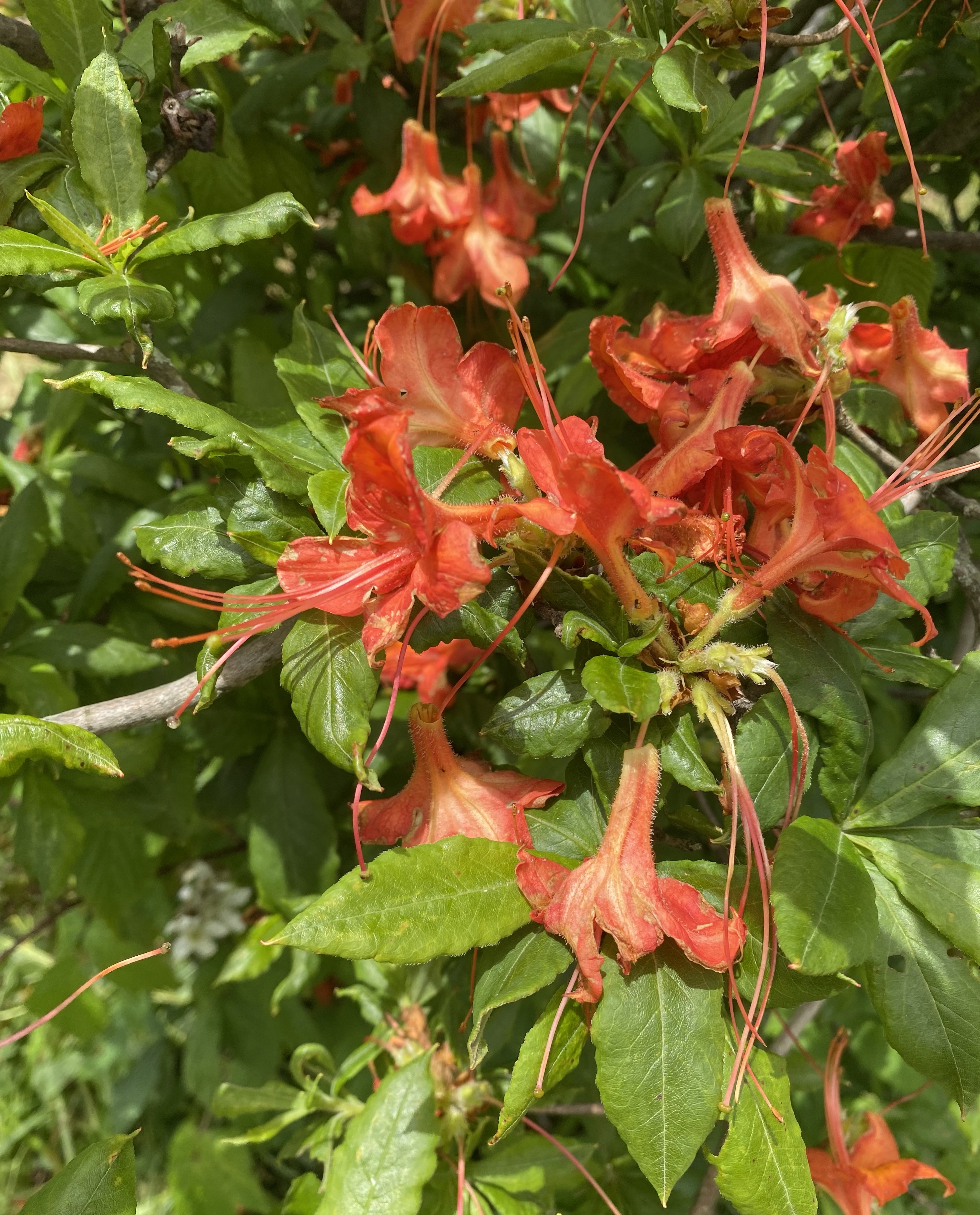
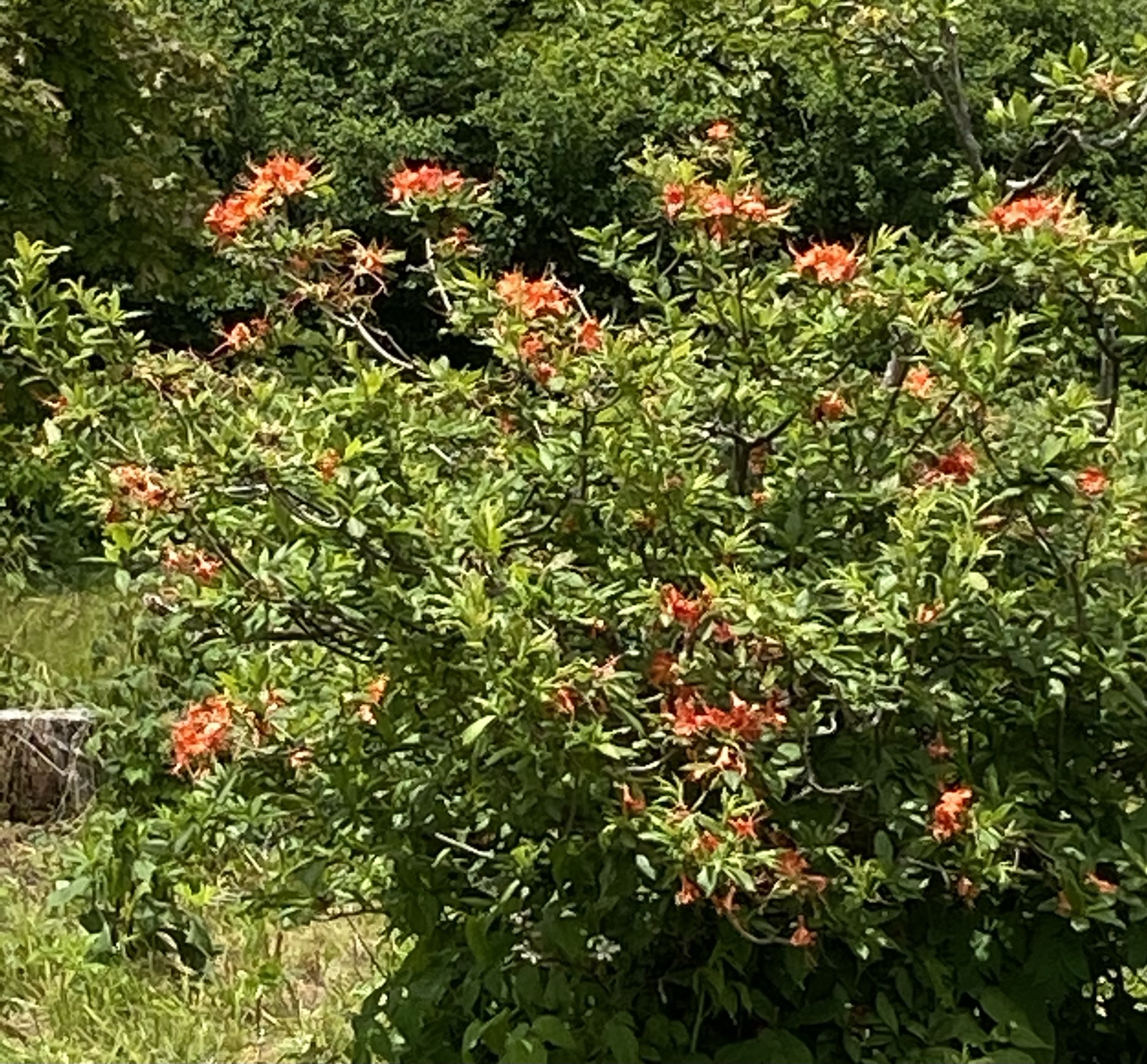
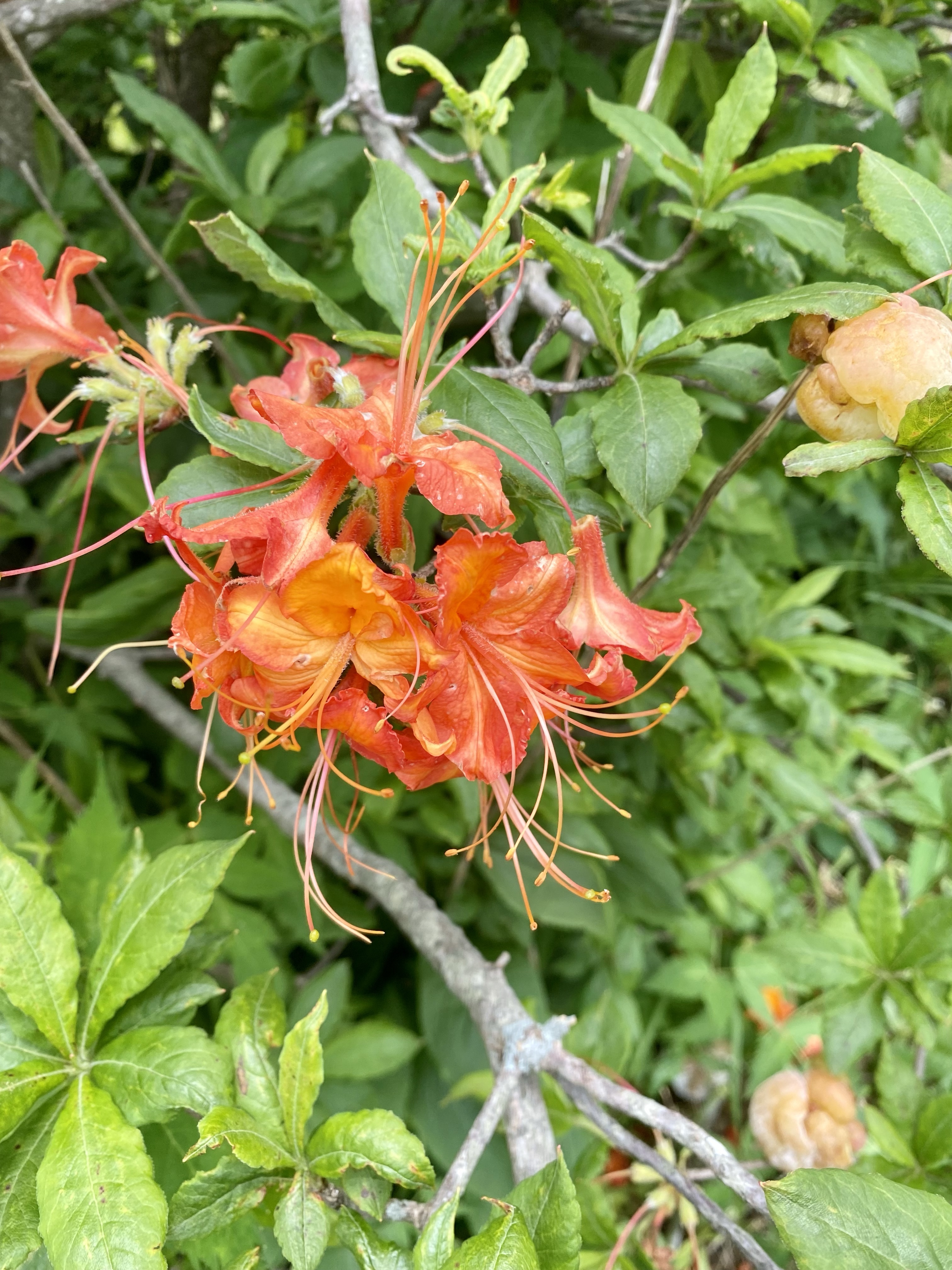
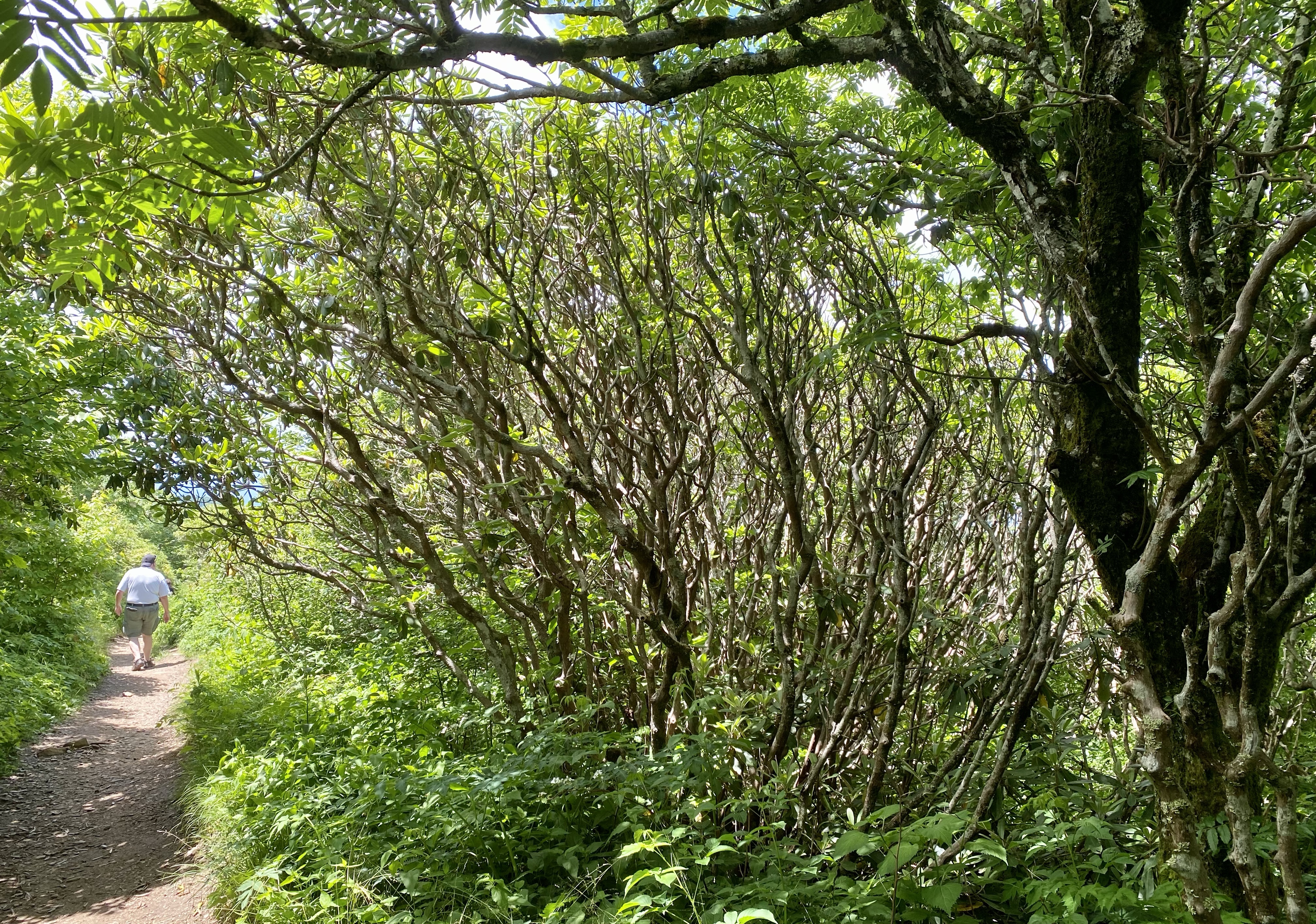
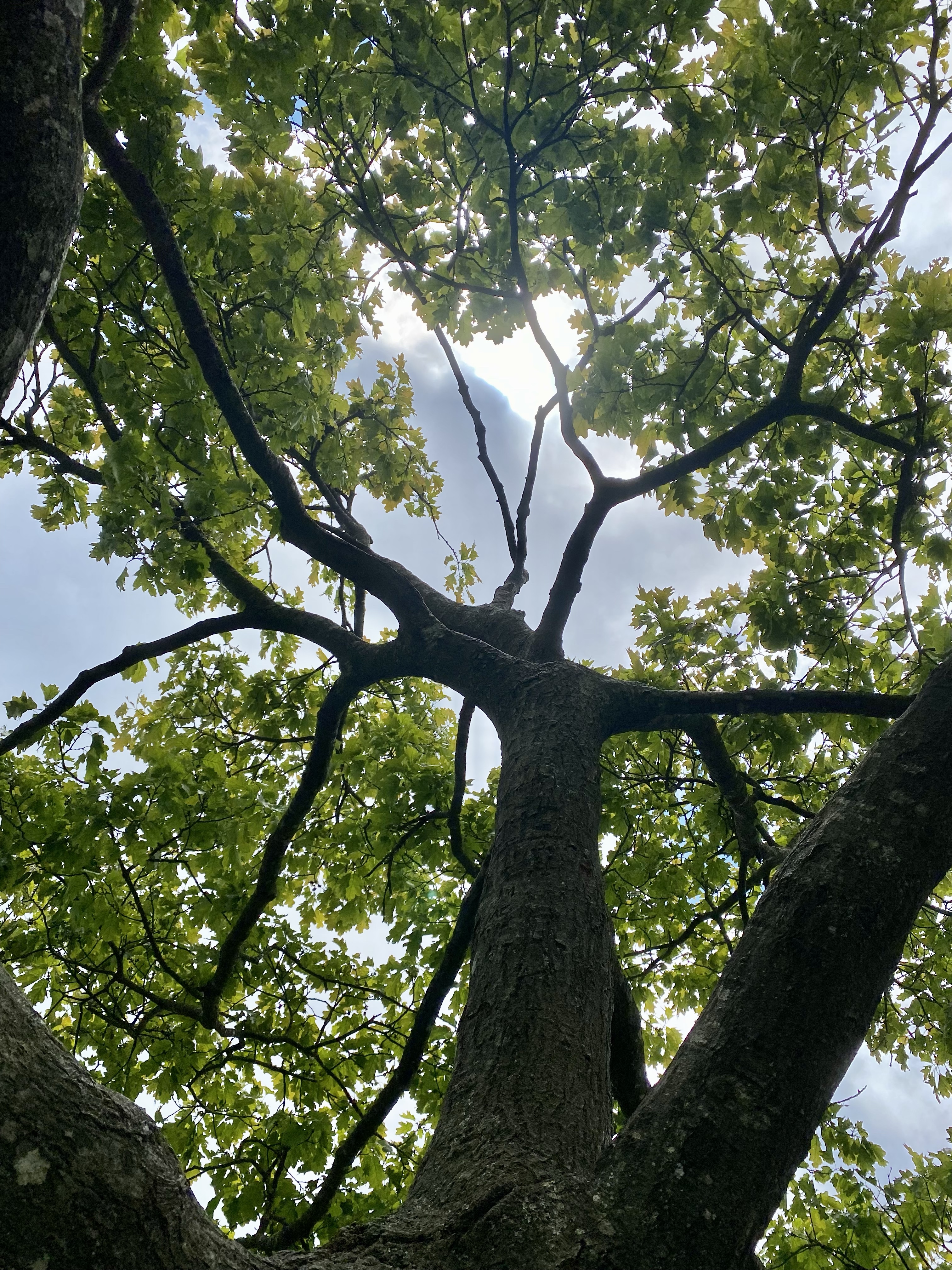
Trekking along the path, twisted trees and shrubs formed tattered tunnels through which we traversed higher into the altitude until we reached Craggy Flats.  This area is signified by a large shelter with paths going uphill to either side of the shelter.  Once at the top, the views were spectacular, allowing us to see layer upon layer of mountain line overlaid with cloud shadows.  While as a general rule, a bald is considered a treeless area, the Great Craggy Mountains’ bald was not entirely treeless as there were a few beauties with their broad limbs fanned out in perfect symmetry.  Mostly, the bald was covered with small flowers, grasses, dirt paths, and a few shrubs that were ablaze with orange flowers–a type of rodondendum called a flame azalea due to its flamboyant flowers.  

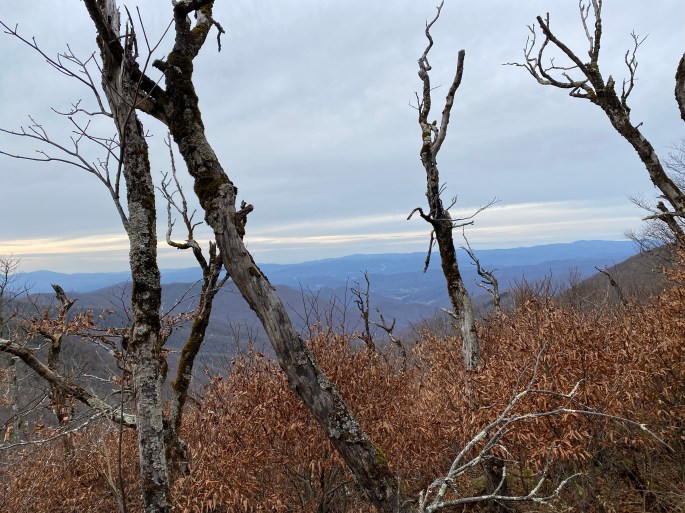
Vantage point of tree limbs

The Craggy Gardens Trail is often identified as one of the busiest trails in the area, but on the day/time John and I chose to explore it, there weren’t too many other hikers.  The hikers we did encounter were friendly and helpful, offering different pieces of advice for locating specific scenery.  In fact, one pair of sisters that I met during my exploration of the bald area remembered I was from Ohio and referred to me by shouting “Ohio!” whenever they found something of interest along the trail they thought I would want to see. 

The search for the Catawba Rhododendrone

On the way down from the bald, at the base of the flat, was a rhododendron upon whose backside (the back of the official Craggy Gardens Trail) was covered in purple Catawba rhododendron blooms!  I trotted back up the off-the-beaten-path to the top bald where the two sisters were admiring the flame azalea. I recalled they were looking for Catawba blossoms to photograph, and I wanted them to know about the hidden purple gems I had just found.  Excitedly, I led them down the hill while they readied their cameras; then I headed back to a shelter area where John was resting.

It seemed that while I was helping the sisters find rhododendron, John had made an acquaintance with a hungry squirrel that had discovered an abandoned banana peel.  It was quite the scene as John attempted to move in closer with his camera to video the squirrel. Meanwhile, the squirrel entertained John with its acrobatic attempts to eat the inside of the peel. It was certainly an “appealing” sight!

After the squirrely entertainment, John and I meandered down the hill to a gazebo overlooking the mountainside.  If we had chosen to continue further downhill, we would have traveled into the official Craggy Garden Picnic Area, but since we still wanted to visit Mount Mitchell, a bit further down the BRP, we chose to retrace our steps back to the visitor center.

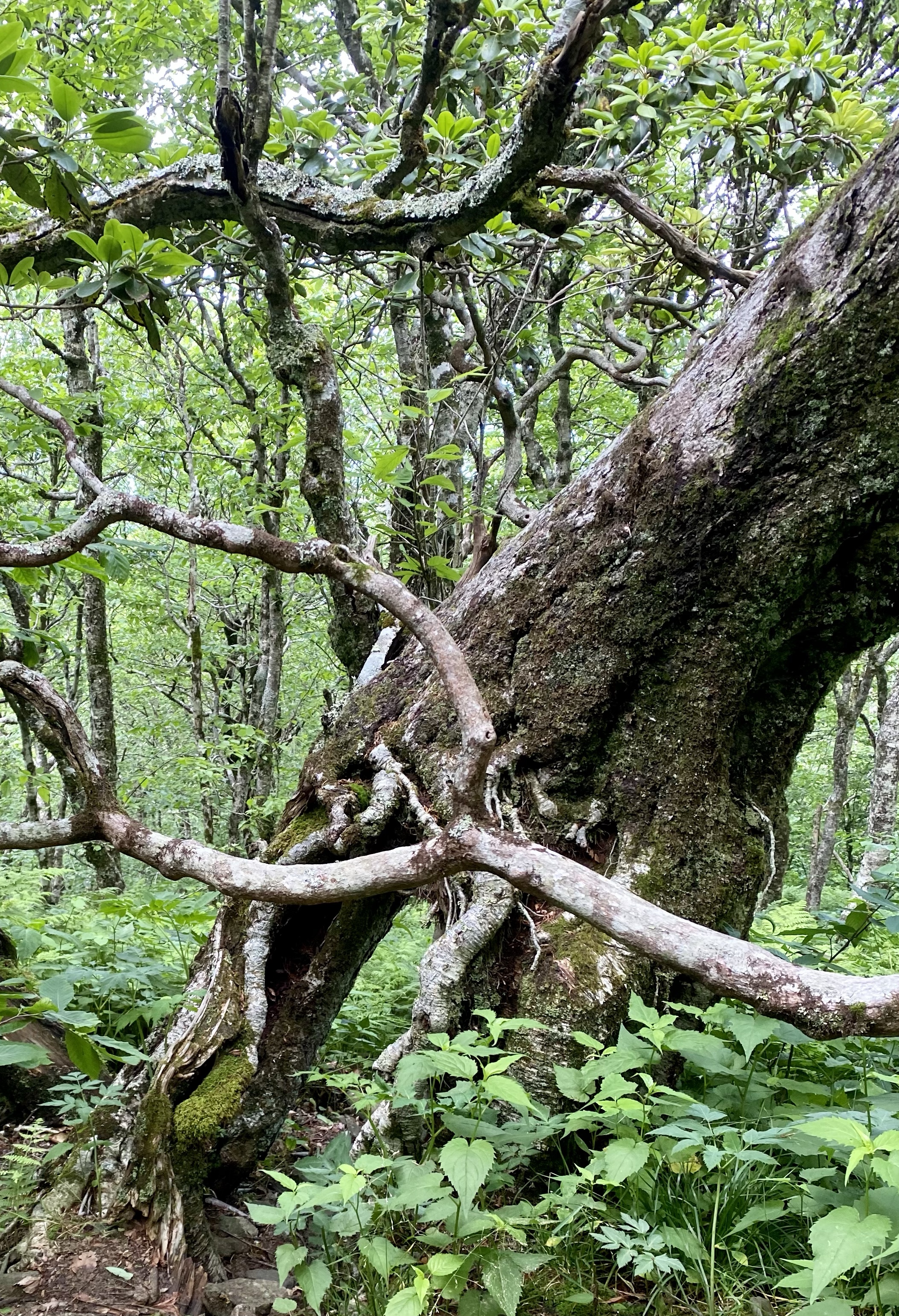
Walking back allowed me to more thoughtfully take in the gnarled trees and shrubs with roots winding over, around, and sometimes even through the rocky and rugged terrain.  Several roots appeared to have a large hole at the base of their trunks, and they still seemed to support life.  In fact, it was a marvel that any life at all could be supported in such a craggy area.

It further occurred to me that most lives–at some point in time–become rocky, rough, and even craggy, like several of my past students’ lives.  The miracle is that no matter how broken and stony life becomes for any of us, we have the ability to survive. Like the Craggy Mountain plants whose limbs twist this way and that to find the sunlight while their roots lengthen and stretch to find nourishment and water, we too, through faith and perseverance, can find ways to stretch, grow, and resiliently root into sources of life-sustaining nourishment.  Even if our roots develop a hole of loss, we can still rise up like the trees, shrubs, and other plant life of the Great Craggy Mountains.