
Always wanting more? Try looking inward instead

Photo by Jensen R on Pexels.com

“Things are just that–things.  They don’t make us who we are.  They make us look better on the outside, even when we’re hollow on the inside.  They’re an illusion–the shiny objects that distract us from the really important things.”–Chelle Bliss 

Trapped in the Wax 🕯️

  The day had been cool and cloudy, and I had come home with a bit of fresh produce, including a variety of fruit.  Given the weather, I thought it seemed like the perfect time to light the fragrant candle, a gift from a student.  I did not think about the fact that fresh fruit, during certain times of the year, is often accompanied by tiny little flying insects.

There they were, though, tiny bugs trapped in the melted wax because they had been drawn to the light of the candle.  Their attraction to shiny things had caused their demise in the end.  I wonder what they sensed the candle light could offer them–if they felt the candle’s sparkling flame would somehow improve their lives.  

Did those bugs confuse the candlelight with sunlight or moonlight?  Did they think it would help them navigate through the otherwise overcast day?  Perhaps, those pests confused the candlelight with bright flowers that nourish insects with nectar?  Were they trying to escape some unseen predator and sense that the bright light would blind their predator from seeing them.  Then again, maybe they were the predators looking for a meal, or were they looking for a suitable mate?  
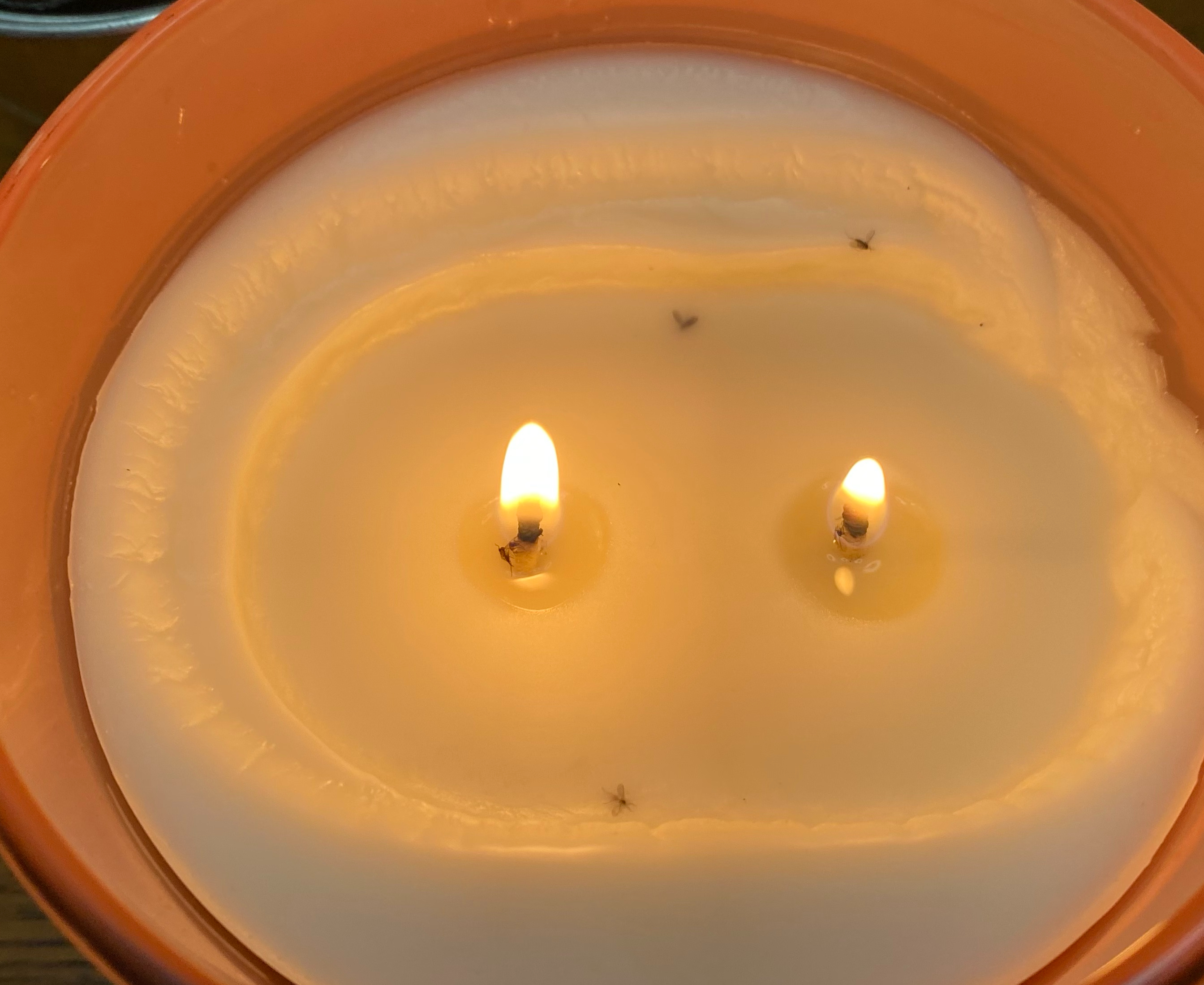
They were so attracted to the flames, they lost their way and became stuck in the melted wax.

Attracted to the Brilliance ✨

Even science doesn’t seem to know the exact reasons bugs are drawn to light, and it made me wonder why humans, likewise, are drawn to shiny things?  Big vehicles, the bigger and shinier the better.  Large homes filled with sparkling appliances, a multitude of large screens, and a variety of other collections, depending upon a person’s interests and means. Closets gorged on a feast of clothes and shoes. Not to mention the cultural attitude about prosperity: those with means have been “blessed.” (I’m not sure what that means for the rest of us.) 

Then there is the shininess of beauty, youth, and attractiveness, especially since our culture tends to place more value on the looks of youth over the experience and wisdom that comes with aging. Cosmetic injections, surgeries, and implants to change looks and/or stave off aging, no matter your gender.  Your face should be blemish-free–no saggy eyes, no droopy chin, and while a few laugh lines are acceptable on men, wrinkles are not so appealing on women. 

Photo by Jack Sparrow on Pexels.com

Window shopping 🛍️

We are attracted to the nectar of status, wealth, and beauty, and yet we are often as trapped as those insects, feeling as if what we have of it is not enough.  This drives us into a perpetual cycle of needing more things, needing more investments, needing more dressings to make us look shiny to others. We are window shopping the lives of others to see if our own shop window is as appealing and competitive-looking as our peers.

Do we, like insects, confuse the brilliance of status and/or youthful beauty with the light of inner peace that can help shine a path through life?  Do we sense that when times get overcast, the more things we have, the better able we will be to find our way through dark times?  Could our obsession with window dressings come from our own insatiable, ego-driven hunger?  Perhaps, we have an unspoken belief that we can protect ourselves from bad things happening to us if we attain a certain income status.  Then again, maybe these objects make us feel/seem more attractive to others, in the hope of luring some attention.

Photo by Pixabay on Pexels.com

Is it enough? 🤔

While I recognize that the words I write sound hyper-critical, please know that I am asking these same questions of myself.  Should I do more to “improve” my looks? Is my career enough at this point in my life? Afterall, I am choosing to remain an educator, rather than administrator, because I still find intrinsic value in what I do, even though it doesn’t have the same monetary value? 

My husband and I have a home, and it may not be the best.  But, it is dry, safe, and warm.  We have food on the table, and we certainly have clothes–albeit not necessarily the most up-to-date styles. At the end of my life, I often remind myself, I can’t take any of it with me.  Nonetheless, I also know I must save for those end-of-life years, for which I hope/think we are doing enough, but is it?  

Why do I sometimes feel I am not doing enough? Why do I feel like I should do more? Am I trapped in the wax of envy?  Am I trapped in the wax of our cultural beliefs of worth and value? Am I the only one with these questions/feelings? I don’t think so.

Photo by Arthur Brognoli on Pexels.com

Self-Reflection 🙏

I’ve concluded that it is only through self-reflection, contemplation, and meditative prayer that the answers are found.  What is right for me, may not be right for others.  By examining our attachments, we can begin to ask ourselves what things/what part of our lives are bringing us true fulfillment, and which are merely fueling our ego?  When we look deeply, we see that many, if not most of our things, paint an illusion of happiness for us.  

Much of what we have externally is impermanent.  Even our relationships, as much as we value them–have a limited time.  Therefore, through introspection, we can perhaps see the importance of living more fully in the present moment, completing our responsibilities without attaching to specific outcomes (because we really aren’t in as much control as we think we are) and surrendering the outcomes of our efforts to a higher power. 

By shifting our focus more frequently to our internal world, we can begin to detach more from our external trappings. Then, we can learn to dampen the sounds of our ego’s attachments to societal values, and discover richness and fulfillment that comes from fostering our own spiritual growth and the expanding sense of peace that comes with it. The more we shift to an internal focus, the less trapped we feel, and the more we can enjoy and appreciate this gift of living. 

Photo by James Wheeler on Pexels.com

Detaching from the illusions our attachments create

“Time is an illusion.  Lunchtime doubly so.–Douglas Adams

A coworker and I were talking after school one day about plans for the work week, the schedule, and what we were planning.  It was a brief exchange as he was preparing to leave for the day, and I was settling into grading papers. 

 I jokingly said, as he headed out of the door, “You know it’s all an illusion.  We can plan all we want, but who knows how it will really unfold.”  

Photo by energepic.com on Pexels.com

This made us both laugh and shake our heads because we both know as teachers no matter how much thought, effort, and time we put into planning for our students, things rarely go as predicted.  Schedules can change and/or students’ level of attention, understanding, or even behavior can completely alter our well–intended plans, creating the need to pivot quickly, adapt and modify plans.

Sure enough, the very next day, plans for the week had changed.  We rethought and restructured our plans.  The next day arrived with another change.  Before long, how the week actually turned out was very different from how it was originally conceived.

Photo by Kobe – on Pexels.com

I share this, not as a point of negativity, but rather as a point of reality.  Rarely does life unfold as we plan for it. Nonetheless, I still tend to cling to schedules and routines since I am not naturally organized.  However, I have learned to embrace the word “flux” over the years. In fact, I am realizing that my attachment to “how things should be” is all just one big illusion.

Furthermore, my illusion is due to my attachment to “control,” which, in fact, is also an illusion.  The desire for control is a gripping cycle for many of us.  Our attachment to ______ (how things were, how they should be, or how they could be) reflects our wish for control.  It also helps to create the illusion that we will be happy if everything “goes according to plans.”  However, when things don’t go as we had hoped, we can feel downhearted or disappointed. 

Photo by Ketut Subiyanto on Pexels.com

However, it’s not just schedules and outcomes to which we attach ourselves.  We can attach ourselves to friends, family, groups, teams, circumstances, positions, things and so forth.  We begin to identify with those people, those groups, those situations, and so forth.  Even our address becomes a point of attachment.  

Unfortunately, these attachments can sometimes allow stress to enter our lives when/if we lose one of these identifiers, things, or when circumstances change.  Sometimes a change can become nearly debilitating due to our grief and sense of loss.  Other times, our anxiety spirals out of control from the pressure we feel as a result of expectations caused by our attachments.

Photo by Suzy Hazelwood on Pexels.com

Again, none of this is inherently bad.  We are all human beings, experiencing the very human need for belonging, validation, and contribution.  However, it might be helpful to also allow for some amount of detachment as we move through life.  This is because when we attempt to only hold on to what feels familiar and comfortable, we can sometimes prevent ourselves from experiencing a newfound way to experience joy and happiness.  Therefore, it is worth remembering the importance of letting go, or at the very least, holding loosely, in order to allow for new, unimagined life experiences.

I was thinking more about this attachment-control-illusion cycle as I went for my weekly long run one morning along the tree lined paths of Ritter park. Jogging alongside those noble limbed sentinels, I realized that trees are not attached to one another.  Instead, they function independently, even though they are part of a collective landscape.  

Photo by Artur Roman on Pexels.com

Numerous dogs, people, and other creatures move in all directions under the shelter of the branches.  Chunky squirrels and round robins flit up, down, and all around outstretched tree arms. All the while, neither do the trees attach their identity to or make plans for any of this, nor do they try to control it.

The trees did not seek my attention, and yet I couldn’t help but notice them.  Neither did the trees seem to need my praise or approval.  Nonetheless, my mind kept marveling at the way their leaves were beginning to bud while at the same time birds were creating neighborhoods of  nestled nests. Likewise, without being attached to a certain group, I could still identify the various types of trees. 

The park trees, like all trees, are independently rooted in the soil and work with the circumstances in which they find themselves planted.  They do not, per se, have expectations or plans for how their growing season should unfold.  In fact, they can’t even count on predictable circumstances from year to year, so changeable is the weather.  

Photo by Mauriciooliveira109 on Pexels.com

No matter their situation, and without any attachments or attempts to control, trees still manage to contribute. They act as a refuge for food and shelter for birds and other animals/insects.  During warmer months, their well-dressed branches provide cooling shade for people and creatures alike. Trees even offer opportunities for raucous fun as squirrels chase one another all around their trunks and branches while birds play hide and seek, singing songs of tidings.

Near the end of my jog, the sun began to burn through the tapestry of clouds.  As the glistening light gradually emerged, the overcast dullness gave way.  Instantly, I felt less encumbered by tired legs, and a renewed vigor filled my heart and lungs.  

Photo by Adam Kontor on Pexels.com

I was then reminded of how cloudy our thinking can become when we fall prey to our self-inflicted illusions. Furthermore, I began to see that there is no pushing through attachments and the illusions our attachments create.  Rather, it is a practice we must intentionally pursue through patience, perseverance, and most of all gentleness, which is not easy. However, the more we can recognize when we are attaching, the more often we may be better able to lightly detach. 

Personally, I still like predictable plans as well as my coworker.  Nonetheless, similarly to the way the sunlight lifted my spirits as I jogged, I know that the more we can detach or grasp less to our so-called illusory plans/attachments, the more we can experience unexpected, and dare I say, unplanned, moments of joy! 

Photo by Sebastian Arie Voortman on Pexels.com