Running with Purpose: The Charleston Distance Classic and My Marathon Journey

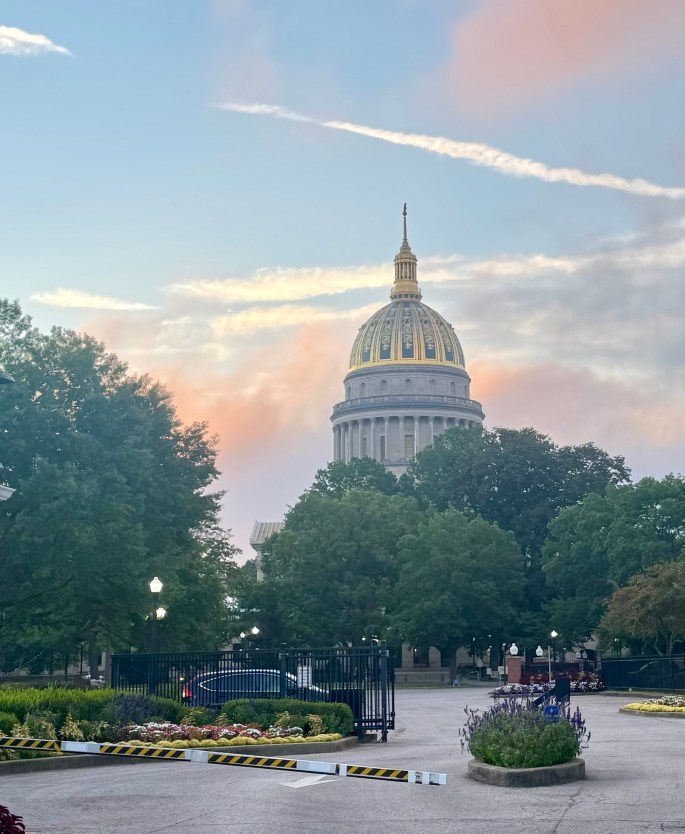
The West Virginia State Capitol building with a golden dome, surrounded by trees and a pastel sky at dawn.
The CDC starts in front of the state capitol of WV.

A Quote to Carry Me to the Start

Dean Karnazes is often credited with saying, “Run when you can, walk if you have to, crawl if you must; just never give up.” His words echoed in my mind while I was experiencing a case of collywobbles as my family and I drove to Charleston, WV, in the predawn hours of Labor Day weekend. Only weeks earlier, I had decided I had built enough base fitness to run the Charleston Distance Classic (CDC), “America’s 15-miler.”

A joyful runner in a race, wearing a white shirt with a 13.1 badge and black shorts, excitedly posing with a water bottle while making a peace sign.
Ready to run the CDC!

Returning to the Classic After Ten Years

It had been more than ten years since I last ran it. In my previous two runs of the CDC, the weather was formidable, with the typical August heat wave bringing high heat and humidity. In fact, it wasn’t unusual to see runners collapse on the course—or cross the finish line only to collapse into the arms of medics from heat exhaustion.

Two women pose together smiling in front of a large government building with a golden dome, one wearing a race bib and athletic attire while the other is in casual sportswear.
My daughter was texting me messages of support throughout the race, so Siri could read them to me in my ear as I ran.

How Running Has Changed for Me

Life was different ten years ago. Besides being younger, I was fairly new to running and relied heavily on veteran runners for guidance. On one hand, I was fortunate to have others with whom to train; on the other hand, I didn’t yet have the aerobic base they had built over years. Plus, when I started running, I gave up strength and flexibility exercises, which I now know would have helped me. Instead, I focused on keeping up with others and hitting the weekly mileage goals.

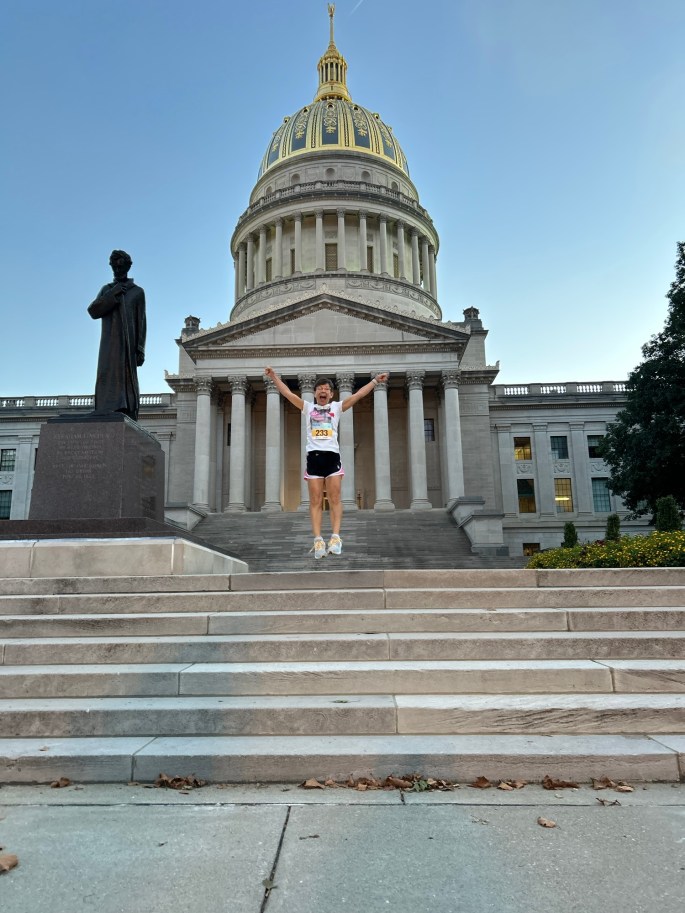
Runner stands on a swing-shaped structure in front of the West Virginia State Capitol, smiling and wearing a race bib, under a clear sky.
Ready to swing into action.

Building Balance and Training for a MarathoN

Over the past decade, I’ve taken breaks from running—first from burnout, when I missed other forms of exercise. I rotated through strength training, yoga, walking, and cycling, always circling back to running. The pandemic brought running back to the forefront, as gyms and studios were closed.

Since then—and one major surgery later—I’ve learned to build a more balanced approach to exercise that includes a wide array of modalities, running among them. I exercise now for the joy of movement, as well as overall wellness. Still, I enjoy the discipline of a challenge. This year, in honor of another decade milestone, I’m training for the Marshall University Marathon (MUM)—the full 26.2 miles. Rather than follow a standard 16-week plan, I began in January, gradually building my aerobic base.
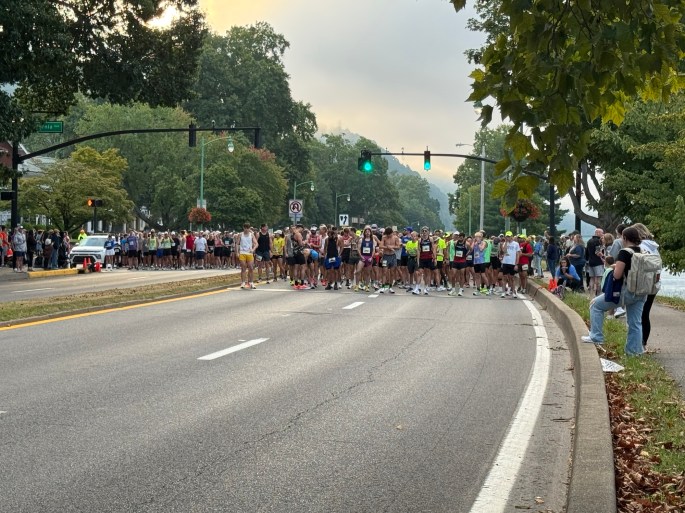
Runners lined up at the starting line of a race on a road, with traffic lights and spectators in the background.
The starting line for the CDC.

A Perfect Day to Race

It was this extended training that gave me confidence to run the CDC again. In addition, the weather worked in my favor. Temperatures were in the 50s when the race began in front of the state capitol. Running along the Kanawha River in the first mile, runners quickly spread out as paces varied.
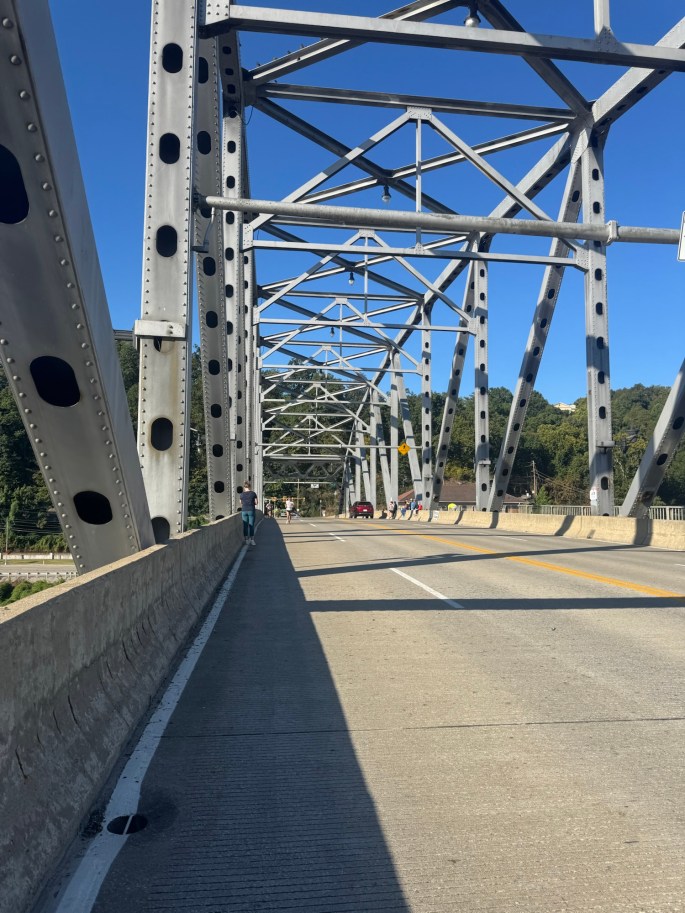
View of a bridge with steel beams and a roadway, featuring a few pedestrians in the distance.
The South Side bridge, which runners crossed twice–near mile 3 and again at mile 8.

“Capital Hill PUnishment” and the Course Challenge

Before long, we crossed the South Side Bridge and began the long trudge up Corridor G, aptly nicknamed “Capital Hill Punishment”—two miles of climbing. As if that weren’t enough, the course then wound through three hilly miles of Charleston’s South Hills neighborhoods. By the time we returned to the South Side Bridge, eight brutal miles were behind us. The final seven were mostly flat, except for one last incline near the end—just when our legs were good and toasted.

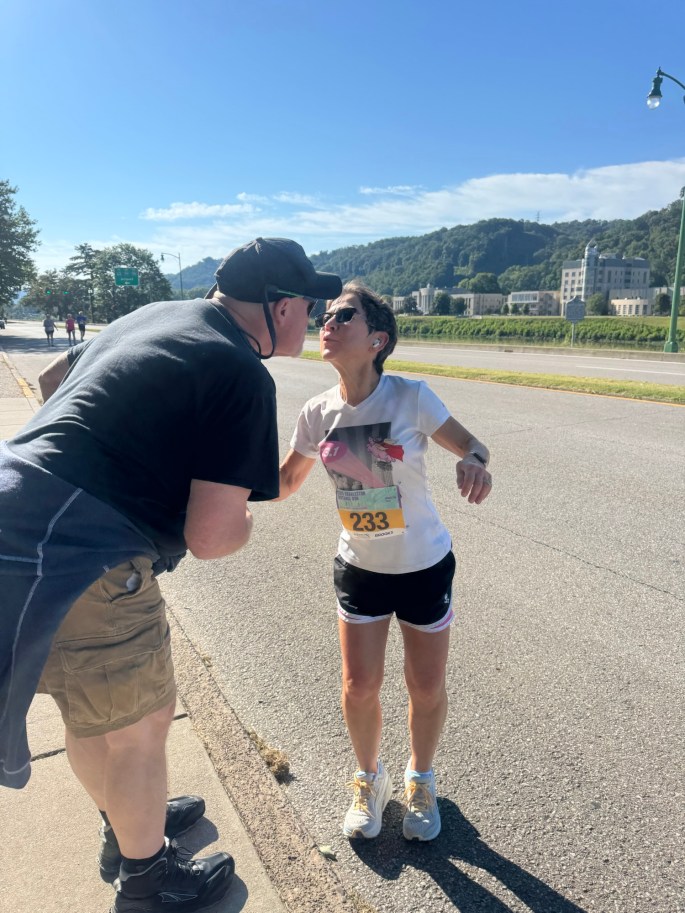
My Cheer Squad: John and Maddie

The CDC is a great spectator race, and I was lucky to have my husband, John, and daughter, Maddie, there. They were tireless cheerleaders, walking all over Charleston to encourage me. At the start, Maddie urged me on with excitement. At mile eight, as I crossed the South Side Bridge for the second time, she even ran alongside me for a short stretch, offering encouragement.

Between miles 11 and 12, they found me again, cheering and taking my empty handheld water bottle—by then more of an annoyance than a help. At Laidley Field, Maddie’s voice carried as soon as I stepped onto the track, her shouts of encouragement giving me the final push.
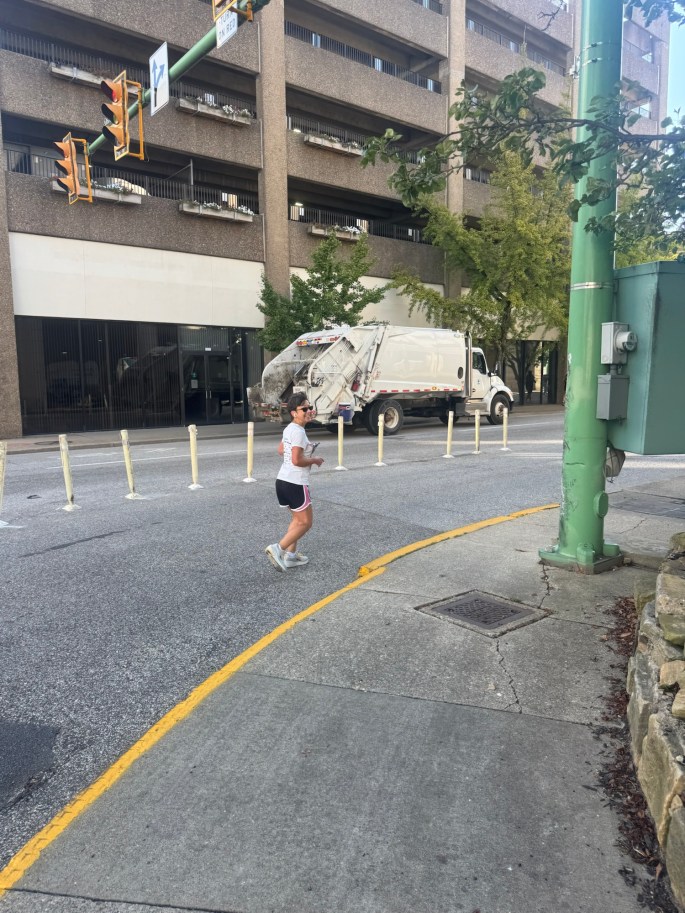
A person jogging on a city street with a garbage truck parked nearby and a multi-story building in the background.
This was mile 8. Afterwards, there was mostly flat course, EXCEPT for a last incline during the very last mile before the finish line. UGH!

Lessons from the Endless Last Mile

Honestly, that last mile seemed endless, and I learned a powerful lesson: even the final mile is still a mile long. My mental discipline slipped, and the fortitude that carried me there begged for rest. I grew whiny and irritable, which only amplified the aches and pains I had managed to ignore until then. It reminded me of my reaction in the last mile of a half marathon I ran this past spring in Asheville, NC.

Scenic view of a riverbank with lush greenery, walking path, and a bridge in the distance under a clear blue sky.
The beautiful Kanawha River that flows through Charleston, WV.

Strengthening My Fortitude

That last mile taught me what I must carry into the last weeks of marathon training: when the long runs get longest, I need to focus on strengthening my fortitude—especially at the very end. This, for me, is the hardest part. I try to follow the advice of Olympian Jeff Galloway (who is also credited with establishing the “Run-Walk-Run” method) to smile at each mile marker—since smiling releases those feel-good chemicals and helps relax the body. He also suggests repeating a mantra or power word. Perhaps I need to lean into this more.

Remembering My “Why”

I also need to remind myself of my “why” when the going gets tough. With the MUM, I hope to raise awareness for Branches Domestic Violence Shelter. Branches provides emergency shelter, legal assistance, counseling, case management, and even meal delivery for domestic violence survivors. Their work saves lives. If my miles can help encourage even a few people to support them, that will mean as much to me as crossing the finish line.
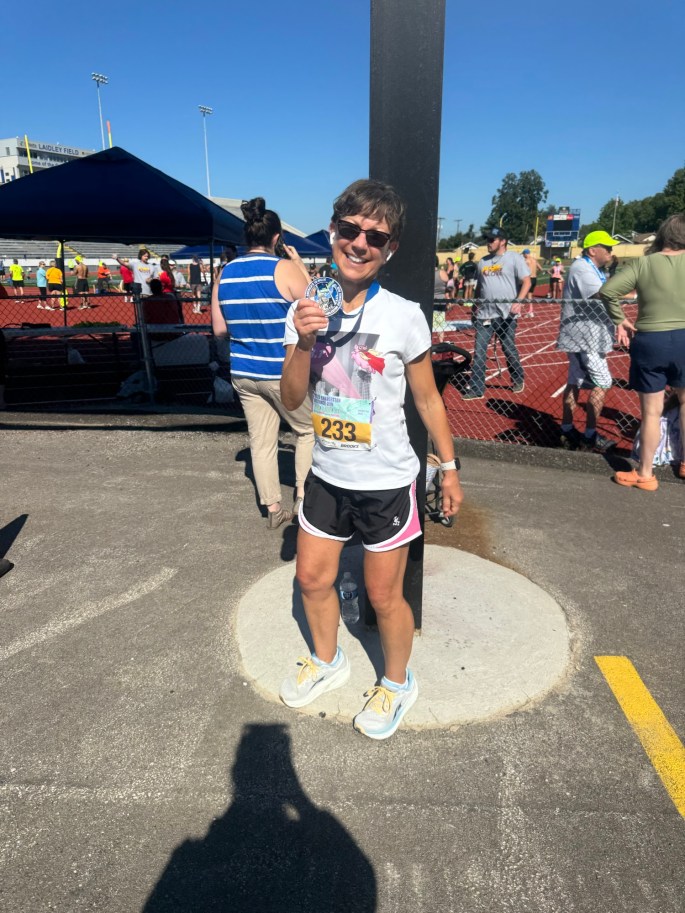
A smiling woman holding a medal, wearing athletic clothing, stands next to a post in a race finish area, with a crowd and tents in the background.
Feeling so grateful for my family, love, and support at the end of the CDC.

Running Differently, Running with Gratitude

Ten years later, I run differently. I take walk breaks when needed, and I’m grateful to still have my health. Running gives me energy, provides structure, and fills me with joy and purpose. Not every run is great, but each mile contributes to my community by keeping me connected to local races and to my own mental, physical, and spiritual well-being. Running also pulls me outdoors, connecting me with the Creator and with the delight of each season.

Never Give Up—In Running or in Life

Running the CDC reinforced the lesson of never giving up. I may be entering a new decade, but that doesn’t mean I have to give up striving for new goals—even if it means crawling to achieve them. Perhaps I’ll see you at the MUM. If not, I hope you’ll create your own journey. Either way, I invite you to celebrate with me—by supporting Branches or by committing to your own goal. Adjust as you must, but never give up. Step by step, with fortitude, tenacity, and a few deep breaths, you can do it.

A running event starting line with an inflatable arch labeled 'Appalachian Timing Group' on a red track, set against a clear blue sky and distant hills.
Never give up! You can cross whatever finish line in life you need to cross!

The Dance of Time: Snowflakes and Memories

“Like snowflakes your words fall silent, but my heart still hears your voice.”–Angie Weiland Crosby

Photo by Skyler Ewing on Pexels.com

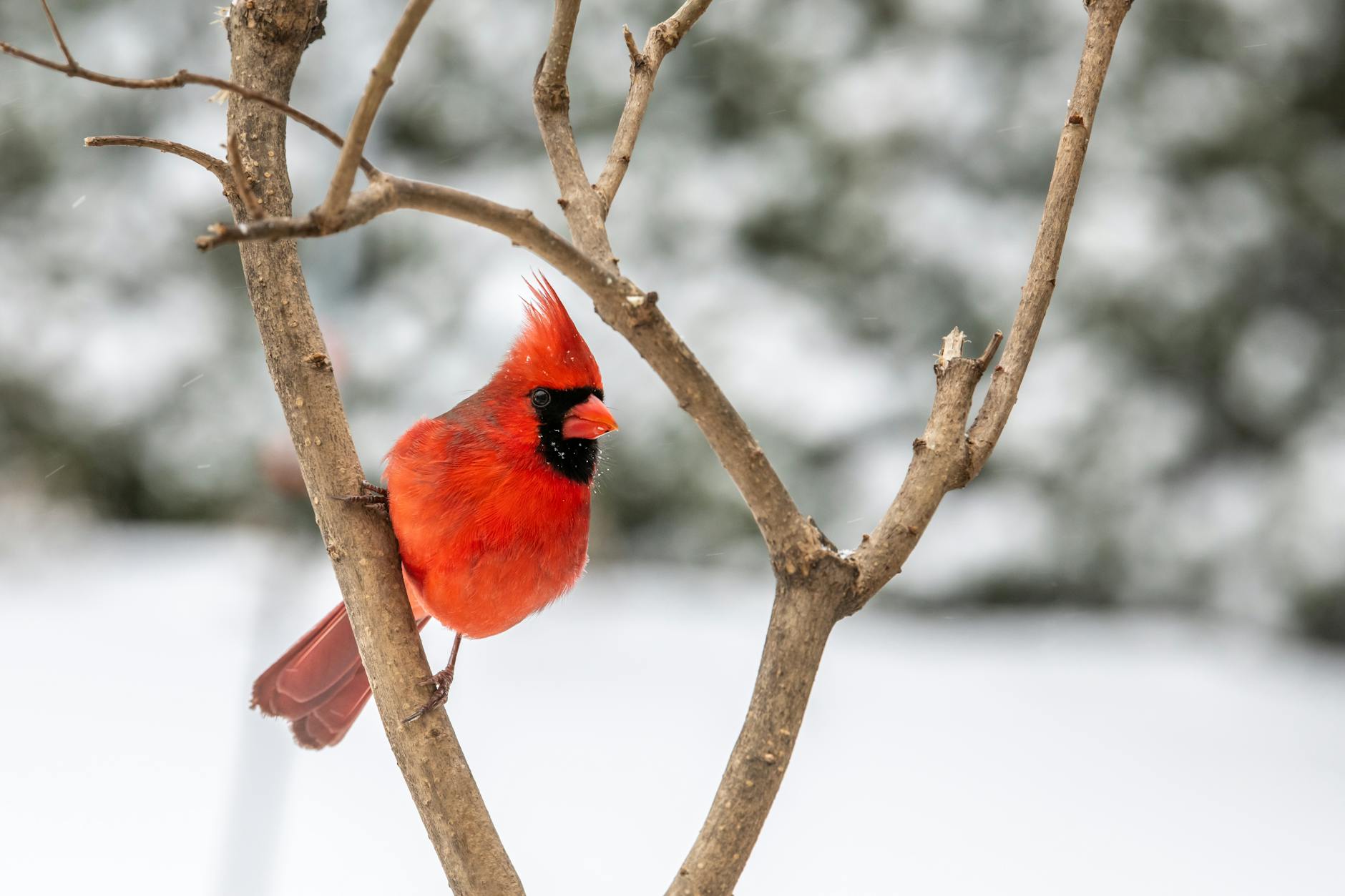
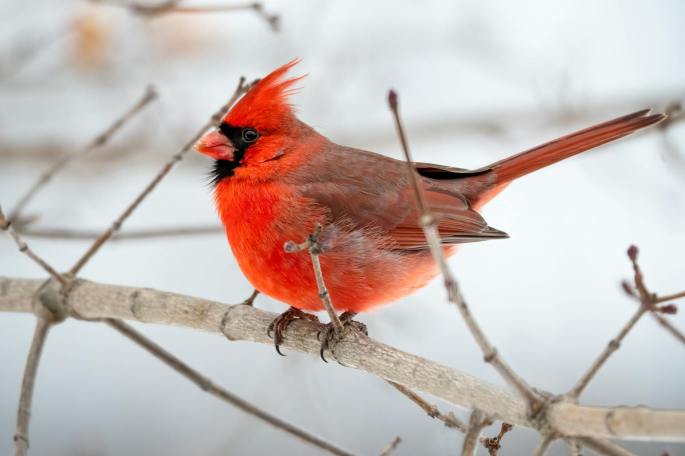
His radiant red contrasts the rambling lines of landscape blanketed in brilliant white over which Mother Nature continues to shake clouds full of crystalized sugar. There is a muted hush, like the stillness of our lungs between the inhale and exhale, and then with a shiver, she cascades more snowy powder in a frenetic freefall. The spry cardinal skips and hops through brambling branches. Then, tilts its head, as if it just remembered an important date, and lifts in flight. 

Inhale. Lips seal in a smiled memory of long ago. 

Pause. Sense the stillness 

Exhale. Perceive the prickle of the past.

Photo by Lena Glukhova on Pexels.com

Observing the steady dance of freed flakes, my mind meanders through the rolling hills of earlier life–so many memories sift through and then meld into the collective cache of moments. Childhood. Youth. Young adult. Parenting. Empty-nesting. Hands outstretched wide.  Collect the moments. Like snowflakes landing on a mitten, I cannot clasp such things for long. 

Inhale. Eyes soften their gaze.

Pause. Brain swirling through Kodacrhome images faded with time.

Exhale. Sense the shudder of time. 

Photo by Mari Anteroinen on Pexels.com

Accumulation of moments, unique in dimension and structure, pass through the sieve of consciousness. One reminiscence overlaps another in a spiraling swirl of sensory recollections. A Chex mix of her memories stirred up with mine.

Galoshes, long underwear and frosty wet jeans.

Layers of shirts and jackets, and a big ol’ coat.  

Mummified walking. 

Snowflakes dusting shoulders and hats; red, dripping noses. 

Snowballs, snowman, snowfort

Neighbors calling

Who hit me in the back?

Inhale. Gaze remains inward

Pause. Linger in timelessness. 

Exhale. Soften into space and time.

Photo by Nguyen Hung on Pexels.com

Rolling, rolling, snowballs large and small, impressions of the past and present pinging. How marvelous, to have these individual souvenirs of time heaped into a memory bank like snowflakes plowed into mounds alongside a road. 

Sounds of barking, scent of wet dog. 

Red sled, yellow cord; here we go again! 

Fearless flights of fancy, impervious to the elements

Mittens over gloves, wet and soaked through. 

Pink cheeks, cold hands; giggles and grins galore. 

Campbell soup and grilled cheese.

Cookies with hot cocoa and a giant floating marshmallow.

Soggy clothes, drip, drip, dripping on an overburdened rack.

Child, with canine companion, reading in big cozy chair

Photo by Vlad Cheu021ban on Pexels.com

Inhale deeply as eyes return to snow. 

Pause. Flakes flicker and fly 

Exhale. Present in the moment.

Photo by Skyler Ewing on Pexels.com

Scaning frosted tree arms splayed open for welcoming feathered friends. There he is again. Handsome boy. Tufted red hair, not a feather out of place. Unflappable and composed in a wintry playground. Head cocks and black eyes glisten. He seems to see me, and I am reminded of a conversation.

Before the snow arrived, my husband and I discussed the impending weather. He had worried and watched the approaching meteorological conditions.  “It will do what it will do,” I said.  Not to be dismissive of his concerns, but to instead, remind both of us that we can only watch and wait.  Then, if/when it arrives–as it did–we will know.

Photo by Yan Krukau on Pexels.com

In that moment, it occurred to me that so will life. Just like weather, life will do with us what life will do. We are not in as much control as we think we are. 

This doesn’t mean we should not prepare, plan (to the degree possible), and be aware of future events, but many, if not most, events cannot be known until we are in the midst of a whirling outpour. Sometimes, those moments merely require that we stand like a child, head thrown back and tongue out, tasting and savoring each precious moment. Other times, life drifts in deep, and we are shoveling out as best we can, holding on for the sun’s warmth.

Through the flurries and cloudbursts of storms, there is the throughline of the present moment. Life is happening now, and what is happening now will be our future memories. 

Photo by Nicki Dick on Pexels.com

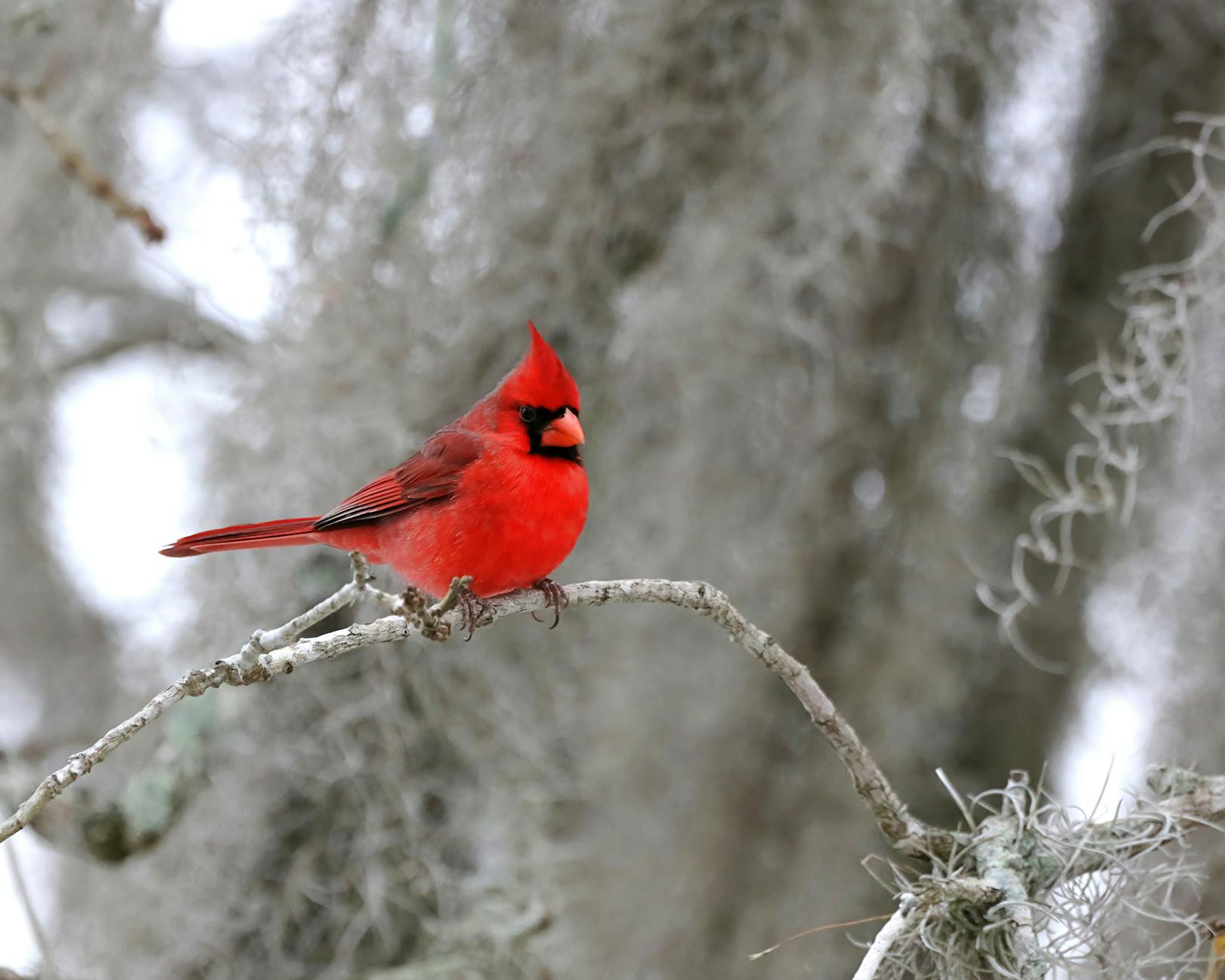
The cardinal serves as a symbol for me of past and present. I cannot see the red feathered fellow in the winter without simultaneously being in awe of his present day beauty while also reminded of my Pappaw.  He loved to feed and watch the birds, especially in the winter; cardinals were his favorite.  “Now, Stethie, look at those red birds out there.  Aren’t they something?” 

Pappaw often told me bluejays were a “mean bird,” albeit “good-looking fellows.” He did not like the way they became territorial and aggressive towards other birds, especially the cardinals at his feeder. There were several occasions in which I’d watched him dart out of the house without a coat or hat and chase the bluejays away to protect “his red birds.”

Photo by Janice Carriger on Pexels.com

Pappaw is long gone. I am not sure if I appreciated my time with him during those once present moments as I should have. And yet, outside of my window, the cardinal continues its call of snowy days present and past.

 The coming and going of time begins in the “right here, right now” moments. Inhale. Connect to the arriving moment.  Pause. Feel the presence. Exhale. Tick. Tock. Another opportunity to collect a memory before, like the snow, it melts away. 

Photo by Arina Krasnikova on Pexels.com


The Stardust of Grandparents Twinkles like their eyes

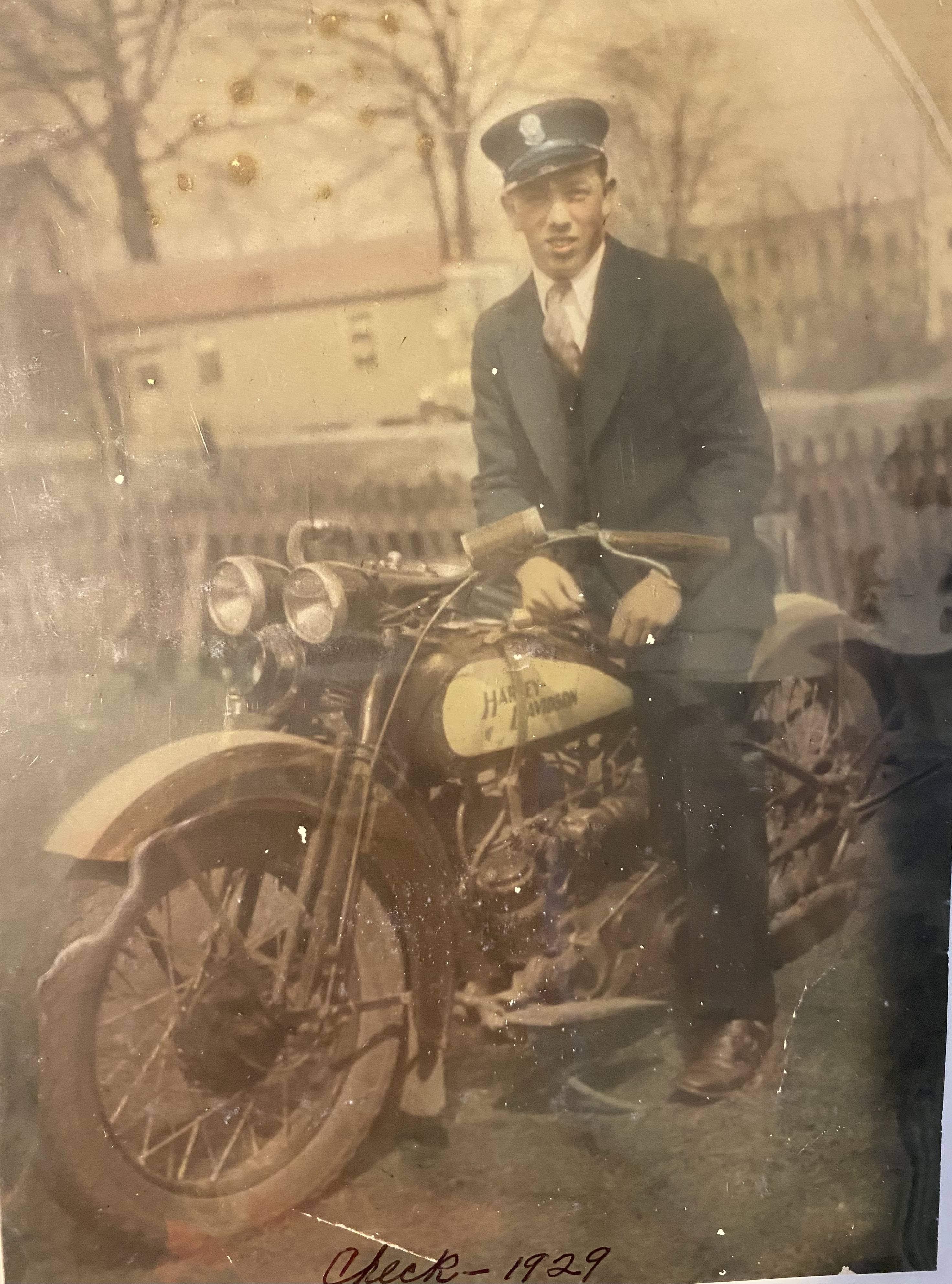
Papaw, in the backyard of my childhood home, with my hand resting on his shoulder. I am not sure what the moment or occasion was, but this photo captured a moment between the two of us.

A Light from the tunnel of times past 💡

My mom found and gave to me a picture of her dad, Papaw, as I called him.  In the photo, he is in the foreground, sitting at a table on the patio of my childhood.  In the background of that picture are several small details of my childhood home.  Gazing for some time at that picture transported me backwards through a tunnel of times past.

To begin, I noticed the infamous backdoor that we weren’t supposed to slam as children heading out to play.  Then, there’s the wooden fence my dad built, which reminded me that he also designed and poured the concrete for that patio. Additionally, I can see part of our clothes line with its bag of clothespins.  I recall my mom teaching me the proper way to hang clothes, sheets, and towels to minimize wrinkles and shorten the drying time. 

He ultimately sold his grocery store business and worked for C & O Railroad.

Papaw 👴🏻

Once the surge of those background memories drifted down the stream of remembrances, another torrent of emotions began swelling–Papaw.  In the photo he sits in one of his classic jumpsuits that he wore nearly every day of his life except for yard work and church events. His smile is tender in this photo, and despite the not-so-great quality of the camera, the picture still manages to capture that twinkle in his eyes.

 I adored that man. Now, as an aging adult, I am certain that Papaw was full of flaws.  Family rumors of the daredevil antics of his youth, his hobo days after marrying my grandmother– leaving her for weeks at a time to raise two young boys and manage an independent grocery store with its own lunch counter by herself– his issues with depression, and perhaps even some philandering, were whispered stories among the family adults.  As kids, we gathered bits and pieces of these stories, as one does a torn up letter, but we were simply too young to put the pieces together.  He was simply our Papaw.

Papaw and me in his backyard.

Traveling Backwards through the Tunnel of time 🔙

Staring at the photo of this complicated man that I am only now beginning to see in a realistic light, I assess the other person in the photo.  She is a college student with her hand on Papaw’s shoulder–a habit I recognize because it is me.  I tend to place my hand on the shoulders of people who are seated at tables, or even desks in a classroom.  I suppose it is my way of saying I care about you; how can I help; or, can I get you anything?  It took my breath away upon first seeing it.  So much is captured in that frozen image of time.
Papaw often called me a Kewpie-doll or China-doll. I am sure this was because of my size.  I was small for my age for many of my younger years.  I was also often sick during this time period, and I recall being hospitalized at least twice.  Both memories are blurs of oxygen tents, IVs in my thighs, dimly lit hospital rooms, and Papaw’s worried face when I would wake with bleary eyes from sickness induced sleep.  

Papaw and me. I am sure I just “helped” him wash his car.

Purple Hazy memories 💜

I remember during one of these stays, he gave me a purple popsicle.  Purple was my favorite color–a color he hated because he associated it with Christ’s crucifixion–but when faced with two granddaughters (my cousin and I) who both loved purple, he came to terms with that color. But, I digress. 

Anyway, he gave me that half popsicle.  (Remember how adults would break those double-stick popsicles into two?)  I was lying on my side, with the hospital bed rail up, trying to lick the popsicle for him.  He said it would make me better, but I couldn’t keep my eyes open.  The popsicle melted, and I remember waking enough to experience a short burst of fear that I would get spanked for making a mess.  (Not that Papaw would have ever laid a hand on me, but I was sick, and logic eluded me.) 

There was another time I woke up in a hospital bed crying because there were needles in my legs (IVs) and I was scared.  Papaw patted my hand and told me not to be afraid as he wiped away his own tears. 

During one of those hospital stays he gave me a bouquet of pink plastic flowers that my grandmother sprayed with perfume.  Once home, I kept it in my bedroom for years, and I would sniff it countless times to see if I could still catch a whiff of that perfume.

Runaway Story 🏃‍♀️

Another time, Grandmother and Papaw came to stay at our childhood home while my parents were out of town.  I became mad at my grandmother for some reason–that part eludes me–but I decided to run away.  I lived on a small cul-de-sac in the country, surrounded by hills, so I am not sure where I thought I would go.  Nonetheless, I took off running in my headstrong way down the street until I got to the main road with fast moving cars and no real safe space to walk.

Tail tucked between my legs, I slowly trudged back to my house, and I slumped against one side of it, arms crossed, still mad, but losing steam.  Out of the house came Papaw. I don’t know how he knew I was there, but there he was.  I am not sure precisely what he said, but he did tell me a story about a time he ran away. He added, with great solemnity, that running away never solved problems.

Looking back on that now, I wonder if there was more he was confessing, but I would not have been old enough to catch the symbolism of his words.  I do recall Papaw encouraging me to be more understanding of my grandmother.  He further added that as the oldest child, he counted on me to be her biggest helper.  He wanted me to apologize to Grandmother and be “his girl” by being her helper from then on.

Even in high school, I still adored my Papaw.

A Grandfather’s Love 💖

And that is what it came down to.  When I studied that picture, I was reminded of being “Papaw’s girl,” something he probably also told all the other grandchildren.  Nevertheless, I believed he loved me most of all, and that made me feel special.  It now seems naive and silly, but that is how he could make me feel.  A feeling that has never left me, even now as I look at that image.

Young, handsome, and daring . . .

The Abundance of his legacy ✨

 Wiping away my reminiscing tears, I gaze at this man who was complex in ways I never knew. He only had a 5th grade education, but he still managed to educate himself through his endless curiosity. Papaw was complicated, and yet simple. He managed to ultimately live an abundant life. 

Papaw traveled all over the world with my grandmother visiting and staying with missionaries, and he also traveled through his hometown as a teen standing on his circa 1920s motorcycle. He was the trusted treasurer of his church for as long as I can remember.  Papaw played football before there was all the protective clothing, and he loved the game until Alzhiemer’s disease took his mind. He retired from C & O railroad, and he once owned a grocery store that was flooded twice by the Ohio River. It was the ‘37 flood that ended those retail days and inspired him to build a house on a hill.  Yet, this same man once swam across the Ohio River from South Shore, KY to somewhere near Portsmouth. 

He had three children, my mom being a late-in-life surprise, and he had nine grandchildren.  He loved us all. 

There are stars which I regard in the mornings when I walk or run.  They line heaven’s boulevard.  They twinkle their good mornings to me like Papaw’s eyes once twinkled his love.  I’d like to think he is part of their stardust. 

I wish I could give every child a grandfather like mine.

Kitchen Table Secrets

“Everybody is a story.  When I was a child, people sat around kitchen tables and told their stories. We don’t do that so much anymore. Sitting around the table telling stories is not just a way of passing time.  It is the way wisdom gets passed along. The stuff that helps us remember a life worth living.”–Rachel Naomi Remen

Photo by Askar Abayev on Pexels.com

I saw her on the opposite side of the block, the woman with purple cord-like hair wound round her head like a hat.  She walked along the sidewalk at the opposite end of me, and she carried what appeared to be a purple calico print backpack on her back. Talking uninhibitedly to herself in a syncopated, sing-song voice, she did an about face and turned toward a man as he stepped out of his car into the damp, cold morning air.  

“Hey, Mr., wanna buy me some breakfast?  Breakfast is good.  Food is good.  I like breakfast food.”

I could not hear his soft reply, but I heard her sadly chime a truncated response.

“Ok, ok.  I am not bad.  I am not bad. Just wanna sit at the kitchen table with Mamaw.  Just wanna sit and eat at the table with Mamaw.” 

The woman, from my distance, appeared to be not much older than my own 22 year old daughter, and emotions suddenly choked my throat and clouded my heart.  I wanted to wrap my arms around, as if she were a small child, and take her back to her home–wherever that may be. In spite of this woman’s evident mental illness, she seemed to long for the comfort, safety, and shelter that we often find at the family kitchen table. 

Photo by Anna Shvets on Pexels.com

Kitchen table memories spooled out in my mind plain as thread, and some were just as colorful.  Many were fond and warm pictures–snapshots of holidays past. Others were remembrances of various familial situations. I was adrift in a kaleidoscope of images; snippets of moments glided through my mind as leaves the colors of amber, crimson, and tangerine, freed from the bondage of a tree, take flight in autumn breezes.  Impressions of full bellies, hot coffee, spirited–or sometimes intense–conversations, and purposeful work endeavors around one piece of furniture continued to tumble about . . . 

Homework and games

Puzzles and paints 

Posters and patterns to sew

Papers typed late into the night

Stacks of bills to pay

Budgets in need of balance

Dancing eyes sharing stories

Tears that break the heart

Conversations and disputes,

I think I need to leave the room

Set the table please

Platters of food to share

May I please be excused?

Not ’till you clean your plate

Spills that demand to be cleaned

Bubbled burps of Friday night soda

Mix well with pizza and chips 

Quarter fines, ‘cause

Burping is rude

Peals of explosive laughter 

Oh no, we’re in trouble now

May I please have some more . . .

What about waffles with peanut butter?

My friend is spending the night

Do I have to do her chores?

Pass the butter please

No, you can’t go out with your friends!

May I have another roll please?

Do you realize the seriousness of your actions?

Come in and sit a spell, friend

Did you hear about this?

Why, yes they say it’s true

Now, listen, you can’t believe everything you hear

Birthday cakes and cookies sprinkled

Presents wrapped with curls of shiny ribbon

Curlers set, braids woven

Talks of dreams and

Future plans filled with hope

Remember when?

No, it went like this.

Did she really throw a fork at Uncle?

Well, they were wrestling

Brothers nearly tore down the kitchen

Over the last piece of cake.

It’s your turn to clean the dishes

But I had to do that last week!

Remember to sweep under the table

Whispered late night conversations

Big changes coming soon

If only kitchen tables could talk

At the heart of a home, there is the kitchen table–a field of harvested memories and land for new seed to sow.  It is my wish, as we gather, eat, converse, and work around our own kitchen tables, that we take time to not only nourish our bodies, but also savor the moments with one another, and form kitchen table memories and traditions worth sharing and passing on to future generations.  May we remember those who have gone before us, and love the ones who remain.  May we likewise take time to pray for those without homes, looking for a kitchen table at which they can sit and sip a cup of comfort.  May those lost souls find some form of peace and solace, and may they one day be reunited, or united, with people who love and care for them.  

Photo by Sam Lion on Pexels.com

My final prayer of hope is for the unknown young lady with wound cords of purple hair. May she be safe and well.  May she no longer roam the streets alone, and may she make her way back to her Mamaw’s kitchen table.  After all, she was once somebody’s baby girl.

Photo by Yan Krukov on Pexels.com

Scent-ual Memories of Mamaw

“The sense of smell can be extraordinarily evocative, bringing back pictures as sharp as photographs of scenes that had left the conscious mind.”–Thalassa Cruso

The tall 8th grader nodded his head slightly as he handed me a basket.  

“This is from my mom,” he added and ambled away on legs leaner and longer than I am tall. 

Filled with several items of self-care, I slowly admired each item in the basket. Noticing a tiny tin of Nivea hand cream, I twisted off its lid. Since my hands were dry from sanitizing students’ tables, I dipped a finger into the rich, velvety cream and gently massaged it into the skin of my hands and fingers.  Working the cream into my hands, I proceeded across the room and thanked the student for his–and his mom’s–thoughtful gift. Then, beginning class in my usual manner, I promptly began moving about the room as I coaxed the 8th grade students into a didactic conversation, and suddenly noticed a familiar aroma . . . Mamaw?

Mamaw and me at her house in the rarely used living room during the Christmas of 1967.

“Nothing revives the past so completely as a smell that was once associated with it.”— Vladimir Nabokov

Mamaw, whose actual name was Maxi Musick, was my paternal grandmother.  Standing 4’10” at her tallest, she became a widow not too much longer after I was born during the mid-1960s.  She lived in the same small craftsman style home in which she raised my dad and his younger brother for most of their lives. (They moved into the home when my dad was around nine years old.) 

Mamaw’s home was of great fascination to me, and it possessed a certain scent. This unique aroma seemed to mostly emanate from the bathroom and seep into the rest of the house as the one and only bathroom was situated right next to what she called the TV room. In particular, this same fragrance seemed to emanate from Mamaw’s skin.  In fact, I considered this Mamaw’s signature scent.

Where was this scent coming from? Surely, it wasn’t coming from one of the students? No, that was an absurd thought.  I’m tired and simply imagining Mammaw’s fragrance. 

Mamaw is sitting behind me in this picture from Christmas 1967. Beside me opening a Christmas gift is my Uncle Gary Musick, Dad’s brother.

Making my way around the room, discussing the topic of the day with the students, the lingering odor of Mamaw remained with me no matter in which part of the room I stood. Gesticulating in order to make a particular emphasis, a strong wave of fragrance wafted through the air.  A student began to talk, and I brought my palms towards my face.  Then rubbing my palms together and quickly inhaling, the warm scent filled my nostrils.  There she was again.  Mamaw.

Trying to force my mind back towards the speaking student, memories of Mamaw crashed to the surface of my consciousness, as if suddenly, hundreds of sticky note memories began covering my brain. Oh, I didn’t want to lose those remembrances, but I needed professional concentration. Nonetheless, winds of recollection continued to dance, lift, and float just below the surface of my focus like watching autumn leaves drifting to earth outside my classroom window.  Oh, but could I catch each one if only I weren’t inside the confines of the setting, focusing on the job at hand.

My mind drifted to summer nights spent at Mamaw’s house  . . .

Mamaw, with her thinning salt and pepper hair, topped with a wiglet, quietly swaying in rhythm, with me beside her, as we sat on a glider that gently twanged and screeched.  Not many words were spoken. The sensory thrill of summer was enough.

 Heading into the TV room once night was fully settled.  We would take turns bathing.  Mamw would emerge freshly cleaned, pink nightgown and robe swathing her tiny body;  wiglet wrapped in tissue paper so that it wouldn’t be mussed during the night, and that warm fragrance, like misty fog surrounding her being, emanating out each pore of her body. 

Together we watched The Rockford Files (or other such popular shows).  Before the episode began, Mamaw briskly entered her darkened kitchen, and using only the small light above her sink, she would prepare for us a snack. Using her cheese slicer, she deftly carved perfect slices of cheese, added a few Ritz crackers, poured a glass of water for herself, and fixed a cup of Tang for me–the drink of astronauts! 

Mamaw, Maxi, Musick is seated at the head of the table in her kitchen in 1967. Her kitchen would mostly remain the same throughout my childhood. It is interesting to note the way Mamaw tilts her head for pictures as I only now recognized that I have a tendency to do the same thing when photographed.

We were now ready to help Jim Rockford solve his current mystery. If Jim said or did something funny, Mamaw laughed with her whole body, her soft belly jiggling with delight. When he’d act romantically with his sometimes girlfriend, Mamaw would joke that she wished James Garner would date her.  Throughout the show, she and I would debate the merits of the case in our attempt to solve the crime.

By 11:00 pm, I would snuggle down in a twin bed that once belonged to my dad as Mamaw, a heavy-footed, purposeful walker for such a small person, would walk through “boys’ bedroom” to enter her own bedroom. I would fall asleep to the sounds of the C & O train cars moving around in the nearby rail yard.  Safe and snuggled in the blankets, if I listened closely, I could also hear the soft tick, tick, tick of the second hand of the square electric clock in her bedroom clicking off the passing seconds.

Rising early in the morning, Mamaw would make oatmeal for us with extra sugar for me, Sweet’N Low for her.  She boiled water to make herself a cup of instant coffee, and she poured me a cup of orange juice, or if I was really fortunate, grape juice.  Then, we might go to the local high school track for a walk, work around the house, work around the yard tending to her flowers or hanging laundry to dry on the line, or she might quilt, asking me to hand her pieces of material, thread, or find her thimble.

If I remember correctly, Mamaw drove a Toyota Corona for most, if not all, of my childhood. It did not have air conditioning, and so we traveled with the windows down in the summer. She required pillows on her seat to assist her reaching the pedals and seeing out of the window. Both hands were on the steering wheel–10 and 2 o’clock. Those hands never strayed from their designated positions, and her eyes were locked straight ahead. Therefore, she let me adjust the dial on the AM radio to WGNT, rather than WTCR, the home of the country music she preferred.

Mamaw was tight with her budget. She adhered to a schedule and routine with breakfast by 7:00 am, lunch at noon, and dinner at 5:00 pm. Her house was simple, but always neat and tidy. While she belonged to a Regular Baptist church that rotated services from one rural location to another, she talked about it only if asked, and I never heard her criticize other denominations and beliefs.

Meanwhile, back in my classroom, I felt the sticky notes of memories loosening as I required more and more focus to keep my part of the student conversation going.  

Papaw Musick and Mamaw Musick with my Dad, Larry. I just love this photo of all three as it conveys so many emotions–especially when you look at the eyes.

“We do not remember days, we remember moments.”–Cesare Pavese

Mamaw, I hope you knew, and somehow still know, how special you were/are to me.  You taught me to keep my head held high and to walk purposefully with firm steps grounded in simple truths. You further taught me to live simply and not wastefully; laugh abundantly and with your whole body; don’t proselytize your faith, but instead, live by example; eat your oatmeal and take walks; plant flowers; go to bed at a regular time, and get up early; be kind and loving; and, always remember that James Garner was one of the greats.

 I’ve decided to keep that tin of cream in my desk drawer at school in order to remind me to live by Mamaw’s simple truths as I work and teach the next generation of kids.  

Hmm . . . I wonder if I could find a way to work The Rockford Files into my curriculum?

A Good Morning Goodbye to Summer

“ . . . Goodnight mush

And goodnight to the old lady whispering “hush” 

Goodnight stars

Goodnight air

Good night noises everywhere”–Margaret Wise Brown from the book, Goodnight Moon, illustrated by Clement Hurd

When my daughter, Madelyn, aka “Maddie,” was a toddler, she had several favorite books with which she played, banged, tugged, and, eventually, pretended to read. One of those favorite titles was Margaret Wise Brown’s, Goodnight Moon.  Of course, as with most children, we went through several phases of “favorite books” that were the bedtime default for, “one more story,” before lights were out.  However, Goodnight Moon was an on again, off again favorite for a couple of years.  There is a reason this 1947 classic children’s story has sold millions of copies and has been translated into numerous languages.

I was reflecting upon those sweet, long ago reading-bedtime-stories-memories and comparing those times within the current context as I made my way through Ritter Park on what was my final week day workout of the summer . . .

Maddie in her extra soft jammies, smelling mildly of soap, her hair slightly damp, her skin soft, pink, and warm, as she wriggled a little closer, imploring me to read, “one more story.”  Reaching for Goodnight Moon for what felt like the thousandth time, I would often change the words of the story to reflect our house, her bedroom, and her surroundings, creating a more personal narrative.  Quite often, Maddie would join in with her own improvisation as well.  

Reading to my daughter is one of those memories that brings tears to my eyes because time seems to have transpired so swiftly.  It feels as if only last week that I was reading those stories, and numerous others, with her.  I didn’t realize then, that as quickly as those page-turning moments were occurring, they were likewise being replaced in the same way Maddie’s bedtime books were changing and evolving. The time of childhood kept moving forward like the plot of her stories. For unlike her storybooks that could be paused or stopped by simply closing the book, time did not then, nor does not now, allow me to stop the story of life from progressing.  Goodnight, Maddie, as a toddler.  

Miss Maddie grew, and with every page turn of life came a new image, a new stage, a new way of saying goodnight.  Giggle-filled toddlerhood seamlessly turned into the carefree days of preschool age, and soon enough the plot evolved into the pleasant days of kindergarten.  As life progressed, cheery days of elementary years were followed by those angsty years of middle school. Next came the plot-twists that belong to the high school years.  Presently, a new page has been turned, with more COVID-related turn-of-events occurring that continue to promote both her personal and academic growth as she makes her way through the challenging college years, especially within today’s state-of-affairs.  

Time just keeps cascading, drumming along, pattering out rhythmic beats of memories.  These snapshot moments of life with our daughter are like the bubbles she created in those early bygone years. Maddie would blow the bubbles into life and then chase those bubbles, trying to “catch” them, but bubbles tend to pop when you try to grasp them.  Instead bubbles are best enjoyed while savoring the creation of each one and then enjoying their flight as they glide through air as shiny kaleidoscopes of joyful color.  However, like my toddler daughter of all those years ago, we often give chase to life, trying to hold onto bubble-like moments of the past or bubbles that might be created in the future, often unaware that current bubbles of life-moments are floating within our view with little personal awareness.  

In some ways, though the pandemic has forced many of us to be more aware of the preciousness of life.  When life as we knew it, came to a screeching halt, or at the very least, drastically slowed down, time spent driving hither and thither was reduced to a bare minimum.  Spending most, to nearly all, of your time at home became the new normal.  The hands of life’s clock tick-tocked to the same rhythm, and yet, felt s-l-o-w-e-r.  Working from home in comfy clothes was the new cool.  John, Maddie, and me, like many that were lucky enough to remain employed or in school, worked from our home battling for wifi and dealing with the imperfection technology; and, truth-be-told, imperfect people since neither John nor I are tech savvy.   Somehow, though, we managed to keep turning those pages of work, school, and life, but it was different, and it seemed to revive the age-old theme for the desire of work-life balance and the importance of spending time with family and loved ones.

Now, as we return to new variations and designs of our work worlds, I have to wonder/worry if we are returning to the proverbial rat race.  While there were, and continue to be, many negatives of living with COVID-19, there were (and are) advantages to quarantining at home.  One of my big takeaways from the experience is that growing desire to strike a greater balance between work life, family, and time spent in meaningful, personal pursuits and/or expressions. COVID has revealed there is more to life than career, and there is likewise much value in time spent with people. While being able to financially support oneself is important, COVID has repeatedly reminded me, and many others, that our time on earth is like those bubbles of Maddie’s youth, elusive, colorful, but short-lived.  I want time to create and savor more meaningful bubbles of life moments.

As I continued down memory lane on that Ritter Park run of last week, I was reminded of the certain situations for which I am/was happy to say goodbye and others for which I am/was glad to say hello with regards to COVID, quarantine, and working from home as well as the positives and negatives of returning to work (school), albeit, with a new way of working and thinking about education and work-life in general.  In my head, Maddie’s Goodnight Moon’s simple verse informed thought bubbles of random rhymes and personal prose . . .

On a great big earth

There was a virus

And a numerous people of worth

And a picture of–

Distractions of media birth

And there were numerous world leaders sitting on chairs

And there were markets

And there were targets

And people were moving

And the bug was stewing

And there was more spread that grew in a rush

And there were even some men who were proclaiming, “hush”

Goodnight school

Goodnight need for much fuel

Goodnight countless people of worth

Hello time at home

Hello best-not-to-roam

Hello extra family time

Hello singing wind chime

Hello work from the table

Hello time for evening cable

Hello bedtime at dark

Hello paths of local parks

Hello time spent in nature

Hello medical danger

Hello life with COVID-19

Hello people on a virtual scene

Goodbye summer months that went by fast

Hello school bells ringing at last

Hello to the students I will see

Hello to the in-person teacher I will be

Goodbye warm lunch peacefully eaten alone.

Goodbye work from home

Hello continued work-friend, Google Chrome

Goodbye quarantine that abounds

Hello, the virus is still around

Hello to spaced out chairs

Hello to continued and fervent prayers

Goodbye work day morning run

Goodbye savoring dawn’s sun

And there’s still no goodbye to men proclaiming, “hush”

Goodbye sweatpants

Goodbye, my growing green plants

Goodbye quarantine life . . .

May this school year and fall 

be safe for all 

Goodbye, fellow morning exerciser, Deborah Garrett who walks an hour and forty minutes most mornings at Ritter Park. She says she “just loves it in Ritter Park.” I hope that I see you from time to time on the weekends. In the meantime, keep on stepping into life!