A Quieter Resolution for the New Year: Listening, Learning, and Loving Without Agreement

“When we listen, we offer with our attention an alms far more precious than anything else.”— Simone Weil

The Season of New Year’s Resolutions—and a Different Invitation

The ritual setting of resolutions for a new year is a ubiquitous January practice. Gym memberships flourish, trackers are checked and rechecked, meals are planned and prepped all in the hope of self-improvement. One quick scroll of social media offers a wide array of options for  workouts, diets, and methods of accountability. While health resolutions matter, our culture needs a quieter resolution–one that prioritizes listening deeply, learning humbly, and choosing neighborly love without agreement.

What We Miss When We Stop Listening

One cultural trend I have noticed–and am often guilty of myself–centers around listening, or a lack thereof. Many of us talk past one another, make snap judgments, and curate words of certainty. Conversations become overlapping monologues–ears present, but attention is elsewhere. In doing so, we miss the quieter forms of communication: facial expressions, postures, and the subtle cues that reveal complexity and lived experiences. When we rush past these, we lose the opportunity to understand another person, and we deny ourselves the opportunity to be changed, even slightly. Making time for focused listening does not mean we are agreeing with another person’s position.  It is choosing understanding over reflex.  

Learning to Listen as a Daily Practice

Learning to listen well is an acquired skill, at least for many of us, myself included, but it is attainable. Engaged listening requires more than ears; it requires intention. It asks us to pause before responding to another person, to consider what was said, and to ask a thoughtful question, rather than immediately offering a counterpoint. Asking a thoughtful question or two can increase understanding of another person, especially if we are willing to sit with discomfort if their viewpoint challenges or counters our own. This type of listening takes time and requires humility. If you are like me, you won’t be perfect–but it is a worthwhile endeavor.

Listening Without Agreement

Frankly, it is easier to relegate people based on our assumptions.  It is inconvenient to take time to ask questions that might alter our long-held beliefs.  However, by listening and respectfully seeking understanding, we incrementally begin to learn more about an alternate point of view without necessarily agreeing with it. 

Lessons from the Classroom About Understanding Others

 This is an ongoing practice for me as a veteran educator separated by generations from my students, and even many of my colleagues, in a high school setting. I have entered numerous conversations over the years in which either I had assumptions about a situation involving a student, parent, or peer or they had assumptions about me. Those conversations did not always lead to agreement, but they almost always led to greater understanding–and that is the difference that mattered most.

What It Means to Love Our Neighbor Today

By taking time to listen and ask questions, we are putting into practice a foundational belief of most world religions and philosophies: “Love your neighbor,” emphasizing respect, compassion, and doing non-harm to others. This Golden Rule practice is neither affectionate nor approving. It is also not remaining silent when faced with harm. In today’s world, “loving your neighbor” can be as simple as showing restraint in how we speak–refusing to reduce a person to a single action or belief. Practicing the Golden rule can also be as simple as not reducing a person to a single belief or action. Loving others is simply a daily choice. It is a posture that can feel costly, especially when it would be easier–or less stressful–to walk away or erupt into outrage. 

Small Ways to Practice Kindness in Everyday Life

Standing in neighborly love takes practice, and it doesn’t have to occur in grand, sweeping gestures. We can begin to put into practice in small, cumulative ways that can still have a bigger impact than we realize.  During gatherings of friends and/or family, try listening longer than feels comfortable to that contrarian relative/acquaintance.  During community, work, or church meetings, instead of immediately refuting a counter point-of-view, respond with curiosity rather than certainty. While interacting with online spaces, try choosing kindness when sharpness would be easier, even if the kind act is not to respond at all. We won’t always be perfect, but the more we practice, the more natural it becomes.

A Resolution That Doesn’t Fit on a Checklist

When setting resolutions, health coaches often ask clients to create goals that are SMART: specific, measurable, achievable/attainable, relevant/realistic, time-bound/timely. Setting a resolution to listen, learn, and “love” others may not, therefore, appear “SMART.” Nonetheless, it remains an attainable and relevant practice through small, incremental steps. 

What Might Change If We Listened First?

Consider what might change if we listened a little longer? If we attempted to learn more than we defended? If we treated others the way we would want to be treated? If we “loved” more than we proved?  

A Practice Worth Returning to All Year Long

These actions are not about “perfection” with a clear-cut checklist that offers overnight transformative results. Instead, they are more about presence and intention–the intention to listen, learn, and love others. It is a resolution that does not have to end with guilt in February; rather, it is a practice that can be picked up and practiced again and again throughout this year and years to come. 

“You don’t have to agree with someone to treat them with dignity.” 

As the year begins, may we all strive to engage in a more neighborly discourse and actions. 

Embrace Kindness: New Year’s Resolutions for 2025

Photo by Matheus Bertelli on Pexels.com

Who Set a Resolution for 2025? 🙋‍♀️ 🙋‍♂️

Did you set a goal or resolution for 2025? According to the Pew Research Center, the younger you are, the more likely you are to establish a resolution. Last year, about half (49%) of the adults, 18-29 years, made at least one resolution. That dropped to ⅓ (31%) of adults, aged 30-49 years, and for those over age 50, only about ⅕ (21%) of this age group sets New Year’s intentions. 

Yougov.com reported similar statistics for last year. This organization’s polling further revealed that by March 2024 nearly ⅔ (70%) of those adults who set resolutions had either mostly or entirely stuck to their goals. Not surprising, most resolutions, according to both PRC and Yougov, had to do with either health, such as exercising more or eating healthier, or wealth, such as saving more money or paying down debt. 

Establishing resolutions around improving one’s health or one’s financial security are certainly worthwhile endeavors for which I wholly support. However, I would like to put forth this idea–whether you do or don’t make New Year’s resolutions–for spreading seeds of goodwill, kindness, and simple decency. While this is a less specific goal–and flies in the face of those who argue for SMART (specific, measurable, achievable, relevant, and time-bound) goals–I would argue that setting a daily intention to plant one seed kindness is also SMART and smart. 

Photo by Polina Kovaleva on Pexels.com

Consider This . . . 🤔

The following quote by William Arthur Ward is often shared at the start of New Year’s that says: “I have the opportunity, once more to right some wrongs, to pray for peace, to plant some trees, and sing more joyful songs.” 

I believe this quote is worth considering now as social media outlets and people of influence have made it socially acceptable to bad-mouth, malign, and verbally abuse others with the intent to create division, discord, and derision. In fact, I think Ward’s decades old statement can be turned into actionable goals, a couple for which I have reworded for the purpose of goal implementation. These include: right some wrongs; pray for peace, plant some seeds, as well as celebrate and share joy.

Right Some Wrongs. This goal is simple. When you do something wrong, own it, apologize for it, make whatever amends you need to make, and learn from it.  We all make mistakes, unintentionally say something hurtful, or do something that upon hindsight wasn’t the best choice. Instead of acting like it didn’t happen or feeling a sense of self-loathing for doing it, do something about it.  Sure it may not be easy, and you may have to swallow your pride. However, in the end, both you and the other person(s) will feel better and/or benefit.

Pray/meditate for Peace. Again, this is another simple goal that takes minimal effort. Spending five to ten minutes per day contemplating peaceful actions for the day, praying for guidance for world, national, and/or local political leaders, or focusing on any other forms of peace you would like to see in the world is neither time-consuming nor hard. The world needs more peace warriors, so why not bless it with more peaceful words, prayers, meditations, thoughts, and altruistic actions.

Plant Some Seeds. Random Acts of Kindness (RAK) Foundation, started in 1995, has done an excellent job of promoting kindness.  Their motto, “Making kindness the norm ♥ ️,” I would argue remains relevant 30 years later. This can definitely fit into the SMART criteria as it is specific, measurable, achievable, relevant, and time-bound. Do and/or say something kind, helpful, and encouraging, every single day.  It’s that simple.  Even if you wake up on the wrong side of the bed, doing something for someone else has the power to not only positively affect that person, but that goodwill will fan out across a sea of souls unseen to you. As an added bonus, you will most likely feel better as well. If you’re at a loss for ideas of kind actions to implement, visit randomactsofkindness.org for scores of suggestions. Acts of kindness can create ripples of positivity on the troubled waters of life; they can be balm for a bruised and battered soul.

Celebrate and share joy. If you’ve ever had a serious illness, you know all too well the realization that can dawn on you for taking for granted those so-called “normal days” of life and health. Therefore, why not celebrate, savor, or at the very least, acknowledge (and perhaps enjoy) an average (or not-so-average) day of life? You have one precious life–that’s it–so pay attention to it. Share a “dad” joke, shake or hold a hand, pat another person the back, hug a friend, stroke your pet’s soft fur, eat that piece of cake, have coffee or tea with a friend, take a walk in the sun, smile more, frown less, take an interest in the person from whom you buy that morning cup of joe. . . . In other words, step away from the screen, from social media, and streaming/gaming services.  Not that there’s anything inherently wrong with them, but life is not lived on screen.  Even in this hyper-connected world, I can’t imagine anyone, nearing the end of their life, wishing they had spent more time with Facebook. 

Photo by Anna Tarazevich on Pexels.com

YOu can make a difference this year! 🫶

Whether you’re part of the statistics that chooses to set New Year’s resolutions or not, we can all make the choice to: right personal wrongs, pray for peace, plant seeds of positivity, and/or celebrate/savor the joy of being alive. These are not difficult tasks, but rather they are simple actions that possess potential opportunities to send forth warming rays of goodwill, tolerance, and decency in a world clouded over with ill will, acrimony, and disrespect. While your actions may not make headlines, you can be sure that one good act begets another. And, that, my dear Reader, can indeed make a difference. 

Happy New Year! 

Life Must Be a Challenge

“Life must be a challenge.”–Sri Swami Satchidananda

“Have a Happy New Year, and whatever goals you set for yourself this year, I hope you achieve them.”

The sales clerk handed me my bags as she spoke these words with a broad smile. I wished her a new year’s greeting before heading out into the swarming mall milieu.  John, my husband, and I were in Cincinnati for a couple of days of relaxation between the Christmas and New Year’s holiday.  We debated the merits of traveling as the Omicron variant seemed to be spreading like athlete’s foot in a high school locker room.  In the end, we decided to take the proper precautions–as we have been doing these past couple of years–and head out for our planned excursion.

Photo by Lena Khrupina on Pexels.com

Back home, I was later reminded of that brief encounter with a sales clerk. 

“Did you set any New Year’s resolutions for this year?” asked the young lady preparing to cut my hair on a recent January appointment .

This question led to an interesting discussion about whether or not to use the start of a new year as a reset button–a time to reflect and set new goals.  The stylist was all for it as she described the way in which her three boys, her partner, and she had shared and recorded their goals for 2022 in a journal.  She added that she wrote the goals down as points for review throughout the year, and they would serve the family as a final reflection on the eve of 2023. It seemed like such an intentional and thoughtful practice to have with her family.

Photo by Polina Kovaleva on Pexels.com

Pondering this practice, I reflected on my own goal-setting practices.  As I had explained to the stylist, my personality is such that I am constantly reviewing my own behaviors/habits.  Any perceived “mistake” I make–whether real or self-imposed–I dwell upon, running and rerunning the incidents on repeat like insurance commercials during televised football games.  I think about what I said/did wrong, or how I should have responded to a circumstance, in hopes of not repeating that behavior.  Sometimes it works, but more often than not, I fail, making the same or similar mistakes.  Ugh!  It is a broken record of imperfection.

Perhaps that is why I am drawn to setting small, achievable goals throughout the year, such as training for a half-marathon, teaching myself a new cooking technique, or even my pursuit of weekly writing deadlines.  These are typically structured goals, with steps from point A to point Z, and clearly delineated deadlines/outcomes.  Then, it’s simply a matter of following through with each step, adjusting when there is a set-back, and continuing on, one step at a time, until crossing the finish line.

In the bigger picture of life, however, things aren’t always so cut-and-dry with step-by-step progress and a clear finish line.  For example, when looking over these past two years of life with COVID, it seems one plan after another falls and one unattainable finish line falls to another.  Just as I struggle with my own fallacies, shortcomings, and humanity, science likewise seems to struggle with virus variants far more complicated than my own list of self-imposed list short-comings.  

All of these seemingly diverse thoughts came together when I reread the opening line of The Golden Present, a reference book to which I have repeatedly referred over a number of years.  The author begins with the following thesis,  “Life must be a challenge.”  In those five words, I was reminded of one simple truth.  If life is to be lived fully, then its challenges, from the personal to the global (and all levels in between), must be met, faced, and dealt with in some form.  

From surviving the ice storm in 2021, that wreaked havoc on local power grids, to navigating the following days of ice melt and rain that lead to devastating flooding; and from learning to adapt, adjust, and safely navigate the “new normal” of life with COVID, to getting up way to early each morning and trying to be a better version of myself than I was the previous day, life in 2021 was certainly full of challenges.  One look back at local, state, national, and global news headlines, and we see that every day, people around the world were faced with challenges far greater than any crisis I faced this year. 

As I write, I am reminded of the wildfires that ravaged the west in the summer, the Florida condo collapse, Hurricane Ida inflicting destruction on Louisiana, social media’s documented toxic influence on youth mental health, tornados that swept through Kentucky, Illinois, Missouri, Tennessee and Arkansas.  Even now, in the early days of 2022, headlines continue to demonstrate that life is indeed full of challenges, adversities, and difficulties. Even within my own work community, a beloved employee was recently severely injured when another vehicle ran a red-light–totaling this employee’s vehicle and putting this person in the hospital for months of recovery.  

I could go on, but the point is this.  I am alive and overall healthy.  If you are reading this, you are alive–and I pray–healthy.  Therefore, as 2023 progresses and the challenges start arriving–and you know they will persist–let us resolve to bravely face adversity while acknowledging that both the good and the bad are gifts of life.  After all, as light can only be known by the presence of darkness, the exuberance of joyful moments can only be known due to struggling through time periods of frustration, and sometimes even despair.  

We are on this earth for such a short time, let us be grateful for the moments–the good times, and the not-so-good times, when obstacles of all types get thrown our way. May we endeavor to fortify our faith in Divine Providence, believe in the power of hope, and may we cultivate love, or at the very least, patience and kindness for others–even those who see things differently from our own point of view.  As the name of my reference book indicates, the present moment is golden, and it is a gift to be unwrapped daily.  

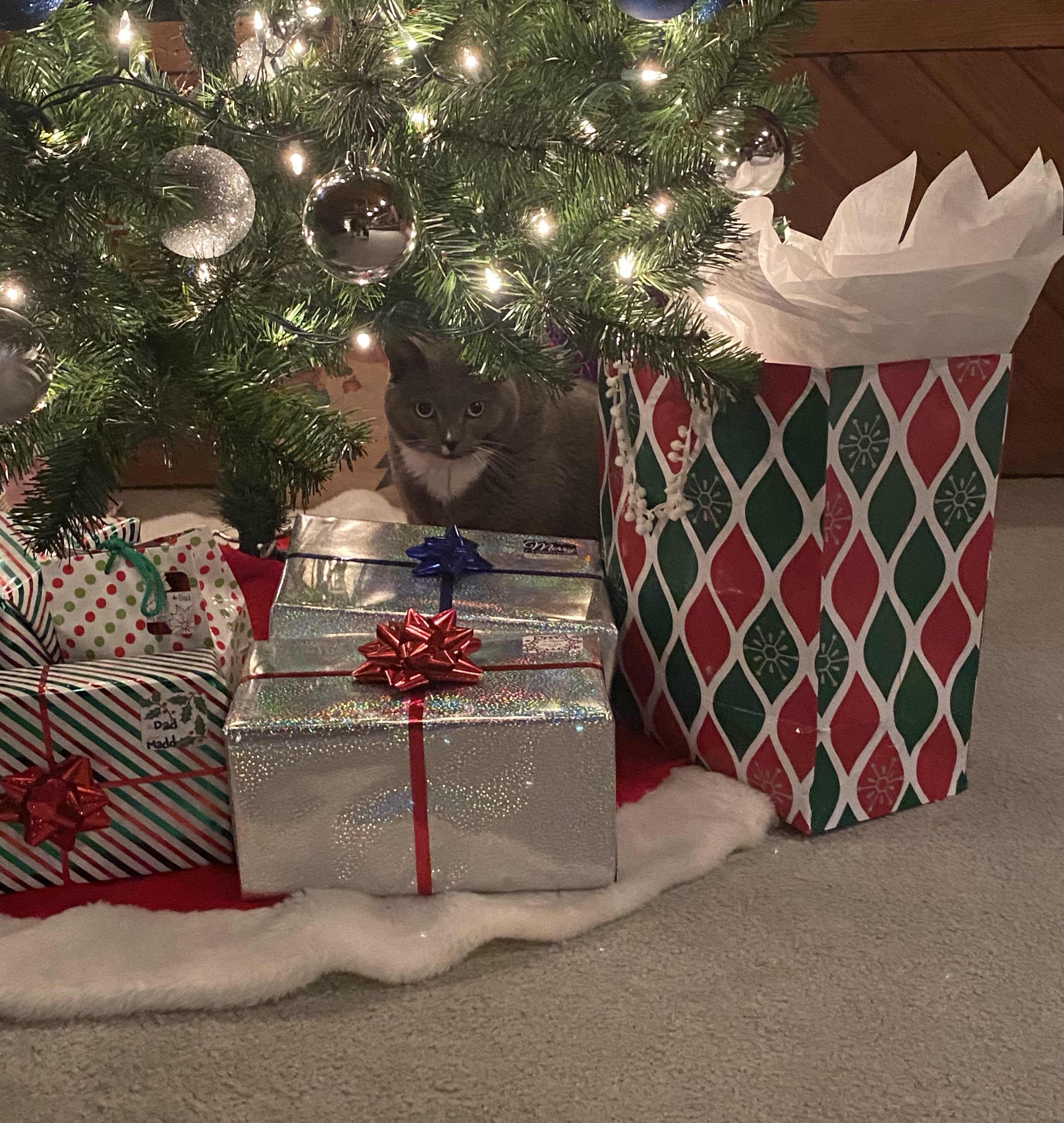
Each day of life is waiting like a present under a tree to be unwrapped!

Besides, who wants a life that is easy?  If life were simple, there’d be no stories to tell around dinner tables, much less work cooler gossip; and, there certainly would not be any fodder for writers who need the challenge of discovering a new story to tell each week in order to meet a weekly deadline!

Photo by Todd Trapani on Pexels.com