

“The breath is the bridge which connects life to consciousness.”–Thich Nhat Hanh

Settle your mind 🧘
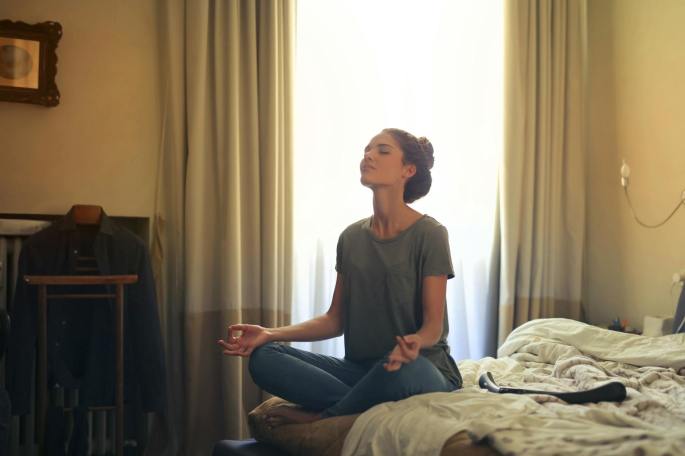
Settle your body onto your mat. See if you can begin to settle your mind.
Soften your eyes. All the muscles around each eye relax.
Release the lines of your forehead; soften your ears, and allow the jaw line to release.
Let the shoulders melt away from your ears as your heart space softens.
Relax the muscles of your hips and legs while you rest in the knowledge that the earth can support you.
Feel the feet relax, allowing the arch and each toe to release.
Take a deep breath in. Pause. Sigh it out through your mouth.
Whatever thoughts, worries, concerns that you had before entering this room, allow them to drift away on the stream of conscious breathing.
Another slow, deliberate inhale. Wait. Now, exhale long, smooth, and controlled once more through your mouth.
Pause once you’ve fully exhaled and gently close your mouth, unless, of course, you are congested and cannot breathe through your nose.
Inhale. Pause for a moment. Long, slow exhale through your nose.
Follow the exhale until your lungs are fully emptied, and wait for a moment before you inhale again.
Once more, be present with the inhale. Intentionally allow for a pause. Then, slowly, with full concentration, exhale–following the exhale until its full conclusion.
Pause, and continue this conscious breathing for the next few minutes.
If thoughts enter your head, recognize that you are thinking. This is only natural. Then, return your attention back to your breath.

Conscious breathing 😮💨
As I write these words, I find that my own breathing has slowed. My own heartbeat is slowing. My thoughts, worries, and concerns about how I will convey in writing what I want to share have begun to loosen their grip on my brain as I allow the words to flow in unison with my breath.
This year in my school setting, I have the privilege of teaching a yoga/mindfulness class to high school students. It is a dream I have had for years finally coming to fruition. 17 students, 11 of which are males, which I find remarkable, signed up for the class. Most, but not all, of the students are athletes, overloaded with the act of balancing coursework with their sports’ schedules and the desire to still have a typical teen social life.
However, when they walk through the gym doors, roll out their yoga mats, their job is to take a break from their very real, youthful concerns. It’s not easy. Like all of us, strands of stress and worries cling to their minds and bodies the way cooked noodles often cling to one another if the noodles have not been properly stirred during the cooking process. My job is to stir the proverbial pot of their mind and guide their bodies through yoga movements that encourage the release, at least for a few moments of their day, from the stickiness of their constant concerns.

The Power of the Pause 🙏
The pause between breath reminds them, and really, all of us, of the importance of taking intentional pauses throughout our day to pay attention to the here and now. Mentally pausing to let go of thoughts of the past, thoughts of future plans, and thoughts of all those unanswerable “what ifs” can be a valuable respite. Taking a few moments to close the eyes, tune out the world, and focus on your in and out breath can release tension and provide a short rest for the mind, eyes, and body.
Even on our busiest days, taking a short pause, enough for a few deep breaths, can renew and refresh your focus, especially if you are feeling anxious and/or stressed. By taking deep breaths, especially those in which you can extend the exhale, sends signals to the body to relax.

TEnd and befriend 🧘🏿♂️
Based upon my limited understanding, longer exhales encourage the vagus nerve to send a signal to engage the parasympathetic system (think: rest and digest or tend and befriend system) and relax the sympathetic system (think: fight, flight, fawn, or freeze system). Those deep breaths, especially with the longer exhalations, let the body know that it is in a state of calm, so that it can “tend and befriend” the work challenge you must complete rather than “fight” it or all together mentally “freeze.”
In addition to soothing the mind and body, by consciously paying attention to our breathing, we can connect to the wonder of being alive, and the miracle that is our body. Our bodies, with its amazing autonomic nervous system, automatically takes care of so many functions and unconscious processes without us having to think about it. We truly are marvelous creations. Conscious breathing can be that bridge between our physical bodies and our conscious minds, as Thich Nhat Hanh pointed out. And, it is a tool for bringing our attention to the present moment. After all, you can’t focus on your breathing and not be aware of the here and now.

Conscious Breathing is the Link
In the end, taking time to intentionally connect with our breath offers numerous benefits. Deep breaths with long exhales can allay our fears, concerns, and worries. It can bring a sense of calm in a short amount of time to an otherwise chaotic day. Conscious breathing can invigorate and recharge the mind for an important and stressful project. Furthermore, deep breathing can link our minds to our bodies while also bringing our attention to the present moment. So pause, take a deep breath, or three, release the grip on your worries and burdens, and reconnect with here and now, and the font of peace that dwells within.
 Steph Simply