Finding Stillness at Charlton Lake Camp: A Reflection

“Only in quiet waters things mirror themselves undistorted. Only in a quiet mind is adequate perception of the world.”–Hans Marggolius

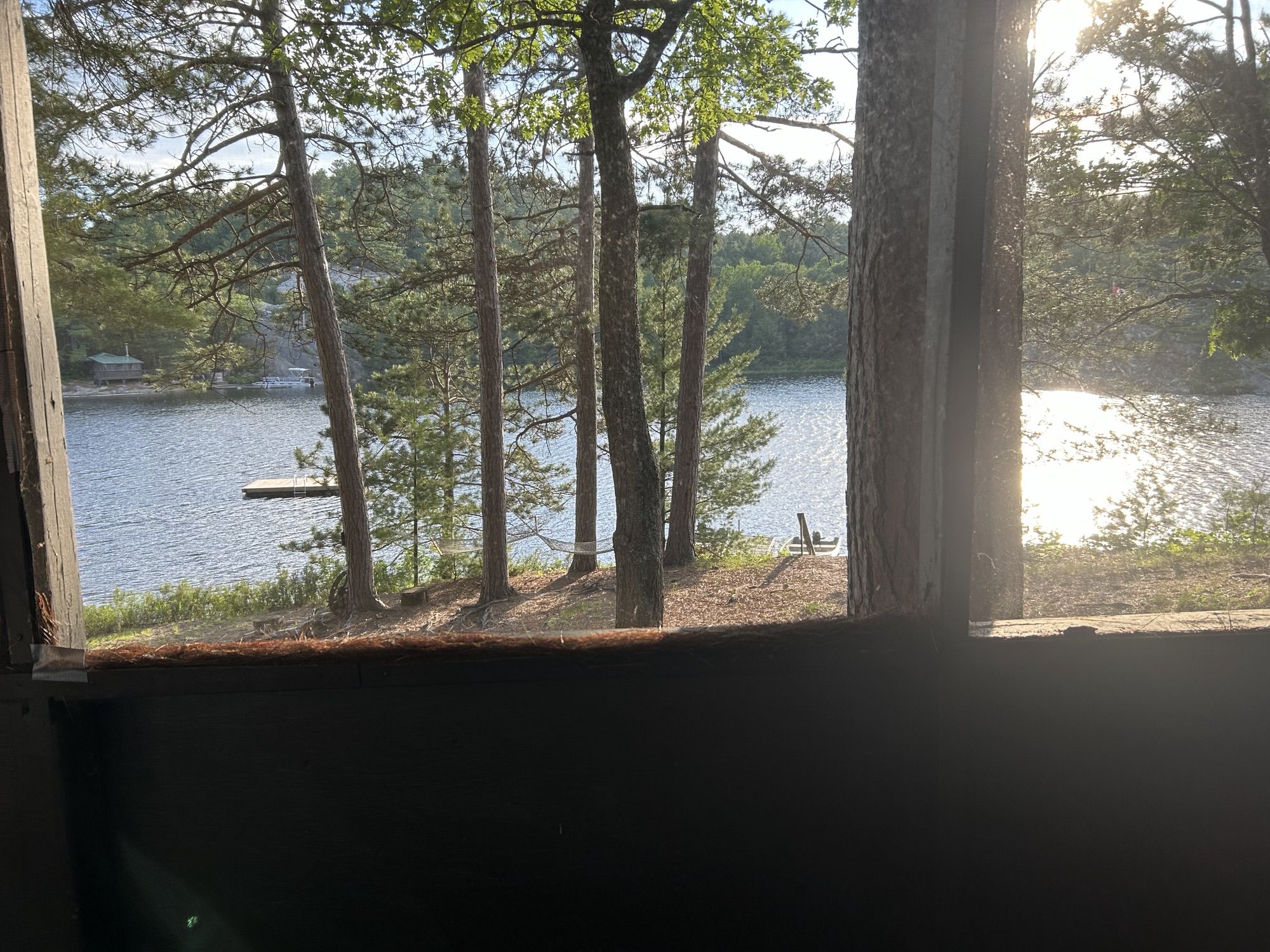
The view through the screened in porch overlooking Whitefish River a throughway to Charlton Lake, Frood Lake, and Cranberry Lake.

Still Waters 🏞️

I sat observing the waters of the Whitefish River flowing toward stillness–moving from one lake to the next, but in a relaxed state of flow that most often seemed to occur in the early morning or late evening.  Occasionally, something would break the surface, and rings would begin spreading outward from the epicenter. When this would happen, I often caught myself holding my breath in anticipation until the last ring dissipated, and the water was once more placid.  Then, with the stillness restored, I resumed my own cadence of breathing slow and steady, matching the river’s pulse.

The peaceful, craggy rise of quartzite rise of the ancient La Cloche Mountains surrounding the lakes.

Lake Charlton Camp 🏕️

My husband, John, and I were staying in Charlton Lake Camp (CLC) located in Killarney Provincial Park, Willisville, Ontario. This was our second trip to CLC, situated in a natural showcase of diverse pines, surrounded by the white quartzite crests of the La Cloche Mountains and translucent, tea-stained waters of Charlton Lake, Frood Lake, and Cranberry Lake with the Whitefish River providing a throughway to the lakes. In the morning, CLC was filled with a wilderness chorus of birdsong, loon calls, bull frogs, lapping sounds of water against rocky shores, and, of course, the buzzing hum of countless varieties of insects. 

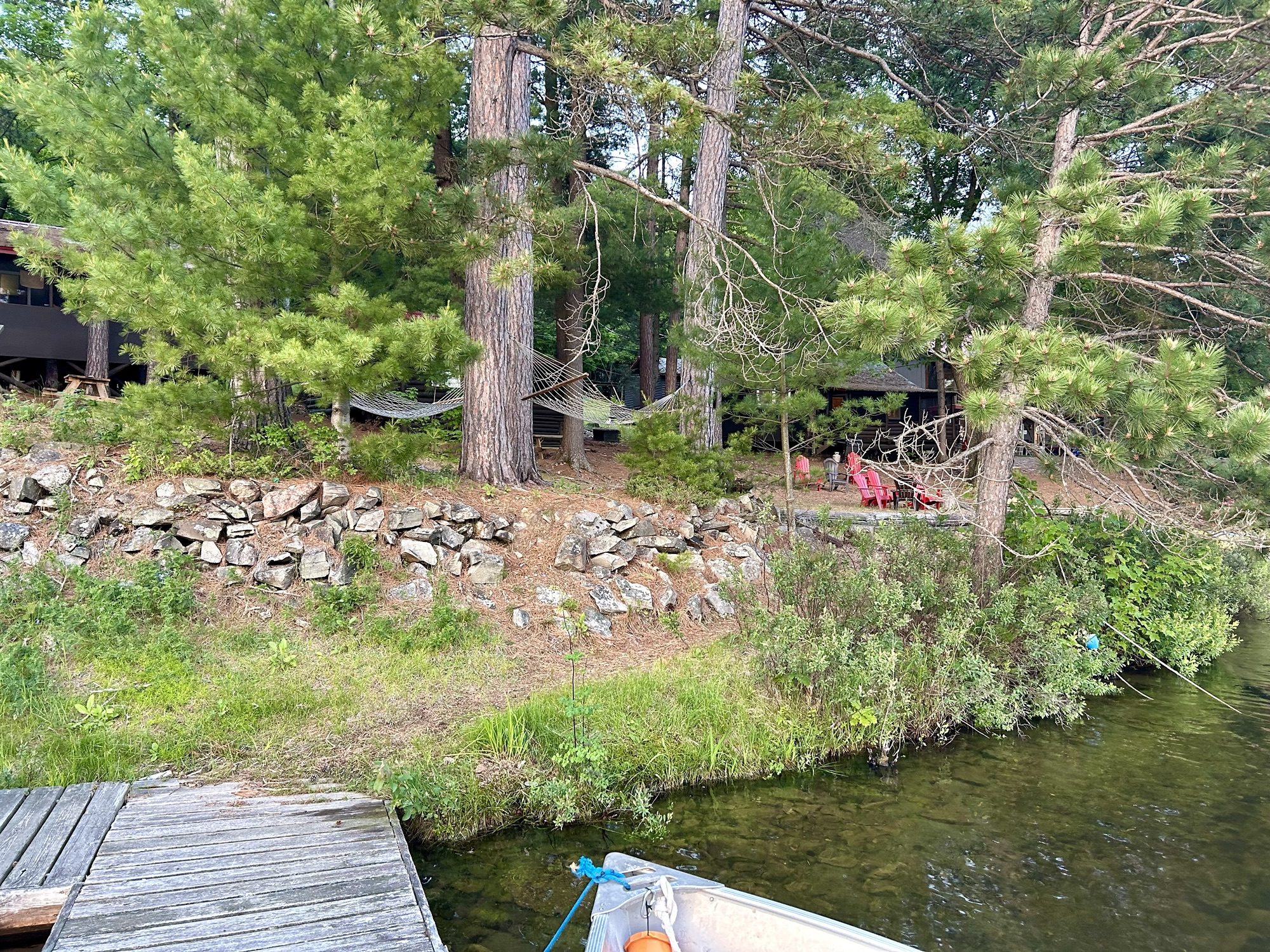
The cabin in which we stayed at Lake Charlton Camp is just beyond the steps that lead to the dock.

Settling into Quiet 🤫

Breathing in deeply, my lungs filled with the aromatic aromas of pines, damp soil, sunned rock, and a hint of morning coffee as I continued to sit and observe, communing with my surroundings. The sun would soon begin lifting above the craggy cliffs behind the cabin in which we stayed, and life would soon begin stirring with those gleaming rays. But, in that moment, hovering between the hush of night and the dawn of daybreak, there was a stillness in which my heart was soft and open–receptive to that still small voice that resides within.

Boating through Frood Lake with the La Cloche Mountains in the foreground.

Slipping into the Gap of peacefulness 😌

I once read that praying is talking to the Divine Creator; whereas, meditation is stilling the mind for the purpose of listening.  Sitting there on that screened porch on the cusp of a new day, I was reminded of that idea.  My heart, head, and soul had relaxed enough to hear the truth–to really parse the ongoing narratives that, when left unchecked, my brain tends to repeat on an endless loop. By settling into the surrounding peacefulness, I could focus on listening, and begin to see how many of those narratives were (and are) often baseless claims forged by past experiences, trauma, anxiety, negative self-talk/criticism, and even a little fear. 

Sitting, breathing calmly, and savoring CLC’s peaceful surroundings through my senses, I found I could let my mind rest easily as if the wheel of ceaseless chatter had ground to stop, or at the very least, slowed its revolution. Taking in a deep breath of the clean, wilderness air, I softened my gaze on the water and continued listening. 

Afternoon sun glistens off the calm waters of Frood Lake.

Riding the waves of emotional influence🌊

Matching my inner calmness to the stillness of the river led me to a realization. My own mind often mirrors those waters of CLC. My mind tends to be at its calmest in the early morning or at night–just before drifting off to sleep, letting go of the day’s worries.  However, once the day fully begins, I am immersed in work and various tasks with multiple decisions being made throughout the day.  As my decision making increases, my judging brain kicks into high gear.  With that continued judgment comes an inner dialogue often influenced and affected by emotions, which rise and fall throughout the day much like the water around me did during the week.

Throughout our time fishing, resting, and relaxing in CLC, I observed how the river and surrounding lakes could quickly become stirred up, rising and falling with the winds of the day, tossed about with a changing weather front, or even fill with large waves when an occasional boat sped across the waters to the farthest end of a lake. There were additional times, when for no discernable reason, the waters would suddenly ascend and descend, jostling the boat John and I were in. 

Riding out the waves of emotions can be similar to navigating a fishing boat over wave-filled waters.

Restless emotions 😬

Fishing during those moments of restless waters and winds was challenging.  The wind would take hold of a perfectly thrown cast and carry the line and lure in a completely different direction than intended. Likewise, when the waters were lifting and dipping with waves, the view beneath the waters was clouded and murky–not allowing the eye to determine if the boat was above rocks, a weed bed, a submerged tree, or any other number of possibilities. Conversely, during the moments of calm, settled waters, navigating and fishing those waters was fairly easy and what was beneath the boat was clearly visible.  

Looking out at the peaceful waters of Whitefish River through the screened porch.

The influence of a RAcing Mind 🤯

The riverview before me, in that early morning hour, was emblematic not only of ideal fishing waters, but also a peaceful state of mind.  Unfortunately, our modern world tends to create and drive the opposite effect–a constant flurry of stirred-up waters–our minds fidgety and/or frantic, racing from one thought to another, moving through agendas of busyness, entertainment, and avoidance. Therefore, if we don’t set aside time to allow our minds an opportunity to cease its chatter and rest easy, how can we ever feel calm and think clearly?

Settle into into the stillness.

The importance of intentional Quiet 🤫

Our inner dialogue is often affected by the changing weather of our emotions.  Those emotions vacillate and shift with each decision we make and with each event we encounter.  And while I fully admit that mind chatter, and all of the emotions that come with it, cannot necessarily be avoided, in similar manner to the weather fronts we experienced during my time at CLC, our emotions can vastly change within the course of a day, much less a week. Therefore, deliberately providing pockets of time for stillness allows us to detach from the emotional narratives, and instead, fosters listening to that still, small voice of knowing, which allows us to, well, “fish” for the truth.

Listen for the whisper of our Creator, the great I AM.

LeT us Listen for the whisper 👂

Ralph Waldo Emerson once penned, “Let us be silent, that we may hear the whisper of God.” What a powerful reminder of the importance of settling the mind, like the still waters that were before me on that morning at Charlton Lake Camp. The type of quiet we choose can be a formal meditation/reflection, but it could also be achieved through walking or other forms of exercise, tending to your flowers/plants, or simply sitting on the porch sipping coffee or tea and listening to the birds. It really doesn’t matter as long as it is an intentional moment set aside to calm those mental waters of ceaselessly, flowing chatter. Prioritizing time for quiet reflection or meditation, however you define it, allows the flow of our hearts and minds to settle, soften, and encounter the “whisper of God.” 

Willisville, Ontario

Get More Grounded: The Benefits and Lesson of Tree Pose

“Be like a tree. Stay grounded. Connect with your roots.  Turn over a new leaf. Bend before you break.  Enjoy your unique natural beauty. Keep growing.”–Joanne Raptis

Photo by SHVETS production on Pexels.com

The magic of Tree Pose 🌳

“Trees sway; get more grounded,” my husband chimed along with the yoga instructor on the DVD as we attempted tree pose on a Monday morning before work, the classic yoga balancing pose that requires standing on one leg. 

I appreciate tree pose for many reasons. It strengthens feet, spine, ankles, legs, and core.  Further, it opens the hip area, stretches the inner thigh and groin muscles.  Plus, it can improve one’s concentration and focus while simultaneously improving alignment of spine and posture.  Most of all, it is a pose of balance, which can help in a multitude of ways. 

Symbolically, tree pose serves up several lessons. However, one of the more literal lessons of tree pose is that of remaining in the present moment.  It’s nearly impossible to balance in tree pose and think into the future or reflect on the past because you end up falling out of the pose. I was reminded of those lessons this past Tuesday, or as I have come to know it as, “Twister (or Tornado) Tuesday.” 

Photo by Ralph W. lambrecht on Pexels.com

Shelter in Place 🌪️

As a veteran educator, I have experienced a wide-array of events, including those that require shelter-in-place. In fact, I can still recall the first time I experienced shelter-in-place with students 30+ years ago.  I was teaching in a mobile unit at a great distance from the main brick and mortar school building. The students under my care ranged from 5-12 years of age, and they had been identified as “severe behavior handicapped.”  

There were twelve students, ten boys and two girls.  Since this was the early 1990s, computers and cell phones were not widely available in the classroom setting. This classroom had an intercom type “phone” that only connected from the school office to the classroom.  It was through this “phone” that I received the message that the entire school was sheltering in place in the hallways.  The school received a call that a tornado had touched down in another part of the county and was heading our way. I was to gather my twelve, not-always-so-compliant students, and move them to the main building as quickly as possible.

By the time I received the “call,” a heavy metal concert of rain and wind had already begun, drumming and shaking the metal building rhymically with tantruming, angry torrents of sideways rain.  Quickly, the paraprofessionals and I helped the students into their school-issued red rain parkas, and that is when the resistance began.

“I am not going out in that rain.”

“I don’t like getting wet.”

“No, I won’t!”

“I’m scared!”

Whether it was the determined, I-am-not-kidding look in my eyes, Divine intervention, or a combination of both, the paraprofessionals and I miraculously gathered all of them in a line.  Holding hands as one unit, we began fighting our way through the class door that kept trying to swallow us back inside due to the enraged winds. Once outside, raindrops pelted any exposed skin, including the students’ face and heads as their hoods were immediately blown off.  We fought our way to the safety of the school while the passion of the rain and winds seemed to increase and determinedly tried to shove us backwards. 

By the time we made it to the school, none of us were dry as the pernicious storm found a way to penetrate even the sturdiest of rain coats.  Quickly, we hustled the students to the primary wing of the school, finding a piece of wall away from windows where they could drop to their knees and cover their heads, rivulets of water streaming over all of us, while adrenalin continued to accelerate my heart rate.

Photo by monicore on Pexels.com

Twister Tuesday 🪟

This memory bolted through my mind on “Twister Tuesday” as my classroom, and the surrounding classrooms, were filled with the strident sound of the emergency broadcast system sending an urgent message to seek shelter immediately. Our middle school classrooms are located on the top floor of our school building, and the entire middle school was directed to make their way to the first floor as quickly as possible. In order to do that, we had to run down three flights of stairs in a glass-lined stairwell. As we headed down, the irate storm quickly made its presence known.  Like Lyssa, a figure in Greek mythology who is said to drive others mad, the storm insanely clambered and clawed at the windows demanding to get inside, but meeting a wall of resistance.

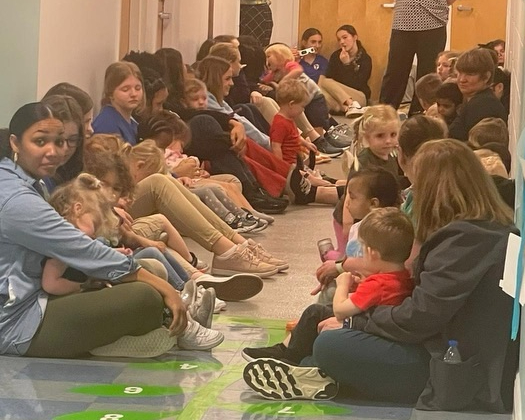
Once downstairs, it was hot, crowded, and overripe with the odor of sweaty, nervous bodies as we sheltered in place away from doors and windows alongside first and second graders as well as preschoolers from the two- and three- year old classes. At times, there were crescendos of anxious voices of students–or, in the case of some of the little ones–crying. During other moments, there were a few older students who experienced panic attacks, but there were many more who remained calm.  There were even those selfless students who chose to hold, cuddle, and comfort younger preschoolers, focusing on the needs of others, rather than themselves.

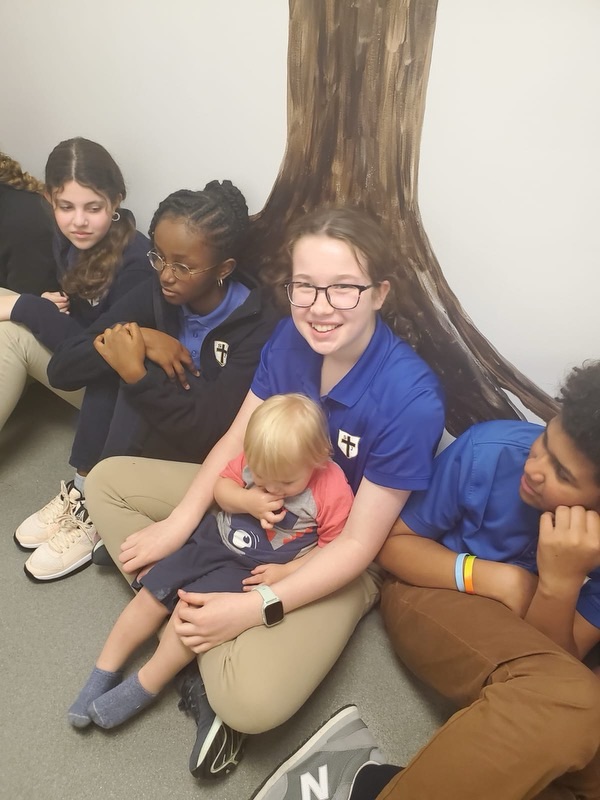
Middle school students caring for the needs of preschoolers during a shelter in place scenario.

And if you Fall . . . Pick yourself 🆙

As I walked among the students, checking on them, assuring some, answering questions of others, my mind echoed with the words from the previous day, “Trees sway; get more grounded.”  And so, I ground down into my faith.  If the students and staff of my previous school survived that former storm way back in the 90s, surely we would survive this one too.  My emotions could sway like the tree on the inside, but the more I swayed, the more I reminded myself to ground down and try to remain balanced in the present moment in order to better focus on those around me.  

It wasn’t easy, and I wasn’t perfect.  But here’s the thing about tree pose. It’s a great way to practice falling. If you fall out of tree pose, you pick yourself up, and try to return to the pose once more.  

Like my beloved tree-pose, Twister Tuesday provided another stretch and realignment personally and professionally as well as to my faith. It challenged my focus and concentration in order to remain balanced.  And when I “fell,” forgetting to remain focused on the present moment, all I had to do was “pick myself up” and try to return to it once more. Most of all, that Tuesday served as a powerful reminder of the power of the True Source dwelling within and around us, always available to keep us grounded. 

Another middle school student getting grounded in the present moment of another’s need.

Do you disturb the peace, or perpetuate it?

  “If in our daily life we can smile, if we can be peaceful and happy, not only we, but everyone will profit from it. This is the most basic kind of peace work.”–Thich Nhat Hanh

The tail twitches and crouching ensues. Hips raised, ears flattened, the tail twitches more rapidly.

“LJ, stop!”

He remains immobile and continues his focus.

“LJAAAY,” said with slow emphasis on the A-sound.

A look is tossed over his lowered shoulders, signaling he doesn’t feel like listening.

Hand reaches for the spray bottle, and John, my husband, walks towards LJ, trigger aimed.  That is all it took. LJ, our solidly black cat, takes off in an attempt to avoid being squirted, but he’s not to be conquered.  Not yet. 

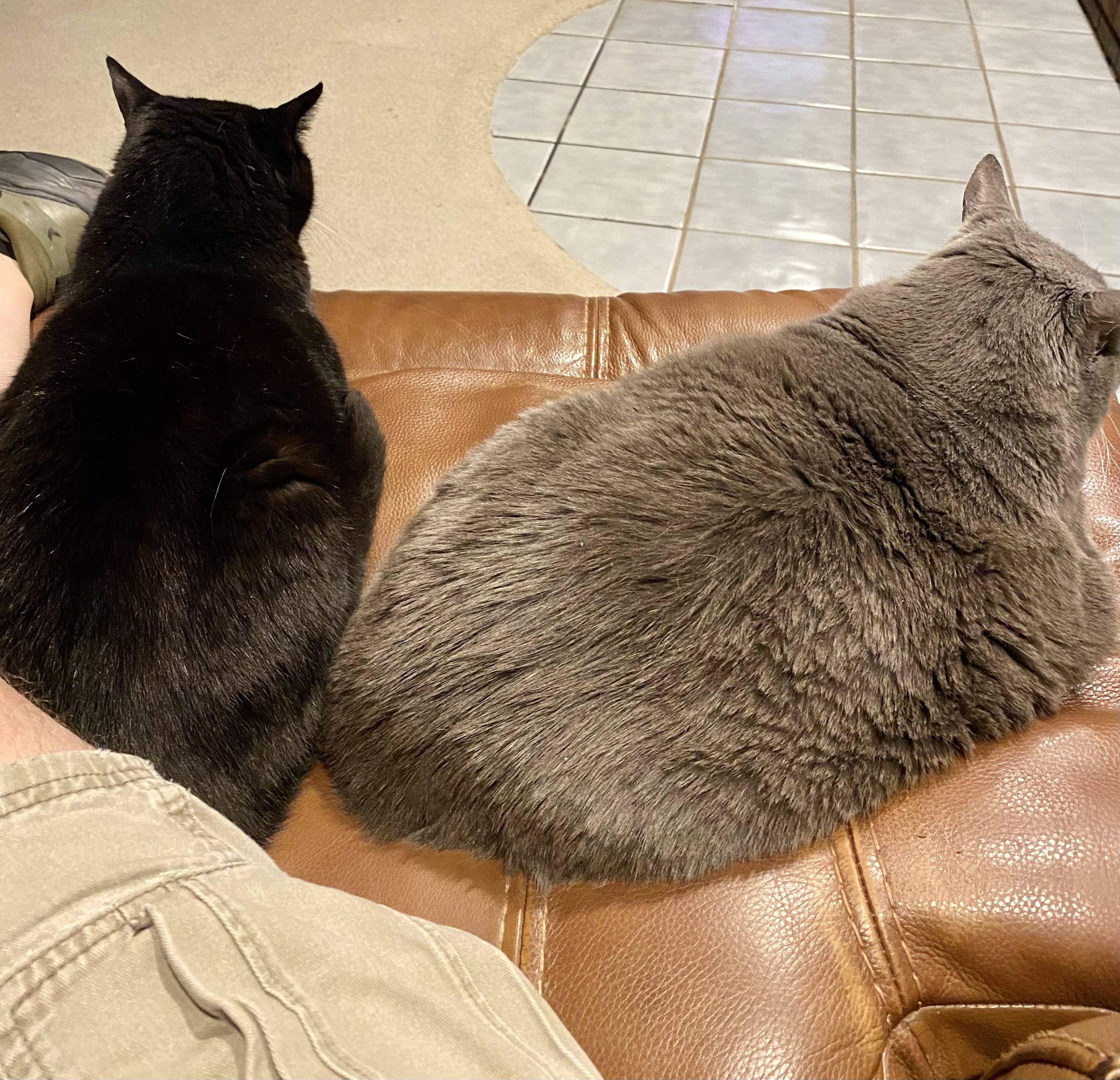
He circles back around the dining room table and reenters the same room through another entry point as if we can not see him.  Meanwhile, the desire of his pouncing antics, Tippi (Tail), our 14 year old gray cat, with the exceptions of tuxedo white on her chest and tufts of white on the tips of her paws and tail, sits peacefully undisturbed.  The only sign that she is aware of his shenagings is the very slow whishing of her tail along the top of the carpet.

LJ prepares to pounce once more; however, John rapidly squirts water in LJ’s direction.  Although John isn’t trying to precisely hit LJ, the sound and sight of the water sends LJ scuttingly out of the room.

Tippi looks towards where the water missed its target, turns her head back to its original position as her body sighs towards the floor in a perfect cat loaf.  Her tail encircles her body once more.

Throughout LJ’s attack, Tippi remained peaceful, never hissing or spewing.  While her tail signaled her awareness, she did not otherwise bring attention to LJ’s negativity.  Instead, she chose to remain at peace with it.  Vigilant, but non-reactive.  

John and I have watched this play out repeatedly, yet no matter how many times LJ attempts to attack Tippi Tail, she rarely responds out of anger. To be sure, Tippi will occasionally respond if he corners her. Mostly, though, she remains peaceful and at ease.  

LJ is a bit younger than Tippi and has not moved from the self-absorbed stage of life.  He wants to be the center of attention on his terms.  If the humans in his home, family members or visitors, aren’t paying attention to him, he finds ways to draw attention to himself.

For example, if Tippi decides to sit with one of us, due to her arthritis, we find ways to offer her assistance to climb up beside us, such as slightly lowering the reclining portion of a chair or couch.  As she tries to lift herself up to position, LJ will haughtily cross the room and attempt to “beat” her to the desired person.  If we move a step stool near the bay window, in order to assist Tippi’s assent to the cat beds in the window, LJ will try to block her attempts in order to claim the bay window area for himself.

Nonetheless, Tippi Tail finds ways to persist with grace and equanimity.  Her peace remains (mostly) unflappable.  Neither does she appear to hate LJ, nor does she appear to be jealous of his presence.  Instead, she seems to understand with a sense of compassion and patience that he can’t help what is inside him–his tendencies to compete, invade, dominate and exploit perceived weakness.  

Due to her serene perseverance, there reigns an unspoken peace between the two cats . . . most moments.  The more peaceful and tolerant Tippi becomes, the more LJ is learning to become that way.  It has taken years, but there are times I will wake up in the morning to find both cats sleeping at the foot of the bed–not necessarily near each other–but in the same approximate area. Furthermore, it is not unusual during cold days to find both of them soaking up the morning sun in the same room and within the same area, albeit, not touching each other.  

Sometimes, upon waking, I am surprised to discover, after I turn on the bedroom lamp, that both LJ and Tippi Tail had been peacefully sleeping at the foot of the bed.

Thich Nhat Hanh once wrote that, “When another person makes you suffer, it is because he suffers deeply within himself, and his suffering is spilling over.” When LJ sees Tippi with one of us, he suffers jealousy because he perceives that she is getting all the attention and love.  If he sees that Tippi wants to be in one of the cat beds in the bay window, he suffers fear because he is afraid there isn’t enough secure space for him in the sunlight to cozy for a nap.  

While they both lived their early lives as stray cats, it is possible that something happened in LJ’s past that causes him to remain stunted and insecure.  Then, again, due to the fact, Tippi is older, and lived with us longer; perhaps, she feels solidly secure with her position in our family.  It could also be that she remembers a time when she was the younger cat in the house, competitively trying to exploit the weakness of one of our former cats, in order to gain our attention.  Possibly, she has simply outgrown those impulsive years. 

Whatever the reason(s), Tippi seems to understand that within LJ are potential seeds of love, compassion, playfulness and peace.  However, she also appears to sense that LJ is dominated by seeds of willfulness, anger, fear, and insecurity.  Due to age, circumstances, and/or experience, she is mindful of these seeds both within herself and within LJ.  Therefore, it often appears that she uses this insight to mindfully choose her actions–modeling peaceful behaviors, and only fighting back in order to keep from getting hurt when he corners her.  

Of course, I have personified my cats in order to make a point. To live in peace and harmony with others, we must recognize that all humans have similar needs/desires:  food, water and shelter, safety, esteem/value, love/belonging and so forth.  There is often fear and/or a feeling of lack when humans sense one of these is missing.  Additionally, everyone has the potential to develop and foster seeds of insight, self-awareness, and self-control, but not everyone focuses on developing these, much less developing them at similar rates.  

As the story of Tippi and LJ illustrates, it is important to be aware of our own insecurities, fears, and impulses in order to exercise self-control.  Recognizing our own proclivities with compassion and understanding, allows us to offer that same consideration and empathy for others.  

While this is never easy, and it takes practice, by learning to be less-reactive and modeling more appropriate ways of speaking, engaging, and responding to others, the more we can reduce conflict.  Of course, this is not to say we passively agree or accept all behavior and actions; rather, it is important to recognize that not every word, action, and deed with which we disagree needs a response.  Furthermore, if a response is required, how much more productive and beneficial they can be when given with considered insight/thought, self-control, and discipline   

Wouldn’t the world be a better place if we could all learn to do what Tippi does with LJ– pursue patience, tolerance, and think before acting.  

The more Tippi practices patience and tolerance with him, the more LJ is becoming more at peace with her.