Cultivating Compassion in a Clamorous World

Your work is not to drag the world kicking and screaming into a new awareness.  Your job is to simply do your work . . .sacredly, secretly, silently . . .and those with ‘eyes to see and ears to hear’ will respond.”–Unknown

A row of shopping carts with red seats lined up in a parking area, creating a visual of retail readiness.
Photo by Ulrick Trappschuh on Pexels.com

A Quiet Act of Compassion 🤫

I was recently in a local dollar store. There was a person checking out that was $5.00 short of the total amount needed to pay their bill.  The clerk patiently waited while the person checking out asked their companion if they had cash on them. When the companion did have any cash, the clerk quietly offered to give the person the $5.00 stating, “I know what it’s like to come up short when it comes to money.”

This act of unpretentious compassion remained with me for days. The clerk was not doing it for recognition, she spoke too discreetly for that. If I had not been nearby when she offered the money, no one would have witnessed her act of generosity.  

In stark contrast to this sales clerk, however, we are enmeshed in a clamorous, overstimulating, attention-seeking era. Loud-speaking voices vye for our attention as do flashy images, catchy phrases, and repeated catch phrases–all playing the game of who can garner the most attention, especially on social media platforms, news outlets, and marketing campaigns. In fact, it often seems to me that bullying, arrogance, and even superficiality are now considered acceptable, if not desired, traits. While characteristics such as humility, deep listening, and thoughtful consideration are undervalued or overlooked. 

A man in a suit appears to be angrily shouting or expressing frustration while leaning over a wooden table.
Photo by Andrea Piacquadio on Pexels.com

The Clamor of Modern Society 📢

Furthermore, the use of repetitive, often vitriolic, messaging can undermine our own belief systems if we are not careful and purposeful with our daily habits. In fact, popular messaging and marketing, if exposed to it often enough, can even degrade the way we choose to comport ourselves on a daily basis. Our ability to remain authentically aligned to our core beliefs and values can be further degraded with continued exposure.

How do we remain steadfast in our core values, much less act as an agent of civility, courtesy, and even compassion with others, like that store clerk, in the midst of a popularized contrarianism?  Do we completely avoid social media, news outlets, and other outside sources of information and entertainment?  Do we cut ourselves off from the outside world and live as hermit?  Certainly not. 

Scrabble tiles arranged to spell 'WE RISE BY LIFTING OTHERS' against a plain white background.
Photo by Brett Jordan on Pexels.com

Cultivating Grounding Practices 🙏

I do believe it is possible to stay true and aligned to a path of decency and decorum. It does, however, require acting with a certain level of discipline, such as limiting time spent on social media, watching/reading news, streaming services, and so forth.  Additionally, it further requires creating habits/regular practices that support and deepen our foundational beliefs, such as prayer/meditation, regularly reading scriptures or sacred texts, and/or connecting with like-minded people that enhance, strengthen, and support our values. These deliberate habits of personal energy keeps us grounded and moving forward along a path of integrity.

A smiling woman in a black sleeveless top seated in a modern setting with green plants in the background.
Photo by Alexander Suhorucov on Pexels.com

Leading through authenticity 😃

By living authentically and intentionally, we don’t need a megaphone or platform to share our message.  Instead, we can focus on our primary responsibility, which is to cultivate our own work and/or calling in order to positively contribute to the world around us.  It is not necessary to proselytize and strive for attention in order to do this; our actions can speak for themselves.

If we choose to live and work from a place of inner strength, we can foster the power of a quiet presence, leading by example rather than boasting and posting all of the ways others should live/act/work. This doesn’t mean that we don’t set expectations for ourselves, or for others, if we happen to be in a leadership position, it just means we don’t publicly berate others who don’t meet those standards, nor do we boast about our own accomplishments. Rather, we can strive to strike a balance between leading by example and fostering an attitude of support in order to lift up others, so that they, too, can reach their potential. Helping others reach expectations can be achieved without a bully-pulpit.

A family walking by a lake, with an adult female holding a camera and interacting with a young child on a balance bike, while another adult male walks alongside them.
Photo by RDNE Stock project on Pexels.com

Trust the process

Of course, there will always be times of resistance and discouragement, both personally and when working with others. However, forcing or attempting to control often leads to more resistance.  I know as a teacher, and on a personal level, when asking a child–or myself for that matter–to learn a new and difficult task, the more I push the child, or myself, the more resistance I often encounter. 

Sometimes, we have to step back and trust the natural unfolding of awareness, which isn’t easy.  It often takes time, space, and many attempts that end in failure before the a-ha moment arrives. However, by allowing others, or ourselves, to awaken at their (our) own pace, we create a more sustainable and respectful relationship with others and/or with our own work

Two hands engaged in a handshake, symbolizing connection and support, with a group of people in the background.
Photo by RDNE Stock project on Pexels.com

Be a catalyst for change

The power to be a catalyst for change resides within ourselves and within others, but it doesn’t require force or brash tactics. Instead of being rude, loud, or stridently trying to convince or control others, we can choose instead to live with consistent habits that foster our integrity, allowing us to lead by example, and work for change through our actions, choosing to empower, encourage, and uplift those around us. By quietly setting an example, embodying our core values, faith, and beliefs, our presence can inspire and affect the world around us.

Generosity Ripples

Witnessing that one small act, served as a reminder that our energy and intentions have the power to make an impact. It further illustrates the importance of humble generosity–doing the right and/or kind thing quietly and habitually, without fanfare or need for attention, can still have a positive influence that spreads. Just as a spring petal falls from its tree and gently floats on currents of air until it lands on the waters of a nearby stream, creating ripples from the center of the stream to its banks, so do deeds of goodness and mercy continue on.
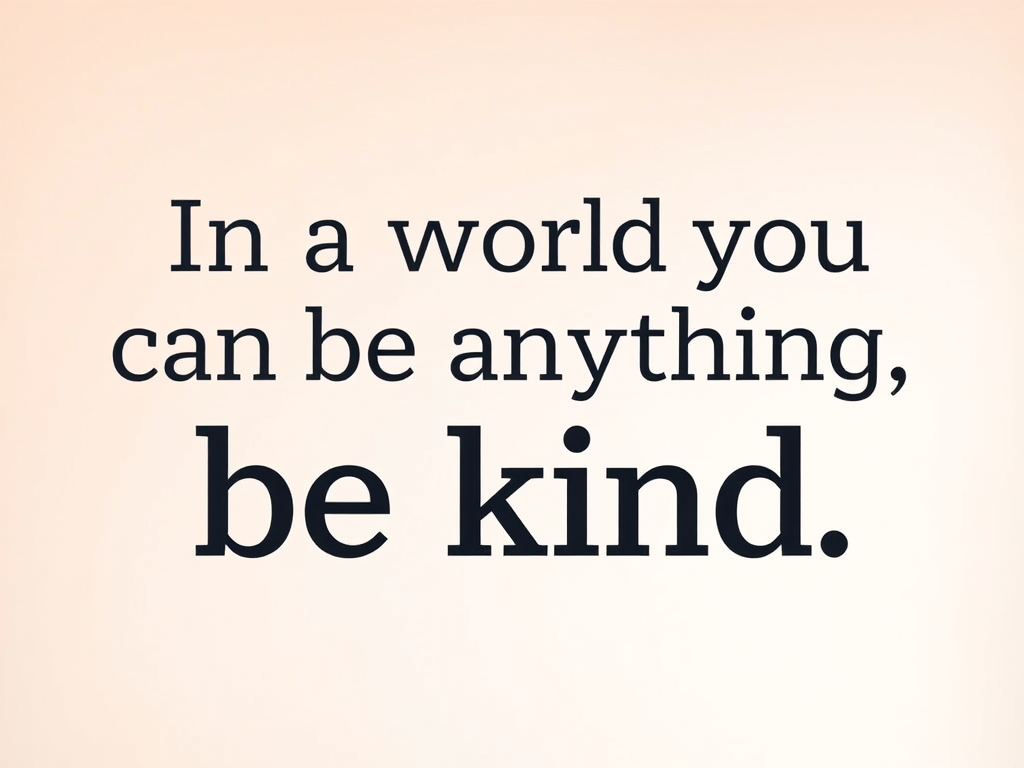

A quote encouraging kindness in a simple, elegant font on a light background.

Finding Inner Peace Amidst Chaos

“Better to keep yourself clean and bright; you are the window through which you must see the world.”–George Bernard Shaw

Photo by thevibrantmachine on Pexels.com

Anxiety provoking 😬

Over the past weeks, I find I am feeling increasingly anxious as I read or listen to the news and/or various social media platforms. There are world events with real human and environmental consequences that worry me. Children are dying from injury and/or starvation in numerous parts of the world.  Plus, the current political climate in our own country is so vitriolic and divisive, it can tie my stomach in knots if I listen or read about it for too long. 

A few days ago, I was leaving work after an especially long day.  Ready to shake off the day, I unloaded my daily work wares into the back of the vehicle, and hopped in the driver seat ready to get home and shake the dust of the day off.  I started the vehicle, and the radio automatically came on.  

Photo by Sindre Fs on Pexels.com

We have a choice 🙉

By word of explanation, I had been listening to a book on the way to school, but because the bluetooth had not yet connected, the radio, set to one of the local public radio stations, automatically defaulted on. Since it was between 5:00 and 6:00 pm, the news was on.  And while NPR is fortunately not one of the news outlets that seems to shout out every headline, it was in the middle of a story that, as my ears focused, began to make me feel worried, and I could once more feel my insides churning. 

I continued listening for a bit more as I headed out of town, but found myself increasingly feeling more anxious.  Suddenly, it occurred to me. I had a choice.  I didn’t have to listen. So, I turned not only the news off, but the entire media system in my vehicle, rolled my window slightly down, and allowed the fresh air to filter in. 

Photo by Aleksandar Andreev on Pexels.com

Connect to Your Breath 😮‍💨

Then, while I drove the rest of the way home, I took time to connect to my breath and to that still, inner voice. 

Inhale. Exhale. Release the jaw. 

Inhale. Longer exhale. Relax the shoulders down and release the grip in my gut. 

Long slow inhale, fill my lungs with fresh air flowing through the window. Pause. 

Then, a longer, relaxed exhale. Loosen the grip on the steering wheel and relax

 the lower body. 

I continued driving like this, using my breath as an aid to continue to relax other parts of my body that I had been unconsciously gripping tightly as the day progressed. I would not have noticed how tightly wound my body was if I had continued listening to the news.

Photo by cottonbro studio on Pexels.com

Connect to Gratitude 🙏

Once I felt a bit more relaxed, I tried to list, in my mind’s eye, five things for which I was grateful. Nothing could be too small, such as, feeling grateful because I had not forgotten my lunch on that day as I had forgotten it on the same day the previous week. But, even more so, I was also grateful for my health, my family, my home, and so on  . . . With each point of gratitude, I took time to pull that image up in my mind and genuinely reflect on at least one particular point of joy each one brought to my life.

Now, I will be honest, there were a few times when I lost my focus due to other drivers, deer crossing the road, or other random distractions.  If I found myself lost in thought, I brought my inner attention back to my breath first, and then back to points of gratitude.  

As I drove closer to home, I mindfully began to release concerns for which I could not control. I prayed for them, but ultimately, released my worries to God. I decided to trust and have faith that my concerns will ultimately work out for the best in ways I could not see or perhaps understand. It did not mean I was dismissing the issues that concern me–I was not.  Instead, I was releasing my stress over them because my anxiety would/will not affect their outcome.

Photo by Stanislav Kondratiev on Pexels.com

Shutting out the winds 🪟

Years ago, I read a story about a monk who had been writing a book.  This was the time period prior to computers, when one would alternate between handwriting manuscripts and typing the final drafts. This monk decided he needed to take a break from writing and went out for fresh air and a walk. 

He left open the windows of the small cottage in which he lived. And as he walked, the weather began to shift, and the wind began to pick up.  When he arrived home, an hour or so later, all of his neatly stacked papers for the book had been tossed about within the house. In order to tidy up the inside of his cottage and reorganize the manuscript, the monk had to close all of his windows to keep out the changing weather.

This story simply illustrates the point that sometimes, if we are consuming too much news, social media, family/friend drama, and so forth, our inner world suffers.  Like the monk’s cottage, the winds of life can toss our inner peace about.  Therefore, it is worth remembering we have a choice. We can choose to take time to shut out, turn off, or let go of the outside world/drama, so that we can turn inwardly, and focus on “tidying-up” the worry/concern/ anxiety inside of us.  

Photo by Alex Green on Pexels.com

It’s not always “breaking News,” so set boundaries 📰

We don’t have to read/listen/scroll through/watch the news and social media at regular intervals throughout the day.  We can take breaks from all of it. In fact, we are not of any benefit to ourselves, much less others, if we aren’t settled and at peace on the inside.  Thus, taking time to connect with your breath and that small, still inner voice can strengthen and renew you, filling you with a sense of calm/peace in order to help others and/or take on challenges.

While we don’t want to completely shut off the world and hide our light, we do have a choice as to where, when, and how much we participate.  Setting boundaries and/or taking breaks from what and how we choose to consume social media and news is within our power, and it doesn’t mean we are absconding from our civic or social responsibility to the world around us. 

Shine your Light 🕯️

If we hope to shine our light and engage in meaningful ways that can contribute to the betterment of our family, friends, community, and even world to the degree possible, we must also take time to close the proverbial outside windows and tend to our own inner world.  After all, even a candle must be protected from the wind in order to burn. 

One breath in, one breath out for peace and calm

 “We need to find God, and that cannot be found in noise and restlessness. God is a friend of silence. See how nature–trees, flowers, grass grows in silence . . . We need silence to be able to touch souls.” –Mother Teresa

Photo by John-Mark Smith on Pexels.com

The Miracle of EArly Morning 🌅

One of my favorite times of day is the stillness of the early morning.  Don’t get me wrong, depending upon how early I have to get up, it can be a chore to drag myself out of bed.  However, once I am up, enveloped by the hum of the house and the ambiance of the celebratory, daybreak birdsong, I feel a peace begin to zip up around me like my favorite hooded jacket. 

Now that daylight arrives earlier, it is especially delightful on the weekends to sit at my desk, steaming mug of coffee beside the laptop, and gaze out the open window as the birds continue their lilting praise of the arrival of daybreak. Sometimes I see the contrails from a jet writing across the sky.  Other times I observe the rustle of trees or my neighbor’s cat stalking some unseen prey. Regardless of what I notice, I take a deep breath, and invite the silence within.

Gazing out into the trees and grass of my backyard, there is a peacefulness of the Divine Presence.  Observing the continual miracle of seasonal change, I am bearing witness to the continuity, strength, and resiliency of nature.  With one breath in and one breath out, I can connect to Divine life force within, silently supplying me with continued strength.

Photo by Engin Akyurt on Pexels.com

Welcome the Silence 🤲

I continue to welcome the silence, and I allow it to wash over me, cleansing the stresses and worries of the night that interrupted my sleep.  I ask God to hold space for me within the silence as my soul settles into place. One breath in. One breath out. Each breath, rich in the silence, nourishing my peace of mind, if only for a few minutes.

Momentarily, I become part of the silence and my brain softens into the quiet, temporarily liberated from its continuous lists of things to do, notice, and concerns. One breath in. One breath out. I feel the silence breathing peace through me, filling my cells. I ask for the peace to live through me and to emanate from my actions, knowing even then, I will still stumble into mistakes.

The early morning silence centers and anchors me to the importance of being more mindful of the here and now.  One breath in. One breath out. I allow the silence to cultivate peace within that moment, and I ask that it remain with me as I move through my day, understanding that disturbances of my inner peace will also most likely occur throughout the day. I further pray the silence will infuse and imbue my day with moments of peace I can offer others, if only through the simple act of a smile or kind word.

Photo by Csankovszki Tibor on Pexels.com

Whispers of Silent Inspiration 🙏

If I am fortunate, the silence will sometimes whisper inspiration when I do encounter stress in a later moment. It only requires that I momentarily bring awareness to my breath, and once more, I can connect to the True Source filling my lungs, giving me life. One breath in.  One breath out. 

When the silent morning meditation begins to wind down, I become more aware of my surroundings and my own physical body.  I look for those poetic plane contrails, but they have usually vaporized, reminding me of the impermanence of struggles, strife, and life in general.  One breath in. One breath out. My words, my thoughts, my deeds are like those contrails, here, in this moment, but eventually given to the heavens.

Bringing awareness to the moment, I will feel the tendrils of morning silence loosening its grip, and I mourn briefly that I must leave its embrace. There are more words to be written, more students that need taught, and more people that need loved.  One breath in. One breath out. I remind myself that I can always come back to the comforting peace of the silence of my mind with one moment of conscious breathing. 

Photo by Dom J on Pexels.com

The antidote to noise and Chatter 🧘

It seems to me that we currently live in a world where many of us have forgotten, or even fear, silence.  Chatter and noise seem to flow in an endless supply, alongside daily routines filled with responsibilities and heaping portions of distractions. However, by seeking the solace of silence and focusing on your breath, if even for a few moments, we may discover our heart rate slows, racing thoughts may decrease, and the body may relax a bit.  One breath in.  One breath out. 

The older I get, the more my appreciation and need for silence grows.  If we listen too long to the noise of the media, news, traffic, screens, chatter, and so on, our stress increases, our worry increases, and our anxiety increases.  We forget that silence soothes our souls and brings us back to the presence of God within and around us. All it takes is one breath in and one breath out. 

Always wanting more? Try looking inward instead

Photo by Jensen R on Pexels.com

“Things are just that–things.  They don’t make us who we are.  They make us look better on the outside, even when we’re hollow on the inside.  They’re an illusion–the shiny objects that distract us from the really important things.”–Chelle Bliss 

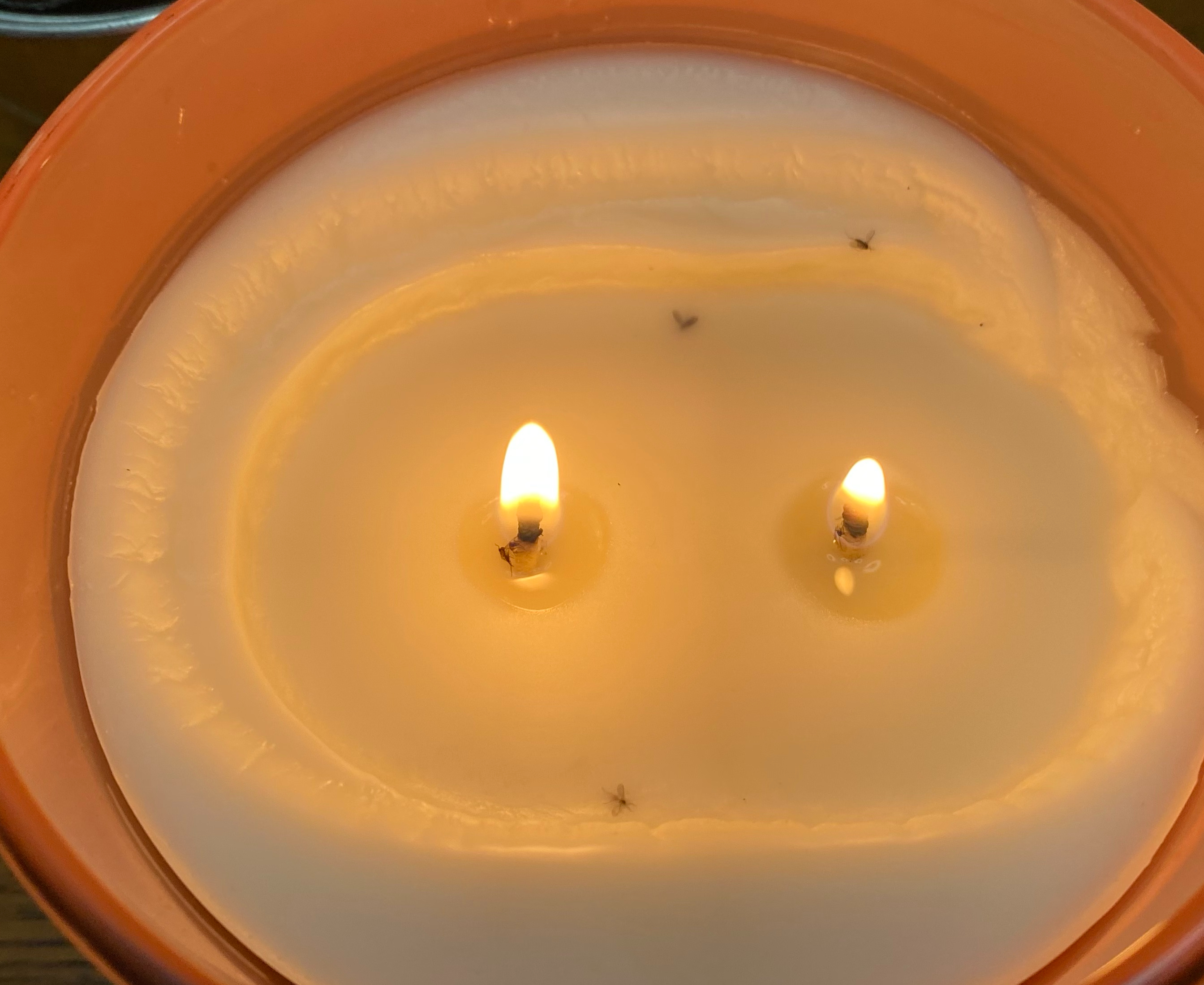
Trapped in the Wax 🕯️

  The day had been cool and cloudy, and I had come home with a bit of fresh produce, including a variety of fruit.  Given the weather, I thought it seemed like the perfect time to light the fragrant candle, a gift from a student.  I did not think about the fact that fresh fruit, during certain times of the year, is often accompanied by tiny little flying insects.

There they were, though, tiny bugs trapped in the melted wax because they had been drawn to the light of the candle.  Their attraction to shiny things had caused their demise in the end.  I wonder what they sensed the candle light could offer them–if they felt the candle’s sparkling flame would somehow improve their lives.  

Did those bugs confuse the candlelight with sunlight or moonlight?  Did they think it would help them navigate through the otherwise overcast day?  Perhaps, those pests confused the candlelight with bright flowers that nourish insects with nectar?  Were they trying to escape some unseen predator and sense that the bright light would blind their predator from seeing them.  Then again, maybe they were the predators looking for a meal, or were they looking for a suitable mate?  

They were so attracted to the flames, they lost their way and became stuck in the melted wax.

Attracted to the Brilliance ✨

Even science doesn’t seem to know the exact reasons bugs are drawn to light, and it made me wonder why humans, likewise, are drawn to shiny things?  Big vehicles, the bigger and shinier the better.  Large homes filled with sparkling appliances, a multitude of large screens, and a variety of other collections, depending upon a person’s interests and means. Closets gorged on a feast of clothes and shoes. Not to mention the cultural attitude about prosperity: those with means have been “blessed.” (I’m not sure what that means for the rest of us.) 

Then there is the shininess of beauty, youth, and attractiveness, especially since our culture tends to place more value on the looks of youth over the experience and wisdom that comes with aging. Cosmetic injections, surgeries, and implants to change looks and/or stave off aging, no matter your gender.  Your face should be blemish-free–no saggy eyes, no droopy chin, and while a few laugh lines are acceptable on men, wrinkles are not so appealing on women. 

Photo by Jack Sparrow on Pexels.com

Window shopping 🛍️

We are attracted to the nectar of status, wealth, and beauty, and yet we are often as trapped as those insects, feeling as if what we have of it is not enough.  This drives us into a perpetual cycle of needing more things, needing more investments, needing more dressings to make us look shiny to others. We are window shopping the lives of others to see if our own shop window is as appealing and competitive-looking as our peers.

Do we, like insects, confuse the brilliance of status and/or youthful beauty with the light of inner peace that can help shine a path through life?  Do we sense that when times get overcast, the more things we have, the better able we will be to find our way through dark times?  Could our obsession with window dressings come from our own insatiable, ego-driven hunger?  Perhaps, we have an unspoken belief that we can protect ourselves from bad things happening to us if we attain a certain income status.  Then again, maybe these objects make us feel/seem more attractive to others, in the hope of luring some attention.

Photo by Pixabay on Pexels.com

Is it enough? 🤔

While I recognize that the words I write sound hyper-critical, please know that I am asking these same questions of myself.  Should I do more to “improve” my looks? Is my career enough at this point in my life? Afterall, I am choosing to remain an educator, rather than administrator, because I still find intrinsic value in what I do, even though it doesn’t have the same monetary value? 

My husband and I have a home, and it may not be the best.  But, it is dry, safe, and warm.  We have food on the table, and we certainly have clothes–albeit not necessarily the most up-to-date styles. At the end of my life, I often remind myself, I can’t take any of it with me.  Nonetheless, I also know I must save for those end-of-life years, for which I hope/think we are doing enough, but is it?  

Why do I sometimes feel I am not doing enough? Why do I feel like I should do more? Am I trapped in the wax of envy?  Am I trapped in the wax of our cultural beliefs of worth and value? Am I the only one with these questions/feelings? I don’t think so.

Photo by Arthur Brognoli on Pexels.com

Self-Reflection 🙏

I’ve concluded that it is only through self-reflection, contemplation, and meditative prayer that the answers are found.  What is right for me, may not be right for others.  By examining our attachments, we can begin to ask ourselves what things/what part of our lives are bringing us true fulfillment, and which are merely fueling our ego?  When we look deeply, we see that many, if not most of our things, paint an illusion of happiness for us.  

Much of what we have externally is impermanent.  Even our relationships, as much as we value them–have a limited time.  Therefore, through introspection, we can perhaps see the importance of living more fully in the present moment, completing our responsibilities without attaching to specific outcomes (because we really aren’t in as much control as we think we are) and surrendering the outcomes of our efforts to a higher power. 

By shifting our focus more frequently to our internal world, we can begin to detach more from our external trappings. Then, we can learn to dampen the sounds of our ego’s attachments to societal values, and discover richness and fulfillment that comes from fostering our own spiritual growth and the expanding sense of peace that comes with it. The more we shift to an internal focus, the less trapped we feel, and the more we can enjoy and appreciate this gift of living. 

Photo by James Wheeler on Pexels.com

Pushing through limiting beliefs: the case for contemplative practice

“When I was a child, I spoke like a child, I thought like a child, I reasoned like a child; when I became an adult, I put an end to childish ways.”–Corinthians 13:11 NRSV

Photo by Pavel Danilyuk on Pexels.com

Push or pull 🚪

Years ago, when I first started dating my husband, we traveled to a local town center and parked in its parking garage.  In order to access the stairwell from the garage, you had to go through a set of glass doors, but we encountered a problem.  

The doors would not push open for us.  John tried.  I tried.  For the life of us, we could not get those doors to open.  We nervously stood there wondering if we would spend the entirety of our second date standing in a parking garage.  Finally, one of us, and by now, I do not remember who, read the sign on the door, “pull here.”  It was really that easy.  The doors opened as if by magic.

Sometimes we are focusing our energy on continuing to open doors that keep our beliefs limited.

This past week, I was reminded of that memory.  Throughout my workweek as an educator, I travel between the high school and the middle school, in order to teach classes.  Structurally, the two buildings are designed quite differently based upon the era in which they build.  Therefore, their doors are designed differently as well.

While I don’t have an issue, as you may have predicted, between pushing and pulling the doors open for either building, instead, it is remembering, on the high school side, which of the double doors leading to each floor is the correct door to pull to open.  Exiting any floor, both doors push open, but when entering the floor, only one door pulls open, and you guessed it, I tend to grab the wrong door and try to pull it open.  You’d think by now, I’d have it down.

When I once more tried to pull the wrong door open again this past Friday, I thought back to that second date with John, and I began to reflect on all the ways life can be like those doors.  How often do we continue to push through something in life, when really we only need to gently pull.  Or, how many times have we reached for the wrong door to open, when the “right” door was there all along?

How many times do we continue pull ourselves through the same doors in life, when all really need to do is pull open a new door.

Those unidentified LImiting Beliefs 🤔

Many of us, at one time or another, have allowed limiting beliefs to influence our choices and actions in life.  These beliefs could have been established in our childhood, steeped in the culture of our local environment, or even part of time-specific attitudes of a specific decade.  For example, you may have been raised in one set of faith practices and remained faithful to that belief system because it seemed like the “only one.”  Another example might be that you were raised in a community with a limited mindset, and therefore, that influenced a large portion of your choices in early adult years.  Then, again, due the decade or family situation in which you were raised, you may have only felt as if you could only pursue specific career paths.

None of the scenarios, or any of the other hundreds of examples, are inherently bad or wrong.  In fact, for many people, it works out just fine until one day it doesn’t.  Specifically, I recall a young lady I once knew. Throughout her young life, she was pushed by parents and their social group to focus on her looks, and she was encouraged to have boyfriends from a young age.  This young lady was beautiful, but she was also bright and kind hearted.  Still, the message she received was that her purpose was to finish high school, marry, and be a mother.

Again, there is nothing wrong with beauty, dating, marriage, and motherhood.  It was the fact that these ideas were valued and encouraged at a young, impressionable age, and indeed, she did what was expected of her. However, when she became pregnant by her senior year of high school and dropped out of school, she was suddenly the object of gossip and rumors.  Her parents were furious with her, unable to see their role in this situation.

Photo by Rafael Henrique on Pexels.com

Coming face to face with limited Beliefs 🧐

In one fell swoop, the young lady appeared to lose her support system, and her shift suddenly shifted from what she had been taught her whole life to the well-being of herself and her child. Eventually, she went to live with a friend and her family. 

It took her years of struggling, but eventually, I am told, the young woman moved out of the area, worked numerous part time jobs in an attempt to support herself and her child.  As her child grew, she began to take online classes.  First, she earned her GED, and later, she earned her associates degree in business.  Some years later, I learned this tenacious woman married and worked for a fairly large business firm.  She never had another child, and she rarely sees her family.  Her child, at last count, was in graduate school.

What I do remember about this young woman was that she once shared with me, early in her pregnancy, how she felt pushed to meet what she thought were the expectations of her.  She reflected that she had spent most of her teen years starving herself to maintain a certain size.  Her education was not prioritized, but rather her social life, specifically dating.  She was pushing through her youth to meet what she thought was her family and community expectation.

Photo by Ivan Bertolazzi on Pexels.com

Recognizing internalized beliefs 🤨

This is only one example. When we only know one way to push, that’s how we open doors in life.  Racism, sexism, bias against other religions or religious bias, prejudice, limiting beliefs about gender roles, and the list could continue, can be restrictive, and even detrimental, ideas that we may not realize we have internalized. These types of belief systems typically occur due to the way in which we were raised, the groups with whom we socialize, the community in which we live, or, the social media platforms we choose to follow.  

Many of us don’t recognize that we may have these internalized limited belief systems until something changes.  All of the sudden, we come face-to-face with a situation in which our beliefs will no longer open the proverbial life door.  For example, years after the young lady moved away, I ran into her mother.  Her mom was divorced, living in a different community, and added she was attending a completely different type of church.  

The mom openly shared with me her regrets about the way she raised and treated her daughter.  Hindsight–and a perspective shift–caused her to see life differently.  At that last encounter, she said she was trying to re-establish a relationship with her daughter, son-in-law, and grandchild.  I hope it worked out for her.

Photo by Matthias Zomer on Pexels.com

The case for Contemplative Practice 🙏

This is where having contemplative practice is important. Whether you do this through meditation, praying, formal scripture study with a trusted mentor, or simply set aside time to be with your own thoughts.  Self-examination and reflection of our actions and attitudes is critical for our personal growth as well as our spiritual growth. This includes taking time to identify areas in which we may still exhibit childish or limited beliefs, attitudes, and actions.  Once identified, the key is to consider the ways in which we can work to replace them with more mature, open-minded, and loving ways.

 In the end, we can keep moving through life pushing through doors based upon untested assumptions, or we can pause when we begin to feel resistance and ask ourselves if it’s time to pull, or at the very least, push open another door.  

Let your Life Be a Work of Art

“Make your lives a masterpiece, you only get one canvas.”–E. A. Bucchianeri, Brushstrokes of a Gadfly

Photo by Ana vu00ea Ana Fotografa on Pexels.com

I recently came across the line, “Let your life be a work of art.”  These words were spoken by the late Thich Nhat Hanh, and they inspired me to reflect upon their deeper meaning.  As often happens, I could feel the tendrils of my brain entwining around this notion and exploring all of its complexities.  In fact, the next day, I found myself in meditation asking myself how to “live artfully” and contribute more beauty to the world.

It seems to me that all lives are pregnant with possible ways to share unique artistry with others. While I know, as Bucchianeri once wrote, we only get one life canvas, I’d like to think, that with the gift of each new day, we are each bequeathed a new canvas on which to create. Therefore, how do we bring about awareness and intention to our daily opportunity to create quality life art? 

Photo by Steve Johnson on Pexels.com

I think many great religious and thought leaders would point to nourishing your innerworld as a start. Initially this may sound self-centered.  However, I am reminded of the repeated directive instructing passengers, when flying on an airline, “put the oxygen mask on yourself first before helping others.”  This is because you cannot be of assistance to another person, if you don’t have a one true source for life. 

Therefore, it makes sense to foster a rich, more faith-filled inner life in order to create a more inspired and productive outer life.  Personally, I know when I mindfully start my day with time set aside for thoughtful devotion and contemplation, my actions are apt to be more harmonious and positive with others.  In fact, I find that if my inner world is unclouded, my actions and choices are more thoughtful and in better service to others.  

Photo by Kelvin Valerio on Pexels.com

That said, I don’t think it’s a linear or perfect process, but a gentle ebb and flow. When we seek, pray, read, meditate, and/or focus upon living more peacefully, as described in most major religions, we can then draw from a wellspring of faith, purposely seeking guidance for serving others.  However, that doesn’t mean we always remember to do that.  Mistakes, stress, anxiety, emotional overload, and so forth, can take us off our A-game for a span of time, but like a swing responding to gravity, our faith can draw us back to the path. 

The more we return to cultivating that inner-world, the more we begin to live in closer alignment with our higher purpose.  Life, it seems, begins to evolve and flow with greater ease, enhancing our ability to constructively contribute to the world and others around us. The greater the sense of ease, the less resistance and/or friction in life, thereby allowing for more effective and productive communication and actions.  Thus, the “art” we hope to create in life, organically continues to evolve and spread to others.  

Photo by Kampus Production on Pexels.com

 In fact, at least based upon my current reflections on the subject, it seems to me, the more we get clear in our inner world, the more we learn to accept responsibility for our own actions and choices.  As we assume more responsibility for our own actions, we can begin to also foster more responsible reactions as well.  In fact, when our reactions become more moderated and considered, the more effectively we can generate a sense of calm, creating less distress in our own lives and the lives of those around us. 

Of course, writing about “life as art” is easier said than done. Nonetheless, I do believe it is worth trying. As with any work of art, the process is often filled with struggle, but as any artist can tell you, the process of creation can often be messy and imperfect.  Therefore, learning to artfully live with more intentionality and tempered reactivity is a process also permeated with struggle as it takes awareness, time, and a large quantity of patience with self and those around us. 

Photo by Afta Putta Gunawan on Pexels.com

However, by repeatedly returning to the cultivation of our inner life, our hearts and minds are gently reminded to remain in alignment with the higher purpose of our faith.  Even after those less-than-stellar days, that we all experience, we can return to our practice and consciously redirect.  In the end, this not only benefits you, but others also profit by your choices, and even more so, by your example.  This give and take of constructive and purposeful living creates a dynamic design of a colorful criss-cross of actions and interactions.

Admiring the beauty of a large pot of flowers, vincas, on my front porch brought me full circle in this “living artfully” thought exploration.  The flowers began as four tiny individual plants. In spite of all the crazy weather, the vincas have multiplied ten-fold, it seems, with eye popping color. The vincas are a reminder that our lives can flourish in similar fashion. 

Our Creator designed us with the ability to withstand dry times, heavy rains, and even stormy seasons. However, the more often we return to nurturing our inner world, the better able our True Source can work through us. By more frequently listening and surrendering to that deeper voice of God, the more we allow our lives to become the design of the Creator’s hands; and like the vincas on my porch, our lives can become unique and colorful works of art to which Hanh encouraged so many years ago. 

By creating the practice of cultivating our inner world, we can become aligned with our higher purpose.  Through the ebb and flow of practice, we learn to accept responsibility for actions, consider our reactions, and allow the "art" of our life to flow with greater ease.
Photo by Jennifer Murray on Pexels.com

Choose Joy

Participate joyfully in the sorrows of the world.  We cannot cure the world of sorrow, but we can choose to live in joy.–Joseph Campbell

Photo by Archie Binamira on Pexels.com

There is a documentary about a Holocaust survivor named Gerda Weissmann Klein that I have watched on several occasions with students.  Her story is, like many Holocaust survivor stories, one of inspiration, hope, and even joy.  One of the lines that often comes back to me is when Weissmann Klein specifically addresses how she survived a death march towards the end of World War II.  Despite the fact this march occurred during the height of a brutally harsh winter, Wiessmann Klein was able to survive for a number of reasons, one of which included her ability to “occupy her mind.”

In simple terms, Weissmann Klein was able to take her mind’s focus off the cruel conditions around her.  Rather than brood over the extreme cold, her hunger, her fatigue or any other legitimate complaint, she colorfully described her intentional deliberations that could last all day, such as spending an entire day planning out her next birthday party, even though she had not been able to have one since the Nazi occupation.  However, it wasn’t so much the what of her thoughts, but the fact that she was able to focus/distract her mind away from the pain/discomfort that naturally accompanied her situation.  Instead she intentionally directed her attention towards ideas/notions/thoughts that safely allowed her to “escape” and feel some sense of happiness if only cerebrally.  It is this human ability to occupy one’s mind, or shift the mind’s attention/perspective, that is a powerful take-away from Weissmannn Klein’s story, and I believe is transferable to other, much less brutal situations.   

Photo by cottonbro on Pexels.com

Given the news, the pandemic, the  major weather events, and all of the sobering occurrences from the past few years, it is easy to allow our mind to focus on the what-is-wrong-in-the-world, whether you are looking at the big picture or sometimes even your own personal circumstances. I know I can easily get wrapped up in the negative and get a full-steam-on gripe session with the best of them.  On one hand, I know it can be beneficial to get the negativity off-your-chest; on the other hand, I also know that there is danger in dwelling or focusing on it for too long–at least for me.

In a similar manner, I’ve noticed that both positivity and negativity are contagious within myself and among others. If I enter work feeling grumpy, put-off, or focused on some negative happening, I tend to attract and may even catch myself seeking out negativity.  It’s not per se always a conscious choice, it just seems to happen that way.  As soon as I recognize it, I feel badly for having given that gray cloud permission to come along for a ride.  The real danger, it seems to me, is when negativity is left unaddressed.

Negative mindsets have a tendency to spiral out of control.  It may start with something as simple as an accidental spill or mess that throws off the morning routine, followed up by that s-l-o-w driver on the morning commute while listening to frustrating news on the radio.  This may then turn into a later than planned arrival at work, followed by unhappy/unpleasant conversation, followed by a work-related problem in need of addressing for uptenth time, and by the time lunch arrives–which is often a working lunch–negativity can feel as if it is bursting at the seams.  

I think Ms. Weissmann Klein was onto something when it comes to not defaulting to the negative. We must actively and intentionally teach our mind to choose joy.  No, it’s not easy, and yes, it sounds cliché.  However, I do believe that we have a choice of how we respond to our circumstances, but like all skills, it takes practice and thought.

Photo by David Orsborne on Pexels.com

I think the lyrics to a King and Country song entitled, “Joy,” best encapsulates this thought.  It is oh-so-easy to focus on all of those nightly news headlines that vie for our attention.  Easier still, is to become wrapped up in our personal headlines: illness, death, divorce, finances, job loss/stress, future uncertainties and so forth.  I can’t tell you how many times I’ve caught myself in the woe-is-me mind story; it’s so darn easy to do.  Here is what I am learning when I catch myself having fallen prey to pessimism.

Sometimes your joy is the source of your smile, but sometimes your smile can be the source of your joy. –Thich Nhat Hanh

Believe it or not, the simple act of smiling can be a lightswitch for our mindset.  I first discovered this through running, but I find it just as helpful in most other situations.  Whether it’s my legs and calves aching from the exertion of exercise, or it’s my shoulders and neck tightening in reaction to stress, as soon as I catch myself responding negatively to stress–to the degree possible–I focus on deeper breathing, relaxing the tightened areas, and adding a smile.  I smile at the sense of accomplishment I will feel once I have completed the goal; smile at the fact I am proud of myself for having caught myself slipping into negativity; smile at the fact that my body still has the ability to exercise, work, read–whatever. All of which leads to more smiling because, well, I am smiling–which leads to the release of feel-good hormones.

Photo by Pixabay on Pexels.com

I was talking to a sister recently about how we wake up with the best intentions to remain sunny and positive, and then one thing might set off the day, and BOOM, there goes the mindset.  My husband says, however, that is part of living in faith.  He reminds me that it’s not about perfection, but recognizing your imperfections–your humanity–and then trying again. 

In the words of King and Country, “. . . Oh, hear my prayer tonight, I’m singing to the sky/ Give me strength to raise my voice, let me testify . . . The time has come to make a choice

And I choose joy!

I can’t pretend to choose joy in every moment, nor am I not acknowledging the very realness of life, headlines, personal crises and all.  Nevertheless, even in the bad times, sorrows, and heartbreak and loss, I can choose my response, and I can choose to find at least one reason to smile.  

Photo by Pixabay on Pexels.com

Like a Prayer

“Why must people kneel down to pray? If I really wanted to pray I’ll tell you what I’d do. I’d go out into a great big field all alone or in the deep, deep woods and I’d look up into the sky—up—up—up—into that lovely blue sky that looks as if there was no end to its blueness. And then I’d just feel a prayer.”–L. M. Montgomery, Anne of the Green Gables

“Ms. Hill, don’t you like doing healthy stuff like hiking and running?”

The 6th grader looked at me with sincerity written across his face.  He was in my homeroom, the group of students with whom I start and end the school day.  By this point in the school year, I have come to know most of the students in this group fairly well, and this particular young man, in spite of his energetic youthfulness, has an uncommonly thoughtful side.  

The group of boys with whom he was talking and joking around at the end of the day, all turned to look at me.  I affirmed that I did indeed like both of those activities, but that I also enjoyed walking or simply being outside equally as much.

Nodding, seemingly with understanding, the same young man further inquired, prodding as to why I liked being outside.  After pausing to gather my thoughts, I explained that it made me feel happy, at peace, and connected to God. 

“So it’s kinda like a prayer, huh?” 

Out of the mouths of babes, or in this case, a 6th grader . . . 

Then, in typical middle-school fashion, the young man’s conversation quickly pivoted back to his buddies, so I returned to my routine end-of-the day tasks.  However, his words remained with me.  In fact, his words have often returned to me on a number of occasions for the past several weeks, especially during moments when I am out-of-doors. 

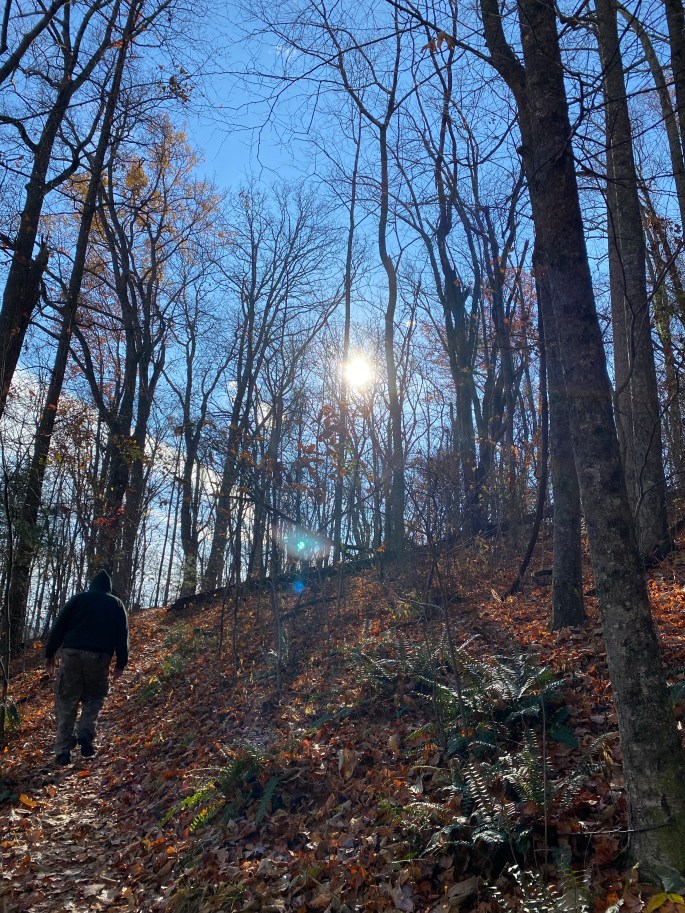
Scanning through photos of my recent trip to the Blueridge Parkway as well as past out-of-doors experiences, it is clearly evident from the large number of nature-centric images that I relish time spent outside.  From images of wispy cloud billows to leaf-scattered earthen trails; from layers of cerulean blue mountainous peaks to emerald green moss dressing up a boulder, and a great many variations in between, I have collected hundreds of images of Mother Earth. Nonetheless, my fondness of nature is so much more than taking photographs.

Time spent outside is like pouring soothing salve over my weathered soul.  One deep inhalation of fresh air, and I can instantly feel more calm and grounded.  In fact, I have an overall sense of vigor, not just in my body, but in my mind and soul when I am outside in the natural world.  It is as if my whole being comes alive.  

Therefore, it was no surprise for me to learn that numerous research bodies and scientific communities corroborate my personal experiences with nature.  As I scanned through several research pieces published by well-respected groups such as the American Psychological Association, Yale School of  the Environment, Harvard Health, and Scientific Reports, to name a few, there were some variations as to what defines “nature” and how long one needs to spend time in nature to reap the benefits; however, all pointed to the fact that spending time out-of-doors is overall beneficial to good health and mental well being.  Some of the commonly cited perks of spending time in nature include: improved mood, increased cognitive and memory function, reduced stress levels, improved mental health, boosted immune system, and overall reduction of blood pressure and heart rates.  

While I whole-heartedly appreciate and welcome ALL of those benefits, it has been my experience that there are also other, more ethereal, benefits of spending time in nature.  I find that when I bear witness to the brilliant rise of the sun, gaze upward as sunlight dapples through a canopy of leafy green, or catch sight of sunbeams streaming across dark silhouettes of towering tree trunks, naked in their winter respite, I feel a sense of awe and wonder.  The wide array of colors, lines, shapes, sizes, and the symmetry rivals great artists of our time–our world is a marvel!

The more I observe nature, the more curious and inquisitive I become.  How did all of this happen?  How do I, a person so small and insignificant in the face of all this wonder, fit into the grand scheme of the great I AM?  How am I to comprehend Divine Providence and this wondrous creation called earth?  I have no answers, nor do I feel a need for answers.  Rather I am in a state of being–being appreciative and feeling adoration for the great playground that is nature. After all, we are called human beings.

Francis Bacon, often cited as the father of science and ironically attributed to have invented the essay form, is quoted as once stating that God wrote two books: The Scripture and “a second book called creation.”  Time spent with the “second book” offers me tangible, first hand reminders of the greatness of our Creator.  Standing in the presence of a lofty range of mountains, floating across a lakeshore rippling with life, strolling through the rhythmical edge of ocean tide waters, or simply jogging alongside streams and trees on an earthen park trail, my heart and soul are at ease.  There are no timelines, no demands for my attention, no to-do lists, or looming deadlines.  Instead, there is a softness that envelops my soul, a well-worn quilt of comfort, that is available to all.

I suppose my student said it best after all. Spending time in the majesty of nature opens my heart and mind, allowing me to feel as if I have been gathered into an embrace by a loved one happy to see me once more as God’s peace settles over me.  My spirit is more serene, and I feel as if I am part of something larger than myself.  Something so large, I cannot fathom it, but it is something like a prayer.