See the soul and ignore the story: Lessons from a lifetime of teaching, part 1

Ignore the story and see the soul.  And remember to love. You’ll never regret it.–Seane Corn

First years of teaching 👩‍🏫

Over the decades of teaching, I have accrued numerous experiences.  Several of these stand-out memories occurred during my earlier years of education.  Therefore, in honor of another school year’s conclusion, I will share some of these memories over the coming weeks, and the many lessons these interactions provided. 

My first teaching position was at Kentucky high school in the late 80s.  Newly graduated and exceptionally young, I was ready to change the world.  Like all first year career experiences, the theoretical training of a university was quite different from the reality I faced.  

I was one of five special education teachers.  Our classrooms were separated from the rest of the school.  We were part of the gymnasium facilities, and my classroom was one of three under the visitor’s side of the bleachers. 

Lines of Separation 📚

In order to get to my “classroom,”  I had to walk through two other “classrooms.”  One wall was slanted because it was the underside of the bleachers, and one wall was a rolling chalkboard separating my classroom from another.  One wall was painted concrete block, and the other side was a giant metal wall with a locked door that stored the ROTC weapons.  The desks were mismatched leftovers from a previous era, and classroom supplies were limited.

My first day of school was filled with nerves, and the isolation of my situation led me to feel even more anxious. However, there was little time to dwell on it as the students began arriving.

The Encounter 🗣️

The last student to arrive stood over six feet in height and brawny.  (I would later learn he worked as a hired-hand at various tobacco farms across the county.)  With one cursory glance, he sized me up, spit tobacco on the floor, and picked me by my shirt collar.

“You ain’t teachin’ me nothin.  I ain’t here to learn.  Only here cause it’s the law.”

His startling blue eyes conveyed his disdain for me as we locked eyes.  I knew this was a make or break moment, and I was determined to not break. So I said the most brilliant set of words.

“Put. Me. Down.”

It was an intense moment.  On the inside, I was filled with fear.  Fear I would lose my job after only one day.  Fear I was about to get hurt.  Fear I wasn’t strong enough to withstand the discipline this job would require.

Wordless Truce ☮️

Outwardly, my eyes never wavered from his.  I would not be intimidated by him.  Seconds seemed to stretch, although I am certain this was not a long moment.  However, it was long enough for me to take in the acne scars on his face as well as a few other scars that looked as if he had experienced his fair share of altercations.  His blonde curly hair was cut in a mullet.

I was acutely aware of the other students’ quiet stares taking in the situation as I once more repeated, “Put. Me. Down.”

Through some act of Divine Intervention, or perhaps the I-am-not-messing-around look in my eye, the student put me down.  I recall the way he smugly looked around at the other students as if to convey he had shown me.  

Peace Offering 🕊️

I could have taken him to the office or written his behavior up, but I chose not to.  Even though I was inexperienced, I knew that would immediately build a wall between not only him, but the rest of the students and me.  Instead, I believed I needed to find out more about him, and work on building a relationship with him and the other students. But, I wasn’t sure how, or even if, it could be done.

In the meantime, once things cooled down, I gave him cleaning supplies and asked him to spit out his tobacco in the trashcan and clean up the floor. Then, I walked away and busied myself with other students.  It took several minutes before he started, but he did clean it up.

Seasons of Change 🍁❄️

By late fall, the young man would occasionally engage in conversations with me, especially if I focused on his knowledge of raising tobacco and his work ethic.  He explained that he had worked alongside his dad, but at some point that stopped.

By winter, I had learned that his father was disabled, and no longer worked, but apparently still knew how to lift his arm to drink and hit. This partly explained the young man’s tough-guy persona. The student often stayed overnight with buddies around the county, or during certain parts of the growing season, he’d stay over at the farms on which he was working.

Misdiagnosis 📖

By mid-year, I felt certain that the student was misidentified.  He was no doubt dyslexic, but that had nothing to do with his IQ or his abilities.  There were so many life and reading skills that I wanted to work with him on, but time was running out.  The young man was determined to quit school once he turned 18, even though he was only a junior. 

One class in which this young man thrived was shop.  He could build and repair seemingly anything.  One of the special education teachers often talked about the young man’s talent and sometimes hired this student for work on the teacher’s farm.

By March, I had established a good working relationship with the student.  I teased him about his haircut and cowboys boots, and he made jokes about my height and “easy” job. Along with the other students, he learned to read and complete job applications, manage a budget, how to dress/act during a job interview, and even how to plan, shop, and prepare a week’s worth of simple meals. He was even reading short books with adapted text about famous athletes. 

Rumor Has It 😔

One day in April, the young man did not show up for school.  That wasn’t unusual.  Many of my students had irregular attendance.  After his third consecutive day of absence, I went to see an administrator to inquire about the student’s absence. He said he would check into it, but the gossip among students said he wasn’t coming back. The young man had had his birthday.

I have no idea what became of this student.  I would like to think the best, but I am not so sure.  Maybe he has a job, family, and even grandkids by now.  I can only hope, but I’ll most likely never know..

Lessons learned 📝

Nevertheless, I am grateful for this student.  He was the first to teach me to ignore the bluster of the student’s story, and see their soul–see the person they can be at their best self and recognize their potential.  I accepted him as he was, envisioned a better future for him, and tried to help him see it too.  

He also taught me that no matter how hard I work with students, they are still individuals who will determine their own fate.  That was, and still remains, a hard lesson to swallow.  So instead, I will focus on his best, albeit unintentional, gift:  See the soul, not the story.  You will never regret it; I haven’t yet.
The End of an Educational Experiment . . .for now

“What a long strange trip it’s been.”–Jerry Garcia

“Dear Ms. Hill,  Thank you for all of your hard work and patience.”

This was a one-sentence thank you note I received from a student in advance of the end of the academic school. I appreciated his sentiment and reflected over what I now think of as the “pandemic years of education”.  These past two academic school years have certainly tested teachers’, students’, and parents’ abilities to practice patience–both within ourselves and with one another in the educational community.  It forced all of the involved stakeholders to work in ways for which we were not prepared, and it stretched us to new limits.

As a middle school, 6-8 Reading Language Arts teacher, I have read countless student journals expressing their feelings of fear and uncertainty when the pandemic first began, their high levels of anxiety as well their feelings of isolation during their time in quarantine, their feelings of frustration during day-upon-day of virtual learning, and their exaperastion when dealing with glitchy/malfunctioning wifi or frozen devices.  Despite all of the pandemic educational vexations, students also wrote of their newfound appreciation for the value of the in-person community that schools foster.  Nonetheless, the scars of this experience, I fear, will remain with many of our students for years to come. 

“Reduced learning time has likely impeded student learning and also affected the development of the whole child.”–Economic Policy Institute

Meanwhile, when reflecting upon this pandemic experience with colleagues, both in the public and private school setting, many reflect upon the multiplicity of issues and/or frustrations, depending upon their unique school community.  Pedagogical adaptations seem to have been one of the major challenges often stated by the educators due to virtual learning, shortened school year, and/or hybrid learning.  Then, there were forced adjustments to instructional delivery in order to balance the engagement of virtual students while simultaneously instructing and attending to the needs of in-person students. This demanded that teachers refine and adapt instructional plans–often on-the-fly if there were wifi issues–in order to best facilitate student learning. Additionally, curriculum was often gleaned to the most essential learning objectives and standards also due to a shortened calendar year and/or class time and, in some cases, to allow for additional time to address the social/emotional needs of the students. Meanwhile, administrative tasks seemed to double with an endless supply of emails, on-line grading, and a multitude of spreadsheets and documentation monitoring student attendance, progress, or lack thereof.

Looking back over this experience, I feel as if I am standing on top of one mountain peak, but I can clearly see there are more summits to climb in the coming academic years.  From my current apex, I can tell you this.  Teachers and students should not judge themselves too harshly as this school year winds down.  Virtual teaching and learning during a pandemic was hard–plain and simple.  Students and teachers alike, across the country, were asked to exit their respective schools on March 13, 2020 with all of their personal/professional supplies and no preparation.  Then, on Monday, March 16, we were exhorted to embark on what would, at this point in my 30-plus years as an educator, be the most dramatic educational paradigm shift I have experienced that continued throughout the summer months of 2020 and on into the 2020-2021 school year for which we are now wrapping up.

One thing is for certain, the pandemic compelled teachers and students alike to establish a strong foundation in the employment of technology for educational purposes. The downside of this is that we also learned that technology is dependent upon access to wifi, devices that work, and equal access for all students to reliable devices and internet access.  While I was blessed to work in a school that offers equal access to devices (although our local wifi provider had MUCH to be desired), that was not the case for all schools.  Additionally, even with working devices, the importance of reliable internet service came to the forefront of the educational world as I witnessed in my own school.  As a teacher who committed to operating paperless during this school year, due to virtual learning, my students and I, very quickly, had to learn how to be incredibly patient when there was no service, certain platforms crashed, or devices simply froze. Which leads me to another lesson.

The last day of school for 1st period, 8th grade, Reading Language Arts students, for 2020-2021, whether in-person or virtual. Eventually, all but one student, returned to the classroom.

“It’s (COVID) taught us that technology can be wonderful, but it will never replace the value of people in safe but rigorous learning spaces talking, playing, and working together.”–Brad Olsen, Senior Fellow in the Center for Universal Education

The importance of local communities, administrators, teachers, students, and parents valuing and supporting one another cannot be overstated. Communities witnessed, very quickly, that not only do schools provide an education for their children, but they are also a reliable source of childcare that keeps children safe, fosters their social development, and supports their emotional and physical well-being.  Meanwhile, administrators, teachers, and students discovered the importance of the synergistic experience that happens with in-person classroom learning. While the remote learning model worked–and will probably continue in certain circumstances–there are real educational, social, and emotional benefits from interacting on-site with one another within the structured periphery of a school setting. 

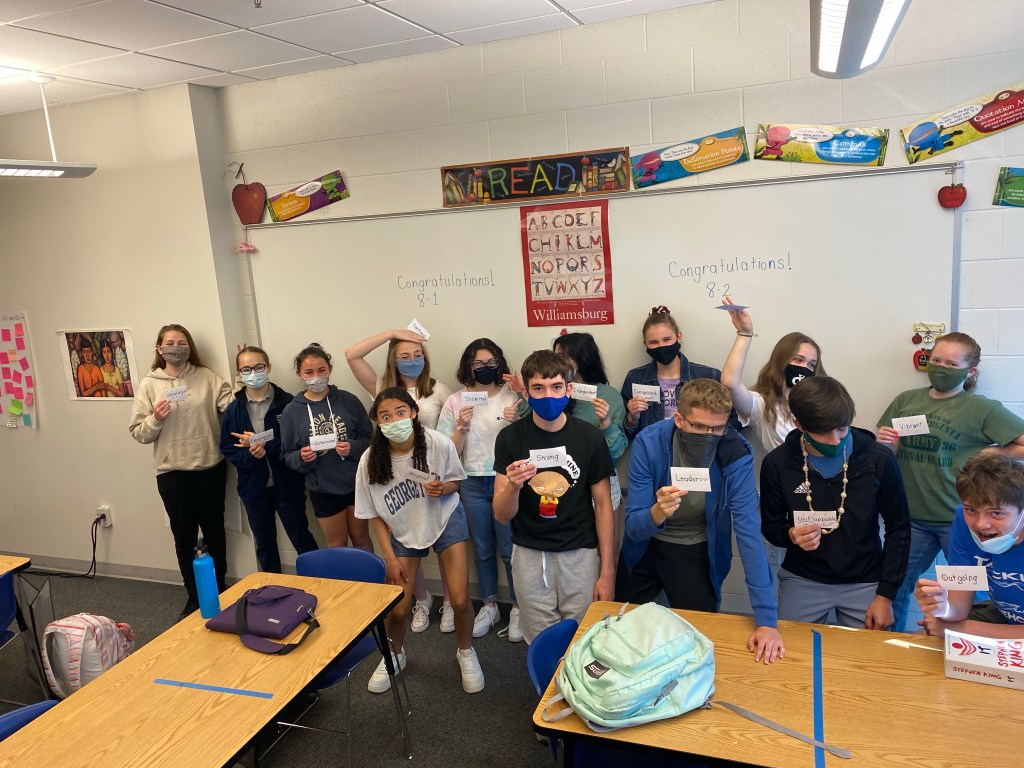
The last day of school for my 8th grade, second period, Reading Language Arts class for 2020-2021, at times, many were virtual, and by the end of the year, all were in-person

“COVID-19 highlighted the essential role of child care for children, families, and the economy, and our serious underinvestment in the care sector.”–Daphna Bassok, Nonresident Senior Fellow in the Brown Center on Education Policy

While I have no doubt, next year will bring the educational system continued challenges from the lingering effects of this pandemic, I believe, overall, we have the ability to face them with an even greater capacity of compassion and empathy if we heed its many lessons.  The pandemic, it seems to me, has reinforced why it is crucial for the community at large to listen to the needs of educators, parents, and students.  It has given local leaders an opportunity to reflect upon the critical role of childcare and its contribution to the fiscal wellbeing of its community.  Likewise, the educational system must continue to rethink and adapt instruction in order to better facilitate student learning while continuing to cultivate ways to meet the emotional and physical needs of children, caregivers, and educators.  One-size does not fit all when it comes to technology, education, and childcare, but all affect and influence the successful functioning of the communities at large.  

In the end, I circle back to what my student simply wrote.  Thank you to the many who extended me patience through what has been one, if not the most, challenging 15 months of my career.  Many have granted me grace in moments of extreme stress and emotional duress, and for those unnamed moments, I am eternally grateful.  Here’s to summer break, and a fresh start on the coming school year.  May schools blessedly remain open.

First period class clowning around on their last day of school which was also a dress down day for their last day of 8th grade.
Second period, 8th grade, striking a pose on their last day of 8th grade which was also a dress down day.