That’s not the sky! That’s the clouds–Lessons in the 90-second rule

“You are not your thoughts.  You are the observer of your thoughts.”–Amit Ray

Photo by Pixabay on Pexels.com

Feelings Come and Go ☁️

It was between classes on a Friday afternoon. A male student entered my classroom, set his books down, and sauntered across the room towards the windows that line the wall of our third floor room. 

He looked as if he was preparing for a quick chat with his buddy when he randomly exclaimed, “Wow, look at that.  The sky looks flat.”

“Dude, that’s not the sky.  That’s the clouds!” a girl retorted.

A debate then ensued as to whether or not the sky and the clouds were one in the same. Several other students joined in the conversation until one student added with great authority that the clouds aren’t always in the sky, but the sky is always there. 

Listening to the student’s debate reminded me of a saying attributed to Thich Nhat Hanh, “Feelings come and go like clouds in a windy sky.”  Hanh taught this, in part, to demonstrate that we have the ability to be an observer of our mind’s thoughts.  I often phrase it like this, “Just because you think it, doesn’t mean it’s true.”

Photo by Yan Krukau on Pexels.com

The 90-second Rule ⏰

In fact, I ran across an interesting fact regarding the duration of emotions.  Neuroscientist and best selling author, Dr. Jill Bolte Taylor, Harvard trained and published, established that emotions only last for approximately 90 seconds.  According to Taylor, “When a person has a reaction to something in their environment,” she says, “there’s a 90-second chemical process that happens in the body; after that, any remaining emotional response is just the person choosing to stay in that emotional loop.”

Upon reading that fact, I almost felt called out, especially with regards to any emotional response after 90-seconds is personal choice.  Wow! That notion is super-charged with opportunities for self-regulation.  However, we all know that regulating emotions isn’t always easy. In fact, I suspect this requires practice for most of us.

Therefore, I want to step back to the clouds and sky scenario. Identifying and recognizing when our mind has gone off into what I call “thinking or story mode” due to an emotional reaction requires a certain level of mindfulness.  This is where knowing the rest of Hanh’s quote is important. “Feelings come and go like clouds in a windy sky. Conscious breathing is my anchor.”

Photo by Stas Knop on Pexels.com

Time for a Mindful Break ⏳

Learning to breathe through difficult moments in order to allow the emotion(s) to pass requires the ability to self-select the pause button. This also requires a certain level of awareness.  Practicing mindfulness can increase this awareness. 

Therefore, let’s play a game.  Come on, what have you got to lose, but a few more seconds added to reading this piece?

Softly close your eyes for 20-30 seconds and listen. Notice what you hear? The hum of the refrigerator? Birds chirping? Heater running? After perceiving and identifying the sounds you hear, open your eyes.  Notice you were able to identify the sounds, but that did not make you the sounds.

Now that you are warmed up, let’s do another one.  This time, take a good look at your surroundings. Pick one item near you and focus on it for a few seconds. What color is it?  Describe its shape. Identify its size.  Describe its function. Bring awareness to the fact you are identifying what you see, but you are separate from it.

Let’s try one more.  (I promise it’s the last one.) Gently close your eyes. Focus on the sensations in your body.  Do you feel air moving against your skin? Is there a part of your skin that is itchy, warm, cold, etc.? How does the fabric against your skin feel? After about 20-30 seconds, open your eyes.  There were numerous sensations you were able to name in those few seconds, but those sensations are separate from who YOU are.

 Practicing aspects of mindfulness is as simple as those three exercises–fostering an awareness of a “something,” giving it a name, and then observing it without judging it as good or bad.  When you do this, you are engaging your “observer mind,” which is an important skill for taking advantage of the 90-second rule. 

Photo by Keenan Constance on Pexels.com

Swatting away those negative thoughts 🙇‍♀️

 I don’t know about you, but I happen to have a mind that, when triggered, is very good at sending waves of negative thoughts and messages.  These antagonistic ideas can quickly commandeer my mind, and it can sometimes take significant time for me to become aware, much less observe those emotions objectively. Once I finally do, I try to imagine that my difficult feelings/thoughts are a pesky mosquito or bee buzzing around in my mind.

  The image encourages me to gently swat away challenging thoughts or feelings by reminding myself that even if I am thinking a certain way, it doesn’t mean it’s true.  Sometimes, I stay trapped in the loop of emotions, and I am reminded that I am a work in progress.  Other times, I can name the story or feelings, and I have the ability to send it on its way. 

I usually have to remind myself to stop judging the experience as good or bad–which I also tend to do. Then, I have to engage my curiosity and ask myself why am I thinking/feeling/reacting a certain way.  This can take a long period of time, and sometimes, I have to tell myself to accept the feeling/thought for the time being, and I can figure out the reason for the feeling later.  

I often find, through reflection, that many of my emotional responses are often caused by certain triggers or trained reactions from long ago.  I am especially prone to messaging that tends to make me feel “less than” others, but everyone has their own unique triggers. I also find I am more likely to be sent into a negative spiral if I am especially fatigued. 

Other common triggers may include, patronizing behavior, micro-management, someone not pulling their weight, someone criticizing you or your work, and so forth.  The thing is to begin to get curious and see if you can begin to identify your personal triggers. 

Photo by Liza Summer on Pexels.com

Tools for Dealing with Difficult Emotions 🔨🪛🔧

In the end, when it comes to emotions, we have 90-seconds in which our bodies chemically react to our triggers and attempts to send us into the “flight, fight, or freeze ” mode.  After that, we have the power to continue with one of those modes, or choose another direction, but it won’t be as easy as snapping a finger.

Knowledge of the 90-second rule does not allow us to avoid challenging emotions.  Instead, it is my hopes that it gives you (and me) the power to:

  • Identify what you are feeling (tight stomach, red face, rising heat, etc.) 
  • Gently ask yourself why you are experiencing it (What was the trigger?)
  • Name the emotion(s) (fear, anger, embarrassment, resentment, etc.)
  • Accept and allow those feelings
  • Offer yourself compassion and see if you can redirect your energy into a more positive endeavor.

Remembering that you have a choice when feeling strong emotions can be empowering, but it is not all rainbows, sunshine, and unicorns. Nonetheless, having tools to navigate through challenging emotions can make a difference, allowing us to eventually see through our cloudy and distorted thinking and perhaps get to the other side with a bit more grace and equanimity.  

Do you disturb the peace, or perpetuate it?

  “If in our daily life we can smile, if we can be peaceful and happy, not only we, but everyone will profit from it. This is the most basic kind of peace work.”–Thich Nhat Hanh

The tail twitches and crouching ensues. Hips raised, ears flattened, the tail twitches more rapidly.

“LJ, stop!”

He remains immobile and continues his focus.

“LJAAAY,” said with slow emphasis on the A-sound.

A look is tossed over his lowered shoulders, signaling he doesn’t feel like listening.

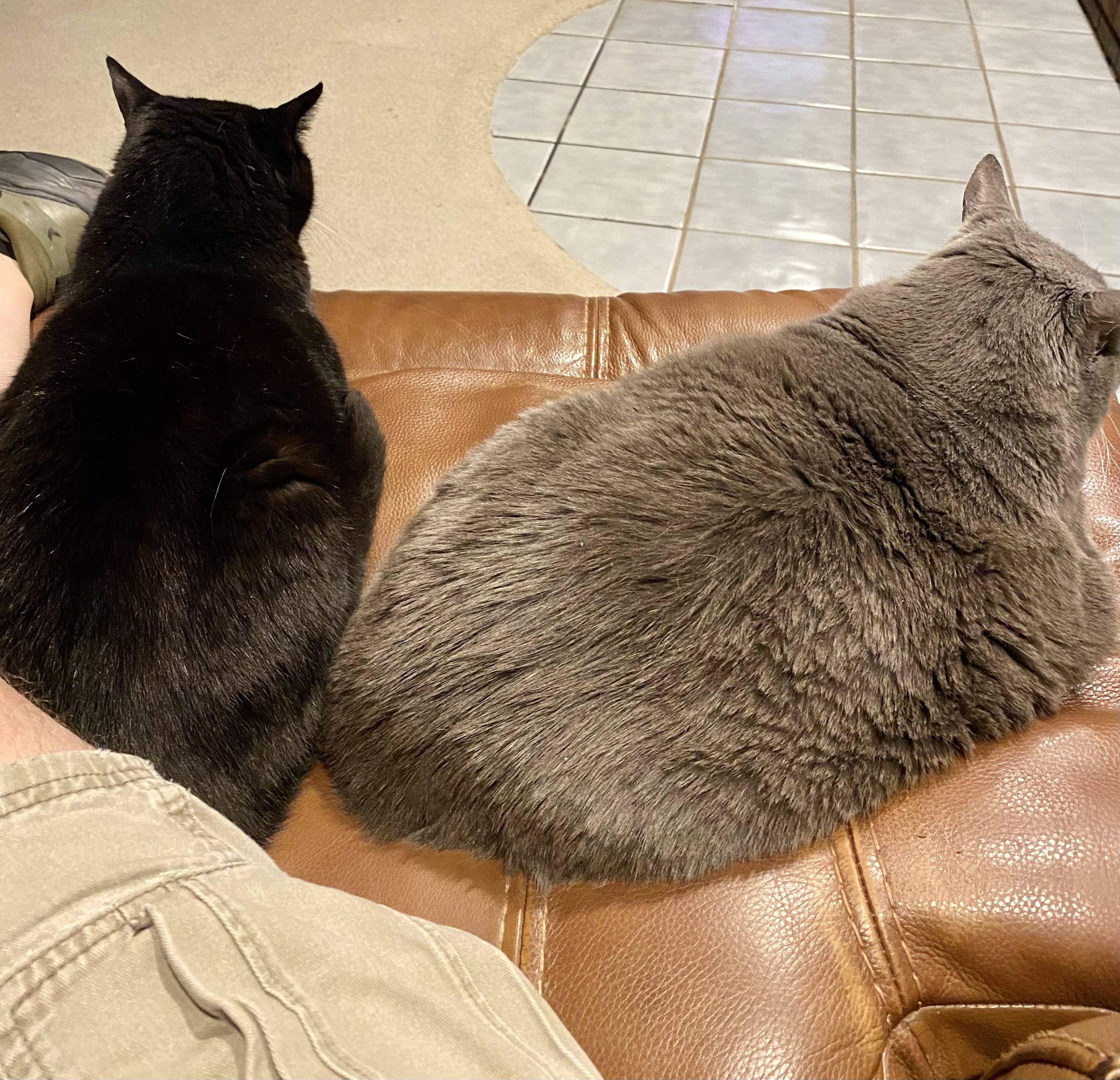
Hand reaches for the spray bottle, and John, my husband, walks towards LJ, trigger aimed.  That is all it took. LJ, our solidly black cat, takes off in an attempt to avoid being squirted, but he’s not to be conquered.  Not yet. 

He circles back around the dining room table and reenters the same room through another entry point as if we can not see him.  Meanwhile, the desire of his pouncing antics, Tippi (Tail), our 14 year old gray cat, with the exceptions of tuxedo white on her chest and tufts of white on the tips of her paws and tail, sits peacefully undisturbed.  The only sign that she is aware of his shenagings is the very slow whishing of her tail along the top of the carpet.

LJ prepares to pounce once more; however, John rapidly squirts water in LJ’s direction.  Although John isn’t trying to precisely hit LJ, the sound and sight of the water sends LJ scuttingly out of the room.

Tippi looks towards where the water missed its target, turns her head back to its original position as her body sighs towards the floor in a perfect cat loaf.  Her tail encircles her body once more.

Throughout LJ’s attack, Tippi remained peaceful, never hissing or spewing.  While her tail signaled her awareness, she did not otherwise bring attention to LJ’s negativity.  Instead, she chose to remain at peace with it.  Vigilant, but non-reactive.  

John and I have watched this play out repeatedly, yet no matter how many times LJ attempts to attack Tippi Tail, she rarely responds out of anger. To be sure, Tippi will occasionally respond if he corners her. Mostly, though, she remains peaceful and at ease.  

LJ is a bit younger than Tippi and has not moved from the self-absorbed stage of life.  He wants to be the center of attention on his terms.  If the humans in his home, family members or visitors, aren’t paying attention to him, he finds ways to draw attention to himself.

For example, if Tippi decides to sit with one of us, due to her arthritis, we find ways to offer her assistance to climb up beside us, such as slightly lowering the reclining portion of a chair or couch.  As she tries to lift herself up to position, LJ will haughtily cross the room and attempt to “beat” her to the desired person.  If we move a step stool near the bay window, in order to assist Tippi’s assent to the cat beds in the window, LJ will try to block her attempts in order to claim the bay window area for himself.

Nonetheless, Tippi Tail finds ways to persist with grace and equanimity.  Her peace remains (mostly) unflappable.  Neither does she appear to hate LJ, nor does she appear to be jealous of his presence.  Instead, she seems to understand with a sense of compassion and patience that he can’t help what is inside him–his tendencies to compete, invade, dominate and exploit perceived weakness.  

Due to her serene perseverance, there reigns an unspoken peace between the two cats . . . most moments.  The more peaceful and tolerant Tippi becomes, the more LJ is learning to become that way.  It has taken years, but there are times I will wake up in the morning to find both cats sleeping at the foot of the bed–not necessarily near each other–but in the same approximate area. Furthermore, it is not unusual during cold days to find both of them soaking up the morning sun in the same room and within the same area, albeit, not touching each other.  

Sometimes, upon waking, I am surprised to discover, after I turn on the bedroom lamp, that both LJ and Tippi Tail had been peacefully sleeping at the foot of the bed.

Thich Nhat Hanh once wrote that, “When another person makes you suffer, it is because he suffers deeply within himself, and his suffering is spilling over.” When LJ sees Tippi with one of us, he suffers jealousy because he perceives that she is getting all the attention and love.  If he sees that Tippi wants to be in one of the cat beds in the bay window, he suffers fear because he is afraid there isn’t enough secure space for him in the sunlight to cozy for a nap.  

While they both lived their early lives as stray cats, it is possible that something happened in LJ’s past that causes him to remain stunted and insecure.  Then, again, due to the fact, Tippi is older, and lived with us longer; perhaps, she feels solidly secure with her position in our family.  It could also be that she remembers a time when she was the younger cat in the house, competitively trying to exploit the weakness of one of our former cats, in order to gain our attention.  Possibly, she has simply outgrown those impulsive years. 

Whatever the reason(s), Tippi seems to understand that within LJ are potential seeds of love, compassion, playfulness and peace.  However, she also appears to sense that LJ is dominated by seeds of willfulness, anger, fear, and insecurity.  Due to age, circumstances, and/or experience, she is mindful of these seeds both within herself and within LJ.  Therefore, it often appears that she uses this insight to mindfully choose her actions–modeling peaceful behaviors, and only fighting back in order to keep from getting hurt when he corners her.  

Of course, I have personified my cats in order to make a point. To live in peace and harmony with others, we must recognize that all humans have similar needs/desires:  food, water and shelter, safety, esteem/value, love/belonging and so forth.  There is often fear and/or a feeling of lack when humans sense one of these is missing.  Additionally, everyone has the potential to develop and foster seeds of insight, self-awareness, and self-control, but not everyone focuses on developing these, much less developing them at similar rates.  

As the story of Tippi and LJ illustrates, it is important to be aware of our own insecurities, fears, and impulses in order to exercise self-control.  Recognizing our own proclivities with compassion and understanding, allows us to offer that same consideration and empathy for others.  

While this is never easy, and it takes practice, by learning to be less-reactive and modeling more appropriate ways of speaking, engaging, and responding to others, the more we can reduce conflict.  Of course, this is not to say we passively agree or accept all behavior and actions; rather, it is important to recognize that not every word, action, and deed with which we disagree needs a response.  Furthermore, if a response is required, how much more productive and beneficial they can be when given with considered insight/thought, self-control, and discipline   

Wouldn’t the world be a better place if we could all learn to do what Tippi does with LJ– pursue patience, tolerance, and think before acting.  

The more Tippi practices patience and tolerance with him, the more LJ is becoming more at peace with her.

Let your Life Be a Work of Art

“Make your lives a masterpiece, you only get one canvas.”–E. A. Bucchianeri, Brushstrokes of a Gadfly

Photo by Ana vu00ea Ana Fotografa on Pexels.com

I recently came across the line, “Let your life be a work of art.”  These words were spoken by the late Thich Nhat Hanh, and they inspired me to reflect upon their deeper meaning.  As often happens, I could feel the tendrils of my brain entwining around this notion and exploring all of its complexities.  In fact, the next day, I found myself in meditation asking myself how to “live artfully” and contribute more beauty to the world.

It seems to me that all lives are pregnant with possible ways to share unique artistry with others. While I know, as Bucchianeri once wrote, we only get one life canvas, I’d like to think, that with the gift of each new day, we are each bequeathed a new canvas on which to create. Therefore, how do we bring about awareness and intention to our daily opportunity to create quality life art? 

Photo by Steve Johnson on Pexels.com

I think many great religious and thought leaders would point to nourishing your innerworld as a start. Initially this may sound self-centered.  However, I am reminded of the repeated directive instructing passengers, when flying on an airline, “put the oxygen mask on yourself first before helping others.”  This is because you cannot be of assistance to another person, if you don’t have a one true source for life. 

Therefore, it makes sense to foster a rich, more faith-filled inner life in order to create a more inspired and productive outer life.  Personally, I know when I mindfully start my day with time set aside for thoughtful devotion and contemplation, my actions are apt to be more harmonious and positive with others.  In fact, I find that if my inner world is unclouded, my actions and choices are more thoughtful and in better service to others.  

Photo by Kelvin Valerio on Pexels.com

That said, I don’t think it’s a linear or perfect process, but a gentle ebb and flow. When we seek, pray, read, meditate, and/or focus upon living more peacefully, as described in most major religions, we can then draw from a wellspring of faith, purposely seeking guidance for serving others.  However, that doesn’t mean we always remember to do that.  Mistakes, stress, anxiety, emotional overload, and so forth, can take us off our A-game for a span of time, but like a swing responding to gravity, our faith can draw us back to the path. 

The more we return to cultivating that inner-world, the more we begin to live in closer alignment with our higher purpose.  Life, it seems, begins to evolve and flow with greater ease, enhancing our ability to constructively contribute to the world and others around us. The greater the sense of ease, the less resistance and/or friction in life, thereby allowing for more effective and productive communication and actions.  Thus, the “art” we hope to create in life, organically continues to evolve and spread to others.  

Photo by Kampus Production on Pexels.com

 In fact, at least based upon my current reflections on the subject, it seems to me, the more we get clear in our inner world, the more we learn to accept responsibility for our own actions and choices.  As we assume more responsibility for our own actions, we can begin to also foster more responsible reactions as well.  In fact, when our reactions become more moderated and considered, the more effectively we can generate a sense of calm, creating less distress in our own lives and the lives of those around us. 

Of course, writing about “life as art” is easier said than done. Nonetheless, I do believe it is worth trying. As with any work of art, the process is often filled with struggle, but as any artist can tell you, the process of creation can often be messy and imperfect.  Therefore, learning to artfully live with more intentionality and tempered reactivity is a process also permeated with struggle as it takes awareness, time, and a large quantity of patience with self and those around us. 

Photo by Afta Putta Gunawan on Pexels.com

However, by repeatedly returning to the cultivation of our inner life, our hearts and minds are gently reminded to remain in alignment with the higher purpose of our faith.  Even after those less-than-stellar days, that we all experience, we can return to our practice and consciously redirect.  In the end, this not only benefits you, but others also profit by your choices, and even more so, by your example.  This give and take of constructive and purposeful living creates a dynamic design of a colorful criss-cross of actions and interactions.

Admiring the beauty of a large pot of flowers, vincas, on my front porch brought me full circle in this “living artfully” thought exploration.  The flowers began as four tiny individual plants. In spite of all the crazy weather, the vincas have multiplied ten-fold, it seems, with eye popping color. The vincas are a reminder that our lives can flourish in similar fashion. 

Our Creator designed us with the ability to withstand dry times, heavy rains, and even stormy seasons. However, the more often we return to nurturing our inner world, the better able our True Source can work through us. By more frequently listening and surrendering to that deeper voice of God, the more we allow our lives to become the design of the Creator’s hands; and like the vincas on my porch, our lives can become unique and colorful works of art to which Hanh encouraged so many years ago. 

By creating the practice of cultivating our inner world, we can become aligned with our higher purpose.  Through the ebb and flow of practice, we learn to accept responsibility for actions, consider our reactions, and allow the "art" of our life to flow with greater ease.
Photo by Jennifer Murray on Pexels.com