Transform Your Mindset: Embrace New Experiences

“Your perspective is always limited by how much you know. Expand your knowledge and you will transform your mind.”–Bruce H. Lipton

A black background with the words 'open to new OPPORTUNITIES.' written in white chalk-like font.
Photo by Anna Tarazevich on Pexels.com

Dreams That Spark Reflection and awaken the Mind 🎆

Recently, I have been experiencing an active dream life. While I do go through periods when I don’t recall my dreams, lately my nights have been filled with vivid, frightful nightmares. In my dreamlike state, I try to “change the channel,” but my mind keeps slipping right back into the same harrowing scenario. These restless nights inspired me to think about how in life, similar to TV (or any current media platform for that matter) without deliberately changing the channel, our point of view can become limited.

From Antennas to Awareness: Early Lessons in Limits 📺

As a child, there were no cable or streaming platforms.  Our family, like the families around us, relied on a TV antenna on top of the house in order to watch local stations.  Theoretically, we should have been able to watch three to four local stations–ABC, CBS, NBC, and PBS.  However, we were surrounded by hills, and as a result, most days, NBC was the only  station we could clearly view. I’d hear classmates talk about shows on other networks, but unless we visited my grandparents, who had better reception, our viewing options were limited.

Books: Windows to the world 📚

A woman reading a book while sitting by a window, illuminated by warm natural light.
Photo by Rahul Shah on Pexels.com

Fortunately, we did not rely on TV as we had access to a wide array of books and magazines through school, the bookmobile, at the house of my grandparents as well as in  my own home.  Therefore, my viewpoint expanded beyond my small-town bubble through reading.

College as a Catalyst for Perspective 🤔

Later, when I attended Ohio University, in Athens, OH, my worldview was dramatically shifted. Though Athens is no metropolis, the diversity of students, professors, and wide-array of sources of information was striking compared to what I had known in the Tri-State area. This was especially true since I lived in an international dorm with students from around the world. Conversations in these halls opened my eyes to new ways of living, thinking, and even eating.

Cultural Conversations and Culinary Discoveries

Water droplets cascading from a fountain, surrounded by a blurred green background.
Photo by CocaKolaLips on Pexels.com

My roommate from Singapore opened my eyes to the water shortages her country was experiencing at the time. In her home apartment complex, water was available only during scheduled times—long showers were out of the question. Her story stuck with me as a concrete example of the finiteness of water.

 Meanwhile, students from Denmark and Sweden introduced me to cheeses that I never before heard of, much less tasted.  A French student was the first person to introduce me to espresso, while students from Vietnam and Korea introduced me to a wide array of spices that would not have been locally available at that time.

Voices from Different Lives 😃

I had a classmate named Annette, the daughter of a military family, who’d lived all over the world. Her life experiences, and the breadth of cultural understanding, was remarkable. She was heads and shoulders above the rest of us in global knowledge and awareness.

In contrast, another classmate, Jerry, grew up on a nearby family farm on the outskirts of campus. He illustrated, first-hand, the struggles of family-farming, the weight of the financial hardship often felt by these families, and the deep faith it takes to persevere.

Spiritual Exploration Through Diverse Worship 🙏

Also, while attending OU, I visited churches of different denominations around campus. This provided direct experience with other forms of worship different from my own upbringing. Each service challenged and broadened my appreciation of varying faith communities.

Travel: Expanding the Map of Understanding 🗺️

As an adult, my perspective has continued to unfold through travel. My husband, daughter, and I have explored various parts of the U.S. from coast to coast and visited several Canadian provinces. During these trips we meet people from all walks of life. These encounters demonstrate the common threads of living as well as the unique–and some not so unique–struggles all humans face. These conversations continue to deepen my empathy and allow me to see cultural events, governmental policies, and life experiences through the eyes of others.

The Environment: Witnessing Earth’s Fragility 🌲

Since most of our travels center around natural and historic sites, my perspective has been further stretched in two important ways. First, traveling reinforces my profound respect for the limited nature of Earth’s resources. Over the years I have witnessed firsthand miles of forests decimated by logging or (most recently) flooding/storms, walked along shores of a fragile coastline in a constant state of erosion, and visited places in which the air quality was at near unbreathable levels due to drought-related dust storms or fires. These expeditions serve as tangible reminders that our environment is not infinite, and it is urgent that we protect/care for it.

History: Lessons in Perspective and Relevance 🧑‍🏫

Second, by visiting historical landmarks, walking historical streets, or exploring museums, it helps me recognize the values, struggles, and limitations of the times in which people once lived and how relevant the past is to today’s world. These excursions (along with reading historical and historical fiction books) demonstrate that history is not just a collection of dates and events; rather, it’s an expansive, unlimited lens–filled with countless lessons–through which we can understand human behavior, social progress (or lack thereof), and cultural identity. 

Most of all, visiting natural and historic attractions repeatedly instructs that what we take for granted—whether a forest or a freedom—can disappear without an ever-expanding viewpoint.

Perspective Lost and Perspective Gained

Without an intentional commitment to varied life experiences, our perspective is restricted and narrowed. We may not see the value of managing natural resources. Likewise, we might not be empathetic to those with cultural differences, and we might have little-to-no context of history and its importance. Without going beyond our comfort zone, we may not see the vastness and inclusiveness of a God so great, we cannot possibly pretend to understand.

Intentional Curiosity: How to Keep Changing the Channel

Therefore, it is important to seek out new experiences that challenge our assumptions and broaden our horizons. There is indisputable value in engaging with people whose lives are different from our own.  By engaging and listening more, judging less, and asking more questions, we are less likely to jump to conclusions while also allowing our assumptions to be tested. Visiting a worship service different from our own current practice or simply visiting a new place–even if it’s just across town–can offer further insight to the world around us. Even reading books, fiction or nonfiction, can also offer unique and salient views of others.

Shift Your View, Shape the World 🌎

In closing, I challenge all of us to avoid getting stuck in life as if in a dream. Instead, let’s keep changing the channel. With each click out of our comfort zone, we gain a more nuanced understanding, broaden our perspective, and foster greater compassion for the world and humanity itself. In fact, by doing so, we might not only expand our viewpoint, but we may also alter the viewpoint of someone else we meet along the way.
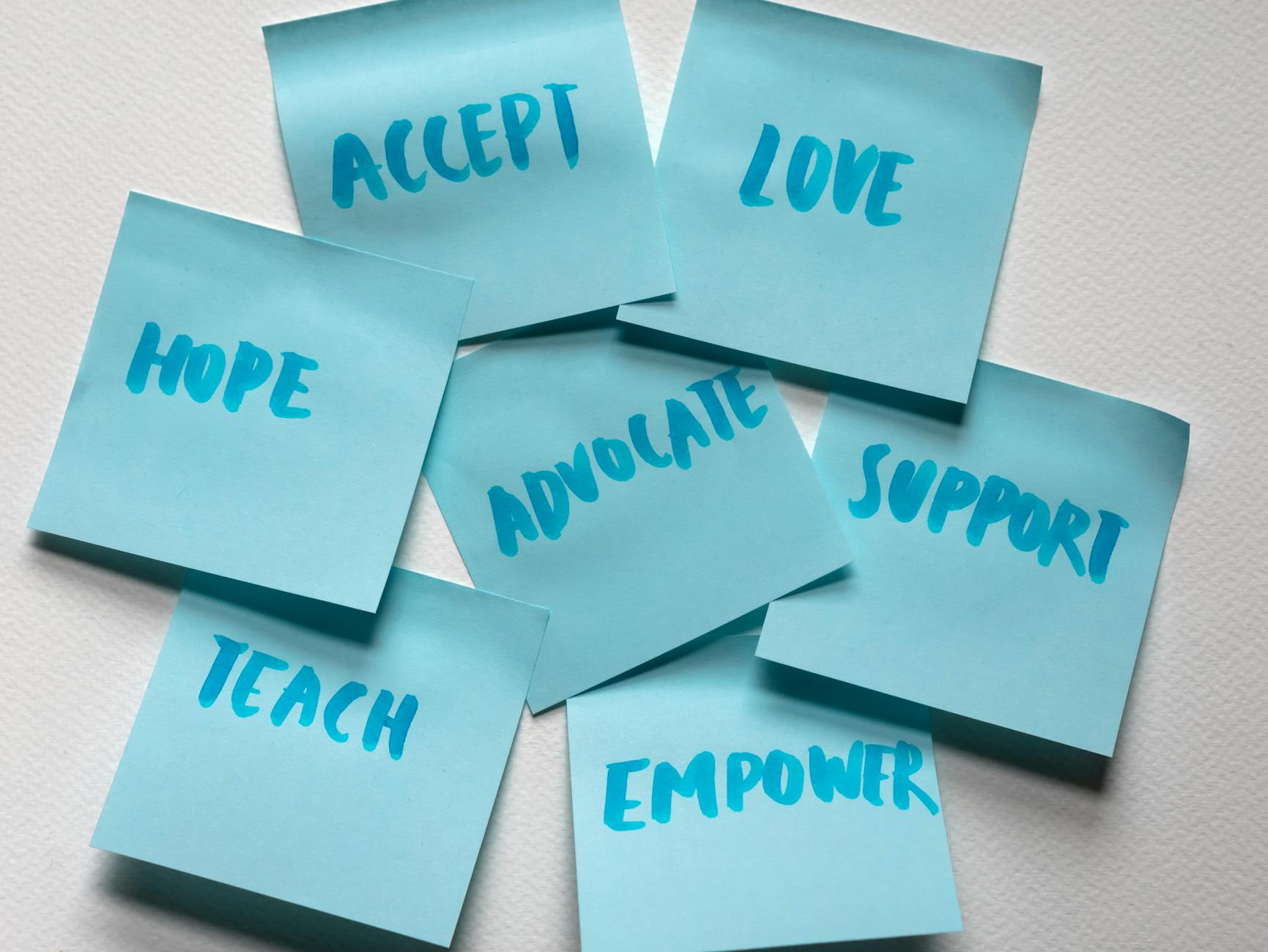
A collection of blue sticky notes with handwritten motivational words: 'ACCEPT', 'LOVE', 'SUPPORT', 'ADVOCATE', 'EMPOWER', 'TEACH', 'HOPE'.
Photo by Polina u2800 on Pexels.com

Embracing Limitations: Lessons from the Asheville Half Marathon

God, grant me the serenity to accept the things I can not change, the courage to change the things I can, and the wisdom to know the difference.”–Prayer for serenity

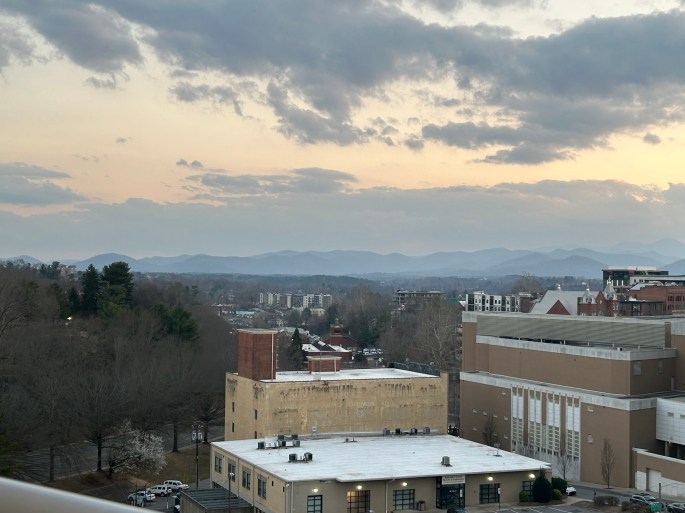
The Blue Ridge Mountains outside of Asheville, NC.

“the mountains are Calling . . .” ⛰️

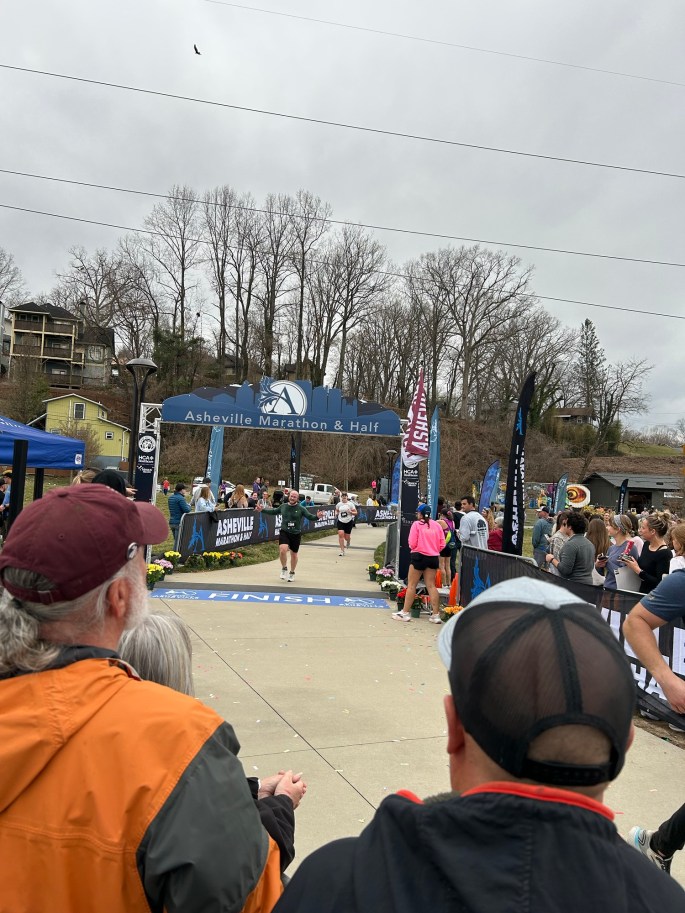
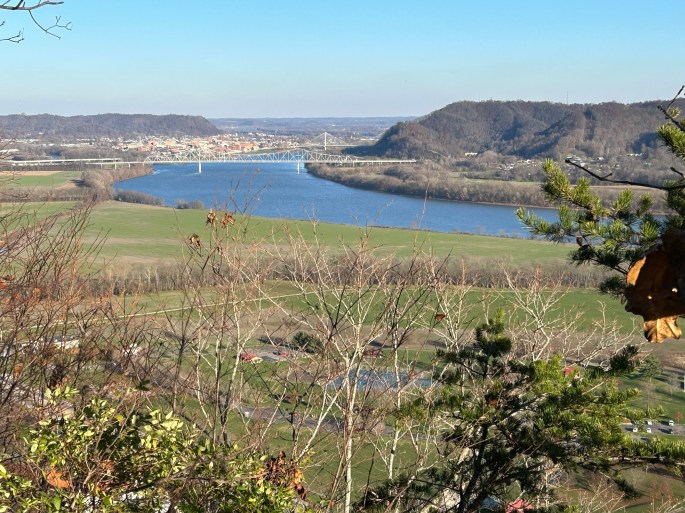
I had been training for months, despite the challenges winter threw at me. Cold? I can handle it. Snow? I can run in it. Gusty wind? I can run that too. However, after my husband, John, and I crested hill after hill making our way into Asheville, North Carolina, I knew the town’s half marathon would offer a whole new level of challenge. 

To be clear, participating in the Asheville Half Marathon was an insignificant hurdle compared to what the people in Asheville, and all of the other residents of the surrounding areas/towns along US 23, have been facing as they deal with the aftermath of Hurricane Helene.

Driving along US 23, John, and I were able to witness that six months after Hurricane Helene angrily chewed through a large portion of the western Appalachian region, the recovery is still ongoing. However, the willful, and not-to-be-deterred, spirit of the residents was unmistakable. 

Rooftop view from Asheville of surrounding Blue Ridge Mountains.

A Tale of Two Sisters 👧 👧

This past fall, not long after Helene hit, the high school in which John and I work, welcomed two sisters into the student body.  They were from the Asheville area and were staying with relatives while their parents and older brother dealt with the devastation and destruction back home.

The girls were engaging and well-poised, especially considering their circumstances. Over the course of a couple months, I got to know them–not well due to the short duration of their stay–but well enough to swap personal stories from time to time. 

When they learned that like their dad, I often trained for half marathons, they immediately invited me to run the Asheville Half Marathon in March. They explained that by the time spring rolled around, the community would not be fully recovered, but the local economy would need the boost that runners and the accompanying spectators could bring. 

“You should definitely come, Ms. Hill.  You’d like the people of Asheville, especially the running community.” 

Once Asheville High School opened, the girls returned back home. And though I haven’t heard from them since, they planted a seed that grew into a shoot of curiosity. 

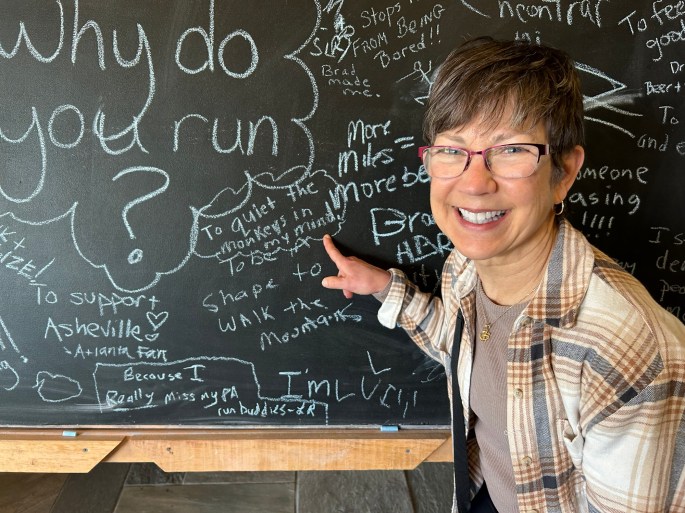
Runners were asked to sign the board stating why they ran.

Sign me up! 📝

Around Christmas, I checked the Asheville Marathon/Half Marathon website, and the powerful and persuasive prose describing the event increased my interest. The website’s editors artfully articulated the community’s belief in the significance of the annual running event. They stated the course’s route would not be “pristine or predictable.” Therefore, the event was for those who “thrive on resilience.” However, the line that sealed the deal stated, “If you’re ready to run in the face of adversity and be a part of Asheville’s comeback story, we can’t wait to see you on the start line!” 

John and I at gathering with other runners and spectators at the starting line before the race began.

Ready, set, Go! 🏁

Soon enough, on a chilly, dark March morning, I waited at the starting line with approximately 2,200 runners from 40 states and three countries who also heeded the call to help support Asheville, according to The Weather Channel. The positive vibe was palpable as runners mingled with spectators. Nonetheless, I was feeling a bit nervous as I recalled the half-marathon route’s elevation gain was nearly 800 feet, and its elevation loss was over 900.  

And, it was hilly.  From start to finish, there were no flat stretches. In the beginning, I read spectator signs claiming, “It’s all downhill from here,” with hope. It didn’t take long to realize those signs lied!  Even the finish line required running uphill, but I am “running” ahead of myself.

Running is a metaphor for living life, and it is always whispering (or sometimes shouting, as this event seemed to do) lessons to those of us willing to listen. Accepting limitations–was the lesson those relentless hills of Asheville taught me. Which makes sense since this is what many of the residents of Asheville and the western Appalachian area had to do during, and now after, the storm–accept and deal with limitations. 

Whether literal or metaphorical, storms of life cause us to suffer. As I repeatedly tried to power through those uphills during the first half, my ego kept telling me to push harder, creating suffering. However, as a late-in-life runner lacking inherent running talent, the reality is that race events for me are more about creating motivation and structure to consistently get me out the door to exercise. At the end of the day, I am not about to set any records; I am not even close to winning my age group, so why was I pushing so hard?

And so, it was on a hill, not long after milepost seven, that I decided to accept my limitations. Sure, I had trained on hills at home, but nothing like this. Why not power walk up the rest of the hills, and then run the downhill portions?

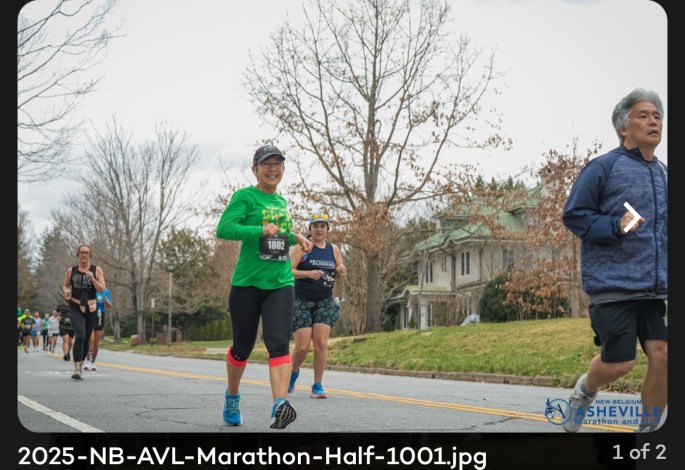
Asheville taught me to accept my limitations.

There is a newfound freedom in accepting one’s limitations 🏃‍♀️

Once I accepted my limitations, there was freedom. I had a new way of being present with the race challenges as they unfolded. This acceptance gave me permission to slow down, take in the sites, and feel a sense of gratitude for my health and ability to make this trip. 

Additionally, by walking the hills, I had more energy to offer encouragement to fellow runners I encountered who also seemed to be struggling. (After all, I run at the back of the pack, where we could all benefit from a little encouragement.) Furthermore, I was also able to offer thanks to the spectators who manned drink stations, rang cowbells, or waved motivating signs with clever phrases such as, “Touch here for power,” “You’re stronger than any storm,” or “You’re running better than our government.” 

By the time I crossed the uphill finish line, tears filled my eyes as I raised my hands in the air.  No, I wasn’t celebrating a personal record, but instead, I was able to celebrate that I crossed the finish line with grace, humility, and a lesson learned. 

The AVL finish line of through which I would later cross humbled, and grateful, by another lesson running once more provided me.

The lesson? Transforming suffering can only occur if we are willing to be with it and accept the limitations it creates. Accepting limitations can be transformatively freeing, allowing us to lean into newly created possibilities we may not have been able to previously envision. I am not saying that accepting our limitations is not easy. However, once we let go of ego and embrace humility, it is possible to embrace the freedom that comes with focusing on what we CAN do.

Thank you , Asheville! I walk away from the finish line with grateful heart and a lesson learned. Furthermore, thank you, Hannah and Allison! I wish your family the best! 💜

The Power of Silence: Reflections on Mindfulness Retreat

In the silence of the heart, God speaks.” Mother Teresa

Photo by Ali Elfaziki on Pexels.com

Silent Retreat? 🧘‍♀️

I don’t remember exactly how the conversation went, but I was enjoying lunch with a friend on a Saturday when she told me she was attending a silent meditation retreat in two weeks, and asked if I would be interested in it. The retreat, she said, was sponsored by The Mindfulness Tree, a meditation community in Charleston, WV, and it would be led by Dr. Christine L. Blice-Baum, MDiv, DMA. Curiosity bloomed, and in a matter of days, I was also registered for the retreat.

In the days leading up to the retreat, I vacillated between feelings of excitement and thoughts of “what-have-I-got-myself-into?” The retreat required spending time in silence with complete strangers, excluding my friend, of course. I kept reminding myself that it wouldn’t be any different than going to an appointment or to the store with numerous others I don’t know. Never once, however, did it cross my mind that this retreat would provide multiple opportunities to come face-to-face with my mind’s resistance and its desire for distractibility.

Photo by Obi Onyeador on Pexels.com

Put away those devices 📲

Upon arrival, all participants in the retreat were asked to put up our phones and take off our smartwatches until the time of our departure. We had the choice to leave our devices in our car, in our own purse/bag, or stow them in a zip lock bag that was put away until the end of retreat.  I chose the latter option as a symbolic break-away from technology and, in all honesty, to reduce any temptation to peek in my bag at either device during the day. 

Not having technology was one of the first minor “discomforts” I repeatedly noticed. It began when I tried to check the outside temperature by looking at my wrist, and then did it several more times! What time is it? No smartwatch. Does the radar show my hometown receiving as much rain as here?  No phone. Blice-Baum just shared a great idea; I should type that in my notes. No phone. I should take a picture of the church’s pipe organ. No phone. Did my husband remember to  . . . . 

Participants in seated meditation.

Lessons of Stillness 🤫

This was my first a-ha moment. I was astounded to realize the amount of time my mind spends in a day consumed with thoughts of all the ways I can implement/use my smartphone and its companion watch. What’s crazy is that I am not a big user of social media, so I had this notion that giving up my devices would not be a big deal. While on one hand, it wasn’t, on the other hand, I was humbled to realize, social media consumer or not, my mind has been trained to be distracted by devices. 

The second big lesson had to do with a notion known as “custody of the eyes”–averting the gaze to avoid visual distractions in order to maintain focus. This practice was a challenge throughout the entirety of the session. 

The retreat schedule was well organized, sessions of seated meditation were interspersed with walking, movement, and standing mediations; however, my mind kept wandering and niggling me to look around at my surroundings. During walking and movement meditations, I had to keep redirecting my attention back to the meditation focus at hand because my mind had the tendency to wander off into people-watching mode. 

Participants take part in a silent walking meditation

The third lesson: I also squabbled with my mind’s habit of entering “squirrel-mode”–moments when something in the environment, or on the wall caught my attention, and my mind would launch off into associations with whatever my eyes had noticed. I knew I was distractible, but I never realized my mind was like a puppy visiting a new environment.

Another eye-opener occurred during our silent lunch. Blice-Baum, after sharing a prayer of gratitude and blessing for the food, led the participants through a short exercise of mindful eating. Then, we were directed to continue to enjoy our meal in silence, engaging all of our senses in the eating experience. This was when my mind really rebelled.  

Since I was a young girl reading the backs of cereal boxes at the breakfast table, I have always read while eating–newspapers, magazines, books–which were later replaced with digital versions. Without such distraction, I noticed my tendency to want to eat quickly and my eyes repeatedly searched around for something on which to focus other than my food. It took time for my mind to settle, slow down, and focus on taste and other sensations associated with the simple act of eating. This was a shocker because I love the taste, textures, and fragrance of food. In fact, I love to eat, but I clearly need to practice eating mindfully more often.

Group picture of participants.

Positive takeaways 🙌

In spite of all the mental obstacles and resistance I experienced throughout the retreat, I walked away feeling refreshed and renewed. Remaining fully focused and present on one’s own breath, a mantra, or an image isn’t easy, but there is something to be said about taking time to slow down and focus on one thing at a time. I felt as if I was coming home to my heart, and my own inner knowing, despite the fact I had to repeatedly redirect my mind like a toddler walking around the Tamarack Marketplace.

Would I do another silent meditation retreat? Absolutely! Many of the things that had been worrying me when I arrived at the retreat felt less weighty when I left. I experienced a recommitment to my personal practice of meditation/mindfulness and was inspired by new techniques to incorporate, not only in my own practice, but also to include with the yoga/mindfulness class I teach at school. Furthermore, in the days that have followed, there has been an overall increase in my sense of gratitude, along with a renewed sense of purpose. I have also noticed a calmer mind with a significant decrease in the power of those negative voices that love to chatter about in my head.

 Most of all, I am much more aware of how easily and quickly my mind can be distracted. These mental diversions on the surface seem as shiny and fun as a carousel ride to a young child, but they can lead to avoidance of the moment at hand–knowledge and understanding of what is going on in the here and now. Therefore, focus––especially given all the digital distractions–more than ever requires diligence, dedication, and continued redirection. And, one of the best ways to do this is the practice of meditation, mindfully completing tasks, or by simply connecting with our own breath.

Photo by Vie Studio on Pexels.com

Interested in Learning more?

If you are interested in learning more about meditation, would like more information about The Mindfulness Tree, or would like to connect with Blice-Baum, please visit www.themindfulnesstree.life

Dr. Christine L. Blice-Baum, MDiv, DMA

Navigating Change: Lessons from a Supertanker’s Course

“Nothing happens until something moves.”–Albert Einstein

Photo by Pixabay on Pexels.com

Why isn’t Change easy? 🤔

“ . . . and that is still my goal,” I overheard a young woman ahead of me in a grocery checkout-line respond to an inquisitive acquaintance, “but change takes time, and it’s not easy.”

My eyes were drawn to the woman who spoke of goals and change as the person with whom she spoke walked away. She had a child in a carrier on her back, and another kid was holding onto the hem of her shirt. A third child she carried on a hip, and there was a baby in a stroller. 

When all of the same young woman’s groceries had been scanned, she realized that her method of payment was in her vehicle. I observed with amazement as she traipsed back outside with four kids in tow to the vast parking lot; several long minutes later, they all marched back inside–the woman clutching a wallet. I was sincerely impressed with the young lady’s calm demeanor throughout the ordeal. 

Upon later reflection, the woman’s reply regarding change brought to mind an expression I once heard: “Making change is like turning around a supertanker.” 

Photo by RANJITH AR on Pexels.com

IN order to change, we have to understand the Problem 🧐

Whether turning around a supertanker or making a life-change, we have to first understand the problem. The problem of turning around a supertanker requires understanding some physics, which I barely recall. Therefore, I did a bit of brushing up, and I was able to learn that turning a supertanker is a problem of inertia, friction, force, and momentum. The same, I think, might also be true in life.

NASA defines Newton’s first law of motion as “every object will remain at rest or in uniform motion in a straight line unless compelled to change its state by the action of an external force.”  Resistance to change in motion is a result of inertia. The larger the mass and/or the greater the speed, the greater the inertia. Therefore, due to the supertanker’s mammoth mass, speeding up, slowing down, turning, or stopping cannot be quickly accomplished. 

Another difficulty in turning a supertanker is due to the role friction plays. According to BBC Bitesize, friction is a “force between two surfaces that are sliding, or trying to slide, across each other.” The amount of friction depends upon the makeup of the two surfaces, but regardless, friction always slows down movement. 

Along with friction, force is another factor influencing the ability of the supertanker to slow down and turn. ByJus describes force as an “external agent capable of changing a body’s state of rest or motion” Given the supertanker’s oversized mass and its momentum (how hard it is to stop an object), the friction and force of the water is relatively weak– similar to sliding on ice. This further explains why a supertanker requires a longer distance and longer time to adjust its speed, turn it around, or bring it to a complete stop in order to avoid damaging the vessel and/or its cargo. It is likewise true for life.

Understanding the role of inertia, friction, force, and Momentum when it comes to change 🤨

Photo by Pixabay on Pexels.com

Similar to moving a super tanker, the greater our inertia and momentum in one direction, the greater the challenge to turn around and/or make a change in our life. Creating life changes, major or minor, typically takes time and planning to overcome the inertia, friction, and/or force that has either stopped our progress or has kept us moving in one (perhaps wrong) direction.

Many of us have experienced some friction that caused us to sense a need for change, but we may have ignored it or lacked the momentum to change. However, as problems, difficulties, or challenges increase their force, our momentum shifts, and we begin to take small steps that can lead to a turn-around. An example of this could be taking an online course or two per semester. While it may take years, eventually a degree or certification of training can be earned, which could lead to the start of a new career and perhaps eventually, better pay and living circumstances.

Unfortunately, there are other times when a major health or life event such as a heart attack, job loss, or an estranged relationship, creates enough of a force to bring us to a full-stop and necessitate us to change course.  However, given the momentum of the life-path that led to the colossal event, there may be physical, personal or relational harm experienced as a result, similar to the damage caused to a supertanker when forced to come to a stop too quickly.

Knowing where to apply the force 😰

Photo by Bilge u015eeyma Ku00fctu00fckou011flu on Pexels.com

The irony of turning a supertanker is that it doesn’t necessarily require a lot of effort to turn it. Sure, it could be pushed and turned from behind, but the amount of force and effort required would be unbelievably great. Another option would be to apply constant pressure to the supertanker’s large rudder at the back of the vessel, which would ultimately turn it, but it would take a lot of force in the form of manpower. 

Instead, ships (and airplanes), such as a supertanker are equipped with a trim tab on their rudder.  As described in Success Engineering, trim tabs help “fine tune the ship’s steering without the need for the ship’s operator to apply constant pressure on the steering controls.”  Hence, the ship can be turned slowly, but with minimal effort and force. 

Your North Star will serves as a guide as you walk along life’s path.

REmember your North Star? 🌟

While people may not have trim tabs, they can have a “North Star.” In the same way the North Star helped sailors navigate waters years ago, having a guiding-light–aka a purpose, goal, or principle–can fine tune our life steering. Life changes and course directions will still need to occur and will also take time, especially if our North Star has been clouded over for some time. Perhaps, this was the case for the young woman at the store. 

Once we understand a problem and set a goal to change, if we follow (or realign) to our guiding light–our true North Star–it can serve as captain of our ship, applying the trim tab when needed to our life’s rudder in order to guide change and course directions as needed.  It doesn’t mean there won’t be friction or rough water ahead; it doesn’t mean we won’t encounter outside forces, such as strong, stormy winds.  And, it doesn’t guarantee that change occurs quickly.  

The point is that in order to turn things around in life, it may be a matter of learning to apply our focus on the right force that can help us overcome our inertia and better manage our friction. Then, we can allow momentum to carry us, course corrections and changes included, as long as we faithfully follow our true North Star.