Springtime Celebration Salad with Walnut Vinaigrette

Featuring asparagus, strawberries, spring mix, and spinach

“Mother Nature’s powers cannot be stuffed into a pill.”–Dr. Micheal Gregor

Photo by Anna Shvets on Pexels.com

pill popping 💊

My husband, John, and I can’t help but giggle every time we see commercials touting the benefits of taking a certain brand of daily vitamins.  This company claims their product provides vitamins and minerals found in fruits and vegetables that we, the lowly consumer, don’t have time to eat.  It especially targets those of us who are older, espousing that by taking these pills, as many as six per day, we will infuse our frail, feeble frames with the vigor and vitality of our former, younger self. 

While there is nothing inherently wrong with taking a multivitamin and/or other key supplements, they should never replace our need for daily consumption of fruits and vegetables.  According to multiple sources, such as,  The Better Health Channel, National Institutes of Health, and Harvard’s T.H. Chan School of Public Health, regularly consuming fruits and vegetables provides the body with important vitamins, minerals, plant chemicals, and a significant source of fiber.  Furthermore, a diet rich in fruits and vegetables have been linked to “lowered blood pressure, reduced risk of heart disease and stroke, prevention of some types of cancers, lowered risk of eye and digestive problems, and have a positive effect on blood sugar . . . .”   These are benefits that can’t be bottled into a pill.
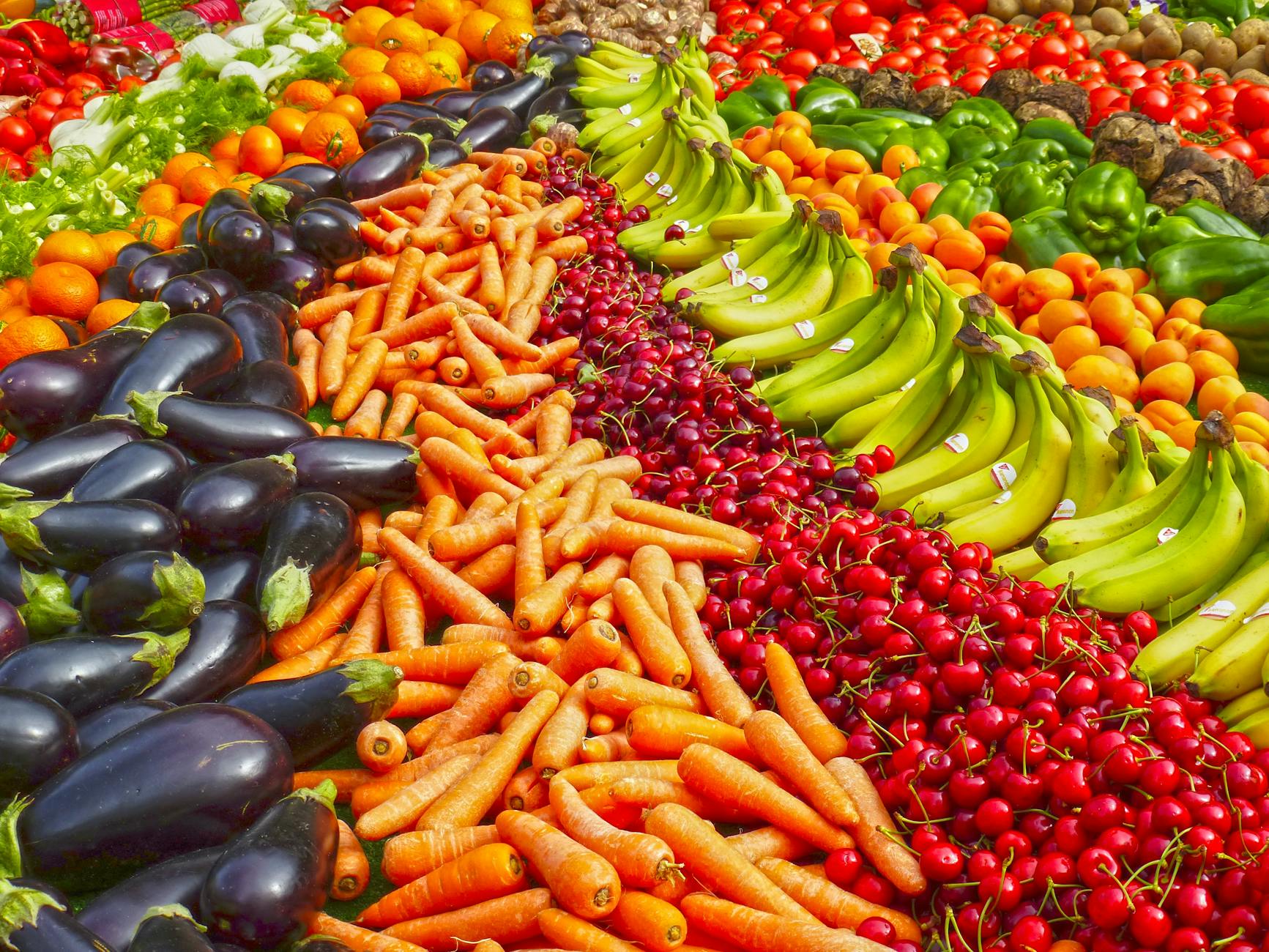
Photo by Pixabay on Pexels.com

Planted in Health 🌱

Of course, I am preaching to the choir, my dear readers.  If you are reading this, you are keenly aware of the benefits fruits and veggies offer.  And, yet, due to clever and slick marketing tactics, Americans have been spending billions in recent years on vitamins and other supplements according to Northwestern Now and Harvard Medical School.  While there are those who do need a few key supplements due to specific health issues, such as those with Crohn’s disease, celiac disease, and ulcerative colitis to name a few, the average healthy adult can get all the vitamins and minerals they need through a well-balanced diet.  Besides, there are numerous tasty and simple ways to incorporate fruit and veggies into your diet.

Photo by Michael Burrows on Pexels.com

Spring produce 🥬

Spring is the perfect time to take advantage of the fruits and vegetables that come into season early, such as greens, asparagus, and strawberries.  Many of these items are often available at local produce stands and markets.  Plus, they can also be found, usually at discounted prices when in-season, at local grocery stores.  Either way, from now until early June, is the perfect time to grab up these produce deals.
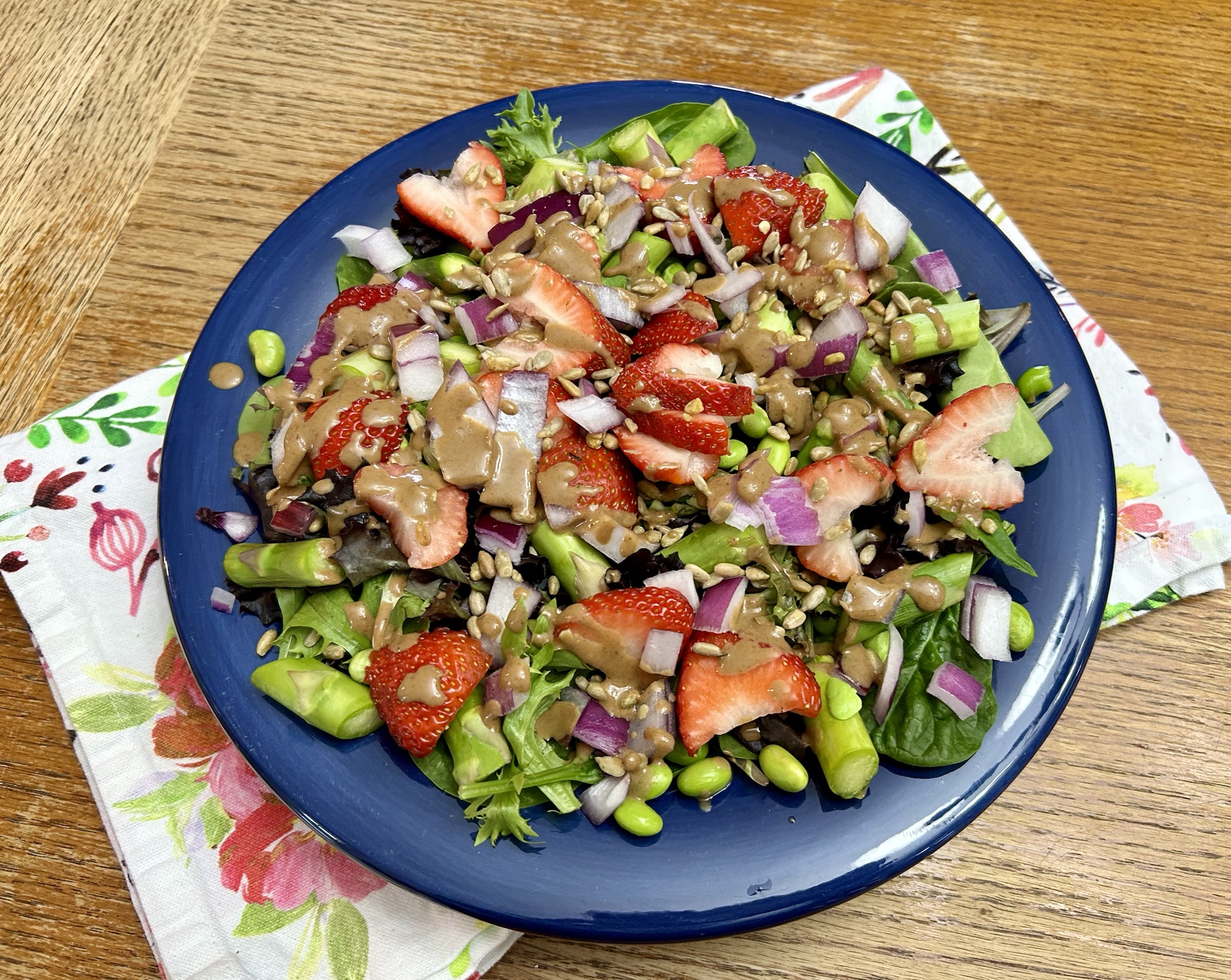
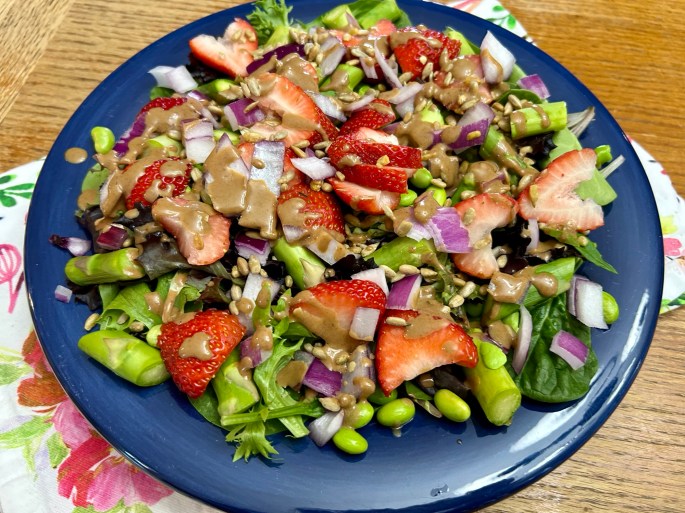
Springtime celebration salad

The salad recipe I am sharing with you is one delicious way to incorporate a variety of spring vegetables and at least one fruit into your day.  It is a bright and colorful salad, bursting with complimentary flavors and textures, and it can be made as a light main dish or a bright start to a meal.  Feel free to play with this recipe by using your favorite dressing, replacing the strawberries with another fruit, changing up the greens and vegetables, or by adding in a favorite protein, bean, or even a grain, such as quinoa.

Make it ahead of time 🥗

I made this salad recipe ahead of time without the fruit and dressing, divided it among Tupperware-type bowls, placed the fruit and poured the dressing into separate, small containers to add to the salad just before eating.  This allowed grab-and-go convenience for lunch.  In the morning, I popped open my lunch bag, filled it with salad, dressing, sliced fruit, and tossed in a handful of whole grain, gluten-free crackers. As I head out the door,  I can rest assured I have packed a nutritionally balanced lunch to fill my afternoon with energy, and I won’t need to worry about spending extra money on overpriced and over-advertised pills.

Celebrate Early Spring produce 🎉

Consider adding this salad into your weekly rotation of spring meals.  Serve it as a meal or as a side.  Toss it up ahead of time if you like– simply add in the fruit and pour on the dressing just before serving.  However and whenever you decide to make it, you are sure to reap the nutritional benefits of delicious spring produce without a pill!
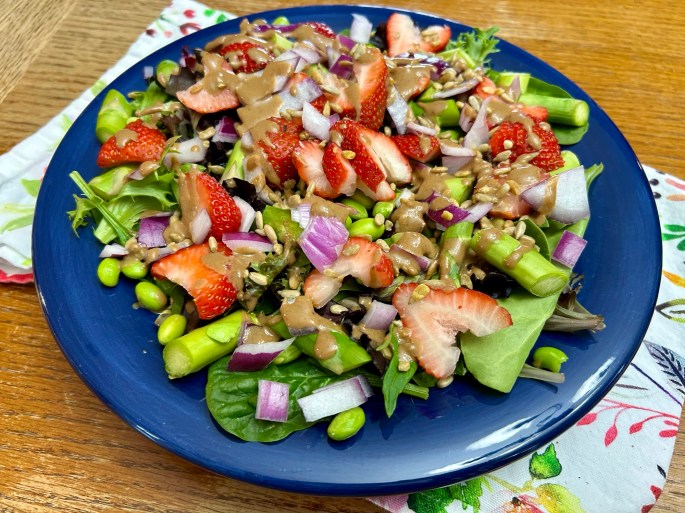
Springtime Celebration Salad with Walnut Vinaigrette, 

Featuring: asparagus, strawberries, spring mix, and spinach

Make 2 large meal sized salads or 4 small dinner salads.

Ingredients for dressing:

½ cup water

½ cup balsamic vinegar

¼ cup chopped walnuts

¼ cup raisins or chopped dates

1 clove garlic or 1 teaspoon garlic powder

1 teaspoon dijon mustard

¼ teaspoon dried oregano (optional)

Salt and pepper to taste

Ingredients for salad:

10 asparagus spears, roughly cut

10 strawberries, sliced (can substitute chopped apple, blueberries, red grapes, or mandarin orange slices if preferred)

4 tablespoons chopped red onion

6 cups spring greens (I used 50/50 blend of spring mix and spinach)

½ cup (or more, depending on preference) shelled edamame beans, called mukimame or thawed frozen peas

½ cup shredded carrots (optional)

½ cup sliced celery (optional)

2-4 tablespoons raw sunflower seeds (or other favorite nut/seed)

½-1 cup feta or goat cheese (omit if vegan)

Directions for salad dressing:

Combine all ingredients in a high powered blender and blend approximately one minute or until smooth.

Store in a container until needed.  Will keep in the refrigerator for two or more weeks.

Directions for salad:

Set out shelled edamame (mukimame) beans or peas to thaw

Cut ends of asparagus, rinse, and then rough cut remaining. Lightly steam asparagus on a covered microwave dish, approximately 30-50 seconds.  (You want them bright green and crisp.)

Rinse and slice strawberries, set aside.

Chop red onion, set aside.

Arrange greens in a large salad bowl, adding in carrots and celery if using.

Top with asparagus, strawberries, and edamame or peas.

Sprinkle with chopped red onion, sunflower seeds (or nuts), and cheese, if using.

Drizzle with desired amount of dressing and serve.

Serve with whole grain baguette slices or whole grain crackers, if desired.

Anyone can complete a half-marathon: Tips to help you achieve this goal

Even when you have gone as far as you can, and everything hurts, and you are staring at a specter of self-doubt, you can find a bit more strength deep inside you, if you look closely enough.”–Hal Higdon

Virginia Beach Shamrock 1/2 Marathon 2024

Pace Yourself 👣

“Your pace on the last mile was spectacular.” Siri voiced my husband’s text into my ear. 

I had just passed mile marker 7 of the Virginia Beach Shamrock Half-marathon.  Up until that point, I wasn’t sure how this event would go for me.  While I had been officially training for this event for months, I had undergone fairly major surgery eleven prior, so I had only gradually returned to running beginning in June.  Even then, it was two months of walking/running, gradually increasing the time spent running.

In November, I participated in the Marshall University Half-Marathon.  Completing it felt like a huge victory since I had to start at ground zero, so-to-speak, post-surgery.  After my surgery at the beginning of April, my exercise consisted of walking around my house for 5-10 minutes at a time several times per day. Therefore, going from house-walking to running 13.2 miles, albeit slowly, within several months was a huge personal milestone. 

Ready to start!

Rethink your definition of Who Can finish a half-Marathon 🏁

Here’s the thing to know about me.  I am not what I would consider athletic.  I was the proverbial band-geek in high school.  Not that I define myself by long-ago standards, but I think many of us can get into our heads and define our athletic abilities based upon those past early experiences. The point is you don’t have to consider yourself “athletic” to participate in a half or full marathon. Anyone can do it.

Furthermore, you don’t have to be fast, and you don’t even have to run it.  You can walk the entire route, or you can mix it up, alternating bouts of walking with running. Others, those who I tend to define as “natural” runners, may spout out finish times and pace with a competitive spirit, but many others, like me, are simply proud of crossing that finish line.  That said, I do confess I notice my finish times, but I never let those times define my accomplishment.  Crossing a finish line is always a victory.

Photo by RUN 4 FFWPU on Pexels.com

Realistic Plans for Beginners ✅

To that end, my relationship with running, which began approximately ten years ago, has developed in fits and starts. When I first began, ten years younger, I was a bit faster than I am now, but I was still running at what competitive runners would consider a slow pace. During those early years, I would try to adhere to established standards of publications, and I always fell short.  I wasn’t experienced enough to fully understand those standards weren’t realistic for me. 

Ten years later, and it still seems like many publications and media outlets set unrealistic expectations for those who are TRULY newbies and need a gentle approach to running/walking.  However, that is gradually beginning to change, and I want to be part of those voices who speak to those so-called “nonathletes” who want to participate in a healthy community event, such as a 5K or half-marathon.  I have read and listened to a few authors who speak to that person with no athletic experience; plus, I have amassed my own personal experience. Therefore, I want to share a few tidbits of encouragement.

Photo by Ketut Subiyanto on Pexels.com

Focus on Increasing time on feet, Not Miles 🦶

First of all, nearly anyone can train to walk, walk/run, or run a half-marathon.  I have met too many people who say they’d love to do it, but believe they aren’t capable.  Yes. You. Are.  I have participated in enough events to know that there are numerous participants who walk the entire route.

Here’s the trick I learned, you do need to train and prepare the body for these events, but it doesn’t have to be extreme. It’s all about time spent on your feet engaged in walking and/or running and the weekly long run that gradually increases in length over 12-24 weeks, depending upon your goals and your starting level of fitness.  (Of course, always seek advice/approval from your healthcare provider before embarking on a program.)

For both Shamrock and the Marshall Half-marathon, my longest run was ten miles, and they were walk/run training sessions–run ten minutes, walk two minutes, and then I kept repeating this pattern for a certain length of time, rather than miles.  This took pressure off completing a certain distance, and it allowed me to better respond to how my body was feeling–adjusting the length of time walking or running.  If I felt rested and strong, I ran for longer periods; however, if I felt over-fatigued or not well, I ran for shorter periods and walked more. 

Photo by Kate Trifo on Pexels.com

Never Underestimate walking 🚶🏽‍♀️

As a general rule, true beginners typically start with walking.  Once you can successfully walk for 30 minutes without stopping–and it might take months to work up to that length of time, and that is ok– then you can begin to add a minute or two of easy jogging, such as walk for ten minutes, jog one minute; repeat two more times.  That is honestly how I moved from walking to running after surgery this past spring once I had clearance from the surgeon.

Photo by Ketut Subiyanto on Pexels.com

Intersperse time jogging 🏃‍♀️

Run Your Butt Off  is a great resource for a structured 12+ week  run/walk plan, but I suggest you disregard the diet information! Additionally, the Shamrock Half Marathon/Marathon website offers free training plans for running/walking an 8K, half, and full marathon. I have successfully used both and found them incredibly helpful and encouraging.

Week-by-week, you can slowly decrease your walking time and increase your running time.  Eventually, you may get to a point where you are happy alternating between running and walking, and that is fine!  Many people adhere to a run/walk practice.  In fact, Jeff Galloway has published numerous articles and books on this topic if you are looking for more guidance.  Therefore, if you want to complete a 5K, 8K, half-marathon, or even a full marathon, there are plans available that will fit your level of fitness. 

Two thumbs up for a personal best!

Sham-rocked! ☘️

As it turned out, I was ultimately able to finish this half-marathon with a personal best time. Once I passed mile marker 7 and my husband made me aware of my pace, I began to get excited and focus a bit more on maintaining my pace, realizing a PR was within reach.  In fact, I finished ten minutes faster than the previous year!  However, it wasn’t easy.  My mind kept telling me about different parts of my body that were hurting, so I had to keep combatting and replacing those negative thoughts with positive messages, such as  “I am getting stronger,” “I am so close now,” “Focus on the feeling of crossing the finish line,” and so forth. 

While it wasn’t my intention to run a PR, I think changing the way I more realistically approached training after surgery made it possible.  Giving myself permission to walk during my months of preparation and using a training plan appropriate for my skill level made a huge difference. Nonetheless, even if I had finished with a slower time, crossing that finish line is always a victory! 

You can do it! 😃

And, I want you to know, Dear Reader, that if you have ever dabbled with the idea of participating in a half-marathon, you can absolutely do it!  I am cheering for you! 

#runforglutenfreewaffle #bestsupport #pocahontaspancakes&wafflehouse #shamrockfinishline

Almost time to go!
And, we are off and running!
Crossing the finish line is such a feeling of accomplishment!

The Lost Art of Delayed Gratification

“The longer you have to wait for something, the more you will appreciate it when it finally arrives. . . .  All good things are worth waiting for . . .”–Susan Gale

Photo by Pixabay on Pexels.com

Window of opportunity ⏱️

One of the more popular health trends that continues to grab headlines is around time-restricted eating or TRE.  It is a form of intermittent fasting in which a person chooses a window of time within a day, typically 6-12 hours, in which they eat.  During the time outside of this window, those following a TRE protocol, do not consume any other calories and drink only water, although there are some following a TRE plan that consume unsweetened tea or coffee. 

The idea of TRE is to reduce the amount of overall calories consumed in a day and to reduce less-positive habits such as eating late at night or snacking too much early in the day.  Besides the obvious benefits of managing body weight, scientific research  into TRE continues to show promising results, including reducing insulin resistance, reduction of inflammation and oxidative stress, can alter and improve the composition of the microbiome, and improved sleep to name a few. 

Photo by Yan Krukau on Pexels.com

Time to Eat 🍱

Time restricted eating is nothing new to me. In fact, my childhood taught this.  I grew up with a natural TRE called breakfast, lunch, dinner and no snacking in between.  Furthermore, my parents believed that if we didn’t like what was offered at a certain meal; well, we wouldn’t starve because I could eat again at the next meal.  

I can recall sitting in elementary school feeling my stomach growl.  Sure, I had breakfast, but we ate early in order to make the school bus.  I would look at the large classroom clock on the wall, counting down the time until the teacher l lined us up and walked us to lunch. Standing in line waiting for everyone to go to the restroom, wash their hands, and line back up, my mouth would water in anticipation of food.  By the time I sat down with the other students who had packed their lunches, I thought I would perish from hunger! But, oh how good that simple food tasted when I could finally take a bite!

By the time I got home from school, my stomach would once more be begging for food, but there was a hard-fast rule.  No snacking before dinner because you’ll ruin your appetite.  This was made more challenging if my parents had ordered a tray lunch from the school cafeteria, and I didn’t like the food.  Still, there was no debating–wait until dinner.

Fortunately, we tended to eat between 5:00 and 6:00 pm, so I didn’t have to wait too long.  However, I tended to be persnickety about certain food items, so if the meal consisted of a food (or foods) that I didn’t like, too bad for me–or any of my siblings for that matter–there was always breakfast.  We weren’t going to starve–even if we thought we would. 

Photo by August de Richelieu on Pexels.com

Delayed Gratification ⌚︎

The beauty of my parent’s rules, whether they intended it or not, was two-fold.  First, food tastes better when truly hungry.  It felt downright wonderful to have a hearty appetite as I sat down for a meal. The other skill learned was the art of delayed gratification.

Sure, I’ve went through phases, such as camps, overnight stays with friends or family, and later in college and as a young adult, where I ate completely differently than how I was raised–eating at irregular times and noshing on foods I would have never been able to eat at home. 

As an adult, I have also likewise gone through similar phases. It is more challenging now to have those structured meal times since food is so widely available at all hours of the day.  No wonder TRE is so popular now.  It brings back that structure and discipline in which I was raised.

The art of delayed gratification, given the immediacy that technology brings, is perhaps becoming a bit of a lost skill set. The ability to resist an immediate reward for a greater or more favorable reward later requires self-regulation and impulse control, skills that often get lost while scrolling through our various screens. However, delayed gratification is a skill that can be learned at any age, but it is not easy.

Photo by Pixabay on Pexels.com

Benefits of Delayed Gratification 🎓

Delayed gratification is what some parents try to teach their children by insisting that all homework must be completed before the kids are given permission to choose a more preferred activity.  It is what adults practice when saving for an important item, such as buying a new car, house, or even something as simple as setting aside money for rent, groceries, utilities, and other bills.  In fact, anytime we choose not to be distracted from our goals or priorities, we are practicing delaying gratification. 

Success in any endeavor, from career to finances, to the most mundane such as cleaning house to choosing when and what to eat, requires the ability to resist the temptation to do something easier (the distraction) and instead, complete something harder, such as studying for that next level career exam or simply choosing, as my parents taught me oh-so-long ago, only eat at meal times. 

Photo by SevenStorm JUHASZIMRUS on Pexels.com

So how do we get better at delayed gratification? ⤵️

There are multiple books, articles, and youtube videos designed to provide various methods. Some people like big changes all at once, such as TRE, leaning into some variation of:  Here’s the rules, the parameters, and the start date.  For certain personalities, a total overhaul of their habits works great.  

However, I tend to prefer more gentle approaches such as:

  • Start with one small change (habit) and stack it with an already existing habit, i.e. I already drink coffee in the morning, why not drink 8-12 ounces of water beforehand?
  • Repeat that change again the next day
  • Set a goal for continuing that new change/habit for a set amount of days with a planned celebration/reward upon reaching the goal
  • If you’re really resistant to completing something, set a timer for two minutes.  At the end of those two minutes, get started. (It sounds silly, but for some people, it works.)
  • Try the “if-then” principle: “If I do this,” (clean kitchen, set up budget, exercise . .), “then I can do this” (scroll through social media, read, nap, etc. . .).
  • Play mind games and daydream (Instead of focusing on what you want to do, daydream about all of the positive feelings you will undergo sticking to and achieving your plan.  Likewise, focus on the negative feelings you will experience if you give-in to a distraction.)
  • Offer forgiveness to yourself when you slip-up (and we all do), but then return to your goal again the next day.
Photo by RUN 4 FFWPU on Pexels.com

Make Delayed Gratification work for you! 😄

Ultimately, whether you are trying to stick to TRE, save for new tires on your vehicle, or make that next big career step, employing the art of delayed gratification can help you keep your goals at the forefront of your mind.  By keeping those goals small and achievable, you can visualize the steps along the path to success (better health, cleaner house, better finances, etc . . .), make peace with your distractions, focus more on your plan/goal, and face challenges (aka distractions) with a bit more self-composure and kindness to self. 

Clouds attaching to my story of sunshine: A lesson on detaching from the plan and surrendering to your Higher Power

“When things don’t go as you planned, don’t be let down. Make new plans. The sun doesn’t stop shining just because of dark clouds.”–unknown

Photo by Jess Bailey Designs on Pexels.com

Who loves a good plan? 🙋‍♀️

Are you a planner?  I can be.  I love a good plan like a kid loves her teddy bear. I can say the same about a solid routine.  Various routines and/or plans give me structure, a scaffolding, to ensure I remember to do, find, and complete various short and long term tasks.  

Without plans and routines, I am a total right-brainer who just goes with the flow.  Free-styling is fine for many of my creative endeavors. Unfortunately, most of my creative endeavors bring little to no income to pay the bills.  However, I love my creative side.  It’s the joyful part of me.  Thus, creating structure and routine to my day, allows me to pay the bills and have fun too.

I will fully admit that I have different plans/routines for different compartments of my day/week, and I work hard to fit those various plans together into the patchwork quilt that is my life. Routines for my profession are obviously far more important and detailed than routines for household chores.  Nonetheless, no matter the plan’s level of so-called importance, if I create or find a plan that truly works, I prefer to stick to it, cling to it if I must . . . but . . .

Photo by Wendelin Jacober on Pexels.com

Uncooperative Plans 😩

Unfortunately, life isn’t always so cooperative.  It keeps flowing like a river reacting to the weather trends unphased by “Stephanie’s plan”.  Sometimes the river of life flows steady ‘round bends and curves.  Other times it is dried to a near trickle, and I wonder if the rains of inspiration will ever arrive.  Then there are those storms that wildly overflow the banks of life’s river sending its waters over rocky embankments and into uncharted territory.

As I sat at my writing desk this morning, contemplating how to begin writing, I spent time staring out the window.  Dawn’s light had broken upon clouds and fog. I could see peaks of brighter blue sky in between the gaps of the clouds overlaid with gauzy fog, and I realized that is often what happens to my plans.

Photo by Tim Mossholder on Pexels.com

planned laughter 😆

I often joke that I must make God laugh all the time by saying that I have a plan.  Despite the fact that I know I need plans to organize myself and my hot-mess of a mind, I also know I cannot attach too tightly to those plans because God and life are going to do what they are going to do with me. And that is exactly what I am now experiencing.

One of my plans for 2024 is to run a spring half-marathon–the Virginia Beach Shamrock.  It is one I ran last March weeks before having a fairly major surgery in April.  Months later, in November, I ran the Marshall University Half-Marathon as a celebration of recovery from that surgery. 

My training plan for the MUM was long and protracted in order to allow my body to heal and recover from surgery.  After returning to work in May, I began gradually increasing my walking endurance throughout May and into June.  

Then, in July and August, I gradually added bouts of jogging into my walking. Gradually, the running sections increased as the walking sections decreased, but there was always permission to walk at any time, and even for the entire work out time, if needed. Due to careful planning, I was able to build up to running the entire half-marathon in November.

Therefore, I thought why not continue training through winter and once more run the VB Shamrock Half-marathon.  I had a plan.  It was mapped out from Thanksgiving week until March 17, the day of the half-marathon.  It was a beautiful and doable plan–not too hard–and fully manageable with my work schedule. 

Photo by Adrien Olichon on Pexels.com

Who’s doing the Steering? 🛻

But as I said, I told God I had this plan, and He had a good ol’ belly laugh at it. I mean He must have enjoyed a real guffaw because very little of “my plan” has gone “as planned.” In fact, I have had to rework and adjust this plan so many times, I have finally, less than three weeks out, metaphorically thrown my hands in the air and surrendered because only Divine Providence knows what will happen on the day of the event. 

Therefore, as I sat at my desk staring at the clouds, the rising mist of the fog, and the interspersed glimpses of blue sky, I reflected on my so-called plan.  The plan included four days per week of running and/or walking, with one longer session per week, completed outside on the weekend, gradually increasing in distance. 

Most of the early weeks into the plan, I was able to complete four days, running outside (translated, not on a treadmill) at least two of those runs.  However, at some point after Christmas, I had to begin making adjustments.  Runs were missed due to conflicts in schedules, and numerous runs were completed inside of a gym on a treadmill due to inclement weather. Plus, I battled several colds and even a random ear infection, which is something I haven’t had since I was a child, so more running time was missed.

Photo by paul voie on Pexels.com

Cloudy thinking 🤔

The thing about running, or any workout journey for that matter, is that it is a microcosm of life.  Lessons learned on the running (walking, hiking, lifting etc) trail are often tangible life lessons.  My plan was those fluffy white clouds in the sky that, in my mind’s eye, I could step comfortably from cloud A to cloud B and so on.  The morning fog, however, was the realities of life. Sometimes my planned path was clear, but most often, there was some sort of, metaphorically speaking, weather event occurring preventing a smooth transition from one step to the next.  

The cerulean sky, to continue the metaphor, was (and is) the Universe, the great I-AM, and that is to whom, in the end, I must surrender.  As Carrie Underwood once sang, I need to let go of the steering wheel because clearly I am not the one in charge despite my illusions of control.

By taking a step back, away from the great “Stephanie-said-so-plan,” I can gain a new perspective.  Firstly, I am grateful for overall good health. Sure, I have had a few minor illnesses this past winter, but nothing life threatening.  

Furthermore, perhaps all those challenges and obstacles were Divine Providence’s way of giving my body the rest I wasn’t giving it. Perhaps, I have been pushing too hard for too long.  Maybe some rest and recovery, like I gave myself after surgery, is what my body needed–especially as a more, ah-hem, older adult.

Photo by Thirdman on Pexels.com

Surrender 🙏

Similarly to the way I witnessed the morning surrendering the events of the coming day to the Creator, I too must surrender the events of the future.  What will be, will be.  End of story.  As my grandmother used to say as a preface, “Lord willin’ and the creek don’t rise,” I will still have the opportunity to travel for a short trip to the shores of Virginia and live to tell another story.  And, where’s the joy in life without stories to tell and lessons to share?  

Surrender the plan