Be Good to One Another: On unseen suffering and the quiet work of kindness

On a winter morning downtown, a moment of waiting becomes a reflection on mental health, unseen suffering, and the quiet work of choosing kindness in a fragile world.

A Morning at the Intersection🚦

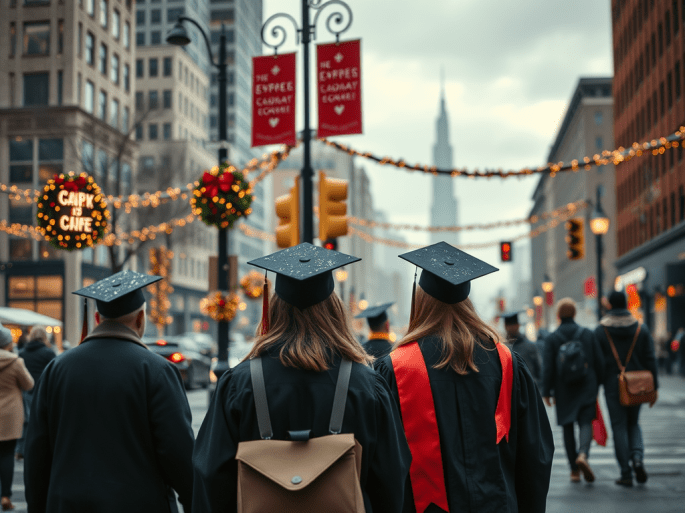
It was a cold, cloudy Saturday morning. I was waiting for the traffic light to change at a major downtown intersection.  All around, Christmas decorations, lights, and baubles sparkled as people dressed for a special occasion hurried towards the city’s arena. I wondered about the unusual sight of numerous people on the sidewalks at this time of day. With sudden clarity, I realized it was the university’s December graduation as groups passed in caps, gowns, tassels, and hoods. 

When We Cannot Know, We Must Care👤

Thinking back to my own daughter’s December graduation, I marveled how life marched on. Groups of people smiling, nodding, waving to one another, braced against the cold, hurriedly moving in a line like train cars linked together on one track bound to the same destination. Recent events came to mind, and I pondered the idea that surface appearances often bely the hidden interior lives of others–a reality social media has exacerbated. Suffering can be tucked away into hidden pockets so that even those closest may not see or know the hidden torment that lurks inside another human’s heart.

Why Unknowing Requires Care ❤️‍🩹

These groups of families, friends, and loved ones believe they know one another. And maybe they do … but maybe they don’t. This precise unknowing is why we need to care for one another–even when it seems futile. Many people carry burdens, traumas, fears, and anxieties that they either don’t share, or don’t know how to process, much less put into words. It is not necessarily a failure; it is part of the human experience that is difficult to understand. We must acknowledge that we may never truly know another person–even those closest to us. Thus, we must offer care, or at the very least, small kindnesses, to others.

“Be Good to One Another” 🫂

I continued to watch in fascination, lost in rumination, as more and more people, dressed in their finery, flowed out of the parking garages on either side of the traffic light. A long-ago, beloved priest’s words came to mind as I continued to watch and wait. “Be good to one another,” he would say at the conclusion of each church service. His words were simple, but their implications were profound. 

What kind of world would we have if more people were simply “good to one another”? If we listened to one another without trying to “fix” anything–personally, this is a hard one, and I suspect I am not the only one. What would happen if we checked in more frequently with another person, even if it feels awkward or tense? What if we responded with more gentleness, kindness, or at the very least, decent courtesy, even when we are tired, rushed, or unsure? Choosing deliberate actions that are kind or respectful does not require insight into another person’s pain, but it does require us to recognize their humanity. 

A Cup of Coffee, a Choice ☕️

I am reminded of a recent incident in which I was running through town. I witnessed an older, unhoused gentleman knock on the window of a man in a car outside of a coffee shop. The man inside of the car leapt out, yelling untold obscenities at the man who knocked. The disheveled, unhoused man kept saying, “I was just going to ask you for a cup of coffee.” The man who had been inside his car became louder and more aggressive. I felt so helpless as I watched in horror. Fortunately, a woman, older than me, walked out of the coffee shop, whispered to the gray-haired man, took him by the arm, and gave him a cup of coffee while the other man continued to spew vitriol. I was so touched by this gentle act. It reminded me of a yoga teacher from an old DVD who stated, “Go out and bless the world because the world needs it.” 

Have We Learned How to Show Up for One Another? 🫴

As I watched the graduation celebration train continue, I couldn’t help but wonder, in spite of all of their book and applied learning, they also learned how to show up for one another? Do they possess the empathy required to “bless” the world? Do they have the skills to offer patience when it is required, hold space when needed, and withhold judgment when encountering dissension or differences?  These are important questions not only recent graduates need to consider, but so do many others, myself included.

Resisting a Hardened Heart 🖤

These are big asks, I know. I try and fail regularly. Nonetheless, I cannot help but believe that striving to be a “perfect” human being matters far less than not allowing the world to harden us, so that we can respond more often with kindness. The key is remembering to reset, when we act unkindly, and try again in our interactions with one another. The world will not be healed by perfection, but rather when we lean into our interactions with one another with presence, awareness, and sensitivity.

Being a Warrior for Peace 😌

The same DVD yoga teacher also advised, “Be a warrior, not a worrier.”  While he typically said this as a point of humor during one of the “warrior” poses yoga is known for, the intent of the message has never been lost on me. Embodying the spirit of a warrior for empathy, gentleness, or kindness, is about offering hope without turning a blind eye to the harsh realities–pain, suffering, fear, or ignorance.  Being a “peaceful warrior” is about a willingness to care without expectations, choosing engagement–however you define it–over withdrawal into a cocoon of hopelessness. It is a practice of continually showing up, even in the smallest of ways.

Choosing Kindness, Again and Again ☺️

I know all too well that kindness will not save everyone, and caring for another does not come with control over another person’s choices. It is further worth acknowledging that our actions, no matter how well-intended, may not help, but it doesn’t mean we should not try. Send that text. Remain quiet and allow the other person’s pause to speak. Ask sincere questions and listen with genuine interest and without expectations. Smile at that stranger.  Offer to help another person–even a cup of coffee to an unhoused man. We never know how actions can impact another person, so please choose kindness over and over. Choose kindness.

As you move through your own daily encounters, consider an idea echoed by numerous writers: “A smile on the outside is often silent suffering on the inside.” 

I invite you, Dear Reader, to notice, reach out, and bless the world quietly with intentional acts of kindness. May we provide flickers of hope and peace in a world often determined to snuff out the light.

A Blessing at the Light 🙏

The traffic light changed.  I drove away, whispering the priest’s words to the strangers celebrating graduation, “Be good to one another. Please, please, please be good to one another above all else.” 

.
The Transformative Power of Art: A Visit to Tamarack

“Do you still feel up for going to the Tamarack?” my husband asked.

A Heavy Heart and a Planned Escape 🚘

Days earlier, we had loosely planned a day trip. The goal was to stop in Charleston for brunch on the way to Beckley, to nose around the galleries and marketplace of the Tamarack, and then return home, making a couple of quick errand stops along the way. Unfortunately, my spirit had been bruised by life, as sometimes happens, but despite feeling down, I agreed to go in the hopes it would be a pleasant distraction.

The brunch and drive along the WV Turnpike were heavy, filled with somber, clarifying conversation as my husband tried to help me clean out the closet of my cluttered heart. Tumbled, but not fully dried from an onslaught of despair, I entered the Tamarack lightened by our discussion, but still damp with distress. My intention from the outset was not to make a purchase, but instead soak up the vibrant and creative energy of the art, and by proxy the artists, who created it. 

Echoing my own feelings, Stella Adler stated, “Life beats down and crushes the soul and art reminds you that you have one.

Entering the Tamarack: A Sensory Shift

Once through the doors, I observed a crowd of people and wondered if this had been a good idea after all. Meandering to the right of the entrance, I surfed the sensory wave. Aromas of Appalachian-inspired cooking filled the air. A long line of people snaked around the fast-casual dining room as I made my way to the ladies’ room. Tamarack’s signature circular shape surrounding an open courtyard created a light and spacious feeling, even during this busy, pre-holiday time period. A multitude of glass windows, adorned with locally designed, gemstone-colored stained glass pieces, radiated an additional cheery warmth. The animated energy of visitors’ conversation added a rhythmic pulse to a popular sing-along soundtrack playing in the background. 

Letting the Atmosphere Settle the Spirit

As I allowed the wave to immerse me, I soon noticed that my breathing and pulse had slowed, tensions were eased, and the emotional flames were beginning to quell. Despite my earlier qualms, I could feel the atmosphere offering a form of calming consolation. The simple act of getting lost in the admiration and appreciation for each artist, and the art pieces they created, nourished my spirit. 

Wandering the Galleries: Beauty in Every Craft 🖼️

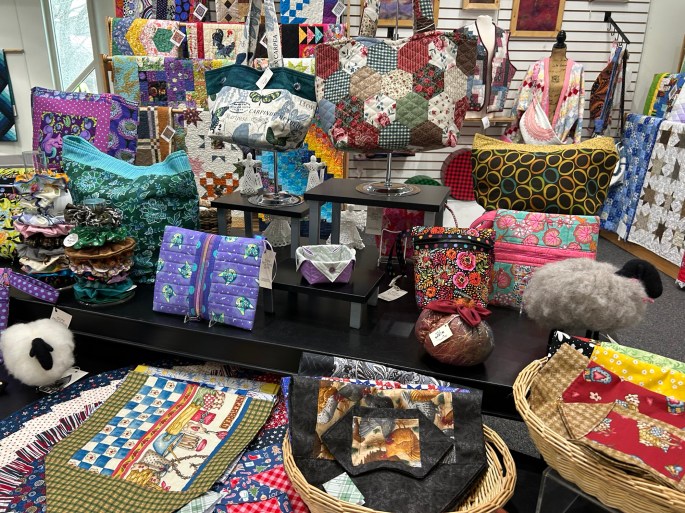
Allowing the natural flow of the galleries to pull me along, I took in richly detailed textiles and exquisite, delicate glass pieces. There were complex and intricate woodworks and artisanal earthen and pottery wares. Tables of WV grown and/or crafted wines, beers, ciders, soaps, candles, and one-of-kind foods/beverages were also available. 

I also stopped by the book nook, filled with locally written fictional and nonfictional books, novellas, cook books, maps, travel guides, and other artfully written materials. Additionally, there was a separate gallery, bright with ample natural light, filled with one-of-a-kind WV paintings, sculptures, prints, and photographs. 

Art as Memory: Echoes of Loved Ones 👵🏼

Allowing the current of creativity to slowly move me at will, the art grounded me into the present moment as I mindfully soaked up the vibrant energy. Different pieces evoked precious memories of loved ones: quilts of my grandmother’s attic, pieces of furniture and toys handcrafted by my husband’s grandfathers, earthen dishes that were reminiscent of family holiday casseroles, paintings and photographs of forested hills during the fall and winter months similar to those I hiked with my siblings and father as a child, and hand sewn creations that my mother once made.

The Healing Power of Art 🎨

I was further reminded of the many art therapy majors with whom I had classes all those long ago years. They often described the important role of art in therapeutic and school settings, a truth supported by research. Creating art and observing art supports mental health and well-being.  It often helps with emotional regulation by creating an outlet in which emotions can be channeled. Art is known to reduce stress and is often used as a tool for creating a greater understanding of one’s emotional atmosphere. Works of art often create a connection/conversation between the creator and viewer, which can provide an opportunity for both personal and collective healing.

Creativity as Community Storytelling

This is because art, such as the works I viewed at Tamarack, is often a reflection of the emotional landscape of a community, region, or even country. How many colorful and varied life stories, events, and personalities, past and living, were being conveyed and connected all under one circular roof? Each stitch, stroke, cut, hammer strike, click, and spin breathed life into each creation that spoke to the heart and soul of human resilience and hope.

In the Company of Strangers: Shared Wonder

As I meandered through the gallery devoted to paintings and photographs, I often lingered on works that spoke to me. Simultaneously, I overheard a pair of women, who were gazing at a section of paintings by a Mingo County artist, speaking with near reverence about their own childhood experiences in the same area. Another couple whispered with one another at nearly every piece, laughing at the memories specific images seemed to evoke. 

Spaces of Belonging: More Than a Marketplace

It occurred to me that art galleries, like the Tamarack, create centers of belonging–gathering places that celebrate the human experience. These transactional spaces aren’t just about exchanging money; they also provide an interchange of ideas and stories between artist, piece, and viewer. Investing in these community hubs is an investment in one another, supporting each other emotionally and culturally. People leave the Tamarack with a taste of what it means to be Appalachian.

A Quiet Affirmation

Standing in that gallery, soaking up all of the intriguing and thought-provoking images, an employee shook me out of my reverie by asking if I was enjoying my visit. I nodded, stating that I was feeling lighter and more grounded than when I entered. She unpretentiously declared, “Art can do that for you.”

We chatted a bit more before I moved on to look through the prints outside the gallery. I still did not have any answers to my specific concerns, but I did have a sense of peace that comes from being heard. Not that I was literally heard; rather, the struggles and joys, the sadness and celebrations, and the wonder and the awe that went into creating these pieces “heard” and spoke to my own related emotions. It was the beginning of healing and hope that often happens when surrounded by reflections of inner beauty.

Leaving with Lightness and Hope

Thomas Merton is credited with stating, “Art enables us to find ourselves and lose ourselves at the same time.” My visit to Tamarack allowed such a juxtaposition: by surrendering myself to time spent with art, my capacity for healing renewal was possible. It served as a reminder. When we immerse ourselves in the present moment, we kindle the still, small voice within, our hearts and minds steady at the sound of this whispering inner-knowing, and we can rest assured we are being held even when the heaviness of life weighs us down. Perhaps that is the gentle promise held within art: when life seems overwhelming and hopeless, the beauty of art and/or the creative process is there to offer us wings of hope for rising once more.