Succeeding at Being Old: What an 18-year-old cat taught me about adaptation

Sometimes the greatest lessons about aging, resilience, and self-compassion come from the most unexpected teachers.

It Was Supposed to Be “Easy-Peasy” 😌

“It’s so intuitive!” I was told. 

“The GPS and data are so much more reliable.”


“The battery lasts so much longer.”

I had been considering switching from one brand of smartwatch to another. Fellow runners recommended it, but so did friends and family. My husband especially encouraged the switch because I had purchased one for him years earlier.

Still, I researched and debated the switch for years before finally deciding to “set the clock,” as it were, and buy one from a local shop. The team at Robert’s Running and Walking helped me set up my new watch. They assured me that it was “easy-peasy,” and I would “love it.”

Three days into owning one, I was ready to throw in the proverbial towel—or in this case, throw the dang watch through a window. I questioned my intelligence for buying it and wondered whether I had reached a new low in technological competence. I kept asking myself, “What’s wrong with you, Steph?” 

My struggles with the new watch were not an isolated event. It was one domino in a series of small incidents that sent me spiraling into the I-am-so-stupid mindset. This negative self-talk, I have noticed, has become amplified with age. It is quite astonishing to see how quickly I can move from, “I don’t know how to do this,” to “There must be something wrong with me.” 

A Better Question 🤔

During the height of my “something is wrong with me” stretch, I came across a social media creator who became an unexpected teacher. Actually, it was the creator’s moniker that caught my attention: “Whatstrongwithu”. I love a good play on words, so this turn of phrase really stood out to me. 

Later, as I was preparing for bed, running through the day’s events with the outlook of the children’s book character, Alexander, known for his “terrible, horrible, no good, very bad days,” I had a flash of inspiration. What if I flipped my inner dialogue from “What’s wrong with you?” to “What’s strong with you?” like the moniker. What abilities, experiences, persistence, curiosity, kindness, adaptability, or perhaps even wisdom do I already possess?

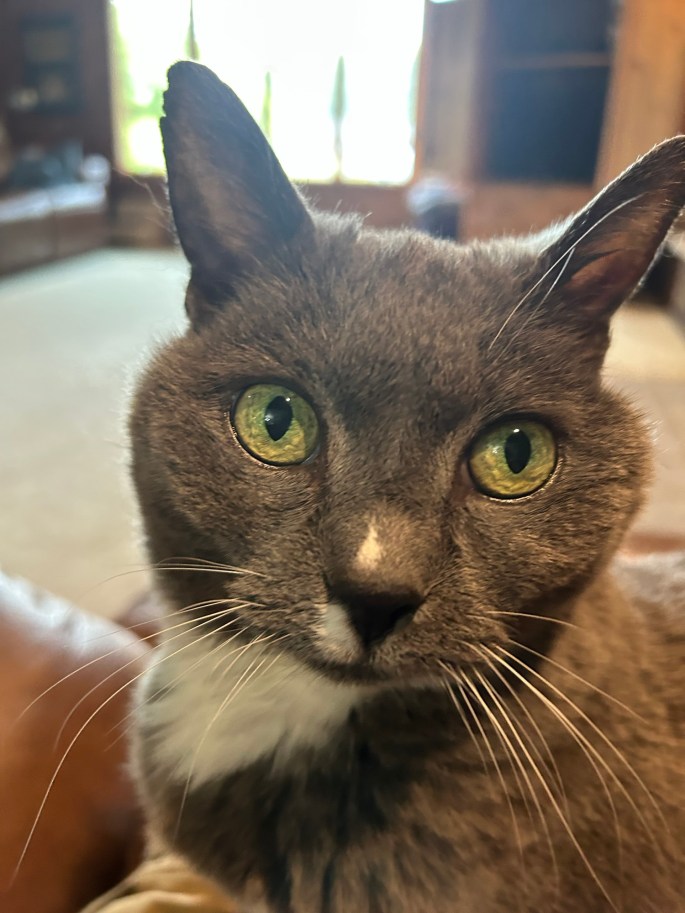
Then, my mind wandered to the previous week’s scare when we thought we would lose our beloved 18-year-old cat, Tippi-Tail. After beginning a new medication for hyperthyroidism, she developed alarming side effects and seemed to rapidly decline. We quickly scheduled an appointment with our veterinarian, fearing the worst. Fortunately, her symptoms turned out to be a short-lived reaction to the treatment, and her bloodwork revealed she was doing remarkably well for her age. 

Tippi-Tail’s Nine Lives 😸

Reflecting on her life further, I thought of her “nine lives”, although, truth be told, she’s had about three. When she was young, Tippi acted impulsively. In fact, we often called her “wild” as she went rip-roaring through the house, knocking over plants, and attacking our then older feline friend, Bobbi with wild abandon. We would correct her with a squirt from a water bottle and a firm “no,” but she was fearless, looking at us with her big-eyed stare of indignation. 

During her middle years, our home became busier and noisier with another cat, another dog, and our energetic daughter and her friends. The fearless kitten who once charged through the house with wild abandon was now more cautious, often retreating under beds or into closets when her world became too stimulating and overwhelming.

In recent years, since the passing of all other pets and our daughter having moved out, Tippi has become an affectionate, cuddly pet. She is now a lap cat who drools when she’s petted as her motor runs. Even more surprising, she greets guests instead of going into hiding, and will even allow them to pet her or occasionally honor them by curling up in their lap. 

Learning to Grow Older 👵🏼

It dawned on me that Tippi-Tail wasn’t meant to be the cat she once was at two years old. She can’t jump as high or move as quickly as she once did, but she still leaps into the window when the neighbor’s cat appears. Her body has changed, yet she grooms herself with meticulous care. Tippi isn’t failing at being young. She is succeeding at being old. 

At my age, my body may not move as it once did when I was younger. I may not learn new technology as quickly as I once did. I may need more recovery time than I once did. In fact, I may have to adapt how I do certain things, but that adaptation doesn’t mean I am failing. 

Watching Tippi-Tail adapt to each stage of her life reminded me of something I needed to hear myself. Like Tippi-Tail, perhaps we aren’t failing at being the younger versions of ourselves. Perhaps we are learning how to succeed at who we are now. 

Maybe the question isn’t, “What’s wrong with you?” Maybe the better question is, “What’s strong with you?” What strengths do we already possess that can help us navigate the challenges in front of us?

Rustic wooden table with bowl of fruit and vase of pink and purple roses

We Live Inside What We Remember

Sometimes the moments we almost decline become the memories we treasure most.

“Isn’t it funny how day by day nothing changes, but when you look back everything is different?”—C. S. Lewis

💌An Invitation I Almost Declined

As my husband and I drove to meet my daughter and her boyfriend for dinner, I could feel the dull headache just behind my eyes. My mind pinged through what I had already checked off on the administration’s end-of-the-year checklist. Tomorrow there would still be a few minor items to wrap up the school year and this year’s graduation. Saturday would still begin early with a long run, followed by household chores tucked in between loads of laundry. Ah, but I could look forward to putting my feet up Saturday evening!

“Do you mind if we come out Saturday? I was also thinking about bringing . . .”

My insides began to tighten. I am embarrassed to say that my first instinct was to protect my energy and say no because I was so dog-tired. My daughter is an educator too, and I knew she had to be exhausted. So if she was asking, it must really matter to her. 

Sensing my hesitation—she knows me so well—she quickly offered a compromise. 

“We can order pizza.” 

This would reduce my efforts, she added. 

Saying “yes” meant I would do some hosting prep, while still doing my usual Saturday routine. I would need to cut up fresh fruit and vegetables for hummus, toss a large green salad with more fresh toppings on the side, put together a few other snacks, and bake a homemade dessert. Surely I could manage that.

🏡The Business of Life

Once home from dinner, with Saturday’s plan fully established, I watched an episode of Downton Abbey. Mr. Carson observed, “The business of life is the acquisition of memories. In the end, that’s all there is.” 

That line struck a nerve. I had been trying to protect my rest when life was offering an opportunity for a memory. 

I looked over at our kitchen table. In the center of it sat a bouquet leftover from Mother’s Day, nearly two weeks earlier. Half of the flowers had already been tossed because they had faded and wilted. The rest looked as if they were hanging on to their last whisper of energy. 

In my mind, I sifted through memories. How strange it is to realize that my mind is filled with decades of unorganized snapshots: names half-remembered, a hodgepodge of family, friends, and former students—small moments and not-so-small moments that outlived many so-called major events. Strange, isn’t it, that we eventually live inside what we remember?

John and I have spent years investing time in the earliest stages of the lives of young people. There are many faces we remember whose names elude us. There have been countless students over whom we have worried and fretted, those who surprised us in ways we never expected, and untold small classroom moments that by some miracle remain in our hearts today. Looking back, it is stunning to realize that we are often so busy arranging the bouquets of life without fully knowing which flowers will last.

At this stage of life, it is hard not to measure. Some people have accumulated wealth. Others have attained status, square footage, or other visible markers of success. There is nothing inherently wrong with any of that. Hard work is hard work. 

But there is, perhaps, another type of good fortune: lunch dates with friends, graduation ceremonies, family gatherings, long conversations, children returning home, or even unexpected Saturday evening dinners. 

🚚Future Memories

My daughter and her boyfriend will soon be moving to Boston. Time with them will then become a precious commodity. Her young adult life will continue to bloom somewhere else—hundreds of miles away. Saturday night dinners will not always be available. And if my lived experience has taught me anything, it is this: we do not always recognize future memories while we are still living them. Yet later, we will live inside what we remember. 

On Saturday evening, plates were loaded and emptied. One story easily led to another. Laughter filled the rooms. We teased Maddie’s boyfriend far too much, but he was such a good sport about it. Our cat kept circling around our daughter, her boyfriend, and their friend—so happy “her girl” was home, if only for a short time. 

No matter how tired we are, or how carefully we guard our energy, love has a way of interrupting us. And in the end, if we are lucky, we live inside that love.

A person walking alone on a winding forest path with autumn leaves and sunlight filtering through the trees

A Prayer to Become Art

Reflections on quiet lives, steady love, and the meaning we leave behind

Perhaps it is aging, or the fact that I read too many books. Perhaps it is because I am a sentimental fool. But lately, I’ve had a persistent thought—maybe more of a prayer. 

Let my life have meaning. Let it become art for someone.

Not headline art. Not museum-worthy art. 

Just something that helps another person survive a difficult season.

The Question That Stayed

I think this inner prayer began earlier this year while reading My Friends by Fredrik Backman. In it, I encountered a quote that gave me pause. I read and reread the words. 

 “Art is what we leave of ourselves in other people.

It was one of those quotes I immediately wrote down. From that moment on, a question kept returning to me: “What am I leaving in other people?” 

I began thinking about the people who had shaped my life, as well as those I had witnessed quietly shaping the lives of others. As I mulled it over, my heart ached a little. I found myself wondering what I had truly offered the world.

Quiet Lives

One of the first people who came to mind was my husband, John. He is a relational magnet. People are naturally drawn to his easygoing personality. He thrives publicly—the more people, the better. His students tell me all the time, sometimes sheepishly since I am also an educator, that John is their favorite teacher. I have always admired that quality in him.

Meanwhile, I am quieter, sometimes even awkward when it comes to small talk. I am comfortable and competent within the classroom, but less so outside of those four walls. 

The subjects John and I teach are different too. My class is harder to love because fewer kids read, and even fewer enjoy it. In the world of education, John’s class is birthday cake, while mine is more like broccoli. On my best days, maybe it’s a clementine—sweet and tangy, but still has to be peeled.

I love that for John, but I also wonder: is it the subject, or is it me? I do not always feel that I impact my students—or coworkers, friends, and family—in the same visible way he does. Still, I am trying to grow into a better, more open version of myself, though it does not come easily. 

Even so, I continue to prefer a quieter life. But can quiet lives still create “art”?  

Does quietly going about my work within the classroom make a difference? Can my passion for my students and subject still be felt through my actions?  

I try to create a structured, reliable classroom—one that challenges students while also giving them opportunities to succeed. I don’t want my students to fail, and I try to teach in ways that help them believe they can learn.  

But does the unspoken care matter? Does consistency leave residue in people? Must impact always be loud? 

The Art We Leave Behind

If “art” is what we leave of ourselves in other people, then I pray I leave behind a sense of love and worth. I hope others feel emotionally safe around me. I hope they sense that I believe in their ability to learn, adapt, and overcome life’s challenges. 

Hope springs eternal in me when it comes to my students, my family, my friends, and humanity itself. I pray that hope is felt.

I am more turtle than hare—more slow and steady than flash and flare. Still, I want to model a different way of moving through the world. I hope to show that aging does not have to diminish us, that nourishing our bodies does not have to be restrictive, and that fitness can take many forms. 

I want others to understand that you do not have to be loud to make a difference. To me, it matters more to live quietly and with integrity, trusting that perhaps someone, somewhere, might find strength or courage in an example of an ordinary life lived faithfully.

Most of all, I want to be the best mom I can to my now-adult daughter. I want to offer her emotional support and steadiness when she needs it, while also giving her the freedom to become fully herself—whether she chooses to live loudly or quietly. 

I want to continue nurturing the love between my husband and me, to love my family well, and to deepen the friendships I already have.

Let me leave warmth and gentleness behind.

Let me leave laughter and joy behind.

Let someone feel less alone because I lived.

Let someone believe their goals are possible.

Let my life be useful art in some small way.

Not grand.

Not immortal.

Just meaningful. 

The Professor Who Changed How I Think About Aging

The early June sun warmed my skin. I sat quietly along the shores of the Outer Banks of North Carolina. The page corners of a biology textbook and spiral-bound notebook—filled with sand and smeared ink—riffled in the chilly ocean breeze. 

I had just earned a master’s degree in 14 months while working full-time as a special education teacher. And I had a dream. I felt pulled to teach Kindergarten students—specifically those in need of early academic intervention. With my background in special education, I felt I was the ideal candidate for this role.

💭A Dream Interrupted

Unfortunately, I was told “no” in clear terms. I was not officially certified to teach kindergarten, despite holding a K-12 special education certificate. The position required a K-8 elementary education certification.

The requirement felt unfair and exhausting. I thought I had done everything “right” to teach this specific “special” class, but it still wasn’t enough. Rather than let this deter me, it became the basis for a new determination: earn that blasted K-8 Elementary certification if that was the last thing I did. Little did I know where, and to whom, this would lead me.

One month after earning my master’s degree, I enrolled at Marshall University. An advisor created a plan that required me to take two condensed summer courses—each just four-weeks long. The first class began the same week as a long-planned vacation my husband, John, and I had already paid for with another couple. If I did not take that summer course, I would have to wait another year before it was offered again.

📞 A Phone Call to Dr. Tarter

This was before email. Therefore, I needed to call to speak with the professor of the class, which ironically was a basic-level biology course with a lab. I called the office—determined, but a little scared. As a teacher, I knew this was a big ask. 

 “Would it be possible to miss the first week of a four-week summer session if I completed all the readings and assignments while I was away and made up the lab work upon my return?” 

This professor didn’t know me.  He didn’t know my work ethic. Missing a full four days of classes out of 16 total sessions was a significant deficit. I wasn’t even sure if I could do it, but I had to try. However, if he said “no,” it meant I would not earn the certification in time for the following school year.

His name was Dr. Tarter.  I don’t remember much about the conversation itself, but I do remember the knot in my stomach as I explained my situation and asked the question. I have a vague recollection of a protracted pause that was followed by a handful of pointed questions as my heart pounded. When he reluctantly consented, it was with a series of stipulations and a parting implication that I still may not pass the class. I assured him I would work hard to make up for the deficit my absence created.

🌊 Studying at the Shoreline

While my friends and husband read Cornwell, Grisham, Koontz, and King, I read about the characteristics of life, scientific method, cell structure, and cellular metabolism. They took long walks along the shore; I sat at the shore’s edge, feet in water, jotting notes in a college ruled notebook. When they stayed up late playing cards, I went to bed early, so I could get up to make flashcards and study in the early morning quiet. I was resolute in my commitment both to the requirements to teach the Kindergarten intervention class and to my hard work. I did not want Dr. Tarter to regret allowing me to miss the week.  

Upon returning to MU, my dedication continued. Much to my surprise, I thrived in Biology and the required lab. It turned out that Dr. Tarter was an excellent instructor, breaking down difficult concepts into clear, understandable ideas. Working in the lab with the guidance of a GA after class was invigorating. What was, at first, an intimidating environment, quickly became a playground for learning.

👩‍🏫 An Unexpected Offer

As the short summer session wound down, Dr. Tarter asked to speak to me after class. He explained he was surprised by my performance, especially considering I missed the first full week of classes. Then, he made an unexpected offer.  He asked if I would consider switching paths. I could work as a graduate assistant in his research lab, receive a small stipend and tuition support, and pursue a Master of Science in Biology. At the age of 29, Dr. Tarter was offering me a different future–one I had never thought possible as a young girl–becoming a scientist. 

I was shocked and torn from within. I. Could. Be. A. Scientist. 

And yet . . .

🤨 Too Old at Twenty-Nine?

There were bills to pay. I now had multiple student loans, and my husband still needed to complete his master’s. How could I ask him to wait another two years before he could start his advanced education? How would we get by on one salary? Worst of all, as I now reflect, I thought I was too old. Too old at age 29—can you imagine? 

 I said all this and more as I declined Dr. Tarter’s offer. I recall how he looked at me with eyes full of compassion and the wisdom that comes from decades of living. 

“Well, I suppose the possibilities of youth can still be held in our senior years.”

🤔 The Lesson That Remained

At times, I’ve often wondered what might have happened if I had accepted that offer— how different my life might have been?  But I don’t carry regret. Instead, I’m grateful that he saw something in me that I couldn’t see yet in myself—something I never believed I was truly capable of achieving. Youth was not what I thought it once was.

As I move through this new decade of life, I find myself near the age Dr. Tarter was when he made that offer. Just like he modeled then, I am committed to continuing to learn—to showing up to life with discipline and diligence. In fact, I am still evolving, despite the fact I never earned another degree. 

I think back to that biology and the spiral bound notebook—its water-stained pages fluttering in the salty air. Likewise, I hold onto that feeling of possibility that Dr. Tarter saw in me. He saw me as more than an educator. He saw another version of me and the possibilities contained within.

The notebook is long gone, and so is Dr. Tarter. But his lesson remains. He was right. Possibility doesn’t belong to youth. It belongs to those willing to keep reaching for it.

When a Stranger Helped Me Pick Up the Pieces

Sometimes the most meaningful acts of kindness come from strangers we may never see again.

❄️ The “Perfect Storm” at the Grocery Store

It was another cold, snowy morning with another round of snow on its way. School had been cancelled for the day, and I thought I would be “smart” by driving to the grocery store early. Surely no one else would do that ahead of the snow. They would have done their shopping last night, right?

Pulling into the parking lot, snow piles—peppered with dirt and debris—blocked several parking spots. Light snow sprinkled down from an angry sky darkened by winter’s wrath once again. It was a Friday, the first of the month, so I should have known that despite the early hour, few parking spots were available. Then it hit me: big-game weekend.

🛒 The Cart with the Stubborn Wheel

Once parked, it was a “perfect storm” inside the store. 80s pop music attempted to brighten the mood. Harsh fluorescent lighting contrasted the outside winter skies.  Paper ads of this week’s specials fluttered in the air as the double doors whooshed open and closed repeatedly. The only cart available was a small cart, which was perfect for my needs. The only problem? It had a front wheel that did not roll properly. 

I quickly attempted to push it. After all, I only needed a few items, but that stubborn wheel kept sticking, making corners especially difficult to turn. Nonetheless, I found a way to, well, get it rolling, and attempted to weave in and out through the throngs of dilly-dallying people and displays. 

I reminded myself of the mission since I had already “researched” prices online: Stick to the list organized by aisle numbers. Get in and get out quickly. Online work awaited me at home, and snowfall had already started. I told myself to slow down, but I kept my pace up anyway.

📦 When Everything Came Crashing Down

And, of course, it happened. The wheel stuck right as I tried to turn a corner. It was like a bad slow-mo scene from an old black-and-white B-movie. I tried to stop it, then catch it, but it wasn’t enough. An entire cardboard display–stockpiling the greatest hits of pharmacy specials—began to crumble to the floor.

 I stumbled, fumbled, and bumbled with individual boxes of pain relievers, antacids, toothpaste, vitamins, and cold/flu care items. Embarrassment colored my cheeks and a sensation of shame sent waves of heat through my body as my heart began to race. I was a child again, and it was “all my fault.” “You should have known better, Steph” echoed in my mind. I tried to work quickly, but my hands were as clumsy and klutzy as that misbehaving wheel. 

🤝 The Kindness of a Stranger

Then, I sensed a presence. I gazed up from a squat position on the floor and there stood a young woman with large expressive eyes. Her kindness was palpable as she stooped down beside me. Her long fingers worked with calm, coordinated dexterity, and she began to help me. I began to protest that it was “my mess,” not her responsibility. Her hands continued to work with precision, and she met my gaze, declaring that it was only cardboard–“no big deal.” 

The display was like putting together a 3-D jigsaw puzzle. Nonetheless, my heart slowed with the gentleness of her response. When we were finished, we each had a few items left over in our hands with no more room on the cardboard shelves. The unknown woman flipped her long chestnut hair over her shoulder and gave an unexpected child-like giggle. In a conspiratorial voice, she directed us to “put the rest of the items here.” It was on a shelf of an endcap of laundry detergent, beads, and dryer sheets.

She winked. “It makes about as much sense as this random display.” 

I thanked her profusely, but she waved me off with an it-was-nothing expression.

❄️ A Snowflake Memory

When my daughter was quite young, I recall playing with her, gleeful and reveling in the snow. “Catching” snowflakes on her mitten was a favorite activity. Time fell away as delicate flakes alighted onto our upturned mittens. There was a silent wonder that muted even the beating of our hearts as we gazed at each individual snowflake. “Look, Mommy, look!” she would say as slowly each snowflake melted into the fabric of our mittens, leaving only a whisper of a mark.

The woman escaped as quickly as she appeared. For a fleeting moment I was back in the snowy front yard with my daughter, silence filled my ears as the warmth of her generosity lingered within me. Then, just as quickly the milieu of the store came back into focus: the buzzing lights, calls for help up front, the throngs of people with party trays, beer, and bread, and another 80s be-bop song played in the background. 

With a warmed and lightened spirit, I trooped off to gather the few items remaining on my list. Of course, my cart still had the broken wheel, and it was still hard to maneuver it through crowded aisles and endcaps. Still, I was able to get the rest of my items without incident. 

How many of us navigate life’s challenges with little vulnerabilities wobbling within us like that shopping cart wheel?  Helping hands are seldom asked for, but often needed in a hurried and harried world.

🌊 The Ripple Effect of Kindness

A week or so later, when I visited the same store, I noticed a woman struggling to reach an item from her motorized shopping cart. One of her legs was in a boot—her current wobbly wheel. As I offered to help her, I was reminded of the helping hand that lifted me up during one of life’s storms and sensed the rippling waves of one person’s ordinary kindness.

Kindness, generosity, and brief moments of courage—these are the connections that steady us when life turns snowy and cold and hands us a cart with a wobbly wheel. 

The Transformative Power of Art: A Visit to Tamarack

“Do you still feel up for going to the Tamarack?” my husband asked.

A Heavy Heart and a Planned Escape 🚘

Days earlier, we had loosely planned a day trip. The goal was to stop in Charleston for brunch on the way to Beckley, to nose around the galleries and marketplace of the Tamarack, and then return home, making a couple of quick errand stops along the way. Unfortunately, my spirit had been bruised by life, as sometimes happens, but despite feeling down, I agreed to go in the hopes it would be a pleasant distraction.

The brunch and drive along the WV Turnpike were heavy, filled with somber, clarifying conversation as my husband tried to help me clean out the closet of my cluttered heart. Tumbled, but not fully dried from an onslaught of despair, I entered the Tamarack lightened by our discussion, but still damp with distress. My intention from the outset was not to make a purchase, but instead soak up the vibrant and creative energy of the art, and by proxy the artists, who created it. 

Echoing my own feelings, Stella Adler stated, “Life beats down and crushes the soul and art reminds you that you have one.

Entering the Tamarack: A Sensory Shift

Once through the doors, I observed a crowd of people and wondered if this had been a good idea after all. Meandering to the right of the entrance, I surfed the sensory wave. Aromas of Appalachian-inspired cooking filled the air. A long line of people snaked around the fast-casual dining room as I made my way to the ladies’ room. Tamarack’s signature circular shape surrounding an open courtyard created a light and spacious feeling, even during this busy, pre-holiday time period. A multitude of glass windows, adorned with locally designed, gemstone-colored stained glass pieces, radiated an additional cheery warmth. The animated energy of visitors’ conversation added a rhythmic pulse to a popular sing-along soundtrack playing in the background. 

Letting the Atmosphere Settle the Spirit

As I allowed the wave to immerse me, I soon noticed that my breathing and pulse had slowed, tensions were eased, and the emotional flames were beginning to quell. Despite my earlier qualms, I could feel the atmosphere offering a form of calming consolation. The simple act of getting lost in the admiration and appreciation for each artist, and the art pieces they created, nourished my spirit. 

Wandering the Galleries: Beauty in Every Craft 🖼️

Allowing the natural flow of the galleries to pull me along, I took in richly detailed textiles and exquisite, delicate glass pieces. There were complex and intricate woodworks and artisanal earthen and pottery wares. Tables of WV grown and/or crafted wines, beers, ciders, soaps, candles, and one-of-kind foods/beverages were also available. 

I also stopped by the book nook, filled with locally written fictional and nonfictional books, novellas, cook books, maps, travel guides, and other artfully written materials. Additionally, there was a separate gallery, bright with ample natural light, filled with one-of-a-kind WV paintings, sculptures, prints, and photographs. 

Art as Memory: Echoes of Loved Ones 👵🏼

Allowing the current of creativity to slowly move me at will, the art grounded me into the present moment as I mindfully soaked up the vibrant energy. Different pieces evoked precious memories of loved ones: quilts of my grandmother’s attic, pieces of furniture and toys handcrafted by my husband’s grandfathers, earthen dishes that were reminiscent of family holiday casseroles, paintings and photographs of forested hills during the fall and winter months similar to those I hiked with my siblings and father as a child, and hand sewn creations that my mother once made.

The Healing Power of Art 🎨

I was further reminded of the many art therapy majors with whom I had classes all those long ago years. They often described the important role of art in therapeutic and school settings, a truth supported by research. Creating art and observing art supports mental health and well-being.  It often helps with emotional regulation by creating an outlet in which emotions can be channeled. Art is known to reduce stress and is often used as a tool for creating a greater understanding of one’s emotional atmosphere. Works of art often create a connection/conversation between the creator and viewer, which can provide an opportunity for both personal and collective healing.

Creativity as Community Storytelling

This is because art, such as the works I viewed at Tamarack, is often a reflection of the emotional landscape of a community, region, or even country. How many colorful and varied life stories, events, and personalities, past and living, were being conveyed and connected all under one circular roof? Each stitch, stroke, cut, hammer strike, click, and spin breathed life into each creation that spoke to the heart and soul of human resilience and hope.

In the Company of Strangers: Shared Wonder

As I meandered through the gallery devoted to paintings and photographs, I often lingered on works that spoke to me. Simultaneously, I overheard a pair of women, who were gazing at a section of paintings by a Mingo County artist, speaking with near reverence about their own childhood experiences in the same area. Another couple whispered with one another at nearly every piece, laughing at the memories specific images seemed to evoke. 

Spaces of Belonging: More Than a Marketplace

It occurred to me that art galleries, like the Tamarack, create centers of belonging–gathering places that celebrate the human experience. These transactional spaces aren’t just about exchanging money; they also provide an interchange of ideas and stories between artist, piece, and viewer. Investing in these community hubs is an investment in one another, supporting each other emotionally and culturally. People leave the Tamarack with a taste of what it means to be Appalachian.

A Quiet Affirmation

Standing in that gallery, soaking up all of the intriguing and thought-provoking images, an employee shook me out of my reverie by asking if I was enjoying my visit. I nodded, stating that I was feeling lighter and more grounded than when I entered. She unpretentiously declared, “Art can do that for you.”

We chatted a bit more before I moved on to look through the prints outside the gallery. I still did not have any answers to my specific concerns, but I did have a sense of peace that comes from being heard. Not that I was literally heard; rather, the struggles and joys, the sadness and celebrations, and the wonder and the awe that went into creating these pieces “heard” and spoke to my own related emotions. It was the beginning of healing and hope that often happens when surrounded by reflections of inner beauty.

Leaving with Lightness and Hope

Thomas Merton is credited with stating, “Art enables us to find ourselves and lose ourselves at the same time.” My visit to Tamarack allowed such a juxtaposition: by surrendering myself to time spent with art, my capacity for healing renewal was possible. It served as a reminder. When we immerse ourselves in the present moment, we kindle the still, small voice within, our hearts and minds steady at the sound of this whispering inner-knowing, and we can rest assured we are being held even when the heaviness of life weighs us down. Perhaps that is the gentle promise held within art: when life seems overwhelming and hopeless, the beauty of art and/or the creative process is there to offer us wings of hope for rising once more.

Embracing Silence: The Owl’s Call to Mindful Listening

A wise old owl sat on an oak;
The more he saw the less he spoke;
The less he spoke the more he heard.” —old proverb

A wise-looking owl perched on a branch in a dark, wooded area, illuminated softly by moonlight.
Photo by Erik Karits on Pexels.com

Listening in the Dark 🌌

I am an early riser, typically awake before the sun. A few weeks ago, my ears perked at the haunting, penetrating call of an owl. Its “Hoo-hoo-hoo, hoo-hoo” echoed around our yard as I looked out into the murky dark. Since then, I intentionally listen for its steadfast call. It has become both a comfort and a mystery—an invitation to listen, reflect, and learn something new.

The owl’s call continues, I am certain, even when I am not listening; yet it requires my full attention in those predawn hours if I hope to notice it regularly. Its presence illustrates the importance of listening and discerning with care and purpose.

A grey and white owl perched on a branch with wings partially spread, showcasing its feathers and an alert expression against a green blurry background.
Photo by Petra Ryan on Pexels.com

What Owls Teach Us About Voice 🗣️

The autumnal hoots I hear, I learned after a bit of research, are used mostly to communicate territory and to call to potential mates. (It is worth noting that many owl species mate for life, finding another only if a partner dies or becomes separated.) Owls also use distinct calls to warn a mate, their nestlings, or even neighboring owls when danger is near. Only when the threat is imminent do they screech, hiss, or snap their beaks in defense of their young. Like the owl, we, too, can carefully choose when to use our voices amid the noise of the world, saving our own form of “screeching” for the rarest and most necessary moments.

Three barn owls perched on a branch in low light, showcasing their distinctive features against a dark background.
Photo by throughmylife_in_ INDIA on Pexels.com

Signals of Respect and Coexistence 🦉

As I read more, I couldn’t help admiring how owls communicate—practically, respectfully, almost as if to say, “I am here. You are there. Let us coexist with our shared resources and help ward off danger.” To be certain, I am personifying and simplifying their communication, but perhaps there is a lesson for us. In a world that often isn’t equitable in its distribution of resources, space, or power, maybe we can learn the art of signaling like owls—communicating truthfully and transparently without silencing others. What if we approached our conversations with presence, restraint, respect, and a shared awareness of the landscape we inhabit?

Holding Our Ground with Grace 🙏

Hearing the owl’s early morning “Hoo-hoo-hoo, hoo-hoo” reinforces the importance of holding our own ground—our principles, values, beliefs, and even compassions—without becoming loud or defensive. The owl does not insist on being seen; rather, it asserts its message with a reserved dignity. We, too, can claim our “territory” through composed conviction and fairness, standing firm without demeaning others. Faith in our tenets, like my unseen morning owl, calls us to trust what cannot be seen but can be discerned only in stillness.

A tall tree with orange leaves against a clear blue sky, surrounded by a grassy area and a house in the background.
Fall is a time of release and renewal.

Autumn’s Invitation to Adapt 🍂

Autumn is a season of release and preparation. Light softens, signaling leaves to fall as trees ready themselves for winter’s quiet work. Many creatures follow this rhythm, including the owl in my backyard adapting to the shifting season. We, too, are invited to adapt—to let go of what is no longer needed, recalibrate our priorities, and listen more deeply. The natural world thrives on balance, which is different from our human desire for “fairness.” It exists in a subtle harmony in which every being plays a role. I wonder what might happen if we focused more on harmony—the give-and-take of shared ecosystems and resources—paired with the wisdom of knowing when to listen and when to speak.

A woman in a pink hijab interacts playfully with a barn owl perched on her arm, pointing towards its face, with another owl visible in the background.
Photo by Rangga Aditya Armien on Pexels.com

The Harmony of Coexistence 🕊️

The autumn owl’s voice in my backyard is solitary, and yet it reflects community. It marks its presence while acknowledging the presence of others, including us. Coexistence, the owl teaches, requires more than hearing what others say; it requires listening to the silences. Of course, human coexistence is complicated, and life often isn’t what we would call fair.

Therefore, it becomes incumbent upon us to listen, act kindly, and withhold judgment—offering small or not-so-small acts of goodness to help restore balance. This may mean choosing gentleness, or even silence, over the need to be “right,” especially when a loved one, friend, or coworker says or posts something unkind or expresses an opinion we strongly oppose. Likewise, offering compassion instead of judgment when someone is rude or ill-behaved can shift a moment for the better, even if only because we have refused to be pulled into energy-sapping negativity.

A serene forest scene with tall trees bathed in soft rays of sunlight filtering through the branches, creating an ethereal atmosphere.
Photo by Atlantic Ambience on Pexels.com

Before the Light Returns 🌅

The owl still calls unseen in the dark predawn hours, reminding us that communication, connection, and hope often begin before the light returns. The owl does not question whether the sun will rise; it simply continues its call, trusting the rhythm of creation. Like my unseen neighbor, I pray we find the courage to speak fairly, listen deeply, and have faith in the unseen process—knowing that every voice lifted in love and fairness echoes far beyond what we can see.

Perhaps that is the heart of the owl’s lesson: when we listen more deeply, we create the conditions for fairness to grow. As I recently read, “Life isn’t fair. It isn’t, which is why people should endeavor to be more fair to one another, not less.” —Kate Quinn.