In addition to being a free-lance writer and creator of Steph Simply website, Stephanie is a 6-8 ELA educator at St. Joseph Catholic Middle School in Huntington, WV. She is also a RYT-200 certified yoga instructor as well as Reiki levels 1 and 2 certified. “Your work is not to drag the world kicking and screaming into a new awareness. Your job is to simply do your work… sacredly, secretly, silently … and those with ‘eyes to see and ears to hear’ will respond.’”–Unknown
“Motherhood is an early retirement position. Your children do grow up.”–Colleen Parro
“Are you ready to go see Mommy? Are you ready to go home? We’re almost to the car, and then we can go home to Mommy. Daddy just has to buckle you in your car seat . . .”
I took the scene in with great fondness as my heart constricted and my vision grew temporarily fuzzy. The toddler was grinning, blinking tears from her eyes, as she took in the bright sun, while the wind ran its fingers through her fine, wispy hair. It was not an unusual exchange for me to witness since there is a daycare/preschool as part of the school setting at which I teach. However, on this particular day, the parent’s sing-song voice, as he interacted with this sweet-cheeked cherub, led to a momentary visit with the past . . .
Mommy, Mommy!
Embracing hugs
Turned into swings
Kisses, sweet
On rosy cheeks
Flaxen hair
Ponytailed by morning
Chaotic halo by day’s end
Indications of a good day
Paints and crayons
Scissors and glue
Look what I made
Just for you!
Meaningful lines
Defined shapes of purpose
There’s you and me
And that one is Daddy
Birthday parties
Dress up boxes
Can I go out to play?
Watch me climb the tree!
One more story please
This one is fun to read
Snuggled up under
Blankets of love
But my teacher says . . .
And my friend say . . .
And tomorrow we . . .
That mean boy is at it again!
Oceanside escapades
Aquariums and zoos
Museum adventures too
Why does summer never last?
Worried feelings
Broken heart
You just don’t understand!
Band Aids no longer mend the hurt
Look at this dress!
I passed the test!
How do you like my hair?
I’m heading out with friends
I once recall reading that we only borrow our children from God for a short period of time. It seems to me that this, indeed, may be true. Furthermore, I believe that children are like birds. They begin life as nestlings–totally dependent upon parents to provide their needs. During the first years, as our children learn to express their needs and gain mobility, juvenile feathers for flight first begin to appear.
With each transition from one stage of life to the next, more feathers are added, and soon enough, initial flight feathers materialize. As parents it is important not to cut those wings back, but to foster their growth in preparation for what will come. As children move into the fledgling phase, they remain with us a bit longer as they don’t yet have their full adult plumage. Instead, they take short test flights, here and there, away from the nest, dipping their toes in the waters of adult life as parents remain nearby offering support and care as needed. These test flights can sometimes be fraught with worrisome situations, concerns, and sometimes even a bit of danger as they awkwardly transition into independence. However, these life experiences, as hard as they can sometimes be, allow our children to develop flight strength in order to ultimately take flight from the nest.
“Oh, it’s delightful to have ambitions. I’m so glad I have such a lot. And there never seems to be any end to them–that’s the best of it. Just as soon as you attain one ambition you see another one glittering higher up still. It does make life so interesting.”–L. M. Montgomery, Anne of the Green Gables
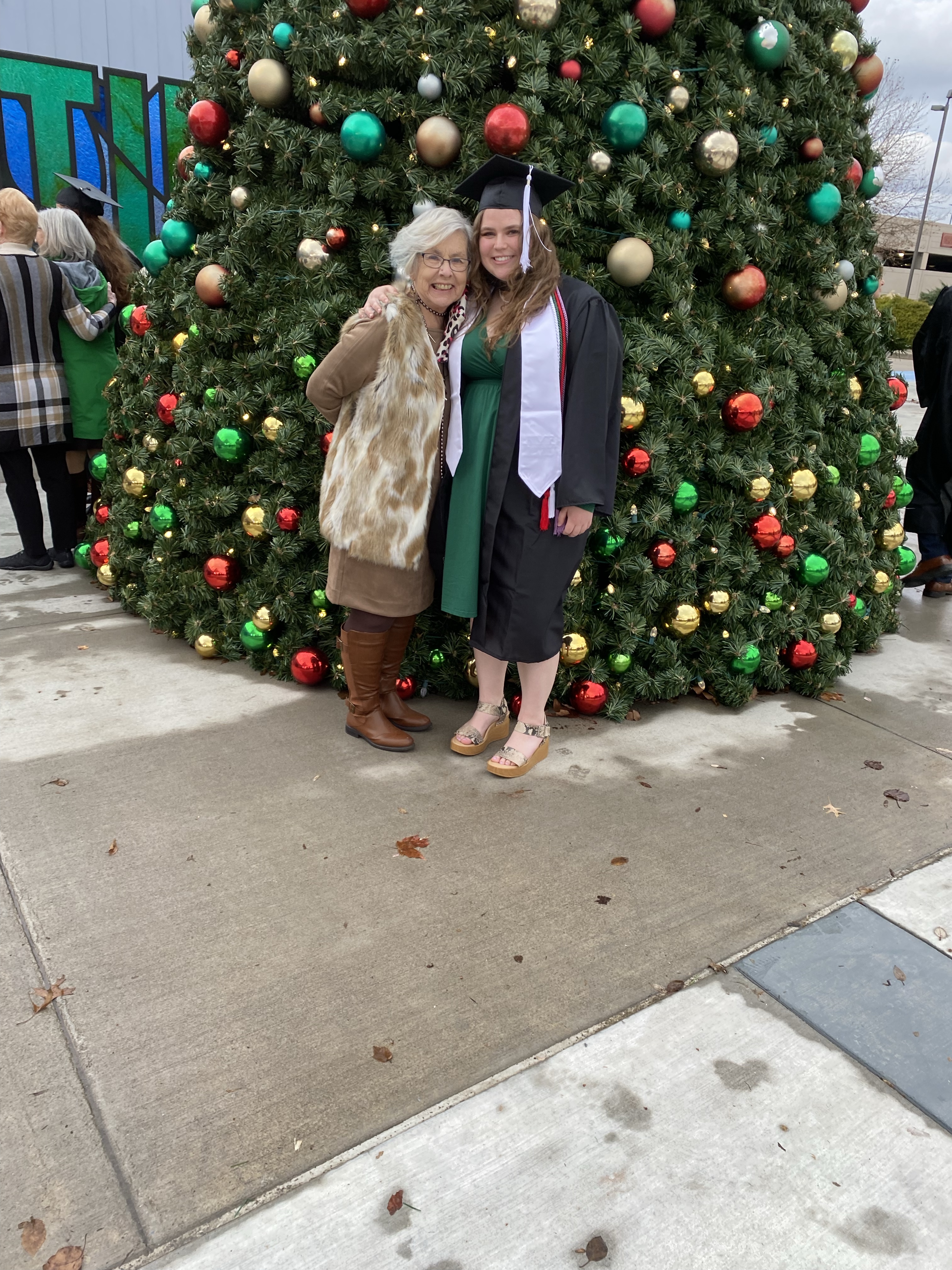
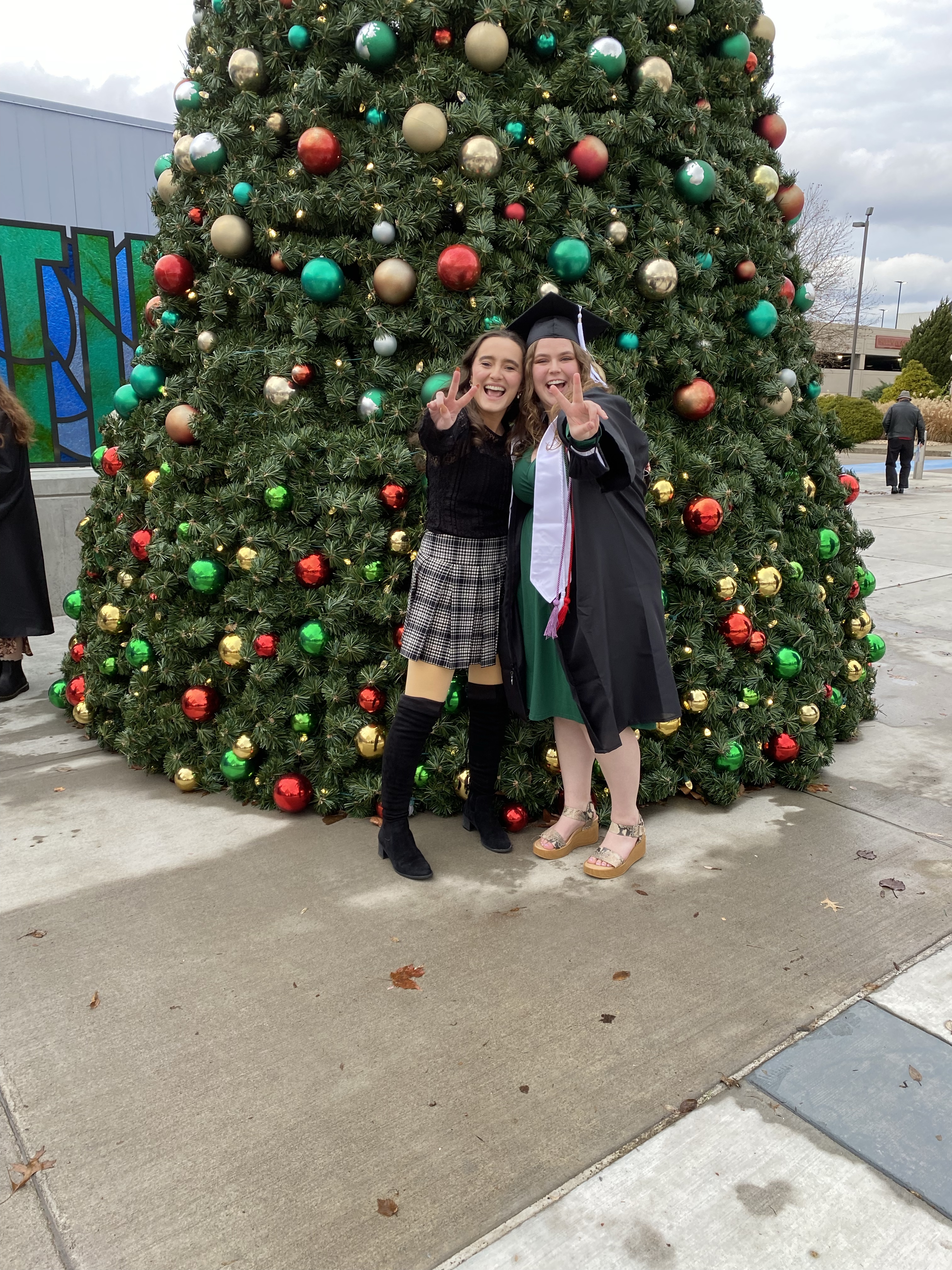
One day prior to writing this, and two weeks after noticing the sing-song father and daughter duo, Madelyn Clarice Hill walked across the stage to receive her college degree for which she had worked diligently to earn. Her wings may have been hidden under a ceremonial gown of black, but they were most certainly present and ready to take flight. Where her maiden voyage will take her, only she and life can determine. What I can say with confidence is that she is ready to fly; she is definitely ready to fly.
The real voyage of discovery consists not in seeking new landscapes, but in having new eyes.–Marcel Proust
There are times in life when you have no idea where the path onto which you have stepped will lead. For example, if you have been married for a number of years, think back to the day you said, “I do.” When you examine the innumerable moments between the “I do” to the present day, it is sometimes astonishing the ways in which the life journey of a marriage meanders and leads. Even if you aren’t married, or haven’t been married long, once you hit a certain age of awareness, you begin to witness how very unpredictable life can be with all of its plot-twists, side paths, and meandering stops, starts, and–SURPRISE–unpredicted events.
The weekend before Thanksgiving, my husband, John, and I, spent a few days in the Black Mountain/Asheville area of North Carolina. Our intent was to take a break from the work routine and spend some time hiking through the picturesque Blue Ridge Mountains. We had researched a few hiking trail options we thought we would enjoy tackling, but we had also selected a couple back-up alternatives in case those didn’t work out.
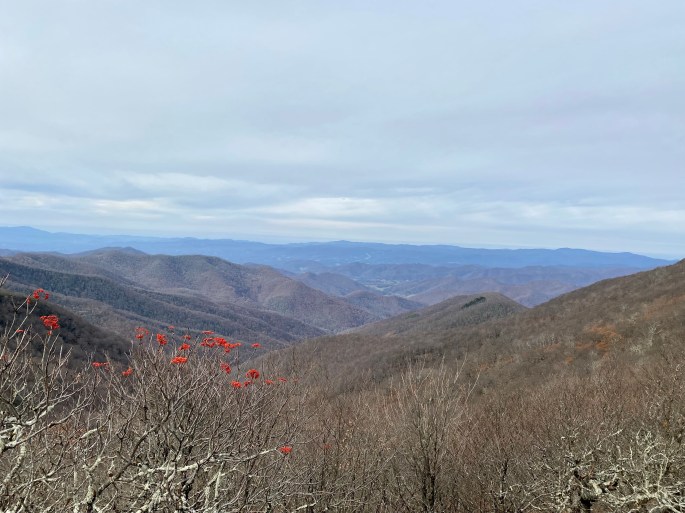
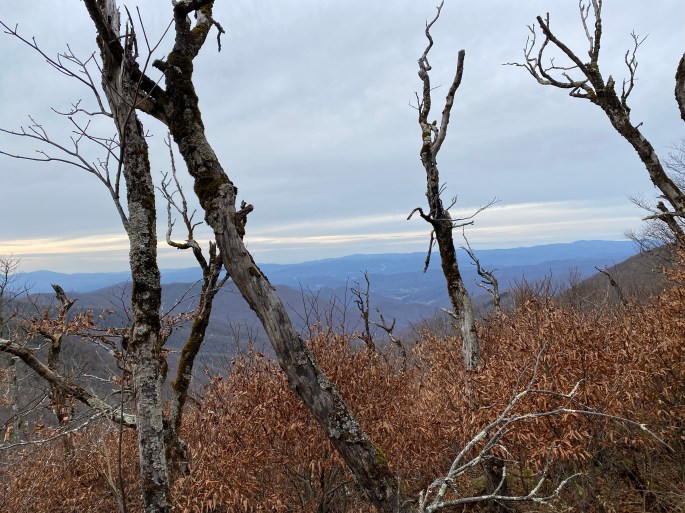
We had hoped to hike to the top of Craggy Pinnacle, instead we ended up hiking the area around it.
Typically, another part of our travel habits is mindfully allowing time to relax and not adhering to a said schedule since our work life as school teachers is very schedule driven. Therefore, when traveling, we usually try not to rush through our mornings to get out of the door. Additionally, we both enjoy experiencing new dining venues as part of the fun during out-of-town expeditions. This often means that part of our relaxed morning is savoring a late morning meal (sort of a brunch). The downside to this habit, when hiking, is that it can cause us to arrive at a trailhead anywhere between the hours of 11:00 am and 2:00 when numerous other relaxed hikers are likewise arriving. This is why we’ve learned to have several hiking paths in mind for any given day as many trailheads have limited parking.
Other than one other couple, John and I encountered no one on this meandering part of the MTS trail.
There were two trails at the top of our list of preferred hiking experiences–one that led to Rattlesnake Lodge and another to the top of Craggy Pinnacle. Unfortunately, we were not able to hike either one. Instead, on one of the afternoons during our trip, we found ourselves at the closed-for-the-season Craggy Garden Visitor Center, with its ample parking area and scenic views, staring at a map of hiking trails that could all be accessed from the parking lot. We picked one that wasn’t part of our so-called list-for-the-day and headed off down the trail without conducting any research. Why not, right? After all, we had already successfully hiked one of the trails shown on the map on a previous trip; therefore, how much more difficult could another trail in the same area be?
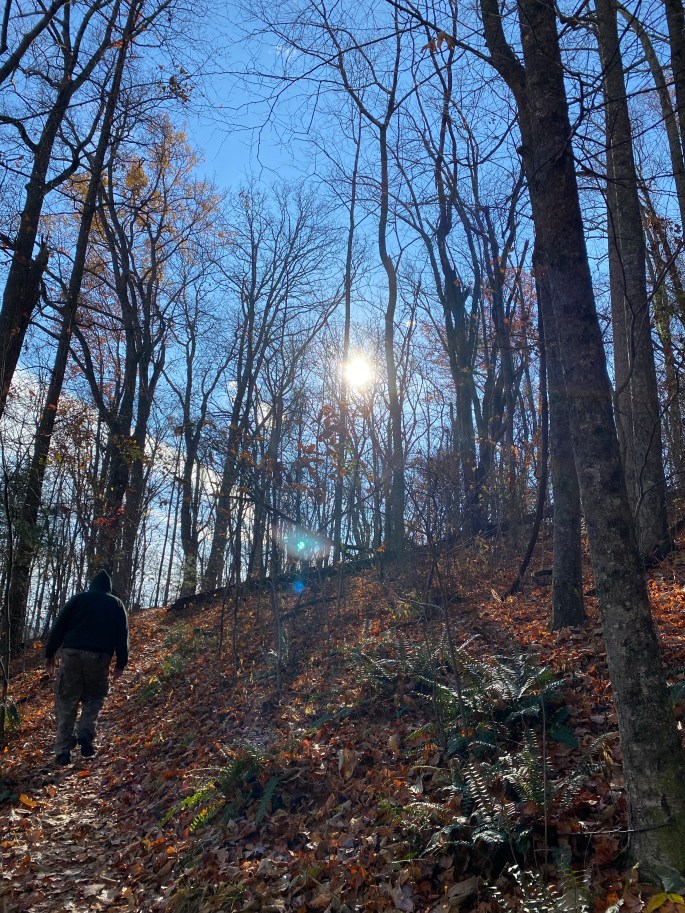
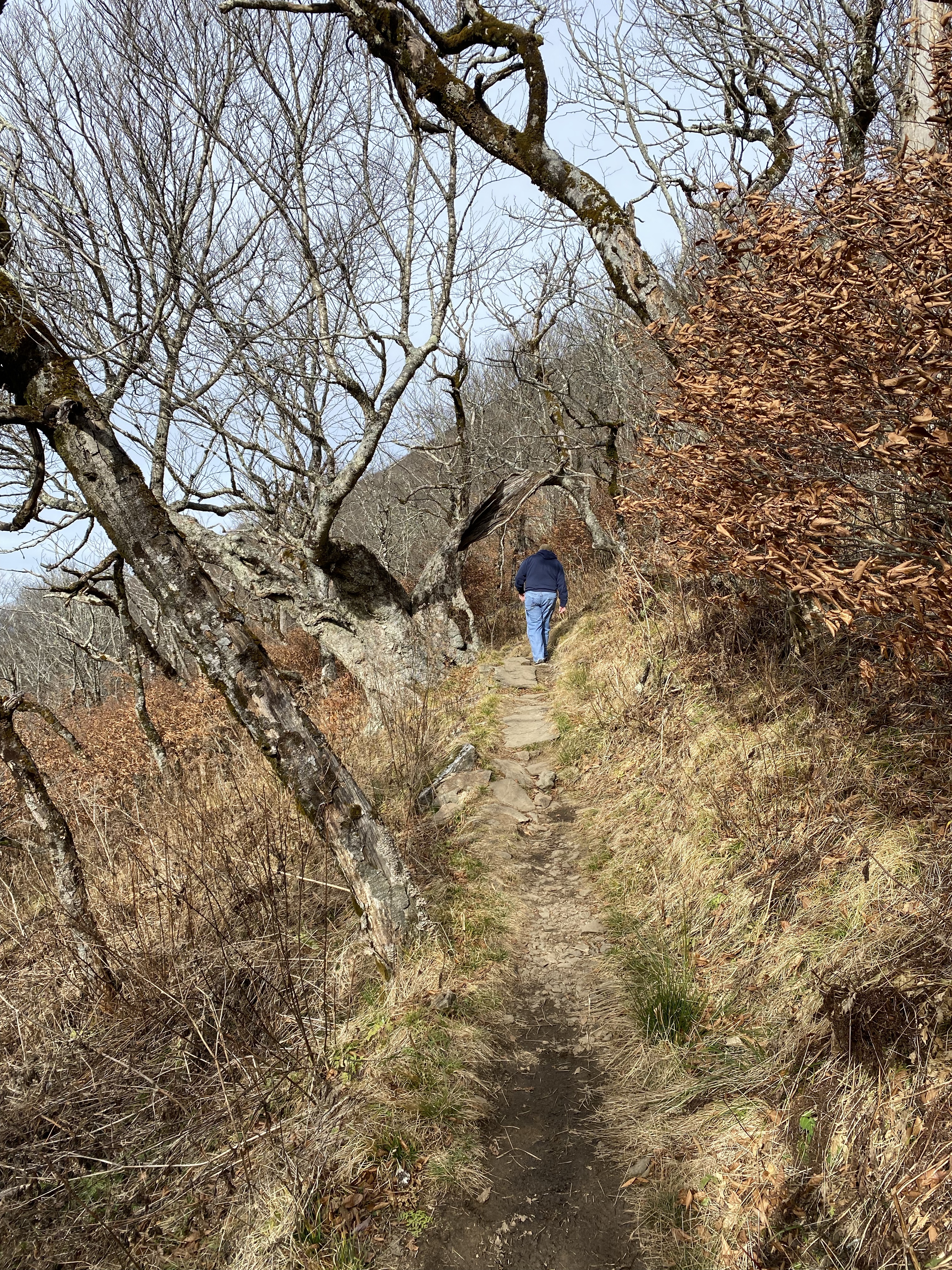
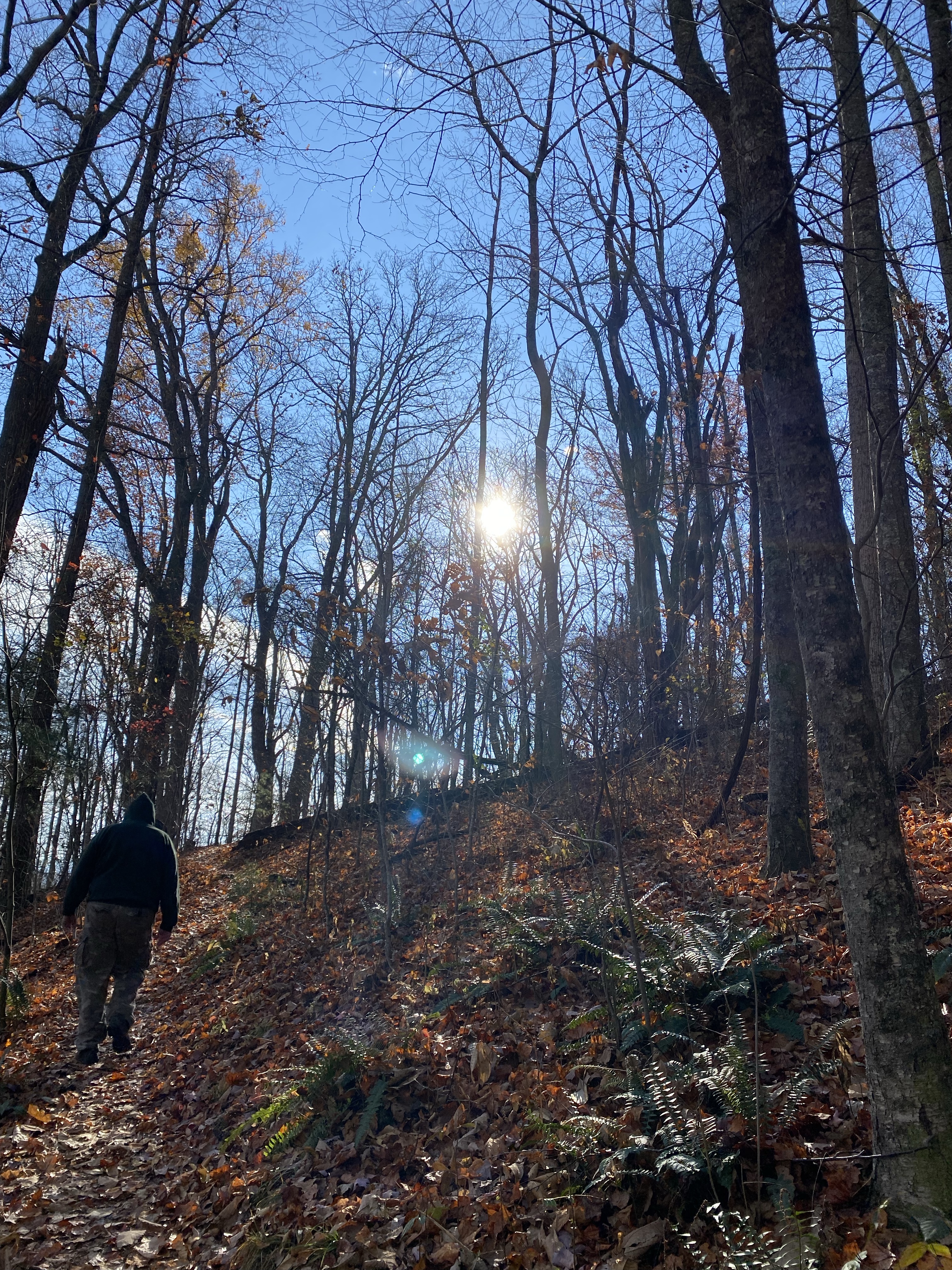
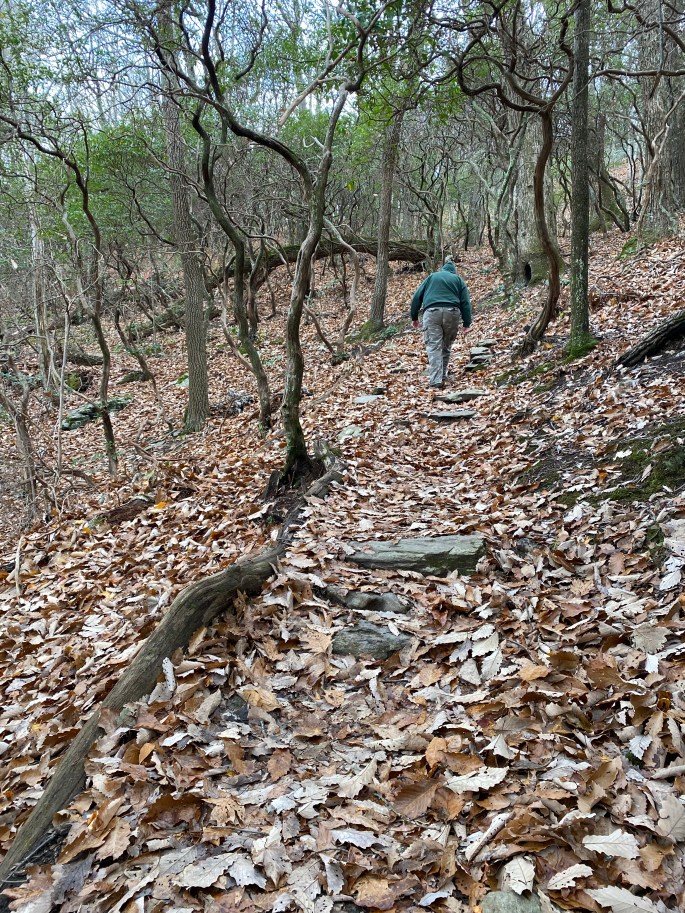
John led the way during this uphill section
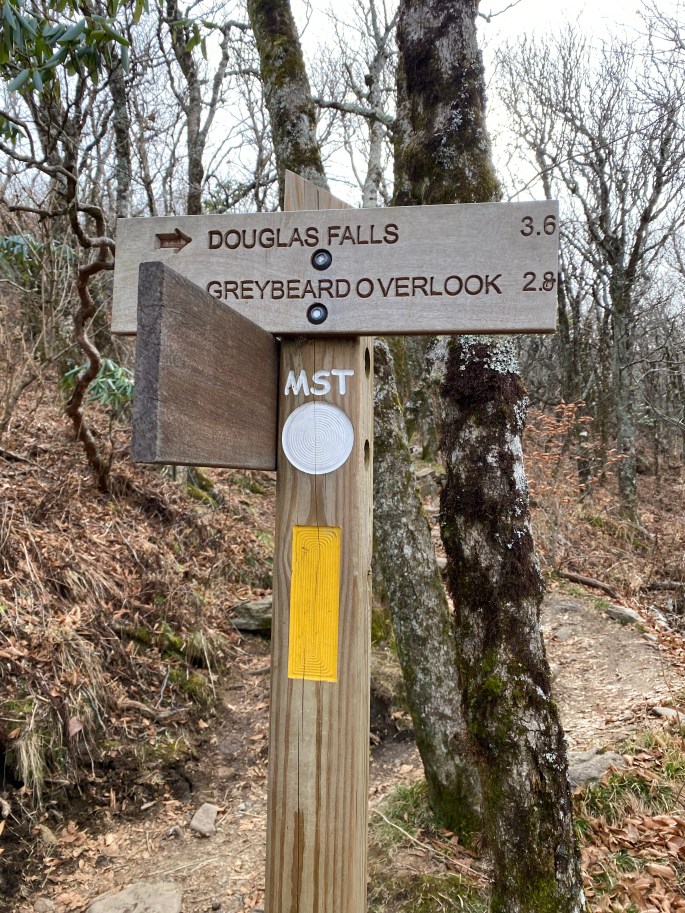
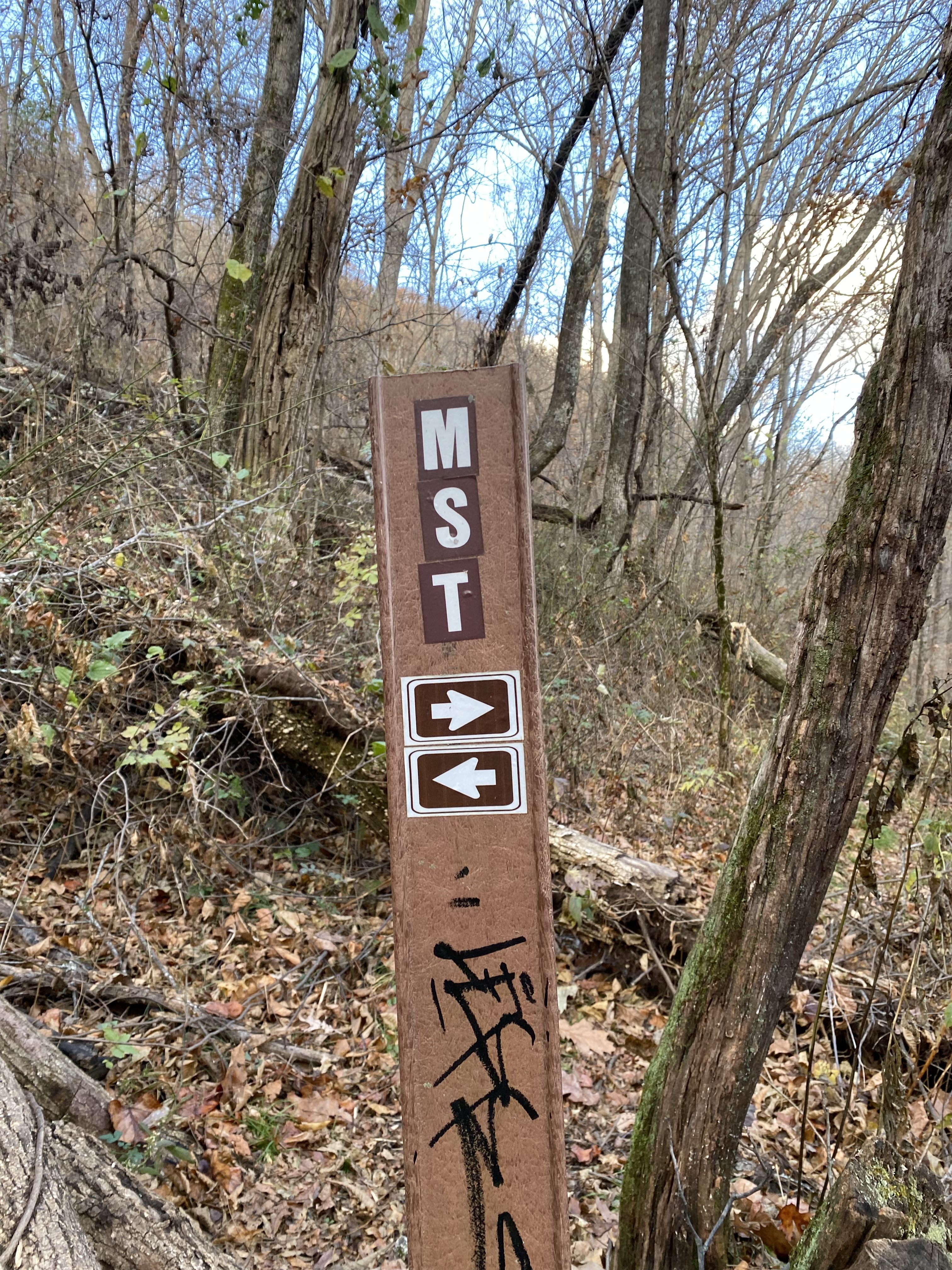
Stepping onto the trail, which was part of the 1,174 mile long Mountain to Sea Trail that crosses North Carolina, we saw a trail marker indicating that Greybeard Mountain Overlook was a “mere” 2.8 mile hike and Douglas Falls was only 3.6 miles away. Perfect! We had plenty of time, as it was early in the afternoon, and the mileage didn’t seem insurmountable–silly, unsuspecting fools that we were!
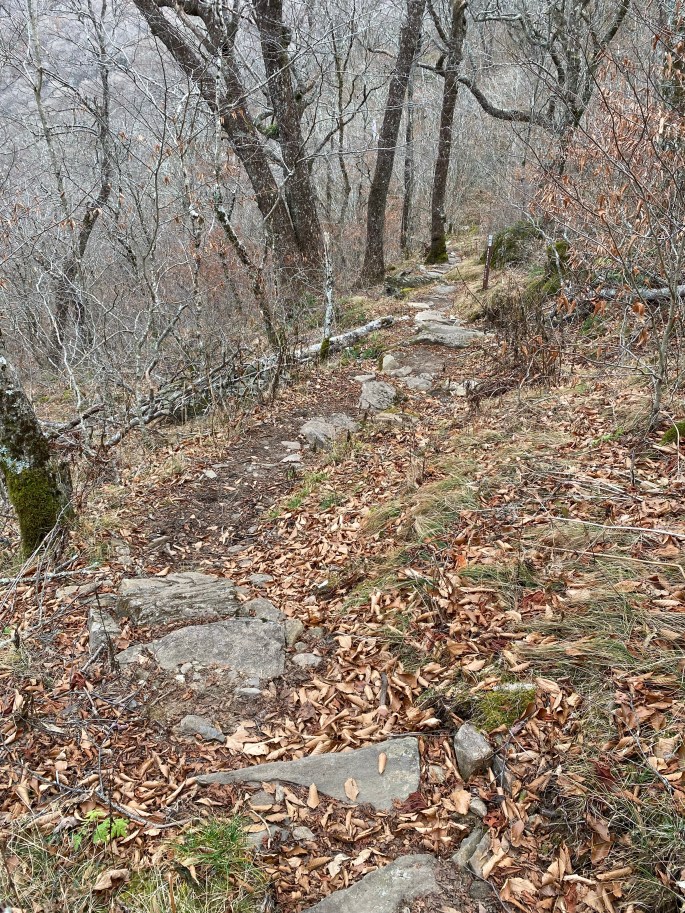
Without prior research, we were completely ignorant of the level of effort required on this section of the MTS trail. In hindsight, we would later learn this section of the MTS trail was rated at a difficulty level of 5, across a multitude of hiking platforms–on a scale of 1 to 5, with 1 being the easiest and 5 the most difficult. Plus, let’s be honest, John and I are definitely not spring chicks. While we both maintain overall good health, we are not near as young and fit as we once were. Nonetheless, we knew nothing of the trail’s ranking, so we persevered on, writing off the exacting switchbacks, arduous ascents, and demanding descents to our age–oblivious to the fact that the segment of MTS over which we hiked would challenge even the most fit.
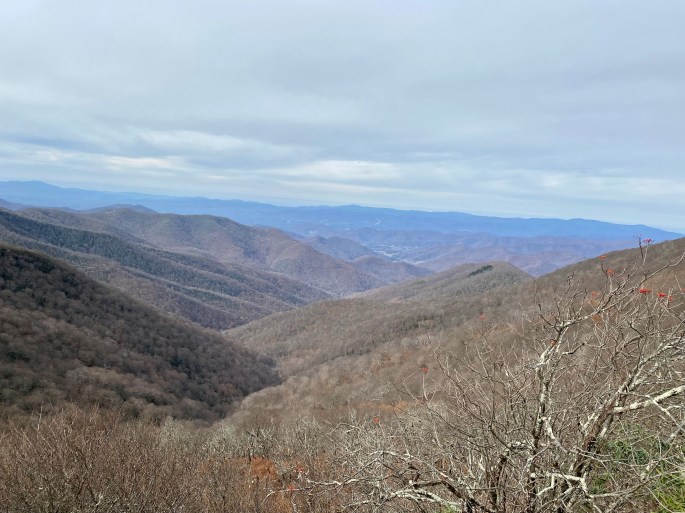
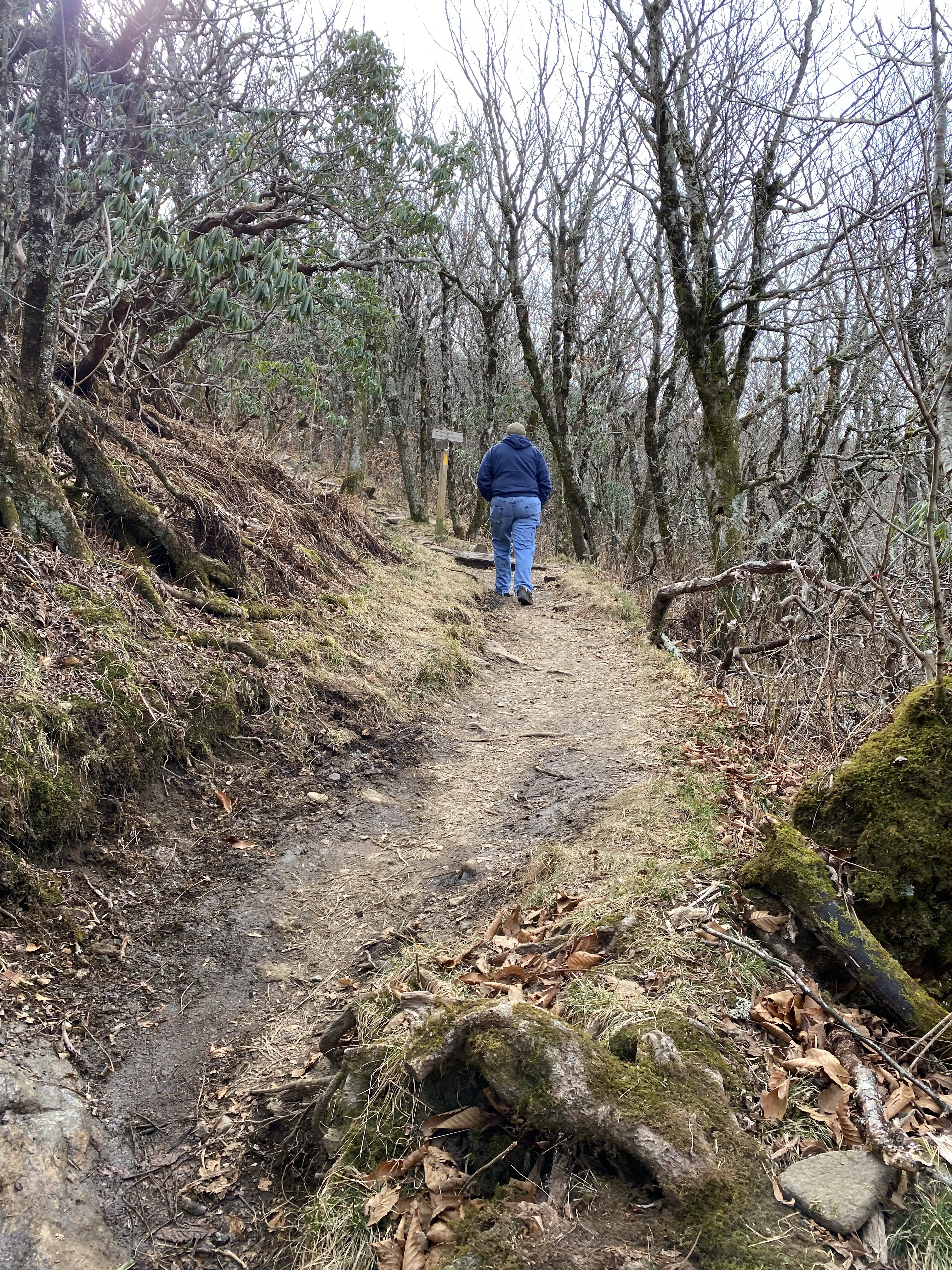
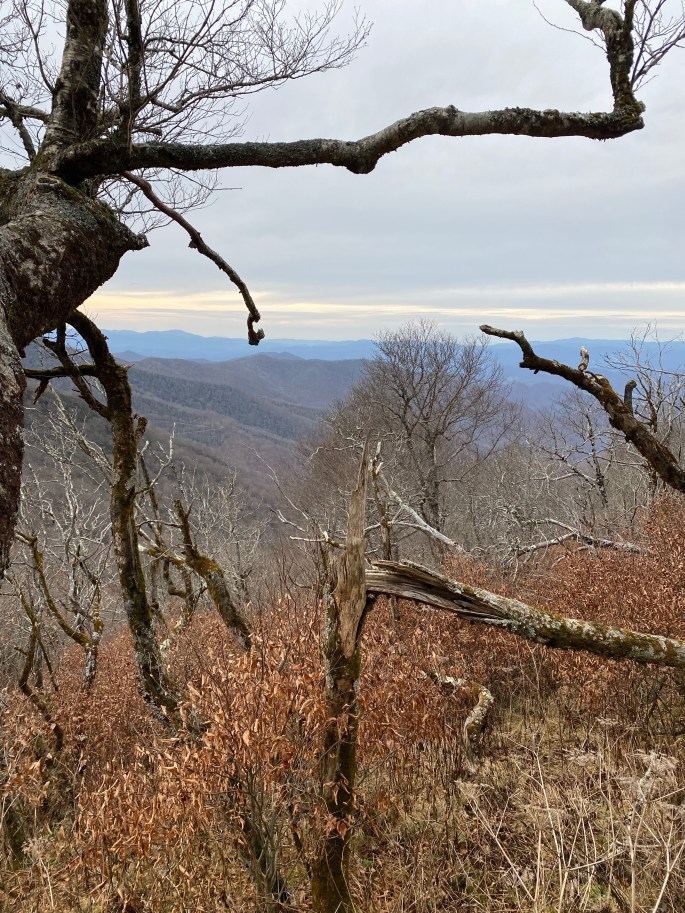
Up and down, over and around, slipping and sliding, grasping and pulling, we made our way over the craggy, uneven, and mountainous terrain. We paused here and there to catch our breath and/or rest our legs–especially John’s right knee, which no longer has a meniscus thanks to an injury and requisite surgery a little over a year prior to the writing of this piece. In spite of it all, the quietude we experienced on this trail was serene and surreal, even when our hearts were often pounding in our ears! With each pause and rest, we would gaze all around at the wondrous mountain scenery and soak up the calmness that accompanies the whisperings of nature.
Nearly two hours later, we encountered a trail marker at a fork in the footpath informing us that Greybeard Overlook was still 1.1 miles away down one fork, and Douglas Falls was still more than 2 miles away along the other fork. What? Surely, this was not possible. Had we accidentally wandered off the trail, or were we really moving that slowly? Cloud cover, throughout our hike, had gradually been increasing, which meant that darkness would envelop the mountains sooner than the predicted 5:20 sunset. It was already after 3:00, we were deep into a cavernous crevasse, so we felt the safest choice was to turn around without reaching either destination.
I wavered. I wanted to see more. Therefore, John, used to my enduring curiosity and energy level, said he would wait while I explored ahead a bit more. While he sat down to rest on a large rock, I carried on to the Greybeard fork which began climbing once more. Continuing further along, the path became more wet and somewhat less rocky. I stepped through muck and oozing mud as small rivulets trickled along this part of the path. To my left, through statuesque trees, I spied those aegean tinged Blue Ridge Mountains, sentinels of the BRP, standing watch over it all. I wanted to continue further, but visions of being trapped in a rocky ravine overnight surrounded by bears and numerous other critters kept me from straying too much further up the path, perhaps only hiking a ¼ of a mile more!
Turning back without having reached our destination was heartbreaking at first. What was the point of hike without some sort of distinctive destination? Nonetheless, as we made our way back up, over, and around the formidable trail, John and I reflected upon the rewards of this trail’s experience–from the scenic views to the tranquil stillness and from the heart thumping ascents to the balance-demanding descents–we challenged our mind, body, and spirit in new and unpredictable ways. We hiked by faith, and our faith grew as God met us there on the mountain path. Isn’t that like life?
Life finds ways to force us out of our comfort zone in order to step out into the unknown. Through living, we experience mountain top high life events, endure darkened valley can’t-see-the-sun-for-days-on-end time-periods, and live through all manner of ups, downs, and unforeseeable meanderings. Life is not about the destination, but about gathering experiences. Furthermore, life is best met through faith, appreciation for all the Creator has given us, and a recognition that the great Sentinel stands watch over us, no matter the path we trod.
How blessed we are to live in a world with mountains, valleys, and an assortment of craggy paths!
Still round the corner, there may wait, a new road or a secret gate.–J. R. Tolkien
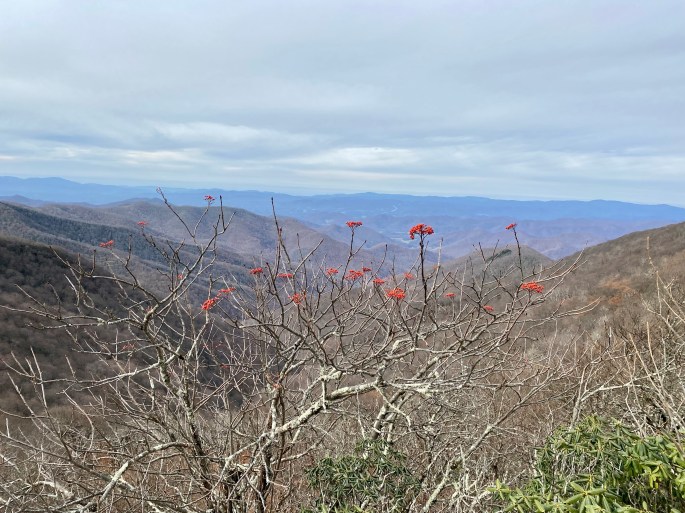
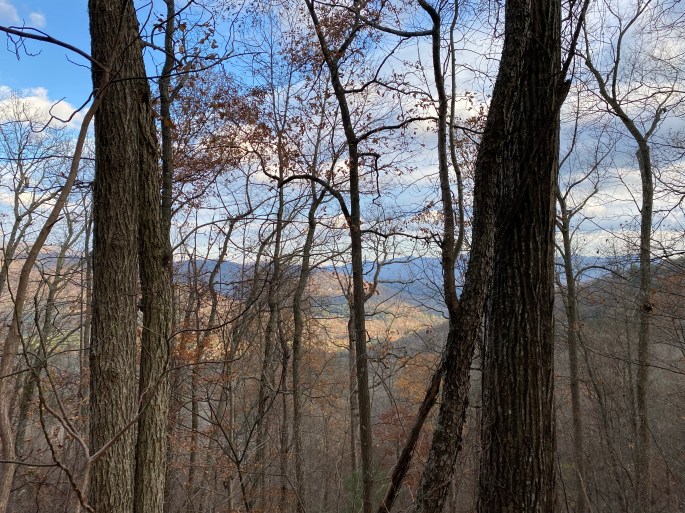
Hearts-pumping, legs moving, a brisk wind periodically scoured at our cheeks as John, my husband, and I began our hike into the autumnal colored woods just outside of Asheville, North Carolina. Porcelain blue skies interspersed with frothy, opaque clouds expanded above the deciduous tree line. To our left, as we made our way along the trail, was an expansive valley enclosed by the cerulean heights of the Blueridge Mountains–a 550 mile expanse of the Appalachian Mountains. To our right, and above our heads, was the Blueridge Ridge Parkway, but we were moving lower and lower into the gap further away from any sounds of traffic. I couldn’t help but smile.
Sunshines from porcelain blue skies as part of the path we hike was once an old wagon road to Rattlesnake Lodge.
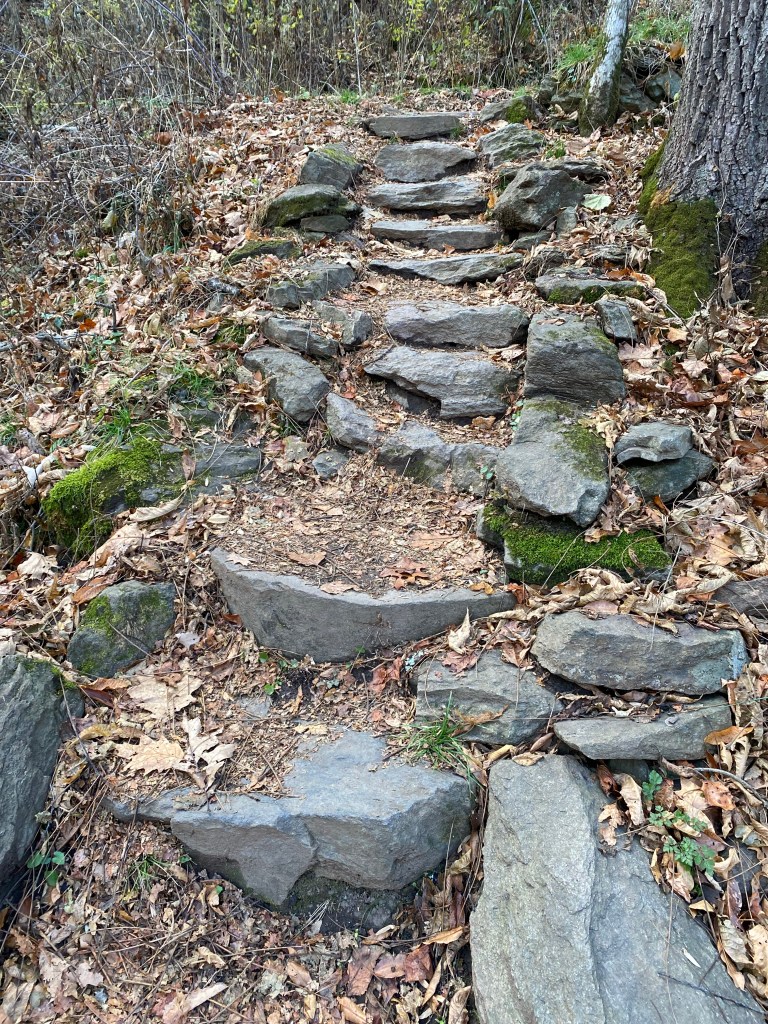
Our hike had actually begun by parking in a small lot at Craven Gap and walking across the BRP. Fortunately, due to either the Thanksgiving holiday week or the chilly temperatures–although to John and me, the mid-40 fahrenheit range was perfect hiking temperature–the BRP wasn’t too busy, allowing us to safely cross. We followed the stoney steps down the beginning of the trail that eased our gradual descent into the ridge-hugging trail. Before taking a more serious turn and further drop, we crossed over a large log that had been allowed to remain across the path, but had been roughly hewed half-way down mid-way up its trunk to allow easier access across.
As we walked, my mind roamed, and my senses soaked up my surroundings: the occasional call of a bird, the scuffling of our feet along the path, the aromatic scent of damp earth, and the multi-hued assemblage of leaves in all shapes, colors, and sizes. I was reminded of the expression, forest bathing, often used by the health and wellness industry, to encourage people to spend more time in nature. Despite its marketing association, I was certainly benefiting from this scenic Blue Ridge immersion.
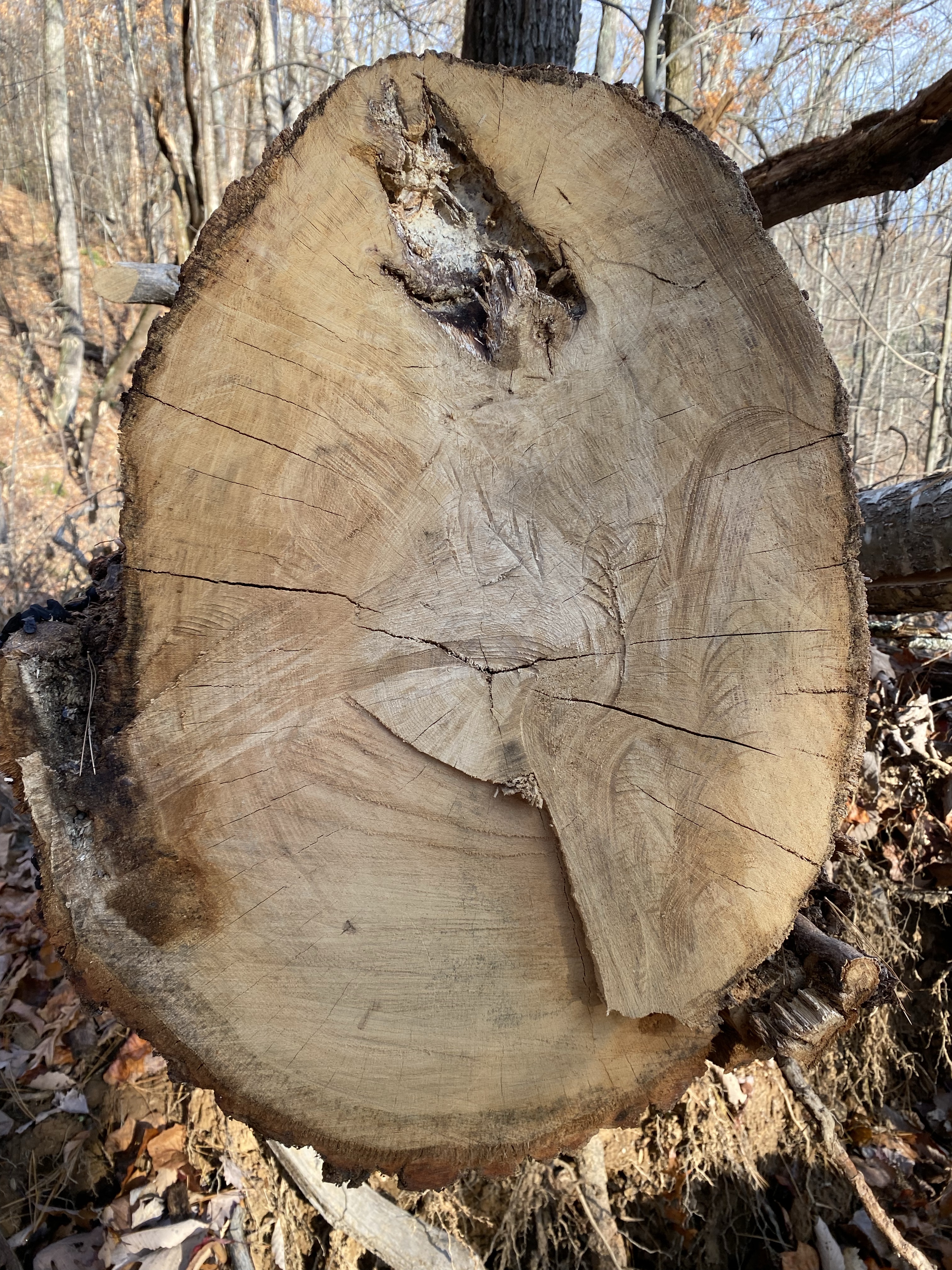
How many years had this tree stood as a witness to life?
John and I paused to admire an expansive trunk that had been a victim of ice, lightning, landslide, or other natural calamity. We admired the seemingly countless lines of growth circling the inside of the tree’s trunk. Its age had to be more than one hundred years old. Running my hands across those lines, I couldn’t help but wonder how many different lives this tree had touched. How many families, dogs, squirrels, birds, insects, and other creatures either traveled past this tree or even called it home? It felt as if I was touching a piece of unspoken history.
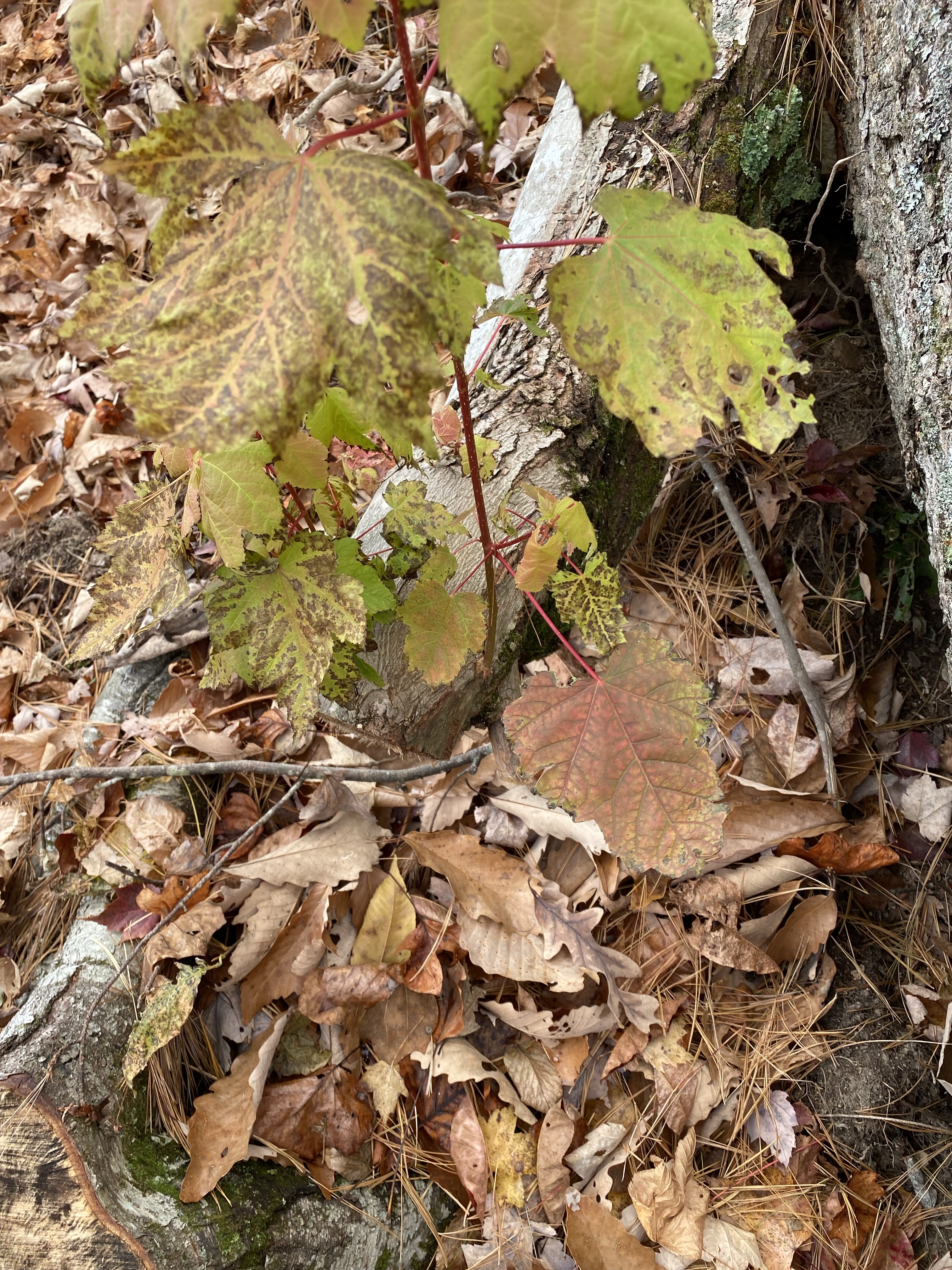
Life finds a way.
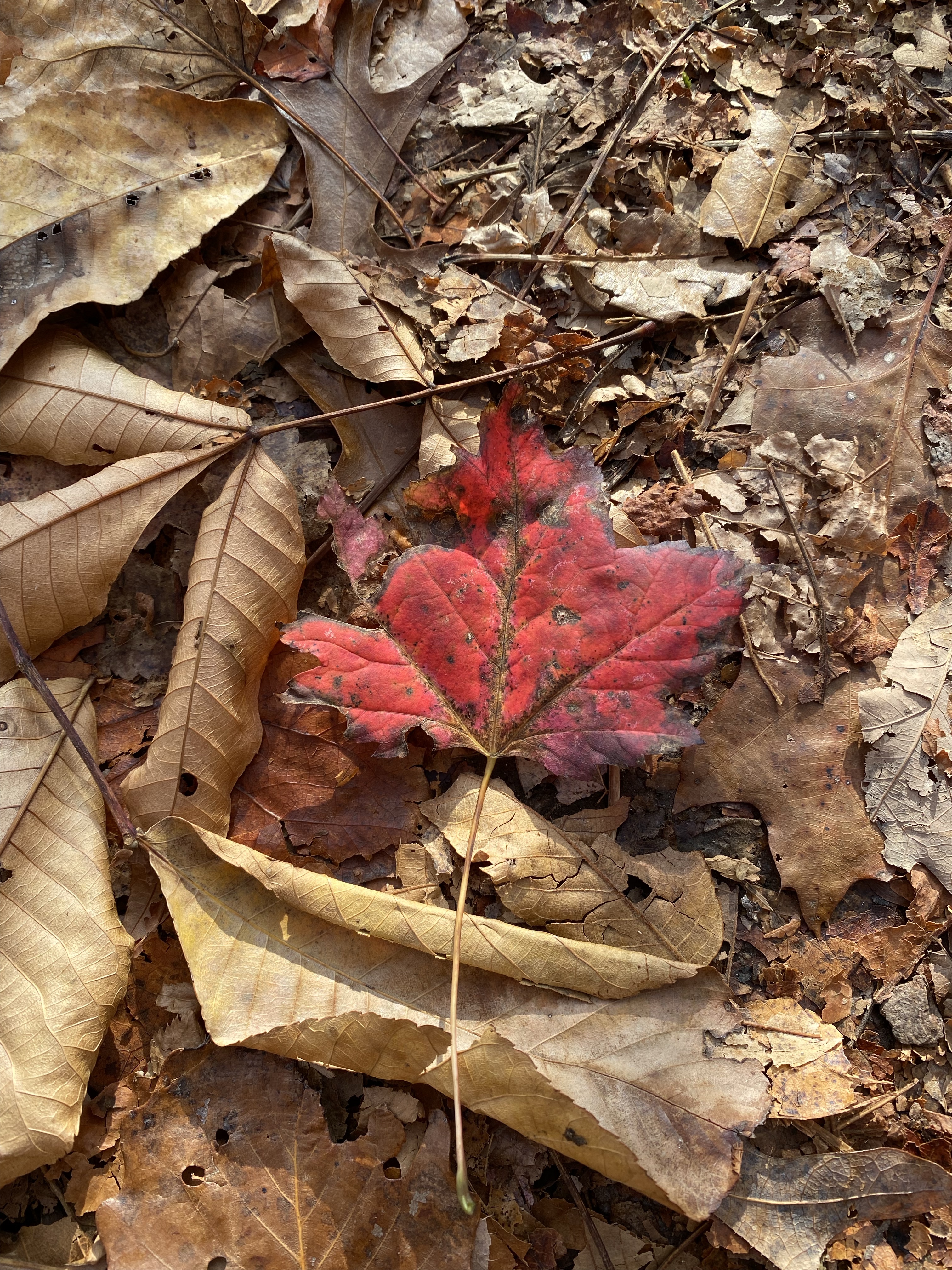
Walking deeper into the wooded crevasse, John pointed out another fallen tree. While it was much smaller in circumference than the previous downed tree, there was a unique start of what appeared to be a maple tree attempting to grow from its trunk. The leaves on it numbered less than 20, but they were changing into their fall coats of colors. What a marvelous example of life finding a way to continue even in the midst of decay.
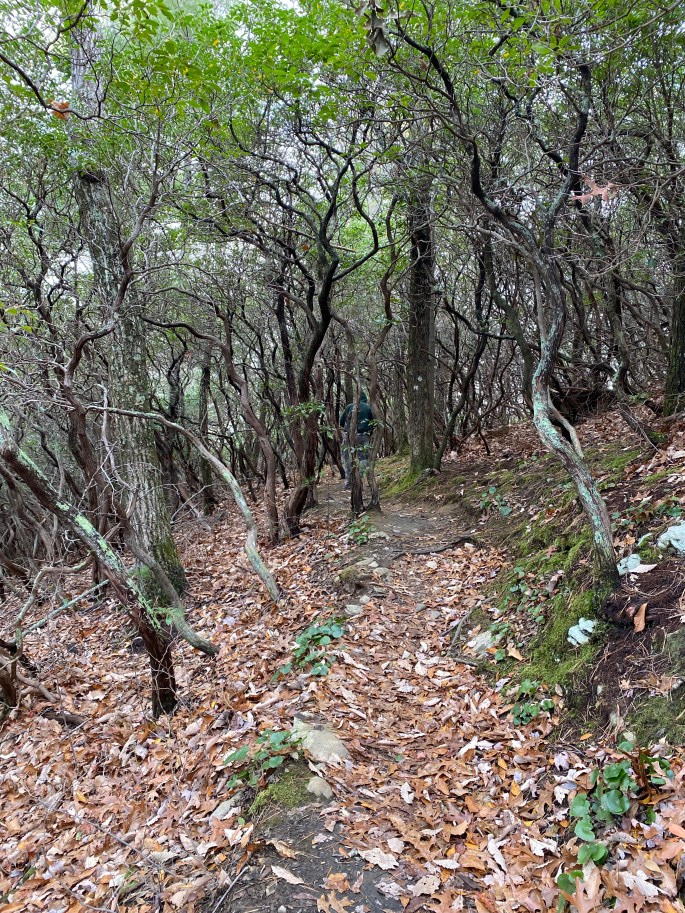
Further down the path, we entered a darkened area lined with bare trees whose branches looked like works of twisted, wire art stretching out into wandering, curving lines. This part of the path was also carpeted with aromatic, long, thin, and tan pine needles, which was unlike any other part of the path. It felt as if we were entering a page out of a fantasy novel, and at any moment, elves, hobbits, dwarfs, or maybe even a unicorn, would enter onto the path in front of us and send us on a discovery quest.
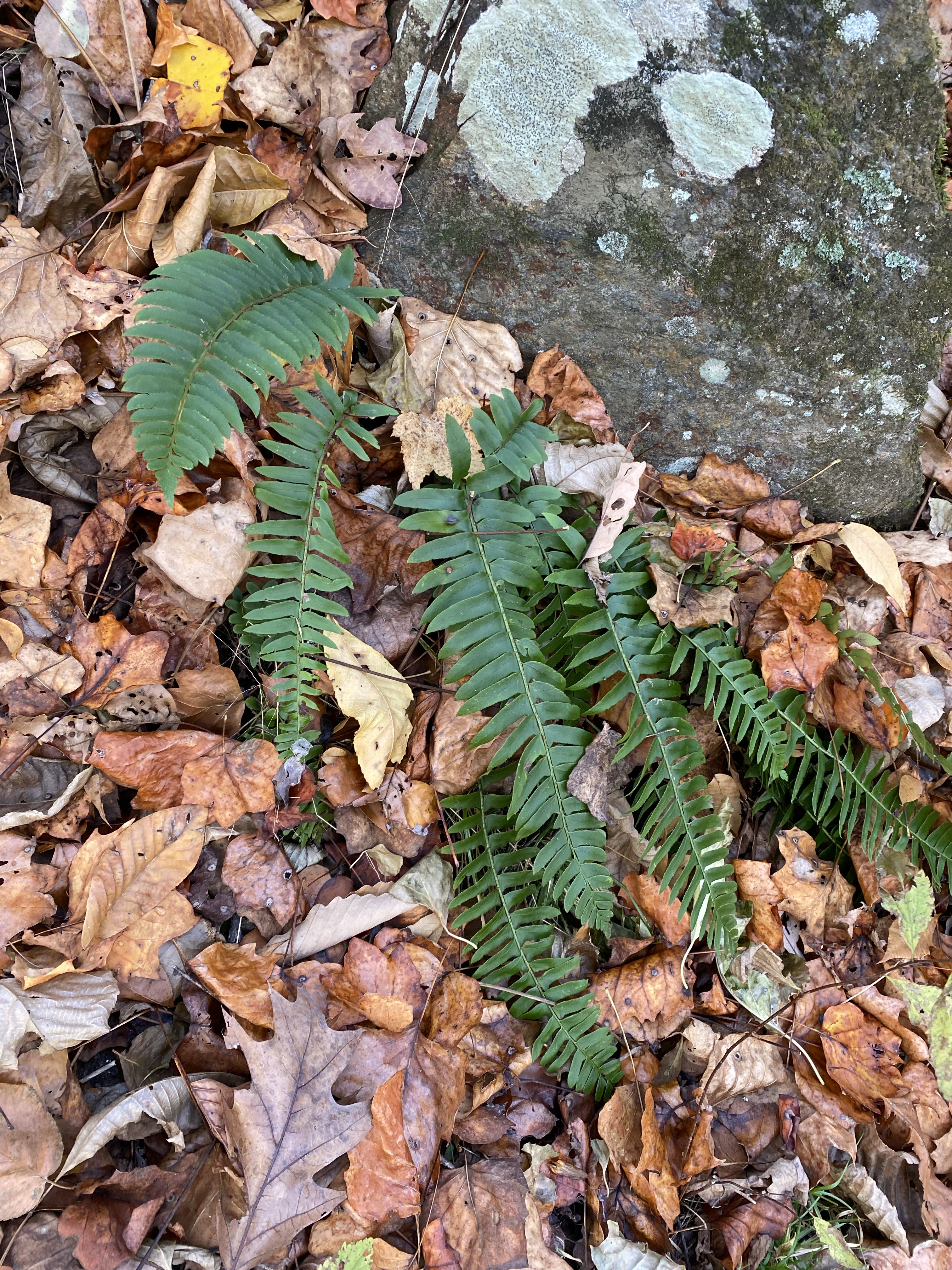
Christmas green ferns sprouted here and there near large rocks sank deep into Mother Earth. Random leaves of striated emerald green emerged from piles of tawny leaves discarded from the bondage of their former trees. Moss, in shades of pistachio, pickles, and pears blanketed rocks and trunks of trees–live and fallen.
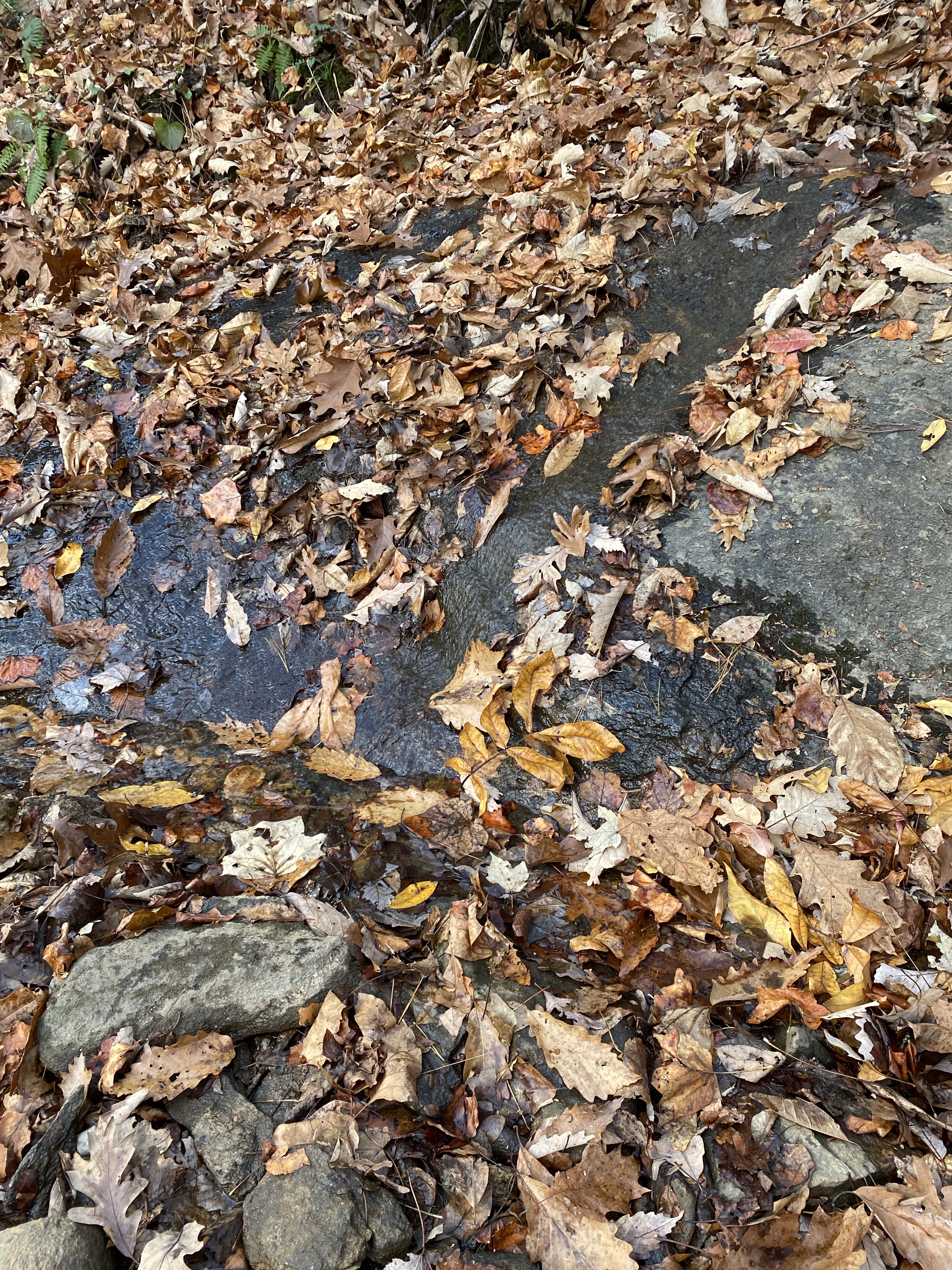
The headwaters of a spring flowing down the mountain.
Trickling headwaters of small, silver springs melodically spilled over rocks, debris, and other forest detritus on its way down the mountain. Oozing mud, slick and thick, filled gaps between rocks on the footpath crossing these singing waters. Sucking sounds slurped at the bottom of our hiking shoes. Above our heads the backup singing wind, provided three-part harmony, as the layers of air moved over us, rustling the tree branches, and echoing over the Grassy Creek Valley below.
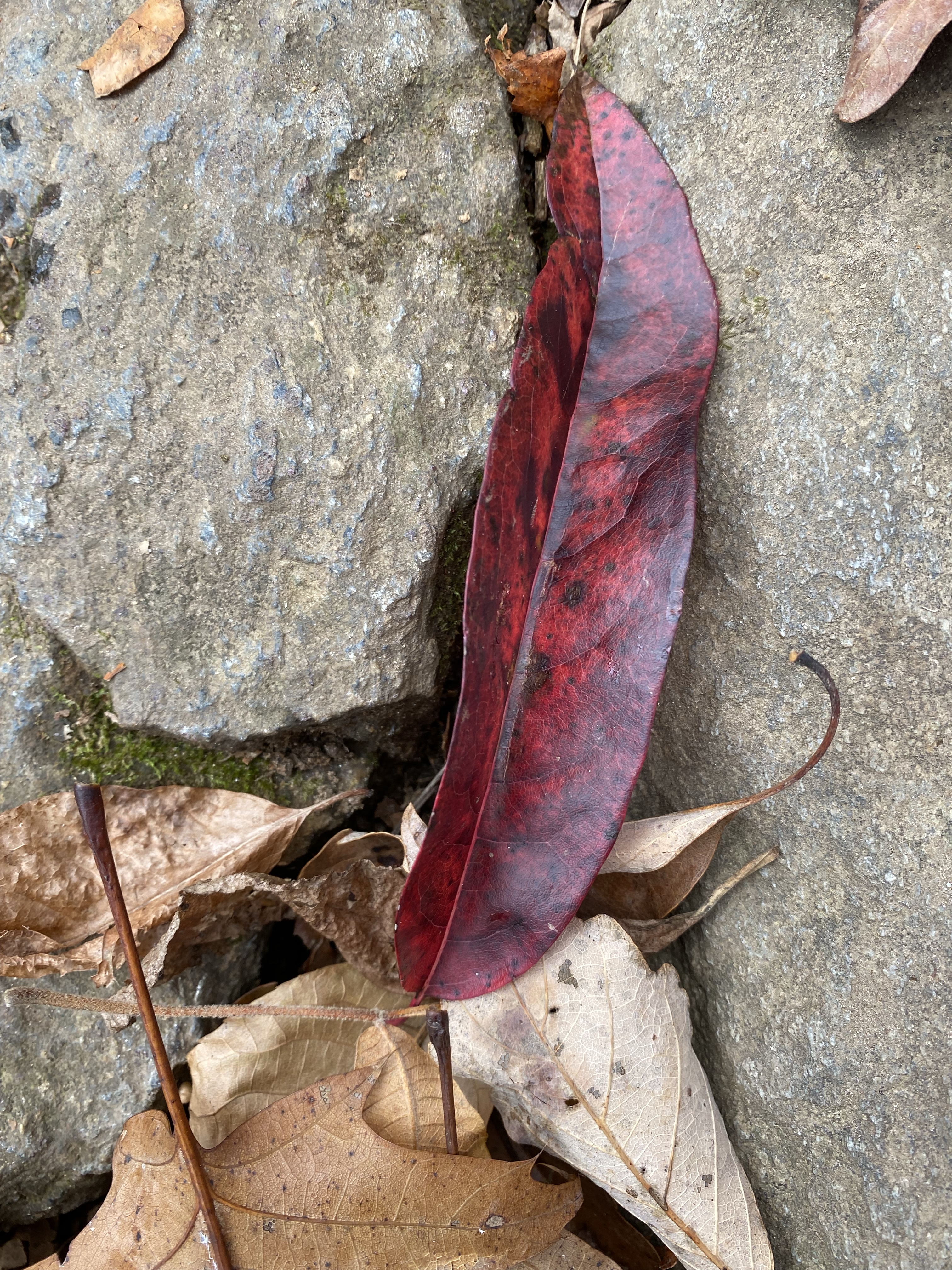
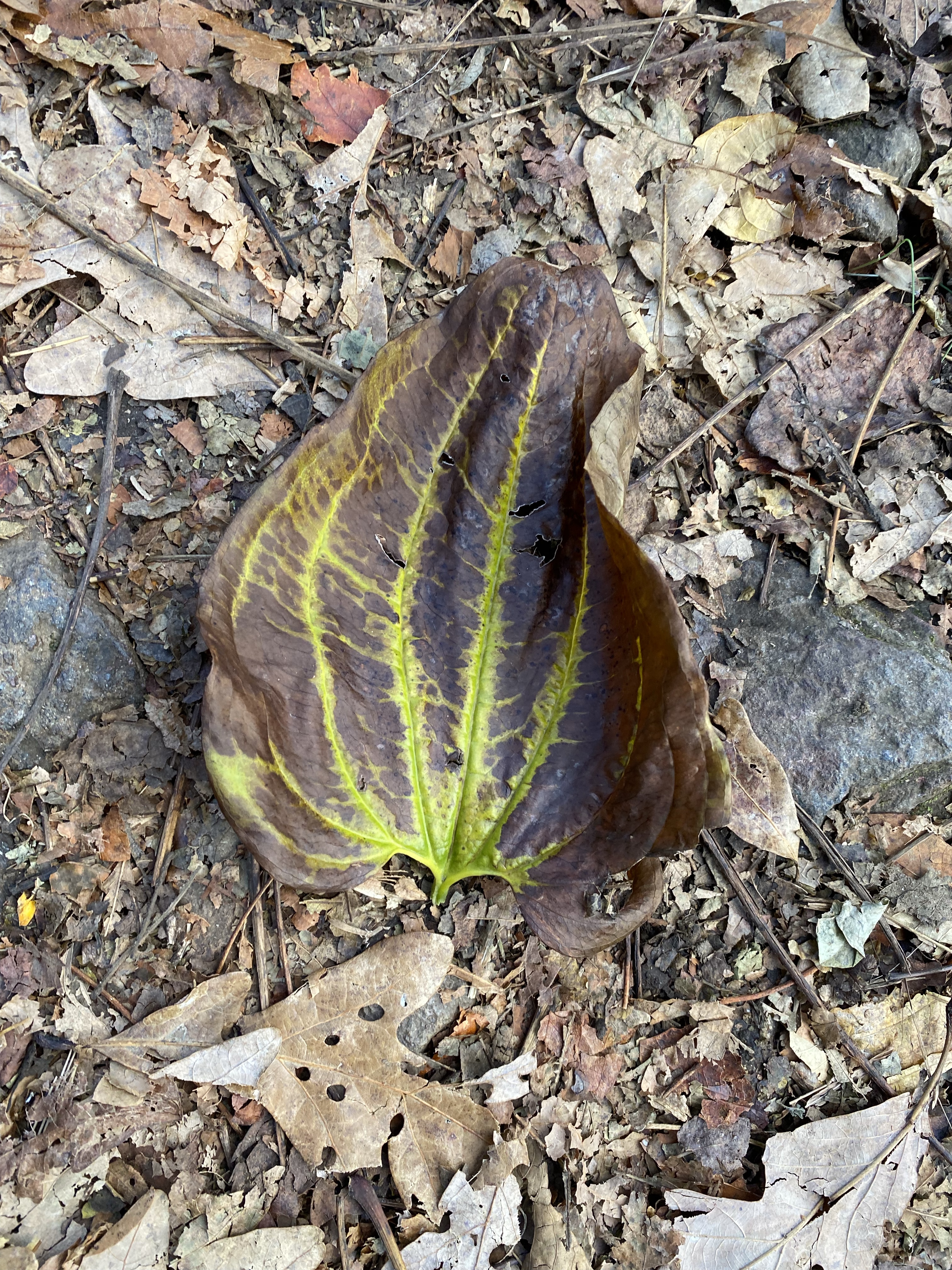
Throughout the footpath, gem-stone colored leaves dotted the path with images of once per year beauty. Blackberry jam tinged stars, mustard-stained clusters, garnet and black tear drops, mahogany and green points, butterscotch lined with granola bristles–the hues seemingly painted on the leaves were as varied as the shapes of the leaves. It was as if God left a jigsaw puzzle scattered across the forest floor.
Sunshines from porcelain blue skies as part of the path we hike was once an old wagon road to Rattlesnake Lodge.
At one point along the pathway, John pointed to what appeared to be a game trail. This began a quiet discussion and subsequent ponderings of the first people who traversed this particular area. Had they been following game trails to make their way through the dense forest and rocky mountain side? What did the mountain look like for them? What challenges must they have faced in order to travel over and through such rugged terrain?
Mountain to Sea Trail Marker
Later, when John and I made our way back to the home in which we were staying in Black Mountain, NC for a short getaway before Thanksgiving, I did a bit of research about the route we hiked. We had covered over five miles moving south towards Grassy Branch, as part of the 1,200 mile long Mountain to Sea Trail that stretches across North Carolina. This unique trail begins at Clingman’s Dome in the Great Smoky Mountains, and it ends at Jockey’s Ridge on the Outer Banks. Having visited both places on separate trips, years apart, I had to marvel at the trail’s length and diverse terrain.
However, there was more. A wide section of the path John and I hiked, according to early maps of the area, was part of an old road bed that appeared to be part of a bygone wagon road to Rattlesnake Lodge, a summer home built in 1904 by Dr. Chase Ambler for his family. Named for its infamous living room ceiling that was covered in rattlesnake skins, the home was eventually sold, and it is believed that the lodge was destroyed in the 1920s due to lightning strike. However, its remains can still be visited via another hiking trail–a footpath John and I hope to travel on another trip.
It is remarkable to think about all of those who had traversed those paths before us, and it is made further marvelous to consider those whose feet first touched its ground hundreds, if not thousands, of years ago. Did those who originally made their way through the Blueridge Mountains have the same thoughts of appreciation and awe as John and I did as we hiked on that magnificent day in November? What were their thoughts, their experiences, and their intentions? What stories must that one path hold? How many more stories do those mountains and all the other paths keep secret?
There were others who blazed the way, and there will be more who follow us. Beyond all of that, however, is the Creator, the ultimate source of all creation. Perhaps, it is that ultimate commune–communing with nature, our ancestors, and our Creator, in addition to all the natural beauty, adornment, and seasonal dressing, that beckons me again and again into the forest, in mountains, onto wooded paths, or near peaceful bodies of water.
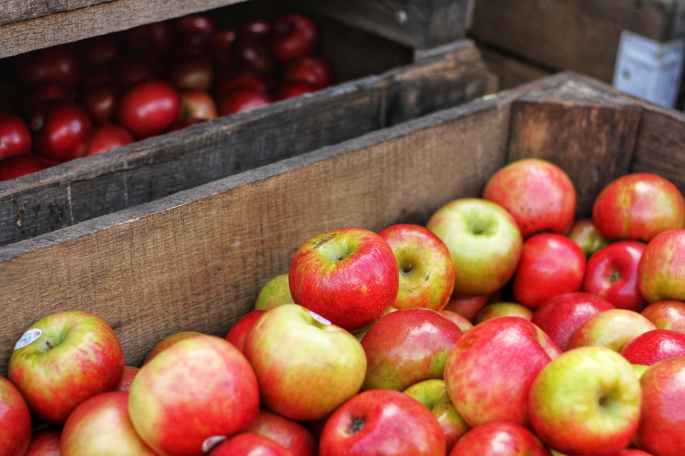
I love apples. From tart to sweet, from bright green to crimson red, and all shades in between, as long as it is a crisp, juicy orb of an apple, I’m ready to slice it up and eat it up. Some of my favorite apples are Fuji, Granny Smith, Honeycrisp, Pink Crisp, and Pink Lady, to name a few, due to their crisp texture and bright taste. Whether eaten alone, smeared with a bit of peanut or almond butter, or chopped and tossed in a salad, apples are a mainstay of my family’s refrigerator.
Fall, in our neck of the woods, is apple season. Prices and selections of apples are at their prime. Additionally, new types of apples are marketed with more regularity, so this is the perfect time of year to explore new apple types. In fact, it was only a few years ago that Honeycrisp was considered “new,” and now it is one of my favorite types of apples.
I recall one of my friends, Jan, bringing a bag of sliced Honeycrisp apples to a Marshall University soccer game as a snack for our kids, who were both youth soccer players at the time, and the reason for our attendance at the game. These were well before the days of MU’s Veterans Memorial Soccer Complex; nonetheless, we all enjoyed the game, and the kids loved those yummy apple slices. Due to that experience, Honeycrisp apples entered into our family’s regular rotation of purchased apples.
Speaking of Jan, she and I were recently discussing Thanksgiving traditions and plans for this year. Jan described a favorite spice cake with nuts and cream cheese frosting that her aunt made when she was younger. As family lore often goes, this aunt shared her recipe at the request of numerous relatives, but all who made the recipe agreed that it never tasted as good as when the aunt made it. Jan mused if the aunt had “accidentally” left off an ingredient. (Which made me giggle because my sweet grandmother once confessed to doing that with one of her recipes!)
Upon reflection of this story, and the added remembrance of our family’s introduction of Honeycrisp apples, that, a-hem, a seed of an idea was planted. Could I create an apple-spice muffin recipe without cream cheese frosting–for which many in my family will be saddened, I’m certain, but with partial nuts? (Some like nuts, some do not.) The answer is what follows below.
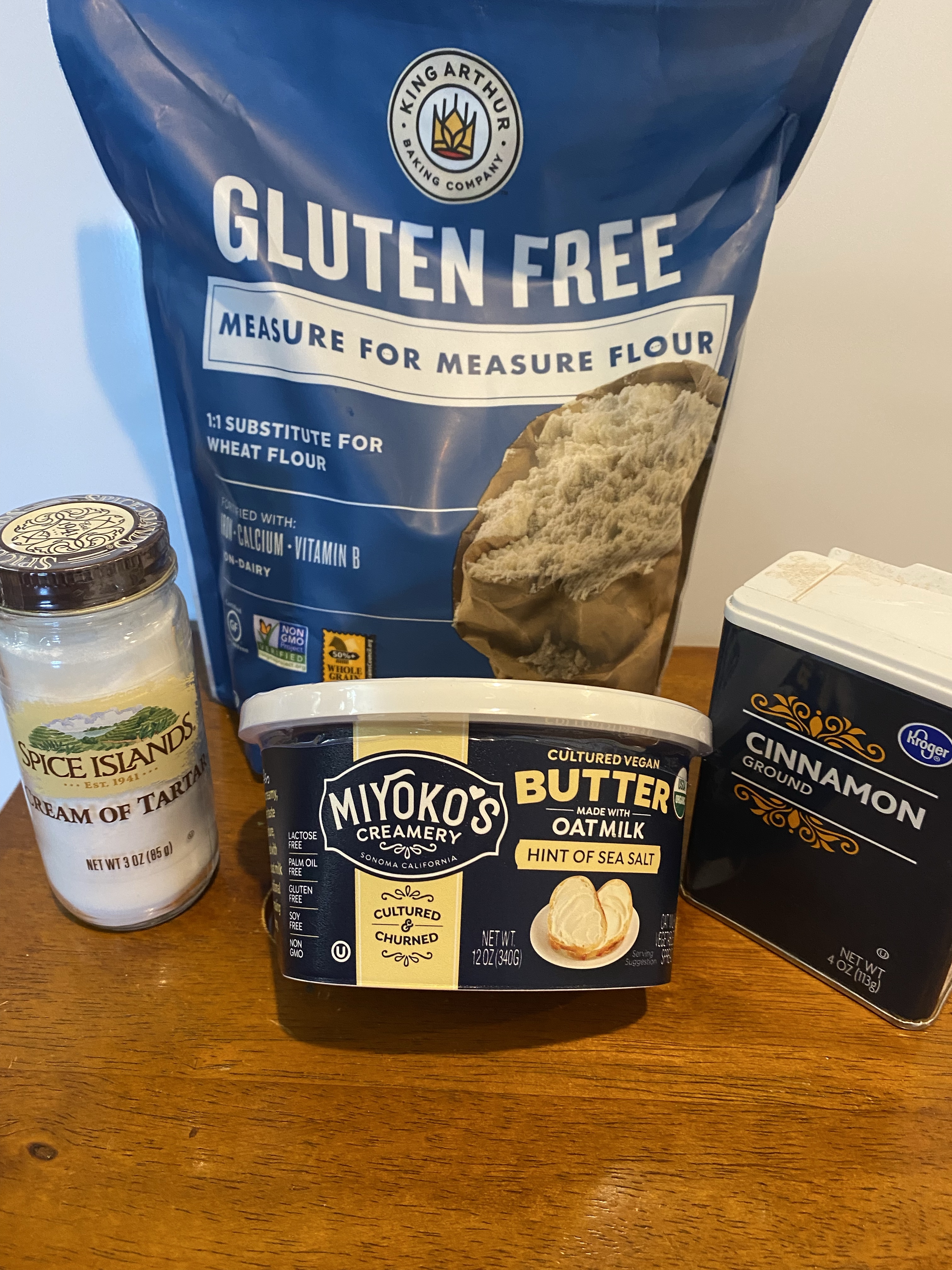
My recipe is gluten-free, but if you do not have to consume a gluten free diet as I do, then feel free to use regular all-purpose flour. Additionally, I kept the recipe plant-based and oil-free because it is easier on my sensitive digestive system. That said, if that is not your preference, replace ½ cup of applesauce, with ⅓ cup oil or melted butter instead. Additionally, 2 eggs can replace 2 “fleggs.” Oh, and why vinegar? It makes the batter more acidic which, in the end, makes the muffins (or cake) fluffy, yet still moist.
This recipe requires a bit more work than other recipes, but it is definitely worth the extra effort. Your kitchen will be filled with autumnal aromas as the muffins bake. Brew up a pot of coffee or your favorite tea, invite over a friend and/or family member, and swap stories while savoring these warm muffins. You never know what your conversation could inspire, or conspire!
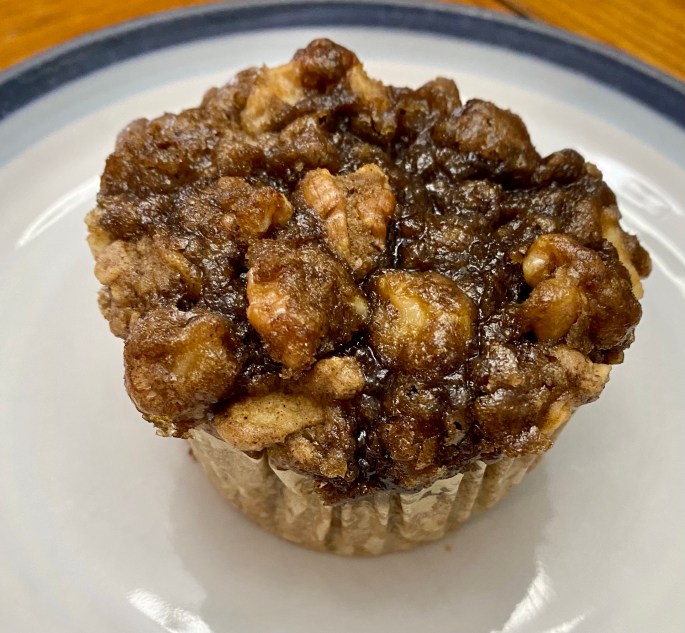
Gluten-free Apple Spice Muffins with Optional Walnut Topping
2 apples, peeled, cored, and chopped (I used Honeycrisp, but feel free to choose another type!)
1 ½ cup gluten free all-purpose flour (Can use regular all-purpose flour.)
1 cup gluten free old fashioned, rolled oats
2 teaspoons cinnamon
½ teaspoon ginger
½ teaspoon allspice
½ teaspoon nutmeg
1 teaspoon baking powder
½ teaspoon baking soda
½ teaspoon salt
½ cup brown sugar
¼ cup sugar
½ cup apple sauce
2 fleggs* or eggs
½ cup milk (or plant based alternative) at room temperature
1 tablespoon apple cider vinegar
1 teaspoon vanilla extract
Directions
Preheat the oven to 350 degrees.
Line muffin pan with parchment paper
If using topping, mix it together first and set in the fridge while mixing batter.
*If using “flegg” instead of eggs, stir together 2 tablespoons of ground flaxseed with 6 tablespoons of water, and set aside in the fridge for 15-30 minutes.
In a large bowl, whisk together flour, oats, cinnamon, ginger, clove, nutmeg, baking powder, baking soda, and salt. Set aside.
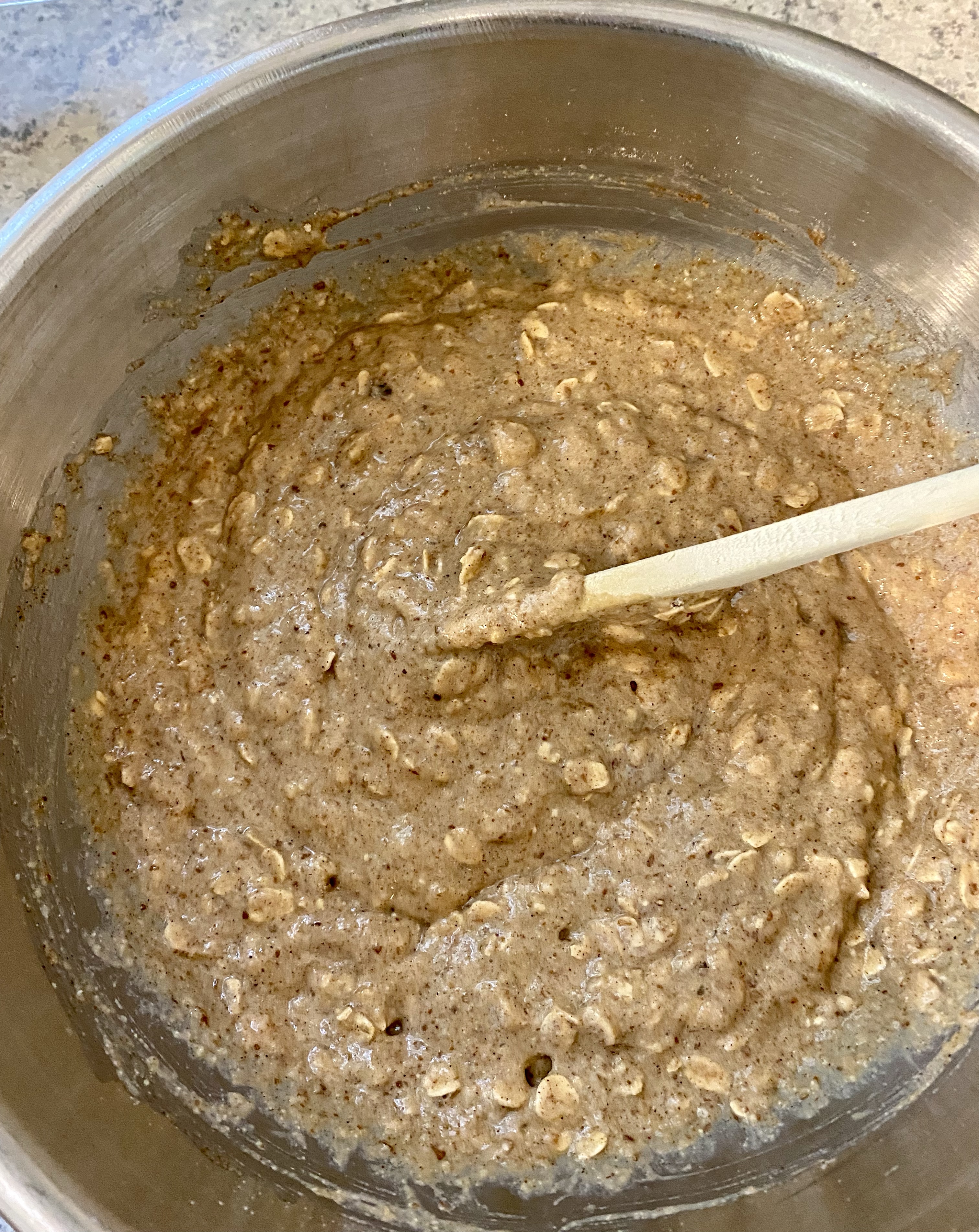
In another large mixing bowl, combine brown sugar, sugar, applesauce, fleggs (or eggs), milk, vinegar, and vanilla.
Add in flour-spice mixture and mix the batter 1-2 minutes until the batter begins to thicken.
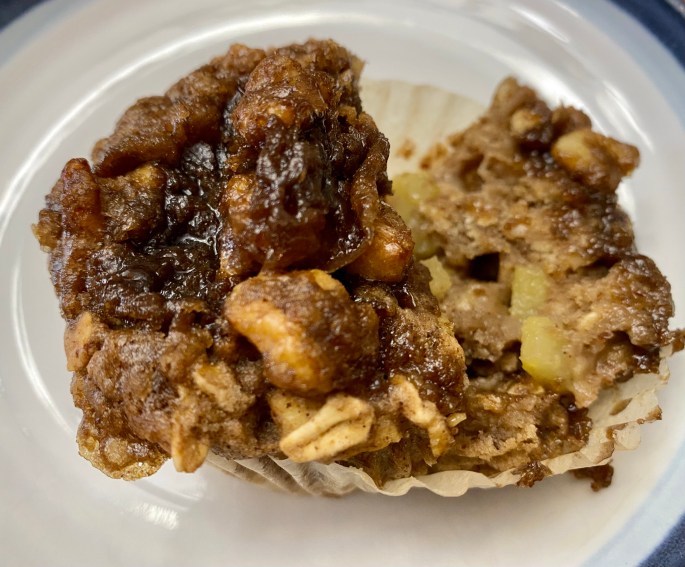
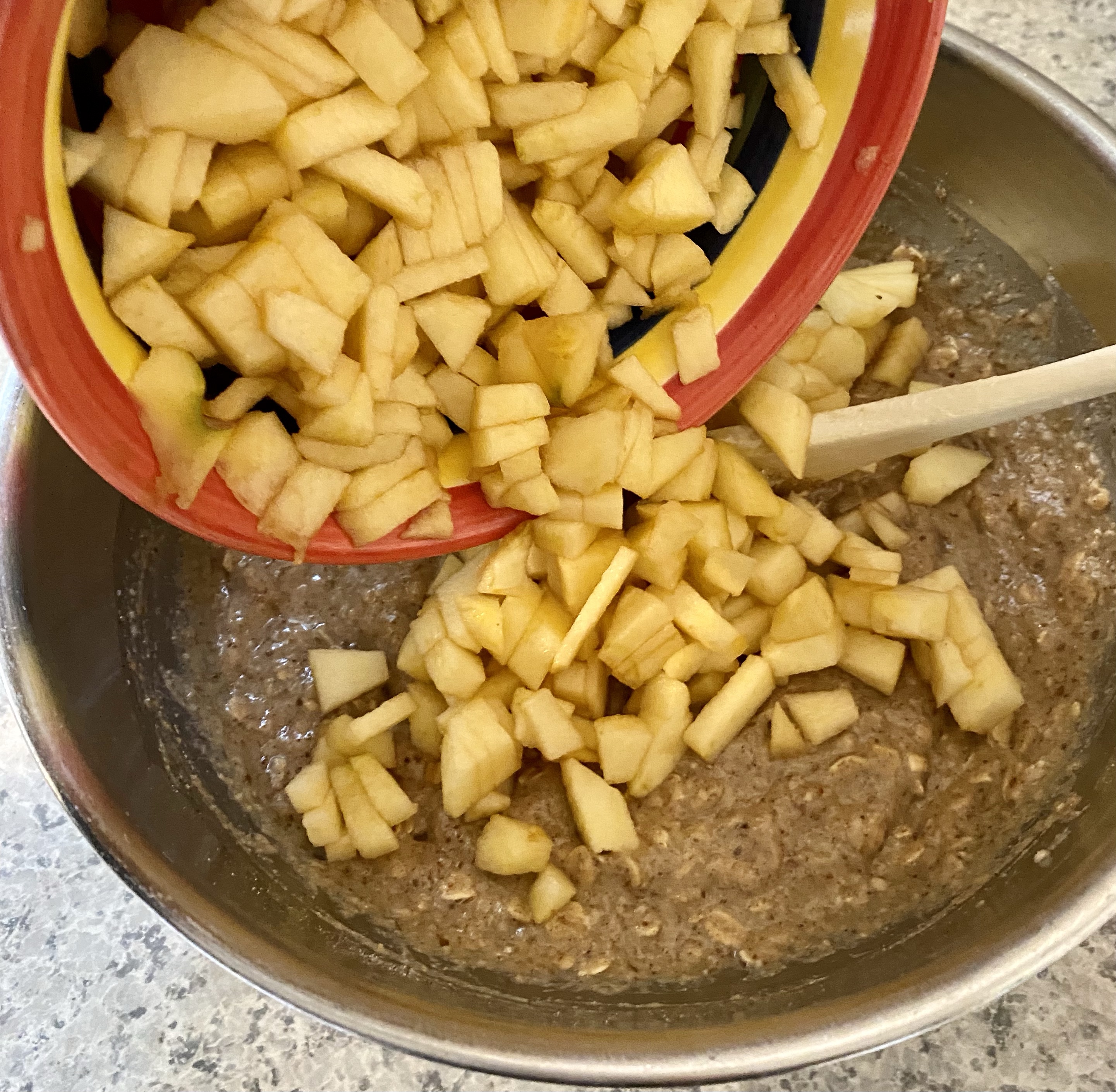
Stir in apples.
Divide batter evenly among muffin cups.
Scatter with topping.
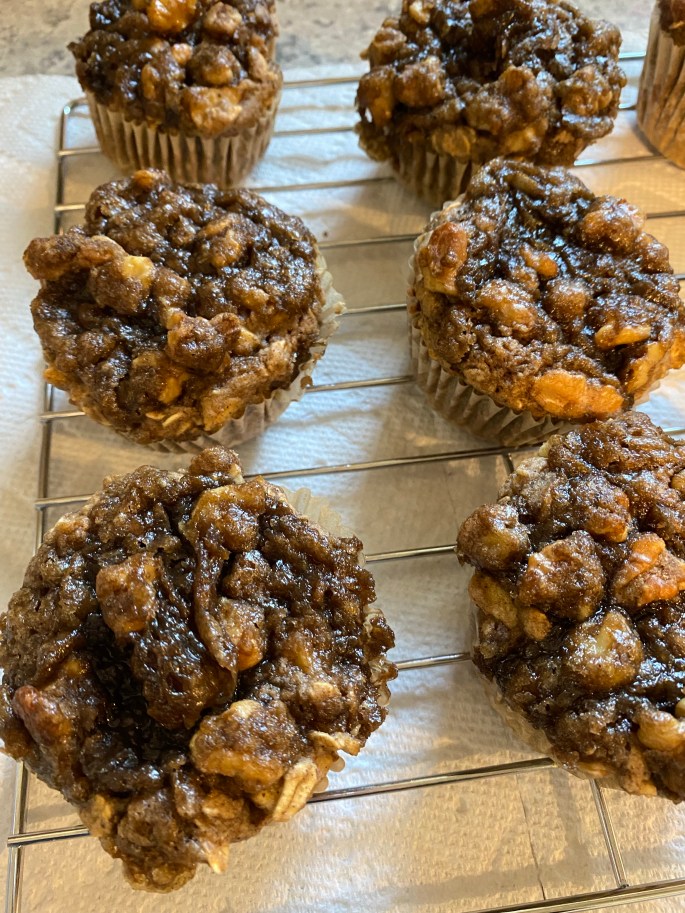
Tip: I cut the nut-topping recipe in half, and only topped half of the muffins. On the half without nut topping, I sprinkled with cinnamon and sugar. Finally, you can skip the nut-topping altogether, and/or stir in ½ cup chopped walnuts into batter when adding in chopped apples.
Bake for 25-30 minutes or until a toothpick inserted in the center comes out clean.
Remove from the oven and allow muffins to cool in a pan set on a wire rack.
Serve warm.
Store any uneaten muffins in a storage container/bag in the fridge or freezer for up to two months.
**Updated option: When baking for those who may not like nuts, or simply can’t have them either, eliminate the nuts from the optional topping, or divide all of the topping recipe in half add simply add 1/4 cup walnuts to one half, and leave the other half of the topping, nut-free.
Mix the dry ingredients.
Combine rest of ingredients.Mix one-two minutes until batter thickens.Stir in apples.Gently mix together apples and batter. Then divide among muffin cups.If desired, sprinkle optional walnut topping over tops of muffin batter before baking.
“Everybody is a story. When I was a child, people sat around kitchen tables and told their stories. We don’t do that so much anymore. Sitting around the table telling stories is not just a way of passing time. It is the way wisdom gets passed along. The stuff that helps us remember a life worth living.”–Rachel Naomi Remen
I saw her on the opposite side of the block, the woman with purple cord-like hair wound round her head like a hat. She walked along the sidewalk at the opposite end of me, and she carried what appeared to be a purple calico print backpack on her back. Talking uninhibitedly to herself in a syncopated, sing-song voice, she did an about face and turned toward a man as he stepped out of his car into the damp, cold morning air.
“Hey, Mr., wanna buy me some breakfast? Breakfast is good. Food is good. I like breakfast food.”
I could not hear his soft reply, but I heard her sadly chime a truncated response.
“Ok, ok. I am not bad. I am not bad. Just wanna sit at the kitchen table with Mamaw. Just wanna sit and eat at the table with Mamaw.”
The woman, from my distance, appeared to be not much older than my own 22 year old daughter, and emotions suddenly choked my throat and clouded my heart. I wanted to wrap my arms around, as if she were a small child, and take her back to her home–wherever that may be. In spite of this woman’s evident mental illness, she seemed to long for the comfort, safety, and shelter that we often find at the family kitchen table.
Kitchen table memories spooled out in my mind plain as thread, and some were just as colorful. Many were fond and warm pictures–snapshots of holidays past. Others were remembrances of various familial situations. I was adrift in a kaleidoscope of images; snippets of moments glided through my mind as leaves the colors of amber, crimson, and tangerine, freed from the bondage of a tree, take flight in autumn breezes. Impressions of full bellies, hot coffee, spirited–or sometimes intense–conversations, and purposeful work endeavors around one piece of furniture continued to tumble about . . .
Homework and games
Puzzles and paints
Posters and patterns to sew
Papers typed late into the night
Stacks of bills to pay
Budgets in need of balance
Dancing eyes sharing stories
Tears that break the heart
Conversations and disputes,
I think I need to leave the room
Set the table please
Platters of food to share
May I please be excused?
Not ’till you clean your plate
Spills that demand to be cleaned
Bubbled burps of Friday night soda
Mix well with pizza and chips
Quarter fines, ‘cause
Burping is rude
Peals of explosive laughter
Oh no, we’re in trouble now
May I please have some more . . .
What about waffles with peanut butter?
My friend is spending the night
Do I have to do her chores?
Pass the butter please
No, you can’t go out with your friends!
May I have another roll please?
Do you realize the seriousness of your actions?
Come in and sit a spell, friend
Did you hear about this?
Why, yes they say it’s true
Now, listen, you can’t believe everything you hear
Birthday cakes and cookies sprinkled
Presents wrapped with curls of shiny ribbon
Curlers set, braids woven
Talks of dreams and
Future plans filled with hope
Remember when?
No, it went like this.
Did she really throw a fork at Uncle?
Well, they were wrestling
Brothers nearly tore down the kitchen
Over the last piece of cake.
It’s your turn to clean the dishes
But I had to do that last week!
Remember to sweep under the table
Whispered late night conversations
Big changes coming soon
If only kitchen tables could talk
At the heart of a home, there is the kitchen table–a field of harvested memories and land for new seed to sow. It is my wish, as we gather, eat, converse, and work around our own kitchen tables, that we take time to not only nourish our bodies, but also savor the moments with one another, and form kitchen table memories and traditions worth sharing and passing on to future generations. May we remember those who have gone before us, and love the ones who remain. May we likewise take time to pray for those without homes, looking for a kitchen table at which they can sit and sip a cup of comfort. May those lost souls find some form of peace and solace, and may they one day be reunited, or united, with people who love and care for them.
My final prayer of hope is for the unknown young lady with wound cords of purple hair. May she be safe and well. May she no longer roam the streets alone, and may she make her way back to her Mamaw’s kitchen table. After all, she was once somebody’s baby girl.
Spare me perfection. Give me instead the wholeness that comes from embracing the full reality of who I am, just as I am. —David Benner
Here I am, photographed at home in a dress Mom sewed for me.
As a child, my mother sewed a large portion of my clothes, especially my dresses. Of course, I took this talent for granted as a child. In fact, it wasn’t until I was in my early twenties, and shopping for so-called “professional” clothes to wear while student-teaching that I began to truly realize what a gift mom’s sewing had been for me.
It was my senior year at Ohio University, Athens campus. It was still the era of the quarter system across most Ohio universities throughout the state. This meant that I had a break from Thanksgiving through the beginning of January. Therefore, I used this time to work, and this year was no exception. However, since I knew I needed appropriate clothes for student-teaching, I landed a job at Lazarus (now Macy’s) at our local mall. My goal was to not only work, but also to take advantage of the employee discount and after-Christmas sales.
I am pictured far right with the high school group of special education students I taught inn 1987. Notice how oversized my store-bought clothes were!
I already knew that I needed to shop in the petite section of the women’s department as I was (and am) less than five feet in height, but what came as a shock to me is how long so-called “petite” sleeves and lengths of skirts, dresses, and pants were! Plus, according to manufacturer measurements, my body shape did not fit into a precise size category. Without belaboring the point too much, it was during these tear-filled hours spent in the Lazarus dressing room desperately trying to find a few items to fit my proportions that my appreciation for my mother’s tailoring grew.
Thinking back to Mom’s sewing, I can recall the efforts she would take to thread the needle–literally and figuratively–while sewing clothes for me. While she would begin each dress, skirt, or blouse made for me with a purchased pre-made pattern, she would also painstakingly take my measurements and alter the size of the pattern accordingly before cutting the cloth. Throughout the sewing process, she would pin the cloth first, ask me to put it on, adjust the proportions as needed, and then thread either the sewing machine needle or her own personal needle to stitch each piece together.
The dress my Mom stitched for me in honor of my college graduation.
In order to sew one complete dress for me, Mom was required to thread one of those needles repeatedly, perhaps even thousands of times. I can recall countless moments of watching Mom attempting to insert the thread through the eye of the needle. Thinking back on it, she had to ensure all of the fibers/strands of thread fit through the tiny eye together. If one strand did not go through, the needle was not properly threaded, and she had to try again. The thread had to go through the eye wholly to live up to the task required by Mom. In fact, in order to prevent a strand from sticking out, Mom would often wet the thread’s end and twist it tightly together. Both creator and creation had to be fully concentrated in order for all fibers to fit through the eye.
Reflecting upon this, I realized what powerful lessons were there in Mom’s sewing. On one hand, there is the lesson of flaws. Mom, the creator of my dresses, did not see me as flawed–not fitting some arbitrary manufacturer standards. Rather, she saw me as a whole–as the Creator sees each of us. Mom was able to take my unique dimensions and measurements in order to create a whole piece that fit one-of-a-kind me. Her fully, concentrated threads and efforts afforded me the opportunity to be adorned in perfectly fitting clothes, so that as a child, I could fully and wholly concentrate on my own efforts and energies into typical childhood endeavors.
My brother, Scott, and me in matching outfits sewed by our mom.
On the other hand, Mom’s repeated endeavors to thread the needle also provides another lesson–one of our Creator, and the way in which we were designed to live. When Mom fashioned clothes for me, she had to take my so-called flawed measurements–measurements not taken into account by the pattern manufacturer. Additionally, she sometimes had to use fabric remnants, old thread, or even mismatched thread to sew various items of clothing for me. There were times her needle broke, her stitches were off, or a measurement was off. There were times I even watched Mom painstakingly pick out all of the stitches along one piece, and start all over. No matter the mistakes, accidents, mismatched thread, or sale-fabric, in the end, it wasn’t the flaws that I saw and wore, it was the whole–the entirety of the piece.
My grandparents and me photographed on the steps of their church. I am wearing a dress Mom sewed for me for Old-Fashion Days celebration.
That is how the Creator designed us to live–wholly. Humans are not perfect, nor were we meant to be perfect. Just as I am not “standard-sized,” our lives are not either. It is our imperfections, blemishes, and fallibility that make us perfectly human. By embracing ourselves as we are–flaws and limitations–we are able to find our strengths and uniquenesses. Furthermore, our mistakes, our errors, and our unfortunate times of sorrow all work together to create a richer and more wholehearted approach to life and to others–after all, how can we possess empathy for other humans if we live a “perfect” life.
It is only when we take time to bind our individual talents and gifts, along with our imperfections, that we are able to thread the eye of our lives. We were designed to be “non-standard.” How would any work site come together if we all had the same skill-set? In fact, how would any couple, family, team, town, and so forth, grow, develop, and thrive together if everyone were the same.
My brother, Scott, and me, once more in outfits stitched by our mom.
Life is not standard. No one person is standard. Each of us, however, is whole–wholly imperfect and Divinely designed to offer this world what no one else can offer. Let each of us embrace our differences, and embrace the differences of others too. As brown sugar, butter, flour, and chocolate chips individually come together in a hot oven to create delicious cookies, so too do the trials and fires of life bind us together. It is my lesson to learn and share that life is more beautifully adorned when we openly and humbly accept our imperfections and allow the Creator’s thread to bind us together in order to live our perfectly, imperfect designed lives.
My brother, Scott, and me, I am a dress stitched by mom.
Have you ever been so tired that you feel a bit lightheaded? I know I have personally experienced that feeling on more than one occasion, and it can be a bit worrisome. Scenes of traffic accidents caused by the driver that fell asleep often enter my mind on those bone-tired days as my thoughts have a tendency for dramatic, worst case scenario.
Recently, I was standing at my classroom whiteboard, writing something in preparation for the incoming class. I could feel the lead weight of my fatigue as if I was wearing the heavy x-ray protective vest worn once a year during a regular dental check-up. The lined dark circles under my colleagues’ eyes that I had observed that morning revealed that I wasn’t the only one, and the students coming and going from my classroom looked just as worn down.
As the next class began, I asked the students how they were doing before beginning instruction. One student honestly answered, “I’m really tired, Ms. Hill. I just want to sleep.”
Other students piped in their agreement. I thoroughly understood. Long gone were the well-rested days of August and September. By this point in the school year, students’ stamina was wearing down. Their growing bodies and minds were in need of a rest, but the school calendar stated it wasn’t yet time.
I needed to encourage them to hang on a bit longer. Therefore, I shared with this particular group the lesson of the toothpaste tube courtesy of my own long, ago teen years. It was handed down to me via an object lesson designed to emphasize the importance of the morning’s scripture reading given by a former, beloved pastor, Rev. Brisker. Unfortunately, I do not recall the scripture. However, for the sake of illustrative purposes, I’ll use Luke 1:37, “For nothing will be impossible with God.”
Sitting in the small sanctuary of the church in which my family attended about the time I entered my teen years, I sat with my red leather bound Bible with my name embossed in gold lettering across the bottom. It was one of those Bibles with thumb-cut indexing, so that the user could find the books of the Bible with ease. While I cannot pretend that I was always this attentive–I was a teenager after all–I do recall paying attention long enough to look up the scripture the kindly pastor read . . . at least most weeks.
On this particular Sunday, I know that I was daydreaming as I gazed out one of the sanctuary windows. At the time, the windows were not stained glass, but instead covered with wavy, flame shaped, pastel shades. While I could not see outside, I could observe that the sun was shining brightly, and I was ready to get out into it. Plus, I was probably hungry by that point too! It was hearing his wife’s name, Rita, that caught my attention.
If ever there was a saint on earth, Rita was one! Though she was full of good-humor, and loved to heartily laugh along with her husband, her gentle, tenderhearted nature always shone through her eyes. Why was he talking about Rita in his sermon?
Refocusing my attention, I realized Rev. Brisker was talking about their family budget in order to help make a point. He described how the closer it got to payday, the more they had to stretch their budget in order to make ends meet–a relatable topic as one of four kids. He described the way in which Rita and he had to constantly remind his own three kids to turn out lights, don’t waste products such as shampoo and other toiletries, serve yourself an amount of food that is only what you’ll eat, rather than waste food, and so forth. These were certainly common themes in my own childhood household.
He then focused on the amount of toothpaste the kids tended to use. This was the time period in which toothpaste tubes were made of some sort of collapsable metal. Rev. Brisker described the effort and pains Rita would take to squeeze and compactly roll the tube of toothpaste in order to “squeeze out a little bit more.” It was then, Rev. B lowered the hammer.
With God, he proclaimed, nothing was impossible. There was always a little bit more for each of us–more strength, more perseverance, more love, more patience, more kindness, more gentleness and so forth. God’s budget was (and is) an endless supply designed to increase our strength and meet our needs. Rev. B encouraged his flock to know that through prayer, and a bit of effort on our part, we could make it through whatever challenges we were facing. From managing a family budget to facing down a personal crisis as well as any other number of obstacles in between, we could endure and squeeze out a little bit more.
I wish I could say that my students were super motivated and inspired by that story. Most were rather unfazed. However, that remembrance served as a powerful reminder to myself, and hopefully to you, Dear Reader, that we, too, can keep going. There’s always a little more toothpaste in the tube of life. Hang in there, my friends, hang in there.
“What’s the point in having a sweet tooth if you don’t use it?”–unknown
I blame my parents. Who else am I supposed to blame for my sweet tooth? While both of my parents eat an overall healthy diet, they also like their dessert from time to time. I confess, I am the same way. It’s all about moderation and balance, and, well, never underestimating the power of chocolate . . . or peanut butter!
I enjoy nearly any form of chocolate!
About a month ago, I baked my grandmother’s traditional recipe for chocolate frosted brownies. It is a family favorite from an old 1930s or 40s vintage Betty Crocker cookbook. While it is not vegan, I can say it is vegetarian; and anyway, I am not about so-called perfect eating. Besides, it’s not like I bake Grandmother Helen’s brownies on a regular basis.
My mom had dinner with us on the evening that I baked brownies, so I sent a few home with her. The next day, my daughter walked into the kitchen where I was food prepping my work lunches for the week, laughing and shaking her head. She said that while talking to my mom on the phone, “Gran’ma confessed to spreading peanut butter all over the brownies before eating them.”
Mash up the banana first. I find a pastry cutter perfect for this!
At first, that seemed sacrilege! How could she desecrate that beloved, treasured family recipe? The horror of it! What was she thinking?
“Sounds like a good idea to me!” said my husband. “I just might try that!”
He had a point. Peanut butter–and almond butter for that matter–are like dessert. Nothing can improve a bad day like nut butter. In fact, I would argue that nut butters, as a rule, have a certain calming quality to them! During my younger years, when annoying bodily afflictions, such as acid reflux, were nearly non-existence, banana and peanut butter was one of my favorite go-to meals. This led me to thinking . . . which is always dangerous!
Stir in the peanut butter.Add in the rest of the liquid ingredients.
I began to wonder if there was a plant-based, gluten-free compromise-recipe I could find or create. Thus, my research began. Scrolling through one web-site after another, I eventually landed on two different recipes. One recipe was from a web-site entitled, “It Doesn’t Taste Like Chicken,” and the other recipe was from a web-site called, “Purely Kaylie.”
Add in the dry ingredients.
Using both of their recipes as scaffolding to create my own variation, I did a bit more research on baking with both oat milk and oat flour. These two ingredients, I decided, would not only increase the nutritional value, (Read between the lines–ease the guilt of my sweet tooth!) but also eliminate gluten and dairy products since I have celiac disease and prefer to eat plant-based. Additionally, I also conducted a bit of research on the science of baking with dutched cocoa, my preferred cocoa, and I learned that it bakes more effectively with baking powder, rather than baking soda.
Stir in chocolate chip and mix until just blended.Pour batter into prepared pan and sprinkle with remaining chocolate chips.
I made this recipe on a Saturday afternoon, and our entire home was redolent with the scent of baking chocolate. The recipe was super-easy, requiring only one bowl, and honestly took no longer than 10 or so minutes of active kitchen time. The oven did the rest. Once cooled, I cut the recipe into 9 generous sized squares and stored part of them in a plastic container in the fridge. I could have frozen them for future weekend cravings, but they did not last that long.
Give this recipe a try. Enjoy it for breakfast, as a dessert, or a grab-and-go snack. It’s a mostly healthy, guilt-free way to have your cake and eat it too!
All to cool before cutting into 9 generous squares.Who prefers corner pieces???
“There is something in October sets the gypsy blood astir: we must rise and follow her , when from every hill of flame she calls, and calls each vagabond by name.”–William Bliss
Fall is the perfect time for hiking, walking, or simply heading out-of-doors for any sort of physical activity. The changing landscape, crisp air, and the earthy scents of damp soil, decaying plant matter, and the musky-sweet scent of drifted piles of discarded leaves invigorate the soul. After sluggish months of heat and humidity, autumn’s sudden drop in temperature is enough to not only add bounce to our step and inspire movement, but also create stirrings within.
Fresh air has a way of plowing the mental landscape into a bucolic pasture of peace and positivity–if only for a short while. What miraculous logic lies in this seasonal change. It is as if, by Divine design, that fall provides us with an opportunity to elevate the spirit, boost the body, and clear the consciousness in preparation for the impending darkness of winter months.
Walking this weekend along a favorite wooded path, I couldn’t help but follow these seasonal musings of my mind. After a long, exceptionally challenging week, it felt both cleansing and healing to immerse myself in the quietude of nature. No headset, nor blathering talk; no tedious tasks, nor irksome situations. Like soaking in a warm, scented bubble bath, stepping onto the wooded path, I immediately felt submerged in the tranquil bathwater of autumn.
Before long, I was lost in the sounds of restless tree branches bouncing in the fall breeze, the humus scent of mulched debris, and the changing hues of leaves and grass. Of course, my mind does not like to be quiet for long, and soon enough, childlike tantrums for attention interrupted my equanimity. Without any warning, my mind began stumbling and bumbling through past events instead of anchoring to the present and peace of the surrounding natural world.
“I cannot endure to waste anything so precious as autumnal sunshine by staying in the house.”–Nathaniel Hawthorne
Isn’t memory a curious process? You can forget about an event, experience, or moment. Then suddenly, as if tripping over a tree root along a smooth forest pathway, you tumble head first right into the past. Like the long roots of trees, past episodes can be found along our life path, but often we are so focused on moving forward, we overlook those rooted memories that make up the tree of our life. This isn’t necessarily a bad thing, unless we haven’t made peace with certain past events.
In the ideal world, falterings into the past can be easily side-stepped, allowing us to keep moving ahead with ease. Like the broken limb of a tree, these past happenings may have left us feeling as if a piece of our life was fragmented. Sometimes, these can be small, mendable, events. Other times they are life-altering occurrences that sever ties with a friend, love, or even family member. Divorce, death, loss of job/home/income, and other hurts can all leave us feeling as splintered as a proverbial tree trunk.
At the time, it feels as if we will never be whole again; never able to grow, much less thrive. However, like the maple tree that lost a major branch in a winter ice storm, our hearts, given time, do heal at the source of the break. It may take several seasons to fully recover, but similarly to the mighty maple, once recovered, we find we can tap into the sweetness of life again.
Some triggered memories, like a fallen log across the path, can seemingly be foreseen well ahead of time. It could be a special celebration, a family or friend gathering/reunion, a party, or other organized event. We see it well in advance–the potential to bump into branches of our past. Therefore, we deliberate, strategize, and plan how we will not allow ourselves to be tripped up, to fall into past, negative behaviors, or other self-defeating notions. If we’re fortunate, we trek through the event without a single obstacle tripping us up, and we wonder why we wasted all that time worrying. At other moments, we repeatedly flounder through multiple encounters without ever gaining a steady foothold due to overthinking or over-efforting.
Other memories we stumble across can be simple knee and/or palm scrapers–just a little momentary scuffle. They are the unforeseen life encounters in which we come face-to-face with our past. Like that hidden rock along a regular walking path, unearthed by heavy rainfall, we’re confidently moving forward when suddenly a buried memory triggers a brief, but sharp tumble. Momentarily we are once more wounded, lost in the temporary feeling of pain, but quickly rise, wipe off the proverbial dirt of the past, and keep hiking on.
Then there are those rocky memories. Those awkward, cringe-worthy moments of impulse, illogical, or otherwise preposterous life hiccups. Like the rough part of a well-worn rocky path, all lives have these times. In fact, these memories, when randomly run across, can sometimes leave you doubled over with laughter as you fumble through recollections of those bumpy reminiscences.
Aw, the path of life, like any good hike in the woods, is full of thorny patches, toppling obstructions, and adversarial pitfalls. Nonetheless, our trails also meander through lush fields of golden moments, wound ‘round bends of colorful times, and over walkways of unexpected joy and bliss. Through the seasons of memories, all the good and the bad, our life paths keep moving us forward. Thrusting us into the now of our lives.
Clearing my mind, and shaking out its detritus of the past, I once more returned to the present moment of the autumnal walk. I felt the air brush softly against my cheek and watched a chubby, round-eyed raccoon waddle away from me. I left the past behind on that trail, decided to let the future take of itself, and began to once more soak up the present moment of the fall goodness, one glorious step at a time. Oh, how I love October.
“I’m so glad we live in a world where there are Octobers.”–L. C. Montgomery, Anne of the Green Gables
Walking into work this past week, I began to make my way up the flights of stairs lined with windows. Above the alley filled with cars, a squirrel scurried along a wire. I paused long enough to observe this rodent. It scooted forward at an energetic pace, then paused, precariously balancing above the unsuspecting vehicles, then scampered along a bit further until it was out of sight.
Continuing my ritualistic workday ascent, I reflected on the delicate balancing act of the trapeze-squirrel and the ways in which it reflected our current work culture. Since the onset of COVID, the demands and pressure upon the labor force have greatly increased. From longer work hours to added levels of responsibility, many workers feel a lack of control over their work environment–which are often becoming more socially toxic. Additionally, workers frequently cite insufficient reward, a lack of fairness, and even a conflict of values with the ever increasing work demands. It’s no wonder that many workers choose to walk away. Unfortunately, the downside for those who choose to remain is that they are merely expected to pick up the extra workload, usually without any appropriate compensation or support.
A squirrel on the playground at my own worksite in the evening sun. There is actually another squirrel nearby, but it dropped out of sight just as I clicked the photo.
To add further fuel to the fire, complaints of worker burnout are often met with the belief that there is something innately wrong with the employee–that the worker is “not the right fit,” or “not a team player,” rather than examine the workplace culture. This has led to one of the highest levels of “quit-rates” since the U.S. Bureau of Labor and Statistics began keeping records” according to their April 2021 data. In fact, based on a growing body of evidence, it’s looking as if those business leaders who do not seriously rethink how they approach the workplace culture will most likely face issues with worker retention and shrinking work pools, leading to decreased productivity and/or unreliable timelines.
While the term “burnout” has been around for decades, the World Health Organization only recently identified worker burnout as a real phenomenon beginning in 2019. According to Dr Tedros Adhanom Ghebreyesus, WHO Director-General, worker burnout is caused by high levels of stress causing the worker to feel cynical and distant from their job which in turn affects their productivity, and more importantly, their personal health. He believes that burnout is a “serious health hazard”
Meanwhile the squirrel’s health is at risk as hawk waits above for his opportunity to attack.
“No job is worth the risk of stroke or heart disease.”–Dr Tedros Adhanom Ghebreyesus, WHO Director-General
To add further support to the WHO’s identification of worker burnout phenomenon, Winona State University has identified five distinct stages of burnout. These stages include:
The Honeymoon Stage: The excitement of the new job/role/position does not allow the worker to realize their workload is unrealistically large as it can be easily written-off due to the newness of the job, but can soon enough push the worker into the next stage.
The Balancing Stage: The employee begins to struggle with life-work balance. As the scales tilt more towards work, fatigue, sleep disturbances, and early signs of dissatisfaction lead to self-detrimental, coping behaviors, such as increased drinking, eating, smoking, and other forms of escapism. With continued worksite pressure, the employee is nudged closer to burnout.
The Chronic Stage: The worker is now often filled with persistent anger/resentment, depression, chronic exhaustion, physical illness, and so forth.
The Crisis Stage: Without intervention, the worker is overwhelmed by feelings of jadeness, powerlessness, pessimistic thinking, and ready to walk away from not only the worksite, but their chosen professional field.
The Enmeshment Stage: If this same worker remains, they move into “enmeshment,” a point in their career where they may be held in high regard by their coworkers, but on the inside, the worker feels like another cog-in-the-wheel, unhappy, and trapped–stuck in an unfulfilling role that leaves them dissatisfied.
“Burnout is nature’s way of telling you you’ve been going through the motions your soul has departed.”–Sam Keen
Finally sensing the danger, the squirrel runs away from the work site.
Unfortunately, management, administration, and/or owners can often be tone-deaf to their workers’ heightened levels of stress. In fact, according to research, the self-help industry and employers appear to blame the workers. Therefore, many workers indeed accept the blame without question, and those workers who do express concerns to management, are often rebuffed with off-hand comments or insincere promises, such as:
“Working long hours never hurt anyone. I like to work long hours.”
“I still find time to do x, y, or z, with all the demands I have.”
“It’s only for the short-term, and you’re so good at what you do.”
Other management teams will offer token trinkets, swag, and so called “social” events/meals–with the expectation that workers don’t break to enjoy the event or meal, but either grab-and-go-back-to-work or remain longer at the work site with co-workers. Some businesses hold annual health or wellness meetings in which employees are instructed to regularly incorporate self-care practices, such as deep breathing, yoga, exercise, or take fresh air breaks, but in practice, the business maintains its habits of scheduling back-to-back meetings, emailing their workers late into the evening or throughout their weekend, and/or remains committed to the expectation that workers pick up an extra shift or assume an addition role with little to no opportunity for those self-care breaks, much less compensation. In fact, the culture of many work-sites seem to have an unspoken creed that working longer hours with an increased load and no breaks is often seen as a badge of honor and an esteemed level of productivity.
“Even the loveliest shoulders can bear but so much.”–Jill Alexander Essbaum
Worker burnout is, as one researcher writes, a “canary in the coalmine” If the canary cannot breathe, it is not the canary’s fault but the coalmine, and so it is with burnout. While there are some actions within the workers control, such as “setting boundaries” to the degree possible, attempting to get adequate rest, nutrition, and/or engaging in enjoyable activities outside of work–these practices can only go so far. The less input/control workers have for their length of work hours, the type of activities in which they must engage, and little sense of fairness, the more likely burnout will continue.
As I see it, this brave new work environment requires creative solutions. Enticing job fairs with their flashy flyers, free food, and dressed-up off-site location are merely bowls under the roof of a leaky attic–the leaking holes still remain within the structure, slowly eating away at the stability of the framework–but do not address the real issue.
Reflecting back to the squirrels, researchers know that squirrels are most active early in the day as they scatter collections of food in a variety of spots to stave off hunger during more meager times of the year. However, these active periods are also filled with moments of free-spirited play. While young squirrels play the most, adult squirrels daily engage in some form of play, be it solitary or interactive. As the day progresses, squirrels begin to wind down and spend up to 60% of their time sleeping.
It is not unusual, at the end of my workday, to find several squirrels with their lively chitterings, dipping and diving with one another in a rambunctious game of chase. Their high spirited antics never fail to make me smile in the slant of the evening sun. If I observe long enough, they take breaks here and there to gather food, dart away to some unseen cache, and quickly zip back for more frolicsome play. I can’t help but wonder if the workplace could learn a lesson or two about what makes a healthy and productive work environment from our fellow squirrels.