Embracing Limitations: Lessons from the Asheville Half Marathon

God, grant me the serenity to accept the things I can not change, the courage to change the things I can, and the wisdom to know the difference.”–Prayer for serenity

The Blue Ridge Mountains outside of Asheville, NC.

“the mountains are Calling . . .” ⛰️

I had been training for months, despite the challenges winter threw at me. Cold? I can handle it. Snow? I can run in it. Gusty wind? I can run that too. However, after my husband, John, and I crested hill after hill making our way into Asheville, North Carolina, I knew the town’s half marathon would offer a whole new level of challenge. 

To be clear, participating in the Asheville Half Marathon was an insignificant hurdle compared to what the people in Asheville, and all of the other residents of the surrounding areas/towns along US 23, have been facing as they deal with the aftermath of Hurricane Helene.

Driving along US 23, John, and I were able to witness that six months after Hurricane Helene angrily chewed through a large portion of the western Appalachian region, the recovery is still ongoing. However, the willful, and not-to-be-deterred, spirit of the residents was unmistakable. 

Rooftop view from Asheville of surrounding Blue Ridge Mountains.

A Tale of Two Sisters 👧 👧

This past fall, not long after Helene hit, the high school in which John and I work, welcomed two sisters into the student body.  They were from the Asheville area and were staying with relatives while their parents and older brother dealt with the devastation and destruction back home.

The girls were engaging and well-poised, especially considering their circumstances. Over the course of a couple months, I got to know them–not well due to the short duration of their stay–but well enough to swap personal stories from time to time. 

When they learned that like their dad, I often trained for half marathons, they immediately invited me to run the Asheville Half Marathon in March. They explained that by the time spring rolled around, the community would not be fully recovered, but the local economy would need the boost that runners and the accompanying spectators could bring. 

“You should definitely come, Ms. Hill.  You’d like the people of Asheville, especially the running community.” 

Once Asheville High School opened, the girls returned back home. And though I haven’t heard from them since, they planted a seed that grew into a shoot of curiosity. 

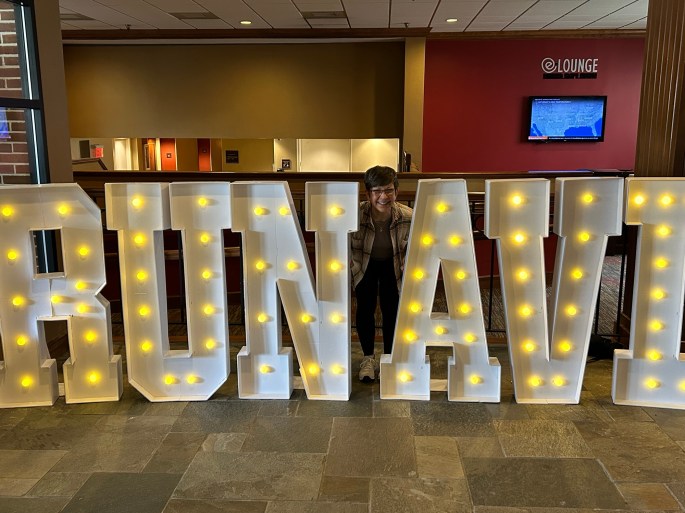
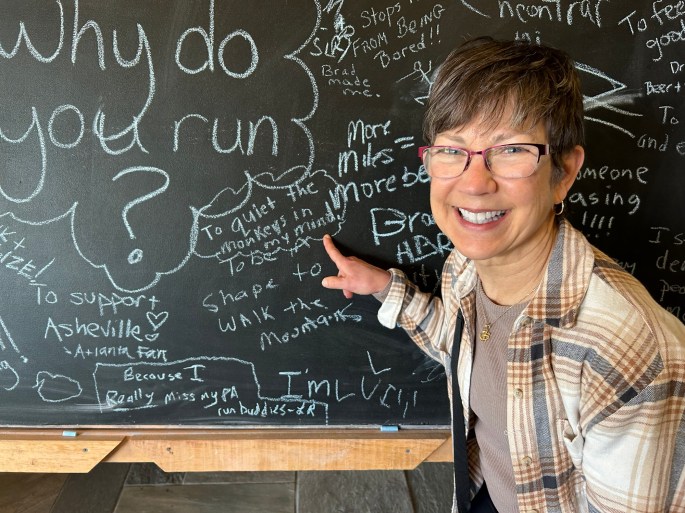
Runners were asked to sign the board stating why they ran.

Sign me up! 📝

Around Christmas, I checked the Asheville Marathon/Half Marathon website, and the powerful and persuasive prose describing the event increased my interest. The website’s editors artfully articulated the community’s belief in the significance of the annual running event. They stated the course’s route would not be “pristine or predictable.” Therefore, the event was for those who “thrive on resilience.” However, the line that sealed the deal stated, “If you’re ready to run in the face of adversity and be a part of Asheville’s comeback story, we can’t wait to see you on the start line!” 

John and I at gathering with other runners and spectators at the starting line before the race began.

Ready, set, Go! 🏁

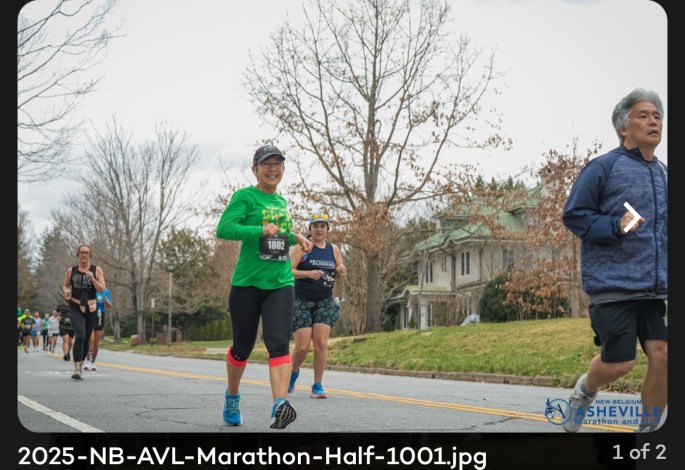
Soon enough, on a chilly, dark March morning, I waited at the starting line with approximately 2,200 runners from 40 states and three countries who also heeded the call to help support Asheville, according to The Weather Channel. The positive vibe was palpable as runners mingled with spectators. Nonetheless, I was feeling a bit nervous as I recalled the half-marathon route’s elevation gain was nearly 800 feet, and its elevation loss was over 900.  

And, it was hilly.  From start to finish, there were no flat stretches. In the beginning, I read spectator signs claiming, “It’s all downhill from here,” with hope. It didn’t take long to realize those signs lied!  Even the finish line required running uphill, but I am “running” ahead of myself.

Running is a metaphor for living life, and it is always whispering (or sometimes shouting, as this event seemed to do) lessons to those of us willing to listen. Accepting limitations–was the lesson those relentless hills of Asheville taught me. Which makes sense since this is what many of the residents of Asheville and the western Appalachian area had to do during, and now after, the storm–accept and deal with limitations. 

Whether literal or metaphorical, storms of life cause us to suffer. As I repeatedly tried to power through those uphills during the first half, my ego kept telling me to push harder, creating suffering. However, as a late-in-life runner lacking inherent running talent, the reality is that race events for me are more about creating motivation and structure to consistently get me out the door to exercise. At the end of the day, I am not about to set any records; I am not even close to winning my age group, so why was I pushing so hard?

And so, it was on a hill, not long after milepost seven, that I decided to accept my limitations. Sure, I had trained on hills at home, but nothing like this. Why not power walk up the rest of the hills, and then run the downhill portions?

Asheville taught me to accept my limitations.

There is a newfound freedom in accepting one’s limitations 🏃‍♀️

Once I accepted my limitations, there was freedom. I had a new way of being present with the race challenges as they unfolded. This acceptance gave me permission to slow down, take in the sites, and feel a sense of gratitude for my health and ability to make this trip. 

Additionally, by walking the hills, I had more energy to offer encouragement to fellow runners I encountered who also seemed to be struggling. (After all, I run at the back of the pack, where we could all benefit from a little encouragement.) Furthermore, I was also able to offer thanks to the spectators who manned drink stations, rang cowbells, or waved motivating signs with clever phrases such as, “Touch here for power,” “You’re stronger than any storm,” or “You’re running better than our government.” 

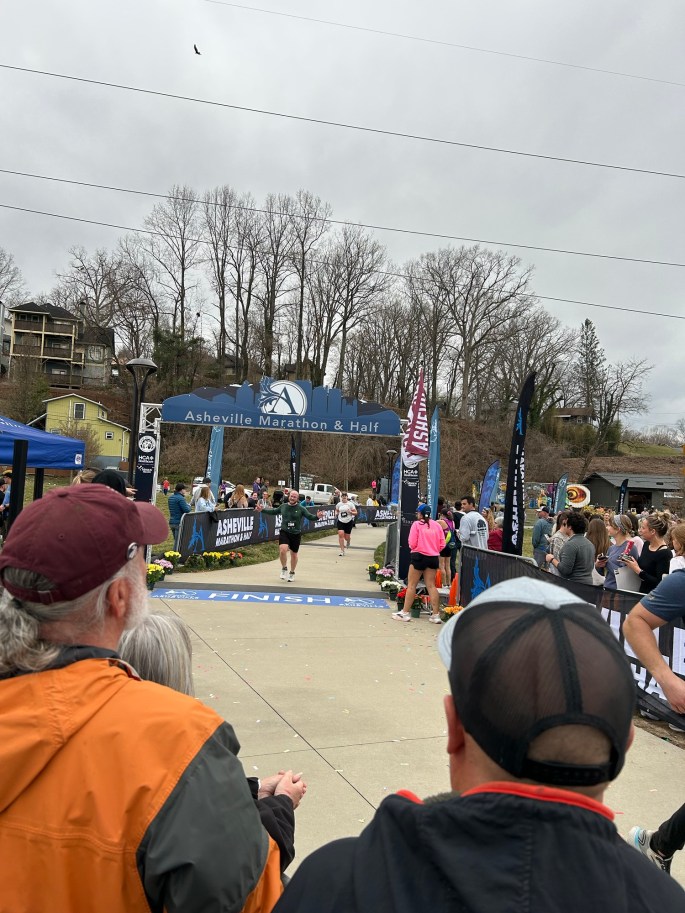
By the time I crossed the uphill finish line, tears filled my eyes as I raised my hands in the air.  No, I wasn’t celebrating a personal record, but instead, I was able to celebrate that I crossed the finish line with grace, humility, and a lesson learned. 

The AVL finish line of through which I would later cross humbled, and grateful, by another lesson running once more provided me.

The lesson? Transforming suffering can only occur if we are willing to be with it and accept the limitations it creates. Accepting limitations can be transformatively freeing, allowing us to lean into newly created possibilities we may not have been able to previously envision. I am not saying that accepting our limitations is not easy. However, once we let go of ego and embrace humility, it is possible to embrace the freedom that comes with focusing on what we CAN do.

Thank you , Asheville! I walk away from the finish line with grateful heart and a lesson learned. Furthermore, thank you, Hannah and Allison! I wish your family the best! 💜

Finding Peace Amid Life’s Storms

Incredible change happens in your life when you decide to take control of what you do have power over instead of craving control over what you don’t.”–Steve Maraboli

Photo by Pixabay on Pexels.com

WArning: Shifting Life weather ⛈️

My husband, John, and his sister, Jacki, have birthdays during the last days of February. This year, we celebrated both birthdays on the day in between their two respective birth dates. As John and I drove towards Jacki’s house, we revelled in the warm-ish, slanted sunlight of late February. However, a stiff, cold breeze hinted of a dramatic weather shift.

Soon enough, we observed layers of dark gray and black clouds encroaching from the northwest as if ready to aggressively lash out in a fit of rage.

By the time we arrived at Jacki’s house, the wind gathered more intensity. Layers of clouds silently slinked closer, blanketing the sunlight. Warning rain drops, heavy with intention, randomly fell at intermittent intervals. 

Our daughter met us in the parking lot of a restaurant as a menacing mass of mayhem loomed above us. The winds forcibly fought against our efforts to walk into the establishment. The restaurant door resisted opening against the wind and then likewise fought to be closed. Seconds after John struggled to shut the door, a hostile bolt of lightning loudly landed nearby, shaking the building.

After being seated, torrents of truculent rain burst forth from swirling chaotic clouds soaking the next few guests who entered through the front doors. 

Photo by Dan Prado on Pexels.com

Change The focus 🎁

Soon enough, however, we diverted our attention away from the storm, talking and swapping stories. John and Jacki opened gifts, and we spent the next hour and a half engrossed in one another’s company with little focus on the discord of the storm unfolding around us. The storm was there, lashing and railing against the walls and windows, but it no longer disturbed our peace of mind as we focused on the unfolding celebration.

Yet, how many times in life do we allow surrounding storms and worries to shake and distract us from the moment at hand?

Photo by Jo Kassis on Pexels.com

Rough Waters Ahead 🌊

Many years ago, our family visited the shores of the Outer Banks in North Carolina when our daughter was quite young. It was a last minute trip during the first week of August, just before the start of school. The three of us made daily trips to the shoreline with books, umbrella, cooler, and boogie boards in tow. 

Unfortunately, the temperatures were incredibly hot, even in the early morning. Therefore, we spent most of our time in the cool water on our boogie boards. We would wade out until our daughter was knee deep, then plop ourselves, belly down, on our boards. Next, we would paddle and kick to where the waves were breaking. When we saw what we thought was a “good wave,” we’d point our boogie boards back to the beach, start paddling and kicking, catch the wave, and ride it in towards the shore.

Each time we rode the wave in, we were taken a little further up the shoreline from where we had set up “camp” due to the strong undertow. Eventually, we would be taken so far north that we could no longer see our belongings, and we would lumber out of the water, walking back to our starting point. This would occur repeatedly as we had no control of the undertow.

Photo by Maria Orlova on Pexels.com

Possible strong Undertow 😵‍💫

The other thing that would happen is that one, or all, of us would get flipped off our boards by a rogue wave. The rough waters hurled us to the sandy, shell-covered bottom, and we would come up sputtering and coughing, completely disheveled–banged up and sand abraded. This often forced us to take a break in order to catch our breath. Nevertheless, it wouldn’t be long until we were right back out there again, trying to catch a wave in the wild surf, despite the fact we knew we would ultimately get dumped again.  

Yet, despite the extreme August heat, strong undertow, and often rough surf, we focused more on our laughter and the joy of being together, creating memories that still make my heart smile.

Photo by Tyler Lastovich on Pexels.com

You can choose your Response 🤔

Like the birthday storm and those long ago OBX waves, life has times when it rages with rough rains of hurt, blows wild winds of change, drifts us along an undertow of misleading information, or chucks us under waves to the bottom of mental anguish. If we choose to focus on the suffering, we will inevitably suffer more.  

We can, however, choose to direct our attention away from the storm and other difficulties. It doesn’t mean we’re not aware of the situation–or completely ignore it. Instead, we can focus on what we can control. The challenge will still be there, but we can choose to live with it, and in the meantime, redirect our attention like we would a toddler in a seaside gift shop drawn to the glass figurines. 

In the end, the chaos of life storms are often not controllable, but our responses and/or level of reactivity can be. Our minds, with practice, can be trained to ride those waves. By focusing on what we can do, such as stepping out of the fray, walking along the shores of self-care, choosing an alternate, renewing activity, and/or turning inward for reflection/prayer, we can redirect our mind in a more positive/productive manner until either when the stormy wave passes, or we are ready to begin kicking and paddling in the waters of life once more.

Finding Service and Joy in Every Job: Lessons from a cleaner

recalling unceasingly before our God and Father your work energized by faith, and your service motivated by love and unwavering hope . . .” 1 Thessalonians 1:3 (Amplified Bible)

What a difference one person can make😃

I had a feeling when I walked into my classroom one frosty January morning and observed the unswept floor, Mr. King (name changed for privacy) had not been in my classroom over Christmas break. Not that I typically permit my students to leave trash and debris on the classroom floor; however, I noticed there were a few pieces of notebook paper, pink pencil eraser dust, and a random pen lid dropped to the floor.  

Thanks, in large part to Mr. King, my classroom floor was usually immaculate. Was he sick? When I saw him, he appeared to be fighting some sort of virus. Picking up what I could off the floor, I thought of Mr. King, and the way he approached his work. However, students had begun to arrive, and I knew I would have to set aside my current strands of thought.

Later in the week, I ran across a quote that reminded me of Mr. King: “You are always doing spiritual work. It is not necessarily the action that is important, but how you do it.” (Satchidananda) I thought of his smile, his positive attitude, and the can-do energy he brought with him to his work. 

Photo by Liliana Drew on Pexels.com

Each Job is part of a Bigger Picture 🧹

I first met Mr. King during the summer before school started. He was part of a professional cleaning crew hired by our school. We occasionally chatted while we both worked, if he happened to be completing a task in my classroom. During one of those chats, we said his cleaning job mattered because he felt he was part of the team helping the students to have a successful school year.  

“If I don’t do my job, then you have to do my job, which means you don’t have as much time to focus on your students and that means their learning suffers.  It’s all a chain, y’see?”

Photo by RDNE Stock project on Pexels.com

Working with Joy 🎶

Once the school year was under way, I would often hear Mr. King, after school hours, singing/humming in the next classroom as he swept. It was a joyful energy, his voice pitching high and low as he worked. 

Some days, after students were dismissed and I remained getting caught up on work, Mr. King would respectfully knock and ask if I minded him coming in to sweep. Never wanting to interfere with his cleaning schedule, I welcomed him in. 

No matter how busy Mr. King was, he would take time to ask about my husband and me. Then, he tended to have some sort of question or story for me to ponder. It was a delightful give and take, and he was most interested in improving himself, body, mind, and spirit.

Though our conversations were never longer than three or four minutes, I was left with the impression that Mr. King was a deeply faith-filled man who had made mistakes, knew he wasn’t perfect, but still had the desire and heart to improve.

He especially seemed to want his life to be of good service. To this end, he once said, “I am working. Am I not? But how am I doing it? That’s what’s real.” 

Photo by Antoni Shkraba on Pexels.com

OUr Work Ethic speaks for us 🤓

Later in the month of January, another coworker said Mr. King went back to Florida, from where he was originally, in order to be closer to his family

Upon hearing this, I recalled he once took a phone call from his daughter while sweeping my classroom. Returning from the hallway into which he had stepped to talk with her, he looked wistful, adding, “I worry about her.”

Photo by Ivan Samkov on Pexels.com

simple ways we can be of SErvice to others: 😃

The memory of Mr. King’s work ethic now serves as a reminder to me that no matter what job we have, we can find ways for our work to be of service to others. Here are some of the ways, Mr. King demonstrated this:

Work with joy. It doesn’t mean that we don’t have challenging or difficult days. Rather, we can still have something for which to feel joyful IN SPITE of circumstances, and that joy can become contagious. Mr. King appeared to find and share joy by singing/humming and smiling outwardly. Even on those days where I could tell something was bothering him, he still offered me a smile and a sincere greeting. 

Find the meaning in your work. Mr. King believed his work was important because he was contributing to the overall well-being and success of students, teachers, and staff. He often spoke about how much he liked the teachers and students he met and was glad he could do his part to help our school. 

Work hard, but take time to pay attention to others. Mr. King was an efficient and effective cleaner, but he still took time to greet staff members by name. If he learned something special about someone, he would ask questions about that special-something and would later refer to it in passing conversations. He was the master of personalized small talk.

Remain flexible and responsive to the needs/priorities of the day. If a worker was out, or a new worker was being trained (which was often), I would frequently overhear Mr. King fielding calls to answer questions and/or offer help. He appeared to adapt his schedule in stride to accommodate necessary changes. Even then, if he saw John, my husband, or me, he’d pause with a “Y’all doin’ ok?” or “You and Mr. John take care this evenin’.” 

Be empathetic and compassionate. Throughout the time Mr. King worked at our school, I observed several occasions when he took time to interact with students who looked frustrated, down, or who simply seemed alone. He’d ask, “You doin’ ok, buddy?” or offer another kind phrase in an attempt to bring a smile to a kid’s face. Then he went right back to work, whistling or humming as he went.  

It’s not what you do, but how you do it. Mr. King epitomized this. A radiant smile never seemed to leave his face while working. Furthermore, he demonstrated to his coworkers, and those with whom he encountered, that he cared, was interested, and desired to uplift the small piece of world his work-life encompassed.  

Photo by Ketut Subiyanto on Pexels.com

final thoughts🤔

None of Mr. King’s skills are life shattering or new ideas. However, in a world where it currently appears acceptable to be ill-mannered, ill-tempered, non-empathetic, and even outright bully others to get your way, Mr. King’s skills and attitude were a refreshing change of pace. Imagine the amount of good that could be generated if more people thought about HOW they worked, spoke, and acted–if more people would choose to be truly service-driven, energized by faith and motivated by love and hope. How much more would be accomplished . . .if only.

The Power of Silence: Reflections on Mindfulness Retreat

In the silence of the heart, God speaks.” Mother Teresa

Photo by Ali Elfaziki on Pexels.com

Silent Retreat? 🧘‍♀️

I don’t remember exactly how the conversation went, but I was enjoying lunch with a friend on a Saturday when she told me she was attending a silent meditation retreat in two weeks, and asked if I would be interested in it. The retreat, she said, was sponsored by The Mindfulness Tree, a meditation community in Charleston, WV, and it would be led by Dr. Christine L. Blice-Baum, MDiv, DMA. Curiosity bloomed, and in a matter of days, I was also registered for the retreat.

In the days leading up to the retreat, I vacillated between feelings of excitement and thoughts of “what-have-I-got-myself-into?” The retreat required spending time in silence with complete strangers, excluding my friend, of course. I kept reminding myself that it wouldn’t be any different than going to an appointment or to the store with numerous others I don’t know. Never once, however, did it cross my mind that this retreat would provide multiple opportunities to come face-to-face with my mind’s resistance and its desire for distractibility.

Photo by Obi Onyeador on Pexels.com

Put away those devices 📲

Upon arrival, all participants in the retreat were asked to put up our phones and take off our smartwatches until the time of our departure. We had the choice to leave our devices in our car, in our own purse/bag, or stow them in a zip lock bag that was put away until the end of retreat.  I chose the latter option as a symbolic break-away from technology and, in all honesty, to reduce any temptation to peek in my bag at either device during the day. 

Not having technology was one of the first minor “discomforts” I repeatedly noticed. It began when I tried to check the outside temperature by looking at my wrist, and then did it several more times! What time is it? No smartwatch. Does the radar show my hometown receiving as much rain as here?  No phone. Blice-Baum just shared a great idea; I should type that in my notes. No phone. I should take a picture of the church’s pipe organ. No phone. Did my husband remember to  . . . . 

Participants in seated meditation.

Lessons of Stillness 🤫

This was my first a-ha moment. I was astounded to realize the amount of time my mind spends in a day consumed with thoughts of all the ways I can implement/use my smartphone and its companion watch. What’s crazy is that I am not a big user of social media, so I had this notion that giving up my devices would not be a big deal. While on one hand, it wasn’t, on the other hand, I was humbled to realize, social media consumer or not, my mind has been trained to be distracted by devices. 

The second big lesson had to do with a notion known as “custody of the eyes”–averting the gaze to avoid visual distractions in order to maintain focus. This practice was a challenge throughout the entirety of the session. 

The retreat schedule was well organized, sessions of seated meditation were interspersed with walking, movement, and standing mediations; however, my mind kept wandering and niggling me to look around at my surroundings. During walking and movement meditations, I had to keep redirecting my attention back to the meditation focus at hand because my mind had the tendency to wander off into people-watching mode. 

Participants take part in a silent walking meditation

The third lesson: I also squabbled with my mind’s habit of entering “squirrel-mode”–moments when something in the environment, or on the wall caught my attention, and my mind would launch off into associations with whatever my eyes had noticed. I knew I was distractible, but I never realized my mind was like a puppy visiting a new environment.

Another eye-opener occurred during our silent lunch. Blice-Baum, after sharing a prayer of gratitude and blessing for the food, led the participants through a short exercise of mindful eating. Then, we were directed to continue to enjoy our meal in silence, engaging all of our senses in the eating experience. This was when my mind really rebelled.  

Since I was a young girl reading the backs of cereal boxes at the breakfast table, I have always read while eating–newspapers, magazines, books–which were later replaced with digital versions. Without such distraction, I noticed my tendency to want to eat quickly and my eyes repeatedly searched around for something on which to focus other than my food. It took time for my mind to settle, slow down, and focus on taste and other sensations associated with the simple act of eating. This was a shocker because I love the taste, textures, and fragrance of food. In fact, I love to eat, but I clearly need to practice eating mindfully more often.

Group picture of participants.

Positive takeaways 🙌

In spite of all the mental obstacles and resistance I experienced throughout the retreat, I walked away feeling refreshed and renewed. Remaining fully focused and present on one’s own breath, a mantra, or an image isn’t easy, but there is something to be said about taking time to slow down and focus on one thing at a time. I felt as if I was coming home to my heart, and my own inner knowing, despite the fact I had to repeatedly redirect my mind like a toddler walking around the Tamarack Marketplace.

Would I do another silent meditation retreat? Absolutely! Many of the things that had been worrying me when I arrived at the retreat felt less weighty when I left. I experienced a recommitment to my personal practice of meditation/mindfulness and was inspired by new techniques to incorporate, not only in my own practice, but also to include with the yoga/mindfulness class I teach at school. Furthermore, in the days that have followed, there has been an overall increase in my sense of gratitude, along with a renewed sense of purpose. I have also noticed a calmer mind with a significant decrease in the power of those negative voices that love to chatter about in my head.

 Most of all, I am much more aware of how easily and quickly my mind can be distracted. These mental diversions on the surface seem as shiny and fun as a carousel ride to a young child, but they can lead to avoidance of the moment at hand–knowledge and understanding of what is going on in the here and now. Therefore, focus––especially given all the digital distractions–more than ever requires diligence, dedication, and continued redirection. And, one of the best ways to do this is the practice of meditation, mindfully completing tasks, or by simply connecting with our own breath.

Photo by Vie Studio on Pexels.com

Interested in Learning more?

If you are interested in learning more about meditation, would like more information about The Mindfulness Tree, or would like to connect with Blice-Baum, please visit www.themindfulnesstree.life

Dr. Christine L. Blice-Baum, MDiv, DMA

Navigating Life’s Uncertainties One Moment at a Time

Take one moment at a time and do the next right thing.”–Eleanor Amerman Sutphen

Photo by Pixabay on Pexels.com

What Did I hear? 👂

My ears perked up when I heard the guest on a podcast share the above phrase based upon  a poem by Sutphen, but made popular by both Elisabeth Elliot and Carl Jung. I had just arrived home with several bags filled with groceries to put away. Setting down the bags, I typed the phrase into my phone’s reminder app in order to remember it. Then, ironically enough, I returned to the next moment: putting away the groceries.

Like a persistent earworm, that phrase kept looping through my brain. Maybe it was Divine Providence, or maybe my subconscious niggled me to recognize the words I needed to hear. Regardless, the universe had offered me a nugget of wisdom to the question I had been asking, but had not yet been able to fully articulate: What can I do in the face of the difficult and uncertain life moment in which I found myself?  

Photo by Sergey Guk on Pexels.com

Snowy Days can lead to Sluggish Ways 😏

The month of January was a slippery, and less than stellar, start to the new year.  All around me, icy roads, alleys, and sidewalks served as a reminder that I was struggling to find my footing. As one who is not naturally organized and often has no sense of time, I function optimally with a routine/schedule.  It’s not that I can’t “go with the flow.”  I can do that quite brilliantly, but I don’t accomplish nearly as much, nor do I make as many–if any–inroads towards goals.

It is as if I have been dropped deep into a dark and menacing forest filled with a multitude of statuesque tree shadows and brambling thorny briers. Meanwhile, a multitude of strands in life’s web are criss-crossing in ways that make it feel less integrous, as if at any moment, the winds will shift and blow a hole in the tenuous gossamer nexus of life. I sense time sliding sideways, and I am trying to find my footing, so I don’t fall into the thin ice at the center of the mostly frozen pond. Arms flapping this way and that way, steps shortening, stumbling, and struggling to remain upright because I need to find my stride once more. 

Photo by Christina & Peter on Pexels.com

The Struggle Can be Real 😞

I am not the first, nor am I alone, I suspect, in feeling “something” akin to a crisis–a time in life when I find myself deeply questioning my purpose, my identity, and my role in all that is occurring. It is a time where I feel helpless to help others who need it but won’t accept it; a time with still unachieved goals and dreams, but I struggle to see, much less find, the path forward; and, a time in which I frequently ask myself: Am I doing the best I can with this one precious life I have been given?

Personally speaking, it feels as if the to-do list grows longer by the day, but few items are getting marked off.  While all around me, events, completely out of my control, dictate more chaos. Pixelated ideas frequent my mind, but my brain resists zooming in and focusing on any one thought as if the identity of each idea has been hidden like a person being interviewed for an investigative, undercover documentary. Overthinking, second-guessing, and a feeling of dormancy have entered my mental home and overstayed their welcome. 

Photo by Todd Trapani on Pexels.com

The Sweet Lesson of Winter Trees ❄️

As I write these words, I pause to gaze out at the trees in my backyard. They too are experiencing dormancy. Deciduous trees have slowed their internal processes and metabolism, halting their own growth in order to conserve energy. Inside the trees, cells have hardened and shrunk. Additionally, the water between the cells has frozen, and the water inside cells is becoming more dense and syrupy. Some trees even grow thicker bark in the winter to create a sheath of preservation until warmer temperatures arrive when growth and leaf production can once more occur.

I take a deep breath and feel the rise of my belly. Dawn’s light has gifted another overcast winter morning. The birds have also risen–chirp, chirp, chirping the gossip of a new day. The rise and fall of their flight, along with their up and down hip-hops along tree branches make me smile. I sigh out the exhale I had been holding, noticing the fall of my belly. With each breath I take, as I continue to ponder the nature beyond my window, I can’t help but notice the rising and falling of my stomach.

Photo by Aleksandr Sochnev on Pexels.com

The Rising and the Falling 🌅🌄

The sunrise, the trees, the birds, and even my breath remind me that everything is subject to rising and falling. Our pain and sadness, our joys and happiness, and even current events are all impermanent, rising and falling with the various seasons of life. This season of personal dormancy that has banked to new heights in my mind will eventually thaw like the melting of the once-deep snow. This is the nature of impermanence–the rising and the falling–nothing can last forever. 

Thus, these dark doldrums of winter housed in my mental guest room might be offering me an opportunity to do less, perhaps allowing my creative juices and energy to fully concentrate and thicken, much like the trees in my backyard, into the sweet syrup of forward progress. It will just take the sweet essence of time. And the only way to get there from the dark passages of here is to take one breath, one moment at a time and keep choosing to do the next right thing.

The Dance of Time: Snowflakes and Memories

“Like snowflakes your words fall silent, but my heart still hears your voice.”–Angie Weiland Crosby

Photo by Skyler Ewing on Pexels.com

His radiant red contrasts the rambling lines of landscape blanketed in brilliant white over which Mother Nature continues to shake clouds full of crystalized sugar. There is a muted hush, like the stillness of our lungs between the inhale and exhale, and then with a shiver, she cascades more snowy powder in a frenetic freefall. The spry cardinal skips and hops through brambling branches. Then, tilts its head, as if it just remembered an important date, and lifts in flight. 

Inhale. Lips seal in a smiled memory of long ago. 

Pause. Sense the stillness 

Exhale. Perceive the prickle of the past.

Photo by Lena Glukhova on Pexels.com

Observing the steady dance of freed flakes, my mind meanders through the rolling hills of earlier life–so many memories sift through and then meld into the collective cache of moments. Childhood. Youth. Young adult. Parenting. Empty-nesting. Hands outstretched wide.  Collect the moments. Like snowflakes landing on a mitten, I cannot clasp such things for long. 

Inhale. Eyes soften their gaze.

Pause. Brain swirling through Kodacrhome images faded with time.

Exhale. Sense the shudder of time. 

Photo by Mari Anteroinen on Pexels.com

Accumulation of moments, unique in dimension and structure, pass through the sieve of consciousness. One reminiscence overlaps another in a spiraling swirl of sensory recollections. A Chex mix of her memories stirred up with mine.

Galoshes, long underwear and frosty wet jeans.

Layers of shirts and jackets, and a big ol’ coat.  

Mummified walking. 

Snowflakes dusting shoulders and hats; red, dripping noses. 

Snowballs, snowman, snowfort

Neighbors calling

Who hit me in the back?

Inhale. Gaze remains inward

Pause. Linger in timelessness. 

Exhale. Soften into space and time.

Photo by Nguyen Hung on Pexels.com

Rolling, rolling, snowballs large and small, impressions of the past and present pinging. How marvelous, to have these individual souvenirs of time heaped into a memory bank like snowflakes plowed into mounds alongside a road. 

Sounds of barking, scent of wet dog. 

Red sled, yellow cord; here we go again! 

Fearless flights of fancy, impervious to the elements

Mittens over gloves, wet and soaked through. 

Pink cheeks, cold hands; giggles and grins galore. 

Campbell soup and grilled cheese.

Cookies with hot cocoa and a giant floating marshmallow.

Soggy clothes, drip, drip, dripping on an overburdened rack.

Child, with canine companion, reading in big cozy chair

Photo by Vlad Cheu021ban on Pexels.com

Inhale deeply as eyes return to snow. 

Pause. Flakes flicker and fly 

Exhale. Present in the moment.

Photo by Skyler Ewing on Pexels.com

Scaning frosted tree arms splayed open for welcoming feathered friends. There he is again. Handsome boy. Tufted red hair, not a feather out of place. Unflappable and composed in a wintry playground. Head cocks and black eyes glisten. He seems to see me, and I am reminded of a conversation.

Before the snow arrived, my husband and I discussed the impending weather. He had worried and watched the approaching meteorological conditions.  “It will do what it will do,” I said.  Not to be dismissive of his concerns, but to instead, remind both of us that we can only watch and wait.  Then, if/when it arrives–as it did–we will know.

Photo by Yan Krukau on Pexels.com

In that moment, it occurred to me that so will life. Just like weather, life will do with us what life will do. We are not in as much control as we think we are. 

This doesn’t mean we should not prepare, plan (to the degree possible), and be aware of future events, but many, if not most, events cannot be known until we are in the midst of a whirling outpour. Sometimes, those moments merely require that we stand like a child, head thrown back and tongue out, tasting and savoring each precious moment. Other times, life drifts in deep, and we are shoveling out as best we can, holding on for the sun’s warmth.

Through the flurries and cloudbursts of storms, there is the throughline of the present moment. Life is happening now, and what is happening now will be our future memories. 

Photo by Nicki Dick on Pexels.com

The cardinal serves as a symbol for me of past and present. I cannot see the red feathered fellow in the winter without simultaneously being in awe of his present day beauty while also reminded of my Pappaw.  He loved to feed and watch the birds, especially in the winter; cardinals were his favorite.  “Now, Stethie, look at those red birds out there.  Aren’t they something?” 

Pappaw often told me bluejays were a “mean bird,” albeit “good-looking fellows.” He did not like the way they became territorial and aggressive towards other birds, especially the cardinals at his feeder. There were several occasions in which I’d watched him dart out of the house without a coat or hat and chase the bluejays away to protect “his red birds.”

Photo by Janice Carriger on Pexels.com

Pappaw is long gone. I am not sure if I appreciated my time with him during those once present moments as I should have. And yet, outside of my window, the cardinal continues its call of snowy days present and past.

 The coming and going of time begins in the “right here, right now” moments. Inhale. Connect to the arriving moment.  Pause. Feel the presence. Exhale. Tick. Tock. Another opportunity to collect a memory before, like the snow, it melts away. 

Photo by Arina Krasnikova on Pexels.com


Embrace Kindness: New Year’s Resolutions for 2025

Photo by Matheus Bertelli on Pexels.com

Who Set a Resolution for 2025? 🙋‍♀️ 🙋‍♂️

Did you set a goal or resolution for 2025? According to the Pew Research Center, the younger you are, the more likely you are to establish a resolution. Last year, about half (49%) of the adults, 18-29 years, made at least one resolution. That dropped to ⅓ (31%) of adults, aged 30-49 years, and for those over age 50, only about ⅕ (21%) of this age group sets New Year’s intentions. 

Yougov.com reported similar statistics for last year. This organization’s polling further revealed that by March 2024 nearly ⅔ (70%) of those adults who set resolutions had either mostly or entirely stuck to their goals. Not surprising, most resolutions, according to both PRC and Yougov, had to do with either health, such as exercising more or eating healthier, or wealth, such as saving more money or paying down debt. 

Establishing resolutions around improving one’s health or one’s financial security are certainly worthwhile endeavors for which I wholly support. However, I would like to put forth this idea–whether you do or don’t make New Year’s resolutions–for spreading seeds of goodwill, kindness, and simple decency. While this is a less specific goal–and flies in the face of those who argue for SMART (specific, measurable, achievable, relevant, and time-bound) goals–I would argue that setting a daily intention to plant one seed kindness is also SMART and smart. 

Photo by Polina Kovaleva on Pexels.com

Consider This . . . 🤔

The following quote by William Arthur Ward is often shared at the start of New Year’s that says: “I have the opportunity, once more to right some wrongs, to pray for peace, to plant some trees, and sing more joyful songs.” 

I believe this quote is worth considering now as social media outlets and people of influence have made it socially acceptable to bad-mouth, malign, and verbally abuse others with the intent to create division, discord, and derision. In fact, I think Ward’s decades old statement can be turned into actionable goals, a couple for which I have reworded for the purpose of goal implementation. These include: right some wrongs; pray for peace, plant some seeds, as well as celebrate and share joy.

Right Some Wrongs. This goal is simple. When you do something wrong, own it, apologize for it, make whatever amends you need to make, and learn from it.  We all make mistakes, unintentionally say something hurtful, or do something that upon hindsight wasn’t the best choice. Instead of acting like it didn’t happen or feeling a sense of self-loathing for doing it, do something about it.  Sure it may not be easy, and you may have to swallow your pride. However, in the end, both you and the other person(s) will feel better and/or benefit.

Pray/meditate for Peace. Again, this is another simple goal that takes minimal effort. Spending five to ten minutes per day contemplating peaceful actions for the day, praying for guidance for world, national, and/or local political leaders, or focusing on any other forms of peace you would like to see in the world is neither time-consuming nor hard. The world needs more peace warriors, so why not bless it with more peaceful words, prayers, meditations, thoughts, and altruistic actions.

Plant Some Seeds. Random Acts of Kindness (RAK) Foundation, started in 1995, has done an excellent job of promoting kindness.  Their motto, “Making kindness the norm ♥ ️,” I would argue remains relevant 30 years later. This can definitely fit into the SMART criteria as it is specific, measurable, achievable, relevant, and time-bound. Do and/or say something kind, helpful, and encouraging, every single day.  It’s that simple.  Even if you wake up on the wrong side of the bed, doing something for someone else has the power to not only positively affect that person, but that goodwill will fan out across a sea of souls unseen to you. As an added bonus, you will most likely feel better as well. If you’re at a loss for ideas of kind actions to implement, visit randomactsofkindness.org for scores of suggestions. Acts of kindness can create ripples of positivity on the troubled waters of life; they can be balm for a bruised and battered soul.

Celebrate and share joy. If you’ve ever had a serious illness, you know all too well the realization that can dawn on you for taking for granted those so-called “normal days” of life and health. Therefore, why not celebrate, savor, or at the very least, acknowledge (and perhaps enjoy) an average (or not-so-average) day of life? You have one precious life–that’s it–so pay attention to it. Share a “dad” joke, shake or hold a hand, pat another person the back, hug a friend, stroke your pet’s soft fur, eat that piece of cake, have coffee or tea with a friend, take a walk in the sun, smile more, frown less, take an interest in the person from whom you buy that morning cup of joe. . . . In other words, step away from the screen, from social media, and streaming/gaming services.  Not that there’s anything inherently wrong with them, but life is not lived on screen.  Even in this hyper-connected world, I can’t imagine anyone, nearing the end of their life, wishing they had spent more time with Facebook. 

Photo by Anna Tarazevich on Pexels.com

YOu can make a difference this year! 🫶

Whether you’re part of the statistics that chooses to set New Year’s resolutions or not, we can all make the choice to: right personal wrongs, pray for peace, plant seeds of positivity, and/or celebrate/savor the joy of being alive. These are not difficult tasks, but rather they are simple actions that possess potential opportunities to send forth warming rays of goodwill, tolerance, and decency in a world clouded over with ill will, acrimony, and disrespect. While your actions may not make headlines, you can be sure that one good act begets another. And, that, my dear Reader, can indeed make a difference. 

Happy New Year! 

Easy Oatmeal Peanut Butter Chocolate Chip Cookies

“A balanced diet is a cookie in each hand.”–Barbara Johnson

Coaching cookies? 🏃‍♀️

During my first year of teaching at a large rural high school in Kentucky, I helped coach the women’s cross country and track teams. The young ladies were an enthusiastic group who wholeheartedly supported each other while managing to be individually competitive. 

 The head coach worked from a philosophy of three “hard-work” practices with active recovery workouts in between. Active recovery days meant running slower, but for longer distances and periods of time. Therefore, those girls burned calories. 

On the day of track meets, which could last upwards of four or more hours, depending upon how many teams were participating, the head coach and a few parents provided fruit, granola bars, little boxes of raisins, and packages of peanut butter crackers, alongside coolers of gatorade and water for the team. It wasn’t unusual for the young ladies to snack throughout the meet, especially once their main event was completed.  

I was young, single, and had extra time on my hands, so I started baking cookies for their meets. The first time I did this, I baked chocolate chip cookies and peanut butter cookies.

An Idea is Born 🤔

The ladies, in the way only teenagers do, started goofing off with the cookies. One of the girls gained her teammates’ attention and put a peanut butter cookie in one hand and a chocolate chip cookie in the other. Then, she dramatically took a bite off one cookie and a bite off the other, and she chewed the two “bites” together. 

“Mmmm,” she raved

Inspired by her friend, another teammate stacked three cookies together, like a sandwich, and bit into the stack. 

“Yummy,” she said with theatrical flair as crumbs sprayed out of her mouth.

A third young lady, giggling hysterically, managed to put a peanut butter cookie on her bottom lip/mouth area and somehow managed to get the chocolate chip cookie to momentarily stick to her top lip.  She tried to talk, and the two cookies, predictably, crumbled out of her mouth, raining onto the other girls and the metal bleachers. 

 She dramatically chewed the pieces of the cookies that remained in her mouth, sing-songing, “Soooo gooooood!” 

Snorts of laughter–and crumbs–erupted.

The girls, slap-happy from such a long-evening on a spring school night, continued eating and entertaining one another with the cookies and silly stories. One girl turned to me. 

“Hey, Ms. Musick, why don’t you make a peanut butter and chocolate chip cookie?” 

“But add oatmeal because it’s good for our cholesterol,” added another girl, arousing fits of raging laughter from her friends. 

The reference was to the head coach–also the head cross country coach–who had, in all seriousness, had a mild cardiac event before the start of school. Throughout that school year, he lost quite a bit of weight and lowered his cholesterol through diet and exercise. It was no secret among the girls that he ate some form of oatmeal and/or oat bran twice daily.

Introducing the Goop-N-Chip Cookie 🍪

Thus, a new cookie recipe was formed by the next track meet. If the cookies contained raisins, they were called “GORP-N-Chip” cookies, and if the cookies did not have raisins, the girls called them “GOOP-N-Chip,” mostly because it rhymed with poop, which made the girls hoot and holler. 

Since that long-ago era, I haven’t made this recipe, and my notes for how to make them slipped into pages of the past, never to be found. (It was based on an idea found on an oatmeal container back in the late 80s during the oatmeal/oat bran craze.) Therefore, this current version takes inspiration from my own butterfinger cookie recipe as well as recipes found on Southern eats and goodies and Sally’s baking addiction. Perhaps, you can share these cookies with your favorite home team, however you define it.

The REcipe ⬇️

GOOP-N-Chip

(Good Old-Fashioned Oatmeal Peanut butter cookies with Chocolate chips)

With gluten-free options 

Ingredients

1 ½ cup all purpose flour (I use gluten free)

1 teaspoon baking powder

1 teaspoon baking soda

1 teaspoon salt

½ cup butter, room temperature

½ cup shortening

1 cup creamy or crunchy (your preference) peanut butter

¾  cup granulated sugar

¾  cup brown sugar

2 large eggs, room temperature 

1 tablespoon vinegar

2 teaspoons vanilla extract

2 cups oats (I used gluten free, old-fashioned rolled oats)

2 cups total of chocolate, peanut butter, or other candy chips (I used a variety of different types of chocolate chips)

½ cup raisins or nuts, optional

Directions

An hour or two before baking, set out eggs and butter to come to room temperature

When ready to bake, preheat oven 350 degrees

Line baking sheet with parchment paper & set out cooling racks

In a large bowl, blend together flour, baking powder, baking soda and salt, then set aside

In a large mixing bowl, cream together butter, shortening, and peanut butter until well blended

Beat in sugar for 2-3 minutes, scraping down sides of bowl as needed

Add in eggs–one at a time–vinegar, and vanilla until well blended, 1-3 more minutes

Stir in flour mixture until blended

Gradually add in oats and chocolate chips

Drop by rounded spoonfuls onto parchment paper, leaving at least one inch between.

Bake 8-12 minutes, less time if you prefer softer cookie, more time if you prefer crunchier cookie

Lift by parchment paper onto a cooling rack and allow to cool.

Store in an airtight container for up to one week or so. 

Tastes especially good with a short reheat in the microwave before eating, and also tastes good with a scoop of ice cream on top!

Building Resilience Through Emotional Awareness

“Feelings build resilience: As they teach me to let go and to become new, I become increasingly flexible in the flow of life.”–Allan Schnarr

Laughter-filled joy is one of the many emotions we can experience throughout the course of a day.

Importance of Heart RAte VAriability 🫀

In this era of fitness tracking gadgets, I have begun to be quite aware of my own heart rate variability. It’s not that I wasn’t aware of the changes in my heartbeat; those oh-so-long-ago biking adventures of my youth, as I pedaled up and down hills, provided me with that lesson.  However, my handy-dandy fitness watch frequently reminds me of my own heart rate and its variations throughout the different activities of my day.

Harvard Health Publishing states that each person’s heartbeat is unique and beats at a specific rate, but the rate can vary depending upon what you are doing. When we are active, stressed, or–heaven forbid–in danger, our heart rate quickens. On the other hand, when we are resting, relaxed, or at ease, our heart rate slows accordingly. 

Photo by cottonbro studio on Pexels.com

Meet the Autonomic Nervous System 😬

The system responsible for regulating our heart rate–and numerous other involuntary functions–is the autonomic nervous system (ANS). It branches into two parts: the sympathetic and parasympathetic nervous system. At its most basic, the sympathetic (think: fight or flight) nervous system puts the body on alert, increasing heart rate and blood pressure; whereas, the parasympathetic (think: peace) nervous system sends calming signals to rest, digest, or relax. 

The two systems work together. For example, if we’ve experienced a highly stressful or dangerous situation, the sympathetic system is at the helm. It will signal your body to release adrenaline and increase your heart rate in case you need to physically react quickly. However, once the situation has passed, the parasympathetic takes over lowering the heart rate and signaling various systems of the body to relax.

Therefore, if the heart adapts to various conditions–from walking to running; from talking to singing; from startled/scared to calm/relaxed, and so on, shouldn’t we, likewise, acknowledge, or perhaps embrace, that our emotions also adapt to life circumstances?

Photo by Andrea Piacquadio on Pexels.com

Emotional Variability 😢 😁 🤣

Our heart rate varies for very real reasons, and so do our emotions. Emotions are often intense and/or reactionary to a specific event, thought, or situation.  They too are a product of the ANS, and they are our body’s signal to something it perceives occurring in our environment for which we may need to respond quickly. 

One way to think of emotions is to view them as clouds in the stratosphere of our brain. Some days, the sky is bluebird-clear; while other days, our emotional atmosphere may begin cloudless, but grey shadows gradually–or quite suddenly–creep in.  Sometimes we have days that start cloudy, clear up, and then go cloudy again. Then there are those dark, overcast periods that can last for days, but do eventually pass. 

Experiencing emotions, such as sadness, anger, or worry does not mean you are emotionally unfit–not at all.  Likewise, experiencing opposing types of emotions–enjoyment, happiness, or awe–does not define you as emotionally healthy. Similar to heart rate variability, it is just as healthy for our emotions to differ in response to what we are experiencing.

Photo by Antoni Shkraba on Pexels.com

embracing our varying emotions 🤗

Therefore, it is important to give ourselves permission to fully feel and accept a wide spectrum of emotions. In fact, there are valid reasons for us to adeptly switch among a wide range of emotions. According to Mindletic, our emotions can sometimes switch frequently throughout the day, and then on other days, we may experience little to no shifts in emotions. Emotional changes are often dependent upon conditions.

The key is to recognize when we do feel something because our ANS is reacting physiologically. We may not be able to name the emotion initially, but we may feel a desire to respond/act and not know why. If that is the case, stay curious and patient. Turn inward when time permits and reflect on how and/or what you feel without judging it as good or bad. Observe any sensations, noticing if they occur in certain parts of the body. 

Photo by Eric W. on Pexels.com

Self-Inquiry is Key 🔑

Given enough time and self-reflection, we may be able to name the feeling: anxiousness, worry, fear, happiness, and so on. Once the emotion can be named, it is important to next determine the trigger that caused it.  Sometimes, identifying the instigating event is easy, such as when a loud bang occurs, we may feel instantly startled.  Other times, figuring out what is causing the emotion can be more challenging.  

For example, there may be a day when you feel anxious, and you’re not sure why. If you allow yourself to remain curious and open to possibilities about the “why” without judgement, you may later have an aha moment when you connect the dots. An example of this could be feeling sad on the first day of winter-like weather. You might assume it is just due to the cloudy, cold nature of the day, which could be true. Later, however, with a bit of self-inquiry, you may recall that the last time you experienced this type of weather was the day you were in a car accident, which helps explain why you felt anxiety.  

Being comfortable with uncomfortable emotions can be challenging but worth the effort.

Holding Space for Difficult emotions 😩

Sitting with an uncomfortable feeling/emotion can be difficult, especially when we are not sure why it has occurred. By refraining from attaching judgement to the feeling, such as “I’m stupid to feel this way,” and continuing with curious contemplation, we can learn to offer all parts of ourselves, emotions included, acceptance. This reduces resistance to feeling certain emotions, fostering a deftness of accepting any number of emotions that may arise in response to life. After all, we wouldn’t resist our heart rate accelerating when jogging a couple of miles.

The more we practice self-reflection of our own emotional experiences, the better able we are to identify various emotions and corresponding triggers; thereby, increasing our ability to respond in a more adaptive manner. This continued practice allows us to cultivate greater emotional awareness, improve our emotional regulation, and develop our own personal toolboxes of self-care responses, such as exercising, journaling, meditating, reading, dancing, doodling, gardening, and so on. 

Photo by Lukas on Pexels.com

✅ Developing our own Emotional “tracker”

The ultimate goal is fostering our internal emotional “tracker”– much like my fitness tracker.  This gives us a window to our own emotional rate variability, allowing us to create adaptive strategies in order to appropriately feel, identify, respond to an emotion, and allow it to pass–much in the way clouds do in the sky. Similarly to the way a heart rate stays elevated for a longer period of time when running a marathon versus walking a short distance, some emotions are going to hang around longer. However, with compassionate and consistent practice, emotional self-inquiry can reduce the long term, adverse effects of our stronger emotions and/or lessen the arousal to the emotion(s) and/or their trigger(s). This allows us to accept and feel the full rainbow emotions while strengthening our ability to bounce back on life’s trampoline with greater awareness, resilience, flexibility, and empathy.

Navigating Change: Lessons from a Supertanker’s Course

“Nothing happens until something moves.”–Albert Einstein

Photo by Pixabay on Pexels.com

Why isn’t Change easy? 🤔

“ . . . and that is still my goal,” I overheard a young woman ahead of me in a grocery checkout-line respond to an inquisitive acquaintance, “but change takes time, and it’s not easy.”

My eyes were drawn to the woman who spoke of goals and change as the person with whom she spoke walked away. She had a child in a carrier on her back, and another kid was holding onto the hem of her shirt. A third child she carried on a hip, and there was a baby in a stroller. 

When all of the same young woman’s groceries had been scanned, she realized that her method of payment was in her vehicle. I observed with amazement as she traipsed back outside with four kids in tow to the vast parking lot; several long minutes later, they all marched back inside–the woman clutching a wallet. I was sincerely impressed with the young lady’s calm demeanor throughout the ordeal. 

Upon later reflection, the woman’s reply regarding change brought to mind an expression I once heard: “Making change is like turning around a supertanker.” 

Photo by RANJITH AR on Pexels.com

IN order to change, we have to understand the Problem 🧐

Whether turning around a supertanker or making a life-change, we have to first understand the problem. The problem of turning around a supertanker requires understanding some physics, which I barely recall. Therefore, I did a bit of brushing up, and I was able to learn that turning a supertanker is a problem of inertia, friction, force, and momentum. The same, I think, might also be true in life.

NASA defines Newton’s first law of motion as “every object will remain at rest or in uniform motion in a straight line unless compelled to change its state by the action of an external force.”  Resistance to change in motion is a result of inertia. The larger the mass and/or the greater the speed, the greater the inertia. Therefore, due to the supertanker’s mammoth mass, speeding up, slowing down, turning, or stopping cannot be quickly accomplished. 

Another difficulty in turning a supertanker is due to the role friction plays. According to BBC Bitesize, friction is a “force between two surfaces that are sliding, or trying to slide, across each other.” The amount of friction depends upon the makeup of the two surfaces, but regardless, friction always slows down movement. 

Along with friction, force is another factor influencing the ability of the supertanker to slow down and turn. ByJus describes force as an “external agent capable of changing a body’s state of rest or motion” Given the supertanker’s oversized mass and its momentum (how hard it is to stop an object), the friction and force of the water is relatively weak– similar to sliding on ice. This further explains why a supertanker requires a longer distance and longer time to adjust its speed, turn it around, or bring it to a complete stop in order to avoid damaging the vessel and/or its cargo. It is likewise true for life.

Understanding the role of inertia, friction, force, and Momentum when it comes to change 🤨

Photo by Pixabay on Pexels.com

Similar to moving a super tanker, the greater our inertia and momentum in one direction, the greater the challenge to turn around and/or make a change in our life. Creating life changes, major or minor, typically takes time and planning to overcome the inertia, friction, and/or force that has either stopped our progress or has kept us moving in one (perhaps wrong) direction.

Many of us have experienced some friction that caused us to sense a need for change, but we may have ignored it or lacked the momentum to change. However, as problems, difficulties, or challenges increase their force, our momentum shifts, and we begin to take small steps that can lead to a turn-around. An example of this could be taking an online course or two per semester. While it may take years, eventually a degree or certification of training can be earned, which could lead to the start of a new career and perhaps eventually, better pay and living circumstances.

Unfortunately, there are other times when a major health or life event such as a heart attack, job loss, or an estranged relationship, creates enough of a force to bring us to a full-stop and necessitate us to change course.  However, given the momentum of the life-path that led to the colossal event, there may be physical, personal or relational harm experienced as a result, similar to the damage caused to a supertanker when forced to come to a stop too quickly.

Knowing where to apply the force 😰

Photo by Bilge u015eeyma Ku00fctu00fckou011flu on Pexels.com

The irony of turning a supertanker is that it doesn’t necessarily require a lot of effort to turn it. Sure, it could be pushed and turned from behind, but the amount of force and effort required would be unbelievably great. Another option would be to apply constant pressure to the supertanker’s large rudder at the back of the vessel, which would ultimately turn it, but it would take a lot of force in the form of manpower. 

Instead, ships (and airplanes), such as a supertanker are equipped with a trim tab on their rudder.  As described in Success Engineering, trim tabs help “fine tune the ship’s steering without the need for the ship’s operator to apply constant pressure on the steering controls.”  Hence, the ship can be turned slowly, but with minimal effort and force. 

Your North Star will serves as a guide as you walk along life’s path.

REmember your North Star? 🌟

While people may not have trim tabs, they can have a “North Star.” In the same way the North Star helped sailors navigate waters years ago, having a guiding-light–aka a purpose, goal, or principle–can fine tune our life steering. Life changes and course directions will still need to occur and will also take time, especially if our North Star has been clouded over for some time. Perhaps, this was the case for the young woman at the store. 

Once we understand a problem and set a goal to change, if we follow (or realign) to our guiding light–our true North Star–it can serve as captain of our ship, applying the trim tab when needed to our life’s rudder in order to guide change and course directions as needed.  It doesn’t mean there won’t be friction or rough water ahead; it doesn’t mean we won’t encounter outside forces, such as strong, stormy winds.  And, it doesn’t guarantee that change occurs quickly.  

The point is that in order to turn things around in life, it may be a matter of learning to apply our focus on the right force that can help us overcome our inertia and better manage our friction. Then, we can allow momentum to carry us, course corrections and changes included, as long as we faithfully follow our true North Star.