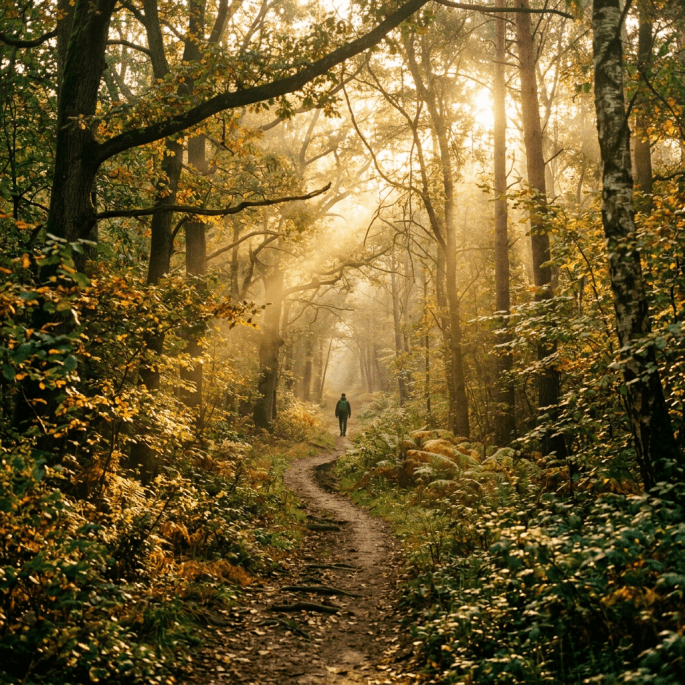
A person walking alone on a winding forest path with autumn leaves and sunlight filtering through the trees

A Prayer to Become Art

Reflections on quiet lives, steady love, and the meaning we leave behind

Perhaps it is aging, or the fact that I read too many books. Perhaps it is because I am a sentimental fool. But lately, I’ve had a persistent thought—maybe more of a prayer. 

Let my life have meaning. Let it become art for someone.

Not headline art. Not museum-worthy art. 

Just something that helps another person survive a difficult season.

The Question That Stayed

I think this inner prayer began earlier this year while reading My Friends by Fredrik Backman. In it, I encountered a quote that gave me pause. I read and reread the words. 

 “Art is what we leave of ourselves in other people.

It was one of those quotes I immediately wrote down. From that moment on, a question kept returning to me: “What am I leaving in other people?” 

I began thinking about the people who had shaped my life, as well as those I had witnessed quietly shaping the lives of others. As I mulled it over, my heart ached a little. I found myself wondering what I had truly offered the world.

Quiet Lives

One of the first people who came to mind was my husband, John. He is a relational magnet. People are naturally drawn to his easygoing personality. He thrives publicly—the more people, the better. His students tell me all the time, sometimes sheepishly since I am also an educator, that John is their favorite teacher. I have always admired that quality in him.

Meanwhile, I am quieter, sometimes even awkward when it comes to small talk. I am comfortable and competent within the classroom, but less so outside of those four walls. 

The subjects John and I teach are different too. My class is harder to love because fewer kids read, and even fewer enjoy it. In the world of education, John’s class is birthday cake, while mine is more like broccoli. On my best days, maybe it’s a clementine—sweet and tangy, but still has to be peeled.

I love that for John, but I also wonder: is it the subject, or is it me? I do not always feel that I impact my students—or coworkers, friends, and family—in the same visible way he does. Still, I am trying to grow into a better, more open version of myself, though it does not come easily. 

Even so, I continue to prefer a quieter life. But can quiet lives still create “art”?  

Does quietly going about my work within the classroom make a difference? Can my passion for my students and subject still be felt through my actions?  

I try to create a structured, reliable classroom—one that challenges students while also giving them opportunities to succeed. I don’t want my students to fail, and I try to teach in ways that help them believe they can learn.  

But does the unspoken care matter? Does consistency leave residue in people? Must impact always be loud? 

The Art We Leave Behind

If “art” is what we leave of ourselves in other people, then I pray I leave behind a sense of love and worth. I hope others feel emotionally safe around me. I hope they sense that I believe in their ability to learn, adapt, and overcome life’s challenges. 

Hope springs eternal in me when it comes to my students, my family, my friends, and humanity itself. I pray that hope is felt.

I am more turtle than hare—more slow and steady than flash and flare. Still, I want to model a different way of moving through the world. I hope to show that aging does not have to diminish us, that nourishing our bodies does not have to be restrictive, and that fitness can take many forms. 

I want others to understand that you do not have to be loud to make a difference. To me, it matters more to live quietly and with integrity, trusting that perhaps someone, somewhere, might find strength or courage in an example of an ordinary life lived faithfully.

Most of all, I want to be the best mom I can to my now-adult daughter. I want to offer her emotional support and steadiness when she needs it, while also giving her the freedom to become fully herself—whether she chooses to live loudly or quietly. 

I want to continue nurturing the love between my husband and me, to love my family well, and to deepen the friendships I already have.

Let me leave warmth and gentleness behind.

Let me leave laughter and joy behind.

Let someone feel less alone because I lived.

Let someone believe their goals are possible.

Let my life be useful art in some small way.

Not grand.

Not immortal.

Just meaningful. 

What Holds

Marathon training changed what I thought was possible. It also taught me that some of life’s most important things aren’t meant to change.

“At the still point of the turning world. 

Neither flesh, nor fleshless; 

Neither from, nor towards; 

at the still point, there the dance is.” 

— T. S. Eliot

🌅 Morning Routine

It was still dark, cool but thankfully no longer the stinging cold of January. Reflective, fluorescent green straps and a chest lamp lit the road as I headed back to the car to meet my husband, John, finishing his workout at the gym. The first birds had begun, their harmonies promising the sun. I inhaled deeply and ran through the morning’s checklist.

Start the dishwasher once both showers were done. Finish herbal tea and refill my bottle with a hydration mix for work. Lunch was already packed—thankfully, my usual. Still left: pack my work bag, shower, and call my daughter. We typically chat most mornings while getting ready, fitting in conversation before the day takes over. Nothing unusual—just routine. 

By Thursday, fatigue would set in—work, early mornings, and daily workouts quietly draining both energy and focus. Routine wasn’t a matter of preference; it was, and still is, protection. Even then, something would likely slip through the cracks as the week wore on.

🧱 Building the Structure

I decided to run the Athens Marathon back in December, about a month after finishing the Marshall University Marathon. It felt like a way to give structure to the winter—to keep moving forward when it would have been easier not to. Paying the entry fee only strengthened that commitment.

It felt like stacking LEGO bricks into something precise. Each piece had to fit within the existing structure of life. Not everything is meant to change. Some things are meant to hold. 

Morning workouts were already the norm; they just needed to be retooled. Weekend runs grew longer. Laundry, errands, cleaning, and meal prep arranged themselves around them. The structure of the workweek held, so the miles moved earlier, stretching the edges of the day. At first, the fatigue of long runs was heavy. But the body adapted. Responsibilities did not. 

🕰️ What Changed—and What Didn’t

Brick-by-brick, I learned more about distance—and about myself. And still, there were only 24 hours in a day. Running became an integrated part of it, not the center. It provided energy for everything else. Life continued, steady as ever, carried by the constant presence and love of family and friends.

Beyond my own small routines, the world kept shifting—nationally and globally, in ways both loud and subtle. Change was constant, as it always is. And still, daily life asked the same things: to show up, to care for one another, and to keep going.

🫶 What Holds

In one sense, the training changed what I believed was possible. I stretched. I learned. I crossed the finish line. The goal was reached—but that was never the point.

Crossing that line was not about changing everything. It could not have occurred without what stayed constant—the steady and loving presence of family, the rhythm of daily life, the hope that carried me, the things that held when everything else was stretched.

The Professor Who Changed How I Think About Aging

The early June sun warmed my skin. I sat quietly along the shores of the Outer Banks of North Carolina. The page corners of a biology textbook and spiral-bound notebook—filled with sand and smeared ink—riffled in the chilly ocean breeze. 

I had just earned a master’s degree in 14 months while working full-time as a special education teacher. And I had a dream. I felt pulled to teach Kindergarten students—specifically those in need of early academic intervention. With my background in special education, I felt I was the ideal candidate for this role.

💭A Dream Interrupted

Unfortunately, I was told “no” in clear terms. I was not officially certified to teach kindergarten, despite holding a K-12 special education certificate. The position required a K-8 elementary education certification.

The requirement felt unfair and exhausting. I thought I had done everything “right” to teach this specific “special” class, but it still wasn’t enough. Rather than let this deter me, it became the basis for a new determination: earn that blasted K-8 Elementary certification if that was the last thing I did. Little did I know where, and to whom, this would lead me.

One month after earning my master’s degree, I enrolled at Marshall University. An advisor created a plan that required me to take two condensed summer courses—each just four-weeks long. The first class began the same week as a long-planned vacation my husband, John, and I had already paid for with another couple. If I did not take that summer course, I would have to wait another year before it was offered again.

📞 A Phone Call to Dr. Tarter

This was before email. Therefore, I needed to call to speak with the professor of the class, which ironically was a basic-level biology course with a lab. I called the office—determined, but a little scared. As a teacher, I knew this was a big ask. 

 “Would it be possible to miss the first week of a four-week summer session if I completed all the readings and assignments while I was away and made up the lab work upon my return?” 

This professor didn’t know me.  He didn’t know my work ethic. Missing a full four days of classes out of 16 total sessions was a significant deficit. I wasn’t even sure if I could do it, but I had to try. However, if he said “no,” it meant I would not earn the certification in time for the following school year.

His name was Dr. Tarter.  I don’t remember much about the conversation itself, but I do remember the knot in my stomach as I explained my situation and asked the question. I have a vague recollection of a protracted pause that was followed by a handful of pointed questions as my heart pounded. When he reluctantly consented, it was with a series of stipulations and a parting implication that I still may not pass the class. I assured him I would work hard to make up for the deficit my absence created.

🌊 Studying at the Shoreline

While my friends and husband read Cornwell, Grisham, Koontz, and King, I read about the characteristics of life, scientific method, cell structure, and cellular metabolism. They took long walks along the shore; I sat at the shore’s edge, feet in water, jotting notes in a college ruled notebook. When they stayed up late playing cards, I went to bed early, so I could get up to make flashcards and study in the early morning quiet. I was resolute in my commitment both to the requirements to teach the Kindergarten intervention class and to my hard work. I did not want Dr. Tarter to regret allowing me to miss the week.  

Upon returning to MU, my dedication continued. Much to my surprise, I thrived in Biology and the required lab. It turned out that Dr. Tarter was an excellent instructor, breaking down difficult concepts into clear, understandable ideas. Working in the lab with the guidance of a GA after class was invigorating. What was, at first, an intimidating environment, quickly became a playground for learning.

👩‍🏫 An Unexpected Offer

As the short summer session wound down, Dr. Tarter asked to speak to me after class. He explained he was surprised by my performance, especially considering I missed the first full week of classes. Then, he made an unexpected offer.  He asked if I would consider switching paths. I could work as a graduate assistant in his research lab, receive a small stipend and tuition support, and pursue a Master of Science in Biology. At the age of 29, Dr. Tarter was offering me a different future–one I had never thought possible as a young girl–becoming a scientist. 

I was shocked and torn from within. I. Could. Be. A. Scientist. 

And yet . . .

🤨 Too Old at Twenty-Nine?

There were bills to pay. I now had multiple student loans, and my husband still needed to complete his master’s. How could I ask him to wait another two years before he could start his advanced education? How would we get by on one salary? Worst of all, as I now reflect, I thought I was too old. Too old at age 29—can you imagine? 

 I said all this and more as I declined Dr. Tarter’s offer. I recall how he looked at me with eyes full of compassion and the wisdom that comes from decades of living. 

“Well, I suppose the possibilities of youth can still be held in our senior years.”

🤔 The Lesson That Remained

At times, I’ve often wondered what might have happened if I had accepted that offer— how different my life might have been?  But I don’t carry regret. Instead, I’m grateful that he saw something in me that I couldn’t see yet in myself—something I never believed I was truly capable of achieving. Youth was not what I thought it once was.

As I move through this new decade of life, I find myself near the age Dr. Tarter was when he made that offer. Just like he modeled then, I am committed to continuing to learn—to showing up to life with discipline and diligence. In fact, I am still evolving, despite the fact I never earned another degree. 

I think back to that biology and the spiral bound notebook—its water-stained pages fluttering in the salty air. Likewise, I hold onto that feeling of possibility that Dr. Tarter saw in me. He saw me as more than an educator. He saw another version of me and the possibilities contained within.

The notebook is long gone, and so is Dr. Tarter. But his lesson remains. He was right. Possibility doesn’t belong to youth. It belongs to those willing to keep reaching for it.

Running Free

How Jeff Galloway’s run-walk-run method helped me become a runner—and find joy along the way

“I hear the music. I feel the beat. And for a moment… I am free…”—Florence + the Machine

🌿Finding My Rhythm on Tobacco Road

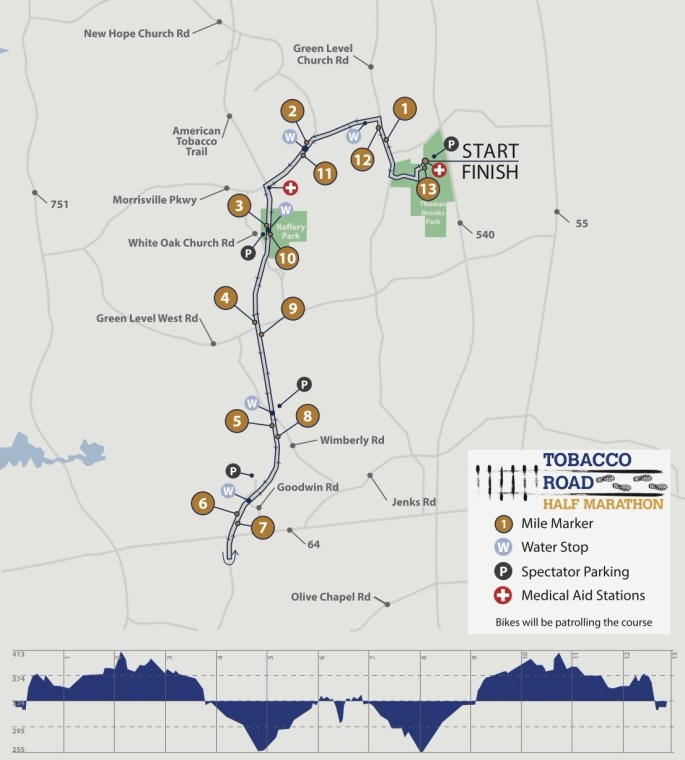
I was running along the rolling, pine-scented path of the American Tobacco Trail (ATT), a rail-to-trail near Cary, NC, as part of the Tobacco Road Marathon/Half-Marathon. The air was brisk, and the sun had just begun its ascent. Shards of brilliant light cut through towering pine trees. The race was promoted as “fast and flat” with its gentle ascents and descents. At the start, thousands of runners packed tightly together, jostling and elbowing forward. By mid-race, I settled into a steady rhythmic cadence, independent of those around me. As “Free” by Florence + the Machine began to play in my ear, I felt “free,” lit from within. In that moment, I realized that feeling was not accidental—it was learned–taught and modeled by one of the best.

Map of the Tobacco Road Half Marathon course, showing the route with mile markers, water stops, spectator parking, and medical aid stations. Includes an elevation profile at the bottom.
Screenshot of the Tobacco Road Marathon.

Who Gets to Call Themselves a Runner?

While I would never describe myself as an athlete, I have tried to be active and exercise throughout my adult years. Aerobics, step-aerobics, biking, walking, hiking, weight lifting, and yoga have all been activities I have returned to over the decades. However, running seemed intimidating. I equated it with those who were “naturally athletic,” fast, long-legged, and thin. I believed running was for those who could run seemingly effortlessly, without walking, for 30–60 minutes or longer. It was a barrier I tried to overcome, but felt like I repeatedly “failed.” Then, I read about something called the run-walk-run method, originated by Jeff Galloway, and all of the intimidation and barriers appeared, from the outside, surmountable. 

💡A Different Way to Begin

Galloway, a former Olympic runner (1972) was the founder of the first specialty running shoe store. Through his books, classes, workshops, training camps, and destination races across the U.S. and around the world, he expounded and demonstrated the benefits of his run-walk-run method, or “jeffing,” as it is sometimes fondly called. His empowering, emphatic message that not only are walk breaks permitted, but encouraged, redefined what it meant to be a runner. If you ran ten seconds, walked five minutes, and then ran 10 more seconds, whether you repeated it once or several times, you were a runner. 

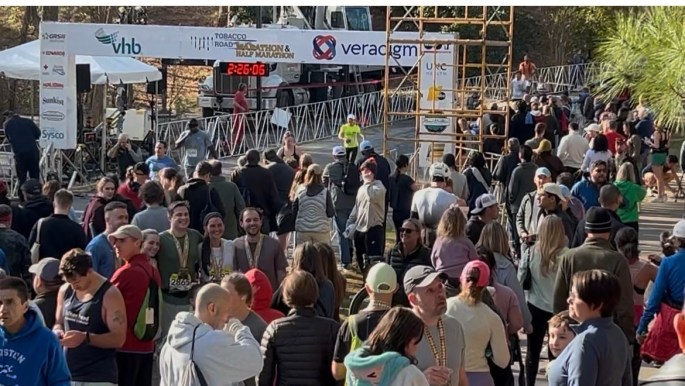
A large crowd of participants and spectators gathered at an outdoor event, with banners and a timer displaying '2:26:06' in the background, near a finish line.
Whether walking, running, or run/walk/running, everyone still has to complete the same distance and cross the same finish line!

🔄Learning to Run—One Interval at a Time

His gentle message—consistency over intensity—resonated with me—and I am certain I am not the only one. His positive and encouraging tone convinced me to start with a run-walk-run interval plan that I could maintain for 30 minutes, and repeat three days per week. Each successive week, I ran a bit longer and walked a bit less. From there, I built gradually. Galloway, for me, and I daresay for hundreds of thousands more around the world, didn’t just change how I approached running—he freed me to change how I think about running. 

🚶‍♀️➡️🏃‍♀️From Walking to Running

Like countless others who encountered Galloway’s message, I gradually shifted from mostly walking, to equal parts walking and running, to the present day—mostly running. (And I still give myself permission to take walk breaks as needed.) 

Letting Go of What I Thought Running “Should” Be

This incremental shift, spread out over months, increased my self-assurance (thinking of myself more often as a runner) and made running feel sustainable. Galloway’s method allowed me to discover enjoyment, replacing what had once felt like pressure about how I believed running “should” be. I suspect I am not the only one who found the door to running opened, not by pushing harder, but by being allowed to ease in. 

🎧✨The Moment It All Came Together

As I continued to pace along the Tobacco Road Half-Marathon route, listening to the music, I could feel my feet matching the cadence of the beat. My heartbeat was steady and my breathing deepened, but I was calm. It was as if in that moment, body, mind, and spirit aligned, and I felt free. I had a sense that “I can do hard things.” This is what Galloway’s message ultimately conveys—however we define “hard.”

🕊️A Legacy That Lives On

Galloway and his wife, Barb, practiced what he preached for over 50 years until his untimely passing in February of this year at the age of 80. His legacy, however, will live on through everyday runners. Those runners who, like me, now have access to a sport once considered undoable. He provided a path to longevity in the sport, and the chance to taste the freedom that comes from enjoying the experience rather than attaching to a certain performance.  

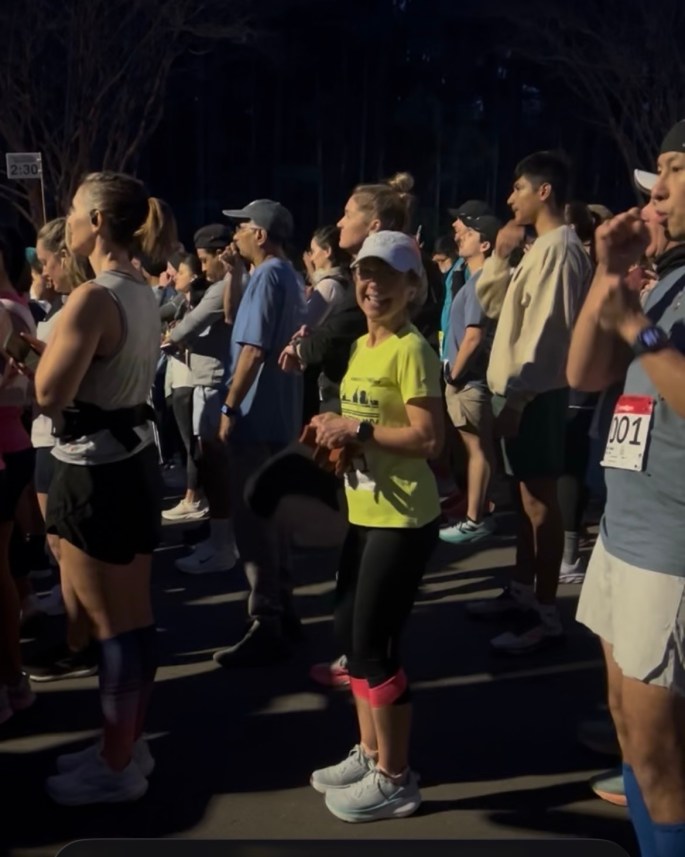
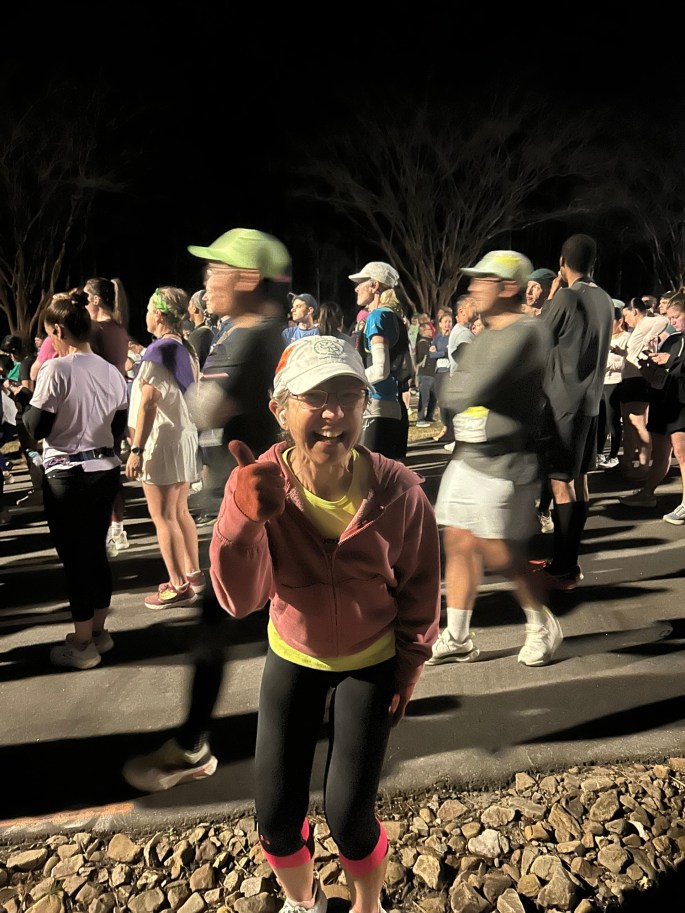
A smiling woman with glasses and a cap gives a thumbs-up gesture in a crowd of runners at night, with other participants blurred in motion around her.
If you are moving forward, you belong!

🌱The Quiet Confidence of Belonging

As I witnessed countless participants take walk breaks in the Tobacco Road Marathon/Half-Marathon, I sensed that Galloway’s legacy isn’t just in the finish lines. Rather, it’s in the unassuming confidence of runners who finally believe they belong. It is a quiet kind of wonder.

👟An Invitation to Begin

To anyone reading this who thinks they are “not a runner,” are beginners, or feel intimidated by pace, age, or comparison, I invite you to try it. Start with a walk that includes short bouts of slow, controlled running. 10–30 seconds is enough. Take a walk break. Take as many as you need. Start where you are. You don’t have to run without stopping to be a runner—you just have to begin. And if you listen, really listen—you just might find, somewhere along the way—maybe even on the ATT—that you’re free too. 

🌅Running Free

May we carry Galloway’s rhythm forward—one run, one walk break, one brave, freeing step at a time.

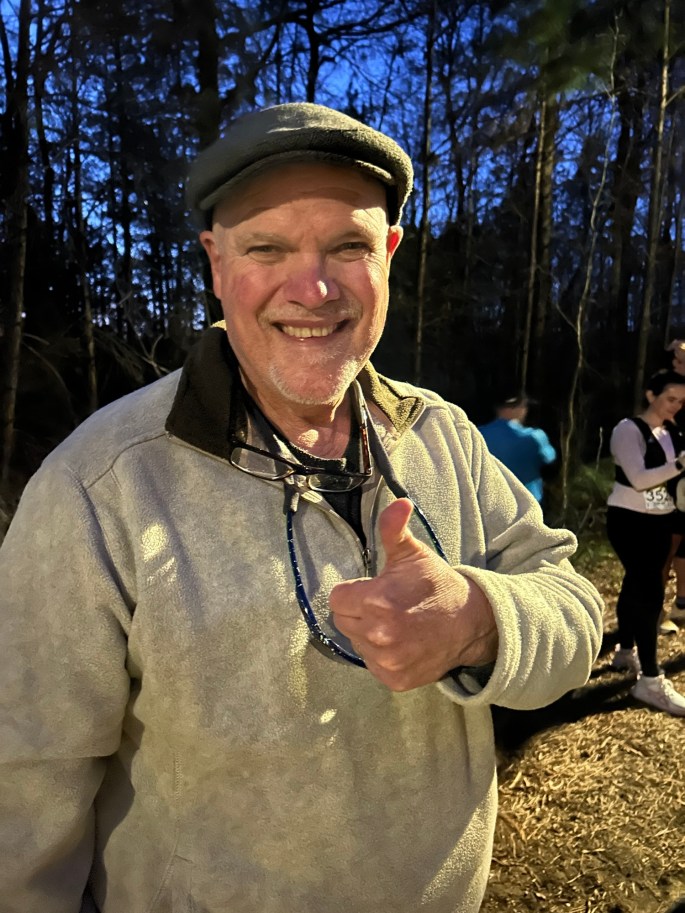
A smiling older man wearing a cap and light-colored jacket gives a thumbs-up gesture outdoors, surrounded by trees during dusk.
Thank you, John, for your never ending love and support of my running adventures!

I Don’t Know Where I’m Going, But I’m Following My Map: How discipline, values, and small steps help us move forward without certainty

When a Casual Comment Becomes a Lifeline

I was briefly chatting with my brother, Scott, a few months ago while he was driving through an unfamiliar town for a job interview. He was using a maps app to help him navigate, and I could hear the navigation system giving him verbal directions. Scott laughed and said, “I don’t know where I am going, but I’m following my map.” 

I teasingly told him that I was stealing that line–it sounded like an earworm lyric from a pop song, the kind that gets stuck in your head after hearing it once. Turns out, the line did stick with me, though not as a song. Instead, it became a phrase of comfort when answers to life’s questions felt far away. As I repeated it to myself, I realized that–contrary to what popular self-help and purpose-driven culture often suggests–we are frequently moving forward without clarity. And that’s okay.

The Maps We Follow in different seasons of life

The maps we use in life vary depending on the season we’re in, and they’re often shaped by our current goals. There are personal, professional, or inner-life maps to guide us: growth plans, workout schedules, work routines, creative practices, calendars, and goals of all kinds.

Listening to the Inner Compass

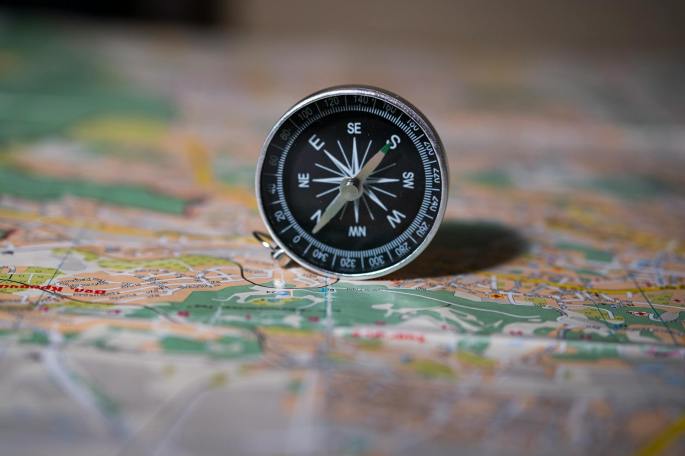
Alongside these maps, we possess an inner compass. This compass is rooted in our values. It helps us recognize which actions and choices align with who we are, and it often points us to what brings us meaning or joy. When we allow our inner compass to work in tandem with our life maps, even when neither promises certainty, they can still guide us forward. 

Why Consistency Matters More Than Certainty

As a runner training for a spring marathon, I rely on a training plan, a literal map. It requires me to show up even on those single-digit mornings when motivation is low. I trust this plan, knowing that it’s probably not perfect. Still, it moves me forward mile by mile. I do not need to know how strong I’ll feel weeks from now; I only need to follow today’s plan, step by step.

The same is true for maps focused on career progression, creative pursuits, and even healing journeys. Momentum is built through consistency, not certainty.

Progress Isn’t Linear

That momentum rarely moves in a straight line. It builds, rises, dips, and rebuilds again. It reminds me of using a navigation system that reroutes unexpectedly–or worse, sends me off at the wrong exit. Getting back on course can feel like a setback, even when it isn’t.

This mirrors life. Not every day is joyful. Some days are ordinary. Others are heavy and disappointing. Forward movement does not guarantee constant and abundant happiness. Sometimes, in order to recognize how far we’ve come, we have to pause long enough to feel gratitude for the distance already traveled. We also need to notice subtle signs of progress–the quiet evidence that we are, in fact, moving forward. 

At other times, we are nudged towards redirections. These reroutes aren’t a sign of failure; they’re simply adjustments–responses to the curveballs life inevitably throws our way.

Staying Aligned With True North

The key is remaining aligned with our True North. This means saying no to paths that look “successful” but feel hollow or ring untrue. When our thoughts, actions, and choices align with our core values, we maintain integrity–personally, professionally, and creatively. Our internal navigation stays intact, helping us to find our way, even when life reroutes us again and again.

The Quiet Freedom of Discipline

Staying true to our True North does require discipline, a word that is often misunderstood. When we live by deeply held values, we reduce decision fatigue. Our choices become acts of self-care, rather than sources of stress. Over time, this value-based, disciplined approach to life creates containers for joy–often found in small, quiet milestones along life’s way. 

When Scott said, “I don’t know where I am going, but I’m following my map,” he was acknowledging–intentional or not–that most of us don’t know exactly where our lives are headed. Yet as long as we remain tuned-in, to our True North–that still small voice within, we are allowed to trust that forward movement is occurring–even if it unfolds along a less straightforward timeline than we might prefer.

In a world filled with loud and distracting voices, I invite you to listen to the compass you trust and follow the map it provides. Have faith. Keep going, even when it feels as though you are going nowhere. Keep going. Your faith knows the way forward.

Navigating Life’s Uncertainties One Moment at a Time

Take one moment at a time and do the next right thing.”–Eleanor Amerman Sutphen

Photo by Pixabay on Pexels.com

What Did I hear? 👂

My ears perked up when I heard the guest on a podcast share the above phrase based upon  a poem by Sutphen, but made popular by both Elisabeth Elliot and Carl Jung. I had just arrived home with several bags filled with groceries to put away. Setting down the bags, I typed the phrase into my phone’s reminder app in order to remember it. Then, ironically enough, I returned to the next moment: putting away the groceries.

Like a persistent earworm, that phrase kept looping through my brain. Maybe it was Divine Providence, or maybe my subconscious niggled me to recognize the words I needed to hear. Regardless, the universe had offered me a nugget of wisdom to the question I had been asking, but had not yet been able to fully articulate: What can I do in the face of the difficult and uncertain life moment in which I found myself?  

Photo by Sergey Guk on Pexels.com

Snowy Days can lead to Sluggish Ways 😏

The month of January was a slippery, and less than stellar, start to the new year.  All around me, icy roads, alleys, and sidewalks served as a reminder that I was struggling to find my footing. As one who is not naturally organized and often has no sense of time, I function optimally with a routine/schedule.  It’s not that I can’t “go with the flow.”  I can do that quite brilliantly, but I don’t accomplish nearly as much, nor do I make as many–if any–inroads towards goals.

It is as if I have been dropped deep into a dark and menacing forest filled with a multitude of statuesque tree shadows and brambling thorny briers. Meanwhile, a multitude of strands in life’s web are criss-crossing in ways that make it feel less integrous, as if at any moment, the winds will shift and blow a hole in the tenuous gossamer nexus of life. I sense time sliding sideways, and I am trying to find my footing, so I don’t fall into the thin ice at the center of the mostly frozen pond. Arms flapping this way and that way, steps shortening, stumbling, and struggling to remain upright because I need to find my stride once more. 

Photo by Christina & Peter on Pexels.com

The Struggle Can be Real 😞

I am not the first, nor am I alone, I suspect, in feeling “something” akin to a crisis–a time in life when I find myself deeply questioning my purpose, my identity, and my role in all that is occurring. It is a time where I feel helpless to help others who need it but won’t accept it; a time with still unachieved goals and dreams, but I struggle to see, much less find, the path forward; and, a time in which I frequently ask myself: Am I doing the best I can with this one precious life I have been given?

Personally speaking, it feels as if the to-do list grows longer by the day, but few items are getting marked off.  While all around me, events, completely out of my control, dictate more chaos. Pixelated ideas frequent my mind, but my brain resists zooming in and focusing on any one thought as if the identity of each idea has been hidden like a person being interviewed for an investigative, undercover documentary. Overthinking, second-guessing, and a feeling of dormancy have entered my mental home and overstayed their welcome. 

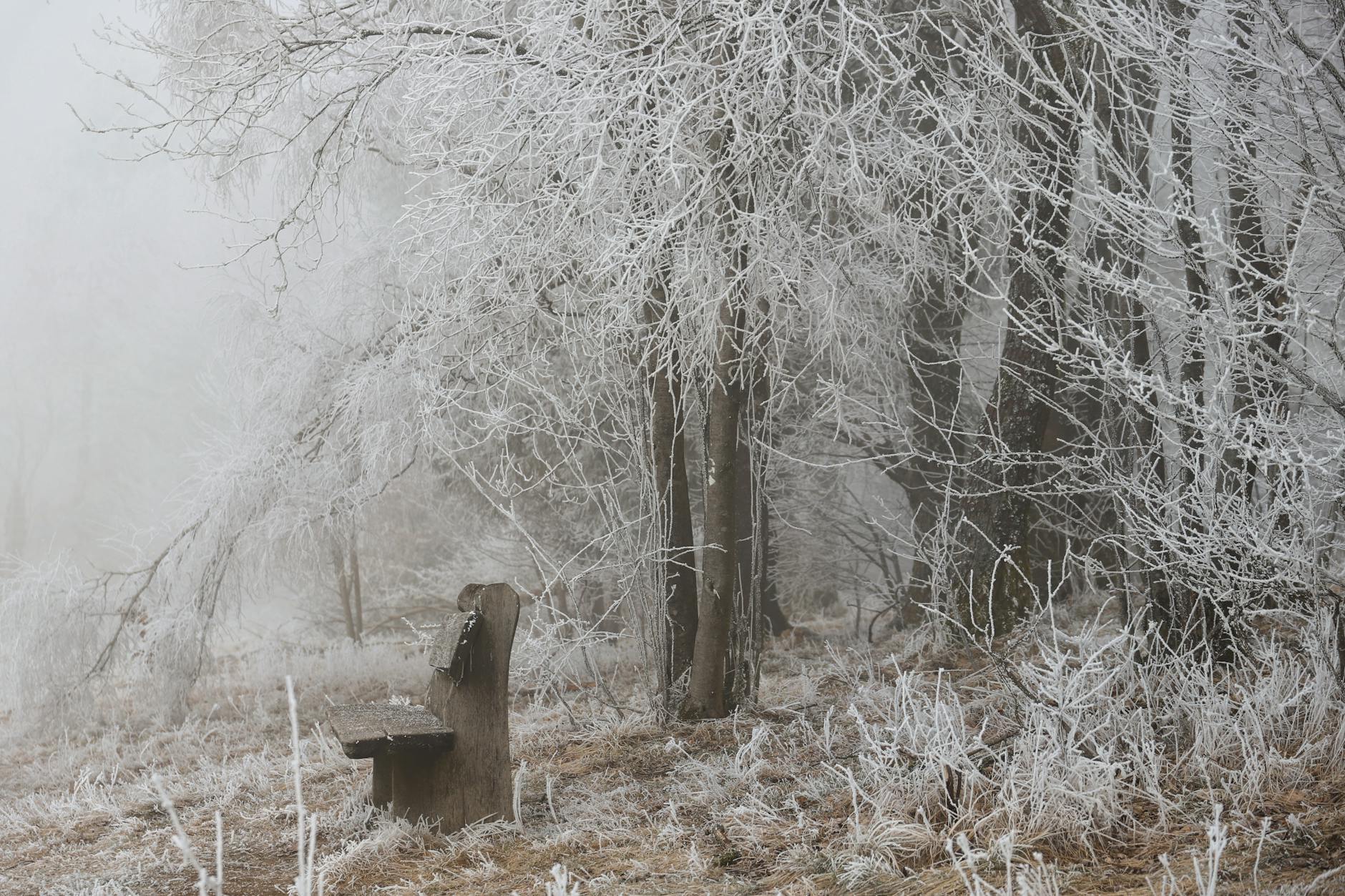
Photo by Todd Trapani on Pexels.com

The Sweet Lesson of Winter Trees ❄️

As I write these words, I pause to gaze out at the trees in my backyard. They too are experiencing dormancy. Deciduous trees have slowed their internal processes and metabolism, halting their own growth in order to conserve energy. Inside the trees, cells have hardened and shrunk. Additionally, the water between the cells has frozen, and the water inside cells is becoming more dense and syrupy. Some trees even grow thicker bark in the winter to create a sheath of preservation until warmer temperatures arrive when growth and leaf production can once more occur.

I take a deep breath and feel the rise of my belly. Dawn’s light has gifted another overcast winter morning. The birds have also risen–chirp, chirp, chirping the gossip of a new day. The rise and fall of their flight, along with their up and down hip-hops along tree branches make me smile. I sigh out the exhale I had been holding, noticing the fall of my belly. With each breath I take, as I continue to ponder the nature beyond my window, I can’t help but notice the rising and falling of my stomach.

Photo by Aleksandr Sochnev on Pexels.com

The Rising and the Falling 🌅🌄

The sunrise, the trees, the birds, and even my breath remind me that everything is subject to rising and falling. Our pain and sadness, our joys and happiness, and even current events are all impermanent, rising and falling with the various seasons of life. This season of personal dormancy that has banked to new heights in my mind will eventually thaw like the melting of the once-deep snow. This is the nature of impermanence–the rising and the falling–nothing can last forever. 

Thus, these dark doldrums of winter housed in my mental guest room might be offering me an opportunity to do less, perhaps allowing my creative juices and energy to fully concentrate and thicken, much like the trees in my backyard, into the sweet syrup of forward progress. It will just take the sweet essence of time. And the only way to get there from the dark passages of here is to take one breath, one moment at a time and keep choosing to do the next right thing.