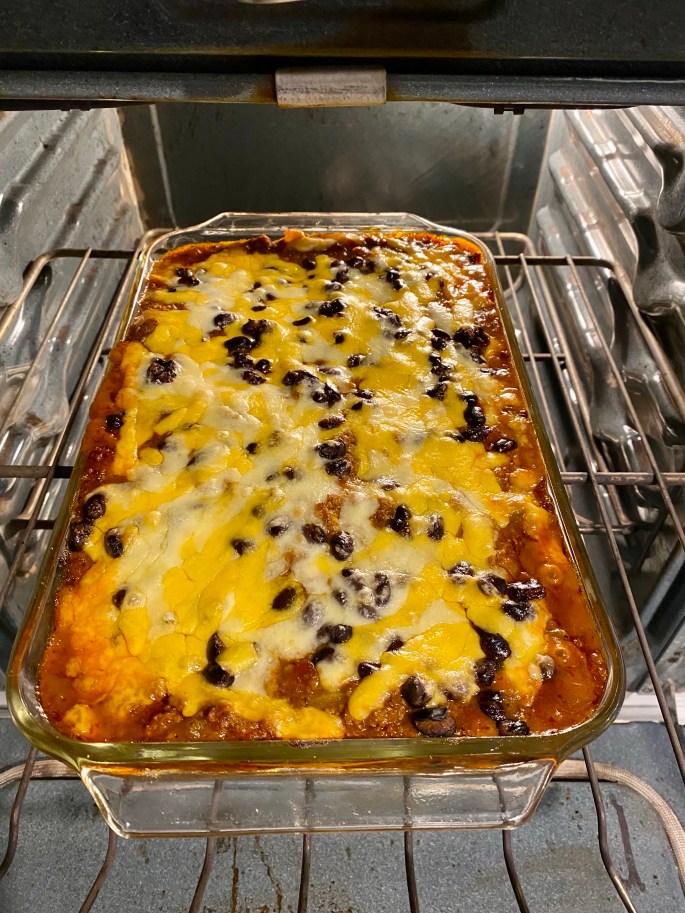
Mexican Enchilada Casserole–with Gluten-free and Plant powered options

“Life without Mexican food is no life at all.”–Unknown

Photo by RODNAE Productions on Pexels.com

Cooking in my home is a bit of a balancing act, especially since I am the only person who has to eat gluten-free due to celiac disease.  Additionally, I have a personal preference for eating a whole food plant-based diet.  It’s taken me years to figure out what works best for my body; so, I have no judgment for those who eat differently–including my own family.  Thankfully, I am blessed with a family that will eat leftovers.  This allows me to cook up oversized, flexible meals for them designed to last them a couple of days, leaving me time to also cook my own meals separately.

I must confess, however, that there are times I feel as if I fall into a cooking rut–repeating many of the same favorite meals for my family.  While they (rarely) complain, I do get excited when I stumble upon a new idea that could potentially work in a wide variety of ways to meet the needs of the omnivore and plant-based eater alike.  The recipe I am sharing with you today is one of those versatile dishes I created that was one part inspiration and another part desperation for a new idea.

Photo by Sabel Blanco on Pexels.com

I knew there was a pound of extra-lean ground beef in the fridge, and I had just restocked all of the typical Mexican-style condiments we frequently use.  My original plan was to make taco meat for my family, a frequent go-to, which can be used not only for tacos, but also for creating nachos, salads, stackers, bowls, and the like.  However, I recalled once making something I called Mexican lasagna years ago, but the recipe was long lost. Still, I couldn’t help but wonder if I could recreate a similar dish.

Research ensued, and cupboards were scoured.  Soon enough, a plan came together in my head.  I typed it all out before I began cooking; after all, if it turned out tasty, I wanted to be able to recreate it.  Plus, I figured, as I cooked, I could also easily type in adjustments to the recipe as needed.

As I cooked, the aromatic scents filled the kitchen.  The spicy fragrance was balanced and reminiscent of my younger years when I first began to learn my way around a kitchen.  Once in the oven, I let it cook, uncovered, and started checking on it around the 20 minute mark. Just as I had hoped, the sauce around the edges had started bubbling, and I could see the cheese beginning to transform into a luscious golden baked color complete with a bit of bubbling and browning.  I removed it after 25 minutes, setting it on hot pads to cool before serving.

This recipe was a home run with my husband and daughter.  They both found their own unique ways to top it.  Meanwhile, I created my own gluten free, plant-powered bowl version, and we rounded out the meal with chips and salsa.  

That said, if your family has a huge appetite, you could definitely serve up rice and/or more beans on the side.  You could even replace the black beans with corn in the casserole, and then serve black or refried beans on the side.  However you decide to vary this recipe, its ingredients are swappable and could easily be modified to suit your dietary needs or interest . . . even gluten free and/or plant-centered!  

From my home to yours, I share this recipe with you, and I am eager to hear how YOU decide to recreate it!  

Enchilada Casserole

Ingredients:

1 pound of lean ground beef (Can use plant-bant based crumbles for vegan.)

1 teaspoon minced garlic

1 cup diced onion

1 packet reduced sodium taco seasoning

½ cup water or favorite broth (I use a low-sodium vegetable.)

1 can red enchilada sauce

1 cup salsa

1 small can of chiles

6 large flour tortillas (Can use 9-corn tortillas, instead, for a gluten free option.)

1 15-ounce can black beans, drained

3 cups of thickly shredded cheddar or Mexican blend cheese (Use non-dairy cheese or skip altogether for vegan.)

Directions:

Preheat the oven to 350 degrees.

Prepare a 13 x 9 baking pan by lightly spraying it with cooking spray.

Over medium heat, in a large pan, brown ground beef, breaking it up while cooking.

Once thoroughly cooked, drain fat from meat, add in onion and garlic, cooking until onion is translucent (about another minute or two.)

Sprinkle meat with taco seasoning, stir in water or broth, allow to simmer for another minute or two.

Next, stir in enchilada sauce, salsa, and chiles into the meat mixture.

Simmer for another 3-4 minutes, stirring occasionally to prevent sticking.

Place the prepared baking pan on a couple of hot pads to protect the counter, pour ⅓ of the meat mixture into the pan, sprinkle ⅓ of a can of black beans over meat, followed by ⅓ of cheese, and top with two flour tortillas or 3 corn tortillas.

Layer the tortillas with another ⅓ of meat mixture, another ⅓ of beans, and another ⅓ of cheese.

Top with tortillas.

Repeat the process with remaining meat mixture, beans, and cheese.

Bake uncovered for 25-30 minutes, until the casserole is bubbling and cheese is beginning to brown.

Allow to cool 5 minutes before serving.

Top with desired toppings, such as guacamole, sour cream, chopped scallions, etc . . .

Makes 9 small servings or 6 generous servings.

Refrigerate leftovers for up to 5 days.

Reheats well and makes great leftovers

Photo by Los Muertos Crew on Pexels.com

Step into Faith: Mood follows action

“We often can’t see what God is doing in our lives, but God sees the whole picture and His plan for us clearly.”–Tony Dungy

Photo by Jonas Ferlin on Pexels.com

I sat staring, alternating between views of my snowy backyard, a March surprise from Mother Nature, and the white screen.  Minutes ticked by, but nothing happened.  Next, I began pursuing my favorite devotional sites.  Still, nothing there–at least nothing that inspired a writing idea.  Finally, I gave in and looked at my list of writing ideas–the list of ideas that have not yet come to fruition, but still hold potential.  All good candidates, but nothing was immediately striking my writer’s voice.

Typically, throughout the week, I will pause, and allow that still small voice to whisper an idea.  It sounds corny, to see it written, but it is true.  I’ve learned that by asking and trusting, an idea will ultimately arrive.  However, there are times when it seems that my alignment is off with the Ultimate Creator, the invisible hand that pens my stories.

Even now, when I reread those words above, I feel heat rising to my cheeks.  I can hear my inner-critic now reminding me that I am NOT an authority on faith, writing, or any combination of the two.  Simply put, I am one person who believes in God, the Divine Source of all creation and inspiration, but it doesn’t make me an expert on anything.  Therefore, who am I to type and share such bold statements?  All I know is I simply write to understand; and today, Divine Providence was slowly unveiling a lesson for me to learn–only I was not seeing that when I first sat down to write this piece.  

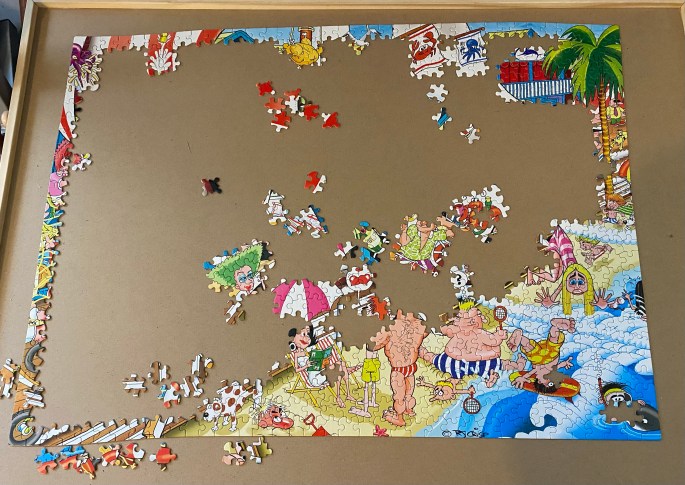
When working a jigsaw puzzle, I begin, like many, by first connecting the edge pieces to not only begin to see the shape of the ultimate goal, but also because it is typically an actionable and achievable first step. Putting together a puzzle can seem overwhelming when first looking at all of the mixed up pieces, especially if there are a large number of them and/or the pieces are tiny.  In fact, initially, it may feel downright impossible to put all of those pieces of the puzzle together to form any sort of image, much less match the image on the puzzle box. Nonetheless, by beginning, by starting with what you can do–the outside frame–piece by piece, your sense of possibility increases.

Likewise, life comes in stages.  Initially, it is a fairly linear process–one stage of development follows another.  However, eventually, often at multiple points throughout adulthood, you encounter an in-between stage–points in life that are not linearly progressive, but rather feel like holding spots.  Often, these holding patterns shift and evolve into new phases, but during the hold, life can feel uncertain and/or even stagnant. There are any variety of in-between stages, depending upon where you are in life and your unique life experiences.  

Conceivable stages could include an in-between stage of marriage and divorce or the aftermath that follows.  Another frequent holding pattern can sometimes occur in careers–the point at which you feel you are no longer upwardly moving or challenged.  Of course, there is the classic empty-nest syndrome–when you try to establish new routines/responsibilities and even renavigate your relationship(s) with your partner and adult-children.  Then, there can tragically be the in-between stage of long-term illness–either of self or care for another.  There are numerous other examples, but the point is this:  There are times in life where you can’t see the full picture–much less, predict the future.  The “next-step” is, quite frankly, not known by anyone other than God–and even that signal can seem crossed, busy, or even disconnected. 

Photo by Andres Ayrton on Pexels.com

These are often the moments that draw us closer to God through prayers for strength and/or answers; other situations can leave us feeling further removed from our faith due to doubt, fear, and uncertainty.  While I am no expert on faith or psychology, I can’t help but believe both responses are very human and very understandable.  What is the answer during these moments? This was my lesson to learn today as I wrote: take a step.  Find your so-called edge-pieces and start working bit-by-bit.

During the week prior to writing this piece, I was speaking with 8th grade students about a project for which they were working for my Reading Language Arts class.  Without going into too much detail, part of this project required that they choose four-plus pieces to write from four different categories of writing for which they were given a list.  They were looking overwhelmed by the project one day; therefore, in order to move them forward, I encouraged them to commit to only one piece of writing for the day.  

“Even if you don’t feel like it, pick what you perceive as an ‘easy’ piece and start.”

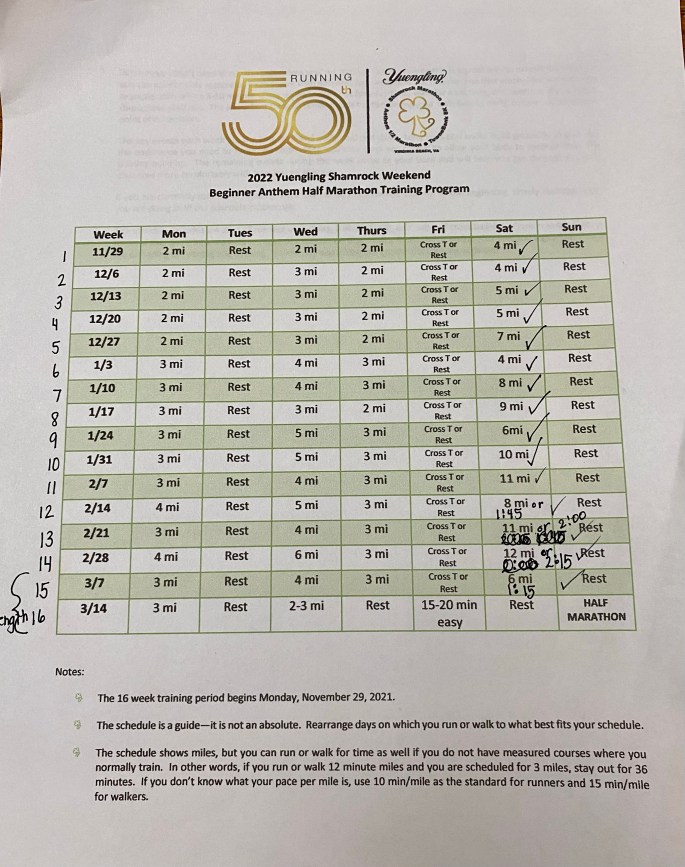
I knew, from my own recent 16-week training for a half-marathon, there were many days I, too, felt overwhelmed.  I was either paralyzed by the number of weeks still left on the calendar for training/conditioning, or I was not-feeling up to the run for the day, especially as that mileage increased.  However, the one thing I learned to be true from this round of training, is that mood follows action.  I may not “feel” like running, but if I simply begin without thinking–if I take one small actionable step–the simple act of starting, begins the momentum for continued action. Continued action leads to another training session checked off the plan, and one step closer to the goal. 

This is what I wanted those 8th graders to experience–the power of completing one small step.  Complete one piece of writing one day; then, come back to class the next time, and complete another piece.  One small success begets another small success, boosting confidence and the faith to tackle the next, more challenging step.  Like the large jigsaw puzzle, they didn’t have to see the whole picture in the beginning; their plans could be subject to change, but they had to take that first actionable step.  Then, step-by-step, the vision of their project could come into focus.

The writing of this piece, likewise, began with uncertainty–only the knowledge that I was supposed to write. I did not have a clear picture of how I would do it, or what nugget of understanding would be revealed in the end. I simply had to start typing; taking one small actionable step.  Piece by piece, the edges of the lesson formed first.  By faith, the rest began to gradually come together, until the entirety picture revealed itself to me. 

Dear Reader, like many of you, I, too, am (and have) experienced several versions of those “in-between” time periods of adulthood.  Without a clear picture of what the future holds, I am often unsure in which direction to step.  Therefore, let us continue to step into each day, one moment at a time, trusting that if we whisper and wait, while filling in the edge pieces, the Ultimate Creator will likewise continue to pen our story.

Photo by Pixabay on Pexels.com

Shadowy Thoughts

“It is only through the shadows that one comes to know the light,”–St. Catherine of Siena

Sunshine filtered through diaphanous clouds strung across a canvas of azure.  Inhaling gratefully, the pit-pat-pit-pat of my footfall maintained its slowly-as-I-go pace, as I headed along Third Avenue towards the campus of Marshall University.  Temperatures were hovering in the low 40s when I left the confines of Ritter Park and were predicted to rapidly rise into the 70s once the wind shifted and sky cleared.  It was a glorious morning for a run (or, in my case, a slow trot); time for my mind to likewise roam free.

It was about 40 minutes into my run that first revealed the beginnings of a lesson.  Rays began shining so brilliantly as the light of the sun began breaking free from the cloud cover. I was reminded of summer morning sunlight, especially at the beach when . . .

. . . the air is still cool, but the warmth of the sun, reflecting off the oceans waters, whispers of fiery heat to come.  Ocean breezes playfully tousle the hair of beachcombers walking the shore lines; their shadows cast long, accompanying their journey along the sand.  Birds call from above, and they too cast shadows of flight as they dip and dive at their prey . . . .

Photo by Travis Rupert on Pexels.com

Passing through part of the campus of MU, silhouettes of tall multiple structures stretched long and lean as I ran up, over, and around their contours thinking of all the potential possibilities that would typically pass over this walk if it were a weekday.  I was reminded of my former self on another campus, in another time.  It seemed like a lifetime ago.  Pit-pat-pit-pat, my continued cadence reminded me time waits for no one; like the dark building profiles, those university years were shadows of my former self.

Mind wandering once more, it circled back to the sunlight and the way it played hide and seek with each shadow I encountered.  How miraculous the sunlight had seemed this past week–one of those rare, early March weeks, when you know, despite the early morning chill, spring is around every corner, nook, and cranny.  It is that time when the earth remains cold, but soft–wafting with scents of melted snow, recent cold rain, and potential growth sprouting signs through the surface. Meanwhile, spring birdsong abounded each morning throughout the week, as the mating season began with the hope that winter’s shadow is finally shaken.

Photo by cottonbro on Pexels.com

Taking notice once more of my surroundings, I took in the expanse of St. Mary’s Hospital;  it’s shadow stretched towards the multitude of campus offshoots behind it.  How many visits have I made there for and/or with loved ones in the shadows of duress?  I began to name them in my head, one-by-one; and yet, my own daughter was born there–one of the most miraculous, brilliant days of life.  What a contradictory place, a hospital, filled with celebration, healing, and hope, but its shadows are filled with fear, illness, and stress.

Crossing over 29th Street, I moved back towards town along 5th avenue where the shadows flipped positions with my shift in direction. I caught a glimpse of my own shadow, appearing long and tall, cantering slowly alongside.  Do I really move like that because I know I am not that tall?  My head began to play games.  For the first time, my mind took notice of the leg fatigue and achiness, the swelling of my feet.  I have less than an hour, I remind the negative side of my brain, my own shadow-self.  Look how far you’ve come.  Think how proud you will feel knowing you did not quit. But I could quit.  I could walk the rest of the way.  I could even call my husband or daughter to come pick me up.  Why would you do that?  You can do this, mind over matter.  No sense believing your shadow, it’s only there because of the light. 

Wait, what? The shadow is there because of the light?

 I am not sure how it made sense, but there was something there, in that thought, in that moment.  Trying to grasp its meaning, its deeper lesson, my mind instead slipped back into the present moment as my feet made their way onto another side of MU campus.  People in colorful costumes were walking towards the campus’ Student Center.  Their colorfully adorned hair, swords, and/or light saber-sort of things, capes, and shields cast intricately shaped shadows that seemingly entered the building well before the actual person.  They must be headed to a comic-con celebration of the shadowy heroes of graphic design.

From 5th Avenue, I eventually made my way to 6th Ave, slowly edging closer to 8th Street for my final lap around Ritter Park as the sun continued to rise and the winds shifted in short, gusted outbursts.  Preparing to pass a presumably homeless gentleman who was walking with a grocery bag in one hand,  I voiced my approach that I would pass him on his left–not wanting to needlessly startle him. He turned to look at me.  His face was red with exposure, covered in a film of grime, his beard was in need of a shave, and his eyes were swollen, but within the center of each sparkled the hint of another life.

“Good morning, Sir.” 

He smiled a mostly toothless, friendly grin.  When he did not speak, I wished him a good day.  He raised a puffy pink hand, and shouted a cheer in my direction.  Within a split moment, his face seemed to fill with light, and for a fleeting instant, I saw the person/the child he once was.  Briefly choked with emotion, I wished desperately that I could somehow impart within him the same vision of potential that I saw within him, in the hopes he could; instead, step into the light and walk away from the shadow of addiction and/or mental illness.  Sadly, I could not, his fight was greater than I could imagine; so instead, I waved back to him, whispered a prayer of hope for his life, and continued on my way.

Returning to the welcoming, much softer path of the park, I completed my run through the dappled light of the Ritter Park loop.  Sections of the crushed limestone path were swathed in shade, and other parts were bathed in full-on sun. Newly established decorative, and highly symbolic, sunflowers dotted parts of the path, allegorical reminders of the shadows of hate and greed left unchecked on a global scale. Can the light of love and peace overcome this?  I can only pray and hope it does.

The sunlight had been a welcome sight, but it was bearing down nearly 30 degrees warmer than when I had first begun.  I was over-dressed and overheated. Nonetheless, I realized, as I walked uphill towards where I had parked, my sunlit run had brought both brightness and heat, cheer and defeat, mind over matter, and lessons of shadow-side of light. 

Photo by Elias Tigiser on Pexels.com

Life can indeed be filled with shadows–the darkness of depression, despair, hopelessness, sickness, and for some, even moments filled with greed, jealousy, hate, and numerous other forms of darkness I cannot begin to understand.  Of course, we cannot control the shadows of the world, but we can remind ourselves that where there is shadow, there can also be light.  Without the light, there is no shadow. It is a duality for which we must make peace.

In the meantime, it is up to each one of us, in those moments when we find ourselves dwelling in the shadows too long, to step out into the light.  We may not be able to do it alone; however, by relying on faith, and trusting in the Ultimate Creator of Light, we can, step-by-step, find the light once more.  Who knows?  Your light might be the light that leads another out of their own darkness.  

May your light shine brightly.

Photo by Matheus Bertelli on Pexels.com

The Power of Whitespace

Whitespace should not be considered merely “blank” space — it is the element of design that enables the objects on the page to exist.–The Segue Creative Team 

As a middle school Reading/Language Arts teacher for grades 6-8, I spend a good portion of my time teaching various writing techniques.  Currently, in my 7th grade classes, we are focused on writing various styles of poetry with the emphasis on exploring various elements of figurative language techniques and literary devices.  Of particular importance to writing poetry, I believe, is to draw the reader into an image/story/feeling in the way a good song has the power to  draw in the listener and attach a particular feeling/image to it. 

Part of the skill in writing a relatable poem is not only using specific words, figurative devices, and imagery, but also incorporating the power of white space.  In the same way my grandmother taught me that our eyes eat food before we taste it, a poem should likewise draw readers’ eyes into the arrangement of the piece first.  In order to do that, writers must learn to use the white space.

Photo by Du00f3 Castle on Pexels.com

Whitespace 

Creates

Balance and  Style

Although it is often called “negative” space, there is nothing negative about appropriate use of white space.  In fact, when duly used, white space increases readability–up to 25% according to some sources.  White space provides breathing room for the reader, a purposeful pause, or point of emphasis. It can create a sense of balance, harmony, and style.  The eye has time to “catch its breath” and focus on the meaning of each line, word, phrase.  A sense of play, intense emotion, or serious tone can also be emphasized and enhanced through the appropriate use of white space–adding power and emphasis to select words.  By giving students permission to incorporate white space, they are more focused on words that are specific and succinct.  This is an important and transferable skill when switching to more formal writing styles that require a clear, concise, and compelling writing style. 

Whitespace is THE fundamental building block of good design . . .  provides visual breathing room for the eye.–The Segue Creative Team

Photo by Robin Schreiner on Pexels.com

On a recent long Saturday morning run, it occurred to me that the notion of white space, as a mental construct, is underused and undervalued in our daily lives.  It is one of the things I most appreciate about my longer weekend runs is the fact that it gives me permission–and time–to let my mind wander.  Many, if not most, of my weekday runs are completed on a treadmill before I do a few strengthening exercises.  During these workouts, I typically wear headphones to listen to music, podcasts, or audible books–depending upon the workout and my mood/interest.  However, when I run outside, I rarely wear headphones; and thereby, I experience the freedom of mental whitespace.

Much of our daily life is consumed with some form of media content consumption.  From the time we get up and, quite often, until we go to bed, many of us are continually interacting and engaging with screens.  Emails, social media, work, news, even cooking, project-building, and other how-to content require some form of on-screen encounter. From content that is audible, to content that is visual, to an interplay of both, much of human interaction is now completed on-line.  As a result, our mind has become trained to repeatedly and frequently seek points of what I call distracted-focus.  Furthermore, it has never been easier to do this at any time, day or night.

Photo by PhotoMIX Company on Pexels.com

As society’s utilization of technology changes, shifts, and evolves, our minds have been forced to adapt.  Our phones wake us up, and while I can never do this for fear of falling back to sleep, I am told that many people remain in bed for several minutes, and upwards to an hour, upon waking, scrolling through media content that happened during those hours devoted to sleep. While we drive our kids to school, they are busy with screens, and we are engaged in handsfree calling or texting.  Once at work, many of us, myself included, utilize multiple devices at once as our eyes and minds shift back and forth from screen to screen, and, depending upon your career, from person to person.  At day’s end, despite eye fatigue and even brain drain, our minds still desire to scroll through social media and news outlets as the brain, like a tired toddler, still craves even more stimulation to keep going.  In a sense, our minds have become the proverbial “Energizer bunny,” continually banging on the drums of our consciousness for more, more, more.

Whitespace not only creates harmony, balance, and helps to brand a design. . . .–The Segue Creative Team

Photo by Pixabay on Pexels.com

Personally, I need breathing space, and I honestly believe that most of us do.  Time away from screens, schedules, and scintillating images/demands.  Unplugging from the visual and auditory distractions of our devices, provides our brain with whitespace–the space to pause and breathe.  I liken it to opening the door and letting a child, or even a pet, go outside to run off steam at the end of the work/school day. When you unplug, it frees the mind to mentally roam or simply be still.  By unplugging, you begin to notice the sounds of nature or even household appliances.  Unplug, and you might see things through new eyes–eyes that are fully focused, rather than distracted.  Unplug, and your senses have permission to roam–noticing the way air caresses your face, the aromas of your surroundings, the full flavor of your coffee, or other favorite beverage, as it dances over your taste buds.  Unplug, and you can breathe deeply and luxuriously as if you have all of the time in the world. Even your ability to think creatively and/or problem-solve increases more when you unplug.

Photo by Asad Photo Maldives on Pexels.com

In the same way white space creates harmony and balance to the design of a web page, book, or even a 7th grade poem, creating “white space” moments in life, allows us to also feel more harmonious, balanced, and perhaps even, peaceful.  As a deep breath or sigh is gratifying to the lungs, and bring calmness to a tough moment, time unplugged offers the mind moments to rest, refresh, and recharge, providing you with more clarity and the ability to focus on what’s really important as well as give you permission to see the extraneous for the distractions they actually are. 

 It doesn’t matter if you take a break from screens inside the comfort of your own home, or outside in fresh air, unplugging and not-doing, is never a waste of time, or well, waste of space.  I especially enjoy unplugging when I am outside for a run, walk, or hike, but I also have found white space moments in the quietude of a car with all distractions turned off, including radio, or in the quiet moments of my home when others are still sleeping or momentarily out.  The ability to unplug may not occur every day, but white space of the mind, be it vacations, exercise, hobbies, or other down-time moments, judiciously scattered throughout the week and/or even month, offers innumerable benefits and is certainly worth prioritizing.  

In the same way white space creates harmony and balance to the design of a book or web site, creating "white space" moments in life, allows us to feel more harmonious, balanced, and perhaps even more peaceful.
Photo by Mabel Amber on Pexels.com

Gluten-free, Chocolate Donuts with Glaze: make your house smell like a bakery outlet

And the donut stood there with a glazed expression.–Unknown

Honestly, I am not what I would call a “donut” person.  Even before I knew I had celiac disease, I never, per se, craved donuts.  However, when I was quite young, my grandparents would occasionally drive about an hour away from their home to a Dolly Madison bakery outlet.  They would buy treats that would normally never be in my own childhood home.  Oatmeal cream pies, twinkies, fruit pies, zingers, and bags of donut gems. I can recall the childlike appeal of those colorful, catchy items on my grandparents’ kitchen table.

I never really understood why they made this trip because my grandmother was an excellent cook and an exceptionally tasty baker of desserts.  Up until the day my grandfather went to a nursing home, it seemed as if Grandmother always had some freshly baked dessert on-hand.  Maybe they made this trip because they came of age during the depression and never had much during those lean years.  Then again, it could have had more to do with the fact that they had once owned and operated a grocery store and simply enjoyed having packaged products. 

Photo by Henri Mathieu-Saint-Laurent on Pexels.com

Regardless of the reason, the grandkids were often able to reap the benefits of these bakery outlet trips.  While we were certainly limited in the amount of sweets we were permitted to eat, my grandparents were always more lenient.  In particular, I fondly recall those donut gems that came in the white bag with a cellophane center allowing purchasers to see those orbs of processed confectionery–ready to spike blood sugar levels of consumers far and wide, especially the small bodies of children.  

In the end, I am not sure if those memories have inspired my latest obsession with donut baking, but I do find baking these treats once per month to be a sweet, creative outlet in a world often filled with bitter headlines.  However, I do try to find ways to bake these donuts a bit more healthily–although let’s be honest, they’re still donuts.  Nonetheless, this recipe is gluten-free that can be made free from animal products, if desired, and it is less sugary than those rings of gems from that long ago bakery outlet. 

Why not set aside less than an hour of time to bake up a pleasant headline in your own home? They are easy to make and a cinch to glaze.  You don’t even have to own a donut pan. Most of all, your house will be smelling like a bakery outlet without the two-hour round trip drive! 

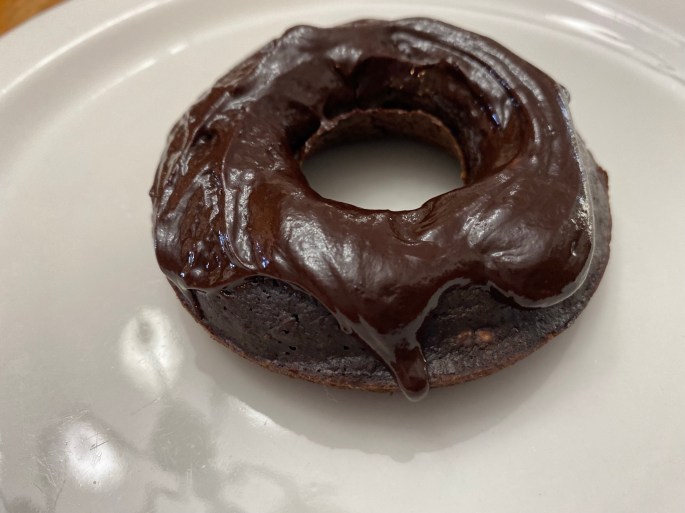
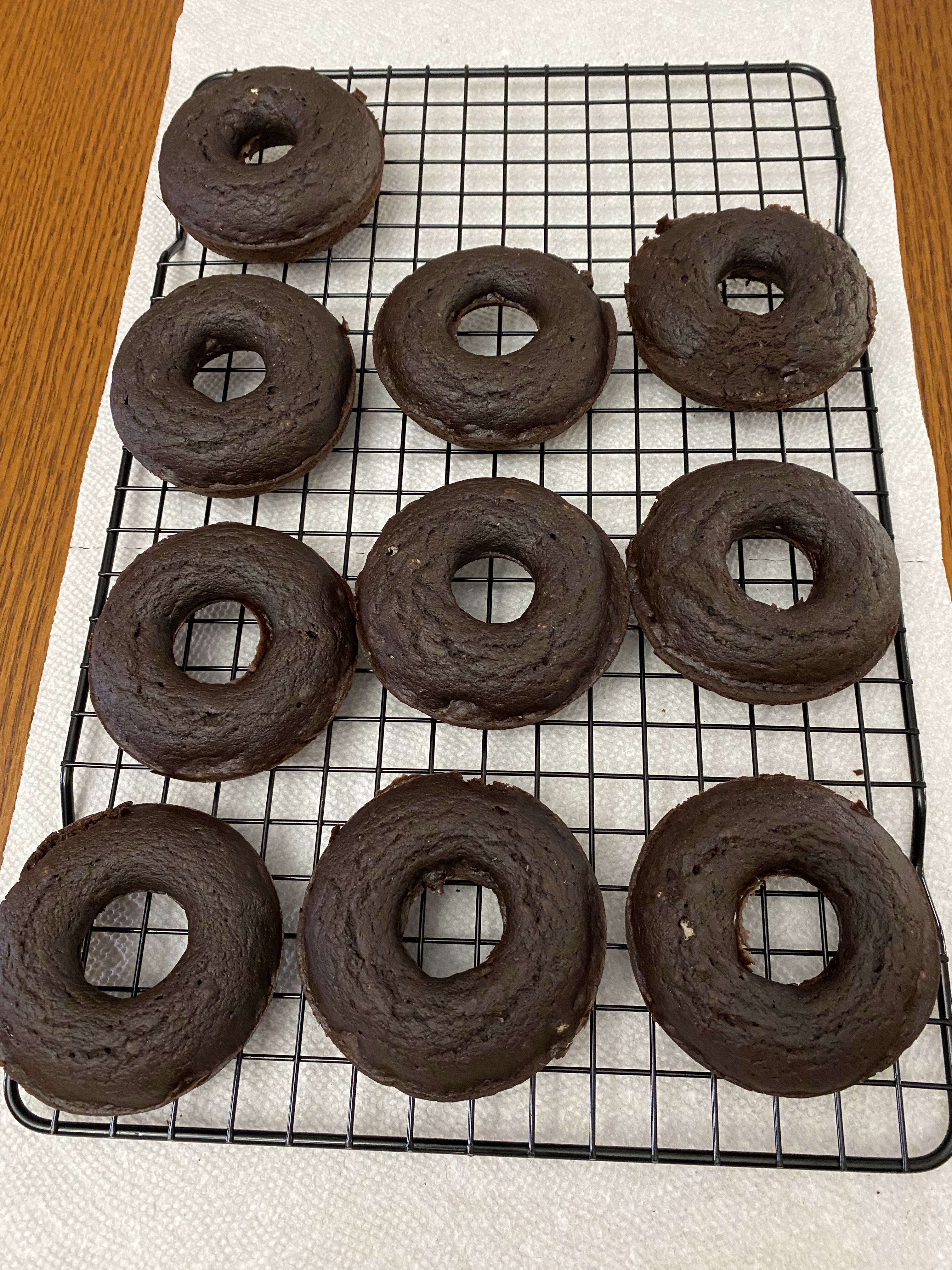
These donuts are ready to be eaten or glazed.

Gluten-Free Chocolate Donuts with optional Glaze

Donut Ingredients:

1 egg OR 1 tablespoon ground flaxseeds + 3 tablespoons water*

1¼  cup oat or all-purpose (gluten-free) flour**

⅓ cup dutched cocoa powder ***

⅓ cup sugar

1 teaspoon baking powder

½ teaspoon baking soda

¼ teaspoon salt

1 tablespoon vinegar

¾ cup milk

3 melted tablespoons of favorite nut-butter, butter, or applesauce****

1 teaspoon pure vanilla extract

Chocolate Glaze Ingredients:

½ cup gluten-free chocolate chips

1-2 tablespoons milk

2 teaspoons pure maple syrup

¼ teaspoon pure vanilla extract

Directions:

  • If using flaxseed, combine flaxseed + 3 tablespoons of water, set in the fridge to “gel” for 10-20 minutes.
  • Preheat the oven to 350 degrees.
  • Prepare a donut pan(s) with a light coating of nonstick cooking spray, OR if you do not have a donut pan, do the same with a muffin pan and plan on filling with batter ½ way full.
  • Combine dry ingredients until well blended.
  • Mix in the remainder of wet ingredients including flaxseed/egg with a large wooden spoon.
  • Divide batter among 8-10 donut spots of donut pan.
  • Bake for 10-15 minutes until a toothpick inserted comes out clean.
  • Allow to cool in the pan for 5 minutes before flipping onto the rack to cool 10-15 more minutes. Serve immediately or add glaze. Makes 8-10 donuts.
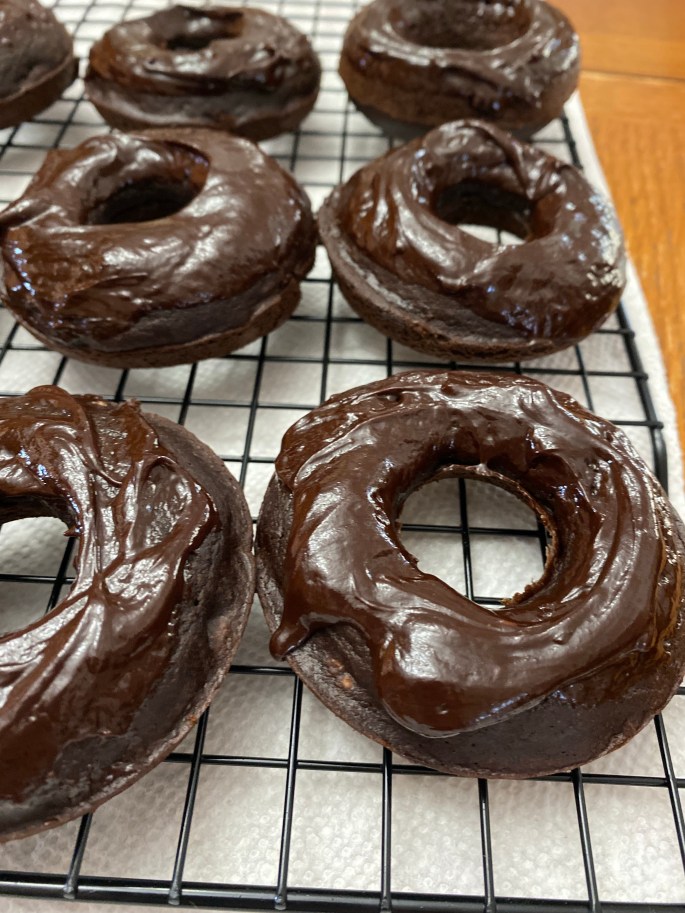
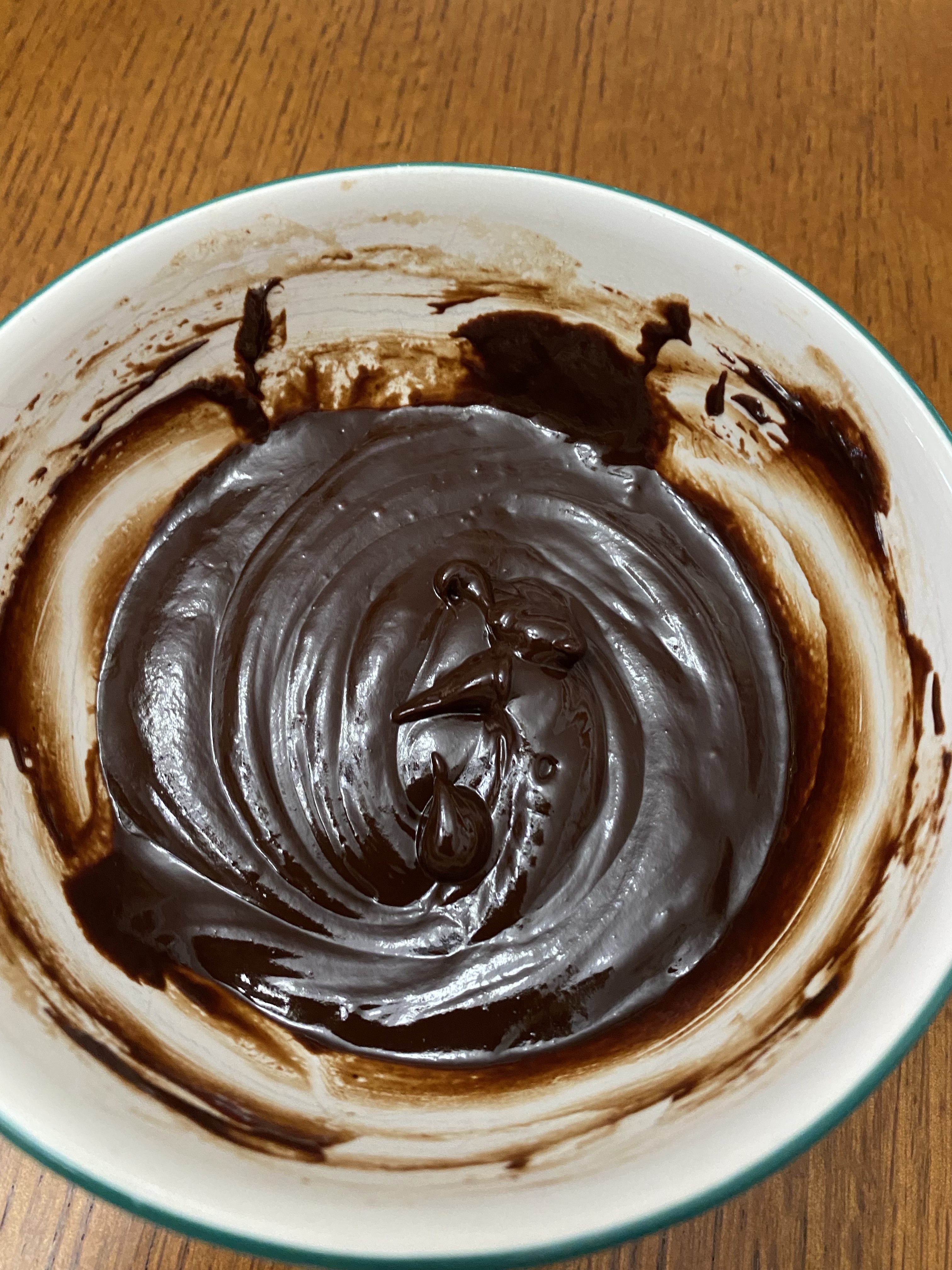
Look at this yummy glaze, ready for donut dipping.

To make glaze:

  •  Lightly spray a microwave-safe bowl with non-stick cooking spray.  
  • Add in chocolate chips and milk. Heat for 30-45 seconds until slightly melted.
  • Stir gently, and once well mixed, add in maple syrup and vanilla extract
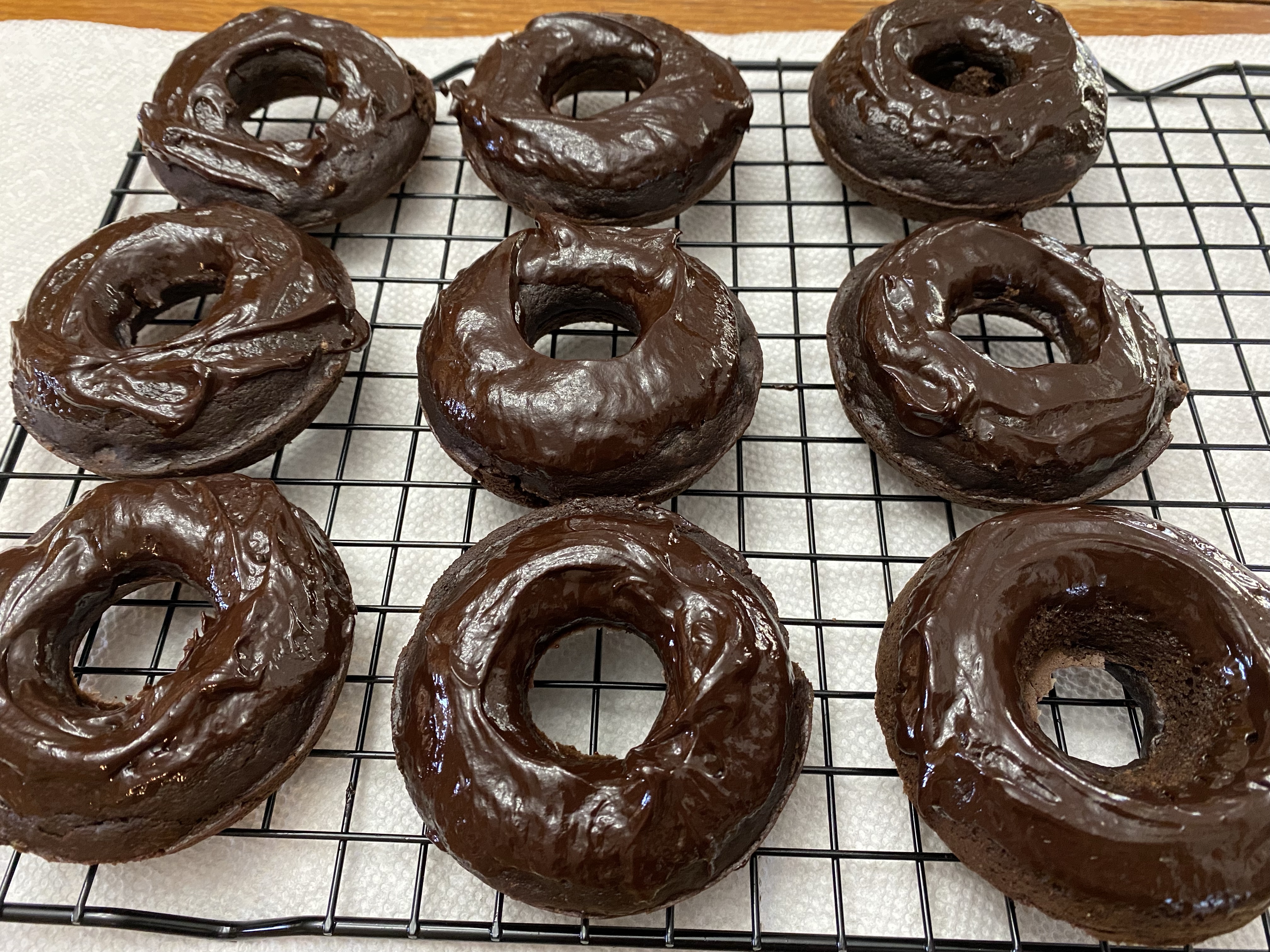
  • While glaze is still warm, individually dip one side of each donut into glaze, and place back on the cooling rack to firm up. Repeat for each donut.  Feel free to add sprinkles, sparkling baking sugar, or shaved bits of chocolate for a more festive look. 

Recipe Notes:

*Choosing between the egg or flaxseed is personal preference, but it is worth noting that

  flaxseed is plant-based. 

**I have celiac disease, so I cannot bake with wheat-based flours.  However, if you do

 do not have a gluten allergy, feel free to use all-purpose flour instead.

***I prefer dutched cocoa powder over regular cocoa powder due to its mellow, smooth

 flavor that I find to be less bitter than regular cocoa powder.  Plus, it makes baked goods

 dark and rich looking.  However, IF using REGULAR cocoa powder, reduce baking

 powder to ½ teaspoon and baking soda to ¼ teaspoon.

****Nut-butters, including tahini, offer a richer flavor and consistency; whereas, butter offers a lighter flavor and can be dairy or plant-based.  Applesauce is a no-oil choice. 

Enjoy!!

Celiac Disease is Real

Celiac disease is a serious autoimmune disease that occurs in genetically predisposed people where the ingestion of gluten leads to damage in the small intestine.–Celiac Disease Foundation

Recently, I went to dinner at a popular local restaurant with a friend.  The wait staff person, whom I will call Sam, was friendly and appeared to listen as I politely explained that I had celiac disease and needed to eat gluten free. I further added that I had not previously eaten there, so Sam pointed out all of the gluten-free items on the menu, directing my attention to several items that might be of interest to me since I also added that I was a plant-based eater. 

Later, after our food had arrived, my friend and I were deep in conversation, when Sam returned to the table to tell me that the dish I had been served was not in fact gluten-free.

Photo by Ana Madeleine Uribe on Pexels.com

At least you only ate part of yours, unlike your friend here.

Wait, what?  First of all, not only was that response rude to my friend, but it was also insensitive to the realities of celiac disease.  Sam then offered an apology and launched into stories of a friends who have celiac disease, but my head would not stop buzzing with worry.  Sam then added a story of a sibling with food allergies who required an epi-pen with the final words, “at least you won’t die.”  

People with celiac disease have a 2x greater risk of developing coronary artery disease, and a 4x greater risk of developing small bowel cancers.–Celiac Disease Foundation

Later, a person, who I can only assume was either a kitchen or restaurant manager, arrived at our table.  I was told that normally there was an upcharge for gluten-free items and another upcharge for vegan cheese, but since I had been wrongly served, I would not be charged any additional fees.  There was no apology, hint of remorse, or even concern in this person’s words or voice.  Meanwhile, my mind kept wondering how I was going to get through the next work day.   

Photo by Kampus Production on Pexels.com

When people with celiac disease eat gluten (a protein found in wheat, rye and barley), their body mounts an immune response that attacks the small intestine. These attacks lead to damage on the villi, small fingerlike projections that line the small intestine, that promote nutrient absorption. When the villi get damaged, nutrients cannot be absorbed properly into the body.–Celiac Disease Foundation

Afterwards, sharing my experience with my daughter, Maddie, she was enraged since she has worked in the restaurant industry for the past two school years.  She shared this story with her current kitchen manager as well as the rest of the staff with whom she works.  They all agreed that the restaurant’s response was inappropriate, and I should to do something, such as leave a bad review on Facebook, Yelp, or Trip Advisor.  Instead, I decided to try to increase awareness of celiac disease through writing. 

It is estimated to affect 1 in 100 people worldwide.–Celiac Disease Foundation 

This is gluten

I am often faced with people, especially in the restaurant industry, who do not believe that celiac disease is serious, much less real.  Perhaps, this is because so many popular diet trends include avoiding gluten and/or because gluten-free items are now so widely available and seen as healthier options.  Often, those who are avoiding gluten for health/diet purposes will still drink beer or consume products with gluten when it suits their situation.  I understand that as someone who is mostly vegan, but will, on occasion, still splurge on cheese.  Unfortunately, this can leave the impression that those of us with celiac disease can do that too.  In fact, I have had family and friends say to me, “Can’t you just take a pill before you eat it?”  If only it were that easy for me.

Celiac disease requires consuming

Ingesting small amounts of gluten, like crumbs from a cutting board or toaster, can trigger small intestine damage.–Celiac Disease Foundation

It wasn’t until the mid-forties that I was diagnosed with celiac disease.  I had been experiencing severe abdominal pain and acid reflux, as well as bloating, cramps, and other, shall we say, digestive issues.  My doctor was treating me with a variety of prescription medications.  My life became a series of timers and pills, and nothing was helping.  After several months of no improvement, he ordered a colonoscopy and an endoscopy.  When the official hospital letter came in the mail informing me that the endoscopy revealed severe damage to my small intestine, suggestive of celiac disease, I was stunned. (It also revealed a hiatal hernia, but that’s a whole other topic!)  When a later blood test confirmed this diagnosis, my life was forever changed. 

Two and one-half million Americans are undiagnosed and are at risk for long-term health complications.–Celiac Disease Foundation 

As my doctor and I talked, it was clear that I had suffered from this disease my entire life, but I had become so accustomed to the symptoms that I didn’t realize anything was wrong.  The entire diagnosis process was spread out over a few months.  Part of the protocol included strictly removing gluten from my diet for two weeks, and then seeing what happened when I re-introduced it to my diet.  Ugh! Talk about pain.  All the stomach pains/issues returned after one day of eating glutinous foods as well as a persistent headache that would not dull.  That was it!  I walked away from gluten products at that point and never looked back.  My life quality has completely changed for the better–including none of the prescriptions of the past.

I buy and order special gluten free products. This is one of my favorite gluten free pizza crusts brand!

Currently, the only treatment for celiac disease is lifelong adherence to a strict gluten-free diet. People living gluten-free must avoid foods with wheat, rye and barley, such as bread and beer.-Celiac Disease Foundation 

Living with celiac disease is typically most challenging when dining out.  It is important that a kitchen staff understand that, no, I won’t die immediately from consuming gluten.  However, within hours of consuming gluten, side effects begin.  Furthermore, with each consumption of gluten–which can even be found in over-the-counter medications, vitamins, lipstick, and toothpaste–I am damaging my body, in particular, my small intestine.  The more gluten I eat, the more likely I am to develop other health issues, such as Type 1 diabetes, muscular dystrophy, anemia, epilepsy, migraines, osteoporosis, shortened stature, heart disease, early on-set dementia, and intestinal cancers.

Celiac disease can develop at any age after people start eating foods or medicines that contain gluten. Left untreated, celiac disease can lead to additional serious health problems.–Celiac Disease Foundation

In the end, I sincerely wish that all restaurants, local and elsewhere, would understand that celiac disease is real; it is not made up.  When I ask for gluten-free food at a restaurant, I will happily pay the upcharge for this choice.  Additionally, I will go out of my way to let staff know that I sincerely appreciate the extra steps taken to prepare my food.  I only ask that restaurants take my request seriously.  If a mistake is made, it is best to tell the customer as soon as possible and sincerely apologize. Mistakes can happen.  However, please don’t write it off as an “at least I won’t die” moment because it will take 24-48 hours for the gluten to work its way through my system–causing unnecessary discomfort, interrupted sleep, endless rest room visits, headache, and body aches–as if I have the flu.  Additionally, at the risk of sounding dramatic, consuming gluten potentially contributes to a premature life-ending, or at the very least, life-altering disease that may have otherwise been avoided.  While celiac disease does not define me, it is part of who I am–a valid part that should be respected and honored.

For more information regarding celiac disease or for those wondering if they, or a loved one, have celiac disease, please visit the Celiac Disease Foundation at celiac.org as well as talk to your health care provider. 

Another tasty brand of bread products.

Choose Joy

Participate joyfully in the sorrows of the world.  We cannot cure the world of sorrow, but we can choose to live in joy.–Joseph Campbell

Photo by Archie Binamira on Pexels.com

There is a documentary about a Holocaust survivor named Gerda Weissmann Klein that I have watched on several occasions with students.  Her story is, like many Holocaust survivor stories, one of inspiration, hope, and even joy.  One of the lines that often comes back to me is when Weissmann Klein specifically addresses how she survived a death march towards the end of World War II.  Despite the fact this march occurred during the height of a brutally harsh winter, Wiessmann Klein was able to survive for a number of reasons, one of which included her ability to “occupy her mind.”

In simple terms, Weissmann Klein was able to take her mind’s focus off the cruel conditions around her.  Rather than brood over the extreme cold, her hunger, her fatigue or any other legitimate complaint, she colorfully described her intentional deliberations that could last all day, such as spending an entire day planning out her next birthday party, even though she had not been able to have one since the Nazi occupation.  However, it wasn’t so much the what of her thoughts, but the fact that she was able to focus/distract her mind away from the pain/discomfort that naturally accompanied her situation.  Instead she intentionally directed her attention towards ideas/notions/thoughts that safely allowed her to “escape” and feel some sense of happiness if only cerebrally.  It is this human ability to occupy one’s mind, or shift the mind’s attention/perspective, that is a powerful take-away from Weissmannn Klein’s story, and I believe is transferable to other, much less brutal situations.   

Photo by cottonbro on Pexels.com

Given the news, the pandemic, the  major weather events, and all of the sobering occurrences from the past few years, it is easy to allow our mind to focus on the what-is-wrong-in-the-world, whether you are looking at the big picture or sometimes even your own personal circumstances. I know I can easily get wrapped up in the negative and get a full-steam-on gripe session with the best of them.  On one hand, I know it can be beneficial to get the negativity off-your-chest; on the other hand, I also know that there is danger in dwelling or focusing on it for too long–at least for me.

In a similar manner, I’ve noticed that both positivity and negativity are contagious within myself and among others. If I enter work feeling grumpy, put-off, or focused on some negative happening, I tend to attract and may even catch myself seeking out negativity.  It’s not per se always a conscious choice, it just seems to happen that way.  As soon as I recognize it, I feel badly for having given that gray cloud permission to come along for a ride.  The real danger, it seems to me, is when negativity is left unaddressed.

Negative mindsets have a tendency to spiral out of control.  It may start with something as simple as an accidental spill or mess that throws off the morning routine, followed up by that s-l-o-w driver on the morning commute while listening to frustrating news on the radio.  This may then turn into a later than planned arrival at work, followed by unhappy/unpleasant conversation, followed by a work-related problem in need of addressing for uptenth time, and by the time lunch arrives–which is often a working lunch–negativity can feel as if it is bursting at the seams.  

I think Ms. Weissmann Klein was onto something when it comes to not defaulting to the negative. We must actively and intentionally teach our mind to choose joy.  No, it’s not easy, and yes, it sounds cliché.  However, I do believe that we have a choice of how we respond to our circumstances, but like all skills, it takes practice and thought.

Photo by David Orsborne on Pexels.com

I think the lyrics to a King and Country song entitled, “Joy,” best encapsulates this thought.  It is oh-so-easy to focus on all of those nightly news headlines that vie for our attention.  Easier still, is to become wrapped up in our personal headlines: illness, death, divorce, finances, job loss/stress, future uncertainties and so forth.  I can’t tell you how many times I’ve caught myself in the woe-is-me mind story; it’s so darn easy to do.  Here is what I am learning when I catch myself having fallen prey to pessimism.

Sometimes your joy is the source of your smile, but sometimes your smile can be the source of your joy. –Thich Nhat Hanh

Believe it or not, the simple act of smiling can be a lightswitch for our mindset.  I first discovered this through running, but I find it just as helpful in most other situations.  Whether it’s my legs and calves aching from the exertion of exercise, or it’s my shoulders and neck tightening in reaction to stress, as soon as I catch myself responding negatively to stress–to the degree possible–I focus on deeper breathing, relaxing the tightened areas, and adding a smile.  I smile at the sense of accomplishment I will feel once I have completed the goal; smile at the fact I am proud of myself for having caught myself slipping into negativity; smile at the fact that my body still has the ability to exercise, work, read–whatever. All of which leads to more smiling because, well, I am smiling–which leads to the release of feel-good hormones.

Photo by Pixabay on Pexels.com

I was talking to a sister recently about how we wake up with the best intentions to remain sunny and positive, and then one thing might set off the day, and BOOM, there goes the mindset.  My husband says, however, that is part of living in faith.  He reminds me that it’s not about perfection, but recognizing your imperfections–your humanity–and then trying again. 

In the words of King and Country, “. . . Oh, hear my prayer tonight, I’m singing to the sky/ Give me strength to raise my voice, let me testify . . . The time has come to make a choice

And I choose joy!

I can’t pretend to choose joy in every moment, nor am I not acknowledging the very realness of life, headlines, personal crises and all.  Nevertheless, even in the bad times, sorrows, and heartbreak and loss, I can choose my response, and I can choose to find at least one reason to smile.  

Photo by Pixabay on Pexels.com

It’s never too late to Bloom

“And the day came when the risk it took to remain tight inside the bud was more painful than the risk it took to blossom.”–Anais Nin

On sunny, but cold winter mornings, it is not unusual for me to walk past the living room and see both of our cats sprawled on the floor in the bright slant of sunshine beaming through the picture window.  Therefore, this past Saturday, as I walked through the house after my morning run, a smile of comfort spread across my face as I caught a glimpse of our two aging felines sun-bathing.  However, my brain also signaled that something was “off.”

Pausing, taking a backwards step to peer once more through an entrance way, I scanned the room.  Our male cat, the longer of the two cats, full of black fur, save one white paw, raised his head, glared at me for having the audacity to enter the room, as if I needed his permission, and meowed his disapproval of my presence.  The gray female, who is, well, she is sensitive about this, but she is, shall we say, the fluffier of the two, blinked open one eye, and then the other, attempting to register the disturbance of her basking peacefulness.  Glancing around the room, seeing nothing out of place, I turned to walk out sensing the full chill of sweat drying as my body began to cool down at a more rapid pace.

I turned to walk away, but wait, there were those alarms again.  Taking one last glance over my shoulder as I simultaneously chastised myself for having a run-away imagination, something clicked.  There was the very thing my brain had been trying in vain to communicate.  

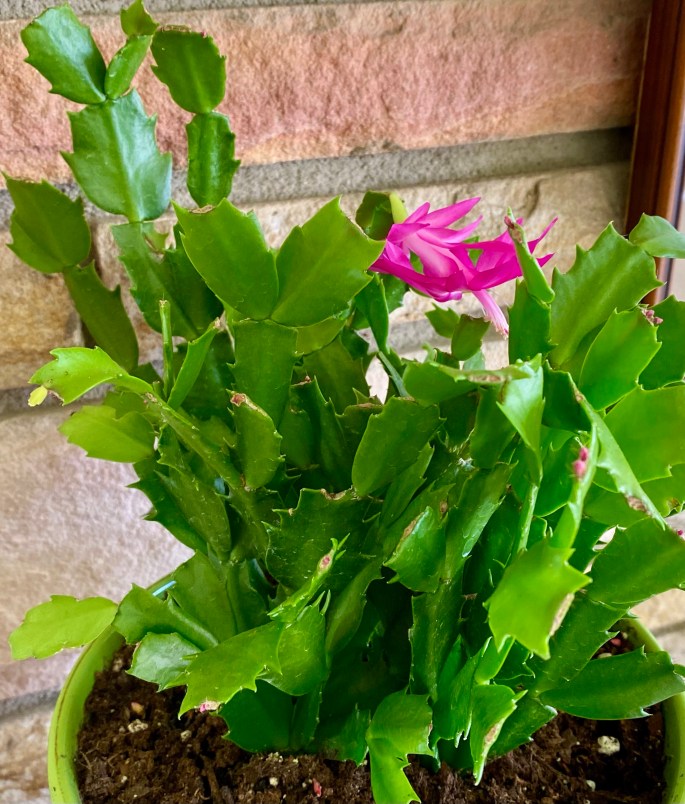
I couldn’t believe it!  Christmas had been over a month ago as the wall calendar we still faithfully use was nearly ready to be flipped to February; and yet, there it was, the only one.  It was delicate, dainty, adored in haughty punch pink and full of pride. 

Oh, wow! I thought as I looked on in amazement at one brilliantly hued bloom on a Christmas cactus.  

In December, the entire plant had been full of blooms as bedazzled as any holiday tree.  In fact, I have two Christmas cacti in the living room, and they had both spectacularly bloomed over the course of the holiday season, beginning not long after Thanksgiving.  However, there were a handful of buds on each plant that grew with great promise, but in the end, never bloomed.  Instead, those buds held tightly together, and eventually fell off the cacti without blossoming.  All of their potential, lost in their continued grasping, waiting for the precise right time to blossom, rather than letting go of control and allowing it to happen.

Turning back to get my phone in order to take a picture, my brain, now buzzing with the excitement of the discovery, was likewise pulsating with the object lesson provided by this blossom.  A Talumedic quote sprinted through my head as my memory tried to catch its fleeting words.  Something about every blade of grass having an angel telling it to grow.  What was that quote?  Did this blossom likewise have an angel?

For the love of Pete, Stephanie, get out of your story-writing head and just enjoy the exotic beauty of this blossom.

Taking the picture, then standing to admire the flower from all angles, I no longer noticed my chilling body as I became filled with inspiration.  I know, I know, I sound so dramatic, but seriously this was special–at least in my mind.  If Divine Providence doesn’t give up on a tightly closed bud, then it surely doesn’t give up on us! If we, as humans, would just quit grasping for the safety of the known and rely in faith that there is a higher power whispering gentle encouragements of growth, we might then realize that we can blossom–even if seemingly out-of-season. 

Years ago, when I taught Kindergarten, each spring, I would order a so-called “Butterfly Garden” as a more tangible way to teach metamorphosis.  Each morning, curious faces would check the caterpillars.  They could observe the ways in which they grew, formed chrysalides, and ultimately witness the emergence of Painted Lady butterflies, wet, crumpled, and rather unrecognizable.  

Photo by Pixabay on Pexels.com

Nearly every year, however, there was that one chrysalis that would not open when the other Painted Ladies emerged.  Often, there were those kids who suggested that we should “break it open” as a way of helping it along the metamorphic process. I would use this as an opportunity to ask them if they liked being woken up from sleep and the comfort of their warm, cozy bed.  Of course, there were echoes of “No,” followed by the typical chatterings of five and six year olds. Eventually, in time, that snuggled up caterpillar would emerge–better late than never!

Photo by Miriam Fischer on Pexels.com

Dear Reader, it can be so hard for us to let go of the comfort of what-was and the arms of the-way-it has-always-been.  However, if like that cactus bud and the late developing butterfly, we can bravely release our graspings, we might find that we can blossom and take flight in a metaphorically new direction, repurposed and ready for new expressions and expanded experiences, even if at the most unexpected times.  As the bud on my Christmas cactus demonstrated, it is never too late to bloom.  

Photo by Jennifer Murray on Pexels.com

Blueberry Lemon-drop Donuts with gluten-free and vegan options

In all my work, I try to say ‘You may be given a load of sour lemons, why not try to make a dozen lemon meringue pies?'”–Maya Angelou

Photo by Tara Winstead on Pexels.com

One snow storm followed by another within the span of one week, and this snow was then followed by the coldest temperatures of the year.  It seems that old man winter has already tossed a few iced lemons our way in the month of January. I can’t help but wonder what frosted goodies he has in store for February!  Of course, there’s always the hope that January has dished up the worst that winter has to offer!  Hey, it could happen . . . 

Perhaps it was due to all of the snow, but I decided last week that if life was going to hand us lemons, I might as well make something out of those tart orbs of joy!  Picking up a lemon in my hand last week, it reminded me of sunshine on crisp winter snow.  I kept thinking of the way in which mid-morning winter sunlight slanted over trees that looked as if they had been dunked in a bag of confectioners sugar as decoration for the crystalized sugar frosted white hills.  Those frolicsome winter rays make me feel as lighthearted as that vibrantly colored lemon in my hand. 

Truthfully, I had already been researching the various ways in which I could bake gluten-free, plant-based donuts. Since my diagnosis of celiac disease over ten years ago, donuts are not something I necessarily crave, but every now and again, I think eating one would be a nice treat.  In fact, it wasn’t until last year during a visit to Lexington, KY, that I actually ate my first gluten-free (and surprisingly plant-based) donut since that diagnosis at Gluten-Free Miracles Bakery & Cafe.  Ever since enjoying the cakey-goodness of that treat, I have wanted to recreate it at home.

While I am dedicated to eating a whole-food plant based diet, with as little processed food as possible, I do believe in balance, and that includes occasional sweet treats–especially if I am the one controlling the ingredients.  That said, it is not my desire to determine how others should eat.  Everyone has to figure out what foods work best for their own unique bodies.  Therefore, when creating this recipe, I tried very hard to make it as inclusive as possible, so no matter the dietary preferences, this is a doable and fairly easy recipe.

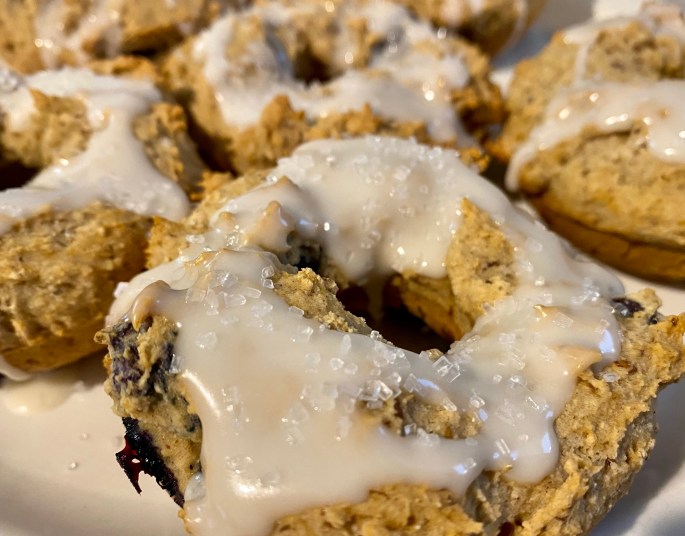
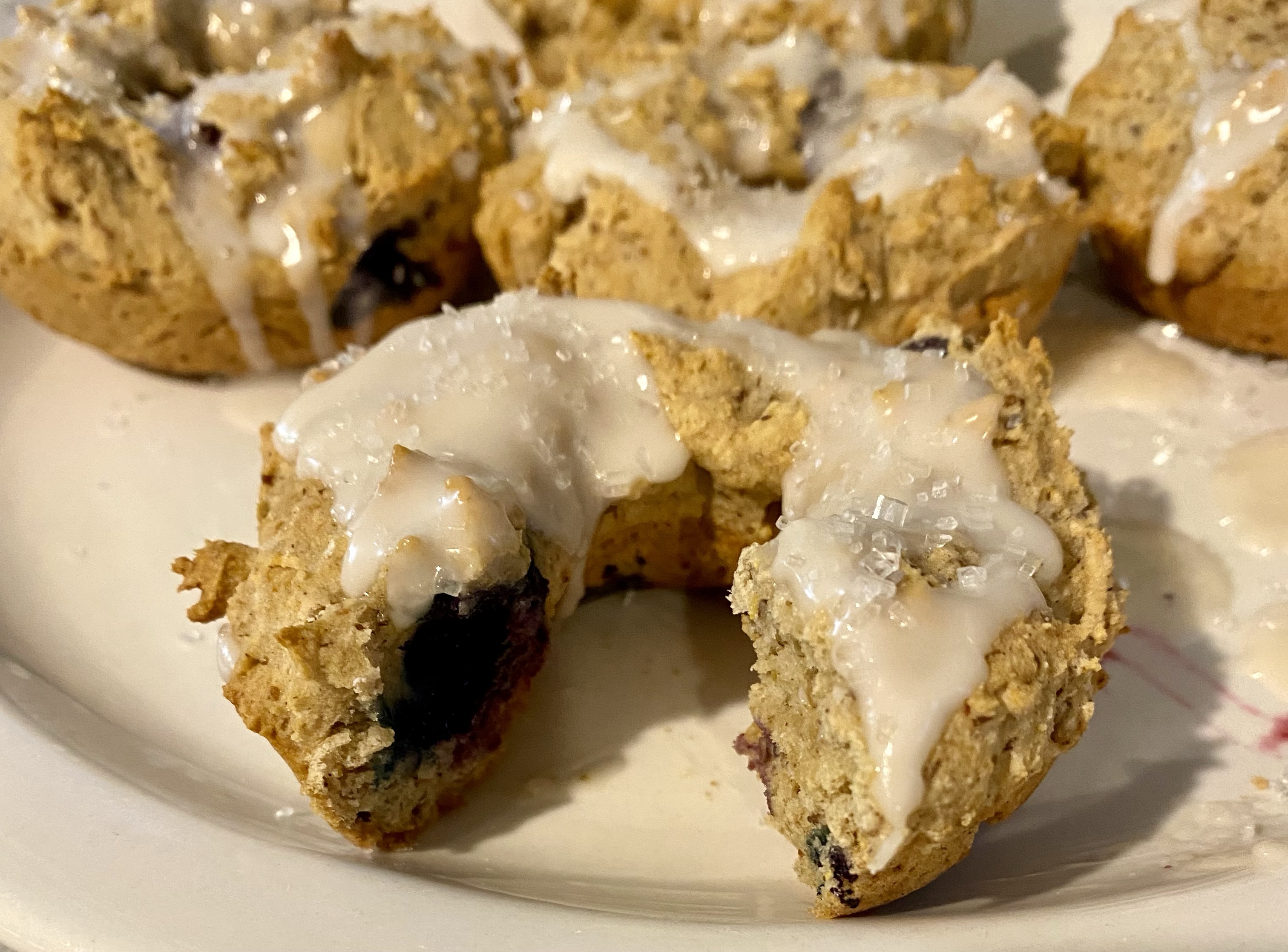
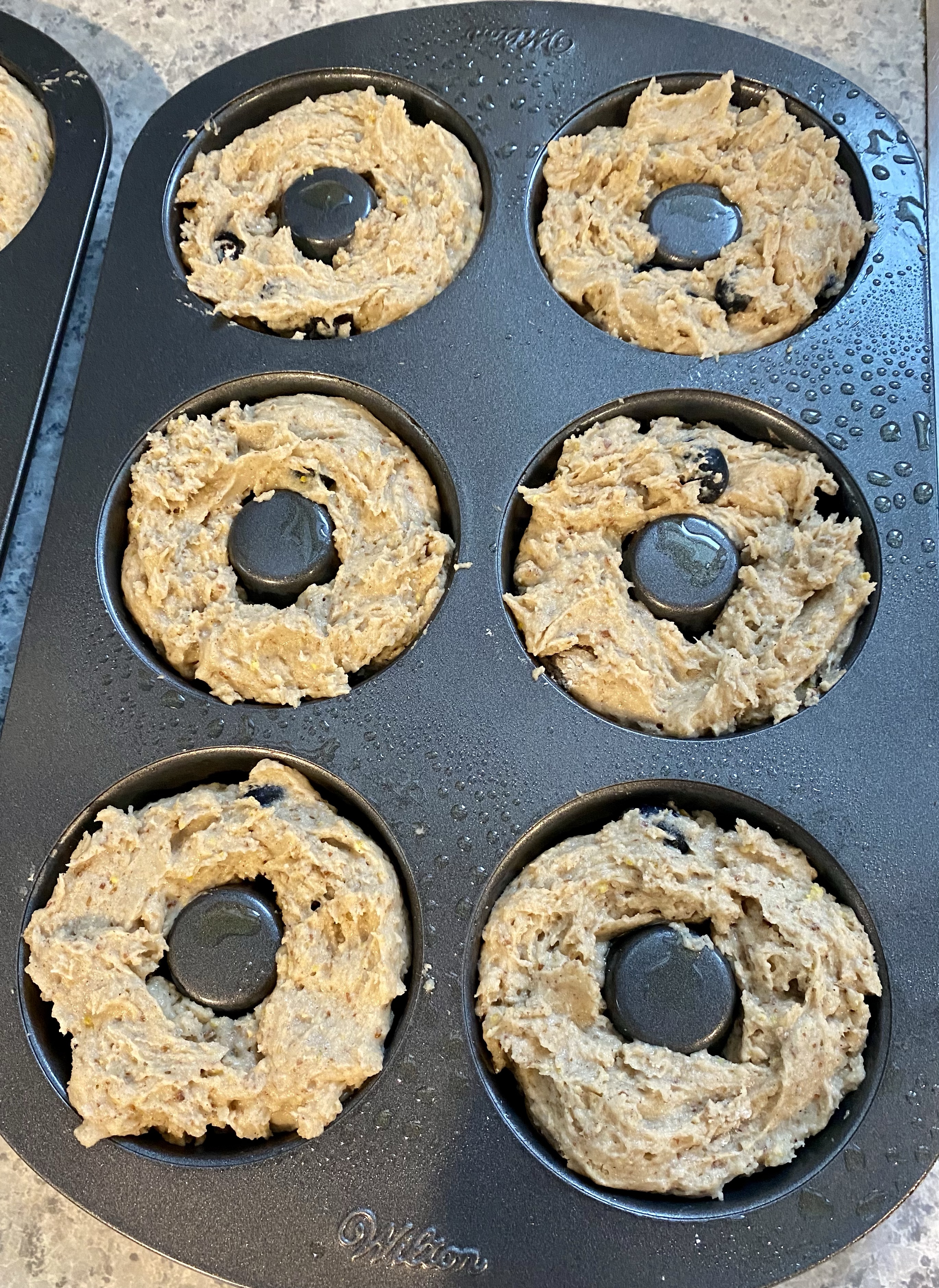
Moist and springy inside, bursting with blueberry goodness!

On a final note, my family (God bless them for being my ever-willing taste-testers.) found the limoncello to be overpowering in the glaze when it was first made; however, the taste mellowed within hours of mixing it.  In fact, they determined that they preferred the glaze a bit thicker with only a small amount of lemon juice (1 tablespoon or less) and no limoncello.  Additionally, in terms of flavor and texture, they preferred a light sprinkling of sparkling sugar over the glaze, but that is totally optional!

Regardless of how you choose to make this recipe, I sincerely hope that you do give it a try.  Whether you dunk one of these lemony rings in coffee, tea, or favorite milk, or if you choose to simply serve it warm, enjoying it bite by tangy, sweet bite, may this recipe brighten and warm your heart with a taste of baked sunshine on a chilly winter day. 


Blueberry Lemon-drop Donuts with Glaze 

(with gluten-free and vegan options)

Ingredients

*2 eggs or fleggs 

**1 ½ cup all purpose (gluten free) flour 

¾ cup oat flour

2 teaspoons baking powder

1 teaspoon baking soda

½ teaspoon salt

¾ teaspoon cinnamon

Zest of one lemon

1 tablespoon vinegar 

2 tablespoons lemon juice

2 teaspoons vanilla extract

¼ cup sugar

¼ cup maple syrup

½ cup milk

¼ cup applesauce (can substitute melted butter, melted vegan butter, or melted coconut oil)

⅓ cup fresh blueberries lightly dusted with (gluten free) flour of choice

Glaze

1 cup confectioners sugar

***1-2 tablespoon limoncello, lemon flavored vodka, or lemon juice–depending on desired strength of flavor

½ teaspoon vanilla extract

Pinch of salt

1-2  tablespoons favorite milk, if/as needed

Directions

If using “flegg,” mix together first and set aside as directed below

Zest lemon and set zest aside.

Preheat the oven to 375 degrees.

Prepare two 6-donut pans by coating with non-stick baking spray or other preferred method of “greasing”

Combine flours, baking powder, baking soda, salt, cinnamon, and lemon zest in a large bowl.

In a medium bowl, whisk together eggs (or fleggs) with vinegar,  vanilla extract, lemon juice, sugar, syrup, milk, and applesauce (or butter or oil).

Stir into dry ingredients until just combined.

Gently fold in blueberries.

Divide batter evenly among donut pans.

Bake for 10-15 minutes or until a toothpick inserted comes out clean.

Allow to cool in the pan for 5 minutes before flipping onto the rack to cool 5-10 more minutes.

Meanwhile, using a fork, stir together glaze ingredients using less liquid at first until desired consistency is reached with the glaze looking white and thick, rather than translucent and thin. Drizzle glaze, as desired, over donuts.

Sprinkle tops of glazed donuts with lemon zest, colorful sprinkles, crystal sugar, or chocolate sprinkles, if desired.

Store in an airtight container in the refrigerator for up to one week.

Can freeze, unglazed donuts up to one month in an airtight container.

Recipe Notes:

*flegg = 2 tablespoons ground flaxseed with 5 tablespoons water, stir together gently, set in fridge 15 minutes 

**Can use all-purpose flour if gluten-free variation is not needed due to allergy/celiac disease

***If a vanilla glaze is preferred, eliminate the limoncello, lemon flavored vodka, or lemon juice, and increase amount of milk as needed to achieve desired pourable thickness 

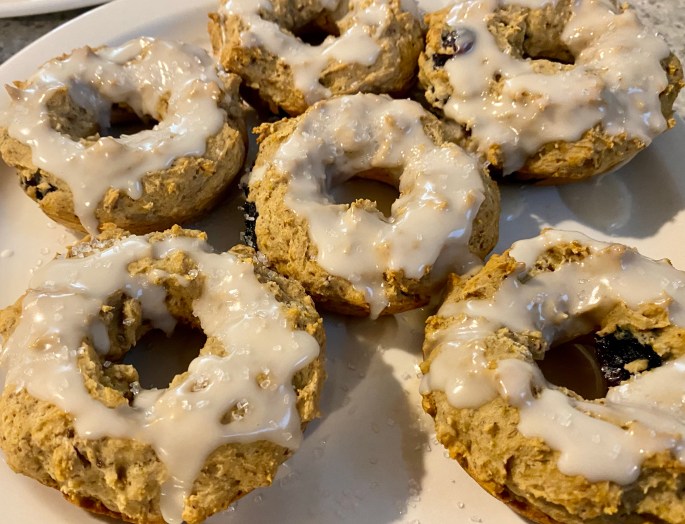
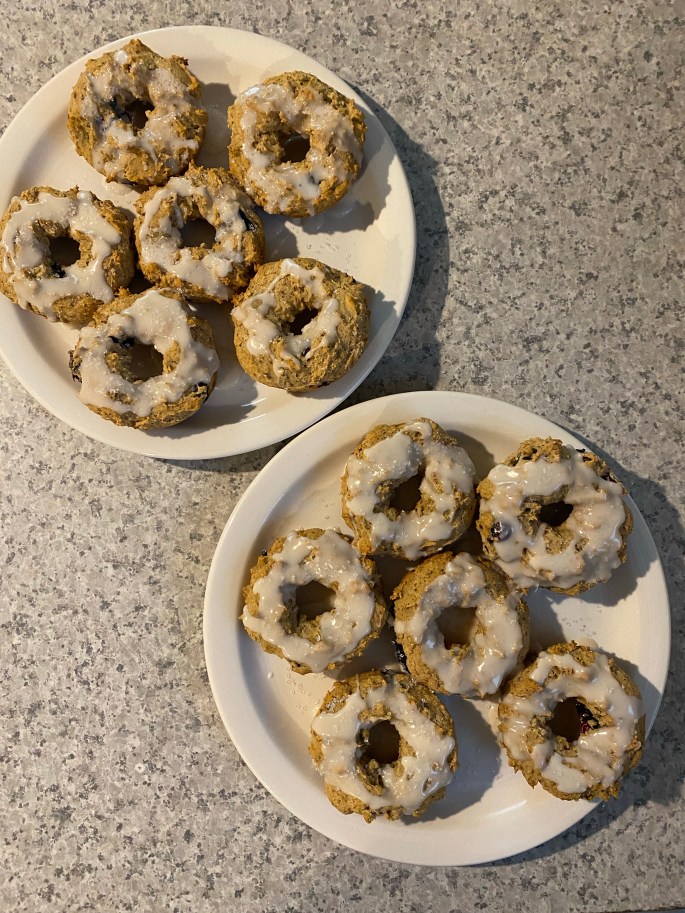
Divide the batter evenly in two 6-donut pans.
When baking with blueberries, whether frozen or fresh, it helps to dust them with a bit of flour
Allow to cool in the pan for five minutes before cooling the rest of the way on racks. Then, glaze as desired!

Early to Bed, Early to Rise

“Morning is an important time of day, because how you spend your morning can often tell you what kind of day you are going to have.” Lemony Snicket

One of my current personal practices of this school year is choosing to wake up at 3:50 am three out of five work days.  I’ll state the obvious:  It’s not fun at the moment the alarm sounds.  Messages, vying for attention, encourage me to hit the snooze button and/or skip the early wake up, “just this one day.”  After all, one time won’t hurt me.  Those messages are strong, loud, and clear as sleep threatens to overtake me, especially now that it is full-on winter with its early morning chill and darkness. I want to be weak and give in, but I know if I give in once, I’ll give in again and again until I ultimately return to old habits that tend to stress me out. 

To be clear, the other two work days, I get up one hour later–4:50 am–which, trust me, feels like a treat.  By the weekend, I’m exceptionally foot-loose and fancy free, setting the alarm for 5:50, which feels like being served up a warm brownie with ice cream on top! 

Okay, okay, perhaps I am being a tad bit dramatic, but the point is that I’ve discovered, after several months of implementation, that waking up early fairly consistently each morning offers me numerous benefits, many of which were unexpected. It began mostly as a way to get in a workout first thing in the morning before going to work, and that is still one of the main motivating reasons.  However, I discovered that I was reaping a few unexpected benefits as well.

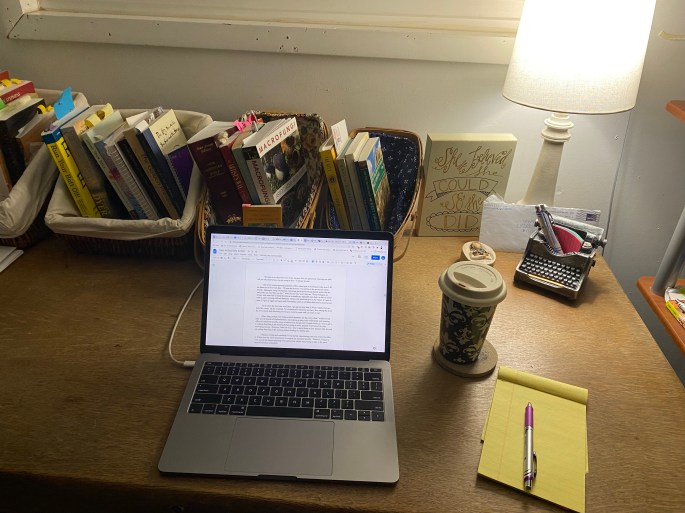
Checking off goals in the predawn hours.

I became curious and wondered if I was merely experiencing some sort of placebo effect or if there was any solid data/research to support my anecdotal benefits.  Therefore, I began to nose around the internet gleaning information from various sites, trying to stick to the more reputable sources of research.  

*Early risers tend to be more proactive about their day

One of the first sources I ran across cited Harvard’s Biologist’s (Christoph Randler) work pointing to the fact that early morning risers tend to be more proactive.  This is due to the fact that they must think ahead and organize for the morning the previous evening in an attempt to anticipate and minimize potential issues. I can attest to the fact that I had to learn early in the process the importance of nightly organization in order for the early morning routine to flow efficiently.  

I continued reading on to learn more.  Here are a few more positive benefits to rising early according to those with more expertise than me: 

*Ability to accomplish most important task(s) (or personal goal) first thing

Since the early morning hours are typically the quietest, the mind (and schedule) are  fairly clear, freeing early risers to focus on the most important, or most challenging, goal of the day–in my case, that’s usually some sort of 5-10 minute devotional, followed by 30-40 minutes of writing/editing/revising/updating website, and finally about 2-3 minutes of clearing out junk work emails that accumulate overnight in my inbox and making note of important emails to tackle first thing at work.  I do these few tasks while sipping a cup of coffee allowing me to feel a small sense of accomplishment, even before I head to the gym. In fact, according to the Harvard Review, in a 2010 study, that early morning sense of accomplishment, sets the tone for your day, allowing early risers to feel more agreeable, optimistic, and conscientious.  Who knew?

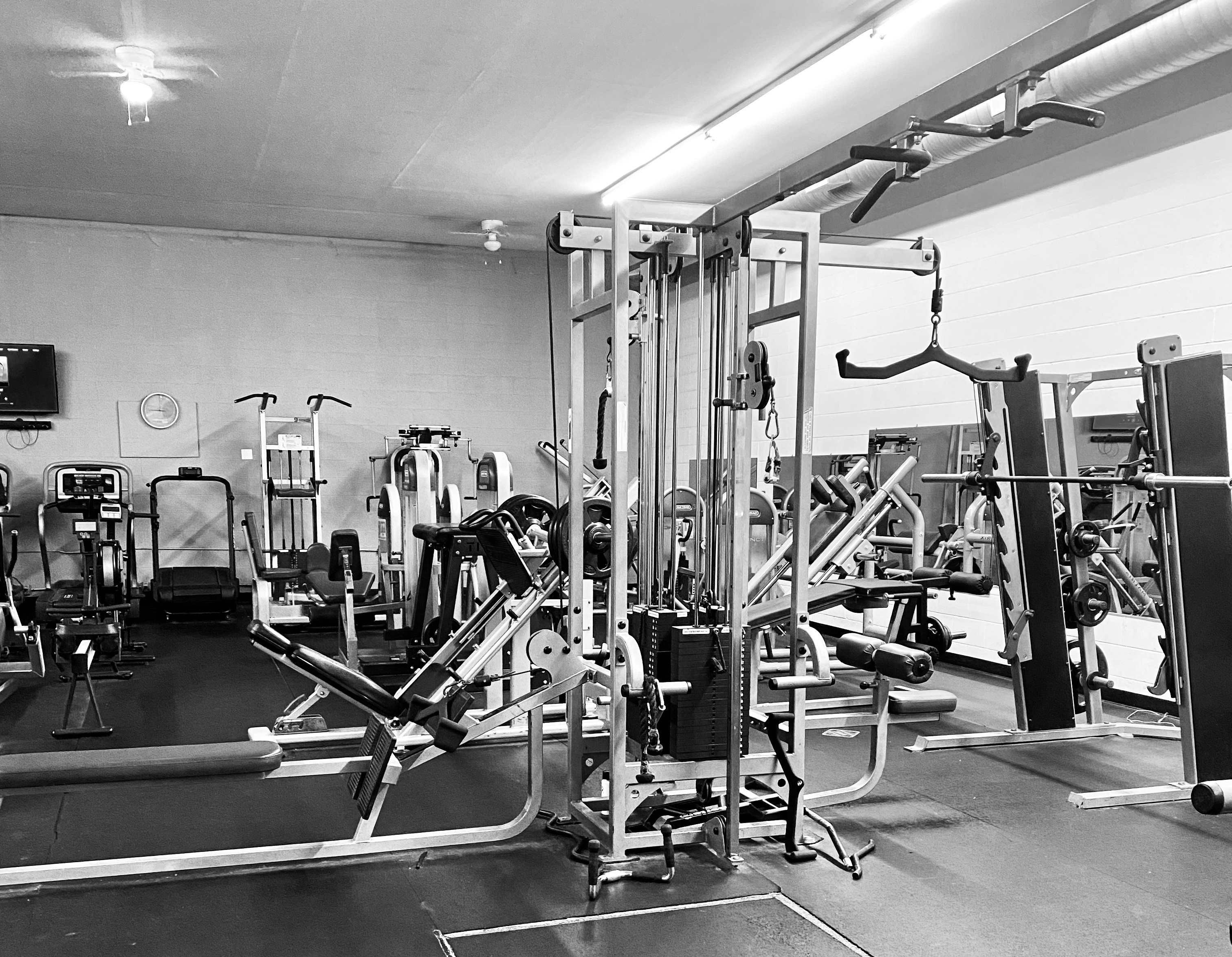
Empty, or near empty gym, is an added bonus to the early morning wake-up, especially in the age of COVID.

*Morning exercise boosts the brain 

As a general rule, exercise benefits the body and mind, no matter what time of day it is completed.  However, people with busy schedules find that they are better able to stick with an exercise routine by completing it in the morning. As an added bonus, working out in the morning allows early risers to take advantage of all of the feel-good endorphins produced by the brain after exercise.  Plus, exercise reduces heart disease, boosts brain cognition, regulates blood sugar and weight, and tends to improve your mood. Therefore, if completing the workout in the morning ensures that you don’t miss a workout, then early risers are checking several boxes before the start of the official workday. Check, check, and check!

*Outlook and sleep quality improves while risk for depression decreases

Typically, those who wake early, tend to go to bed earlier, and experience overall better sleep quality which can positively increase outlook.  We can all relate to how we feel after a horrible night of tossing and turning, especially on a Sunday night after a weekend of sleeping in, when sleep seems so elusive.  According to the Sleep Foundation, by keeping a fairly consistent daily wake-up time, including the weekends, you can maintain your circadian rhythm, allowing you to fall asleep faster and sleep better.  Additionally, a 2012 study conducted by the Canadian Institutes of Health Research confirms that early risers tend to have more consistent sleep leading to healthy, happy, and overall sense of well-being. Moreover, recent 2021 studies, one published in JAMA Psychiatry and an additional one published in Molecular Psychiatry, point to the fact that rising early can significantly reduce your risk for depression as well as other mental illnesses.

Photo by Lukas Rychvalsky on Pexels.com

*Increased productivity

Rising early has been shown to increase productivity by enhancing one’s ability to problem solve according to the Journal of Sleep Research.  It also turns out that waking up early reduces stress (Think: beating the stress of morning rush hour), increases alertness, and minimizes forgetfulness.  Early risers have more time to acclimate to the day by moving beyond that sleep inertia period–that slower moving time period when thinking can still be foggy and the body is not fully awake–increasing focused concentration upon arrival at work, and thereby potentially increasing productivity.  Additionally, they have time to complete more tasks before becoming overtired, a major culprit of forgetfulness.  

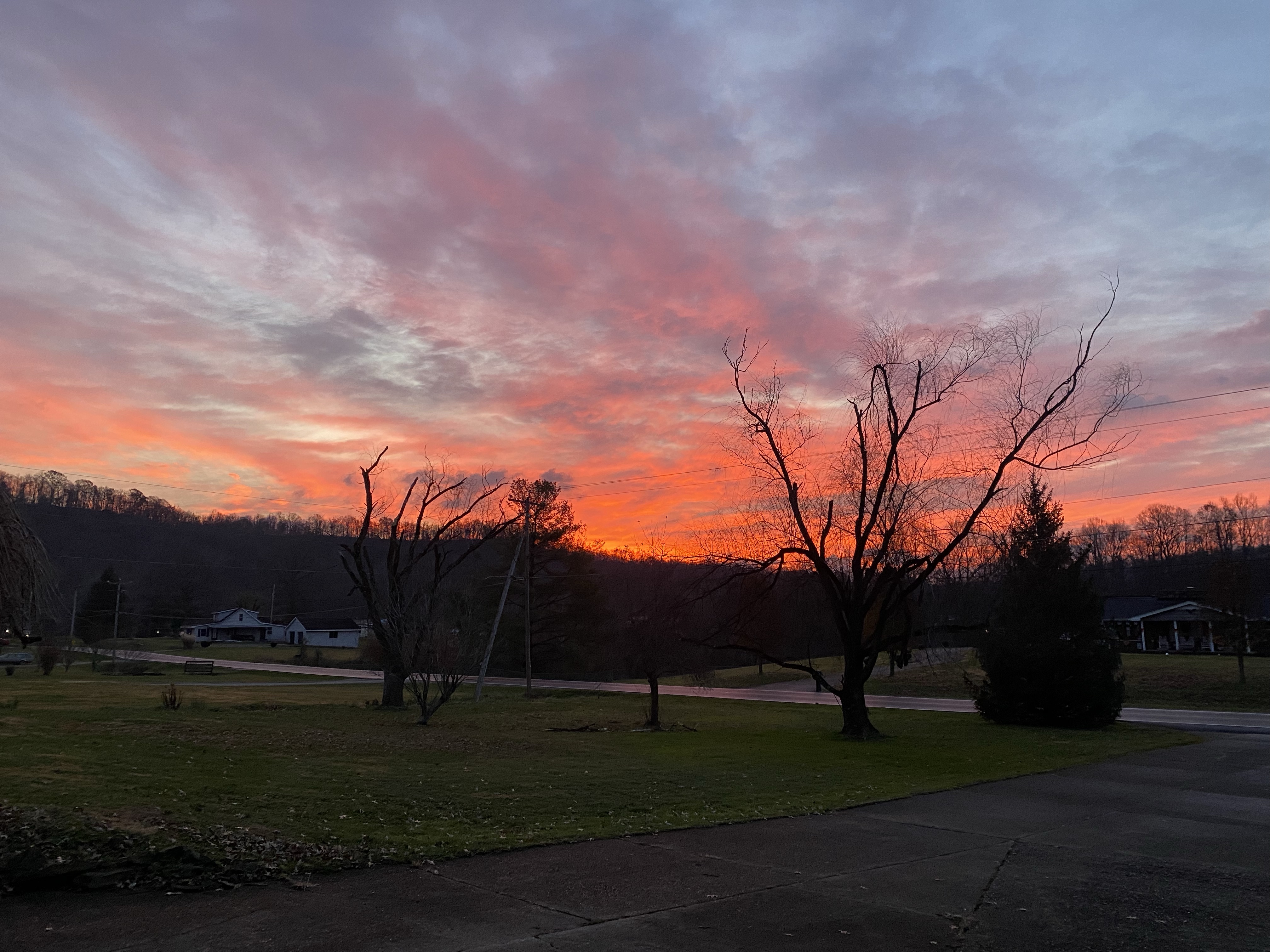
On the way to work as the sun is rising and several daily goals have already been checked!

In the end, most researchers agree that by implementing a fairly consistent bedtime/wake-up routine, it is possible to train your body to wake up early. One thing is for sure, I like my sleep as well as the next person, and I certainly don’t enjoy those first moments of the alarm sounding, especially on those three extra-early days.  However, the benefits I have discovered, and now confirmed, far outweigh those few moments of discomfort.  I am able to meet my daily writing goals, miss fewer workouts while exercising in a fairly empty gym without being dog-tired from work, and I am much more energized and positive, well, most days.  The only caveat: I am typically in bed, no later than 9:00 pm, much to my family’s chagrin–not they really mind.

I won’t claim early rising is for everyone, but it’s working for me.  Nor can I say that I will do it forever, but for the time being, I will continue with my pre-dawn rising.  If it was good enough for Ben Franklin, one of the greatest inventors ever, it should work for a simple school teacher and writer, like me.  Who’s in with me?

Photo by Pixabay on Pexels.com