Running with Purpose: The Charleston Distance Classic and My Marathon Journey

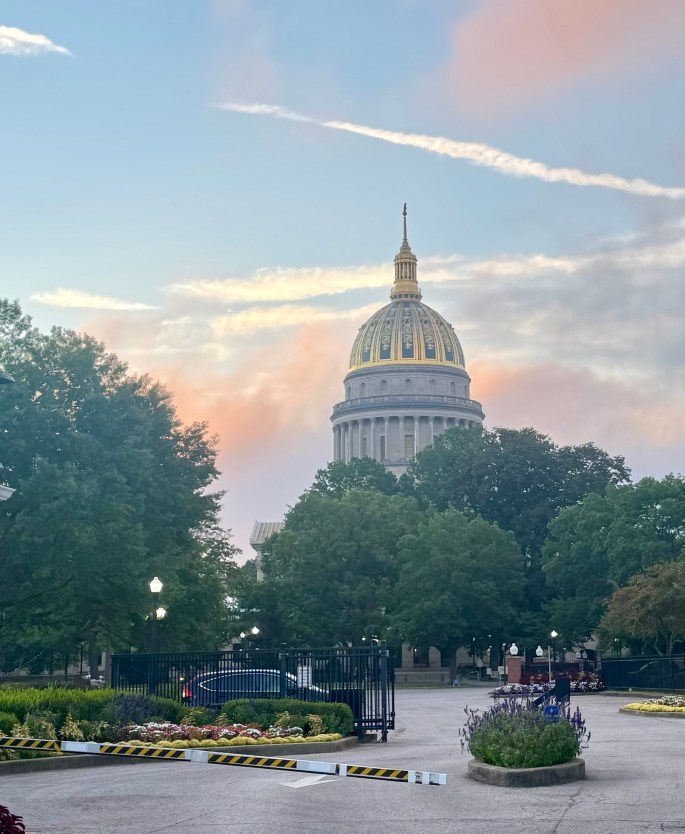
The West Virginia State Capitol building with a golden dome, surrounded by trees and a pastel sky at dawn.
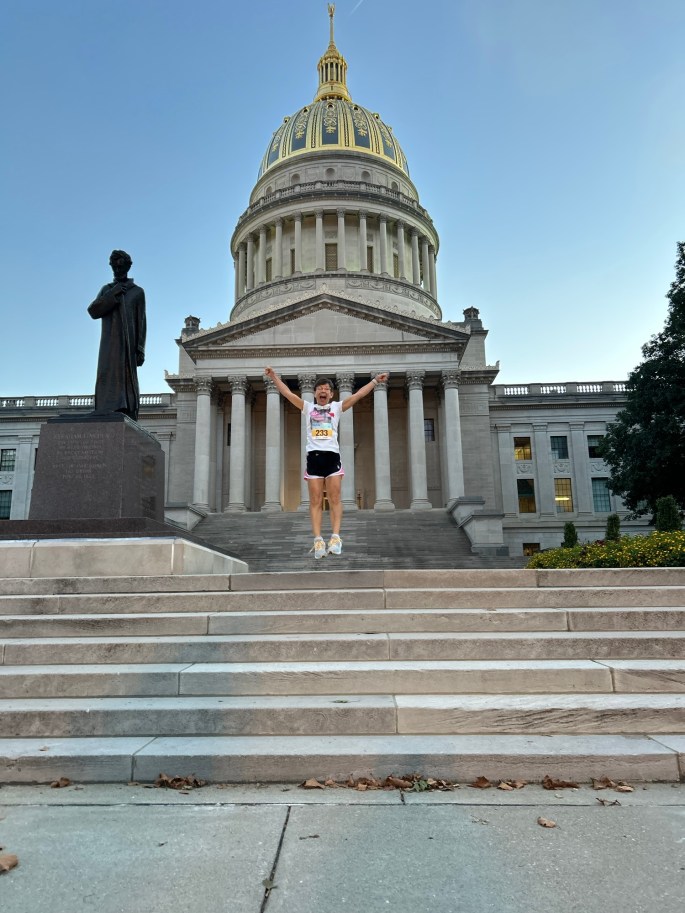
The CDC starts in front of the state capitol of WV.

A Quote to Carry Me to the Start

Dean Karnazes is often credited with saying, “Run when you can, walk if you have to, crawl if you must; just never give up.” His words echoed in my mind while I was experiencing a case of collywobbles as my family and I drove to Charleston, WV, in the predawn hours of Labor Day weekend. Only weeks earlier, I had decided I had built enough base fitness to run the Charleston Distance Classic (CDC), “America’s 15-miler.”

A joyful runner in a race, wearing a white shirt with a 13.1 badge and black shorts, excitedly posing with a water bottle while making a peace sign.
Ready to run the CDC!

Returning to the Classic After Ten Years

It had been more than ten years since I last ran it. In my previous two runs of the CDC, the weather was formidable, with the typical August heat wave bringing high heat and humidity. In fact, it wasn’t unusual to see runners collapse on the course—or cross the finish line only to collapse into the arms of medics from heat exhaustion.

Two women pose together smiling in front of a large government building with a golden dome, one wearing a race bib and athletic attire while the other is in casual sportswear.
My daughter was texting me messages of support throughout the race, so Siri could read them to me in my ear as I ran.

How Running Has Changed for Me

Life was different ten years ago. Besides being younger, I was fairly new to running and relied heavily on veteran runners for guidance. On one hand, I was fortunate to have others with whom to train; on the other hand, I didn’t yet have the aerobic base they had built over years. Plus, when I started running, I gave up strength and flexibility exercises, which I now know would have helped me. Instead, I focused on keeping up with others and hitting the weekly mileage goals.

Runner stands on a swing-shaped structure in front of the West Virginia State Capitol, smiling and wearing a race bib, under a clear sky.
Ready to swing into action.

Building Balance and Training for a MarathoN

Over the past decade, I’ve taken breaks from running—first from burnout, when I missed other forms of exercise. I rotated through strength training, yoga, walking, and cycling, always circling back to running. The pandemic brought running back to the forefront, as gyms and studios were closed.

Since then—and one major surgery later—I’ve learned to build a more balanced approach to exercise that includes a wide array of modalities, running among them. I exercise now for the joy of movement, as well as overall wellness. Still, I enjoy the discipline of a challenge. This year, in honor of another decade milestone, I’m training for the Marshall University Marathon (MUM)—the full 26.2 miles. Rather than follow a standard 16-week plan, I began in January, gradually building my aerobic base.
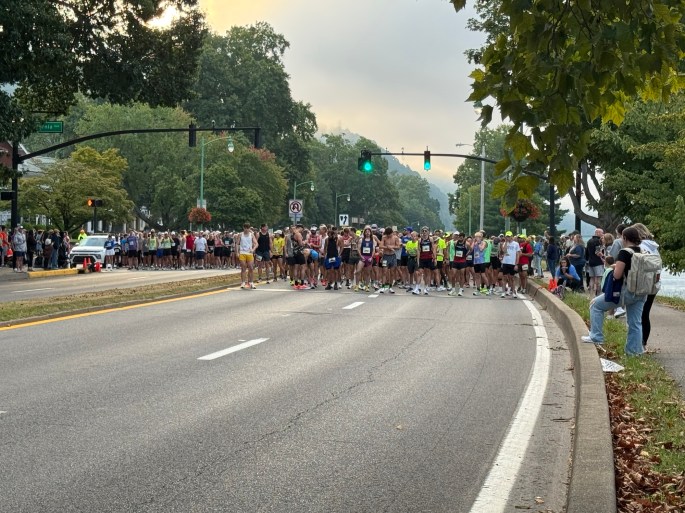
Runners lined up at the starting line of a race on a road, with traffic lights and spectators in the background.
The starting line for the CDC.

A Perfect Day to Race

It was this extended training that gave me confidence to run the CDC again. In addition, the weather worked in my favor. Temperatures were in the 50s when the race began in front of the state capitol. Running along the Kanawha River in the first mile, runners quickly spread out as paces varied.
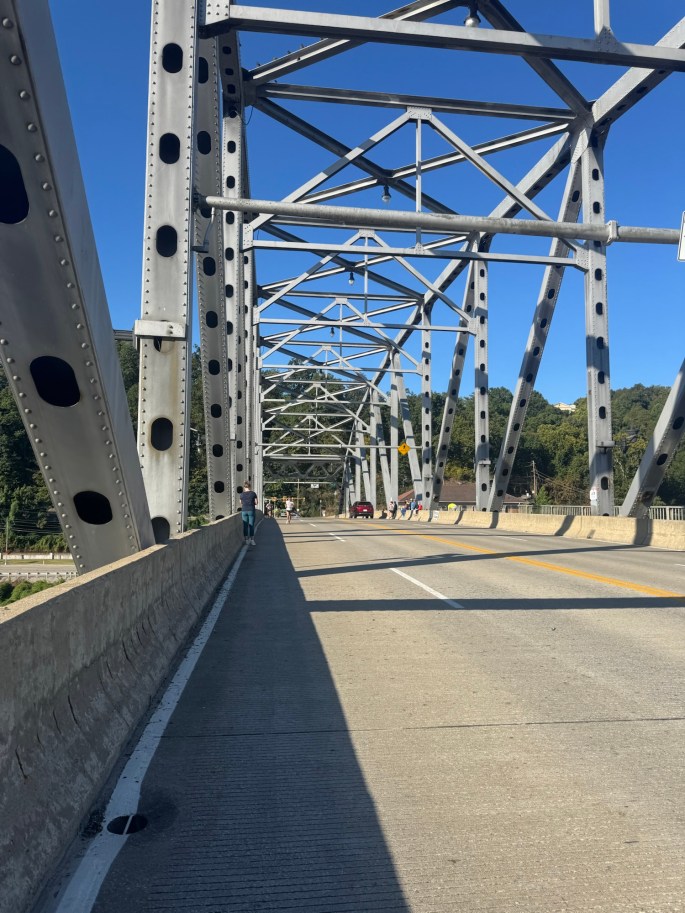
View of a bridge with steel beams and a roadway, featuring a few pedestrians in the distance.
The South Side bridge, which runners crossed twice–near mile 3 and again at mile 8.

“Capital Hill PUnishment” and the Course Challenge

Before long, we crossed the South Side Bridge and began the long trudge up Corridor G, aptly nicknamed “Capital Hill Punishment”—two miles of climbing. As if that weren’t enough, the course then wound through three hilly miles of Charleston’s South Hills neighborhoods. By the time we returned to the South Side Bridge, eight brutal miles were behind us. The final seven were mostly flat, except for one last incline near the end—just when our legs were good and toasted.

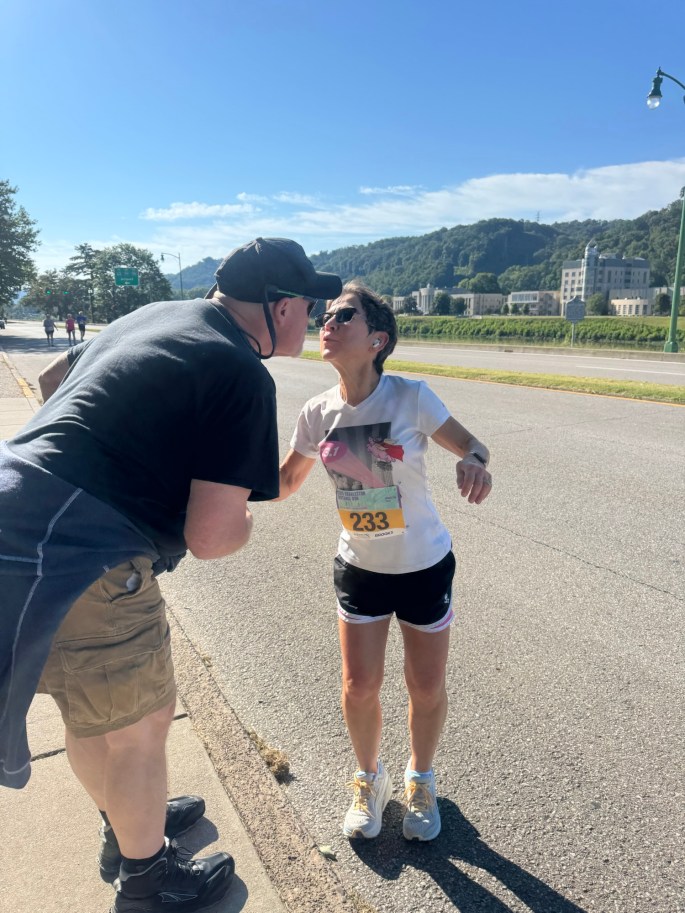
My Cheer Squad: John and Maddie

The CDC is a great spectator race, and I was lucky to have my husband, John, and daughter, Maddie, there. They were tireless cheerleaders, walking all over Charleston to encourage me. At the start, Maddie urged me on with excitement. At mile eight, as I crossed the South Side Bridge for the second time, she even ran alongside me for a short stretch, offering encouragement.

Between miles 11 and 12, they found me again, cheering and taking my empty handheld water bottle—by then more of an annoyance than a help. At Laidley Field, Maddie’s voice carried as soon as I stepped onto the track, her shouts of encouragement giving me the final push.
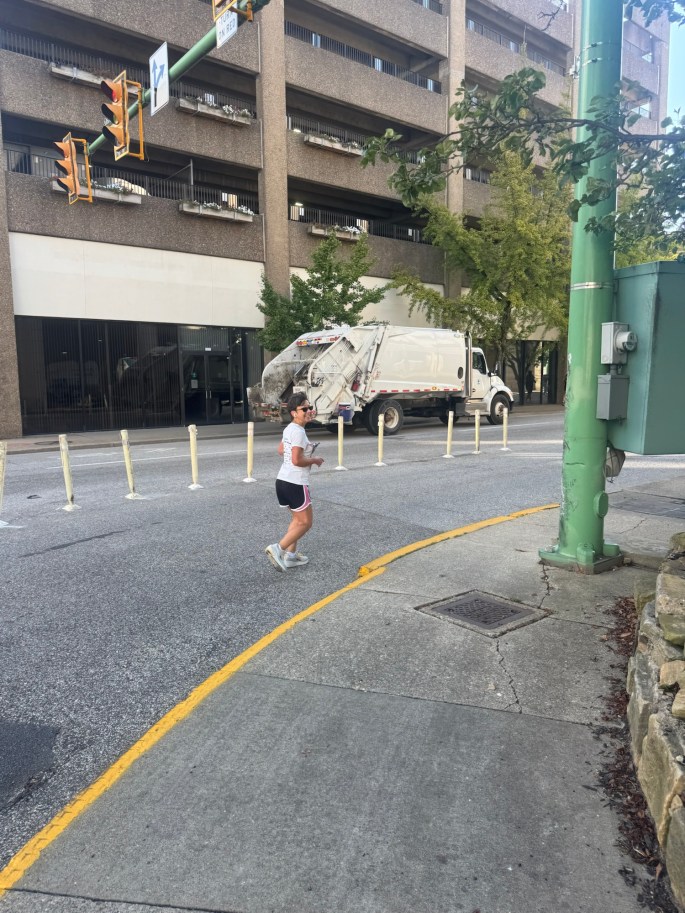
A person jogging on a city street with a garbage truck parked nearby and a multi-story building in the background.
This was mile 8. Afterwards, there was mostly flat course, EXCEPT for a last incline during the very last mile before the finish line. UGH!

Lessons from the Endless Last Mile

Honestly, that last mile seemed endless, and I learned a powerful lesson: even the final mile is still a mile long. My mental discipline slipped, and the fortitude that carried me there begged for rest. I grew whiny and irritable, which only amplified the aches and pains I had managed to ignore until then. It reminded me of my reaction in the last mile of a half marathon I ran this past spring in Asheville, NC.

Scenic view of a riverbank with lush greenery, walking path, and a bridge in the distance under a clear blue sky.
The beautiful Kanawha River that flows through Charleston, WV.

Strengthening My Fortitude

That last mile taught me what I must carry into the last weeks of marathon training: when the long runs get longest, I need to focus on strengthening my fortitude—especially at the very end. This, for me, is the hardest part. I try to follow the advice of Olympian Jeff Galloway (who is also credited with establishing the “Run-Walk-Run” method) to smile at each mile marker—since smiling releases those feel-good chemicals and helps relax the body. He also suggests repeating a mantra or power word. Perhaps I need to lean into this more.

Remembering My “Why”

I also need to remind myself of my “why” when the going gets tough. With the MUM, I hope to raise awareness for Branches Domestic Violence Shelter. Branches provides emergency shelter, legal assistance, counseling, case management, and even meal delivery for domestic violence survivors. Their work saves lives. If my miles can help encourage even a few people to support them, that will mean as much to me as crossing the finish line.
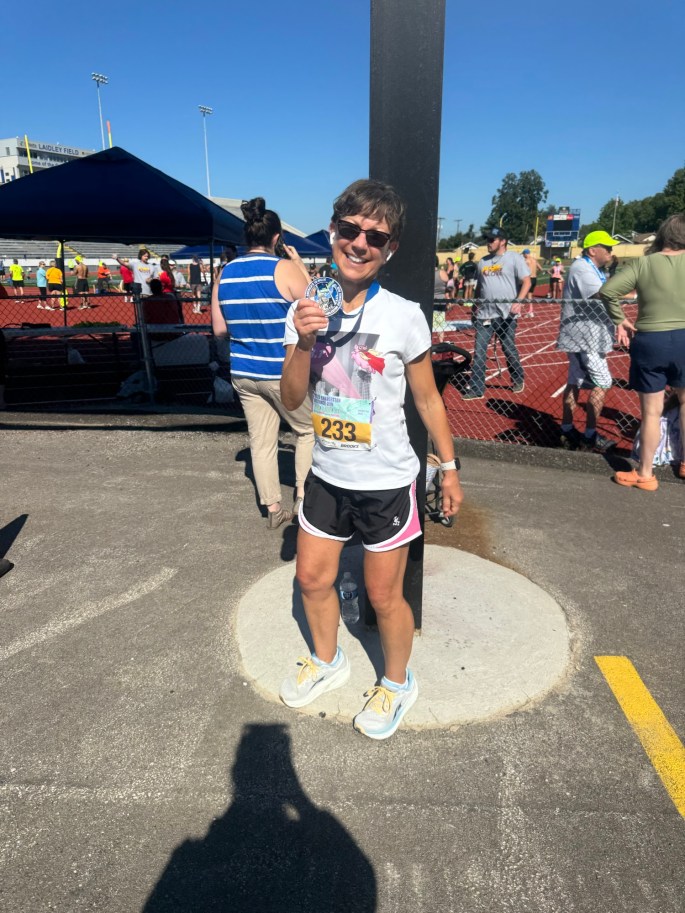
A smiling woman holding a medal, wearing athletic clothing, stands next to a post in a race finish area, with a crowd and tents in the background.
Feeling so grateful for my family, love, and support at the end of the CDC.

Running Differently, Running with Gratitude

Ten years later, I run differently. I take walk breaks when needed, and I’m grateful to still have my health. Running gives me energy, provides structure, and fills me with joy and purpose. Not every run is great, but each mile contributes to my community by keeping me connected to local races and to my own mental, physical, and spiritual well-being. Running also pulls me outdoors, connecting me with the Creator and with the delight of each season.

Never Give Up—In Running or in Life

Running the CDC reinforced the lesson of never giving up. I may be entering a new decade, but that doesn’t mean I have to give up striving for new goals—even if it means crawling to achieve them. Perhaps I’ll see you at the MUM. If not, I hope you’ll create your own journey. Either way, I invite you to celebrate with me—by supporting Branches or by committing to your own goal. Adjust as you must, but never give up. Step by step, with fortitude, tenacity, and a few deep breaths, you can do it.

A running event starting line with an inflatable arch labeled 'Appalachian Timing Group' on a red track, set against a clear blue sky and distant hills.
Never give up! You can cross whatever finish line in life you need to cross!

Surrender to the challenge and be liberated

“I’m noticing the difference between surrender and resignation.  One is a true letting go, the other is believing I am powerless.”–Andrea Scher

Balancing Act ⚖️

Like numerous other professions, my job in education brings with it unique challenges each year. It is not just the day-to-day, week-to-week dilemmas, but it’s the balancing act between the demands of work and the demands of life.  Additionally, like many jobs, the demands of work cannot be met within the confines of the scheduled work day.  While the work day may officially end at 3:30, there is no way to complete all the work within those hours. 

Thus, there is that predicament daily, and on weekends, of how to accommodate it all. Work and personal life demands are a jigsaw puzzle in which the pieces don’t always fit together.  If I put a piece into the frame of work, then it seems to take away from the frame of personal life.  Inside my head there is an image of how it should all blend seamlessly into one harmonious picture, but the reality is often an abstract palette of discordant images.

Photo by Andrea Piacquadio on Pexels.com

Solving the Puzzle of Time 🧩

How often do we feel the weight of: how to put the pieces together today?  One of the keys, I’ve discovered, to balancing work and life is to take it one day at a time. To be sure, that sounds cliché.  However, by focusing solely on one day, as part of the whole of the equation, it can often allow me to discern what must be done vs what needs to eventually be done.  Then it is a matter of focusing on one unfolding moment at a time.  If we can choose to surrender to the fact that we are facing challenges that cannot all be completed in one day, we can begin to let go of the attachment to “how it should be” and the picture-perfect image of “what it should look like.” 

  Attaching to that ideal image of “this is when and how it will be” is often the source of suffering and stress.  It is only human nature–especially in the current social media world in which we live–to visualize how “perfect” it will look/feel when we complete X, Y, and Z.  However, most of the time, at least in my experience, life tosses in some sort of unpredicted bollix, and suddenly that flawless finish is unattainable–as if it was ever possible to begin with! 

Photo by Elina Fairytale on Pexels.com

The Strength of Surrender 💪

I have found that the notion of “surrender”is often associated with giving up, giving in, or acquiescing to a lower standard, but that is just our ego talking.  Furthermore, surrender is not a resignation either, which can sometimes lead to feelings of bitterness, anger, and resentment because you can’t “have it all” as popular culture and social media would have us believe. Instead, surrendering to the fact that you “can’t do it all” actually takes strength.

Nonetheless, choosing to ignore the mind’s ego can feel vulnerable and scary. It takes a real act of courage to surrender, and let go of our attachments. But, once we decide to release the ego’s messaging, we begin to allow ourselves to be led inwardly by a higher power, our True Source.

The water of this creek winds and bends over its rocky bed demonstrating the difference between ease and easy.

Ease into the challenges one by one 😌

Surrendering lightens our load and allows our day to flow with more ease and much less tension. That is not to say our day will suddenly become easy, there will still be challenges, but we can feel free from the binds of stress that come with ego-driven motivation. When we let go of the ego’s attachments, we are recognizing our true personal worth–we so much more than what we do.  

Ignoring our ego is an act of love and faith, not only in our abilities, but it is also a willingness to recognize that all those perfect images are just that–images, not the reality that social media often leads us to believe. Letting go of that attachment is an act of faith and a willingness to believe that we will be inwardly led by our intuition in harmony with our higher power.  

Surrendering gives us permission to let go of all those perfect images our ego attaches to.  We can begin to recognize that we are safe, despite the ego’s messaging that can falsely have us believing that, if we don’t achieve said-thing by said-time, we are failing.  Instead, surrendering says, we are trusting the way will be provided; and therefore, we can and will choose wisely.  Surrendering allows us the freedom to walk the path of life’s pavestone moments, step-by-step, stone-by-stone, knowing that when the time is right, all will come together as it should.

There are times of the year when even the trees quietly and gently let go of their colorful adornment, demonstrating the art of detaching from ego.

The ARt of Detaching 🍂

It’s about letting go of control. (We never had it to begin with anyway.)  It’s as simple as breathing.  Inhale. Exhale.  One moment at a time.  One step at a time.  One priority at a time. Trusting that just as each breath provides us with life, our path will ultimately be paved in its due time

The power of surrender is not weak as our ego leads us to believe.  Instead, it liberates us to stand in our strength by expelling all the tension, fear, anxiety, stress, and suffering attached to the ego’s. “This is how and when it should be.” It is the difference between closed fists trying to muscle their way through a situation, versus relaxed hands, flexibly handing each moment as it comes.

The energy of surrendering is only a breath away. Inhale energy for life’s next moment. Exhale, and release the tension attached to how it should be.  Surrendering to the moment can really be that easy. It is our ego that makes it so hard.  Inhale. Exhale. Surrender to your inner-knowing. The Breath of Life will provide.