Embracing Silence: The Owl’s Call to Mindful Listening

A wise old owl sat on an oak;
The more he saw the less he spoke;
The less he spoke the more he heard.” —old proverb

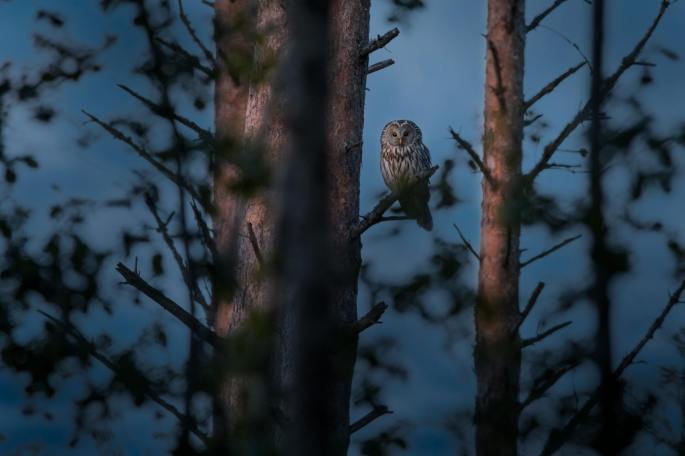
A wise-looking owl perched on a branch in a dark, wooded area, illuminated softly by moonlight.
Photo by Erik Karits on Pexels.com

Listening in the Dark 🌌

I am an early riser, typically awake before the sun. A few weeks ago, my ears perked at the haunting, penetrating call of an owl. Its “Hoo-hoo-hoo, hoo-hoo” echoed around our yard as I looked out into the murky dark. Since then, I intentionally listen for its steadfast call. It has become both a comfort and a mystery—an invitation to listen, reflect, and learn something new.

The owl’s call continues, I am certain, even when I am not listening; yet it requires my full attention in those predawn hours if I hope to notice it regularly. Its presence illustrates the importance of listening and discerning with care and purpose.
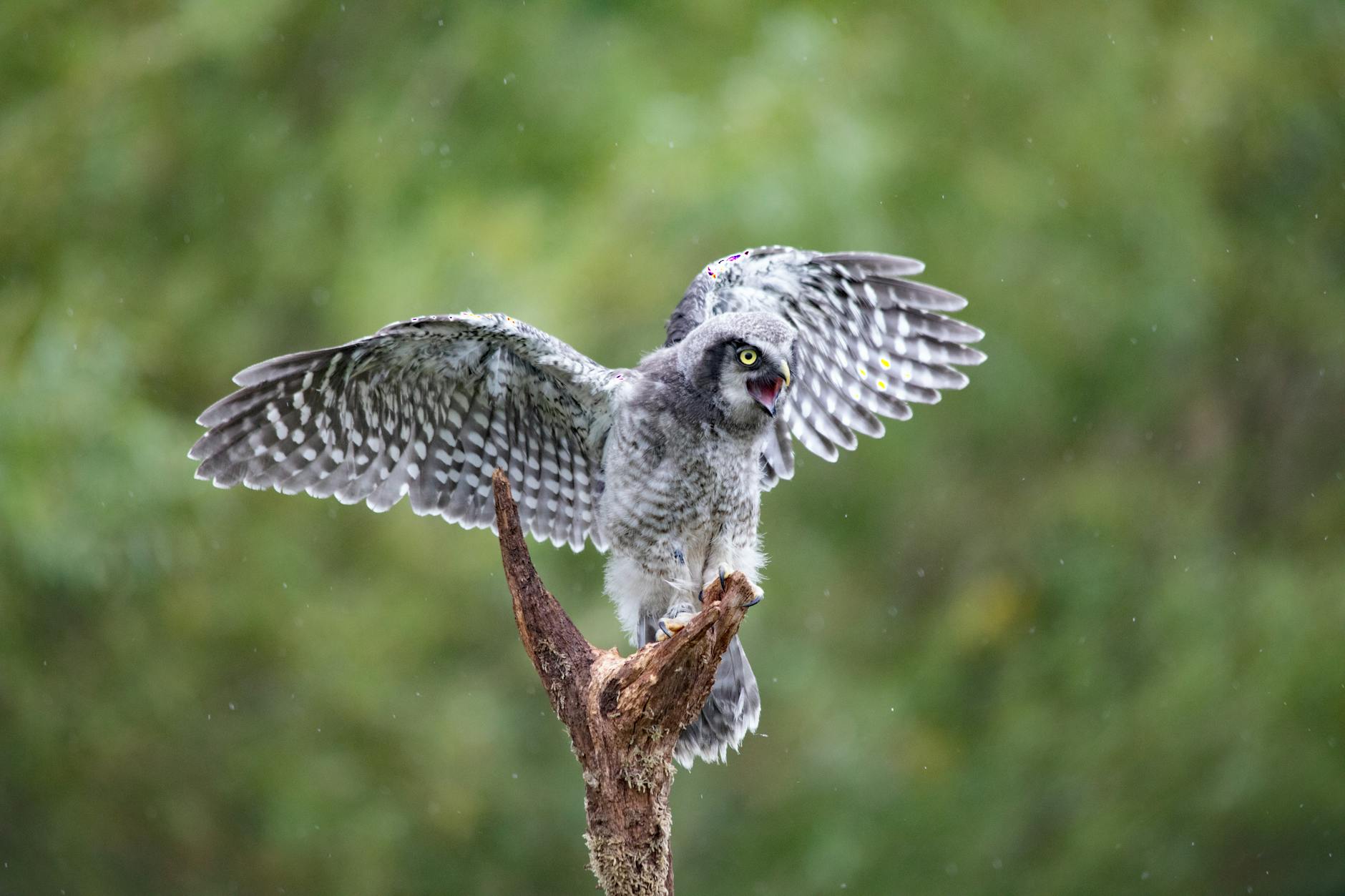
A grey and white owl perched on a branch with wings partially spread, showcasing its feathers and an alert expression against a green blurry background.
Photo by Petra Ryan on Pexels.com

What Owls Teach Us About Voice 🗣️

The autumnal hoots I hear, I learned after a bit of research, are used mostly to communicate territory and to call to potential mates. (It is worth noting that many owl species mate for life, finding another only if a partner dies or becomes separated.) Owls also use distinct calls to warn a mate, their nestlings, or even neighboring owls when danger is near. Only when the threat is imminent do they screech, hiss, or snap their beaks in defense of their young. Like the owl, we, too, can carefully choose when to use our voices amid the noise of the world, saving our own form of “screeching” for the rarest and most necessary moments.
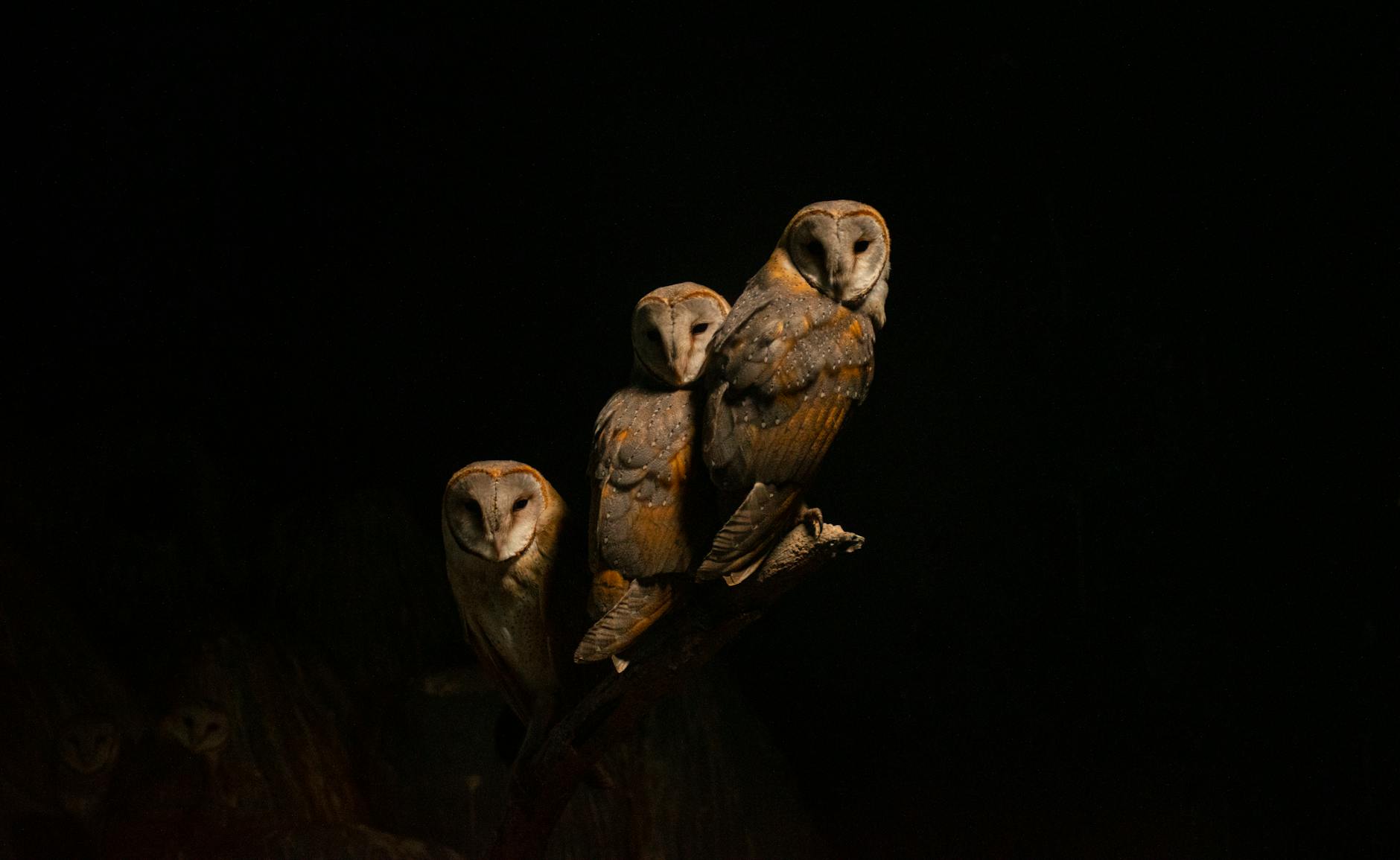
Three barn owls perched on a branch in low light, showcasing their distinctive features against a dark background.
Photo by throughmylife_in_ INDIA on Pexels.com

Signals of Respect and Coexistence 🦉

As I read more, I couldn’t help admiring how owls communicate—practically, respectfully, almost as if to say, “I am here. You are there. Let us coexist with our shared resources and help ward off danger.” To be certain, I am personifying and simplifying their communication, but perhaps there is a lesson for us. In a world that often isn’t equitable in its distribution of resources, space, or power, maybe we can learn the art of signaling like owls—communicating truthfully and transparently without silencing others. What if we approached our conversations with presence, restraint, respect, and a shared awareness of the landscape we inhabit?

Holding Our Ground with Grace 🙏

Hearing the owl’s early morning “Hoo-hoo-hoo, hoo-hoo” reinforces the importance of holding our own ground—our principles, values, beliefs, and even compassions—without becoming loud or defensive. The owl does not insist on being seen; rather, it asserts its message with a reserved dignity. We, too, can claim our “territory” through composed conviction and fairness, standing firm without demeaning others. Faith in our tenets, like my unseen morning owl, calls us to trust what cannot be seen but can be discerned only in stillness.

A tall tree with orange leaves against a clear blue sky, surrounded by a grassy area and a house in the background.
Fall is a time of release and renewal.

Autumn’s Invitation to Adapt 🍂

Autumn is a season of release and preparation. Light softens, signaling leaves to fall as trees ready themselves for winter’s quiet work. Many creatures follow this rhythm, including the owl in my backyard adapting to the shifting season. We, too, are invited to adapt—to let go of what is no longer needed, recalibrate our priorities, and listen more deeply. The natural world thrives on balance, which is different from our human desire for “fairness.” It exists in a subtle harmony in which every being plays a role. I wonder what might happen if we focused more on harmony—the give-and-take of shared ecosystems and resources—paired with the wisdom of knowing when to listen and when to speak.

A woman in a pink hijab interacts playfully with a barn owl perched on her arm, pointing towards its face, with another owl visible in the background.
Photo by Rangga Aditya Armien on Pexels.com

The Harmony of Coexistence 🕊️

The autumn owl’s voice in my backyard is solitary, and yet it reflects community. It marks its presence while acknowledging the presence of others, including us. Coexistence, the owl teaches, requires more than hearing what others say; it requires listening to the silences. Of course, human coexistence is complicated, and life often isn’t what we would call fair.

Therefore, it becomes incumbent upon us to listen, act kindly, and withhold judgment—offering small or not-so-small acts of goodness to help restore balance. This may mean choosing gentleness, or even silence, over the need to be “right,” especially when a loved one, friend, or coworker says or posts something unkind or expresses an opinion we strongly oppose. Likewise, offering compassion instead of judgment when someone is rude or ill-behaved can shift a moment for the better, even if only because we have refused to be pulled into energy-sapping negativity.

A serene forest scene with tall trees bathed in soft rays of sunlight filtering through the branches, creating an ethereal atmosphere.
Photo by Atlantic Ambience on Pexels.com

Before the Light Returns 🌅

The owl still calls unseen in the dark predawn hours, reminding us that communication, connection, and hope often begin before the light returns. The owl does not question whether the sun will rise; it simply continues its call, trusting the rhythm of creation. Like my unseen neighbor, I pray we find the courage to speak fairly, listen deeply, and have faith in the unseen process—knowing that every voice lifted in love and fairness echoes far beyond what we can see.

Perhaps that is the heart of the owl’s lesson: when we listen more deeply, we create the conditions for fairness to grow. As I recently read, “Life isn’t fair. It isn’t, which is why people should endeavor to be more fair to one another, not less.” —Kate Quinn.

The Power of Whitespace

Whitespace should not be considered merely “blank” space — it is the element of design that enables the objects on the page to exist.–The Segue Creative Team 

As a middle school Reading/Language Arts teacher for grades 6-8, I spend a good portion of my time teaching various writing techniques.  Currently, in my 7th grade classes, we are focused on writing various styles of poetry with the emphasis on exploring various elements of figurative language techniques and literary devices.  Of particular importance to writing poetry, I believe, is to draw the reader into an image/story/feeling in the way a good song has the power to  draw in the listener and attach a particular feeling/image to it. 

Part of the skill in writing a relatable poem is not only using specific words, figurative devices, and imagery, but also incorporating the power of white space.  In the same way my grandmother taught me that our eyes eat food before we taste it, a poem should likewise draw readers’ eyes into the arrangement of the piece first.  In order to do that, writers must learn to use the white space.

Photo by Du00f3 Castle on Pexels.com

Whitespace 

Creates

Balance and  Style

Although it is often called “negative” space, there is nothing negative about appropriate use of white space.  In fact, when duly used, white space increases readability–up to 25% according to some sources.  White space provides breathing room for the reader, a purposeful pause, or point of emphasis. It can create a sense of balance, harmony, and style.  The eye has time to “catch its breath” and focus on the meaning of each line, word, phrase.  A sense of play, intense emotion, or serious tone can also be emphasized and enhanced through the appropriate use of white space–adding power and emphasis to select words.  By giving students permission to incorporate white space, they are more focused on words that are specific and succinct.  This is an important and transferable skill when switching to more formal writing styles that require a clear, concise, and compelling writing style. 

Whitespace is THE fundamental building block of good design . . .  provides visual breathing room for the eye.–The Segue Creative Team

Photo by Robin Schreiner on Pexels.com

On a recent long Saturday morning run, it occurred to me that the notion of white space, as a mental construct, is underused and undervalued in our daily lives.  It is one of the things I most appreciate about my longer weekend runs is the fact that it gives me permission–and time–to let my mind wander.  Many, if not most, of my weekday runs are completed on a treadmill before I do a few strengthening exercises.  During these workouts, I typically wear headphones to listen to music, podcasts, or audible books–depending upon the workout and my mood/interest.  However, when I run outside, I rarely wear headphones; and thereby, I experience the freedom of mental whitespace.

Much of our daily life is consumed with some form of media content consumption.  From the time we get up and, quite often, until we go to bed, many of us are continually interacting and engaging with screens.  Emails, social media, work, news, even cooking, project-building, and other how-to content require some form of on-screen encounter. From content that is audible, to content that is visual, to an interplay of both, much of human interaction is now completed on-line.  As a result, our mind has become trained to repeatedly and frequently seek points of what I call distracted-focus.  Furthermore, it has never been easier to do this at any time, day or night.

Photo by PhotoMIX Company on Pexels.com

As society’s utilization of technology changes, shifts, and evolves, our minds have been forced to adapt.  Our phones wake us up, and while I can never do this for fear of falling back to sleep, I am told that many people remain in bed for several minutes, and upwards to an hour, upon waking, scrolling through media content that happened during those hours devoted to sleep. While we drive our kids to school, they are busy with screens, and we are engaged in handsfree calling or texting.  Once at work, many of us, myself included, utilize multiple devices at once as our eyes and minds shift back and forth from screen to screen, and, depending upon your career, from person to person.  At day’s end, despite eye fatigue and even brain drain, our minds still desire to scroll through social media and news outlets as the brain, like a tired toddler, still craves even more stimulation to keep going.  In a sense, our minds have become the proverbial “Energizer bunny,” continually banging on the drums of our consciousness for more, more, more.

Whitespace not only creates harmony, balance, and helps to brand a design. . . .–The Segue Creative Team

Photo by Pixabay on Pexels.com

Personally, I need breathing space, and I honestly believe that most of us do.  Time away from screens, schedules, and scintillating images/demands.  Unplugging from the visual and auditory distractions of our devices, provides our brain with whitespace–the space to pause and breathe.  I liken it to opening the door and letting a child, or even a pet, go outside to run off steam at the end of the work/school day. When you unplug, it frees the mind to mentally roam or simply be still.  By unplugging, you begin to notice the sounds of nature or even household appliances.  Unplug, and you might see things through new eyes–eyes that are fully focused, rather than distracted.  Unplug, and your senses have permission to roam–noticing the way air caresses your face, the aromas of your surroundings, the full flavor of your coffee, or other favorite beverage, as it dances over your taste buds.  Unplug, and you can breathe deeply and luxuriously as if you have all of the time in the world. Even your ability to think creatively and/or problem-solve increases more when you unplug.

Photo by Asad Photo Maldives on Pexels.com

In the same way white space creates harmony and balance to the design of a web page, book, or even a 7th grade poem, creating “white space” moments in life, allows us to also feel more harmonious, balanced, and perhaps even, peaceful.  As a deep breath or sigh is gratifying to the lungs, and bring calmness to a tough moment, time unplugged offers the mind moments to rest, refresh, and recharge, providing you with more clarity and the ability to focus on what’s really important as well as give you permission to see the extraneous for the distractions they actually are. 

 It doesn’t matter if you take a break from screens inside the comfort of your own home, or outside in fresh air, unplugging and not-doing, is never a waste of time, or well, waste of space.  I especially enjoy unplugging when I am outside for a run, walk, or hike, but I also have found white space moments in the quietude of a car with all distractions turned off, including radio, or in the quiet moments of my home when others are still sleeping or momentarily out.  The ability to unplug may not occur every day, but white space of the mind, be it vacations, exercise, hobbies, or other down-time moments, judiciously scattered throughout the week and/or even month, offers innumerable benefits and is certainly worth prioritizing.  

In the same way white space creates harmony and balance to the design of a book or web site, creating "white space" moments in life, allows us to feel more harmonious, balanced, and perhaps even more peaceful.
Photo by Mabel Amber on Pexels.com