Running Toward Hope: A Marathon of Movement and Love

“Every run is a work of art, a drawing on each day’s canvas. Some runs are shouts and some runs are whispers. Some runs are eulogies and others celebrations.”—Dagny Scott Barrios

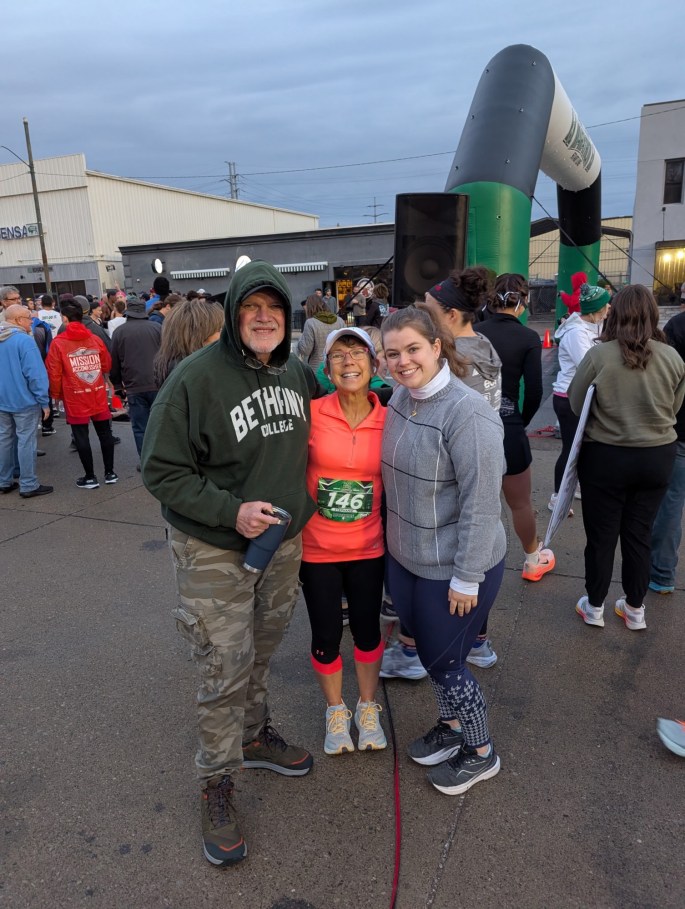
A group of three people, including a man in a green hoodie, a woman in a bright orange top with a running bib, and a woman in a gray sweater, gather smiling at a running event in an outdoor setting with other runners in the background.
Just before the start of the marathon I took time to get a hug from my two biggest supporters throughout the training process: my husband, L, and my daughter, R.

A Morning of Reflection and Gratitude 🌅

A light mist fell as an overcast gray morning began to chase away the night. I stood quietly in a throng of animated runners, taking deep breaths as reflection and gratitude washed over me. Months of preparation had led to this moment, and I felt thankful not only for my health but for the loving support that carried me here—to this celebration of movement, resilience, and connection.

Running as an Act of Hope ✨

It had been ten years since I last pinned on a bib for this distance, and my body hummed with anticipation, hope, and belief—the belief that movement is for everyone at every age, and that it is, in itself, an act of hope. I was about to embark on an emotional 26.2-mile trail of faith that became more about the people who supported me than the miles themselves.

Discovering Joy in Gentle Movement 😄

I came to running later in life, and it wasn’t easy at first. Only when I learned to approach running gently—to let go of preconceived (and societal) notions of what running “should” be—did I discover paths full of freedom, clarity, and renewal. Movement, whether running, walking, dancing, or stretching, benefits body, mind, and spirit. It brings a sense of structure to an often chaotic world and offers a feeling of accomplishment—if nothing else goes right in a day, at least I moved my body. Movement brings us alive to ourselves, our spirit, and, in turn, to the world around us.

The joy, I’ve learned, is in the doing—not in attaching to a pace, distance, or goal. Those things can be part of the experience, but they aren’t required.

A man and a woman embrace warmly in a crowded setting, both smiling in a moment of connection before a marathon.
Maddie’s, my daughter, boyfriend, Connor, flew all the way from Austin, TX to be part of this event. Together, with Maddie, he helped plan the marathon surprise of a lifetime!

Redefining What It Means to Age 🧓

As I neared my 60th birthday, I began to notice messaging that framed this decade as one of limitation. I decided instead to flip the narrative and celebrate the 60s as a decade of possibilities. Why not run into this new decade the way I ran into my 50s—with eyes and arms wide to adventure?

Training with Gentleness and Grace 😌

Since I was already running regularly, I committed to training for a marathon, but this time with gentleness. Instead of a traditional four-month build-up, I created a ten-month plan that encouraged patience, routine, and presence. Twice-weekly strength training and yoga joined the schedule, as did listening to my body and using the run-walk-run method as needed. I also focused on proper hydration and fueling before, during, and after runs. Most of all, my husband and daughter supported me from the very beginning—their quiet, everyday encouragement becoming a steady foundation of strength.

A woman running on a street wearing a bright pink long-sleeve top, black leggings, and a cap, displaying a race number on her waist.
Gentleness was a large part of the 10-month training block that led to this moment of hope and celebration.

Adapting Through Life’s Curveballs 😰

Training for a marathon brings rhythm and structure to daily life—the early morning runs, the long weekend miles that lengthen gradually, and the sweet evening stretches after dinner. But life, of course, has its curveballs: weather shifts, fatigue, scheduling conflicts, unexpected events, and bouts of self-doubt. With age, though, I’ve learned to adapt rather than resist these realities, co-creating a practical, flexible approach to progress.

As my weekend long runs grew longer, my husband and daughter often appeared—driving by, stopping to cheer, or jogging beside me for a short distance. These small bursts of love in action fueled my heart and kept me going. Training, I realized, was less about mileage and more about cultivating fortitude, flexibility, and gratitude—along with a dash of fierceness—all essential life skills carried from the road.

A group of enthusiastic spectators cheer on runners during a marathon, surrounded by autumn foliage and a partly cloudy sky.
Maddie, and my husband, John, often showed up during the last few miles of my Saturday long runs to cheer me on as Maddie is seen here doing during the actual event itself.

Race Day: A Celebration of Love 💖

As the marathon began, the city of Huntington vibrant in energy, rebelling against the lackluster sky. Rhythmic footfalls and nervous chatter surrounded me as runners jostled for position. Warmly dressed spectators cheered, waving handmade signs against a backdrop of burnished orange, crimson, and yellow autumn trees. Little did I know that my daughter had turned this event into an outpouring of love.

Surprises Along the Course 🫢

At the start, my husband, daughter, and her boyfriend—who had flown in from Texas to surprise me—stood cheering. But that was only the beginning. Every few miles along the route, my daughter had arranged for friends, family, and coworkers to appear, waving signs and calling my name. I didn’t realize the scope of her plan until near the end, but each familiar face filled me with renewed energy, gratitude, and joy.

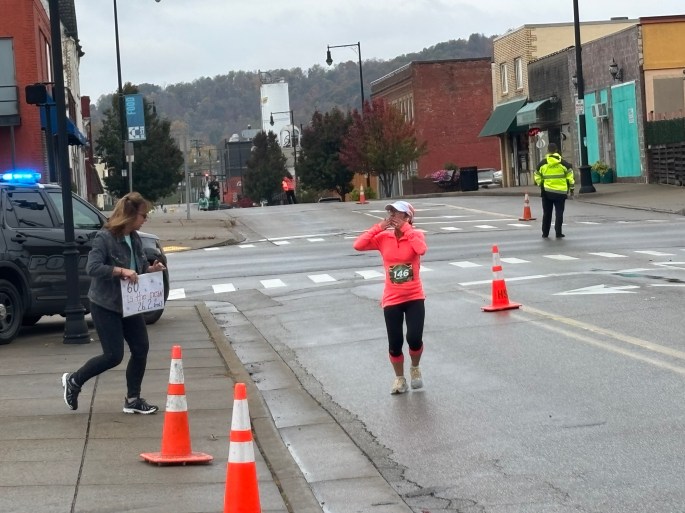
A female runner in a bright pink shirt crosses a street marked by traffic cones, while a supporter holds a sign nearby in a lively downtown setting.
The look of complete surprise when I see my sister, Traci, and her husband, David, around the 19-20 mile mark of the marathon. I had no idea they would show up along the route!
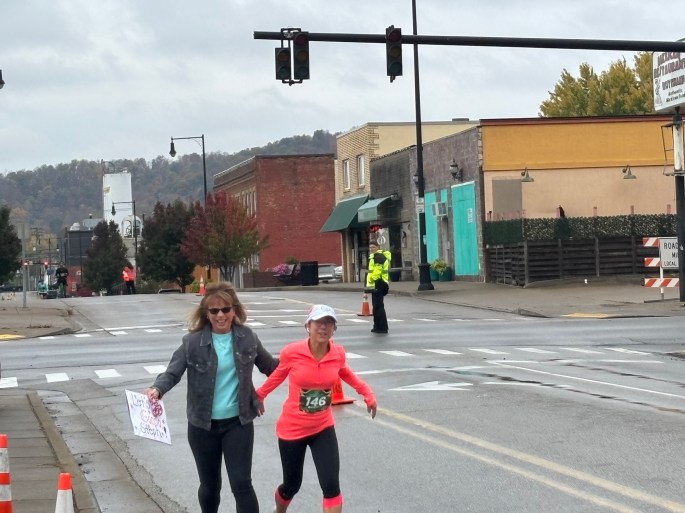
Two women running together on a city street during a marathon, with one holding a sign. They are surrounded by a lively atmosphere and shops in the background.
Of course, I had to veer off the path to give her hug, which helped uplift me over the next few miles.

Crossing the Finish Line 🏁

As I turned toward the final quarter mile, a group of race volunteers began singing “Happy Birthday” while my daughter’s boyfriend joined for a short burst of encouragement. My husband stood outside the stadium offering final words of encouragement, and my daughter met me at the bottom of the stadium ramp to run beside me as I approached the finish line. I wasn’t just completing a marathon; I was receiving the best birthday gift—a living reminder of love: a convergence of community, family, and friendship. It was a story of hope, purpose, generosity, and perseverance—the joy and power of a shared journey.

Two volunteers wearing bright reflective vests stand by a crosswalk in a park-like setting with blooming flowers and trees. In the background, a pathway leads towards a building under a cloudy sky.
This was the point, less than a quarter mile to go, when a group of race volunteers, led by an unknown female spectator and Conner, joined in to sing “Happy Birthday” to me as approached and rounded the corner to the finish line.

The Marathon as a Metaphor for Life 🪞

This journey mirrors life: we move forward by faith and grace, one step at a time, through both joy and challenge, supported by others who believe in us. That’s the power of movement—it connects us to our bodies, to others, and to something larger than ourselves. Choosing to move, to train, to keep going even when the path feels long, is an affirmation that with faith, growth and renewal are always possible—at any age.

Movement as a Lifelong Invitation 💌

Movement can take many forms: walking, stretching, dancing, or choosing to train for something big. The point is to move with intention and persistence, to embrace your own journey, and not attach to societal and social media messaging. Just move—and let movement open the door to new possibilities, both inner and outer.

A runner crosses the finish line at a sports stadium, with spectators in the stands and a clear blue sky overhead.
Maddie runs alongside me for the last few feet, just as she did in 2015, to encourage across the finish line. Once I was close to the finish line, she dropped back behind the rope to let me finish alone. However, I really wasn’t alone. I was surrounded by a giant embrace of joy, hope, and love of family, friends, and community!!

The Joy Continues ☺️

The rhythm of footsteps, the smiles for miles, and the faces of loved ones along the route are forever imprinted in my heart—all reminders that every step matters. The marathon finish line was crossed, but the renewed sense of possibility and joy continues. Whatever your pace or path, keep moving forward—heart, mind, and spirit. You never know what acts of hope and love may be waiting for you along life’s path.

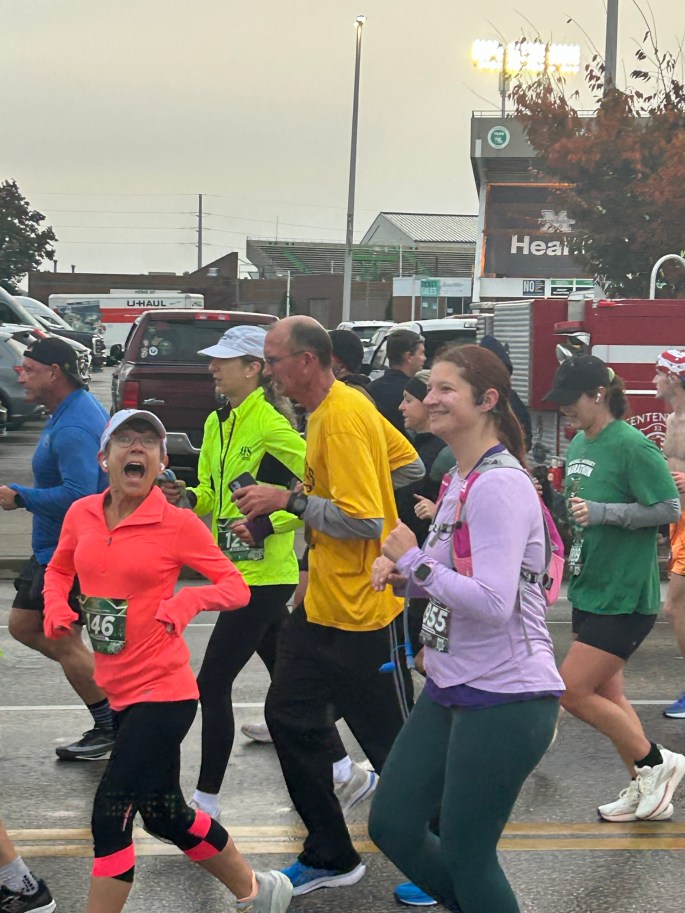
A group of runners participating in a marathon on an overcast morning, with diverse individuals wearing colorful athletic clothing and cheerful expressions.
The joy, and the journey of love and hope, continues . . .

A Grateful Heart 💜

P.S. Thank you to the countless and nameless MUM volunteers who invested hours of time to ensure the safety and success of runners, walkers, and those beloved spectators. And, an extra special heartfelt thank you to my friends and family who celebrated this milestone with me. And to Maddie and John, I love you to the moon and back.

A group of three smiling individuals taking a selfie on a subway or train, with a map visible in the background.
I wonder where the next path of adventure will lead?
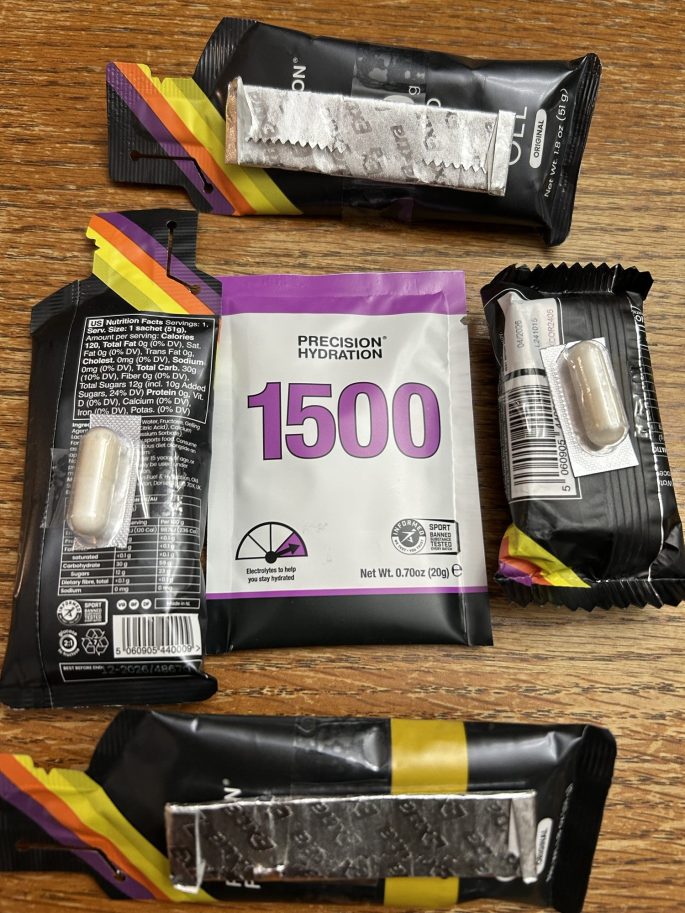
An assortment of hydration and energy products for runners, including electrolyte tablets and energy gels, arranged on a wooden surface.
Shout out to Precision Fuel and Hydration for the support during this training journey! I learned a lot from your team.

Navigating Life’s Construction Zones: A Path to Self-Improvement

“Construction is a matter of optimism; it’s a matter of facing the future with optimism.”–Cesar Pelli

A construction site on a road featuring orange traffic barrels, traffic lights indicating a red signal, and a view of green hills in the background.
Photo by Robert So on Pexels.com

Summer Roads and Slowdowns: A Familiar Frustration 🚧

It’s the height of the summer travel season. This year, AAA projected that 61.6 million Americans will travel by car between June 28 and July 6. That’s a lot of drivers on the roads! And more likely than not, most of those drivers will encounter some sort of delays or rerouting due to construction. 

Those orange barrels, detour signs, and dusty, smoke-filled roads can wreak havoc on estimated times of arrival, impeding drivers’ progress. Traversing a construction-filled route recently, it occurred to me that just as roads need maintenance, upkeep, and improvement, our lives can also benefit from similar attention. In fact, summer road construction serves as an excellent reminder for how we, too, must assess, repair, and improve our own lives.

Like it or not, road repairs are a necessary part of travel. Winter and spring often ravage roads due to ice, snow, freeze, thaw, excessive rain and so forth.  Potholes, cracked pavement, faded lines, and broken shoulders or guardrails can reduce safety and severely damage tires, rims, alignment, suspension, and so forth. Thus, in order to function properly, roads require regular repair and upkeep. 

A woman in a pink blazer sitting at a table, looking stressed or overwhelmed while using a laptop.
Photo by Edward Jenner on Pexels.com

The Wear and Tear We Can’t Always See 😓

The same is true for our own lives; we, too, experience wear and tear, but it is expressed differently in each of us. Signs may include physical and/or mental fatigue, burn out, and/or incremental increase of poor habits.  Other signs might include unresolved conflict, a sense of drifting or lack of purpose; and/or for others, it could be increased feelings of anxiety, sadness, or indifference. Like potholes on a road, it is important to not ignore these symptoms and instead cultivate a sense of caring curiosity as if we were concerned for a child–only it is concern for ourself–and it begins with an honest self-assessment of our emotional, mental, physical, and even relational well-being.

A woman with red hair looks stressed while working on a laptop, resting her forehead on her hand, in a bright interior setting.
Photo by Alexander Dummer on Pexels.com

Reading the Signs: Time for a Personal Detour ↪️

As with construction, upon reflection we might discover that many of our difficulties and discomforts created ruts, broken shoulders and cracks in our own personal life. These impediments signal that we may need to reroute our own life in order to make internal repairs. In the same way construction zones temporarily create detours, rerouted traffic, and lane shifts, personal redirection can likewise be thought of as a temporary, but necessary setback for long-term improvement. 

A person sitting on a couch, resting their chin on their hand, looking thoughtfully at a laptop with papers and a pen on the table.
Photo by Keira Burton on Pexels.com

Detours with Purpose: Reframing Setbacks as Redirection ↩️

These life detours, be they physical-health and/or mental well-being crisis, a death, divorce, and so on, typically create obstacles–a change in what we think is “the plan.”  However, just as construction zones are there to repair the road, our healing, growth, and ability to move towards wholeness often begins as we experience these hurdles. Therefore, it is helpful to reframe our thinking around these life detours and obstacles as opportunities for not only healing, but also reflection, intervention, or a necessary challenge to a long-held personal perspective.

A woman sitting in a chair, looking contemplative and holding a pen near a notebook, with her hand resting on her forehead in a thoughtful manner.
Photo by cottonbro studio on Pexels.com

Grit, Heat, and Hard Work: The Labor of Self-Growth 🥵

Another important point to consider with regards to road construction is that the work crew must endure a wide array of weather conditions, including extreme heat and humidity that accompanies summer. A return to safe and smooth roads cannot occur without their effort, perseverance, sweat, and labor. Likewise, personal growth and/or physical healing often requires a similar level of grit. 

Whether we participate in therapy, work to improve or create beneficial habits, set clear–and perhaps new–boundaries, work to forgive, and/or learn a new skill or life lesson (or both), personal construction demands that we put in the work. Discomfort, like construction, is a necessity.  Growth and healing are not easy and rarely occur without challenge and effort.

Two women engaged in a conversation at a table in a modern office setting, with one woman wearing glasses and a blue dress, and the other facing away.
Photo by Christina Morillo on Pexels.com

Preventive Maintenance: Investing in Long-Term Well-Being 😃

Another important consideration to effective road repair is that maintenance should be ongoing, rather than deferred, as this can lead to greater road damage and travel hazard. By taking care of ongoing small issues as they arise, bigger problems can be prevented in the future. 

Similarly, our own “self-maintenance” is also a worthwhile investment in order to reduce the likelihood of a major life-repair. Taking time to invest in our own daily health through quality sleep, good nutrition, stress management, physical exercise, fostering healthy relationships, and even learning new things–can be thought of as small personal investments that pay dividends towards our own long term “infrastructure.”  

A woman and a man sitting on a couch engaged in a conversation, with a woman taking notes in the foreground. The room features plants and wall art.
Photo by Antoni Shkraba Studio on Pexels.com

Building a Support Crew: Don’t Travel Alone 😁

That said, sometimes personal maintenance can sometimes feel like “one more thing to do” especially when we’re in the midst of a life-storm. Therefore, it can be helpful to cultivate a “crew,” a few good people who can share our times of smooth sailing, encourage our development and/or maintenance of positive habits, and also support us during those bumpy passage days. Ultimately, with regular self-care maintenance and a good support crew, we can cultivate a strong inner foundation that is better able to withstand life’s pressures and storms.

Black and white image of a close embrace between a woman and a child, capturing a moment of warmth and connection.
Photo by Nataliya Vaitkevich on Pexels.com

Freshly Paved Paths: Signs of Inner Progress 🥹

One of the best parts of road construction occurs when it is finally completed. Routes are once more open, and the ease and smoothness of traveling these roads signals tangible progress. In fact, driving effortlessly over a direct route without detours, potholes, or bumps can be a liberating feeling. 

A smiling man with curly hair, laughing joyfully against a wooden background.
Photo by Pixabay on Pexels.com

Progress, Not Perfection: Life Is Always Under Construction 🦺

Unfortunately, it never lasts for long. Rainy season, freeze-thaw season, excessive travel, or 1,000 other scenarios means construction will once again occur, if not specifically on the newly refurbished route. It’s all part of the process of progress–one never attains perfection when it comes to infrastructure–there’s always room for improvement.

Equally, on the other side of our own personal repairs, detours, and/or maintenance, we gradually return to a sense of homeostasis.  Our rerouted life may possess a greater sense of clarity, restored confidence, better decision making skills, and perhaps even a deeper sense of joy. We, too, may feel the momentum to move forward in a renewed direction and embrace the possibilities that come with an unexpected, but freshly paved path.

Smiling woman wearing a cozy sweater, expressing joy and warmth.
Photo by Dellon Thomas on Pexels.com

Final Thoughts: Be the Engineer of Your Own Journey 👷

To be sure, summer construction can seem like a real drag on travel; however, it ultimately leads to new routes, expanded systems of travel that are safer and more efficient. However, even when the summer construction season comes to an end, the maintenance of these roads does not end, and that is worth remembering.

Likewise, summer construction reminds us that we are the engineers of our own lives. No, we cannot control everything that happens to us, but we can control our reactions AND we can also make repairs as needed as well as prevent some issues from arising. Therefore, let’s be as proactive as possible through regular sustainment of our own life-construction, so that when life’s storms create a pothole–or five–we are fortified with the strength our regular maintenance and upkeep provides us. In life, as in roads, it’s about progress, not perfection. 

I’ll see you out there on the road of life!

.

Running Beyond Age: Embracing Health and Freedom in Every Step

“Running is an act of creative self expression”–Lawrence van Lingen on Extramilest podcast

A Familiar Morning Scene: Defying the Stereotype 👟👟

Two older runners jogging together on a path surrounded by grass and wildflowers in a park during early morning.
Photo by Anastasia Shuraeva on Pexels.com

Picture this. It’s early on a warm Saturday morning in your local park. The sun is low on the horizon, and mist is rising above the grass and a meandering stream that runs alongside a crushed gravel path. The scent of a nearby rose garden is heady as two runners descend the hill following the path. Moving at a steady clip, one runner has a full head of white hair while the other is more salt than pepper. They are relaxed and chatting as they pass by.

This is a routine sighting for me on my weekend jogs. Numerous older runners, walkers, and run/walkers defying the stereotype through exercise, that aging equals physical decline. In fact, according to AARP, beginning in 2023, the average age of runners has risen. Some of the biggest gains are those 55 years and older, with numerous runners sticking to it well into their 60s, 70s, and 80s as witnessed in the ages of Boston Marathon finishers in recent years as well as other major marathons around the world. Of course, there’s no denying aging does change the body, so why do I see numbers of people my age and older consistently outside running and/or walking?

Running as Personal Ritual and Liberation 🏃‍♀️

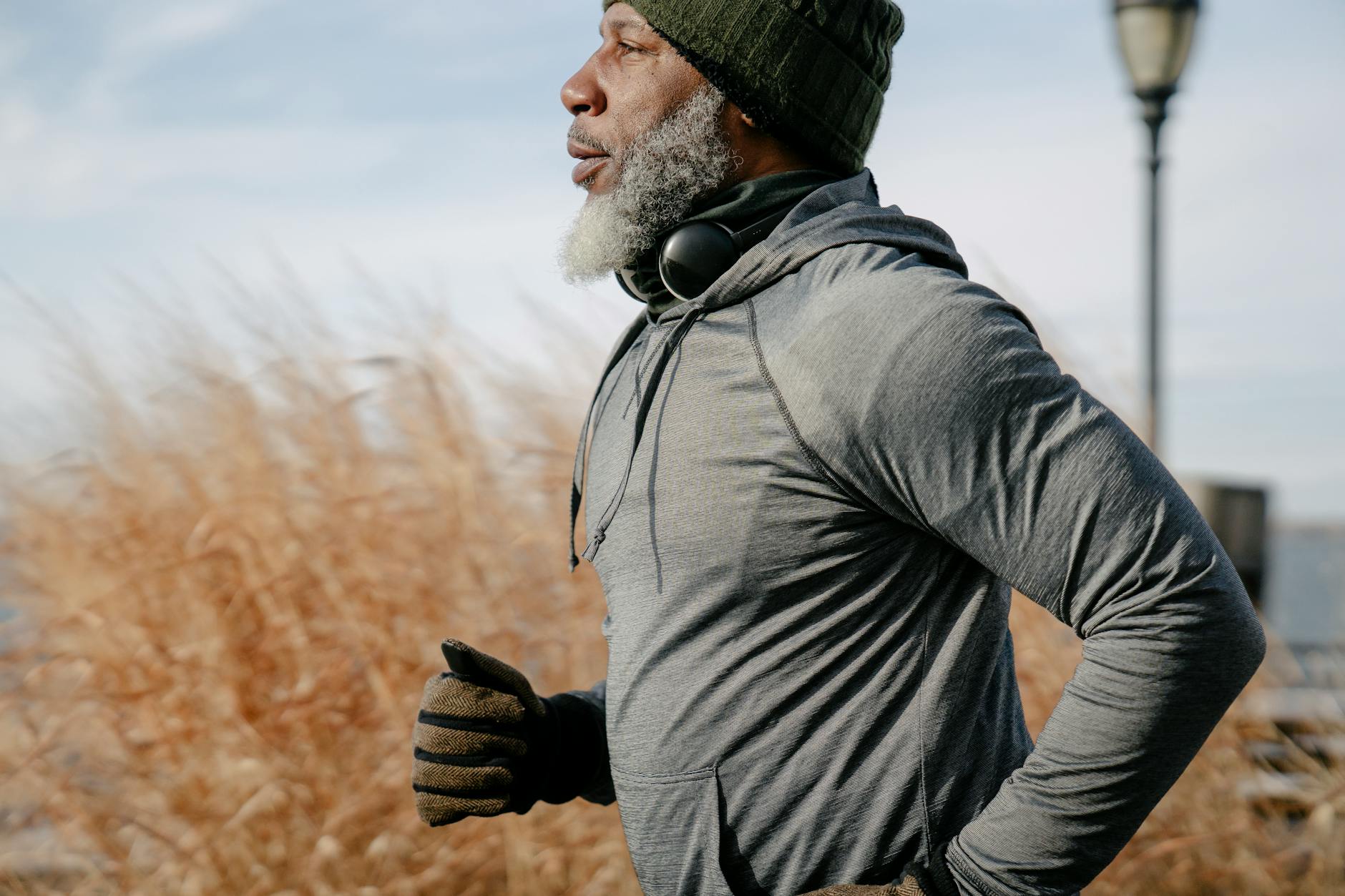
Older man jogging outdoors in a gray hoodie and gloves, surrounded by tall grass with a calm sky in the background.
Photo by Barbara Olsen on Pexels.com

For many older individuals, like myself, running or run/walking becomes a personal manifestation of life–a ritualistic form of imaginative self expression that allows us to reconnect with our inner rhythm, identity, and self-determination. It creates a sense of freedom and play that we once had as a child. Additionally, running offers numerous benefits, including improved physical health, enhanced mental well-being, social connections, and a renewed sense of personal meaning, to name a few. 

The Science-Backed Physical Benefits of Running 🏃‍♂️

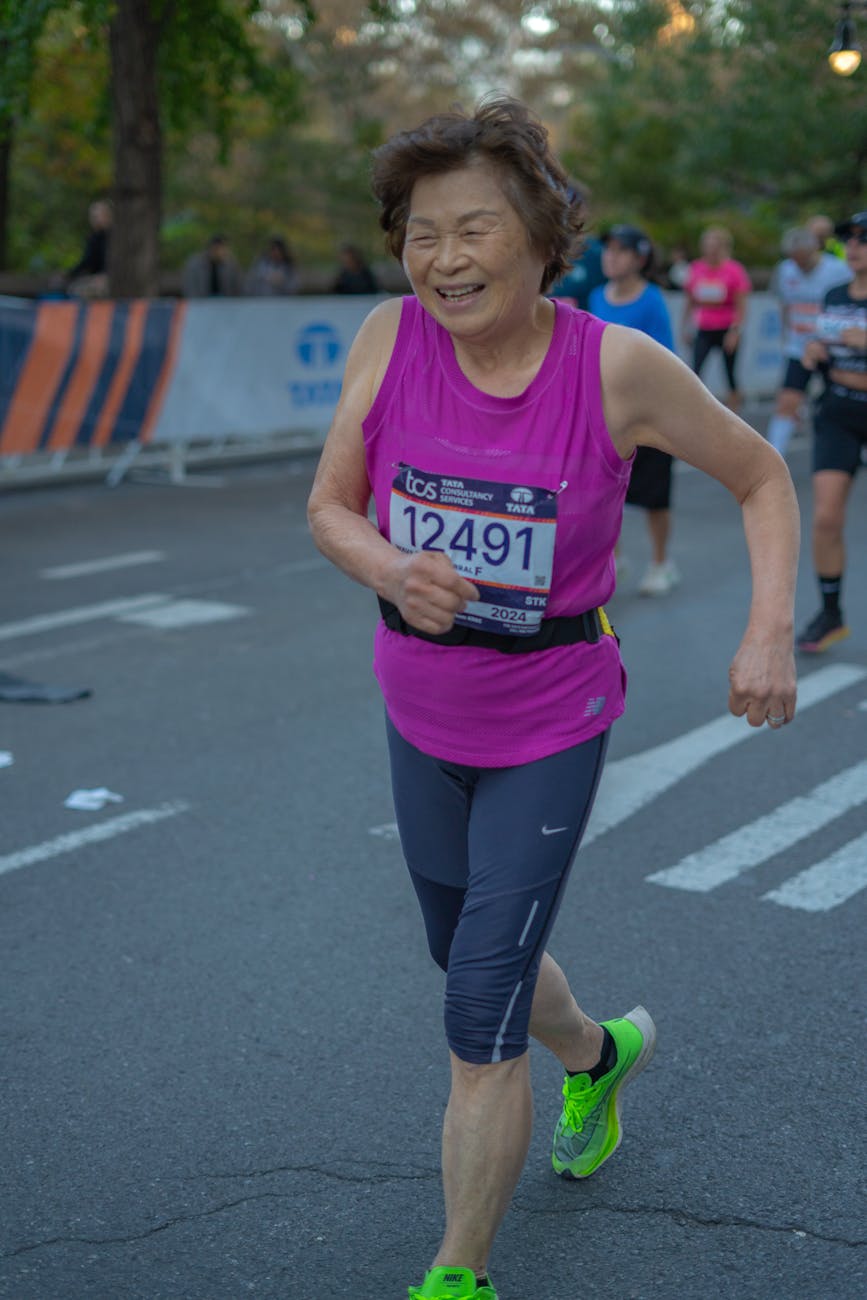
An older female runner smiling while participating in a race, wearing a bright pink tank top and bib number 12491, with greenery and other runners in the background.
Photo by khaoula Bkm on Pexels.com

I occasionally encounter critics who question the safety of running at “my age,” (a term used by my students); however, according to another 2023 AARP article, older runners just have to be “smart about it.” This is why many running groups often point beginners, including seniors, to using a run-walk-run method to establish a strong aerobic base. In fact, Cleveland Clinic, in a 2024 article, points to numerous physical health advantages to walking and/or running for all ages, but especially seniors. These advantages include:

  • Strengthens heart and improves circulation
  • Reduces risk of heart disease and stroke
  • Increases bone density, helping prevent osteoporosis 
  • Improves joint flexibility and maintains muscle function
  • Boosts metabolism and supports healthy aging
  • Improves blood sugar regulation and lowers risk for type 2 diabetes
  • Reduces risk of dementia and Alzheimer’s disease

Mental Health Gains: Silence the Inner Critic 🙉

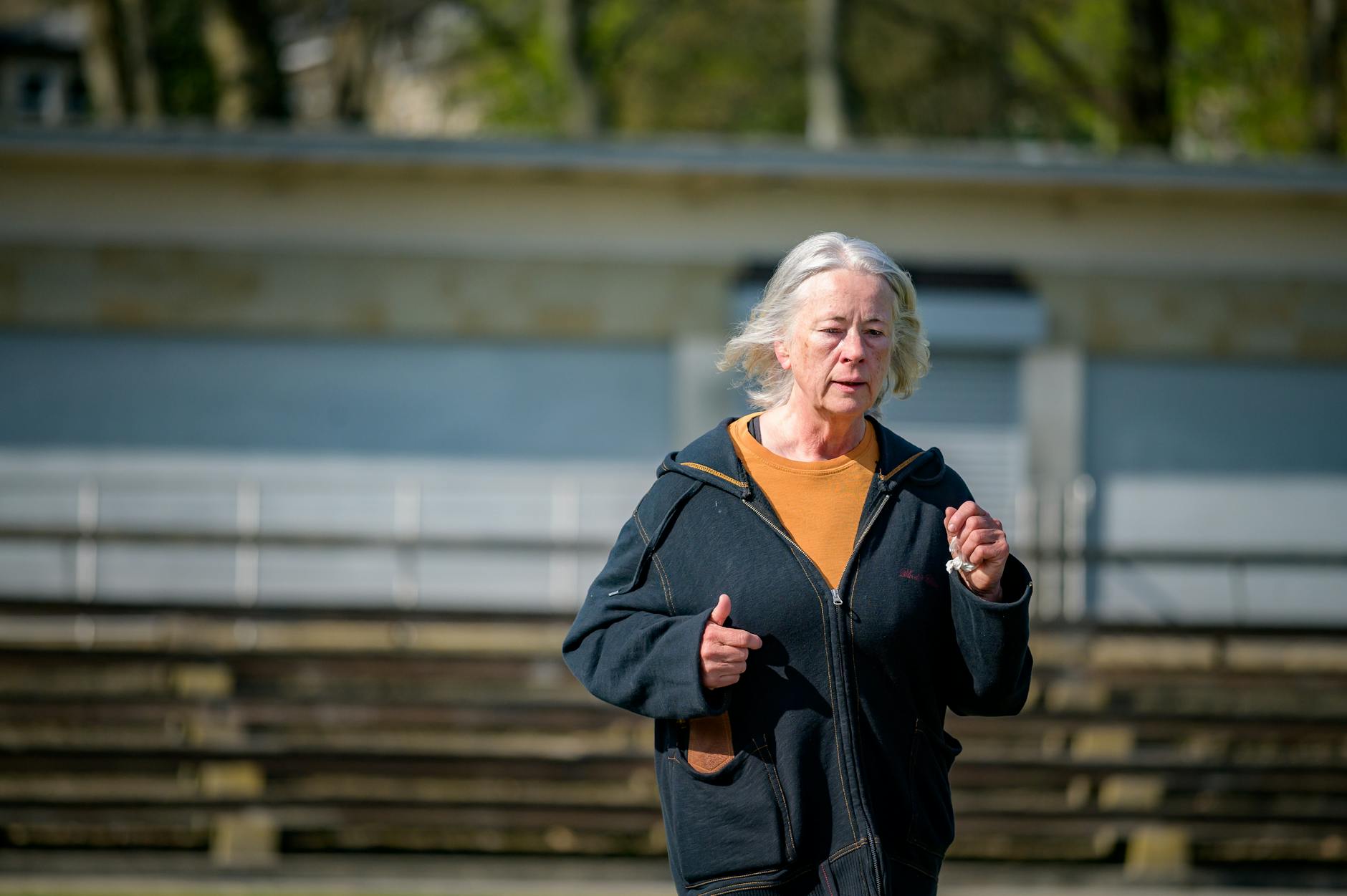
An older woman running outdoors in a black hoodie and orange shirt, focused on her exercise, with a blurred background of benches and greenery.
Photo by Centre for Ageing Better on Pexels.com

Certainly, the physical health benefits of running are important to me; however, one of the greatest advantages is the feelings of improved mental health and well-being. I often refer to monkeys living in my mind, and running allows me to rise above the swirling negative chatter that often clouds my mind. On days when it seems everything goes sideways, if I have completed my morning run, I can take solace in the fact that I completed at least one positive act, thereby helping me to keep symptoms of depression and anxiety at arm’s length. 

I also find running clears my head, improves thinking, and increases memory, which is a bonus as I age. In fact, running–and exercise in general–is like meditation in motion because it deeply connects me to my breath. Plus, it is a great source of stress reduction.

The Artistry of Movement: Running as a Creative Outlet ✍️

An older man with a full head of gray hair is pouring water from a cup over his head while running in a sunny outdoor setting. He wears a bright red athletic shirt and a race bib number 757. In the background, other runners can be seen along a palm tree-lined street.
Photo by Jou00e3o Godoy on Pexels.com

Running is also a form of innovative self-expression, for young and old alike. Like crafting one’s own piece of art, running showcases the beauty of a body in motion. It offers time for inspiration and reflection. Each run, like a canvas, offers the opportunity to tell a story, footstep-by-footstep. Personally, time spent running also allows me to process life as well as difficult, often buried, emotions, and it even sparks inspiration. My running, albeit slow, feels like an act of liberation, hope, and a tribute to the many obstacles I have overcome along the way. It is a symbol of inner strength, resilience, and freedom to be me–in a world that has often felt as if it boxed me in.

Spirituality, Solitude, and Social Connection 🙏

An older man running on a path surrounded by tall grass and trees on a sunny day.
Photo by Thomas Shockey on Pexels.com

For many runners, older and young, running offers an opportunity to hang out with other runners and socialize. However, some find that running solo, instead, creates a sacred space in which they can connect to their Higher Power, feeling that sense of peace and ease. Still others appreciate the opportunity to spend time in nature, soaking up fresh air and the beauty of Mother Earth.

A Healthy Routine for a Vibrant Life 🙌

Two female runners in matching orange and red jerseys sprint together, holding hands as they approach the finish line. They display expressions of determination and joy during a race.
Photo by RUN 4 FFWPU on Pexels.com

Running, for many, including myself, forms a meaningful structure to the day, a time set aside for one’s personal well-being and health.  This is important because there are numerous obligations and responsibilities that life often demands, even as we age. By setting aside regular time to run, sleep typically improves, which can be so elusive in older adults. Furthermore, those who run typically tend to eat better and don’t tend to abuse substances in order to better support their ability to run.

Staying Safe and Smart with Age 🤔

An older woman running outdoors, wearing a bright yellow tank top with a blue logo, smiling and gesturing with her hands. The background features greenery and a sunlit path.
Photo by RUN 4 FFWPU on Pexels.com

Of course, as we age, we do have to be safe about our exercise habits, which often begins with checking-in with a health-care provider. Additionally, I highly recommend finding good footwear that works for your own personal gait/foot-type; a local running store expert can help with this. Furthermore, as AARP points out, older runners should not go from “zero to 60.” Warm-ups and cool-downs are essential, and for those wanting to start running, a good walk-run program like Run Your Butt Off or the Run-walk-run training plans are two great ways to start. (I have personally used both and can attest to their gentle nature.) 

Other considerations as we age include running less on concrete and asphalt, if possible, and spending more time on softer surfaces, like the paths at local parks. Treadmills also offer a more cushioned surface, and they are a great option when weather is too hot, too cold, or otherwise uncomfortable. If you run at night or early morning, it is important to wear a headlamp and reflective vest for safety’s sake. Additionally, if you run alone, it is a good idea to let someone know where you are running and for how long. 

Every Run Is a Story: Movement as Becoming 🏃

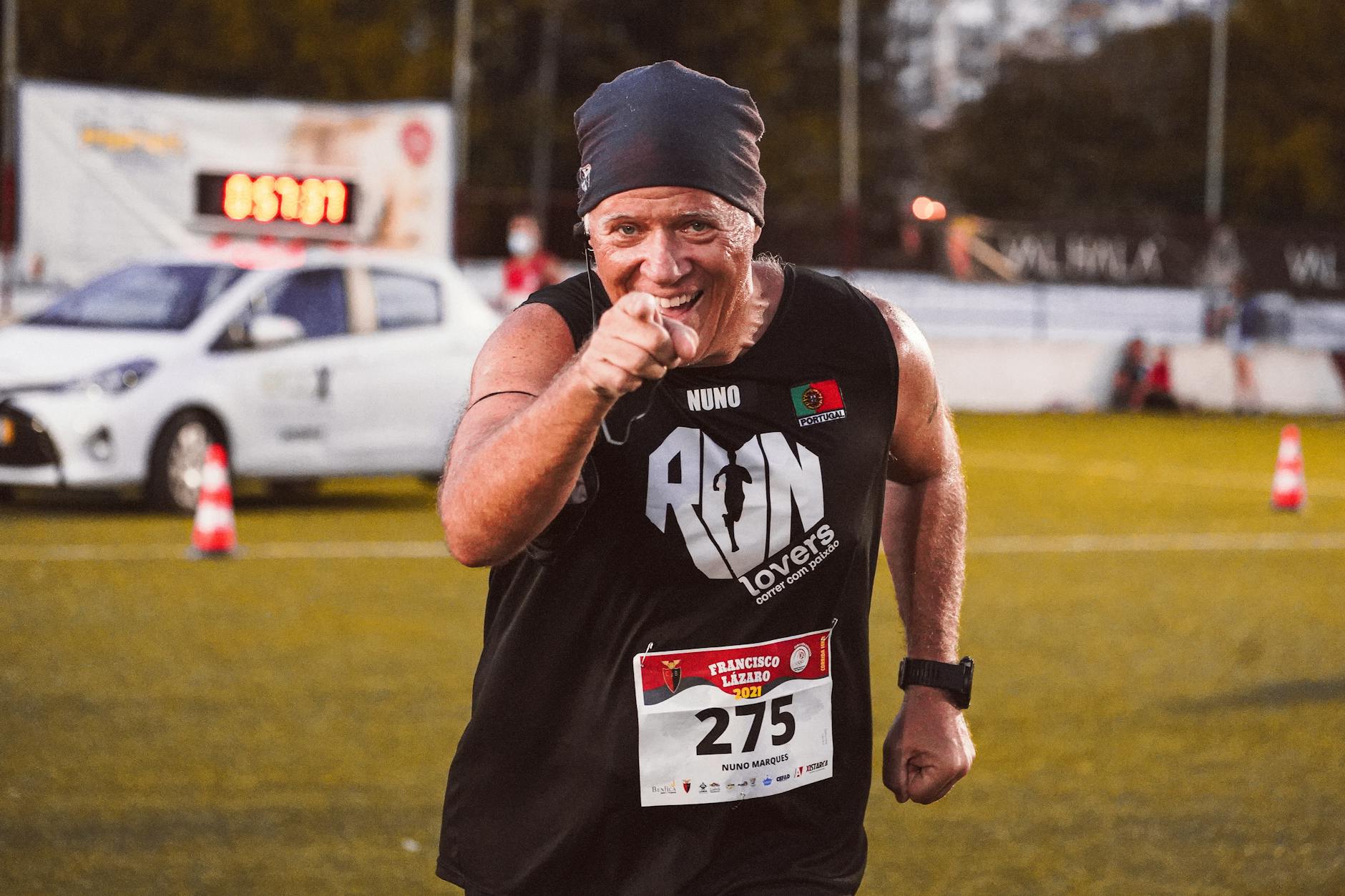
A runner with a confident expression points at the camera while sporting a black sleeveless shirt with 'RUN lovers' printed on it, a race bib, and a headband, during an event in a sporting field.
Photo by RUN 4 FFWPU on Pexels.com

Bottom line, each run or run/walk/run is an adventure. Sure, some runs are less adventurous than others, but those moments offer an opportunity to learn about ourselves if we remain open and curious. Running (and walking) is accessible and fairly low-cost, and it is an effective way for older (and even younger) adults to improve their mental, physical, emotional, and even spiritual well-being. 

Beyond these benefits, running, for me, continues to remain a quiet act of self-expression. With each step and stride I take, I am writing a story, reclaiming my space and time, and paying homage to The Creator, celebrating this gift that is life. In this way, running transcends exercise and becomes a personal journey of becoming, no matter my age. 

With the right approach and mindset, whether you run, run-walk-run, or mostly walk, moving our bodies regularly can create joy and empower older adults to age well—proving that vitality truly has no age limit!

An older man with white hair smiles while wearing a jacket and a medal, standing among a group of people in a blurred background.
Photo by Roman Biernacki on Pexels.com

Transform Your Mindset: Embrace New Experiences

“Your perspective is always limited by how much you know. Expand your knowledge and you will transform your mind.”–Bruce H. Lipton

A black background with the words 'open to new OPPORTUNITIES.' written in white chalk-like font.
Photo by Anna Tarazevich on Pexels.com

Dreams That Spark Reflection and awaken the Mind 🎆

Recently, I have been experiencing an active dream life. While I do go through periods when I don’t recall my dreams, lately my nights have been filled with vivid, frightful nightmares. In my dreamlike state, I try to “change the channel,” but my mind keeps slipping right back into the same harrowing scenario. These restless nights inspired me to think about how in life, similar to TV (or any current media platform for that matter) without deliberately changing the channel, our point of view can become limited.

From Antennas to Awareness: Early Lessons in Limits 📺

As a child, there were no cable or streaming platforms.  Our family, like the families around us, relied on a TV antenna on top of the house in order to watch local stations.  Theoretically, we should have been able to watch three to four local stations–ABC, CBS, NBC, and PBS.  However, we were surrounded by hills, and as a result, most days, NBC was the only  station we could clearly view. I’d hear classmates talk about shows on other networks, but unless we visited my grandparents, who had better reception, our viewing options were limited.

Books: Windows to the world 📚

A woman reading a book while sitting by a window, illuminated by warm natural light.
Photo by Rahul Shah on Pexels.com

Fortunately, we did not rely on TV as we had access to a wide array of books and magazines through school, the bookmobile, at the house of my grandparents as well as in  my own home.  Therefore, my viewpoint expanded beyond my small-town bubble through reading.

College as a Catalyst for Perspective 🤔

Later, when I attended Ohio University, in Athens, OH, my worldview was dramatically shifted. Though Athens is no metropolis, the diversity of students, professors, and wide-array of sources of information was striking compared to what I had known in the Tri-State area. This was especially true since I lived in an international dorm with students from around the world. Conversations in these halls opened my eyes to new ways of living, thinking, and even eating.

Cultural Conversations and Culinary Discoveries

Water droplets cascading from a fountain, surrounded by a blurred green background.
Photo by CocaKolaLips on Pexels.com

My roommate from Singapore opened my eyes to the water shortages her country was experiencing at the time. In her home apartment complex, water was available only during scheduled times—long showers were out of the question. Her story stuck with me as a concrete example of the finiteness of water.

 Meanwhile, students from Denmark and Sweden introduced me to cheeses that I never before heard of, much less tasted.  A French student was the first person to introduce me to espresso, while students from Vietnam and Korea introduced me to a wide array of spices that would not have been locally available at that time.

Voices from Different Lives 😃

I had a classmate named Annette, the daughter of a military family, who’d lived all over the world. Her life experiences, and the breadth of cultural understanding, was remarkable. She was heads and shoulders above the rest of us in global knowledge and awareness.

In contrast, another classmate, Jerry, grew up on a nearby family farm on the outskirts of campus. He illustrated, first-hand, the struggles of family-farming, the weight of the financial hardship often felt by these families, and the deep faith it takes to persevere.

Spiritual Exploration Through Diverse Worship 🙏

Also, while attending OU, I visited churches of different denominations around campus. This provided direct experience with other forms of worship different from my own upbringing. Each service challenged and broadened my appreciation of varying faith communities.

Travel: Expanding the Map of Understanding 🗺️

As an adult, my perspective has continued to unfold through travel. My husband, daughter, and I have explored various parts of the U.S. from coast to coast and visited several Canadian provinces. During these trips we meet people from all walks of life. These encounters demonstrate the common threads of living as well as the unique–and some not so unique–struggles all humans face. These conversations continue to deepen my empathy and allow me to see cultural events, governmental policies, and life experiences through the eyes of others.

The Environment: Witnessing Earth’s Fragility 🌲

Since most of our travels center around natural and historic sites, my perspective has been further stretched in two important ways. First, traveling reinforces my profound respect for the limited nature of Earth’s resources. Over the years I have witnessed firsthand miles of forests decimated by logging or (most recently) flooding/storms, walked along shores of a fragile coastline in a constant state of erosion, and visited places in which the air quality was at near unbreathable levels due to drought-related dust storms or fires. These expeditions serve as tangible reminders that our environment is not infinite, and it is urgent that we protect/care for it.

History: Lessons in Perspective and Relevance 🧑‍🏫

Second, by visiting historical landmarks, walking historical streets, or exploring museums, it helps me recognize the values, struggles, and limitations of the times in which people once lived and how relevant the past is to today’s world. These excursions (along with reading historical and historical fiction books) demonstrate that history is not just a collection of dates and events; rather, it’s an expansive, unlimited lens–filled with countless lessons–through which we can understand human behavior, social progress (or lack thereof), and cultural identity. 

Most of all, visiting natural and historic attractions repeatedly instructs that what we take for granted—whether a forest or a freedom—can disappear without an ever-expanding viewpoint.

Perspective Lost and Perspective Gained

Without an intentional commitment to varied life experiences, our perspective is restricted and narrowed. We may not see the value of managing natural resources. Likewise, we might not be empathetic to those with cultural differences, and we might have little-to-no context of history and its importance. Without going beyond our comfort zone, we may not see the vastness and inclusiveness of a God so great, we cannot possibly pretend to understand.

Intentional Curiosity: How to Keep Changing the Channel

Therefore, it is important to seek out new experiences that challenge our assumptions and broaden our horizons. There is indisputable value in engaging with people whose lives are different from our own.  By engaging and listening more, judging less, and asking more questions, we are less likely to jump to conclusions while also allowing our assumptions to be tested. Visiting a worship service different from our own current practice or simply visiting a new place–even if it’s just across town–can offer further insight to the world around us. Even reading books, fiction or nonfiction, can also offer unique and salient views of others.

Shift Your View, Shape the World 🌎

In closing, I challenge all of us to avoid getting stuck in life as if in a dream. Instead, let’s keep changing the channel. With each click out of our comfort zone, we gain a more nuanced understanding, broaden our perspective, and foster greater compassion for the world and humanity itself. In fact, by doing so, we might not only expand our viewpoint, but we may also alter the viewpoint of someone else we meet along the way.

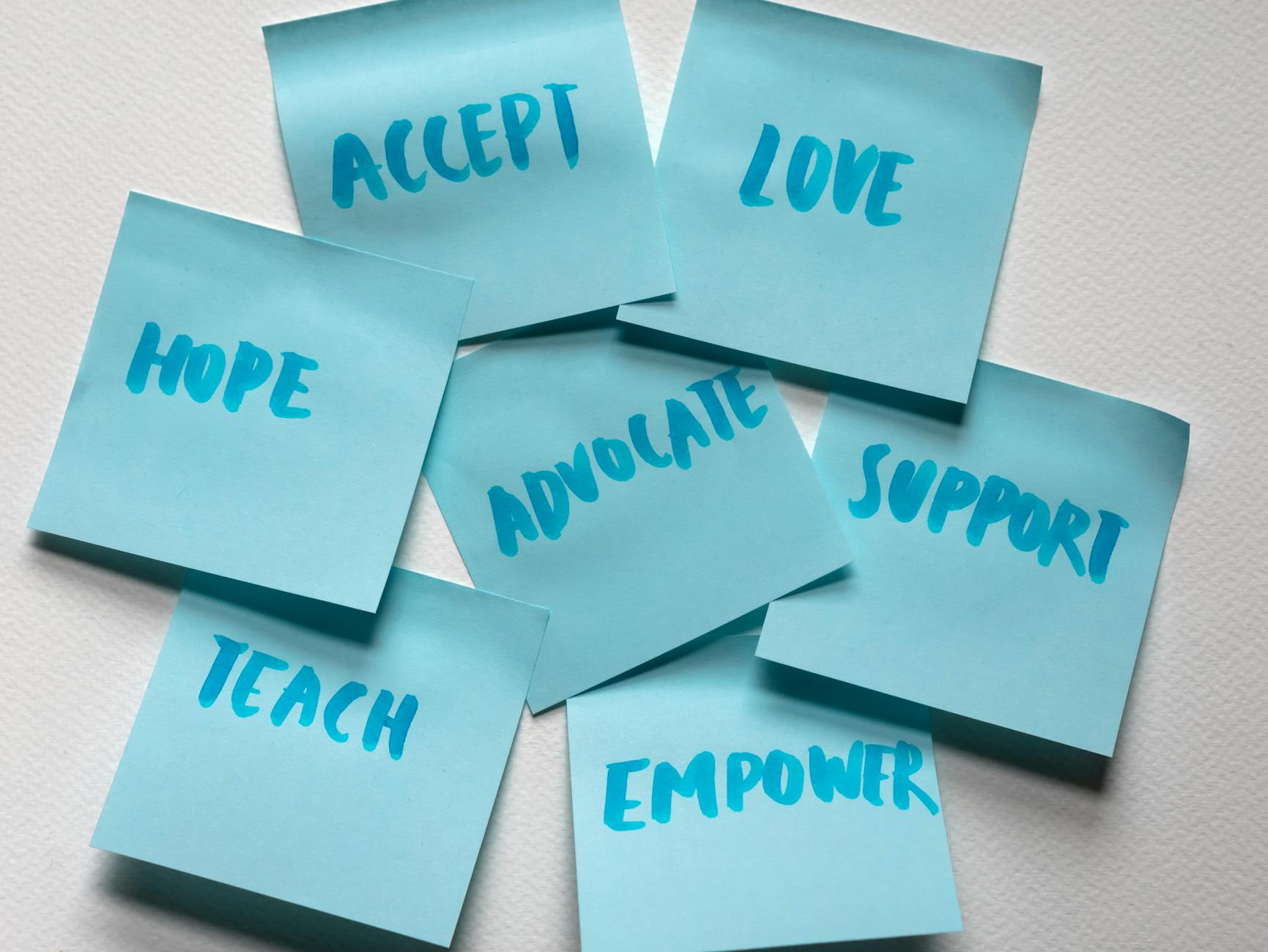
A collection of blue sticky notes with handwritten motivational words: 'ACCEPT', 'LOVE', 'SUPPORT', 'ADVOCATE', 'EMPOWER', 'TEACH', 'HOPE'.
Photo by Polina u2800 on Pexels.com

Thrive Through Love: Lessons From Plants

“We must cultivate our own garden.”–Voltaire 

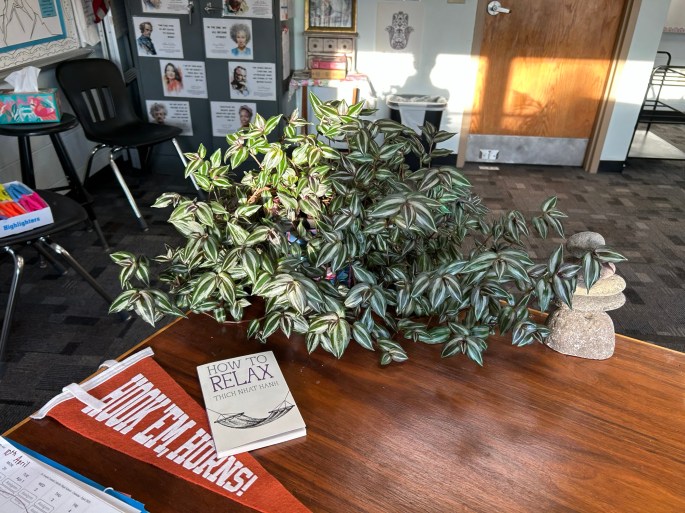
Drooping from lack of water, my mosaic plant symbolizes our soul without enough attention, love, and supportive relationships.

As I walked into my classroom after spring break, making my way behind my desk, my mosaic plant greeted me with drooping leaves as if to say, “Where have you been?” 

“You poor thing!” I spoke aloud to it–as if it would reply. “I am so sorry. Let me get you some water.” 

Oh, sure, Dear Reader, roll-your-eyes and act as if you don’t talk to your plants. I have no shame in admitting it. Besides, scientific research has established that talking to your plants can create low-level vibrations that stimulate growth. However, since that is not the thesis of this essay, I won’t wander any further down that path. 

The unwatered mosaic plant had suffered alone in the silence of my classroom for well over a week without water. This particular plant requires frequent watering and rotation. When given this, it responds with perky growth and vivid color. Therefore, it was a sad, sickly sight. 

As I carefully began to water my plant, hanging limply in the pot, it reminded me of the way in which humans also need care and attention. Regular watering of plants supports photosynthesis and the roots ability to absorb nutrients from the soil, both of which foster growth. Likewise, when humans receive adequate hydration and adequate nutrition from a healthy, well-balanced diet, our bodies have a better chance of remaining healthy and vibrant.  

Plants, like humans, thrive best when nurtured from within and without.

Continuing to gently water and mist my wilted mosaic plant–yes, I was talking to it all the while–I was reminded of the ways in which humans can wilt from neglect. Our mind, body, and spirit, like my mosaic plant, need nurturing. Without it, our inner world can wither, and we will limp along with a spiritual heart that has a difficult time beating. 

However, with regular sprinklings of love, affection, and/or supportive relationships, our souls can remain hydrated. From faith-based practices to monthly outings with friends or family, from attention/love of a pet to simple interactions with a store clerk, and from exchanging kind words/texts with a neighbor, co-worker, or organization/club member to actions of self-care/love, there are countless ways in which our souls can be watered and nurtured. Therefore, it is vital that we practice engaging with others, so we won’t wilt from lack of love and support. 

Moving around the room to water my other plants, I realized they would soon need to be repotted with fresh, fertilized soil. Some would need a bigger pot than the container in which they currently dwelled. Fresh, fertilized soil, rich in nutrients, is vital for the health and well-being of my plants. New soil will provide a wide array of ingredients uniquely combined to fortify my plants against disease to help them grow healthy and strong.

Photo by cottonbro studio on Pexels.com

Likewise, in order for us to thrive, we, too, need nourishment from a variety of sources. One way we can thrive is by establishing and maintaining a purpose-filled life. This purpose can change and evolve over time as we age and mature, but it needs to be a purpose that not only compels us out of bed each morning, but fuels our life with meaning. 

Creating and maintaining meaningful connections with others, especially when linked to our purpose, can further enrich our lives deeply. Fortification can also be found by mentoring/helping others as well as surrounding ourselves with positive, supportive influences. These types of relationships can form a reciprocal, two-way street, much like plants form with people, which can facilitate an ongoing source of nourishment in our lives. 

Once all the plants were watered, I began rotating each pot to allow all parts of each plant equal time to face and absorb the warmth of sunlight. Sunshine, like water, is needed for photosynthesis. It is only through the process of photosynthesis that plants can have the food needed for growth. When plants face the challenge of living inside a building, they overcome that challenge by growing toward a window, even if it causes the plant to grow with a lean. 

Photo by Khanh Le on Pexels.com

We, too, need to lean into sunshine. The sunshine of positive experiences can imbue us with warmth and motivate us to keep going. That motivation is especially important when we are faced with challenges, as life is never obstacle-free. However, by facing the unique challenge(s) life tends to throw our way, we can eventually discover the unique joy of overcoming difficult circumstances, or at the very least, grow stronger and more resilient from the effort put into overcoming.  

And when those life-challenges seem endless, as they often do, lasting beyond what we think is possible, it warms and strengthens the soul to find pleasure in the little things. From the sweet embrace of a loved one to the sound of birdsong in the morning, from the taste of a great cup of coffee (or whatever) with a friend to the aroma of fresh cookies baking in the oven, or perhaps reading a new book or playing an instrument–whatever you choose, these small delights can be the rays of sunshine that help get us through those dark days of difficulty. 

The object lesson provided by my mosaic plant reminded me that no living thing– humans included–benefits from neglect. When we lose sight of love, meaningful connections, purpose, and positive experiences, we will internally wither, which can manifest itself as physical ailments and/or mental health issues. Without proper care and nurturing, we can grow disheartened, disinterested, and even emotionally distressed or traumatized. 

Photo by Tristan Le on Pexels.com

However, we all have the potential to thrive. Let us strive to offer love and understanding to others and to ourselves. When we see someone hurting, let us find ways to lift them up. 

Likewise, when we recognize our own heart is hurting, let us tend to our own needs through acts of self-compassion, reaching out to others, or seeking other positive means to act as rays of sunshine to lift our spirits. Our time on this earth is short, let us seek productive methods to nourish and enrich others as well as our own lives, so that our life garden can blossom and flourish, no matter where we are planted.

The Power of Silence: Reflections on Mindfulness Retreat

“In the silence of the heart, God speaks.” Mother Teresa

Photo by Ali Elfaziki on Pexels.com

Silent Retreat? 🧘‍♀️

I don’t remember exactly how the conversation went, but I was enjoying lunch with a friend on a Saturday when she told me she was attending a silent meditation retreat in two weeks, and asked if I would be interested in it. The retreat, she said, was sponsored by The Mindfulness Tree, a meditation community in Charleston, WV, and it would be led by Dr. Christine L. Blice-Baum, MDiv, DMA. Curiosity bloomed, and in a matter of days, I was also registered for the retreat.

In the days leading up to the retreat, I vacillated between feelings of excitement and thoughts of “what-have-I-got-myself-into?” The retreat required spending time in silence with complete strangers, excluding my friend, of course. I kept reminding myself that it wouldn’t be any different than going to an appointment or to the store with numerous others I don’t know. Never once, however, did it cross my mind that this retreat would provide multiple opportunities to come face-to-face with my mind’s resistance and its desire for distractibility.

Photo by Obi Onyeador on Pexels.com

Put away those devices 📲

Upon arrival, all participants in the retreat were asked to put up our phones and take off our smartwatches until the time of our departure. We had the choice to leave our devices in our car, in our own purse/bag, or stow them in a zip lock bag that was put away until the end of retreat.  I chose the latter option as a symbolic break-away from technology and, in all honesty, to reduce any temptation to peek in my bag at either device during the day. 

Not having technology was one of the first minor “discomforts” I repeatedly noticed. It began when I tried to check the outside temperature by looking at my wrist, and then did it several more times! What time is it? No smartwatch. Does the radar show my hometown receiving as much rain as here?  No phone. Blice-Baum just shared a great idea; I should type that in my notes. No phone. I should take a picture of the church’s pipe organ. No phone. Did my husband remember to  . . . . 

Participants in seated meditation.

Lessons of Stillness 🤫

This was my first a-ha moment. I was astounded to realize the amount of time my mind spends in a day consumed with thoughts of all the ways I can implement/use my smartphone and its companion watch. What’s crazy is that I am not a big user of social media, so I had this notion that giving up my devices would not be a big deal. While on one hand, it wasn’t, on the other hand, I was humbled to realize, social media consumer or not, my mind has been trained to be distracted by devices. 

The second big lesson had to do with a notion known as “custody of the eyes”–averting the gaze to avoid visual distractions in order to maintain focus. This practice was a challenge throughout the entirety of the session. 

The retreat schedule was well organized, sessions of seated meditation were interspersed with walking, movement, and standing mediations; however, my mind kept wandering and niggling me to look around at my surroundings. During walking and movement meditations, I had to keep redirecting my attention back to the meditation focus at hand because my mind had the tendency to wander off into people-watching mode. 

Participants take part in a silent walking meditation

The third lesson: I also squabbled with my mind’s habit of entering “squirrel-mode”–moments when something in the environment, or on the wall caught my attention, and my mind would launch off into associations with whatever my eyes had noticed. I knew I was distractible, but I never realized my mind was like a puppy visiting a new environment.

Another eye-opener occurred during our silent lunch. Blice-Baum, after sharing a prayer of gratitude and blessing for the food, led the participants through a short exercise of mindful eating. Then, we were directed to continue to enjoy our meal in silence, engaging all of our senses in the eating experience. This was when my mind really rebelled.  

Since I was a young girl reading the backs of cereal boxes at the breakfast table, I have always read while eating–newspapers, magazines, books–which were later replaced with digital versions. Without such distraction, I noticed my tendency to want to eat quickly and my eyes repeatedly searched around for something on which to focus other than my food. It took time for my mind to settle, slow down, and focus on taste and other sensations associated with the simple act of eating. This was a shocker because I love the taste, textures, and fragrance of food. In fact, I love to eat, but I clearly need to practice eating mindfully more often.

Group picture of participants.

Positive takeaways 🙌

In spite of all the mental obstacles and resistance I experienced throughout the retreat, I walked away feeling refreshed and renewed. Remaining fully focused and present on one’s own breath, a mantra, or an image isn’t easy, but there is something to be said about taking time to slow down and focus on one thing at a time. I felt as if I was coming home to my heart, and my own inner knowing, despite the fact I had to repeatedly redirect my mind like a toddler walking around the Tamarack Marketplace.

Would I do another silent meditation retreat? Absolutely! Many of the things that had been worrying me when I arrived at the retreat felt less weighty when I left. I experienced a recommitment to my personal practice of meditation/mindfulness and was inspired by new techniques to incorporate, not only in my own practice, but also to include with the yoga/mindfulness class I teach at school. Furthermore, in the days that have followed, there has been an overall increase in my sense of gratitude, along with a renewed sense of purpose. I have also noticed a calmer mind with a significant decrease in the power of those negative voices that love to chatter about in my head.

 Most of all, I am much more aware of how easily and quickly my mind can be distracted. These mental diversions on the surface seem as shiny and fun as a carousel ride to a young child, but they can lead to avoidance of the moment at hand–knowledge and understanding of what is going on in the here and now. Therefore, focus––especially given all the digital distractions–more than ever requires diligence, dedication, and continued redirection. And, one of the best ways to do this is the practice of meditation, mindfully completing tasks, or by simply connecting with our own breath.

Photo by Vie Studio on Pexels.com

Interested in Learning more?

If you are interested in learning more about meditation, would like more information about The Mindfulness Tree, or would like to connect with Blice-Baum, please visit www.themindfulnesstree.life

Dr. Christine L. Blice-Baum, MDiv, DMA

Navigating Life’s Uncertainties One Moment at a Time

“Take one moment at a time and do the next right thing.”–Eleanor Amerman Sutphen

Photo by Pixabay on Pexels.com

What Did I hear? 👂

My ears perked up when I heard the guest on a podcast share the above phrase based upon  a poem by Sutphen, but made popular by both Elisabeth Elliot and Carl Jung. I had just arrived home with several bags filled with groceries to put away. Setting down the bags, I typed the phrase into my phone’s reminder app in order to remember it. Then, ironically enough, I returned to the next moment: putting away the groceries.

Like a persistent earworm, that phrase kept looping through my brain. Maybe it was Divine Providence, or maybe my subconscious niggled me to recognize the words I needed to hear. Regardless, the universe had offered me a nugget of wisdom to the question I had been asking, but had not yet been able to fully articulate: What can I do in the face of the difficult and uncertain life moment in which I found myself?  

Photo by Sergey Guk on Pexels.com

Snowy Days can lead to Sluggish Ways 😏

The month of January was a slippery, and less than stellar, start to the new year.  All around me, icy roads, alleys, and sidewalks served as a reminder that I was struggling to find my footing. As one who is not naturally organized and often has no sense of time, I function optimally with a routine/schedule.  It’s not that I can’t “go with the flow.”  I can do that quite brilliantly, but I don’t accomplish nearly as much, nor do I make as many–if any–inroads towards goals.

It is as if I have been dropped deep into a dark and menacing forest filled with a multitude of statuesque tree shadows and brambling thorny briers. Meanwhile, a multitude of strands in life’s web are criss-crossing in ways that make it feel less integrous, as if at any moment, the winds will shift and blow a hole in the tenuous gossamer nexus of life. I sense time sliding sideways, and I am trying to find my footing, so I don’t fall into the thin ice at the center of the mostly frozen pond. Arms flapping this way and that way, steps shortening, stumbling, and struggling to remain upright because I need to find my stride once more. 

Photo by Christina & Peter on Pexels.com

The Struggle Can be Real 😞

I am not the first, nor am I alone, I suspect, in feeling “something” akin to a crisis–a time in life when I find myself deeply questioning my purpose, my identity, and my role in all that is occurring. It is a time where I feel helpless to help others who need it but won’t accept it; a time with still unachieved goals and dreams, but I struggle to see, much less find, the path forward; and, a time in which I frequently ask myself: Am I doing the best I can with this one precious life I have been given?

Personally speaking, it feels as if the to-do list grows longer by the day, but few items are getting marked off.  While all around me, events, completely out of my control, dictate more chaos. Pixelated ideas frequent my mind, but my brain resists zooming in and focusing on any one thought as if the identity of each idea has been hidden like a person being interviewed for an investigative, undercover documentary. Overthinking, second-guessing, and a feeling of dormancy have entered my mental home and overstayed their welcome. 

Photo by Todd Trapani on Pexels.com

The Sweet Lesson of Winter Trees ❄️

As I write these words, I pause to gaze out at the trees in my backyard. They too are experiencing dormancy. Deciduous trees have slowed their internal processes and metabolism, halting their own growth in order to conserve energy. Inside the trees, cells have hardened and shrunk. Additionally, the water between the cells has frozen, and the water inside cells is becoming more dense and syrupy. Some trees even grow thicker bark in the winter to create a sheath of preservation until warmer temperatures arrive when growth and leaf production can once more occur.

I take a deep breath and feel the rise of my belly. Dawn’s light has gifted another overcast winter morning. The birds have also risen–chirp, chirp, chirping the gossip of a new day. The rise and fall of their flight, along with their up and down hip-hops along tree branches make me smile. I sigh out the exhale I had been holding, noticing the fall of my belly. With each breath I take, as I continue to ponder the nature beyond my window, I can’t help but notice the rising and falling of my stomach.

Photo by Aleksandr Sochnev on Pexels.com

The Rising and the Falling 🌅🌄

The sunrise, the trees, the birds, and even my breath remind me that everything is subject to rising and falling. Our pain and sadness, our joys and happiness, and even current events are all impermanent, rising and falling with the various seasons of life. This season of personal dormancy that has banked to new heights in my mind will eventually thaw like the melting of the once-deep snow. This is the nature of impermanence–the rising and the falling–nothing can last forever. 

Thus, these dark doldrums of winter housed in my mental guest room might be offering me an opportunity to do less, perhaps allowing my creative juices and energy to fully concentrate and thicken, much like the trees in my backyard, into the sweet syrup of forward progress. It will just take the sweet essence of time. And the only way to get there from the dark passages of here is to take one breath, one moment at a time and keep choosing to do the next right thing.

Building Resilience Through Emotional Awareness

“Feelings build resilience: As they teach me to let go and to become new, I become increasingly flexible in the flow of life.”–Allan Schnarr

Laughter-filled joy is one of the many emotions we can experience throughout the course of a day.

Importance of Heart RAte VAriability 🫀

In this era of fitness tracking gadgets, I have begun to be quite aware of my own heart rate variability. It’s not that I wasn’t aware of the changes in my heartbeat; those oh-so-long-ago biking adventures of my youth, as I pedaled up and down hills, provided me with that lesson.  However, my handy-dandy fitness watch frequently reminds me of my own heart rate and its variations throughout the different activities of my day.

Harvard Health Publishing states that each person’s heartbeat is unique and beats at a specific rate, but the rate can vary depending upon what you are doing. When we are active, stressed, or–heaven forbid–in danger, our heart rate quickens. On the other hand, when we are resting, relaxed, or at ease, our heart rate slows accordingly. 

Photo by cottonbro studio on Pexels.com

Meet the Autonomic Nervous System 😬

The system responsible for regulating our heart rate–and numerous other involuntary functions–is the autonomic nervous system (ANS). It branches into two parts: the sympathetic and parasympathetic nervous system. At its most basic, the sympathetic (think: fight or flight) nervous system puts the body on alert, increasing heart rate and blood pressure; whereas, the parasympathetic (think: peace) nervous system sends calming signals to rest, digest, or relax. 

The two systems work together. For example, if we’ve experienced a highly stressful or dangerous situation, the sympathetic system is at the helm. It will signal your body to release adrenaline and increase your heart rate in case you need to physically react quickly. However, once the situation has passed, the parasympathetic takes over lowering the heart rate and signaling various systems of the body to relax.

Therefore, if the heart adapts to various conditions–from walking to running; from talking to singing; from startled/scared to calm/relaxed, and so on, shouldn’t we, likewise, acknowledge, or perhaps embrace, that our emotions also adapt to life circumstances?

Photo by Andrea Piacquadio on Pexels.com

Emotional Variability 😢 😁 🤣

Our heart rate varies for very real reasons, and so do our emotions. Emotions are often intense and/or reactionary to a specific event, thought, or situation.  They too are a product of the ANS, and they are our body’s signal to something it perceives occurring in our environment for which we may need to respond quickly. 

One way to think of emotions is to view them as clouds in the stratosphere of our brain. Some days, the sky is bluebird-clear; while other days, our emotional atmosphere may begin cloudless, but grey shadows gradually–or quite suddenly–creep in.  Sometimes we have days that start cloudy, clear up, and then go cloudy again. Then there are those dark, overcast periods that can last for days, but do eventually pass. 

Experiencing emotions, such as sadness, anger, or worry does not mean you are emotionally unfit–not at all.  Likewise, experiencing opposing types of emotions–enjoyment, happiness, or awe–does not define you as emotionally healthy. Similar to heart rate variability, it is just as healthy for our emotions to differ in response to what we are experiencing.

Photo by Antoni Shkraba on Pexels.com

embracing our varying emotions 🤗

Therefore, it is important to give ourselves permission to fully feel and accept a wide spectrum of emotions. In fact, there are valid reasons for us to adeptly switch among a wide range of emotions. According to Mindletic, our emotions can sometimes switch frequently throughout the day, and then on other days, we may experience little to no shifts in emotions. Emotional changes are often dependent upon conditions.

The key is to recognize when we do feel something because our ANS is reacting physiologically. We may not be able to name the emotion initially, but we may feel a desire to respond/act and not know why. If that is the case, stay curious and patient. Turn inward when time permits and reflect on how and/or what you feel without judging it as good or bad. Observe any sensations, noticing if they occur in certain parts of the body. 

Photo by Eric W. on Pexels.com

Self-Inquiry is Key 🔑

Given enough time and self-reflection, we may be able to name the feeling: anxiousness, worry, fear, happiness, and so on. Once the emotion can be named, it is important to next determine the trigger that caused it.  Sometimes, identifying the instigating event is easy, such as when a loud bang occurs, we may feel instantly startled.  Other times, figuring out what is causing the emotion can be more challenging.  

For example, there may be a day when you feel anxious, and you’re not sure why. If you allow yourself to remain curious and open to possibilities about the “why” without judgement, you may later have an aha moment when you connect the dots. An example of this could be feeling sad on the first day of winter-like weather. You might assume it is just due to the cloudy, cold nature of the day, which could be true. Later, however, with a bit of self-inquiry, you may recall that the last time you experienced this type of weather was the day you were in a car accident, which helps explain why you felt anxiety.  

Being comfortable with uncomfortable emotions can be challenging but worth the effort.

Holding Space for Difficult emotions 😩

Sitting with an uncomfortable feeling/emotion can be difficult, especially when we are not sure why it has occurred. By refraining from attaching judgement to the feeling, such as “I’m stupid to feel this way,” and continuing with curious contemplation, we can learn to offer all parts of ourselves, emotions included, acceptance. This reduces resistance to feeling certain emotions, fostering a deftness of accepting any number of emotions that may arise in response to life. After all, we wouldn’t resist our heart rate accelerating when jogging a couple of miles.

The more we practice self-reflection of our own emotional experiences, the better able we are to identify various emotions and corresponding triggers; thereby, increasing our ability to respond in a more adaptive manner. This continued practice allows us to cultivate greater emotional awareness, improve our emotional regulation, and develop our own personal toolboxes of self-care responses, such as exercising, journaling, meditating, reading, dancing, doodling, gardening, and so on. 

Photo by Lukas on Pexels.com

✅ Developing our own Emotional “tracker”

The ultimate goal is fostering our internal emotional “tracker”– much like my fitness tracker.  This gives us a window to our own emotional rate variability, allowing us to create adaptive strategies in order to appropriately feel, identify, respond to an emotion, and allow it to pass–much in the way clouds do in the sky. Similarly to the way a heart rate stays elevated for a longer period of time when running a marathon versus walking a short distance, some emotions are going to hang around longer. However, with compassionate and consistent practice, emotional self-inquiry can reduce the long term, adverse effects of our stronger emotions and/or lessen the arousal to the emotion(s) and/or their trigger(s). This allows us to accept and feel the full rainbow emotions while strengthening our ability to bounce back on life’s trampoline with greater awareness, resilience, flexibility, and empathy.

Health Benefits of Oat Bran: A Nutritional Powerhouse with muffin recipe

“Oat bran, a by-product of oat grain processing, is a good source of soluble fibers: β-glucans that are linked to the reduction of cholesterol and to the prevention of cardiovascular diseases.”Science Direct

Photo by Vie Studio on Pexels.com

Oat Bran Fad 🥄

Are you old enough to remember the oat bran craze of the late 1980? A 1991 Los Angeles Times article described the oat bran-craze as a short-lived obsession, which began in 1987 when several influential U.S. medical groups, such as the American Heart Association and the American College of Cardiology, started the Know Your Cholesterol campaign. Former president Ronald Reagan would later proclaim April 1988 as National Know Your Cholesterol Month.

 I was early in my career at that time, and I can recall one of my coworker’s transformation when his doctor ordered him to lower his cholesterol after suffering a mild heart attack in his mid-40s. He decided to eschew medication, and try the “eating healthier” route, which included eating oat bran every morning for breakfast. In addition to several dietary changes, he added walking and/or bike riding for 30+ minutes four to five times a week. His results were stunning. By the end of that school year, he looked like a different person. 

Award-winning Nutrition 🏆

The oat bran craze, like other dietary fads, lost its shine by the early 1990s; however, it is still certainly worthy of regular consumption and should probably have a star placed on the Nutritional Wall of Fame if there were one. Specifically, it is high in soluble fiber. When eaten, soluble fiber soaks up water like a sponge, creating a gel-like substance that can lower blood sugar levels, holds on to cholesterol and fat, and make stool easier to pass.  

In addition to being high in soluble fiber, oat bran is lower in carbs and calories than oatmeal.  Oat bran is also higher in nutrients such as protein, fiber, iron, thiamine, and magnesium to name a few. It contains high levels of antioxidants which ward off chronic disease, inflammation, and offers other health benefits. Additionally, oat bran may also help lower both blood pressure and cholesterol.  Plus, it is naturally gluten free. 

Easy addition ➕

Making oat bran a regular part of a healthy diet is easy to do. Eat it as a creamy, comforting, warm porridge-like cereal, or mix it up as you would your favorite overnight-oats recipe for a velvety breakfast delight in the morning. Oat bran can be a nutritional addition to smoothies. It can be an excellent addition to baked goods, such as quick breads, cakes, and muffins like the recipe I share here. Stir oat bran into your favorite yogurt, or add it to your favorite casseroles, meatballs, meatloaf, or burger recipes. 

TAsty Holiday Treat That benefits your Health ✨

Even though it is a long way from those late 1980s, regular consumption of oat bran can go a long way to benefiting your health. The recipe below is one easy way to level up your oat bran game. The muffins are tasty on their own, and they deliciously pair with a drizzle of honey or smear of melted butter alongside a warm cup of coffee or tea. They freeze well for quick grab and go convenience, which is important over the coming Thanksgiving holiday. Plus, there’s a slew of optional stir-in ingredients listed below, so you can personalize this recipe to fit your taste preferences.

From my home to yours, I wish you a healthy, happy, and wonderful Thanksgiving full of homemade goodness. 

Personalize this recipe with your choice of stir-in ingredients to take this recipe to the next level of flavor and health!

Healthy Holiday Pumpkin Oat Bran Muffins

Ingredients:

1 ½ cup oat bran

1 ½ cup oat flour (can replace with all-purpose flour or gluten free variation)

2 teaspoons baking soda

1 teaspoon baking powder

½ teaspoon salt

4 packets of your favorite sweetener

1 ½ teaspoon cinnamon

½ teaspoon ground ginger*

½ teaspoon ground nutmeg*

Âź teaspoon ground cloves*

⅛ teaspoon all-spice* 

2 eggs or “fleggs**” 

1 tablespoon apple cider vinegar

15 ounce can pure pumpkin puree 

½ cup apple sauce

½ cup pure maple syrup 

⅓ cup milk (dairy or nondairy)

2 teaspoons pure vanilla extract

Optional stir-ins: 1 cup chopped nuts and/or ½ cup blueberries, raisins, currants, chopped dates, dried cranberries, or chocolate chips

Notes: 

*Can replace ginger, nutmeg, cloves, & all-spice with 1 ½ teaspoon pumpkin pie spice

**To make two flax “eggs” or “flegg”: Stir together 2 tablespoons ground flaxseed + 5 tablespoons water and set in fridge for 5+ minutes before adding to recipe

Directions:

Preheat oven to 375 degrees

Be sure to set out eggs, if using, and maple syrup ahead of time to come to room temperature.

If replacing eggs with flaxseed “flegg” variation, combine ground flaxseed and water, and set in fridge for five minutes to thicken 

Meanwhile, combine dry ingredients (oat bran, flour, baking soda, baking powder, salt, and all of the spices) into large mixing bowl and set aside

Next, mix together wet ingredients

Pour wet ingredients into dry ingredients, but do not overmix

Gently fold in any additional stir-in ingredients, such as blueberries, nuts, chocolate chips, and/or dried fruit, if using

Divide evenly among 12 prepared muffin tins

Sprinkle with sparkling sugar or cinnamon, if desired

Bake 18-22 minutes or until a toothpick inserted in the center comes out clean

Cool five minutes before serving

Store uneaten muffins in an airtight container in the fridge for up to five days, or freeze for up to three months.

The Power of Smiling: Benefits for Health and Happiness

“If you see someone without a smile today, give ‘em yours.”–Dolly Parton

Photo by Adenir Figueiredo Carvalho on Pexels.com

How often do you smile? 😃

I recently came across a fact that stated children smile about 400 times per day . Whereas, most adults on average tend to smile anywhere from 20 times per day to, at the most, 50 times, depending upon their level of happiness for the day. That is a stark contrast!  

Whether you are grinning, beaming, twinkling, smiling from ear to ear, all smiles, or even offering a partial smile, when you look at another person, it tends to communicate a positive feeling.  Think about what happens when you see someone else smiling, especially a baby or toddler smiling–most of us typically smile in return!  I find even writing about seeing another person smile is instigating my own smile.

Photo by Teddy Joseph on Pexels.com

REasons we may not smile often 😒

In the words of the Joker, “Why so serious?” Why don’t we smile more often? What is it about adulting that doesn’t inspire us to smile more often?  According to a 2019 Psychology Today article, there are numerous adults who are simply not prone to smiling.  Reasons vary including: feeling shy or unsure of self; feeling self-conscious of own smile, especially if in need of dental work; believing it is silly or inappropriate to smile, especially those raised to not to smile frequently due to cultural or family mores; and, some don’t smile due to state of  their mental health. Furthermore, psychologists have also noted that when people have a smartphone in their hands, most of us are less likely to smile and engage because we are so focused on our phone screen. 

Photo by Mwabonje Ringa on Pexels.com

Benefits of smiling more 😁

Believe it or not, though, there are both physical and mental health benefits to smiling. First of all, dopamine, the feel-good chemical (neurotransmitter) in our brain, is released when we smile. Smiling also releases endorphins, a mild-pain reliever, and serotonin, an antidepressant that can reduce stress.  The more we smile, the more these neurotransmitters can work together to boost our overall sense of well-being, reduce our sense of pain, and increase our sense of positivity.

Smiling, along with laughter, causes our brain to also release neuropeptides which are small proteins found in the brain. These chemicals are known for staving off illness by initiating the body’s immune-system response to increase production of antibodies to fight off disease and illness. Along with warding off illness, there is evidence that smiling–and its cousin, laughter–can also help lower our blood pressure as well as heart rate.

Science still has more research to conduct regarding the specific benefits of smiling, according to the National Library of Medicine, but the studies consistently demonstrate that smiling produces a number of health-related benefits. Smiling more can foster a longer life by positively exerting influence over the immune system during times of acute stress or illness, improving recovery, and thereby reducing illness, or its duration, over time. Now, that’s worth smiling about!

Smiling also makes us appear more attractive and likable.  When we beam at another person, we are often considered courteous and trustworthy. In fact, shining those pearly whites also makes us appear more confident, successful, and knowledgeable.  Keep that in mind the next time you have an interview or have to give a presentation. 

Plus, smiling is contagious. When we smile at another person, it is hard for the other person not to smile back. To be sure, it doesn’t work on every person, but it can certainly go a long way to lightening the mood–even if it’s just our own.  So why not try smiling more? 

Photo by Kampus Production on Pexels.com

Practical, and not-so-practical, ways to increase those grins 😆

  • Practice smiling in the mirror: It sounds silly, but the more we practice smiling, the more confident we become at doing it. 
  • Try the smile challenge: One way to practice smiling more is to look up the different types of smiles.  Depending upon the source, most experts claim there are 18-19 types of identifiable smiles, but only six are for genuine happiness. Grab a friend and a mirror and see how many you can make. This is just silly enough to bring on some laughs and joy-filled smiles.
  • Waiting challenge: Stuck in a line at your favorite fast-casual dining or coffee shop?  Waiting in a doctor’s office? Waiting in any sort of line?  Instead of scrolling through your phone, try the smile challenge. See if you can maintain a gentle smile throughout the entirety of your wait, or see how many people you can make smile by smiling at them. 
  • Smile timers: Set reminders or post-it notes throughout the day to smile, especially for those time periods for which you know you most likely won’t feel like smiling. 
  • Create list(s), picture file, journal, or write positive post-it notes of things that naturally make you smile when you see/think about them. Purposely place them, so that you will encounter them throughout the day or week and be reminded to smile.
  • Daily smile challenge:  Challenge yourself to be the reason one (or more) person smiles today.  
  • Watch something funny: Whether choosing a social media/youtube reel/short, movies, comic strip, or other source jolliness, taking time to embrace humor is an immediate mood booster.
Photo by Craig Adderley on Pexels.com

unleash the power of your smile 😃

In the words of Buddy the Elf, from Elf, “I just like smiling.  Smiling’s my favorite.” And, now we know why. Smiling is a superpower, and it is not just for elves or children. Those grins are for all of us to enjoy in our everyday life. When we smile, our health, our well-being, and the well-being of those around us, benefits. So the next time you’re feeling down, frustrated, sick, or even angry, see if you can’t sneak in a smile or two.  Even if you don’t feel like it, the overall benefits seem to point to the fact that those few extra smiles might just be worth the effort. In the words of the late Jim Begg, “Before you put on that frown, make absolutely sure there are no smiles available.”