Cultivating Compassion in a Clamorous World

Your work is not to drag the world kicking and screaming into a new awareness.  Your job is to simply do your work . . .sacredly, secretly, silently . . .and those with ‘eyes to see and ears to hear’ will respond.”–Unknown

A row of shopping carts with red seats lined up in a parking area, creating a visual of retail readiness.
Photo by Ulrick Trappschuh on Pexels.com

A Quiet Act of Compassion 🤫

I was recently in a local dollar store. There was a person checking out that was $5.00 short of the total amount needed to pay their bill.  The clerk patiently waited while the person checking out asked their companion if they had cash on them. When the companion did have any cash, the clerk quietly offered to give the person the $5.00 stating, “I know what it’s like to come up short when it comes to money.”

This act of unpretentious compassion remained with me for days. The clerk was not doing it for recognition, she spoke too discreetly for that. If I had not been nearby when she offered the money, no one would have witnessed her act of generosity.  

In stark contrast to this sales clerk, however, we are enmeshed in a clamorous, overstimulating, attention-seeking era. Loud-speaking voices vye for our attention as do flashy images, catchy phrases, and repeated catch phrases–all playing the game of who can garner the most attention, especially on social media platforms, news outlets, and marketing campaigns. In fact, it often seems to me that bullying, arrogance, and even superficiality are now considered acceptable, if not desired, traits. While characteristics such as humility, deep listening, and thoughtful consideration are undervalued or overlooked. 

A man in a suit appears to be angrily shouting or expressing frustration while leaning over a wooden table.
Photo by Andrea Piacquadio on Pexels.com

The Clamor of Modern Society 📢

Furthermore, the use of repetitive, often vitriolic, messaging can undermine our own belief systems if we are not careful and purposeful with our daily habits. In fact, popular messaging and marketing, if exposed to it often enough, can even degrade the way we choose to comport ourselves on a daily basis. Our ability to remain authentically aligned to our core beliefs and values can be further degraded with continued exposure.

How do we remain steadfast in our core values, much less act as an agent of civility, courtesy, and even compassion with others, like that store clerk, in the midst of a popularized contrarianism?  Do we completely avoid social media, news outlets, and other outside sources of information and entertainment?  Do we cut ourselves off from the outside world and live as hermit?  Certainly not. 

Scrabble tiles arranged to spell 'WE RISE BY LIFTING OTHERS' against a plain white background.
Photo by Brett Jordan on Pexels.com

Cultivating Grounding Practices 🙏

I do believe it is possible to stay true and aligned to a path of decency and decorum. It does, however, require acting with a certain level of discipline, such as limiting time spent on social media, watching/reading news, streaming services, and so forth.  Additionally, it further requires creating habits/regular practices that support and deepen our foundational beliefs, such as prayer/meditation, regularly reading scriptures or sacred texts, and/or connecting with like-minded people that enhance, strengthen, and support our values. These deliberate habits of personal energy keeps us grounded and moving forward along a path of integrity.

A smiling woman in a black sleeveless top seated in a modern setting with green plants in the background.
Photo by Alexander Suhorucov on Pexels.com

Leading through authenticity 😃

By living authentically and intentionally, we don’t need a megaphone or platform to share our message.  Instead, we can focus on our primary responsibility, which is to cultivate our own work and/or calling in order to positively contribute to the world around us.  It is not necessary to proselytize and strive for attention in order to do this; our actions can speak for themselves.

If we choose to live and work from a place of inner strength, we can foster the power of a quiet presence, leading by example rather than boasting and posting all of the ways others should live/act/work. This doesn’t mean that we don’t set expectations for ourselves, or for others, if we happen to be in a leadership position, it just means we don’t publicly berate others who don’t meet those standards, nor do we boast about our own accomplishments. Rather, we can strive to strike a balance between leading by example and fostering an attitude of support in order to lift up others, so that they, too, can reach their potential. Helping others reach expectations can be achieved without a bully-pulpit.

A family walking by a lake, with an adult female holding a camera and interacting with a young child on a balance bike, while another adult male walks alongside them.
Photo by RDNE Stock project on Pexels.com

Trust the process

Of course, there will always be times of resistance and discouragement, both personally and when working with others. However, forcing or attempting to control often leads to more resistance.  I know as a teacher, and on a personal level, when asking a child–or myself for that matter–to learn a new and difficult task, the more I push the child, or myself, the more resistance I often encounter. 

Sometimes, we have to step back and trust the natural unfolding of awareness, which isn’t easy.  It often takes time, space, and many attempts that end in failure before the a-ha moment arrives. However, by allowing others, or ourselves, to awaken at their (our) own pace, we create a more sustainable and respectful relationship with others and/or with our own work

Two hands engaged in a handshake, symbolizing connection and support, with a group of people in the background.
Photo by RDNE Stock project on Pexels.com

Be a catalyst for change

The power to be a catalyst for change resides within ourselves and within others, but it doesn’t require force or brash tactics. Instead of being rude, loud, or stridently trying to convince or control others, we can choose instead to live with consistent habits that foster our integrity, allowing us to lead by example, and work for change through our actions, choosing to empower, encourage, and uplift those around us. By quietly setting an example, embodying our core values, faith, and beliefs, our presence can inspire and affect the world around us.

Generosity Ripples

Witnessing that one small act, served as a reminder that our energy and intentions have the power to make an impact. It further illustrates the importance of humble generosity–doing the right and/or kind thing quietly and habitually, without fanfare or need for attention, can still have a positive influence that spreads. Just as a spring petal falls from its tree and gently floats on currents of air until it lands on the waters of a nearby stream, creating ripples from the center of the stream to its banks, so do deeds of goodness and mercy continue on.

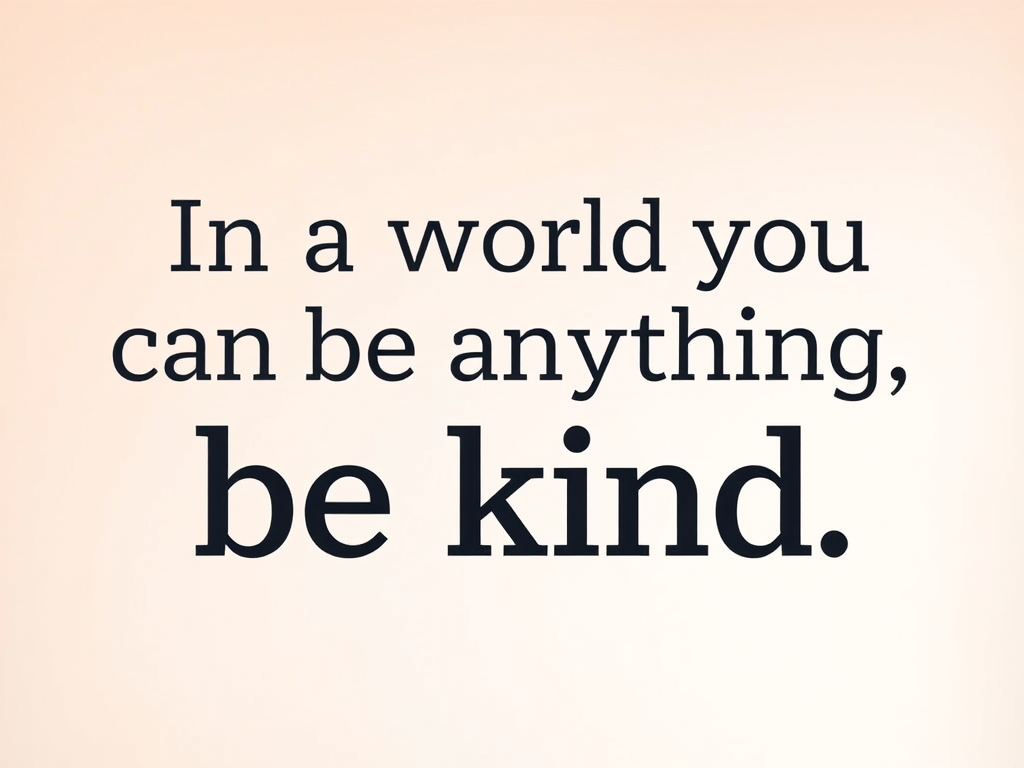
A quote encouraging kindness in a simple, elegant font on a light background.

Finding Service and Joy in Every Job: Lessons from a cleaner

recalling unceasingly before our God and Father your work energized by faith, and your service motivated by love and unwavering hope . . .” 1 Thessalonians 1:3 (Amplified Bible)

What a difference one person can make😃

I had a feeling when I walked into my classroom one frosty January morning and observed the unswept floor, Mr. King (name changed for privacy) had not been in my classroom over Christmas break. Not that I typically permit my students to leave trash and debris on the classroom floor; however, I noticed there were a few pieces of notebook paper, pink pencil eraser dust, and a random pen lid dropped to the floor.  

Thanks, in large part to Mr. King, my classroom floor was usually immaculate. Was he sick? When I saw him, he appeared to be fighting some sort of virus. Picking up what I could off the floor, I thought of Mr. King, and the way he approached his work. However, students had begun to arrive, and I knew I would have to set aside my current strands of thought.

Later in the week, I ran across a quote that reminded me of Mr. King: “You are always doing spiritual work. It is not necessarily the action that is important, but how you do it.” (Satchidananda) I thought of his smile, his positive attitude, and the can-do energy he brought with him to his work. 

Photo by Liliana Drew on Pexels.com

Each Job is part of a Bigger Picture 🧹

I first met Mr. King during the summer before school started. He was part of a professional cleaning crew hired by our school. We occasionally chatted while we both worked, if he happened to be completing a task in my classroom. During one of those chats, we said his cleaning job mattered because he felt he was part of the team helping the students to have a successful school year.  

“If I don’t do my job, then you have to do my job, which means you don’t have as much time to focus on your students and that means their learning suffers.  It’s all a chain, y’see?”

Photo by RDNE Stock project on Pexels.com

Working with Joy 🎶

Once the school year was under way, I would often hear Mr. King, after school hours, singing/humming in the next classroom as he swept. It was a joyful energy, his voice pitching high and low as he worked. 

Some days, after students were dismissed and I remained getting caught up on work, Mr. King would respectfully knock and ask if I minded him coming in to sweep. Never wanting to interfere with his cleaning schedule, I welcomed him in. 

No matter how busy Mr. King was, he would take time to ask about my husband and me. Then, he tended to have some sort of question or story for me to ponder. It was a delightful give and take, and he was most interested in improving himself, body, mind, and spirit.

Though our conversations were never longer than three or four minutes, I was left with the impression that Mr. King was a deeply faith-filled man who had made mistakes, knew he wasn’t perfect, but still had the desire and heart to improve.

He especially seemed to want his life to be of good service. To this end, he once said, “I am working. Am I not? But how am I doing it? That’s what’s real.” 

Photo by Antoni Shkraba on Pexels.com

OUr Work Ethic speaks for us 🤓

Later in the month of January, another coworker said Mr. King went back to Florida, from where he was originally, in order to be closer to his family

Upon hearing this, I recalled he once took a phone call from his daughter while sweeping my classroom. Returning from the hallway into which he had stepped to talk with her, he looked wistful, adding, “I worry about her.”

Photo by Ivan Samkov on Pexels.com

simple ways we can be of SErvice to others: 😃

The memory of Mr. King’s work ethic now serves as a reminder to me that no matter what job we have, we can find ways for our work to be of service to others. Here are some of the ways, Mr. King demonstrated this:

Work with joy. It doesn’t mean that we don’t have challenging or difficult days. Rather, we can still have something for which to feel joyful IN SPITE of circumstances, and that joy can become contagious. Mr. King appeared to find and share joy by singing/humming and smiling outwardly. Even on those days where I could tell something was bothering him, he still offered me a smile and a sincere greeting. 

Find the meaning in your work. Mr. King believed his work was important because he was contributing to the overall well-being and success of students, teachers, and staff. He often spoke about how much he liked the teachers and students he met and was glad he could do his part to help our school. 

Work hard, but take time to pay attention to others. Mr. King was an efficient and effective cleaner, but he still took time to greet staff members by name. If he learned something special about someone, he would ask questions about that special-something and would later refer to it in passing conversations. He was the master of personalized small talk.

Remain flexible and responsive to the needs/priorities of the day. If a worker was out, or a new worker was being trained (which was often), I would frequently overhear Mr. King fielding calls to answer questions and/or offer help. He appeared to adapt his schedule in stride to accommodate necessary changes. Even then, if he saw John, my husband, or me, he’d pause with a “Y’all doin’ ok?” or “You and Mr. John take care this evenin’.” 

Be empathetic and compassionate. Throughout the time Mr. King worked at our school, I observed several occasions when he took time to interact with students who looked frustrated, down, or who simply seemed alone. He’d ask, “You doin’ ok, buddy?” or offer another kind phrase in an attempt to bring a smile to a kid’s face. Then he went right back to work, whistling or humming as he went.  

It’s not what you do, but how you do it. Mr. King epitomized this. A radiant smile never seemed to leave his face while working. Furthermore, he demonstrated to his coworkers, and those with whom he encountered, that he cared, was interested, and desired to uplift the small piece of world his work-life encompassed.  

Photo by Ketut Subiyanto on Pexels.com

final thoughts🤔

None of Mr. King’s skills are life shattering or new ideas. However, in a world where it currently appears acceptable to be ill-mannered, ill-tempered, non-empathetic, and even outright bully others to get your way, Mr. King’s skills and attitude were a refreshing change of pace. Imagine the amount of good that could be generated if more people thought about HOW they worked, spoke, and acted–if more people would choose to be truly service-driven, energized by faith and motivated by love and hope. How much more would be accomplished . . .if only.

Embrace Kindness: New Year’s Resolutions for 2025

Photo by Matheus Bertelli on Pexels.com

Who Set a Resolution for 2025? 🙋‍♀️ 🙋‍♂️

Did you set a goal or resolution for 2025? According to the Pew Research Center, the younger you are, the more likely you are to establish a resolution. Last year, about half (49%) of the adults, 18-29 years, made at least one resolution. That dropped to ⅓ (31%) of adults, aged 30-49 years, and for those over age 50, only about ⅕ (21%) of this age group sets New Year’s intentions. 

Yougov.com reported similar statistics for last year. This organization’s polling further revealed that by March 2024 nearly ⅔ (70%) of those adults who set resolutions had either mostly or entirely stuck to their goals. Not surprising, most resolutions, according to both PRC and Yougov, had to do with either health, such as exercising more or eating healthier, or wealth, such as saving more money or paying down debt. 

Establishing resolutions around improving one’s health or one’s financial security are certainly worthwhile endeavors for which I wholly support. However, I would like to put forth this idea–whether you do or don’t make New Year’s resolutions–for spreading seeds of goodwill, kindness, and simple decency. While this is a less specific goal–and flies in the face of those who argue for SMART (specific, measurable, achievable, relevant, and time-bound) goals–I would argue that setting a daily intention to plant one seed kindness is also SMART and smart. 

Photo by Polina Kovaleva on Pexels.com

Consider This . . . 🤔

The following quote by William Arthur Ward is often shared at the start of New Year’s that says: “I have the opportunity, once more to right some wrongs, to pray for peace, to plant some trees, and sing more joyful songs.” 

I believe this quote is worth considering now as social media outlets and people of influence have made it socially acceptable to bad-mouth, malign, and verbally abuse others with the intent to create division, discord, and derision. In fact, I think Ward’s decades old statement can be turned into actionable goals, a couple for which I have reworded for the purpose of goal implementation. These include: right some wrongs; pray for peace, plant some seeds, as well as celebrate and share joy.

Right Some Wrongs. This goal is simple. When you do something wrong, own it, apologize for it, make whatever amends you need to make, and learn from it.  We all make mistakes, unintentionally say something hurtful, or do something that upon hindsight wasn’t the best choice. Instead of acting like it didn’t happen or feeling a sense of self-loathing for doing it, do something about it.  Sure it may not be easy, and you may have to swallow your pride. However, in the end, both you and the other person(s) will feel better and/or benefit.

Pray/meditate for Peace. Again, this is another simple goal that takes minimal effort. Spending five to ten minutes per day contemplating peaceful actions for the day, praying for guidance for world, national, and/or local political leaders, or focusing on any other forms of peace you would like to see in the world is neither time-consuming nor hard. The world needs more peace warriors, so why not bless it with more peaceful words, prayers, meditations, thoughts, and altruistic actions.

Plant Some Seeds. Random Acts of Kindness (RAK) Foundation, started in 1995, has done an excellent job of promoting kindness.  Their motto, “Making kindness the norm ♥ ️,” I would argue remains relevant 30 years later. This can definitely fit into the SMART criteria as it is specific, measurable, achievable, relevant, and time-bound. Do and/or say something kind, helpful, and encouraging, every single day.  It’s that simple.  Even if you wake up on the wrong side of the bed, doing something for someone else has the power to not only positively affect that person, but that goodwill will fan out across a sea of souls unseen to you. As an added bonus, you will most likely feel better as well. If you’re at a loss for ideas of kind actions to implement, visit randomactsofkindness.org for scores of suggestions. Acts of kindness can create ripples of positivity on the troubled waters of life; they can be balm for a bruised and battered soul.

Celebrate and share joy. If you’ve ever had a serious illness, you know all too well the realization that can dawn on you for taking for granted those so-called “normal days” of life and health. Therefore, why not celebrate, savor, or at the very least, acknowledge (and perhaps enjoy) an average (or not-so-average) day of life? You have one precious life–that’s it–so pay attention to it. Share a “dad” joke, shake or hold a hand, pat another person the back, hug a friend, stroke your pet’s soft fur, eat that piece of cake, have coffee or tea with a friend, take a walk in the sun, smile more, frown less, take an interest in the person from whom you buy that morning cup of joe. . . . In other words, step away from the screen, from social media, and streaming/gaming services.  Not that there’s anything inherently wrong with them, but life is not lived on screen.  Even in this hyper-connected world, I can’t imagine anyone, nearing the end of their life, wishing they had spent more time with Facebook. 

Photo by Anna Tarazevich on Pexels.com

YOu can make a difference this year! 🫶

Whether you’re part of the statistics that chooses to set New Year’s resolutions or not, we can all make the choice to: right personal wrongs, pray for peace, plant seeds of positivity, and/or celebrate/savor the joy of being alive. These are not difficult tasks, but rather they are simple actions that possess potential opportunities to send forth warming rays of goodwill, tolerance, and decency in a world clouded over with ill will, acrimony, and disrespect. While your actions may not make headlines, you can be sure that one good act begets another. And, that, my dear Reader, can indeed make a difference. 

Happy New Year! 

The Power of Kindness: Good Thoughts, Good Words, and Good Deeds

“Be kind whenever possible. It is always possible.”Dalai Lama

Photo by Alexas Fotos on Pexels.com

The shape of kindness ❤️

This past spring I viewed a documentary on various world religions, and one line  from this film really stood out. “Good thoughts, good words, and good deeds” is considered an essential teaching and practice of Zoroastrian faith. As I understand it, doing good deeds is not reward focused, but it’s more about thinking the best of others as well as doing good acts for its own sake. That maxim has remained with me all these months later.

At its core is kindness–kindness to others, and even, kindness to self. Kindness is one of those notions that gets tossed around in cutesy social media quotes and images, such as, “Spreading kindness like confetti!” or “In a world where you can be anything, be kind.”  While I love the intent around these images, it is easy to grow immune to their effects or even cynical.

Still, at the end of the day, kindness truly does matter. How many of us have been impacted by a rude, disrespectful, or all around unkind encounter?  I know I have. I walk or drive away feeling like Pig-Pen, a proverbial cloud of yuckiness clinging to me. Like lint on black pants, it seems that one act of unpleasantness appears to attract more of it. 

Photo by Craig Adderley on Pexels.com

Moods are contagious 🤧

For example, the day may begin with a car cutting you off on your drive into work. Preparing to walk into work, the lid to your new, supposedly, leak-proof coffee cup isn’t quite tight enough, and you end up entering your workplace with brown stains down that new light-colored shirt that, of course, you were wearing. 

After stopping by the restroom to try to blot off the stain as best you can, you open your computer only to find an email from that “thinks-they-are-so-special” client that sends you into another negative spiral. By the time lunchtime rolls around, and you realize you forgot your packed lunch at home that you actually took time to pack the night before, that cloud of negativity has burst open, and you feel soaked through with negative thoughts.

Photo by Christina Morillo on Pexels.com

Here to help 🤝

Kindness, however, often works the same way. What if the drive into work was eventless and traffic was light.  While the coffee still spills, a co-worker offers their Tide-pen to help make the stain less noticeable. When you open your inbox to email, you discover an email that includes words of appreciation from a hard-won client for a job well-done. 

When you discover that you left your packed lunch at home, another coworker offers to pick you up something while they are out on an errand, which gives you a bit of time to get caught up on a few other tasks you’ve been meaning to do. Meanwhile, you make a mental note to think of something nice you can do in return for that coworker later in the week. 

The same day, served up two ways.  Kindness can make a difference like that.  And the best part is that kindness does not require any special talent, money, or resources; we can cultivate it through our “thoughts, words, and deeds” as those of the Zoroastrian faith are encouraged to do.

Photo by Andrea Piacquadio on Pexels.com

Kind words and actions cost nothing but reap dividends 🤩

Offering to help others, saying or writing kind words, or simply being considerate are all ways of intentionally sharing kindness. Those simple acts can benefit others in ways that we may never be directly witnessed, but do not, nonetheless, detract from the worth of the actions. In fact, one small act of deliberate kindness, like its negative counterpart, can initiate a wave of positive events as one act leads to another and on to another.

Even if we offer a kind word or deed to others without expecting anything in return, those acts still benefit us. According to the Mayo Clinic, demonstrating kindness to others positively contributes to our sense of self-esteem, empathy, compassion, and boosts our mood. In the same 2023 article, the Mayo Clinic adds that acts of kindness lowers one’s blood pressure and levels of cortisol, a hormone directly related to stress.  Kindness can boost your mood and increase feelings of connectedness, thereby decreasing feelings of loneliness.  

Photo by Dziana Hasanbekava on Pexels.com

Benefits of Kindness 🧠

Kindness is also good for the mind.  When you do a thoughtful act, even as simple as sharing a pack of gum, offer words of encouragement, or even speak a simple compliment, you create physiological changes in your brain. With each kind act, dopamine and serotonin are released, creating feelings of well-being.  Meanwhile, the pleasure and reward centers of our brains are lit up. Additionally, kind acts and words can flood our bodies with endorphins, those “feel good” chemicals that boost mood and reduce sensations of pain and/or stress.

Kindness doesn’t have to just be focused on others; kind thoughts towards oneself is also as important and just as worthy of an endeavor.  Practicing kind self-talk that is positive and encouraging of self is worth-while, and much more beneficial than the negative loops that too easily circulate in our heads.  In addition to the practice of affirming and loving self-talk, fostering a sense of gratitude goes a long way to feeling kindness towards self and others. 

Photo by Kindel Media on Pexels.com

So many ways to offer Kindness 📝

Of course, there are the obvious kind actions such as volunteering and working/helping out with causes in which you believe.  However, there are other less overt, more subtle ways of generating kindness that are just as beneficial, if not more so!  Consider the following actions:

  • Call that friend or acquaintance that you haven’t seen in weeks 
  • Mail an old-fashioned postcard or letter to someone telling them how much they mean to you or you appreciate them
  • Write a handwritten thank you note the next time someone does something nice for you
  • Get flowers, candy, a cup of coffee, or a some other little treat for someone for no reason
  • Check in or call someone who is either sick or you know is going through a rough patch
  • Offer to take a shut-in to church, to the grocery store, or even to lunch
  • Buy a cake mix or cookie dough. Then, bake and share a treat with a neighbor or friend for no particular reason
  • Keep a gratitude journal to continue to foster good thoughts
Photo by Eva Bronzini on Pexels.com

everyone’s superpower 🦸‍♀️

The list could go on, but the point is, acts of kindness and generosity to others (and self) can be as big or small as you want.  “Good thoughts, good words, and good deeds”  put into actions, no matter the size, will always benefit others in some way.  

In the end, kindness is a big deal.  In fact, it’s a kinda superpower we all have the ability to possess. It merely takes a tad bit of thought and time. 

Saint Nicholas of Myra, a story of service and generosity

“The giver of every good and perfect gift has called upon us to mimic His giving, by grace, through faith, and this is not of ourselves.”–St. Nicholas of Myra

Photo by Andrea Piacquadio on Pexels.com

Heart-warming Stories . . . 📖

I have always appreciated heart-warming stories–you know the type.  The wronged protagonist, our underdog hero, faces one insurmountable challenge after another.  Just when you think the bad guys are truly going to get him or her, the protagonist finds a way to persevere, inspiring mere-mortals that we too can be like the protagonist.  

Those comforting stories are like cotton-candy, light, sweet, and sticky. Instead of needing to clean your hands, it’s the story that sticks around in your mind, inspiring you to perhaps make a change in your own life.  That sums up the legend of Saint Nicholas of Myra.

My interest in the story of Saint Nicholas was piqued when our school pastor, Rev. Monsignor Dean G. Borgmeyer, spoke of the upcoming Feast of Saint Nicholas at a school church service.  I wanted to learn a bit more about him and conducted a brief search. From Britannica to Farmer’s Almanac and from the Cincinnati Enquirer to National Today and a few others, my gleanings yielded a variety of lore associated with St. Nicholas.

By the time this is published, the Feast of Saint Nicholas will have already occurred in Western Christian countries on December 6, including the United States; however, it won’t occur in the Eastern Christian countries until December 19. Nonetheless, his legend, and all the variations of it, is a heartening story.  In fact, it inspired many of our current traditions and notions centered around the present-day conception of Santa Claus.

Photo by Andrea Piacquadio on Pexels.com

. . . Get Into your Head . . . 🧐

Some sources say that Nicholas was born to wealthy parents in the 3rd or 4th century in the Lycian seaport village of Patra, Turkey. It is believed that he traveled to Egypt and Palestine during his youth.  Tragically, however, according to one account, his parents died when he was quite young due to an epidemic sweeping the area.  This same report added that because he was raised Christian, Nicholas ultimately sold his belongings, dedicated his life to one of service, and then used his inheritance to help others.  At some point during his years of service to the church, he returned to Lycia, and there, he was made Bishop of Myra, one of the youngest men to be named bishop. 

Most sources emphasize his dedication to helping children in particular.  In fact, the one most often repeated stories are variations of how he helped a poor father keep his three daughters from a life of poverty, slavery, or prostitution by providing each of them with a dowry.  One account stated that stockings filled with gold coins were lobbed through a window of the family’s home and landed in shoes near the hearth.  Another account simply stated that gold coins were mysteriously found in their shoes.  In a similar fashion, unrelated to the three daughters, it is also claimed that children would find gold coins in their stockings that were left outside to dry after washing, and it was a widely held belief that this was the work of Bishop Nicholas.  

All sources agree that Nicholas was imprisoned for his good works and probably tortured during the Roman persecutions of Christians. Most likely he was released during the reign of Constantine the Great and continued his life devoted to helping those in need.  He was supposedly declared a saint on the same day he died at an estimated age of 73.

Photo by RDNE Stock project on Pexels.com

. . . Melt your heart . . . ♥️

His reputation for kindness and generosity grew because it is believed most of his gifts to others were given anonymously, and as a result, there are many wildly, unbelievable legends and miracles associated with Saint Nicholas. One such miracle was of a crazed butcher who chopped up three young kids and hid them in brine.  Supposedly, Nicholas was able to fully restore the lives of all three children and return them whole and healthy to their parents. Another story tells of a kidnapped son being returned to his family one year later, guided by Bishop Nicholas, years after his death. 

However, for me the greatest takeaway of the story of Saint Nicholas is the idea of practicing generosity and kindness to others, not just through the holiday season, but throughout the year–especially in an anonymous or low-key manner as part of a regular practice. In fact, during the recent funeral of Rosalynn Carter, her pastor talked about the fact that she understood the message of living a life of faith and service intellectually in her head.  That intellectual seed of understanding became planted in her heart, and the desire to share and love others grew from that planted seed of faith.  From her heart, a passion for generosity and service moved to her hands via actions.  Over time, these acts of service and kindness became a regular practice, thus creating a habit.  Head. Heart. Hands. Habit.

The story of St. Nicholas is quite similar, and you don’t have to believe all parts of his legend to get the message.  The protagonist understood at a young age the importance of faith and serving others.  Due to this belief, he soon learned to embrace and embody the idea of service into actions.  Then, the act of kindness and generosity became so ingrained in him that service, kindness, and generosity became the habit of his life–even if it meant facing persecution for it.  Head. Heart. Hands. Habit.

Photo by Brett Jordan on Pexels.com

. . .And move your hands to action 🤝

As 2023 winds down with the holiday season, it is so easy to get wrapped up (honestly, no pun intended, but it does fit) in commercial, marketing hype, which can lead to stress, over-obligating, and overspending–which creates even more stress and anxiety which is self-focused. While I am not saying you should not participate and enjoy the holiday season, rather I encourage all of us to also take time to reflect on our own head, heart, hands, and habits of 2023.  

How can we more often incorporate acts of service? Can we find ways to practice generosity and kindness regularly and/or anonymously? Can we carry that spirit of Saint Nicholas beyond the holiday season and look for ways to continue in 2024.  If we can intellectually convince ourselves of the value of service to others, however small, then maybe our hearts would soften and open to the idea. From that softened heart, we might find the audacity to commit our hands in 2024 to some form of humble service–not because we want others to know, or we want a tax-write off, but because it is simply the right thing to do. Could it, would it, become a habit?  What would happen if there were more people like Mrs. Carter or like the legendary St. Nicholas?   

It Starts with One Seed

“In this earth, 

In this soil, 

In this pure field

Let’s not plant 

Any seeds 

Other than seeds of compassion

and Love–Rumi

Photo by Mary Taylor on Pexels.com

While it’s nerdy to admit this, my husband and I love shows about nature, with PBS’s Nature among one of favorites.  Go ahead, make fun of us, or roll your eyes. We teach middle schooler students; we can take it! 

Recently, an episode of Nature featured animals who survive on the highest and most extreme terrain of the Alps.  While you may continue to giggle and guffaw at our choice of entertainment, this episode fed our minds with its breathtaking cinematography of an extraordinary landscape and the unique variety of animals adapted to the Alpine mountain climate, including the chamois, ibex, marmot, golden eagle, and the spotted nutcracker.  It was while the narrator and filming focused on the nutcracker scene that, shall I say, planted a seed.

Photo by Trace Hudson on Pexels.com

In the Alpine world, the Swiss stone pine exists, thanks in large part to the work of the spotted nutcracker. The nutcracker relies on the seeds of the Swiss stone pine for food.  Even though this tree only produces seeds between the months of August and October, this bird is able to survive year ‘round in the harsh conditions of the Alpine climate because of its ability to stockpile these seeds in a wide variety of locations and remember their hiding spots. The birds’ naturally seem to select places that prevent their collection from being stolen by scavengers.  Interestingly, these carefully selected locations are also less likely to support seed germination–at least for a several months.  Thus, these hidden seed-pantries enable the spotted nutcracker to eat year ‘round, including feeding its young in the spring.

Fortunately, for the Swiss stone pine, it can live for as many as 500 years–which works in the favor for both the tree and spotted nutcracker.  In fact, even if only one to two seeds per year from the nutcracker’s hidden caches remain uneaten, and therefore germinate, it is enough to keep the tree viable for hundreds of years.  Thus, making this symbiotic relationship an ideal partnership for the continuation of both species.

Photo by eberhard grossgasteiger on Pexels.com

“Keep on sowing your seed, for you never know which will grow—perhaps it all will.”–Ecclesiastes 11:6 TLB

One seed.  Hidden, dropped, or lost–dormantly remains idle until the conditions change.

One seed.  Full of potential–enough energy to fuel the growth of a new seedling.

One seed.  Serendipity–precise temperature, water, oxygen, light.

One seed. Free to break through its hardened shell and begin growing.

From one seed of the Swiss stone pine, a root first forms, followed by a shoot that will grow into its stems, branches, and needles.  Over the years, as the seedling extends into maturity, the tree will endure countless challenges throughout the entirety of its life. From strong winds to Alpine avalanches, from temperatures well below freezing (think -30 to -40 degrees) to extremely warm temperatures, from blizzard conditions to summer storms, and all conditions in between, this tree finds a way to persevere for hundreds of years.  

However, the Swiss stone pine does not survive all those hundreds of years without breakage. In fact, the trunk of this tree is so brittle that its top may be repeatedly broken off in harsh conditions.  Despite its brokenness, it continues to grow and produce seeds that are editable–not only for the nutcracker, but also for other birds, animals, and even human consumption.

Often referred to as the “Queen of the Alps,” the Swiss stone pine survives its brokenness and storms by forming lateral shoots that often resprout in response to the weather conditions.  Furthermore, the nutcracker typically only consumes about 80% of the Swiss stone pine seeds it hoards.  Therefore, thanks in large part to the work of the nutcracker, groups of seeds often germinate together in one spot, and the numerous trees sprout together.  What often appears as one tree with multiple trunks are actually several trees growing together in one root system. Additionally, even if the nutcracker–or for that matter, other creatures– would happen to eat all of the trees’ seeds for several seasons in a row, the Swiss stone pine’s seed cycle includes a mast season, every four or five years, producing so great a quantity of seeds that it would be impossible for all of its seeds to be consumed. Thus, ensuring the tree’s survival, but also the survival of any Alpine creature who may rely on this tree for shelter or food, such as the spotted nutcracker.

One seed. One tree. One bird.  Watch the ripples expand.

Photo by Pixabay on Pexels.com

We can’t change people, but we may plant seeds that may one day bloom in them.”–Mary Davis

Reflecting upon this unique symbiotic relationship, I was reminded of our own human to human interactions.  From day to day, month to month, and from year to year, imagine the seeds each human being can potentially plant.  Many of these seeds foster our own well being and the well being of others as we cultivate friendships and relationships for the mutual benefit of all involved.  These relationships eventually sprout into new families and new friend groups. 

Furthermore, seeds planted with coworkers, neighbors, professionals with whom we regularly interact, as well as complete strangers, can germinate ideas, thoughts, and other notions that, one day, may benefit that person.  From the compassionate gesture of helping a complete stranger to private gestures of kindness unseen or unheard by those benefiting, from one tender word of encouragement to one empathetic ear ready to listen, we all have the ability to sow seeds wherever we go.

Even when we are broken by the squalls, obstacles, and difficulties of life, through the rooted and interconnected relationships of our germinated seeds, we can find the strength to rise again.  In conditions ranging from the most arid to emotionally drowning episodes, from the frozen heart to impassioned flare of tempers, it is our propagation of seeds that comes back to us again and again, making us more resilient, more strong, and ultimately able to persevere, allowing us to continue to produce even more seeds

Photo by Pixabay on Pexels.com

One positive word. One helpful deed. One encouraging smile.  Seeds are planted.  Perhaps, they remain dormant in the recipient’s being for days, weeks, months, even years.  Nonetheless, one moment, under the right circumstance, that seed will take root, sprout, and soon enough branches and roots systems, like Swiss stone pine trees, will expand over the mountains of time.  You may not see it, but your one choice, your one act, repeated throughout your life, may create a forest from which many will be nourished and find shelter. 

Don’t judge each day by the harvest you reap but by the seeds that you plant.”–Robert Louis Stevenson