Nutritious Maple Walnut Salad Inspired by Alzheimer’s Study | Health Recipe

“I am cautiously optimistic and very encouraged by these findings, which may give many people new hope and new choices,” Dr. Dean Ornish

highly anticipated study 📈
Photo by Greta Hoffman on Pexels.com

I recently returned from a trip to Ontario, Canada. While I was there, a major study, led by Dr. Dean Ornish, was released in BioMed Central’s Alzheimer’s Research and Therapy. This highly anticipated research was widely promoted across various news outlets weeks earlier. Despite the fact I had read the earlier press releases, reading the report, one peaceful early morning in a rustic cabin along the shores of backwoods lake, provided greater understanding.

As I have previously written, Alzheimer’s disease (AD) and dementia are part of the genetic make-up on both sides of my family history.  Watching it take the minds of my beloved grandparents was heartbreaking. Ultimately, they required extensive care in large part due to AD, the burden of which fell upon their children. Therefore, I want to do all that is possible to avoid placing that type of burden upon my loved ones.

Ornish’s study is the first controlled clinical trial to demonstrate that lifestyle habits can delay the onset and progression of mild cognitive impairment (MCI) or early dementia due to AD. The study initially enrolled 51 patients and their designated partners, aged 45-90, for 20 weeks, but two withdrew. Nonetheless, the study guided the remaining 49 patients through a series of interventions, including a plant-based diet; walking 30 minutes per day; strength training three days a week; stress management including yoga, breathing exercises, and meditation, to name a few; group support via Zoom meetings, and specific supplementation, all of which is clearly spelled out. 

Excitement Incitement 💡

The excitement of this study got my recipe-creating gears grinding, especially as a major heat wave sank its talons in a large swath of the U.S. and Canada, including where I was staying with my husband. With the extreme heat we were experiencing, the last thing I wanted to do was turn on the cabin’s stove or oven, especially since there was no air conditioning. Therefore, throughout our stay, I created several dinners of seriously large salads, adding additional inspiration for this month’s recipe.  

Of further influence was the wide availability of Canadian maple syrup.  In fact, I encountered a representative of White Meadows Farms, out of St. Catherine, Ontario.  This family-owned farm, established in 1937, has been harvesting sap to make maple syrup for over three generations. After one sample, my taste buds were “stuck” on the flavor of their dark syrup. I knew I had to put their syrup to good use as part of this recipe creation. After all, sweet moderation is an important part of good health.

Nuts for health 🌰
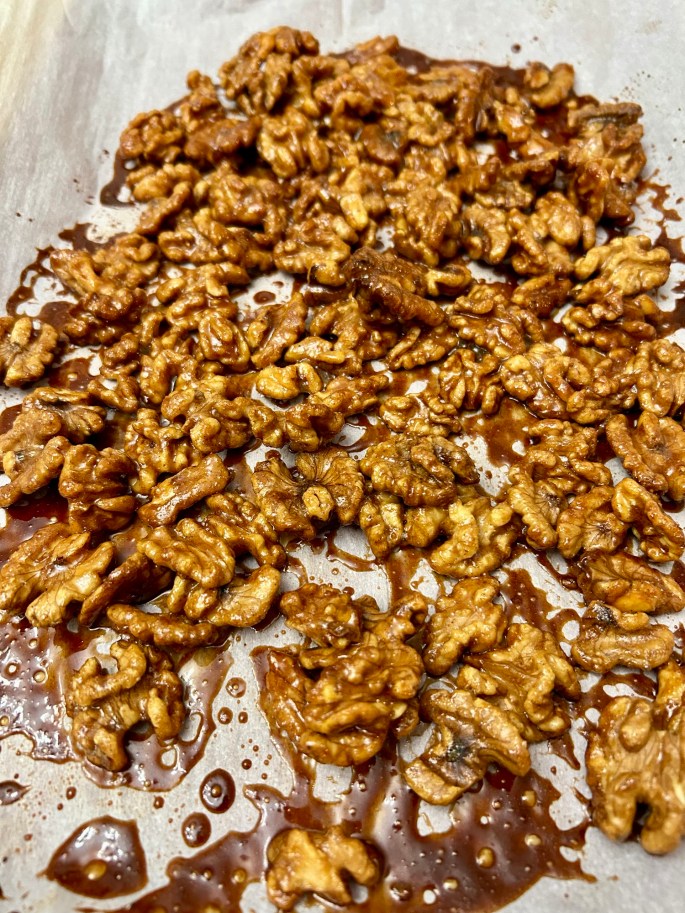
Another point of inspiration for this recipe was the wide availability of bulk walnuts at the local market near our camp. Nut and seeds are a healthy part of the Ornish diet. In fact, according to the Cleveland Clinic, walnuts provide a good source of omega-3 fats and antioxidants for heart health, benefit gut health due to their high fiber content, help stave off inflammation, and may reduce risks for certain cancers.  Additionally, those healthy fats and antioxidants may boost brain health–perhaps that is why walnuts are shaped like a brain!

A rainbow recipe of pride 🏳️‍🌈

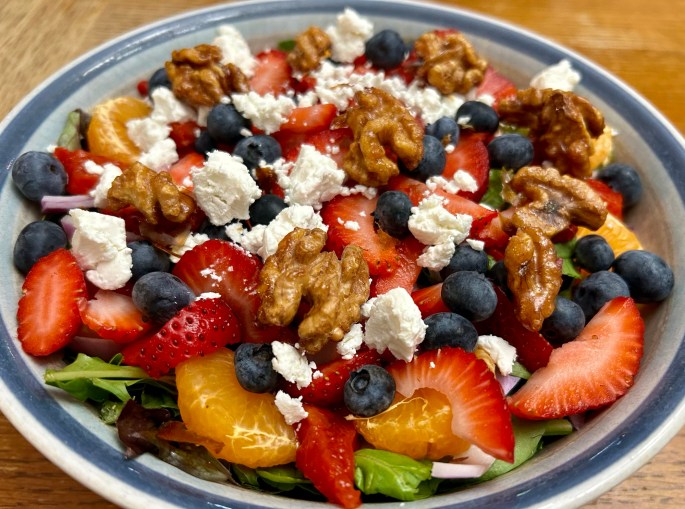
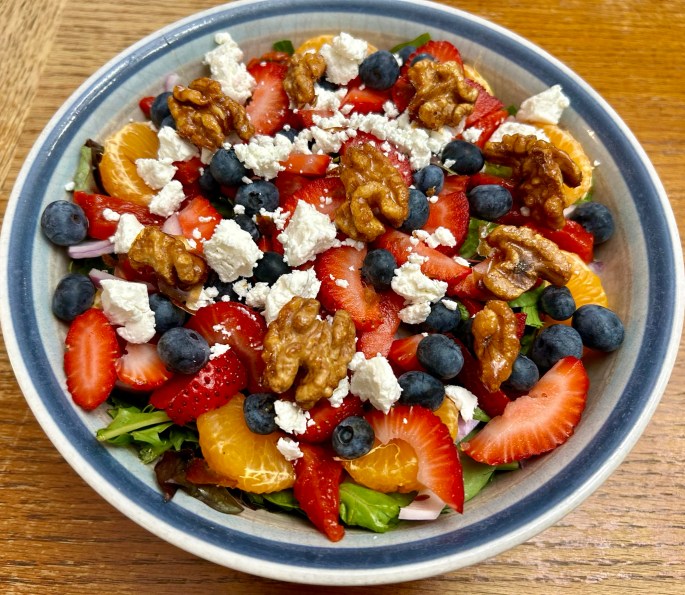
One final source of inspiration for this recipe was the fact that it was created during June, the month of Pride, dedicated to celebrating my friends and loved ones in the LGBTQ+ community, including my brother and two nieces.  It is with great, well, “pride” and celebration that this recipe will debut on June 28, International LGBTQ+ Day.  This gorgeous salad offers a RAINBOW of tasty colors and textures designed to nourish EVERY body.

From my home to yours, I wish you health, happiness, and hope for an optimistic future free from dementia and Alzheimer’s disease!
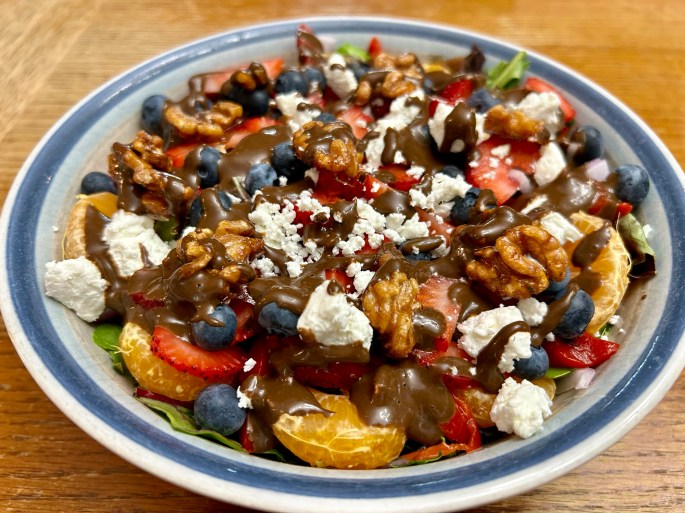
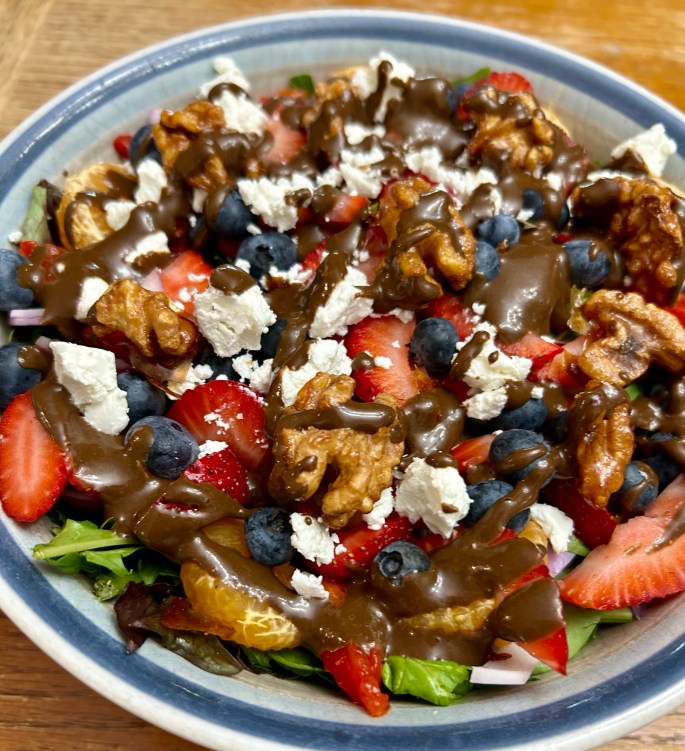
Rainbow salad with maple walnuts and vinaigrette, gluten-free with vegan options

Maple walnuts ingredients:

2 cups walnuts

⅓ cup pure maple syrup

½ to 1 teaspoon vanilla 

¼ to ½ teaspoon cinnamon 

⅛  teaspoon sea salt

Salad ingredients:

5 or more ounces of favorite baby greens

1 cup sliced strawberries

¾ cup blueberries

2-3 clementines, sectioned

½ sliced large red onion

½ cup roasted red peppers and/or shredded carrots

2-4 ounces goat, or equivalent vegan, cheese or 1 cup beans, drained and rinsed

Maple walnut balsamic vinaigrette ingredients:

¼ cup walnuts

½ cup water

¼ cup balsamic vinegar

2 tablespoons maple syrup

1 tablespoons dijon mustard

½ teaspoon dried onion powder

½ teaspoon dried oregano

⅛ teaspoon salt

Pepper to taste

Maple walnut directions:

Preheat oven to 350 degrees

Line baking pan with parchment paper or lightly grease and set aside

Place maple syrup in a small, microwave safe bowl.

Heat syrup for 30-60 seconds

Stir in vanilla, cinnamon, and sea salt until thoroughly mixed

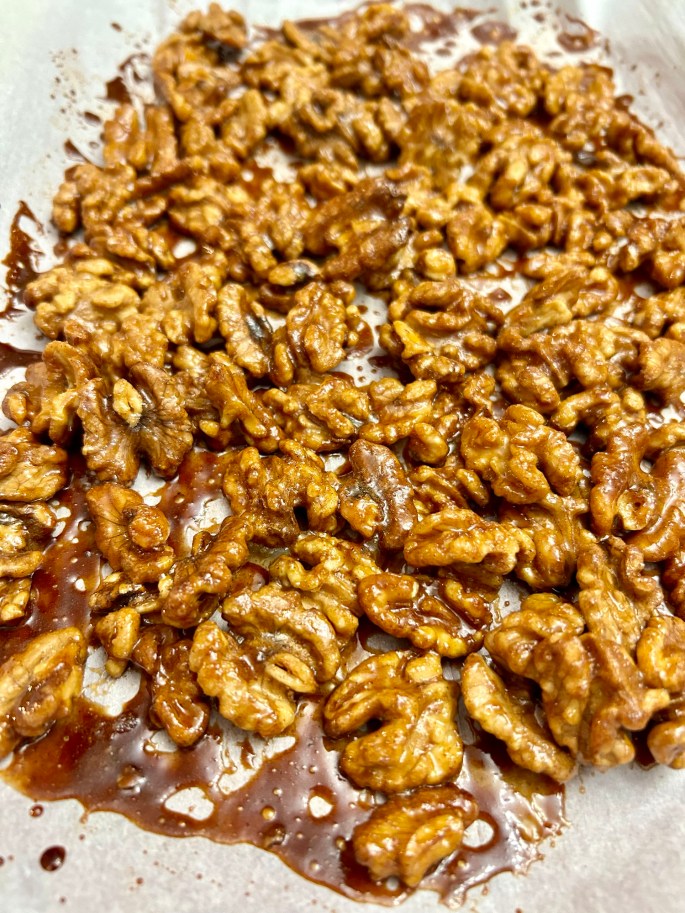
Pour syrup mixture over walnuts, and stir until well coated

Spread coated walnuts onto prepared baking sheet

Bake 5-7 minutes, then stir and rotate 

Continue baking for 3-5 minutes or until walnuts are golden brown

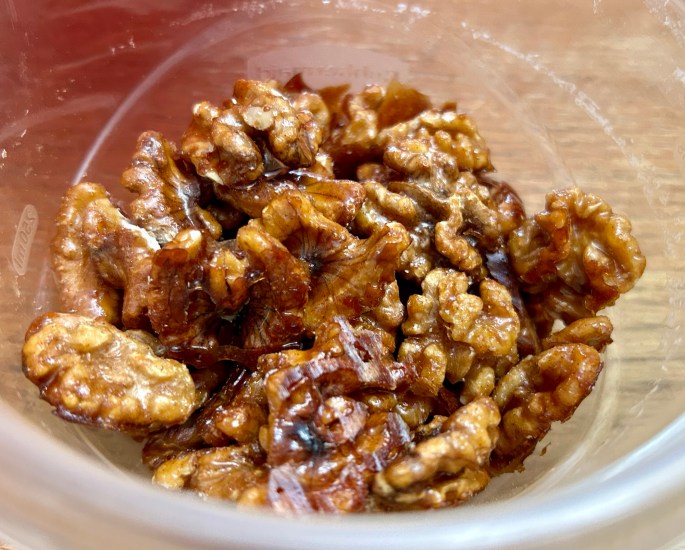
Remove walnuts from oven and allow to cool on baking sheet 

Break walnuts apart and store in airtight container or baggie for up to 3-4 for weeks

Enjoy these maple walnuts as a snack or sprinkle over salads, fruit bowls, oatmeal, yogurt parfaits, ice cream sundaes, etc 

Maple walnut balsamic vinaigrette directions:

Place all ingredients in high powered blender and blend until smooth, approximately 45 seconds

Pour into glass container (I like to use canning jar)

Store in refrigerator for up to 4 weeks

Makes approximately 1 cup dressing

To assemble salad:

Add greens to large salad bowl

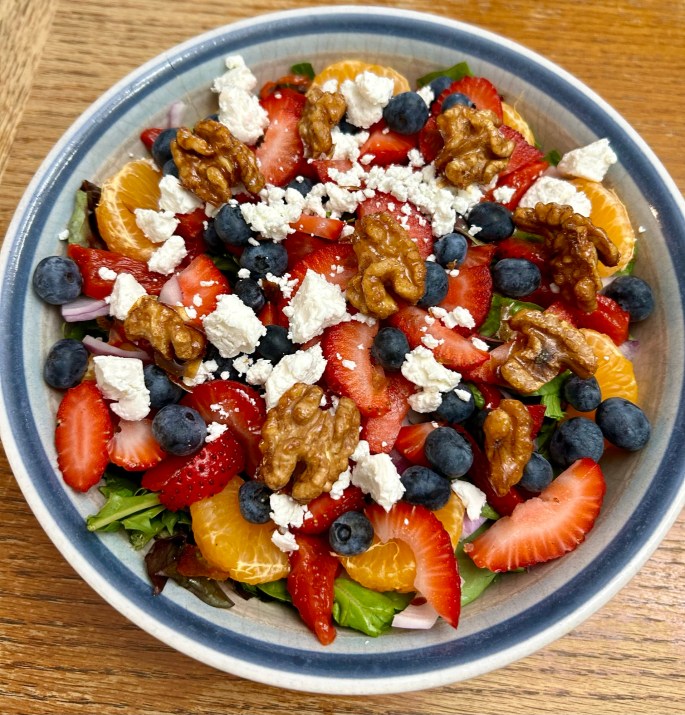
Add sliced strawberries, blueberries, clementines, sliced red onion, sliced red pepper, and/or shredded carrots, if using.

Toss with desired amount of dressing, divide among plates/bowls and top with goat or vegan cheese (or top with beans instead, such as roasted chickpeas)

Serves 2-4
This recipe also took inspiration from the following websites and articles: Better with Cake, The Garden Grazer, Hello Nutritarian, “Effects of intensive lifestyle changes on the progression of mild cognitive impairment or early dementia due to Alzheimer’s disease: a randomized, controlled clinical trial,” an article on BioMed Central,“‘A study to give us hope’: Lifestyle changes improve Alzheimer’s symptoms for some,” an article on CNN, and Shane and Simple.


Your Health Journey: It’s more than just taking a pill

“Take care of your body.  It’s the only place you have to live.”–Jim Rohn

Photo by nappy on Pexels.com

Listen to your Gut-Instincts🙇‍♀️

It’s been a little over a decade since I received the medical diagnosis that dramatically changed my life. I spent years battling upset stomach, gas, bloating, heartburn, and lower belly pain that only got worse with age. Pills had always been the answers.  In fact, at one point in my life, I had multiple timers set on my phone to remind me to take prescribed medications before and after eating.  

During a vacation near Boone, North Carolina, with my husband and daughter in which we had to plan our days around the timing of my medication, I finally decided I had had enough.  Call it “gut-instinct”, but I knew that whatever was going on inside my body, the prescriptions were not the answer.

Photo by MART PRODUCTION on Pexels.com

Finding a Doctor to listen 👂

Fortunately, I had a doctor at the time who took me seriously and listened. Together, we discussed a plan of action. Still, it took several months of waiting for tests and lab work to be completed, and more time waiting for results–the “hurry-up-and-wait” shuffle–as I fondly call it.  

I am not sure what I expected the results to be. However, when the letter arrived at my house stating I needed to schedule a follow-up appointment with my doctor (which was already on the books) due to indications of celiac disease and hiatal hernia, I was initially upset due to the dramatic lifestyle changes to manage both.

Photo by Alexas Fotos on Pexels.com

Change is Not Easy 😬

To state the obvious, change is not easy, so I faced a fair amount of challenges as I adjusted my diet.  Ultimately, though, as my symptoms subsided, and, one-by-one, the medications fell by the wayside, my motivation to continue increased.  I also came to see that compared to other potential prognosis, changing my diet was a minor task compared to invasive treatments, therapies, and surgeries.  

I’ve learned much, and continue to learn, along my health journey. Therefore, I share my experience as a point of encouragement when dealing with medical issues. 

Photo by Christina Morillo on Pexels.com

Advocate for Yourself 🗣️

First, I encourage you to trust your instincts, and advocate for yourself, especially if you are a person of color, a woman, a person with a higher BMI, or a LGBTQ+ person.  Unfortunately, as with any field, there are those medical professionals with internalized biases.  While I am confident not all doctors are bad actors, my own personal experience–and that of several others I know–have certainly informed me that if you belong to one of those categories, your complaints may not be given serious and thoughtful consideration. Therefore, you MUST advocate for yourself, even if it means changing doctors or traveling out of the area in which you live.

Photo by Pixabay on Pexels.com

Not every Health Issue requires a Pill

Secondly, sometimes medication is absolutely necessary; however, prescriptions are not end-all-be-all for every situation.  While I did have a doctor who truly listened to me, it still took me advocating for myself and not settling for what he prescribed based upon the medical system in which he worked. I am fortunate that when I questioned the medicine, that this doctor did not take it personally or as an assault on his professional judgment.  Nor did he try to use shame, or blame-the-patient tactics, as I had previously experienced.  He heard me out, asked numerous questions, and based upon those answers, set up a series of diagnostic tests. 

Photo by Brett Sayles on Pexels.com

Be Gentle with yourself as you navigate lifestyle changes 😊

Thirdly, be gentle with yourself if you have to make lifestyle changes. Once I received my results, overhauling my diet was scary–do you know how many things have gluten in them and/or cause reflux? I felt a huge amount of internal resistance to those changes in the beginning because it seemed like such an overwhelming task. 

Lifestyle changes are not easy, and it takes time to make the adjustments.  There are going to be setbacks, slipups, and mistakes along the way.  I know; I experienced them.  Completely changing the way I ate was a steep learning curve, and it was an eye-opening experience. Nonetheless, at the end of the day, I wanted to feel better and not live my life on a series of timers and pills.

Photo by Jack Sparrow on Pexels.com

Find your support 👯‍♀️

Enlist support for your changes. Join Facebook communities or other support groups to help you transition and navigate through the changes. Thankfully, I had support in the form of my family and friends.  Of course, they did not have to necessarily change the way they ate, but they absolutely made, and still continue to make, accommodations for my dietary needs.  This is especially true for when we dine out.  I have a limited number of restaurants in which I can safely eat.  Therefore, if I can’t eat at a certain location, friends and family will nearly always choose another option, so I can also enjoy the meal with them.

Photo by Krivec Ales on Pexels.com

health is a constant series of adjustments along the way 🛣️

Finally, know that your health journey is a continuous process.  Because I spent over four decades without a proper diagnosis, I am still encountering health difficulties.  One of the biggest obstacles I now face is a result of undiagnosed celiac disease.  Celiac causes the villi that make up the lining of the small intestines where nutrients are absorbed to become damaged. Over time, the villi atrophy and flatten due to inflammation from eating products that contain gluten.  

Despite overall healthy eating and consistent exercise, until I cleared the gluten in order to reduce the inflammation in my body, I was not able to absorb enough nutrients, specifically calcium, Vitamin D, and Vitamin K.  Additionally, due to  acid-reflux, I took proton-pump inhibitors for several years, which are also known to deplete magnesium, calcium, and other important minerals.  

Thus, I now have osteopenia.  As a result I have already had one surgery and may later need another one. However, I am doing all I can to keep that from happening, including completing the prescribed exercises, lifestyle changes, and appropriate supplementation of key nutrients.  Additionally, of course, I continue to maintain lifestyle changes with regards to a gluten-free diet, low-acid diet, and I am now more motivated to continue consistent weight-bearing exercise to keep my bones as healthy and strong as I can. 

Our health is truly a source of personal wealth.  Therefore, learning to advocate our own health needs is critical.  To be sure, doctors are highly educated, but that doesn’t mean they are fully educated when it comes to YOUR BODY and YOUR unique HEALTH needs.  

Photo by Yan Krukau on Pexels.com

IT’s your body. Treat it Well.

Speak up for yourself.  Trust your instincts.  If you need medication, take it, but don’t overlook lifestyle habits as well.  Educate yourself on lifestyle habits that can positively (and negatively) impact your health and make adjustments as needed.  Don’t be afraid to ask for support, and forgive yourself if you slip-up along your health journey.  

At the end of the day.  It is your body.  It is the only one you have.  Treat it like the sacred, precious gift that it is.