Embracing Silence: The Owl’s Call to Mindful Listening

A wise old owl sat on an oak;
The more he saw the less he spoke;
The less he spoke the more he heard.” —old proverb

A wise-looking owl perched on a branch in a dark, wooded area, illuminated softly by moonlight.
Photo by Erik Karits on Pexels.com

Listening in the Dark 🌌

I am an early riser, typically awake before the sun. A few weeks ago, my ears perked at the haunting, penetrating call of an owl. Its “Hoo-hoo-hoo, hoo-hoo” echoed around our yard as I looked out into the murky dark. Since then, I intentionally listen for its steadfast call. It has become both a comfort and a mystery—an invitation to listen, reflect, and learn something new.

The owl’s call continues, I am certain, even when I am not listening; yet it requires my full attention in those predawn hours if I hope to notice it regularly. Its presence illustrates the importance of listening and discerning with care and purpose.

A grey and white owl perched on a branch with wings partially spread, showcasing its feathers and an alert expression against a green blurry background.
Photo by Petra Ryan on Pexels.com

What Owls Teach Us About Voice 🗣️

The autumnal hoots I hear, I learned after a bit of research, are used mostly to communicate territory and to call to potential mates. (It is worth noting that many owl species mate for life, finding another only if a partner dies or becomes separated.) Owls also use distinct calls to warn a mate, their nestlings, or even neighboring owls when danger is near. Only when the threat is imminent do they screech, hiss, or snap their beaks in defense of their young. Like the owl, we, too, can carefully choose when to use our voices amid the noise of the world, saving our own form of “screeching” for the rarest and most necessary moments.

Three barn owls perched on a branch in low light, showcasing their distinctive features against a dark background.
Photo by throughmylife_in_ INDIA on Pexels.com

Signals of Respect and Coexistence 🦉

As I read more, I couldn’t help admiring how owls communicate—practically, respectfully, almost as if to say, “I am here. You are there. Let us coexist with our shared resources and help ward off danger.” To be certain, I am personifying and simplifying their communication, but perhaps there is a lesson for us. In a world that often isn’t equitable in its distribution of resources, space, or power, maybe we can learn the art of signaling like owls—communicating truthfully and transparently without silencing others. What if we approached our conversations with presence, restraint, respect, and a shared awareness of the landscape we inhabit?

Holding Our Ground with Grace 🙏

Hearing the owl’s early morning “Hoo-hoo-hoo, hoo-hoo” reinforces the importance of holding our own ground—our principles, values, beliefs, and even compassions—without becoming loud or defensive. The owl does not insist on being seen; rather, it asserts its message with a reserved dignity. We, too, can claim our “territory” through composed conviction and fairness, standing firm without demeaning others. Faith in our tenets, like my unseen morning owl, calls us to trust what cannot be seen but can be discerned only in stillness.

A tall tree with orange leaves against a clear blue sky, surrounded by a grassy area and a house in the background.
Fall is a time of release and renewal.

Autumn’s Invitation to Adapt 🍂

Autumn is a season of release and preparation. Light softens, signaling leaves to fall as trees ready themselves for winter’s quiet work. Many creatures follow this rhythm, including the owl in my backyard adapting to the shifting season. We, too, are invited to adapt—to let go of what is no longer needed, recalibrate our priorities, and listen more deeply. The natural world thrives on balance, which is different from our human desire for “fairness.” It exists in a subtle harmony in which every being plays a role. I wonder what might happen if we focused more on harmony—the give-and-take of shared ecosystems and resources—paired with the wisdom of knowing when to listen and when to speak.

A woman in a pink hijab interacts playfully with a barn owl perched on her arm, pointing towards its face, with another owl visible in the background.
Photo by Rangga Aditya Armien on Pexels.com

The Harmony of Coexistence 🕊️

The autumn owl’s voice in my backyard is solitary, and yet it reflects community. It marks its presence while acknowledging the presence of others, including us. Coexistence, the owl teaches, requires more than hearing what others say; it requires listening to the silences. Of course, human coexistence is complicated, and life often isn’t what we would call fair.

Therefore, it becomes incumbent upon us to listen, act kindly, and withhold judgment—offering small or not-so-small acts of goodness to help restore balance. This may mean choosing gentleness, or even silence, over the need to be “right,” especially when a loved one, friend, or coworker says or posts something unkind or expresses an opinion we strongly oppose. Likewise, offering compassion instead of judgment when someone is rude or ill-behaved can shift a moment for the better, even if only because we have refused to be pulled into energy-sapping negativity.

A serene forest scene with tall trees bathed in soft rays of sunlight filtering through the branches, creating an ethereal atmosphere.
Photo by Atlantic Ambience on Pexels.com

Before the Light Returns 🌅

The owl still calls unseen in the dark predawn hours, reminding us that communication, connection, and hope often begin before the light returns. The owl does not question whether the sun will rise; it simply continues its call, trusting the rhythm of creation. Like my unseen neighbor, I pray we find the courage to speak fairly, listen deeply, and have faith in the unseen process—knowing that every voice lifted in love and fairness echoes far beyond what we can see.

Perhaps that is the heart of the owl’s lesson: when we listen more deeply, we create the conditions for fairness to grow. As I recently read, “Life isn’t fair. It isn’t, which is why people should endeavor to be more fair to one another, not less.” —Kate Quinn.

Pearls of Morning: Lessons from Spider Webs and Stillness

“Heavy dew this morning and every spider web in the garden is strong with pearls of moisture…. webs wherever I look, all shining things of silver beauty.–Edwin Way Teale

A close-up of a dewy spider web illuminated by streetlights in a quiet early morning setting, with blurred traffic lights in the background.

The Quiet Wonder Before Dawn 🌅

It was an early fall morning. Darkness still clung to the earth in a cool embrace. The traffic lights—green, yellow, red—continued their rhythm despite the empty streets. The air was cool and humid, and the hush before dawn rested easily upon the road. Pausing at the red light before continuing my jog, I noticed a spider web dappled with dew within the frame of the traffic light. I stopped in my tracks; upon closer inspection, I saw countless spider webs, draped with baubles of dew, hung from light poles and electric lines—even within the traffic lights themselves.

Hidden Beauty in Plain Sight🚦

I was awestruck by the beauty of the webs, looking ever-festive in the glow of lights—an unexpected wonder, shimmering high above me. After a few moments of appreciating the beauty, I jogged on through town, questions forming in my mind. How did they get so high? Why had I not previously noticed something so extraordinary hiding in plain sight? How many other marvels were hiding in plain sight, waiting for someone to notice?

A serene landscape featuring rolling hills partially obscured by a thick layer of fog, bathed in soft, diffused light, creating an ethereal atmosphere.

When We Slow Down Enough to See 🤓

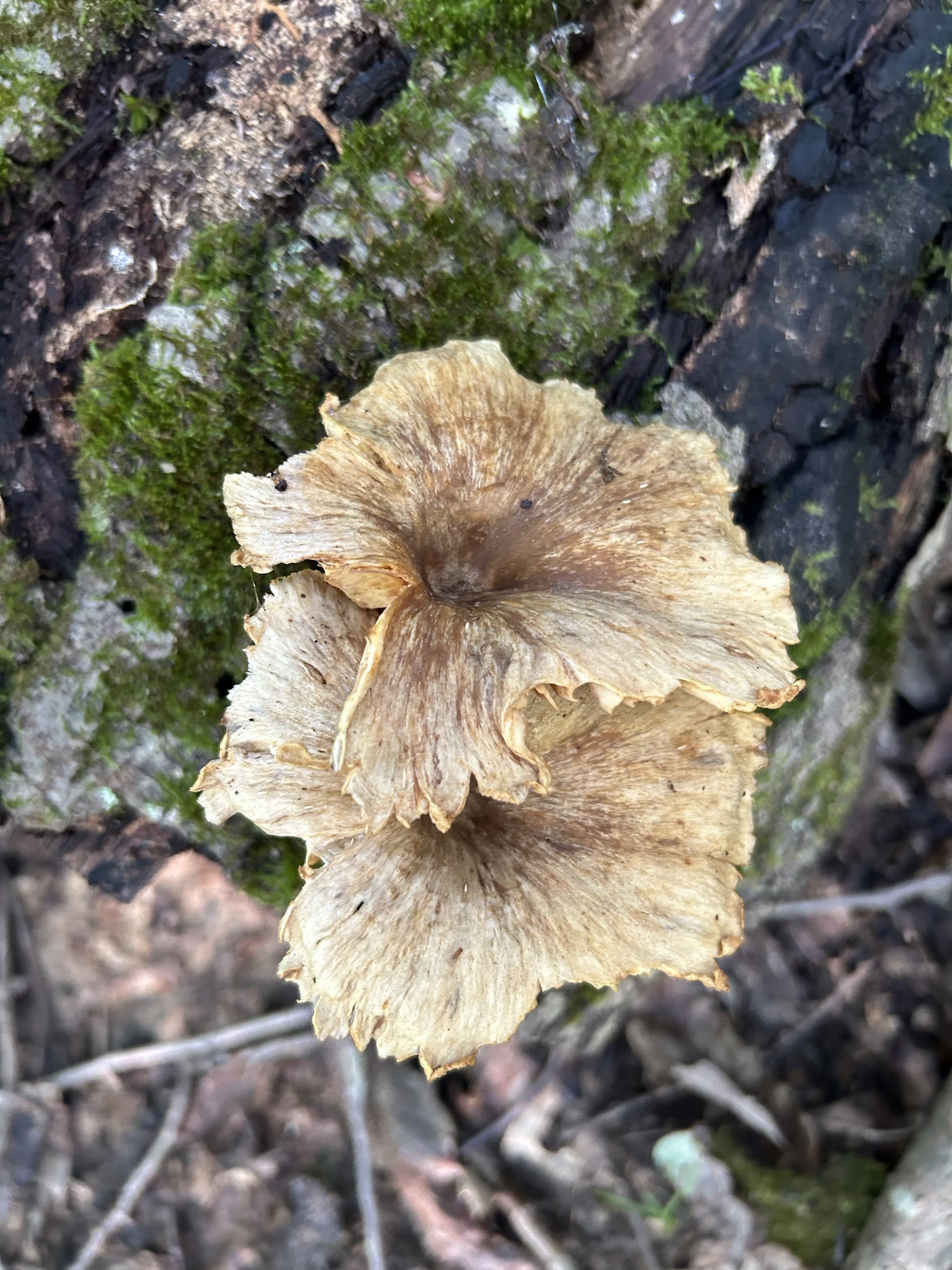
It occurred to me that more often than not, we rush through the routine of life overlooking these mini-marvels—the ballet of fall leaves chasséing from tree to stream, then pirouetting along water currents; sinuous streamers of fog tendrils meandering around hilltops; or, the multiplicity of ice crystals frosting over a car’s windshield to name a few. These wonders are woven into daily life: from the cantaloupe-colored brilliance of sunrise over the Ohio River to the glimmer of moonlight on a frost-covered lawn; from flower-like fungi blooming on fallen logs to a puppy seeing its own reflection in a puddle. Beauty surrounds us, waiting to be noticed. Like the invisible art gallery of spider webs in traffic lights on my morning jog, most go unnoticed until the light hits just right. However, when we take time to pause and pay attention, beauty will often reveal itself in unexpected yet common places, including stoplights.

A close-up image of a brownish mushroom growing on a tree trunk, highlighting its textured surface and natural surroundings.
Flower-like fungi “blossoming” from fallen tree branch

The Power of Morning Stillness 😌

That early-morning observation turned meditation centered my day. It offered more than one lesson and served as a reminder that the morning placidity can bring a sense of calming clarity before the noise of the day. Making time for stillness in the morning, whether sipping coffee, walking a beloved pet, or sitting in prayer meditation—offers an opportunity for spaciousness at the day’s start. A moment to center, notice, reflect, and connect. Even a few minutes of stillness can offer us an opportunity to ground ourselves and recalibrate our perspective. If we grow quiet enough, we may remember that peace resides within us. That is not to say that peace is the absence of movement, purpose, or challenge, but rather it is a strong presence within us—much like the hidden strength within the delicate spider web. 

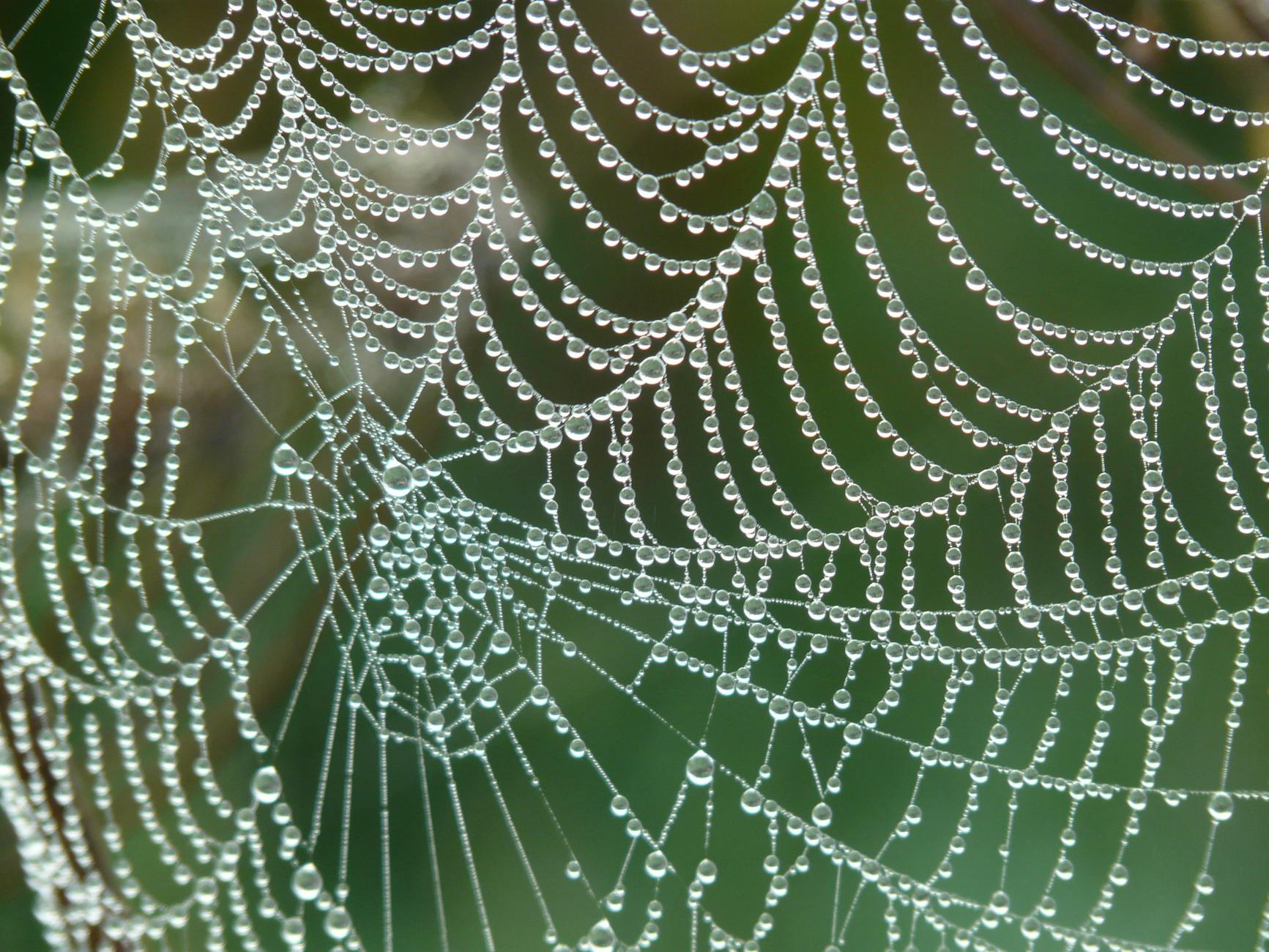
A close-up of a spider web adorned with dewdrops, creating a sparkling effect against a blurred green background.
Photo by Pixabay on Pexels.com

Lessons from the Web: Resilience and Renewal 🕸️

As I reflected on the morning jog through town, I realized that each web represented perseverance, fortitude, and tenacity–three key qualities essential for growth. Each morning, orb-weaving spiders consume their protein-rich webs to reclaim the silk for rebuilding. This ensures the new web they build in the evening is fresh, sticky, and strong enough to catch plenty of prey. Through practice, the spiders gain strength and instinctively how to rebuild after storms and strong wind.

The spiders’ resilience serves as a reminder that we, too, have the grit to rebuild after disappointments, setbacks, and loss. Like the spider, rebuilding our lives is often quiet work that begins only after we have nourished body, mind, and spirit. The spider’s persistence mirrors our own–delicate and determined–reconstructing through incremental, small steps. Life, like the spider’s web, is fragile, yet we too possess tensile strength—centered in faith—that guides us as we restore, renew, and rebuild. 

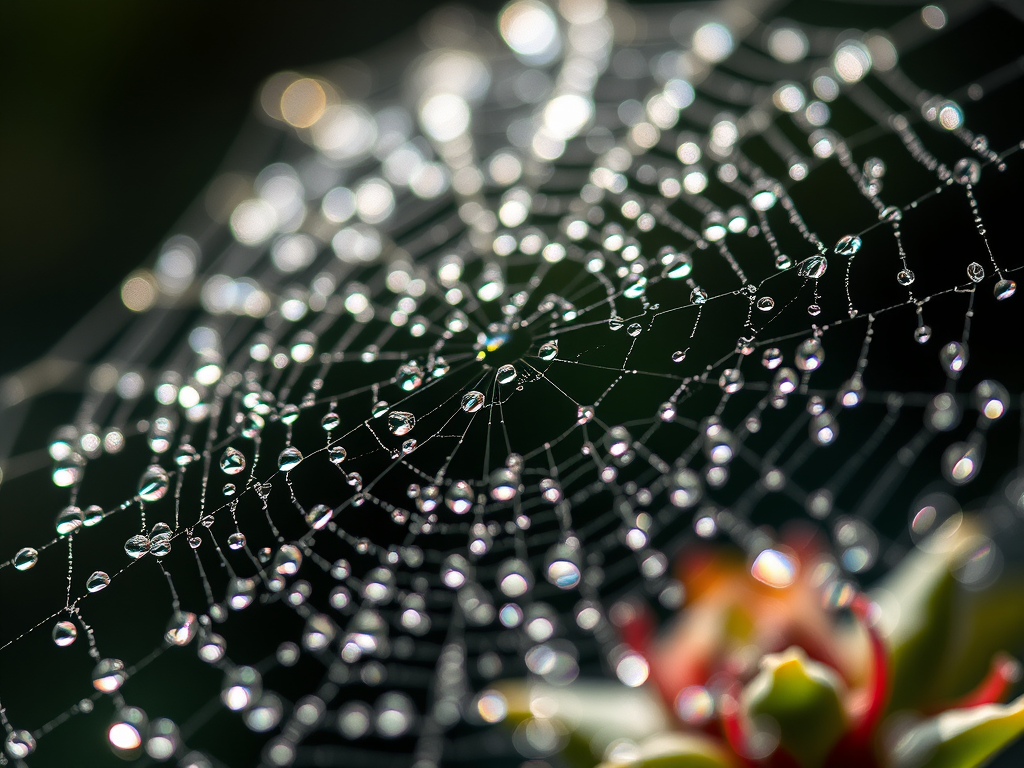
A close-up view of a spider web adorned with numerous droplets of dew, reflecting light and creating a sparkling effect against a dark background.

The Threads That Bind Us 🕷️

The spider’s web, where no thread stands alone, echoes the interconnectedness of our own lives. We are part of a collective. As the light shone through the webs, each dew drop caught the light, refracting color and seemingly creating miniature worlds. Just as the traffic/street lights played across the spider webs’ dew drops, our connected lives reflect multiple roles–friend, spouse/partner, worker, neighbor, parent, child, citizen . . . . Each strand of life possesses a quiet strength that is integral to the whole. In fact, the integrity of the web depends upon the strength and resiliency of every strand. Each facet of our lives holds and reveals meaning; together, the varied strands of our lives unite the whole, creating an array of meaningful relationships.

A close-up view of a beautifully intricate spider web adorned with dew droplets, creating a delicate display of nature's artistry in black and white.
Photo by don chowdhury on Pexels.com

Finding the Extraordinary in the Ordinary 🌃

In the end, the light changed, and I crossed the street as the sun rose, erasing the glimmer of those webs. Yet the image remains—reminding me to keep looking for the extraordinary in ordinary places. Perhaps it waits in the quietude before dawn, a pause at a red light, or the hush of nightfall. So many interlaced moments shimmer within the droplets of daily life, waiting for those willing to see. Those silky webs may vanish with daylight, but their pearls of wisdom still glimmer within me, reminding me that beauty often hides in ordinary light.  

May we all learn to look a little longer, to pause at life’s red lights, and to notice the silken threads of beauty connecting us in the quiet hours of dawn.

Discovering Daily Delights: Boost Your Happiness Practice

Right in the difficult we must have our joys, our happiness, our dreams: there against the depth of this background, they stand out, there for the first time we see how beautiful they are.” —Rainer Maria Rilke

A night sky filled with stars, with a shooting star streaking across the horizon, silhouetted by trees and distant hills.
Photo by Erike Fusiki on Pexels.com

A Spark in the Sky 💫

I was on an early morning run. Orion and his dogs, Canis Major and Canis Minor, were hunting above me in the eastern sky. As I ran, I periodically glanced upward, marveling at the stars’ movement. Suddenly, a star appeared to shoot sparkling light through the predawn sky. Was it a satellite, the Perseid meteor shower, or another heavenly body? I am not sure, but something inside me shifted. I felt delighted. That event was my daily delight.

A doe and her fawn walking together along a sandy path, surrounded by vegetation.
Photo by Mehmet Turgut Kirkgoz on Pexels.com

How Daily Delights Began 🤔

A few weeks before that shooting star sighting, I began my ‘daily delight’ practice in August. Numerous uncontrollable negative events were filling me with worry, anxiety, and fear. Despite taking proactive steps to reduce the negativity I was exposing myself to, it still found ways to seep in—almost as if it permeated the very air I breathed. Then, at first light on a quiet Saturday morning, a doe and her fawn strolled out of the woods alongside my running path. Pausing for a moment, I watched the mother nudge the little one across the trail and toward a nearly dry creek. It felt sacred. Later, I described it to my family as my daily delight, and the concept was born.

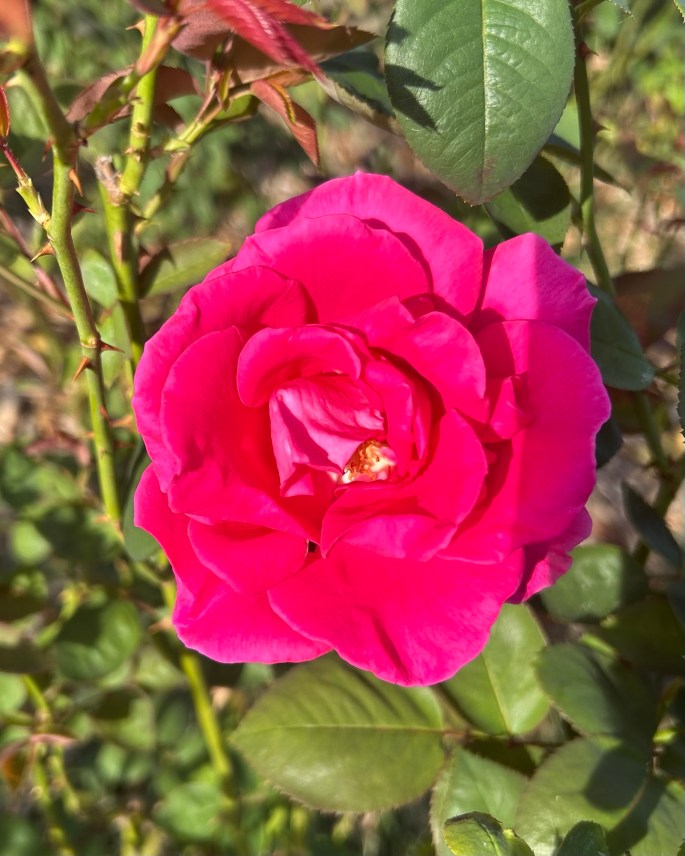
A close-up of a vibrant pink rose surrounded by green foliage, showcasing its full bloom and delicate petals.

Why This Practice Matters 😌

From that moment, I began cultivating an intentional practice of looking for at least one daily delight each day. As a result, I noticed that my mindset shifted, and my stress began to ease. More importantly, these little delights reminded me that goodness still exists—even on the darkest days.

A steaming cup of coffee rests on an open book, symbolizing a moment of warmth and reflection.
Photo by lil artsy on Pexels.com

What Counts as a Daily Delight? ☑️

To me, daily delights are moments that cost nothing, big or small, that spark joy or wonder. They might be a kind word from a stranger, the first sip of bargain coffee that tastes surprisingly better than the pricey brand you had been purchasing, the symmetry of flowers along a walking route, or the brilliant explosion of color as the sun rises over the Ohio River while driving to work. Ordinary moments are transformed and elevated simply by the act of paying attention.

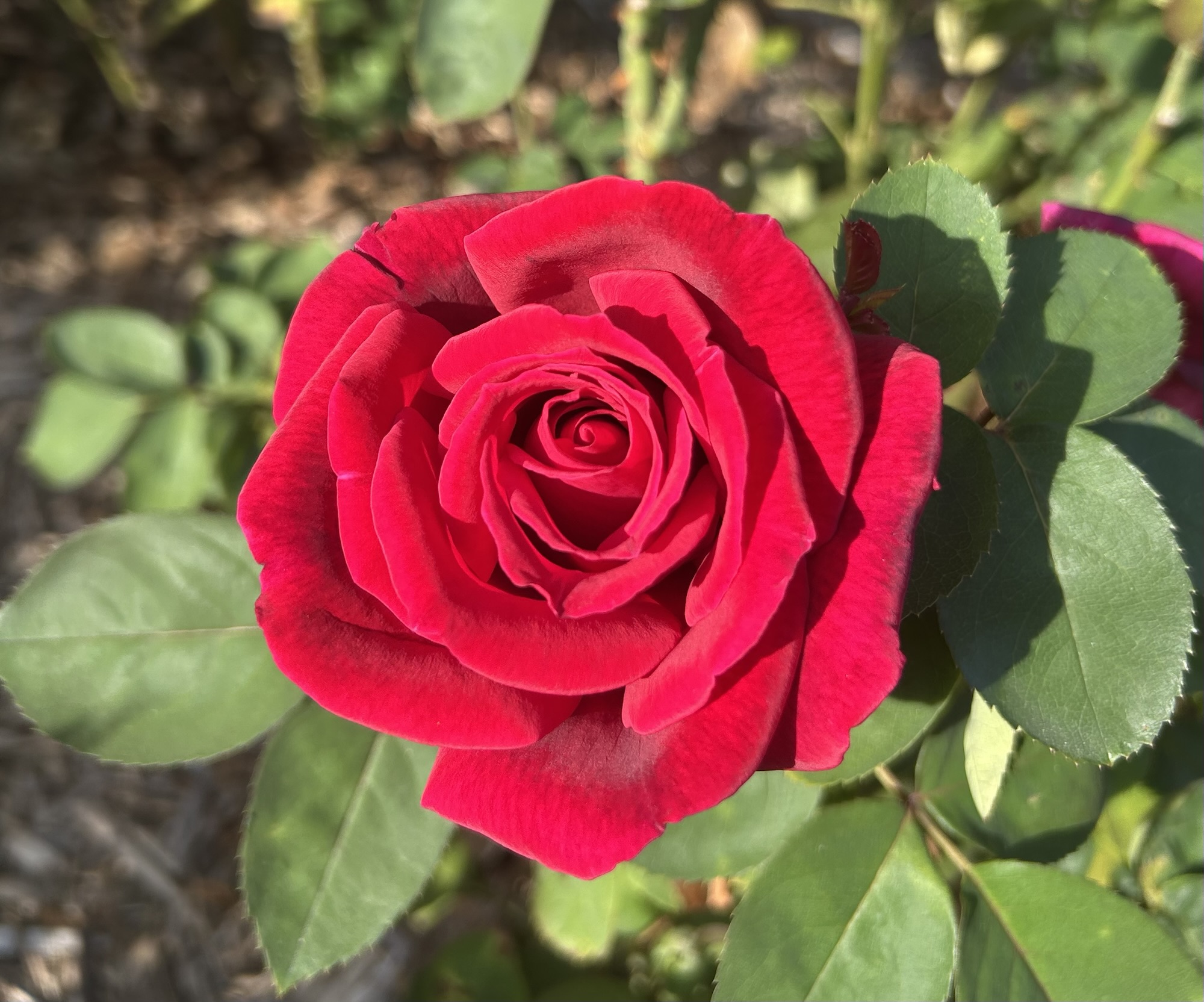
A close-up of a vibrant red rose in full bloom, surrounded by green leaves, capturing the beauty and intricate details of the petals.
Photo by lil artsy on Pexels.com

How to Find Them 🔎

The practice begins in the morning by setting an intention to look for the daily delight. As the day unfolds, I keep my mind’s eye alert—like a scavenger hunt—for hidden treasures, knowing that some days require more searching than others. The daily delight could be birdsong during my run, the sprawling sunlight lighting up the grain of my old oak desk, or a video of my daughter’s friend’s baby babbling and giggling at her new-found ability to pretend to cough. The practice is accessible, requires no extra time, and costs nothing but intention.

A close-up of a pink and white rose blossom surrounded by green leaves.

The Science Behind It 📖

Our brains, as a survival mechanism, are hardwired to notice threats. They fixate on bad events to help us avoid future peril. Unfortunately, in a 24-hour news cycle, this tendency takes a mental toll. Our brains often can’t distinguish real threats from repeated media images, leaving us anxious, restless, or fearful.

Intentionally noticing delights, however small, helps counterbalance this wiring. It reduces stress, builds resilience, and—most importantly—fosters hope. Practiced regularly, it becomes a bridge to gratitude and a more grateful outlook.

A couple sitting on a couch, wrapped in a blanket, smiling and laughing while playing with a light-colored dog.
Photo by Andres Ayrton on Pexels.com

Low-barrier Maintenance ✅

Fostering a daily delight practice is accessible to anyone, anytime, almost anywhere. It’s what I call a low-barrier activity—it doesn’t require journaling, a special setting, or money (no hidden fees or price hikes here!). You might keep a journal of delights or share them with friends or family. Personally, I enjoy sharing mine with others when appropriate because it amplifies positive feelings within. However, there are no other requirements beyond noticing and savoring the event.

A person gently touching foreheads with a cat in a sunlit room filled with plants.
Photo by Yuliya kota on Pexels.com

Even on Hard Days 😓

Of course, some days are less than stellar, especially when hardships pile up. In those times, it’s tempting to slip into cynicism. Yet even then, finding one joy—however small—can ease our uneasiness and calm our agitation. While we cannot erase challenging circumstances, we can coexist with them and still find good.

Two men laughing together outdoors, enjoying a moment of joy in a natural setting.
Photo by Ketut Subiyanto on Pexels.com

The Ripple Effects ↝

The ripple effects of this practice are profound: reduced tension, greater resilience, increased gratitude, and more positive interactions with others. Sharing a delight can spark connection, deepening bonds, and spreading positivity. Over time, this simple practice trains us to notice light even in the darkest corners of our world.

A close-up of a garden sign reading 'JUMP FOR JOY' with the word 'Floribunda' beneath it, surrounded by dried leaves and grass.

Shining Light in a Dark World 🔦

Like those hidden picture games of childhood, simple joys abound; they just need us to notice and color them in. They’re free, accessible, and powerful in shifting perspectives. Daily delights don’t excuse us from facing hard truths, but they open our eyes to possibilities—even on the hardest days.

A close-up of a pink rose flower blooming among green leaves.

Your Turn

So, what daily delight will you notice today??

Navigating Life’s Construction Zones: A Path to Self-Improvement

Construction is a matter of optimism; it’s a matter of facing the future with optimism.”–Cesar Pelli

A construction site on a road featuring orange traffic barrels, traffic lights indicating a red signal, and a view of green hills in the background.
Photo by Robert So on Pexels.com

Summer Roads and Slowdowns: A Familiar Frustration 🚧

It’s the height of the summer travel season. This year, AAA projected that 61.6 million Americans will travel by car between June 28 and July 6. That’s a lot of drivers on the roads! And more likely than not, most of those drivers will encounter some sort of delays or rerouting due to construction. 

Those orange barrels, detour signs, and dusty, smoke-filled roads can wreak havoc on estimated times of arrival, impeding drivers’ progress. Traversing a construction-filled route recently, it occurred to me that just as roads need maintenance, upkeep, and improvement, our lives can also benefit from similar attention. In fact, summer road construction serves as an excellent reminder for how we, too, must assess, repair, and improve our own lives.

Like it or not, road repairs are a necessary part of travel. Winter and spring often ravage roads due to ice, snow, freeze, thaw, excessive rain and so forth.  Potholes, cracked pavement, faded lines, and broken shoulders or guardrails can reduce safety and severely damage tires, rims, alignment, suspension, and so forth. Thus, in order to function properly, roads require regular repair and upkeep. 

A woman in a pink blazer sitting at a table, looking stressed or overwhelmed while using a laptop.
Photo by Edward Jenner on Pexels.com

The Wear and Tear We Can’t Always See 😓

The same is true for our own lives; we, too, experience wear and tear, but it is expressed differently in each of us. Signs may include physical and/or mental fatigue, burn out, and/or incremental increase of poor habits.  Other signs might include unresolved conflict, a sense of drifting or lack of purpose; and/or for others, it could be increased feelings of anxiety, sadness, or indifference. Like potholes on a road, it is important to not ignore these symptoms and instead cultivate a sense of caring curiosity as if we were concerned for a child–only it is concern for ourself–and it begins with an honest self-assessment of our emotional, mental, physical, and even relational well-being.

A woman with red hair looks stressed while working on a laptop, resting her forehead on her hand, in a bright interior setting.
Photo by Alexander Dummer on Pexels.com

Reading the Signs: Time for a Personal Detour ↪️

As with construction, upon reflection we might discover that many of our difficulties and discomforts created ruts, broken shoulders and cracks in our own personal life. These impediments signal that we may need to reroute our own life in order to make internal repairs. In the same way construction zones temporarily create detours, rerouted traffic, and lane shifts, personal redirection can likewise be thought of as a temporary, but necessary setback for long-term improvement. 

A person sitting on a couch, resting their chin on their hand, looking thoughtfully at a laptop with papers and a pen on the table.
Photo by Keira Burton on Pexels.com

Detours with Purpose: Reframing Setbacks as Redirection ↩️

These life detours, be they physical-health and/or mental well-being crisis, a death, divorce, and so on, typically create obstacles–a change in what we think is “the plan.”  However, just as construction zones are there to repair the road, our healing, growth, and ability to move towards wholeness often begins as we experience these hurdles. Therefore, it is helpful to reframe our thinking around these life detours and obstacles as opportunities for not only healing, but also reflection, intervention, or a necessary challenge to a long-held personal perspective.

A woman sitting in a chair, looking contemplative and holding a pen near a notebook, with her hand resting on her forehead in a thoughtful manner.
Photo by cottonbro studio on Pexels.com

Grit, Heat, and Hard Work: The Labor of Self-Growth 🥵

Another important point to consider with regards to road construction is that the work crew must endure a wide array of weather conditions, including extreme heat and humidity that accompanies summer. A return to safe and smooth roads cannot occur without their effort, perseverance, sweat, and labor. Likewise, personal growth and/or physical healing often requires a similar level of grit. 

Whether we participate in therapy, work to improve or create beneficial habits, set clear–and perhaps new–boundaries, work to forgive, and/or learn a new skill or life lesson (or both), personal construction demands that we put in the work. Discomfort, like construction, is a necessity.  Growth and healing are not easy and rarely occur without challenge and effort.

Two women engaged in a conversation at a table in a modern office setting, with one woman wearing glasses and a blue dress, and the other facing away.
Photo by Christina Morillo on Pexels.com

Preventive Maintenance: Investing in Long-Term Well-Being 😃

Another important consideration to effective road repair is that maintenance should be ongoing, rather than deferred, as this can lead to greater road damage and travel hazard. By taking care of ongoing small issues as they arise, bigger problems can be prevented in the future. 

Similarly, our own “self-maintenance” is also a worthwhile investment in order to reduce the likelihood of a major life-repair. Taking time to invest in our own daily health through quality sleep, good nutrition, stress management, physical exercise, fostering healthy relationships, and even learning new things–can be thought of as small personal investments that pay dividends towards our own long term “infrastructure.”  

A woman and a man sitting on a couch engaged in a conversation, with a woman taking notes in the foreground. The room features plants and wall art.
Photo by Antoni Shkraba Studio on Pexels.com

Building a Support Crew: Don’t Travel Alone 😁

That said, sometimes personal maintenance can sometimes feel like “one more thing to do” especially when we’re in the midst of a life-storm. Therefore, it can be helpful to cultivate a “crew,” a few good people who can share our times of smooth sailing, encourage our development and/or maintenance of positive habits, and also support us during those bumpy passage days. Ultimately, with regular self-care maintenance and a good support crew, we can cultivate a strong inner foundation that is better able to withstand life’s pressures and storms.

Black and white image of a close embrace between a woman and a child, capturing a moment of warmth and connection.
Photo by Nataliya Vaitkevich on Pexels.com

Freshly Paved Paths: Signs of Inner Progress 🥹

One of the best parts of road construction occurs when it is finally completed. Routes are once more open, and the ease and smoothness of traveling these roads signals tangible progress. In fact, driving effortlessly over a direct route without detours, potholes, or bumps can be a liberating feeling. 

A smiling man with curly hair, laughing joyfully against a wooden background.
Photo by Pixabay on Pexels.com

Progress, Not Perfection: Life Is Always Under Construction 🦺

Unfortunately, it never lasts for long. Rainy season, freeze-thaw season, excessive travel, or 1,000 other scenarios means construction will once again occur, if not specifically on the newly refurbished route. It’s all part of the process of progress–one never attains perfection when it comes to infrastructure–there’s always room for improvement.

Equally, on the other side of our own personal repairs, detours, and/or maintenance, we gradually return to a sense of homeostasis.  Our rerouted life may possess a greater sense of clarity, restored confidence, better decision making skills, and perhaps even a deeper sense of joy. We, too, may feel the momentum to move forward in a renewed direction and embrace the possibilities that come with an unexpected, but freshly paved path.

Smiling woman wearing a cozy sweater, expressing joy and warmth.
Photo by Dellon Thomas on Pexels.com

Final Thoughts: Be the Engineer of Your Own Journey 👷

To be sure, summer construction can seem like a real drag on travel; however, it ultimately leads to new routes, expanded systems of travel that are safer and more efficient. However, even when the summer construction season comes to an end, the maintenance of these roads does not end, and that is worth remembering.

Likewise, summer construction reminds us that we are the engineers of our own lives. No, we cannot control everything that happens to us, but we can control our reactions AND we can also make repairs as needed as well as prevent some issues from arising. Therefore, let’s be as proactive as possible through regular sustainment of our own life-construction, so that when life’s storms create a pothole–or five–we are fortified with the strength our regular maintenance and upkeep provides us. In life, as in roads, it’s about progress, not perfection. 

I’ll see you out there on the road of life!

.

Running Beyond Age: Embracing Health and Freedom in Every Step

“Running is an act of creative self expression”–Lawrence van Lingen on Extramilest podcast

A Familiar Morning Scene: Defying the Stereotype 👟👟

Two older runners jogging together on a path surrounded by grass and wildflowers in a park during early morning.
Photo by Anastasia Shuraeva on Pexels.com

Picture this. It’s early on a warm Saturday morning in your local park. The sun is low on the horizon, and mist is rising above the grass and a meandering stream that runs alongside a crushed gravel path. The scent of a nearby rose garden is heady as two runners descend the hill following the path. Moving at a steady clip, one runner has a full head of white hair while the other is more salt than pepper. They are relaxed and chatting as they pass by.

This is a routine sighting for me on my weekend jogs. Numerous older runners, walkers, and run/walkers defying the stereotype through exercise, that aging equals physical decline. In fact, according to AARP, beginning in 2023, the average age of runners has risen. Some of the biggest gains are those 55 years and older, with numerous runners sticking to it well into their 60s, 70s, and 80s as witnessed in the ages of Boston Marathon finishers in recent years as well as other major marathons around the world. Of course, there’s no denying aging does change the body, so why do I see numbers of people my age and older consistently outside running and/or walking?

Running as Personal Ritual and Liberation 🏃‍♀️

Older man jogging outdoors in a gray hoodie and gloves, surrounded by tall grass with a calm sky in the background.
Photo by Barbara Olsen on Pexels.com

For many older individuals, like myself, running or run/walking becomes a personal manifestation of life–a ritualistic form of imaginative self expression that allows us to reconnect with our inner rhythm, identity, and self-determination. It creates a sense of freedom and play that we once had as a child. Additionally, running offers numerous benefits, including improved physical health, enhanced mental well-being, social connections, and a renewed sense of personal meaning, to name a few. 

The Science-Backed Physical Benefits of Running 🏃‍♂️

An older female runner smiling while participating in a race, wearing a bright pink tank top and bib number 12491, with greenery and other runners in the background.
Photo by khaoula Bkm on Pexels.com

I occasionally encounter critics who question the safety of running at “my age,” (a term used by my students); however, according to another 2023 AARP article, older runners just have to be “smart about it.” This is why many running groups often point beginners, including seniors, to using a run-walk-run method to establish a strong aerobic base. In fact, Cleveland Clinic, in a 2024 article, points to numerous physical health advantages to walking and/or running for all ages, but especially seniors. These advantages include:

  • Strengthens heart and improves circulation
  • Reduces risk of heart disease and stroke
  • Increases bone density, helping prevent osteoporosis 
  • Improves joint flexibility and maintains muscle function
  • Boosts metabolism and supports healthy aging
  • Improves blood sugar regulation and lowers risk for type 2 diabetes
  • Reduces risk of dementia and Alzheimer’s disease

Mental Health Gains: Silence the Inner Critic 🙉

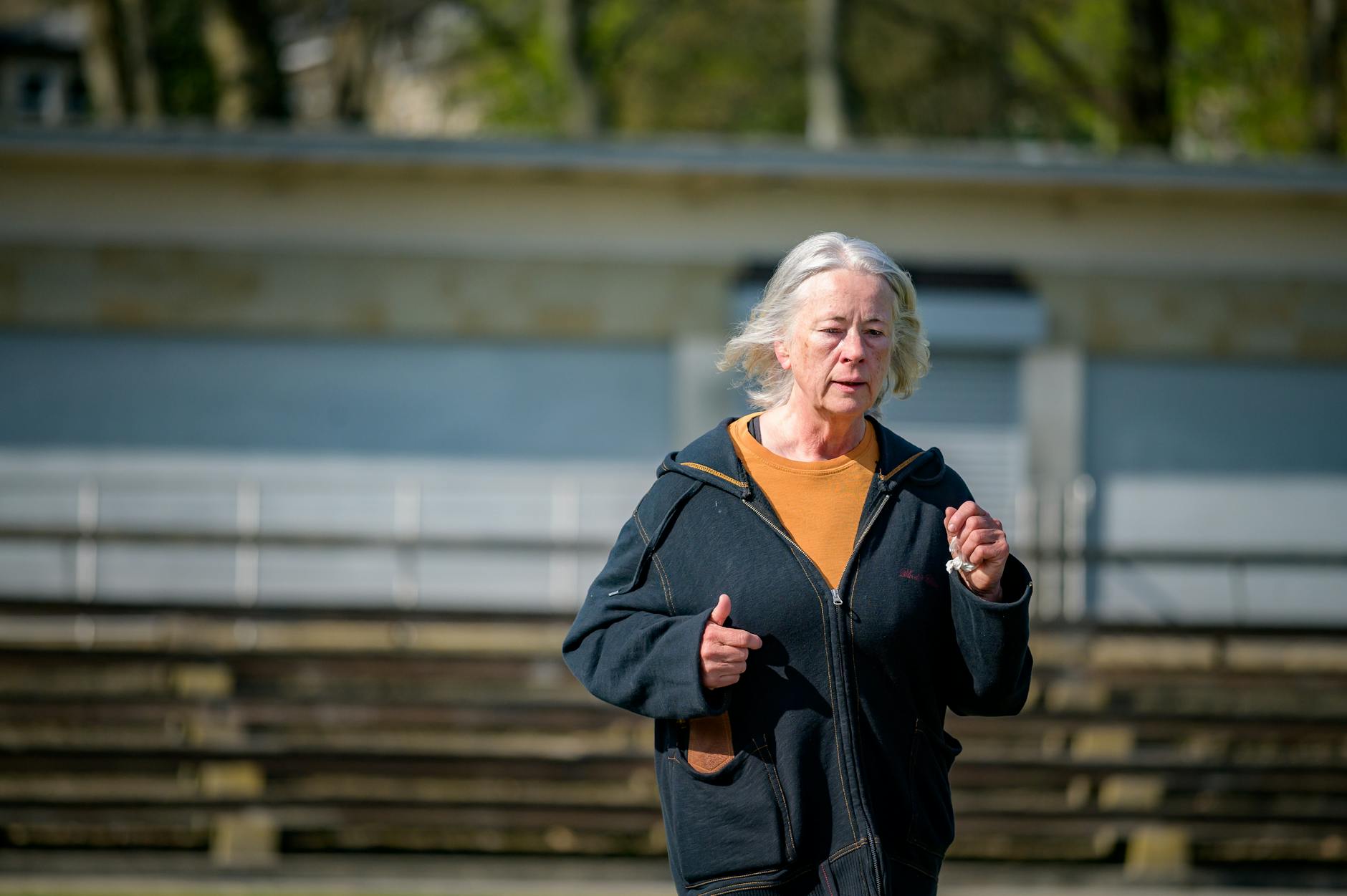
An older woman running outdoors in a black hoodie and orange shirt, focused on her exercise, with a blurred background of benches and greenery.
Photo by Centre for Ageing Better on Pexels.com

Certainly, the physical health benefits of running are important to me; however, one of the greatest advantages is the feelings of improved mental health and well-being. I often refer to monkeys living in my mind, and running allows me to rise above the swirling negative chatter that often clouds my mind. On days when it seems everything goes sideways, if I have completed my morning run, I can take solace in the fact that I completed at least one positive act, thereby helping me to keep symptoms of depression and anxiety at arm’s length. 

I also find running clears my head, improves thinking, and increases memory, which is a bonus as I age. In fact, running–and exercise in general–is like meditation in motion because it deeply connects me to my breath. Plus, it is a great source of stress reduction.

The Artistry of Movement: Running as a Creative Outlet ✍️

An older man with a full head of gray hair is pouring water from a cup over his head while running in a sunny outdoor setting. He wears a bright red athletic shirt and a race bib number 757. In the background, other runners can be seen along a palm tree-lined street.
Photo by Jou00e3o Godoy on Pexels.com

Running is also a form of innovative self-expression, for young and old alike. Like crafting one’s own piece of art, running showcases the beauty of a body in motion. It offers time for inspiration and reflection. Each run, like a canvas, offers the opportunity to tell a story, footstep-by-footstep. Personally, time spent running also allows me to process life as well as difficult, often buried, emotions, and it even sparks inspiration. My running, albeit slow, feels like an act of liberation, hope, and a tribute to the many obstacles I have overcome along the way. It is a symbol of inner strength, resilience, and freedom to be me–in a world that has often felt as if it boxed me in.

Spirituality, Solitude, and Social Connection 🙏

An older man running on a path surrounded by tall grass and trees on a sunny day.
Photo by Thomas Shockey on Pexels.com

For many runners, older and young, running offers an opportunity to hang out with other runners and socialize. However, some find that running solo, instead, creates a sacred space in which they can connect to their Higher Power, feeling that sense of peace and ease. Still others appreciate the opportunity to spend time in nature, soaking up fresh air and the beauty of Mother Earth.

A Healthy Routine for a Vibrant Life 🙌

Two female runners in matching orange and red jerseys sprint together, holding hands as they approach the finish line. They display expressions of determination and joy during a race.
Photo by RUN 4 FFWPU on Pexels.com

Running, for many, including myself, forms a meaningful structure to the day, a time set aside for one’s personal well-being and health.  This is important because there are numerous obligations and responsibilities that life often demands, even as we age. By setting aside regular time to run, sleep typically improves, which can be so elusive in older adults. Furthermore, those who run typically tend to eat better and don’t tend to abuse substances in order to better support their ability to run.

Staying Safe and Smart with Age 🤔

An older woman running outdoors, wearing a bright yellow tank top with a blue logo, smiling and gesturing with her hands. The background features greenery and a sunlit path.
Photo by RUN 4 FFWPU on Pexels.com

Of course, as we age, we do have to be safe about our exercise habits, which often begins with checking-in with a health-care provider. Additionally, I highly recommend finding good footwear that works for your own personal gait/foot-type; a local running store expert can help with this. Furthermore, as AARP points out, older runners should not go from “zero to 60.” Warm-ups and cool-downs are essential, and for those wanting to start running, a good walk-run program like Run Your Butt Off or the Run-walk-run training plans are two great ways to start. (I have personally used both and can attest to their gentle nature.) 

Other considerations as we age include running less on concrete and asphalt, if possible, and spending more time on softer surfaces, like the paths at local parks. Treadmills also offer a more cushioned surface, and they are a great option when weather is too hot, too cold, or otherwise uncomfortable. If you run at night or early morning, it is important to wear a headlamp and reflective vest for safety’s sake. Additionally, if you run alone, it is a good idea to let someone know where you are running and for how long. 

Every Run Is a Story: Movement as Becoming 🏃

A runner with a confident expression points at the camera while sporting a black sleeveless shirt with 'RUN lovers' printed on it, a race bib, and a headband, during an event in a sporting field.
Photo by RUN 4 FFWPU on Pexels.com

Bottom line, each run or run/walk/run is an adventure. Sure, some runs are less adventurous than others, but those moments offer an opportunity to learn about ourselves if we remain open and curious. Running (and walking) is accessible and fairly low-cost, and it is an effective way for older (and even younger) adults to improve their mental, physical, emotional, and even spiritual well-being. 

Beyond these benefits, running, for me, continues to remain a quiet act of self-expression. With each step and stride I take, I am writing a story, reclaiming my space and time, and paying homage to The Creator, celebrating this gift that is life. In this way, running transcends exercise and becomes a personal journey of becoming, no matter my age. 

With the right approach and mindset, whether you run, run-walk-run, or mostly walk, moving our bodies regularly can create joy and empower older adults to age well—proving that vitality truly has no age limit!

An older man with white hair smiles while wearing a jacket and a medal, standing among a group of people in a blurred background.
Photo by Roman Biernacki on Pexels.com

Cultivating Compassion in a Clamorous World

Your work is not to drag the world kicking and screaming into a new awareness.  Your job is to simply do your work . . .sacredly, secretly, silently . . .and those with ‘eyes to see and ears to hear’ will respond.”–Unknown

A row of shopping carts with red seats lined up in a parking area, creating a visual of retail readiness.
Photo by Ulrick Trappschuh on Pexels.com

A Quiet Act of Compassion 🤫

I was recently in a local dollar store. There was a person checking out that was $5.00 short of the total amount needed to pay their bill.  The clerk patiently waited while the person checking out asked their companion if they had cash on them. When the companion did have any cash, the clerk quietly offered to give the person the $5.00 stating, “I know what it’s like to come up short when it comes to money.”

This act of unpretentious compassion remained with me for days. The clerk was not doing it for recognition, she spoke too discreetly for that. If I had not been nearby when she offered the money, no one would have witnessed her act of generosity.  

In stark contrast to this sales clerk, however, we are enmeshed in a clamorous, overstimulating, attention-seeking era. Loud-speaking voices vye for our attention as do flashy images, catchy phrases, and repeated catch phrases–all playing the game of who can garner the most attention, especially on social media platforms, news outlets, and marketing campaigns. In fact, it often seems to me that bullying, arrogance, and even superficiality are now considered acceptable, if not desired, traits. While characteristics such as humility, deep listening, and thoughtful consideration are undervalued or overlooked. 

A man in a suit appears to be angrily shouting or expressing frustration while leaning over a wooden table.
Photo by Andrea Piacquadio on Pexels.com

The Clamor of Modern Society 📢

Furthermore, the use of repetitive, often vitriolic, messaging can undermine our own belief systems if we are not careful and purposeful with our daily habits. In fact, popular messaging and marketing, if exposed to it often enough, can even degrade the way we choose to comport ourselves on a daily basis. Our ability to remain authentically aligned to our core beliefs and values can be further degraded with continued exposure.

How do we remain steadfast in our core values, much less act as an agent of civility, courtesy, and even compassion with others, like that store clerk, in the midst of a popularized contrarianism?  Do we completely avoid social media, news outlets, and other outside sources of information and entertainment?  Do we cut ourselves off from the outside world and live as hermit?  Certainly not. 

Scrabble tiles arranged to spell 'WE RISE BY LIFTING OTHERS' against a plain white background.
Photo by Brett Jordan on Pexels.com

Cultivating Grounding Practices 🙏

I do believe it is possible to stay true and aligned to a path of decency and decorum. It does, however, require acting with a certain level of discipline, such as limiting time spent on social media, watching/reading news, streaming services, and so forth.  Additionally, it further requires creating habits/regular practices that support and deepen our foundational beliefs, such as prayer/meditation, regularly reading scriptures or sacred texts, and/or connecting with like-minded people that enhance, strengthen, and support our values. These deliberate habits of personal energy keeps us grounded and moving forward along a path of integrity.

A smiling woman in a black sleeveless top seated in a modern setting with green plants in the background.
Photo by Alexander Suhorucov on Pexels.com

Leading through authenticity 😃

By living authentically and intentionally, we don’t need a megaphone or platform to share our message.  Instead, we can focus on our primary responsibility, which is to cultivate our own work and/or calling in order to positively contribute to the world around us.  It is not necessary to proselytize and strive for attention in order to do this; our actions can speak for themselves.

If we choose to live and work from a place of inner strength, we can foster the power of a quiet presence, leading by example rather than boasting and posting all of the ways others should live/act/work. This doesn’t mean that we don’t set expectations for ourselves, or for others, if we happen to be in a leadership position, it just means we don’t publicly berate others who don’t meet those standards, nor do we boast about our own accomplishments. Rather, we can strive to strike a balance between leading by example and fostering an attitude of support in order to lift up others, so that they, too, can reach their potential. Helping others reach expectations can be achieved without a bully-pulpit.

A family walking by a lake, with an adult female holding a camera and interacting with a young child on a balance bike, while another adult male walks alongside them.
Photo by RDNE Stock project on Pexels.com

Trust the process

Of course, there will always be times of resistance and discouragement, both personally and when working with others. However, forcing or attempting to control often leads to more resistance.  I know as a teacher, and on a personal level, when asking a child–or myself for that matter–to learn a new and difficult task, the more I push the child, or myself, the more resistance I often encounter. 

Sometimes, we have to step back and trust the natural unfolding of awareness, which isn’t easy.  It often takes time, space, and many attempts that end in failure before the a-ha moment arrives. However, by allowing others, or ourselves, to awaken at their (our) own pace, we create a more sustainable and respectful relationship with others and/or with our own work

Two hands engaged in a handshake, symbolizing connection and support, with a group of people in the background.
Photo by RDNE Stock project on Pexels.com

Be a catalyst for change

The power to be a catalyst for change resides within ourselves and within others, but it doesn’t require force or brash tactics. Instead of being rude, loud, or stridently trying to convince or control others, we can choose instead to live with consistent habits that foster our integrity, allowing us to lead by example, and work for change through our actions, choosing to empower, encourage, and uplift those around us. By quietly setting an example, embodying our core values, faith, and beliefs, our presence can inspire and affect the world around us.

Generosity Ripples

Witnessing that one small act, served as a reminder that our energy and intentions have the power to make an impact. It further illustrates the importance of humble generosity–doing the right and/or kind thing quietly and habitually, without fanfare or need for attention, can still have a positive influence that spreads. Just as a spring petal falls from its tree and gently floats on currents of air until it lands on the waters of a nearby stream, creating ripples from the center of the stream to its banks, so do deeds of goodness and mercy continue on.

A quote encouraging kindness in a simple, elegant font on a light background.

Thrive Through Love: Lessons From Plants

We must cultivate our own garden.”–Voltaire 

Drooping from lack of water, my mosaic plant symbolizes our soul without enough attention, love, and supportive relationships.

As I walked into my classroom after spring break, making my way behind my desk, my mosaic plant greeted me with drooping leaves as if to say, “Where have you been?” 

“You poor thing!” I spoke aloud to it–as if it would reply. “I am so sorry. Let me get you some water.” 

Oh, sure, Dear Reader, roll-your-eyes and act as if you don’t talk to your plants. I have no shame in admitting it. Besides, scientific research has established that talking to your plants can create low-level vibrations that stimulate growth. However, since that is not the thesis of this essay, I won’t wander any further down that path. 

The unwatered mosaic plant had suffered alone in the silence of my classroom for well over a week without water. This particular plant requires frequent watering and rotation. When given this, it responds with perky growth and vivid color. Therefore, it was a sad, sickly sight. 

As I carefully began to water my plant, hanging limply in the pot, it reminded me of the way in which humans also need care and attention. Regular watering of plants supports photosynthesis and the roots ability to absorb nutrients from the soil, both of which foster growth. Likewise, when humans receive adequate hydration and adequate nutrition from a healthy, well-balanced diet, our bodies have a better chance of remaining healthy and vibrant.  

Plants, like humans, thrive best when nurtured from within and without.

Continuing to gently water and mist my wilted mosaic plant–yes, I was talking to it all the while–I was reminded of the ways in which humans can wilt from neglect. Our mind, body, and spirit, like my mosaic plant, need nurturing. Without it, our inner world can wither, and we will limp along with a spiritual heart that has a difficult time beating. 

However, with regular sprinklings of love, affection, and/or supportive relationships, our souls can remain hydrated. From faith-based practices to monthly outings with friends or family, from attention/love of a pet to simple interactions with a store clerk, and from exchanging kind words/texts with a neighbor, co-worker, or organization/club member to actions of self-care/love, there are countless ways in which our souls can be watered and nurtured. Therefore, it is vital that we practice engaging with others, so we won’t wilt from lack of love and support. 

Moving around the room to water my other plants, I realized they would soon need to be repotted with fresh, fertilized soil. Some would need a bigger pot than the container in which they currently dwelled. Fresh, fertilized soil, rich in nutrients, is vital for the health and well-being of my plants. New soil will provide a wide array of ingredients uniquely combined to fortify my plants against disease to help them grow healthy and strong.

Photo by cottonbro studio on Pexels.com

Likewise, in order for us to thrive, we, too, need nourishment from a variety of sources. One way we can thrive is by establishing and maintaining a purpose-filled life. This purpose can change and evolve over time as we age and mature, but it needs to be a purpose that not only compels us out of bed each morning, but fuels our life with meaning. 

Creating and maintaining meaningful connections with others, especially when linked to our purpose, can further enrich our lives deeply. Fortification can also be found by mentoring/helping others as well as surrounding ourselves with positive, supportive influences. These types of relationships can form a reciprocal, two-way street, much like plants form with people, which can facilitate an ongoing source of nourishment in our lives. 

Once all the plants were watered, I began rotating each pot to allow all parts of each plant equal time to face and absorb the warmth of sunlight. Sunshine, like water, is needed for photosynthesis. It is only through the process of photosynthesis that plants can have the food needed for growth. When plants face the challenge of living inside a building, they overcome that challenge by growing toward a window, even if it causes the plant to grow with a lean. 

Photo by Khanh Le on Pexels.com

We, too, need to lean into sunshine. The sunshine of positive experiences can imbue us with warmth and motivate us to keep going. That motivation is especially important when we are faced with challenges, as life is never obstacle-free. However, by facing the unique challenge(s) life tends to throw our way, we can eventually discover the unique joy of overcoming difficult circumstances, or at the very least, grow stronger and more resilient from the effort put into overcoming.  

And when those life-challenges seem endless, as they often do, lasting beyond what we think is possible, it warms and strengthens the soul to find pleasure in the little things. From the sweet embrace of a loved one to the sound of birdsong in the morning, from the taste of a great cup of coffee (or whatever) with a friend to the aroma of fresh cookies baking in the oven, or perhaps reading a new book or playing an instrument–whatever you choose, these small delights can be the rays of sunshine that help get us through those dark days of difficulty. 

The object lesson provided by my mosaic plant reminded me that no living thing– humans included–benefits from neglect. When we lose sight of love, meaningful connections, purpose, and positive experiences, we will internally wither, which can manifest itself as physical ailments and/or mental health issues. Without proper care and nurturing, we can grow disheartened, disinterested, and even emotionally distressed or traumatized. 

Photo by Tristan Le on Pexels.com

However, we all have the potential to thrive. Let us strive to offer love and understanding to others and to ourselves. When we see someone hurting, let us find ways to lift them up. 

Likewise, when we recognize our own heart is hurting, let us tend to our own needs through acts of self-compassion, reaching out to others, or seeking other positive means to act as rays of sunshine to lift our spirits. Our time on this earth is short, let us seek productive methods to nourish and enrich others as well as our own lives, so that our life garden can blossom and flourish, no matter where we are planted.

The Art of Loving Unconditionally: Lessons from A River Runs Through It

A scenic view of a river meandering through lush greenery under a blue sky with clouds.
The flow of a river.

Words of Wisdom From a Classic read 📖

One of my favorite stories is A River Runs Through It by Norman Maclean. It is an exquisitely written, semi-biographical account of Maclean, and his brother, Paul, growing up in Montana as sons of a Presbyterian minister who taught his boys the art of fly-fishing. The movie version, directed by Robert Redford, captures the earnest beauty of Maclean’s prose. Both pieces weave together a tapestry of thought-provoking life themes centered around family love and connection (including unconditional love for a family member), grace, the fragility and brevity of life, and the eternal nature of time, with the art of fly-fishing as a metaphor as the unifying thread. 

The story’s emphasis on the complicated nature of the brothers’ relationship make it especially compelling and heart-wrenching. Therefore, I have revisited both works on numerous occasions. Each time I reread the story, (and subsequently watch the film) I discover a new gem and/or am reminded of a favorite part, such as a well-written phrase, a turn of words, a point of symbolism, and so forth. My most recent encounter with Maclean’s work was towards the end of December. 

There is a set of lines that stirs my heart every time I read them: 

“So it is . . .that we can seldom help anybody.  Either we don’t know what part to give or maybe we don’t like to give any part of ourselves.  Then, more often than not, the part that is needed is not wanted. And, even more often, we do not have the part that is needed.”

“We are willing to help, Lord, but what if anything is needed?”

Two boys hiking together by a river, wearing casual outdoor clothing and smiling at each other.
AI generated by WordPress.

How do we help others? 🧍🧍‍♂️

As I once more read each word, underlining and contemplating them in the quiet hours of morning, I reflected upon how, with each reading, those words still ring true, but their meaning evolves as I progress in age and life experience. Those bittersweet words bring to mind loved ones and students over the years for whom I have tried to help.

More recently, students of one of my classes and I were discussing their currently assigned book. The main character in their book grew up in a rough set of circumstances, and through a series of unfortunate events, wound up incarcerated in a juvenile detention center. One of the questions that book raises is: Can someone overcome their circumstances and change with the right intervention/outside help? 

The students debated valid points. Some endorsed the possibility that people can overcome their environment and change for the better. Others pointed out the difficulty of changing what has been hard wired into you. 

As the discussion continued, a student asked me what I thought. All eyes in the circle turned to me.

A silhouetted hand reaching out, symbolizing support and connection.
Photo by lalesh aldarwish on Pexels.com

Bittersweet reminder 🤔

Maclean’s words echoed in my mind as I carefully considered my response. Memories flooded my mind–former students and more personal situations in which I have been truly willing to help– offering extra time, extra care, and extra love. In many cases I have researched and offered suggestions of help–probably way too many with the presumption of, “I can help them fix it,” whatever “it ” may be.  I’ve further ridden the waves of the person’s ups and downs as they strive to overcome and change. I have been, and I still am, willing to help; Lord knows, but as Maclean so eloquently articulated, “{I}we can seldom help anybody.”

Helping others is a complicated process for which our hearts may be in the right place. However, as Maclean points out: most change within another person is not in our control.  Perhaps being willing to help is the best any of us can do unless asked–and even then–we can only offer our support; it is the person who must do the work within.  

Maybe, our support and love will help instigate the needed change, but there’s a strong chance that it won’t. Therefore, it is not our job to “fix” others; it is, instead, our job to love them.  Of course, we can still sincerely believe in the person and continue to pray and hope that the person will overcome their difficult situation or change for the better, but in the meantime we must accept them as they are. 

 Rather than say all of this to my students, I kept it simple. I shared my belief that by nature, hope springs eternal for me when it comes to believing in my students’ (and others’) capabilities for growth and change. I don’t think I could have remained an educator for nearly four decades if I did not believe that change and growth is possible for all of my students. 

A woman with long hair, dressed in dark clothing, is shown in a contemplative pose with her hands clasped together in front of her, against a dark background illuminated with red and blue lighting.
Photo by Mikhail Nilov on Pexels.com

Be Present 🙏

And, while I didn’t share this with my students, my belief and hope flows into my own personal life, too. However, my profession and personal experiences continue to inform me that overcoming what has been ingrained into you at a young age, be it genetic, environmental, or both, is difficult, even with the best help and support.  Furthermore, my experience has also humbly informed me that assuming the person wants help or wants to change is arrogant and so is thinking that we know how to help them.

This doesn’t mean we have to give up; rather, I am beginning to believe it’s about presence. We can be there for them by simply spending time with them as appropriate.  Likewise, we can provide positive support and encouragement, such as, answering the phone when they call, replying to a text they send, or being available to chat. 

Likewise, it doesn’t mean we go overboard using up all of our time and resources, leaving us emotionally, physically, or financially spent. Rather it’s important to find that fine line of being there, but not too much; having firm boundaries, but a welcoming heart/spirit. Mostly though, it seems important that we allow love to flow from us, like the waters of Big Blackfoot River in Maclean’s novella, so maybe on the person’s worst day, they will at least know that they are loved.  They. Are. Loved.

A close-up view of colorful puzzle pieces surrounding the words 'Accept. Understand. Love.' on a white background.
Photo by Tara Winstead on Pexels.com

Unconditional love 💜

In the words of thought-leader and influencer, Brené Brown, we must come to peace with the fact that “When you love someone unconditionally, you accept them for who they are, flaws and all.” And that, in the end, just as Maclean had to learn, must be enough. We can only change ourselves, no matter how much we want to help another. 

A chalkboard with the words 'HERE TO HELP' written in white letters on a black background.
Photo by Anna Tarazevich on Pexels.com

The Power of Silence: Reflections on Mindfulness Retreat

In the silence of the heart, God speaks.” Mother Teresa

Photo by Ali Elfaziki on Pexels.com

Silent Retreat? 🧘‍♀️

I don’t remember exactly how the conversation went, but I was enjoying lunch with a friend on a Saturday when she told me she was attending a silent meditation retreat in two weeks, and asked if I would be interested in it. The retreat, she said, was sponsored by The Mindfulness Tree, a meditation community in Charleston, WV, and it would be led by Dr. Christine L. Blice-Baum, MDiv, DMA. Curiosity bloomed, and in a matter of days, I was also registered for the retreat.

In the days leading up to the retreat, I vacillated between feelings of excitement and thoughts of “what-have-I-got-myself-into?” The retreat required spending time in silence with complete strangers, excluding my friend, of course. I kept reminding myself that it wouldn’t be any different than going to an appointment or to the store with numerous others I don’t know. Never once, however, did it cross my mind that this retreat would provide multiple opportunities to come face-to-face with my mind’s resistance and its desire for distractibility.

Photo by Obi Onyeador on Pexels.com

Put away those devices 📲

Upon arrival, all participants in the retreat were asked to put up our phones and take off our smartwatches until the time of our departure. We had the choice to leave our devices in our car, in our own purse/bag, or stow them in a zip lock bag that was put away until the end of retreat.  I chose the latter option as a symbolic break-away from technology and, in all honesty, to reduce any temptation to peek in my bag at either device during the day. 

Not having technology was one of the first minor “discomforts” I repeatedly noticed. It began when I tried to check the outside temperature by looking at my wrist, and then did it several more times! What time is it? No smartwatch. Does the radar show my hometown receiving as much rain as here?  No phone. Blice-Baum just shared a great idea; I should type that in my notes. No phone. I should take a picture of the church’s pipe organ. No phone. Did my husband remember to  . . . . 

Participants in seated meditation.

Lessons of Stillness 🤫

This was my first a-ha moment. I was astounded to realize the amount of time my mind spends in a day consumed with thoughts of all the ways I can implement/use my smartphone and its companion watch. What’s crazy is that I am not a big user of social media, so I had this notion that giving up my devices would not be a big deal. While on one hand, it wasn’t, on the other hand, I was humbled to realize, social media consumer or not, my mind has been trained to be distracted by devices. 

The second big lesson had to do with a notion known as “custody of the eyes”–averting the gaze to avoid visual distractions in order to maintain focus. This practice was a challenge throughout the entirety of the session. 

The retreat schedule was well organized, sessions of seated meditation were interspersed with walking, movement, and standing mediations; however, my mind kept wandering and niggling me to look around at my surroundings. During walking and movement meditations, I had to keep redirecting my attention back to the meditation focus at hand because my mind had the tendency to wander off into people-watching mode. 

Participants take part in a silent walking meditation

The third lesson: I also squabbled with my mind’s habit of entering “squirrel-mode”–moments when something in the environment, or on the wall caught my attention, and my mind would launch off into associations with whatever my eyes had noticed. I knew I was distractible, but I never realized my mind was like a puppy visiting a new environment.

Another eye-opener occurred during our silent lunch. Blice-Baum, after sharing a prayer of gratitude and blessing for the food, led the participants through a short exercise of mindful eating. Then, we were directed to continue to enjoy our meal in silence, engaging all of our senses in the eating experience. This was when my mind really rebelled.  

Since I was a young girl reading the backs of cereal boxes at the breakfast table, I have always read while eating–newspapers, magazines, books–which were later replaced with digital versions. Without such distraction, I noticed my tendency to want to eat quickly and my eyes repeatedly searched around for something on which to focus other than my food. It took time for my mind to settle, slow down, and focus on taste and other sensations associated with the simple act of eating. This was a shocker because I love the taste, textures, and fragrance of food. In fact, I love to eat, but I clearly need to practice eating mindfully more often.

Group picture of participants.

Positive takeaways 🙌

In spite of all the mental obstacles and resistance I experienced throughout the retreat, I walked away feeling refreshed and renewed. Remaining fully focused and present on one’s own breath, a mantra, or an image isn’t easy, but there is something to be said about taking time to slow down and focus on one thing at a time. I felt as if I was coming home to my heart, and my own inner knowing, despite the fact I had to repeatedly redirect my mind like a toddler walking around the Tamarack Marketplace.

Would I do another silent meditation retreat? Absolutely! Many of the things that had been worrying me when I arrived at the retreat felt less weighty when I left. I experienced a recommitment to my personal practice of meditation/mindfulness and was inspired by new techniques to incorporate, not only in my own practice, but also to include with the yoga/mindfulness class I teach at school. Furthermore, in the days that have followed, there has been an overall increase in my sense of gratitude, along with a renewed sense of purpose. I have also noticed a calmer mind with a significant decrease in the power of those negative voices that love to chatter about in my head.

 Most of all, I am much more aware of how easily and quickly my mind can be distracted. These mental diversions on the surface seem as shiny and fun as a carousel ride to a young child, but they can lead to avoidance of the moment at hand–knowledge and understanding of what is going on in the here and now. Therefore, focus––especially given all the digital distractions–more than ever requires diligence, dedication, and continued redirection. And, one of the best ways to do this is the practice of meditation, mindfully completing tasks, or by simply connecting with our own breath.

Photo by Vie Studio on Pexels.com

Interested in Learning more?

If you are interested in learning more about meditation, would like more information about The Mindfulness Tree, or would like to connect with Blice-Baum, please visit www.themindfulnesstree.life

Dr. Christine L. Blice-Baum, MDiv, DMA

Navigating Life’s Uncertainties One Moment at a Time

Take one moment at a time and do the next right thing.”–Eleanor Amerman Sutphen

Photo by Pixabay on Pexels.com

What Did I hear? 👂

My ears perked up when I heard the guest on a podcast share the above phrase based upon  a poem by Sutphen, but made popular by both Elisabeth Elliot and Carl Jung. I had just arrived home with several bags filled with groceries to put away. Setting down the bags, I typed the phrase into my phone’s reminder app in order to remember it. Then, ironically enough, I returned to the next moment: putting away the groceries.

Like a persistent earworm, that phrase kept looping through my brain. Maybe it was Divine Providence, or maybe my subconscious niggled me to recognize the words I needed to hear. Regardless, the universe had offered me a nugget of wisdom to the question I had been asking, but had not yet been able to fully articulate: What can I do in the face of the difficult and uncertain life moment in which I found myself?  

Photo by Sergey Guk on Pexels.com

Snowy Days can lead to Sluggish Ways 😏

The month of January was a slippery, and less than stellar, start to the new year.  All around me, icy roads, alleys, and sidewalks served as a reminder that I was struggling to find my footing. As one who is not naturally organized and often has no sense of time, I function optimally with a routine/schedule.  It’s not that I can’t “go with the flow.”  I can do that quite brilliantly, but I don’t accomplish nearly as much, nor do I make as many–if any–inroads towards goals.

It is as if I have been dropped deep into a dark and menacing forest filled with a multitude of statuesque tree shadows and brambling thorny briers. Meanwhile, a multitude of strands in life’s web are criss-crossing in ways that make it feel less integrous, as if at any moment, the winds will shift and blow a hole in the tenuous gossamer nexus of life. I sense time sliding sideways, and I am trying to find my footing, so I don’t fall into the thin ice at the center of the mostly frozen pond. Arms flapping this way and that way, steps shortening, stumbling, and struggling to remain upright because I need to find my stride once more. 

Photo by Christina & Peter on Pexels.com

The Struggle Can be Real 😞

I am not the first, nor am I alone, I suspect, in feeling “something” akin to a crisis–a time in life when I find myself deeply questioning my purpose, my identity, and my role in all that is occurring. It is a time where I feel helpless to help others who need it but won’t accept it; a time with still unachieved goals and dreams, but I struggle to see, much less find, the path forward; and, a time in which I frequently ask myself: Am I doing the best I can with this one precious life I have been given?

Personally speaking, it feels as if the to-do list grows longer by the day, but few items are getting marked off.  While all around me, events, completely out of my control, dictate more chaos. Pixelated ideas frequent my mind, but my brain resists zooming in and focusing on any one thought as if the identity of each idea has been hidden like a person being interviewed for an investigative, undercover documentary. Overthinking, second-guessing, and a feeling of dormancy have entered my mental home and overstayed their welcome. 

Photo by Todd Trapani on Pexels.com

The Sweet Lesson of Winter Trees ❄️

As I write these words, I pause to gaze out at the trees in my backyard. They too are experiencing dormancy. Deciduous trees have slowed their internal processes and metabolism, halting their own growth in order to conserve energy. Inside the trees, cells have hardened and shrunk. Additionally, the water between the cells has frozen, and the water inside cells is becoming more dense and syrupy. Some trees even grow thicker bark in the winter to create a sheath of preservation until warmer temperatures arrive when growth and leaf production can once more occur.

I take a deep breath and feel the rise of my belly. Dawn’s light has gifted another overcast winter morning. The birds have also risen–chirp, chirp, chirping the gossip of a new day. The rise and fall of their flight, along with their up and down hip-hops along tree branches make me smile. I sigh out the exhale I had been holding, noticing the fall of my belly. With each breath I take, as I continue to ponder the nature beyond my window, I can’t help but notice the rising and falling of my stomach.

Photo by Aleksandr Sochnev on Pexels.com

The Rising and the Falling 🌅🌄

The sunrise, the trees, the birds, and even my breath remind me that everything is subject to rising and falling. Our pain and sadness, our joys and happiness, and even current events are all impermanent, rising and falling with the various seasons of life. This season of personal dormancy that has banked to new heights in my mind will eventually thaw like the melting of the once-deep snow. This is the nature of impermanence–the rising and the falling–nothing can last forever. 

Thus, these dark doldrums of winter housed in my mental guest room might be offering me an opportunity to do less, perhaps allowing my creative juices and energy to fully concentrate and thicken, much like the trees in my backyard, into the sweet syrup of forward progress. It will just take the sweet essence of time. And the only way to get there from the dark passages of here is to take one breath, one moment at a time and keep choosing to do the next right thing.