Finding Stillness at Charlton Lake Camp: A Reflection

“Only in quiet waters things mirror themselves undistorted. Only in a quiet mind is adequate perception of the world.”–Hans Marggolius

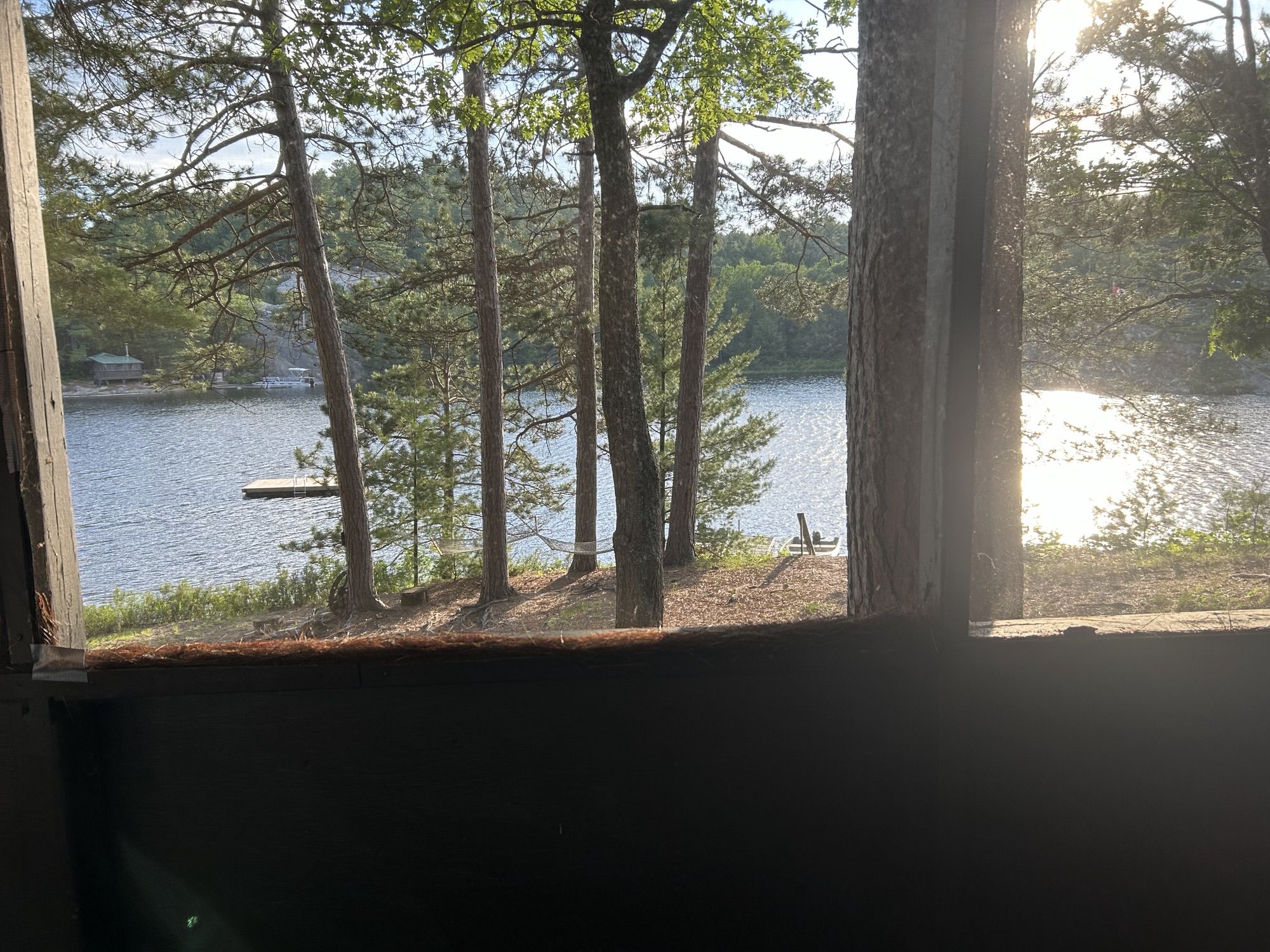
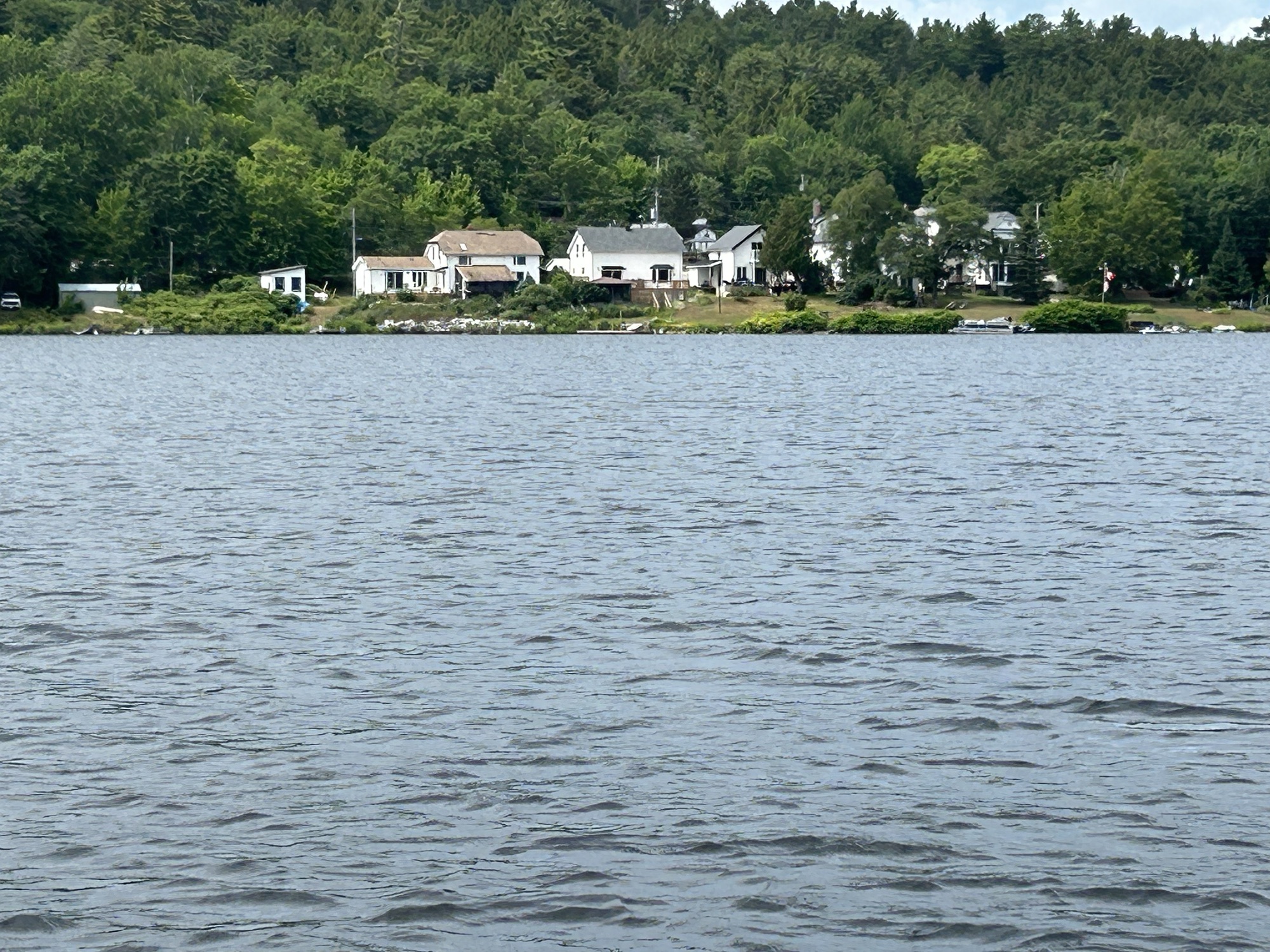
The view through the screened in porch overlooking Whitefish River a throughway to Charlton Lake, Frood Lake, and Cranberry Lake.

Still Waters 🏞️

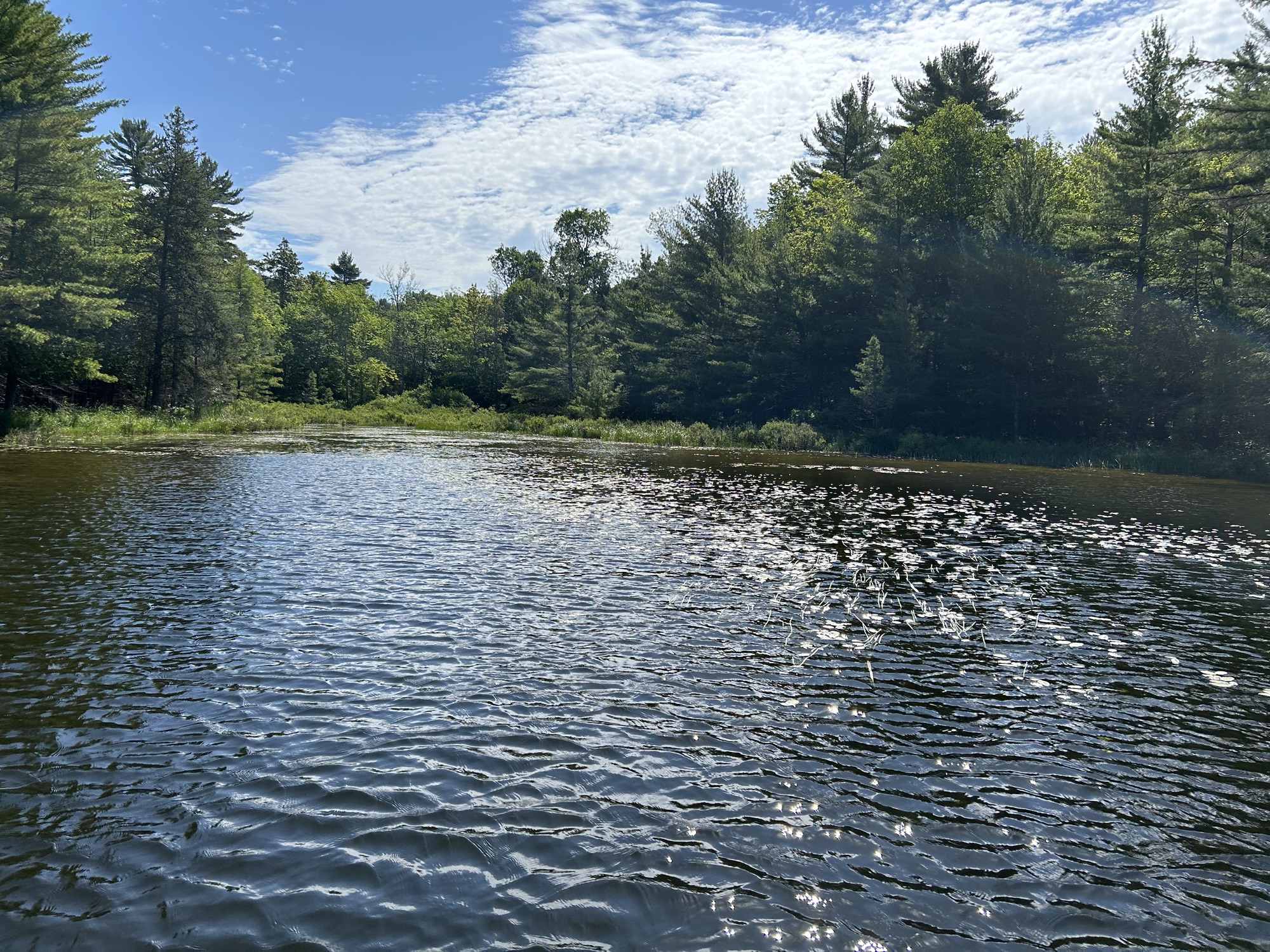
I sat observing the waters of the Whitefish River flowing toward stillness–moving from one lake to the next, but in a relaxed state of flow that most often seemed to occur in the early morning or late evening.  Occasionally, something would break the surface, and rings would begin spreading outward from the epicenter. When this would happen, I often caught myself holding my breath in anticipation until the last ring dissipated, and the water was once more placid.  Then, with the stillness restored, I resumed my own cadence of breathing slow and steady, matching the river’s pulse.

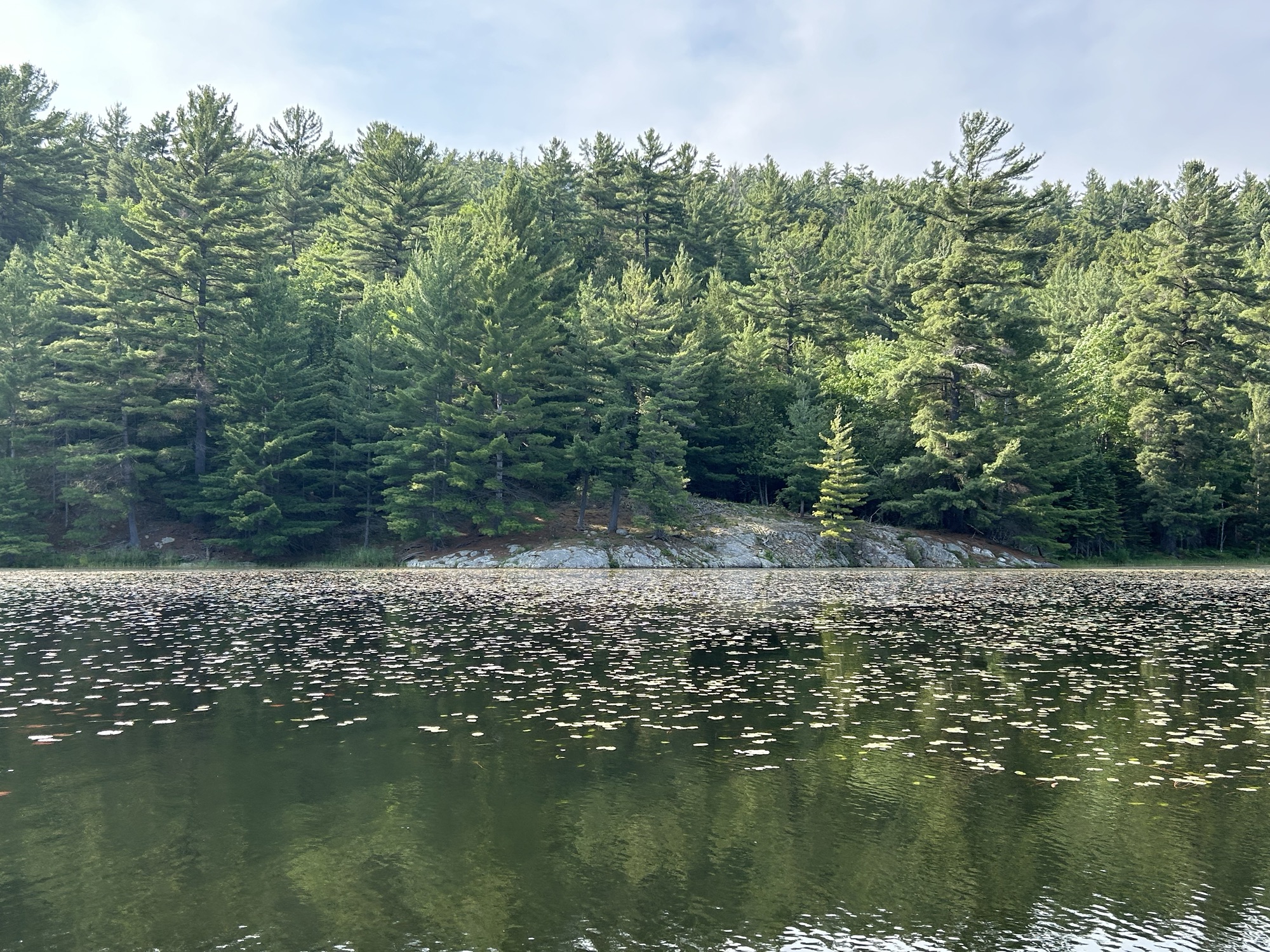
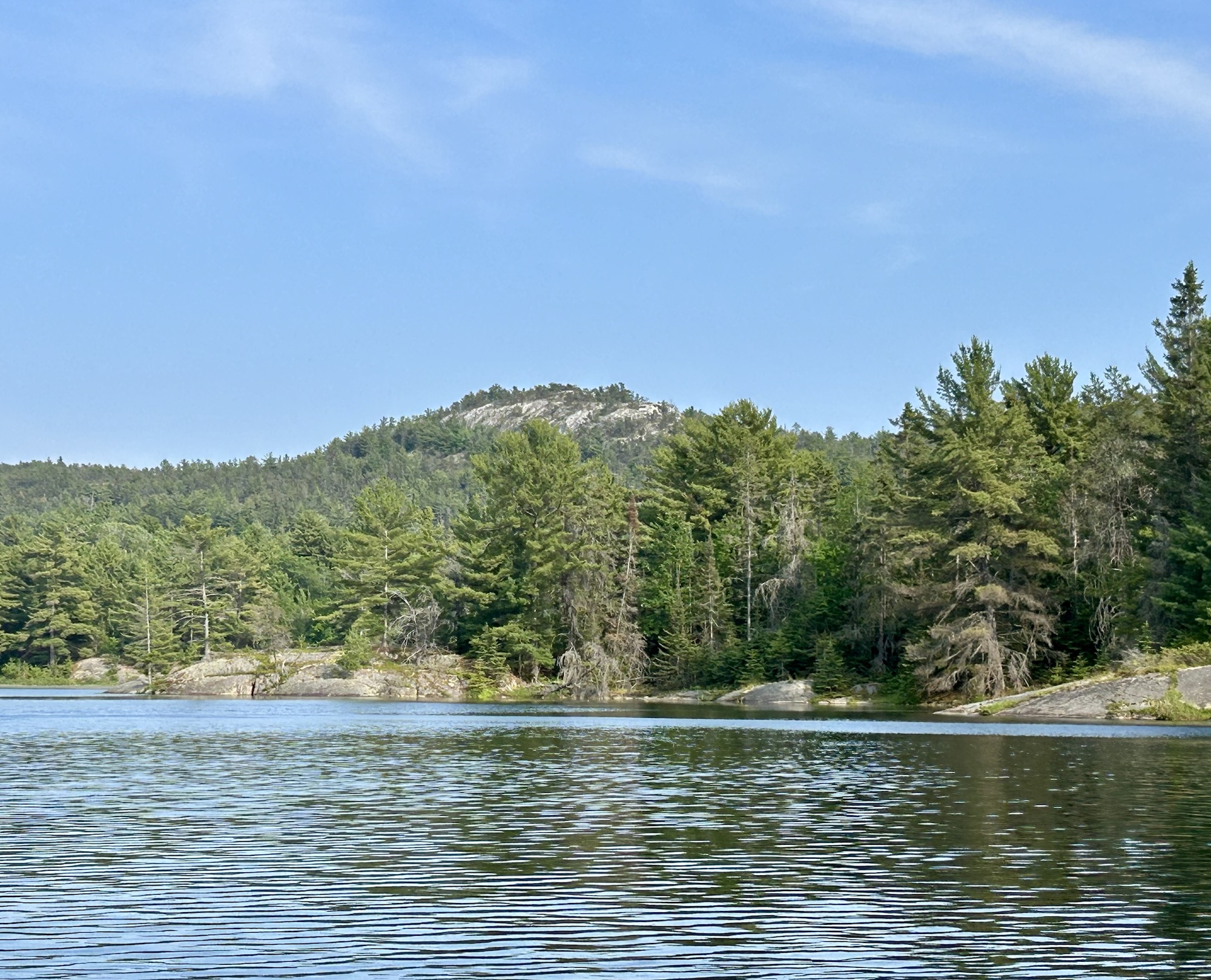
The peaceful, craggy rise of quartzite rise of the ancient La Cloche Mountains surrounding the lakes.

Lake Charlton Camp 🏕️

My husband, John, and I were staying in Charlton Lake Camp (CLC) located in Killarney Provincial Park, Willisville, Ontario. This was our second trip to CLC, situated in a natural showcase of diverse pines, surrounded by the white quartzite crests of the La Cloche Mountains and translucent, tea-stained waters of Charlton Lake, Frood Lake, and Cranberry Lake with the Whitefish River providing a throughway to the lakes. In the morning, CLC was filled with a wilderness chorus of birdsong, loon calls, bull frogs, lapping sounds of water against rocky shores, and, of course, the buzzing hum of countless varieties of insects. 

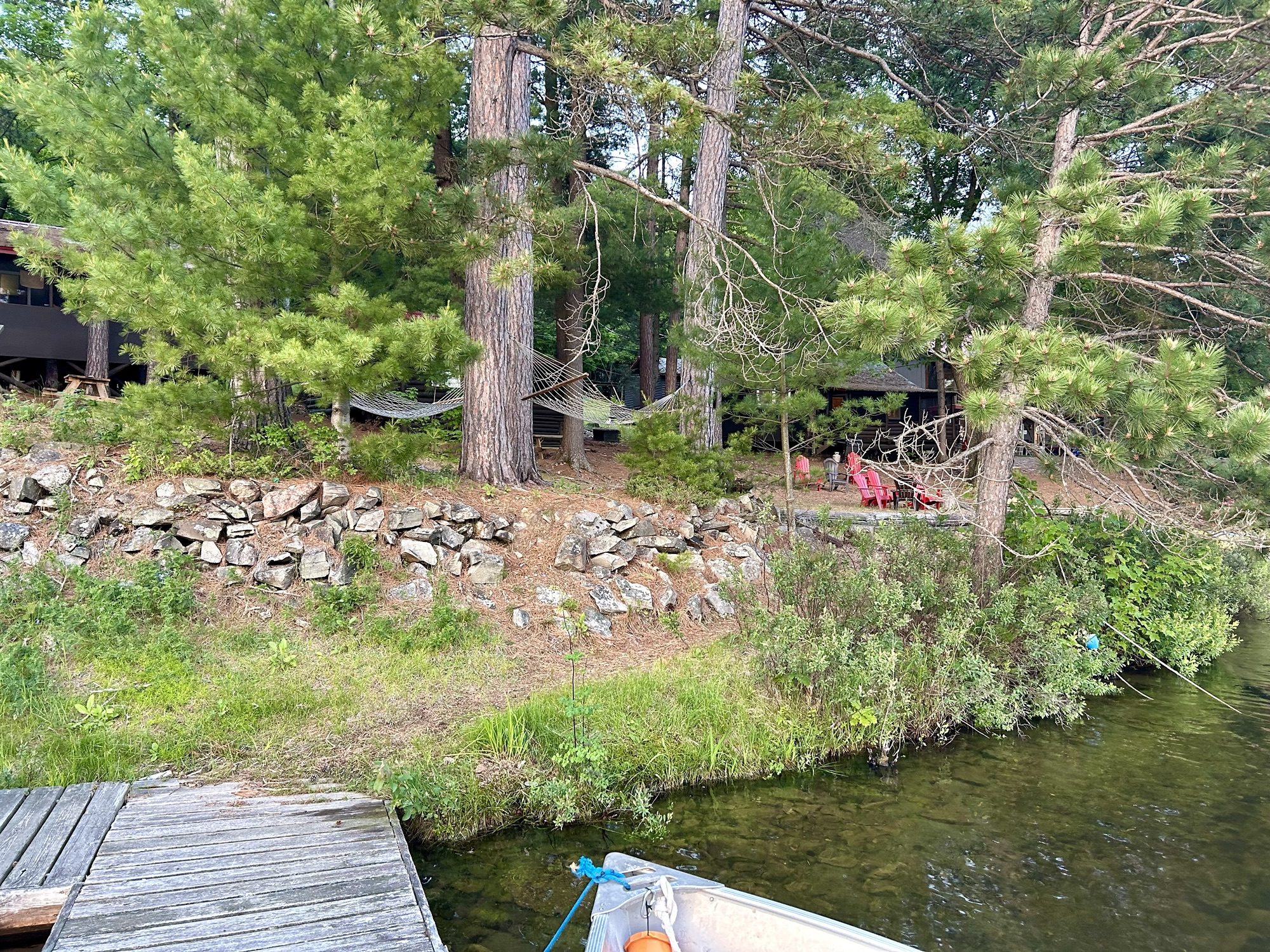
The cabin in which we stayed at Lake Charlton Camp is just beyond the steps that lead to the dock.

Settling into Quiet 🤫

Breathing in deeply, my lungs filled with the aromatic aromas of pines, damp soil, sunned rock, and a hint of morning coffee as I continued to sit and observe, communing with my surroundings. The sun would soon begin lifting above the craggy cliffs behind the cabin in which we stayed, and life would soon begin stirring with those gleaming rays. But, in that moment, hovering between the hush of night and the dawn of daybreak, there was a stillness in which my heart was soft and open–receptive to that still small voice that resides within.

Boating through Frood Lake with the La Cloche Mountains in the foreground.

Slipping into the Gap of peacefulness 😌

I once read that praying is talking to the Divine Creator; whereas, meditation is stilling the mind for the purpose of listening.  Sitting there on that screened porch on the cusp of a new day, I was reminded of that idea.  My heart, head, and soul had relaxed enough to hear the truth–to really parse the ongoing narratives that, when left unchecked, my brain tends to repeat on an endless loop. By settling into the surrounding peacefulness, I could focus on listening, and begin to see how many of those narratives were (and are) often baseless claims forged by past experiences, trauma, anxiety, negative self-talk/criticism, and even a little fear. 

Sitting, breathing calmly, and savoring CLC’s peaceful surroundings through my senses, I found I could let my mind rest easily as if the wheel of ceaseless chatter had ground to stop, or at the very least, slowed its revolution. Taking in a deep breath of the clean, wilderness air, I softened my gaze on the water and continued listening. 

Afternoon sun glistens off the calm waters of Frood Lake.

Riding the waves of emotional influence🌊

Matching my inner calmness to the stillness of the river led me to a realization. My own mind often mirrors those waters of CLC. My mind tends to be at its calmest in the early morning or at night–just before drifting off to sleep, letting go of the day’s worries.  However, once the day fully begins, I am immersed in work and various tasks with multiple decisions being made throughout the day.  As my decision making increases, my judging brain kicks into high gear.  With that continued judgment comes an inner dialogue often influenced and affected by emotions, which rise and fall throughout the day much like the water around me did during the week.

Throughout our time fishing, resting, and relaxing in CLC, I observed how the river and surrounding lakes could quickly become stirred up, rising and falling with the winds of the day, tossed about with a changing weather front, or even fill with large waves when an occasional boat sped across the waters to the farthest end of a lake. There were additional times, when for no discernable reason, the waters would suddenly ascend and descend, jostling the boat John and I were in. 

Riding out the waves of emotions can be similar to navigating a fishing boat over wave-filled waters.

Restless emotions 😬

Fishing during those moments of restless waters and winds was challenging.  The wind would take hold of a perfectly thrown cast and carry the line and lure in a completely different direction than intended. Likewise, when the waters were lifting and dipping with waves, the view beneath the waters was clouded and murky–not allowing the eye to determine if the boat was above rocks, a weed bed, a submerged tree, or any other number of possibilities. Conversely, during the moments of calm, settled waters, navigating and fishing those waters was fairly easy and what was beneath the boat was clearly visible.  

Looking out at the peaceful waters of Whitefish River through the screened porch.

The influence of a RAcing Mind 🤯

The riverview before me, in that early morning hour, was emblematic not only of ideal fishing waters, but also a peaceful state of mind.  Unfortunately, our modern world tends to create and drive the opposite effect–a constant flurry of stirred-up waters–our minds fidgety and/or frantic, racing from one thought to another, moving through agendas of busyness, entertainment, and avoidance. Therefore, if we don’t set aside time to allow our minds an opportunity to cease its chatter and rest easy, how can we ever feel calm and think clearly?

Settle into into the stillness.

The importance of intentional Quiet 🤫

Our inner dialogue is often affected by the changing weather of our emotions.  Those emotions vacillate and shift with each decision we make and with each event we encounter.  And while I fully admit that mind chatter, and all of the emotions that come with it, cannot necessarily be avoided, in similar manner to the weather fronts we experienced during my time at CLC, our emotions can vastly change within the course of a day, much less a week. Therefore, deliberately providing pockets of time for stillness allows us to detach from the emotional narratives, and instead, fosters listening to that still, small voice of knowing, which allows us to, well, “fish” for the truth.

Listen for the whisper of our Creator, the great I AM.

LeT us Listen for the whisper 👂

Ralph Waldo Emerson once penned, “Let us be silent, that we may hear the whisper of God.” What a powerful reminder of the importance of settling the mind, like the still waters that were before me on that morning at Charlton Lake Camp. The type of quiet we choose can be a formal meditation/reflection, but it could also be achieved through walking or other forms of exercise, tending to your flowers/plants, or simply sitting on the porch sipping coffee or tea and listening to the birds. It really doesn’t matter as long as it is an intentional moment set aside to calm those mental waters of ceaselessly, flowing chatter. Prioritizing time for quiet reflection or meditation, however you define it, allows the flow of our hearts and minds to settle, soften, and encounter the “whisper of God.” 

Willisville, Ontario

Nutritious Maple Walnut Salad Inspired by Alzheimer’s Study | Health Recipe

“I am cautiously optimistic and very encouraged by these findings, which may give many people new hope and new choices,” Dr. Dean Ornish

highly anticipated study 📈

Photo by Greta Hoffman on Pexels.com

I recently returned from a trip to Ontario, Canada. While I was there, a major study, led by Dr. Dean Ornish, was released in BioMed Central’s Alzheimer’s Research and Therapy. This highly anticipated research was widely promoted across various news outlets weeks earlier. Despite the fact I had read the earlier press releases, reading the report, one peaceful early morning in a rustic cabin along the shores of backwoods lake, provided greater understanding.

As I have previously written, Alzheimer’s disease (AD) and dementia are part of the genetic make-up on both sides of my family history.  Watching it take the minds of my beloved grandparents was heartbreaking. Ultimately, they required extensive care in large part due to AD, the burden of which fell upon their children. Therefore, I want to do all that is possible to avoid placing that type of burden upon my loved ones.

Ornish’s study is the first controlled clinical trial to demonstrate that lifestyle habits can delay the onset and progression of mild cognitive impairment (MCI) or early dementia due to AD. The study initially enrolled 51 patients and their designated partners, aged 45-90, for 20 weeks, but two withdrew. Nonetheless, the study guided the remaining 49 patients through a series of interventions, including a plant-based diet; walking 30 minutes per day; strength training three days a week; stress management including yoga, breathing exercises, and meditation, to name a few; group support via Zoom meetings, and specific supplementation, all of which is clearly spelled out. 

Excitement Incitement 💡

The excitement of this study got my recipe-creating gears grinding, especially as a major heat wave sank its talons in a large swath of the U.S. and Canada, including where I was staying with my husband. With the extreme heat we were experiencing, the last thing I wanted to do was turn on the cabin’s stove or oven, especially since there was no air conditioning. Therefore, throughout our stay, I created several dinners of seriously large salads, adding additional inspiration for this month’s recipe.  

Of further influence was the wide availability of Canadian maple syrup.  In fact, I encountered a representative of White Meadows Farms, out of St. Catherine, Ontario.  This family-owned farm, established in 1937, has been harvesting sap to make maple syrup for over three generations. After one sample, my taste buds were “stuck” on the flavor of their dark syrup. I knew I had to put their syrup to good use as part of this recipe creation. After all, sweet moderation is an important part of good health.

Nuts for health 🌰

Another point of inspiration for this recipe was the wide availability of bulk walnuts at the local market near our camp. Nut and seeds are a healthy part of the Ornish diet. In fact, according to the Cleveland Clinic, walnuts provide a good source of omega-3 fats and antioxidants for heart health, benefit gut health due to their high fiber content, help stave off inflammation, and may reduce risks for certain cancers.  Additionally, those healthy fats and antioxidants may boost brain health–perhaps that is why walnuts are shaped like a brain!

A rainbow recipe of pride 🏳️‍🌈

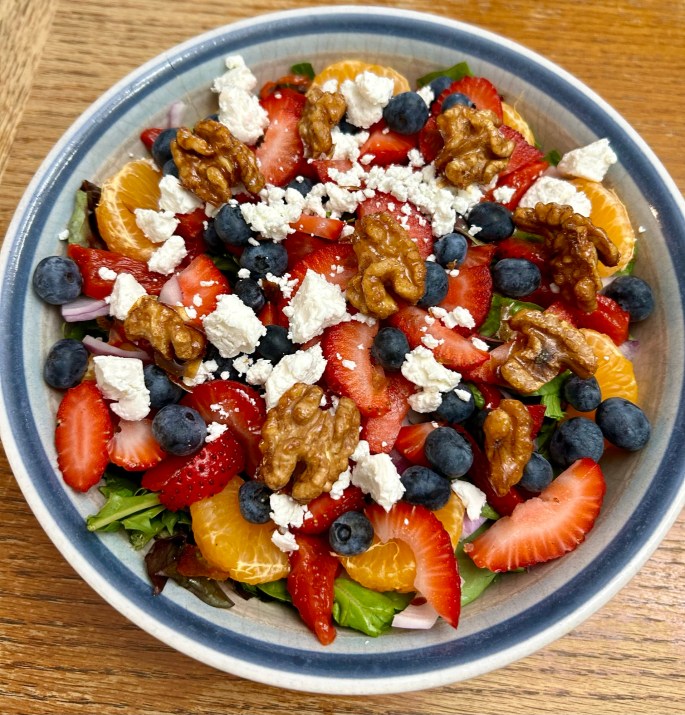
One final source of inspiration for this recipe was the fact that it was created during June, the month of Pride, dedicated to celebrating my friends and loved ones in the LGBTQ+ community, including my brother and two nieces.  It is with great, well, “pride” and celebration that this recipe will debut on June 28, International LGBTQ+ Day.  This gorgeous salad offers a RAINBOW of tasty colors and textures designed to nourish EVERY body.

From my home to yours, I wish you health, happiness, and hope for an optimistic future free from dementia and Alzheimer’s disease!

Rainbow salad with maple walnuts and vinaigrette, gluten-free with vegan options

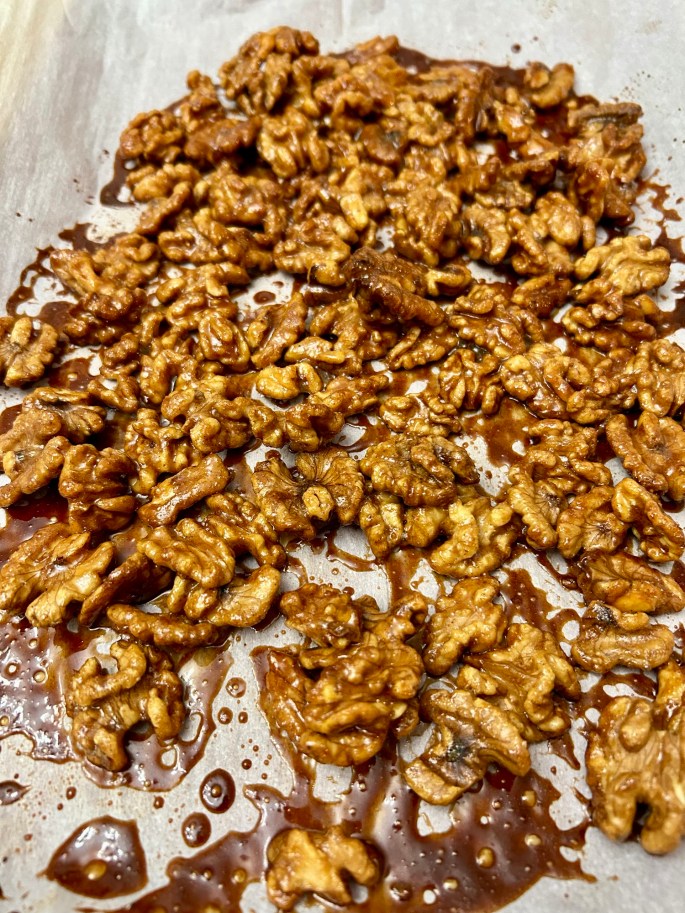
Maple walnuts ingredients:

2 cups walnuts

⅓ cup pure maple syrup

½ to 1 teaspoon vanilla 

¼ to ½ teaspoon cinnamon 

⅛  teaspoon sea salt

Salad ingredients:

5 or more ounces of favorite baby greens

1 cup sliced strawberries

¾ cup blueberries

2-3 clementines, sectioned

½ sliced large red onion

½ cup roasted red peppers and/or shredded carrots

2-4 ounces goat, or equivalent vegan, cheese or 1 cup beans, drained and rinsed

Maple walnut balsamic vinaigrette ingredients:

¼ cup walnuts

½ cup water

¼ cup balsamic vinegar

2 tablespoons maple syrup

1 tablespoons dijon mustard

½ teaspoon dried onion powder

½ teaspoon dried oregano

⅛ teaspoon salt

Pepper to taste

Maple walnut directions:

Preheat oven to 350 degrees

Line baking pan with parchment paper or lightly grease and set aside

Place maple syrup in a small, microwave safe bowl.

Heat syrup for 30-60 seconds

Stir in vanilla, cinnamon, and sea salt until thoroughly mixed

Pour syrup mixture over walnuts, and stir until well coated

Spread coated walnuts onto prepared baking sheet

Bake 5-7 minutes, then stir and rotate 

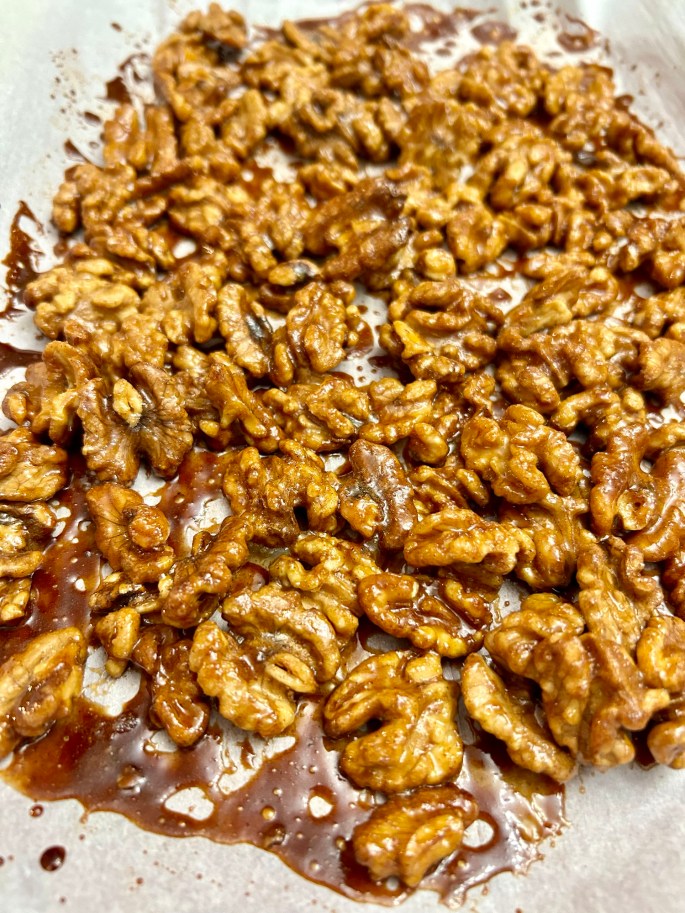
Continue baking for 3-5 minutes or until walnuts are golden brown

Remove walnuts from oven and allow to cool on baking sheet 

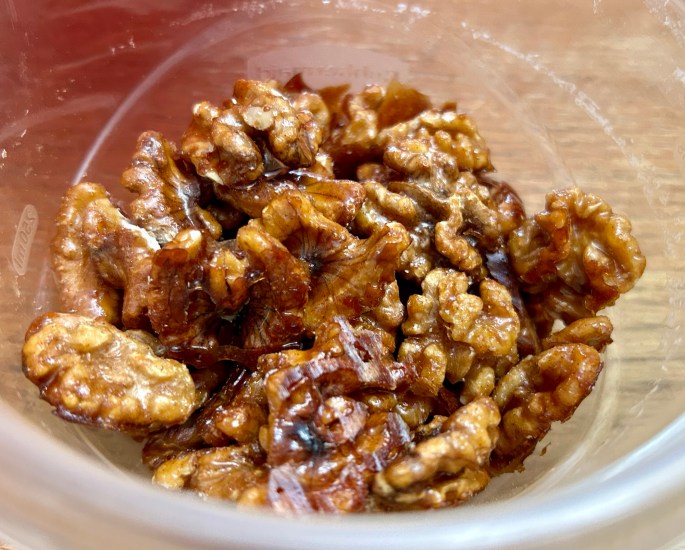
Break walnuts apart and store in airtight container or baggie for up to 3-4 for weeks

Enjoy these maple walnuts as a snack or sprinkle over salads, fruit bowls, oatmeal, yogurt parfaits, ice cream sundaes, etc 

Maple walnut balsamic vinaigrette directions:

Place all ingredients in high powered blender and blend until smooth, approximately 45 seconds

Pour into glass container (I like to use canning jar)

Store in refrigerator for up to 4 weeks

Makes approximately 1 cup dressing

To assemble salad:

Add greens to large salad bowl

Add sliced strawberries, blueberries, clementines, sliced red onion, sliced red pepper, and/or shredded carrots, if using.

Toss with desired amount of dressing, divide among plates/bowls and top with goat or vegan cheese (or top with beans instead, such as roasted chickpeas)

Serves 2-4

This recipe also took inspiration from the following websites and articles: Better with Cake, The Garden Grazer, Hello Nutritarian, “Effects of intensive lifestyle changes on the progression of mild cognitive impairment or early dementia due to Alzheimer’s disease: a randomized, controlled clinical trial,” an article on BioMed Central,“‘A study to give us hope’: Lifestyle changes improve Alzheimer’s symptoms for some,” an article on CNN, and Shane and Simple.

Mindful Breathing for Inner Peace: Embracing the Wisdom of Native American Tradition

“We are what our thoughts have made us; so take care about what you think. Words are secondary. Thoughts live; they travel far.”–Swami Vivekananda 

Author note: A reader requested I write another meditation.  I hope this benefits not only that reader, but anyone else who may be in need of a quiet mind, even if only for a few moments.  

Photo by Rachel Claire on Pexels.com

Wakeful Worries 😏

As I rose early on a recent morning, thoughts were bouncing around on the trampoline of my mind.  I had a to-do list that was growing and several creative ideas sprouting.  Overriding all of this, however, were stresses and worries springing about like jackrabbits in the desert. In fact, those negative thoughts, I realized with a sudden clarity, had been vying for residency in my mind for several weeks to the point they were disrupting my sleep.

Feeling the inner war, I opened a window, sat down in a chair near it–cup of coffee in hand–and welcomed nature’s morning muzak.  I took in a deep inhale, and slowly let it out. 

Inhaling, I felt the expanse of my ribs. Exhaling, I sensed bits of tension releasing. Focusing on my breath, I gently closed my eyes in an attempt to relax my body and release the mind noise.  Inhale, soften. Exhale, dissolve.

Photo by Anete Lusina on Pexels.com

Focused Breathing 😮‍💨

I am unsure how long I remained in this focused state of breathing, but soon, my mind drifted–as it tends to do–back into thoughts.  Thoughts of past events, worries of future events, and pressing concerns for the day ahead kept popping up. I had to keep redirecting my mind back to my breath and gently pushed aside those niggling thoughts.  It wasn’t easy.  Like a curious toddler trying to tempt fate, my mind kept circling back to those all-consuming worries and concerns.  

Inhale, redirect the mind back to the breath.  Exhale.  Let go of the negative thoughts jostling for attention. 

As my mind engaged in this game of ping-pong, I was reminded of a story I heard years ago during my yoga teacher training.  

Inhale, notice how easily the body can breathe.  Exhale, notice how naturally the body releases. 

Photo by Shelby Waltz on Pexels.com

The Parable of the two Wolves 🐺

The story, as I recall, is based on a Native American parable.  An old tribal leader was teaching his grandson about life. The grandfather tells his grandson that there is a fight going on inside of him. He describes it as a terrible fight between two wolves.  

Inhale, notice the ease of breath.

One wolf is evil, the story goes. He is filled with anger, envy, superiority, regret, greed, arrogance, self-pity, guilt, resentment, inferiority, lies, false-pride, and ego.  

Exhale, let go more.

The other wolf is good. He is filled with joy, peace, love, hope, serenity, humility, kindness, benevolence, empathy, generosity, truth, and compassion.  

Inhale, lungs fill.

The grandson thought about it for a minute, and then asked his grandfather, “Which wolf will win?” 

Exhale, lungs release.

The old tribal leader smiled and replied, “The wolf you feed will win.”

Inhale truth; exhale falsities. 

Photo by Polina Tankilevitch on Pexels.com

our Thoughts can be shackling ⛓️

I sat with the story, returning to the ebb and flow of my breath. The nourishment of the inhale continued to fill me with a sense of peace.  The long, slow exhale showered the soul, washing away worries, fears, and anxieties.

Many of us have experienced moments when we feel shackled by memories and traumas of past events. For some of us, those past occurrences created deeply-rooted fears, planted in our minds like cancerous tumors. Those seeds of fear from long-ago have a tendency to create clouds of self-doubt, blocking rays of hope and joy that can be found in the present moment.

Inhale, strength.  Exhale, dread.

However, there are times when all the present can offer you is a stem full of thorny events as if the sweet blossoms of life have been stolen. Illness, disease, work-day stressors, financial struggles, and numerous other difficulties prickle and needle our days with seemingly no balm for the soul. At these times, it can be easy to dip into the waters of sorrow, the woe-is-me story.

Inhale, perseverance. Exhale, detachment from the story.

Photo by Gary Barnes on Pexels.com

mindful connections 😌

However, even when we are surrounded by the chaos of life, there is a place of peace and ease. All it takes is a moment to reconnect with our breath, the river of calm and life-giving force within us. By giving up the struggle for one moment, we can let go of the bubbles of tension held within our depths, and allow them to rise and release with each exhale.  With each inhalation, we strengthen our connection to our True Source, our Infinite Creator.  With each exhalation, we can surrender our illusion of control and trust that all is as it should be.  

Inhale, fortitude. Exhale, liberate the mind.

By watching the ebb and flow of each inhale and exhale, we can lay down our burdens of our fear, doubt, and pain for the time being, and allow the Universe to carry the load for us. We can inhale the peace, and with the exhale, perceive the lightness of nothing is weighing us down in the moment. We can allow ourselves to feel the Divine creations that we are, and have faith in the process.  All is well in this moment as we breathe.

Inhale, trust.  Exhale, believe.

Photo by Arthur Brognoli on Pexels.com

breathe. connect. have faith. 😌

  In the same way that we trust our lungs to breathe for us–even when we are not focused on them–so too must we put our trust in our Creator and the flow of our life.  It doesn’t mean all will be perfect, for life is not simple. However, when life, and/or those around you, choose to feed the bad wolf, take a breath, and remind yourself that you have the power to choose to feed the good wolf, simply by pausing and taking a few deep breaths. 

Inhale, faith. Exhale, peace. 

One breath in, one breath out for peace and calm

 “We need to find God, and that cannot be found in noise and restlessness. God is a friend of silence. See how nature–trees, flowers, grass grows in silence . . . We need silence to be able to touch souls.” –Mother Teresa

Photo by John-Mark Smith on Pexels.com

The Miracle of EArly Morning 🌅

One of my favorite times of day is the stillness of the early morning.  Don’t get me wrong, depending upon how early I have to get up, it can be a chore to drag myself out of bed.  However, once I am up, enveloped by the hum of the house and the ambiance of the celebratory, daybreak birdsong, I feel a peace begin to zip up around me like my favorite hooded jacket. 

Now that daylight arrives earlier, it is especially delightful on the weekends to sit at my desk, steaming mug of coffee beside the laptop, and gaze out the open window as the birds continue their lilting praise of the arrival of daybreak. Sometimes I see the contrails from a jet writing across the sky.  Other times I observe the rustle of trees or my neighbor’s cat stalking some unseen prey. Regardless of what I notice, I take a deep breath, and invite the silence within.

Gazing out into the trees and grass of my backyard, there is a peacefulness of the Divine Presence.  Observing the continual miracle of seasonal change, I am bearing witness to the continuity, strength, and resiliency of nature.  With one breath in and one breath out, I can connect to Divine life force within, silently supplying me with continued strength.

Photo by Engin Akyurt on Pexels.com

Welcome the Silence 🤲

I continue to welcome the silence, and I allow it to wash over me, cleansing the stresses and worries of the night that interrupted my sleep.  I ask God to hold space for me within the silence as my soul settles into place. One breath in. One breath out. Each breath, rich in the silence, nourishing my peace of mind, if only for a few minutes.

Momentarily, I become part of the silence and my brain softens into the quiet, temporarily liberated from its continuous lists of things to do, notice, and concerns. One breath in. One breath out. I feel the silence breathing peace through me, filling my cells. I ask for the peace to live through me and to emanate from my actions, knowing even then, I will still stumble into mistakes.

The early morning silence centers and anchors me to the importance of being more mindful of the here and now.  One breath in. One breath out. I allow the silence to cultivate peace within that moment, and I ask that it remain with me as I move through my day, understanding that disturbances of my inner peace will also most likely occur throughout the day. I further pray the silence will infuse and imbue my day with moments of peace I can offer others, if only through the simple act of a smile or kind word.

Photo by Csankovszki Tibor on Pexels.com

Whispers of Silent Inspiration 🙏

If I am fortunate, the silence will sometimes whisper inspiration when I do encounter stress in a later moment. It only requires that I momentarily bring awareness to my breath, and once more, I can connect to the True Source filling my lungs, giving me life. One breath in.  One breath out. 

When the silent morning meditation begins to wind down, I become more aware of my surroundings and my own physical body.  I look for those poetic plane contrails, but they have usually vaporized, reminding me of the impermanence of struggles, strife, and life in general.  One breath in. One breath out. My words, my thoughts, my deeds are like those contrails, here, in this moment, but eventually given to the heavens.

Bringing awareness to the moment, I will feel the tendrils of morning silence loosening its grip, and I mourn briefly that I must leave its embrace. There are more words to be written, more students that need taught, and more people that need loved.  One breath in. One breath out. I remind myself that I can always come back to the comforting peace of the silence of my mind with one moment of conscious breathing. 

Photo by Dom J on Pexels.com

The antidote to noise and Chatter 🧘

It seems to me that we currently live in a world where many of us have forgotten, or even fear, silence.  Chatter and noise seem to flow in an endless supply, alongside daily routines filled with responsibilities and heaping portions of distractions. However, by seeking the solace of silence and focusing on your breath, if even for a few moments, we may discover our heart rate slows, racing thoughts may decrease, and the body may relax a bit.  One breath in.  One breath out. 

The older I get, the more my appreciation and need for silence grows.  If we listen too long to the noise of the media, news, traffic, screens, chatter, and so on, our stress increases, our worry increases, and our anxiety increases.  We forget that silence soothes our souls and brings us back to the presence of God within and around us. All it takes is one breath in and one breath out. 

Berry Immunity Boosting Smoothie aka Stress Less Smoothie

The greatest weapon against stress is our ability to choose one thought over another.”–William James

Photo by Pedro Figueras on Pexels.com

The challenge of work-life balance⚖️

It is not uncommon to engage in conversations centering around stress.  Attempting to balance the demands of work and life can be challenging. The combination of long work hours, while also juggling the needs of family, make it difficult to have time to do the things that would otherwise relieve stress, such as regular exercise, outings with friends, or even a relaxing soak in the tub. 

When stress ramps up, there is a chain-reaction in our bodies.  According to Harvard School of Public Health, when stress is high, the body’s demand for oxygen and energy increases, which in turn increases the demand for key nutrients.  Simultaneously, stress causes the body to eliminate other vital nutrients. This can take a toll on the body’s immune system.

As the chain reaction of stress continues, hormones become affected.  If the stress is acute, the body will secrete adrenaline, which suppresses appetite.  However, when the stress becomes more chronic, cortisol levels begin to rise, instigating food cravings.  Cortisol tends to create cravings for foods that are typically considered “comfort foods,” full of sugar, salt, and fat.  Unfortunately, if cortisol stays elevated, the chain reaction continues to wreak havoc upon our bodies, and this often influences our coping strategies.

Photo by cottonbro studio on Pexels.com

The body’s stress response 😰

Chronic high stress time periods, depletes the body of energy and can often reduce time available for decompression. This can inhibit the desire to prepare healthy, nutritious meals.  Sometimes, chronic stress causes us to skip meals.  The downside to skipping meals is that, as the cortisol levels rise, once there is an opportunity to eat, we tend to reach for those comfort foods that will not replenish the body’s stores of diminished nutrients.

Therefore, how we respond to stress matters.  With some situations, we can identify upcoming stressful time periods before they begin, and thus, we can be more proactive.  However, that isn’t always the case.  Nonetheless, there are a few basic guidelines, according to The University of North Carolina at Chapel Hill that are worth remembering.

Photo by Antoni Shkraba on Pexels.com

Tips for eating during times of stress 😣

  • Keep nutrient-dense grab-and-go snacks on hand at all times.  Foods like baby carrots, celery sticks, hummus cups, guacamole cups, apples, oranges, bananas, popcorn, almonds, walnuts, pistachios, low-sugar yogurt, low-sugar granola, low-sugar oatmeal packets, whole-grain crackers and so forth.
  • Eat at regular intervals when possible.  This will keep blood sugar stable, and keep the brain, which needs glucose, working at its best.
  • Eat high-fiber foods. Foods, such as fruits, vegetables, nuts, seeds, beans, oatmeal, and other whole grains, have been shown to decrease perceived stress levels and increase alertness.
  • Focus on eating fruits and vegetables, especially leafy greens, whenever possible.  These foods are filled with the vitamins and minerals your body needs to neutralize the harmful molecules our bodies produce when under stress. 
  • Foods rich in unsaturated fat also help. Think walnuts, flax seeds, chia seeds, and fish oil to name a few. These foods are associated with increased brain function; however, deficiencies in fatty acids can result in depression and/or anxiety. 
  • Be mindful of caffeine and/or alcohol intake. Both of these can disrupt sleep, which the body desperately needs during times of stress.  Additionally, both can increase blood pressure, which can increase feelings of anxiety.
  • Ensure your body is getting enough quality sleep. Getting enough sleep allows the body to reduce cortisol levels and other stress hormones, increasing the chances of remaining calmer in the face of stress.
  • Employ constructive coping strategies. Whether it is talking to a trusted friend or therapist, journaling, meditating, asking for help, or going for a walk–developing positive coping skills is a lifetime skill set. 
Photo by Wallace Chuck on Pexels.com

The reality of stress 😩

Stress is reality at different points in our lives.  While we cannot control when it will arise, we can control our response to it.  It is easy and understandable to seek comfort during times of stress.  However, when those sources of comfort become unhealthy coping mechanisms, such as over- or undereating, drinking alcohol in excess, going without sleep, and so forth, we risk using short-sighted solutions that could lead to developing long-term problems, creating even more stress.  

Stress less smoothie 🍓

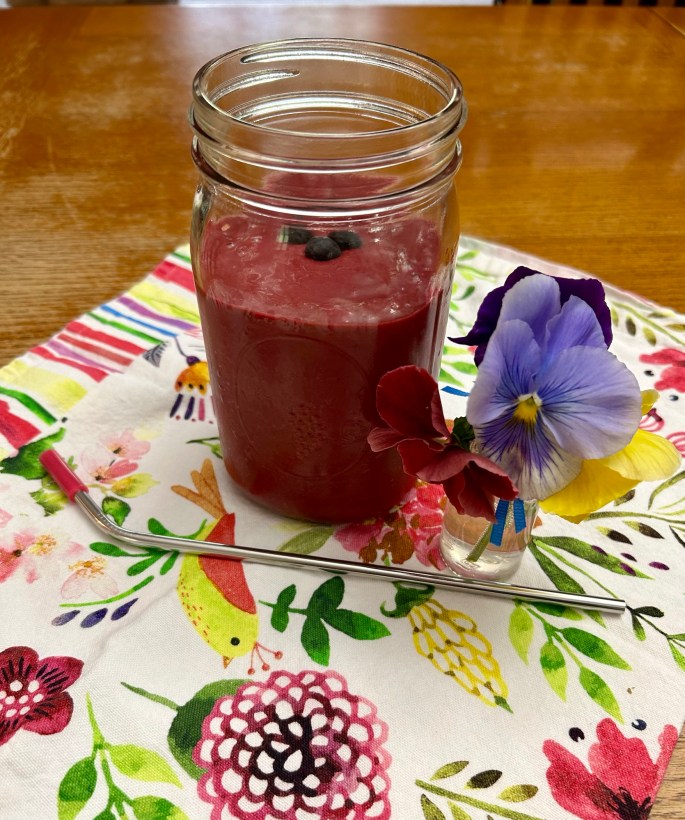
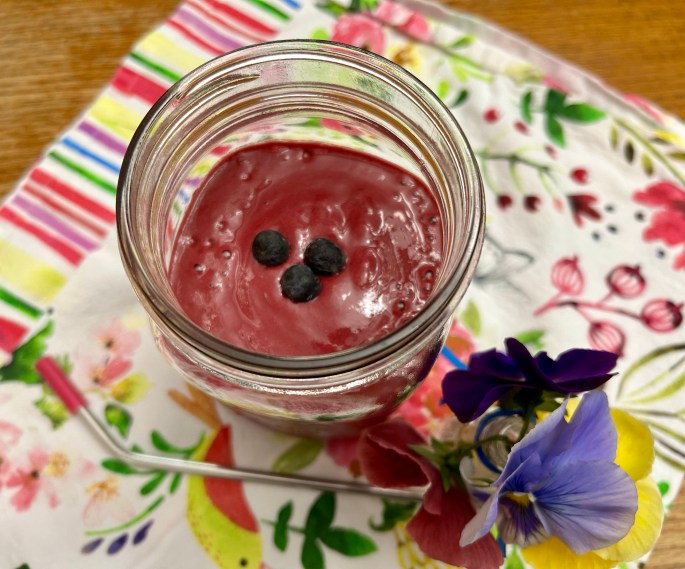
Below is my newest smoothie creation.  It is full of nutrient-rich foods that are high in fiber.  Some of the ingredients may cause you to raise an eye-brow in wonder, but I promise, it does taste great.  That said, feel free to adjust, add to, or eliminate ingredients that don’t suit your palate or dietary needs.

This recipe can be made ahead of time and frozen into individual servings.  They will stay fresh in the freezer for up to three months.  Then, whenever faced with a stressful day, take one smoothie out the night before, set it in the fridge to thaw, and then it’s grab-and-go convenience for the next workday. Sip on it through a lunch meeting, or if more time is available, pour it into a bowl and sprinkle on favorite fruit and nut/seed toppings, along with a bit of granola. 

I can’t promise that this recipe will change the stress around you. However, it does provide a powerful nutritional punch to help stave off the effects of stress, and offers one less thing to worry about.  Plus, it feels good knowing that if everything else goes wrong in the day, at least one small part of your day was stress-free.  

Cheers to one less thing to stress about!

Berry Stress Less Smoothie

Nutrient dense, stress combating meal replacement

Ingredients:

2 cup spinach, riced cauliflower, or kale (can be frozen)

½ cup strawberries, frozen

½ cup raspberries, frozen

½ cup cherries, frozen

1 apple

½ cup lentils

1 parsnips

2 tablespoon flax, chia seeds, or hemp seeds (or combination of any two)

2 tablespoons goji berries, OR 2 medjool dates, OR 2 prunes, optional

2 tablespoons cocoa or cacao powder, optional

2 scoops protein powder, optional

1 cup beet juice (can use pomegranate or cherry juice or simply use water)

1 cup milk  plant or dairy based variation)

½-1 cup of water, if too thick

Directions:

Put all ingredients in high powered blender

Blend until creamy and smooth

Makes 2 large servings 

Get More Grounded: The Benefits and Lesson of Tree Pose

“Be like a tree. Stay grounded. Connect with your roots.  Turn over a new leaf. Bend before you break.  Enjoy your unique natural beauty. Keep growing.”–Joanne Raptis

Photo by SHVETS production on Pexels.com

The magic of Tree Pose 🌳

“Trees sway; get more grounded,” my husband chimed along with the yoga instructor on the DVD as we attempted tree pose on a Monday morning before work, the classic yoga balancing pose that requires standing on one leg. 

I appreciate tree pose for many reasons. It strengthens feet, spine, ankles, legs, and core.  Further, it opens the hip area, stretches the inner thigh and groin muscles.  Plus, it can improve one’s concentration and focus while simultaneously improving alignment of spine and posture.  Most of all, it is a pose of balance, which can help in a multitude of ways. 

Symbolically, tree pose serves up several lessons. However, one of the more literal lessons of tree pose is that of remaining in the present moment.  It’s nearly impossible to balance in tree pose and think into the future or reflect on the past because you end up falling out of the pose. I was reminded of those lessons this past Tuesday, or as I have come to know it as, “Twister (or Tornado) Tuesday.” 

Photo by Ralph W. lambrecht on Pexels.com

Shelter in Place 🌪️

As a veteran educator, I have experienced a wide-array of events, including those that require shelter-in-place. In fact, I can still recall the first time I experienced shelter-in-place with students 30+ years ago.  I was teaching in a mobile unit at a great distance from the main brick and mortar school building. The students under my care ranged from 5-12 years of age, and they had been identified as “severe behavior handicapped.”  

There were twelve students, ten boys and two girls.  Since this was the early 1990s, computers and cell phones were not widely available in the classroom setting. This classroom had an intercom type “phone” that only connected from the school office to the classroom.  It was through this “phone” that I received the message that the entire school was sheltering in place in the hallways.  The school received a call that a tornado had touched down in another part of the county and was heading our way. I was to gather my twelve, not-always-so-compliant students, and move them to the main building as quickly as possible.

By the time I received the “call,” a heavy metal concert of rain and wind had already begun, drumming and shaking the metal building rhymically with tantruming, angry torrents of sideways rain.  Quickly, the paraprofessionals and I helped the students into their school-issued red rain parkas, and that is when the resistance began.

“I am not going out in that rain.”

“I don’t like getting wet.”

“No, I won’t!”

“I’m scared!”

Whether it was the determined, I-am-not-kidding look in my eyes, Divine intervention, or a combination of both, the paraprofessionals and I miraculously gathered all of them in a line.  Holding hands as one unit, we began fighting our way through the class door that kept trying to swallow us back inside due to the enraged winds. Once outside, raindrops pelted any exposed skin, including the students’ face and heads as their hoods were immediately blown off.  We fought our way to the safety of the school while the passion of the rain and winds seemed to increase and determinedly tried to shove us backwards. 

By the time we made it to the school, none of us were dry as the pernicious storm found a way to penetrate even the sturdiest of rain coats.  Quickly, we hustled the students to the primary wing of the school, finding a piece of wall away from windows where they could drop to their knees and cover their heads, rivulets of water streaming over all of us, while adrenalin continued to accelerate my heart rate.

Photo by monicore on Pexels.com

Twister Tuesday 🪟

This memory bolted through my mind on “Twister Tuesday” as my classroom, and the surrounding classrooms, were filled with the strident sound of the emergency broadcast system sending an urgent message to seek shelter immediately. Our middle school classrooms are located on the top floor of our school building, and the entire middle school was directed to make their way to the first floor as quickly as possible. In order to do that, we had to run down three flights of stairs in a glass-lined stairwell. As we headed down, the irate storm quickly made its presence known.  Like Lyssa, a figure in Greek mythology who is said to drive others mad, the storm insanely clambered and clawed at the windows demanding to get inside, but meeting a wall of resistance.

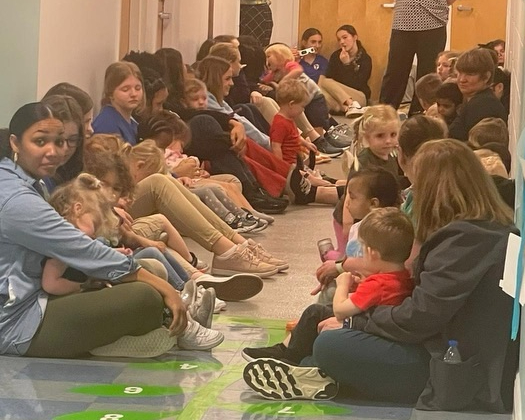
Once downstairs, it was hot, crowded, and overripe with the odor of sweaty, nervous bodies as we sheltered in place away from doors and windows alongside first and second graders as well as preschoolers from the two- and three- year old classes. At times, there were crescendos of anxious voices of students–or, in the case of some of the little ones–crying. During other moments, there were a few older students who experienced panic attacks, but there were many more who remained calm.  There were even those selfless students who chose to hold, cuddle, and comfort younger preschoolers, focusing on the needs of others, rather than themselves.

Middle school students caring for the needs of preschoolers during a shelter in place scenario.

And if you Fall . . . Pick yourself 🆙

As I walked among the students, checking on them, assuring some, answering questions of others, my mind echoed with the words from the previous day, “Trees sway; get more grounded.”  And so, I ground down into my faith.  If the students and staff of my previous school survived that former storm way back in the 90s, surely we would survive this one too.  My emotions could sway like the tree on the inside, but the more I swayed, the more I reminded myself to ground down and try to remain balanced in the present moment in order to better focus on those around me.  

It wasn’t easy, and I wasn’t perfect.  But here’s the thing about tree pose. It’s a great way to practice falling. If you fall out of tree pose, you pick yourself up, and try to return to the pose once more.  

Like my beloved tree-pose, Twister Tuesday provided another stretch and realignment personally and professionally as well as to my faith. It challenged my focus and concentration in order to remain balanced.  And when I “fell,” forgetting to remain focused on the present moment, all I had to do was “pick myself up” and try to return to it once more. Most of all, that Tuesday served as a powerful reminder of the power of the True Source dwelling within and around us, always available to keep us grounded. 

Another middle school student getting grounded in the present moment of another’s need.

The Lost Art of Delayed Gratification

“The longer you have to wait for something, the more you will appreciate it when it finally arrives. . . .  All good things are worth waiting for . . .”–Susan Gale

Photo by Pixabay on Pexels.com

Window of opportunity ⏱️

One of the more popular health trends that continues to grab headlines is around time-restricted eating or TRE.  It is a form of intermittent fasting in which a person chooses a window of time within a day, typically 6-12 hours, in which they eat.  During the time outside of this window, those following a TRE protocol, do not consume any other calories and drink only water, although there are some following a TRE plan that consume unsweetened tea or coffee. 

The idea of TRE is to reduce the amount of overall calories consumed in a day and to reduce less-positive habits such as eating late at night or snacking too much early in the day.  Besides the obvious benefits of managing body weight, scientific research  into TRE continues to show promising results, including reducing insulin resistance, reduction of inflammation and oxidative stress, can alter and improve the composition of the microbiome, and improved sleep to name a few. 

Photo by Yan Krukau on Pexels.com

Time to Eat 🍱

Time restricted eating is nothing new to me. In fact, my childhood taught this.  I grew up with a natural TRE called breakfast, lunch, dinner and no snacking in between.  Furthermore, my parents believed that if we didn’t like what was offered at a certain meal; well, we wouldn’t starve because I could eat again at the next meal.  

I can recall sitting in elementary school feeling my stomach growl.  Sure, I had breakfast, but we ate early in order to make the school bus.  I would look at the large classroom clock on the wall, counting down the time until the teacher l lined us up and walked us to lunch. Standing in line waiting for everyone to go to the restroom, wash their hands, and line back up, my mouth would water in anticipation of food.  By the time I sat down with the other students who had packed their lunches, I thought I would perish from hunger! But, oh how good that simple food tasted when I could finally take a bite!

By the time I got home from school, my stomach would once more be begging for food, but there was a hard-fast rule.  No snacking before dinner because you’ll ruin your appetite.  This was made more challenging if my parents had ordered a tray lunch from the school cafeteria, and I didn’t like the food.  Still, there was no debating–wait until dinner.

Fortunately, we tended to eat between 5:00 and 6:00 pm, so I didn’t have to wait too long.  However, I tended to be persnickety about certain food items, so if the meal consisted of a food (or foods) that I didn’t like, too bad for me–or any of my siblings for that matter–there was always breakfast.  We weren’t going to starve–even if we thought we would. 

Photo by August de Richelieu on Pexels.com

Delayed Gratification ⌚︎

The beauty of my parent’s rules, whether they intended it or not, was two-fold.  First, food tastes better when truly hungry.  It felt downright wonderful to have a hearty appetite as I sat down for a meal. The other skill learned was the art of delayed gratification.

Sure, I’ve went through phases, such as camps, overnight stays with friends or family, and later in college and as a young adult, where I ate completely differently than how I was raised–eating at irregular times and noshing on foods I would have never been able to eat at home. 

As an adult, I have also likewise gone through similar phases. It is more challenging now to have those structured meal times since food is so widely available at all hours of the day.  No wonder TRE is so popular now.  It brings back that structure and discipline in which I was raised.

The art of delayed gratification, given the immediacy that technology brings, is perhaps becoming a bit of a lost skill set. The ability to resist an immediate reward for a greater or more favorable reward later requires self-regulation and impulse control, skills that often get lost while scrolling through our various screens. However, delayed gratification is a skill that can be learned at any age, but it is not easy.

Photo by Pixabay on Pexels.com

Benefits of Delayed Gratification 🎓

Delayed gratification is what some parents try to teach their children by insisting that all homework must be completed before the kids are given permission to choose a more preferred activity.  It is what adults practice when saving for an important item, such as buying a new car, house, or even something as simple as setting aside money for rent, groceries, utilities, and other bills.  In fact, anytime we choose not to be distracted from our goals or priorities, we are practicing delaying gratification. 

Success in any endeavor, from career to finances, to the most mundane such as cleaning house to choosing when and what to eat, requires the ability to resist the temptation to do something easier (the distraction) and instead, complete something harder, such as studying for that next level career exam or simply choosing, as my parents taught me oh-so-long ago, only eat at meal times. 

Photo by SevenStorm JUHASZIMRUS on Pexels.com

So how do we get better at delayed gratification? ⤵️

There are multiple books, articles, and youtube videos designed to provide various methods. Some people like big changes all at once, such as TRE, leaning into some variation of:  Here’s the rules, the parameters, and the start date.  For certain personalities, a total overhaul of their habits works great.  

However, I tend to prefer more gentle approaches such as:

  • Start with one small change (habit) and stack it with an already existing habit, i.e. I already drink coffee in the morning, why not drink 8-12 ounces of water beforehand?
  • Repeat that change again the next day
  • Set a goal for continuing that new change/habit for a set amount of days with a planned celebration/reward upon reaching the goal
  • If you’re really resistant to completing something, set a timer for two minutes.  At the end of those two minutes, get started. (It sounds silly, but for some people, it works.)
  • Try the “if-then” principle: “If I do this,” (clean kitchen, set up budget, exercise . .), “then I can do this” (scroll through social media, read, nap, etc. . .).
  • Play mind games and daydream (Instead of focusing on what you want to do, daydream about all of the positive feelings you will undergo sticking to and achieving your plan.  Likewise, focus on the negative feelings you will experience if you give-in to a distraction.)
  • Offer forgiveness to yourself when you slip-up (and we all do), but then return to your goal again the next day.
Photo by RUN 4 FFWPU on Pexels.com

Make Delayed Gratification work for you! 😄

Ultimately, whether you are trying to stick to TRE, save for new tires on your vehicle, or make that next big career step, employing the art of delayed gratification can help you keep your goals at the forefront of your mind.  By keeping those goals small and achievable, you can visualize the steps along the path to success (better health, cleaner house, better finances, etc . . .), make peace with your distractions, focus more on your plan/goal, and face challenges (aka distractions) with a bit more self-composure and kindness to self. 

Clouds attaching to my story of sunshine: A lesson on detaching from the plan and surrendering to your Higher Power

“When things don’t go as you planned, don’t be let down. Make new plans. The sun doesn’t stop shining just because of dark clouds.”–unknown

Photo by Jess Bailey Designs on Pexels.com

Who loves a good plan? 🙋‍♀️

Are you a planner?  I can be.  I love a good plan like a kid loves her teddy bear. I can say the same about a solid routine.  Various routines and/or plans give me structure, a scaffolding, to ensure I remember to do, find, and complete various short and long term tasks.  

Without plans and routines, I am a total right-brainer who just goes with the flow.  Free-styling is fine for many of my creative endeavors. Unfortunately, most of my creative endeavors bring little to no income to pay the bills.  However, I love my creative side.  It’s the joyful part of me.  Thus, creating structure and routine to my day, allows me to pay the bills and have fun too.

I will fully admit that I have different plans/routines for different compartments of my day/week, and I work hard to fit those various plans together into the patchwork quilt that is my life. Routines for my profession are obviously far more important and detailed than routines for household chores.  Nonetheless, no matter the plan’s level of so-called importance, if I create or find a plan that truly works, I prefer to stick to it, cling to it if I must . . . but . . .

Photo by Wendelin Jacober on Pexels.com

Uncooperative Plans 😩

Unfortunately, life isn’t always so cooperative.  It keeps flowing like a river reacting to the weather trends unphased by “Stephanie’s plan”.  Sometimes the river of life flows steady ‘round bends and curves.  Other times it is dried to a near trickle, and I wonder if the rains of inspiration will ever arrive.  Then there are those storms that wildly overflow the banks of life’s river sending its waters over rocky embankments and into uncharted territory.

As I sat at my writing desk this morning, contemplating how to begin writing, I spent time staring out the window.  Dawn’s light had broken upon clouds and fog. I could see peaks of brighter blue sky in between the gaps of the clouds overlaid with gauzy fog, and I realized that is often what happens to my plans.

Photo by Tim Mossholder on Pexels.com

planned laughter 😆

I often joke that I must make God laugh all the time by saying that I have a plan.  Despite the fact that I know I need plans to organize myself and my hot-mess of a mind, I also know I cannot attach too tightly to those plans because God and life are going to do what they are going to do with me. And that is exactly what I am now experiencing.

One of my plans for 2024 is to run a spring half-marathon–the Virginia Beach Shamrock.  It is one I ran last March weeks before having a fairly major surgery in April.  Months later, in November, I ran the Marshall University Half-Marathon as a celebration of recovery from that surgery. 

My training plan for the MUM was long and protracted in order to allow my body to heal and recover from surgery.  After returning to work in May, I began gradually increasing my walking endurance throughout May and into June.  

Then, in July and August, I gradually added bouts of jogging into my walking. Gradually, the running sections increased as the walking sections decreased, but there was always permission to walk at any time, and even for the entire work out time, if needed. Due to careful planning, I was able to build up to running the entire half-marathon in November.

Therefore, I thought why not continue training through winter and once more run the VB Shamrock Half-marathon.  I had a plan.  It was mapped out from Thanksgiving week until March 17, the day of the half-marathon.  It was a beautiful and doable plan–not too hard–and fully manageable with my work schedule. 

Photo by Adrien Olichon on Pexels.com

Who’s doing the Steering? 🛻

But as I said, I told God I had this plan, and He had a good ol’ belly laugh at it. I mean He must have enjoyed a real guffaw because very little of “my plan” has gone “as planned.” In fact, I have had to rework and adjust this plan so many times, I have finally, less than three weeks out, metaphorically thrown my hands in the air and surrendered because only Divine Providence knows what will happen on the day of the event. 

Therefore, as I sat at my desk staring at the clouds, the rising mist of the fog, and the interspersed glimpses of blue sky, I reflected on my so-called plan.  The plan included four days per week of running and/or walking, with one longer session per week, completed outside on the weekend, gradually increasing in distance. 

Most of the early weeks into the plan, I was able to complete four days, running outside (translated, not on a treadmill) at least two of those runs.  However, at some point after Christmas, I had to begin making adjustments.  Runs were missed due to conflicts in schedules, and numerous runs were completed inside of a gym on a treadmill due to inclement weather. Plus, I battled several colds and even a random ear infection, which is something I haven’t had since I was a child, so more running time was missed.

Photo by paul voie on Pexels.com

Cloudy thinking 🤔

The thing about running, or any workout journey for that matter, is that it is a microcosm of life.  Lessons learned on the running (walking, hiking, lifting etc) trail are often tangible life lessons.  My plan was those fluffy white clouds in the sky that, in my mind’s eye, I could step comfortably from cloud A to cloud B and so on.  The morning fog, however, was the realities of life. Sometimes my planned path was clear, but most often, there was some sort of, metaphorically speaking, weather event occurring preventing a smooth transition from one step to the next.  

The cerulean sky, to continue the metaphor, was (and is) the Universe, the great I-AM, and that is to whom, in the end, I must surrender.  As Carrie Underwood once sang, I need to let go of the steering wheel because clearly I am not the one in charge despite my illusions of control.

By taking a step back, away from the great “Stephanie-said-so-plan,” I can gain a new perspective.  Firstly, I am grateful for overall good health. Sure, I have had a few minor illnesses this past winter, but nothing life threatening.  

Furthermore, perhaps all those challenges and obstacles were Divine Providence’s way of giving my body the rest I wasn’t giving it. Perhaps, I have been pushing too hard for too long.  Maybe some rest and recovery, like I gave myself after surgery, is what my body needed–especially as a more, ah-hem, older adult.

Photo by Thirdman on Pexels.com

Surrender 🙏

Similarly to the way I witnessed the morning surrendering the events of the coming day to the Creator, I too must surrender the events of the future.  What will be, will be.  End of story.  As my grandmother used to say as a preface, “Lord willin’ and the creek don’t rise,” I will still have the opportunity to travel for a short trip to the shores of Virginia and live to tell another story.  And, where’s the joy in life without stories to tell and lessons to share?  

Surrender the plan

The chipped teapot: Seeing our “imperfections” for what they really are

“It’s made me realize that imperfect is perfectly comfortable to me. Whether it’s a city or my apartment, I feel most at home when things are somewhat flawed.”–Hoda Kotb

Chipped, but not broken.

I’m a Little TeaPot 🫖

I picked up the teapot.  It had a chip on the top of its deep navy shape. I could feel how simultaneously sad and angry I was.  The chip was my fault.  I had dropped the lid and broken a piece off revealing the original white unglazed pottery underneath.  

Suddenly, the spiral began.  Why am I such a clutz?  How could I be so stupid? What is wrong with me that I can’t simply hold on to a lid in soapy water?  Way to go, Steph.

I am familiar with that inner critical voice demanding so-called, “prefection.”  That voice is full of all of the things I should do, and it also lists all the ways I fail and fall short.  It is the voice that can sometimes make me cry when I sense I have let someone down or dropped the ball on something I “should” have done. 

Photo by Moe Magners on Pexels.com

coping skills 🥸

In my younger years, I tried a variety of coping mechanisms to quell that demanding, perfectionist voice. I attempted to ignore the inner critic, but until I was wise enough to know the difference, ignoring sometimes led to overlooking those helpful, intuitive signals.  I also tried projecting a big ego full of confidence to hide that voice of doubt–which, I quickly learned, was a sure way to epically fail.  Of course, there were the tried-and-not-so-true methods of numbing that critic with overeating, over drinking, or even overdoing, but that only made me more miserable. 

Listening to that inner critic has also led to procrastination. For example, if I know a specific big job/task needs to be completed, I can become paralyzed from completing it because my inner critic states it must be completed in a certain “perfect” manner, making the task seem more overwhelming than it is. This paralysis can lead to shame, guilt, and self-loathing because it points to “another failure” when left undone. 

Other times, it’s not so much about procrastination as much as it is that I am managing a wide array of interests, so I get side-tracked from one project to work on another. Nonetheless, focusing on those “other interests,” instead of the “one-big-thing,” can also instigate self-criticism because, “Why can’t I be more focused and stick to one thing?” 

Surely, there are others who fight this battle of perfectionism.  Right?  Based upon all of the various titles of best selling books centered around the topic of perfectionism, I certainly must not be alone in my battle.

A bowlful of encourage-mints!

Letting go of the Perfectionism script 📝

However, with age, my inner gaze, like my own vision, has changed. Letting go of perfection has, to a certain degree, been a natural part of the aging process.  Aging, and the life-wisdom that comes with it, empowers me to more closely see the reality of situations. 

For example, while writing this piece, I picked up an individually wrapped mint to pop in my mouth to allow it to slowly dissolve as I write.  Unfortunately, when I picked it up, I dropped the mint on the floor.  My first voice said, “Way to go, dork.  You broke the mint.  Now, you’ll end up crunching it, rather than slowly letting it dissolve.”  Fortunately, my wiser, older voice swiftly pointed out, “Now, you have two mints! Twice the enjoyment!”

Of course, this is a simple scenario, but it leads to my next point.  Learning to let go of the narrative of perfection is difficult, and it is more of a process than a destination.  Here’s the thing though.  My beautiful, albeit chipped, navy tea pot still works.  It still steeps my various teas perfectly, and it pours without spilling a drop. All I have to do is turn the lid, and no one has to see the chip. Thus, learning to turn, or flip, the narrative of that inner critical voice demanding “perfections” is likewise a great tool.

While there is nothing inherently wrong with setting high personal standards, leaving wiggle room for what is truly acceptable, is a much less stressful approach. It also helps deflate the bubble of shame often attached to rigid standards when we allow for a less-stringent approach.  

Photo by Karolina Grabowska on Pexels.com

Flawless 😎

Another strategy for releasing perfectionism’s grip is to observe that many of our so-called “personal flaws,” when viewed from a different perspective, are actually strengths.  For example, I might leave one task undone for a longer than “it should be” time period, but that is typically because I am pursuing a creative endeavor such as writing, cooking, or even planning how I will teach a concept to my students.  What’s wrong with that?  Like you, I also wear many hats, so why shouldn’t I give myself grace to focus on one task without pressure to do all tasks “now.”

The more we can learn to adapt an attitude of grace and self-acceptance the more likely the tentacles of perfectionism will begin to loosen.  By embracing our many strengths and talents, we can also feel the weight of shame lifting like a dark cloud shattering as sunlight breaks through. For example, in my own life, I am not the early bird at work in the morning, but that’s because I am a morning person.  I spend several hours completing numerous tasks at home before arriving at work, such as writing, exercising, grading papers, and so on.  Therefore, why should I feel ashamed of my productivity?  

Another skill that has also come with age is learning to focus less on so-called mistakes, and instead, making a point to respect the fact that any time I make a mistake, it fosters my own learning. Mistakes are, in reality, a path to learning to do something better and a tool for continuing to hone a skill.  One example of this was when I was adapting an old family recipe for pound cake to a gluten-free variation. I botched that cake twice before finally figuring out the best way to make it.  Even now, I continue to refine and improve not only that recipe, but also my own technique for baking gluten-free. It is through this acceptance and openness to allowing for mistakes that growth can occur.

Flip the narrative, like I flip the lid around on the teapot.

MUlishly imperfect ⭐️ 💫 🌟

In the end, that inner-critic with its attachment to being perfect is misleading and false. One look at nature reveals anomalies, asymmetries, and even accidents are all part of one big beautiful creation. 

Consider the mule.  It is the offspring of male donkey and a female horse.  It’s not a perfect horse, and it’s not a perfect donkey.  Instead, it possesses its own unique imperfect–some might even say, mulish– vibe, and so can we. 

While focusing less on our so-called flaws and more on strengths, leaving wiggle room for plan B (or C and D), and remaining open to the lessons of a mistake, may not lead to perfection, it sure can lead to a much more peaceful, approachable, and manageable way of living. It’s not easy, and it requires patient practice in the pursuit of learning to let go. However, with continued practice, we can begin to let go of that “perfect” narrative and become much more at ease with the “imperfect.”

Photo by Leeloo The First on Pexels.com

That’s not the sky! That’s the clouds–Lessons in the 90-second rule

“You are not your thoughts.  You are the observer of your thoughts.”–Amit Ray

Photo by Pixabay on Pexels.com

Feelings Come and Go ☁️

It was between classes on a Friday afternoon. A male student entered my classroom, set his books down, and sauntered across the room towards the windows that line the wall of our third floor room. 

He looked as if he was preparing for a quick chat with his buddy when he randomly exclaimed, “Wow, look at that.  The sky looks flat.”

“Dude, that’s not the sky.  That’s the clouds!” a girl retorted.

A debate then ensued as to whether or not the sky and the clouds were one in the same. Several other students joined in the conversation until one student added with great authority that the clouds aren’t always in the sky, but the sky is always there. 

Listening to the student’s debate reminded me of a saying attributed to Thich Nhat Hanh, “Feelings come and go like clouds in a windy sky.”  Hanh taught this, in part, to demonstrate that we have the ability to be an observer of our mind’s thoughts.  I often phrase it like this, “Just because you think it, doesn’t mean it’s true.”

Photo by Yan Krukau on Pexels.com

The 90-second Rule ⏰

In fact, I ran across an interesting fact regarding the duration of emotions.  Neuroscientist and best selling author, Dr. Jill Bolte Taylor, Harvard trained and published, established that emotions only last for approximately 90 seconds.  According to Taylor, “When a person has a reaction to something in their environment,” she says, “there’s a 90-second chemical process that happens in the body; after that, any remaining emotional response is just the person choosing to stay in that emotional loop.”

Upon reading that fact, I almost felt called out, especially with regards to any emotional response after 90-seconds is personal choice.  Wow! That notion is super-charged with opportunities for self-regulation.  However, we all know that regulating emotions isn’t always easy. In fact, I suspect this requires practice for most of us.

Therefore, I want to step back to the clouds and sky scenario. Identifying and recognizing when our mind has gone off into what I call “thinking or story mode” due to an emotional reaction requires a certain level of mindfulness.  This is where knowing the rest of Hanh’s quote is important. “Feelings come and go like clouds in a windy sky. Conscious breathing is my anchor.”

Photo by Stas Knop on Pexels.com

Time for a Mindful Break ⏳

Learning to breathe through difficult moments in order to allow the emotion(s) to pass requires the ability to self-select the pause button. This also requires a certain level of awareness.  Practicing mindfulness can increase this awareness. 

Therefore, let’s play a game.  Come on, what have you got to lose, but a few more seconds added to reading this piece?

Softly close your eyes for 20-30 seconds and listen. Notice what you hear? The hum of the refrigerator? Birds chirping? Heater running? After perceiving and identifying the sounds you hear, open your eyes.  Notice you were able to identify the sounds, but that did not make you the sounds.

Now that you are warmed up, let’s do another one.  This time, take a good look at your surroundings. Pick one item near you and focus on it for a few seconds. What color is it?  Describe its shape. Identify its size.  Describe its function. Bring awareness to the fact you are identifying what you see, but you are separate from it.

Let’s try one more.  (I promise it’s the last one.) Gently close your eyes. Focus on the sensations in your body.  Do you feel air moving against your skin? Is there a part of your skin that is itchy, warm, cold, etc.? How does the fabric against your skin feel? After about 20-30 seconds, open your eyes.  There were numerous sensations you were able to name in those few seconds, but those sensations are separate from who YOU are.

 Practicing aspects of mindfulness is as simple as those three exercises–fostering an awareness of a “something,” giving it a name, and then observing it without judging it as good or bad.  When you do this, you are engaging your “observer mind,” which is an important skill for taking advantage of the 90-second rule. 

Photo by Keenan Constance on Pexels.com

Swatting away those negative thoughts 🙇‍♀️

 I don’t know about you, but I happen to have a mind that, when triggered, is very good at sending waves of negative thoughts and messages.  These antagonistic ideas can quickly commandeer my mind, and it can sometimes take significant time for me to become aware, much less observe those emotions objectively. Once I finally do, I try to imagine that my difficult feelings/thoughts are a pesky mosquito or bee buzzing around in my mind.

  The image encourages me to gently swat away challenging thoughts or feelings by reminding myself that even if I am thinking a certain way, it doesn’t mean it’s true.  Sometimes, I stay trapped in the loop of emotions, and I am reminded that I am a work in progress.  Other times, I can name the story or feelings, and I have the ability to send it on its way. 

I usually have to remind myself to stop judging the experience as good or bad–which I also tend to do. Then, I have to engage my curiosity and ask myself why am I thinking/feeling/reacting a certain way.  This can take a long period of time, and sometimes, I have to tell myself to accept the feeling/thought for the time being, and I can figure out the reason for the feeling later.  

I often find, through reflection, that many of my emotional responses are often caused by certain triggers or trained reactions from long ago.  I am especially prone to messaging that tends to make me feel “less than” others, but everyone has their own unique triggers. I also find I am more likely to be sent into a negative spiral if I am especially fatigued. 

Other common triggers may include, patronizing behavior, micro-management, someone not pulling their weight, someone criticizing you or your work, and so forth.  The thing is to begin to get curious and see if you can begin to identify your personal triggers. 

Photo by Liza Summer on Pexels.com

Tools for Dealing with Difficult Emotions 🔨🪛🔧

In the end, when it comes to emotions, we have 90-seconds in which our bodies chemically react to our triggers and attempts to send us into the “flight, fight, or freeze ” mode.  After that, we have the power to continue with one of those modes, or choose another direction, but it won’t be as easy as snapping a finger.

Knowledge of the 90-second rule does not allow us to avoid challenging emotions.  Instead, it is my hopes that it gives you (and me) the power to:

  • Identify what you are feeling (tight stomach, red face, rising heat, etc.) 
  • Gently ask yourself why you are experiencing it (What was the trigger?)
  • Name the emotion(s) (fear, anger, embarrassment, resentment, etc.)
  • Accept and allow those feelings
  • Offer yourself compassion and see if you can redirect your energy into a more positive endeavor.

Remembering that you have a choice when feeling strong emotions can be empowering, but it is not all rainbows, sunshine, and unicorns. Nonetheless, having tools to navigate through challenging emotions can make a difference, allowing us to eventually see through our cloudy and distorted thinking and perhaps get to the other side with a bit more grace and equanimity.