Pearls of Morning: Lessons from Spider Webs and Stillness

“Heavy dew this morning and every spider web in the garden is strong with pearls of moisture…. webs wherever I look, all shining things of silver beauty.–Edwin Way Teale

A close-up of a dewy spider web illuminated by streetlights in a quiet early morning setting, with blurred traffic lights in the background.

The Quiet Wonder Before Dawn 🌅

It was an early fall morning. Darkness still clung to the earth in a cool embrace. The traffic lights—green, yellow, red—continued their rhythm despite the empty streets. The air was cool and humid, and the hush before dawn rested easily upon the road. Pausing at the red light before continuing my jog, I noticed a spider web dappled with dew within the frame of the traffic light. I stopped in my tracks; upon closer inspection, I saw countless spider webs, draped with baubles of dew, hung from light poles and electric lines—even within the traffic lights themselves.

Hidden Beauty in Plain Sight🚦

I was awestruck by the beauty of the webs, looking ever-festive in the glow of lights—an unexpected wonder, shimmering high above me. After a few moments of appreciating the beauty, I jogged on through town, questions forming in my mind. How did they get so high? Why had I not previously noticed something so extraordinary hiding in plain sight? How many other marvels were hiding in plain sight, waiting for someone to notice?
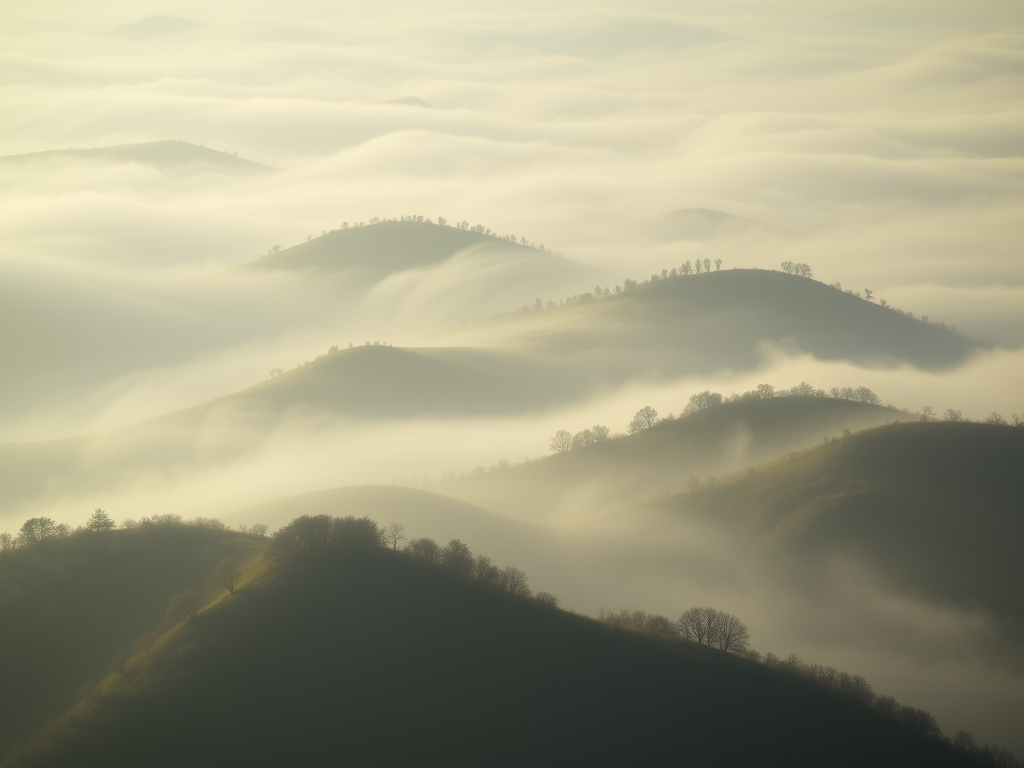
A serene landscape featuring rolling hills partially obscured by a thick layer of fog, bathed in soft, diffused light, creating an ethereal atmosphere.

When We Slow Down Enough to See 🤓

It occurred to me that more often than not, we rush through the routine of life overlooking these mini-marvels—the ballet of fall leaves chasséing from tree to stream, then pirouetting along water currents; sinuous streamers of fog tendrils meandering around hilltops; or, the multiplicity of ice crystals frosting over a car’s windshield to name a few. These wonders are woven into daily life: from the cantaloupe-colored brilliance of sunrise over the Ohio River to the glimmer of moonlight on a frost-covered lawn; from flower-like fungi blooming on fallen logs to a puppy seeing its own reflection in a puddle. Beauty surrounds us, waiting to be noticed. Like the invisible art gallery of spider webs in traffic lights on my morning jog, most go unnoticed until the light hits just right. However, when we take time to pause and pay attention, beauty will often reveal itself in unexpected yet common places, including stoplights.
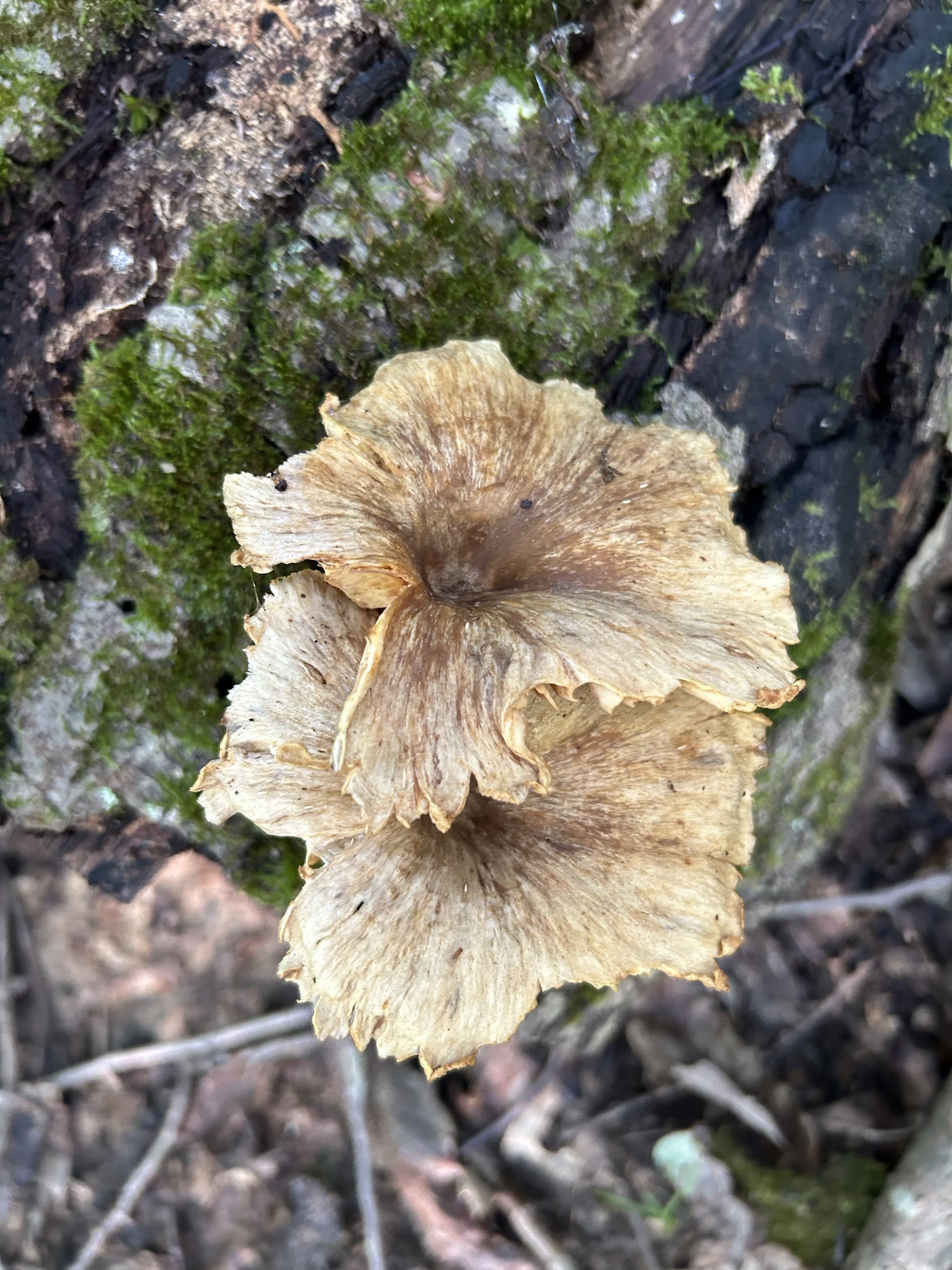
A close-up image of a brownish mushroom growing on a tree trunk, highlighting its textured surface and natural surroundings.
Flower-like fungi “blossoming” from fallen tree branch

The Power of Morning Stillness 😌

That early-morning observation turned meditation centered my day. It offered more than one lesson and served as a reminder that the morning placidity can bring a sense of calming clarity before the noise of the day. Making time for stillness in the morning, whether sipping coffee, walking a beloved pet, or sitting in prayer meditation—offers an opportunity for spaciousness at the day’s start. A moment to center, notice, reflect, and connect. Even a few minutes of stillness can offer us an opportunity to ground ourselves and recalibrate our perspective. If we grow quiet enough, we may remember that peace resides within us. That is not to say that peace is the absence of movement, purpose, or challenge, but rather it is a strong presence within us—much like the hidden strength within the delicate spider web. 

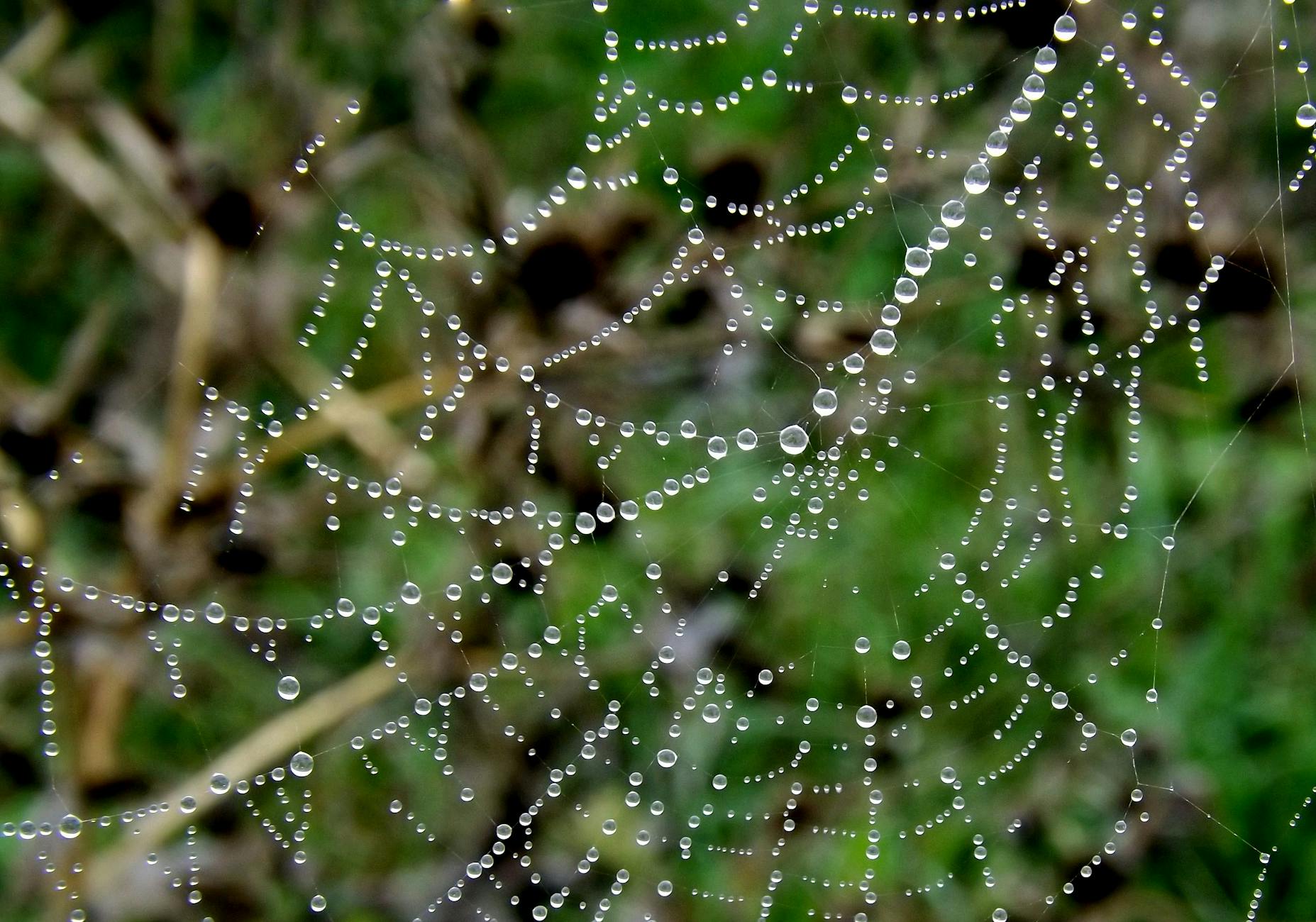
A close-up of a spider web adorned with dewdrops, creating a sparkling effect against a blurred green background.
Photo by Pixabay on Pexels.com

Lessons from the Web: Resilience and Renewal 🕸️

As I reflected on the morning jog through town, I realized that each web represented perseverance, fortitude, and tenacity–three key qualities essential for growth. Each morning, orb-weaving spiders consume their protein-rich webs to reclaim the silk for rebuilding. This ensures the new web they build in the evening is fresh, sticky, and strong enough to catch plenty of prey. Through practice, the spiders gain strength and instinctively how to rebuild after storms and strong wind.

The spiders’ resilience serves as a reminder that we, too, have the grit to rebuild after disappointments, setbacks, and loss. Like the spider, rebuilding our lives is often quiet work that begins only after we have nourished body, mind, and spirit. The spider’s persistence mirrors our own–delicate and determined–reconstructing through incremental, small steps. Life, like the spider’s web, is fragile, yet we too possess tensile strength—centered in faith—that guides us as we restore, renew, and rebuild. 

A close-up view of a spider web adorned with numerous droplets of dew, reflecting light and creating a sparkling effect against a dark background.

The Threads That Bind Us 🕷️

The spider’s web, where no thread stands alone, echoes the interconnectedness of our own lives. We are part of a collective. As the light shone through the webs, each dew drop caught the light, refracting color and seemingly creating miniature worlds. Just as the traffic/street lights played across the spider webs’ dew drops, our connected lives reflect multiple roles–friend, spouse/partner, worker, neighbor, parent, child, citizen . . . . Each strand of life possesses a quiet strength that is integral to the whole. In fact, the integrity of the web depends upon the strength and resiliency of every strand. Each facet of our lives holds and reveals meaning; together, the varied strands of our lives unite the whole, creating an array of meaningful relationships.

A close-up view of a beautifully intricate spider web adorned with dew droplets, creating a delicate display of nature's artistry in black and white.
Photo by don chowdhury on Pexels.com

Finding the Extraordinary in the Ordinary 🌃

In the end, the light changed, and I crossed the street as the sun rose, erasing the glimmer of those webs. Yet the image remains—reminding me to keep looking for the extraordinary in ordinary places. Perhaps it waits in the quietude before dawn, a pause at a red light, or the hush of nightfall. So many interlaced moments shimmer within the droplets of daily life, waiting for those willing to see. Those silky webs may vanish with daylight, but their pearls of wisdom still glimmer within me, reminding me that beauty often hides in ordinary light.  

May we all learn to look a little longer, to pause at life’s red lights, and to notice the silken threads of beauty connecting us in the quiet hours of dawn.

Running with Purpose: The Charleston Distance Classic and My Marathon Journey

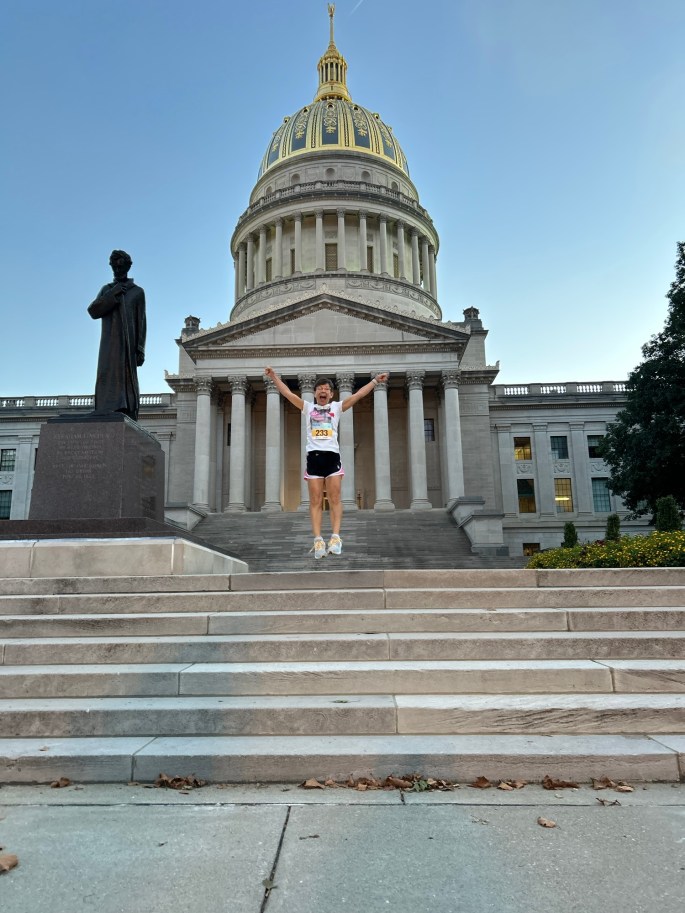
The West Virginia State Capitol building with a golden dome, surrounded by trees and a pastel sky at dawn.
The CDC starts in front of the state capitol of WV.

A Quote to Carry Me to the Start

Dean Karnazes is often credited with saying, “Run when you can, walk if you have to, crawl if you must; just never give up.” His words echoed in my mind while I was experiencing a case of collywobbles as my family and I drove to Charleston, WV, in the predawn hours of Labor Day weekend. Only weeks earlier, I had decided I had built enough base fitness to run the Charleston Distance Classic (CDC), “America’s 15-miler.”

A joyful runner in a race, wearing a white shirt with a 13.1 badge and black shorts, excitedly posing with a water bottle while making a peace sign.
Ready to run the CDC!

Returning to the Classic After Ten Years

It had been more than ten years since I last ran it. In my previous two runs of the CDC, the weather was formidable, with the typical August heat wave bringing high heat and humidity. In fact, it wasn’t unusual to see runners collapse on the course—or cross the finish line only to collapse into the arms of medics from heat exhaustion.

Two women pose together smiling in front of a large government building with a golden dome, one wearing a race bib and athletic attire while the other is in casual sportswear.
My daughter was texting me messages of support throughout the race, so Siri could read them to me in my ear as I ran.

How Running Has Changed for Me

Life was different ten years ago. Besides being younger, I was fairly new to running and relied heavily on veteran runners for guidance. On one hand, I was fortunate to have others with whom to train; on the other hand, I didn’t yet have the aerobic base they had built over years. Plus, when I started running, I gave up strength and flexibility exercises, which I now know would have helped me. Instead, I focused on keeping up with others and hitting the weekly mileage goals.

Runner stands on a swing-shaped structure in front of the West Virginia State Capitol, smiling and wearing a race bib, under a clear sky.
Ready to swing into action.

Building Balance and Training for a MarathoN

Over the past decade, I’ve taken breaks from running—first from burnout, when I missed other forms of exercise. I rotated through strength training, yoga, walking, and cycling, always circling back to running. The pandemic brought running back to the forefront, as gyms and studios were closed.

Since then—and one major surgery later—I’ve learned to build a more balanced approach to exercise that includes a wide array of modalities, running among them. I exercise now for the joy of movement, as well as overall wellness. Still, I enjoy the discipline of a challenge. This year, in honor of another decade milestone, I’m training for the Marshall University Marathon (MUM)—the full 26.2 miles. Rather than follow a standard 16-week plan, I began in January, gradually building my aerobic base.

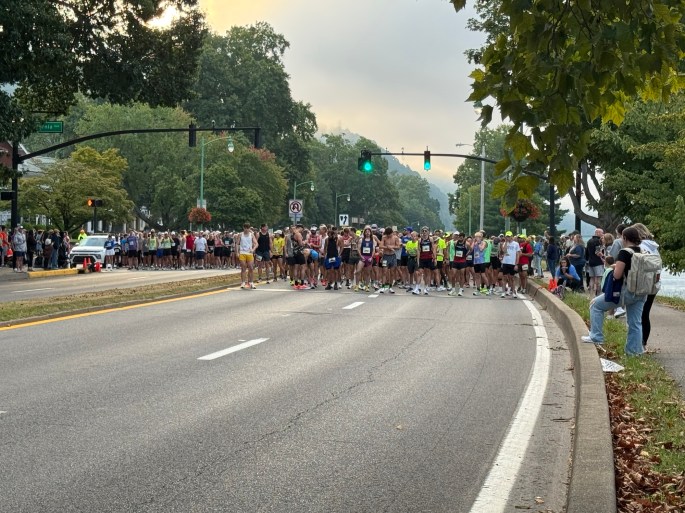
Runners lined up at the starting line of a race on a road, with traffic lights and spectators in the background.
The starting line for the CDC.

A Perfect Day to Race

It was this extended training that gave me confidence to run the CDC again. In addition, the weather worked in my favor. Temperatures were in the 50s when the race began in front of the state capitol. Running along the Kanawha River in the first mile, runners quickly spread out as paces varied.

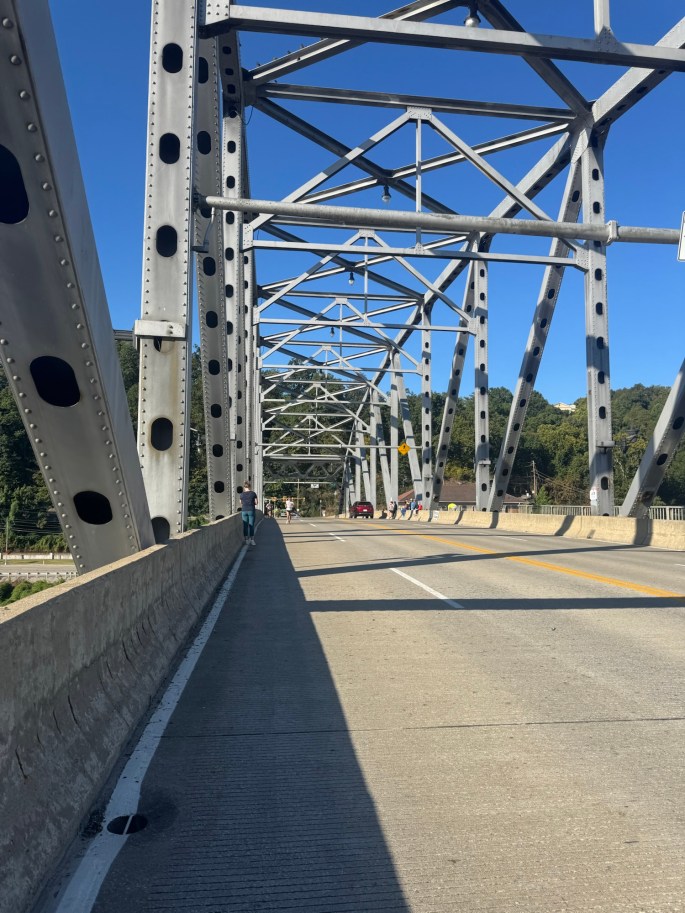
View of a bridge with steel beams and a roadway, featuring a few pedestrians in the distance.
The South Side bridge, which runners crossed twice–near mile 3 and again at mile 8.

“Capital Hill PUnishment” and the Course Challenge

Before long, we crossed the South Side Bridge and began the long trudge up Corridor G, aptly nicknamed “Capital Hill Punishment”—two miles of climbing. As if that weren’t enough, the course then wound through three hilly miles of Charleston’s South Hills neighborhoods. By the time we returned to the South Side Bridge, eight brutal miles were behind us. The final seven were mostly flat, except for one last incline near the end—just when our legs were good and toasted.

My Cheer Squad: John and Maddie

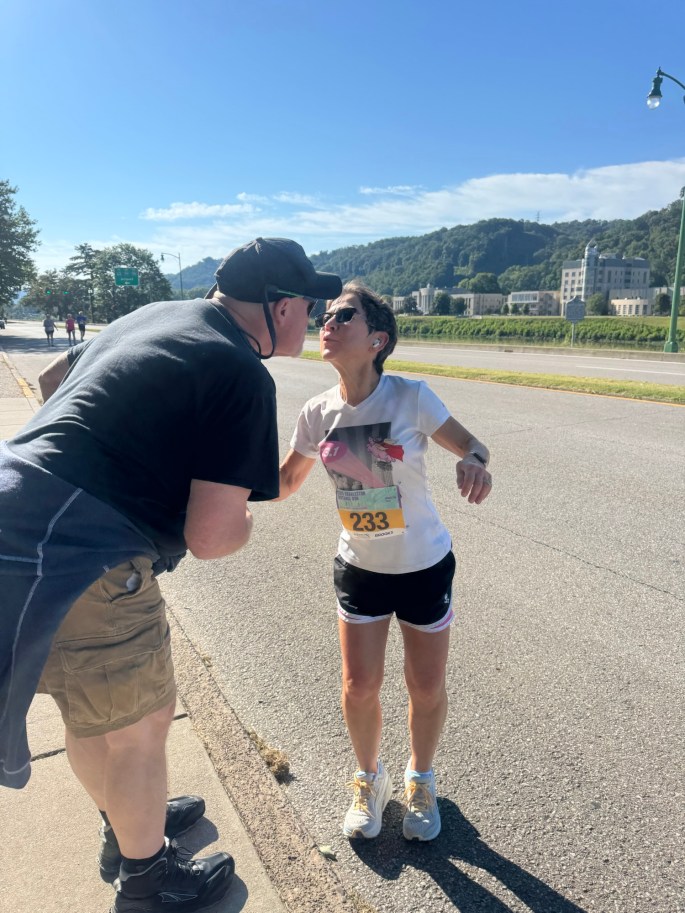
The CDC is a great spectator race, and I was lucky to have my husband, John, and daughter, Maddie, there. They were tireless cheerleaders, walking all over Charleston to encourage me. At the start, Maddie urged me on with excitement. At mile eight, as I crossed the South Side Bridge for the second time, she even ran alongside me for a short stretch, offering encouragement.

Between miles 11 and 12, they found me again, cheering and taking my empty handheld water bottle—by then more of an annoyance than a help. At Laidley Field, Maddie’s voice carried as soon as I stepped onto the track, her shouts of encouragement giving me the final push.

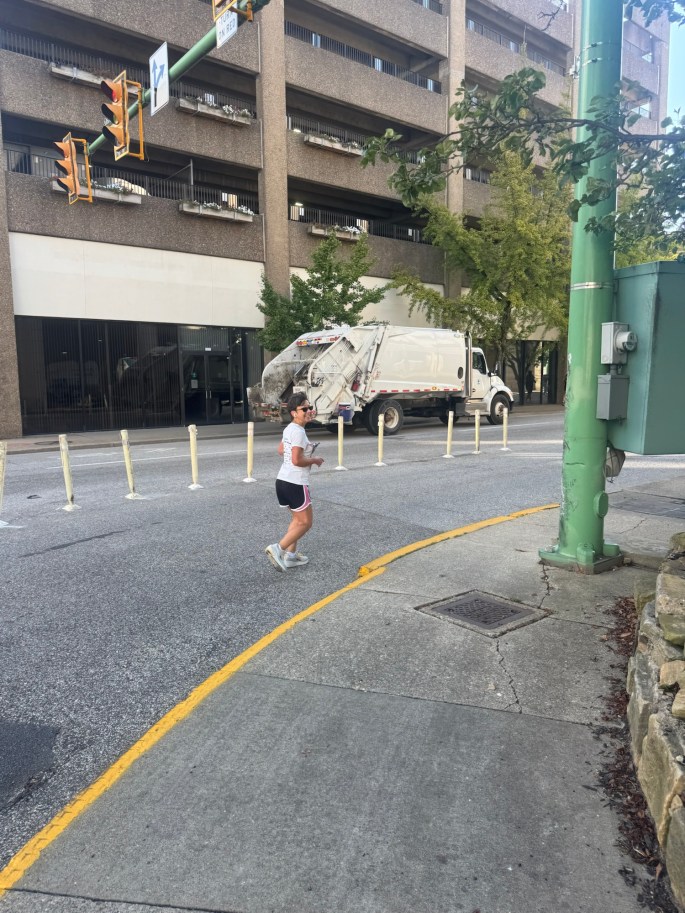
A person jogging on a city street with a garbage truck parked nearby and a multi-story building in the background.
This was mile 8. Afterwards, there was mostly flat course, EXCEPT for a last incline during the very last mile before the finish line. UGH!

Lessons from the Endless Last Mile

Honestly, that last mile seemed endless, and I learned a powerful lesson: even the final mile is still a mile long. My mental discipline slipped, and the fortitude that carried me there begged for rest. I grew whiny and irritable, which only amplified the aches and pains I had managed to ignore until then. It reminded me of my reaction in the last mile of a half marathon I ran this past spring in Asheville, NC.

Scenic view of a riverbank with lush greenery, walking path, and a bridge in the distance under a clear blue sky.
The beautiful Kanawha River that flows through Charleston, WV.

Strengthening My Fortitude

That last mile taught me what I must carry into the last weeks of marathon training: when the long runs get longest, I need to focus on strengthening my fortitude—especially at the very end. This, for me, is the hardest part. I try to follow the advice of Olympian Jeff Galloway (who is also credited with establishing the “Run-Walk-Run” method) to smile at each mile marker—since smiling releases those feel-good chemicals and helps relax the body. He also suggests repeating a mantra or power word. Perhaps I need to lean into this more.

Remembering My “Why”

I also need to remind myself of my “why” when the going gets tough. With the MUM, I hope to raise awareness for Branches Domestic Violence Shelter. Branches provides emergency shelter, legal assistance, counseling, case management, and even meal delivery for domestic violence survivors. Their work saves lives. If my miles can help encourage even a few people to support them, that will mean as much to me as crossing the finish line.

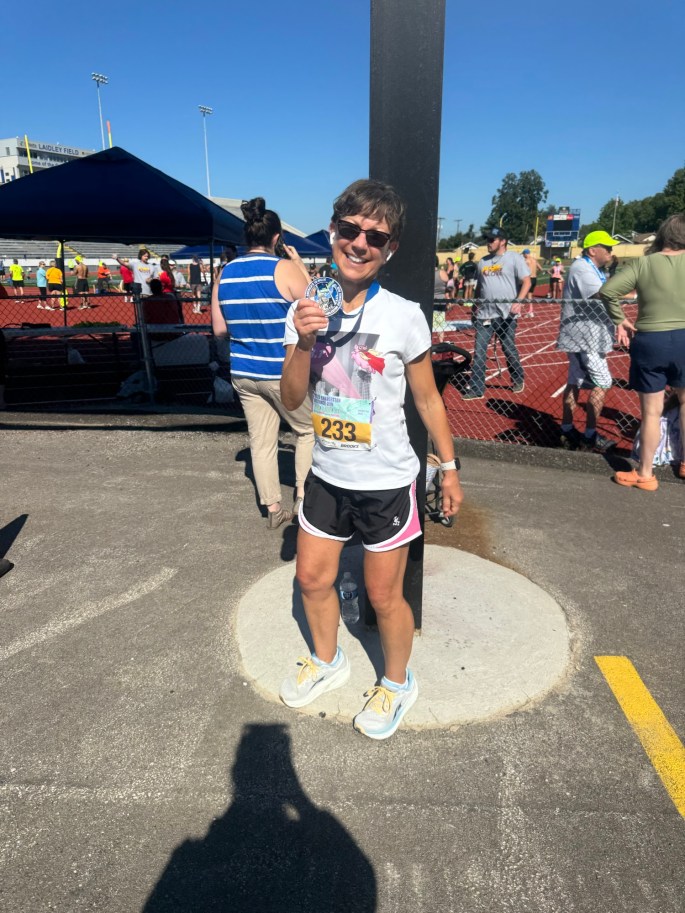
A smiling woman holding a medal, wearing athletic clothing, stands next to a post in a race finish area, with a crowd and tents in the background.
Feeling so grateful for my family, love, and support at the end of the CDC.

Running Differently, Running with Gratitude

Ten years later, I run differently. I take walk breaks when needed, and I’m grateful to still have my health. Running gives me energy, provides structure, and fills me with joy and purpose. Not every run is great, but each mile contributes to my community by keeping me connected to local races and to my own mental, physical, and spiritual well-being. Running also pulls me outdoors, connecting me with the Creator and with the delight of each season.

Never Give Up—In Running or in Life

Running the CDC reinforced the lesson of never giving up. I may be entering a new decade, but that doesn’t mean I have to give up striving for new goals—even if it means crawling to achieve them. Perhaps I’ll see you at the MUM. If not, I hope you’ll create your own journey. Either way, I invite you to celebrate with me—by supporting Branches or by committing to your own goal. Adjust as you must, but never give up. Step by step, with fortitude, tenacity, and a few deep breaths, you can do it.

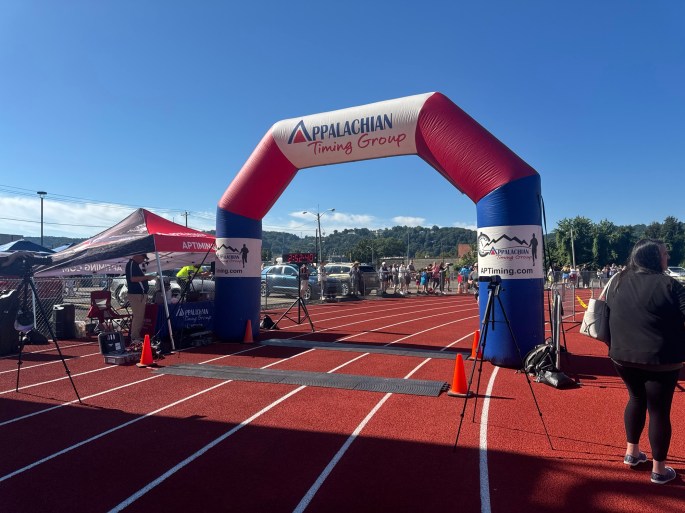
A running event starting line with an inflatable arch labeled 'Appalachian Timing Group' on a red track, set against a clear blue sky and distant hills.
Never give up! You can cross whatever finish line in life you need to cross!

Navigating Life’s Construction Zones: A Path to Self-Improvement

Construction is a matter of optimism; it’s a matter of facing the future with optimism.”–Cesar Pelli

A construction site on a road featuring orange traffic barrels, traffic lights indicating a red signal, and a view of green hills in the background.
Photo by Robert So on Pexels.com

Summer Roads and Slowdowns: A Familiar Frustration 🚧

It’s the height of the summer travel season. This year, AAA projected that 61.6 million Americans will travel by car between June 28 and July 6. That’s a lot of drivers on the roads! And more likely than not, most of those drivers will encounter some sort of delays or rerouting due to construction. 

Those orange barrels, detour signs, and dusty, smoke-filled roads can wreak havoc on estimated times of arrival, impeding drivers’ progress. Traversing a construction-filled route recently, it occurred to me that just as roads need maintenance, upkeep, and improvement, our lives can also benefit from similar attention. In fact, summer road construction serves as an excellent reminder for how we, too, must assess, repair, and improve our own lives.

Like it or not, road repairs are a necessary part of travel. Winter and spring often ravage roads due to ice, snow, freeze, thaw, excessive rain and so forth.  Potholes, cracked pavement, faded lines, and broken shoulders or guardrails can reduce safety and severely damage tires, rims, alignment, suspension, and so forth. Thus, in order to function properly, roads require regular repair and upkeep. 

A woman in a pink blazer sitting at a table, looking stressed or overwhelmed while using a laptop.
Photo by Edward Jenner on Pexels.com

The Wear and Tear We Can’t Always See 😓

The same is true for our own lives; we, too, experience wear and tear, but it is expressed differently in each of us. Signs may include physical and/or mental fatigue, burn out, and/or incremental increase of poor habits.  Other signs might include unresolved conflict, a sense of drifting or lack of purpose; and/or for others, it could be increased feelings of anxiety, sadness, or indifference. Like potholes on a road, it is important to not ignore these symptoms and instead cultivate a sense of caring curiosity as if we were concerned for a child–only it is concern for ourself–and it begins with an honest self-assessment of our emotional, mental, physical, and even relational well-being.

A woman with red hair looks stressed while working on a laptop, resting her forehead on her hand, in a bright interior setting.
Photo by Alexander Dummer on Pexels.com

Reading the Signs: Time for a Personal Detour ↪️

As with construction, upon reflection we might discover that many of our difficulties and discomforts created ruts, broken shoulders and cracks in our own personal life. These impediments signal that we may need to reroute our own life in order to make internal repairs. In the same way construction zones temporarily create detours, rerouted traffic, and lane shifts, personal redirection can likewise be thought of as a temporary, but necessary setback for long-term improvement. 

A person sitting on a couch, resting their chin on their hand, looking thoughtfully at a laptop with papers and a pen on the table.
Photo by Keira Burton on Pexels.com

Detours with Purpose: Reframing Setbacks as Redirection ↩️

These life detours, be they physical-health and/or mental well-being crisis, a death, divorce, and so on, typically create obstacles–a change in what we think is “the plan.”  However, just as construction zones are there to repair the road, our healing, growth, and ability to move towards wholeness often begins as we experience these hurdles. Therefore, it is helpful to reframe our thinking around these life detours and obstacles as opportunities for not only healing, but also reflection, intervention, or a necessary challenge to a long-held personal perspective.

A woman sitting in a chair, looking contemplative and holding a pen near a notebook, with her hand resting on her forehead in a thoughtful manner.
Photo by cottonbro studio on Pexels.com

Grit, Heat, and Hard Work: The Labor of Self-Growth 🥵

Another important point to consider with regards to road construction is that the work crew must endure a wide array of weather conditions, including extreme heat and humidity that accompanies summer. A return to safe and smooth roads cannot occur without their effort, perseverance, sweat, and labor. Likewise, personal growth and/or physical healing often requires a similar level of grit. 

Whether we participate in therapy, work to improve or create beneficial habits, set clear–and perhaps new–boundaries, work to forgive, and/or learn a new skill or life lesson (or both), personal construction demands that we put in the work. Discomfort, like construction, is a necessity.  Growth and healing are not easy and rarely occur without challenge and effort.

Two women engaged in a conversation at a table in a modern office setting, with one woman wearing glasses and a blue dress, and the other facing away.
Photo by Christina Morillo on Pexels.com

Preventive Maintenance: Investing in Long-Term Well-Being 😃

Another important consideration to effective road repair is that maintenance should be ongoing, rather than deferred, as this can lead to greater road damage and travel hazard. By taking care of ongoing small issues as they arise, bigger problems can be prevented in the future. 

Similarly, our own “self-maintenance” is also a worthwhile investment in order to reduce the likelihood of a major life-repair. Taking time to invest in our own daily health through quality sleep, good nutrition, stress management, physical exercise, fostering healthy relationships, and even learning new things–can be thought of as small personal investments that pay dividends towards our own long term “infrastructure.”  

A woman and a man sitting on a couch engaged in a conversation, with a woman taking notes in the foreground. The room features plants and wall art.
Photo by Antoni Shkraba Studio on Pexels.com

Building a Support Crew: Don’t Travel Alone 😁

That said, sometimes personal maintenance can sometimes feel like “one more thing to do” especially when we’re in the midst of a life-storm. Therefore, it can be helpful to cultivate a “crew,” a few good people who can share our times of smooth sailing, encourage our development and/or maintenance of positive habits, and also support us during those bumpy passage days. Ultimately, with regular self-care maintenance and a good support crew, we can cultivate a strong inner foundation that is better able to withstand life’s pressures and storms.

Black and white image of a close embrace between a woman and a child, capturing a moment of warmth and connection.
Photo by Nataliya Vaitkevich on Pexels.com

Freshly Paved Paths: Signs of Inner Progress 🥹

One of the best parts of road construction occurs when it is finally completed. Routes are once more open, and the ease and smoothness of traveling these roads signals tangible progress. In fact, driving effortlessly over a direct route without detours, potholes, or bumps can be a liberating feeling. 

A smiling man with curly hair, laughing joyfully against a wooden background.
Photo by Pixabay on Pexels.com

Progress, Not Perfection: Life Is Always Under Construction 🦺

Unfortunately, it never lasts for long. Rainy season, freeze-thaw season, excessive travel, or 1,000 other scenarios means construction will once again occur, if not specifically on the newly refurbished route. It’s all part of the process of progress–one never attains perfection when it comes to infrastructure–there’s always room for improvement.

Equally, on the other side of our own personal repairs, detours, and/or maintenance, we gradually return to a sense of homeostasis.  Our rerouted life may possess a greater sense of clarity, restored confidence, better decision making skills, and perhaps even a deeper sense of joy. We, too, may feel the momentum to move forward in a renewed direction and embrace the possibilities that come with an unexpected, but freshly paved path.

Smiling woman wearing a cozy sweater, expressing joy and warmth.
Photo by Dellon Thomas on Pexels.com

Final Thoughts: Be the Engineer of Your Own Journey 👷

To be sure, summer construction can seem like a real drag on travel; however, it ultimately leads to new routes, expanded systems of travel that are safer and more efficient. However, even when the summer construction season comes to an end, the maintenance of these roads does not end, and that is worth remembering.

Likewise, summer construction reminds us that we are the engineers of our own lives. No, we cannot control everything that happens to us, but we can control our reactions AND we can also make repairs as needed as well as prevent some issues from arising. Therefore, let’s be as proactive as possible through regular sustainment of our own life-construction, so that when life’s storms create a pothole–or five–we are fortified with the strength our regular maintenance and upkeep provides us. In life, as in roads, it’s about progress, not perfection. 

I’ll see you out there on the road of life!

.

The Spirograph Effect: Creativity in Life Design

“Not all who wander are lost”–J.R.R. Tolkien

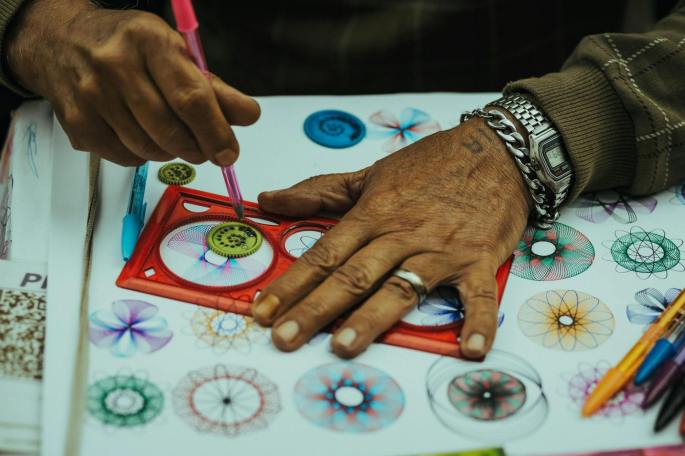
Close-up of hands using drawing tools to create a spiral geometric design on paper.

A Student’s Doodle Sparks a Memory✍️

Months ago, I observed a student drawing spiraling circles over and over on a sheet of notebook paper while participating in our class discussion. For some reason, I was reminded of an old toy my siblings and I once enjoyed: the Spirograph. I can’t remember which one of us received it, but we would sit together for what seemed like hours at the kitchen table drawing colorful, eye-popping (at least to us) geometric shapes.

Four children gathered around a table, smiling and drawing colorful patterns on a large sheet of paper using various markers.

Lessons Hidden in a Childhood Toy ꩜

Reflecting upon that long-ago childhood toy, led to the realization that the Spirograph illustrates the significance of specific concepts when it comes to creating our own life design, such as the influence of structure, patience, persistence, and the importance of celebrating our own unique individuality. It also emphasizes the value of working through natural constraints and trusting the process of learning through repetition. What’s more, the Spirograph demonstrates the relevance of trial and error–which often includes failure–as well as accepting the beauty that can be found in our so-called “imperfections”.

The Spirograph’s Ingenious Origins 👨‍🔬

To appreciate the genius of the spirograph as a toy, requires understanding a bit of its history. Denys Fisher, a British engineer, created it as a child’s play thing based upon various iterations, beginning as early as 1827. At the time of its original conception, it was used for advancing mathematical and engineering concepts. Spirograph, the toy, wasn’t available until 1965, and it went on to win “Toy of the Year” in 1967. Unbelievably, it is still available today.

This classic geometric drawing toy originally came with two transparent rings, two transparent bars, 18 clear wheels of varying sizes, two colored ink pens, pushpins, putty, and paper. Using the various tools, my siblings and I could draw precise, and quite mesmerizing, mathematical curves known as hypotrochoids, epitrochoids, and cycloids. With the switch of any one part, we could vary the size, shape, and geometry of intricate and, at the time, mind-boggling patterns. Essentially, the Spirograph is operated on a balance of limitation and creative freedom, which reflects much of the human experience.

A box of the original Spirograph design set, featuring colorful geometric designs and detailing the contents, including pieces and tools for creating intricate patterns.

Art Through Limits: Creative Freedom Within Structure 🎨

When one is drawing with the Spirograph, one has to adapt to its restrictions. The designs made by using the Spirograph are limited by the size and shape of the wheels and whether you are using the rack or the ring, as well as the color of the chosen pen(s) used to design a figure. Additionally, there are rules for creating specific outcomes as described in its guide book.  While it isn’t necessary to follow the laid-out directions, if one desires it to create a specific shape or design, one has to follow the step-by-step instructions.

This is similar to life in many ways. Influences in life vary from person to person and from family to family, often dependent upon experiences, education, and available information. Many individuals have followed very specific guidelines provided by parents, religion, schools, and even societal norms while others may have fewer influences. For many of us, following a structured timeline is how we landed in our current field/career path.  However, there are just as many, who followed a winding path of their own creation, and still produce a meaningful life experience. Like the Spirograph, following guidelines creates remarkable results for some people, while for others, grabbing the gears and turning them their own darn way works just as well.

Black and white abstract spiral pattern created with lines and arrows, resembling a geometric design.

The Power of Patience and Trusting the Process 🙏

When working with the Spirograph, my siblings and I had to have faith in the process. We had to further learn that creating something meaningful takes time. The desired design outcome emerged slowly, turn by turn, and layer upon layer. In sum, the Spirograph required us to have patience, trust the process, and stay the course. 

Similarly, our life journey takes time as we, hopefully, continuously evolve and grow. We may have times we question the process, or we may waiver in our faith, patience, and persistence. However, rushing life outcomes usually ends up backfiring. Moreover, the time required for personal growth fosters resilience, a much needed companion to patience. We only have one precious life, and as our life design unfolds, with all of its curves and angles, it is never worth rushing. 

A colorful doodle featuring spiraling circles and geometric shapes, reminiscent of designs created with a Spirograph toy.

Failure, Play, and the Magic of Repetition 🖍️

With the Spirograph, I recall that we often learned through repetition and play. We might draw the same shape over and over, sometimes changing the color, or merely changing the size. Other times, we followed the guidelines, and somehow still managed to “fail”!  And, yet, many of those so-called failures ended up being unique and pretty creations–even if they did not come out as planned. Other times, we would just “mess around” to see what we could create. Some results were not so spectacular, but other times, the creations were fairly impressive or, at the very least, provided us with a new understanding for creating specific curves and/or angles. 

Life can often be the same way. How many of us have experienced times where we “followed the rules,” doing what we were “supposed to do,” and still somehow managed to fall flat on our face. Years later, however, we may look back and realize that those “failings” led to something far greater than we could have ever imagined. Other times, a bit of experimentation leads to a new life path or experience that brings unexpected joy we might not have otherwise known. Thus, like the Spirograph, a playful and experimental mindset can lead to untold delights and adventures.
A collection of hand-drawn spirals in varying sizes, arranged artistically on a blank background.

The Beauty of Uniqueness in Design—and in Life 🖼️

Learning to welcome individual uniqueness was another life lesson the Spirograph provided. It often intrigued my young mind how my siblings and I could make the same design, but with a switch of pen color or pressure, or switch of a gear wheel, we could make each drawing unique, despite the fact we were essentially using the same tools. 

Sometimes, we would be surprised when trying to make the exact same shape, because we accidentally missed one of the required steps. Skipping one step, tended to create an irregular shape. Nonetheless, our younger selves marveled at the unique loveliness of the design. Our child-size egos told us we were pioneering artists in those moments!
Marks of Authenticity: Irregular Paths, Unique Lives

What a powerful reminder of the importance of celebrating our own–and others’– idiosyncrasies, including any so-called irregular paths. These individual characteristics and traits, as well as any “irregular paths’ traveled, are all marks of authenticity–that one-of-a-kind spice in our life serving. As humans, our genetic material is vastly similar across all humanity. Yet, this same genetic material still manages to create unique DNA characteristics, such as varying eye color, height, body shapes, and so forth. Furthermore, despite our similar genetic makeup, our lived experiences vary. In a sense, we are pioneering artists of our own lives.

A colorful collection of intricate geometric patterns resembling designs created with a Spirograph. The spirals and mandalas feature vibrant colors and diverse shapes, showcasing creativity and uniqueness.

Embracing Life’s Curves and Imperfections 🌀

Like the Spirograph of my childhood, we all deal with life constraints, no matter what path we try to create for ourselves. These life designs often, and sometimes repeatedly, require practice, patience, perseverance. Life also requires us to accept the many so-called imperfections and irregularities that come as part of the creative process. However, those “flawed” experiences give our life meaning and purpose. Therefore, it is worth remembering we have the power to play and create with the pen we have. All those curved lines and angles that make up our lives, including the missteps, are what continues to compose and create our magnificent, one-of-a-kind life design. Let’s embrace the possibilities.

Who’s ready to draw? ✍️

Embracing Darkness: The Lotus Flower’s Lesson of Hope and Resilience

“Most people are afraid of suffering. But suffering is a kind of mud to help the lotus flower of happiness grow.  There can be no lotus flower without mud.”–Thích Nhất Hạnh

FAcing Difficult Days 😟

How many of us have endured through difficult and murky situations?  How many more of us have observed/supported a loved one undergoing a dark and/or dire situation?  Whether it is personal suffering or suffering of a loved one, we have all either experienced or observed painfully dark days; I know I have. 

Sometimes the difficulty can create so much suffering, it feels as if a pack of wolves have hunted us down, snipped and yipped at our heels, and are now chewing away at our insides.  Sleep may no longer feel like an escape, and even if part of the difficulty causes physical pain, it is often the pain caused by our own minds and heart that can hurt the most. 

Photo by Pixabay on Pexels.com

Quotes to Get you Through 📝

There are a couple of quotes and an image I have come to appreciate over the years. They tend to come to mind when I feel knocked down by life. I think of them as a mental antidote for counteracting my fear when facing down a difficult situation.

Keep getting up no matter how many times you fall.

One quote is a Japanese proverb: “Fall down seven times, stand up eight.” This saying is hope-centric, and it means a great deal to me.  It serves as a reminder that no matter how many times we make a mistake or life events knock us down, we must still find a way to get back up.  This doesn’t mean it’s easy.  Sometimes, all we can do is claw, crawl, and clatter until we find the resolve and strength to stand once more.

Rise like the sun

Another inspiring quote by Maya Angelou: “Still I rise.”  While the author writes of her oppressive and challenging experiences as a black woman, the phrase’s universal theme of resilience in the face of struggles can speak to all of us. Those three words are filled with a bold defiance in the face of suffering.

Photo by Celeste 2305 on Pexels.com

Lotus are Adaptable 🪷

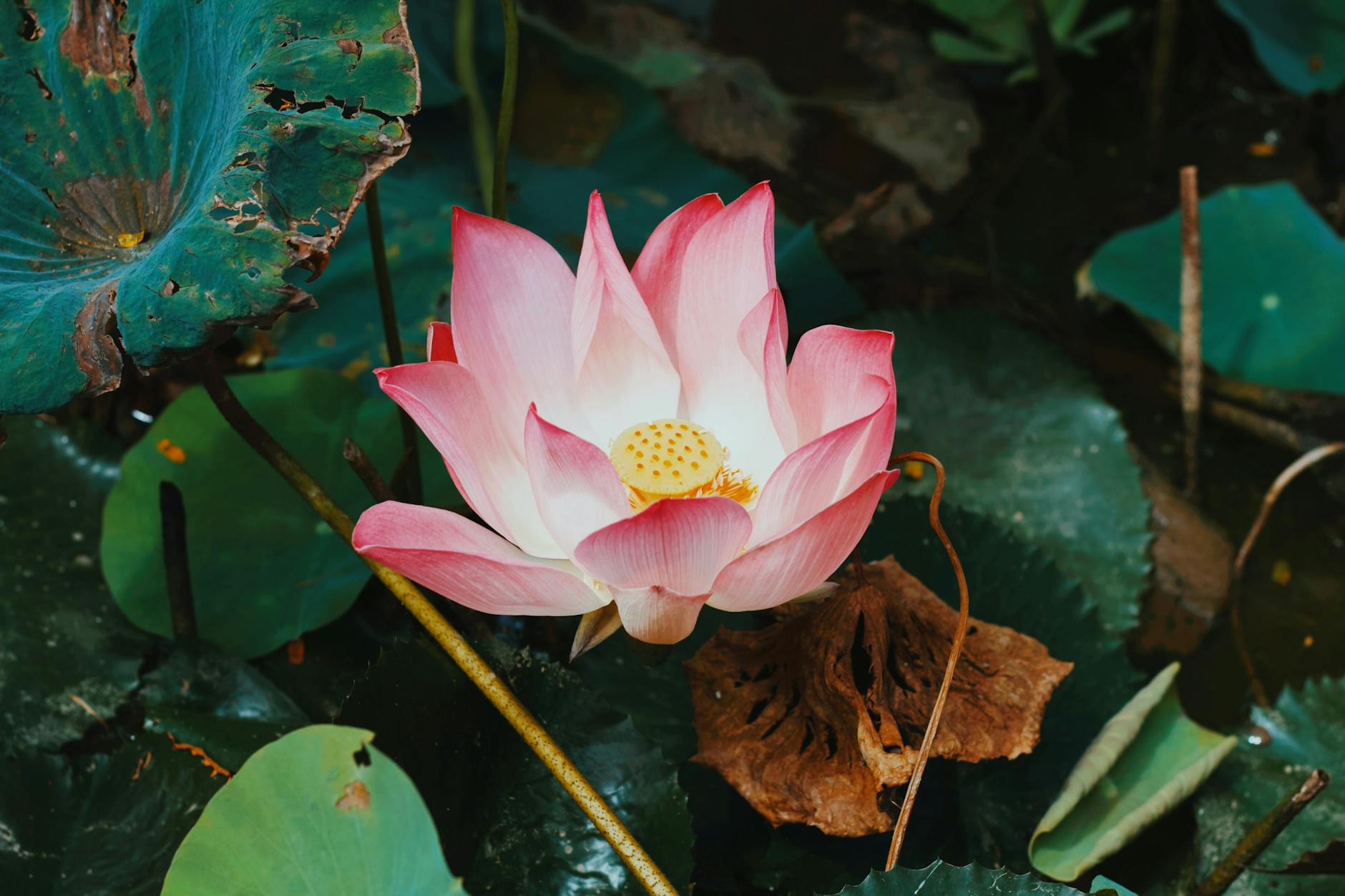
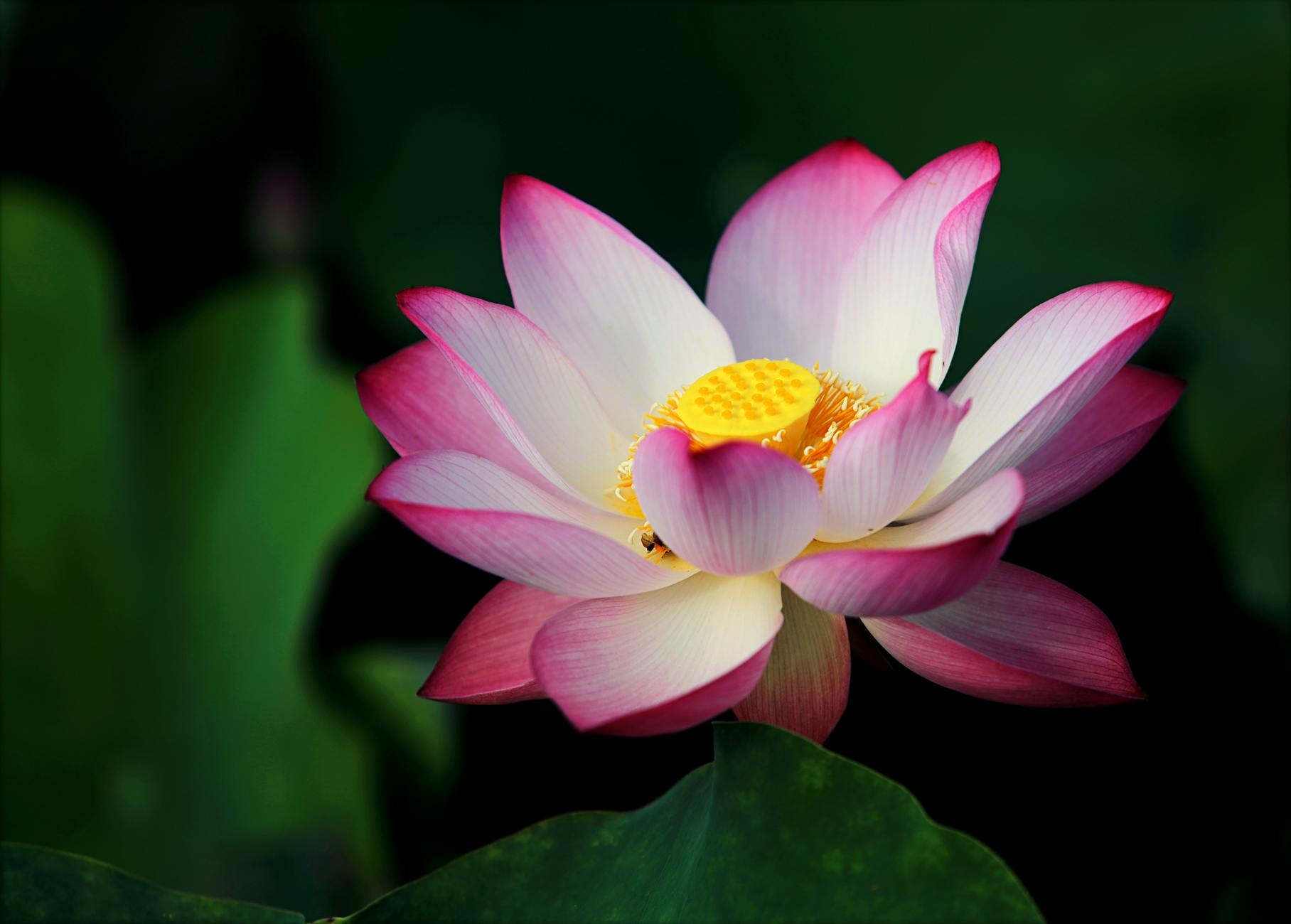
Both of those quotes culminate in the symbol of the lotus, the ultimate emblem of perseverance and tenacity. This aquatic flowering plant has been admired and a part of lore for centuries.  The more colorful lotus are tropical in nature and are most notably found in Asian countries.  However, the lotus plant is quite adaptable, and an American variation can be found along the east coast in waters ranging from Ontario, Canada to Florida. 

Lotus Persist 🌱

Because the lotus plant grows in a variety of environments, it has developed a method of ensuring its continuation. Once pollinated, the lotus releases large quantities of seeds into the environment. Many of these seeds will be eaten by aquatic life; however, the seeds, as I understand it, are quite durable.  Some lotus’ seeds can get up to 1.5 inches in size, surviving for several years, long past the life of the flower.  In fact, the seeds can persist in conditions that would prevent many other types of seeds from germinating. 

Lotus Aren’t AFraid of The Dark 🌑

Once germinated, the seeds begin sprouting in the mud, sending roots down even deeper into the muck.  Depending upon the plant and the depth of water, it can take from two weeks to two months for the plant to grow up to six feet tall through the murky water. As the round leaves reach the top of the water they can fan out in width up to 36+ inches wide. Once the plant has fully surfaced, the flower will begin to grow and ultimately bloom. 

Short life, Deeply rooted 🙏

Each American Lotus flower, with its butter yellow petals and fragrant aroma, will only last a few days, opening its petals during the day and closing the petals at night. The blossom appears to be free floating, but it remains rooted in the mud. During its short duration, the flower will bear seed pods that resemble the end of a watering can or shower head, ensuring multiple seeds from each flower will be dispersed back into its environment.

Lotuses ShaRe 🫱 🫲

Both the seeds and roots can be eaten, and parts of the plant can be used for medicinal purposes. Seeds pods can be dried and used in flower arrangement.  Additionally, due to the fact that lotus flourish easily in a variety of areas, even in the murkiest of waters, these plants provide shelter, habitat, and food for a variety of aquatic wildlife.  Each fall, however, the plants die away.

Gifts can arise from dark places

Therefore, the lotus is a prime example of the way in which gifts can rise from the darkest of places. Despite the fact the lotus is born in the mud, it rises to stand victoriously every spring.  Upon rising, its blossoms bear seeds to ensure it has a way to stand back up.

Seeds of hope, help, and healing

Beyond the fact the lotus has planned for its inevitable fall, it also offers seeds of hope and nourishment for others. Each flower produces an overabundance of seeds, many of which will settle into the mud for rebirth, but many more of those seeds will provide food for other living creatures. Additionally, those mud-buried lotus roots also provide nourishment not only to the plant itself, but can also nourish others.  Not to mention that the plant has medicinal qualities, offers shelter to others within its aquatic community, and beautifies a variety of environments.

Photo by Hiu1ebfu Hou00e0ng on Pexels.com

Lotus Life 𑁍

Let us live like the lotus flower. When we experience those dark and difficult times in our life, let us root down into the loam of our soul and allow faith to germinate a seed of hope. By rooting through the muck and into the nourishment of our faith, we can rise. It may take weeks, months, or even years, but we can rise and blossom once more.

Once on the surface, it is our job to produce good seeds of hope and help for others.  Even if our calm waters fade away and we find ourselves sinking into the inky dark once more, still we can rise.  We have done it before; we can do it again.  And with each new revival, our blooms can continue to offer more gifts to the world.  No matter how darkly rooted our past or present was/is, no matter the number of times it occurs, we can stand up, we can rise, we can bloom, and we can embody the lotus, offering shelter, nourishment, and healing hope to others. 

Blossoming Amidst Difficulties: Lessons from Bodie Lighthouse

“Stuck between a rock and a hard place . . . You’d better stop. Put on a kind face.”–Mick Jagger and Keith Richards

Overcoming Rocky circumstances 🌺

I was walking quickly back to my vehicle with a couple of coffees in hand.  Wait. What did I just see? Walking back a few feet, I looked at the spot in between the concrete wall and the sidewalk that abutted to it. Oh my heavens! It was a flower!

How it was possible for a flower to grow in such a tight crevice was mind-boggling.  The blossoming plant was the very definition of being “stuck between a rock and a hard place.”

Photo by Pixabay on Pexels.com

How many life situations feel like that–thrusting us between rocky and hard circumstances? 

Most of us can identify times in which we were (or are) in situations in which there was no good solution or easy way out.  Like a praying mantis trapped in the web of a spider, our hands may be lifted in prayer, but the various strands of a difficult situation continue to remain sticky and taut. We can see life going on all around us, and yet, we remain stuck between an “unknown outcome” and “continued pain.” 

Confronting Difficulties 🪜

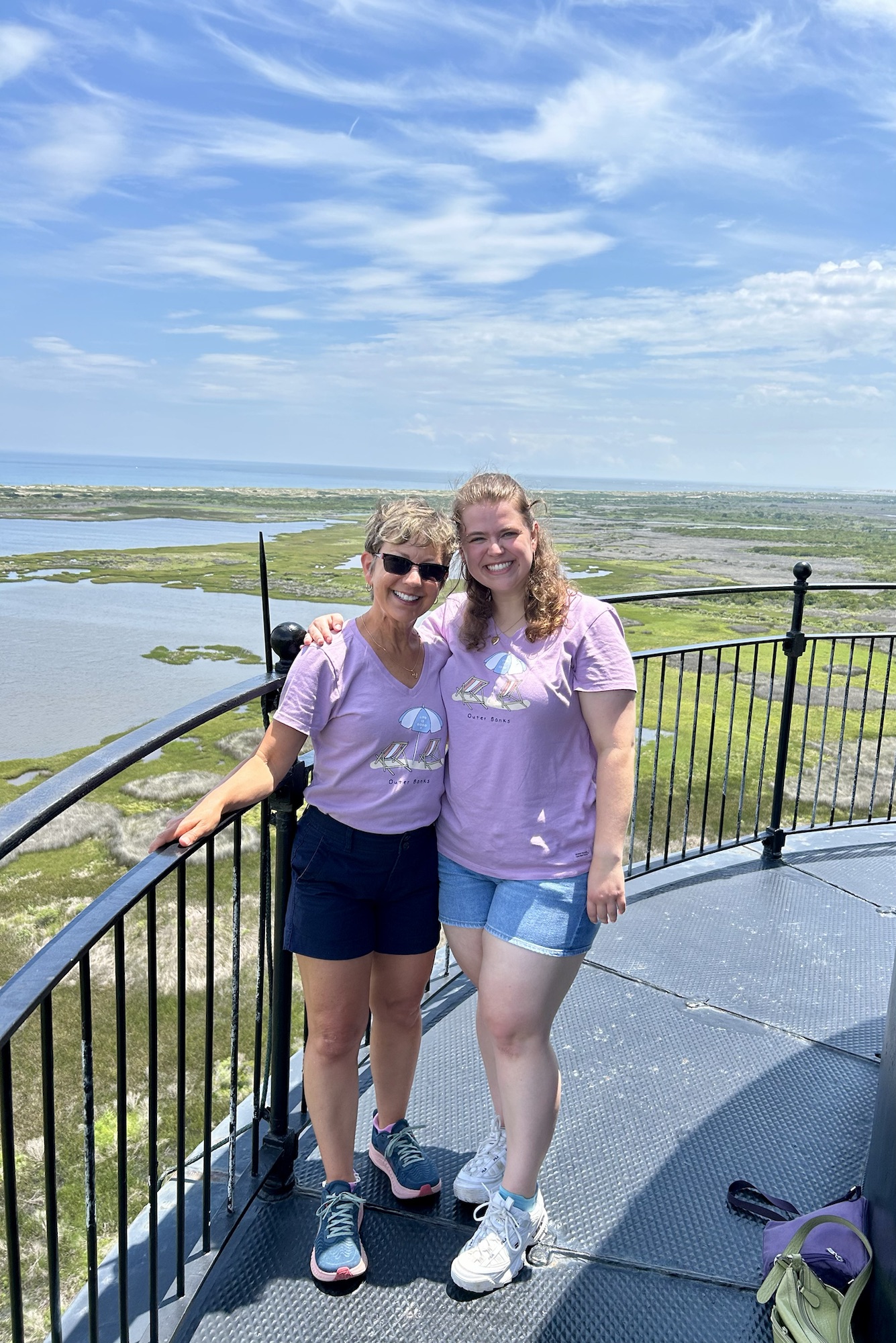
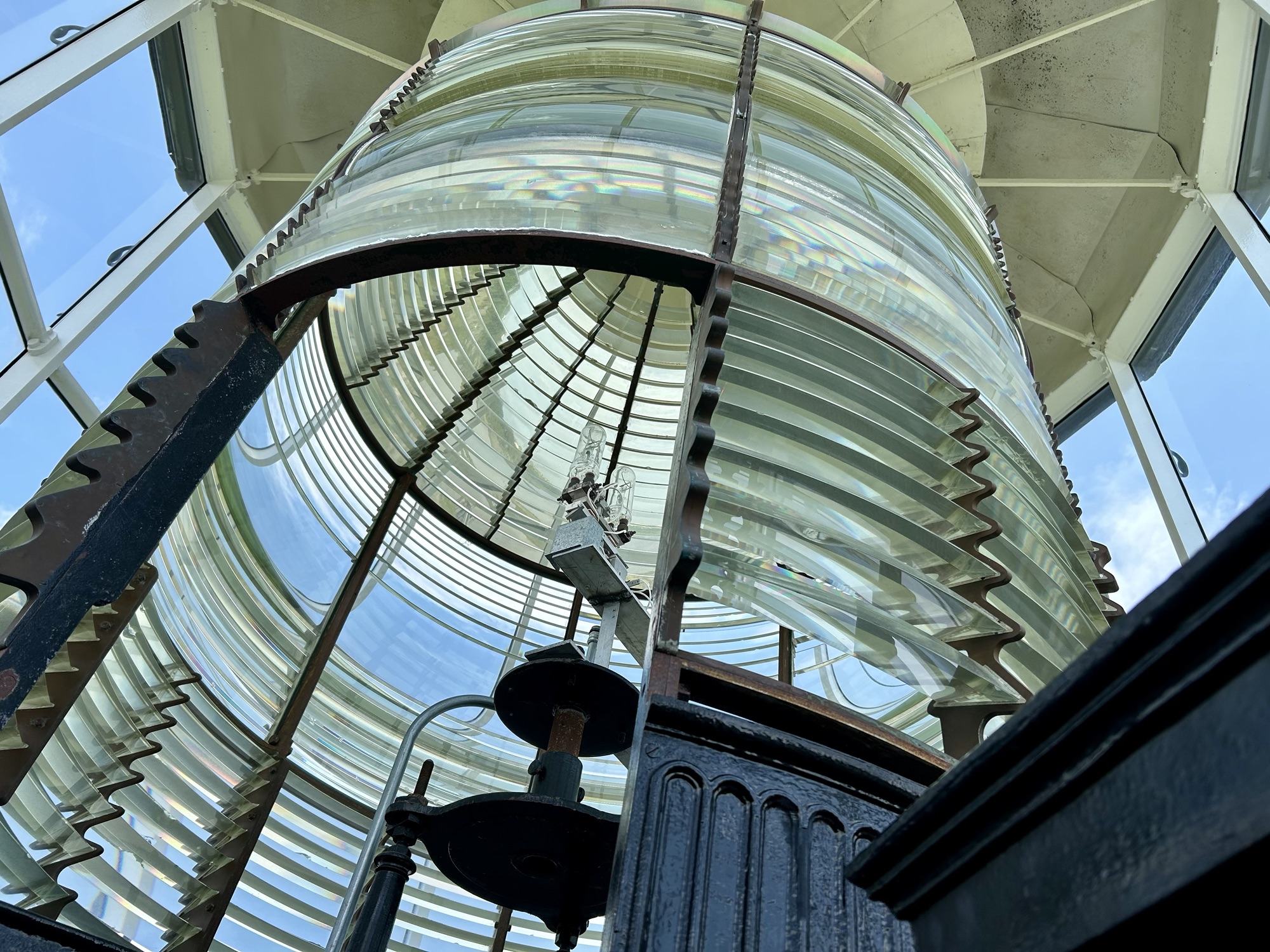
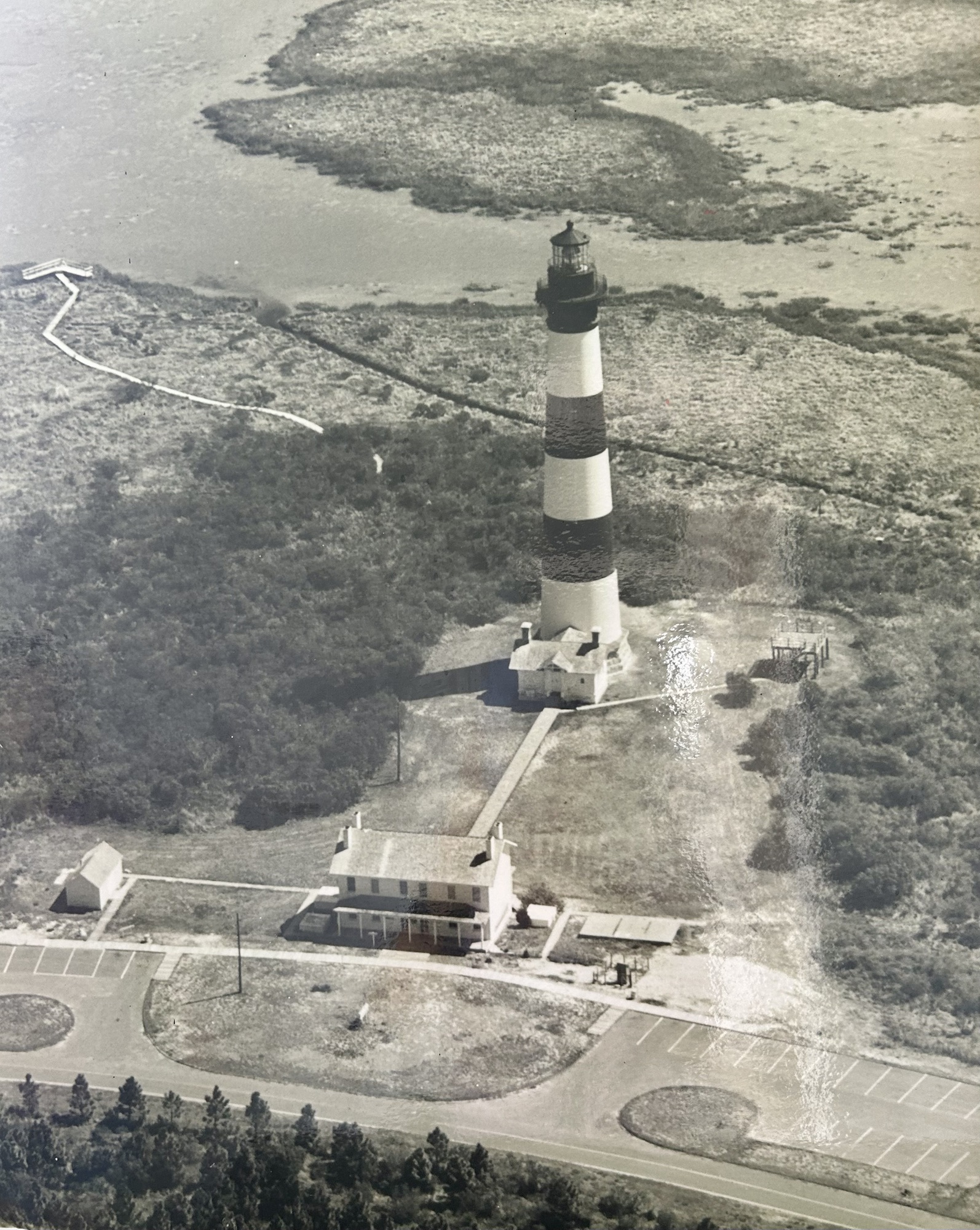
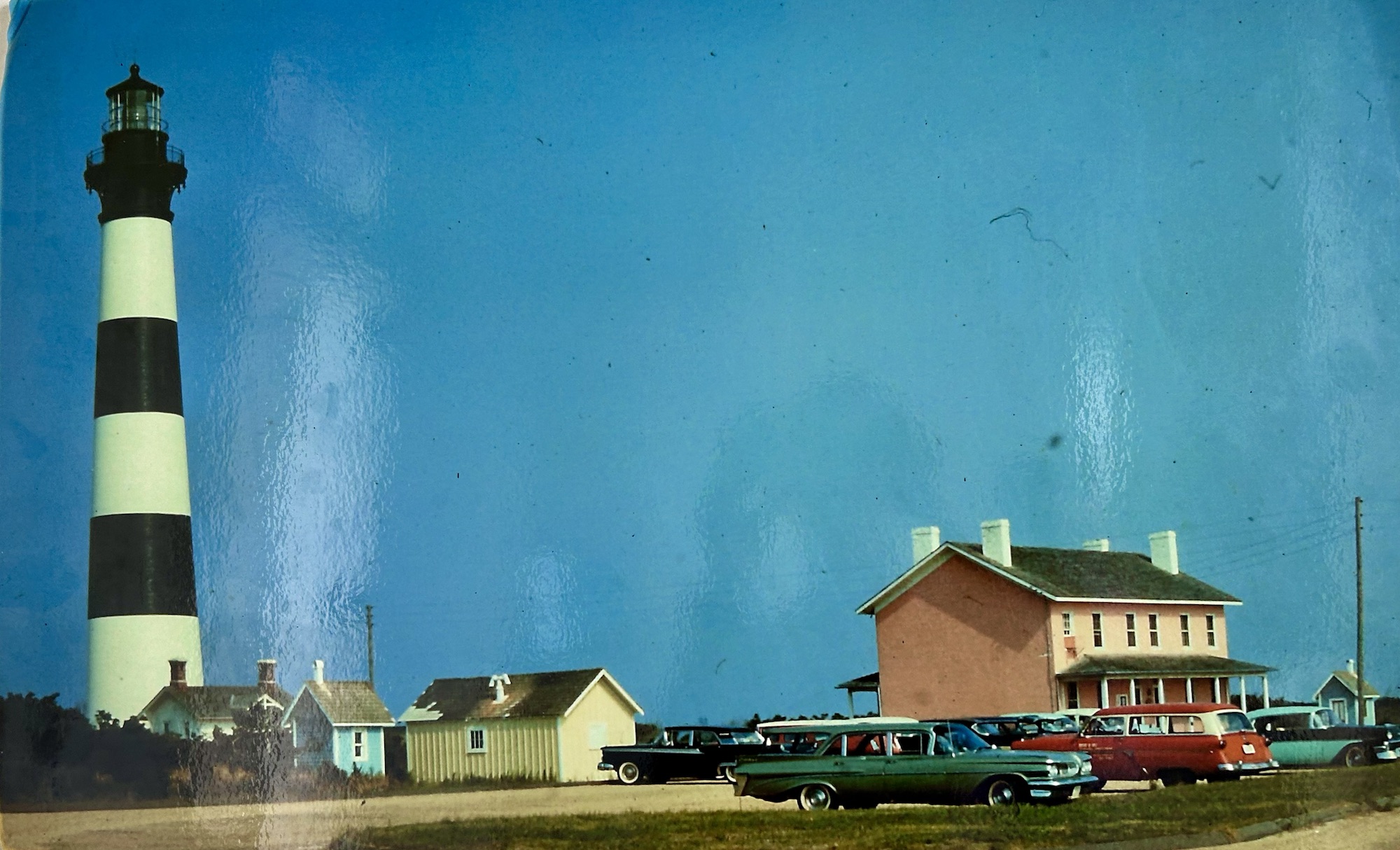
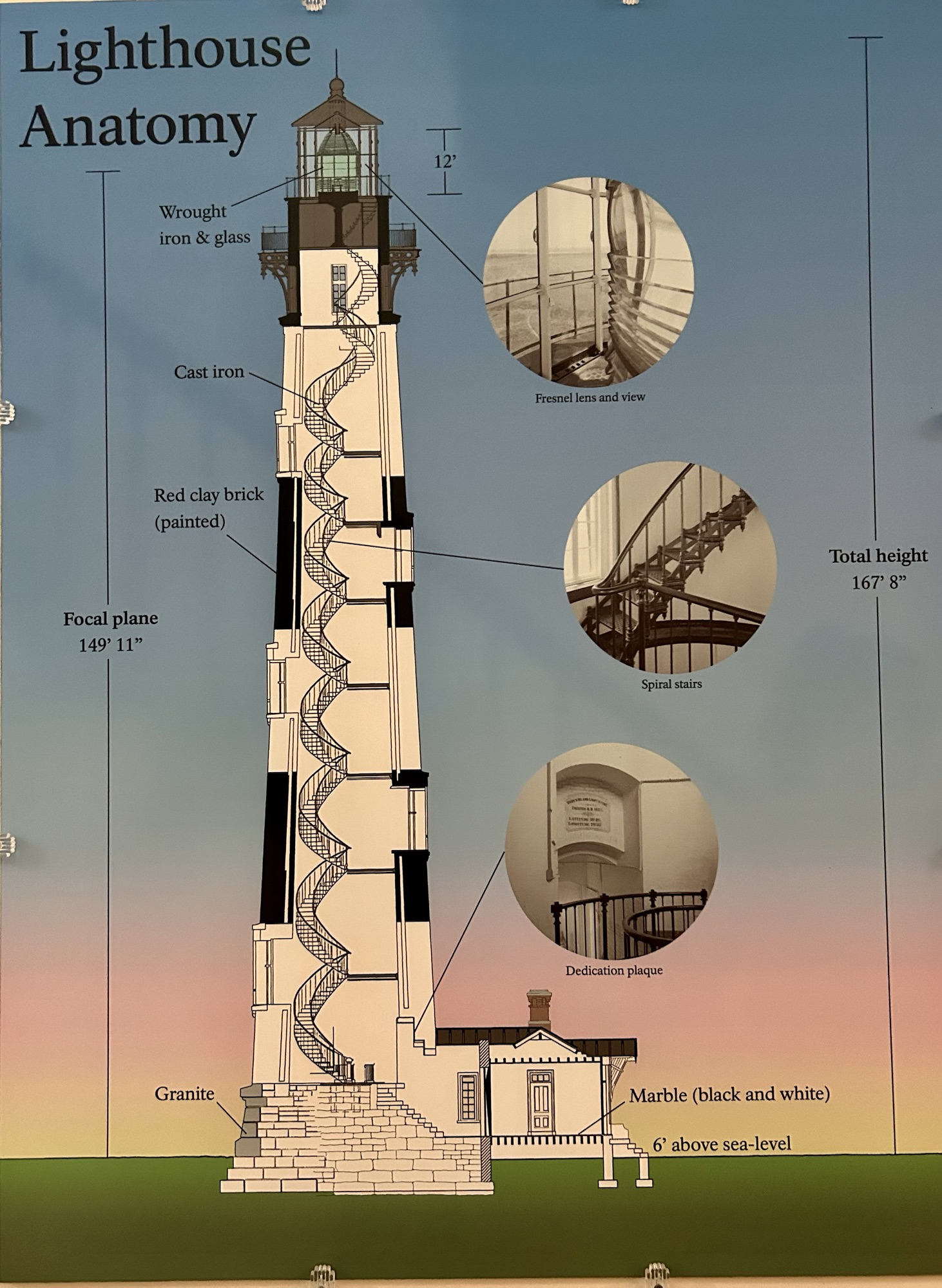
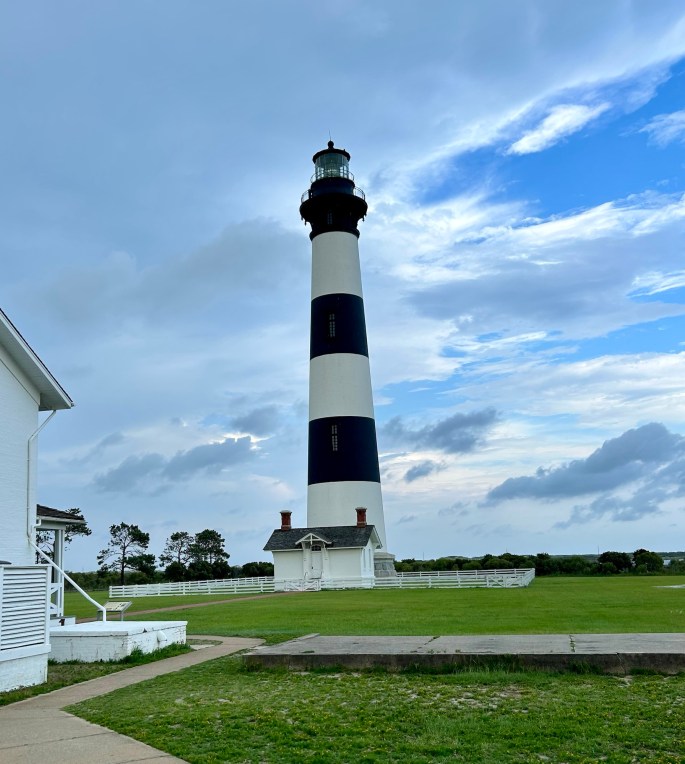
My daughter and I visited the Bodie (pronounced “body”) Lighthouse located on the Cape Hatteras National Seashore on a warm July afternoon. Once inside the lighthouse at the scheduled time, we were facing over 200 spiraling steps, equal to climbing 10 stories.  It contained no air conditioning; however, there were nine landings on which we could rest and catch our breath.

While climbing those steps, visitors must coordinate with other climbers as only one person at a time is allowed on a section of steps.  Therefore, when arriving at a landing, I had to yell “clear” to my daughter below, so she knew she could begin climbing the next section of steps.  Then, I had to listen and look above to the next section of steps to ensure there was no one coming down the steps from the top before I embarked to the next level. 

One step at a time 🚶🏽‍♀️

On and on we climbed.  Our thighs were burning, and none of the windows on the lighthouse’s walls were open.  Although there were small fans on each landing, they did little to prevent the sweat that accumulated on our brows and backs. Each time I reached a landing, I would marvel at the number of steps still above me, but I also felt a sense of amazement as I looked back down at the number of steps I had already climbed before shouting, “Clear!”

When we finally reached the top landing and were able to step outside onto the platform, the air felt exquisitely cool.  The breeze lifted and lightened our spirits, but it was the expansive view that took our breath away. 

A greater perspective 🌅

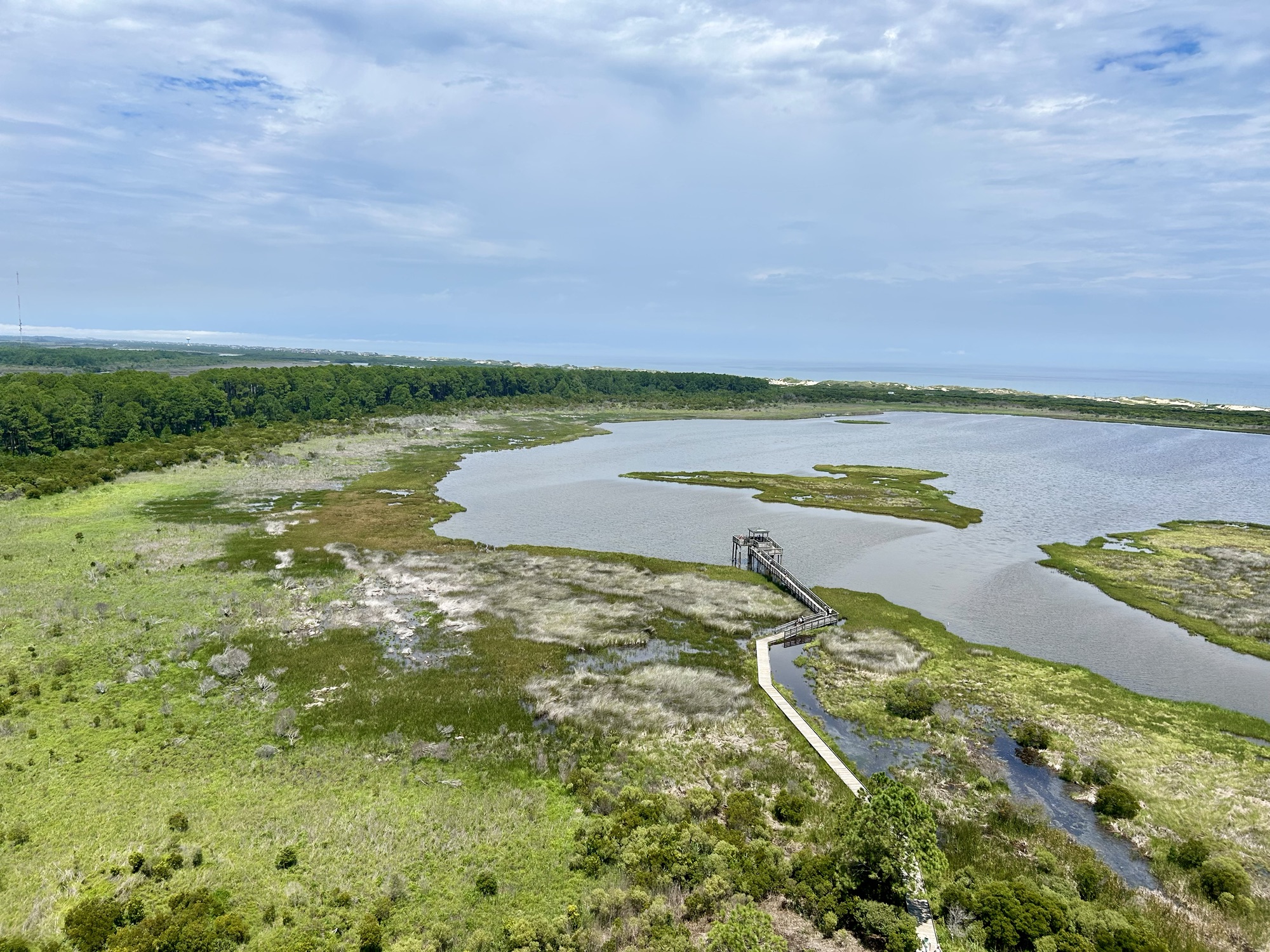
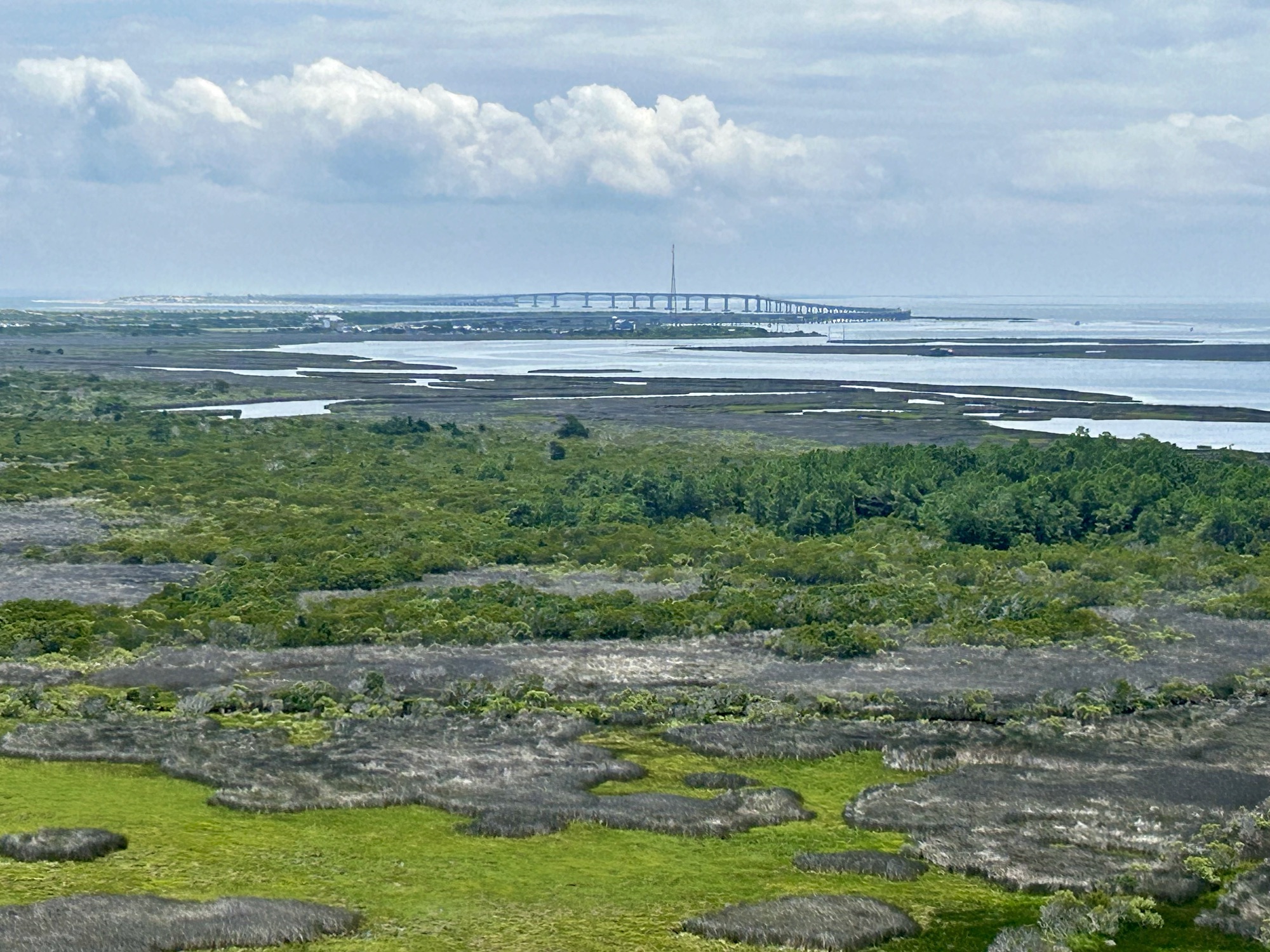
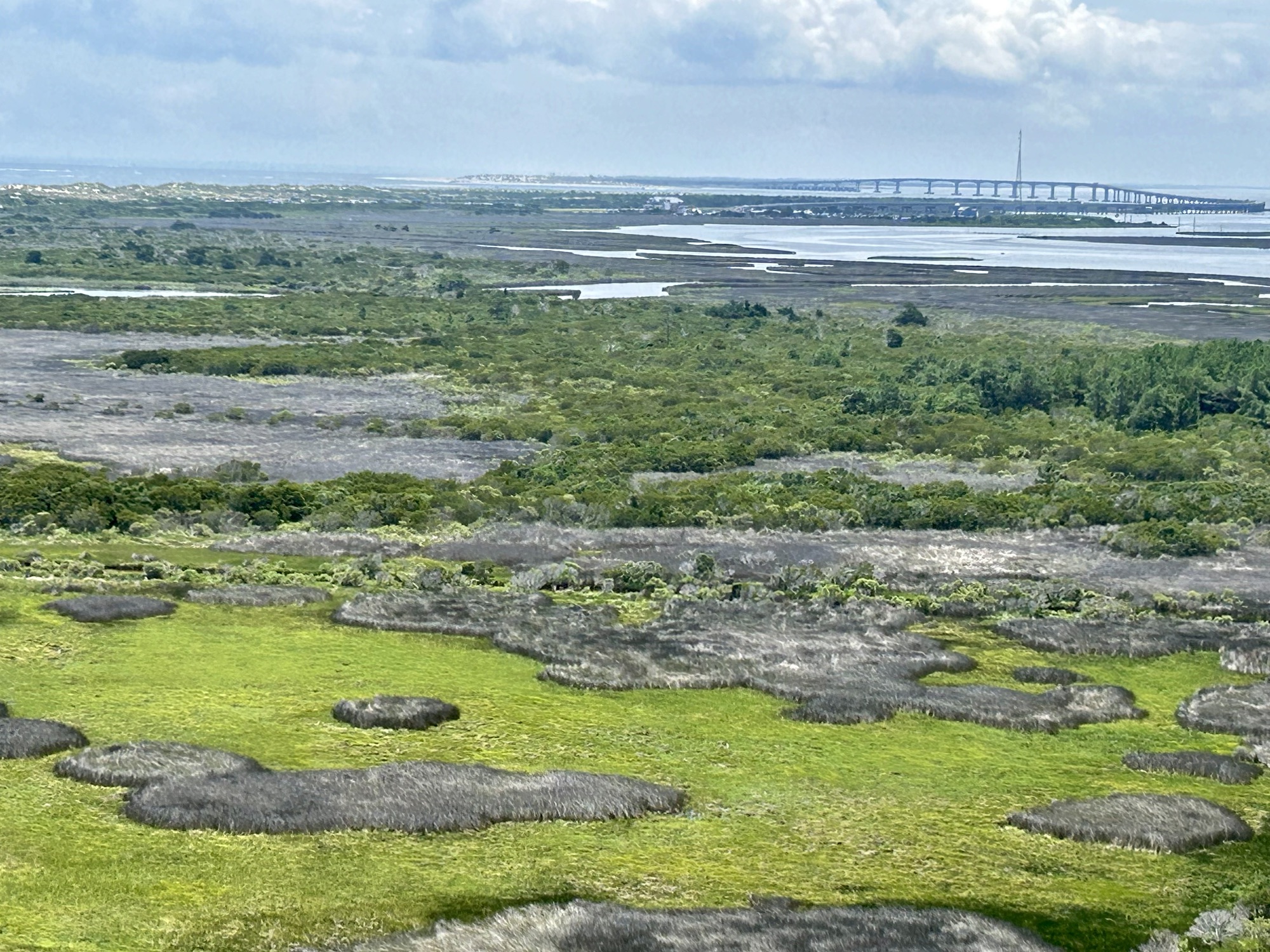
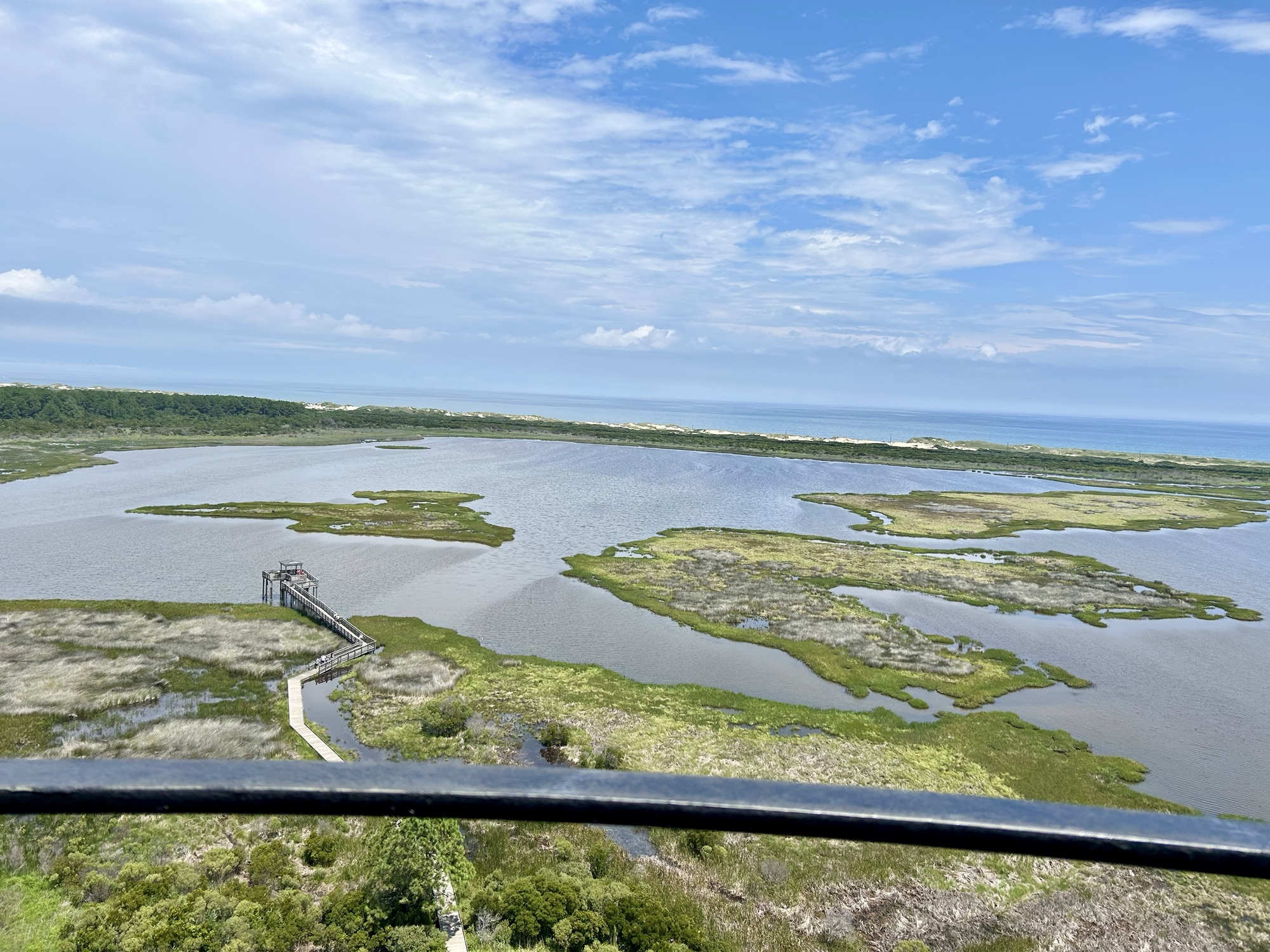
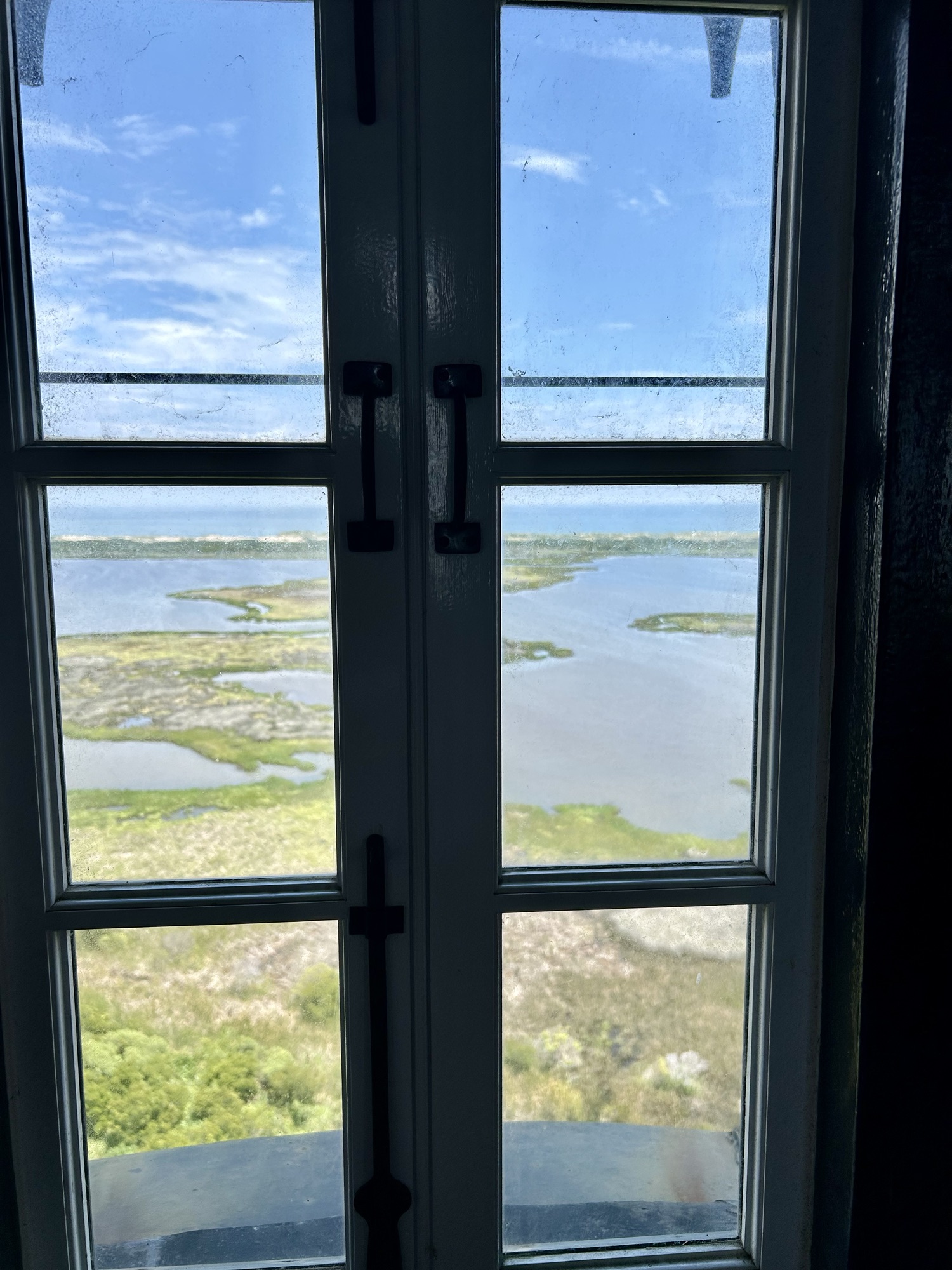
Spread out before us was 360 degrees of the sweeping sights of Bodie Island, Pamlico Sound, and the Atlantic Ocean.  Astonished by the surrounding marshlands, pine trees, distant bridges, the various bodies of water, and a map-like view of the vicinity, we appraised how different the Hatteras Seashore looked from a bird’s eye view. In fact, we realized that we only saw a fragment of what was all around us whenever we drove along NC Route 12 to and from the lighthouse.

We would have loved to have stayed longer, but our time was limited by default of the National Park visitor schedule.  Of course, the only way to exit was to climb down those 200+ steps, one level at a time.

The Only way Through is Through ⬇️

Just as the way up took time, especially coordinating with others, so did the climb down.  However, this time, it felt different.  We now possessed the confidence of knowing that we had conquered the climb and made it to the top.  We stepped down the steps with a certain satisfaction one feels from having successfully “blossomed,” as that flower did between the cracks, with the completion of a difficult task.  
Many of life’s struggles and challenges are like that lighthouse climb. 

Sometimes we face situations in life that are so difficult, we feel stuck.  If we don’t tie up our laces and start climbing, we’ll remain stuck, unable to move the boulder of a problem.  However, if we start climbing, it’s going to hurt, and we will sweat from the effort–at least proverbially speaking. 

Start climbing anyway

Similarly to those nine landings, we may climb over one rock, only to realize there are more to maneuver around. There are more sides, more stony surfaces relating to the struggle than we initially think.  Thus, there is more climbing to do, more problems to solve.  

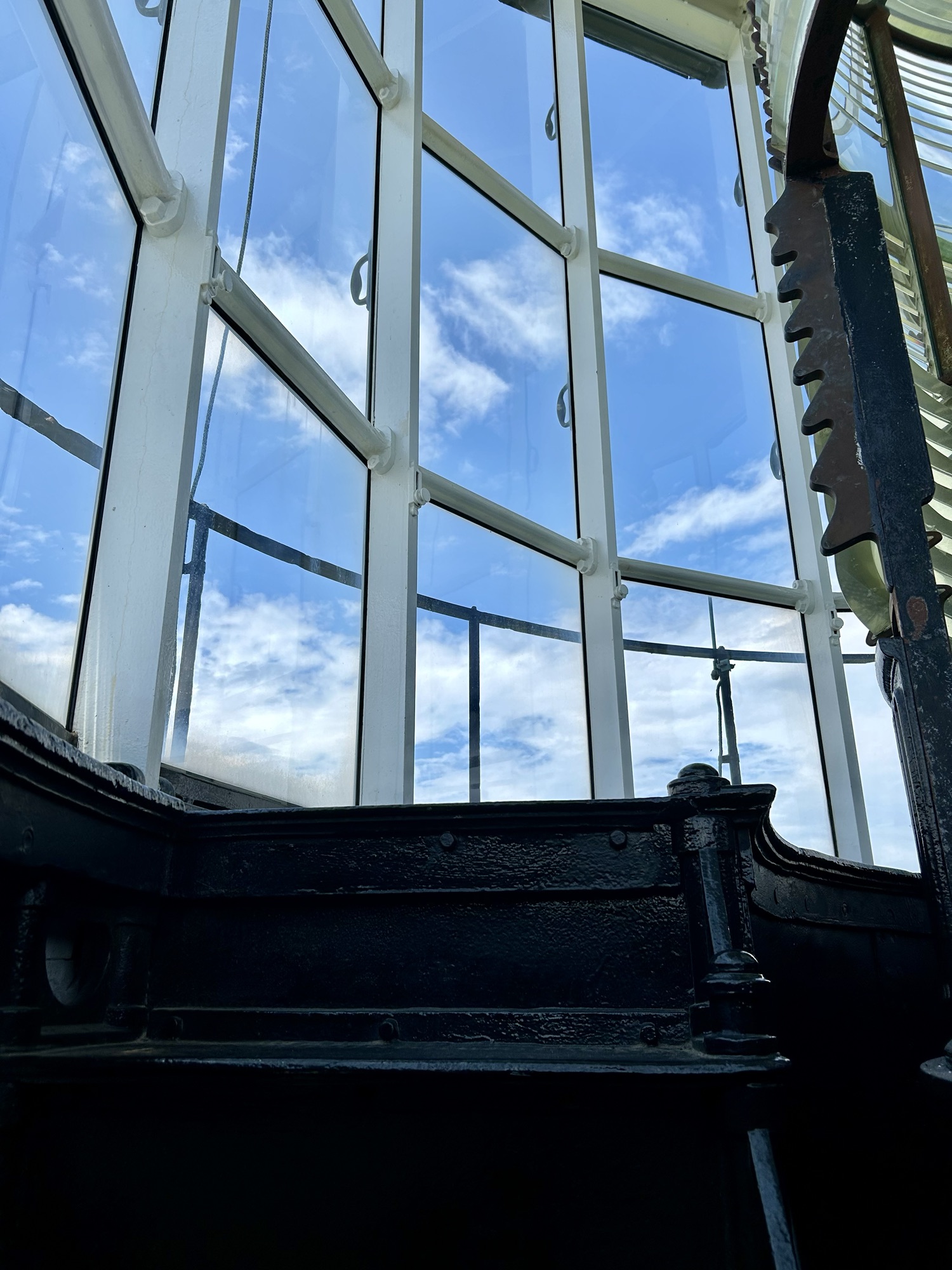
Looking through the lighthouse window, I could see the progress we were making.

Appreciate how far you have come

No matter how much more there is to go when dealing with life’s challenges/changes, it is worthwhile to notice how far you have come.

Taking a moment to pause and celebrate the challenges that you were able to “clear” is important. It not only serves as an opportunity for gratitude for what has been overcome, but also provides time to symbolically catch your breath before attempting to conquer the next step of the challenge.  Certainly, the “unknown” will remain in wait; however, by pausing and not rushing towards a quick solution, we are better able to gather enough strength for tackling the next part of the challenge.

Making the climb together made a difference.

Seek Support

When working through a life challenge, it is often beneficial to enlist the help of a friend or loved one.

Climbing up the Bodie Lighthouse steps, not only did I have my daughter with me, but there was a group who had reached the top before us. As they descended, they offered words of hope.

“The view is gorgeous from the top!”

“You’re almost there!”

“It is so worth the sweat!”

Seeds of encouragement, whether spoken or written, along with the presence of another dear soul helping us along the way, can make all the difference when we are striving from level to the next as we navigate the challenge/change.  

Invoking your Higher Power can light the way through rocky and rough patches.

Have Faith

Invoking the help of our Higher Power can offer further strength and resolve.

With each step taken, and each landing reached, hope increases.  When that sense of hope is nourished with support, encouragement, and faith, it fortifies us–feeling akin to love–a love that can see us through the difficult time.

Hope often feels akin to love. 💜

Eventually, each of life’s challenges and changes reach their pinnacle, allowing for a reprieve to bask in the breezes of accomplishment and the joy of the new lifeview. 

Of course, like those summer blossoms, we can’t remain on top forever.  Eventually, we all must descend from the height of accomplishment.  However, we can make that descent with a greater sense of resiliency, strength, and a deepened faith that we can not only move up, over, and around life’s rocks and hard places, but we can also help others do the same.

Effective Teaching and Coaching: Cultivating Student Achievement and Self-Improvement

Lessons from a Lifetime of Teaching series, Part 3

“The road to success is not a path you find, but a trail you blaze.”–Robert Breault

Author’s Note: This is the third installment of stories from decades of teaching students grades K-12.  It is my hope that by sharing these stories, I will cultivate lessons of compassion, empathy, and understanding

Photo by cottonbro studio on Pexels.com

Coaching requirement ⛹️‍♀️

My educational career began at a rural Kentucky high school. I was one of five special education teachers. One of the requirements for teaching at this high school was coaching a team in some capacity. Therefore, I assisted with the women’s cross country and track teams. 

At the time, I didn’t know a thing about either sport, but the head coach of the cross country team was another special education teacher, Coach Bailey (name changed for privacy). I didn’t realize it when I first met him, but in the end, Bailey became a role model for me as an educator and coach.  

As luck would have it, our classrooms were side by side, divided only by a rolling chalkboard.  In the two years I worked with “Coach,” as everyone called him, I rarely heard him raise his voice, and if he did, you can bet he had a darn good reason. Mostly, Coach was a naturally soft-spoken man who could both nurture and challenge students and athletes alike.
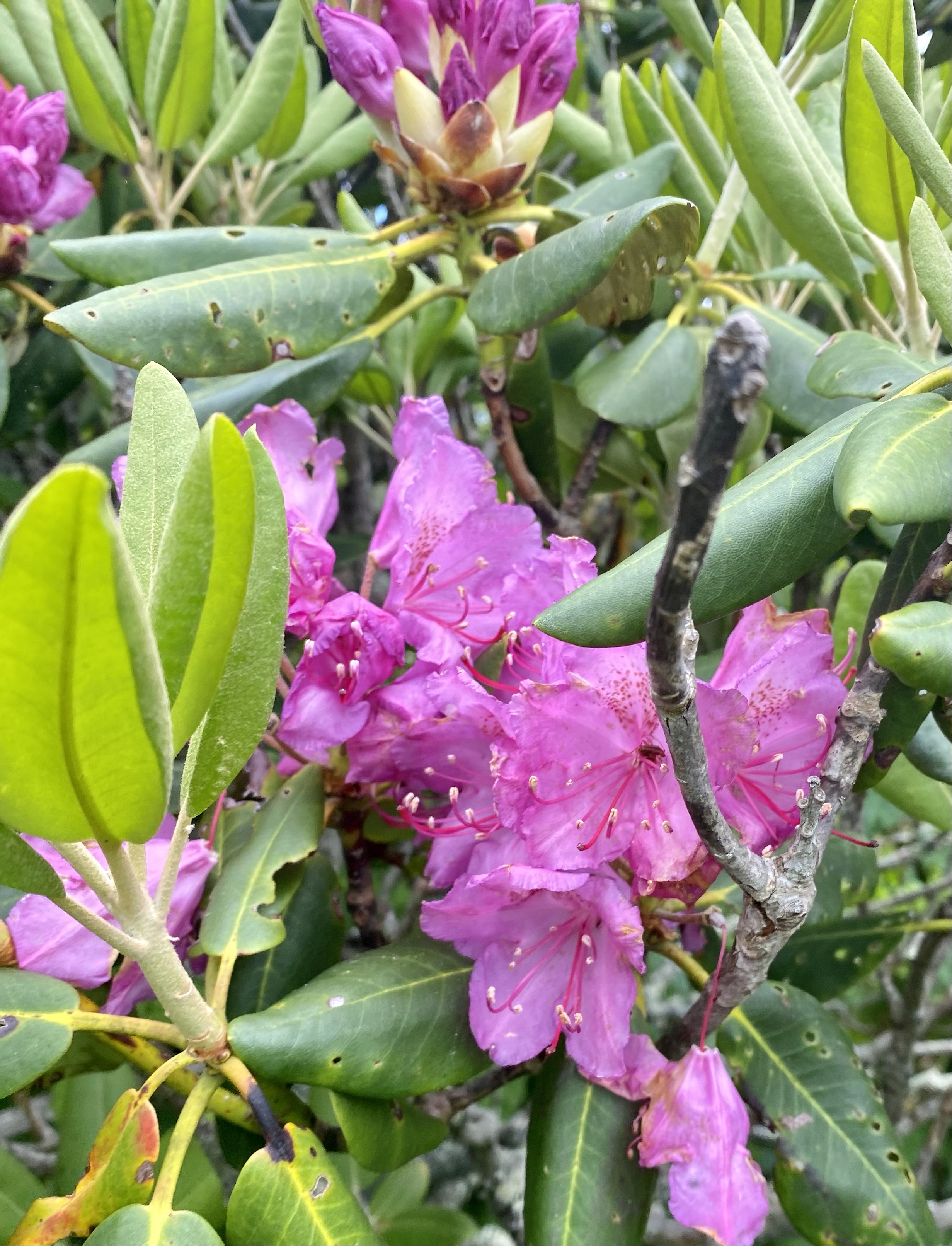
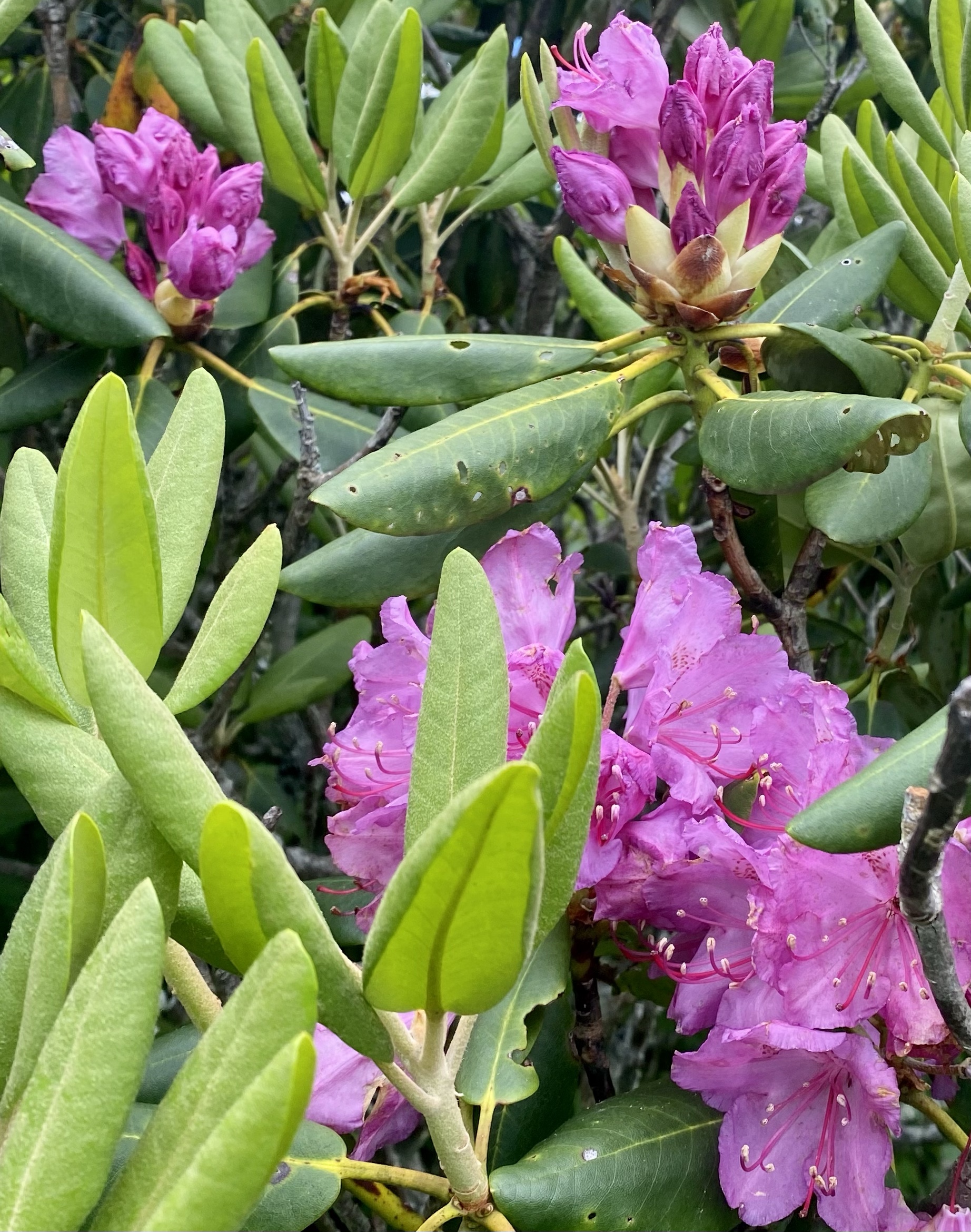
Photo by cottonbro studio on Pexels.com

Meet the Coach 🏃‍♀️

Coach, in my mind, was “older” with salt and pepper straight hair parted down the center and a thick mustache.  His face was browned and weathered from years spent in the sun that contrasted his light aquamarine eyes.  His typical attire was khakis with a school logo polo shirt with a matching ball cap–the cap was only for sporting events. When the temperatures turned cold, he added a school logo v-neck polyester pullover that was popular with coaching staff in the late 80s.

On our first meeting, Coach gave me a tour of the “department facilities,” such as they were.  Three of the five special education classrooms were underneath the visitor side of the gym bleachers, and the other two classrooms were found at the end of the gym, just beyond the baseline.  As we walked, he politely introduced me to the faculty and staff we encountered. 

Later, when Coach discovered I had been assigned to “assist” him with the cross country team, he did not roll his eyes, sigh, or mutter under his breath upon hearing I had no coaching experience, which I feared he would do.  Instead, he said he was glad to have me as part of the team because the young ladies needed a female leader.

Photo by RUN 4 FFWPU on Pexels.com

Ladies Cross Country Team 🏃‍♀️🏃‍♀️

He then explained that the cross-country team had already begun practicing and invited me to join them that afternoon. It was then he asked if I ran.  Not wanting to disappoint him, I said that I did, which was sort of true. I had begun jogging during my last quarter of college just before graduating. I continued to jog two-three days per week around town after moving in with my grandparents that same summer, but I was by no means fast or knowledgeable about running beyond the basics. I knew I would have much to learn.

By 3:00 pm, I was on an access road along the Ohio River meeting the team. As Coach introduced me to the young ladies, they welcomed me with warm smiles.  As the weeks progressed, I would come to love these ladies, especially for the mature way they approached running, academics, and life in general. They were a driven group with gritty spirits, and they supported one another throughout the season even though they were competitors in races.

During this first practice, I learned that my job was to run, jog, or walk with whoever was at the back of the pack during the team’s long training runs while Coach rode his bike with the girls at the front of the group.  I was worried because I did not know if I had that level of fitness to keep up with even the so-called “slowest” runner.  

Photo by Tirachard Kumtanom on Pexels.com

The IMportance of Grit 💪

It turned out that there were two ladies who had joined the team with no running experience. Coach already knew they were not yet able to keep up with the other seasoned runners. Therefore, he asked that I remain steadfastly encouraging.  It was a role I relished. 

As the season progressed, one of the two newer runners was a “natural,” and was soon running with the rest of the team.  But Coach still insisted that I mostly focus on helping “Amy,” the runner who still struggled. He shared that while winning races was nice, developing stamina and perseverance were lifelong skills applicable to many settings, not just running.

Throughout the cross country season, Coach fostered a team attitude of, “You’re only in competition with your best time.”  His coaching style was gentle, but firm; supportive, but with high expectations.  However, those expectations were individualized to each runner, including Amy.  This philosophy was most evident after the regional meet.

Photo by Chiara Caldarola on Pexels.com

Individualized Success 🏅

We had two runners who finished in the top spots who qualified to move on to the sectional meet.  While Coach was happy with those two and praised their efforts, he also pointed out a few techniques they could use to improve their times for the next race.  

Additionally, since it was the last meet for the rest of the team, Coach took time to speak to each of the runners, showing them their running times from those hot days of August until the end of October.  All team members had improved significantly, and he made sure each runner knew how much they had achieved over the season. Coach conveyed heartfelt pride in each lady’s accomplishment, and he encouraged each one to run track in the spring.

Later, I watched Amy, who was always the last finisher for our team, walk over to her parents and chatter away about her improved times and how she couldn’t wait for spring track season.

Photo by Gerd Altmann on Pexels.com

Nudges of Success 🙌

Coach taught his students in the same manner in which he coached.  His expectations were high, but his capacity for compassion and empathy was deep. Coach was attentive and intentional when talking with students and athletes alike. He could be firm when needed, but mostly, he taught and coached with a gentle, kind, and encouraging spirit.

How fortunate was I to have taught with Coach for two years. He modeled that effective teaching–and coaching–is about the importance of each student–how you make them feel and the impact of motivating students to improve and stretch to be better versions of themselves. Every student’s best is different, and it is the job of a teacher and/or coach to see this and purposefully nudge each student forward to the next level in order for students to blaze their own trail of success.

Craggy Life Lessons

“Yonder were the mountains:  The sunlight revealed their tiny heads and wide shoulders, craggy and purple, with small black trees, delicate as eyelashes, on their slopes.”–Paul Theroux 

It never ceases to amaze me the ways in which life can manage to not only survive, but thrive.  As an experienced educator, I have worked with countless students, including those who come from the most anemic of backgrounds–impoverished in experiences, impoverished in love/emotional support, or impoverished financially.  Miraculously, many of those disadvantaged students still manage to not only survive their hardscrabble circumstances, but also find enough sustenance outside of their own rocky homelife for growth.  These kids are like camels–able to soak up enough goodness and nutrition from one or two smaller sources, such as a church, school, sports, and so forth, that allow them to flourish through long stints of inadequate and insubstantial living situations.

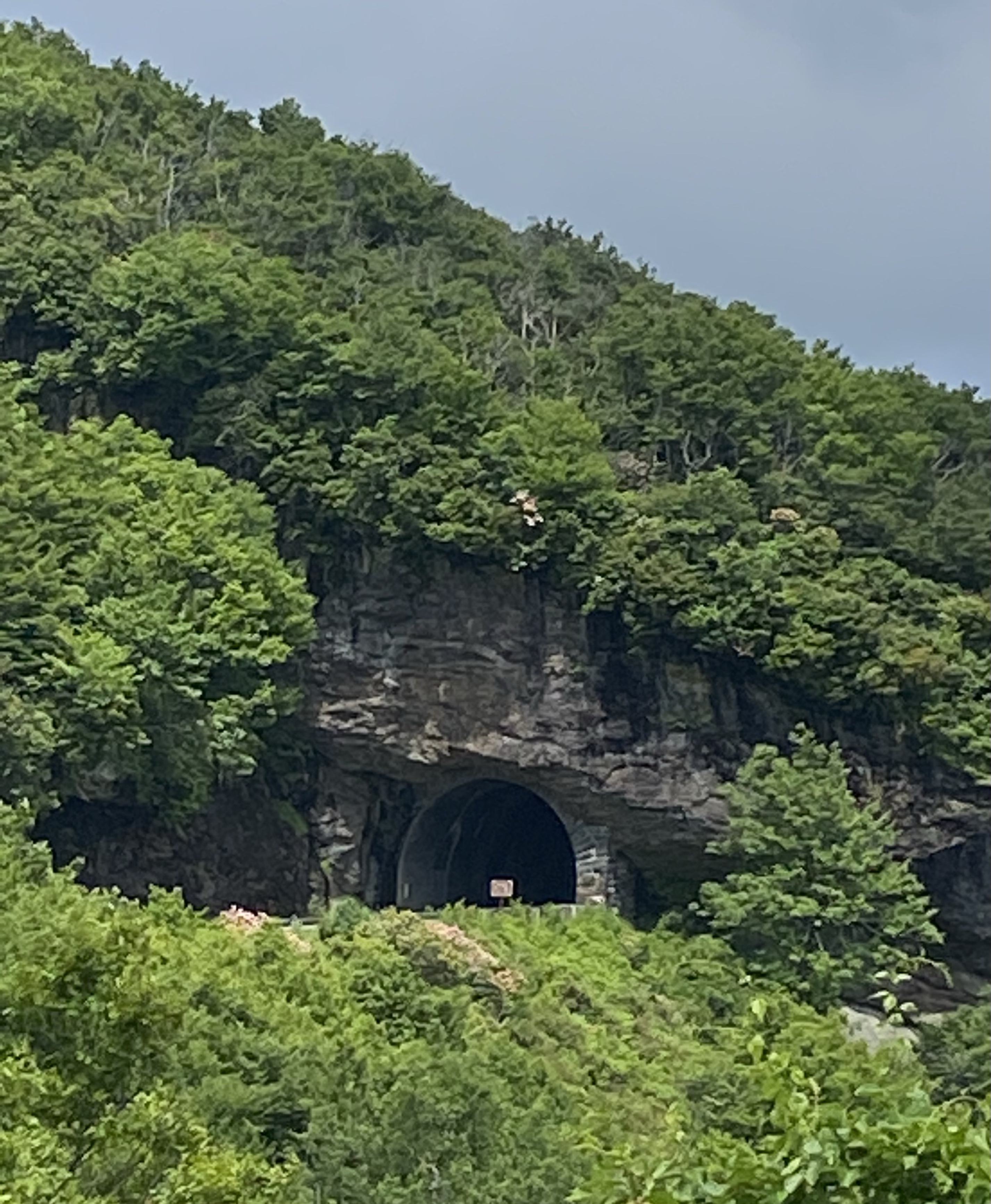
Craggy Pinnacle, elevation 5,817′, can be driven through via Blue Ridge Parkway tunnel or hiked to the top for epic 360 degree views.

Visiting Craggy Gardens, north of Asheville, NC and just off the Blue Ridge Parkway, I was reminded that not only can humans survive ramshackle environments, but also a wide array of plant life can likewise do the same. Craggy Gardens are part of the Great Craggy Mountains, or “the Craggies,” which is a rock-filled area of approximately 194 square miles in the Blue Ridge Mountains that border the Black Mountains.  The highest point of the Craggies is Craggy Dome rising at an elevation of 6,105 feet, but there are several other high peaks of interest in this unique geological and botanical habitat, including Craggy Pinnacle, through which visitors can drive and/or hike to the top along the scenic BRP. 

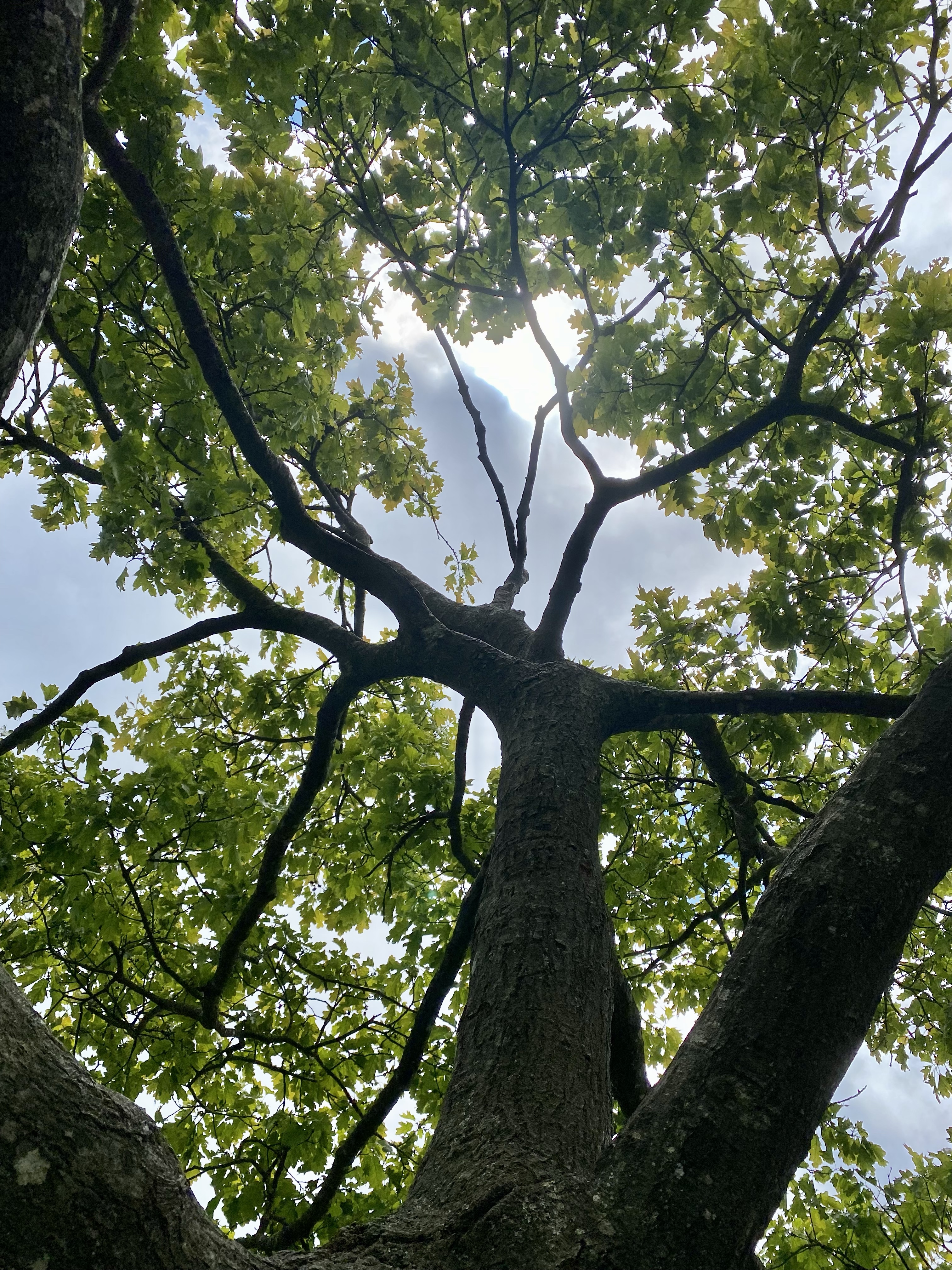
A few ancient symmetrical trees dot the bald of Craggy Flats which is mostly covered in grasses, shrubs, rocks, and few flowering plants.

The Great Craggy Mountains are known for its exposed rocky, aka “craggy,” surfaces, high altitudes with spectacular vistas, and an elevated bald known for its rhododendrons, mountain laurel, flame azalea, other colorful wildflowers, and heath.  There is both a picnic area at milepost 367.6 and the Craggy Garden Visitor’s Center at milepost 264.4; plus, there are several hiking trails for a variety of hiking skill levels. Additionally, the Craggy Mountains are known for its twisted trees, May-apple flowers, Turkscap lilies, autumnal leaf colors, the clusters of red berries that decorate the Ash trees in the fall, and its rare and endangered plant life.  In fact, according to the Blue Ridge Parkway Guide, “Craggy Gardens has been recognized by the state of North Carolina as a Natural Heritage Area and has also been recommended as a National Natural Landmark.”

During our visit to the Craggy Mountains, John, my husband, and I stopped at the Craggy Garden Visitor Center.  At an elevation of 5,497 feet, the air was significantly cooler than when we left town, hovering in the high 50s.  Inside the visitor center, a warm fire blazed in a wood burning stove in a far corner with several rocking chairs around its hearth.  Outside, posted along the front wall, was a map of the different hiking trails in the vicinity.  

The Craggy Pinnacle Tunnel as seen from the Craggy Garden Visitor Center.

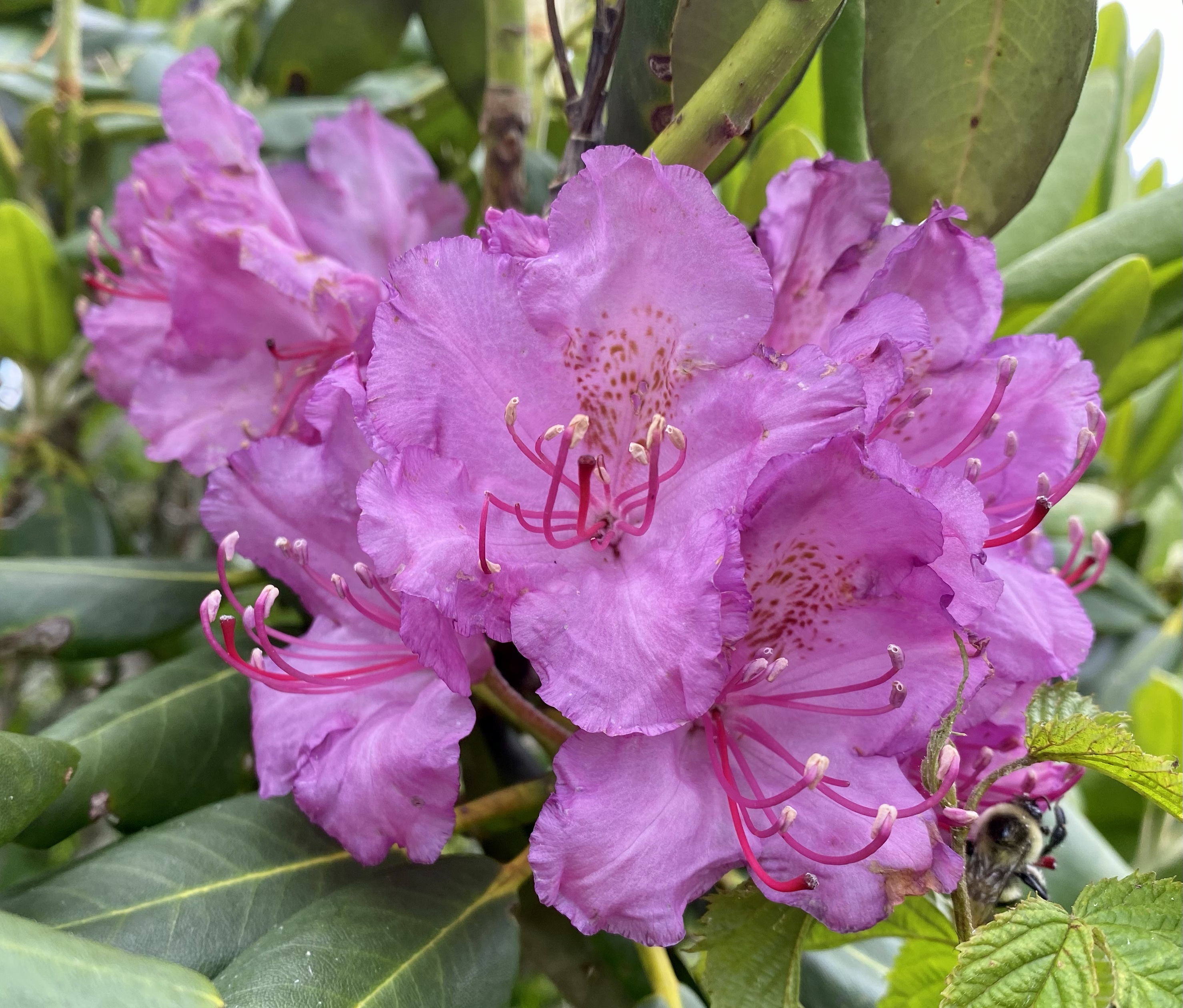
As newbies, we decided our first hiking experience in the Craggies should be uphill along Craggy Gardens Trail which led to the Craggy Flats at an elevation of 5,892 feet.  Since our visit was in late June, we were hoping to see the renowned Catawba rhododendron; however, John had already been warned that these infamous flowering pink and purple shrubs had come and gone with little fanfare.  Nonetheless, I was not to be deterred in my enthusiasm for the potential adventure that awaited along the trail.

Craggy Garden Trail

  “Nature is a book of many pages and each page tells a fascinating story to him who learns her language. Our fertile valleys and craggy mountains recite an epic poem of geologic conflicts. The starry sky reveals gigantic suns and space and time without end.”–A. E. Douglass

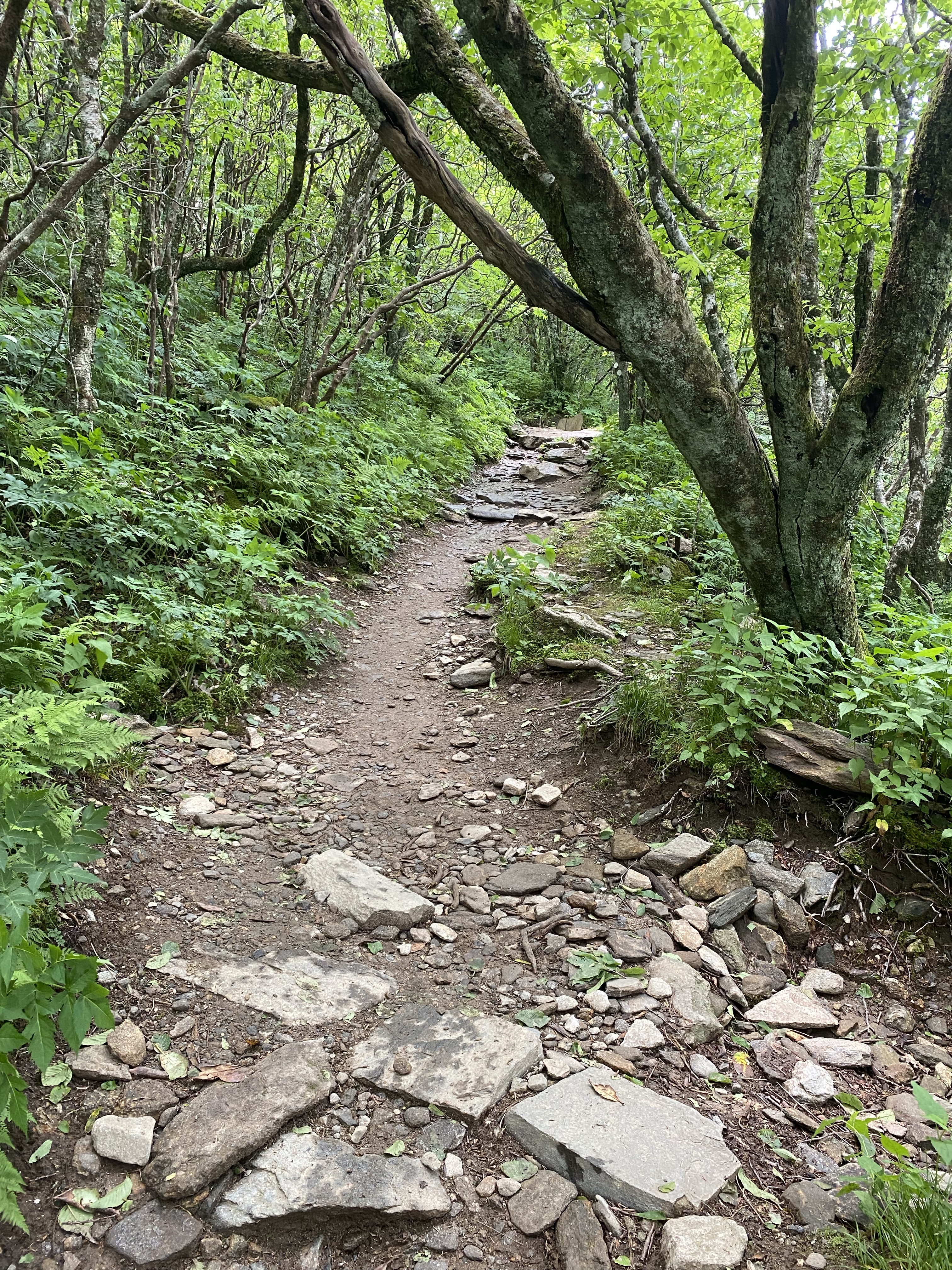
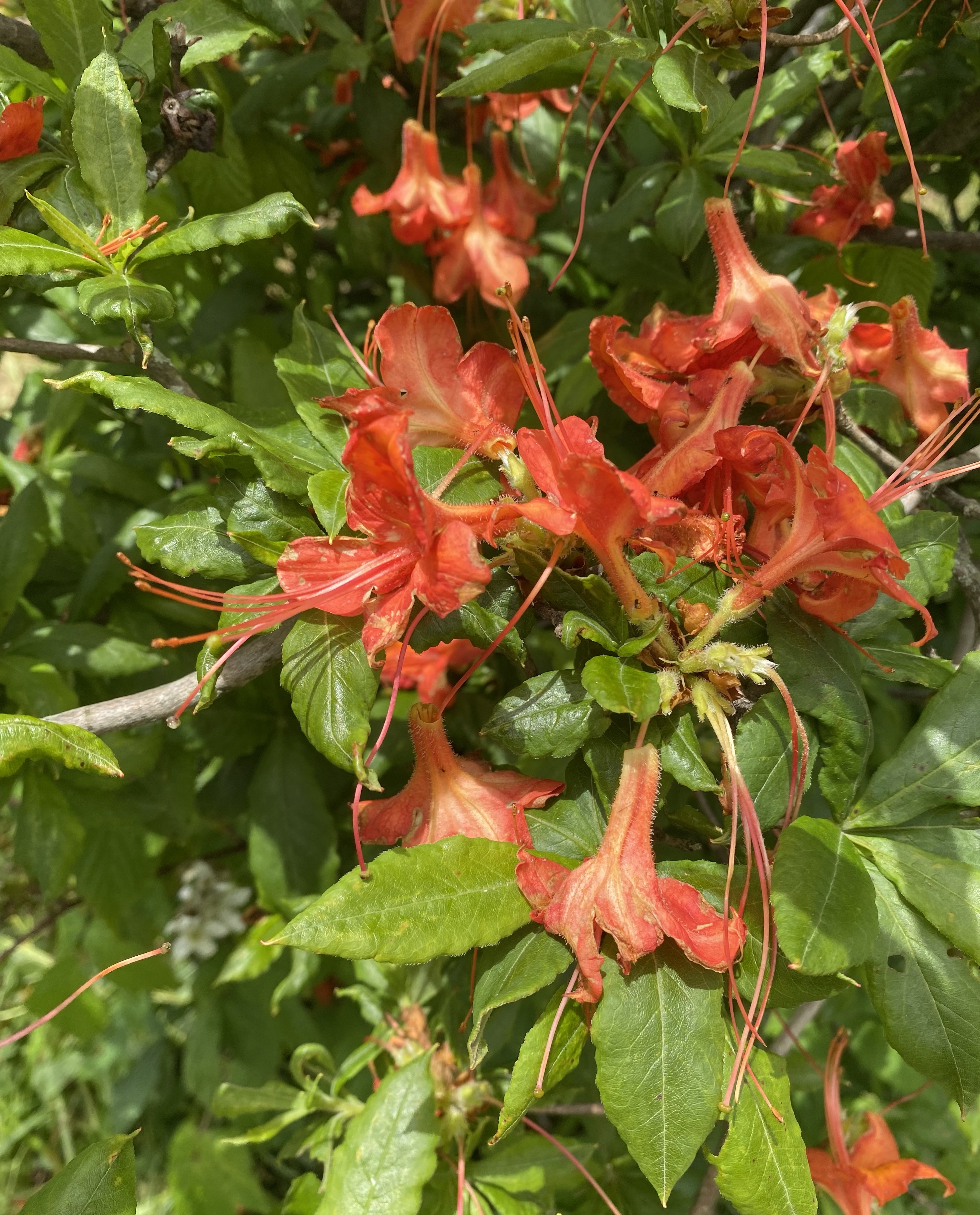
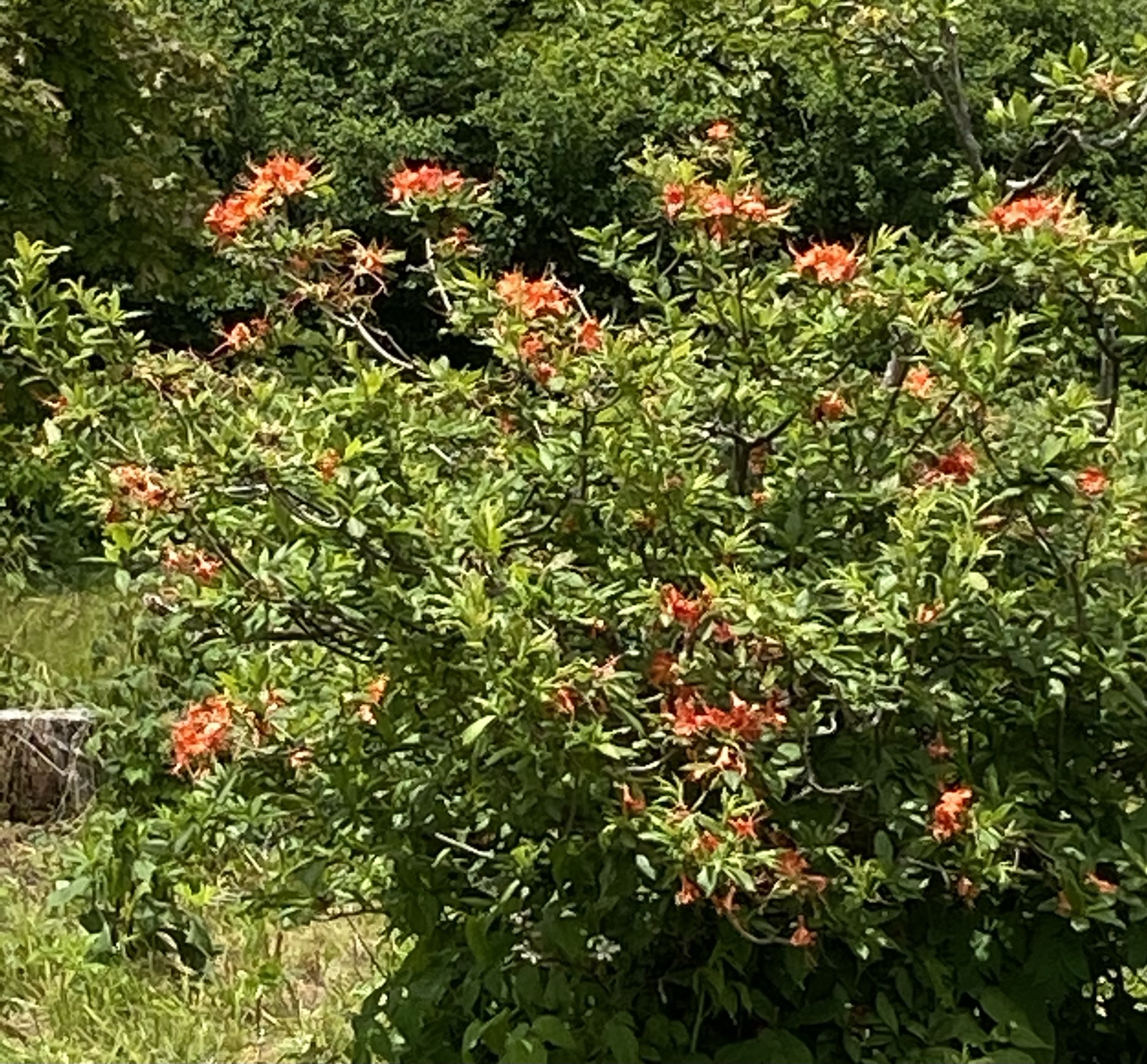
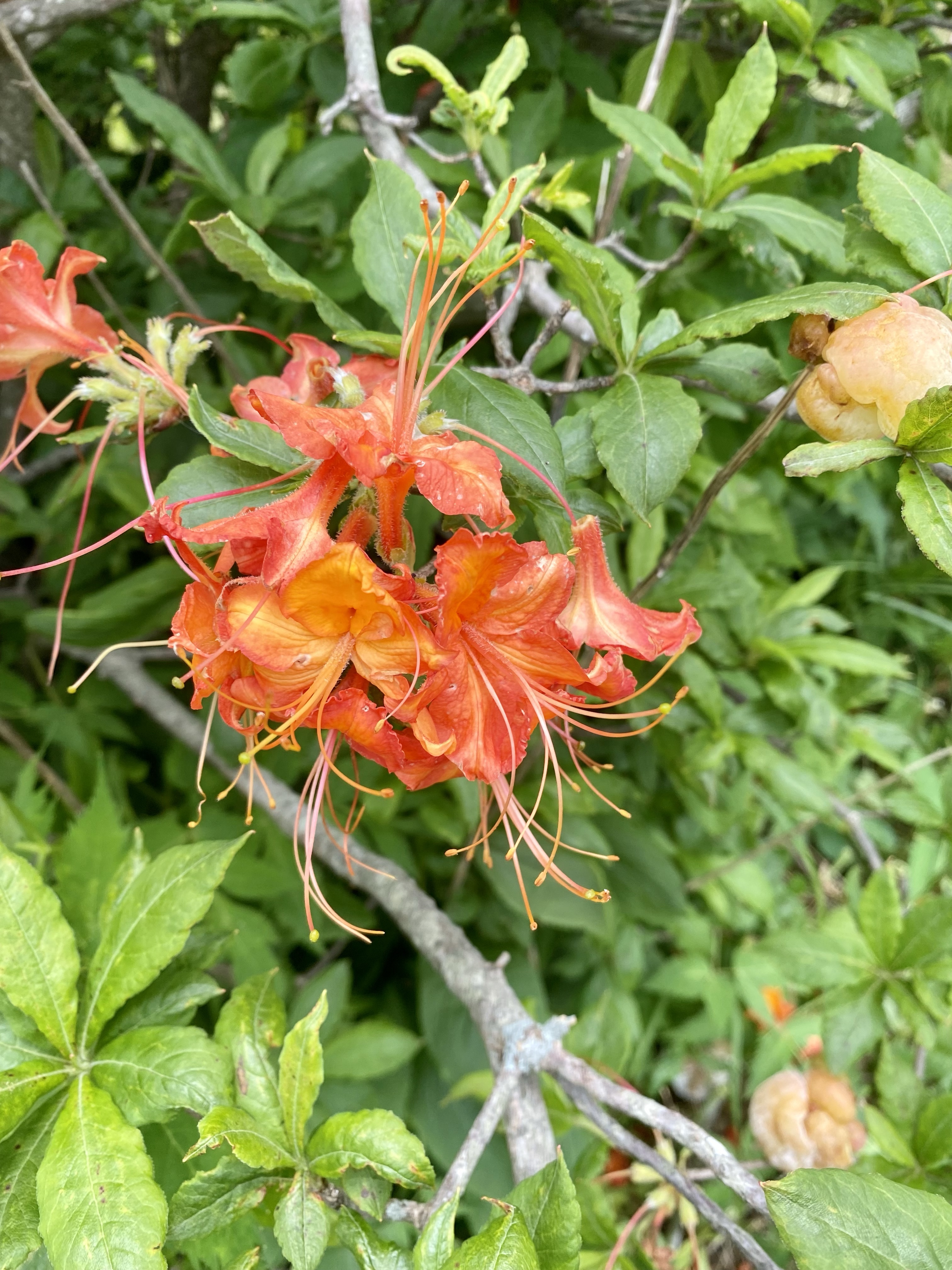
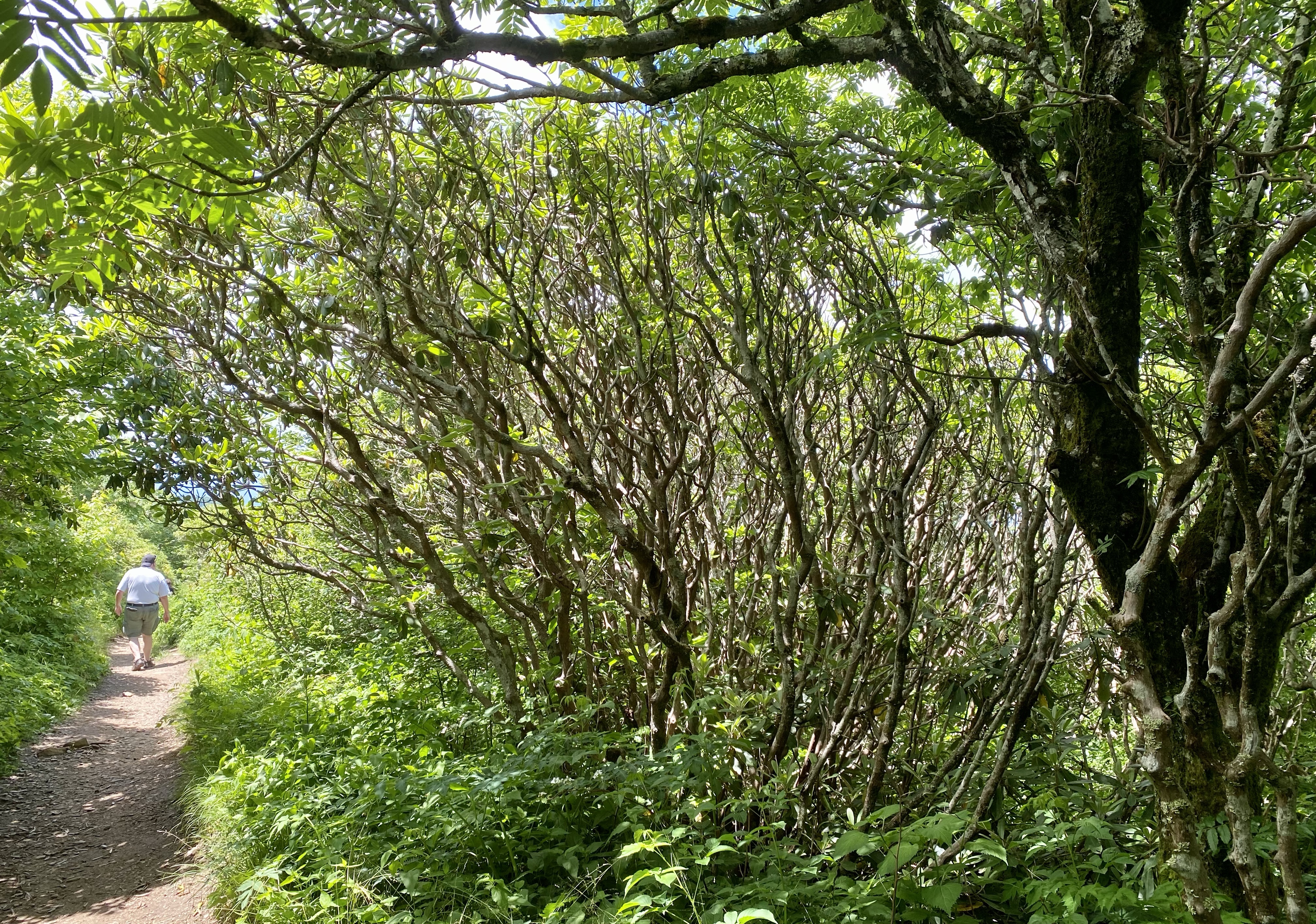
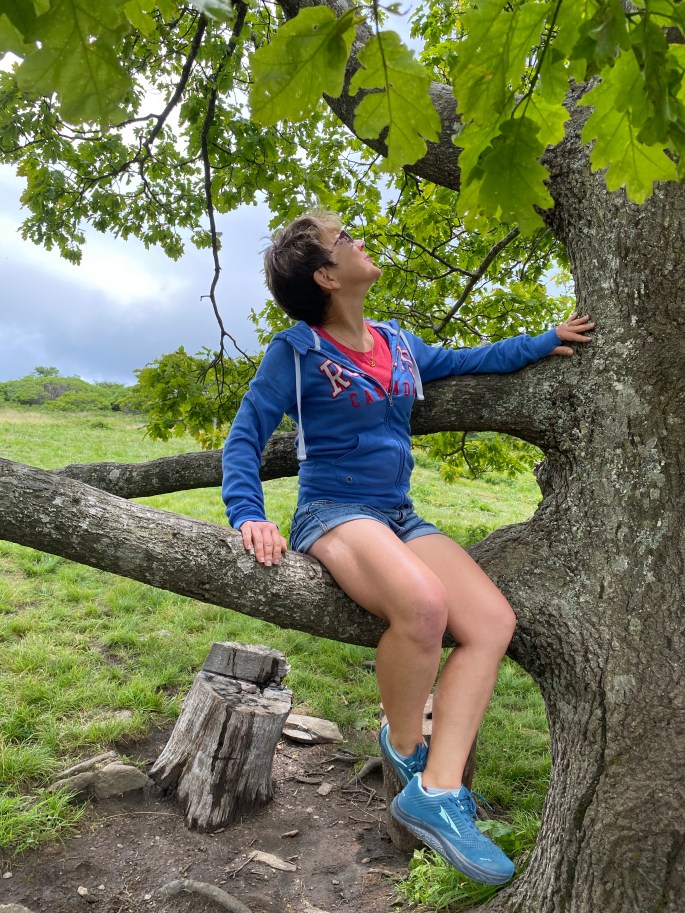
Trekking along the path, twisted trees and shrubs formed tattered tunnels through which we traversed higher into the altitude until we reached Craggy Flats.  This area is signified by a large shelter with paths going uphill to either side of the shelter.  Once at the top, the views were spectacular, allowing us to see layer upon layer of mountain line overlaid with cloud shadows.  While as a general rule, a bald is considered a treeless area, the Great Craggy Mountains’ bald was not entirely treeless as there were a few beauties with their broad limbs fanned out in perfect symmetry.  Mostly, the bald was covered with small flowers, grasses, dirt paths, and a few shrubs that were ablaze with orange flowers–a type of rodondendum called a flame azalea due to its flamboyant flowers.  

Vantage point of tree limbs

The Craggy Gardens Trail is often identified as one of the busiest trails in the area, but on the day/time John and I chose to explore it, there weren’t too many other hikers.  The hikers we did encounter were friendly and helpful, offering different pieces of advice for locating specific scenery.  In fact, one pair of sisters that I met during my exploration of the bald area remembered I was from Ohio and referred to me by shouting “Ohio!” whenever they found something of interest along the trail they thought I would want to see. 

The search for the Catawba Rhododendrone

On the way down from the bald, at the base of the flat, was a rhododendron upon whose backside (the back of the official Craggy Gardens Trail) was covered in purple Catawba rhododendron blooms!  I trotted back up the off-the-beaten-path to the top bald where the two sisters were admiring the flame azalea. I recalled they were looking for Catawba blossoms to photograph, and I wanted them to know about the hidden purple gems I had just found.  Excitedly, I led them down the hill while they readied their cameras; then I headed back to a shelter area where John was resting.

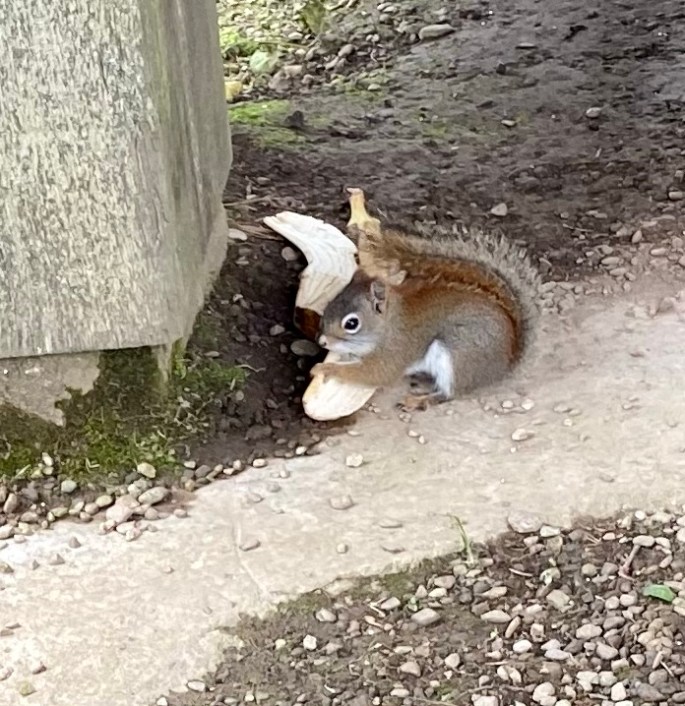
It seemed that while I was helping the sisters find rhododendron, John had made an acquaintance with a hungry squirrel that had discovered an abandoned banana peel.  It was quite the scene as John attempted to move in closer with his camera to video the squirrel. Meanwhile, the squirrel entertained John with its acrobatic attempts to eat the inside of the peel. It was certainly an “appealing” sight!

After the squirrely entertainment, John and I meandered down the hill to a gazebo overlooking the mountainside.  If we had chosen to continue further downhill, we would have traveled into the official Craggy Garden Picnic Area, but since we still wanted to visit Mount Mitchell, a bit further down the BRP, we chose to retrace our steps back to the visitor center.

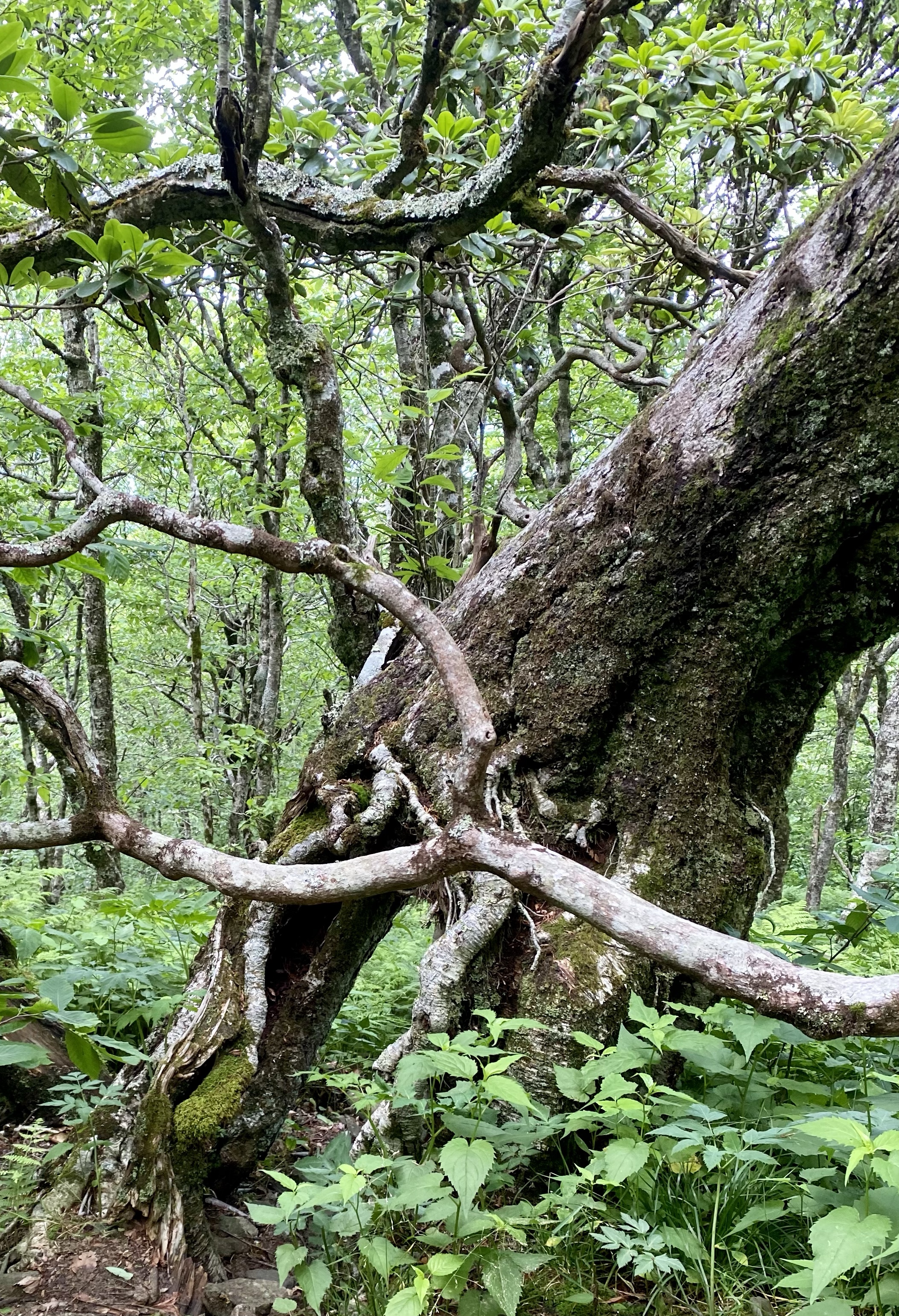
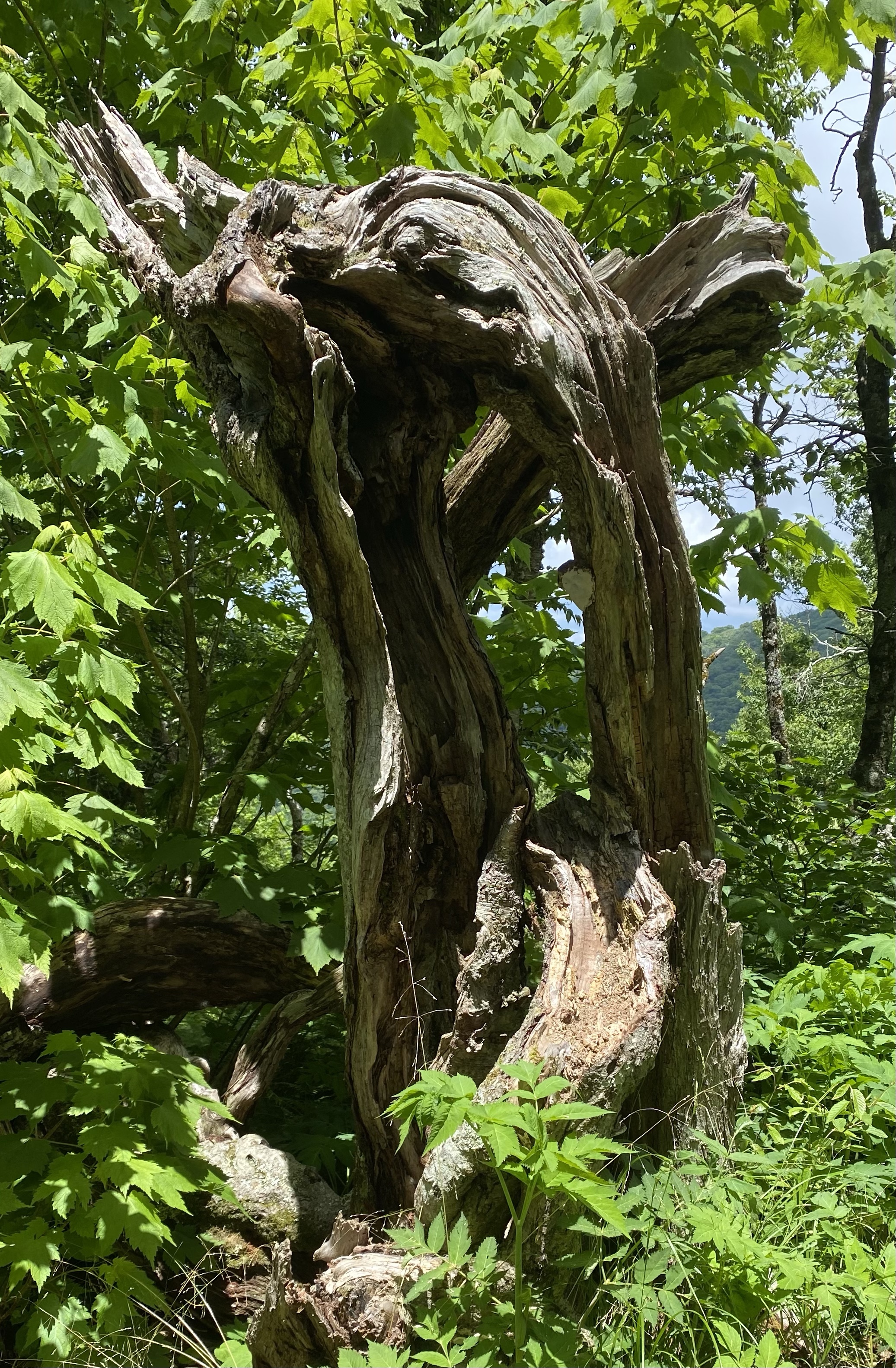
Walking back allowed me to more thoughtfully take in the gnarled trees and shrubs with roots winding over, around, and sometimes even through the rocky and rugged terrain.  Several roots appeared to have a large hole at the base of their trunks, and they still seemed to support life.  In fact, it was a marvel that any life at all could be supported in such a craggy area.

It further occurred to me that most lives–at some point in time–become rocky, rough, and even craggy, like several of my past students’ lives.  The miracle is that no matter how broken and stony life becomes for any of us, we have the ability to survive. Like the Craggy Mountain plants whose limbs twist this way and that to find the sunlight while their roots lengthen and stretch to find nourishment and water, we too, through faith and perseverance, can find ways to stretch, grow, and resiliently root into sources of life-sustaining nourishment.  Even if our roots develop a hole of loss, we can still rise up like the trees, shrubs, and other plant life of the Great Craggy Mountains.