Embracing Life’s Unanswered Questions

“Be patient toward all that is unsolved in your heart and try to love the questions themselves. Live the questions now. Perhaps you will then gradually, without noticing it, live along some distant day into the answer.“–Rilke 

A vibrant sunrise with deep orange and golden hues peeking through soft clouds, symbolizing new beginnings and hope.
Photo by Bradley Hook on Pexels.com

When the Mind Won’t Stop Asking 😕

Those words of Rilke, written over a century ago, remind me that some of the hardest seasons in life are the ones that offer no answers—only questions that echo back in silence.

A silhouette of a person walking towards a bright sunrise, symbolizing hope and introspection.
Photo by Dom Gould on Pexels.com

Running into the Questions ⁉️

I was driving home Saturday morning after my weekly long run with a podcast playing in the background. The previous week had been difficult, and I had hoped the run would provide a reprieve from my worries. I started running well before the sun rose under the cloak of a starry sky, which served to keep my mind calm. Then, the rich crimson of dawn edged up the horizon, deepening from vermilion to the fiery orange of full sunrise. As if on cue, the monkeys in my mind began chattering—an endless loop of questions followed by equally endless, devastating possibilities. 

I tried to redirect my thoughts: “If only this or that would happen, then everything will be fine,” I told myself. The problem with this if–then principle is that it’s meant for building new habits or personal change; I can’t magically apply it to others—or to the world at large. Even after my run, the mind monkeys continued their spirals. Then a line from the podcast caught my attention, “What I think Rilke’s words are stating is that if we can learn to live in peace alongside the questions, this may allow us to witness the unfolding of the answers in some indeterminate future.” 

A hand reaching out towards a shimmering body of water under a bright sky.
Photo by Lukas on Pexels.com

An Invitation, Not a Reprimand 🙂

Of course, I had not heard Rilke’s words, so I had to rewind the podcast in order to focus on the original quote. Those words felt like an invitation to hope, rather than a reprimand for my monkey mind. To be clear, it did not feel like a promise of a positive outcome, but rather hope for a greater understanding one day. Rilke’s words seemed to affirm my questioning, as long as I let the questions simply “be,” like one ingredient in the stew of life. 

Hands holding a small, gift-wrapped box with a ribbon against a soft, patterned background.
Photo by Kim Stiver on Pexels.com

The Unsolved Nature of Life 🧐

While I cannot speak for everyone, I think many of us live with unanswered questions—and I’m probably in the camp that has more than a few. Seasons of life bring different questions, but they often center around themes of health, purpose, relationships, concern for others, and the future. It is often uncomfortable–the unsolved nature of life. We desire, like the fairy tales of our childhood, resolutions to problems in which we “all lived happily ever after.” We like knowing what is next; we desire to wrap up answers neatly and hand them over like a present. But life, as we eventually learn, isn’t wrapped in tidy endings. 

A serene landscape shrouded in fog, featuring two swans gliding on a calm body of water, with bare trees reflecting in the misty surroundings.
Photo by Karol Wiu015bniewski on Pexels.com

When Answers Refuse to Come 🤨

If you have ever encountered a personal crisis, or that of a loved one, you know the “hurry up and wait” sense of time that often accompanies these scenarios–appointments scheduled off into the distant future, followed up by more appointments with no answers, only more maybes and/or more questions or concerns. It can feel like an autumn fog settling over a town in the early morning hours. You can see outlines of various possibilities, but still not know what the future holds. And yet, even in that fog, life quietly continues. 

A chalk-drawn question mark on a black background, symbolizing uncertainty and curiosity.
Photo by Pixabay on Pexels.com

Coexisting with Uncertainty ❓

On one hand, Rilke seems to invite us to love the questions—an improbable ask, given the weight of so many of life’s uncertainties. Perhaps, as the podcaster suggested, Rilke’s words invite us to coexist with uncertainty rather than chase quick answers. Personally, when I face challenges, my first instinct is to “fix it,” whatever “it” may be. However, most of life’s bigger questions are not, per se “fixable” in a vacuum. There are many uncontrollable variables that often fill me with an anxious energy. 

This is when I tend to lean into writing, outdoor movement (especially running and walking), as well as reading–trying to learn as much as I can about the current challenge I am facing. Additionally, I will offer help (if I can be of service) to those for whom I am concerned. In this way, I feel like I am stretching and growing in understanding and empathy, rather than grasping and silently suffering. 

A close-up image of colorful daisies, featuring hues of pink, yellow, orange, and purple, surrounded by green foliage.
Photo by Leigh Patrick on Pexels.com

The Garden Rule: Sleep, Creep, and Leap 🪻

I’ve lived long enough to know that many answers only emerge with the sweet relief of distance and time—like the three-year rule of a perennial garden: sleep, creep, and leap. A long-ago biology professor once explained that in the first year of a newly planted garden, the plants appear to grow very little because they’re focused on developing and strengthening their roots. The following year, roots are still growing and establishing, but they do have enough energy to create a bit more growth above ground. However, by the third year, the roots are fully established and the plant appears to “leap” out of the ground with growth. So it can be with the answers to life’s questions. 

Three white blocks arranged to spell 'WHY' in black uppercase letters.
Photo by Ann H on Pexels.com

Growing Through What We Don’t Yet Understand 📈

There are times in life where we cannot figure out why we keep facing one roadblock and one challenge after another. We wonder how much more we can endure, why we are faced with a certain situation, or why things are not going the way we imagined. Like that early decorative landscaped garden, we cannot see that our experiences are developing roots of strength and stability. We may not see that our ability to empathize, our talents, our emotional well-being, and even our souls, are stretching and strengthening. Later, we may look back and see that those setbacks were quietly shaping us—building the strength we’d need for what came next. 

A person kayaking on a calm body of water during sunset, with vibrant pink and orange clouds reflected in the water.
Photo by Taryn Elliott on Pexels.com

The Ineffable Beauty of Living with Questions ✨

As I further reflected on Rilke’s words and my own lived experiences, I realized that there is a certain ineffable beauty that is created by living with questions because it asks us to rely upon faith and grace, granting us a greater purpose as a seeker and a doer. 

We are not here to solve life, but to live it—with curiosity, patience, and hope.

While hope does spring eternal, it is not the same as knowing the answers. Perhaps, that’s the point–it is more about trusting that our life story is continuing to unfold in its own time and season. 

A calm, reflective body of water at sunset, with vibrant streaks of orange and blue in the sky, and a small island featuring lush greenery and palm trees.
Photo by Johannes Plenio on Pexels.com

Light, Grace, and the Unfolding of Answers 💫

Finishing the drive home, I realized that Rilke had a point. As long as I have questions, as long as I seek answers, I am not only living, but I am living with an open, loving heart and a curious, empathetic mind. I have been fortunate to live to see questions answered, but I still have more questions to go–about loved ones, about the world, and about myself. 

Like the sunrise that began my run, the light of understanding will come again—slowly, beautifully, and in its own time. Until then, I feel grateful for life’s questions. They have strengthened my life in numerous ways and provided me with unpredicted opportunities for growth. In the words of John O’Donohue, “Perhaps the beauty of not knowing is that it keeps our hearts open enough to be surprised by grace.” I welcome that grace into my life—and I hope you do too.

Cultivating Compassion in a Clamorous World

Your work is not to drag the world kicking and screaming into a new awareness.  Your job is to simply do your work . . .sacredly, secretly, silently . . .and those with ‘eyes to see and ears to hear’ will respond.”–Unknown

A row of shopping carts with red seats lined up in a parking area, creating a visual of retail readiness.
Photo by Ulrick Trappschuh on Pexels.com

A Quiet Act of Compassion 🤫

I was recently in a local dollar store. There was a person checking out that was $5.00 short of the total amount needed to pay their bill.  The clerk patiently waited while the person checking out asked their companion if they had cash on them. When the companion did have any cash, the clerk quietly offered to give the person the $5.00 stating, “I know what it’s like to come up short when it comes to money.”

This act of unpretentious compassion remained with me for days. The clerk was not doing it for recognition, she spoke too discreetly for that. If I had not been nearby when she offered the money, no one would have witnessed her act of generosity.  

In stark contrast to this sales clerk, however, we are enmeshed in a clamorous, overstimulating, attention-seeking era. Loud-speaking voices vye for our attention as do flashy images, catchy phrases, and repeated catch phrases–all playing the game of who can garner the most attention, especially on social media platforms, news outlets, and marketing campaigns. In fact, it often seems to me that bullying, arrogance, and even superficiality are now considered acceptable, if not desired, traits. While characteristics such as humility, deep listening, and thoughtful consideration are undervalued or overlooked. 

A man in a suit appears to be angrily shouting or expressing frustration while leaning over a wooden table.
Photo by Andrea Piacquadio on Pexels.com

The Clamor of Modern Society 📢

Furthermore, the use of repetitive, often vitriolic, messaging can undermine our own belief systems if we are not careful and purposeful with our daily habits. In fact, popular messaging and marketing, if exposed to it often enough, can even degrade the way we choose to comport ourselves on a daily basis. Our ability to remain authentically aligned to our core beliefs and values can be further degraded with continued exposure.

How do we remain steadfast in our core values, much less act as an agent of civility, courtesy, and even compassion with others, like that store clerk, in the midst of a popularized contrarianism?  Do we completely avoid social media, news outlets, and other outside sources of information and entertainment?  Do we cut ourselves off from the outside world and live as hermit?  Certainly not. 

Scrabble tiles arranged to spell 'WE RISE BY LIFTING OTHERS' against a plain white background.
Photo by Brett Jordan on Pexels.com

Cultivating Grounding Practices 🙏

I do believe it is possible to stay true and aligned to a path of decency and decorum. It does, however, require acting with a certain level of discipline, such as limiting time spent on social media, watching/reading news, streaming services, and so forth.  Additionally, it further requires creating habits/regular practices that support and deepen our foundational beliefs, such as prayer/meditation, regularly reading scriptures or sacred texts, and/or connecting with like-minded people that enhance, strengthen, and support our values. These deliberate habits of personal energy keeps us grounded and moving forward along a path of integrity.

A smiling woman in a black sleeveless top seated in a modern setting with green plants in the background.
Photo by Alexander Suhorucov on Pexels.com

Leading through authenticity 😃

By living authentically and intentionally, we don’t need a megaphone or platform to share our message.  Instead, we can focus on our primary responsibility, which is to cultivate our own work and/or calling in order to positively contribute to the world around us.  It is not necessary to proselytize and strive for attention in order to do this; our actions can speak for themselves.

If we choose to live and work from a place of inner strength, we can foster the power of a quiet presence, leading by example rather than boasting and posting all of the ways others should live/act/work. This doesn’t mean that we don’t set expectations for ourselves, or for others, if we happen to be in a leadership position, it just means we don’t publicly berate others who don’t meet those standards, nor do we boast about our own accomplishments. Rather, we can strive to strike a balance between leading by example and fostering an attitude of support in order to lift up others, so that they, too, can reach their potential. Helping others reach expectations can be achieved without a bully-pulpit.

A family walking by a lake, with an adult female holding a camera and interacting with a young child on a balance bike, while another adult male walks alongside them.
Photo by RDNE Stock project on Pexels.com

Trust the process

Of course, there will always be times of resistance and discouragement, both personally and when working with others. However, forcing or attempting to control often leads to more resistance.  I know as a teacher, and on a personal level, when asking a child–or myself for that matter–to learn a new and difficult task, the more I push the child, or myself, the more resistance I often encounter. 

Sometimes, we have to step back and trust the natural unfolding of awareness, which isn’t easy.  It often takes time, space, and many attempts that end in failure before the a-ha moment arrives. However, by allowing others, or ourselves, to awaken at their (our) own pace, we create a more sustainable and respectful relationship with others and/or with our own work

Two hands engaged in a handshake, symbolizing connection and support, with a group of people in the background.
Photo by RDNE Stock project on Pexels.com

Be a catalyst for change

The power to be a catalyst for change resides within ourselves and within others, but it doesn’t require force or brash tactics. Instead of being rude, loud, or stridently trying to convince or control others, we can choose instead to live with consistent habits that foster our integrity, allowing us to lead by example, and work for change through our actions, choosing to empower, encourage, and uplift those around us. By quietly setting an example, embodying our core values, faith, and beliefs, our presence can inspire and affect the world around us.

Generosity Ripples

Witnessing that one small act, served as a reminder that our energy and intentions have the power to make an impact. It further illustrates the importance of humble generosity–doing the right and/or kind thing quietly and habitually, without fanfare or need for attention, can still have a positive influence that spreads. Just as a spring petal falls from its tree and gently floats on currents of air until it lands on the waters of a nearby stream, creating ripples from the center of the stream to its banks, so do deeds of goodness and mercy continue on.

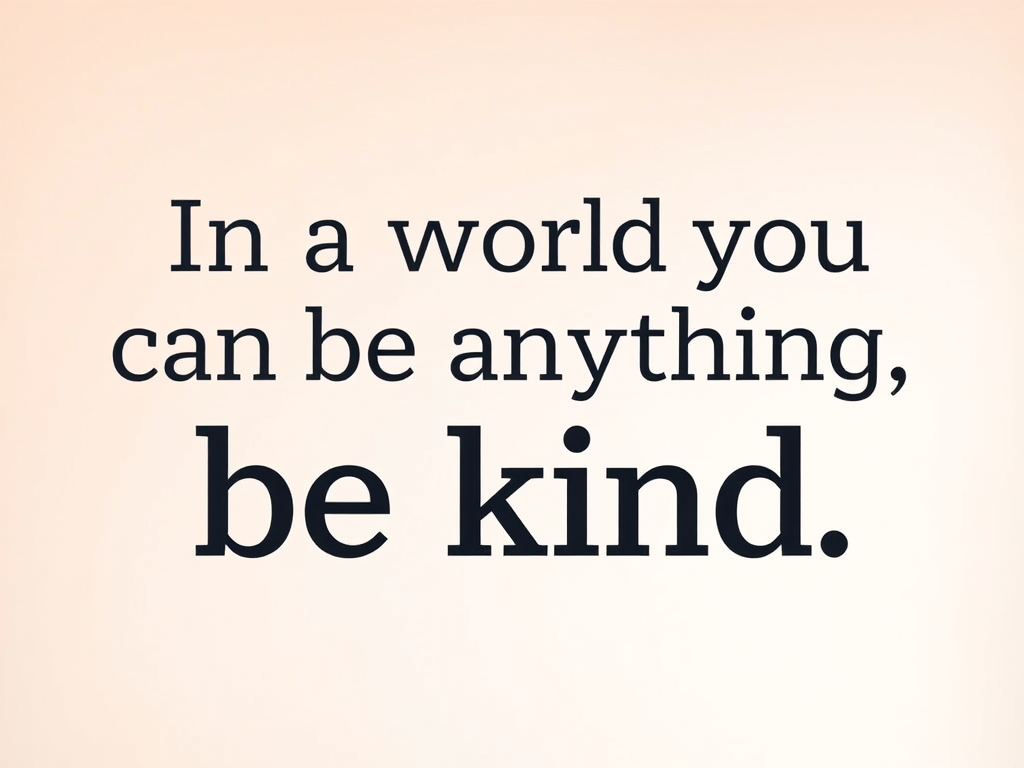
A quote encouraging kindness in a simple, elegant font on a light background.

Embrace Kindness: New Year’s Resolutions for 2025

Photo by Matheus Bertelli on Pexels.com

Who Set a Resolution for 2025? 🙋‍♀️ 🙋‍♂️

Did you set a goal or resolution for 2025? According to the Pew Research Center, the younger you are, the more likely you are to establish a resolution. Last year, about half (49%) of the adults, 18-29 years, made at least one resolution. That dropped to ⅓ (31%) of adults, aged 30-49 years, and for those over age 50, only about ⅕ (21%) of this age group sets New Year’s intentions. 

Yougov.com reported similar statistics for last year. This organization’s polling further revealed that by March 2024 nearly ⅔ (70%) of those adults who set resolutions had either mostly or entirely stuck to their goals. Not surprising, most resolutions, according to both PRC and Yougov, had to do with either health, such as exercising more or eating healthier, or wealth, such as saving more money or paying down debt. 

Establishing resolutions around improving one’s health or one’s financial security are certainly worthwhile endeavors for which I wholly support. However, I would like to put forth this idea–whether you do or don’t make New Year’s resolutions–for spreading seeds of goodwill, kindness, and simple decency. While this is a less specific goal–and flies in the face of those who argue for SMART (specific, measurable, achievable, relevant, and time-bound) goals–I would argue that setting a daily intention to plant one seed kindness is also SMART and smart. 

Photo by Polina Kovaleva on Pexels.com

Consider This . . . 🤔

The following quote by William Arthur Ward is often shared at the start of New Year’s that says: “I have the opportunity, once more to right some wrongs, to pray for peace, to plant some trees, and sing more joyful songs.” 

I believe this quote is worth considering now as social media outlets and people of influence have made it socially acceptable to bad-mouth, malign, and verbally abuse others with the intent to create division, discord, and derision. In fact, I think Ward’s decades old statement can be turned into actionable goals, a couple for which I have reworded for the purpose of goal implementation. These include: right some wrongs; pray for peace, plant some seeds, as well as celebrate and share joy.

Right Some Wrongs. This goal is simple. When you do something wrong, own it, apologize for it, make whatever amends you need to make, and learn from it.  We all make mistakes, unintentionally say something hurtful, or do something that upon hindsight wasn’t the best choice. Instead of acting like it didn’t happen or feeling a sense of self-loathing for doing it, do something about it.  Sure it may not be easy, and you may have to swallow your pride. However, in the end, both you and the other person(s) will feel better and/or benefit.

Pray/meditate for Peace. Again, this is another simple goal that takes minimal effort. Spending five to ten minutes per day contemplating peaceful actions for the day, praying for guidance for world, national, and/or local political leaders, or focusing on any other forms of peace you would like to see in the world is neither time-consuming nor hard. The world needs more peace warriors, so why not bless it with more peaceful words, prayers, meditations, thoughts, and altruistic actions.

Plant Some Seeds. Random Acts of Kindness (RAK) Foundation, started in 1995, has done an excellent job of promoting kindness.  Their motto, “Making kindness the norm ♥ ️,” I would argue remains relevant 30 years later. This can definitely fit into the SMART criteria as it is specific, measurable, achievable, relevant, and time-bound. Do and/or say something kind, helpful, and encouraging, every single day.  It’s that simple.  Even if you wake up on the wrong side of the bed, doing something for someone else has the power to not only positively affect that person, but that goodwill will fan out across a sea of souls unseen to you. As an added bonus, you will most likely feel better as well. If you’re at a loss for ideas of kind actions to implement, visit randomactsofkindness.org for scores of suggestions. Acts of kindness can create ripples of positivity on the troubled waters of life; they can be balm for a bruised and battered soul.

Celebrate and share joy. If you’ve ever had a serious illness, you know all too well the realization that can dawn on you for taking for granted those so-called “normal days” of life and health. Therefore, why not celebrate, savor, or at the very least, acknowledge (and perhaps enjoy) an average (or not-so-average) day of life? You have one precious life–that’s it–so pay attention to it. Share a “dad” joke, shake or hold a hand, pat another person the back, hug a friend, stroke your pet’s soft fur, eat that piece of cake, have coffee or tea with a friend, take a walk in the sun, smile more, frown less, take an interest in the person from whom you buy that morning cup of joe. . . . In other words, step away from the screen, from social media, and streaming/gaming services.  Not that there’s anything inherently wrong with them, but life is not lived on screen.  Even in this hyper-connected world, I can’t imagine anyone, nearing the end of their life, wishing they had spent more time with Facebook. 

Photo by Anna Tarazevich on Pexels.com

YOu can make a difference this year! 🫶

Whether you’re part of the statistics that chooses to set New Year’s resolutions or not, we can all make the choice to: right personal wrongs, pray for peace, plant seeds of positivity, and/or celebrate/savor the joy of being alive. These are not difficult tasks, but rather they are simple actions that possess potential opportunities to send forth warming rays of goodwill, tolerance, and decency in a world clouded over with ill will, acrimony, and disrespect. While your actions may not make headlines, you can be sure that one good act begets another. And, that, my dear Reader, can indeed make a difference. 

Happy New Year! 

Conquering Perfectionism: Tips for a Balanced Life

“Perfectionists strive to never make mistakes. Excellence is striving high but offering yourself grace for mistakes made and things you don’t know yet.”–Sharon Martin

Photo by RDNE Stock project on Pexels.com

imperfect pressure 😰

I watched in horror before school began as a student began pulling at their hair so hard, strands of it landed on the table. I quietly walked over to offer help/support. The child was a known perfectionist and quickly angered if they were unable to complete their work with total accuracy. As it turned out, they were completing math homework that was due at 8:00 a.m., which was less than ten minutes away. It was homework they had procrastinated completing and were feeling the pressure of not having the time needed to complete the work “perfect.”  

As a teacher, I encounter both students–and adults–that appear to strive (either intrinsically or extrinsically), for “perfection.” However, the idea of perfectionism is a human-construct. When we look at the natural world, we can see multiple examples of this.  Think of any three-legged animal you may have encountered.  One could argue that those creatures are not “perfect” specimens, but they are still able to function “perfectly.”  Another example is the number of plants that are classified as “imperfect” because they do not have both the male and female parts needed to produce flowers.  However, through adaptation, they are able to produce flowers.

Photo by Fox on Pexels.com

Intrinsic vs. extrinsic “perfectionism” 🗂️

Perfectionistic behavior in humans can manifest itself in various ways. So-called “perfectionism,” for some, can be intrinsically-driven. These are people who hold themselves and their work/performance to higher standards. They are self-motivated and often view mistakes as setbacks from which they can learn.  Their goals are realistic and achievable. Overall, this type of “perfectionism” can be healthy unless it evolves–either from internal or external forces–to an unhealthy, maladaptive state.

An “unhealthy” state of perfectionism can often be attributed to others–cultural and/or societal cues, well-intended friends, or even family. In fact, think about how often the word “perfect” sneaks into day-to-day interactions and conversations.  Even sports’ analysis is rife with its use of “perfect”–perfect pass, perfect catch, perfect save, perfect pitch and so on.  Similarly, from many outward appearances, one could argue life rewards those who are “perfect.”

Unfortunately, perfectionism can become problematic when people begin to set standards that are extreme and often unattainable. This can lead to a sense of “failure,” a constant feeling of stress, and/or develop procrastination/avoidance habits because the tasks/work can seem so overwhelming because it can’t be completed “perfectly.”  Perfectionism can reduce feelings of joy/happiness, diminish one’s self-esteem, and often leads to burnout. It is worth further noting that perfectionism can sometimes evolve as an extension of anxiety, OCD, ADHD, and/or depression.

Photo by energepic.com on Pexels.com

Downside to perfectionism 😫

Perfectionism, when left unchecked, is beyond “trying to be your best.”  It’s more about setting standards that are so high, they are either difficult to maintain or unrealistic to achieve. Many people think that perfect work/performance is the only way to be accepted and/or valued, often because they have a fear of not being good enough or worry about how others perceive them. 

In particular, I have noticed that students (and adults) with perfectionistic tendencies place extreme amounts of pressure on themselves to perform “perfectly.”  Then, if their work/performance misses the high-mark they have established in their mind, their self-talk becomes highly critical and often leads to self-loathing that can spiral into depression and harmful coping mechanisms.  Sometimes, this need to be perfect can spill over into their relationships in which friends and acquaintances who don’t meet “perfect standards” are berated, belittled, and shamed for not having the ability to perform at a specific level.

Photo by Christina Morillo on Pexels.com

Reframing the way we talk 🗣️

What can be done about this?  One important step that any of us can take is to reframe the way we talk about performances.  Rather than being quick to say, “that was perfect,” consider focusing on acknowledging/praising the effort or the process. This is especially important for parents or anyone working with children and teens; however, it is also equally important in the work setting or within close relationships. For example, instead of saying that a presentation is “perfect,” focus on the process.  “Your presentation was so clear and to the point. Tell me about how you came up with that idea.” The point is that we bring harm to others when we foster the myth of perfectionism.  

Proactive practice and tips for 📋overcoming perfectionistic tendencies

I’ve gathered several tips from a wide array of sources as well as a few anecdotal tips I have observed students and/or adults employ to combat perfectionistic tendencies.  Even if you are not battling perfectionism, per se, some of these tips are overall proactive practices for a healthy work/life balance.

  • Become aware of perfectionist tendencies, and reduce self-imposed pressure. Sure, you could spend hours crossing every t and dotting every i, but after a certain amount of, there is a diminished return on time invested.  Sometimes, it’s okay to complete the task well (read: not “perfect”) in a reasonable amount of time
  • Break a big job into smaller tasks, and habit bundle in order to avoid procrastination. If the thought of a task is overwhelming, break it down into smaller tasks spread out over several days, and “bundle” it with something you enjoy doing while completing the task or afterwards, i.e. Instead of cleaning the entire house, commit to cleaning two rooms while listening to your favorite playlist or podcast. Then repeat the process with two more rooms at another time.
  • Celebrate small successes and praise yourself.  When completing a step of a major task/job/assignment, take time to acknowledge and feel good about each completed step. 
  • Limit your time on task(s), and focus on meaning over “perfect.”  See the big picture/goal, so that you can be less perfect about some things and focus more on the overall, most important goal.
  • Acknowledge that “perfect” is a human construct, and reframe how you talk to others about work/skills/projects. This is one that takes practice and awareness due to how easy it is to interject the word, “perfect” when acknowledging/praising one’s job.
  • Allow yourself to make mistakes, and view them as learning opportunities. This is a big step towards a more healthy mindset. We all make mistakes, and they provide important lessons that can potentially impact future work.
  • Cut out negative influences and accept/seek constructive feedback. While it may not be completely possible to avoid those who place unrealistic expectations on you or others, it is possible to ignore those messages and seek advice from mentors who truly have your best interest at heart.
Photo by fauxels on Pexels.com

Final Thoughts 🤔

Coping with perfectionism can be challenging, especially when family, friends, and/or other outside influences may be sending other messages.  While it’s good to have high standards for ourselves, those standards should not be at the expense of our mental health and well-being. Finding a more balanced approach to work/performance can increase our peace of mind, overall well-being, and give us permission to live and work with a bit more grace and kindness towards ourselves and others. 

The chipped teapot: Seeing our “imperfections” for what they really are

“It’s made me realize that imperfect is perfectly comfortable to me. Whether it’s a city or my apartment, I feel most at home when things are somewhat flawed.”–Hoda Kotb

Chipped, but not broken.

I’m a Little TeaPot 🫖

I picked up the teapot.  It had a chip on the top of its deep navy shape. I could feel how simultaneously sad and angry I was.  The chip was my fault.  I had dropped the lid and broken a piece off revealing the original white unglazed pottery underneath.  

Suddenly, the spiral began.  Why am I such a clutz?  How could I be so stupid? What is wrong with me that I can’t simply hold on to a lid in soapy water?  Way to go, Steph.

I am familiar with that inner critical voice demanding so-called, “prefection.”  That voice is full of all of the things I should do, and it also lists all the ways I fail and fall short.  It is the voice that can sometimes make me cry when I sense I have let someone down or dropped the ball on something I “should” have done. 

Photo by Moe Magners on Pexels.com

coping skills 🥸

In my younger years, I tried a variety of coping mechanisms to quell that demanding, perfectionist voice. I attempted to ignore the inner critic, but until I was wise enough to know the difference, ignoring sometimes led to overlooking those helpful, intuitive signals.  I also tried projecting a big ego full of confidence to hide that voice of doubt–which, I quickly learned, was a sure way to epically fail.  Of course, there were the tried-and-not-so-true methods of numbing that critic with overeating, over drinking, or even overdoing, but that only made me more miserable. 

Listening to that inner critic has also led to procrastination. For example, if I know a specific big job/task needs to be completed, I can become paralyzed from completing it because my inner critic states it must be completed in a certain “perfect” manner, making the task seem more overwhelming than it is. This paralysis can lead to shame, guilt, and self-loathing because it points to “another failure” when left undone. 

Other times, it’s not so much about procrastination as much as it is that I am managing a wide array of interests, so I get side-tracked from one project to work on another. Nonetheless, focusing on those “other interests,” instead of the “one-big-thing,” can also instigate self-criticism because, “Why can’t I be more focused and stick to one thing?” 

Surely, there are others who fight this battle of perfectionism.  Right?  Based upon all of the various titles of best selling books centered around the topic of perfectionism, I certainly must not be alone in my battle.

A bowlful of encourage-mints!

Letting go of the Perfectionism script 📝

However, with age, my inner gaze, like my own vision, has changed. Letting go of perfection has, to a certain degree, been a natural part of the aging process.  Aging, and the life-wisdom that comes with it, empowers me to more closely see the reality of situations. 

For example, while writing this piece, I picked up an individually wrapped mint to pop in my mouth to allow it to slowly dissolve as I write.  Unfortunately, when I picked it up, I dropped the mint on the floor.  My first voice said, “Way to go, dork.  You broke the mint.  Now, you’ll end up crunching it, rather than slowly letting it dissolve.”  Fortunately, my wiser, older voice swiftly pointed out, “Now, you have two mints! Twice the enjoyment!”

Of course, this is a simple scenario, but it leads to my next point.  Learning to let go of the narrative of perfection is difficult, and it is more of a process than a destination.  Here’s the thing though.  My beautiful, albeit chipped, navy tea pot still works.  It still steeps my various teas perfectly, and it pours without spilling a drop. All I have to do is turn the lid, and no one has to see the chip. Thus, learning to turn, or flip, the narrative of that inner critical voice demanding “perfections” is likewise a great tool.

While there is nothing inherently wrong with setting high personal standards, leaving wiggle room for what is truly acceptable, is a much less stressful approach. It also helps deflate the bubble of shame often attached to rigid standards when we allow for a less-stringent approach.  

Photo by Karolina Grabowska on Pexels.com

Flawless 😎

Another strategy for releasing perfectionism’s grip is to observe that many of our so-called “personal flaws,” when viewed from a different perspective, are actually strengths.  For example, I might leave one task undone for a longer than “it should be” time period, but that is typically because I am pursuing a creative endeavor such as writing, cooking, or even planning how I will teach a concept to my students.  What’s wrong with that?  Like you, I also wear many hats, so why shouldn’t I give myself grace to focus on one task without pressure to do all tasks “now.”

The more we can learn to adapt an attitude of grace and self-acceptance the more likely the tentacles of perfectionism will begin to loosen.  By embracing our many strengths and talents, we can also feel the weight of shame lifting like a dark cloud shattering as sunlight breaks through. For example, in my own life, I am not the early bird at work in the morning, but that’s because I am a morning person.  I spend several hours completing numerous tasks at home before arriving at work, such as writing, exercising, grading papers, and so on.  Therefore, why should I feel ashamed of my productivity?  

Another skill that has also come with age is learning to focus less on so-called mistakes, and instead, making a point to respect the fact that any time I make a mistake, it fosters my own learning. Mistakes are, in reality, a path to learning to do something better and a tool for continuing to hone a skill.  One example of this was when I was adapting an old family recipe for pound cake to a gluten-free variation. I botched that cake twice before finally figuring out the best way to make it.  Even now, I continue to refine and improve not only that recipe, but also my own technique for baking gluten-free. It is through this acceptance and openness to allowing for mistakes that growth can occur.

Flip the narrative, like I flip the lid around on the teapot.

MUlishly imperfect ⭐️ 💫 🌟

In the end, that inner-critic with its attachment to being perfect is misleading and false. One look at nature reveals anomalies, asymmetries, and even accidents are all part of one big beautiful creation. 

Consider the mule.  It is the offspring of male donkey and a female horse.  It’s not a perfect horse, and it’s not a perfect donkey.  Instead, it possesses its own unique imperfect–some might even say, mulish– vibe, and so can we. 

While focusing less on our so-called flaws and more on strengths, leaving wiggle room for plan B (or C and D), and remaining open to the lessons of a mistake, may not lead to perfection, it sure can lead to a much more peaceful, approachable, and manageable way of living. It’s not easy, and it requires patient practice in the pursuit of learning to let go. However, with continued practice, we can begin to let go of that “perfect” narrative and become much more at ease with the “imperfect.”

Photo by Leeloo The First on Pexels.com