A Quieter Resolution for the New Year: Listening, Learning, and Loving Without Agreement

“When we listen, we offer with our attention an alms far more precious than anything else.”— Simone Weil

The Season of New Year’s Resolutions—and a Different Invitation

The ritual setting of resolutions for a new year is a ubiquitous January practice. Gym memberships flourish, trackers are checked and rechecked, meals are planned and prepped all in the hope of self-improvement. One quick scroll of social media offers a wide array of options for  workouts, diets, and methods of accountability. While health resolutions matter, our culture needs a quieter resolution–one that prioritizes listening deeply, learning humbly, and choosing neighborly love without agreement.

What We Miss When We Stop Listening

One cultural trend I have noticed–and am often guilty of myself–centers around listening, or a lack thereof. Many of us talk past one another, make snap judgments, and curate words of certainty. Conversations become overlapping monologues–ears present, but attention is elsewhere. In doing so, we miss the quieter forms of communication: facial expressions, postures, and the subtle cues that reveal complexity and lived experiences. When we rush past these, we lose the opportunity to understand another person, and we deny ourselves the opportunity to be changed, even slightly. Making time for focused listening does not mean we are agreeing with another person’s position.  It is choosing understanding over reflex.  

Learning to Listen as a Daily Practice

Learning to listen well is an acquired skill, at least for many of us, myself included, but it is attainable. Engaged listening requires more than ears; it requires intention. It asks us to pause before responding to another person, to consider what was said, and to ask a thoughtful question, rather than immediately offering a counterpoint. Asking a thoughtful question or two can increase understanding of another person, especially if we are willing to sit with discomfort if their viewpoint challenges or counters our own. This type of listening takes time and requires humility. If you are like me, you won’t be perfect–but it is a worthwhile endeavor.

Listening Without Agreement

Frankly, it is easier to relegate people based on our assumptions.  It is inconvenient to take time to ask questions that might alter our long-held beliefs.  However, by listening and respectfully seeking understanding, we incrementally begin to learn more about an alternate point of view without necessarily agreeing with it. 

Lessons from the Classroom About Understanding Others

 This is an ongoing practice for me as a veteran educator separated by generations from my students, and even many of my colleagues, in a high school setting. I have entered numerous conversations over the years in which either I had assumptions about a situation involving a student, parent, or peer or they had assumptions about me. Those conversations did not always lead to agreement, but they almost always led to greater understanding–and that is the difference that mattered most.

What It Means to Love Our Neighbor Today

By taking time to listen and ask questions, we are putting into practice a foundational belief of most world religions and philosophies: “Love your neighbor,” emphasizing respect, compassion, and doing non-harm to others. This Golden Rule practice is neither affectionate nor approving. It is also not remaining silent when faced with harm. In today’s world, “loving your neighbor” can be as simple as showing restraint in how we speak–refusing to reduce a person to a single action or belief. Practicing the Golden rule can also be as simple as not reducing a person to a single belief or action. Loving others is simply a daily choice. It is a posture that can feel costly, especially when it would be easier–or less stressful–to walk away or erupt into outrage. 

Small Ways to Practice Kindness in Everyday Life

Standing in neighborly love takes practice, and it doesn’t have to occur in grand, sweeping gestures. We can begin to put into practice in small, cumulative ways that can still have a bigger impact than we realize.  During gatherings of friends and/or family, try listening longer than feels comfortable to that contrarian relative/acquaintance.  During community, work, or church meetings, instead of immediately refuting a counter point-of-view, respond with curiosity rather than certainty. While interacting with online spaces, try choosing kindness when sharpness would be easier, even if the kind act is not to respond at all. We won’t always be perfect, but the more we practice, the more natural it becomes.

A Resolution That Doesn’t Fit on a Checklist

When setting resolutions, health coaches often ask clients to create goals that are SMART: specific, measurable, achievable/attainable, relevant/realistic, time-bound/timely. Setting a resolution to listen, learn, and “love” others may not, therefore, appear “SMART.” Nonetheless, it remains an attainable and relevant practice through small, incremental steps. 

What Might Change If We Listened First?

Consider what might change if we listened a little longer? If we attempted to learn more than we defended? If we treated others the way we would want to be treated? If we “loved” more than we proved?  

A Practice Worth Returning to All Year Long

These actions are not about “perfection” with a clear-cut checklist that offers overnight transformative results. Instead, they are more about presence and intention–the intention to listen, learn, and love others. It is a resolution that does not have to end with guilt in February; rather, it is a practice that can be picked up and practiced again and again throughout this year and years to come. 

“You don’t have to agree with someone to treat them with dignity.” 

As the year begins, may we all strive to engage in a more neighborly discourse and actions. 

Be Good to One Another: On unseen suffering and the quiet work of kindness

On a winter morning downtown, a moment of waiting becomes a reflection on mental health, unseen suffering, and the quiet work of choosing kindness in a fragile world.

A Morning at the Intersection🚦

It was a cold, cloudy Saturday morning. I was waiting for the traffic light to change at a major downtown intersection.  All around, Christmas decorations, lights, and baubles sparkled as people dressed for a special occasion hurried towards the city’s arena. I wondered about the unusual sight of numerous people on the sidewalks at this time of day. With sudden clarity, I realized it was the university’s December graduation as groups passed in caps, gowns, tassels, and hoods. 

When We Cannot Know, We Must Care👤

Thinking back to my own daughter’s December graduation, I marveled how life marched on. Groups of people smiling, nodding, waving to one another, braced against the cold, hurriedly moving in a line like train cars linked together on one track bound to the same destination. Recent events came to mind, and I pondered the idea that surface appearances often bely the hidden interior lives of others–a reality social media has exacerbated. Suffering can be tucked away into hidden pockets so that even those closest may not see or know the hidden torment that lurks inside another human’s heart.

Why Unknowing Requires Care ❤️‍🩹

These groups of families, friends, and loved ones believe they know one another. And maybe they do … but maybe they don’t. This precise unknowing is why we need to care for one another–even when it seems futile. Many people carry burdens, traumas, fears, and anxieties that they either don’t share, or don’t know how to process, much less put into words. It is not necessarily a failure; it is part of the human experience that is difficult to understand. We must acknowledge that we may never truly know another person–even those closest to us. Thus, we must offer care, or at the very least, small kindnesses, to others.

“Be Good to One Another” 🫂

I continued to watch in fascination, lost in rumination, as more and more people, dressed in their finery, flowed out of the parking garages on either side of the traffic light. A long-ago, beloved priest’s words came to mind as I continued to watch and wait. “Be good to one another,” he would say at the conclusion of each church service. His words were simple, but their implications were profound. 

What kind of world would we have if more people were simply “good to one another”? If we listened to one another without trying to “fix” anything–personally, this is a hard one, and I suspect I am not the only one. What would happen if we checked in more frequently with another person, even if it feels awkward or tense? What if we responded with more gentleness, kindness, or at the very least, decent courtesy, even when we are tired, rushed, or unsure? Choosing deliberate actions that are kind or respectful does not require insight into another person’s pain, but it does require us to recognize their humanity. 

A Cup of Coffee, a Choice ☕️

I am reminded of a recent incident in which I was running through town. I witnessed an older, unhoused gentleman knock on the window of a man in a car outside of a coffee shop. The man inside of the car leapt out, yelling untold obscenities at the man who knocked. The disheveled, unhoused man kept saying, “I was just going to ask you for a cup of coffee.” The man who had been inside his car became louder and more aggressive. I felt so helpless as I watched in horror. Fortunately, a woman, older than me, walked out of the coffee shop, whispered to the gray-haired man, took him by the arm, and gave him a cup of coffee while the other man continued to spew vitriol. I was so touched by this gentle act. It reminded me of a yoga teacher from an old DVD who stated, “Go out and bless the world because the world needs it.” 

Have We Learned How to Show Up for One Another? 🫴

As I watched the graduation celebration train continue, I couldn’t help but wonder, in spite of all of their book and applied learning, they also learned how to show up for one another? Do they possess the empathy required to “bless” the world? Do they have the skills to offer patience when it is required, hold space when needed, and withhold judgment when encountering dissension or differences?  These are important questions not only recent graduates need to consider, but so do many others, myself included.

Resisting a Hardened Heart 🖤

These are big asks, I know. I try and fail regularly. Nonetheless, I cannot help but believe that striving to be a “perfect” human being matters far less than not allowing the world to harden us, so that we can respond more often with kindness. The key is remembering to reset, when we act unkindly, and try again in our interactions with one another. The world will not be healed by perfection, but rather when we lean into our interactions with one another with presence, awareness, and sensitivity.

Being a Warrior for Peace 😌

The same DVD yoga teacher also advised, “Be a warrior, not a worrier.”  While he typically said this as a point of humor during one of the “warrior” poses yoga is known for, the intent of the message has never been lost on me. Embodying the spirit of a warrior for empathy, gentleness, or kindness, is about offering hope without turning a blind eye to the harsh realities–pain, suffering, fear, or ignorance.  Being a “peaceful warrior” is about a willingness to care without expectations, choosing engagement–however you define it–over withdrawal into a cocoon of hopelessness. It is a practice of continually showing up, even in the smallest of ways.

Choosing Kindness, Again and Again ☺️

I know all too well that kindness will not save everyone, and caring for another does not come with control over another person’s choices. It is further worth acknowledging that our actions, no matter how well-intended, may not help, but it doesn’t mean we should not try. Send that text. Remain quiet and allow the other person’s pause to speak. Ask sincere questions and listen with genuine interest and without expectations. Smile at that stranger.  Offer to help another person–even a cup of coffee to an unhoused man. We never know how actions can impact another person, so please choose kindness over and over. Choose kindness.

As you move through your own daily encounters, consider an idea echoed by numerous writers: “A smile on the outside is often silent suffering on the inside.” 

I invite you, Dear Reader, to notice, reach out, and bless the world quietly with intentional acts of kindness. May we provide flickers of hope and peace in a world often determined to snuff out the light.

A Blessing at the Light 🙏

The traffic light changed.  I drove away, whispering the priest’s words to the strangers celebrating graduation, “Be good to one another. Please, please, please be good to one another above all else.” 

.

The Transformative Power of Art: A Visit to Tamarack

“Do you still feel up for going to the Tamarack?” my husband asked.

A Heavy Heart and a Planned Escape 🚘

Days earlier, we had loosely planned a day trip. The goal was to stop in Charleston for brunch on the way to Beckley, to nose around the galleries and marketplace of the Tamarack, and then return home, making a couple of quick errand stops along the way. Unfortunately, my spirit had been bruised by life, as sometimes happens, but despite feeling down, I agreed to go in the hopes it would be a pleasant distraction.

The brunch and drive along the WV Turnpike were heavy, filled with somber, clarifying conversation as my husband tried to help me clean out the closet of my cluttered heart. Tumbled, but not fully dried from an onslaught of despair, I entered the Tamarack lightened by our discussion, but still damp with distress. My intention from the outset was not to make a purchase, but instead soak up the vibrant and creative energy of the art, and by proxy the artists, who created it. 

Echoing my own feelings, Stella Adler stated, “Life beats down and crushes the soul and art reminds you that you have one.

Entering the Tamarack: A Sensory Shift

Once through the doors, I observed a crowd of people and wondered if this had been a good idea after all. Meandering to the right of the entrance, I surfed the sensory wave. Aromas of Appalachian-inspired cooking filled the air. A long line of people snaked around the fast-casual dining room as I made my way to the ladies’ room. Tamarack’s signature circular shape surrounding an open courtyard created a light and spacious feeling, even during this busy, pre-holiday time period. A multitude of glass windows, adorned with locally designed, gemstone-colored stained glass pieces, radiated an additional cheery warmth. The animated energy of visitors’ conversation added a rhythmic pulse to a popular sing-along soundtrack playing in the background. 

Letting the Atmosphere Settle the Spirit

As I allowed the wave to immerse me, I soon noticed that my breathing and pulse had slowed, tensions were eased, and the emotional flames were beginning to quell. Despite my earlier qualms, I could feel the atmosphere offering a form of calming consolation. The simple act of getting lost in the admiration and appreciation for each artist, and the art pieces they created, nourished my spirit. 

Wandering the Galleries: Beauty in Every Craft 🖼️

Allowing the natural flow of the galleries to pull me along, I took in richly detailed textiles and exquisite, delicate glass pieces. There were complex and intricate woodworks and artisanal earthen and pottery wares. Tables of WV grown and/or crafted wines, beers, ciders, soaps, candles, and one-of-kind foods/beverages were also available. 

I also stopped by the book nook, filled with locally written fictional and nonfictional books, novellas, cook books, maps, travel guides, and other artfully written materials. Additionally, there was a separate gallery, bright with ample natural light, filled with one-of-a-kind WV paintings, sculptures, prints, and photographs. 

Art as Memory: Echoes of Loved Ones 👵🏼

Allowing the current of creativity to slowly move me at will, the art grounded me into the present moment as I mindfully soaked up the vibrant energy. Different pieces evoked precious memories of loved ones: quilts of my grandmother’s attic, pieces of furniture and toys handcrafted by my husband’s grandfathers, earthen dishes that were reminiscent of family holiday casseroles, paintings and photographs of forested hills during the fall and winter months similar to those I hiked with my siblings and father as a child, and hand sewn creations that my mother once made.

The Healing Power of Art 🎨

I was further reminded of the many art therapy majors with whom I had classes all those long ago years. They often described the important role of art in therapeutic and school settings, a truth supported by research. Creating art and observing art supports mental health and well-being.  It often helps with emotional regulation by creating an outlet in which emotions can be channeled. Art is known to reduce stress and is often used as a tool for creating a greater understanding of one’s emotional atmosphere. Works of art often create a connection/conversation between the creator and viewer, which can provide an opportunity for both personal and collective healing.

Creativity as Community Storytelling

This is because art, such as the works I viewed at Tamarack, is often a reflection of the emotional landscape of a community, region, or even country. How many colorful and varied life stories, events, and personalities, past and living, were being conveyed and connected all under one circular roof? Each stitch, stroke, cut, hammer strike, click, and spin breathed life into each creation that spoke to the heart and soul of human resilience and hope.

In the Company of Strangers: Shared Wonder

As I meandered through the gallery devoted to paintings and photographs, I often lingered on works that spoke to me. Simultaneously, I overheard a pair of women, who were gazing at a section of paintings by a Mingo County artist, speaking with near reverence about their own childhood experiences in the same area. Another couple whispered with one another at nearly every piece, laughing at the memories specific images seemed to evoke. 

Spaces of Belonging: More Than a Marketplace

It occurred to me that art galleries, like the Tamarack, create centers of belonging–gathering places that celebrate the human experience. These transactional spaces aren’t just about exchanging money; they also provide an interchange of ideas and stories between artist, piece, and viewer. Investing in these community hubs is an investment in one another, supporting each other emotionally and culturally. People leave the Tamarack with a taste of what it means to be Appalachian.

A Quiet Affirmation

Standing in that gallery, soaking up all of the intriguing and thought-provoking images, an employee shook me out of my reverie by asking if I was enjoying my visit. I nodded, stating that I was feeling lighter and more grounded than when I entered. She unpretentiously declared, “Art can do that for you.”

We chatted a bit more before I moved on to look through the prints outside the gallery. I still did not have any answers to my specific concerns, but I did have a sense of peace that comes from being heard. Not that I was literally heard; rather, the struggles and joys, the sadness and celebrations, and the wonder and the awe that went into creating these pieces “heard” and spoke to my own related emotions. It was the beginning of healing and hope that often happens when surrounded by reflections of inner beauty.

Leaving with Lightness and Hope

Thomas Merton is credited with stating, “Art enables us to find ourselves and lose ourselves at the same time.” My visit to Tamarack allowed such a juxtaposition: by surrendering myself to time spent with art, my capacity for healing renewal was possible. It served as a reminder. When we immerse ourselves in the present moment, we kindle the still, small voice within, our hearts and minds steady at the sound of this whispering inner-knowing, and we can rest assured we are being held even when the heaviness of life weighs us down. Perhaps that is the gentle promise held within art: when life seems overwhelming and hopeless, the beauty of art and/or the creative process is there to offer us wings of hope for rising once more.

Embracing Silence: The Owl’s Call to Mindful Listening

A wise old owl sat on an oak;
The more he saw the less he spoke;
The less he spoke the more he heard.” —old proverb

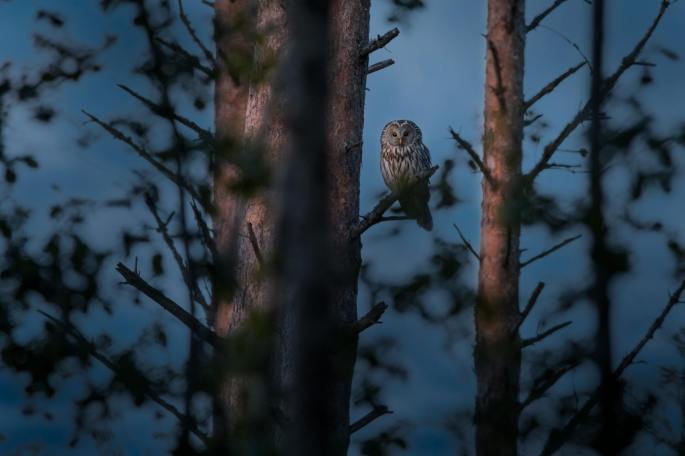
A wise-looking owl perched on a branch in a dark, wooded area, illuminated softly by moonlight.
Photo by Erik Karits on Pexels.com

Listening in the Dark 🌌

I am an early riser, typically awake before the sun. A few weeks ago, my ears perked at the haunting, penetrating call of an owl. Its “Hoo-hoo-hoo, hoo-hoo” echoed around our yard as I looked out into the murky dark. Since then, I intentionally listen for its steadfast call. It has become both a comfort and a mystery—an invitation to listen, reflect, and learn something new.

The owl’s call continues, I am certain, even when I am not listening; yet it requires my full attention in those predawn hours if I hope to notice it regularly. Its presence illustrates the importance of listening and discerning with care and purpose.

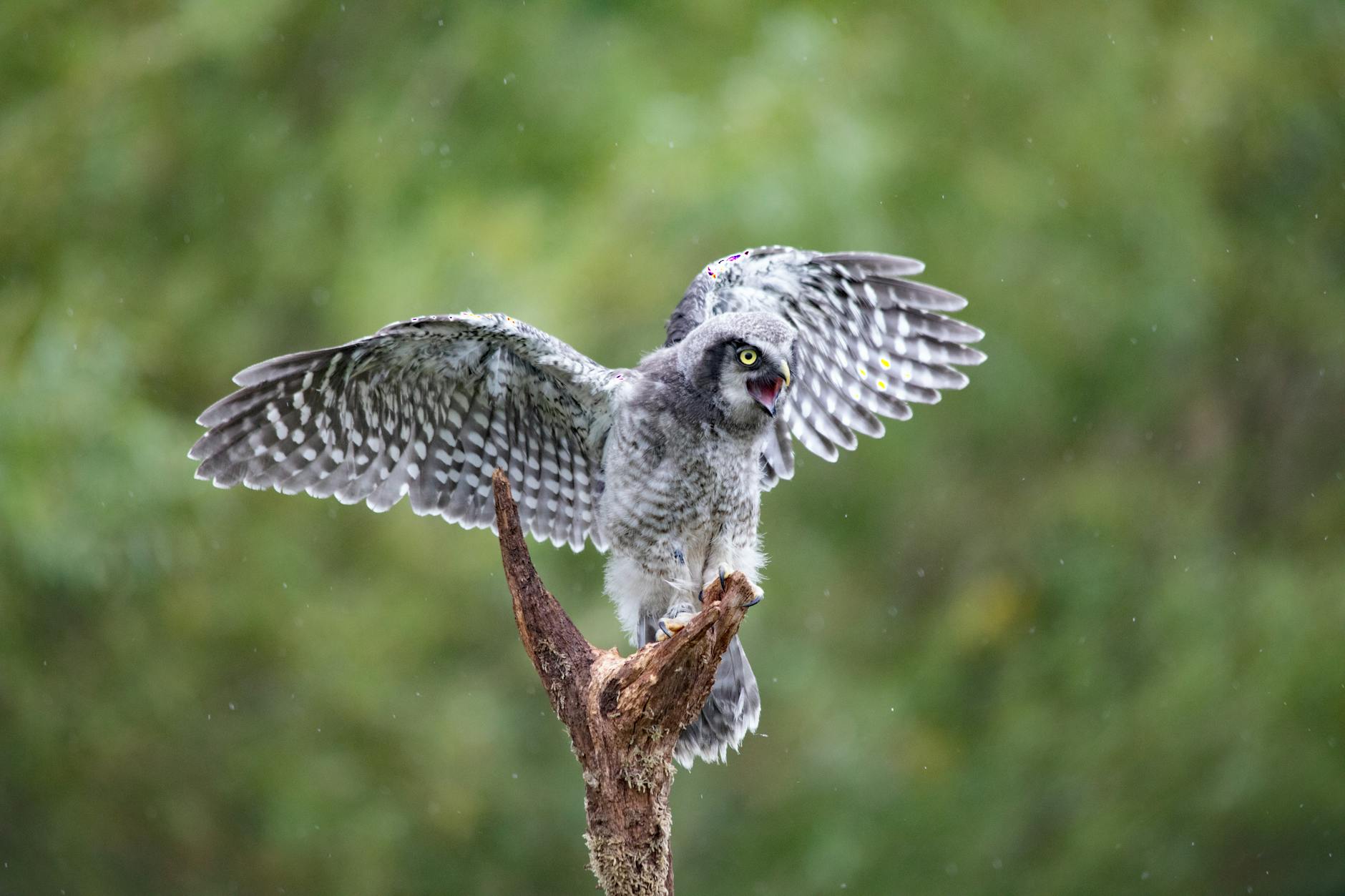
A grey and white owl perched on a branch with wings partially spread, showcasing its feathers and an alert expression against a green blurry background.
Photo by Petra Ryan on Pexels.com

What Owls Teach Us About Voice 🗣️

The autumnal hoots I hear, I learned after a bit of research, are used mostly to communicate territory and to call to potential mates. (It is worth noting that many owl species mate for life, finding another only if a partner dies or becomes separated.) Owls also use distinct calls to warn a mate, their nestlings, or even neighboring owls when danger is near. Only when the threat is imminent do they screech, hiss, or snap their beaks in defense of their young. Like the owl, we, too, can carefully choose when to use our voices amid the noise of the world, saving our own form of “screeching” for the rarest and most necessary moments.

Three barn owls perched on a branch in low light, showcasing their distinctive features against a dark background.
Photo by throughmylife_in_ INDIA on Pexels.com

Signals of Respect and Coexistence 🦉

As I read more, I couldn’t help admiring how owls communicate—practically, respectfully, almost as if to say, “I am here. You are there. Let us coexist with our shared resources and help ward off danger.” To be certain, I am personifying and simplifying their communication, but perhaps there is a lesson for us. In a world that often isn’t equitable in its distribution of resources, space, or power, maybe we can learn the art of signaling like owls—communicating truthfully and transparently without silencing others. What if we approached our conversations with presence, restraint, respect, and a shared awareness of the landscape we inhabit?

Holding Our Ground with Grace 🙏

Hearing the owl’s early morning “Hoo-hoo-hoo, hoo-hoo” reinforces the importance of holding our own ground—our principles, values, beliefs, and even compassions—without becoming loud or defensive. The owl does not insist on being seen; rather, it asserts its message with a reserved dignity. We, too, can claim our “territory” through composed conviction and fairness, standing firm without demeaning others. Faith in our tenets, like my unseen morning owl, calls us to trust what cannot be seen but can be discerned only in stillness.

A tall tree with orange leaves against a clear blue sky, surrounded by a grassy area and a house in the background.
Fall is a time of release and renewal.

Autumn’s Invitation to Adapt 🍂

Autumn is a season of release and preparation. Light softens, signaling leaves to fall as trees ready themselves for winter’s quiet work. Many creatures follow this rhythm, including the owl in my backyard adapting to the shifting season. We, too, are invited to adapt—to let go of what is no longer needed, recalibrate our priorities, and listen more deeply. The natural world thrives on balance, which is different from our human desire for “fairness.” It exists in a subtle harmony in which every being plays a role. I wonder what might happen if we focused more on harmony—the give-and-take of shared ecosystems and resources—paired with the wisdom of knowing when to listen and when to speak.

A woman in a pink hijab interacts playfully with a barn owl perched on her arm, pointing towards its face, with another owl visible in the background.
Photo by Rangga Aditya Armien on Pexels.com

The Harmony of Coexistence 🕊️

The autumn owl’s voice in my backyard is solitary, and yet it reflects community. It marks its presence while acknowledging the presence of others, including us. Coexistence, the owl teaches, requires more than hearing what others say; it requires listening to the silences. Of course, human coexistence is complicated, and life often isn’t what we would call fair.

Therefore, it becomes incumbent upon us to listen, act kindly, and withhold judgment—offering small or not-so-small acts of goodness to help restore balance. This may mean choosing gentleness, or even silence, over the need to be “right,” especially when a loved one, friend, or coworker says or posts something unkind or expresses an opinion we strongly oppose. Likewise, offering compassion instead of judgment when someone is rude or ill-behaved can shift a moment for the better, even if only because we have refused to be pulled into energy-sapping negativity.

A serene forest scene with tall trees bathed in soft rays of sunlight filtering through the branches, creating an ethereal atmosphere.
Photo by Atlantic Ambience on Pexels.com

Before the Light Returns 🌅

The owl still calls unseen in the dark predawn hours, reminding us that communication, connection, and hope often begin before the light returns. The owl does not question whether the sun will rise; it simply continues its call, trusting the rhythm of creation. Like my unseen neighbor, I pray we find the courage to speak fairly, listen deeply, and have faith in the unseen process—knowing that every voice lifted in love and fairness echoes far beyond what we can see.

Perhaps that is the heart of the owl’s lesson: when we listen more deeply, we create the conditions for fairness to grow. As I recently read, “Life isn’t fair. It isn’t, which is why people should endeavor to be more fair to one another, not less.” —Kate Quinn.

Running Toward Hope: A Marathon of Movement and Love

Every run is a work of art, a drawing on each day’s canvas. Some runs are shouts and some runs are whispers. Some runs are eulogies and others celebrations.”—Dagny Scott Barrios

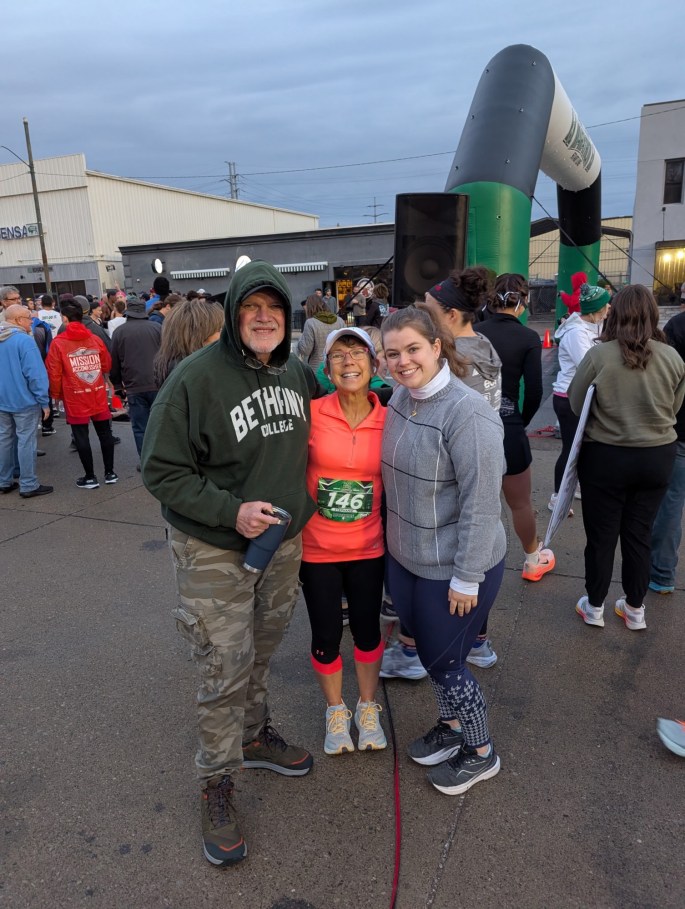
A group of three people, including a man in a green hoodie, a woman in a bright orange top with a running bib, and a woman in a gray sweater, gather smiling at a running event in an outdoor setting with other runners in the background.
Just before the start of the marathon I took time to get a hug from my two biggest supporters throughout the training process: my husband, L, and my daughter, R.

A Morning of Reflection and Gratitude 🌅

A light mist fell as an overcast gray morning began to chase away the night. I stood quietly in a throng of animated runners, taking deep breaths as reflection and gratitude washed over me. Months of preparation had led to this moment, and I felt thankful not only for my health but for the loving support that carried me here—to this celebration of movement, resilience, and connection.

Running as an Act of Hope ✨

It had been ten years since I last pinned on a bib for this distance, and my body hummed with anticipation, hope, and belief—the belief that movement is for everyone at every age, and that it is, in itself, an act of hope. I was about to embark on an emotional 26.2-mile trail of faith that became more about the people who supported me than the miles themselves.

Discovering Joy in Gentle Movement 😄

I came to running later in life, and it wasn’t easy at first. Only when I learned to approach running gently—to let go of preconceived (and societal) notions of what running “should” be—did I discover paths full of freedom, clarity, and renewal. Movement, whether running, walking, dancing, or stretching, benefits body, mind, and spirit. It brings a sense of structure to an often chaotic world and offers a feeling of accomplishment—if nothing else goes right in a day, at least I moved my body. Movement brings us alive to ourselves, our spirit, and, in turn, to the world around us.

The joy, I’ve learned, is in the doing—not in attaching to a pace, distance, or goal. Those things can be part of the experience, but they aren’t required.

A man and a woman embrace warmly in a crowded setting, both smiling in a moment of connection before a marathon.
Maddie’s, my daughter, boyfriend, Connor, flew all the way from Austin, TX to be part of this event. Together, with Maddie, he helped plan the marathon surprise of a lifetime!

Redefining What It Means to Age 🧓

As I neared my 60th birthday, I began to notice messaging that framed this decade as one of limitation. I decided instead to flip the narrative and celebrate the 60s as a decade of possibilities. Why not run into this new decade the way I ran into my 50s—with eyes and arms wide to adventure?

Training with Gentleness and Grace 😌

Since I was already running regularly, I committed to training for a marathon, but this time with gentleness. Instead of a traditional four-month build-up, I created a ten-month plan that encouraged patience, routine, and presence. Twice-weekly strength training and yoga joined the schedule, as did listening to my body and using the run-walk-run method as needed. I also focused on proper hydration and fueling before, during, and after runs. Most of all, my husband and daughter supported me from the very beginning—their quiet, everyday encouragement becoming a steady foundation of strength.

A woman running on a street wearing a bright pink long-sleeve top, black leggings, and a cap, displaying a race number on her waist.
Gentleness was a large part of the 10-month training block that led to this moment of hope and celebration.

Adapting Through Life’s Curveballs 😰

Training for a marathon brings rhythm and structure to daily life—the early morning runs, the long weekend miles that lengthen gradually, and the sweet evening stretches after dinner. But life, of course, has its curveballs: weather shifts, fatigue, scheduling conflicts, unexpected events, and bouts of self-doubt. With age, though, I’ve learned to adapt rather than resist these realities, co-creating a practical, flexible approach to progress.

As my weekend long runs grew longer, my husband and daughter often appeared—driving by, stopping to cheer, or jogging beside me for a short distance. These small bursts of love in action fueled my heart and kept me going. Training, I realized, was less about mileage and more about cultivating fortitude, flexibility, and gratitude—along with a dash of fierceness—all essential life skills carried from the road.

A group of enthusiastic spectators cheer on runners during a marathon, surrounded by autumn foliage and a partly cloudy sky.
Maddie, and my husband, John, often showed up during the last few miles of my Saturday long runs to cheer me on as Maddie is seen here doing during the actual event itself.

Race Day: A Celebration of Love 💖

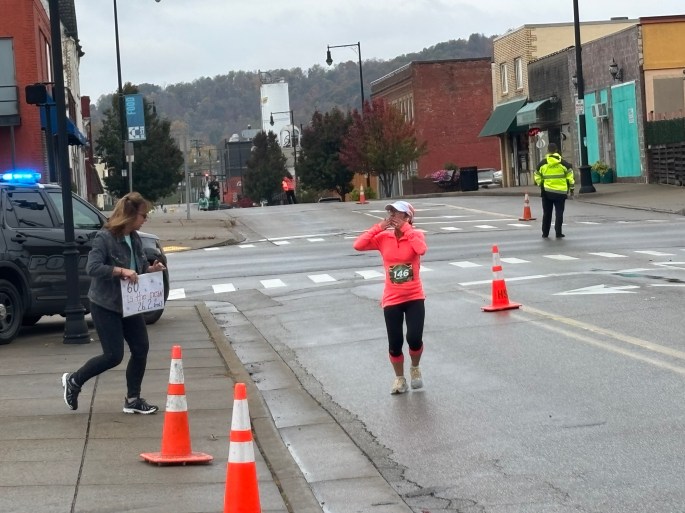
As the marathon began, the city of Huntington vibrant in energy, rebelling against the lackluster sky. Rhythmic footfalls and nervous chatter surrounded me as runners jostled for position. Warmly dressed spectators cheered, waving handmade signs against a backdrop of burnished orange, crimson, and yellow autumn trees. Little did I know that my daughter had turned this event into an outpouring of love.

Surprises Along the Course 🫢

At the start, my husband, daughter, and her boyfriend—who had flown in from Texas to surprise me—stood cheering. But that was only the beginning. Every few miles along the route, my daughter had arranged for friends, family, and coworkers to appear, waving signs and calling my name. I didn’t realize the scope of her plan until near the end, but each familiar face filled me with renewed energy, gratitude, and joy.

A female runner in a bright pink shirt crosses a street marked by traffic cones, while a supporter holds a sign nearby in a lively downtown setting.
The look of complete surprise when I see my sister, Traci, and her husband, David, around the 19-20 mile mark of the marathon. I had no idea they would show up along the route!
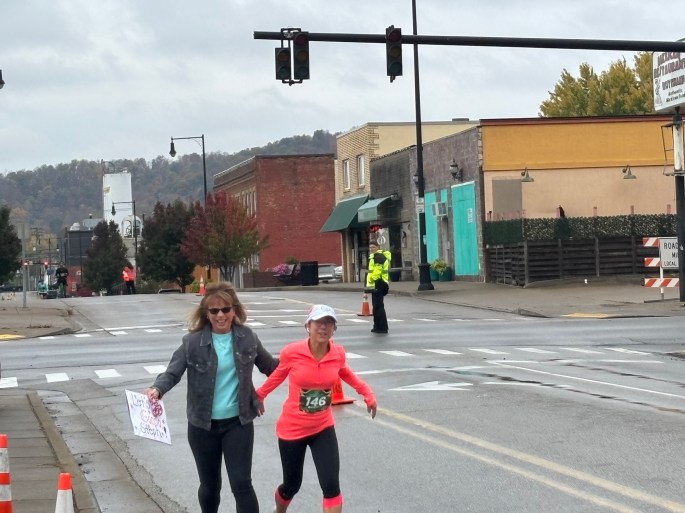
Two women running together on a city street during a marathon, with one holding a sign. They are surrounded by a lively atmosphere and shops in the background.
Of course, I had to veer off the path to give her hug, which helped uplift me over the next few miles.

Crossing the Finish Line 🏁

As I turned toward the final quarter mile, a group of race volunteers began singing “Happy Birthday” while my daughter’s boyfriend joined for a short burst of encouragement. My husband stood outside the stadium offering final words of encouragement, and my daughter met me at the bottom of the stadium ramp to run beside me as I approached the finish line. I wasn’t just completing a marathon; I was receiving the best birthday gift—a living reminder of love: a convergence of community, family, and friendship. It was a story of hope, purpose, generosity, and perseverance—the joy and power of a shared journey.

Two volunteers wearing bright reflective vests stand by a crosswalk in a park-like setting with blooming flowers and trees. In the background, a pathway leads towards a building under a cloudy sky.
This was the point, less than a quarter mile to go, when a group of race volunteers, led by an unknown female spectator and Conner, joined in to sing “Happy Birthday” to me as approached and rounded the corner to the finish line.

The Marathon as a Metaphor for Life 🪞

This journey mirrors life: we move forward by faith and grace, one step at a time, through both joy and challenge, supported by others who believe in us. That’s the power of movement—it connects us to our bodies, to others, and to something larger than ourselves. Choosing to move, to train, to keep going even when the path feels long, is an affirmation that with faith, growth and renewal are always possible—at any age.

Movement as a Lifelong Invitation 💌

Movement can take many forms: walking, stretching, dancing, or choosing to train for something big. The point is to move with intention and persistence, to embrace your own journey, and not attach to societal and social media messaging. Just move—and let movement open the door to new possibilities, both inner and outer.

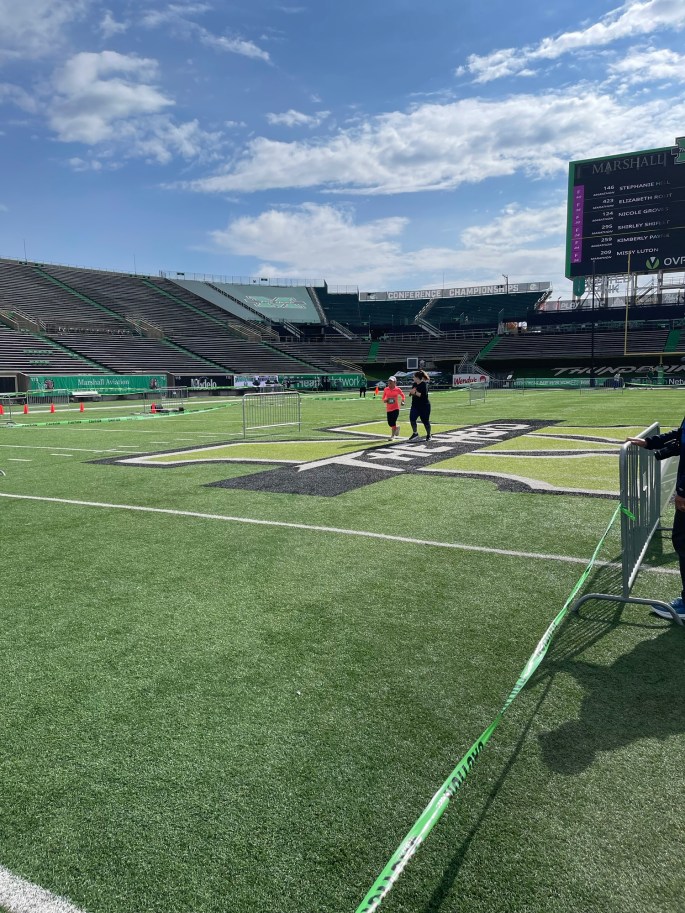
A runner crosses the finish line at a sports stadium, with spectators in the stands and a clear blue sky overhead.
Maddie runs alongside me for the last few feet, just as she did in 2015, to encourage across the finish line. Once I was close to the finish line, she dropped back behind the rope to let me finish alone. However, I really wasn’t alone. I was surrounded by a giant embrace of joy, hope, and love of family, friends, and community!!

The Joy Continues ☺️

The rhythm of footsteps, the smiles for miles, and the faces of loved ones along the route are forever imprinted in my heart—all reminders that every step matters. The marathon finish line was crossed, but the renewed sense of possibility and joy continues. Whatever your pace or path, keep moving forward—heart, mind, and spirit. You never know what acts of hope and love may be waiting for you along life’s path.

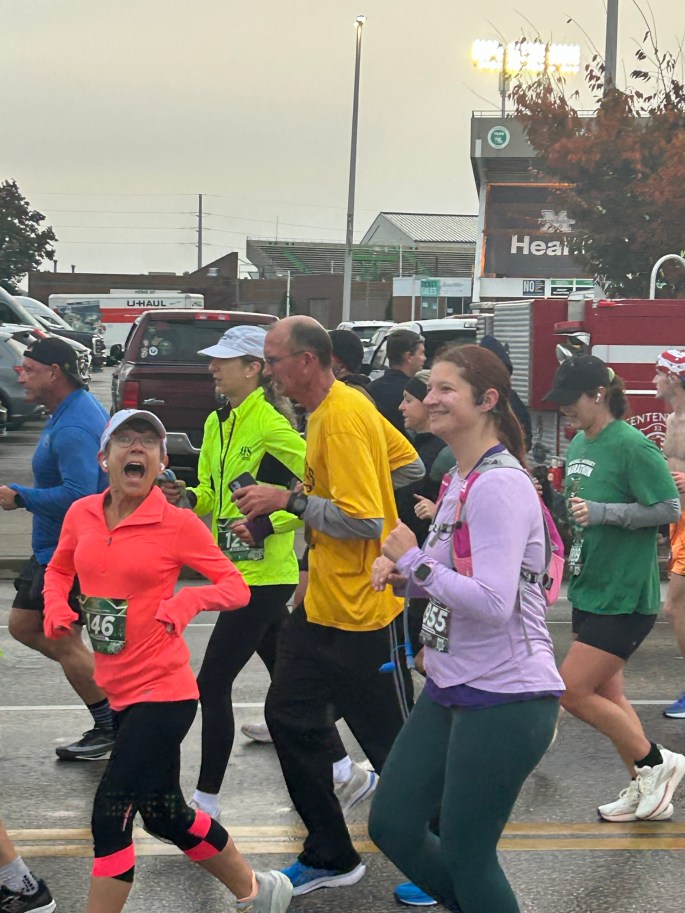
A group of runners participating in a marathon on an overcast morning, with diverse individuals wearing colorful athletic clothing and cheerful expressions.
The joy, and the journey of love and hope, continues . . .

A Grateful Heart 💜

P.S. Thank you to the countless and nameless MUM volunteers who invested hours of time to ensure the safety and success of runners, walkers, and those beloved spectators. And, an extra special heartfelt thank you to my friends and family who celebrated this milestone with me. And to Maddie and John, I love you to the moon and back.

A group of three smiling individuals taking a selfie on a subway or train, with a map visible in the background.
I wonder where the next path of adventure will lead?
An assortment of hydration and energy products for runners, including electrolyte tablets and energy gels, arranged on a wooden surface.
Shout out to Precision Fuel and Hydration for the support during this training journey! I learned a lot from your team.

Pearls of Morning: Lessons from Spider Webs and Stillness

“Heavy dew this morning and every spider web in the garden is strong with pearls of moisture…. webs wherever I look, all shining things of silver beauty.–Edwin Way Teale

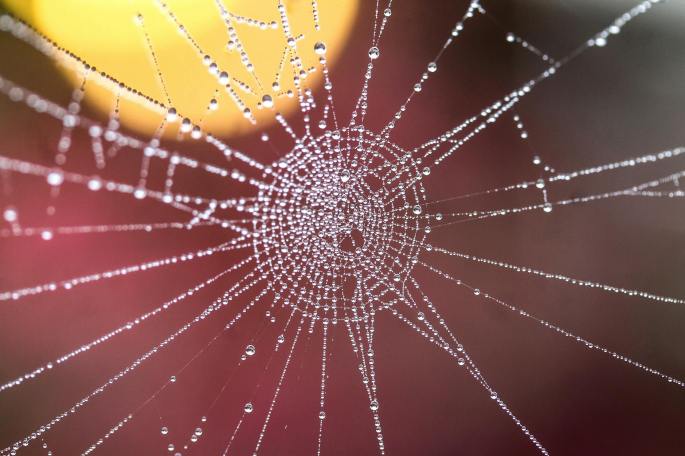
A close-up of a dewy spider web illuminated by streetlights in a quiet early morning setting, with blurred traffic lights in the background.

The Quiet Wonder Before Dawn 🌅

It was an early fall morning. Darkness still clung to the earth in a cool embrace. The traffic lights—green, yellow, red—continued their rhythm despite the empty streets. The air was cool and humid, and the hush before dawn rested easily upon the road. Pausing at the red light before continuing my jog, I noticed a spider web dappled with dew within the frame of the traffic light. I stopped in my tracks; upon closer inspection, I saw countless spider webs, draped with baubles of dew, hung from light poles and electric lines—even within the traffic lights themselves.

Hidden Beauty in Plain Sight🚦

I was awestruck by the beauty of the webs, looking ever-festive in the glow of lights—an unexpected wonder, shimmering high above me. After a few moments of appreciating the beauty, I jogged on through town, questions forming in my mind. How did they get so high? Why had I not previously noticed something so extraordinary hiding in plain sight? How many other marvels were hiding in plain sight, waiting for someone to notice?

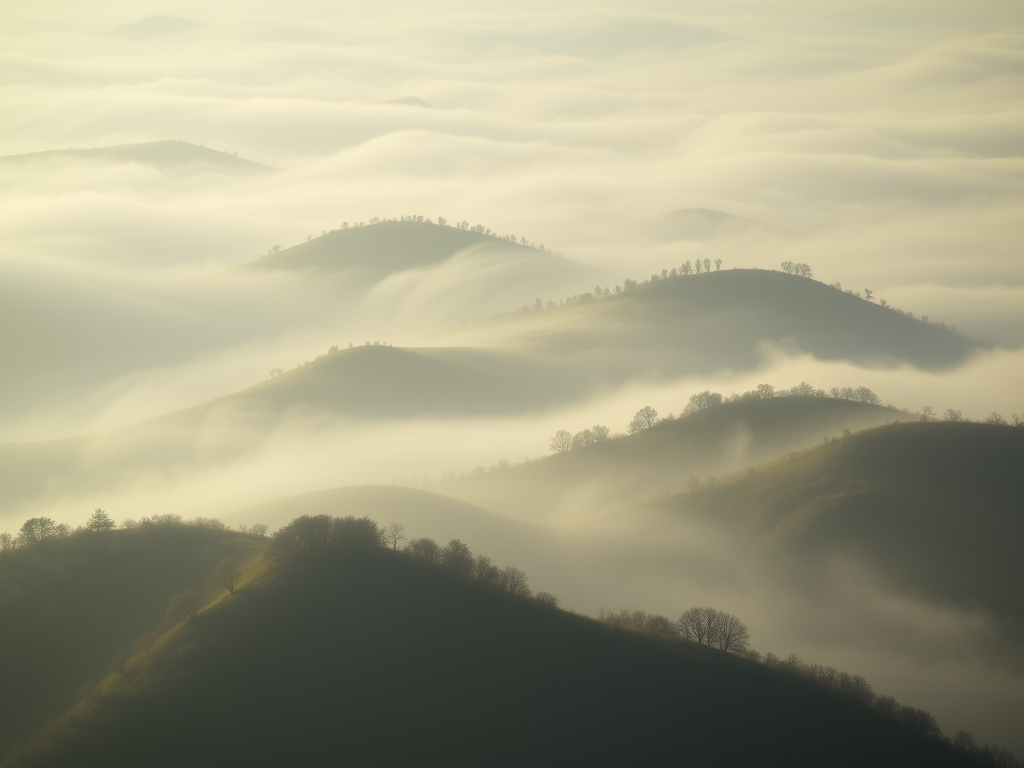
A serene landscape featuring rolling hills partially obscured by a thick layer of fog, bathed in soft, diffused light, creating an ethereal atmosphere.

When We Slow Down Enough to See 🤓

It occurred to me that more often than not, we rush through the routine of life overlooking these mini-marvels—the ballet of fall leaves chasséing from tree to stream, then pirouetting along water currents; sinuous streamers of fog tendrils meandering around hilltops; or, the multiplicity of ice crystals frosting over a car’s windshield to name a few. These wonders are woven into daily life: from the cantaloupe-colored brilliance of sunrise over the Ohio River to the glimmer of moonlight on a frost-covered lawn; from flower-like fungi blooming on fallen logs to a puppy seeing its own reflection in a puddle. Beauty surrounds us, waiting to be noticed. Like the invisible art gallery of spider webs in traffic lights on my morning jog, most go unnoticed until the light hits just right. However, when we take time to pause and pay attention, beauty will often reveal itself in unexpected yet common places, including stoplights.

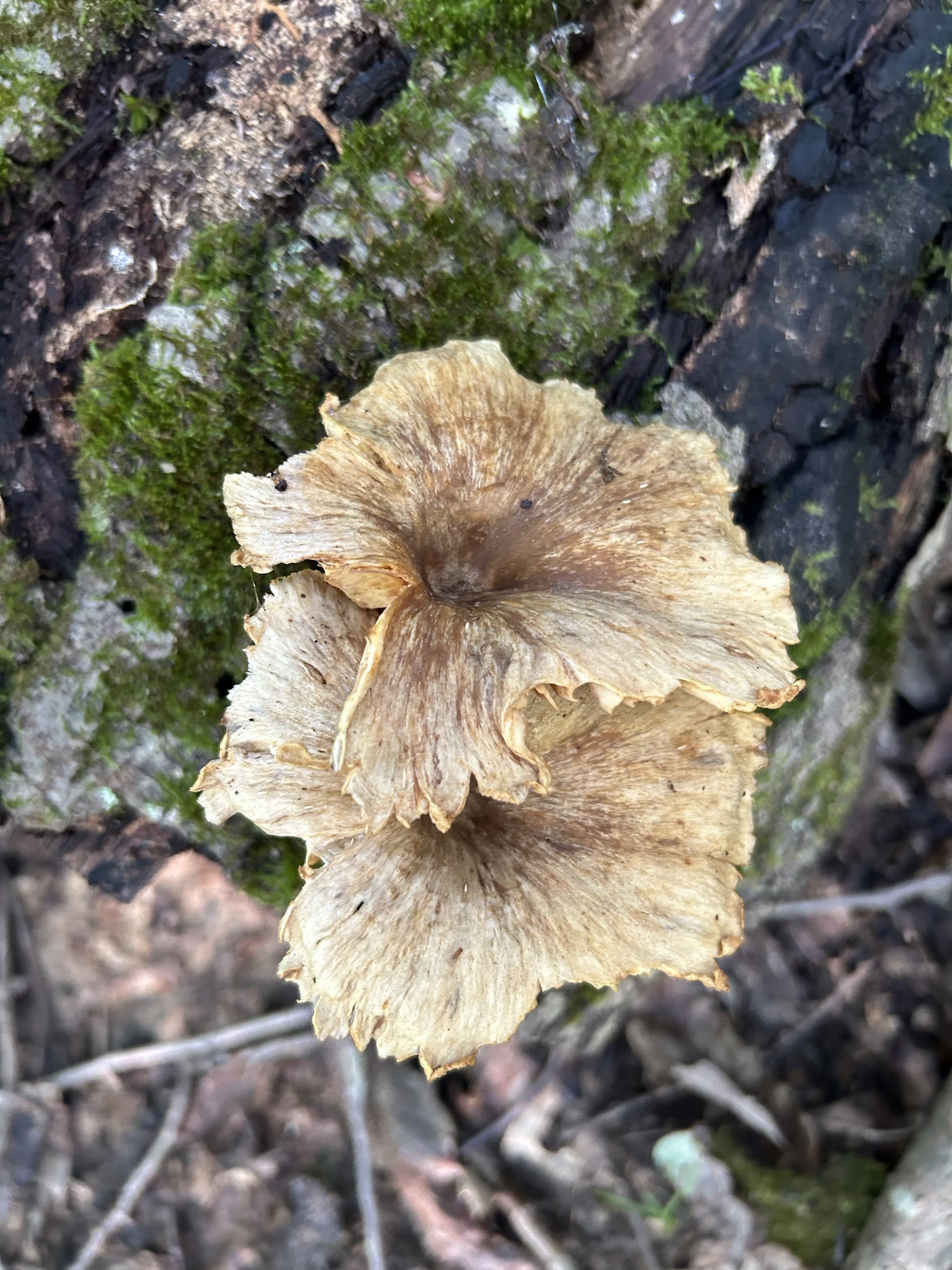
A close-up image of a brownish mushroom growing on a tree trunk, highlighting its textured surface and natural surroundings.
Flower-like fungi “blossoming” from fallen tree branch

The Power of Morning Stillness 😌

That early-morning observation turned meditation centered my day. It offered more than one lesson and served as a reminder that the morning placidity can bring a sense of calming clarity before the noise of the day. Making time for stillness in the morning, whether sipping coffee, walking a beloved pet, or sitting in prayer meditation—offers an opportunity for spaciousness at the day’s start. A moment to center, notice, reflect, and connect. Even a few minutes of stillness can offer us an opportunity to ground ourselves and recalibrate our perspective. If we grow quiet enough, we may remember that peace resides within us. That is not to say that peace is the absence of movement, purpose, or challenge, but rather it is a strong presence within us—much like the hidden strength within the delicate spider web. 

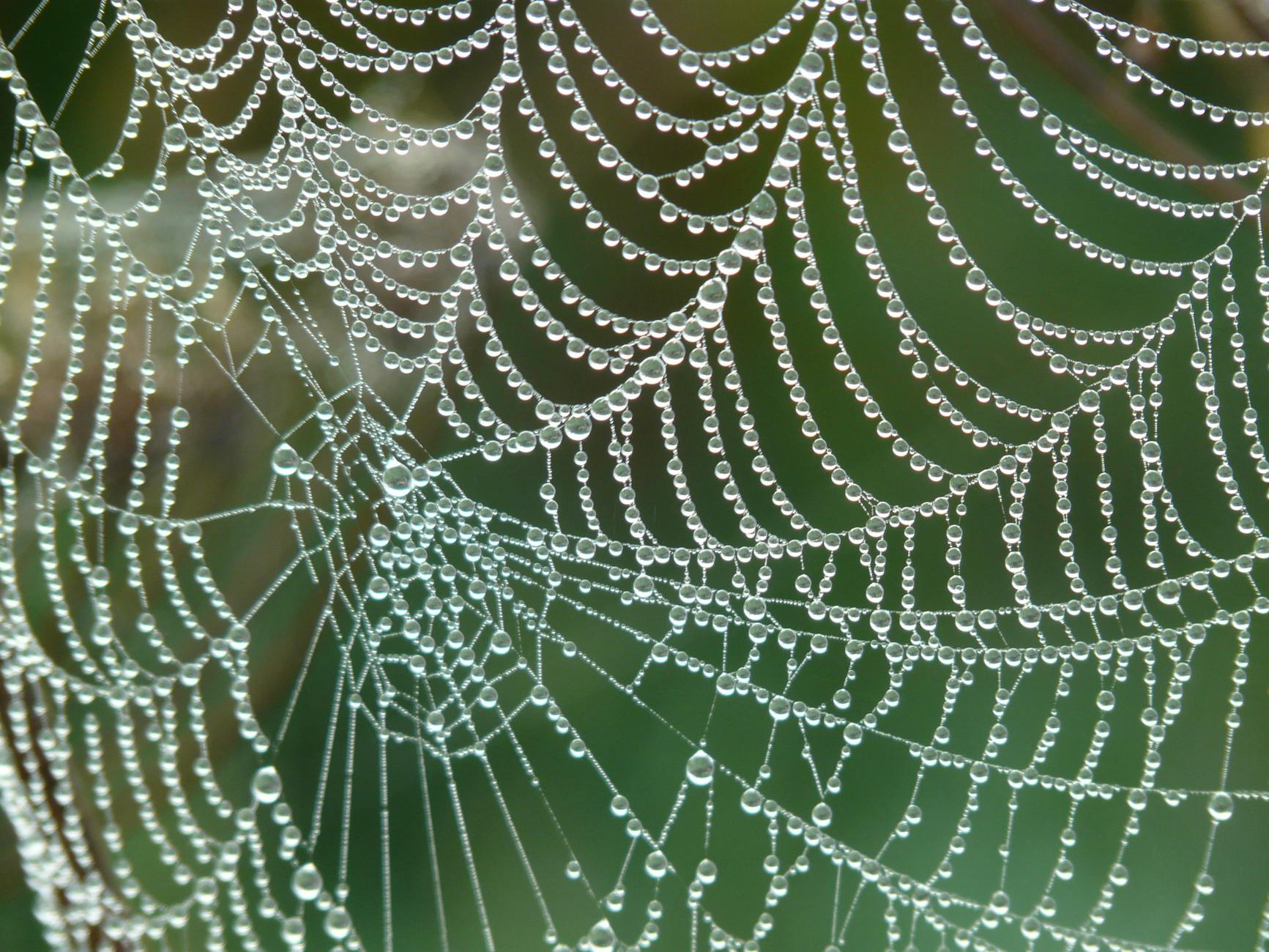
A close-up of a spider web adorned with dewdrops, creating a sparkling effect against a blurred green background.
Photo by Pixabay on Pexels.com

Lessons from the Web: Resilience and Renewal 🕸️

As I reflected on the morning jog through town, I realized that each web represented perseverance, fortitude, and tenacity–three key qualities essential for growth. Each morning, orb-weaving spiders consume their protein-rich webs to reclaim the silk for rebuilding. This ensures the new web they build in the evening is fresh, sticky, and strong enough to catch plenty of prey. Through practice, the spiders gain strength and instinctively how to rebuild after storms and strong wind.

The spiders’ resilience serves as a reminder that we, too, have the grit to rebuild after disappointments, setbacks, and loss. Like the spider, rebuilding our lives is often quiet work that begins only after we have nourished body, mind, and spirit. The spider’s persistence mirrors our own–delicate and determined–reconstructing through incremental, small steps. Life, like the spider’s web, is fragile, yet we too possess tensile strength—centered in faith—that guides us as we restore, renew, and rebuild. 

A close-up view of a spider web adorned with numerous droplets of dew, reflecting light and creating a sparkling effect against a dark background.

The Threads That Bind Us 🕷️

The spider’s web, where no thread stands alone, echoes the interconnectedness of our own lives. We are part of a collective. As the light shone through the webs, each dew drop caught the light, refracting color and seemingly creating miniature worlds. Just as the traffic/street lights played across the spider webs’ dew drops, our connected lives reflect multiple roles–friend, spouse/partner, worker, neighbor, parent, child, citizen . . . . Each strand of life possesses a quiet strength that is integral to the whole. In fact, the integrity of the web depends upon the strength and resiliency of every strand. Each facet of our lives holds and reveals meaning; together, the varied strands of our lives unite the whole, creating an array of meaningful relationships.

A close-up view of a beautifully intricate spider web adorned with dew droplets, creating a delicate display of nature's artistry in black and white.
Photo by don chowdhury on Pexels.com

Finding the Extraordinary in the Ordinary 🌃

In the end, the light changed, and I crossed the street as the sun rose, erasing the glimmer of those webs. Yet the image remains—reminding me to keep looking for the extraordinary in ordinary places. Perhaps it waits in the quietude before dawn, a pause at a red light, or the hush of nightfall. So many interlaced moments shimmer within the droplets of daily life, waiting for those willing to see. Those silky webs may vanish with daylight, but their pearls of wisdom still glimmer within me, reminding me that beauty often hides in ordinary light.  

May we all learn to look a little longer, to pause at life’s red lights, and to notice the silken threads of beauty connecting us in the quiet hours of dawn.

Embracing Life’s Unanswered Questions

“Be patient toward all that is unsolved in your heart and try to love the questions themselves. Live the questions now. Perhaps you will then gradually, without noticing it, live along some distant day into the answer.“–Rilke 

A vibrant sunrise with deep orange and golden hues peeking through soft clouds, symbolizing new beginnings and hope.
Photo by Bradley Hook on Pexels.com

When the Mind Won’t Stop Asking 😕

Those words of Rilke, written over a century ago, remind me that some of the hardest seasons in life are the ones that offer no answers—only questions that echo back in silence.

A silhouette of a person walking towards a bright sunrise, symbolizing hope and introspection.
Photo by Dom Gould on Pexels.com

Running into the Questions ⁉️

I was driving home Saturday morning after my weekly long run with a podcast playing in the background. The previous week had been difficult, and I had hoped the run would provide a reprieve from my worries. I started running well before the sun rose under the cloak of a starry sky, which served to keep my mind calm. Then, the rich crimson of dawn edged up the horizon, deepening from vermilion to the fiery orange of full sunrise. As if on cue, the monkeys in my mind began chattering—an endless loop of questions followed by equally endless, devastating possibilities. 

I tried to redirect my thoughts: “If only this or that would happen, then everything will be fine,” I told myself. The problem with this if–then principle is that it’s meant for building new habits or personal change; I can’t magically apply it to others—or to the world at large. Even after my run, the mind monkeys continued their spirals. Then a line from the podcast caught my attention, “What I think Rilke’s words are stating is that if we can learn to live in peace alongside the questions, this may allow us to witness the unfolding of the answers in some indeterminate future.” 

A hand reaching out towards a shimmering body of water under a bright sky.
Photo by Lukas on Pexels.com

An Invitation, Not a Reprimand 🙂

Of course, I had not heard Rilke’s words, so I had to rewind the podcast in order to focus on the original quote. Those words felt like an invitation to hope, rather than a reprimand for my monkey mind. To be clear, it did not feel like a promise of a positive outcome, but rather hope for a greater understanding one day. Rilke’s words seemed to affirm my questioning, as long as I let the questions simply “be,” like one ingredient in the stew of life. 

Hands holding a small, gift-wrapped box with a ribbon against a soft, patterned background.
Photo by Kim Stiver on Pexels.com

The Unsolved Nature of Life 🧐

While I cannot speak for everyone, I think many of us live with unanswered questions—and I’m probably in the camp that has more than a few. Seasons of life bring different questions, but they often center around themes of health, purpose, relationships, concern for others, and the future. It is often uncomfortable–the unsolved nature of life. We desire, like the fairy tales of our childhood, resolutions to problems in which we “all lived happily ever after.” We like knowing what is next; we desire to wrap up answers neatly and hand them over like a present. But life, as we eventually learn, isn’t wrapped in tidy endings. 

A serene landscape shrouded in fog, featuring two swans gliding on a calm body of water, with bare trees reflecting in the misty surroundings.
Photo by Karol Wiu015bniewski on Pexels.com

When Answers Refuse to Come 🤨

If you have ever encountered a personal crisis, or that of a loved one, you know the “hurry up and wait” sense of time that often accompanies these scenarios–appointments scheduled off into the distant future, followed up by more appointments with no answers, only more maybes and/or more questions or concerns. It can feel like an autumn fog settling over a town in the early morning hours. You can see outlines of various possibilities, but still not know what the future holds. And yet, even in that fog, life quietly continues. 

A chalk-drawn question mark on a black background, symbolizing uncertainty and curiosity.
Photo by Pixabay on Pexels.com

Coexisting with Uncertainty ❓

On one hand, Rilke seems to invite us to love the questions—an improbable ask, given the weight of so many of life’s uncertainties. Perhaps, as the podcaster suggested, Rilke’s words invite us to coexist with uncertainty rather than chase quick answers. Personally, when I face challenges, my first instinct is to “fix it,” whatever “it” may be. However, most of life’s bigger questions are not, per se “fixable” in a vacuum. There are many uncontrollable variables that often fill me with an anxious energy. 

This is when I tend to lean into writing, outdoor movement (especially running and walking), as well as reading–trying to learn as much as I can about the current challenge I am facing. Additionally, I will offer help (if I can be of service) to those for whom I am concerned. In this way, I feel like I am stretching and growing in understanding and empathy, rather than grasping and silently suffering. 

A close-up image of colorful daisies, featuring hues of pink, yellow, orange, and purple, surrounded by green foliage.
Photo by Leigh Patrick on Pexels.com

The Garden Rule: Sleep, Creep, and Leap 🪻

I’ve lived long enough to know that many answers only emerge with the sweet relief of distance and time—like the three-year rule of a perennial garden: sleep, creep, and leap. A long-ago biology professor once explained that in the first year of a newly planted garden, the plants appear to grow very little because they’re focused on developing and strengthening their roots. The following year, roots are still growing and establishing, but they do have enough energy to create a bit more growth above ground. However, by the third year, the roots are fully established and the plant appears to “leap” out of the ground with growth. So it can be with the answers to life’s questions. 

Three white blocks arranged to spell 'WHY' in black uppercase letters.
Photo by Ann H on Pexels.com

Growing Through What We Don’t Yet Understand 📈

There are times in life where we cannot figure out why we keep facing one roadblock and one challenge after another. We wonder how much more we can endure, why we are faced with a certain situation, or why things are not going the way we imagined. Like that early decorative landscaped garden, we cannot see that our experiences are developing roots of strength and stability. We may not see that our ability to empathize, our talents, our emotional well-being, and even our souls, are stretching and strengthening. Later, we may look back and see that those setbacks were quietly shaping us—building the strength we’d need for what came next. 

A person kayaking on a calm body of water during sunset, with vibrant pink and orange clouds reflected in the water.
Photo by Taryn Elliott on Pexels.com

The Ineffable Beauty of Living with Questions ✨

As I further reflected on Rilke’s words and my own lived experiences, I realized that there is a certain ineffable beauty that is created by living with questions because it asks us to rely upon faith and grace, granting us a greater purpose as a seeker and a doer. 

We are not here to solve life, but to live it—with curiosity, patience, and hope.

While hope does spring eternal, it is not the same as knowing the answers. Perhaps, that’s the point–it is more about trusting that our life story is continuing to unfold in its own time and season. 

A calm, reflective body of water at sunset, with vibrant streaks of orange and blue in the sky, and a small island featuring lush greenery and palm trees.
Photo by Johannes Plenio on Pexels.com

Light, Grace, and the Unfolding of Answers 💫

Finishing the drive home, I realized that Rilke had a point. As long as I have questions, as long as I seek answers, I am not only living, but I am living with an open, loving heart and a curious, empathetic mind. I have been fortunate to live to see questions answered, but I still have more questions to go–about loved ones, about the world, and about myself. 

Like the sunrise that began my run, the light of understanding will come again—slowly, beautifully, and in its own time. Until then, I feel grateful for life’s questions. They have strengthened my life in numerous ways and provided me with unpredicted opportunities for growth. In the words of John O’Donohue, “Perhaps the beauty of not knowing is that it keeps our hearts open enough to be surprised by grace.” I welcome that grace into my life—and I hope you do too.

Discovering Daily Delights: Boost Your Happiness Practice

Right in the difficult we must have our joys, our happiness, our dreams: there against the depth of this background, they stand out, there for the first time we see how beautiful they are.” —Rainer Maria Rilke

A night sky filled with stars, with a shooting star streaking across the horizon, silhouetted by trees and distant hills.
Photo by Erike Fusiki on Pexels.com

A Spark in the Sky 💫

I was on an early morning run. Orion and his dogs, Canis Major and Canis Minor, were hunting above me in the eastern sky. As I ran, I periodically glanced upward, marveling at the stars’ movement. Suddenly, a star appeared to shoot sparkling light through the predawn sky. Was it a satellite, the Perseid meteor shower, or another heavenly body? I am not sure, but something inside me shifted. I felt delighted. That event was my daily delight.

A doe and her fawn walking together along a sandy path, surrounded by vegetation.
Photo by Mehmet Turgut Kirkgoz on Pexels.com

How Daily Delights Began 🤔

A few weeks before that shooting star sighting, I began my ‘daily delight’ practice in August. Numerous uncontrollable negative events were filling me with worry, anxiety, and fear. Despite taking proactive steps to reduce the negativity I was exposing myself to, it still found ways to seep in—almost as if it permeated the very air I breathed. Then, at first light on a quiet Saturday morning, a doe and her fawn strolled out of the woods alongside my running path. Pausing for a moment, I watched the mother nudge the little one across the trail and toward a nearly dry creek. It felt sacred. Later, I described it to my family as my daily delight, and the concept was born.

A close-up of a vibrant pink rose surrounded by green foliage, showcasing its full bloom and delicate petals.

Why This Practice Matters 😌

From that moment, I began cultivating an intentional practice of looking for at least one daily delight each day. As a result, I noticed that my mindset shifted, and my stress began to ease. More importantly, these little delights reminded me that goodness still exists—even on the darkest days.

A steaming cup of coffee rests on an open book, symbolizing a moment of warmth and reflection.
Photo by lil artsy on Pexels.com

What Counts as a Daily Delight? ☑️

To me, daily delights are moments that cost nothing, big or small, that spark joy or wonder. They might be a kind word from a stranger, the first sip of bargain coffee that tastes surprisingly better than the pricey brand you had been purchasing, the symmetry of flowers along a walking route, or the brilliant explosion of color as the sun rises over the Ohio River while driving to work. Ordinary moments are transformed and elevated simply by the act of paying attention.

A close-up of a vibrant red rose in full bloom, surrounded by green leaves, capturing the beauty and intricate details of the petals.
Photo by lil artsy on Pexels.com

How to Find Them 🔎

The practice begins in the morning by setting an intention to look for the daily delight. As the day unfolds, I keep my mind’s eye alert—like a scavenger hunt—for hidden treasures, knowing that some days require more searching than others. The daily delight could be birdsong during my run, the sprawling sunlight lighting up the grain of my old oak desk, or a video of my daughter’s friend’s baby babbling and giggling at her new-found ability to pretend to cough. The practice is accessible, requires no extra time, and costs nothing but intention.

A close-up of a pink and white rose blossom surrounded by green leaves.

The Science Behind It 📖

Our brains, as a survival mechanism, are hardwired to notice threats. They fixate on bad events to help us avoid future peril. Unfortunately, in a 24-hour news cycle, this tendency takes a mental toll. Our brains often can’t distinguish real threats from repeated media images, leaving us anxious, restless, or fearful.

Intentionally noticing delights, however small, helps counterbalance this wiring. It reduces stress, builds resilience, and—most importantly—fosters hope. Practiced regularly, it becomes a bridge to gratitude and a more grateful outlook.

A couple sitting on a couch, wrapped in a blanket, smiling and laughing while playing with a light-colored dog.
Photo by Andres Ayrton on Pexels.com

Low-barrier Maintenance ✅

Fostering a daily delight practice is accessible to anyone, anytime, almost anywhere. It’s what I call a low-barrier activity—it doesn’t require journaling, a special setting, or money (no hidden fees or price hikes here!). You might keep a journal of delights or share them with friends or family. Personally, I enjoy sharing mine with others when appropriate because it amplifies positive feelings within. However, there are no other requirements beyond noticing and savoring the event.

A person gently touching foreheads with a cat in a sunlit room filled with plants.
Photo by Yuliya kota on Pexels.com

Even on Hard Days 😓

Of course, some days are less than stellar, especially when hardships pile up. In those times, it’s tempting to slip into cynicism. Yet even then, finding one joy—however small—can ease our uneasiness and calm our agitation. While we cannot erase challenging circumstances, we can coexist with them and still find good.

Two men laughing together outdoors, enjoying a moment of joy in a natural setting.
Photo by Ketut Subiyanto on Pexels.com

The Ripple Effects ↝

The ripple effects of this practice are profound: reduced tension, greater resilience, increased gratitude, and more positive interactions with others. Sharing a delight can spark connection, deepening bonds, and spreading positivity. Over time, this simple practice trains us to notice light even in the darkest corners of our world.

A close-up of a garden sign reading 'JUMP FOR JOY' with the word 'Floribunda' beneath it, surrounded by dried leaves and grass.

Shining Light in a Dark World 🔦

Like those hidden picture games of childhood, simple joys abound; they just need us to notice and color them in. They’re free, accessible, and powerful in shifting perspectives. Daily delights don’t excuse us from facing hard truths, but they open our eyes to possibilities—even on the hardest days.

A close-up of a pink rose flower blooming among green leaves.

Your Turn

So, what daily delight will you notice today??

Running with Purpose: The Charleston Distance Classic and My Marathon Journey

The West Virginia State Capitol building with a golden dome, surrounded by trees and a pastel sky at dawn.
The CDC starts in front of the state capitol of WV.

A Quote to Carry Me to the Start

Dean Karnazes is often credited with saying, “Run when you can, walk if you have to, crawl if you must; just never give up.” His words echoed in my mind while I was experiencing a case of collywobbles as my family and I drove to Charleston, WV, in the predawn hours of Labor Day weekend. Only weeks earlier, I had decided I had built enough base fitness to run the Charleston Distance Classic (CDC), “America’s 15-miler.”

A joyful runner in a race, wearing a white shirt with a 13.1 badge and black shorts, excitedly posing with a water bottle while making a peace sign.
Ready to run the CDC!

Returning to the Classic After Ten Years

It had been more than ten years since I last ran it. In my previous two runs of the CDC, the weather was formidable, with the typical August heat wave bringing high heat and humidity. In fact, it wasn’t unusual to see runners collapse on the course—or cross the finish line only to collapse into the arms of medics from heat exhaustion.

Two women pose together smiling in front of a large government building with a golden dome, one wearing a race bib and athletic attire while the other is in casual sportswear.
My daughter was texting me messages of support throughout the race, so Siri could read them to me in my ear as I ran.

How Running Has Changed for Me

Life was different ten years ago. Besides being younger, I was fairly new to running and relied heavily on veteran runners for guidance. On one hand, I was fortunate to have others with whom to train; on the other hand, I didn’t yet have the aerobic base they had built over years. Plus, when I started running, I gave up strength and flexibility exercises, which I now know would have helped me. Instead, I focused on keeping up with others and hitting the weekly mileage goals.

Runner stands on a swing-shaped structure in front of the West Virginia State Capitol, smiling and wearing a race bib, under a clear sky.
Ready to swing into action.

Building Balance and Training for a MarathoN

Over the past decade, I’ve taken breaks from running—first from burnout, when I missed other forms of exercise. I rotated through strength training, yoga, walking, and cycling, always circling back to running. The pandemic brought running back to the forefront, as gyms and studios were closed.

Since then—and one major surgery later—I’ve learned to build a more balanced approach to exercise that includes a wide array of modalities, running among them. I exercise now for the joy of movement, as well as overall wellness. Still, I enjoy the discipline of a challenge. This year, in honor of another decade milestone, I’m training for the Marshall University Marathon (MUM)—the full 26.2 miles. Rather than follow a standard 16-week plan, I began in January, gradually building my aerobic base.

Runners lined up at the starting line of a race on a road, with traffic lights and spectators in the background.
The starting line for the CDC.

A Perfect Day to Race

It was this extended training that gave me confidence to run the CDC again. In addition, the weather worked in my favor. Temperatures were in the 50s when the race began in front of the state capitol. Running along the Kanawha River in the first mile, runners quickly spread out as paces varied.

View of a bridge with steel beams and a roadway, featuring a few pedestrians in the distance.
The South Side bridge, which runners crossed twice–near mile 3 and again at mile 8.

“Capital Hill PUnishment” and the Course Challenge

Before long, we crossed the South Side Bridge and began the long trudge up Corridor G, aptly nicknamed “Capital Hill Punishment”—two miles of climbing. As if that weren’t enough, the course then wound through three hilly miles of Charleston’s South Hills neighborhoods. By the time we returned to the South Side Bridge, eight brutal miles were behind us. The final seven were mostly flat, except for one last incline near the end—just when our legs were good and toasted.

My Cheer Squad: John and Maddie

The CDC is a great spectator race, and I was lucky to have my husband, John, and daughter, Maddie, there. They were tireless cheerleaders, walking all over Charleston to encourage me. At the start, Maddie urged me on with excitement. At mile eight, as I crossed the South Side Bridge for the second time, she even ran alongside me for a short stretch, offering encouragement.

Between miles 11 and 12, they found me again, cheering and taking my empty handheld water bottle—by then more of an annoyance than a help. At Laidley Field, Maddie’s voice carried as soon as I stepped onto the track, her shouts of encouragement giving me the final push.

A person jogging on a city street with a garbage truck parked nearby and a multi-story building in the background.
This was mile 8. Afterwards, there was mostly flat course, EXCEPT for a last incline during the very last mile before the finish line. UGH!

Lessons from the Endless Last Mile

Honestly, that last mile seemed endless, and I learned a powerful lesson: even the final mile is still a mile long. My mental discipline slipped, and the fortitude that carried me there begged for rest. I grew whiny and irritable, which only amplified the aches and pains I had managed to ignore until then. It reminded me of my reaction in the last mile of a half marathon I ran this past spring in Asheville, NC.

Scenic view of a riverbank with lush greenery, walking path, and a bridge in the distance under a clear blue sky.
The beautiful Kanawha River that flows through Charleston, WV.

Strengthening My Fortitude

That last mile taught me what I must carry into the last weeks of marathon training: when the long runs get longest, I need to focus on strengthening my fortitude—especially at the very end. This, for me, is the hardest part. I try to follow the advice of Olympian Jeff Galloway (who is also credited with establishing the “Run-Walk-Run” method) to smile at each mile marker—since smiling releases those feel-good chemicals and helps relax the body. He also suggests repeating a mantra or power word. Perhaps I need to lean into this more.

Remembering My “Why”

I also need to remind myself of my “why” when the going gets tough. With the MUM, I hope to raise awareness for Branches Domestic Violence Shelter. Branches provides emergency shelter, legal assistance, counseling, case management, and even meal delivery for domestic violence survivors. Their work saves lives. If my miles can help encourage even a few people to support them, that will mean as much to me as crossing the finish line.

A smiling woman holding a medal, wearing athletic clothing, stands next to a post in a race finish area, with a crowd and tents in the background.
Feeling so grateful for my family, love, and support at the end of the CDC.

Running Differently, Running with Gratitude

Ten years later, I run differently. I take walk breaks when needed, and I’m grateful to still have my health. Running gives me energy, provides structure, and fills me with joy and purpose. Not every run is great, but each mile contributes to my community by keeping me connected to local races and to my own mental, physical, and spiritual well-being. Running also pulls me outdoors, connecting me with the Creator and with the delight of each season.

Never Give Up—In Running or in Life

Running the CDC reinforced the lesson of never giving up. I may be entering a new decade, but that doesn’t mean I have to give up striving for new goals—even if it means crawling to achieve them. Perhaps I’ll see you at the MUM. If not, I hope you’ll create your own journey. Either way, I invite you to celebrate with me—by supporting Branches or by committing to your own goal. Adjust as you must, but never give up. Step by step, with fortitude, tenacity, and a few deep breaths, you can do it.

A running event starting line with an inflatable arch labeled 'Appalachian Timing Group' on a red track, set against a clear blue sky and distant hills.
Never give up! You can cross whatever finish line in life you need to cross!

Exploring Meeks Mountain Trails: Miles of Magic

“Time spent among trees is never time wasted.” — Katrina Mayer

A Cool Morning in the Woods

The path is clearly marked.

It was one of those rare cool mornings in July after a long-held heat wave broke. The earthy summer scents of damp ground and musky moss filled the air. The crunch of detritus under our hiking shoes rose as the sounds of traffic on WV 34 faded into the background. 

My dad and I were in our happy place, discovering new trails hidden in plain sight in the woods.  However, it was clear from the start, we were not alone. Imprints of four-footed friends as well as knobby tire tracks indicated an array of outdoor enthusiasts were also enjoying these well-worn paths.

Discovering Meeks Mountain Trails

Welcome to Meeks Mountain Trails! (My Dad, Larry Musick, featured in this photo.)

We arrived at Hurricane Park to hike Meeks Mountain Trails, a printed map of all the trails in hand. However, we were unsure where to start since this was our first visit. As luck would have it, we encountered a park worker who enthusiastically explained the trail system—including the way the trails were marked and the level of challenge for each trail. He recommended the red and white trail on our first visit and offered advice for future, more challenging, hikes.

A Community-Built Gem

Photo by Philipp M on Pexels.com

Meeks Mountain Trails is a gem of a trail system close to home.  With more than 34 miles of trails, it is a haven for hikers, runners, mountain bikers, and primitive campers alike. Despite being interconnected, the trails are well-marked, with varying degrees of difficulty and length. It is easy to dip in for a short hike, commit to a long trail run, or tackle a challenging mountain bike route. 

According to the Meeks Mountain Trail Alliance website, the trail project began in 2018 with a desire to increase the health and well-being of the surrounding communities as well as increase opportunities for economic growth. Since then, over 600 volunteers have logged over 35,000 hours building and maintaining trails in cooperation with the city of Hurricane and private landowners, the Meeks family. 

Our First Hike: The Red and White Trail

A fallen log with beautiful, flower-like growth on it.

My dad and I followed the park worker’s advice and hiked the red and white trail–a gentle introduction to the Meeks Mountain Trails (MMT) system. This 3.2-mile trail offered us comfortable challenges, with exposed roots, rolling, rocky ascents and descents, a stream crossing, and switchbacks to keep things interesting. We thoroughly enjoyed the dappled morning sunlight as we made our way up, over, and around the trail. We marveled as a mountain biker powered up a sharp, twisting incline. A hesitant dog appeared to balk at the idea of crossing a stream while his running companion tried to coax the dog across, leaving us smiling.

Something for Everyone

Trail map that can be found online for Meeks Mountain Trails.

The MMTA offers a wide array of trail lengths and challenges, from one mile to over ten miles. It appears to be one of those places in which the more you visit, the more complex and nuanced you can make your outdoor adventure. The trails are well-marked by a color-coded system, but it’s advisable to look over the trail map and descriptions of each trail, found on the MMTA website, before embarking on a Meeks Mountain Trails adventure.

There are trails for beginner-friendly walks, which is what the Hurricane Park employee described to us as family-friendly trails, appropriate for parents with younger children. There are more moderate for those looking to elevate their running, hiking, or biking game, and challenging trails for the more adventurous and skilled. What I most noticed was the diversity of plant life: ferns, moss, lichen, colorful mushrooms and wildflowers, fallen trees teeming with insect life, and deciduous trees of all types reaching for the heavens amidst rocks of varying sizes. 

As my dad and I hiked, we marveled at the large amount of work hours it must have taken to not only build the trails, but also to maintain them.  We admired the work of local scout troops who provided benches in several scenic spots along the path we trod. Most of all, we simply enjoyed the trail, feeling grateful for its existence so close to home.

Tips for a Great Visit

Be sure to pack in water, snacks, bug repellant, or even a picnic lunch!

If you’ve never been to Meeks Mountain Trails, and you are considering visiting it for your next outdoor adventure, there are a few things to keep in mind. First of all, parking is free and easy to access as it is available at Hurricane City Park. The trailhead to all trails is only steps away from the parking lot. Restrooms are also available near the parking lot. 

Before entering the trails, consider bringing: 

  • Tick and mosquito repellent 
  • Proper trail shoes or bike gear 
  • Water, snacks, or even a picnic lunch 
  • Flashlights and/or headlamps if hiking early or late 

As a bonus, you can even support the MMTA by visiting their online shop to purchase official MM gear.

Sharing the Trail

Another one of those flower-like fungi that I found all along the trail.

Additionally, once out on the trail, as my dad and I learned, it is important to be aware of other hikers, runners, and mountain bikers. Maintaining appropriate etiquette allows all outdoor enthusiasts to share and enjoy the trails. This includes stepping aside for faster climbers and bikes, while offering a friendly wave or voiced greeting when passing by someone, especially when passing from behind as you don’t want to startle or scare a fellow adventurer. Lastly, remember to “leave no trace”: pack out whatever you pack in.

Finding Peace Close to Home

My Dad kept teasing me about how frequently I would pause along the trail to take a closer look at something that caught my eye.

You don’t have to be a serious trail runner, hiker, or mountain biker to enjoy Meeks Mountain Trails. These community trails welcome all levels of adventure while giving every visitor the opportunity for peace, solitude, and healthy movement. Best of all, they are right here in our own backyard. Whether you move on two feet or two wheels, consider visiting Meeks Mountain Trails this fall. After all, in the words of John Muir, “Keep close to Nature’s heart . . .and break clear away, once in a while, and climb a mountain or spend a week in the woods. Wash your spirit clean.” This is exactly how I felt as we drove away from our morning spent in the heart of the woods.

In the end, Dad and I agreed, it had been a very good hike, and we looked forward to returning again in the future.