Winter Forecast: Cloudy with a Chance of Prayer

“If you want to see sunshine, you have to weather the storm,”–Frank Lane


“O sunlight!  The most precious gold to be found on earth.”–Roman Payne


img_2936


“How do people live in Seattle?” I asked one of my co-workers?


“Or, Portland?” she added.


“No wonder our kids are so sick,” added another co-worker, referring to the large number of students that continue to be absent due to illness.


“We need a good frost, a solid freezing to kill off things, but we just haven’t had it this winter,” the first added in response.


We all made our way down the short school hallway, each exiting into our own classroom before the arrival of our students. 

 

abstract art background blue sky
Photo by Pixabay on Pexels.com


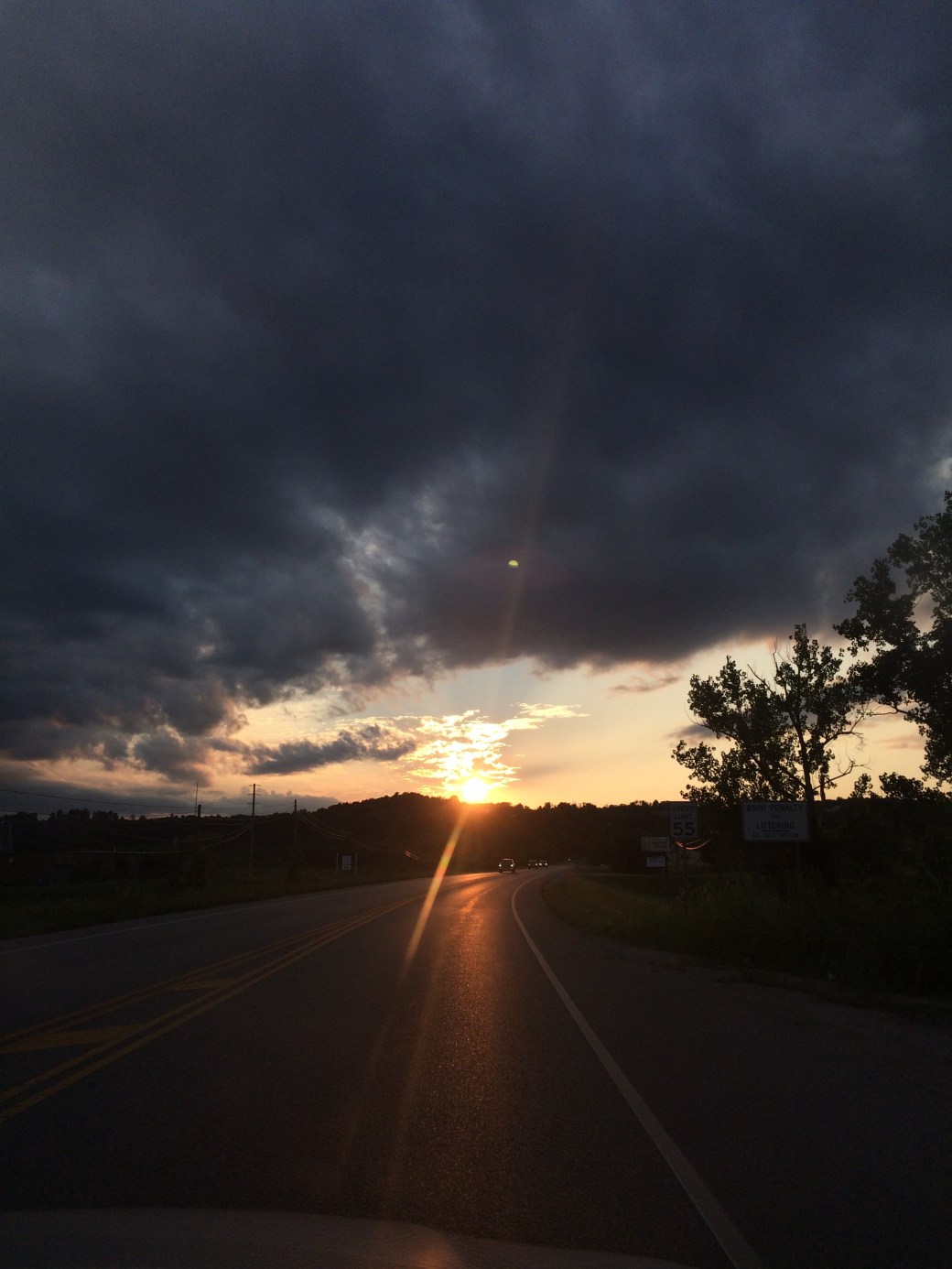
Walking into mine, I made my way to my desk, and clicked on school email.  There, in my in-box, were numerous emails from sick students or parents of ill students asking for missed assignments, requesting clarification, or submitting make-up work.  I was struggling to keep up with the daily correspondence as well as keep up with all the other behind-the-scenes work and preparation as well as maintain the demands of the daily schedule.  Sighing, I turned to look out my classroom windows that ran almost the entire length of one wall. Light snow was blustering about, but it was expected to return to the rain that we had seen throughout the week.  Another day of gray and gloom. With one more audible sigh, I turned, and began setting up for the day.


Surprisingly, towards the end of the school day, a bit of milky sunlight began to break through the pervasive dullness. In fact, the following day, Saturday, abundant sunshine filled the heavens; and despite strong wind gusts and frosty temperatures, I could feel the positive effects of the sun’s rays.  The metaphorical cloud of despair that seemed to permeate my outlook for the past few weeks, began to–momentarily, at least–thaw.
 

img_8663


“Not again,” I bemoaned to my husband, John, later that same day. “Another week with mostly rainy weather!” 


John and I were on our way to dinner to celebrate his birthday.  I had just clicked off the weather app on my phone to check out the forecast for the following week as the day’s dousing of sunshine made me hopeful, and perhaps a bit greedy, for more sunshine in the following week.


“It’s supposed to be heavy at times too.  Another chance of flooding,” he added with a voice full of disappointment.


I let his words sink in feeling the weight of disappointment clutching at my chest.   


img_1226


Sunshine, sweet cheery friend, why are you so fickle this season?  


Seasonal affective disorder has never felt so real to me as it has this winter.  Is it my age? Is it in my head, and like the pains of childbirth, I have simply forgotten how I felt last winter?  Surely, I cannot not be the only one feeling this way as February winds down? Based on conversations I’ve been sharing with co-workers, I don’t think so, but maybe we’re more sensitive souls as we work with hormonal middle school students.  And yet, I have participated in countless conversations with others outside of the confines of our school building who share similar thoughts. Still . . . 


img_0983


Where are you sunshine?  You tease me with a day or two of golden joy, only to hide for days, even weeks, at a time.  Please come back to me and stay. Have I been taking you for granted? Have I not admired you enough? Have I not given enough appreciation for your satisfying solar sensations?


Then, it hit me. I have abandoned specific routines that typically nourish my soul.  However, my morning meditation and prayer practice has fallen by the wayside. I have further abandoned  my morning moment of daily devotional reading. Daily yoga practice has likewise been forsaken. These morning rituals have been supplanted by “to do” lists and hitting the snooze button, one too many times, and/or setting a later morning alarm because I am so desperate for more sleep.  While I do need sleep, and I never seem to get enough of it, my overall need for rest is not going to be solved by getting 15-20 more minutes of sleep. Thus, perhaps it is connecting with the Divine through my spiritual practices that I am truly missing–my inner source of sunshine. Insert face into palm!


img_1212


The day before writing this piece,  I encountered a woman at a local grocery store.  I was departing the store through the designated “exit,” and an unknown woman was attempting to enter through it.  I stepped aside to allow her to come in, and I encouraged her step in out of the sharp wind. She smiled and apologized.  


“I know I shouldn’t come in through the exit.”  


 I smiled at her in reply, confessing that I often do the same thing.  It occurred to me then that the store doesn’t mind how you get inside their premises as long as you keep coming back when you run low or out of their products. Hmm . . .  
 

img_1054


How similar is that to our own faith habits?  God doesn’t mind the way in which we enter our faith walk, we just have to keep returning for the love and the lessons that are offered.  Otherwise, we will always run low, or in my case, run on fumes–nearly depleted of all inner joy. In fact, Divine Providence, I continue to observe, has a way of continuously placing the same lessons in my life until I am finally ready to learn.  While I am not by any means stating that the dismal weather was purposely put into our local winter weather system solely for me to learn this lesson, I do realize now that it was/is my perception of this season, created by my depleted tank and lack of faith habits, that was/is the main source for my personal cloud of suffering, rather than the actual weather.  


Winter weather must be endured, or spring would not smell so sweet.  However, by returning to my faith routine, the ones that I know nurture my soul, I can begin to, well, weather the downpours of life’s seasonal and metaphorical changes.  I believe I see a forecast for the return of earlier starts to my day with morning peaks of devotional reading, prayer/meditation, and perhaps even five minutes of yoga.  May they return me to the Ultimate Source of personal sunshine.


grayscale photography of man sitting on grass field
Photo by Flickr on Pexels.com

It’s What You Leave

“We do not remember days, we remember moments.”–Jennifer Niven


“The thing I realize is, that it’s not what you take, it’s what you leave.”–Jennifer Niven


img_1091
Chester “Check” Arlen Slater, aka Papaw


There he was, in my mind’s eye, intently gazing at me with those merriment-filled blue eyes, that, though dimmed by age, still had the ability to communicate to the person with whom he spoke, “No one but you matters at this moment.”  


“Stethie,” he would say as he steadfastly clasped my hands, “Get your education.  Go as far as you can. Don’t be like your dumb ol’ Papaw.”  


img_1093
Papaw and me when I was around two years old in his backyard in front of his garden.


Chester “Check” Arlen Slater was my maternal grandfather, but my siblings, my Kentucky cousins, and I called him, “Papaw,” while our “Texas cousins” called him “Poppie-Check.”  On one hand, I was closest to “Grandmother,” his wife, in spite of our continued clashes–unfortunately, I was as strong willed as she; however, as my mother talked to me in a recent conversation, I realized, it was Papaw who tended to inject me with doses of conviction and self-reliance as if giving me a vaccination of inner-strength against the challenges of the world.


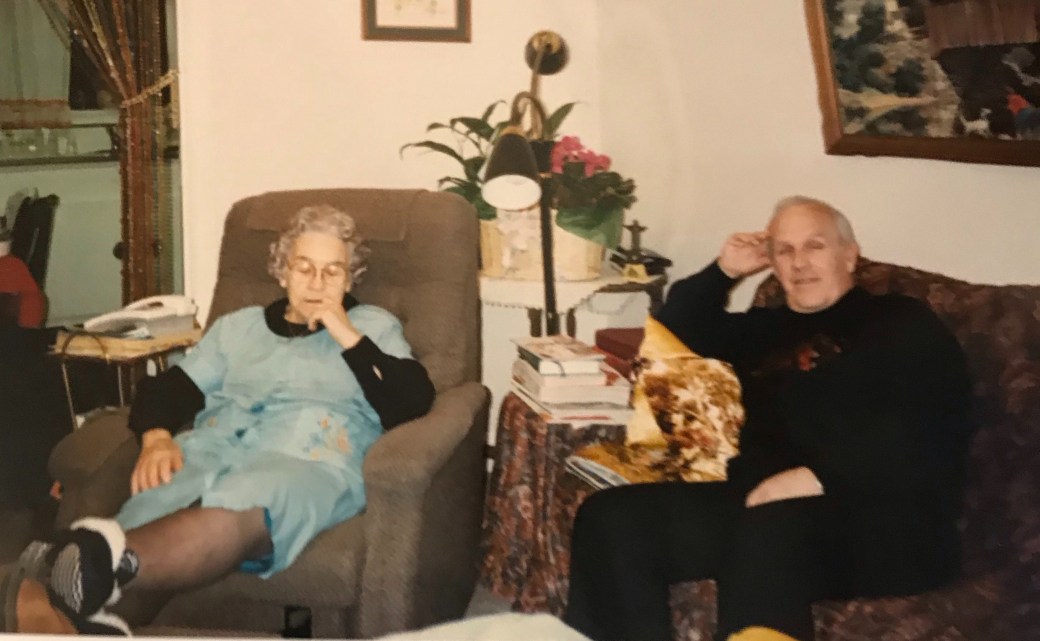
Grandmother and Papaw through the years.  In later years, they tried to color coordinate their outfits .


To be clear, Papaw was a complicated man.  As I understand it, based upon stories I recall my grandmother, my mom, and other various family members telling me, he possessed quite a bit of wanderlust and a roving eye when he was early married to Grandmother.  In fact, he was known to leave my grandmother for months at time to go “hobo-ing,” hopping from one train for another. Furthermore, I was told years later, he would lock himself upstairs for days at a time once he and my Grandmother settled into a home they had built after my mother was born.  Regrettably, I was never brave enough to ask him about any of those events. I sensed it would have embarrassed him.


img_1079
Papaw could been seen at his desk every Sunday between church services, working on various items for the church he and Grandmother faithfully attended.


I do know that he often described in great detail how he never did well in school.  He told tales of a teacher putting a “dunce” hat on him and putting him in the corner of the classroom.  Then, there were the stories of how the teacher would tie a string from her finger to his, “because I was her favorite pupil.”  His educational career was short-lived as he only made it to the 5th grade.


img_1081
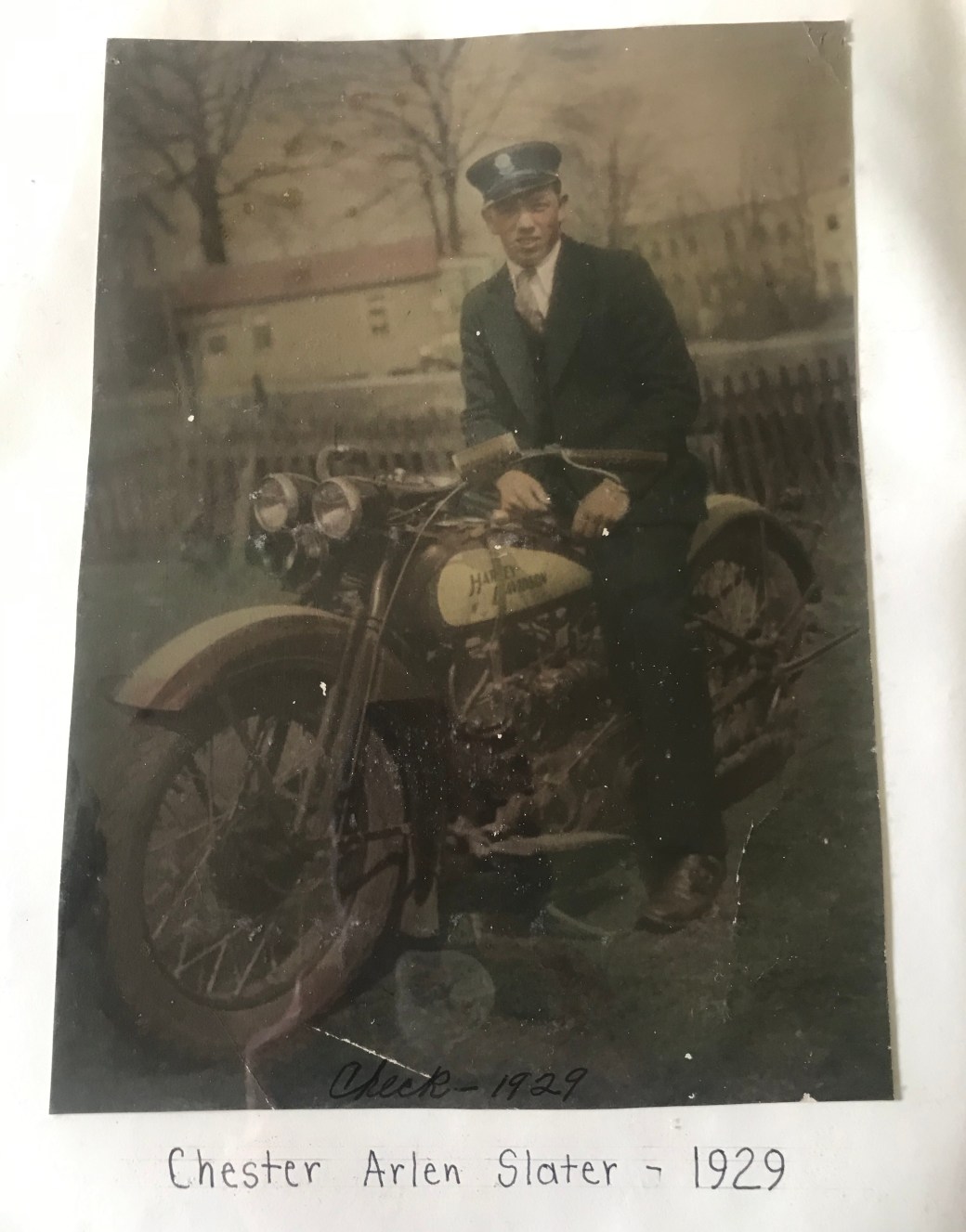
Papaw with his motorcycle 1929.


He loved to play football when the game was in its infancy and did not require much in the way of safety gear.  I can imagine him as a strong, swift athlete, full of swagger. Papaw was even once described to me as a spoiled and indulged child.   He owned one of the first motorcycles, if not the first, in the town of Raceland, KY, and was known to perform “wheelies” and other daring feats on the town’s streets–sending bystanders swarming to the sidewalks.


His sister, Gladys, whom he dearly loved, and for whom felt immense pride–although it likewise seemed to create personal shame–was educated at Morehead State University at a time when women of Eastern Kentucky were rarely educated beyond the 5-8th grade.  She became a teacher, married a veterinarian, and they lived in a town not far outside of Lexington, KY. 


Papaw often held up Great-Aunt Gladys to me as the gold standard for how I should aspire to live my life. She had a master’s degree, a career, and a successful marriage/family.  Her husband was soft-spoken and kind, and Gladys possessed a quiet strength and grace that never failed to impress me during the few times I recall meeting her.


Somehow, I think Papaw felt inwardly like failure due to his lack of education, especially when in comparison to that of his sister.  However, as a lifelong educator whose university studies focused on the needs of special education, I recognize that Papaw most likely had a learning disability accompanied with what would now be identified as ADHD (attention deficit hyperactivity disorder).  I further suspect he was both an auditory and kinesthetic (tactile) learner, and he probably best learned through some form of movement while listening. I am further inclined to think he may have battled depression that may have been tied to this same learning issue.


img_1076
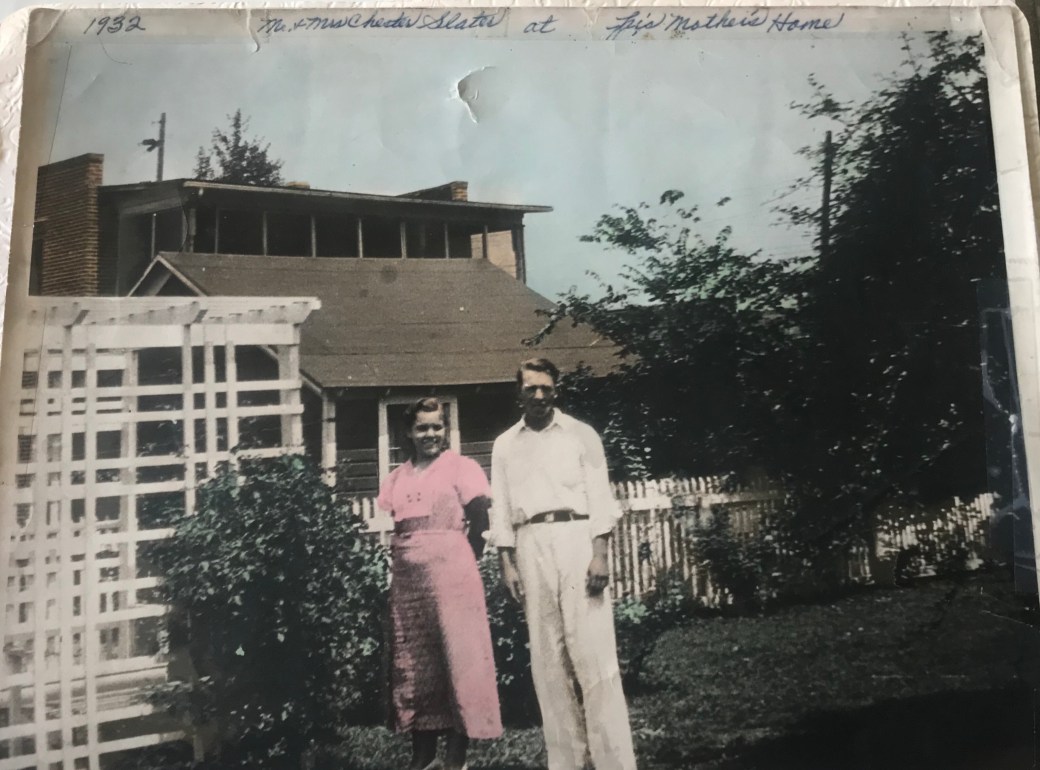
Grandmother and Papaw at his mother’s house in 1932.


In spite of his struggles, Papaw had the ability to quip numerous adages, a few poems, random science facts, bits of trivia, geographic information, and oh-so-many stories.  He “read” the daily local newspaper, National Geographic, American Heritage, Guidepost, and various other magazines. His bookshelves were lined with these periodicals as well as World Book Encyclopedia with its annual updates. Although truth be told, I suspect, as I reflect on his reading behavior, he mostly looked at the pictures, read the captions below, and focused on reading headlines, titles, and bold faced words.  Nonetheless, his thirst for knowledge and understanding of the world, his desire to make real human connections, and his even greater eagerness to be the center of attention were all real sides of this complex man.


I share all of this to lend context to the following. All of these images, and more, hit me as mom and I talked on that Saturday.  

The ebb and flow of our conversation led me to share with her a beautiful quote from a young adult book my daughter had recommended to me: “The thing I realize is, that it’s not what you take, it’s what you leave.”


“Like the ‘Bridge Builder’ poem Dad used to recite?” mom queried with an eyebrow raising. “Dad used to recite it all of the time.”


In my mind, I tried to scrape, claw, and dig my way to a memory of this, but I kept coming up empty.  


At home, later that day, I looked it up.   There it was, the very lesson Papaw was trying to convey to me all those years ago. He wanted me to be a “bridge builder” because that is how he saw his sister.  He failed to recognize that he, himself, was a bridge builder to hundreds of members of the local Boy Scout troops he led, to the local church he loved, to the C & O railroad employees with whom he worked, to the hundreds of missionaries he either visited or hosted at his home, and to me, along with all of his eight other grandchildren who listened, learned, and loved this conflicted, but well-intended, man of heart. 


And so, Dear Reader, I say to you, no matter what your career, position, job title, and so forth–none of that matters.  Life is neither what you take from it, nor is it the money you make; rather, life is about the moments you create and the bridges you build for the next generation. 


 Be a bridge builder; I fervently pray that I am. 


The Bridge Builder

By   Will Allen Dromgoole


An old man, going a lone a highway, 

Came, at the evening cold and gray, 

To a chasm vast and deep and wide. 

The old man crossed in the twilight dim, 

The sullen stream had no fear for him; 

But he turned when safe on the other side 

And built a bridge to span the tide.


“Old man,” said a fellow pilgrim near, 

“You are wasting your strength with building here; 

Your journey will end with the ending day,

You never again will pass this way; 

You’ve crossed the chasm, deep and wide, 

Why build this bridge at evening tide?”


The builder lifted his old gray head; 

“Good friend, in the path I have come,” he said, 

“There followeth after me to-day, 

A youth whose feet must pass this way. 

This chasm that has been as naught to me 

To that fair-haired youth may a pitfall be; 

He, too, must cross in the twilight dim;

Good friend, I am building this bridge for him!”


img_1094
A poem that I wrote for Grandmother and Papaw for their 50th wedding anniversary. (I was only 17 years old, so while it is not the best quality, the message still rings true!)


img_1095

Papaw Slater and me one Christmas.  I would have been in high school, and he was most likely in his 70s at this point, or at least, close to 70.  

Spring Grasses

“You could cover the whole earth with asphalt, but sooner or later green grass would break through.”–Ilya Ehrenburg


“Every blade of grass has its Angel that bends over it and whispers, ‘Grow, grow.’”–The Talmud


img_1053


The largest part of my childhood was spent in a tiny cul-de-sac built into the valley of U-shaped hills.  A creek ran down the back of one side of the neighborhood, and behind it were steep, rocky hills. Along the rear of the opposite side of the neighborhood–the side on which my family and I lived–was a low hill with a gravel road running along its flattened top with tall wooded hills soldiering alongside this.


During the summers, my mom ran a fairly tight ship with my three siblings and me, even during the times she wasn’t home.  While we were permitted to sleep-in within reason, we typically had a list of chores to complete, limits on the time we could watch the family TV, and we were, most of all, encouraged–aka ordered–to spend most of our days outside.  Ironically, however, she preferred us to stay in our own yard.


Mom told us to get out outside and play!
Photo by Jonathan Petersson on Pexels.com


As a parent, I now understand why she enforced this rule, but as a kid, it certainly seemed, “not fair.” Looking back, it seems to me that she wanted to be able to look out one of the windows in our small, ranch-style house and be able to see us. However, there were soft edges to her boundaries that we eventually discovered because–as children do, especially me–we tested those edges for firmness.


Typically, we could climb up the moderate hill in our backyard and play on the portion of the “backroad”–as we called it– that was within view of the kitchen window.  It was, in actuality, an extended driveway to a family farm just beyond our neighborhood; thus, the only traffic on this road, as best as I can remember, were those traveling to and from this home.  


green leaf tree surrounded by green grass field
Photo by Pixabay on Pexels.com


Likewise, we could also play in the street in front of our home.  Again, we needed to be visibly seen from the house–this time from the picture window in the living room–as the only traffic flow was from neighbors traveling to and from the four houses around the top of “the circle,” as we called it, one of which was my own childhood home. 


Our summer play varied from year to year as our ages often determined the type of play in which we participated.  During my youngest years, it seems to me that play centered around the yard–often around the larger of the two trees in the front yard, the area around and on our small front porch, or in the backyard where the shady area would expand in the afternoons. These younger years, it seems to me, were filled with mostly imaginative play as we kids played “house,” “school,” and role-played popular shows and/or concepts on TV, such as “war” and “cowboys and Indians,” and other similar ideas.  Afterall, this was the seventies.


 During my older years,  it seems that our play occurred often in and alongside the top part of “the street” and “the circle,” especially alongside the front of a split rail fence belonging to one of our neighbors, the Allen’s, that lined their front yard.  These were the summers of riding our bikes up and down the road, as well as playing more organized games; such as, wiffle ball, red light green light, dodgeball, monkey in the middle, football, and the ever-popular kickball. Tempers flared, egos grew quickly–and were just as swiftly deflated–swear words were uttered by the most daring, and time seemed endless. 

img_1052
Time seemed endless.


Depending upon the year, but especially so during the summer months, once grassy areas would be worn down to flat brown earthen patches due to the heavy foot traffic of kids.  Most years, there was a brown, semi-oval shaped edge to our front yard that rarely held any grass. Likewise, in our backyard, there were bare patches alongside of our house as well as in parts of the backyard that recieved the heaviest footfall and/or wear and tear, such as under and around the swings of our swing set.  On the back road, irregular grassy sprouts would grow in the middle of the road and alongside it, but the path for the tire tracks would be worn smooth except for the gravely rocks. Meanwhile, the Allen’s poor fence line would begin missing patches of grass from the “teams” taking turns standing, sitting, or leaning on their fence, waiting for a turn to “at bat” or to kick.  


Once school resumed, fall became winter, and less foot traffic stressed yards. Come spring, the grass–albeit sometimes crabgrass–would begin to threaten to fill in those brown patches.  Then, our feet would trod down those areas once more. Eventually, as kids grew, leaving for other locations, I can imagine, as if viewing a time lapse video, the grass triumphed again and again–even with a new generation of kids.  Some areas may have required a bit more TLC, save for back road–assuming it is still used– but nature’s green carpet was sure to have returned; and so will you, Dear Reader. 


Eventually, nature’s green carpet would soon return, and so will you, Dear Reader!


Throughout one’s life seasons, wear and tear occurs.  There are times in which life can absolutely wear a person down. This can be manifested physically, mentally, and even spiritually.  Moreover, these wearing-down time periods often affect more than one aspect of a person’s being. Fatigue sets in, weariness abounds, and the proverbial grass from the past, in the future, or even the proverbial yards of others’ lives, seem greener and more lush–leaving us clasping and wishing for better, less downtrodden, times.  However, like those brown patches of earth from my childhood, eventually, with time, growth will occur–and that is the fact upon which to focus.


According to an old adage, it takes a fire to grow grass around a hydrant.  Likewise, it takes time to bounce back after an abrasive and inflamed time period in life.  Afterwards, you are often not the same person you once were, as you are more informed about life and your own inner strength/resolve. 


img_1054


Furthermore, it’s worth remembering that there are angels in your life, encouraging you to grow–even at your most worn-down time.  Sometimes these so-called angels can been seen, known, and identified as friends, family, coworkers, neighbors, and sometimes, even strangers..  However, there may be other times when you may not realize that so-called angels are guiding, prompting, praying, and nudging you towards regrowth.  


You, like each blade of grass, were planted on Earth by The Divine Creator, to grow, change, and bloom into a unique creation.  Like each blade of grass, you are continually transformed by life’s seasonal modifications; but you can, and will, rise–face shining in the sun again.  As a matter of fact, in life’s ultimate conclusion, you will also rise, and angels will still surround you.


Don’t give up, Dear Friend, don’t give up.  Angels are everywhere, and new grasses are already sprouting their roots within you. 

green grass
Photo by Public Domain Pictures on Pexels.com

Just Breathe

“Feelings come and go like clouds in a windy sky.  Conscious breath is my anchor.”–Thich Nhat Hanh 


“Yeah I’m a lucky man/ To count on both hands/ The ones I love . . . Stay with me/ Let’s just breathe . . .” as performed by Pearl Jam, lyrics by Eddie Veder


“Now, what was I going to do?” 


I was talking to myself, but loud enough for one of my EW! (Elevate Writing) Club members to overhear me.


“Mrs. Hill, just do what I do when I can’t remember what I wanted to do.  Sit down and say, ‘I am breathing. I am living. I am me.’”


“Hmm, Amanda, I am impressed,” I replied.  “Does it work for you?”


“Aw, I just made it up here on the spot.  But, it sounded good, huh?”


She turned back to her writing as I froze at the profound wisdom this 13 year old had just so casually tossed my way.


“I am breathing. I am living. I am me.


img_0999


I hastily jotted down the words before I forgot them, and then rolled them forward in my mind as a kid rolls a kickball toward a kicker in a game. Unfortunately, it was Friday afternoon, my EW! students were good-heartedly, but loudly, teasing one another as they wrote, and so it was a strike–at least for the moment–as my tired and distracted brain could not connect with the words.  Still, I tucked the yellow sticky- note in my school bag for later retrieval once home. 


In fact, as soon as I was home, I placed that sticky-note on my kitchen table, so that I would be reminded of those words for the next few days.  Throughout the weekend, though, my mind, along with my body, was rushing about. Laundry seemed to be overflowing. Errands needed to be ran. There were meetings to attend, groceries to get, and a nearly forgotten, nearly overflowing cat litter box that pretty much summed up my mindset when I finally got around to cleaning it.  That, of all places, was when it hit me.


“I am breathing. I am living. I am me.


I reflected over the discussions I often lead at the start of the yoga classes I teach.  How frequently have I stated the importance of the breath as a reminder of the presence of God in our life. Our breath, like our heart beat, is automatic.  Both the breath and the heartbeat occur without us ever thinking about them–pulsating and filling our life with living energy. What a marvelous miracle that is in and of itself! 


calm blue sea during golden hour
Photo by Sasha Martynov on Pexels.com


In yoga, the breath is often referred to as prana, a Sanskrit word that means “vital life force.” It allows us to bring in vital energy and expel out that which does not sustain life.  In yoga practice, the breath is often considered, “the anchor,” the “thing” to come back to–to refocus upon–when the mind begins to wander into thoughts rather than clearing. Stooped as I was, looking down at the waste that needed to be removed from the litter box, it occured to me that perhaps my own mind needed to return to its anchor.


“I am breathing. I am living. I am me.


As I went through the motions of scooping and cleaning, I began to slow down my breath and simultaneously attempted to clear my own racing thoughts. I began to reflect on a story for which I had asked my mom earlier in the day.


“Tell me about Papaw Musick,” I had asked her.


img_1004
Papaw Musick alongside my Mamaw as they proudly hold their newborn son, my Dad, Larry Musick.


He was my paternal grandfather who passed away not long after I was born.  Asking my mom’s impressions about her former father-in-law may have seemed odd, but we were talking about the closing of a local facility, Bellefonte Hospital, which had been the sight of care for many of my loved ones who have now passed on to their heavenly home.  For whatever reason, our conversation made me think of Papaw Musick, and before I had time to think, I had blurted out those words. 


My mom smiled immediately. 


“Oh, he was a good man, Steph. He was just crazy about you,” and she proceeded to share a few sweet anecdotes.


img_1003
Papaw Musick holding/feeding newborn me


Reflecting on mom’s stories of the small, but stout man who I never really knew, but who once held and cradled me in his arms, tears momentarily filled my eyes.  In fact, I was reminded of one of my favorite photos of him in which he is doing that very thing with my tiny newborn body while holding my a bottle. 


img_1005
Mamaw Musick with me at her house, 1-2 years after Papaw Musick had passed. I remember Mamaw once telling me that Papaw Musick had always wanted a daughter, so he was happy that his first grandchild was a girl.


I am fairly certain that I have Papaw Musick’s large rib cage, as does my Dad, and I further suspect that I have his shoulders and arms–again, like my Dad. I also have the Musick eyes, like my Dad and siblings; and yet, like my mother, I have my Grandmother’s face and lower body shape.  I talk with my hand like the Slaters, my maternal family; but I have the Musick volume; and, both sides of my family gave me the love of Appalachian food and the power of a good story. In fact, without both the Slater and Musick clans coming together, I may not have ever met my husband and shared my life with the Hill/Moore family and . . .


img_1007
My Dad and me when was about two or so.


I was overcome with emotion at all of these thoughts, so I stood up and walked through our home thinking of what a miracle my life, and all lives for that matter, truly are.  As a child, I blamed myself for my parents’ ultimate difficulties. I used to think that if I had never been born, then they would not have been brought together. However, in that moment, it occurred to me that if there had not been a me, then there may not have been my brother and two sisters–for which I am continually grateful.  Which also means, there would not have been such a rich tapestry of relatives with all of their wonderful experiences and stories that now connect me to distant states such as California, Texas, Louisiana, Virginia, Florida, and others, in spite of all of us being rooted, at one time, in Kentucky.


img_1008
My brother, Scott, top center; my sister, Traci, left; me right; and our baby sister, Rachel, bottom center.


“I am breathing. I am living. I am me.


Thank you Mom and Dad for the gift of my life.  I hate that your married life, while I was growing up (and I suspect, you too, were likewise growing), was so challenging and difficult.  However, there is not a doubt in my mind that you loved us. Despite those trying times, you still provided me with many rich memories, stories, recipes, and the love of extended family for which I am thankful.  


I hope that one day, I will meet Pappaw Musick, and all those who have gone before me, and perhaps hold them all in some form of an eternal embrace.


I am not sure Amanda knew the inspirational power of the words she shared with me, but I certainly do appreciate that I was there to hear to them. *****


Amanda Day, an eighth grader at St. Joseph Catholic Middle School, is also an EW! Club member, writer extraordinaire, and the source of inspiration for this piece.

img_0620  Sigh, just breathe.

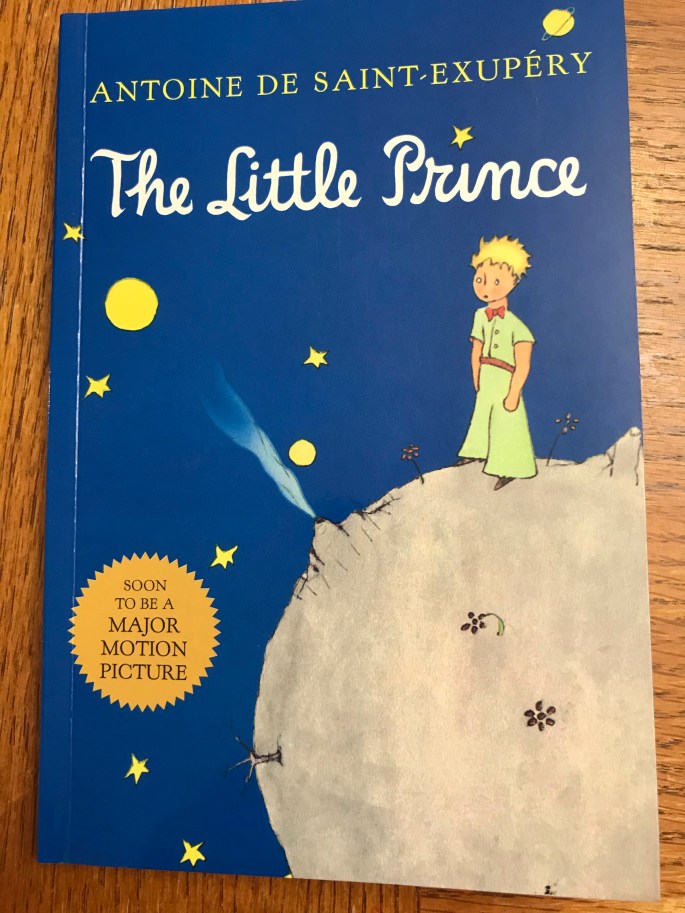
The Lesson of The Little Prince

“One runs the risk of weeping a little, if one lets oneself be tamed…”Antoine de Saint-Exupéry


“It is only with the heart that one can see rightly; what is essential is invisible to the eye.” Antoine de Saint-Exupéry


          “If you love a flower which happens to be on a star, it is sweet at night to gaze at the sky. All the stars are a riot of flowers.”Antoine de Saint-Exupéry


img_0951


My love for children’s and young-adult literature is no secret. As a veteran educator with nearly 35 years of classroom experience, books have centered at the heart of what I do.  In fact, books are quite typically the unifying thread that binds, and has bound, the vast majority of lessons I teach. Good literature has the power to inspire lessons in geography, math, biology, physics, history, politics, psychology, sociology, and so much more. Additionally, a great story can even offer a life lesson, or two, that pulls at the readers’ hearts and challenges the reader to reflect, contemplate, and evaluate both their internal world as well as their external actions.


Many years ago, I was once asked, during an interview, to name my favorite book.  To this date, though I do not recall for what I was being interviewed, I vividly remember my response, Charlotte’s Web, by E.B. White, and the stinging silence that followed.  Afterwards, I remember inwardly cringing because I am certain, given the context of whatever adult-situation in which I found myself, the interviewer made certain assumptions about me–namely, I must not be very bright and/or well-read. 


img_0953


Later, I thought of all of the phenomenal and influential novels I have read for which I could have responded, making me sound, at the very least, more mature–and certainly more well-read–than the beloved children’s classic.  Still, E.B. White penned a story in 1952 with two strong female characters who saved a life, motivated by their passionate desire to rid the world of a wrongful death. More importantly, White’s characters illustrate to readers what it means to live a compassionate and loving life, how to develop and foster lasting relationships, and, in the end, how to sacrifice one’s self to the greater good of another–even if that means letting go and saying goodbye.


I was reminded of this interviewer’s question from the 1990s when I overheard a piece on public radio regarding inspiring spiritual books that aren’t, per se, considered “religious,” but still offer readers lessons for the soul.  While I was not able to listen to the entire piece, it was of interest to me that of the six or so titles that were recommended, at least three of those titles were considered children or young-adult literature. Huh, maybe I was on to something years ago and only now is the rest of the world catching up to me!


Two of the juvenile titles, I had read within recent years, but one title, The Little Prince, by Antoine De Saint-Exupéry, I was not sure if I had read or not.  I felt as if I had, but memory, like the morning fog rising above the Ohio River, fades as time passes. The person being interviewed on the radio stated that it was this particular book that continues to help him in times of grief.  That was all it took, and I decided in that moment to read–or perhaps, reread–this classic.   


“Stars

They make me wonder where you are

Stars

Up on heaven’s boulevard . . .”–Grace Potter


There is a song, written by Grace Potter, and performed by Potter and the Nocturnals, for which I have found great comfort when missing a relative who has slipped their Earthbound chains.  While I suspect the song is actually about lost love, since the writer states she cannot look at the star without wondering where her former love is, her lyrics, instead, remind me of how I prefer to think the opposite.  Whenever I look at the night sky and see my friends, Orion, Libra, the Little Dipper, and even Mars and Venus–though they’re not stars–I am reminded of those I have lost. It often seems to me as if the twinkling of the stars is God’s way of allowing the heavenly souls to wink at those of us still bound to Earth’s gravity as if to say, “We are okay, and you are okay.  You’re welcome to join us, but there is no rush. Time is endless in the heavens.” 


blue and purple cosmic sky
Photo by Inactive. on Pexels.com


Ah, but I am a silly, ingenuous adult at my heart, I suppose.  Perhaps that is why from the very first chapter of The Little Prince I was transfixed.  The author’s opening scene describes, in great child-like detail, why the main character, an adult pilot, abandoned his budding career as an artist as a child due to grown-ups who could not understand his art; and therefore, the character was encouraged to pursue more serious matters such as, “geography, history, arithmetic, and grammar. “Grown-ups never understand anything by themselves, and it is exhausting for children to have to provide explanations over and over again.”  Thus, at the ripe old age of six, the main character begins to lose sight of matters of the heart and soul–which cannot be seen by the eye–until his plane crashes in the desert where upon he meets a Little Prince from another planet.


I can recall the nagging feeling, after that unknown interview, that has always nagged at me, if I am to be honest.  That feeling is called, “You, Stephanie, are not smart.” And while I do not want to create some glorified fictional version of my childhood–and adulthood, for that matter–I certainly can look back throughout the years and recognize my dreamy nature.  My desire, which is perhaps equal parts strength and Achilles heel, to go into my head, to dream, create, and think–really, heartfully, soulfully think–has always been my comfort, ally; and at times, has given me the ability to withstand certain difficult situations.  It is probably that very quality that makes me immensely sensitive, and perhaps ultimately, it is what called me to education. Then, again, perhaps this is my over-active imagination wanting to believe this. . .


img_0950
It is often juvenile literature which challenges us to think deeply on matters of the heart.


What I do know is that I will no longer apologize for adoring children’s literature.  I have cried more real tears, felt more deeply, and have often been more motivated–upon reflection of a work–to evaluate and rethink my actions or motives due to well-written books geared for younger audiences.  My interviewer was merely, in the words of The Little Prince, a serious adult who could not see, or find value, in the matters of the heart and soul.  He could not look up at the stars and see what I see; he could not feel the depths of real love; the joy of true friendship; what it means to really sacrifice for another; and I am quite certain, he could not pick up a children’s book and allow himself to imagine, dream and grow.  And that, Dear Reader, is a sad story, for he is missing out on the joy of seeing heaven’s boulevard and other inner-worldly experiences.


May we all celebrate great books, even those written for the unfledged mind.


img_0952

img_0954

The Girl with the Pink Fuzzy Socks

“Hope is an adventure, a going forward, a confident search for a rewarding life.”–Dr. Karl Menninger


“Hope is the thing with feathers that perches in the soul–and sings the tunes without words–and never stops at all.”–Emily Dickinson


animal avian beak bird
Photo by Pixabay on Pexels.com


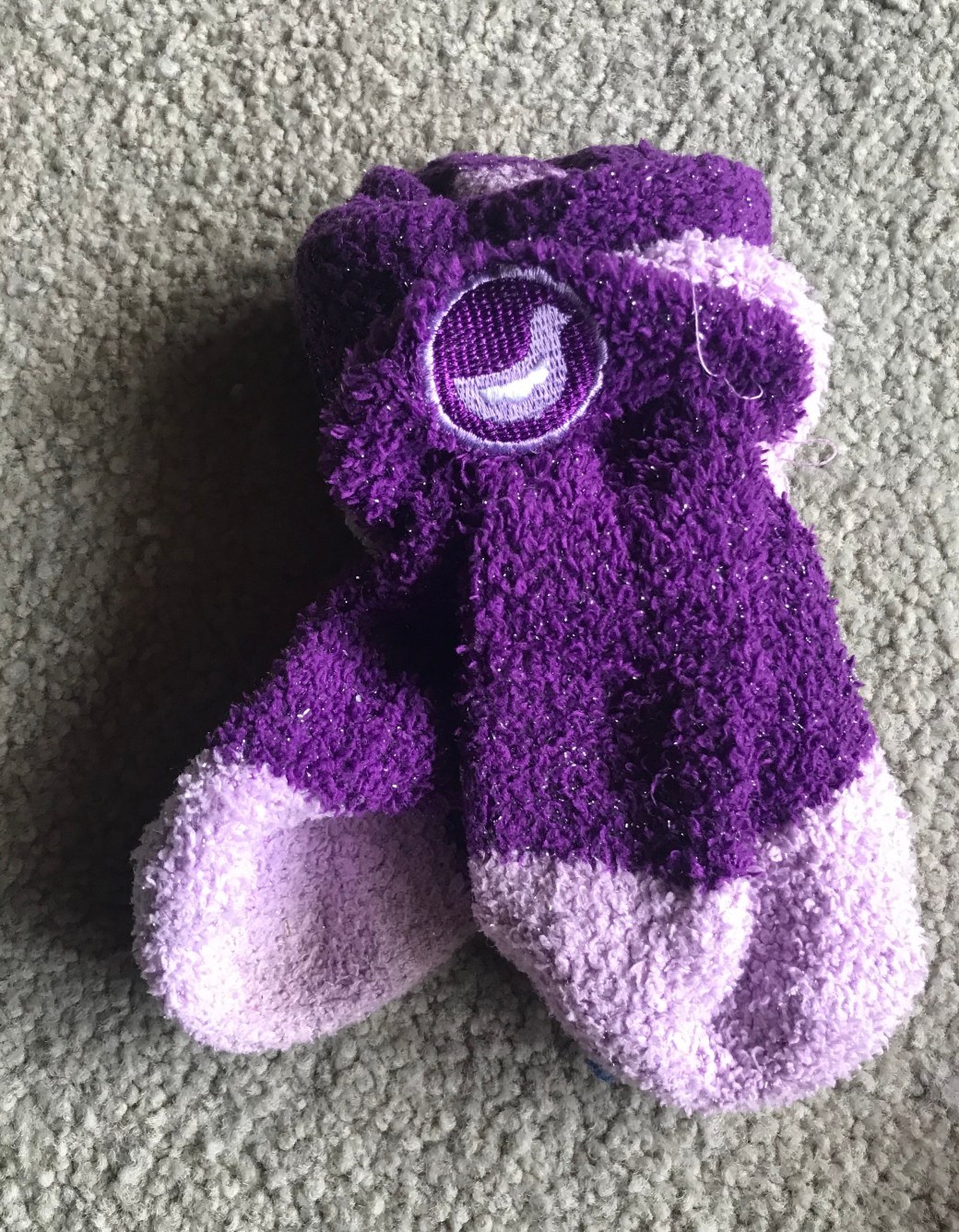
It was her pink fuzzy socks with the swath of white encircling the top of her long ankle that kept drawing my attention–well, the socks and her face–imploring, seeking, and open. Those socks spoke of youth, vibrancy, and a healthy need for warmth–except that the weather was quirky for winter and, on this particular day, the temperature was exceptionally warm.  Plus, this was a warm yoga class with the temperature set at 85 degrees. Still, it wasn’t unusual for people to prefer to practice yoga in socks rather than bare feet.


pink and white sock with pink flower hanging
Photo by Pixabay on Pexels.com


In direct contrast with the cute socks and her youthful visage framed by long locks, the shade of flax intermingled with goldenrod, were her eyes, that darted, jumped, and searched.  Her energy was frenetic and animated. It appeared that she spoke with the entirety of her body. In fact, she needed little invitation to talk as one small question seemed to release the valve to the unseen dam within her soul.


My level of empathy and compassion are part blessing and curse. When someone is truly suffering, I can feel it emanating off them as steam rises from the soup pot when the lid is removed.  With age, I have tried to learn to develop emotional bubble wrap, especially when faced with angry, negative, or heartbroken energy. Try as I might to seal myself insides off, like the scent of garbage drippings that cling to blacktop in the summer, long after the truck has collected the refuse, so often do other’s emotional dross sink into me leaving me affected for hours and even days.


img_0909
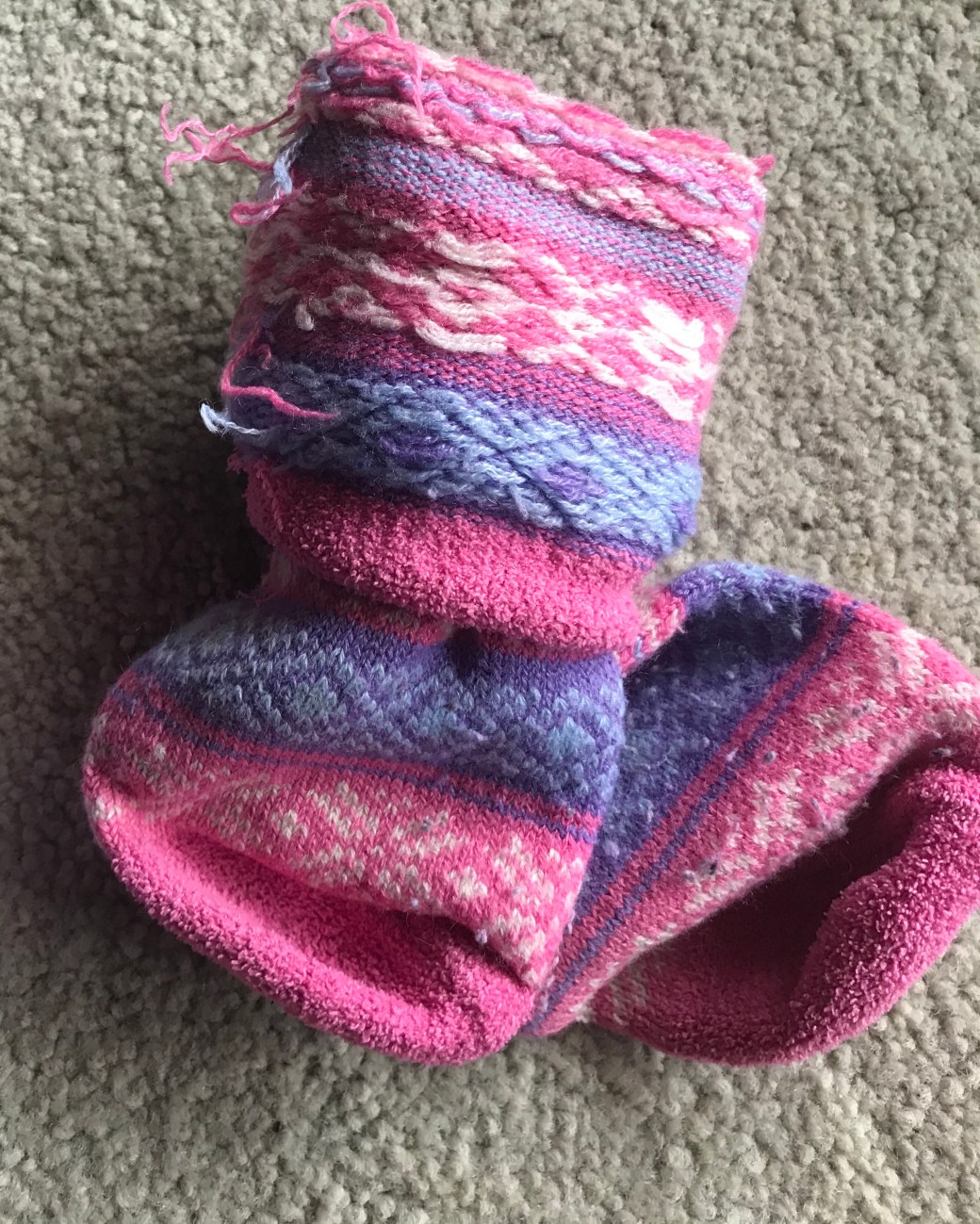
Her socks reminded me of socks like my daughter likes to wear around the house, especially in the winter.


Thus, when the girl with the pink socks, that I shall name Sarah for the sake of this story, began talking, it was as if offshoots of her pain gradually began to stretch and grow within me.  Her story came out as quickly as an overturned cup of wine; and, just as swiftly as that proverbial glass of wine, it had rapidly and permanently stained her life. Without revealing too much, her husband had been diagnosed with a rare form of cancer for which he had undergone one radical and brutal treatment after another. It had been exactly a year since his initial diagnosis, and now, she explained, hospice had been called in.  The couple wasn’t yet in their third decade of life, and they had two young children! 


As I write Sarah’s story, I can still feel her sadness and anxiety deeply within my gut. Sarah was taking a yoga class that I was teaching. It was a recent visit to her doctor that had prompted Sarah to yoga.  The doctor, she reported, wanted to prescribe numerous medications to help reduce her anxiety. Sarah had refused, and instead, decided to give yoga a try.


“My mind is never still.  It won’t settle; it is so restless. I can’t pray anymore.”


woman doing yoga pose on pink yoga mat
Photo by Burst on Pexels.com


She went on to explain that she was hoping that yoga would help her quiet her mind, so that she could, once more, meditate and pray.  Ironically, the theme of my class on that particular day was focused on the fact that health encompasses more than just the physical body, but it also includes the well-being of the mind and spirit. Additionally, I had planned to read a short passage explaining that one of the traditional purposes of yoga was not only to strengthen the body and make it more supple; but ultimately, to quiet the mind, so that afterwards, one could sit and meditate and/or pray for extended periods. After hearing her story, I just wasn’t sure if this was the appropriate way to proceed, but I decided to give a try anyway.


And while this is an imperfect story, just as life is also rarely defect-free, Sarah did sit still, if only for a few moments, at the end of class.  The other exercisers and I gathered around her afterwards. Sarah talked more, and we listened more. We looked at the pictures of her beautiful, and oh-so-young family.  One person typed the correct spelling of her husband’s name into her phone, so his name could be added to the prayer-list at her church.  


img_0910
My daughter’s variation of pink, fuzzy socks.


Meanwhile, I still keep thinking of those fuzzy pink socks, and I am reminded of my own daughter who loves to wear those types of socks in the winter.  Like my own child, this young couple were once children of parents who loved and cared for them. How those parents must have envisioned their children’s future with such hope and promise.  Most likely, those same parents must have felt that same hope rising when the young couple were married, and even more so with the birth of each child–their precious grandchildren.


I can’t understand this story; I only feel the pain, the hidden hurt of this child with her pink fuzzy socks; the beautiful strands of  her wavy, tousled hair; her darting eyes; and all of her words–pouring out of her soul in search of the path of least resistance like excessive rain water travels down hill.  However, for this child–there is no path of least resistance–she traverses a path few would want to trudge.  


As I write her story, I think of all the events in my life for which I could complain, I could whine, and snivel.  In fact, I could write a tale or two of woeful, personal tragedy, but those stories would be nothing, nothing compared to Sarah with the pink socks.  Wherever she is, may she somehow be comforted, her pain lessened, and I further pray that her mind will find peace, so that she can focus on being a mom who is full of hopes and dreams for her own two children as well as herself.


aquatic bloom blooming blossom
Photo by Pixabay on Pexels.com

I Can’t Stay Long

 o“Time has no divisions to mark its passage, there is never a thunderstorm or blare of trumpets to announce the beginning of a new month or year.  Even when a new century begins, it is only we mortals who ring bells and fire off pistols.”– Tomas Mann


“Time is a sort of river of passing events, and strong is its current;  no sooner is a thing brought to sight than it is swept by and another takes its place, and this too will be swept away.”–Marcus Aurelius


img_0807
This polaroid of Uncle Leo is of unknown source to me.


“I can’t stay long, Mom.”  


His words were a familiar phrase meant to be part greeting and part warning.  A rush of winter’s chilly air crowded in around him like flies swarming picnic food.  Despite the fact he quickly closed the back door, the entrance through which all family, and most friends, entered, the temperature of the room temporarily lowered, and I was momentarily reminded of the thin layer of ice lining the single pane windows. I shivered in reaction.


img_0814
My Uncle Leo and Aunt Janet during Christmas at my Grandparents’ house during the 1990’s.


“What’s wrong, Sis?  You act like it’s winter,” he teasingly questioned me as he wiped his feet on the doormat. 


He had entered directly into the kitchen table area of my grandparent’s kitchen.  Uncle Leo was the middle brother of my mom. Uncle Ralph was Mom’s oldest brother, followed by Leo, one and a half years later, and then Mom was born some eleven or so years after Leo.  


Uncle Leo, Uncle Ralph, and Grandmother, holding my mom, Dolores, who was born eleven years after Leo.


Leo had thinning hair, but that which remained was nice and mostly salt, with an occasional strand of pepper throughout.  His eyes, like his daddy’s–my grandfather–and his brother, my Uncle Ralph, twinkled when he spoke; and yet, unlike Pappaw and Uncle Ralph, Leo possessed a bit of intuitiveness/sensitivity–a trait of his mom’s–my grandmother–that I only now begin to realize/understand  . . .


img_0797
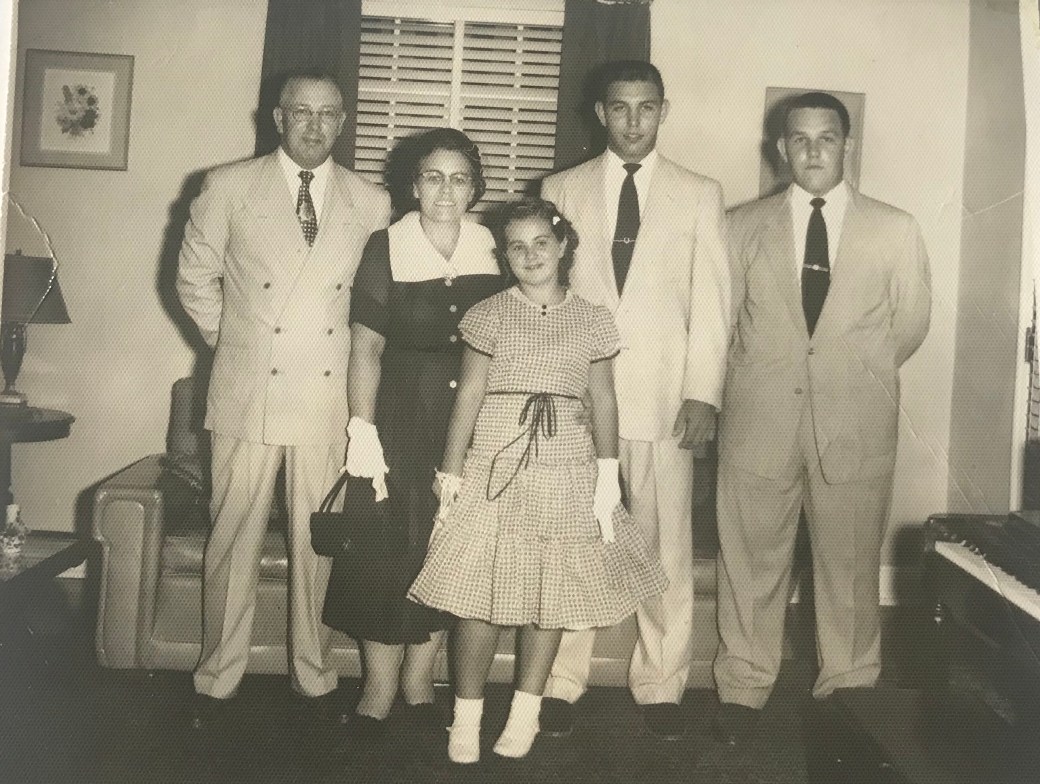
My Pappaw and Grandmother, “Check” and Helen Slater; their oldest son, Ralph; middle child, Leo; and my mom, Dolores, was the youngest.


My first recollection of Uncle Leo’s emotional sensitivity occurred when I was fairly young. I recall him gazing intently at me as I passed him in the back hall of the evangelical, small town church we attended until I was twelve years.  We were between the preparation activities for Sunday School and the actual classes. I was walking with my peers to my class, and Uncle Leo was traveling with the adults in the opposite direction. While I do not remember his exact words, he knew I was sad/upset, and he further seemed to know the reason why, though I had not spoken a word to him.  As he walked by me, he ruffled the top of my head and began singing to me, as he was known to do, in his best baritone/bass-like voice. Oh, how that man loved to sing and make others smile.


img_0799

Uncle Leo; his Grandfather, my paternal great-grandfather, Wesley; and Uncle Ralph


In fact, later, I recall my mom asking me what I had said to Uncle Leo, and I began to panic because, for the life of me, I didn’t know what I had said/done wrong.  The subject was dropped; but later, I overheard adult conversation after church regarding how I wore my heart on my sleeve and was an open book for him to read . . .


img_0806

Back Row: Pappaw; Grandmother; Uncle Ralph; his wife, Patty; and their son, David   Bottom Row: Uncle Leo with Ralph’s oldest, Candy, on his lap; Leo’s wife, Janet; my mom, Dolores; and Ralph’s middle child, Carol.


It was this sensitivity, well, and let’s be honest, Grandmother’s cooking, that I now understand motivated Leo to drop by and visit my grandparents–sometimes unexpectedly, but also when my Grandmother called. While Leo was funny, witty, and charming, like Pappaw and Uncle Ralph, Leo had these eyes that knew, understood, and offered empathy when needed.  He could take a 30 minute visit with my grandparents, spend 25 of those minutes swapping funny stories with Pappaw, making both Grandmother and Pappaw laugh.  However, Leo could likewise skillfully interject a sentence of some serious nature to either gratify or reassure Grandmother–though, truth-be-told, due to her instinctive nature, she often knew he placating her.  Still, she nonetheless relished the respect of my uncle’s gesture regardless of his intent.


img_0800

Uncle Leo and Uncle Ralph–ultimately, Ralph would move Dallas, Texas where he was a pilot for Braniff International Airways; and Uncle Leo worked for Amtrak Railway.


When Leo arrived at my grandparents’ backdoor on that wintry afternoon, I do not remember if it had been a snow day closure, a Saturday, or an afternoon after school hours, but I was not at my place of work–the first teaching gig of my career–a two-year stint at Greenup County High School School, a mostly rural county school in eastern KY, during which time I lived with my grandparents.  Leo, in his typical fashion, had entered the kitchen with great flourish, his blue/gray eyes ablazin’ and a song emanating from his throaty voice–always a church hymn that could be sung in four-part harmony. He habitually spoke in-between the lines of a song.


Leo lived nearby in the same quaint town of Raceland, KY, situated in the eastern, and less rural, part of Greenup County.  He worked on the railroad, so he wasn’t home often. However, anytime my grandmother made one of his favorite foods, such as vegetable soup, as she had on this day, and she knew he was home on a lay-over, she gave Uncle Leo a call on her black rotary phone to invite him over “for a bite.”

img_0808
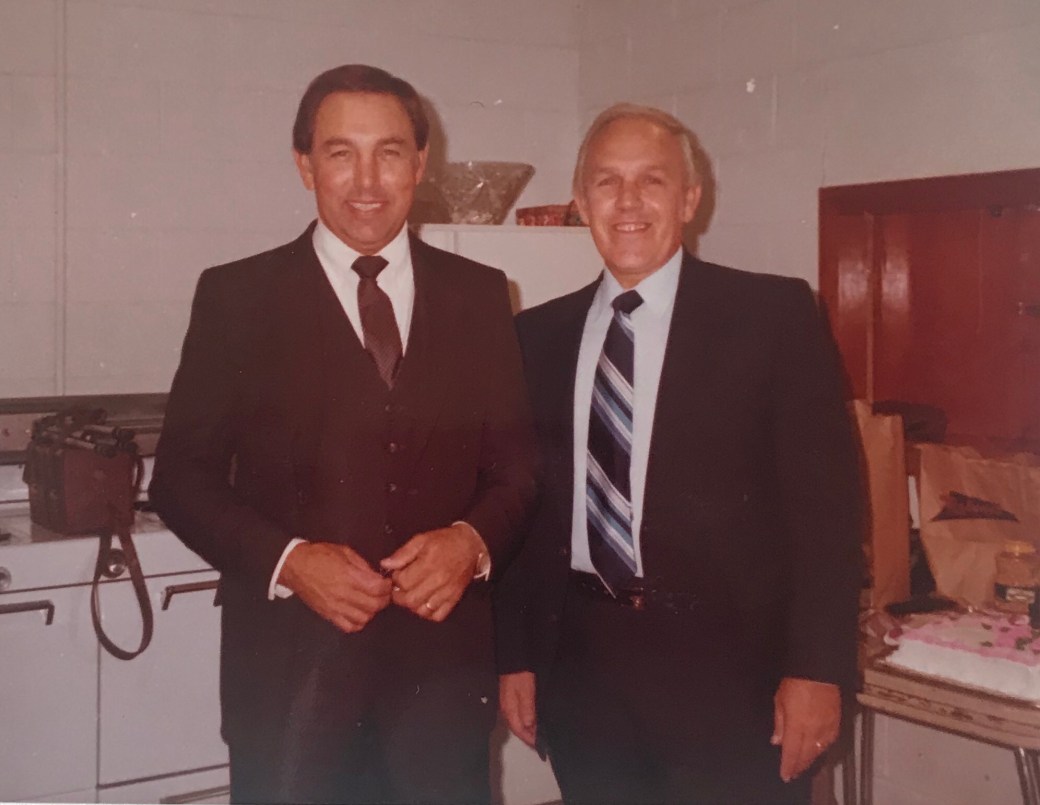
Uncle Ralph, back home visiting from his home in Dallas, Texas alongside Uncle Leo a lifelong resident of Raceland, KY. This photo was taken at my grandparents’ 50th wedding anniversary.


“I don’t want much, Mom,” he said, as he always did, winking at me comically because we both knew that Grandmother’s servings were typically large enough to feed at least two people. 


I was already sitting at their kitchen table working on something, presumably lesson plans or grading papers, and he sat down across from me.  Grandmother bustled around the kitchen–as if suddenly energized by an unknown source–first gathering his soup and saltine crackers, followed by more flurry as she gathered a clean, plastic tub, most likely a former container of some sort of meat or salad, and she began filling it to the brim with more soup to cool on the counter, so he could take it home for later.


Eventually, Grandmother would sit down at the head of the table, her usual spot to the left of me, with Pappaw already sitting to my right. 


“Whatcha’ know, Pop?” Leo would ask with another wink and easy grin as his eyes continued to gleam. 


img_0805
Grandmother, Pappaw, Aunt Janet, Uncle Leo, and Janet’s bridesmaids, including my mom, second from left, on the day of Leo and Janet’s wedding.


Pappaw, with eyes matching his son’s starlight sparkle, would, in his classic entertaining manner, share some sort of silly story, based on partial truth, but exaggerated and stretched out like the colorful salt-water taffy sold at every beachside tourist gift shop.  Together, these two beloved men would alternate who treadled the proverbial story spinning wheel creating long, colorful yarns knitted together in one expansive fabricated story that enfolded Grandmother’s kitchen with warmth and laughter. Grandmother could be heard saying,“Oh, Check,” my grandfather’s nickname, or “Now Leo,” shaking her head in feign disgust, but her eyes betrayed her as they filled with love and appreciation for the moment.


img_0801
Uncle Ralph and Leo at the foot of their new driveway and house. After the great flood of theOhio River, my Pappaw swore his family would never live on low land again.


Soon Leo with dart away with as much fanfare as when he entered.  A hush would quickly settle over the kitchen like a summer rain settling the dust after a dry spell. Grandmother would sigh, pick up his dishes, carry them to her sink, pour another cup of coffee in her unbreakable, mostly white and blue Corelle coffee mug, and return to her chores, shoulders slumping as she went. Pappaw, with crestfallen face and sunken chest, would return to either the work desk in their bedroom, or disappear to the basement to complete a seemingly urgent task, with the fire embers that only moments ago had burned brightly in eyes now gradually extinguishing.  Meanwhile, I remained in the kitchen as the frosty air filled the room once more. The moment was gone, flowing on as the winter waters do along the mighty Ohio River that unites the three states–Kentucky, Ohio, West Virginia–in which I have spent a lifetime–working, playing, and loving.  


img_0798
Uncle Leo and Ralph, but I am unsure of the context of the setting.


As I look back at that moment, I am overwrought with colliding emotions regarding the passage of time as I reach back, trying to hold on to the memory a bit longer.  However, as I age, my memories are becoming more fluid, like water slipping through space and time.  


img_0815
I love this picture of my Grandmother and Uncle Leo. This would have been a Christmas Eve, possibly 1994 or ’95. Grandmother had dozed off to sleep after dinner. She always pushed too hard during the holidays, but loved being surround by family. I wish my camera could have capture Leo’s twinkling eyes.


Another decade of life is on the horizon.  1999 once seemed an eternity away, much less 2019; and by the time you read this, Dear Reader, another new decade, 2020, will have arrived.  I still remain on this earth, surrounded by loved ones, and filled with the memories of those who were once here with me, full of the knowledge that soon, I too, will drift down the eternal flow of the river of time because in the words of Uncle Leo, I can’t stay long.


img_0812
Uncle Leo’s oldest daughter, my cousin, Michelle born in February of ’65; and I was born is September of the same year. This was taken in 1967 at my grandparents’ home.
img_0813
Uncle Leo’s youngest child, Clifton during the same mid-1990’s Christmas Eve gathering.
img_0816
My mom, Aunt Patty, and Uncle Ralph sharing a laugh, probably due to a story that Pappaw, Ralph, Leo, or perhaps all three men, must have shared as they were all three big story tellers. Again, this was probably around 1995.

When clouds of depression darken your sky, don’t give in

“If you don’t like something, change it; if you can’t change it, change the way you think about it.”–Mary Engelbreit


There is only one corner of the universe you can be certain of improving, and that’s your own self.”–Aldous Huxley


“I don’t know if it’s the holidays, the cloudy weather, the lack of sunlight, or what, but I am really struggling.  Then, when I say it aloud, I feel like I am crazy–like no one else struggles this time of year.”


Yes, I was “eavesdropping,” as John, my husband, has frequently accused me of doing, but I was waiting in a long line at a popular store the Saturday before Christmas to buy a gift. All around me were people having conversations. What was I supposed to do?  Besides, the lady who was speaking kept looking back at me beseechingly as if she wanted me to participate in the conversation.


img_0740


While the unknown sad woman, as I now came to think of her, had listened to her companion offer the advice to focus on the “real reason for the season,” sad woman was quick to retort.


“Yes, I know, I know.  I hear every week at church.  It seems like either pastors feel they have to say that, or they are just clueless to the real mental anguish people go through,” she added with frustration in her voice.  


As the line slowly moved forward to the check out point, sad woman went on to describe to her companion how her life had been turned upside down over the course of the year.  She had lost one parent and a good paying job thanks to a corporate decision to cut costs. Now this woman, for whom I was now feeling profoundly empathetic, was working two part time jobs, her remaining, but ill, parent had moved into her house, and her adult child had also moved back home, albeit temporarily, due to an impending divorce. 


img_0737
Sometimes, it’s hard to count your blessings when overwhelmed by life.


“I know I am supposed to ‘count my blessing and name them one by one’ as the old hymn states, but I am so busy trying to count dollars to make ends meet . . . ,”  her voice trailed off as she stepped forward to pay for her meager purchase, a gift for her mom–it was her mom’s favorite fragrance.  


“She always smiles when I rub this scent on her arm.  It’s the one time she knows me,” I heard her explain to the young, but uncaring clerk.


img_0739


Driving home the thirty or so minutes to my home, my mind kept rolling over this sad woman’s story.  She was around my age, maybe a bit older, but not by more than ten years. How many other stories did I know similar to hers?  Too many, I realized.


Likewise, I can think of several other people with whom I interact who seemingly, “have it all,” as far as financial success goes, who I have overheard or been engaged in conversations with that openly confess they are mentally struggling.  Every time I hear this, I am so deeply empathetic, that I can feel/sense their cloud of sadness too. In fact, I sincerely wish there was a way I could brush away the darkness for them as if I were brushing crumbs off of a table after dinner.  


adult alone anxious black and white
Photo by Kat Jayne on Pexels.com


Unfortunately, whether it’s short term holiday blues, seasonal affective disorder, or a more serious mental illness, such as depression and/ or anxiety, there is no quick-fix.  However, having experienced depression, and bouts of the blues, I can tell you this. There is a gem inside of you, it’s just covered up with some dirt and dust, and with a bit of patience and persistence, it is my sincere belief that you can get through the dark times.


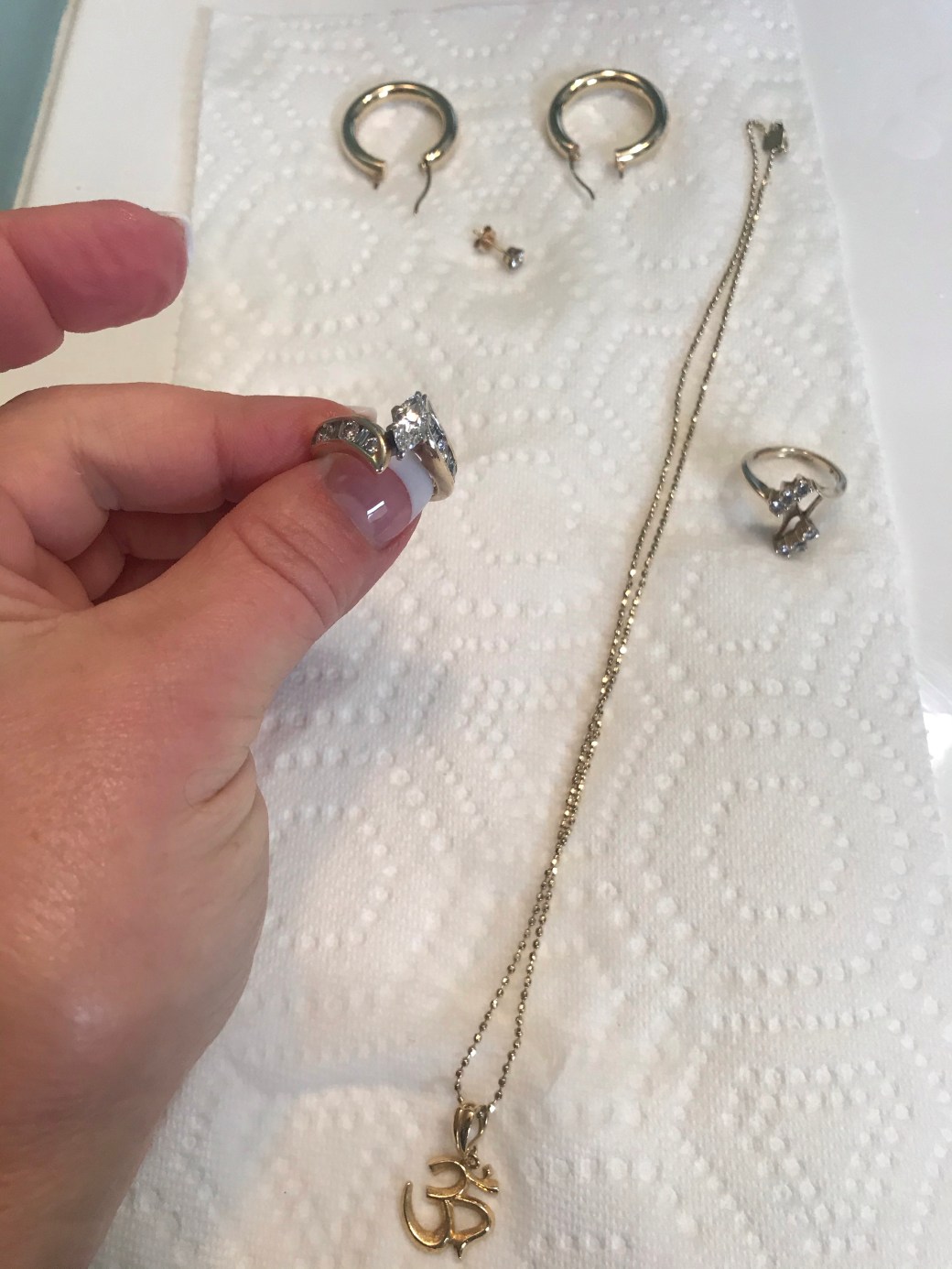
I do not own much of what some might consider “good” jewelry, but the few pieces that I do own, I wear nearly daily, mostly because of the importance of the people in my life who have given them to me.  Due to the fact that I wear them frequently, they get dirty, dull, and diminished looking. Therefore, I try to weekly to soak my jewelry in a combination of ammonia and classic blue Dawn detergent (not anything with pearls or sterling silver).  


img_0734


Once these pieces have soaked an hour or so, I use an old soft toothbrush to gently brush away the grime.  Three events during this process never fail to surprise me. The first is the amount of dirt particles that have settled in the bottom of the solution that came off the jewelry.  The second event is how shiny and lustrous the pieces look after being brushed and rinsed in warm water. Finally, as I set each piece on a paper towel to dry, I am stunned by how silky smooth/soft each one feels.  


When I first put on each piece, I am still taken aback by the way they look in the light, reflecting it just so.  As I rinse away the solution I made for the cleaning, I never fail to be surprised by the fact that I never realized how dirty each piece was until I cleaned it.  Further, I am so thankful I once more took time to clean them, rid them of their dirt with a little TLC, and, as I gently put each piece back on, I am reminded that no matter the irritants that can sometimes darken my soul, like the dirt in the jewelry, in the end, I can ultimately shine through with a little bit of help and self-cleaning.  And, that, Dear sad woman, or anyone else experiencing depression, is true for you!


img_0731


You may be a bit dulled up, in fact, you may be flat out covered in darkness.  I get it. I have experienced depression too–not yours, but my own version of the dark cloud–the kind that makes it hard to get out of bed; the kind that sends you behind closed doors, so that you can cry profusely without prying eyes; the kind that makes you feel like you don’t matter, no one cares, and there is nothing you can do. I’ve been mucked up with all that, and more, on a few occasions.


Well, I am here to say, hold on, Dear Friend, hold on.  Clasp, claw, clutch the edge and hang on for dear life. There is a way through it.  You’ve collected some metaphorical dirt, maybe even more than your fair share, but inside of you is a gem that can be found by simply placing your hand on your heart.  No one, and I mean no one, has a heartbeat rhythm similar to yours. It is your unique marker formed by The Creator. It is continuously beating, whether you think about it or not, and it serves as a reminder that you, like your heart, can beat this.  It may take time, it may take therapy or medicine, it may take hours of exercise or talking with a trusted friend, it may take time spent outside, a change in scenery, or any other number of ways to get through it, but keep cleaning away the dirt; keep excavating–the real you is still there waiting to shine through once more.

img_0732

Best Laid Plans–A Lesson in Humility

“The best laid plans of mice and men often go awry.”–Robert Burns


“This too shall pass.”–Persian adage


The schedule for the day, as is often the case on Saturdays, was full. My to-do list was inscribed and fortified via thorough mental rehearsals for several days prior.  In fact, Saturday was really only a continuation of a busy week filled with items needing to be completed and a forecast of another week just like it coming up. Nothing insurmountable as long as the steady pace of productivity persisted.  Get. It. Done. Girl.


img_0700


Friday was a late night, at least late in my early-bird world. John, my husband and co-worker, and I had, along with the rest of the St. Joseph Catholic School middle school staff, chaperoned a Christmas themed dance for our students.  Combine that with an after-school writing club that I sponsor on Fridays, and I wasn’t able to leave school that day until after we cleaned up from the dance. No big deal, other than we had not yet eaten dinner, and I needed to be up fairly early the next morning to teach two classes at Brown Dog Yoga in Ashland, KY.
 

christmas tree with baubles
Photo by freestocks.org on Pexels.com


Therefore, John and I headed to a nearby Asian restaurant in hopes of avoiding a heavy dinner for my sensitive stomach.  Steamed vegetables and rice seemed light enough. Once home, I did feel extremely tired, but nothing too unusual. Thus, my thoughts once more pursued that mental list of appointments and “must-dos” as I drifted off to sleep.


img_0710


After a restless night, I stepped out of bed the next morning, and knew, as soon as my feet hit the floor, my stomach was upset.  Not unusual, between eating late–a new found age-related issue–and my celiac disease–cross-contamination of wheat products is a threat any time I dine out–I wasn’t super worried.  Sure, my belly was protesting, but if there is one thing I do well, it was persist . . . at least that is what I told myself with dramatic mental flair.


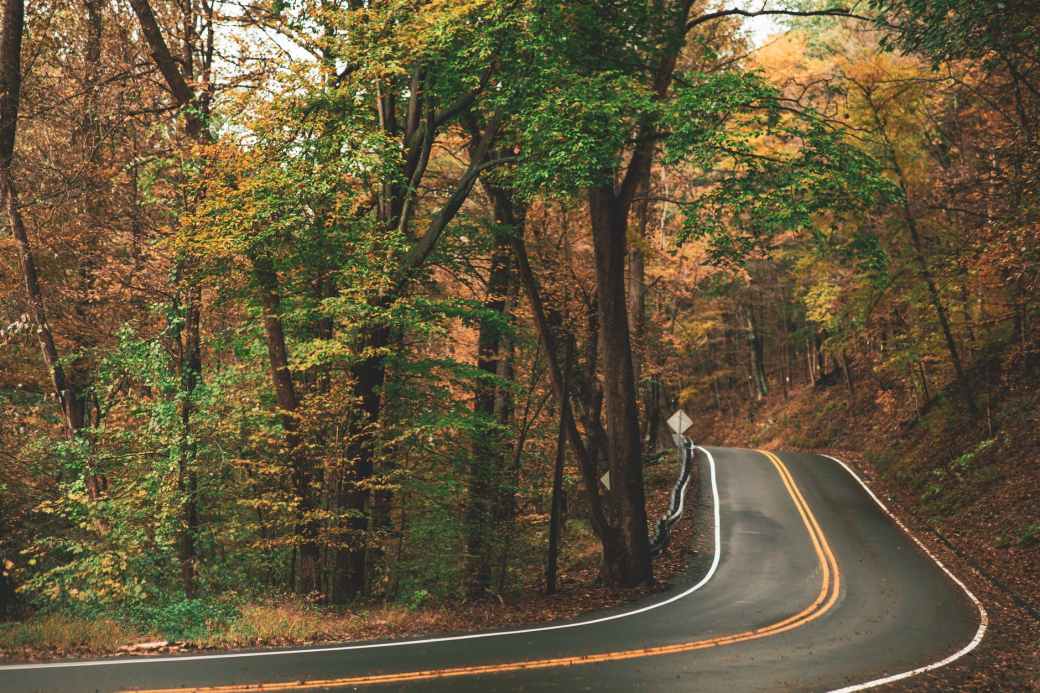
Driving the thirty minutes to Ashland, my stomach only complained more.  It’s the curvy state route over which I am traveling.  That seemed like a plausible reason to me.  You ate a late dinner.  Plus, you didn’t sleep well last night.  Maybe a wheat noodle was accidentally cut into your rice.–Okay, that last thought was logic-defying, but these are the types of lies I tell myself even when the proverbial handwriting is on the wall. 

 

gray concrete roadway beside green and brown leafed trees
Photo by Craig Adderley on Pexels.com


Arriving at the yoga studio, I still did not feel better, but as the clients began to arrive, I was able to focus on them, taking my mind off my own digestive distress.  In fact, as I taught through my first class, I was convinced that if I’d just give it time, whatever was upsetting my stomach was sure to subside. You’ve been here hundreds of times, Steph.  This is not a big deal.


Heading into my second class, heated yoga, I was 80-90 percent convinced, this was all in my head.  Now, to clarify, the warm yoga classes at our studio never have the temperature set higher than 85 degrees fahrenheit, so it is not an unreasonable temperature, especially on a chilly Saturday morning.  In fact, I embrace the warm temperatures as I tend to be cold natured. However, half-way through class though, the heat began to increase my nausea as a feeling of imminent misery began to grow deep within my gut.  Swallow.  Swallow. Keep focused on the clients and the flow. Swallow. Swallow. Focus on their needs. Not. About. You.


I made it through, and convinced myself that nothing was wrong once I was outside of the warm room.  This too shall pass as my Dad is fond of saying.  He’s right, you know.  This will pass. 


Determined, I drove to my next stop–a hair appointment which had been scheduled six weeks earlier.  Arriving early, as the appointment time had been slightly changed, I decided to take a nap in the car.  Seemed logical, despite the fact I don’t typically nap, much less take one in my car. A nap will allow your stomach to settle.


vehicles parked in front of cinemark building
Photo by Ricardo Esquivel on Pexels.com


Erin, my stylist and salon manager, warmly greeted me as I entered 20 minutes later, and we talked a bit.  Then, she took a good look at me.  


“Are you alright?  You don’t look like yourself.”


I assured her I was fine, and she assured me that we could reschedule the appointment if needed.


“Just an upset stomach–no big deal.”


Fortunately, as the manager, she is often pulled away from the chair to take care of minor issues as they arise.  Several issues later, she was finally ready to mix my hide-the gray-color. As she walked away to mix up the colorful magic, I urgently called after her. 


male and female signage on wall
Photo by Tim Mossholder on Pexels.com


“Don’t mix the color,” and I ran to the public restroom, embarrassed, but worried I wouldn’t make it in time.


For the record, there is nothing more humbling than being forced to, shall I say, bow before the public porcelain.  Ironically, thoughts of all of the germs I must be encountering filled my mind as I contributed my own germs to the water below.   Why now?  I have an entire list of things that must be completed, plus another appointment in Barboursville, and Christmas party tonight. . .or, so I thought.  


“Best laid plans of mice and men . . .” a saying my mom is fond of repeating came to mind.  Why do my parents’ words still continue to haunt me at my age?


Dad and Mom were both right.  The stomach bug did eventually pass, a few days later, and my perfectly timed plans were, well, publicly flushed away as I was forced to drive home, crawl into bed, and not leave except for, yep, you guessed, more visits with white porcelain fixtures–but at least it was my own!


white toilet paper
Photo by hermaion on Pexels.com


The moral of the story?  God has a funny sense of humor?  While I suspect that’s true, it was not my take away.  When life gives you a virus, write a story? While that is always a possibility with me, it, too, was not the lesson.  No, for me, it was all about the arrogance of “I” and my attachment to my ego.


I can persevere.  I have plans. I am busy.  I must do this. I, I, I . . .


I had to let go of my perceived control of life, and allow life to unfold without meI had to humble myself to a virus.  I was forced to face the fact that I am not in control–not even a little.  As the hours ticked by, the dear faces of my daughter, Madelyn, and John, appeared, hovered, checked, covered, and cared for my withering ego and temporarily waning body.  Daylight dimmed to darkness; night hours stretched out with simmering suffering; the sunrise eventually, but slowly, slithered through panes of glass; and still, time ticked on without me.


And perhaps, that is one of the greatest gifts of the holidays, or “holy days.”  A designated day to renew our faith and set aside time to rest–preferably not ill– and recharge, gathering with the ones we love, and perhaps even, swap a story or five.  Time spent together– savoring the sweet, simplicity and comfort of laughter, love, and the present moment without any focus on “I.”  


collect moments not things quote
Photo by fotografierende on Pexels.com

A Fall Prayer of Gratitude

            “I realize there’s something incredibly honest about the trees in winter, how they’re experts at letting things go.”—Jeffrey McDaniel


            “We should never forget a good act that has been done to us.”—The Thirukkural


           As I stepped out of my vehicle into the straight lines and right angles of the parking lot, leaves–wispy and whirling–whizzed past me as the gusts of wind directed their descent to earth.  Flitting and floating shades of amber, coriander, tobacco, and cinnamon offered contrast to the somber, slate-colored clouds. I stood momentarily as pin-prickles of spiky raindrops spotted my glasses and seemingly pierced my face.  Another change of weather signaling winter was coming soon. 


img_7836 


           Remnants of the dream from much earlier, well before I rose for the work day, still clung to me the way the smell of cigarette smoke once clung onto my clothes after a date night with my husband, early in our marriage, before laws banning public smoking.  I continued to let the rain pelt me as my vision began blurring from the droplets accumulating on my lens.  


img_0261 


          “Let it go, Steph.  Let it go.”


           Soon enough, I was immersed in my day, and all was forgotten, replaced by the immediacy of the present moment.  


green maple leaves on river
Photo by Francesco Ungaro on Pexels.com


             Teaching, whether in my current middle school setting, or when I am in the midst of a yoga or fitness class at Brown Dog Yoga, demands that I fully focus on the needs of others.  What is the goal of the day’s lesson/s? How are the students responding? Do I need to make adjustments? It is a continuous feedback loop. Present, observe, adjust, interact, respond, sense, encourage, listen . . .the verbs are endless.  If I am really focused, all else is forgotten, and before long, another 45- or 60-minute class has flashed before my eyes.


           Likewise, writing, planning, cooking, or other purposeful endeavors can draw me into only what is happening, right there, in that instant.  In fact, quite often, if I do not set timers, I can become totally engrossed and lose track of all time–often making me late for whatever is on-tap for the day.  It is both a curse and blessing.


pexels-photo-707582.jpeg
Photo by Buenosia Carol on Pexels.com


        Additionally, as I become more keenly aware of the passage of time via the loss of loved ones, the aging of other loved ones–both above and around my age–as well as my own changing life, body, and status, I fully recognize that I am no longer that young, wide-eyed, optimistic young woman who wanted to leave my home geography, eradicate injustice, offer love and hope to those without, and move up the ranks of education.  Instead, life has kept me rooted home, and offered me experiences I could have never envisioned.


img_0555
As photographed for Brown Dog Yoga, photographer, Ashley Franz of AF Photography.


      So life has not been what I once envisioned it to be as a younger person.  What of it? So there have been challenges, difficulties, heartbreak, and even an occasional bad dream about a past event.  Again, what of it? I can choose to focus and wallow on those perceived negatives–and quite honestly, I occasionally still do.  However, why negate all the good that has occurred in my life and continues to occur? I have so many bountiful blessings that money, prestige, or another address could have never given me.  I am not the story or labels in my head, and neither are you Dear Reader. We are each uniquely, infinitely, and beautifully created by a Divine Source.


img_6992


        I have, and continue to enjoy, opportunities to travel and explore, not only within the Tri-State region, but also throughout the U.S. and Canada.  I have been further blessed to teach in a multiplicity of settings with a wide-array of ages that my younger self, with its limited perspective, could have never imagined.  Additionally, I was lucky enough to have a young woman take a chance on my writing in a now defunct county newspaper that gave me the confidence to approach another local paper that continues to welcome my writing—something I absolutely never dreamed I would do and for which I continue to be grateful with each passing week.  


img_0601
As seen on Instagram at thepositiveminds


         Furthermore, I am so fortunate to have lovingly shared my life with another educator who is just as passionate as me in the lifelong pursuit of learning and sharing with others.  Together, we have a daughter who is half way between her 20th and 21st year of life—a time that is so exciting, unpredictable, and oh-so-challenging.  What a wonderful gift it is to see the world through her eyes!


          I had/have the love, support, and/or closeness of my spouse and daughter, parents, grandparents, siblings, in-laws, countless relatives within immediate and extended family, friends, acquaintances, teachers, mentors, and the list could go, including pets, connected like an intricately woven spider web, drenched with early autumnal dew of which I am but one strand of connectivity.


arachnid artistic blur close up
Photo by Pixabay on Pexels.com


          Thank you, God, Divine Source, Ultimate Creator, for keeping my heart beating and my breath coming–continuously, persistently, resolutely.  I am Your instrument. My prayer is that You, in an Infinite Wisdom that I will never comprehend, continue to use me, lead me, teach me, and guide me.  I am here to serve; I no longer question my calling–that in and of itself is a gift. Lead my life where You will, and I will continue to do my best to live in the present moment, shaking off the dust of my past and uninformed self as the trees shed their leaves in the fall.  Though the trees look dormant in times of winter, life is percolating inside, revitalizing, nourishing, and strengthening, so that when spring emerges–and it always does–it can offer shade in the heat of life.  


img_0603
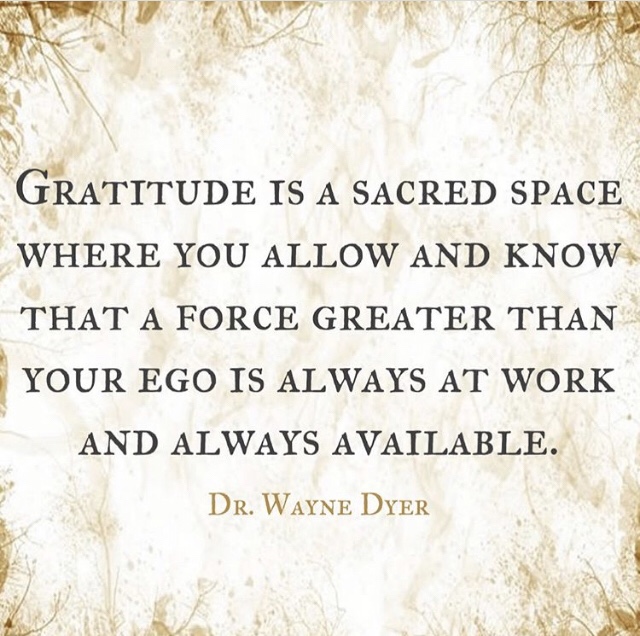
As seen on Instagram at drwaynedyer