Your Health Journey: It’s more than just taking a pill

“Take care of your body.  It’s the only place you have to live.”–Jim Rohn

Photo by nappy on Pexels.com

Listen to your Gut-Instincts🙇‍♀️

It’s been a little over a decade since I received the medical diagnosis that dramatically changed my life. I spent years battling upset stomach, gas, bloating, heartburn, and lower belly pain that only got worse with age. Pills had always been the answers.  In fact, at one point in my life, I had multiple timers set on my phone to remind me to take prescribed medications before and after eating.  

During a vacation near Boone, North Carolina, with my husband and daughter in which we had to plan our days around the timing of my medication, I finally decided I had had enough.  Call it “gut-instinct”, but I knew that whatever was going on inside my body, the prescriptions were not the answer.

Photo by MART PRODUCTION on Pexels.com

Finding a Doctor to listen 👂

Fortunately, I had a doctor at the time who took me seriously and listened. Together, we discussed a plan of action. Still, it took several months of waiting for tests and lab work to be completed, and more time waiting for results–the “hurry-up-and-wait” shuffle–as I fondly call it.  

I am not sure what I expected the results to be. However, when the letter arrived at my house stating I needed to schedule a follow-up appointment with my doctor (which was already on the books) due to indications of celiac disease and hiatal hernia, I was initially upset due to the dramatic lifestyle changes to manage both.

Photo by Alexas Fotos on Pexels.com

Change is Not Easy 😬

To state the obvious, change is not easy, so I faced a fair amount of challenges as I adjusted my diet.  Ultimately, though, as my symptoms subsided, and, one-by-one, the medications fell by the wayside, my motivation to continue increased.  I also came to see that compared to other potential prognosis, changing my diet was a minor task compared to invasive treatments, therapies, and surgeries.  

I’ve learned much, and continue to learn, along my health journey. Therefore, I share my experience as a point of encouragement when dealing with medical issues. 

Photo by Christina Morillo on Pexels.com

Advocate for Yourself 🗣️

First, I encourage you to trust your instincts, and advocate for yourself, especially if you are a person of color, a woman, a person with a higher BMI, or a LGBTQ+ person.  Unfortunately, as with any field, there are those medical professionals with internalized biases.  While I am confident not all doctors are bad actors, my own personal experience–and that of several others I know–have certainly informed me that if you belong to one of those categories, your complaints may not be given serious and thoughtful consideration. Therefore, you MUST advocate for yourself, even if it means changing doctors or traveling out of the area in which you live.

Photo by Pixabay on Pexels.com

Not every Health Issue requires a Pill

Secondly, sometimes medication is absolutely necessary; however, prescriptions are not end-all-be-all for every situation.  While I did have a doctor who truly listened to me, it still took me advocating for myself and not settling for what he prescribed based upon the medical system in which he worked. I am fortunate that when I questioned the medicine, that this doctor did not take it personally or as an assault on his professional judgment.  Nor did he try to use shame, or blame-the-patient tactics, as I had previously experienced.  He heard me out, asked numerous questions, and based upon those answers, set up a series of diagnostic tests. 

Photo by Brett Sayles on Pexels.com

Be Gentle with yourself as you navigate lifestyle changes 😊

Thirdly, be gentle with yourself if you have to make lifestyle changes. Once I received my results, overhauling my diet was scary–do you know how many things have gluten in them and/or cause reflux? I felt a huge amount of internal resistance to those changes in the beginning because it seemed like such an overwhelming task. 

Lifestyle changes are not easy, and it takes time to make the adjustments.  There are going to be setbacks, slipups, and mistakes along the way.  I know; I experienced them.  Completely changing the way I ate was a steep learning curve, and it was an eye-opening experience. Nonetheless, at the end of the day, I wanted to feel better and not live my life on a series of timers and pills.

Photo by Jack Sparrow on Pexels.com

Find your support 👯‍♀️

Enlist support for your changes. Join Facebook communities or other support groups to help you transition and navigate through the changes. Thankfully, I had support in the form of my family and friends.  Of course, they did not have to necessarily change the way they ate, but they absolutely made, and still continue to make, accommodations for my dietary needs.  This is especially true for when we dine out.  I have a limited number of restaurants in which I can safely eat.  Therefore, if I can’t eat at a certain location, friends and family will nearly always choose another option, so I can also enjoy the meal with them.

Photo by Krivec Ales on Pexels.com

health is a constant series of adjustments along the way 🛣️

Finally, know that your health journey is a continuous process.  Because I spent over four decades without a proper diagnosis, I am still encountering health difficulties.  One of the biggest obstacles I now face is a result of undiagnosed celiac disease.  Celiac causes the villi that make up the lining of the small intestines where nutrients are absorbed to become damaged. Over time, the villi atrophy and flatten due to inflammation from eating products that contain gluten.  

Despite overall healthy eating and consistent exercise, until I cleared the gluten in order to reduce the inflammation in my body, I was not able to absorb enough nutrients, specifically calcium, Vitamin D, and Vitamin K.  Additionally, due to  acid-reflux, I took proton-pump inhibitors for several years, which are also known to deplete magnesium, calcium, and other important minerals.  

Thus, I now have osteopenia.  As a result I have already had one surgery and may later need another one. However, I am doing all I can to keep that from happening, including completing the prescribed exercises, lifestyle changes, and appropriate supplementation of key nutrients.  Additionally, of course, I continue to maintain lifestyle changes with regards to a gluten-free diet, low-acid diet, and I am now more motivated to continue consistent weight-bearing exercise to keep my bones as healthy and strong as I can. 

Our health is truly a source of personal wealth.  Therefore, learning to advocate our own health needs is critical.  To be sure, doctors are highly educated, but that doesn’t mean they are fully educated when it comes to YOUR BODY and YOUR unique HEALTH needs.  

Photo by Yan Krukau on Pexels.com

IT’s your body. Treat it Well.

Speak up for yourself.  Trust your instincts.  If you need medication, take it, but don’t overlook lifestyle habits as well.  Educate yourself on lifestyle habits that can positively (and negatively) impact your health and make adjustments as needed.  Don’t be afraid to ask for support, and forgive yourself if you slip-up along your health journey.  

At the end of the day.  It is your body.  It is the only one you have.  Treat it like the sacred, precious gift that it is.

Get More Grounded: The Benefits and Lesson of Tree Pose

“Be like a tree. Stay grounded. Connect with your roots.  Turn over a new leaf. Bend before you break.  Enjoy your unique natural beauty. Keep growing.”–Joanne Raptis

Photo by SHVETS production on Pexels.com

The magic of Tree Pose 🌳

“Trees sway; get more grounded,” my husband chimed along with the yoga instructor on the DVD as we attempted tree pose on a Monday morning before work, the classic yoga balancing pose that requires standing on one leg. 

I appreciate tree pose for many reasons. It strengthens feet, spine, ankles, legs, and core.  Further, it opens the hip area, stretches the inner thigh and groin muscles.  Plus, it can improve one’s concentration and focus while simultaneously improving alignment of spine and posture.  Most of all, it is a pose of balance, which can help in a multitude of ways. 

Symbolically, tree pose serves up several lessons. However, one of the more literal lessons of tree pose is that of remaining in the present moment.  It’s nearly impossible to balance in tree pose and think into the future or reflect on the past because you end up falling out of the pose. I was reminded of those lessons this past Tuesday, or as I have come to know it as, “Twister (or Tornado) Tuesday.” 

Photo by Ralph W. lambrecht on Pexels.com

Shelter in Place 🌪️

As a veteran educator, I have experienced a wide-array of events, including those that require shelter-in-place. In fact, I can still recall the first time I experienced shelter-in-place with students 30+ years ago.  I was teaching in a mobile unit at a great distance from the main brick and mortar school building. The students under my care ranged from 5-12 years of age, and they had been identified as “severe behavior handicapped.”  

There were twelve students, ten boys and two girls.  Since this was the early 1990s, computers and cell phones were not widely available in the classroom setting. This classroom had an intercom type “phone” that only connected from the school office to the classroom.  It was through this “phone” that I received the message that the entire school was sheltering in place in the hallways.  The school received a call that a tornado had touched down in another part of the county and was heading our way. I was to gather my twelve, not-always-so-compliant students, and move them to the main building as quickly as possible.

By the time I received the “call,” a heavy metal concert of rain and wind had already begun, drumming and shaking the metal building rhymically with tantruming, angry torrents of sideways rain.  Quickly, the paraprofessionals and I helped the students into their school-issued red rain parkas, and that is when the resistance began.

“I am not going out in that rain.”

“I don’t like getting wet.”

“No, I won’t!”

“I’m scared!”

Whether it was the determined, I-am-not-kidding look in my eyes, Divine intervention, or a combination of both, the paraprofessionals and I miraculously gathered all of them in a line.  Holding hands as one unit, we began fighting our way through the class door that kept trying to swallow us back inside due to the enraged winds. Once outside, raindrops pelted any exposed skin, including the students’ face and heads as their hoods were immediately blown off.  We fought our way to the safety of the school while the passion of the rain and winds seemed to increase and determinedly tried to shove us backwards. 

By the time we made it to the school, none of us were dry as the pernicious storm found a way to penetrate even the sturdiest of rain coats.  Quickly, we hustled the students to the primary wing of the school, finding a piece of wall away from windows where they could drop to their knees and cover their heads, rivulets of water streaming over all of us, while adrenalin continued to accelerate my heart rate.

Photo by monicore on Pexels.com

Twister Tuesday 🪟

This memory bolted through my mind on “Twister Tuesday” as my classroom, and the surrounding classrooms, were filled with the strident sound of the emergency broadcast system sending an urgent message to seek shelter immediately. Our middle school classrooms are located on the top floor of our school building, and the entire middle school was directed to make their way to the first floor as quickly as possible. In order to do that, we had to run down three flights of stairs in a glass-lined stairwell. As we headed down, the irate storm quickly made its presence known.  Like Lyssa, a figure in Greek mythology who is said to drive others mad, the storm insanely clambered and clawed at the windows demanding to get inside, but meeting a wall of resistance.

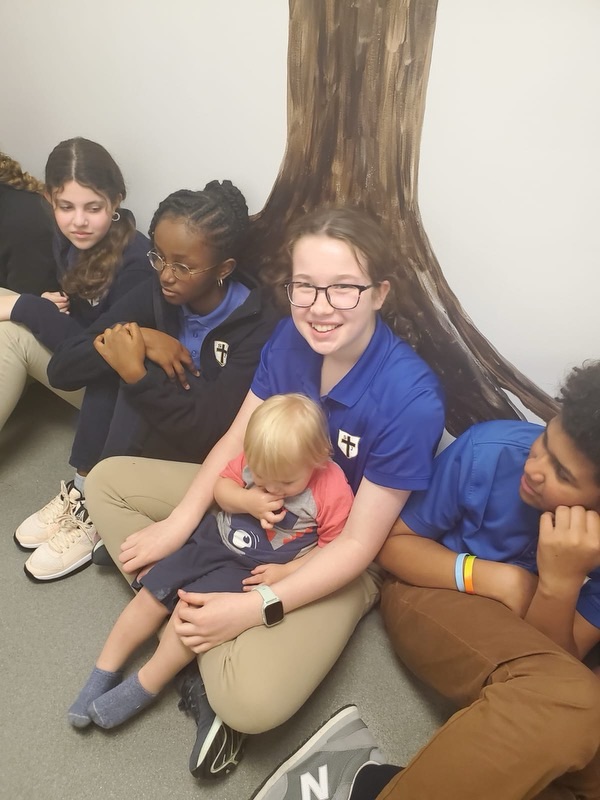
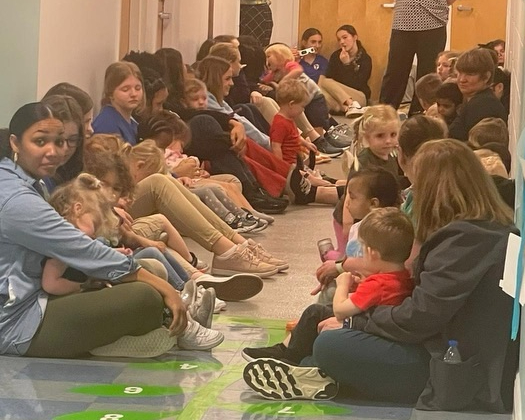
Once downstairs, it was hot, crowded, and overripe with the odor of sweaty, nervous bodies as we sheltered in place away from doors and windows alongside first and second graders as well as preschoolers from the two- and three- year old classes. At times, there were crescendos of anxious voices of students–or, in the case of some of the little ones–crying. During other moments, there were a few older students who experienced panic attacks, but there were many more who remained calm.  There were even those selfless students who chose to hold, cuddle, and comfort younger preschoolers, focusing on the needs of others, rather than themselves.

Middle school students caring for the needs of preschoolers during a shelter in place scenario.

And if you Fall . . . Pick yourself 🆙

As I walked among the students, checking on them, assuring some, answering questions of others, my mind echoed with the words from the previous day, “Trees sway; get more grounded.”  And so, I ground down into my faith.  If the students and staff of my previous school survived that former storm way back in the 90s, surely we would survive this one too.  My emotions could sway like the tree on the inside, but the more I swayed, the more I reminded myself to ground down and try to remain balanced in the present moment in order to better focus on those around me.  

It wasn’t easy, and I wasn’t perfect.  But here’s the thing about tree pose. It’s a great way to practice falling. If you fall out of tree pose, you pick yourself up, and try to return to the pose once more.  

Like my beloved tree-pose, Twister Tuesday provided another stretch and realignment personally and professionally as well as to my faith. It challenged my focus and concentration in order to remain balanced.  And when I “fell,” forgetting to remain focused on the present moment, all I had to do was “pick myself up” and try to return to it once more. Most of all, that Tuesday served as a powerful reminder of the power of the True Source dwelling within and around us, always available to keep us grounded. 

Another middle school student getting grounded in the present moment of another’s need.

Grief and Love–one story of surviving the loss

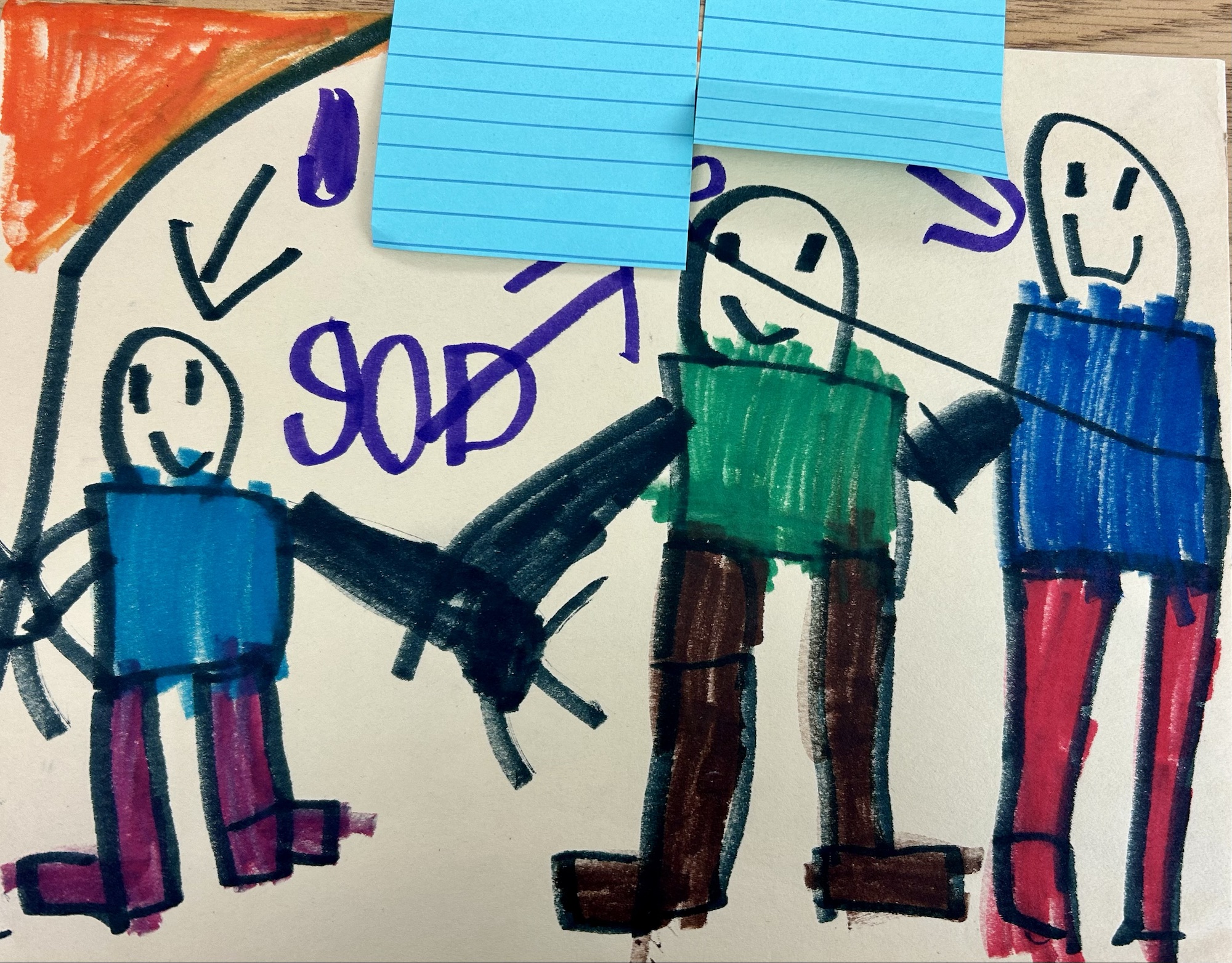
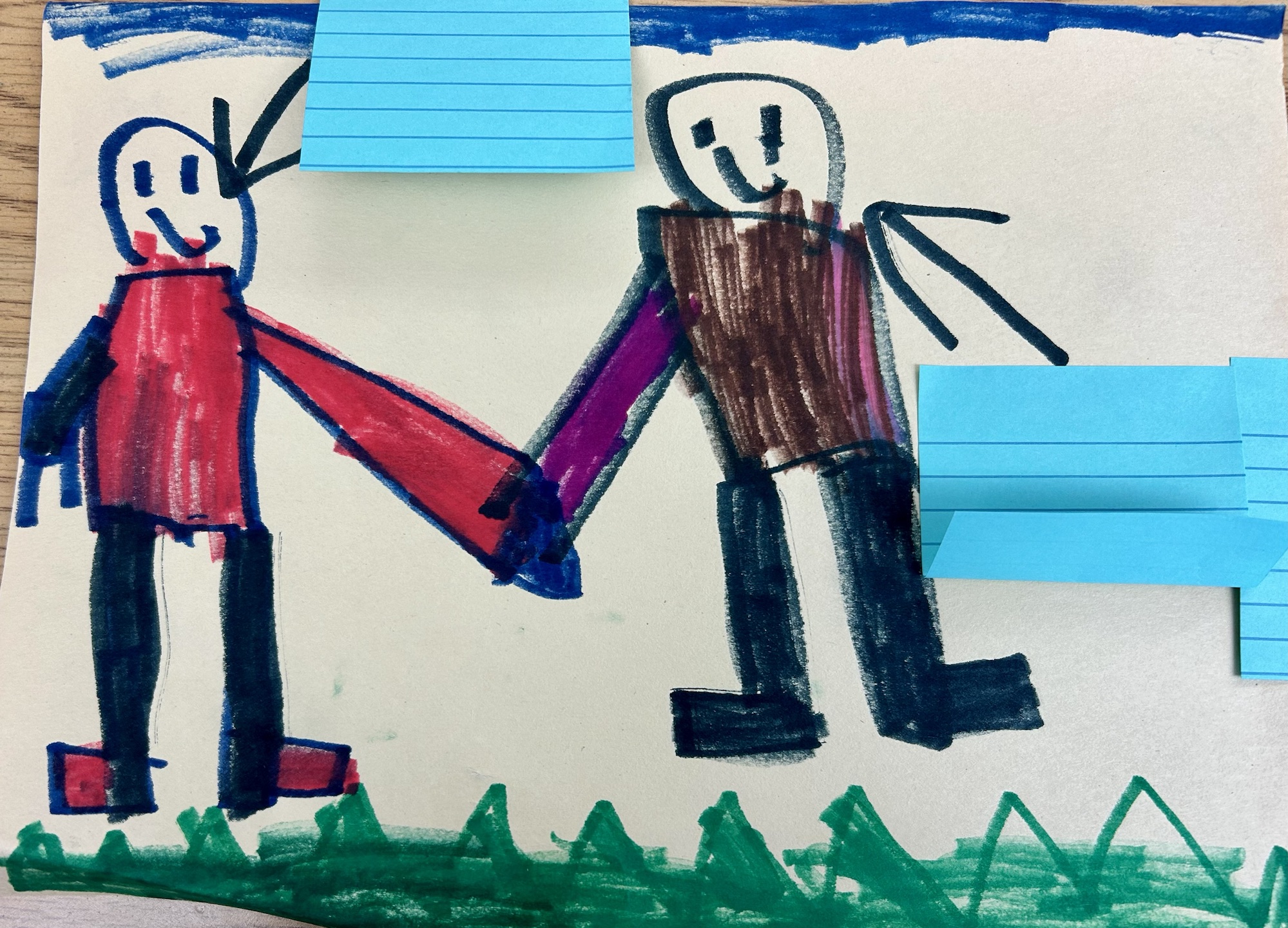
A picture created by one of my former Kindergarten students depicting what they believed was their former classmate’s ascent into heaven. The rainbow is what the heavenly friend is sending back to the friend still who is still alive. (Post-it notes are covering names.)

A story revisited 🥺

It was a spring day with wide cerulean skies and clouds of cotton puffs as I stepped out of my vehicle, as per usual, when I saw the employee approaching with my curbside grocery order.  I am a regular customer, so I tend to know the names and faces of the usual employees, but she was new to me.  Therefore, I was surprised when she asked if I was a teacher. I smiled, and said that I was. I could have never predicted what she would next say.

As she talked, there it was.  The wound, which I thought had healed, was painfully stabbed open. It is an unfortunate story, centering on a young family, a classroom of five-year-olds, their parents, and me–bound together by a loss too surreal to be true– yet it was. 

 She said she attended the funeral and saw me, and she added that she related to the family. Additionally, she added that all her kids attended that same school in which I once taught, now nearly 20 years later. As what appeared to be an after-thought she added, “You was a good teacher.” 

I asked about the surviving family and the sibling, who was only a baby at the time of the event.  The sibling, she reported, was now studying at a university.  This bit of information buoyed my spirit.  

Another picture drawn by another student depicting their deceased friend, holding hands with God and Jesus.

An event that forever changed me 😨

With over three and half decades in education, I can look back at certain points in my career and identify pivotal moments that forever changed me.  This loss of a five-year-old student was probably one of the most defining moments in my career. It sent me spiraling into a deep darkness for which I believed I should keep hidden from the world because it was my face those cherished students and their parents looked to for strength and stability–or at least that is how I perceived the situation at the time.  

On the inside, I was crumbling, questioning everything my faith had taught me.  Angry at that the Universe would allow such a senseless death, and angry at myself for what felt like was my “butterfly-effect” that seemingly set the wheels in motion for this tragedy.  Emotions, which I now know, can override logic during unexpected loss.

Outwardly for the world, I did the best I could, but none of my training had prepared me. While there were times, I felt led from within by a Source greater than myself. Other times, I felt I was driving a car without headlights after a severe storm, stumbling and bumping up against one roadblock after another.  

Another drawing depicting a student holding hands with the deceased classmate, adding that they missed their friend. (Names are covered with post-it notes.)

Days of Mourning 😢

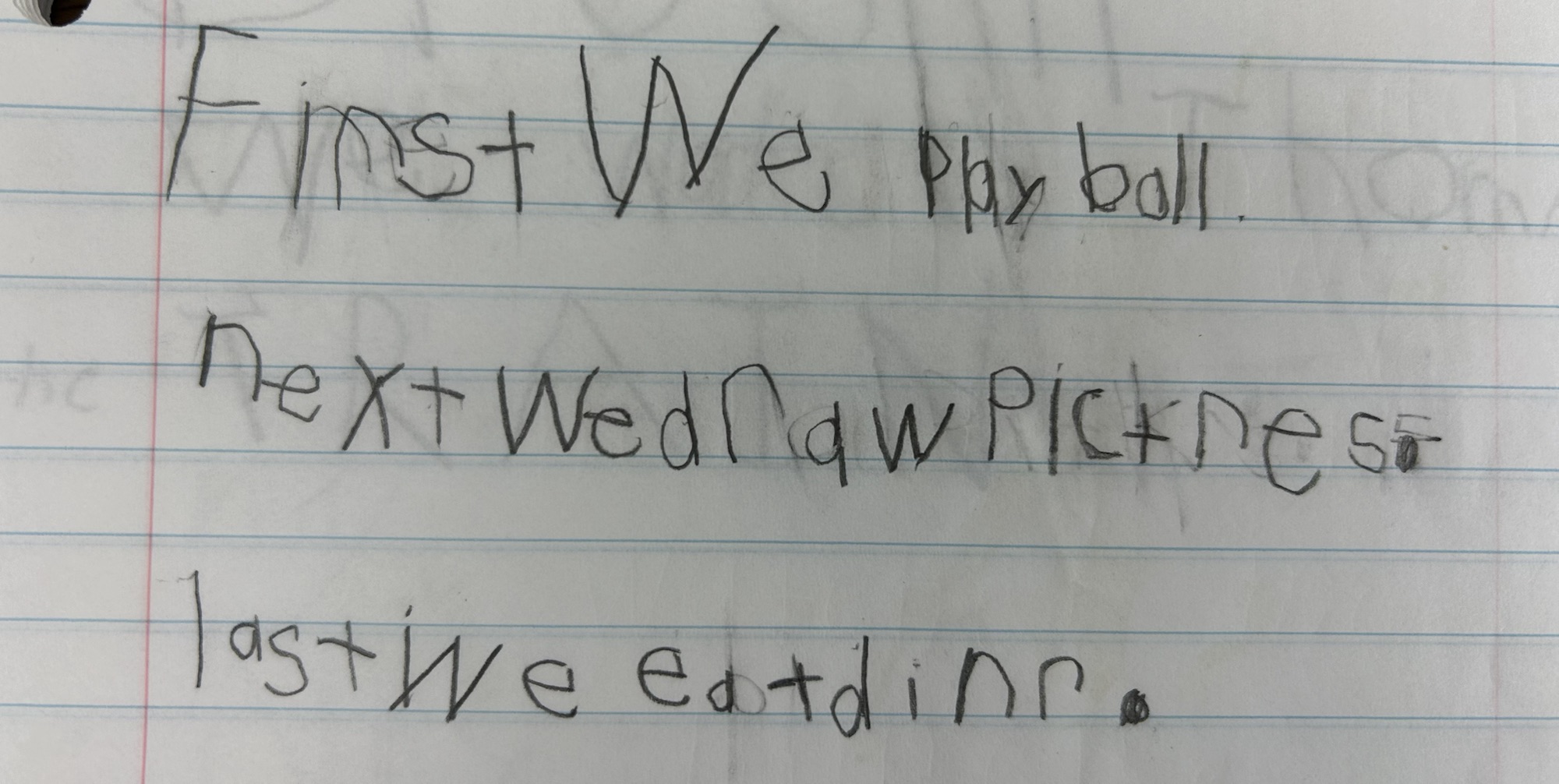
There were countless days when my students would just cry, and so I let them, allowing their tears to express what they could not put into words.  I hugged them often, and permitted/encouraged them to express their feelings in a safe and productive ways.  They drew pictures, decorated their former classmates’ seat, and took turns holding and talking to a bear that had been built for them to help process their grief.

Some students, who weren’t as verbal as others, became noticeably aggressive as they moved through stages of grief.  This required much patience and tolerance.  While I understood they needed to get out their anger as they were not developmentally old enough to understand death, I could not let them harm other students.  Therefore, I had to come up with creative outlets for their feelings, such as allowing them to be the official “wrecking ball” if someone wanted their block creation knocked over or the official “paper shredder” of messed-up papers.

A “story” written by a student describing what happened when the student took home the grief therapy bear.

Sometimes, Life isn’t fair 😩

Thinking back to that tragedy, I wish I could go back to my younger self and say, “You’re doing ok,” in the same way I would have said to my students at the time.  Instead, I spent much time questioning what more I should be doing.  And, each night, when I went home to my own beloved daughter the exact same age, I felt simultaneously grateful and guilty.  Why did I get to keep my child, but someone else didn’t?  It wasn’t fair.

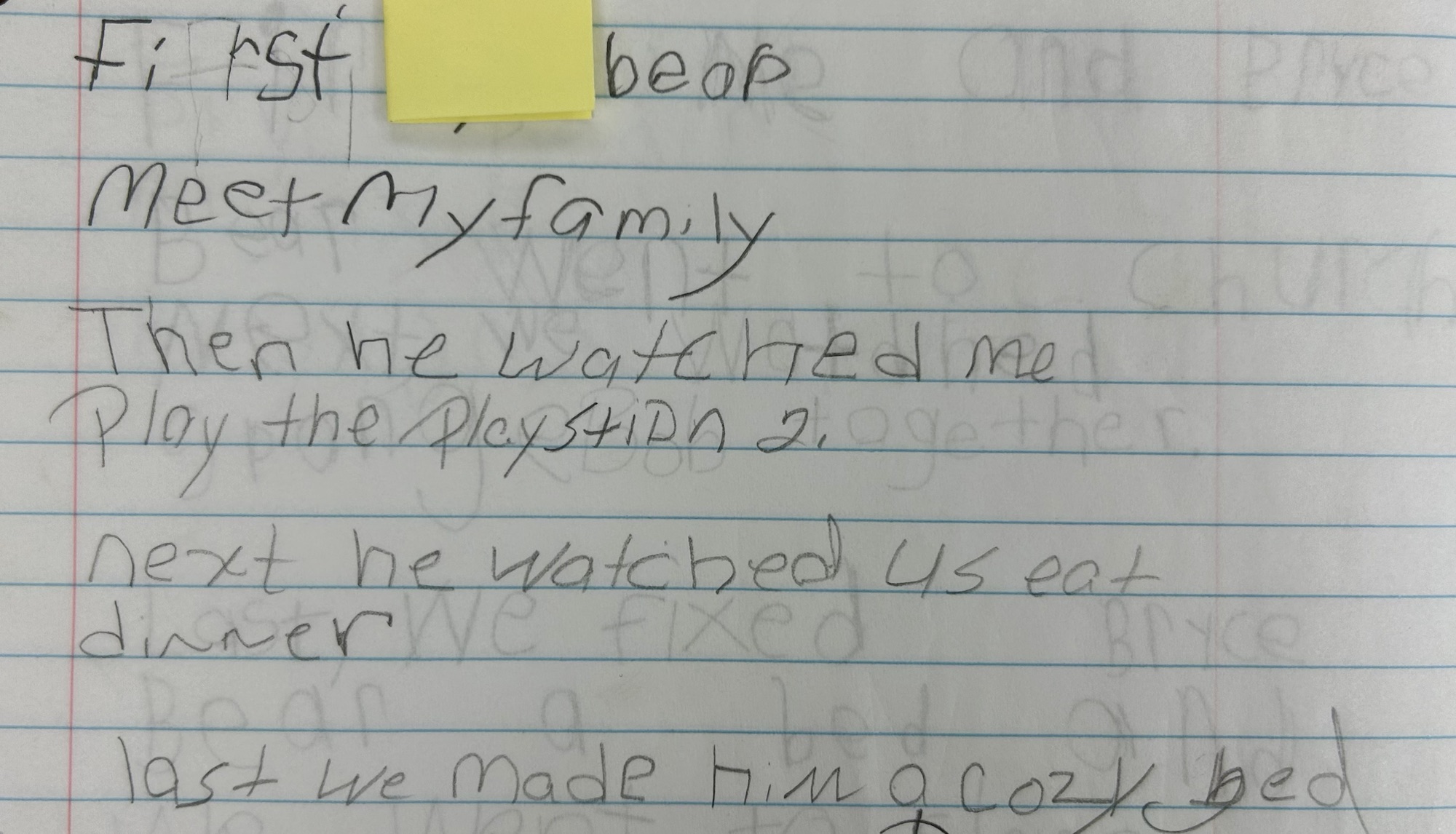
Another student’s experience with the grief therapy bear.

Nearly 20 years later . . .⏳

Now, nearly 20 years later, life continues to march on at a breathtaking pace. Those students are now in their 25th year of life.  They are all, I hope, making their way into their independence, exploring the edges of the kind of responsible adult they want to evolve into.  I pray they will each find their own version of success, however they define it. 

I especially hope the child’s family is well.  They were dealt a tragic blow for which I have no explanation.  I am certain it has not been easy for them, but I pray their hearts continue to mend to the degree possible. Most of all, I wish them peace.

Another drawing of expressing their feelings about their departed friend. (Name is covered by post-it notes.)

Does time Really heal? ❤️‍🩹

They say time heals all wounds, but I am not sure.  The wounds may heal, but the scar still remains.  Like all scars, they fade with the passing of time, but those scars remain as a reminder of who we once were.

 Once there was a young family of four, until suddenly there were three.  Once I was a kindergarten teacher with 15 students, and, in the blink of an eye, there were 14.  I wish I knew why, but that is not for me to understand.  Instead, I will forever be haunted by what more I could have done. 

Another student’s experience with the grief therapy bear.

Looking back on the love 💜

Nonetheless, looking back now, what I most recall is the love.  Love for the departed student, love for the other students of that class, and deep abiding appreciation for those students’ parents who unconditionally supported me and guided their children tirelessly through what had to be one of the darkest periods in their young and tender lives.

Their is beauty in life, even if short lived 🌸

On the day of writing this, I went for a run in a park.  It was early spring, and the air held the promise of warmer days.  All around me the wind blew off the white petals of flowering trees, and the petals danced around me like snowflakes, graceful on the currents of air.  I realized, the flowers will soon be replaced by the green leaves, and the cycle of life will continue through the seasons.  However, in that moment, I could not help but feel those petals were a heavenly reminder of the beauty that is possible in life–even if for only a short time.

Musician and writer, Nick Cave, is said to have written in a letter, “Grief and love are forever intertwined. Grief is the terrible reminder of the depths of our love and, like love, grief is non-negotiable.”  I couldn’t agree more.  

Another piece of artwork expressing the joy of friendship in spite of the loss. (Names covered with post-it notes.)
Another student’s experience with the bear.

Anyone can complete a half-marathon: Tips to help you achieve this goal

Even when you have gone as far as you can, and everything hurts, and you are staring at a specter of self-doubt, you can find a bit more strength deep inside you, if you look closely enough.”–Hal Higdon

Virginia Beach Shamrock 1/2 Marathon 2024

Pace Yourself 👣

“Your pace on the last mile was spectacular.” Siri voiced my husband’s text into my ear. 

I had just passed mile marker 7 of the Virginia Beach Shamrock Half-marathon.  Up until that point, I wasn’t sure how this event would go for me.  While I had been officially training for this event for months, I had undergone fairly major surgery eleven prior, so I had only gradually returned to running beginning in June.  Even then, it was two months of walking/running, gradually increasing the time spent running.

In November, I participated in the Marshall University Half-Marathon.  Completing it felt like a huge victory since I had to start at ground zero, so-to-speak, post-surgery.  After my surgery at the beginning of April, my exercise consisted of walking around my house for 5-10 minutes at a time several times per day. Therefore, going from house-walking to running 13.2 miles, albeit slowly, within several months was a huge personal milestone. 

Ready to start!

Rethink your definition of Who Can finish a half-Marathon 🏁

Here’s the thing to know about me.  I am not what I would consider athletic.  I was the proverbial band-geek in high school.  Not that I define myself by long-ago standards, but I think many of us can get into our heads and define our athletic abilities based upon those past early experiences. The point is you don’t have to consider yourself “athletic” to participate in a half or full marathon. Anyone can do it.

Furthermore, you don’t have to be fast, and you don’t even have to run it.  You can walk the entire route, or you can mix it up, alternating bouts of walking with running. Others, those who I tend to define as “natural” runners, may spout out finish times and pace with a competitive spirit, but many others, like me, are simply proud of crossing that finish line.  That said, I do confess I notice my finish times, but I never let those times define my accomplishment.  Crossing a finish line is always a victory.

Photo by RUN 4 FFWPU on Pexels.com

Realistic Plans for Beginners ✅

To that end, my relationship with running, which began approximately ten years ago, has developed in fits and starts. When I first began, ten years younger, I was a bit faster than I am now, but I was still running at what competitive runners would consider a slow pace. During those early years, I would try to adhere to established standards of publications, and I always fell short.  I wasn’t experienced enough to fully understand those standards weren’t realistic for me. 

Ten years later, and it still seems like many publications and media outlets set unrealistic expectations for those who are TRULY newbies and need a gentle approach to running/walking.  However, that is gradually beginning to change, and I want to be part of those voices who speak to those so-called “nonathletes” who want to participate in a healthy community event, such as a 5K or half-marathon.  I have read and listened to a few authors who speak to that person with no athletic experience; plus, I have amassed my own personal experience. Therefore, I want to share a few tidbits of encouragement.

Photo by Ketut Subiyanto on Pexels.com

Focus on Increasing time on feet, Not Miles 🦶

First of all, nearly anyone can train to walk, walk/run, or run a half-marathon.  I have met too many people who say they’d love to do it, but believe they aren’t capable.  Yes. You. Are.  I have participated in enough events to know that there are numerous participants who walk the entire route.

Here’s the trick I learned, you do need to train and prepare the body for these events, but it doesn’t have to be extreme. It’s all about time spent on your feet engaged in walking and/or running and the weekly long run that gradually increases in length over 12-24 weeks, depending upon your goals and your starting level of fitness.  (Of course, always seek advice/approval from your healthcare provider before embarking on a program.)

For both Shamrock and the Marshall Half-marathon, my longest run was ten miles, and they were walk/run training sessions–run ten minutes, walk two minutes, and then I kept repeating this pattern for a certain length of time, rather than miles.  This took pressure off completing a certain distance, and it allowed me to better respond to how my body was feeling–adjusting the length of time walking or running.  If I felt rested and strong, I ran for longer periods; however, if I felt over-fatigued or not well, I ran for shorter periods and walked more. 

Photo by Kate Trifo on Pexels.com

Never Underestimate walking 🚶🏽‍♀️

As a general rule, true beginners typically start with walking.  Once you can successfully walk for 30 minutes without stopping–and it might take months to work up to that length of time, and that is ok– then you can begin to add a minute or two of easy jogging, such as walk for ten minutes, jog one minute; repeat two more times.  That is honestly how I moved from walking to running after surgery this past spring once I had clearance from the surgeon.

Photo by Ketut Subiyanto on Pexels.com

Intersperse time jogging 🏃‍♀️

Run Your Butt Off  is a great resource for a structured 12+ week  run/walk plan, but I suggest you disregard the diet information! Additionally, the Shamrock Half Marathon/Marathon website offers free training plans for running/walking an 8K, half, and full marathon. I have successfully used both and found them incredibly helpful and encouraging.

Week-by-week, you can slowly decrease your walking time and increase your running time.  Eventually, you may get to a point where you are happy alternating between running and walking, and that is fine!  Many people adhere to a run/walk practice.  In fact, Jeff Galloway has published numerous articles and books on this topic if you are looking for more guidance.  Therefore, if you want to complete a 5K, 8K, half-marathon, or even a full marathon, there are plans available that will fit your level of fitness. 

Two thumbs up for a personal best!

Sham-rocked! ☘️

As it turned out, I was ultimately able to finish this half-marathon with a personal best time. Once I passed mile marker 7 and my husband made me aware of my pace, I began to get excited and focus a bit more on maintaining my pace, realizing a PR was within reach.  In fact, I finished ten minutes faster than the previous year!  However, it wasn’t easy.  My mind kept telling me about different parts of my body that were hurting, so I had to keep combatting and replacing those negative thoughts with positive messages, such as  “I am getting stronger,” “I am so close now,” “Focus on the feeling of crossing the finish line,” and so forth. 

While it wasn’t my intention to run a PR, I think changing the way I more realistically approached training after surgery made it possible.  Giving myself permission to walk during my months of preparation and using a training plan appropriate for my skill level made a huge difference. Nonetheless, even if I had finished with a slower time, crossing that finish line is always a victory! 

You can do it! 😃

And, I want you to know, Dear Reader, that if you have ever dabbled with the idea of participating in a half-marathon, you can absolutely do it!  I am cheering for you! 

#runforglutenfreewaffle #bestsupport #pocahontaspancakes&wafflehouse #shamrockfinishline

Almost time to go!
And, we are off and running!
Crossing the finish line is such a feeling of accomplishment!

The Lost Art of Delayed Gratification

“The longer you have to wait for something, the more you will appreciate it when it finally arrives. . . .  All good things are worth waiting for . . .”–Susan Gale

Photo by Pixabay on Pexels.com

Window of opportunity ⏱️

One of the more popular health trends that continues to grab headlines is around time-restricted eating or TRE.  It is a form of intermittent fasting in which a person chooses a window of time within a day, typically 6-12 hours, in which they eat.  During the time outside of this window, those following a TRE protocol, do not consume any other calories and drink only water, although there are some following a TRE plan that consume unsweetened tea or coffee. 

The idea of TRE is to reduce the amount of overall calories consumed in a day and to reduce less-positive habits such as eating late at night or snacking too much early in the day.  Besides the obvious benefits of managing body weight, scientific research  into TRE continues to show promising results, including reducing insulin resistance, reduction of inflammation and oxidative stress, can alter and improve the composition of the microbiome, and improved sleep to name a few. 

Photo by Yan Krukau on Pexels.com

Time to Eat 🍱

Time restricted eating is nothing new to me. In fact, my childhood taught this.  I grew up with a natural TRE called breakfast, lunch, dinner and no snacking in between.  Furthermore, my parents believed that if we didn’t like what was offered at a certain meal; well, we wouldn’t starve because I could eat again at the next meal.  

I can recall sitting in elementary school feeling my stomach growl.  Sure, I had breakfast, but we ate early in order to make the school bus.  I would look at the large classroom clock on the wall, counting down the time until the teacher l lined us up and walked us to lunch. Standing in line waiting for everyone to go to the restroom, wash their hands, and line back up, my mouth would water in anticipation of food.  By the time I sat down with the other students who had packed their lunches, I thought I would perish from hunger! But, oh how good that simple food tasted when I could finally take a bite!

By the time I got home from school, my stomach would once more be begging for food, but there was a hard-fast rule.  No snacking before dinner because you’ll ruin your appetite.  This was made more challenging if my parents had ordered a tray lunch from the school cafeteria, and I didn’t like the food.  Still, there was no debating–wait until dinner.

Fortunately, we tended to eat between 5:00 and 6:00 pm, so I didn’t have to wait too long.  However, I tended to be persnickety about certain food items, so if the meal consisted of a food (or foods) that I didn’t like, too bad for me–or any of my siblings for that matter–there was always breakfast.  We weren’t going to starve–even if we thought we would. 

Photo by August de Richelieu on Pexels.com

Delayed Gratification ⌚︎

The beauty of my parent’s rules, whether they intended it or not, was two-fold.  First, food tastes better when truly hungry.  It felt downright wonderful to have a hearty appetite as I sat down for a meal. The other skill learned was the art of delayed gratification.

Sure, I’ve went through phases, such as camps, overnight stays with friends or family, and later in college and as a young adult, where I ate completely differently than how I was raised–eating at irregular times and noshing on foods I would have never been able to eat at home. 

As an adult, I have also likewise gone through similar phases. It is more challenging now to have those structured meal times since food is so widely available at all hours of the day.  No wonder TRE is so popular now.  It brings back that structure and discipline in which I was raised.

The art of delayed gratification, given the immediacy that technology brings, is perhaps becoming a bit of a lost skill set. The ability to resist an immediate reward for a greater or more favorable reward later requires self-regulation and impulse control, skills that often get lost while scrolling through our various screens. However, delayed gratification is a skill that can be learned at any age, but it is not easy.

Photo by Pixabay on Pexels.com

Benefits of Delayed Gratification 🎓

Delayed gratification is what some parents try to teach their children by insisting that all homework must be completed before the kids are given permission to choose a more preferred activity.  It is what adults practice when saving for an important item, such as buying a new car, house, or even something as simple as setting aside money for rent, groceries, utilities, and other bills.  In fact, anytime we choose not to be distracted from our goals or priorities, we are practicing delaying gratification. 

Success in any endeavor, from career to finances, to the most mundane such as cleaning house to choosing when and what to eat, requires the ability to resist the temptation to do something easier (the distraction) and instead, complete something harder, such as studying for that next level career exam or simply choosing, as my parents taught me oh-so-long ago, only eat at meal times. 

Photo by SevenStorm JUHASZIMRUS on Pexels.com

So how do we get better at delayed gratification? ⤵️

There are multiple books, articles, and youtube videos designed to provide various methods. Some people like big changes all at once, such as TRE, leaning into some variation of:  Here’s the rules, the parameters, and the start date.  For certain personalities, a total overhaul of their habits works great.  

However, I tend to prefer more gentle approaches such as:

  • Start with one small change (habit) and stack it with an already existing habit, i.e. I already drink coffee in the morning, why not drink 8-12 ounces of water beforehand?
  • Repeat that change again the next day
  • Set a goal for continuing that new change/habit for a set amount of days with a planned celebration/reward upon reaching the goal
  • If you’re really resistant to completing something, set a timer for two minutes.  At the end of those two minutes, get started. (It sounds silly, but for some people, it works.)
  • Try the “if-then” principle: “If I do this,” (clean kitchen, set up budget, exercise . .), “then I can do this” (scroll through social media, read, nap, etc. . .).
  • Play mind games and daydream (Instead of focusing on what you want to do, daydream about all of the positive feelings you will undergo sticking to and achieving your plan.  Likewise, focus on the negative feelings you will experience if you give-in to a distraction.)
  • Offer forgiveness to yourself when you slip-up (and we all do), but then return to your goal again the next day.
Photo by RUN 4 FFWPU on Pexels.com

Make Delayed Gratification work for you! 😄

Ultimately, whether you are trying to stick to TRE, save for new tires on your vehicle, or make that next big career step, employing the art of delayed gratification can help you keep your goals at the forefront of your mind.  By keeping those goals small and achievable, you can visualize the steps along the path to success (better health, cleaner house, better finances, etc . . .), make peace with your distractions, focus more on your plan/goal, and face challenges (aka distractions) with a bit more self-composure and kindness to self. 

Clouds attaching to my story of sunshine: A lesson on detaching from the plan and surrendering to your Higher Power

“When things don’t go as you planned, don’t be let down. Make new plans. The sun doesn’t stop shining just because of dark clouds.”–unknown

Photo by Jess Bailey Designs on Pexels.com

Who loves a good plan? 🙋‍♀️

Are you a planner?  I can be.  I love a good plan like a kid loves her teddy bear. I can say the same about a solid routine.  Various routines and/or plans give me structure, a scaffolding, to ensure I remember to do, find, and complete various short and long term tasks.  

Without plans and routines, I am a total right-brainer who just goes with the flow.  Free-styling is fine for many of my creative endeavors. Unfortunately, most of my creative endeavors bring little to no income to pay the bills.  However, I love my creative side.  It’s the joyful part of me.  Thus, creating structure and routine to my day, allows me to pay the bills and have fun too.

I will fully admit that I have different plans/routines for different compartments of my day/week, and I work hard to fit those various plans together into the patchwork quilt that is my life. Routines for my profession are obviously far more important and detailed than routines for household chores.  Nonetheless, no matter the plan’s level of so-called importance, if I create or find a plan that truly works, I prefer to stick to it, cling to it if I must . . . but . . .

Photo by Wendelin Jacober on Pexels.com

Uncooperative Plans 😩

Unfortunately, life isn’t always so cooperative.  It keeps flowing like a river reacting to the weather trends unphased by “Stephanie’s plan”.  Sometimes the river of life flows steady ‘round bends and curves.  Other times it is dried to a near trickle, and I wonder if the rains of inspiration will ever arrive.  Then there are those storms that wildly overflow the banks of life’s river sending its waters over rocky embankments and into uncharted territory.

As I sat at my writing desk this morning, contemplating how to begin writing, I spent time staring out the window.  Dawn’s light had broken upon clouds and fog. I could see peaks of brighter blue sky in between the gaps of the clouds overlaid with gauzy fog, and I realized that is often what happens to my plans.

Photo by Tim Mossholder on Pexels.com

planned laughter 😆

I often joke that I must make God laugh all the time by saying that I have a plan.  Despite the fact that I know I need plans to organize myself and my hot-mess of a mind, I also know I cannot attach too tightly to those plans because God and life are going to do what they are going to do with me. And that is exactly what I am now experiencing.

One of my plans for 2024 is to run a spring half-marathon–the Virginia Beach Shamrock.  It is one I ran last March weeks before having a fairly major surgery in April.  Months later, in November, I ran the Marshall University Half-Marathon as a celebration of recovery from that surgery. 

My training plan for the MUM was long and protracted in order to allow my body to heal and recover from surgery.  After returning to work in May, I began gradually increasing my walking endurance throughout May and into June.  

Then, in July and August, I gradually added bouts of jogging into my walking. Gradually, the running sections increased as the walking sections decreased, but there was always permission to walk at any time, and even for the entire work out time, if needed. Due to careful planning, I was able to build up to running the entire half-marathon in November.

Therefore, I thought why not continue training through winter and once more run the VB Shamrock Half-marathon.  I had a plan.  It was mapped out from Thanksgiving week until March 17, the day of the half-marathon.  It was a beautiful and doable plan–not too hard–and fully manageable with my work schedule. 

Photo by Adrien Olichon on Pexels.com

Who’s doing the Steering? 🛻

But as I said, I told God I had this plan, and He had a good ol’ belly laugh at it. I mean He must have enjoyed a real guffaw because very little of “my plan” has gone “as planned.” In fact, I have had to rework and adjust this plan so many times, I have finally, less than three weeks out, metaphorically thrown my hands in the air and surrendered because only Divine Providence knows what will happen on the day of the event. 

Therefore, as I sat at my desk staring at the clouds, the rising mist of the fog, and the interspersed glimpses of blue sky, I reflected on my so-called plan.  The plan included four days per week of running and/or walking, with one longer session per week, completed outside on the weekend, gradually increasing in distance. 

Most of the early weeks into the plan, I was able to complete four days, running outside (translated, not on a treadmill) at least two of those runs.  However, at some point after Christmas, I had to begin making adjustments.  Runs were missed due to conflicts in schedules, and numerous runs were completed inside of a gym on a treadmill due to inclement weather. Plus, I battled several colds and even a random ear infection, which is something I haven’t had since I was a child, so more running time was missed.

Photo by paul voie on Pexels.com

Cloudy thinking 🤔

The thing about running, or any workout journey for that matter, is that it is a microcosm of life.  Lessons learned on the running (walking, hiking, lifting etc) trail are often tangible life lessons.  My plan was those fluffy white clouds in the sky that, in my mind’s eye, I could step comfortably from cloud A to cloud B and so on.  The morning fog, however, was the realities of life. Sometimes my planned path was clear, but most often, there was some sort of, metaphorically speaking, weather event occurring preventing a smooth transition from one step to the next.  

The cerulean sky, to continue the metaphor, was (and is) the Universe, the great I-AM, and that is to whom, in the end, I must surrender.  As Carrie Underwood once sang, I need to let go of the steering wheel because clearly I am not the one in charge despite my illusions of control.

By taking a step back, away from the great “Stephanie-said-so-plan,” I can gain a new perspective.  Firstly, I am grateful for overall good health. Sure, I have had a few minor illnesses this past winter, but nothing life threatening.  

Furthermore, perhaps all those challenges and obstacles were Divine Providence’s way of giving my body the rest I wasn’t giving it. Perhaps, I have been pushing too hard for too long.  Maybe some rest and recovery, like I gave myself after surgery, is what my body needed–especially as a more, ah-hem, older adult.

Photo by Thirdman on Pexels.com

Surrender 🙏

Similarly to the way I witnessed the morning surrendering the events of the coming day to the Creator, I too must surrender the events of the future.  What will be, will be.  End of story.  As my grandmother used to say as a preface, “Lord willin’ and the creek don’t rise,” I will still have the opportunity to travel for a short trip to the shores of Virginia and live to tell another story.  And, where’s the joy in life without stories to tell and lessons to share?  

Surrender the plan

The chipped teapot: Seeing our “imperfections” for what they really are

“It’s made me realize that imperfect is perfectly comfortable to me. Whether it’s a city or my apartment, I feel most at home when things are somewhat flawed.”–Hoda Kotb

Chipped, but not broken.

I’m a Little TeaPot 🫖

I picked up the teapot.  It had a chip on the top of its deep navy shape. I could feel how simultaneously sad and angry I was.  The chip was my fault.  I had dropped the lid and broken a piece off revealing the original white unglazed pottery underneath.  

Suddenly, the spiral began.  Why am I such a clutz?  How could I be so stupid? What is wrong with me that I can’t simply hold on to a lid in soapy water?  Way to go, Steph.

I am familiar with that inner critical voice demanding so-called, “prefection.”  That voice is full of all of the things I should do, and it also lists all the ways I fail and fall short.  It is the voice that can sometimes make me cry when I sense I have let someone down or dropped the ball on something I “should” have done. 

Photo by Moe Magners on Pexels.com

coping skills 🥸

In my younger years, I tried a variety of coping mechanisms to quell that demanding, perfectionist voice. I attempted to ignore the inner critic, but until I was wise enough to know the difference, ignoring sometimes led to overlooking those helpful, intuitive signals.  I also tried projecting a big ego full of confidence to hide that voice of doubt–which, I quickly learned, was a sure way to epically fail.  Of course, there were the tried-and-not-so-true methods of numbing that critic with overeating, over drinking, or even overdoing, but that only made me more miserable. 

Listening to that inner critic has also led to procrastination. For example, if I know a specific big job/task needs to be completed, I can become paralyzed from completing it because my inner critic states it must be completed in a certain “perfect” manner, making the task seem more overwhelming than it is. This paralysis can lead to shame, guilt, and self-loathing because it points to “another failure” when left undone. 

Other times, it’s not so much about procrastination as much as it is that I am managing a wide array of interests, so I get side-tracked from one project to work on another. Nonetheless, focusing on those “other interests,” instead of the “one-big-thing,” can also instigate self-criticism because, “Why can’t I be more focused and stick to one thing?” 

Surely, there are others who fight this battle of perfectionism.  Right?  Based upon all of the various titles of best selling books centered around the topic of perfectionism, I certainly must not be alone in my battle.

A bowlful of encourage-mints!

Letting go of the Perfectionism script 📝

However, with age, my inner gaze, like my own vision, has changed. Letting go of perfection has, to a certain degree, been a natural part of the aging process.  Aging, and the life-wisdom that comes with it, empowers me to more closely see the reality of situations. 

For example, while writing this piece, I picked up an individually wrapped mint to pop in my mouth to allow it to slowly dissolve as I write.  Unfortunately, when I picked it up, I dropped the mint on the floor.  My first voice said, “Way to go, dork.  You broke the mint.  Now, you’ll end up crunching it, rather than slowly letting it dissolve.”  Fortunately, my wiser, older voice swiftly pointed out, “Now, you have two mints! Twice the enjoyment!”

Of course, this is a simple scenario, but it leads to my next point.  Learning to let go of the narrative of perfection is difficult, and it is more of a process than a destination.  Here’s the thing though.  My beautiful, albeit chipped, navy tea pot still works.  It still steeps my various teas perfectly, and it pours without spilling a drop. All I have to do is turn the lid, and no one has to see the chip. Thus, learning to turn, or flip, the narrative of that inner critical voice demanding “perfections” is likewise a great tool.

While there is nothing inherently wrong with setting high personal standards, leaving wiggle room for what is truly acceptable, is a much less stressful approach. It also helps deflate the bubble of shame often attached to rigid standards when we allow for a less-stringent approach.  

Photo by Karolina Grabowska on Pexels.com

Flawless 😎

Another strategy for releasing perfectionism’s grip is to observe that many of our so-called “personal flaws,” when viewed from a different perspective, are actually strengths.  For example, I might leave one task undone for a longer than “it should be” time period, but that is typically because I am pursuing a creative endeavor such as writing, cooking, or even planning how I will teach a concept to my students.  What’s wrong with that?  Like you, I also wear many hats, so why shouldn’t I give myself grace to focus on one task without pressure to do all tasks “now.”

The more we can learn to adapt an attitude of grace and self-acceptance the more likely the tentacles of perfectionism will begin to loosen.  By embracing our many strengths and talents, we can also feel the weight of shame lifting like a dark cloud shattering as sunlight breaks through. For example, in my own life, I am not the early bird at work in the morning, but that’s because I am a morning person.  I spend several hours completing numerous tasks at home before arriving at work, such as writing, exercising, grading papers, and so on.  Therefore, why should I feel ashamed of my productivity?  

Another skill that has also come with age is learning to focus less on so-called mistakes, and instead, making a point to respect the fact that any time I make a mistake, it fosters my own learning. Mistakes are, in reality, a path to learning to do something better and a tool for continuing to hone a skill.  One example of this was when I was adapting an old family recipe for pound cake to a gluten-free variation. I botched that cake twice before finally figuring out the best way to make it.  Even now, I continue to refine and improve not only that recipe, but also my own technique for baking gluten-free. It is through this acceptance and openness to allowing for mistakes that growth can occur.

Flip the narrative, like I flip the lid around on the teapot.

MUlishly imperfect ⭐️ 💫 🌟

In the end, that inner-critic with its attachment to being perfect is misleading and false. One look at nature reveals anomalies, asymmetries, and even accidents are all part of one big beautiful creation. 

Consider the mule.  It is the offspring of male donkey and a female horse.  It’s not a perfect horse, and it’s not a perfect donkey.  Instead, it possesses its own unique imperfect–some might even say, mulish– vibe, and so can we. 

While focusing less on our so-called flaws and more on strengths, leaving wiggle room for plan B (or C and D), and remaining open to the lessons of a mistake, may not lead to perfection, it sure can lead to a much more peaceful, approachable, and manageable way of living. It’s not easy, and it requires patient practice in the pursuit of learning to let go. However, with continued practice, we can begin to let go of that “perfect” narrative and become much more at ease with the “imperfect.”

Photo by Leeloo The First on Pexels.com

There is only room for love, not prejudice, even in the world of pet adoption

“How lucky I am to have something that makes saying goodbye so hard.” –Winnie The Pooh

Photo by Khangnht98 | u0274u1d0fu1d04u1d1bu1d07 on Pexels.com

Lucky cat 🐈‍⬛

He came into our lives as part of an abandoned litter of black cats. He was tall, long, and solid black; however, he was, along with his siblings, quite malnourished.  Our friends who discovered the passel of black kittens took them into their home and began caring for them.  Later, they asked if we would like the one they had already named LJ, which stood for Lucky Junior, named after one of their large black rescue cats named Lucky. We met him, and it was love at first sight. LJ came home with us, and the rest is feline history.

However, it was not an easy transition.  Although LJ was a lover-boy with any human who paid him the slightest bit of attention, he very early tried to establish his dominance over our female gray tuxedo cat. He was frequently caught stalking and/or jumping on her. If we did not intercede in time, the two cats would erupt in a rolling, screeching tumult of gray and black fur.  

Catching the morning sun’s rays.

Distant Friends 🐈 🦮 🐈‍⬛

There were times, more often than not, that peace reigned supreme and the two lived companionably. This peace most often fell in the light of the morning sun streaming through windows in which they both loved to lounge and loll side-by-side, but at a safe distance.  Other times, they sat together in our bay window for hours, each in their own cat beds in respective corners.  During recent years, they even began sitting with John, my husband, one on either side of his legs. 

Not too much longer after we adopted LJ, a stray dog showed up in our life.  He was a cocktail of chow, pitbull, and retriever.  It was clear he had been abused by a previous owner, and to this day, we can’t imagine why because he was such a gentle creature.  He was already house-trained, stayed close to the house when outside, and quickly became a loyal and loving family member. We named him Rusty due to the color of his fur, and it suited his old soul spirit.

However, there was one significant issue–he was not about to let LJ be the alpha pet.  He had adopted us, specifically John, my husband; and therefore, John was “his property.”  Anytime LJ attempted to sit with John, Rusty would not stand for it.  Rusty never tried to hurt LJ, but he would lay, sit, and sometimes stand, in front of John and growl, blocking LJ’s attempts at laptime. Furthermore, Rusty did not like it when LJ would start a row with Tippi, and occasionally he would growl and nip at LJ to stop his shenanigans. 

Rusty keeping LJ away from John.

Rusty Habits 🦮

Rusty had some other dog-like habits.  For example, any time Rusty would smell John cutting, cooking, and/or making a sandwich with meat, Rusty would enter the kitchen and patiently sit at John’s feet with a pitiful begging expression.  When John would sit down to eat, Rusty would be at his side looking up at John with imploring eyes desirous of scraps.

Many years later, after Rusty passed, LJ began exhibiting behaviors similar to Rusty.  He aggressively attempted to block Tippi’s attempts to sit with John. When John was in the kitchen working with meat or making a sandwich, LJ would dart into the kitchen and meow with great ferocity in hopes of fetching a few scraps. In the strangest twist of all, once Rusty was gone, whenever John would sit down to eat, LJ began to sit near John, pleading with passionate meows for scraps.  We joked that Rusty’s spirit lived on through LJ.

Who’s the alpha pet?

The Black Cat Myth 🐈‍⬛

We called LJ “our handsome boy” in our best pet voices because he was so dark and regal.  However, black cats, and even black dogs for that matter, are typically the last to be adopted, and they are the most often euthanized in animal shelters.  When completing research as to the whys of this phenomena, I discovered varied reasons. Some point to Pope Gregory IX who declared that cats bore Satan’s spirit. Others point to the middle ages when black cats were associated with witches. It is even reported that there were those who blamed cats for the spread of the bubonic plague–even though they ate the rodents that spread it. 

Regardless of the reasons, I personally find any prejudice regarding fur, or skin color for that matter, reprehensible. Cats (and dogs), like people, come in all shapes, colors, and sizes.  Each has their own personality.  Some cats, like people, are more loving.  Others are more aloof. There are those who have been mistreated, and as a result, may not yet have learned an appropriate way to behave–but, it doesn’t mean they can’t learn. 

We have had a total of four cats in our family (never more than two cats at a time though), two of which were black or mostly black.  Of the four, the two black cats were the most loving, each in their own way. Our first black cat was lovingly devoted to me, and later to our daughter, Maddie, after she was born.  However, LJ was one of a kind because he simply loved anyone and everyone who entered our house. 

A long ago Mother’s Day when my daughter, Maddie, served me breakfast in bed assisted by our two, now-passed cats, Bobbi (background) and Robbi (foreground).
LJ, being held like baby, this past Christmas by Maddie, our daughter.

Love and Loyalty 🐈‍⬛ ❤️ 🦮

LJ basked in any and all attention.  He allowed you to cradle him like a baby and rub his belly–all the while his motor would purr.  Pulling on his tail actually made him happy as long as it wasn’t too hard.  He was also proud, fastidiously cleaning any loose fur off his body. 

Best of all, he loved us.  All three of us–my husband, daughter, and me.  He had been fighting an unknown illness that no amount of blood tests or toxicology tests could determine other than to say it appeared to be some form of kidney disease.  He was prescribed a nutritional supplement which I gave him religiously.  It seemed to help until, suddenly, last Friday morning.

LJ’s swift demise occurred in less than 24 hours.  He was miserable during those last few hours, but he appeared to keep hanging on for us.  Even to the end, he was still trying to make his “motor” run for us.  During those final minutes, before the sedative kicked in, he still tried to find the strength to lift his head and look at us. He is now buried at one corner of our back porch, the opposite corner of our other beloved black cat, Bobbi.  

A separate peace.

Consider Adopting a Furry Friend 🐾

Every morning, LJ would meow for me to let him out onto this porch, so he could dutifully guard its inside perimeter.  He is no longer greeting me in this manner when I get up, and my heart still aches as a result.  Ironically, Tippi has begun meowing to visit the porch, visiting and sniffing “his corner.” She seems confused by the loss of her once rival, and often meows throughout our home in search of him. I suppose Tippi and LJ will now have a separate peace. 

When considering the decision of adopting a cat or dog, please do not allow fur color to deter you from a potential pet. Additionally, while adopting from “official” breeders is nice, please take time to consider all of the many worthy dogs and cats left at animal shelters, tossed aside at dumpsters, or dropped alongside a road that are full of an abundance love and devotion for that one special human willing to open their heart and home to them. 

In the meantime, rest in peace our handsome, handsome boy, LJ.

That’s not the sky! That’s the clouds–Lessons in the 90-second rule

“You are not your thoughts.  You are the observer of your thoughts.”–Amit Ray

Photo by Pixabay on Pexels.com

Feelings Come and Go ☁️

It was between classes on a Friday afternoon. A male student entered my classroom, set his books down, and sauntered across the room towards the windows that line the wall of our third floor room. 

He looked as if he was preparing for a quick chat with his buddy when he randomly exclaimed, “Wow, look at that.  The sky looks flat.”

“Dude, that’s not the sky.  That’s the clouds!” a girl retorted.

A debate then ensued as to whether or not the sky and the clouds were one in the same. Several other students joined in the conversation until one student added with great authority that the clouds aren’t always in the sky, but the sky is always there. 

Listening to the student’s debate reminded me of a saying attributed to Thich Nhat Hanh, “Feelings come and go like clouds in a windy sky.”  Hanh taught this, in part, to demonstrate that we have the ability to be an observer of our mind’s thoughts.  I often phrase it like this, “Just because you think it, doesn’t mean it’s true.”

Photo by Yan Krukau on Pexels.com

The 90-second Rule ⏰

In fact, I ran across an interesting fact regarding the duration of emotions.  Neuroscientist and best selling author, Dr. Jill Bolte Taylor, Harvard trained and published, established that emotions only last for approximately 90 seconds.  According to Taylor, “When a person has a reaction to something in their environment,” she says, “there’s a 90-second chemical process that happens in the body; after that, any remaining emotional response is just the person choosing to stay in that emotional loop.”

Upon reading that fact, I almost felt called out, especially with regards to any emotional response after 90-seconds is personal choice.  Wow! That notion is super-charged with opportunities for self-regulation.  However, we all know that regulating emotions isn’t always easy. In fact, I suspect this requires practice for most of us.

Therefore, I want to step back to the clouds and sky scenario. Identifying and recognizing when our mind has gone off into what I call “thinking or story mode” due to an emotional reaction requires a certain level of mindfulness.  This is where knowing the rest of Hanh’s quote is important. “Feelings come and go like clouds in a windy sky. Conscious breathing is my anchor.”

Photo by Stas Knop on Pexels.com

Time for a Mindful Break ⏳

Learning to breathe through difficult moments in order to allow the emotion(s) to pass requires the ability to self-select the pause button. This also requires a certain level of awareness.  Practicing mindfulness can increase this awareness. 

Therefore, let’s play a game.  Come on, what have you got to lose, but a few more seconds added to reading this piece?

Softly close your eyes for 20-30 seconds and listen. Notice what you hear? The hum of the refrigerator? Birds chirping? Heater running? After perceiving and identifying the sounds you hear, open your eyes.  Notice you were able to identify the sounds, but that did not make you the sounds.

Now that you are warmed up, let’s do another one.  This time, take a good look at your surroundings. Pick one item near you and focus on it for a few seconds. What color is it?  Describe its shape. Identify its size.  Describe its function. Bring awareness to the fact you are identifying what you see, but you are separate from it.

Let’s try one more.  (I promise it’s the last one.) Gently close your eyes. Focus on the sensations in your body.  Do you feel air moving against your skin? Is there a part of your skin that is itchy, warm, cold, etc.? How does the fabric against your skin feel? After about 20-30 seconds, open your eyes.  There were numerous sensations you were able to name in those few seconds, but those sensations are separate from who YOU are.

 Practicing aspects of mindfulness is as simple as those three exercises–fostering an awareness of a “something,” giving it a name, and then observing it without judging it as good or bad.  When you do this, you are engaging your “observer mind,” which is an important skill for taking advantage of the 90-second rule. 

Photo by Keenan Constance on Pexels.com

Swatting away those negative thoughts 🙇‍♀️

 I don’t know about you, but I happen to have a mind that, when triggered, is very good at sending waves of negative thoughts and messages.  These antagonistic ideas can quickly commandeer my mind, and it can sometimes take significant time for me to become aware, much less observe those emotions objectively. Once I finally do, I try to imagine that my difficult feelings/thoughts are a pesky mosquito or bee buzzing around in my mind.

  The image encourages me to gently swat away challenging thoughts or feelings by reminding myself that even if I am thinking a certain way, it doesn’t mean it’s true.  Sometimes, I stay trapped in the loop of emotions, and I am reminded that I am a work in progress.  Other times, I can name the story or feelings, and I have the ability to send it on its way. 

I usually have to remind myself to stop judging the experience as good or bad–which I also tend to do. Then, I have to engage my curiosity and ask myself why am I thinking/feeling/reacting a certain way.  This can take a long period of time, and sometimes, I have to tell myself to accept the feeling/thought for the time being, and I can figure out the reason for the feeling later.  

I often find, through reflection, that many of my emotional responses are often caused by certain triggers or trained reactions from long ago.  I am especially prone to messaging that tends to make me feel “less than” others, but everyone has their own unique triggers. I also find I am more likely to be sent into a negative spiral if I am especially fatigued. 

Other common triggers may include, patronizing behavior, micro-management, someone not pulling their weight, someone criticizing you or your work, and so forth.  The thing is to begin to get curious and see if you can begin to identify your personal triggers. 

Photo by Liza Summer on Pexels.com

Tools for Dealing with Difficult Emotions 🔨🪛🔧

In the end, when it comes to emotions, we have 90-seconds in which our bodies chemically react to our triggers and attempts to send us into the “flight, fight, or freeze ” mode.  After that, we have the power to continue with one of those modes, or choose another direction, but it won’t be as easy as snapping a finger.

Knowledge of the 90-second rule does not allow us to avoid challenging emotions.  Instead, it is my hopes that it gives you (and me) the power to:

  • Identify what you are feeling (tight stomach, red face, rising heat, etc.) 
  • Gently ask yourself why you are experiencing it (What was the trigger?)
  • Name the emotion(s) (fear, anger, embarrassment, resentment, etc.)
  • Accept and allow those feelings
  • Offer yourself compassion and see if you can redirect your energy into a more positive endeavor.

Remembering that you have a choice when feeling strong emotions can be empowering, but it is not all rainbows, sunshine, and unicorns. Nonetheless, having tools to navigate through challenging emotions can make a difference, allowing us to eventually see through our cloudy and distorted thinking and perhaps get to the other side with a bit more grace and equanimity.  

Take Care of Your Heart–February is Heart Health Awareness month

“You have the power to take action to protect yourself against heart disease.”–National Institutes of Health 

Photo by Pixabay on Pexels.com

The short list 👵🏼

I am often teased for my height.  To be sure, I am easy to overlook, especially with the way gravity and aging are currently in cunning cahoots with their persistent resolve to pull me closer to earth.  However, if you think I am short, you should have seen my Mamaw.

Mamaw was my Dad’s mom, and she was itty-bitty.  I am not sure of her pinnacle height, but once I reached my full, so-called, height, I was taller than her.  That’s ok.  What Mamaw did not have in height, she made up for in moxie.

I can recall spending the night with Mamaw.  Her house was modest, well-organized, and fastidiously tidy. Most guests entered through the backdoor entrance which led into the brightly lit kitchen filled with shades of yellow.  Through the sunny kitchen was a compact TV, or family room, with Mamaw’s sewing machine squarely positioned in front of the room’s only window. 

Mamaw was a quilter. It seemed as if every time I was there, she was working on a quilt.  These vast projects of art typically took her six months to a year–depending upon the size of the quilt.  Therefore, the TV room was often filled with pieces of brightly colored fabric, precisely arranged, laid out on the floor, and pinned together. I loved watching her work, especially once she got the large hoop out that held the fabric taut as her trained fingers worked the needle and thread like a fly buzzing above a soda can at a picnic. 

Photo by Pixabay on Pexels.com

Sweet Remembrances 🏡

In contrast to her diminutive stature, her footsteps came down with a heavy sound. You could hear her coming, no matter what part of the house she was in.  This was especially noticeable in what my kid’s mind perceived as “early morning.”  She tended to rise somewhere between 5:30 and 6:30.  Her size-five, narrow feet sounded as if she were a giant stepping through the house as she went about her morning routine and began making breakfast. 

Breakfast was typically simple most mornings. Sometimes she ate boxed cereal, such as Raisin Bran or Corn Flakes. Other times, she prepared poached eggs with toast.  However, her biggest go-to breakfast that I recall was oatmeal.  She made the oatmeal so thick and creamy that it often stuck to the pan, but boy was it ever good.

As best I can remember, she prepared our breakfast while I was still in bed. (She would check with me the night before to learn my breakfast preference.)  Then she would mix up a cup of Tang for each of us (An orange powder, fortified with Vitamin C that advertisers claimed astronauts drank.) and then heat up water for her cup of Nescafe. By the time I made it to the kitchen, the table was set, and she was waiting for me. Sometimes we talked while we ate; other times, we were quiet.  But there was a comfort just being with her in that bright kitchen, custom built to accommodate her petite size.

Photo by Andrea Piacquadio on Pexels.com

Walk This Way 🚶🏽‍♀️

 Mamaw was active and was known to walk at a local high school track.  I accompanied her on a few walks, and her pace was steady.  Typically, her goal was two laps, which equaled two miles.  If she was feeling good, we might walk a little more.  If the weather was overly hot or humid, we might walk less. 

Mamaw cleaned her own house weekly and cooked her own meals.  She went up and down steps to her basement regularly to do laundry, grab a jar of canned vegetables or fruit, or retrieve another needed item.  Grocery shopping was usually a once a week event–often coinciding with double-coupon day as she managed her budget tightly.  Mamaw attended her Old Regular Baptist Church when she could, and even at her funeral, they still lined their hymns in a mournful melody, a tradition dating back to a time-period when hymnals weren’t readily available. 

Mamaw never drank alcohol, and she never smoked.  And while she often fretted over having a bit of a belly (from which her laughter emanated so joyfully), she overall maintained a consistent and fairly healthy weight for her body type.  

Photo by Pixabay on Pexels.com

Unexpected Event ❤️‍🩹

I do imagine there were moments in the span of her life that caused her stress because I can remember her saying she felt “nervous.”  From a kid’s perspective though, she seemed happy enough.  However, I feel certain, after her husband, Papaw Musick, suddenly passed away from a heart attack when I was less than a year old, and she still had a son at home in high school, she must have carried many burdens and worries.

Despite her overall level of daily activity and seemingly determined mindset, many years later, Mamaw also suffered a heart attack at the age of 74.  I recall visiting her in the hospital and being stunned by the way her body had been temporally physically altered from emergency surgery.  She, like her passed husband, was not a person anyone would have thought of as being at-risk for heart attack, and yet, they both suffered from a cardiac event.

Photo by Karolina Grabowska on Pexels.com

February is Heart Health awareness♥️

Therefore, it is in honor of Mamaw and Papaw Musick that I write this piece.  Friday, February 2, 2024 is National Wear Red Day, also known as Go Red for Women as part of the overall campaign for Heart Health Awareness during the month of February. This heart-centered initiative dates back to Lyndon B. Johnson, in 1964, who first established this annual event after he had a heart attack. 

According to the CDC , “Over 60 million women (44%) in the United States are living with some form of heart disease.”  It is the leading cause of death in 1 out of 5 women. 

Regarding men and heart disease, the news is even more grim. The CDC also states that heart disease is the leading cause of death of US men, about 1 out of 4 men.  What’s worse, half of the men who died suddenly had no previous symptoms.  

Photo by Jessica Lewis ud83eudd8b thepaintedsquare on Pexels.com

Steps to maintain Heart Health 💕

Any way you slice it, heart disease is a silent killer of women and men, but there are some actions you can consider initiating this month to prevent heart disease according to the CDC and the Mayo Clinic:

  • Get moving: Aiming for 30+ minutes of movement per day, even short bouts of movement, incorporated throughout your day, are helpful
  • Quit smoking or using tobacco products
  • Moderate alcohol consumption 
  • Know and monitor your blood pressure, and work to control it
  • Eat whole foods that are heart healthy, specifically the Mayo Clinic recommends Dash or Mediterranean style of eating
  • Maintain a weight that is healthy for your unique body
  • Consider annual blood work to monitor cholesterol levels and triglycerides 
  • Manage your stress levels
  • Prioritize quality sleep
  • Take steps to prevent infections
  • Take steps to prevent and/or manage diabetes
Photo by Puwadon Sang-ngern on Pexels.com

take care of your one and only precious heart ❤️

After Mamaw’s cardiac event, she went on to live for nearly two more decades, and for that I am grateful. She was an excellent role model for me in the art of living simply, making due with what you have, and being grateful for it. Mamaw laughed often–a full-belly laugh that seemed to fill her entire body with glee.  Those dainty hands of hers kept busy most hours of the day, and she kept her body moving. Most of all her heart was kind and her spirit was gentle. 

I hope my Mamaw’s story will inspire you to take care of your heart, if not for your sake, for the sake of your loved ones. Your precious heart matters, and YOU make a difference in the life of others, whether you realize it or not, just as my Mamaw did for me.