Finding Peace Amid Life’s Storms

Incredible change happens in your life when you decide to take control of what you do have power over instead of craving control over what you don’t.”–Steve Maraboli

Photo by Pixabay on Pexels.com

WArning: Shifting Life weather ⛈️

My husband, John, and his sister, Jacki, have birthdays during the last days of February. This year, we celebrated both birthdays on the day in between their two respective birth dates. As John and I drove towards Jacki’s house, we revelled in the warm-ish, slanted sunlight of late February. However, a stiff, cold breeze hinted of a dramatic weather shift.

Soon enough, we observed layers of dark gray and black clouds encroaching from the northwest as if ready to aggressively lash out in a fit of rage.

By the time we arrived at Jacki’s house, the wind gathered more intensity. Layers of clouds silently slinked closer, blanketing the sunlight. Warning rain drops, heavy with intention, randomly fell at intermittent intervals. 

Our daughter met us in the parking lot of a restaurant as a menacing mass of mayhem loomed above us. The winds forcibly fought against our efforts to walk into the establishment. The restaurant door resisted opening against the wind and then likewise fought to be closed. Seconds after John struggled to shut the door, a hostile bolt of lightning loudly landed nearby, shaking the building.

After being seated, torrents of truculent rain burst forth from swirling chaotic clouds soaking the next few guests who entered through the front doors. 
Photo by Dan Prado on Pexels.com

Change The focus 🎁

Soon enough, however, we diverted our attention away from the storm, talking and swapping stories. John and Jacki opened gifts, and we spent the next hour and a half engrossed in one another’s company with little focus on the discord of the storm unfolding around us. The storm was there, lashing and railing against the walls and windows, but it no longer disturbed our peace of mind as we focused on the unfolding celebration.

Yet, how many times in life do we allow surrounding storms and worries to shake and distract us from the moment at hand?

Photo by Jo Kassis on Pexels.com

Rough Waters Ahead 🌊

Many years ago, our family visited the shores of the Outer Banks in North Carolina when our daughter was quite young. It was a last minute trip during the first week of August, just before the start of school. The three of us made daily trips to the shoreline with books, umbrella, cooler, and boogie boards in tow. 

Unfortunately, the temperatures were incredibly hot, even in the early morning. Therefore, we spent most of our time in the cool water on our boogie boards. We would wade out until our daughter was knee deep, then plop ourselves, belly down, on our boards. Next, we would paddle and kick to where the waves were breaking. When we saw what we thought was a “good wave,” we’d point our boogie boards back to the beach, start paddling and kicking, catch the wave, and ride it in towards the shore.

Each time we rode the wave in, we were taken a little further up the shoreline from where we had set up “camp” due to the strong undertow. Eventually, we would be taken so far north that we could no longer see our belongings, and we would lumber out of the water, walking back to our starting point. This would occur repeatedly as we had no control of the undertow.

Photo by Maria Orlova on Pexels.com

Possible strong Undertow 😵‍💫

The other thing that would happen is that one, or all, of us would get flipped off our boards by a rogue wave. The rough waters hurled us to the sandy, shell-covered bottom, and we would come up sputtering and coughing, completely disheveled–banged up and sand abraded. This often forced us to take a break in order to catch our breath. Nevertheless, it wouldn’t be long until we were right back out there again, trying to catch a wave in the wild surf, despite the fact we knew we would ultimately get dumped again.  

Yet, despite the extreme August heat, strong undertow, and often rough surf, we focused more on our laughter and the joy of being together, creating memories that still make my heart smile.
Photo by Tyler Lastovich on Pexels.com

You can choose your Response 🤔

Like the birthday storm and those long ago OBX waves, life has times when it rages with rough rains of hurt, blows wild winds of change, drifts us along an undertow of misleading information, or chucks us under waves to the bottom of mental anguish. If we choose to focus on the suffering, we will inevitably suffer more.  

We can, however, choose to direct our attention away from the storm and other difficulties. It doesn’t mean we’re not aware of the situation–or completely ignore it. Instead, we can focus on what we can control. The challenge will still be there, but we can choose to live with it, and in the meantime, redirect our attention like we would a toddler in a seaside gift shop drawn to the glass figurines. 

In the end, the chaos of life storms are often not controllable, but our responses and/or level of reactivity can be. Our minds, with practice, can be trained to ride those waves. By focusing on what we can do, such as stepping out of the fray, walking along the shores of self-care, choosing an alternate, renewing activity, and/or turning inward for reflection/prayer, we can redirect our mind in a more positive/productive manner until either when the stormy wave passes, or we are ready to begin kicking and paddling in the waters of life once more.

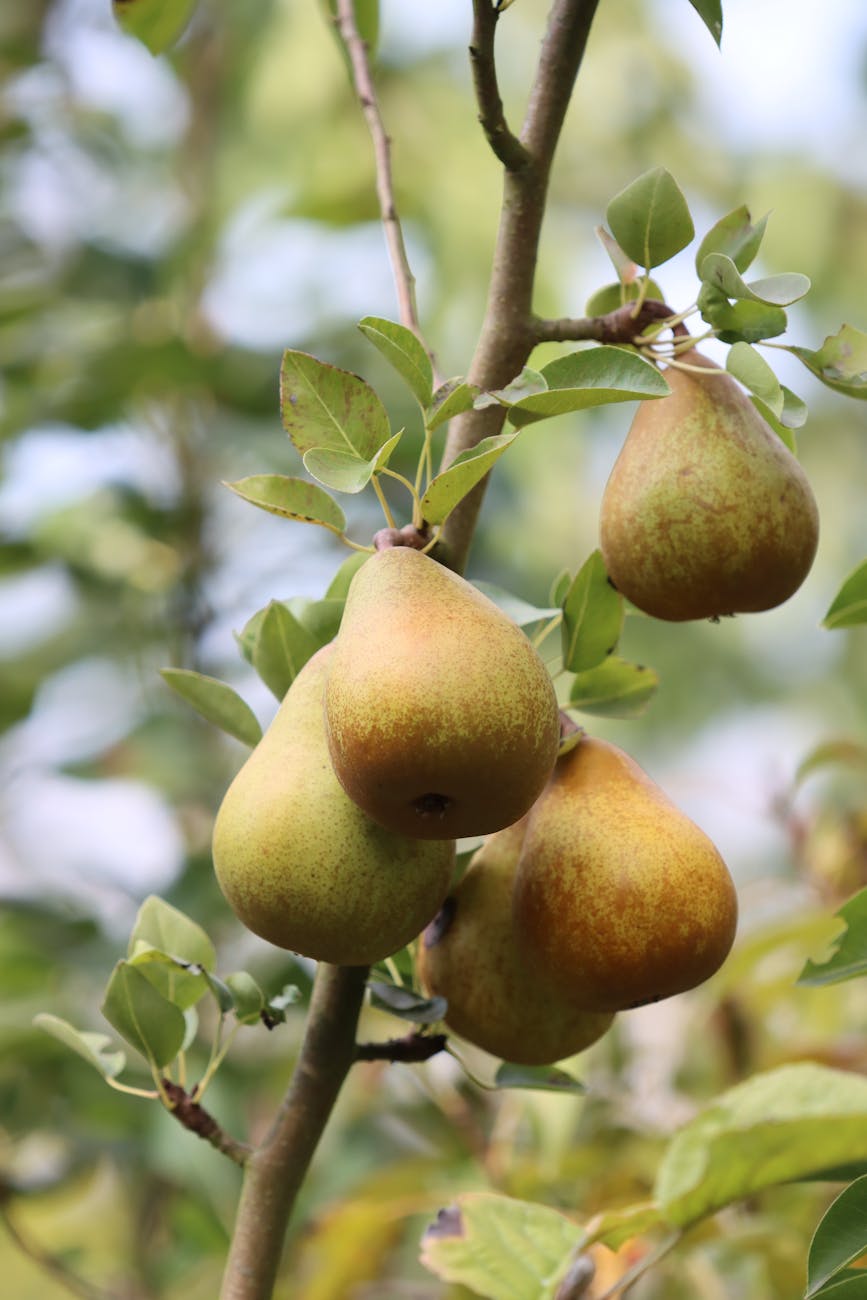
Perfect Pear-Crisp Recipe for Fall

“There are only ten minutes in the life of a pear when it is perfect to eat.”–Ralph Waldo Emmerson

Photo by ML ARANDA on Pexels.com

The seasons of Pears 🍐

Pears are in-season locally.  For those who grow these fruit trees, this is a once a year celebration of those sweet, juicy fruits.  Ironically, for all their sweetness, pears are one fruit that do not, and should not, fully ripen on the tree. In fact, pears need to be harvested when mature, but not ripe. If left on the tree too long, pears become mealy.

Across the United States, pears come into season anywhere from August to October, depending upon what part of the country they are grown.  Most pears–about 95%–found in the stores, are grown in California, Washington, and Oregon according to Food Network. That said, it’s not too late to find home grown pears at local farmers markets and roadside stands. 

Photo by u7d20u6750u738bu56fd Footage Kingdom on Pexels.com

How to to Know when Pears are ripe 🍐

When buying pears, keep in mind that they do take a while to ripen enough for eating. In order to determine if a pear is ripe enough to eat, gently press on the neck of a pear with your thumb. If your thumb gives, the fruit is ripe, if the fruit doesn’t yield, it needs more time to ripen.  However, it is worth noting that slightly under-ripe pears can still be used for baking and recipes that require some form of cooking.  The heat allows the fruits’ sweet juices to release into your favorite recipes. 

I am fortunate enough to have a neighbor, Sandra Patterson, who is generous when her pear trees bear their fruit.  For the past several years, she has offered to share her harvested fruit with those around her, and they are always a tasty, seasonal delight.  Unfortunately, pears are so versatile, I have a hard time choosing how I want to prepare them.  From salads to main dishes, from sweet breads to delightful sauces, and from luscious desserts to slicing them up and eating them fresh, pears lend themselves to a wide array of recipes. 

Pears are versatile ✨

In the past, I have made pear butter, which is similar to apple butter.  I have made quinoa pear salad and microwavable “baked” pears.  I have sliced them up and added them to garden salads with dried cranberries and walnuts, or put them on toast with peanut butter, raisins, and a sprinkle of cinnamon.  While I don’t eat meat, I know that one of my coworkers adds freshly sliced pears to the pan when baking pork loin.  And these ideas are only the tip of the recipe-iceberg for fresh pears.

This year, however, I decided to go with one of my favorite simple treats: pear crisp.  I love any kind of bakeable fruit with a hearty, crunchy oat topping, and the ease of these types of “crumble” desserts is one I especially appreciate.  Additionally, for those with celiac disease or gluten intolerance, fruit crisps, when made with gluten-free ingredients, such as oats and oat flour, make a delightful replacement for gluten-laden fruit pies.  

Easy to bake up, and rich in fall taste!

Pear Crisp Anyone? 🙌

I chose to use maple syrup in this recipe instead of the traditional brown sugar because it offers a comforting fall scent and flavor. When baking with maple syrup, it lends a caramel-like taste to baked goods that I believe “pears” well with traditional fall spices such as cinnamon, nutmeg, and allspice—all of which are found in the apple-pie spice that I incorporated into this recipe.

That said, you can replace the maple syrup with brown sugar as noted in the recipe. And, you can also replace the apple pie spice with cinnamon, if preferred. Other recipe modifications could include replacing the pears with an equivalent amount of apples or using half apples/half pears. Furthermore, if you like raisins or dried cranberries, sprinkle ¼ to ½ cup of those over the fruit before adding the topping.

Regardless of how you adapt this recipe to suit your taste preferences, it is my hope that it inspires you to bake up some “pear-fect” homemade goodness in your home for a fall treat. As it bakes, your house will overflow with fragrant autumnal scents sure to make your belly growl. Brew some tea or coffee and soften up your favorite ice cream variation to serve up along with this dessert, and enjoy!

From my home to yours, I wish health, happiness, and homemade eats!

Chock-full of sweet, seasonal pears and topped with a maple-rich oat-and-walnut crunchy topping, pear crisp makes for a simple, but luscious fall treat.

Easy Pear Crisp Recipe 🧑‍🍳

Easy Pear Crisp, Gluten-free and plant based 

(Thank you, Sandra, for the “pear-amount” inspiration for this recipe.)

Ingredients

6-7 ripe pears

1 teaspoon apple pie spice (Can substitute with cinnamon)

¾ cup rolled oats

¾ cup oat-flour flour (Can substitute all-purpose flour.)

½ cup chopped walnuts and/or pecans, optional

1 teaspoons of cinnamon

1 teaspoon baking powder

¼ teaspoon salt

 ⅔ cup pure maple syrup (Can substitute 1 cup brown sugar)

1 teaspoon vanilla extract

½ cup cold butter, cut into pieces (I use vegan variation.)

Directions

Preheat oven to 375 degrees

Coat square baking dish with cooking spray  (Mine was 9 x 9)

Core and deseed pears, then slice or chop fruit, depending upon preference (I left peel on, but you can peel pears)

Place fruit in prepared baking dish

Sprinkle with apple pie spice

In a large bowl, mix together oats, flour, cinnamon, nuts (if using), baking powder, and salt.

Cut in maple syrup, vanilla extract, and butter pieces using a pastry blender, forks, or large, firm spoon. (Mixture will be thick and slightly crumbly if using syrup; it will be mostly crumbly if using brown sugar.)

Sprinkle oat mixture over fruit

Bake for 30-35 minutes or until the top is golden brown.

Serve warm.  It makes 6-9 servings.  Leftovers can be stored in covered containers in the refrigerator for up to a week. It can also be frozen for up to three months. 

Cottage Pudding with Vanilla Sauce with gluten-free options

“At home, my food is just sort of comfort food. It’s not super fancy, but it’s certainly tasty.”–Anne Burrell

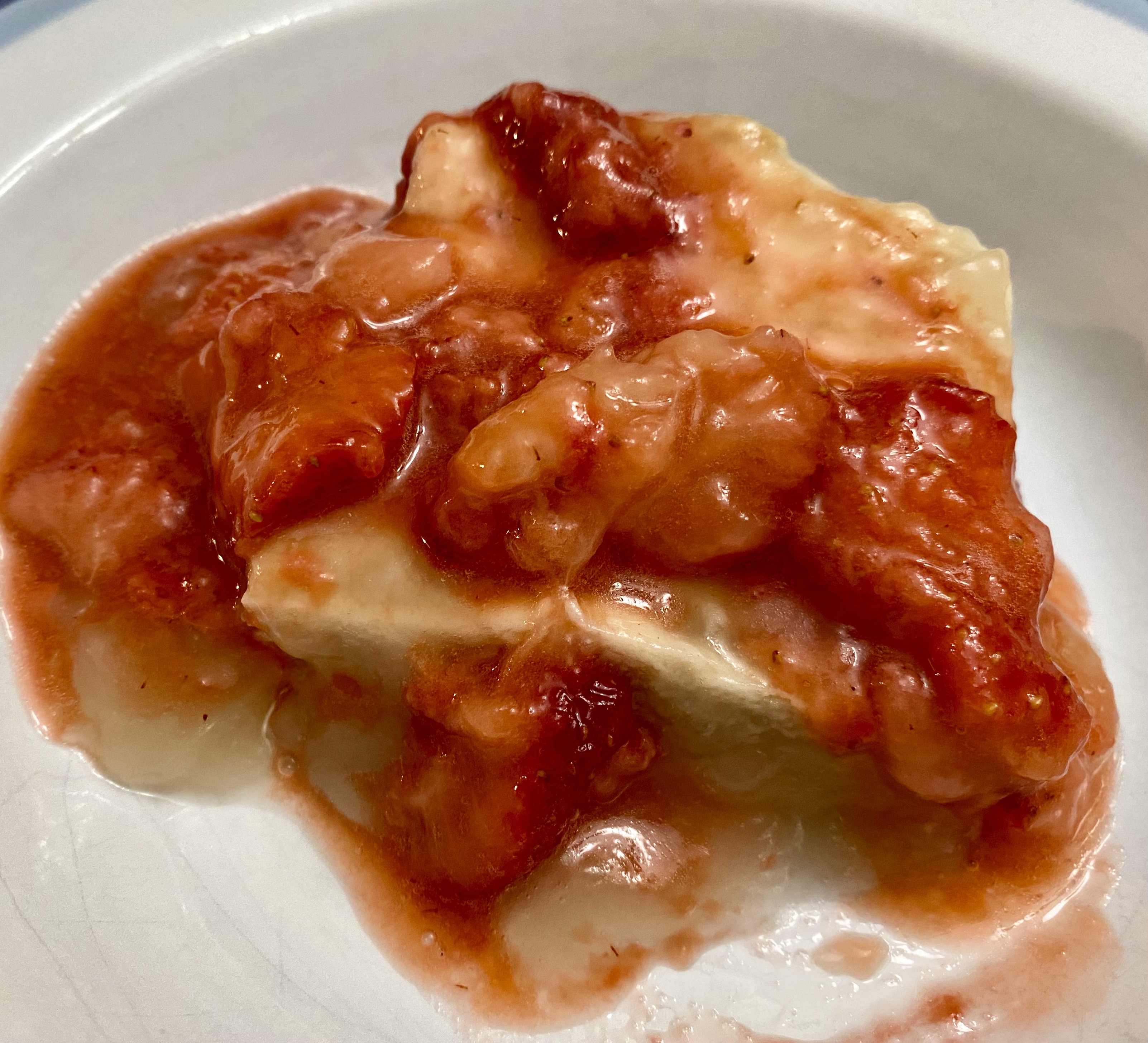
Serve it up with strawberry sauce or any other fruit sauce.

When I read the above quote by TV celebrity chef Anne Burrell, I realized I do not know much about who she is or the type of foods she likes; her words simply resonated with me. Therefore, I am not sure if my idea of comfort food is the same as hers, but most of my favorite comfort foods are budget-friendly, including the recipe from my childhood I am sharing with you today.  I think this recipe is especially comforting on cool evenings like the ones we experience during the fall time of the year.

I grew up surrounded by women who knew how to cook, what I considered comfort food, and it was definitely low-cost.  Two of these women, my grandmothers, came of age during the depression and the World War 2 era that followed, so you know they had to learn to manage with few resources. And though my own mom did not grow up during such challenging circumstances, as the mother of four children, she definitely had to learn to cook as inexpensively as possible.

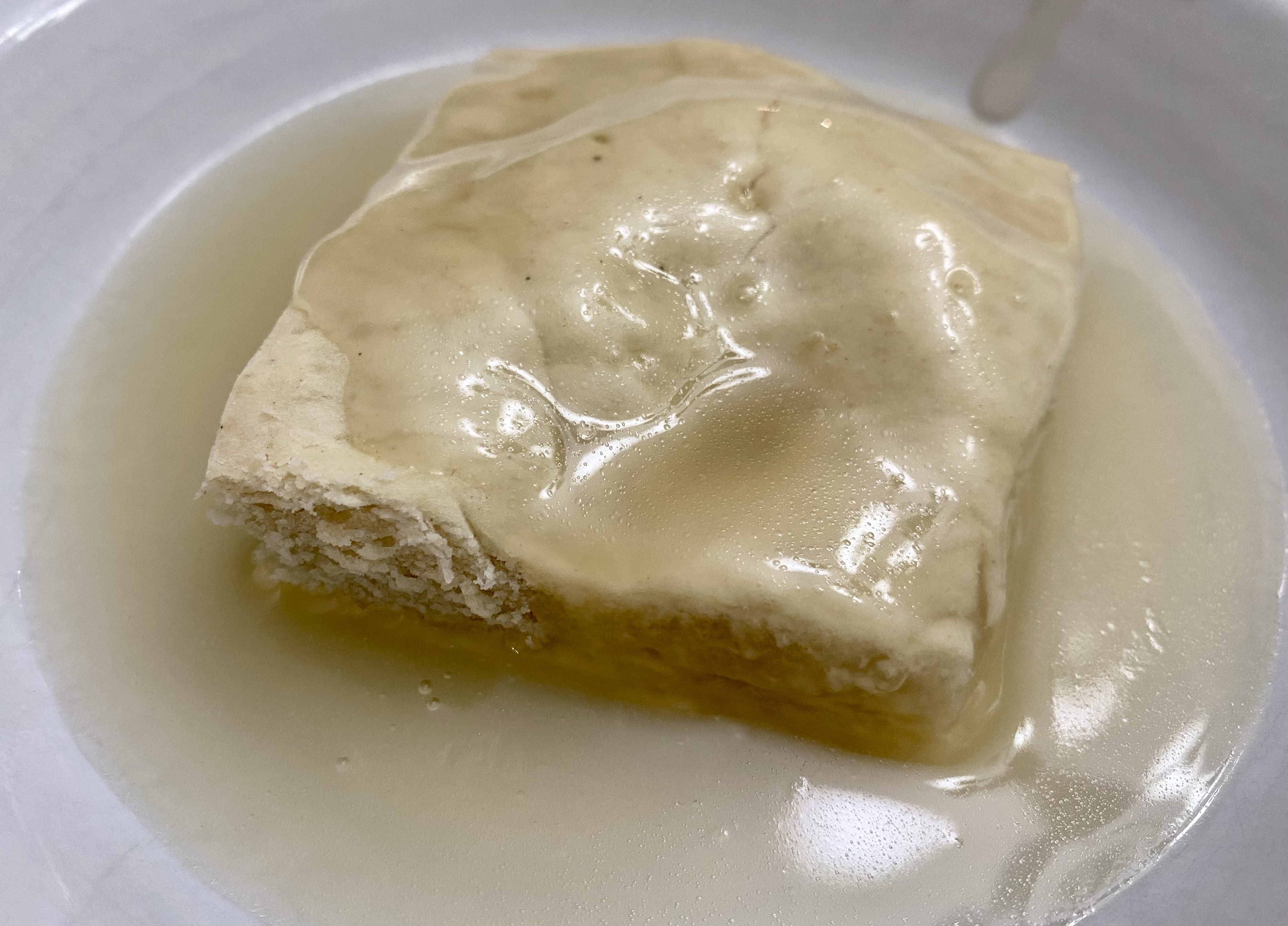
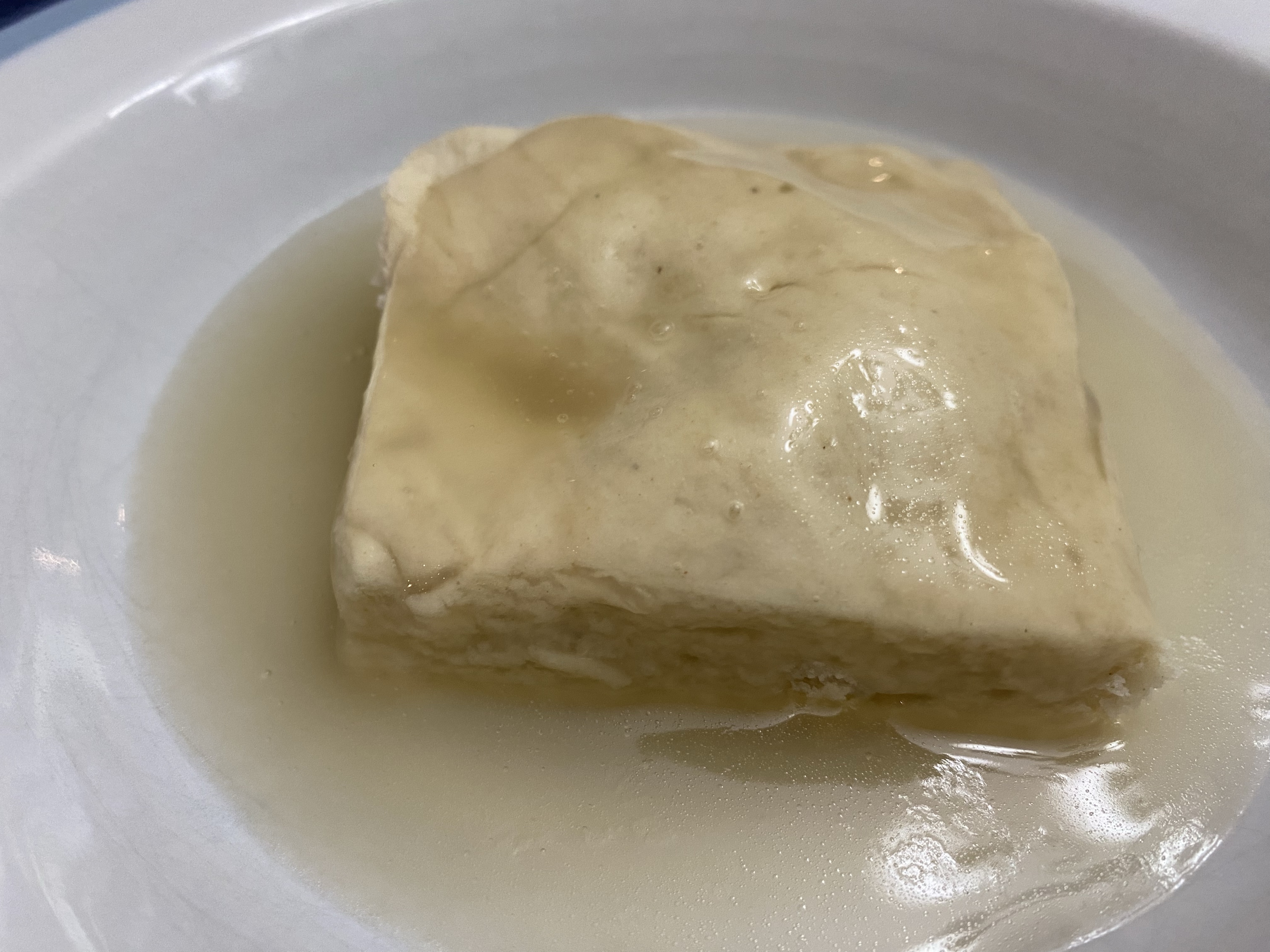
Don’t let the plain canvas fool you, the vanilla sauce is rich and thick!

Cooking on a budget does not have to equate with not eating well.  Some of the best and healthiest foods are quite often budget friendly–although I know this recipe is an exception with regards to “healthy.”.  In fact, this recipe uses common ingredients most of us have on hand if we bake with any regularity.  

As best as I can tell, based upon my limited research, this recipe originated in the mid-1800s in North America. “Cottage,” refers to the fact that the recipe was considered simple and affordable for common farmers and laborers of the time period.  “Pudding” is a word that dates back to England, and it was, and still sometimes is, used to refer to any dessert.  However, given this cake is served with a sauce, lending it somewhat mushy, perhaps the word pudding was intentional.

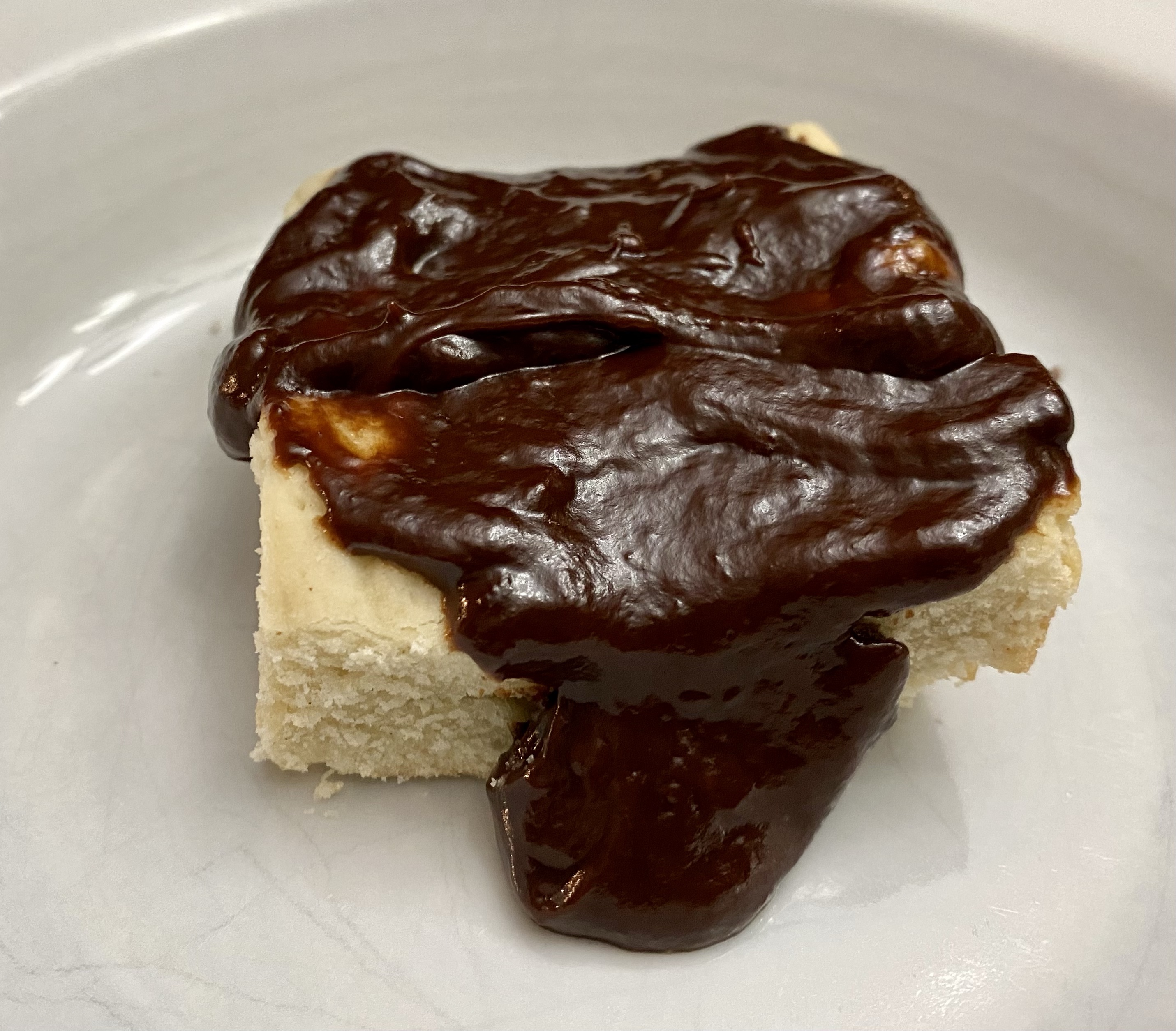
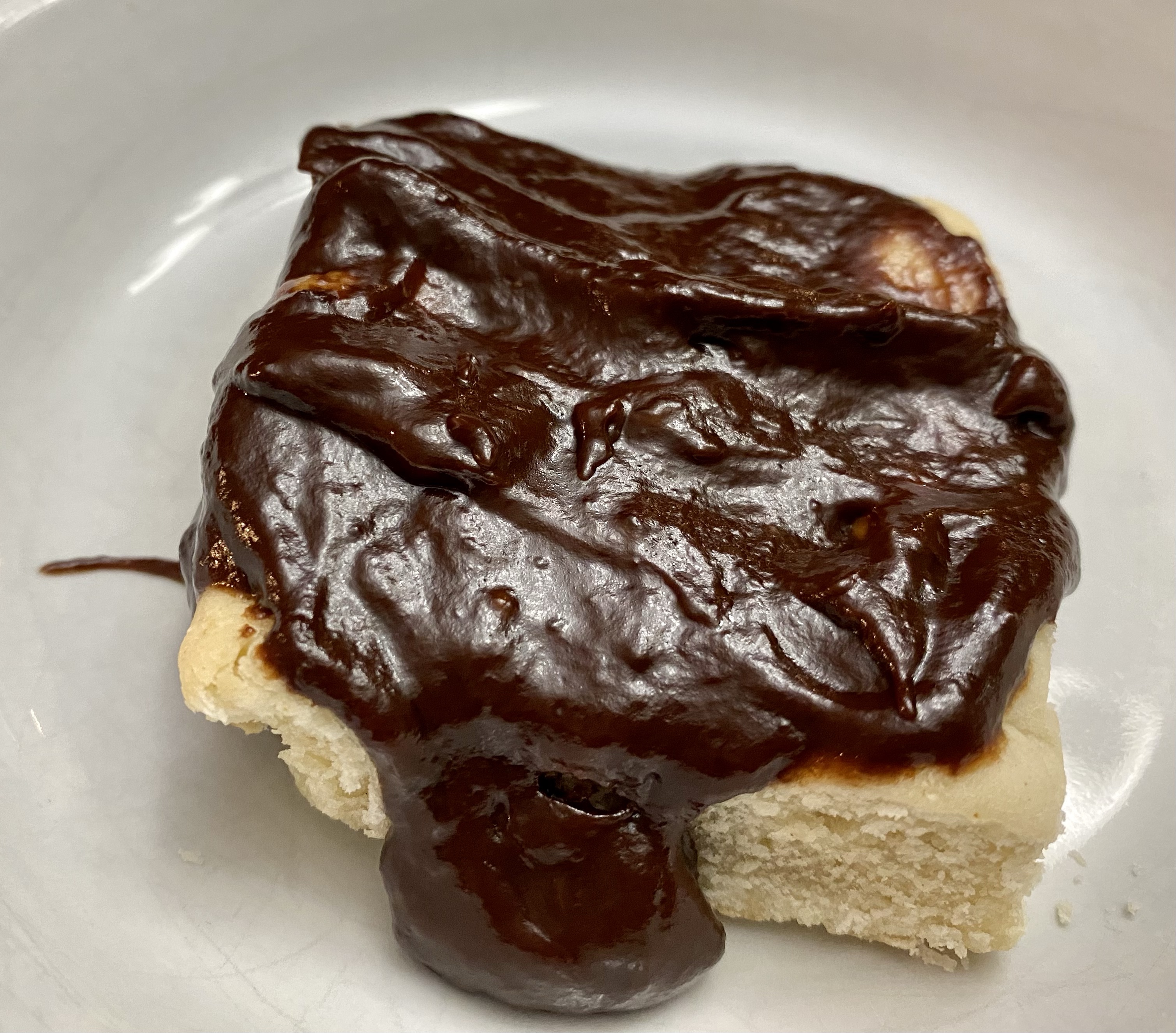
This shortbread-like cake lends itself to a wide-array of toppings, such as chocolate sauce.

Regardless of its history, I believe there is a time and place for celebratory, comfort food, and it doesn’t have to cost an arm and a leg to make it.  This simple dessert is one my mom used to make on rare, but special occasions for the family when I was younger.  In fact, it was often made in honor of birthdays or other special events.  

I remember feeling excited as a youth when this was served.  Perhaps, it was the warm syrup served on top of it that made it feel special as if we were eating a thick, dense pancake for dessert.  Then, again, maybe because with six of us eating–four of which were kids, and only nine servings–I knew I had better enjoy and savor the dessert on the day it was made. (There certainly weren’t any leftovers that I can recall.) Plus, there was that simple vanilla flavor that was warm, comforting, and oh-so-tasty.

Load this cake up with your favorite fruit; it can hold up to it because it has more of a shortbread consistency.

I was reflecting on my impending birthday when this recipe came to mind.  I rooted around my old recipe box and dug this oldie-but-goodie recipe card. Since I had not baked it since well before my diagnosis of celiac disease, it occurred to me that I should create a gluten-free variation to celebrate my birthday. 

(My celiac disease went undiagnosed until my late 40s, so my mom would not have known I needed a gluten-free variation.  Besides, celiac disease was not really well-known/understood in the era in which I was raised.)   

I hope you will give this simple recipe a try.  The cake is quite similar to shortbread, or an old-fashioned biscuit–so it lends itself to a wide-array of toppings.  It’s traditionally served with a glaze or custard sauce, but you could certainly use any fruit toppings, or other traditional sauces, such as brown butter, caramel, lemon, or chocolate.  I certainly came across several recipe variations for sauces.   

The cake is a versatile canvas–welcoming all flavors and types of sauces.

Cut this cake into nine pieces.  Serve the cake warm and then drizzle plenty of sauce over it. Feel free to poke holes in the top of each piece before drizzling with syrup, as we used to do as kids, to soak up the maximum amount of syrup. It’s perfect with a cup of hot coffee, tea, hot cocoa, or even milk–if that’s your thing. 

From my home to yours, I wish you stories and memories filled with comfort food.

The original recipe written down for me by my mom. Notice there are three difference variations for the sauce.

Cottage Pudding with Vanilla Sauce

Ingredients:

1 ¾ cups flour, gluten free if needed

2 teaspoons baking powder

½ teaspoon salt

¼ cup soft shortening

¾ cup sugar

1 egg or plant–based egg substitute

1 tablespoon vinegar

¾ cup milk

1 teaspoon vanilla extract 

Sauce:

Ingredients:

1 cup sugar

2 tablespoons cornstarch (ensure it’s from a gluten free facility it needed)

2 cups water

2 teaspoon vanilla 

¼ cup butter, can be vegan 

Directions:

Preheat oven to 350 degrees

Prepare 9×9 baking with nonstick cooking spray

Stir together flour, baking powder, and salt in a bowl

In a mixing bowl, cream together shortening and sugar until light and fluffy

Beat in egg and vinegar until mixture is creamed together

Measure milk into cup and stir vanilla extract into it

Mixing slowly, add in about ⅓ flour mixture and ½ milk mixture

Once incorporated, add in another ⅓ flour mixture and rest of milk mixture

Add in remaining flour mixture until batter is smooth and well blended

Spread into prepared pan

Bake 25-30 minutes or until toothpick inserted in center comes out clean

Allow to cool 10 minutes before serving with warm sauce

Makes 9 servings

To make the sauce:

Meanwhile, mix sugar and cornstarch together in a pan over medium heat

Gradually stir in water

Bring to a rolling boil for one minute, stirring constantly

Stir in butter and vanilla extract

Once butter has melted and all ingredients are blended, sauce is ready to serve

Save leftover in airtight container in refrigerator

Warm sauce to serve over cake whenever eating leftovers

This sauce makes great syrup for pancake, waffle, or french toast  

The importance of fostering self-efficacy at any age

“Believe in yourself! Have faith in your abilities! Without a humble but reasonable confidence in your own powers you cannot be successful or happy.” –Norman Vincent Peale

Photo by William Fortunato on Pexels.com

Early in my career as an educator, I decided to complete a program that would increase my level of certification.  As part of this program, there was an expectation to complete a semester of student-teaching, however, I was already a full-time educator.  Therefore, the university “powers-that-be” decided that as an alternative, I would spend two days in a classroom and school outside of my own teaching district where I would be evaluated by a university representative and the cooperating classroom teacher.

It was established that on the first full day, I would observe the teacher and students.  Then, on the second full day, I would be in charge of all instruction while the university representative and the classroom teacher evaluated my performance. 

At first, I celebrated this plan.  I had been successfully teaching for over ten years.  My career, up to that point, had been exclusively completed in challenging classroom settings with students of multiple grade levels and various identities, such as ADHD, intellectual disabilities, as well as emotional and behavioral disability.  How hard could the evaluation be? Then, I read the fine print.

Photo by Pavel Danilyuk on Pexels.com

 This two-day evaluation period would occur mid-May. (You don’t have to be an educator to imagine what a May classroom is like.)  And, if I did not receive high marks on this evaluation, I would have to forgo my teacher salary fall semester in order to student-teach in another district.

The closer the evaluation date, the more my inner critic’s voice grew.  What if you and the unknown classroom teacher have diametrically opposed philosophies of teaching? What if the teacher doesn’t welcome/like you?  What if the students don’t like you? You know how students tend to behave with a substitute teacher. 

 On the day of the evaluation, my heart pounded, my stomach churned, and my nerves were tightly wound.  I soaked my clothes with sweat, not only because there was no air conditioning in this school, but also due to the immense pressure I felt.  By the end of the second day, I was physically exhausted from the stress.  Fortunately, I passed with flying colors, but what if I failed?  Where would I be now, and how would it have affected my future trajectory?

Photo by cottonbro studio on Pexels.com

Life is full of challenges similar, if not greater, to this experience.  I can’t help but wonder about the importance of self-esteem, self-confidence, and self-efficacy in determining the outcomes of such events.  While each term represents different concepts of “self,” the interplay of the three is one of the keys to personal growth throughout our adult years.

Specifically, self-esteem is more about personal feelings of value and worth. Self-confidence, in contrast, is a person’s overall belief in self across a wide-array of settings; whereas, self-efficacy is more context-specific. For example, a person can have a high degree of self-confidence in their role as a student, professional, or athlete, but have much lower levels of self-confidence when it comes to social situations or other areas of life.  Nonetheless, this same person could still overall have a fairly high level of self-esteem.  Why is that?

Photo by Alexander Suhorucov on Pexels.com

What is self-efficacy?

Research indicates that those with an overall higher sense of self-efficacy tend to have higher self-esteem, but what is self-efficacy? Self-efficacy, as defined by Abert Bandura, “is the belief in one’s capabilities to organize and execute the courses of action required to manage prospective situations.”  This belief in an individual’s own abilities plays a significant role in how one thinks, behaves, and feels about their place in the world.

A person with a high sense of self-efficacy:

  • Views challenges as something to be mastered rather than feared
  • Recovers faster from failure 
  • Believes they can control threatening situations   
  • Develops deep interests and stronger sense of commitment to their interests/activities
  • Are less likely to experience depression and typically have lower levels of stress.

Whereas, a person with a low sense of self-efficacy:

  • Views difficult tasks as threats, increasing their desire to avoid them  
  • Sees challenges as tasks that demonstrate their deficiencies rather than their strengths 
  • Lose faith in their own abilities after a perceived failure
  • Experience higher levels of depression, anxiety, and stress
Photo by Ketut Subiyanto on Pexels.com

Four Ways Self-Efficacy Develops


Therefore, it is important to find ways to boost self-efficacy, especially during those formative teen and young adult years.  Bandura identified four ways this can be accomplished:

  • Mastery experiences: Successfully completing challenging tasks.  While it is important to experience and learn from failure, successes boost self-confidence.
  • Vicarious experiences or social modeling: Watching another person, similar to you, complete a challenging task, increases a person’s belief that they can accomplish the same task modeling after that person
  • Social/verbal persuasion: Receiving sincere verbal encouragement raises a person’s belief that they can accomplish a challenge
  • Psychological and emotional responses: Negative emotions, physical responses, emotional state, mood, stress can all impact a person’s abilities to complete new tasks.  However, it is more how the responses are interpreted and perceived that can be a determining factor in successfully completing a difficult task.
Photo by Vlada Karpovich on Pexels.com

How to Strengthen Self-efficacy at Any age

For educators and parents, these are important considerations when interacting with children, teens, and young adults.  However, it is still important to strengthen one’s self-efficacy, even as we age, in order to better deal with new life challenges as they arise. 

Here are some suggested ways to foster self-efficacy at any age:

  •  Celebrate Successes no matter how small. Work on setting goals that force you to stretch, but are realistically achievable.  With each goal achieved, a stronger belief in your abilities is forged. 
  • Observe and connect with others. Seeing, engaging with, and modeling others who are either working towards similar goals as you, or who have completed similar goals, increases your belief that you can accomplish similar results.
  • Monitor mental health, thoughts, and emotions. Some people may need to work with a professional to manage positive mental health, while others simply need to hone a few mindfulness skills to manage thoughts and emotions. Determine tools and techniques that help manage feelings of anxiety and stress that arise during difficult tasks in order to feel more confident to achieve desired outcomes.
  • In a similar vein, practice self-compassion and positive self-talk. Words matter, even the ones silently spoken in our heads. Work on quieting the inner critic when it rears its ugly head with words, phrases, and mantras that promote self-belief.
  • Surround yourself with a solid support system who will offer genuine positive affirmations.  This can be tricky as you don’t want insincerity, flattery, and words spoken out of a sense of obligation.  Instead, connect with a few key mentors, friends, and allies who are reliable, know you, and will offer authentic feedback and affirmations.
Photo by Rebrand Cities on Pexels.com

Final Thoughts on Self-Efficacy

Traversing life’s ups and downs isn’t always easy, and it’s made more difficult for those with lower levels of self-efficacy.  By continuously developing a stronger sense of self-efficacy, the more we are able to handle life’s proverbial curve balls.  In fact, it might allow us to handle them with a bit more grace and equanimity. 

Photo by Andrea Piacquadio on Pexels.com

Spinach-Artichoke Dip with plant-based and gluten-free options

“Popeye was right about spinach: dark green, leafy vegetables are the healthiest food on the planet. As whole foods go, they offer the most nutrition per calorie.”–Michael Gregor

“You’re not going to believe what I ate, Mom!”

I was talking with my daughter, Madelyn, on the phone.  She is attending graduate school, and she was describing a dinner that a friend had prepared for one evening during a break from her studies.  

“Spinach and artichoke dip!  Not only that, Mom, but it was vegan, and it was surprisingly good . . . and you know how funny I am about texture and taste.”

Maddie went on to insist that I would have to make this dip when she was home for the holidays.  In fact, she had already asked her friend to share the recipe with her, so she could send it to me.  She went on to explain how her friend has lupus, and eats an anti-inflammatory diet that focuses heavily on fruits, vegetables, nuts, seeds, and a few select whole grains in order to reduce her inflammation.  

As I listened to her continue to describe the dip, my mind was already thinking about the ways I could adapt the recipe.  I was eager to, ahem, dip into reading various plant forward recipes and techniques in order to create my own version.  Not only did I want to make the dip in honor of my daughter’s request, but also because the dip is largely made up of two of my favorite vegetables: spinach and artichokes.

Photo by Jacqueline Howell on Pexels.com

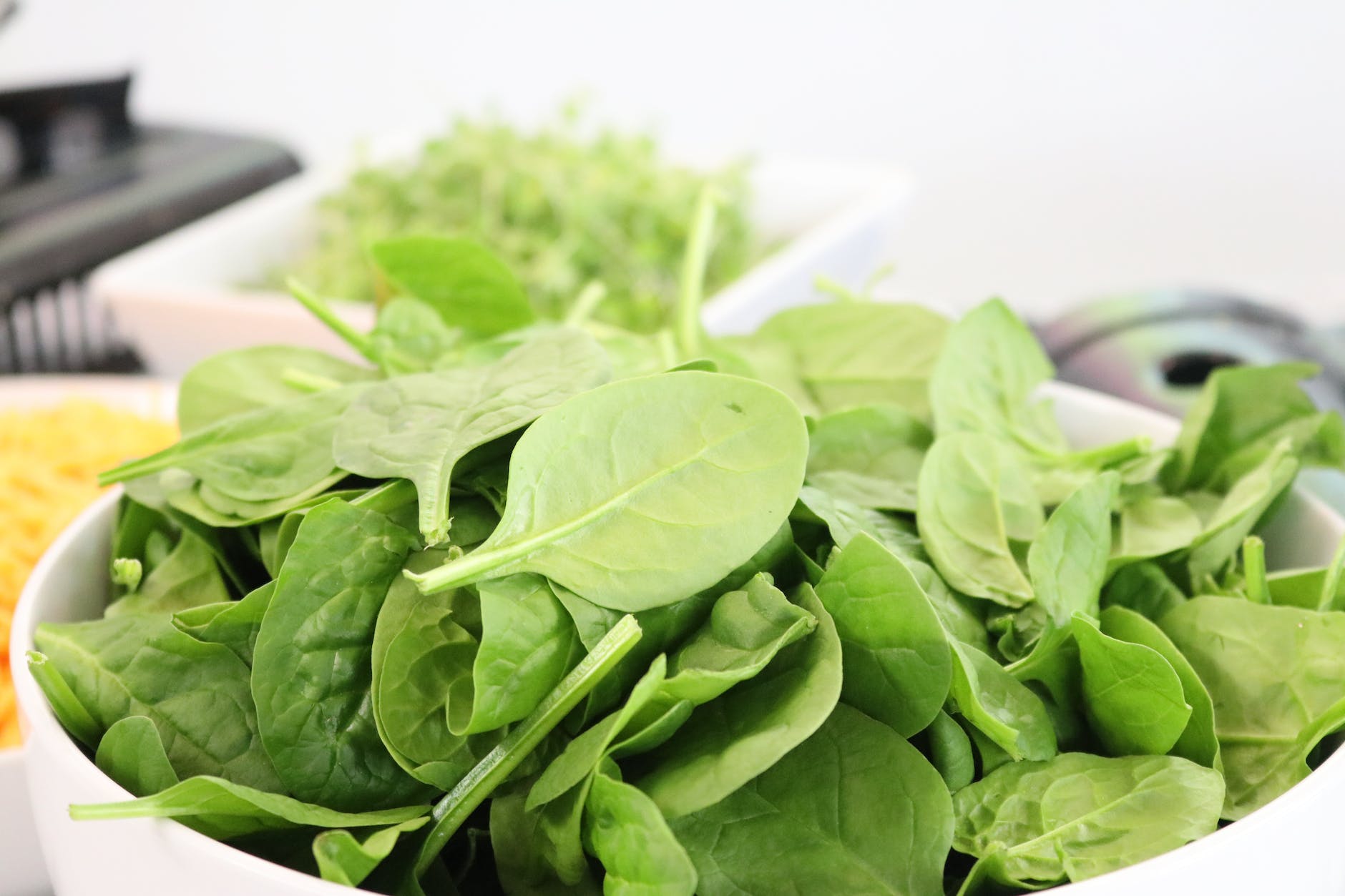
Maddie’s friend was on to something.  Both artichokes and spinach are highly anti-inflammatory.  Spinach, specifically, is chock full of vitamins, such as A, K and C, and it also contains folate, magnesium, iron, potassium, calcium, and small amounts of other B vitamins. It is high in fiber and low in calories.  Spinach is also high in antioxidants, supports brain and eye health, has been shown to protect against certain diseases, and helps to lower blood pressure when regularly consumed.  

Photo by Andie on Pexels.com

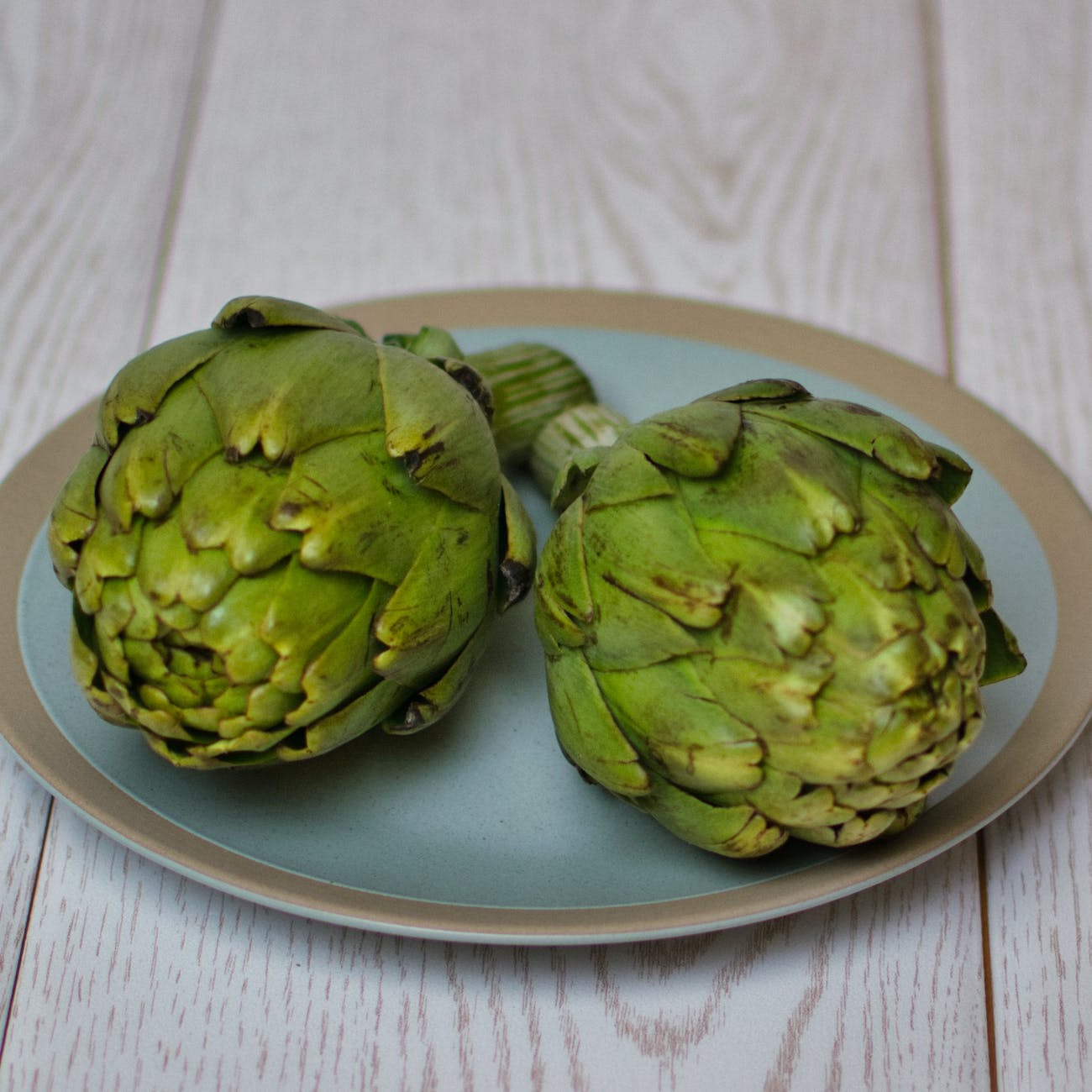
Artichokes are no joke either. They, too, are full of vitamins, including folate, magnesium, manganese, potassium, as well as vitamins K and C.  Like spinach, artichokes are high in fiber, full of antioxidants, and have been shown, when consumed daily, to help regulate blood pressure. Additionally, artichokes promote liver health and are a unique source of prebiotics, which are beneficial gut bacteria that can boost immunity, assist in digestion, and benefit mood.

Of course, I can share all the benefits of these two nutritional, anti-inflammatory powerhouses, but let’s be honest, for most people, myself included, it’s all about the taste. Does this dip taste good, in addition to being made with beneficial ingredients?  Is it worthy of being shared with others?   

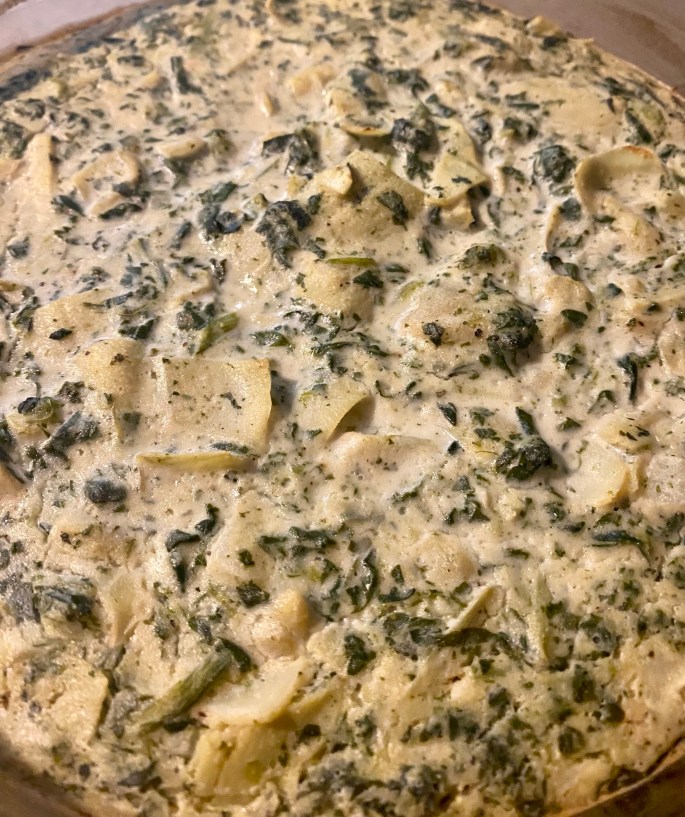
I had my favorite taste tasters, and pickiest eaters, Maddie, and my husband, John, taste the dip, and miracle of all miracles, they both liked it!  Maddie, the pickiest of the two, said she loved it just as I made it.  Her only wish was that we had baguette crackers like her friend served it with.  John, typically not as picky, filled up and ate a big soup bowl worth of dip; however, he added both parmesan and mozzarella cheese to his bowl because he, “wouldn’t want to eat too healthy over the holidays!”  Meanwhile, I served up the dip on a plain baked potato for my dinner, and let me just say that was one tasty dish!

Whether you make it with, or without dairy, you’re still packing a healthy punch of powerful, propitious plants. Serve it up for your next favorite gathering and watch it disappear.  No one ever has to know the dip benefits their health too! 

From my home to yours, may you have a prosperous and healthy 2023.

Spinach Artichoke Dip

Plant-based with dairy-free and gluten-free options

Ingredients

1 cup (raw) cashews, soaked overnight or at least 4+ hours

1 ¼  cup Greek or plant-based Greek yogurt (can substitute with mayonnaise)

¼ cup water

12-16 ounces (1 package) frozen spinach, thawed and drained

1 14 ounce can artichokes, drained and chopped

⅓ cup finely chopped onion

2 teaspoons minced garlic

1 tablespoon freshly squeezed lemon

1 teaspoon braggs liquid aminos (or soy sauce, if don’t need gluten free)

 ½ teaspoon salt, or to taste

½ teaspoon onion powder

½ teaspoon pepper

Optional additions: Mix in up to 4 ounces or ½  cup of any of the following ingredients:

cream cheese (or vegan variation), parmesan/romano/pecorino cheese, soft goat cheese, and/or mozzarella cheese, if desired

Directions

Preheat oven to 400 degrees

Coat a small casserole dish with cooking spray (2 quart size).

In a food processor or high speed blender, blend cashews, yogurt and water until creamy, about 1-2 minutes.

Add cashew mixture to a large mixing bowl and stir in the rest of the ingredients.

Spread dip evenly in the casserole dish.

*Bake 20-30 minutes, or until top turns golden brown

Serve warm with veggies, tortilla chips, crackers, smear over your favorite toasted bread, or even a baked potato.

Store leftovers in an airtight container and refrigerate.

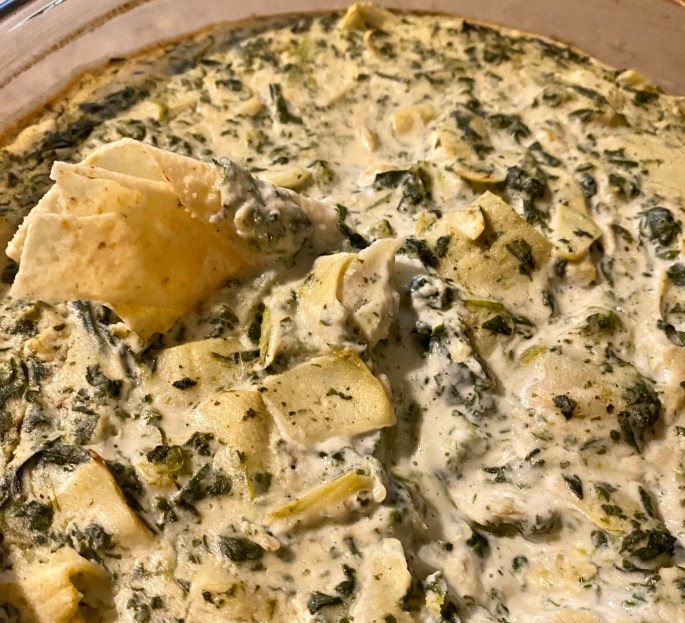
Serve warm with crackers, tortilla chips, or baguette chips

*Serves 6-10 as appetizer

Watermelon Replenisher

“The USDA has found that watermelon actually stimulates the release of excel perspiration, so heat stroke will not be on your radar so long as you have a cold one in your hands.”11 Foods That Help Prevent Heat Stroke | Eat This Not That

Photo by Andrea Piacquadio on Pexels.com

It’s that time of year, back to school.  With the start of school comes all of the fall team sports’ practices in the August heat and humidity.  From band camp to preseason soccer practice and all other sports in between, it is the sweaty time of year!  With all that sweat comes the risk of dehydration.  Despite coaches’ best efforts to encourage kids to drink, athletes often leave August practices depleted of essential fluids, salts, and electrolytes.

In fact, according to the Collegiate and Professional Sports Dietician Association, the average athlete loses about 1-3 liters of sweat per hour of intense physical activity. With that loss of sweat is also salt, specifically, depending upon the size of the athlete, anywhere from 1,380 to 5,520 mg of salt per hour. Along with water and salt, the athlete is also losing significant amounts of chloride and potassium as well as smaller amounts of magnesium and calcium. 

Photo by Liliana Drew on Pexels.com

What’s more, losing as little as two percent of body weight in sweat can impede an athlete’s performance. Therefore, it is important for athletes to remember to hydrate before, during, and after practice.  Maintaining electrolyte balance throughout the day is especially crucial when an athlete participates in two-per-day practices, which are often popular during the month of August. 

Of course, electrolytes can be found in a wide variety of prepackaged sports drinks, but they can also be found in whole food sources. Salt is particularly easy to find by simply adding salt to foods and beverages; however, it can also be found in nuts/trail mixes, pretzels, and crackers.  Meanwhile, broccoli, almonds, yogurt, and milk products are good sources of calcium, while peanut butter, cashews, almonds, pumpkin seeds, spinach, and beans (legumes) are high in magnesium. Potassium can be found in peaches, potatoes, kiwi, banana, dark leafy greens, citrus fruits, and watermelon! 

Photo by Daria Shevtsova on Pexels.com

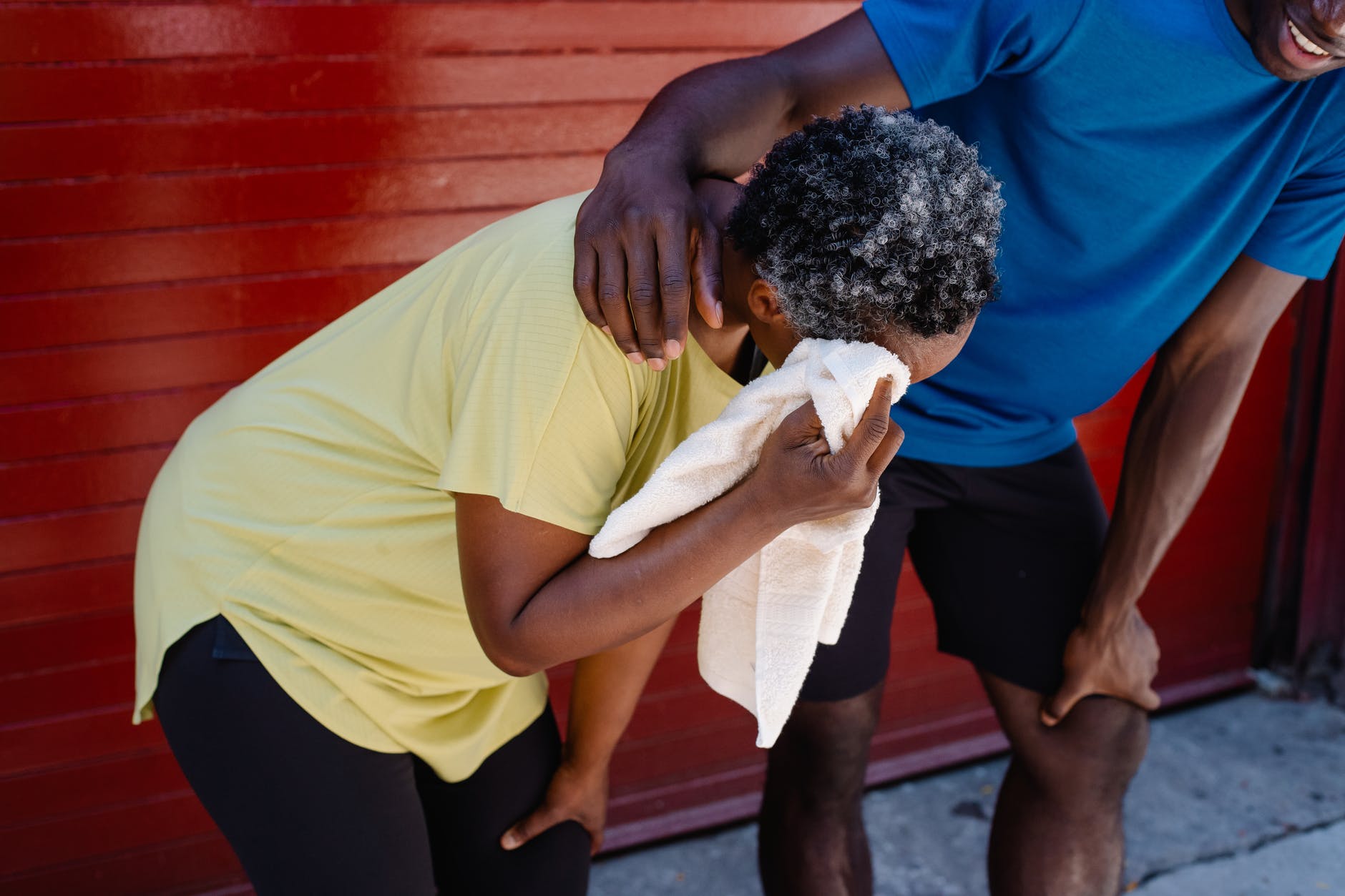
Recently, my daughter, Maddie, came home red-face and sweat-soaked after an intense out-of-doors workout session.  While she’s more than old enough to take care of herself, I couldn’t help but feel concerned about her level of hydration and asked what she thought about watermelon slushie.  I asked this because I knew she loved watermelon, and I suspected it would be a refreshing way to rehydrate.  She liked the idea, so we talked about what a watermelon slushie could include, and together we came up with a recipe.

Obviously, the main ingredient had to be watermelon. But what else, if anything, should be added?  Maddie suggested collagen powder because it is a great source of protein and would not detract away from the taste-star of the show, watermelon.  Of course, if it was going to be a slushie, we both knew it would also need ice. Then, she suggested lime juice–not too much, just a hint of it, and she further suggested sweetening it up a bit with a teaspoon of sugar combined with a packet of her favorite stevia brand.  We threw it all together in a blender and hoped for the best!

It turned out better than we had hoped! We have since made it three more times and have found, the sweeter and riper the watermelon, the better the slushie. However, we did learn a couple of taste notes. First, if you are not a salt with watermelon person, don’t add the salt.  Secondly, too much lime can overwhelm the slushie, especially if you are not particularly fond of the flavor of lime.

On the nutritional side, it is worth noting that watermelon is nearly 92 percent water! In addition to being high in potassium, it is also a good source of magnesium and calcium. It contains l-citrulline which may help alleviate muscle soreness associated with intense exercise.  Furthermore, watermelon is a good source of a multitude of vitamins and antioxidants making it a fantastic exercise recovery fuel! 

Here’s to all those summer athletes of ALL ages.  No matter what age, if you’re exercising or working out-of-doors in the August heat, then you’re sure to be sweating! So rehydrate with the sweetheart of summer fruits:  watermelon.  And, if you’re feeling a little frisky, you could also make this recipe and add in a splash or two of your favorite adult spirits for a cool, light-hearted, and refreshing cocktail hour on the home patio or deck.  

Regardless of the variation you choose to make, stay safe and hydrated during these dog days of summer.  

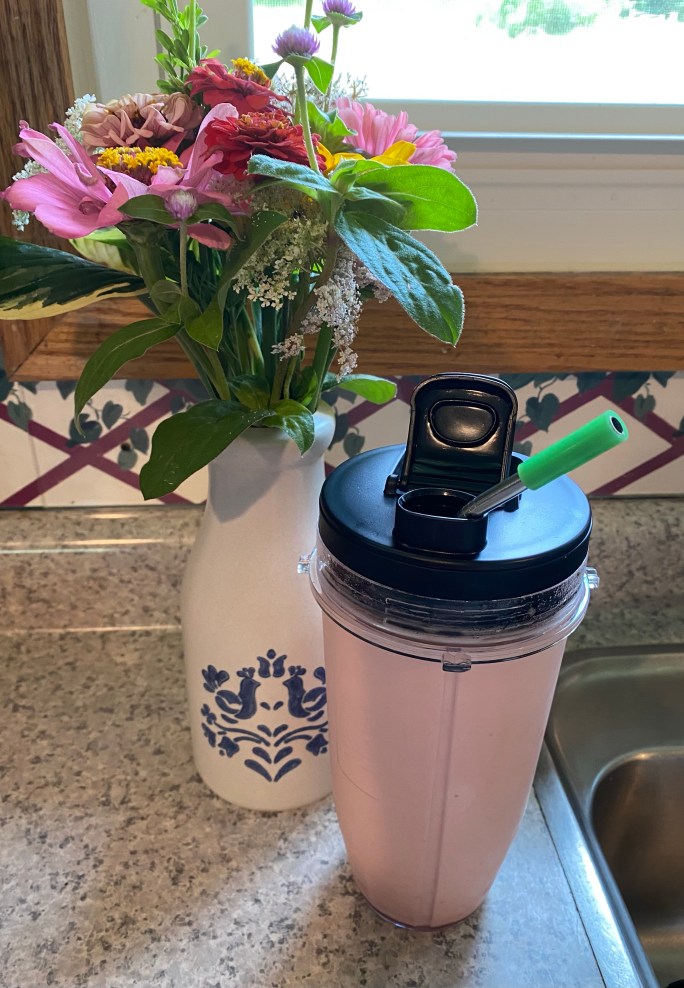
A beautiful flower arrangement by and from my daughter alongside her Watermelon Replenisher.

Maddie’s Watermelon Replenisher

Ingredients:

4 cups cubed, seedless–or seeds removed– watermelon

2 servings favorite collagen powder (can substitute vegan version or scoop unflavored protein powder)

2-4 packets of Stevia or other favorite sweetener (can substitute 2-4 teaspoons of sugar or use a combination of the two, which is what we do)

1 teaspoon to 1 tablespoon lime juice–depending upon taste preference

Dash of salt, if you’re a “salt on watermelon” person

2-3 cups of ice

Directions:

Blend all ingredients in blender until slushy consistency.

Divide into two large glasses.

Garnish with lime slice or mint leaves if desired.

Makes 2 large or 4 small slushies

Photo by Huynh Phong on Pexels.com

Raven Rock Nature Preserve–A Great Place to Hike in Southeastern Ohio

With its dramatic overlook, Raven Rock has long been an attraction for area residents and visitors. Its history is legendary, with some stories placing, at various moments in time, Daniel Boone and Tecumseh at its edge, 500 feet above the Ohio River.”–Andrew Lee Feight, Ph.D. 

He asked me, but if my answer surprised him, he didn’t show it. 

Our 33rd wedding anniversary was fast approaching, and John, my husband, asked what I wanted to do in honor of it.  Go hiking, of course!  I know, not the most logical, or necessarily romantic choice, but it is something special we typically do out-of-town.  If we love hiking at destination locations, why not also start hiking more often closer to home? After all, after 33 years together, as the saying goes, “We’re not getting any younger!”  

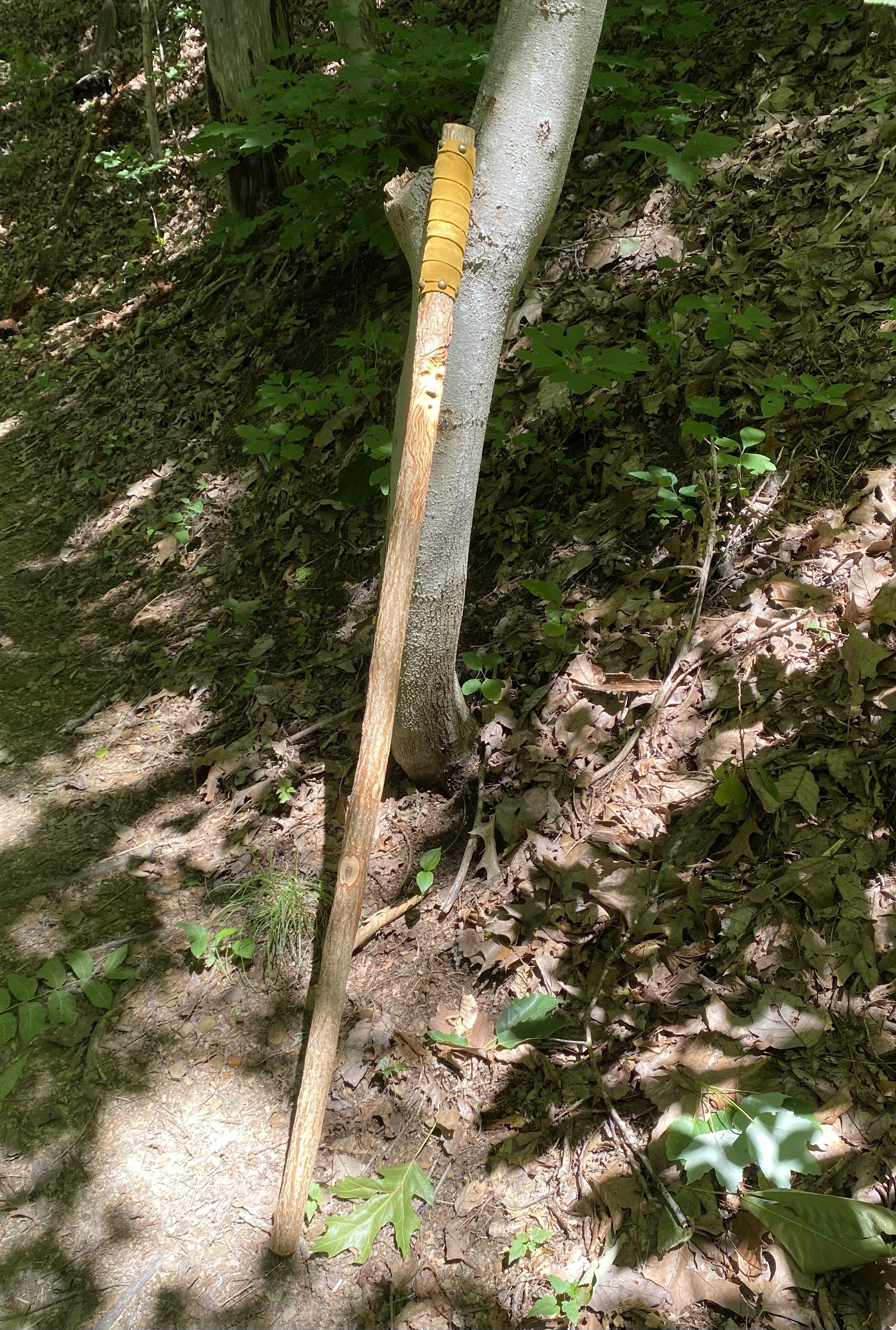
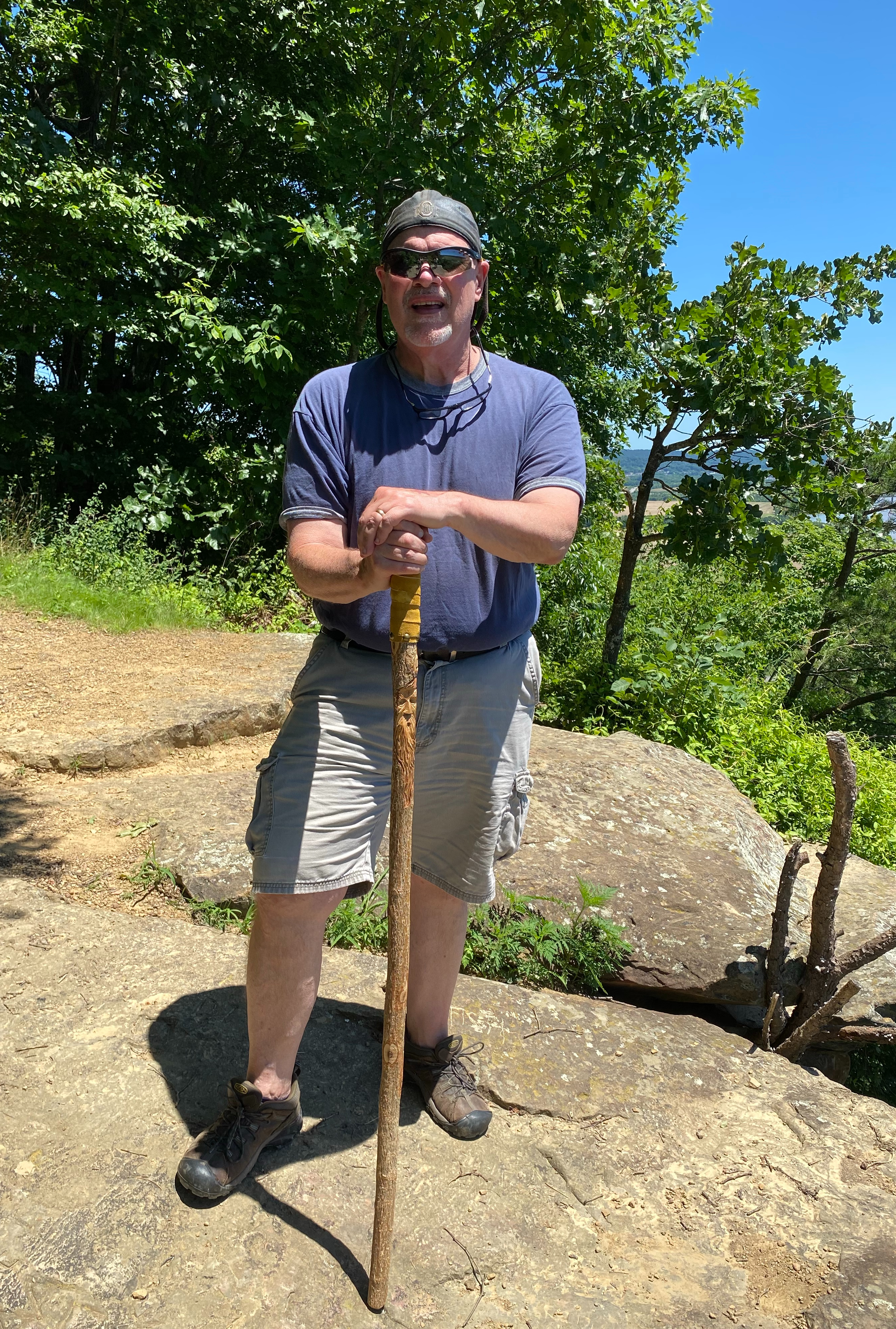
John was able hike, in spite of the meniscectomy, with the help of this hand carved hiking sticking, a gift from a beloved student.

The more we talked about it, the more we embraced the idea.  Within an hour to two drive of our home, there are an abundance of trails that we have not explored.  Why not take more frequent mini-staycations and enjoy the great outdoors together?   While there is definitely some cost in gas, especially given the current prices, hiking closer to home is an overall more cost effective experience when compared to traveling hundreds of miles. 

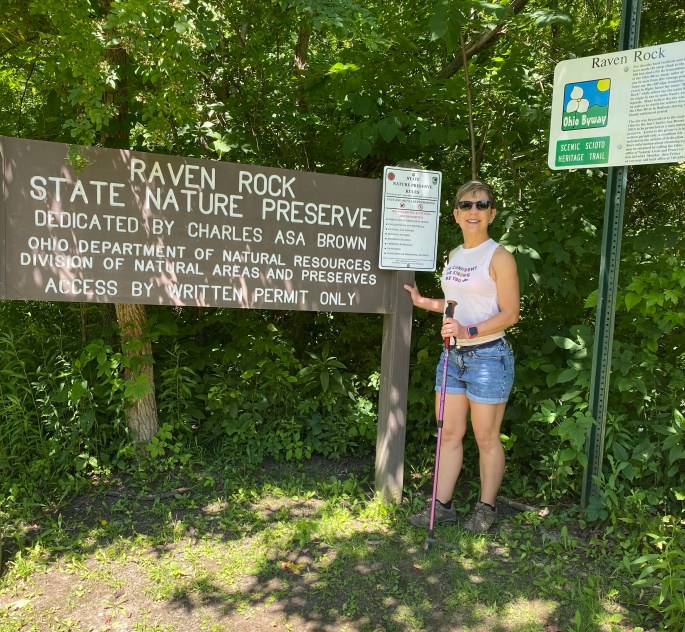
Once owned by Charles Brown, this 98 acre preserve was donated to the state of Ohio in the early 1990s.

Our destination?  Raven Rock State Nature Preserve.  This was a trail I had previously hiked a few years ago with my dad as seen here  Ravens Rock Trail, Portsmouth, OH – Steph Simply. The thing I remembered most about it was the rewarding spectacular view at the top of this trail after a strong uphill effort.  If I remember correctly, Dad and I walked to the edge of the rock, collectively inhaled, and exclaimed, “Wow!”  I hoped John would have that kind of experience too. 

Rumors abound that the now closed former trail was a gut-wrenching, vomit inducing, path that challenged even the most experienced hikers.

Unfortunately, John had a meniscectomy in August, so I knew his knee would be fragile on this trail.  I wasn’t sure if he would feel up to it, but he gladly agreed to the hike as long as he could take as many breaks as his knee demanded.  Breaks, schmakes, I don’t mind those when I get to hang out with Mother Nature!  

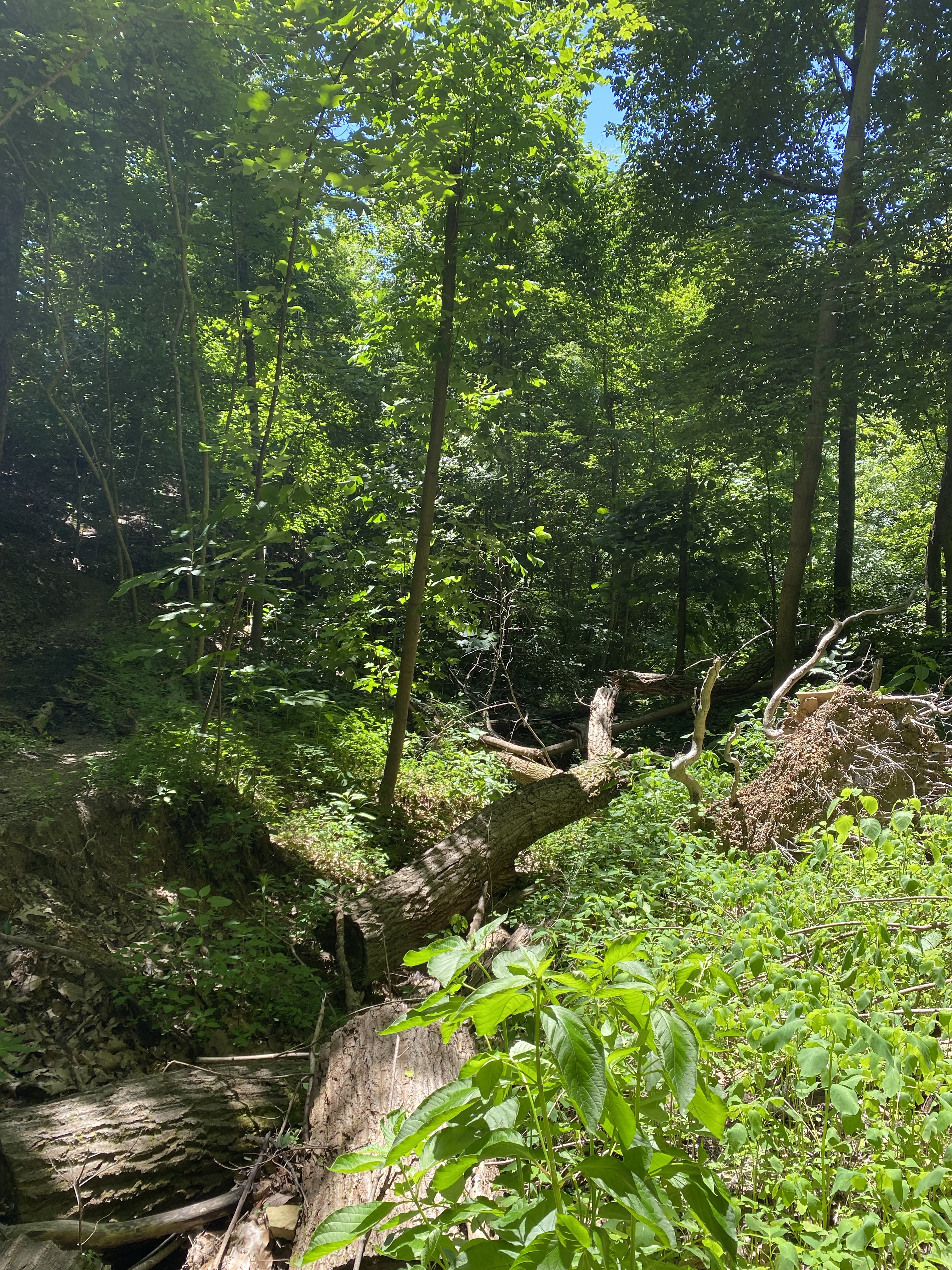
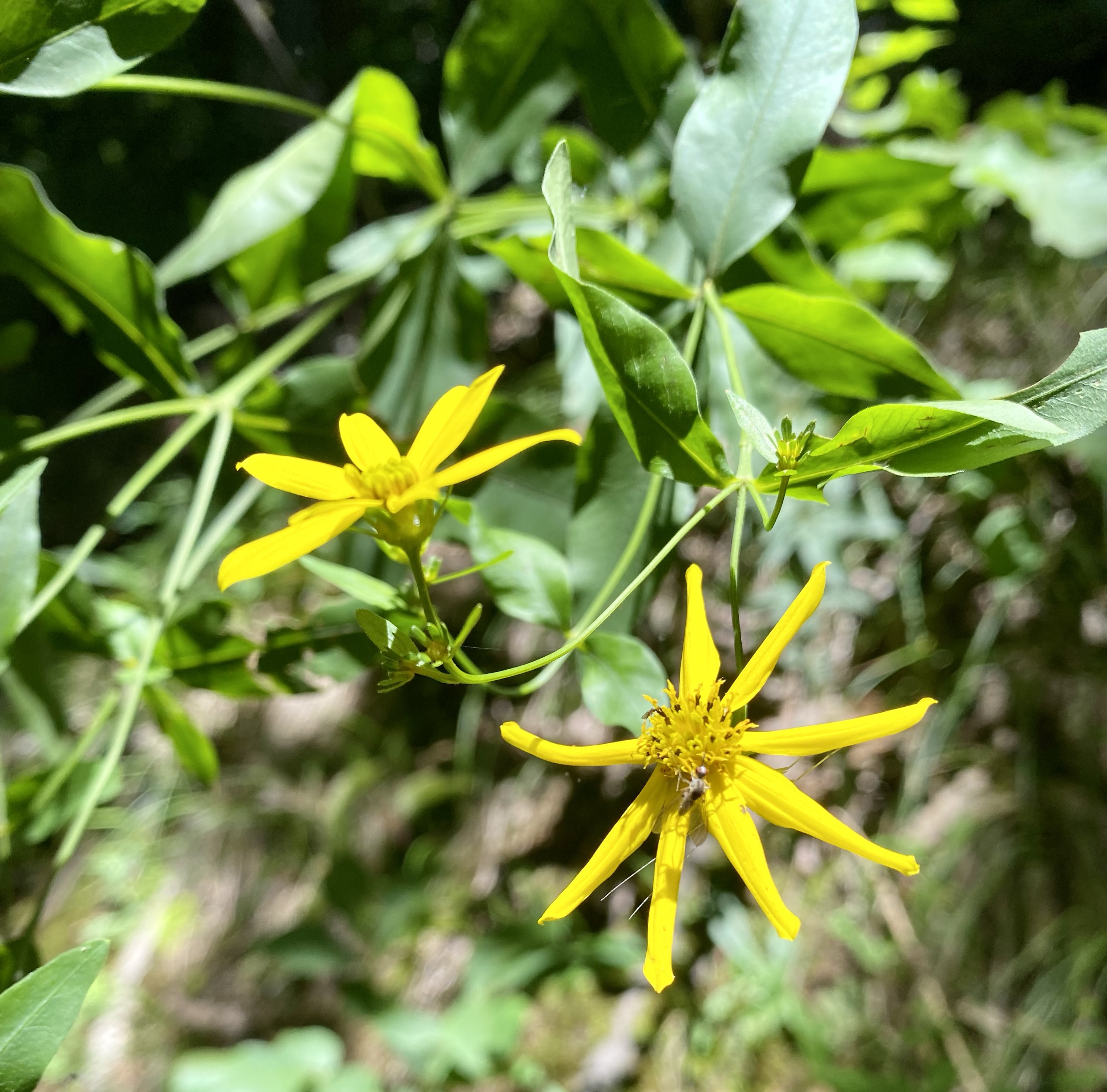
A few images of Mother Nature along the way.

That said, the trail involves several switchbacks with anywhere from an 8% grade to a 28% grade in some parts of the heavily forested trail. In fact, according to Natural Ohio Adventures, Raven Rock trail may be the only trail in Ohio that has an elevation gain similar to a Rocky Mountain trail. The same website also states that no other known Ohio overlook is more elevated than Raven Rock.

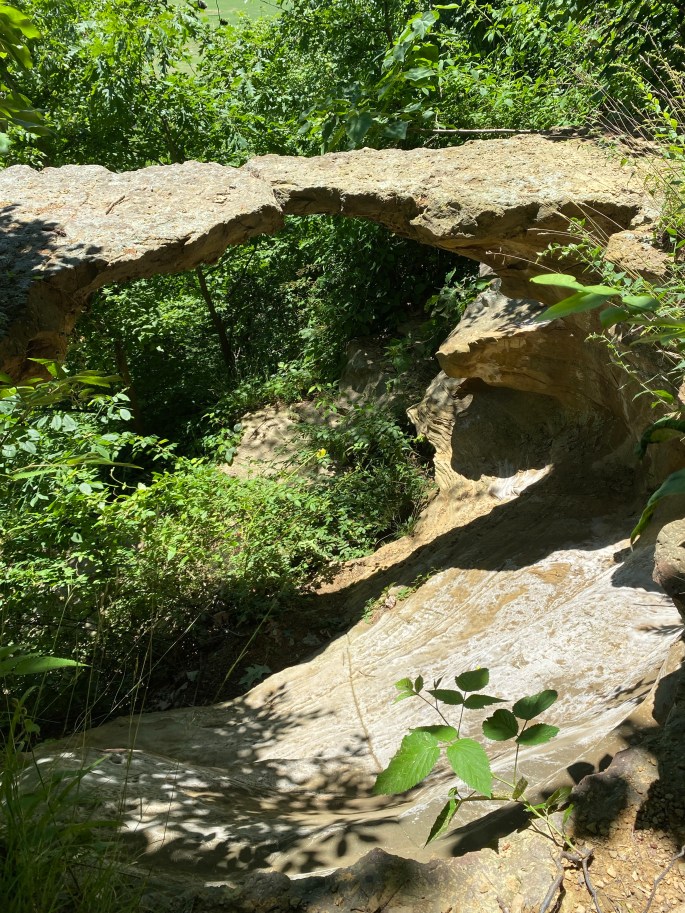
Here’s one arch!

Depending upon the source, there are a couple of different reasons as to why Raven Rock was named as such.  One account, according to an article by Andrew Lee Feight, Ph.D., describes the romantic tale that a long ago native warrior, named Raven, once jumped to his death from the rock ledge, rather than surrender to enemy hands.  However, most sources note that when looking at the rock from above, the central overhanging rock looks like that of a raven’s head and beak while the rest of the rock appears to be its outstretched wings.

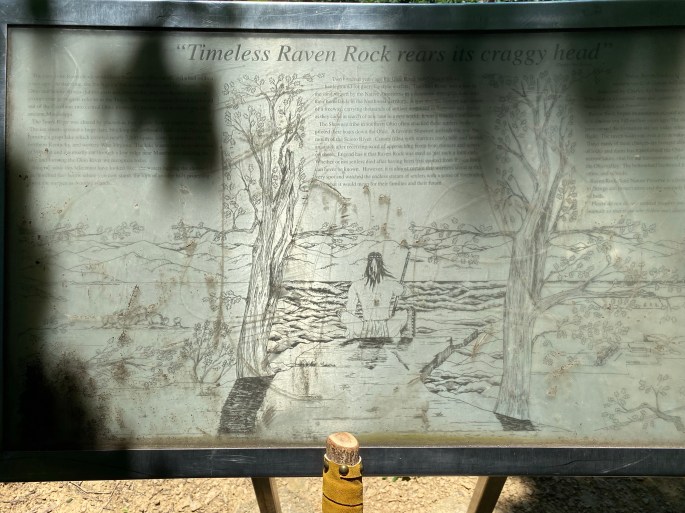
You’ll find this faded sign at the top of the trail explaining the Raven Rock’s past.

Historically speaking, there seems to be general consensus that Raven Rock would have been an overlook used by native people, such as the Cherokee and Shawnee.  As the faded marker at the top of the trail indicates, there must have been countless natives who observed European settlers traveling on the river encroaching upon their original lands.  What must these unknown original people have felt?  Did they, in fact, use that overlook as a place for planning attacks in an attempt to prevent these strangers from taking land that rightfully belonged to them?  One can only speculate.

Hello in there!

Raven Rock, according to the Ohio Department of Natural Resources, is composed of Missisiipian age sandstone. The weathering of the sandstone over the years has created three naturally occurring rock arches. The largest arch, Raven Rock Arch, is over ten feet long.  

Mother Nature is an artist.

Raven Rock preserve is home to the rare and potentially threatened Blackjack Oak tree (Quercus Marilandica) and a state endangered plant, Small-flowered Scorpionweed – Phacelia dubia.   Therefore, this trail, and the land around it, is considered quite fragile.  Ohio requests that hikers obtain a permit before exploring the trail which can be completed online in advance. I did read that hikers can also obtain permits at Shawnee State Park, but I am not sure about this point. 

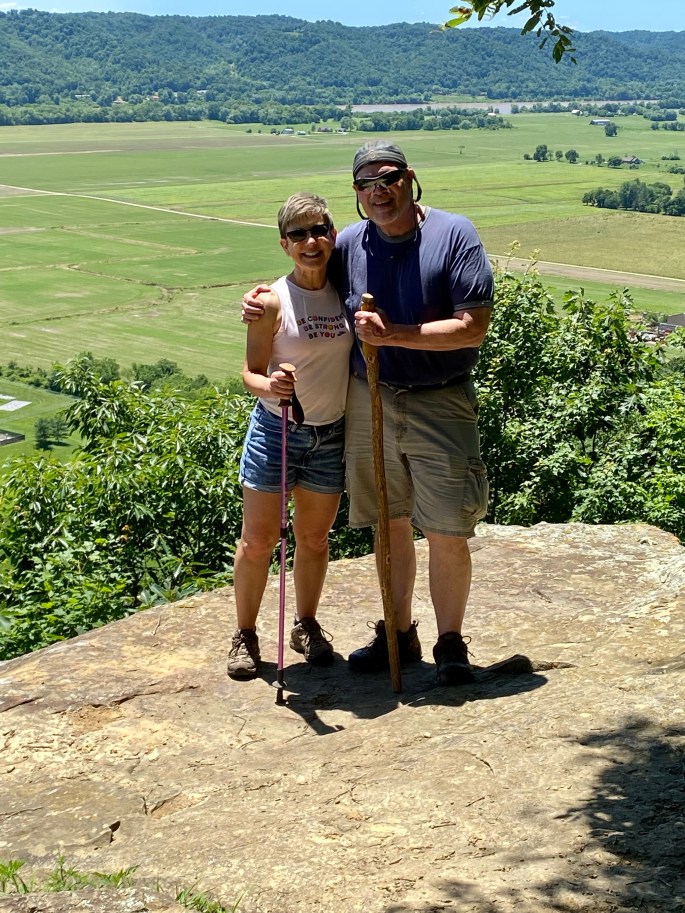
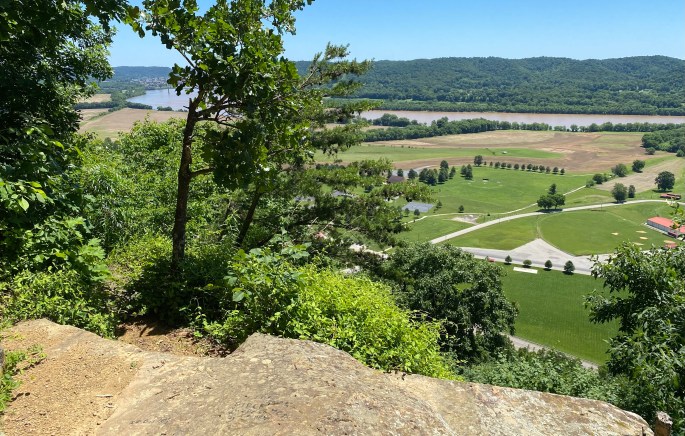
We made it to the top! 500 feet above the confluence of the Ohio and Scioto River.

As John and I headed up the trail, the skies were bluebird clear, and the temperatures were pleasant. There had been strong thunderstorms that had moved through the area the night before, which had fortunately broken a heat wave, but had unfortunately left thick, muddy sections along the path.  Those slippery, mucky spots, however, were few and far between, mostly located near the bottom of the trail.

It’s all uphill to get to the top with varying grades of inclines.

We both hiked with walking stick/pole for the first time, and we found them to be quite helpful for balance in several of the more rocky and steep areas.  They were also helpful both moving uphill and downhill as well as for creating an awareness of the edge of the trail/cliff.   

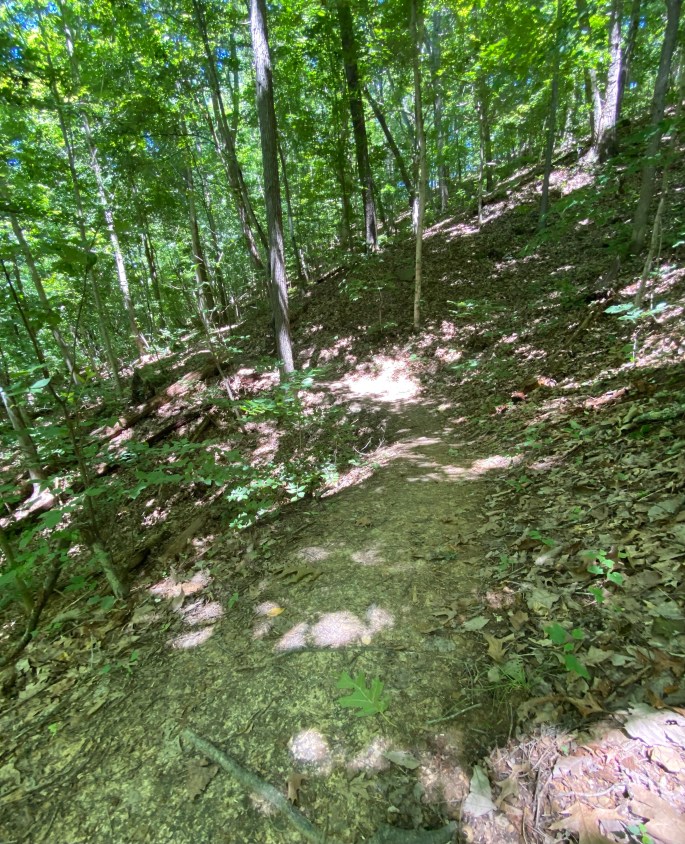
The trail can be quite narrow and rocky in places.

There were no trail markers that we could see, aside from the entrance sign, but the trail was easy enough to follow as it was a well-worn path.  A couple sections of the trail, we noticed, were beginning to wash away, but there were no confusing portions leaving us wondering which way to go.  Even though the trail is steep, it does seem to alternate between segments that are less steep and more steep, giving hikers ample time to catch your breath on the 1.25 mile ascent. 

Check out this view.

The view was as spectacular as I remembered it!  Overlooking the confluence of the Scioto and Ohio Rivers, as well as all the surrounding hills, farmland, and community, the panoramic view was spectacular, especially on this clear day.  John and I discussed how gorgeous the precipice must be in full autumn colors or even in the winter, once the leaves have fallen.  

And another view

One safety point:  There is no guard rail, so hikers must be careful walking the edge of Raven Rock.  Nonetheless, you can stand or sit at a safe distance from the edge and take in miles of landscape and riverview.  However, for those with a healthy fear of heights, there is a bench, at a safe distance, on which you can sit and take in most of the vantage point. 

Don’t want to get on the rock? Have no fear, a bench is here!

If you like to hike and appreciate a scenic perspective, then Raven Rock Nature Preserve is a trail John and I recommend you explore.  According to two respected hiking sites, the trail is rated as an intermediate or moderate level due to its inclines.  While we do agree with that assessment, we also believe it would be doable for any level of hikers as long as you take breaks as needed and definitely bring a bottle of water–uphill hiking makes you very thirsty!  

Here’s to the wonders of the trail and Mother Nature!

Another perspective from the top
In this photo, you can clearly see the edge of Raven Rock as we look out over the land and rivers below.
When you look up and feel the Divine Source of all creation.
Standing of Raven’s Rock!
Playing around along the path.

The Power of Whitespace

Whitespace should not be considered merely “blank” space — it is the element of design that enables the objects on the page to exist.–The Segue Creative Team 

As a middle school Reading/Language Arts teacher for grades 6-8, I spend a good portion of my time teaching various writing techniques.  Currently, in my 7th grade classes, we are focused on writing various styles of poetry with the emphasis on exploring various elements of figurative language techniques and literary devices.  Of particular importance to writing poetry, I believe, is to draw the reader into an image/story/feeling in the way a good song has the power to  draw in the listener and attach a particular feeling/image to it. 

Part of the skill in writing a relatable poem is not only using specific words, figurative devices, and imagery, but also incorporating the power of white space.  In the same way my grandmother taught me that our eyes eat food before we taste it, a poem should likewise draw readers’ eyes into the arrangement of the piece first.  In order to do that, writers must learn to use the white space.

Photo by Du00f3 Castle on Pexels.com

Whitespace 

Creates

Balance and  Style

Although it is often called “negative” space, there is nothing negative about appropriate use of white space.  In fact, when duly used, white space increases readability–up to 25% according to some sources.  White space provides breathing room for the reader, a purposeful pause, or point of emphasis. It can create a sense of balance, harmony, and style.  The eye has time to “catch its breath” and focus on the meaning of each line, word, phrase.  A sense of play, intense emotion, or serious tone can also be emphasized and enhanced through the appropriate use of white space–adding power and emphasis to select words.  By giving students permission to incorporate white space, they are more focused on words that are specific and succinct.  This is an important and transferable skill when switching to more formal writing styles that require a clear, concise, and compelling writing style. 

Whitespace is THE fundamental building block of good design . . .  provides visual breathing room for the eye.–The Segue Creative Team

Photo by Robin Schreiner on Pexels.com

On a recent long Saturday morning run, it occurred to me that the notion of white space, as a mental construct, is underused and undervalued in our daily lives.  It is one of the things I most appreciate about my longer weekend runs is the fact that it gives me permission–and time–to let my mind wander.  Many, if not most, of my weekday runs are completed on a treadmill before I do a few strengthening exercises.  During these workouts, I typically wear headphones to listen to music, podcasts, or audible books–depending upon the workout and my mood/interest.  However, when I run outside, I rarely wear headphones; and thereby, I experience the freedom of mental whitespace.

Much of our daily life is consumed with some form of media content consumption.  From the time we get up and, quite often, until we go to bed, many of us are continually interacting and engaging with screens.  Emails, social media, work, news, even cooking, project-building, and other how-to content require some form of on-screen encounter. From content that is audible, to content that is visual, to an interplay of both, much of human interaction is now completed on-line.  As a result, our mind has become trained to repeatedly and frequently seek points of what I call distracted-focus.  Furthermore, it has never been easier to do this at any time, day or night.

Photo by PhotoMIX Company on Pexels.com

As society’s utilization of technology changes, shifts, and evolves, our minds have been forced to adapt.  Our phones wake us up, and while I can never do this for fear of falling back to sleep, I am told that many people remain in bed for several minutes, and upwards to an hour, upon waking, scrolling through media content that happened during those hours devoted to sleep. While we drive our kids to school, they are busy with screens, and we are engaged in handsfree calling or texting.  Once at work, many of us, myself included, utilize multiple devices at once as our eyes and minds shift back and forth from screen to screen, and, depending upon your career, from person to person.  At day’s end, despite eye fatigue and even brain drain, our minds still desire to scroll through social media and news outlets as the brain, like a tired toddler, still craves even more stimulation to keep going.  In a sense, our minds have become the proverbial “Energizer bunny,” continually banging on the drums of our consciousness for more, more, more.
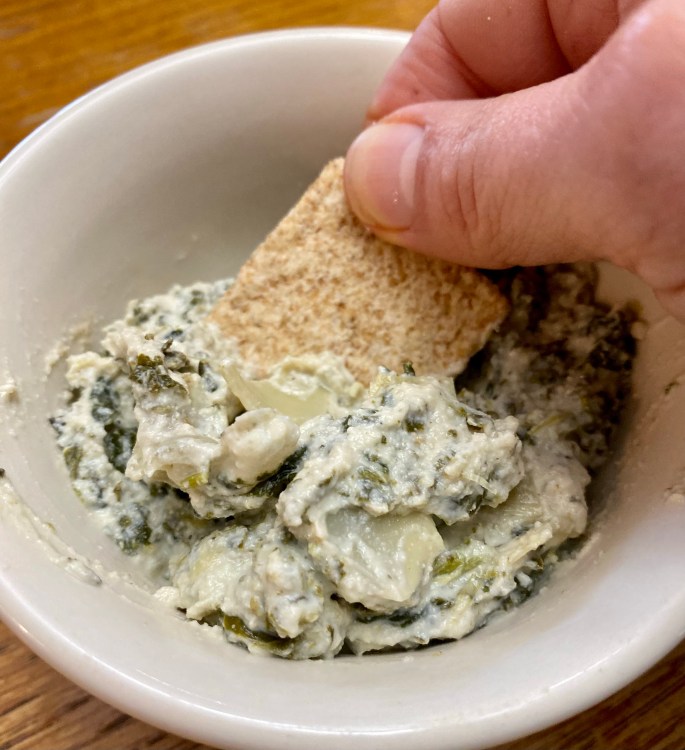
Whitespace not only creates harmony, balance, and helps to brand a design. . . .–The Segue Creative Team

Photo by Pixabay on Pexels.com

Personally, I need breathing space, and I honestly believe that most of us do.  Time away from screens, schedules, and scintillating images/demands.  Unplugging from the visual and auditory distractions of our devices, provides our brain with whitespace–the space to pause and breathe.  I liken it to opening the door and letting a child, or even a pet, go outside to run off steam at the end of the work/school day. When you unplug, it frees the mind to mentally roam or simply be still.  By unplugging, you begin to notice the sounds of nature or even household appliances.  Unplug, and you might see things through new eyes–eyes that are fully focused, rather than distracted.  Unplug, and your senses have permission to roam–noticing the way air caresses your face, the aromas of your surroundings, the full flavor of your coffee, or other favorite beverage, as it dances over your taste buds.  Unplug, and you can breathe deeply and luxuriously as if you have all of the time in the world. Even your ability to think creatively and/or problem-solve increases more when you unplug.

Photo by Asad Photo Maldives on Pexels.com

In the same way white space creates harmony and balance to the design of a web page, book, or even a 7th grade poem, creating “white space” moments in life, allows us to also feel more harmonious, balanced, and perhaps even, peaceful.  As a deep breath or sigh is gratifying to the lungs, and bring calmness to a tough moment, time unplugged offers the mind moments to rest, refresh, and recharge, providing you with more clarity and the ability to focus on what’s really important as well as give you permission to see the extraneous for the distractions they actually are. 

 It doesn’t matter if you take a break from screens inside the comfort of your own home, or outside in fresh air, unplugging and not-doing, is never a waste of time, or well, waste of space.  I especially enjoy unplugging when I am outside for a run, walk, or hike, but I also have found white space moments in the quietude of a car with all distractions turned off, including radio, or in the quiet moments of my home when others are still sleeping or momentarily out.  The ability to unplug may not occur every day, but white space of the mind, be it vacations, exercise, hobbies, or other down-time moments, judiciously scattered throughout the week and/or even month, offers innumerable benefits and is certainly worth prioritizing.  

In the same way white space creates harmony and balance to the design of a book or web site, creating "white space" moments in life, allows us to feel more harmonious, balanced, and perhaps even more peaceful.
Photo by Mabel Amber on Pexels.com

Gluten-free, Chocolate Donuts with Glaze: make your house smell like a bakery outlet

And the donut stood there with a glazed expression.–Unknown

Honestly, I am not what I would call a “donut” person.  Even before I knew I had celiac disease, I never, per se, craved donuts.  However, when I was quite young, my grandparents would occasionally drive about an hour away from their home to a Dolly Madison bakery outlet.  They would buy treats that would normally never be in my own childhood home.  Oatmeal cream pies, twinkies, fruit pies, zingers, and bags of donut gems. I can recall the childlike appeal of those colorful, catchy items on my grandparents’ kitchen table.
I never really understood why they made this trip because my grandmother was an excellent cook and an exceptionally tasty baker of desserts.  Up until the day my grandfather went to a nursing home, it seemed as if Grandmother always had some freshly baked dessert on-hand.  Maybe they made this trip because they came of age during the depression and never had much during those lean years.  Then again, it could have had more to do with the fact that they had once owned and operated a grocery store and simply enjoyed having packaged products. 

Photo by Henri Mathieu-Saint-Laurent on Pexels.com

Regardless of the reason, the grandkids were often able to reap the benefits of these bakery outlet trips.  While we were certainly limited in the amount of sweets we were permitted to eat, my grandparents were always more lenient.  In particular, I fondly recall those donut gems that came in the white bag with a cellophane center allowing purchasers to see those orbs of processed confectionery–ready to spike blood sugar levels of consumers far and wide, especially the small bodies of children.  

In the end, I am not sure if those memories have inspired my latest obsession with donut baking, but I do find baking these treats once per month to be a sweet, creative outlet in a world often filled with bitter headlines.  However, I do try to find ways to bake these donuts a bit more healthily–although let’s be honest, they’re still donuts.  Nonetheless, this recipe is gluten-free that can be made free from animal products, if desired, and it is less sugary than those rings of gems from that long ago bakery outlet. 

Why not set aside less than an hour of time to bake up a pleasant headline in your own home? They are easy to make and a cinch to glaze.  You don’t even have to own a donut pan. Most of all, your house will be smelling like a bakery outlet without the two-hour round trip drive! 

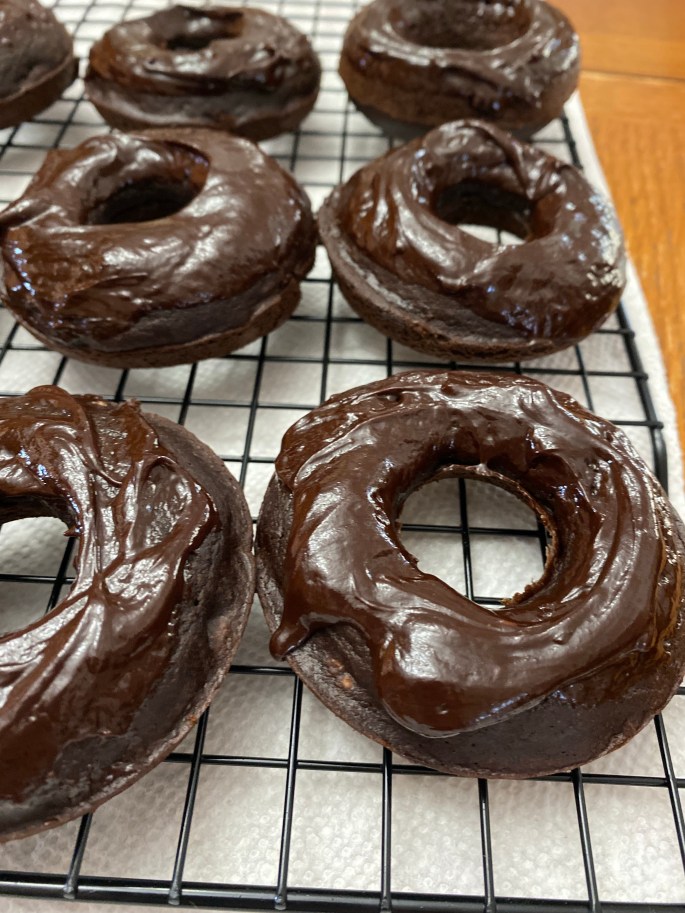
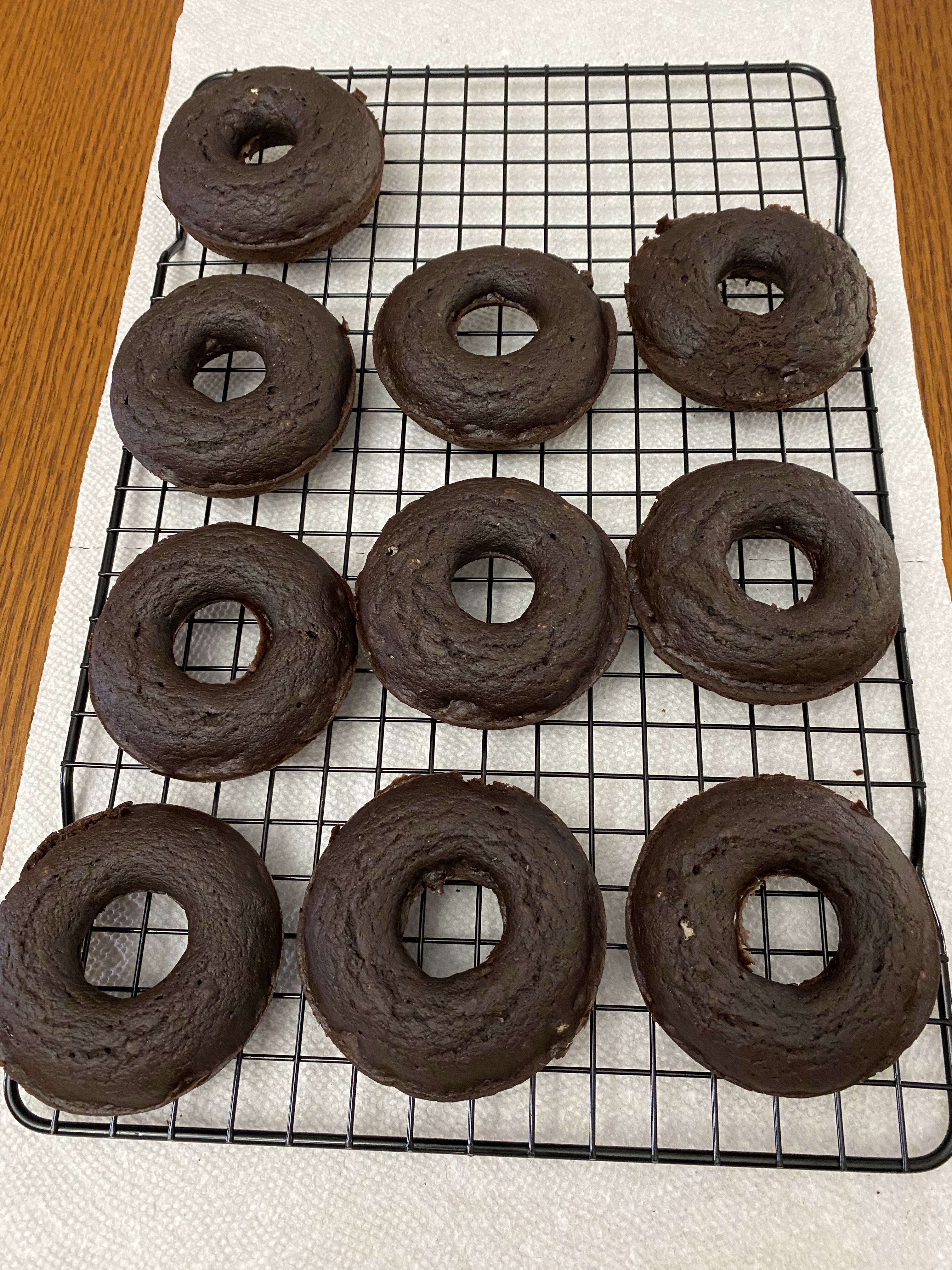
These donuts are ready to be eaten or glazed.

Gluten-Free Chocolate Donuts with optional Glaze

Donut Ingredients:

1 egg OR 1 tablespoon ground flaxseeds + 3 tablespoons water*

1¼  cup oat or all-purpose (gluten-free) flour**

⅓ cup dutched cocoa powder ***

⅓ cup sugar

1 teaspoon baking powder

½ teaspoon baking soda

¼ teaspoon salt

1 tablespoon vinegar

¾ cup milk

3 melted tablespoons of favorite nut-butter, butter, or applesauce****

1 teaspoon pure vanilla extract

Chocolate Glaze Ingredients:

½ cup gluten-free chocolate chips

1-2 tablespoons milk

2 teaspoons pure maple syrup

¼ teaspoon pure vanilla extract

Directions:

  • If using flaxseed, combine flaxseed + 3 tablespoons of water, set in the fridge to “gel” for 10-20 minutes.
  • Preheat the oven to 350 degrees.
  • Prepare a donut pan(s) with a light coating of nonstick cooking spray, OR if you do not have a donut pan, do the same with a muffin pan and plan on filling with batter ½ way full.
  • Combine dry ingredients until well blended.
  • Mix in the remainder of wet ingredients including flaxseed/egg with a large wooden spoon.
  • Divide batter among 8-10 donut spots of donut pan.
  • Bake for 10-15 minutes until a toothpick inserted comes out clean.
  • Allow to cool in the pan for 5 minutes before flipping onto the rack to cool 10-15 more minutes. Serve immediately or add glaze. Makes 8-10 donuts.
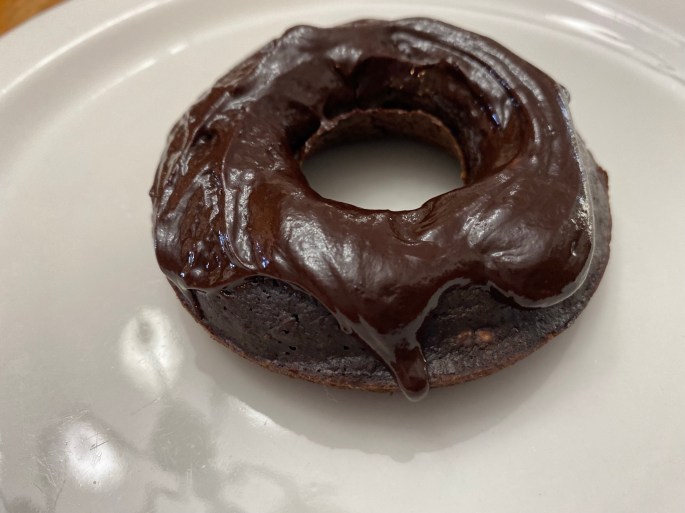
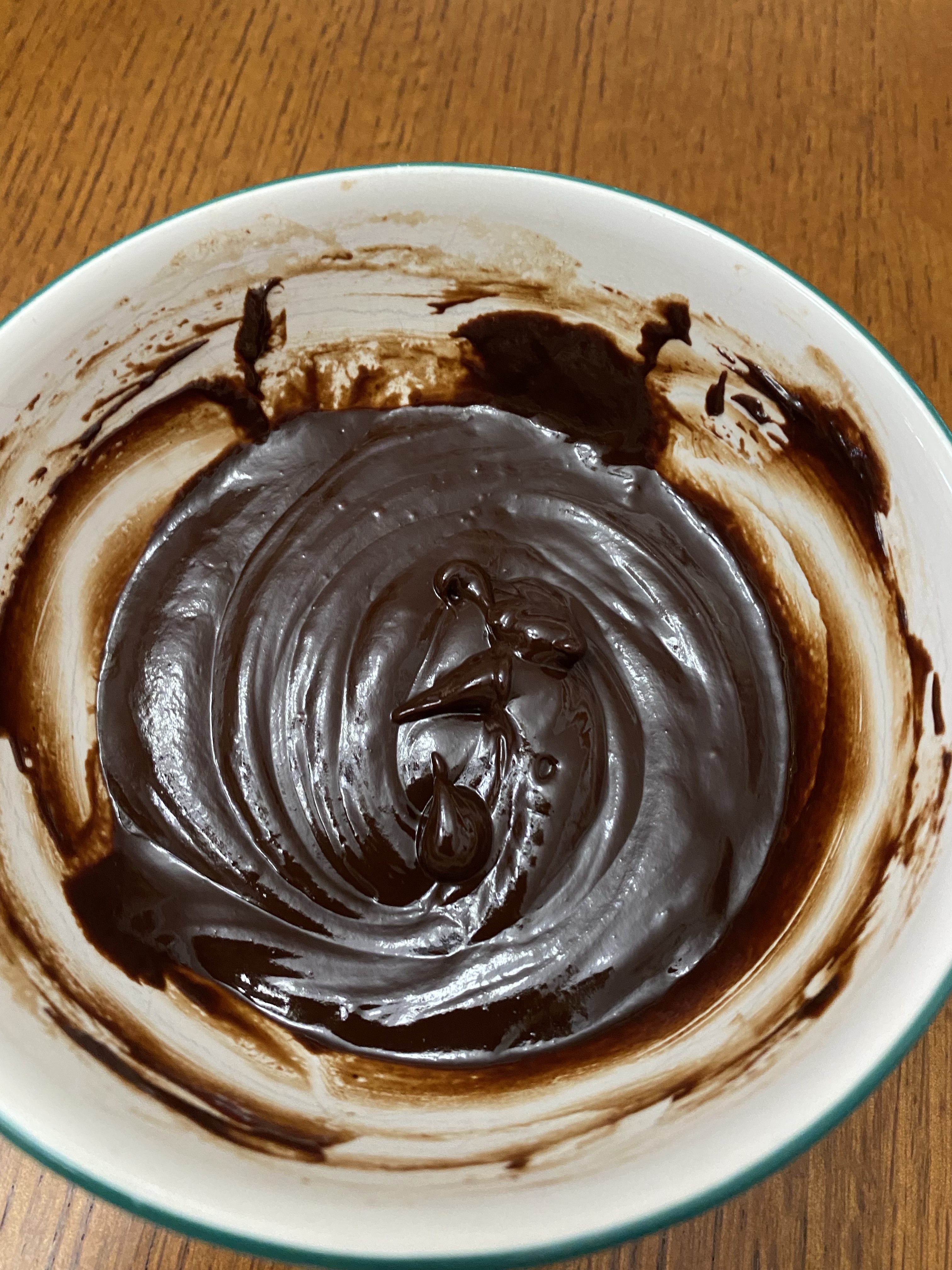
Look at this yummy glaze, ready for donut dipping.

To make glaze:

  •  Lightly spray a microwave-safe bowl with non-stick cooking spray.  
  • Add in chocolate chips and milk. Heat for 30-45 seconds until slightly melted.
  • Stir gently, and once well mixed, add in maple syrup and vanilla extract
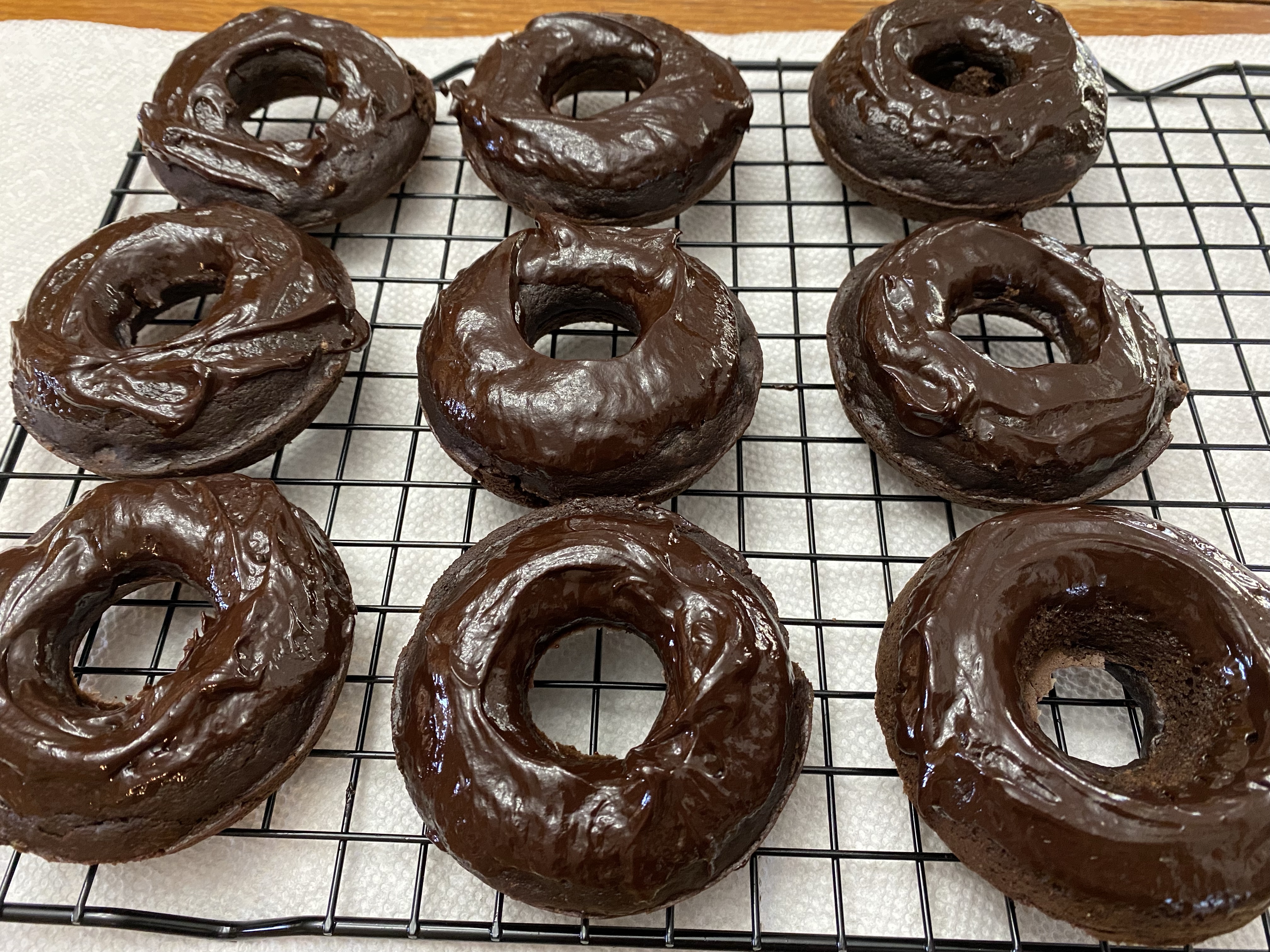
  • While glaze is still warm, individually dip one side of each donut into glaze, and place back on the cooling rack to firm up. Repeat for each donut.  Feel free to add sprinkles, sparkling baking sugar, or shaved bits of chocolate for a more festive look. 

Recipe Notes:

*Choosing between the egg or flaxseed is personal preference, but it is worth noting that

  flaxseed is plant-based. 

**I have celiac disease, so I cannot bake with wheat-based flours.  However, if you do

 do not have a gluten allergy, feel free to use all-purpose flour instead.

***I prefer dutched cocoa powder over regular cocoa powder due to its mellow, smooth

 flavor that I find to be less bitter than regular cocoa powder.  Plus, it makes baked goods

 dark and rich looking.  However, IF using REGULAR cocoa powder, reduce baking

 powder to ½ teaspoon and baking soda to ¼ teaspoon.

****Nut-butters, including tahini, offer a richer flavor and consistency; whereas, butter offers a lighter flavor and can be dairy or plant-based.  Applesauce is a no-oil choice. 

Enjoy!!

Welcome to the Fifth-Decade-of-Life-Club, a Tale of Sibling Warfare and Love

            “Everyone knows that if you’ve got a brother, you’re going to fight.”—Liam Gallagher


            “Nothing can stop me from loving my brother.”—Brandy Norwood


img_4581-1
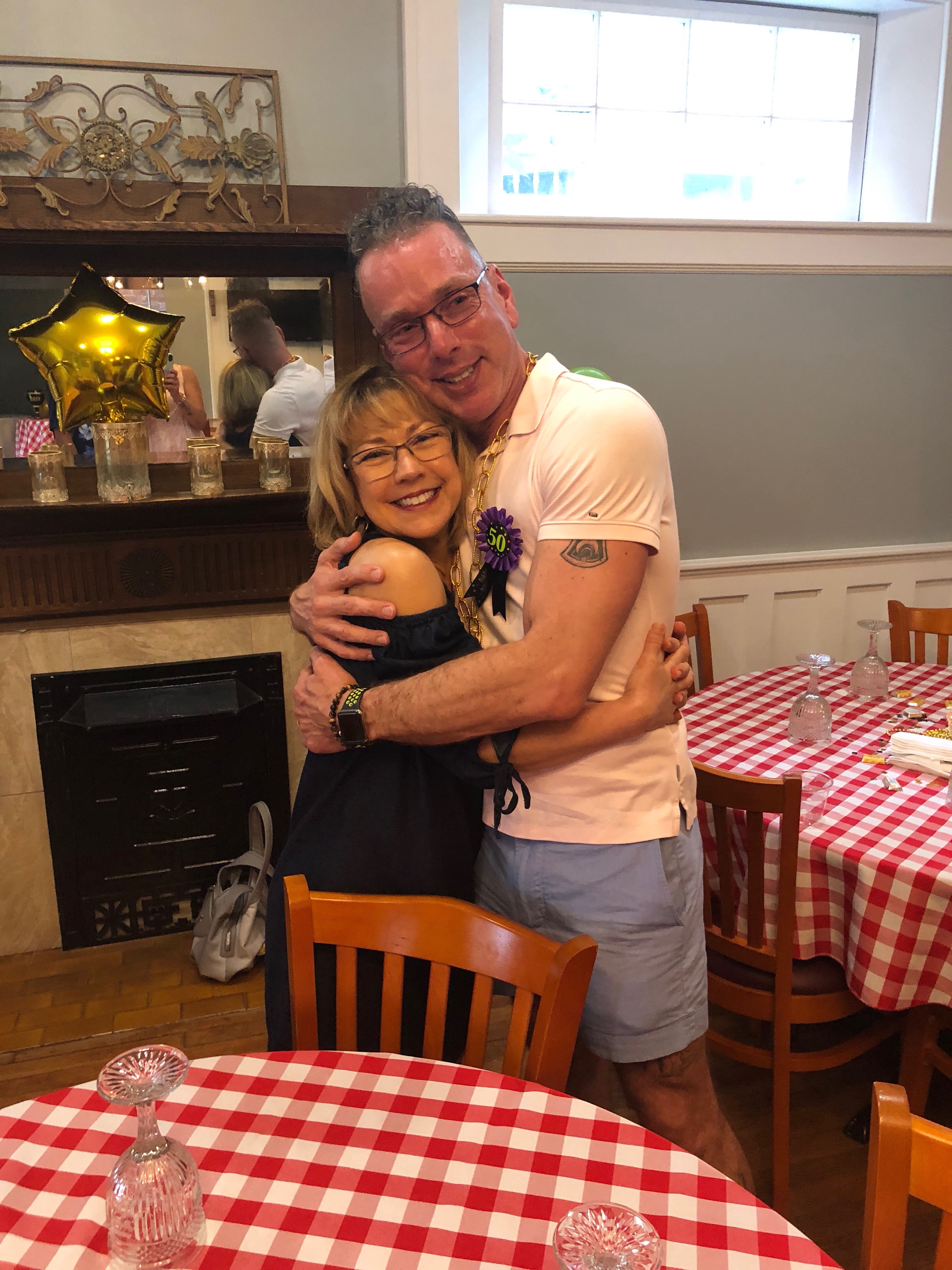
Me, and baby brother, Scott at his 50th birthday celebration at La Famiglia, Huntington, WV.


“My back has been bothering me.  I’m not for sure why,” he reveals to me during a phone conversation.


“I know what you mean.   I put ice on my back most mornings,” I reply.


“Those foods used to never bother me, but now . . .” he later bemoans.


“Me too!” I declare in affirmative.


“I love you,” he states as he hangs up the phone.


“I love you, too.”

img_4623
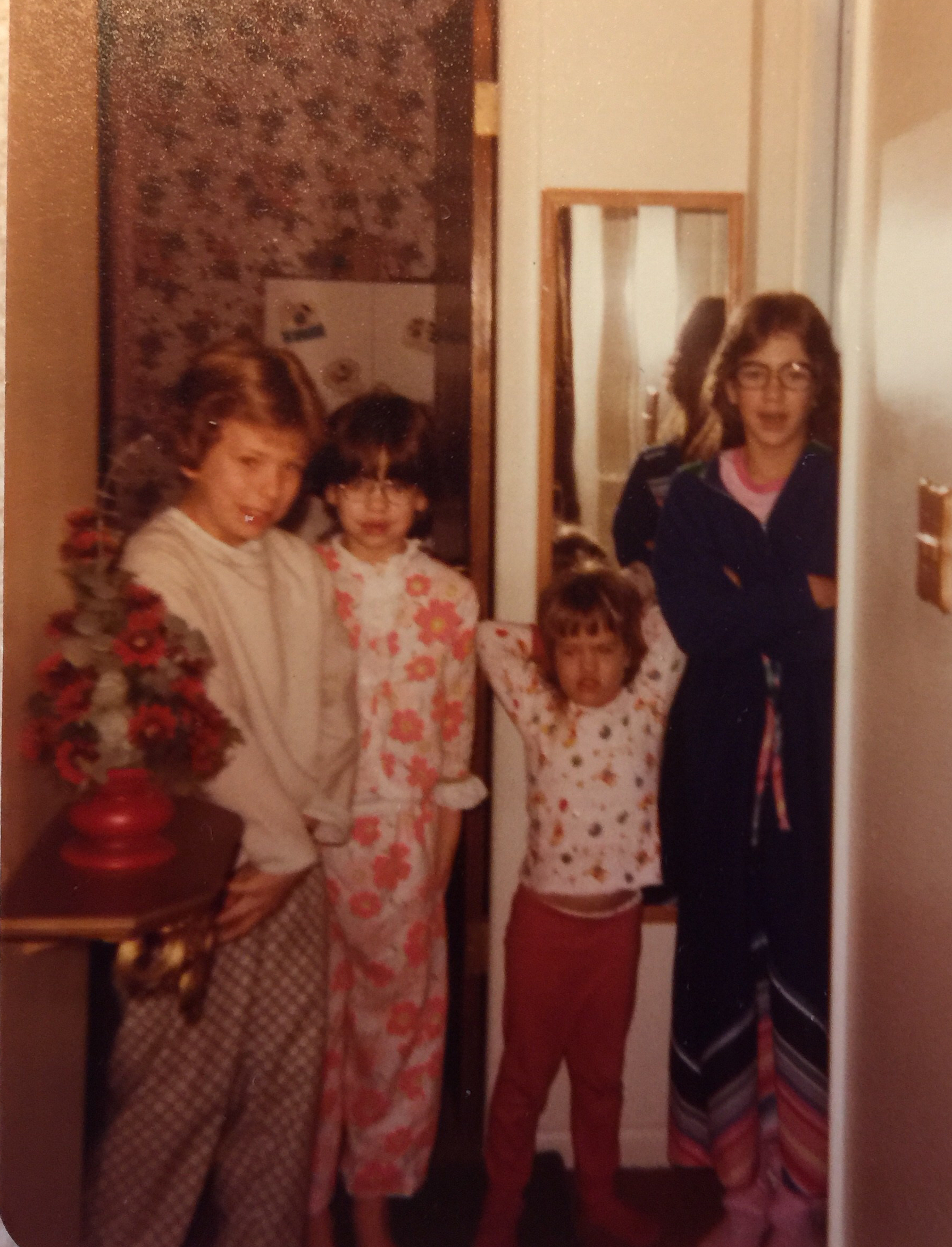
Left to Right, my sister, Traci; my brother, Scott; me; and my sister, Rachel. This was our annual night before Christmas picture, one of the few times we weren’t fighting about something.


Is this really the same person with whom I used to debate over whose turn it was to wash versus dry the dishes after supper?  Is this the same person with whom I became so enraged that I actually pelted him in the belly with a plastic baseball bat?  Was this the same person who, in my young mind, used run straight to Mom to reveal my misdeeds, and infuriate me enough to plot his death, or, at the very least contemplate all of the ways I could cause him equivalent injury?


Of course, this is also the same person whose baby crib and my twin bed once occupied the same space, leaving me to feel like his guardian.  He is the same person to whom I would read storybook after storybook once I learned how to read.  As a teen, whenever I heard the newest alternative music, I couldn’t wait to tell him all about it.  Furthermore, we shared a love of cooking the classic, “Chef Boyardee Pizza kit,” all the while “doctoring it up” (aka adding extra toppings to it that weren’t in the kit.)   Plus, we both loved to come home from junior high and high school, flip on the TV, and watch the newest After School Special, a made for TV movie based upon a currently popular teen book; old TV reruns, such as Bewitched or Bonanza; or, later, when I was in my first year of college at the local branch of Ohio University, our favorite soap opera, Santa Barbara.


I felt as if I was my brother’s guardian.


It all began one day in May 1968.  Up until that point, I was special.  I was the only one; and in my mind, the entire world centered on me.  Then, my solo career came crashing to a sudden and irreversible halt!  One day I was sent to stay with my grandparents; and, low and behold, several days later, I went home to find, of all things, a baby—a boy, at that, who would monopolize what was once my spotlight! Little did I know, this unknown baby was only the first addition with whom I needed to adjust—I would eventually have to share the limelight with two more babies, but at least they were girls!


img_4603
Up until May of 1968, I was in rocking’ in the limelight of my parents’ love and attention.


img_4613
Then, in May of 1968, I was sent to stay with my grandparents for a few days. Pictured here with my grandparents’ during an Old Fashioned days celebration.


By the time I was three, I had lost my center-stage status and was forced to share the stage with other siblings, the first of which was my brother, Scott.


As the childhood years passed, my brother, Scott, would become both friend and foe.  I had a temper, and he knew how to set it off.  Heaven help me, when he and our middle sister, Traci, would pair up together against our baby sister, Rachel, or me.


One of the more funny examples of this occurred when Rachel was quite young—no more than two years of age.  Scott and Traci devised a plan to trick her into climbing inside a toy box in their bedroom to look for a “lost” item. Once she was within the box, they promptly shut the lid and sat on top of it.  I was horrified, and of course, angry.  I began yelling at them from my bedroom to, “Let her go,” while they laughed at me.  Running in a rage towards them, I tried hitting and kicking them.  Of course, mom quickly entered the room; and in the end, I was trouble because, “I was the oldest and should have got her rather than taking business into my own hands.”  I declare, where’s the justice in that?


img_4620
Scott, Traci, Rachel, and me on the morning of Christmas. By this point, I shared a bedroom with Rachel; and, Scott and Traci shared a bedroom.


No matter how annoyed I could become with Scott, I was the first person to rise in his defense any time I perceived another person outside of our family picking on him.  If any of the neighborhood or school boys we knew, said a cross word to Scott, my black and white saddle oxford shoes instantly turned into kicking weapons as I simultaneously gave those so-called-baddies the greatest tongue-lashing I could create.


In fact, I recall one hot August day, while on a break during high school band camp, throwing my nearly five feet self in front of a pack of football players who were making fun of my brother. I dared a single one of them to pass in front of me and say another word to him.  I stood my ground, craning my head, in order to look directly into each of their eyes as I set my chin firm and determined. They, quite miraculously, walked away and quit bothering him—at least for the rest of that day. Afterwards, once I realized how dangerous and quite stupid my actions were, I ran to hide inside the instrument closet of the band room and cried, but never told my brother, well, until now—assuming he reads this.


During our teen years, my siblings could be my best friend one moment, and my mortal enemy the next–at least temporarily.


Now that Scott is joining me in the fifth-decade-of-life club, I can see that through good times, and some rather ugly times, our deep connection and love has remained.  Scott is witty, articulate, and intelligent.  He loves Broadway musicals, good food/drinks, dogs, and music—especially danceable tunes.  My brother served in the Air Force, has experienced a wide-ranging, successful career-life, has three beautiful kids, and one adorable grandchild.  Plus, he is married to a person who truly loves him.  I am proud to be his big sister.


Happy Belated Birthday, Scott!! May you continue to celebrate and dance through the rest of your life!


P.S.  Thank you La Famiglia for the wonderful venue in which to celebrate and thank you Selena Urbaez for the delicious gluten-free, melt-in-your mouth, lemon cake as well as the decadent, uber-rich, gluten-free chocolate cupcakes!!  Wow!