The Transformative Power of Art: A Visit to Tamarack

“Do you still feel up for going to the Tamarack?” my husband asked.

A Heavy Heart and a Planned Escape 🚘

Days earlier, we had loosely planned a day trip. The goal was to stop in Charleston for brunch on the way to Beckley, to nose around the galleries and marketplace of the Tamarack, and then return home, making a couple of quick errand stops along the way. Unfortunately, my spirit had been bruised by life, as sometimes happens, but despite feeling down, I agreed to go in the hopes it would be a pleasant distraction.

The brunch and drive along the WV Turnpike were heavy, filled with somber, clarifying conversation as my husband tried to help me clean out the closet of my cluttered heart. Tumbled, but not fully dried from an onslaught of despair, I entered the Tamarack lightened by our discussion, but still damp with distress. My intention from the outset was not to make a purchase, but instead soak up the vibrant and creative energy of the art, and by proxy the artists, who created it. 

Echoing my own feelings, Stella Adler stated, “Life beats down and crushes the soul and art reminds you that you have one.

Entering the Tamarack: A Sensory Shift

Once through the doors, I observed a crowd of people and wondered if this had been a good idea after all. Meandering to the right of the entrance, I surfed the sensory wave. Aromas of Appalachian-inspired cooking filled the air. A long line of people snaked around the fast-casual dining room as I made my way to the ladies’ room. Tamarack’s signature circular shape surrounding an open courtyard created a light and spacious feeling, even during this busy, pre-holiday time period. A multitude of glass windows, adorned with locally designed, gemstone-colored stained glass pieces, radiated an additional cheery warmth. The animated energy of visitors’ conversation added a rhythmic pulse to a popular sing-along soundtrack playing in the background. 

Letting the Atmosphere Settle the Spirit

As I allowed the wave to immerse me, I soon noticed that my breathing and pulse had slowed, tensions were eased, and the emotional flames were beginning to quell. Despite my earlier qualms, I could feel the atmosphere offering a form of calming consolation. The simple act of getting lost in the admiration and appreciation for each artist, and the art pieces they created, nourished my spirit. 

Wandering the Galleries: Beauty in Every Craft 🖼️

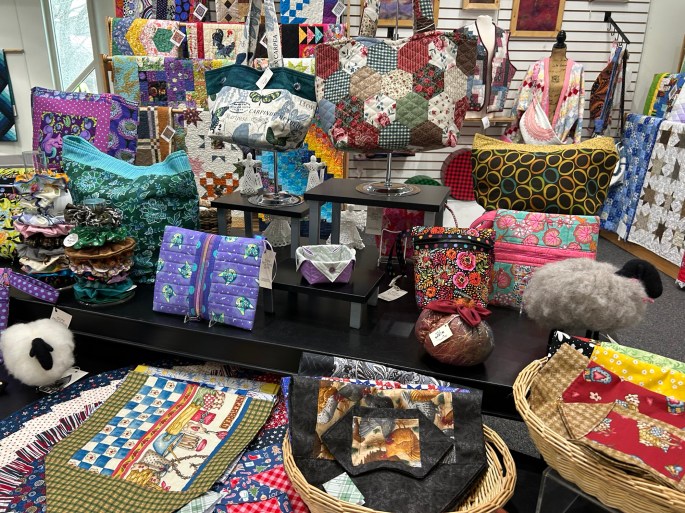
Allowing the natural flow of the galleries to pull me along, I took in richly detailed textiles and exquisite, delicate glass pieces. There were complex and intricate woodworks and artisanal earthen and pottery wares. Tables of WV grown and/or crafted wines, beers, ciders, soaps, candles, and one-of-kind foods/beverages were also available. 

I also stopped by the book nook, filled with locally written fictional and nonfictional books, novellas, cook books, maps, travel guides, and other artfully written materials. Additionally, there was a separate gallery, bright with ample natural light, filled with one-of-a-kind WV paintings, sculptures, prints, and photographs. 

Art as Memory: Echoes of Loved Ones 👵🏼

Allowing the current of creativity to slowly move me at will, the art grounded me into the present moment as I mindfully soaked up the vibrant energy. Different pieces evoked precious memories of loved ones: quilts of my grandmother’s attic, pieces of furniture and toys handcrafted by my husband’s grandfathers, earthen dishes that were reminiscent of family holiday casseroles, paintings and photographs of forested hills during the fall and winter months similar to those I hiked with my siblings and father as a child, and hand sewn creations that my mother once made.

The Healing Power of Art 🎨

I was further reminded of the many art therapy majors with whom I had classes all those long ago years. They often described the important role of art in therapeutic and school settings, a truth supported by research. Creating art and observing art supports mental health and well-being.  It often helps with emotional regulation by creating an outlet in which emotions can be channeled. Art is known to reduce stress and is often used as a tool for creating a greater understanding of one’s emotional atmosphere. Works of art often create a connection/conversation between the creator and viewer, which can provide an opportunity for both personal and collective healing.

Creativity as Community Storytelling

This is because art, such as the works I viewed at Tamarack, is often a reflection of the emotional landscape of a community, region, or even country. How many colorful and varied life stories, events, and personalities, past and living, were being conveyed and connected all under one circular roof? Each stitch, stroke, cut, hammer strike, click, and spin breathed life into each creation that spoke to the heart and soul of human resilience and hope.

In the Company of Strangers: Shared Wonder

As I meandered through the gallery devoted to paintings and photographs, I often lingered on works that spoke to me. Simultaneously, I overheard a pair of women, who were gazing at a section of paintings by a Mingo County artist, speaking with near reverence about their own childhood experiences in the same area. Another couple whispered with one another at nearly every piece, laughing at the memories specific images seemed to evoke. 

Spaces of Belonging: More Than a Marketplace

It occurred to me that art galleries, like the Tamarack, create centers of belonging–gathering places that celebrate the human experience. These transactional spaces aren’t just about exchanging money; they also provide an interchange of ideas and stories between artist, piece, and viewer. Investing in these community hubs is an investment in one another, supporting each other emotionally and culturally. People leave the Tamarack with a taste of what it means to be Appalachian.

A Quiet Affirmation

Standing in that gallery, soaking up all of the intriguing and thought-provoking images, an employee shook me out of my reverie by asking if I was enjoying my visit. I nodded, stating that I was feeling lighter and more grounded than when I entered. She unpretentiously declared, “Art can do that for you.”

We chatted a bit more before I moved on to look through the prints outside the gallery. I still did not have any answers to my specific concerns, but I did have a sense of peace that comes from being heard. Not that I was literally heard; rather, the struggles and joys, the sadness and celebrations, and the wonder and the awe that went into creating these pieces “heard” and spoke to my own related emotions. It was the beginning of healing and hope that often happens when surrounded by reflections of inner beauty.

Leaving with Lightness and Hope

Thomas Merton is credited with stating, “Art enables us to find ourselves and lose ourselves at the same time.” My visit to Tamarack allowed such a juxtaposition: by surrendering myself to time spent with art, my capacity for healing renewal was possible. It served as a reminder. When we immerse ourselves in the present moment, we kindle the still, small voice within, our hearts and minds steady at the sound of this whispering inner-knowing, and we can rest assured we are being held even when the heaviness of life weighs us down. Perhaps that is the gentle promise held within art: when life seems overwhelming and hopeless, the beauty of art and/or the creative process is there to offer us wings of hope for rising once more.

Running Beyond Age: Embracing Health and Freedom in Every Step

“Running is an act of creative self expression”–Lawrence van Lingen on Extramilest podcast

A Familiar Morning Scene: Defying the Stereotype 👟👟

Two older runners jogging together on a path surrounded by grass and wildflowers in a park during early morning.
Photo by Anastasia Shuraeva on Pexels.com

Picture this. It’s early on a warm Saturday morning in your local park. The sun is low on the horizon, and mist is rising above the grass and a meandering stream that runs alongside a crushed gravel path. The scent of a nearby rose garden is heady as two runners descend the hill following the path. Moving at a steady clip, one runner has a full head of white hair while the other is more salt than pepper. They are relaxed and chatting as they pass by.

This is a routine sighting for me on my weekend jogs. Numerous older runners, walkers, and run/walkers defying the stereotype through exercise, that aging equals physical decline. In fact, according to AARP, beginning in 2023, the average age of runners has risen. Some of the biggest gains are those 55 years and older, with numerous runners sticking to it well into their 60s, 70s, and 80s as witnessed in the ages of Boston Marathon finishers in recent years as well as other major marathons around the world. Of course, there’s no denying aging does change the body, so why do I see numbers of people my age and older consistently outside running and/or walking?

Running as Personal Ritual and Liberation 🏃‍♀️

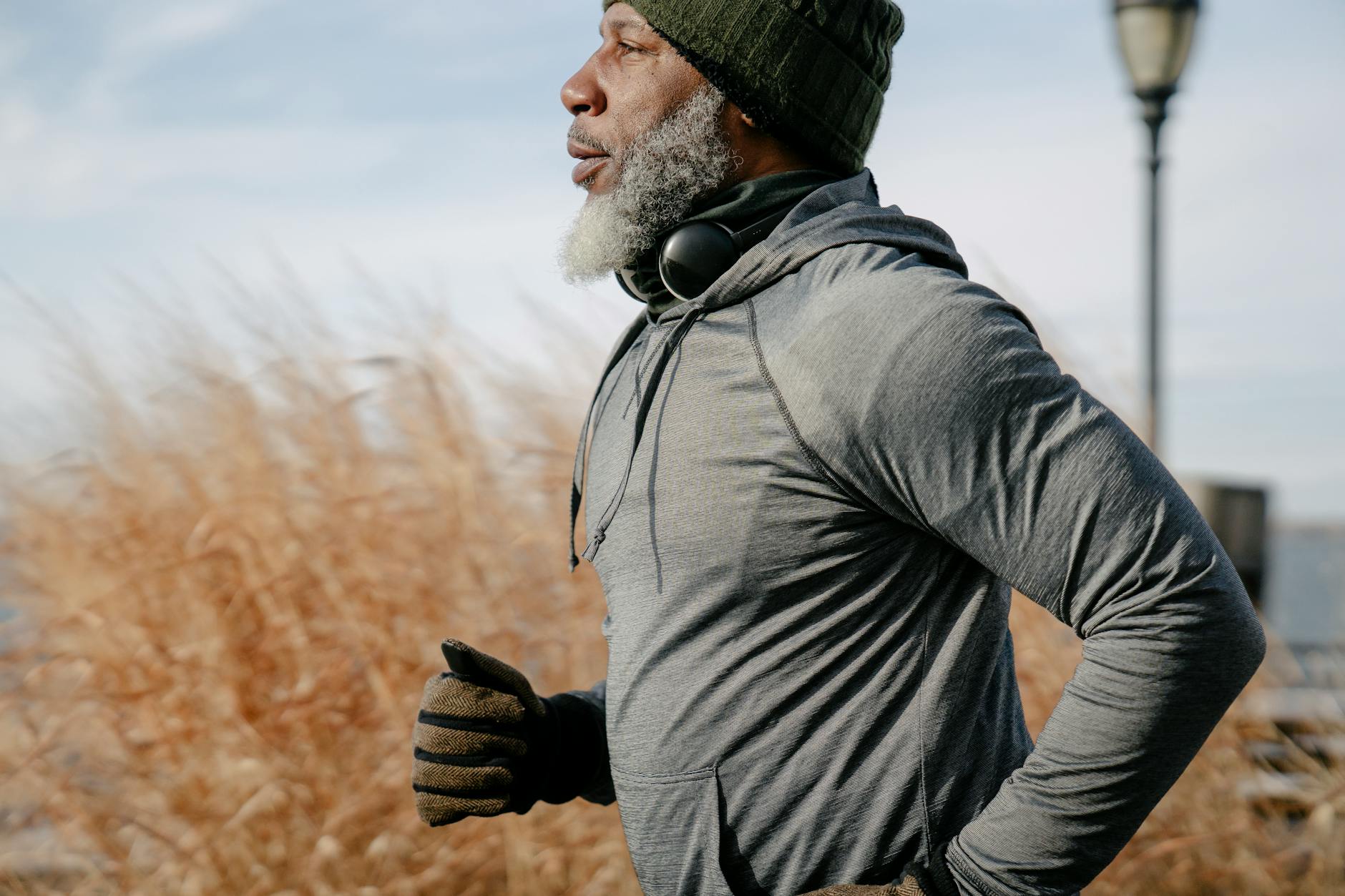
Older man jogging outdoors in a gray hoodie and gloves, surrounded by tall grass with a calm sky in the background.
Photo by Barbara Olsen on Pexels.com

For many older individuals, like myself, running or run/walking becomes a personal manifestation of life–a ritualistic form of imaginative self expression that allows us to reconnect with our inner rhythm, identity, and self-determination. It creates a sense of freedom and play that we once had as a child. Additionally, running offers numerous benefits, including improved physical health, enhanced mental well-being, social connections, and a renewed sense of personal meaning, to name a few. 

The Science-Backed Physical Benefits of Running 🏃‍♂️

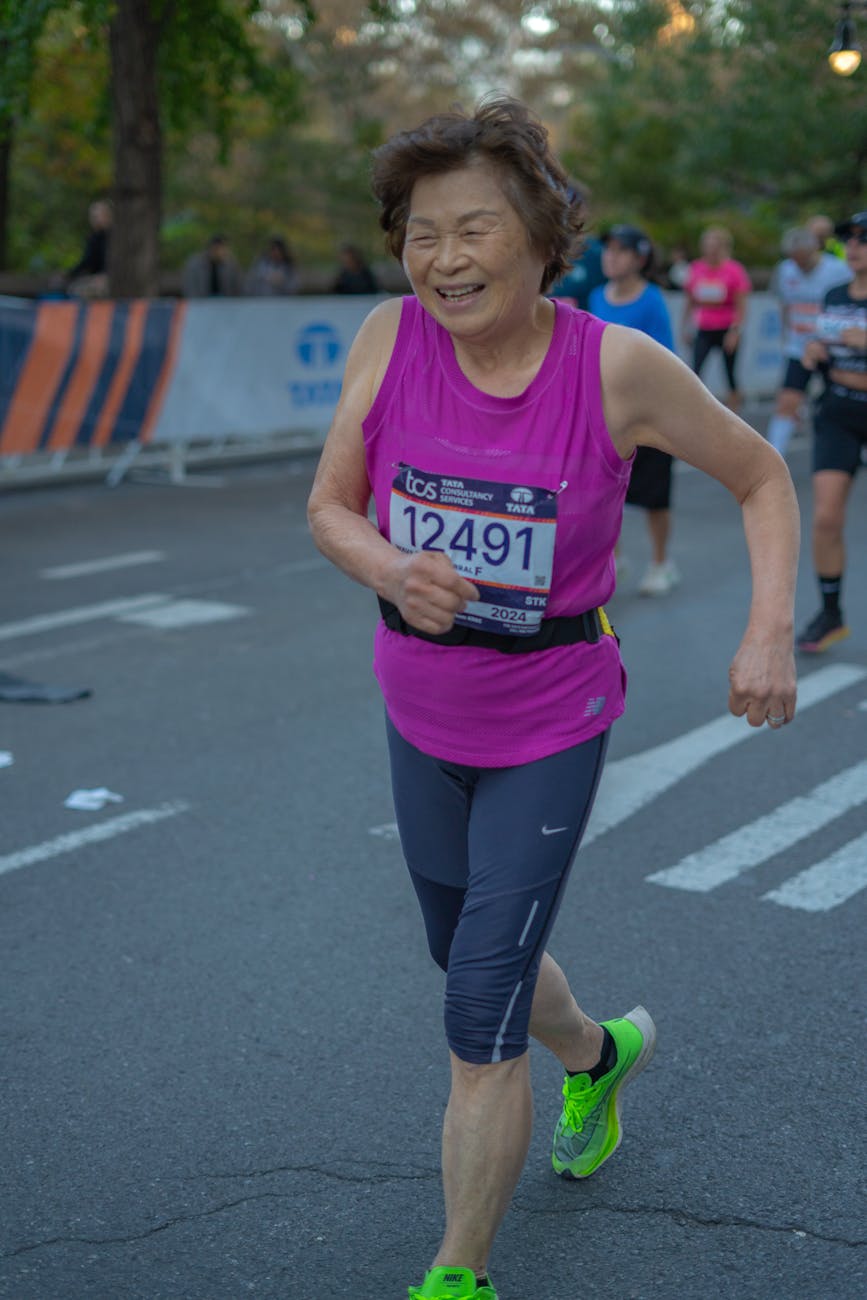
An older female runner smiling while participating in a race, wearing a bright pink tank top and bib number 12491, with greenery and other runners in the background.
Photo by khaoula Bkm on Pexels.com

I occasionally encounter critics who question the safety of running at “my age,” (a term used by my students); however, according to another 2023 AARP article, older runners just have to be “smart about it.” This is why many running groups often point beginners, including seniors, to using a run-walk-run method to establish a strong aerobic base. In fact, Cleveland Clinic, in a 2024 article, points to numerous physical health advantages to walking and/or running for all ages, but especially seniors. These advantages include:

  • Strengthens heart and improves circulation
  • Reduces risk of heart disease and stroke
  • Increases bone density, helping prevent osteoporosis 
  • Improves joint flexibility and maintains muscle function
  • Boosts metabolism and supports healthy aging
  • Improves blood sugar regulation and lowers risk for type 2 diabetes
  • Reduces risk of dementia and Alzheimer’s disease

Mental Health Gains: Silence the Inner Critic 🙉

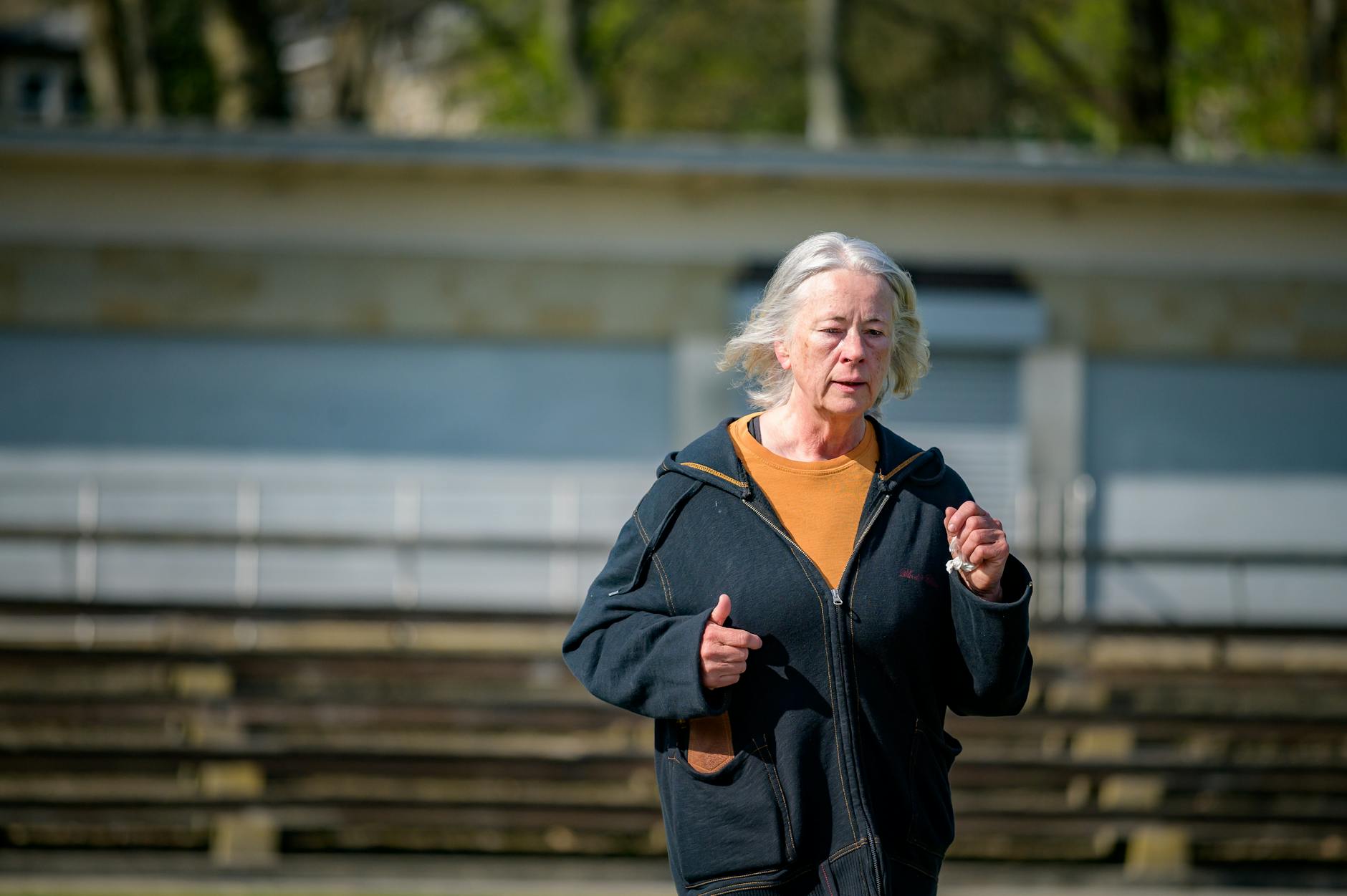
An older woman running outdoors in a black hoodie and orange shirt, focused on her exercise, with a blurred background of benches and greenery.
Photo by Centre for Ageing Better on Pexels.com

Certainly, the physical health benefits of running are important to me; however, one of the greatest advantages is the feelings of improved mental health and well-being. I often refer to monkeys living in my mind, and running allows me to rise above the swirling negative chatter that often clouds my mind. On days when it seems everything goes sideways, if I have completed my morning run, I can take solace in the fact that I completed at least one positive act, thereby helping me to keep symptoms of depression and anxiety at arm’s length. 

I also find running clears my head, improves thinking, and increases memory, which is a bonus as I age. In fact, running–and exercise in general–is like meditation in motion because it deeply connects me to my breath. Plus, it is a great source of stress reduction.

The Artistry of Movement: Running as a Creative Outlet ✍️

An older man with a full head of gray hair is pouring water from a cup over his head while running in a sunny outdoor setting. He wears a bright red athletic shirt and a race bib number 757. In the background, other runners can be seen along a palm tree-lined street.
Photo by Jou00e3o Godoy on Pexels.com

Running is also a form of innovative self-expression, for young and old alike. Like crafting one’s own piece of art, running showcases the beauty of a body in motion. It offers time for inspiration and reflection. Each run, like a canvas, offers the opportunity to tell a story, footstep-by-footstep. Personally, time spent running also allows me to process life as well as difficult, often buried, emotions, and it even sparks inspiration. My running, albeit slow, feels like an act of liberation, hope, and a tribute to the many obstacles I have overcome along the way. It is a symbol of inner strength, resilience, and freedom to be me–in a world that has often felt as if it boxed me in.

Spirituality, Solitude, and Social Connection 🙏

An older man running on a path surrounded by tall grass and trees on a sunny day.
Photo by Thomas Shockey on Pexels.com

For many runners, older and young, running offers an opportunity to hang out with other runners and socialize. However, some find that running solo, instead, creates a sacred space in which they can connect to their Higher Power, feeling that sense of peace and ease. Still others appreciate the opportunity to spend time in nature, soaking up fresh air and the beauty of Mother Earth.

A Healthy Routine for a Vibrant Life 🙌

Two female runners in matching orange and red jerseys sprint together, holding hands as they approach the finish line. They display expressions of determination and joy during a race.
Photo by RUN 4 FFWPU on Pexels.com

Running, for many, including myself, forms a meaningful structure to the day, a time set aside for one’s personal well-being and health.  This is important because there are numerous obligations and responsibilities that life often demands, even as we age. By setting aside regular time to run, sleep typically improves, which can be so elusive in older adults. Furthermore, those who run typically tend to eat better and don’t tend to abuse substances in order to better support their ability to run.

Staying Safe and Smart with Age 🤔

An older woman running outdoors, wearing a bright yellow tank top with a blue logo, smiling and gesturing with her hands. The background features greenery and a sunlit path.
Photo by RUN 4 FFWPU on Pexels.com

Of course, as we age, we do have to be safe about our exercise habits, which often begins with checking-in with a health-care provider. Additionally, I highly recommend finding good footwear that works for your own personal gait/foot-type; a local running store expert can help with this. Furthermore, as AARP points out, older runners should not go from “zero to 60.” Warm-ups and cool-downs are essential, and for those wanting to start running, a good walk-run program like Run Your Butt Off or the Run-walk-run training plans are two great ways to start. (I have personally used both and can attest to their gentle nature.) 

Other considerations as we age include running less on concrete and asphalt, if possible, and spending more time on softer surfaces, like the paths at local parks. Treadmills also offer a more cushioned surface, and they are a great option when weather is too hot, too cold, or otherwise uncomfortable. If you run at night or early morning, it is important to wear a headlamp and reflective vest for safety’s sake. Additionally, if you run alone, it is a good idea to let someone know where you are running and for how long. 

Every Run Is a Story: Movement as Becoming 🏃

A runner with a confident expression points at the camera while sporting a black sleeveless shirt with 'RUN lovers' printed on it, a race bib, and a headband, during an event in a sporting field.
Photo by RUN 4 FFWPU on Pexels.com

Bottom line, each run or run/walk/run is an adventure. Sure, some runs are less adventurous than others, but those moments offer an opportunity to learn about ourselves if we remain open and curious. Running (and walking) is accessible and fairly low-cost, and it is an effective way for older (and even younger) adults to improve their mental, physical, emotional, and even spiritual well-being. 

Beyond these benefits, running, for me, continues to remain a quiet act of self-expression. With each step and stride I take, I am writing a story, reclaiming my space and time, and paying homage to The Creator, celebrating this gift that is life. In this way, running transcends exercise and becomes a personal journey of becoming, no matter my age. 

With the right approach and mindset, whether you run, run-walk-run, or mostly walk, moving our bodies regularly can create joy and empower older adults to age well—proving that vitality truly has no age limit!

An older man with white hair smiles while wearing a jacket and a medal, standing among a group of people in a blurred background.
Photo by Roman Biernacki on Pexels.com

The Spirograph Effect: Creativity in Life Design

“Not all who wander are lost”–J.R.R. Tolkien

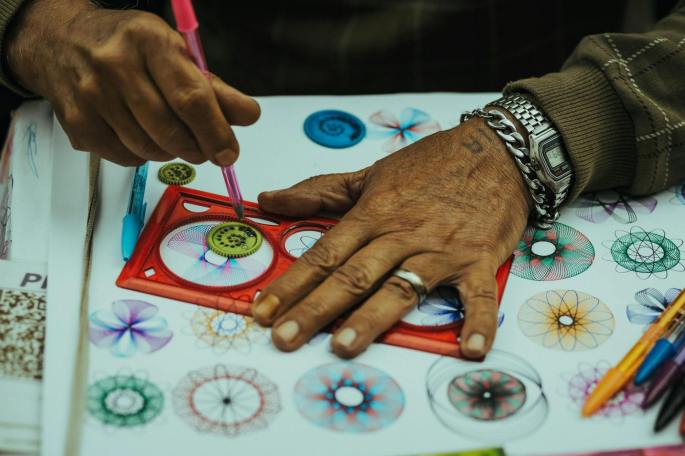
Close-up of hands using drawing tools to create a spiral geometric design on paper.

A Student’s Doodle Sparks a Memory✍️

Months ago, I observed a student drawing spiraling circles over and over on a sheet of notebook paper while participating in our class discussion. For some reason, I was reminded of an old toy my siblings and I once enjoyed: the Spirograph. I can’t remember which one of us received it, but we would sit together for what seemed like hours at the kitchen table drawing colorful, eye-popping (at least to us) geometric shapes.

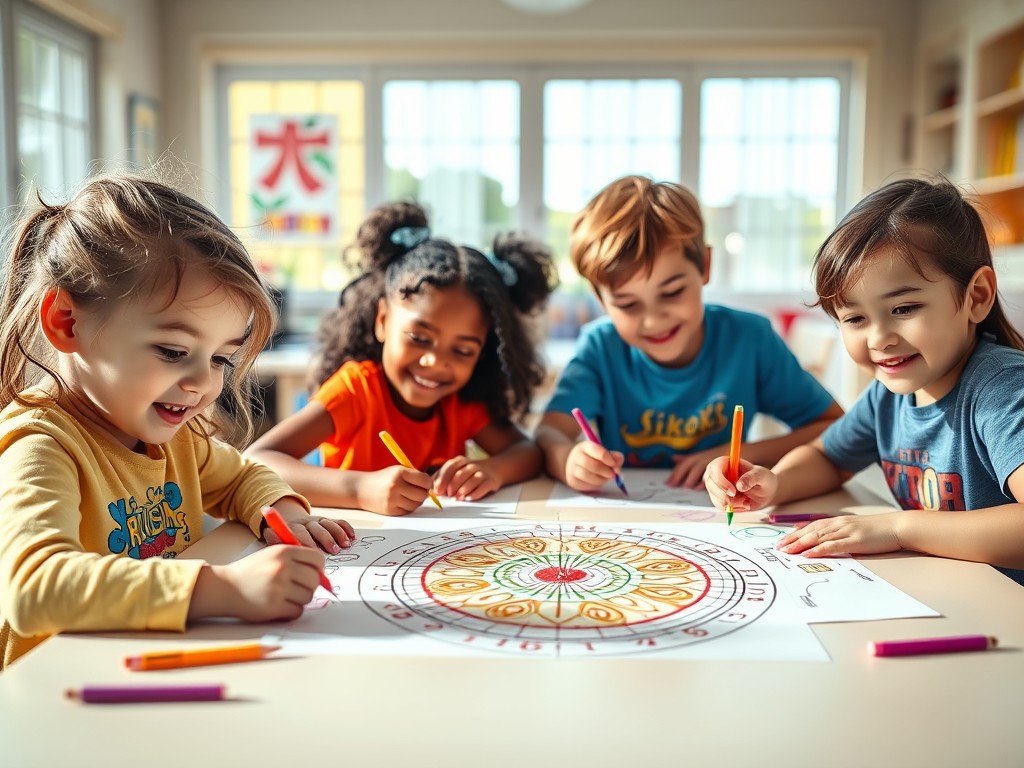
Four children gathered around a table, smiling and drawing colorful patterns on a large sheet of paper using various markers.

Lessons Hidden in a Childhood Toy ꩜

Reflecting upon that long-ago childhood toy, led to the realization that the Spirograph illustrates the significance of specific concepts when it comes to creating our own life design, such as the influence of structure, patience, persistence, and the importance of celebrating our own unique individuality. It also emphasizes the value of working through natural constraints and trusting the process of learning through repetition. What’s more, the Spirograph demonstrates the relevance of trial and error–which often includes failure–as well as accepting the beauty that can be found in our so-called “imperfections”.

The Spirograph’s Ingenious Origins 👨‍🔬

To appreciate the genius of the spirograph as a toy, requires understanding a bit of its history. Denys Fisher, a British engineer, created it as a child’s play thing based upon various iterations, beginning as early as 1827. At the time of its original conception, it was used for advancing mathematical and engineering concepts. Spirograph, the toy, wasn’t available until 1965, and it went on to win “Toy of the Year” in 1967. Unbelievably, it is still available today.

This classic geometric drawing toy originally came with two transparent rings, two transparent bars, 18 clear wheels of varying sizes, two colored ink pens, pushpins, putty, and paper. Using the various tools, my siblings and I could draw precise, and quite mesmerizing, mathematical curves known as hypotrochoids, epitrochoids, and cycloids. With the switch of any one part, we could vary the size, shape, and geometry of intricate and, at the time, mind-boggling patterns. Essentially, the Spirograph is operated on a balance of limitation and creative freedom, which reflects much of the human experience.

A box of the original Spirograph design set, featuring colorful geometric designs and detailing the contents, including pieces and tools for creating intricate patterns.

Art Through Limits: Creative Freedom Within Structure 🎨

When one is drawing with the Spirograph, one has to adapt to its restrictions. The designs made by using the Spirograph are limited by the size and shape of the wheels and whether you are using the rack or the ring, as well as the color of the chosen pen(s) used to design a figure. Additionally, there are rules for creating specific outcomes as described in its guide book.  While it isn’t necessary to follow the laid-out directions, if one desires it to create a specific shape or design, one has to follow the step-by-step instructions.

This is similar to life in many ways. Influences in life vary from person to person and from family to family, often dependent upon experiences, education, and available information. Many individuals have followed very specific guidelines provided by parents, religion, schools, and even societal norms while others may have fewer influences. For many of us, following a structured timeline is how we landed in our current field/career path.  However, there are just as many, who followed a winding path of their own creation, and still produce a meaningful life experience. Like the Spirograph, following guidelines creates remarkable results for some people, while for others, grabbing the gears and turning them their own darn way works just as well.

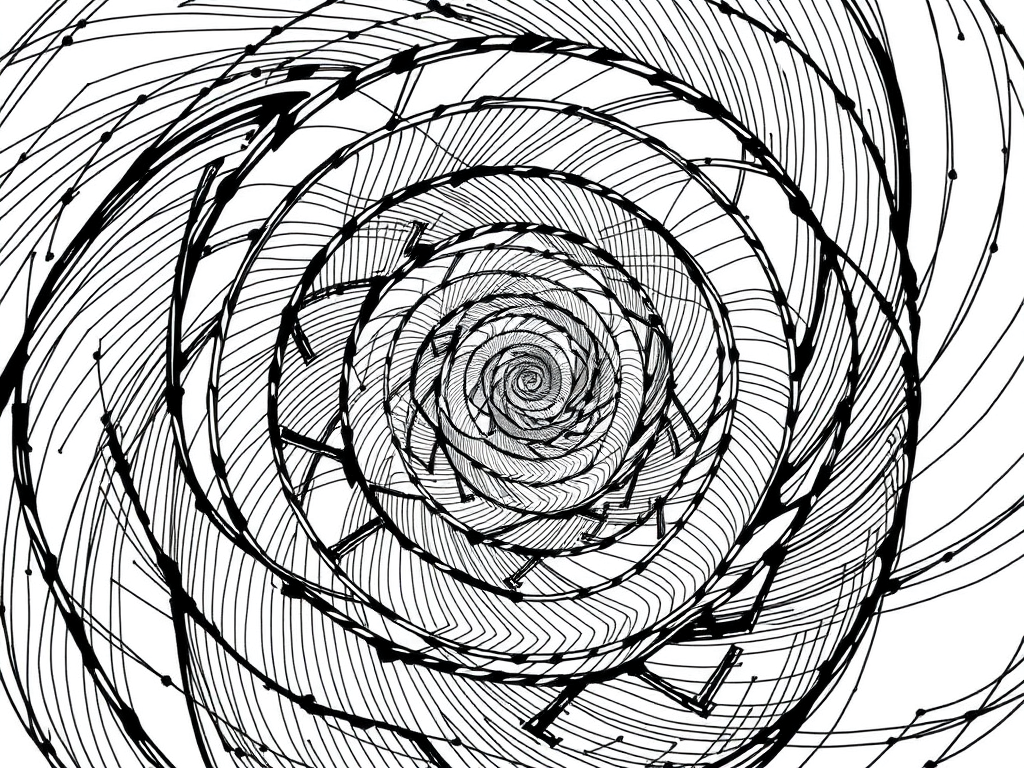
Black and white abstract spiral pattern created with lines and arrows, resembling a geometric design.

The Power of Patience and Trusting the Process 🙏

When working with the Spirograph, my siblings and I had to have faith in the process. We had to further learn that creating something meaningful takes time. The desired design outcome emerged slowly, turn by turn, and layer upon layer. In sum, the Spirograph required us to have patience, trust the process, and stay the course. 

Similarly, our life journey takes time as we, hopefully, continuously evolve and grow. We may have times we question the process, or we may waiver in our faith, patience, and persistence. However, rushing life outcomes usually ends up backfiring. Moreover, the time required for personal growth fosters resilience, a much needed companion to patience. We only have one precious life, and as our life design unfolds, with all of its curves and angles, it is never worth rushing. 

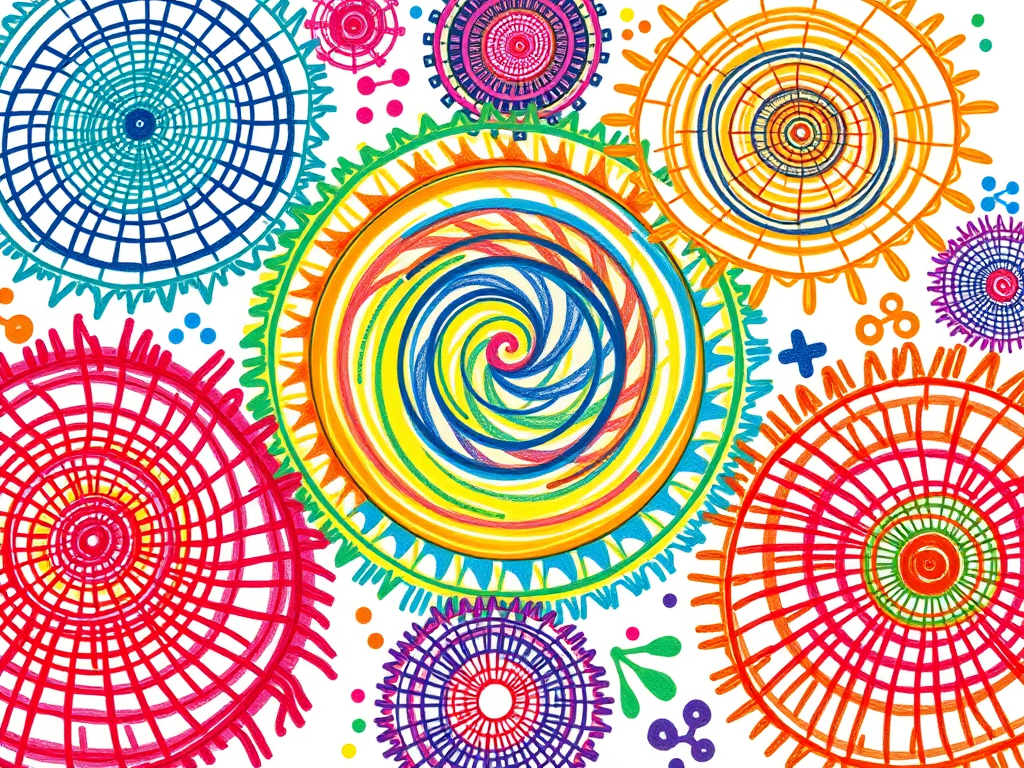
A colorful doodle featuring spiraling circles and geometric shapes, reminiscent of designs created with a Spirograph toy.

Failure, Play, and the Magic of Repetition 🖍️

With the Spirograph, I recall that we often learned through repetition and play. We might draw the same shape over and over, sometimes changing the color, or merely changing the size. Other times, we followed the guidelines, and somehow still managed to “fail”!  And, yet, many of those so-called failures ended up being unique and pretty creations–even if they did not come out as planned. Other times, we would just “mess around” to see what we could create. Some results were not so spectacular, but other times, the creations were fairly impressive or, at the very least, provided us with a new understanding for creating specific curves and/or angles. 

Life can often be the same way. How many of us have experienced times where we “followed the rules,” doing what we were “supposed to do,” and still somehow managed to fall flat on our face. Years later, however, we may look back and realize that those “failings” led to something far greater than we could have ever imagined. Other times, a bit of experimentation leads to a new life path or experience that brings unexpected joy we might not have otherwise known. Thus, like the Spirograph, a playful and experimental mindset can lead to untold delights and adventures.

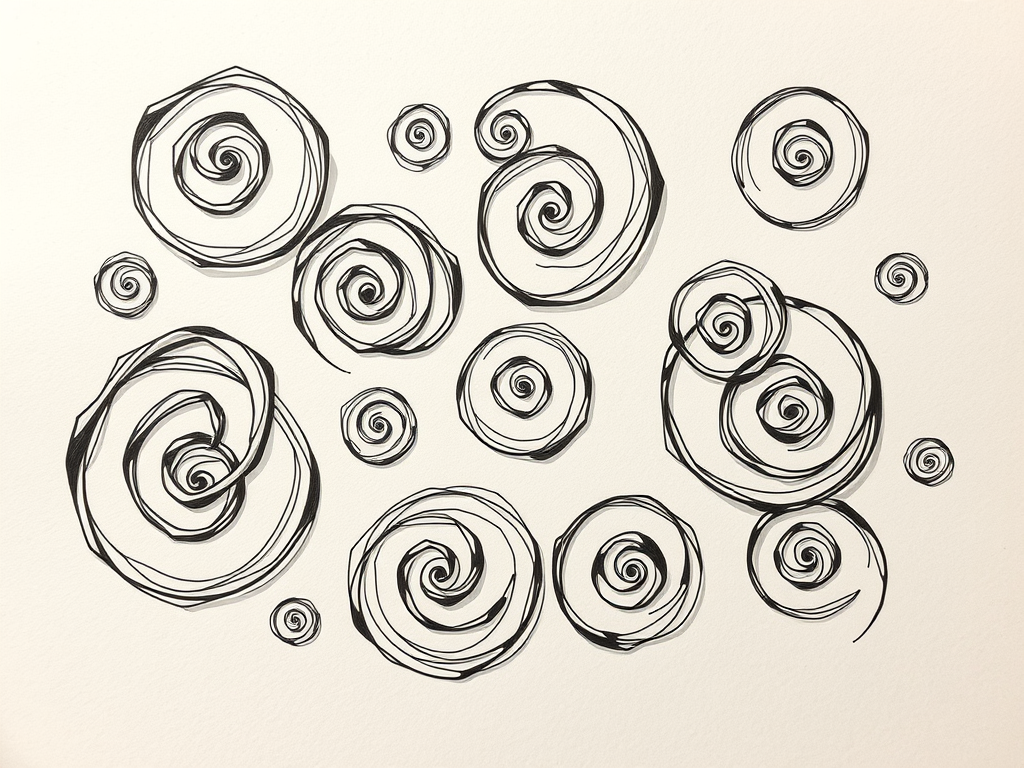
A collection of hand-drawn spirals in varying sizes, arranged artistically on a blank background.

The Beauty of Uniqueness in Design—and in Life 🖼️

Learning to welcome individual uniqueness was another life lesson the Spirograph provided. It often intrigued my young mind how my siblings and I could make the same design, but with a switch of pen color or pressure, or switch of a gear wheel, we could make each drawing unique, despite the fact we were essentially using the same tools. 

Sometimes, we would be surprised when trying to make the exact same shape, because we accidentally missed one of the required steps. Skipping one step, tended to create an irregular shape. Nonetheless, our younger selves marveled at the unique loveliness of the design. Our child-size egos told us we were pioneering artists in those moments!

Marks of Authenticity: Irregular Paths, Unique Lives

What a powerful reminder of the importance of celebrating our own–and others’– idiosyncrasies, including any so-called irregular paths. These individual characteristics and traits, as well as any “irregular paths’ traveled, are all marks of authenticity–that one-of-a-kind spice in our life serving. As humans, our genetic material is vastly similar across all humanity. Yet, this same genetic material still manages to create unique DNA characteristics, such as varying eye color, height, body shapes, and so forth. Furthermore, despite our similar genetic makeup, our lived experiences vary. In a sense, we are pioneering artists of our own lives.

A colorful collection of intricate geometric patterns resembling designs created with a Spirograph. The spirals and mandalas feature vibrant colors and diverse shapes, showcasing creativity and uniqueness.

Embracing Life’s Curves and Imperfections 🌀

Like the Spirograph of my childhood, we all deal with life constraints, no matter what path we try to create for ourselves. These life designs often, and sometimes repeatedly, require practice, patience, perseverance. Life also requires us to accept the many so-called imperfections and irregularities that come as part of the creative process. However, those “flawed” experiences give our life meaning and purpose. Therefore, it is worth remembering we have the power to play and create with the pen we have. All those curved lines and angles that make up our lives, including the missteps, are what continues to compose and create our magnificent, one-of-a-kind life design. Let’s embrace the possibilities.

Who’s ready to draw? ✍️