Embracing Silence: The Owl’s Call to Mindful Listening

A wise old owl sat on an oak;
The more he saw the less he spoke;
The less he spoke the more he heard.” —old proverb

A wise-looking owl perched on a branch in a dark, wooded area, illuminated softly by moonlight.
Photo by Erik Karits on Pexels.com

Listening in the Dark 🌌

I am an early riser, typically awake before the sun. A few weeks ago, my ears perked at the haunting, penetrating call of an owl. Its “Hoo-hoo-hoo, hoo-hoo” echoed around our yard as I looked out into the murky dark. Since then, I intentionally listen for its steadfast call. It has become both a comfort and a mystery—an invitation to listen, reflect, and learn something new.

The owl’s call continues, I am certain, even when I am not listening; yet it requires my full attention in those predawn hours if I hope to notice it regularly. Its presence illustrates the importance of listening and discerning with care and purpose.

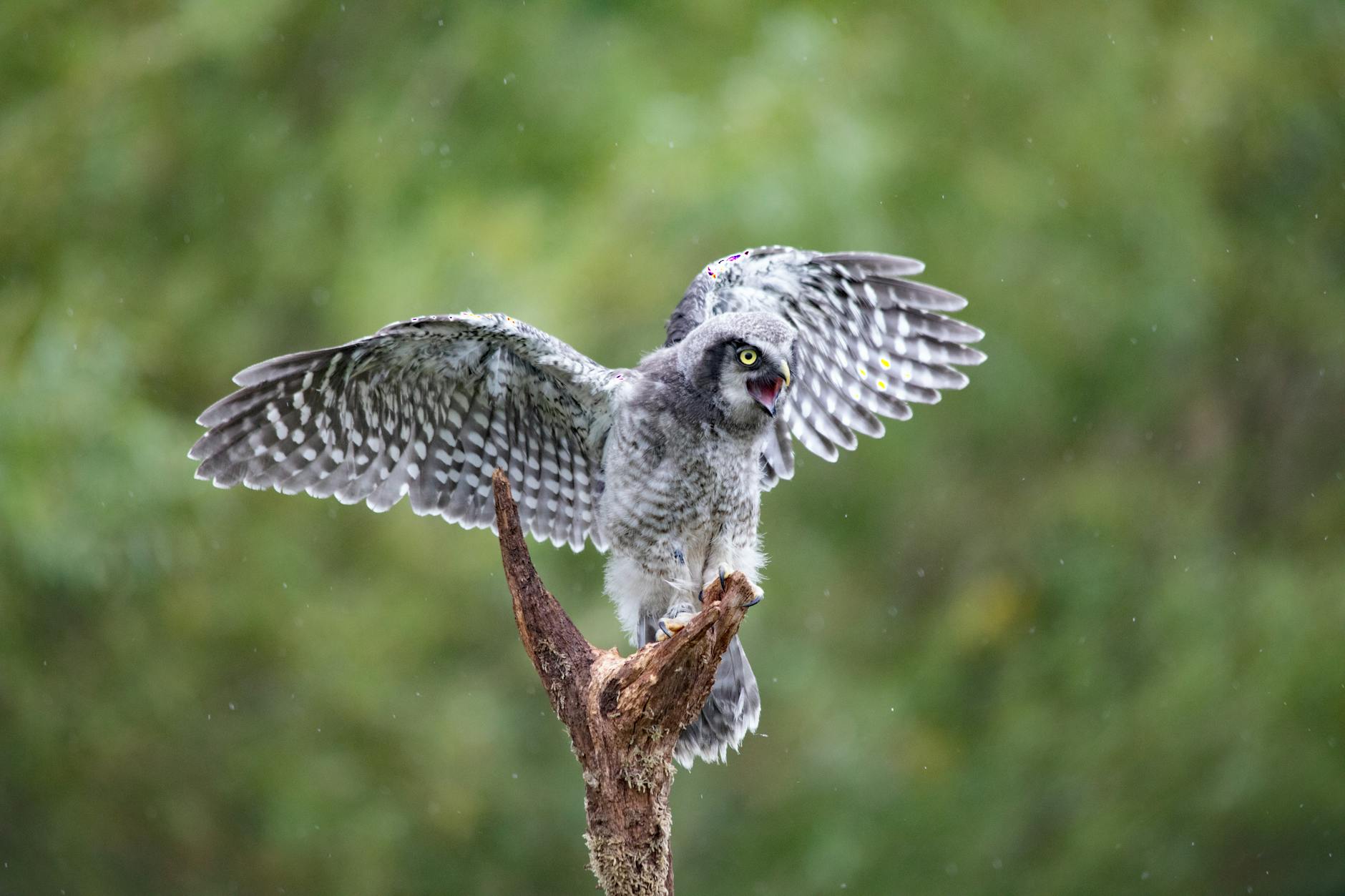
A grey and white owl perched on a branch with wings partially spread, showcasing its feathers and an alert expression against a green blurry background.
Photo by Petra Ryan on Pexels.com

What Owls Teach Us About Voice 🗣️

The autumnal hoots I hear, I learned after a bit of research, are used mostly to communicate territory and to call to potential mates. (It is worth noting that many owl species mate for life, finding another only if a partner dies or becomes separated.) Owls also use distinct calls to warn a mate, their nestlings, or even neighboring owls when danger is near. Only when the threat is imminent do they screech, hiss, or snap their beaks in defense of their young. Like the owl, we, too, can carefully choose when to use our voices amid the noise of the world, saving our own form of “screeching” for the rarest and most necessary moments.

Three barn owls perched on a branch in low light, showcasing their distinctive features against a dark background.
Photo by throughmylife_in_ INDIA on Pexels.com

Signals of Respect and Coexistence 🦉

As I read more, I couldn’t help admiring how owls communicate—practically, respectfully, almost as if to say, “I am here. You are there. Let us coexist with our shared resources and help ward off danger.” To be certain, I am personifying and simplifying their communication, but perhaps there is a lesson for us. In a world that often isn’t equitable in its distribution of resources, space, or power, maybe we can learn the art of signaling like owls—communicating truthfully and transparently without silencing others. What if we approached our conversations with presence, restraint, respect, and a shared awareness of the landscape we inhabit?

Holding Our Ground with Grace 🙏

Hearing the owl’s early morning “Hoo-hoo-hoo, hoo-hoo” reinforces the importance of holding our own ground—our principles, values, beliefs, and even compassions—without becoming loud or defensive. The owl does not insist on being seen; rather, it asserts its message with a reserved dignity. We, too, can claim our “territory” through composed conviction and fairness, standing firm without demeaning others. Faith in our tenets, like my unseen morning owl, calls us to trust what cannot be seen but can be discerned only in stillness.

A tall tree with orange leaves against a clear blue sky, surrounded by a grassy area and a house in the background.
Fall is a time of release and renewal.

Autumn’s Invitation to Adapt 🍂

Autumn is a season of release and preparation. Light softens, signaling leaves to fall as trees ready themselves for winter’s quiet work. Many creatures follow this rhythm, including the owl in my backyard adapting to the shifting season. We, too, are invited to adapt—to let go of what is no longer needed, recalibrate our priorities, and listen more deeply. The natural world thrives on balance, which is different from our human desire for “fairness.” It exists in a subtle harmony in which every being plays a role. I wonder what might happen if we focused more on harmony—the give-and-take of shared ecosystems and resources—paired with the wisdom of knowing when to listen and when to speak.

A woman in a pink hijab interacts playfully with a barn owl perched on her arm, pointing towards its face, with another owl visible in the background.
Photo by Rangga Aditya Armien on Pexels.com

The Harmony of Coexistence 🕊️

The autumn owl’s voice in my backyard is solitary, and yet it reflects community. It marks its presence while acknowledging the presence of others, including us. Coexistence, the owl teaches, requires more than hearing what others say; it requires listening to the silences. Of course, human coexistence is complicated, and life often isn’t what we would call fair.

Therefore, it becomes incumbent upon us to listen, act kindly, and withhold judgment—offering small or not-so-small acts of goodness to help restore balance. This may mean choosing gentleness, or even silence, over the need to be “right,” especially when a loved one, friend, or coworker says or posts something unkind or expresses an opinion we strongly oppose. Likewise, offering compassion instead of judgment when someone is rude or ill-behaved can shift a moment for the better, even if only because we have refused to be pulled into energy-sapping negativity.

A serene forest scene with tall trees bathed in soft rays of sunlight filtering through the branches, creating an ethereal atmosphere.
Photo by Atlantic Ambience on Pexels.com

Before the Light Returns 🌅

The owl still calls unseen in the dark predawn hours, reminding us that communication, connection, and hope often begin before the light returns. The owl does not question whether the sun will rise; it simply continues its call, trusting the rhythm of creation. Like my unseen neighbor, I pray we find the courage to speak fairly, listen deeply, and have faith in the unseen process—knowing that every voice lifted in love and fairness echoes far beyond what we can see.

Perhaps that is the heart of the owl’s lesson: when we listen more deeply, we create the conditions for fairness to grow. As I recently read, “Life isn’t fair. It isn’t, which is why people should endeavor to be more fair to one another, not less.” —Kate Quinn.

Finding Peace Amid Life’s Storms

Incredible change happens in your life when you decide to take control of what you do have power over instead of craving control over what you don’t.”–Steve Maraboli

Photo by Pixabay on Pexels.com

WArning: Shifting Life weather ⛈️

My husband, John, and his sister, Jacki, have birthdays during the last days of February. This year, we celebrated both birthdays on the day in between their two respective birth dates. As John and I drove towards Jacki’s house, we revelled in the warm-ish, slanted sunlight of late February. However, a stiff, cold breeze hinted of a dramatic weather shift.

Soon enough, we observed layers of dark gray and black clouds encroaching from the northwest as if ready to aggressively lash out in a fit of rage.

By the time we arrived at Jacki’s house, the wind gathered more intensity. Layers of clouds silently slinked closer, blanketing the sunlight. Warning rain drops, heavy with intention, randomly fell at intermittent intervals. 

Our daughter met us in the parking lot of a restaurant as a menacing mass of mayhem loomed above us. The winds forcibly fought against our efforts to walk into the establishment. The restaurant door resisted opening against the wind and then likewise fought to be closed. Seconds after John struggled to shut the door, a hostile bolt of lightning loudly landed nearby, shaking the building.

After being seated, torrents of truculent rain burst forth from swirling chaotic clouds soaking the next few guests who entered through the front doors. 

Photo by Dan Prado on Pexels.com

Change The focus 🎁

Soon enough, however, we diverted our attention away from the storm, talking and swapping stories. John and Jacki opened gifts, and we spent the next hour and a half engrossed in one another’s company with little focus on the discord of the storm unfolding around us. The storm was there, lashing and railing against the walls and windows, but it no longer disturbed our peace of mind as we focused on the unfolding celebration.

Yet, how many times in life do we allow surrounding storms and worries to shake and distract us from the moment at hand?

Photo by Jo Kassis on Pexels.com

Rough Waters Ahead 🌊

Many years ago, our family visited the shores of the Outer Banks in North Carolina when our daughter was quite young. It was a last minute trip during the first week of August, just before the start of school. The three of us made daily trips to the shoreline with books, umbrella, cooler, and boogie boards in tow. 

Unfortunately, the temperatures were incredibly hot, even in the early morning. Therefore, we spent most of our time in the cool water on our boogie boards. We would wade out until our daughter was knee deep, then plop ourselves, belly down, on our boards. Next, we would paddle and kick to where the waves were breaking. When we saw what we thought was a “good wave,” we’d point our boogie boards back to the beach, start paddling and kicking, catch the wave, and ride it in towards the shore.

Each time we rode the wave in, we were taken a little further up the shoreline from where we had set up “camp” due to the strong undertow. Eventually, we would be taken so far north that we could no longer see our belongings, and we would lumber out of the water, walking back to our starting point. This would occur repeatedly as we had no control of the undertow.

Photo by Maria Orlova on Pexels.com

Possible strong Undertow 😵‍💫

The other thing that would happen is that one, or all, of us would get flipped off our boards by a rogue wave. The rough waters hurled us to the sandy, shell-covered bottom, and we would come up sputtering and coughing, completely disheveled–banged up and sand abraded. This often forced us to take a break in order to catch our breath. Nevertheless, it wouldn’t be long until we were right back out there again, trying to catch a wave in the wild surf, despite the fact we knew we would ultimately get dumped again.  

Yet, despite the extreme August heat, strong undertow, and often rough surf, we focused more on our laughter and the joy of being together, creating memories that still make my heart smile.

Photo by Tyler Lastovich on Pexels.com

You can choose your Response 🤔

Like the birthday storm and those long ago OBX waves, life has times when it rages with rough rains of hurt, blows wild winds of change, drifts us along an undertow of misleading information, or chucks us under waves to the bottom of mental anguish. If we choose to focus on the suffering, we will inevitably suffer more.  

We can, however, choose to direct our attention away from the storm and other difficulties. It doesn’t mean we’re not aware of the situation–or completely ignore it. Instead, we can focus on what we can control. The challenge will still be there, but we can choose to live with it, and in the meantime, redirect our attention like we would a toddler in a seaside gift shop drawn to the glass figurines. 

In the end, the chaos of life storms are often not controllable, but our responses and/or level of reactivity can be. Our minds, with practice, can be trained to ride those waves. By focusing on what we can do, such as stepping out of the fray, walking along the shores of self-care, choosing an alternate, renewing activity, and/or turning inward for reflection/prayer, we can redirect our mind in a more positive/productive manner until either when the stormy wave passes, or we are ready to begin kicking and paddling in the waters of life once more.

Navigating Life’s Uncertainties One Moment at a Time

Take one moment at a time and do the next right thing.”–Eleanor Amerman Sutphen

Photo by Pixabay on Pexels.com

What Did I hear? 👂

My ears perked up when I heard the guest on a podcast share the above phrase based upon  a poem by Sutphen, but made popular by both Elisabeth Elliot and Carl Jung. I had just arrived home with several bags filled with groceries to put away. Setting down the bags, I typed the phrase into my phone’s reminder app in order to remember it. Then, ironically enough, I returned to the next moment: putting away the groceries.

Like a persistent earworm, that phrase kept looping through my brain. Maybe it was Divine Providence, or maybe my subconscious niggled me to recognize the words I needed to hear. Regardless, the universe had offered me a nugget of wisdom to the question I had been asking, but had not yet been able to fully articulate: What can I do in the face of the difficult and uncertain life moment in which I found myself?  

Photo by Sergey Guk on Pexels.com

Snowy Days can lead to Sluggish Ways 😏

The month of January was a slippery, and less than stellar, start to the new year.  All around me, icy roads, alleys, and sidewalks served as a reminder that I was struggling to find my footing. As one who is not naturally organized and often has no sense of time, I function optimally with a routine/schedule.  It’s not that I can’t “go with the flow.”  I can do that quite brilliantly, but I don’t accomplish nearly as much, nor do I make as many–if any–inroads towards goals.

It is as if I have been dropped deep into a dark and menacing forest filled with a multitude of statuesque tree shadows and brambling thorny briers. Meanwhile, a multitude of strands in life’s web are criss-crossing in ways that make it feel less integrous, as if at any moment, the winds will shift and blow a hole in the tenuous gossamer nexus of life. I sense time sliding sideways, and I am trying to find my footing, so I don’t fall into the thin ice at the center of the mostly frozen pond. Arms flapping this way and that way, steps shortening, stumbling, and struggling to remain upright because I need to find my stride once more. 

Photo by Christina & Peter on Pexels.com

The Struggle Can be Real 😞

I am not the first, nor am I alone, I suspect, in feeling “something” akin to a crisis–a time in life when I find myself deeply questioning my purpose, my identity, and my role in all that is occurring. It is a time where I feel helpless to help others who need it but won’t accept it; a time with still unachieved goals and dreams, but I struggle to see, much less find, the path forward; and, a time in which I frequently ask myself: Am I doing the best I can with this one precious life I have been given?

Personally speaking, it feels as if the to-do list grows longer by the day, but few items are getting marked off.  While all around me, events, completely out of my control, dictate more chaos. Pixelated ideas frequent my mind, but my brain resists zooming in and focusing on any one thought as if the identity of each idea has been hidden like a person being interviewed for an investigative, undercover documentary. Overthinking, second-guessing, and a feeling of dormancy have entered my mental home and overstayed their welcome. 

Photo by Todd Trapani on Pexels.com

The Sweet Lesson of Winter Trees ❄️

As I write these words, I pause to gaze out at the trees in my backyard. They too are experiencing dormancy. Deciduous trees have slowed their internal processes and metabolism, halting their own growth in order to conserve energy. Inside the trees, cells have hardened and shrunk. Additionally, the water between the cells has frozen, and the water inside cells is becoming more dense and syrupy. Some trees even grow thicker bark in the winter to create a sheath of preservation until warmer temperatures arrive when growth and leaf production can once more occur.

I take a deep breath and feel the rise of my belly. Dawn’s light has gifted another overcast winter morning. The birds have also risen–chirp, chirp, chirping the gossip of a new day. The rise and fall of their flight, along with their up and down hip-hops along tree branches make me smile. I sigh out the exhale I had been holding, noticing the fall of my belly. With each breath I take, as I continue to ponder the nature beyond my window, I can’t help but notice the rising and falling of my stomach.

Photo by Aleksandr Sochnev on Pexels.com

The Rising and the Falling 🌅🌄

The sunrise, the trees, the birds, and even my breath remind me that everything is subject to rising and falling. Our pain and sadness, our joys and happiness, and even current events are all impermanent, rising and falling with the various seasons of life. This season of personal dormancy that has banked to new heights in my mind will eventually thaw like the melting of the once-deep snow. This is the nature of impermanence–the rising and the falling–nothing can last forever. 

Thus, these dark doldrums of winter housed in my mental guest room might be offering me an opportunity to do less, perhaps allowing my creative juices and energy to fully concentrate and thicken, much like the trees in my backyard, into the sweet syrup of forward progress. It will just take the sweet essence of time. And the only way to get there from the dark passages of here is to take one breath, one moment at a time and keep choosing to do the next right thing.

The Power of Smiling: Benefits for Health and Happiness

“If you see someone without a smile today, give ‘em yours.”–Dolly Parton

Photo by Adenir Figueiredo Carvalho on Pexels.com

How often do you smile? 😃

I recently came across a fact that stated children smile about 400 times per day . Whereas, most adults on average tend to smile anywhere from 20 times per day to, at the most, 50 times, depending upon their level of happiness for the day. That is a stark contrast!  

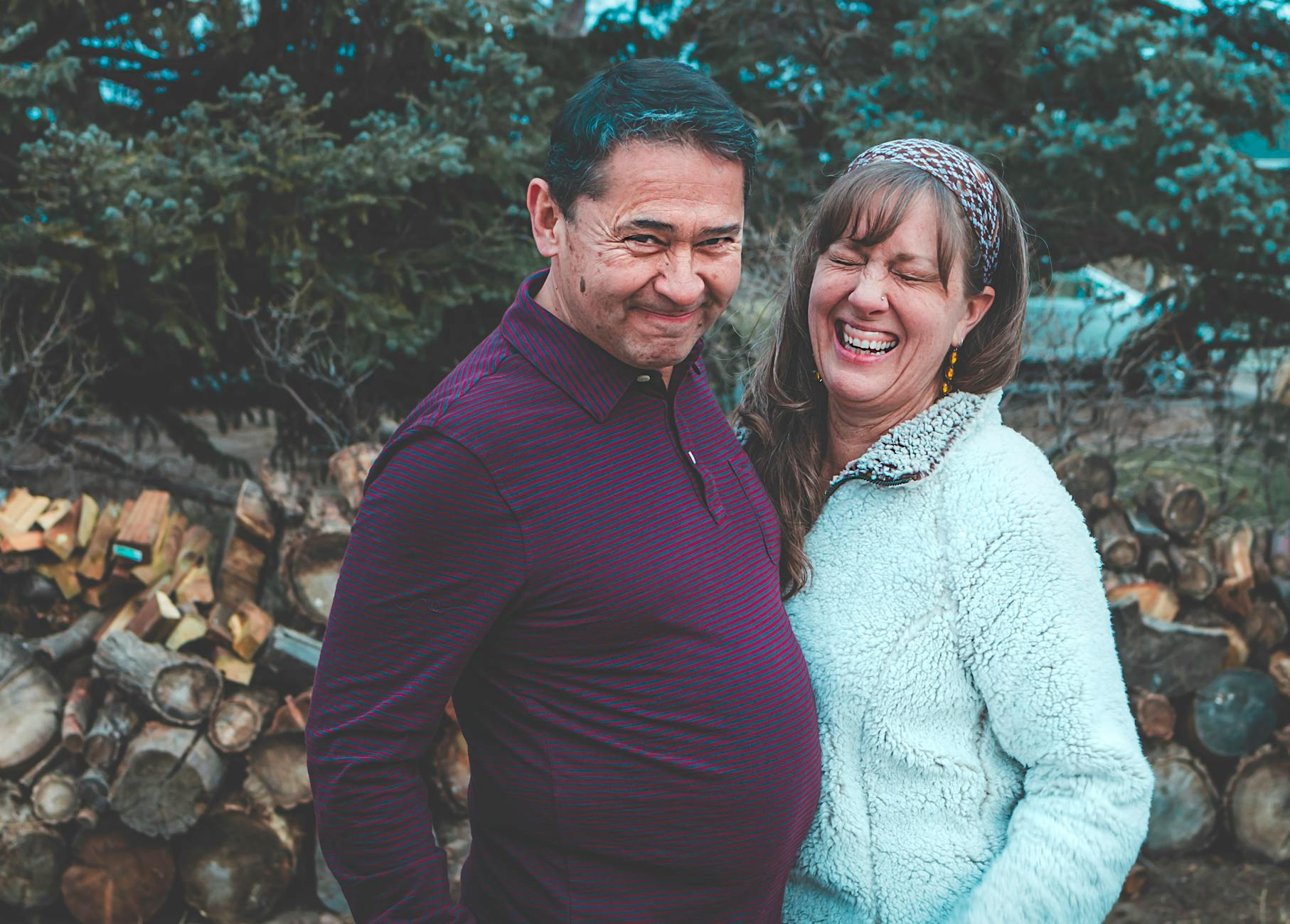
Whether you are grinning, beaming, twinkling, smiling from ear to ear, all smiles, or even offering a partial smile, when you look at another person, it tends to communicate a positive feeling.  Think about what happens when you see someone else smiling, especially a baby or toddler smiling–most of us typically smile in return!  I find even writing about seeing another person smile is instigating my own smile.

Photo by Teddy Joseph on Pexels.com

REasons we may not smile often 😒

In the words of the Joker, “Why so serious?” Why don’t we smile more often? What is it about adulting that doesn’t inspire us to smile more often?  According to a 2019 Psychology Today article, there are numerous adults who are simply not prone to smiling.  Reasons vary including: feeling shy or unsure of self; feeling self-conscious of own smile, especially if in need of dental work; believing it is silly or inappropriate to smile, especially those raised to not to smile frequently due to cultural or family mores; and, some don’t smile due to state of  their mental health. Furthermore, psychologists have also noted that when people have a smartphone in their hands, most of us are less likely to smile and engage because we are so focused on our phone screen. 

Photo by Mwabonje Ringa on Pexels.com

Benefits of smiling more 😁

Believe it or not, though, there are both physical and mental health benefits to smiling. First of all, dopamine, the feel-good chemical (neurotransmitter) in our brain, is released when we smile. Smiling also releases endorphins, a mild-pain reliever, and serotonin, an antidepressant that can reduce stress.  The more we smile, the more these neurotransmitters can work together to boost our overall sense of well-being, reduce our sense of pain, and increase our sense of positivity.

Smiling, along with laughter, causes our brain to also release neuropeptides which are small proteins found in the brain. These chemicals are known for staving off illness by initiating the body’s immune-system response to increase production of antibodies to fight off disease and illness. Along with warding off illness, there is evidence that smiling–and its cousin, laughter–can also help lower our blood pressure as well as heart rate.

Science still has more research to conduct regarding the specific benefits of smiling, according to the National Library of Medicine, but the studies consistently demonstrate that smiling produces a number of health-related benefits. Smiling more can foster a longer life by positively exerting influence over the immune system during times of acute stress or illness, improving recovery, and thereby reducing illness, or its duration, over time. Now, that’s worth smiling about!

Smiling also makes us appear more attractive and likable.  When we beam at another person, we are often considered courteous and trustworthy. In fact, shining those pearly whites also makes us appear more confident, successful, and knowledgeable.  Keep that in mind the next time you have an interview or have to give a presentation. 

Plus, smiling is contagious. When we smile at another person, it is hard for the other person not to smile back. To be sure, it doesn’t work on every person, but it can certainly go a long way to lightening the mood–even if it’s just our own.  So why not try smiling more? 

Photo by Kampus Production on Pexels.com

Practical, and not-so-practical, ways to increase those grins 😆

  • Practice smiling in the mirror: It sounds silly, but the more we practice smiling, the more confident we become at doing it. 
  • Try the smile challenge: One way to practice smiling more is to look up the different types of smiles.  Depending upon the source, most experts claim there are 18-19 types of identifiable smiles, but only six are for genuine happiness. Grab a friend and a mirror and see how many you can make. This is just silly enough to bring on some laughs and joy-filled smiles.
  • Waiting challenge: Stuck in a line at your favorite fast-casual dining or coffee shop?  Waiting in a doctor’s office? Waiting in any sort of line?  Instead of scrolling through your phone, try the smile challenge. See if you can maintain a gentle smile throughout the entirety of your wait, or see how many people you can make smile by smiling at them. 
  • Smile timers: Set reminders or post-it notes throughout the day to smile, especially for those time periods for which you know you most likely won’t feel like smiling. 
  • Create list(s), picture file, journal, or write positive post-it notes of things that naturally make you smile when you see/think about them. Purposely place them, so that you will encounter them throughout the day or week and be reminded to smile.
  • Daily smile challenge:  Challenge yourself to be the reason one (or more) person smiles today.  
  • Watch something funny: Whether choosing a social media/youtube reel/short, movies, comic strip, or other source jolliness, taking time to embrace humor is an immediate mood booster.
Photo by Craig Adderley on Pexels.com

unleash the power of your smile 😃

In the words of Buddy the Elf, from Elf, “I just like smiling.  Smiling’s my favorite.” And, now we know why. Smiling is a superpower, and it is not just for elves or children. Those grins are for all of us to enjoy in our everyday life. When we smile, our health, our well-being, and the well-being of those around us, benefits. So the next time you’re feeling down, frustrated, sick, or even angry, see if you can’t sneak in a smile or two.  Even if you don’t feel like it, the overall benefits seem to point to the fact that those few extra smiles might just be worth the effort. In the words of the late Jim Begg, “Before you put on that frown, make absolutely sure there are no smiles available.”