The Transformative Power of Art: A Visit to Tamarack

“Do you still feel up for going to the Tamarack?” my husband asked.

A Heavy Heart and a Planned Escape 🚘

Days earlier, we had loosely planned a day trip. The goal was to stop in Charleston for brunch on the way to Beckley, to nose around the galleries and marketplace of the Tamarack, and then return home, making a couple of quick errand stops along the way. Unfortunately, my spirit had been bruised by life, as sometimes happens, but despite feeling down, I agreed to go in the hopes it would be a pleasant distraction.

The brunch and drive along the WV Turnpike were heavy, filled with somber, clarifying conversation as my husband tried to help me clean out the closet of my cluttered heart. Tumbled, but not fully dried from an onslaught of despair, I entered the Tamarack lightened by our discussion, but still damp with distress. My intention from the outset was not to make a purchase, but instead soak up the vibrant and creative energy of the art, and by proxy the artists, who created it. 

Echoing my own feelings, Stella Adler stated, “Life beats down and crushes the soul and art reminds you that you have one.

Entering the Tamarack: A Sensory Shift

Once through the doors, I observed a crowd of people and wondered if this had been a good idea after all. Meandering to the right of the entrance, I surfed the sensory wave. Aromas of Appalachian-inspired cooking filled the air. A long line of people snaked around the fast-casual dining room as I made my way to the ladies’ room. Tamarack’s signature circular shape surrounding an open courtyard created a light and spacious feeling, even during this busy, pre-holiday time period. A multitude of glass windows, adorned with locally designed, gemstone-colored stained glass pieces, radiated an additional cheery warmth. The animated energy of visitors’ conversation added a rhythmic pulse to a popular sing-along soundtrack playing in the background. 

Letting the Atmosphere Settle the Spirit

As I allowed the wave to immerse me, I soon noticed that my breathing and pulse had slowed, tensions were eased, and the emotional flames were beginning to quell. Despite my earlier qualms, I could feel the atmosphere offering a form of calming consolation. The simple act of getting lost in the admiration and appreciation for each artist, and the art pieces they created, nourished my spirit. 

Wandering the Galleries: Beauty in Every Craft 🖼️

Allowing the natural flow of the galleries to pull me along, I took in richly detailed textiles and exquisite, delicate glass pieces. There were complex and intricate woodworks and artisanal earthen and pottery wares. Tables of WV grown and/or crafted wines, beers, ciders, soaps, candles, and one-of-kind foods/beverages were also available. 

I also stopped by the book nook, filled with locally written fictional and nonfictional books, novellas, cook books, maps, travel guides, and other artfully written materials. Additionally, there was a separate gallery, bright with ample natural light, filled with one-of-a-kind WV paintings, sculptures, prints, and photographs. 

Art as Memory: Echoes of Loved Ones 👵🏼

Allowing the current of creativity to slowly move me at will, the art grounded me into the present moment as I mindfully soaked up the vibrant energy. Different pieces evoked precious memories of loved ones: quilts of my grandmother’s attic, pieces of furniture and toys handcrafted by my husband’s grandfathers, earthen dishes that were reminiscent of family holiday casseroles, paintings and photographs of forested hills during the fall and winter months similar to those I hiked with my siblings and father as a child, and hand sewn creations that my mother once made.

The Healing Power of Art 🎨

I was further reminded of the many art therapy majors with whom I had classes all those long ago years. They often described the important role of art in therapeutic and school settings, a truth supported by research. Creating art and observing art supports mental health and well-being.  It often helps with emotional regulation by creating an outlet in which emotions can be channeled. Art is known to reduce stress and is often used as a tool for creating a greater understanding of one’s emotional atmosphere. Works of art often create a connection/conversation between the creator and viewer, which can provide an opportunity for both personal and collective healing.

Creativity as Community Storytelling

This is because art, such as the works I viewed at Tamarack, is often a reflection of the emotional landscape of a community, region, or even country. How many colorful and varied life stories, events, and personalities, past and living, were being conveyed and connected all under one circular roof? Each stitch, stroke, cut, hammer strike, click, and spin breathed life into each creation that spoke to the heart and soul of human resilience and hope.

In the Company of Strangers: Shared Wonder

As I meandered through the gallery devoted to paintings and photographs, I often lingered on works that spoke to me. Simultaneously, I overheard a pair of women, who were gazing at a section of paintings by a Mingo County artist, speaking with near reverence about their own childhood experiences in the same area. Another couple whispered with one another at nearly every piece, laughing at the memories specific images seemed to evoke. 

Spaces of Belonging: More Than a Marketplace

It occurred to me that art galleries, like the Tamarack, create centers of belonging–gathering places that celebrate the human experience. These transactional spaces aren’t just about exchanging money; they also provide an interchange of ideas and stories between artist, piece, and viewer. Investing in these community hubs is an investment in one another, supporting each other emotionally and culturally. People leave the Tamarack with a taste of what it means to be Appalachian.

A Quiet Affirmation

Standing in that gallery, soaking up all of the intriguing and thought-provoking images, an employee shook me out of my reverie by asking if I was enjoying my visit. I nodded, stating that I was feeling lighter and more grounded than when I entered. She unpretentiously declared, “Art can do that for you.”

We chatted a bit more before I moved on to look through the prints outside the gallery. I still did not have any answers to my specific concerns, but I did have a sense of peace that comes from being heard. Not that I was literally heard; rather, the struggles and joys, the sadness and celebrations, and the wonder and the awe that went into creating these pieces “heard” and spoke to my own related emotions. It was the beginning of healing and hope that often happens when surrounded by reflections of inner beauty.
Leaving with Lightness and Hope

Thomas Merton is credited with stating, “Art enables us to find ourselves and lose ourselves at the same time.” My visit to Tamarack allowed such a juxtaposition: by surrendering myself to time spent with art, my capacity for healing renewal was possible. It served as a reminder. When we immerse ourselves in the present moment, we kindle the still, small voice within, our hearts and minds steady at the sound of this whispering inner-knowing, and we can rest assured we are being held even when the heaviness of life weighs us down. Perhaps that is the gentle promise held within art: when life seems overwhelming and hopeless, the beauty of art and/or the creative process is there to offer us wings of hope for rising once more.

Embracing Silence: The Owl’s Call to Mindful Listening

A wise old owl sat on an oak;
The more he saw the less he spoke;
The less he spoke the more he heard.” —old proverb

A wise-looking owl perched on a branch in a dark, wooded area, illuminated softly by moonlight.
Photo by Erik Karits on Pexels.com

Listening in the Dark 🌌

I am an early riser, typically awake before the sun. A few weeks ago, my ears perked at the haunting, penetrating call of an owl. Its “Hoo-hoo-hoo, hoo-hoo” echoed around our yard as I looked out into the murky dark. Since then, I intentionally listen for its steadfast call. It has become both a comfort and a mystery—an invitation to listen, reflect, and learn something new.

The owl’s call continues, I am certain, even when I am not listening; yet it requires my full attention in those predawn hours if I hope to notice it regularly. Its presence illustrates the importance of listening and discerning with care and purpose.

A grey and white owl perched on a branch with wings partially spread, showcasing its feathers and an alert expression against a green blurry background.
Photo by Petra Ryan on Pexels.com

What Owls Teach Us About Voice 🗣️

The autumnal hoots I hear, I learned after a bit of research, are used mostly to communicate territory and to call to potential mates. (It is worth noting that many owl species mate for life, finding another only if a partner dies or becomes separated.) Owls also use distinct calls to warn a mate, their nestlings, or even neighboring owls when danger is near. Only when the threat is imminent do they screech, hiss, or snap their beaks in defense of their young. Like the owl, we, too, can carefully choose when to use our voices amid the noise of the world, saving our own form of “screeching” for the rarest and most necessary moments.

Three barn owls perched on a branch in low light, showcasing their distinctive features against a dark background.
Photo by throughmylife_in_ INDIA on Pexels.com

Signals of Respect and Coexistence 🦉

As I read more, I couldn’t help admiring how owls communicate—practically, respectfully, almost as if to say, “I am here. You are there. Let us coexist with our shared resources and help ward off danger.” To be certain, I am personifying and simplifying their communication, but perhaps there is a lesson for us. In a world that often isn’t equitable in its distribution of resources, space, or power, maybe we can learn the art of signaling like owls—communicating truthfully and transparently without silencing others. What if we approached our conversations with presence, restraint, respect, and a shared awareness of the landscape we inhabit?

Holding Our Ground with Grace 🙏

Hearing the owl’s early morning “Hoo-hoo-hoo, hoo-hoo” reinforces the importance of holding our own ground—our principles, values, beliefs, and even compassions—without becoming loud or defensive. The owl does not insist on being seen; rather, it asserts its message with a reserved dignity. We, too, can claim our “territory” through composed conviction and fairness, standing firm without demeaning others. Faith in our tenets, like my unseen morning owl, calls us to trust what cannot be seen but can be discerned only in stillness.

A tall tree with orange leaves against a clear blue sky, surrounded by a grassy area and a house in the background.
Fall is a time of release and renewal.

Autumn’s Invitation to Adapt 🍂

Autumn is a season of release and preparation. Light softens, signaling leaves to fall as trees ready themselves for winter’s quiet work. Many creatures follow this rhythm, including the owl in my backyard adapting to the shifting season. We, too, are invited to adapt—to let go of what is no longer needed, recalibrate our priorities, and listen more deeply. The natural world thrives on balance, which is different from our human desire for “fairness.” It exists in a subtle harmony in which every being plays a role. I wonder what might happen if we focused more on harmony—the give-and-take of shared ecosystems and resources—paired with the wisdom of knowing when to listen and when to speak.

A woman in a pink hijab interacts playfully with a barn owl perched on her arm, pointing towards its face, with another owl visible in the background.
Photo by Rangga Aditya Armien on Pexels.com

The Harmony of Coexistence 🕊️

The autumn owl’s voice in my backyard is solitary, and yet it reflects community. It marks its presence while acknowledging the presence of others, including us. Coexistence, the owl teaches, requires more than hearing what others say; it requires listening to the silences. Of course, human coexistence is complicated, and life often isn’t what we would call fair.

Therefore, it becomes incumbent upon us to listen, act kindly, and withhold judgment—offering small or not-so-small acts of goodness to help restore balance. This may mean choosing gentleness, or even silence, over the need to be “right,” especially when a loved one, friend, or coworker says or posts something unkind or expresses an opinion we strongly oppose. Likewise, offering compassion instead of judgment when someone is rude or ill-behaved can shift a moment for the better, even if only because we have refused to be pulled into energy-sapping negativity.

A serene forest scene with tall trees bathed in soft rays of sunlight filtering through the branches, creating an ethereal atmosphere.
Photo by Atlantic Ambience on Pexels.com

Before the Light Returns 🌅

The owl still calls unseen in the dark predawn hours, reminding us that communication, connection, and hope often begin before the light returns. The owl does not question whether the sun will rise; it simply continues its call, trusting the rhythm of creation. Like my unseen neighbor, I pray we find the courage to speak fairly, listen deeply, and have faith in the unseen process—knowing that every voice lifted in love and fairness echoes far beyond what we can see.

Perhaps that is the heart of the owl’s lesson: when we listen more deeply, we create the conditions for fairness to grow. As I recently read, “Life isn’t fair. It isn’t, which is why people should endeavor to be more fair to one another, not less.” —Kate Quinn.

Running Toward Hope: A Marathon of Movement and Love

Every run is a work of art, a drawing on each day’s canvas. Some runs are shouts and some runs are whispers. Some runs are eulogies and others celebrations.”—Dagny Scott Barrios

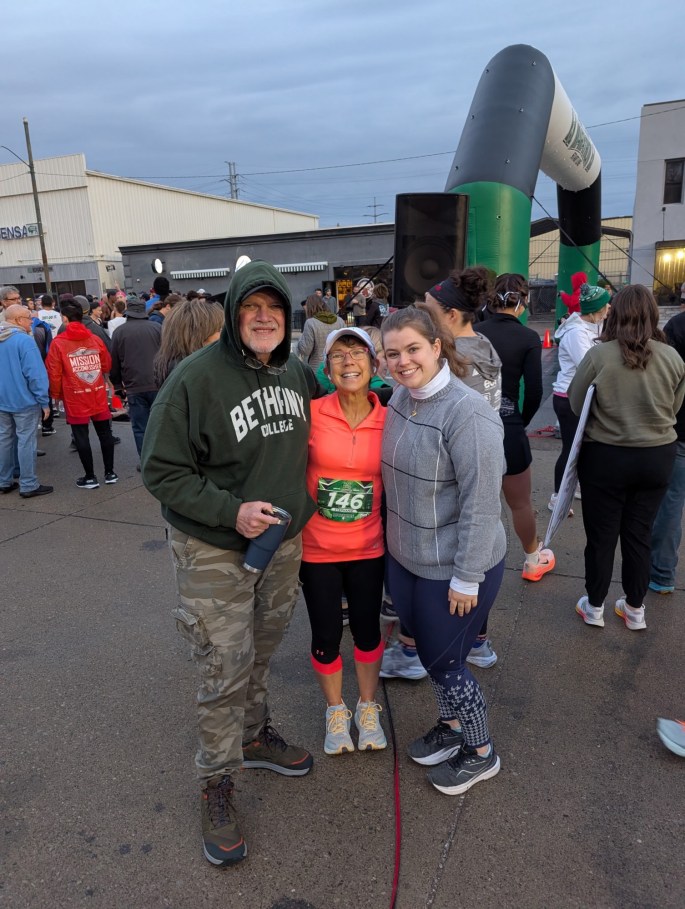
A group of three people, including a man in a green hoodie, a woman in a bright orange top with a running bib, and a woman in a gray sweater, gather smiling at a running event in an outdoor setting with other runners in the background.
Just before the start of the marathon I took time to get a hug from my two biggest supporters throughout the training process: my husband, L, and my daughter, R.

A Morning of Reflection and Gratitude 🌅

A light mist fell as an overcast gray morning began to chase away the night. I stood quietly in a throng of animated runners, taking deep breaths as reflection and gratitude washed over me. Months of preparation had led to this moment, and I felt thankful not only for my health but for the loving support that carried me here—to this celebration of movement, resilience, and connection.

Running as an Act of Hope ✨

It had been ten years since I last pinned on a bib for this distance, and my body hummed with anticipation, hope, and belief—the belief that movement is for everyone at every age, and that it is, in itself, an act of hope. I was about to embark on an emotional 26.2-mile trail of faith that became more about the people who supported me than the miles themselves.

Discovering Joy in Gentle Movement 😄

I came to running later in life, and it wasn’t easy at first. Only when I learned to approach running gently—to let go of preconceived (and societal) notions of what running “should” be—did I discover paths full of freedom, clarity, and renewal. Movement, whether running, walking, dancing, or stretching, benefits body, mind, and spirit. It brings a sense of structure to an often chaotic world and offers a feeling of accomplishment—if nothing else goes right in a day, at least I moved my body. Movement brings us alive to ourselves, our spirit, and, in turn, to the world around us.

The joy, I’ve learned, is in the doing—not in attaching to a pace, distance, or goal. Those things can be part of the experience, but they aren’t required.

A man and a woman embrace warmly in a crowded setting, both smiling in a moment of connection before a marathon.
Maddie’s, my daughter, boyfriend, Connor, flew all the way from Austin, TX to be part of this event. Together, with Maddie, he helped plan the marathon surprise of a lifetime!

Redefining What It Means to Age 🧓

As I neared my 60th birthday, I began to notice messaging that framed this decade as one of limitation. I decided instead to flip the narrative and celebrate the 60s as a decade of possibilities. Why not run into this new decade the way I ran into my 50s—with eyes and arms wide to adventure?

Training with Gentleness and Grace 😌

Since I was already running regularly, I committed to training for a marathon, but this time with gentleness. Instead of a traditional four-month build-up, I created a ten-month plan that encouraged patience, routine, and presence. Twice-weekly strength training and yoga joined the schedule, as did listening to my body and using the run-walk-run method as needed. I also focused on proper hydration and fueling before, during, and after runs. Most of all, my husband and daughter supported me from the very beginning—their quiet, everyday encouragement becoming a steady foundation of strength.

A woman running on a street wearing a bright pink long-sleeve top, black leggings, and a cap, displaying a race number on her waist.
Gentleness was a large part of the 10-month training block that led to this moment of hope and celebration.

Adapting Through Life’s Curveballs 😰

Training for a marathon brings rhythm and structure to daily life—the early morning runs, the long weekend miles that lengthen gradually, and the sweet evening stretches after dinner. But life, of course, has its curveballs: weather shifts, fatigue, scheduling conflicts, unexpected events, and bouts of self-doubt. With age, though, I’ve learned to adapt rather than resist these realities, co-creating a practical, flexible approach to progress.

As my weekend long runs grew longer, my husband and daughter often appeared—driving by, stopping to cheer, or jogging beside me for a short distance. These small bursts of love in action fueled my heart and kept me going. Training, I realized, was less about mileage and more about cultivating fortitude, flexibility, and gratitude—along with a dash of fierceness—all essential life skills carried from the road.

A group of enthusiastic spectators cheer on runners during a marathon, surrounded by autumn foliage and a partly cloudy sky.
Maddie, and my husband, John, often showed up during the last few miles of my Saturday long runs to cheer me on as Maddie is seen here doing during the actual event itself.

Race Day: A Celebration of Love 💖

As the marathon began, the city of Huntington vibrant in energy, rebelling against the lackluster sky. Rhythmic footfalls and nervous chatter surrounded me as runners jostled for position. Warmly dressed spectators cheered, waving handmade signs against a backdrop of burnished orange, crimson, and yellow autumn trees. Little did I know that my daughter had turned this event into an outpouring of love.

Surprises Along the Course 🫢

At the start, my husband, daughter, and her boyfriend—who had flown in from Texas to surprise me—stood cheering. But that was only the beginning. Every few miles along the route, my daughter had arranged for friends, family, and coworkers to appear, waving signs and calling my name. I didn’t realize the scope of her plan until near the end, but each familiar face filled me with renewed energy, gratitude, and joy.

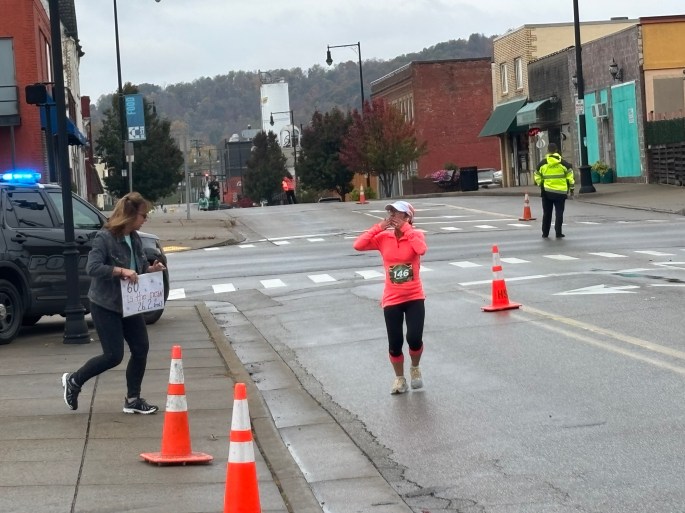
A female runner in a bright pink shirt crosses a street marked by traffic cones, while a supporter holds a sign nearby in a lively downtown setting.
The look of complete surprise when I see my sister, Traci, and her husband, David, around the 19-20 mile mark of the marathon. I had no idea they would show up along the route!
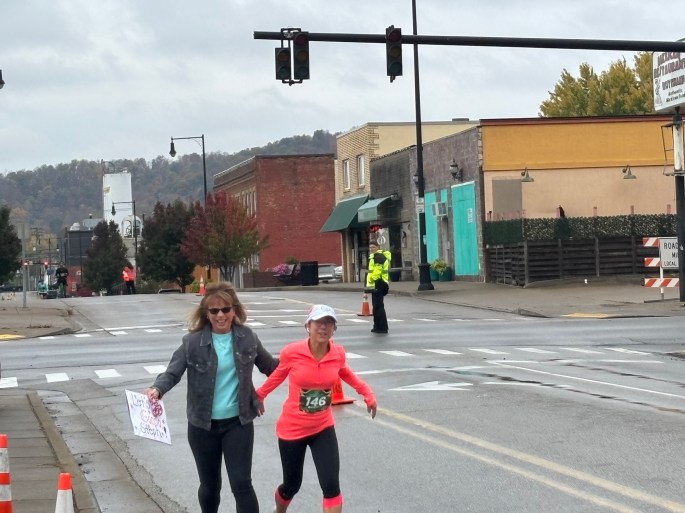
Two women running together on a city street during a marathon, with one holding a sign. They are surrounded by a lively atmosphere and shops in the background.
Of course, I had to veer off the path to give her hug, which helped uplift me over the next few miles.

Crossing the Finish Line 🏁

As I turned toward the final quarter mile, a group of race volunteers began singing “Happy Birthday” while my daughter’s boyfriend joined for a short burst of encouragement. My husband stood outside the stadium offering final words of encouragement, and my daughter met me at the bottom of the stadium ramp to run beside me as I approached the finish line. I wasn’t just completing a marathon; I was receiving the best birthday gift—a living reminder of love: a convergence of community, family, and friendship. It was a story of hope, purpose, generosity, and perseverance—the joy and power of a shared journey.

Two volunteers wearing bright reflective vests stand by a crosswalk in a park-like setting with blooming flowers and trees. In the background, a pathway leads towards a building under a cloudy sky.
This was the point, less than a quarter mile to go, when a group of race volunteers, led by an unknown female spectator and Conner, joined in to sing “Happy Birthday” to me as approached and rounded the corner to the finish line.

The Marathon as a Metaphor for Life 🪞

This journey mirrors life: we move forward by faith and grace, one step at a time, through both joy and challenge, supported by others who believe in us. That’s the power of movement—it connects us to our bodies, to others, and to something larger than ourselves. Choosing to move, to train, to keep going even when the path feels long, is an affirmation that with faith, growth and renewal are always possible—at any age.

Movement as a Lifelong Invitation 💌

Movement can take many forms: walking, stretching, dancing, or choosing to train for something big. The point is to move with intention and persistence, to embrace your own journey, and not attach to societal and social media messaging. Just move—and let movement open the door to new possibilities, both inner and outer.

A runner crosses the finish line at a sports stadium, with spectators in the stands and a clear blue sky overhead.
Maddie runs alongside me for the last few feet, just as she did in 2015, to encourage across the finish line. Once I was close to the finish line, she dropped back behind the rope to let me finish alone. However, I really wasn’t alone. I was surrounded by a giant embrace of joy, hope, and love of family, friends, and community!!

The Joy Continues ☺️

The rhythm of footsteps, the smiles for miles, and the faces of loved ones along the route are forever imprinted in my heart—all reminders that every step matters. The marathon finish line was crossed, but the renewed sense of possibility and joy continues. Whatever your pace or path, keep moving forward—heart, mind, and spirit. You never know what acts of hope and love may be waiting for you along life’s path.

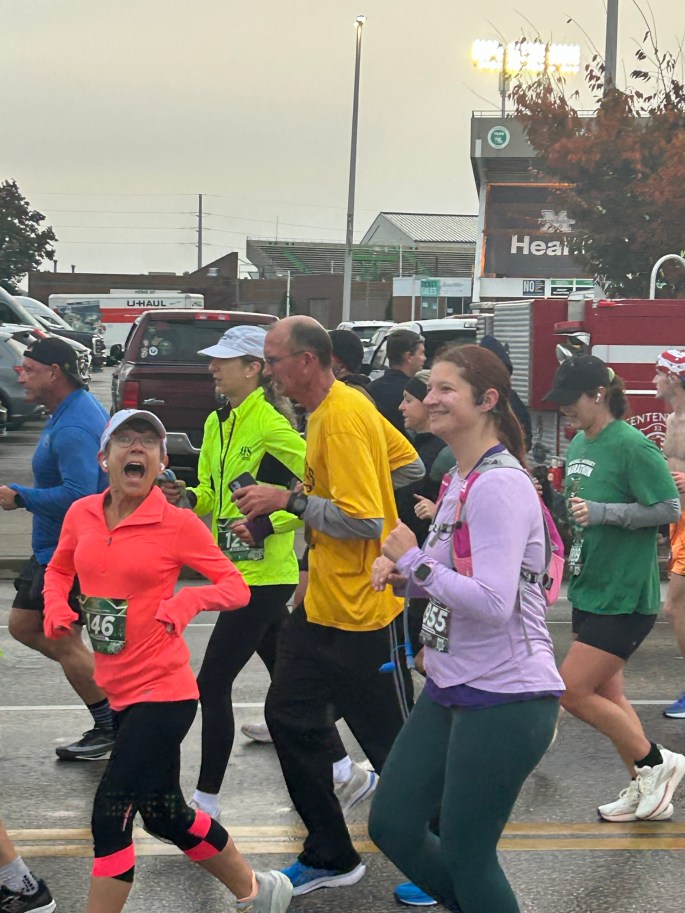
A group of runners participating in a marathon on an overcast morning, with diverse individuals wearing colorful athletic clothing and cheerful expressions.
The joy, and the journey of love and hope, continues . . .

A Grateful Heart 💜

P.S. Thank you to the countless and nameless MUM volunteers who invested hours of time to ensure the safety and success of runners, walkers, and those beloved spectators. And, an extra special heartfelt thank you to my friends and family who celebrated this milestone with me. And to Maddie and John, I love you to the moon and back.

A group of three smiling individuals taking a selfie on a subway or train, with a map visible in the background.
I wonder where the next path of adventure will lead?
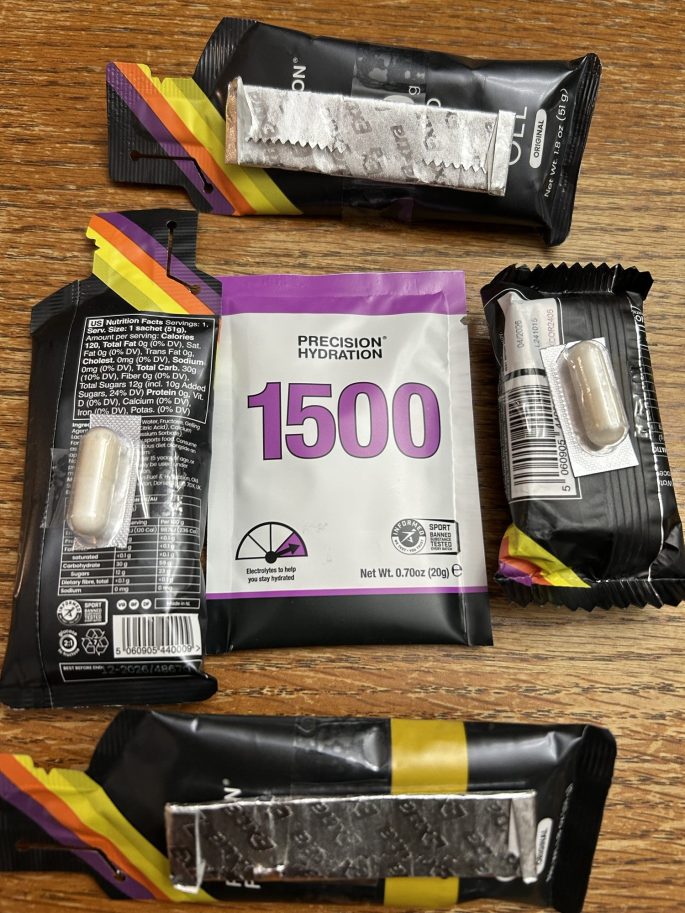
An assortment of hydration and energy products for runners, including electrolyte tablets and energy gels, arranged on a wooden surface.
Shout out to Precision Fuel and Hydration for the support during this training journey! I learned a lot from your team.

Pearls of Morning: Lessons from Spider Webs and Stillness

“Heavy dew this morning and every spider web in the garden is strong with pearls of moisture…. webs wherever I look, all shining things of silver beauty.–Edwin Way Teale

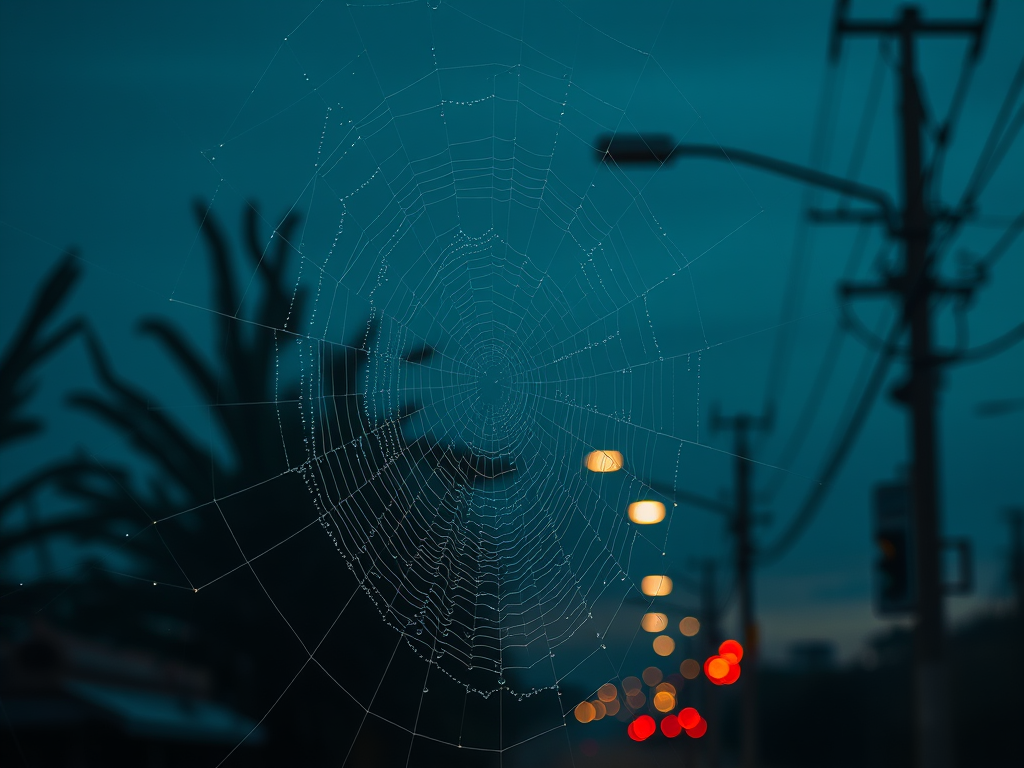
A close-up of a dewy spider web illuminated by streetlights in a quiet early morning setting, with blurred traffic lights in the background.

The Quiet Wonder Before Dawn 🌅

It was an early fall morning. Darkness still clung to the earth in a cool embrace. The traffic lights—green, yellow, red—continued their rhythm despite the empty streets. The air was cool and humid, and the hush before dawn rested easily upon the road. Pausing at the red light before continuing my jog, I noticed a spider web dappled with dew within the frame of the traffic light. I stopped in my tracks; upon closer inspection, I saw countless spider webs, draped with baubles of dew, hung from light poles and electric lines—even within the traffic lights themselves.

Hidden Beauty in Plain Sight🚦

I was awestruck by the beauty of the webs, looking ever-festive in the glow of lights—an unexpected wonder, shimmering high above me. After a few moments of appreciating the beauty, I jogged on through town, questions forming in my mind. How did they get so high? Why had I not previously noticed something so extraordinary hiding in plain sight? How many other marvels were hiding in plain sight, waiting for someone to notice?

A serene landscape featuring rolling hills partially obscured by a thick layer of fog, bathed in soft, diffused light, creating an ethereal atmosphere.

When We Slow Down Enough to See 🤓

It occurred to me that more often than not, we rush through the routine of life overlooking these mini-marvels—the ballet of fall leaves chasséing from tree to stream, then pirouetting along water currents; sinuous streamers of fog tendrils meandering around hilltops; or, the multiplicity of ice crystals frosting over a car’s windshield to name a few. These wonders are woven into daily life: from the cantaloupe-colored brilliance of sunrise over the Ohio River to the glimmer of moonlight on a frost-covered lawn; from flower-like fungi blooming on fallen logs to a puppy seeing its own reflection in a puddle. Beauty surrounds us, waiting to be noticed. Like the invisible art gallery of spider webs in traffic lights on my morning jog, most go unnoticed until the light hits just right. However, when we take time to pause and pay attention, beauty will often reveal itself in unexpected yet common places, including stoplights.

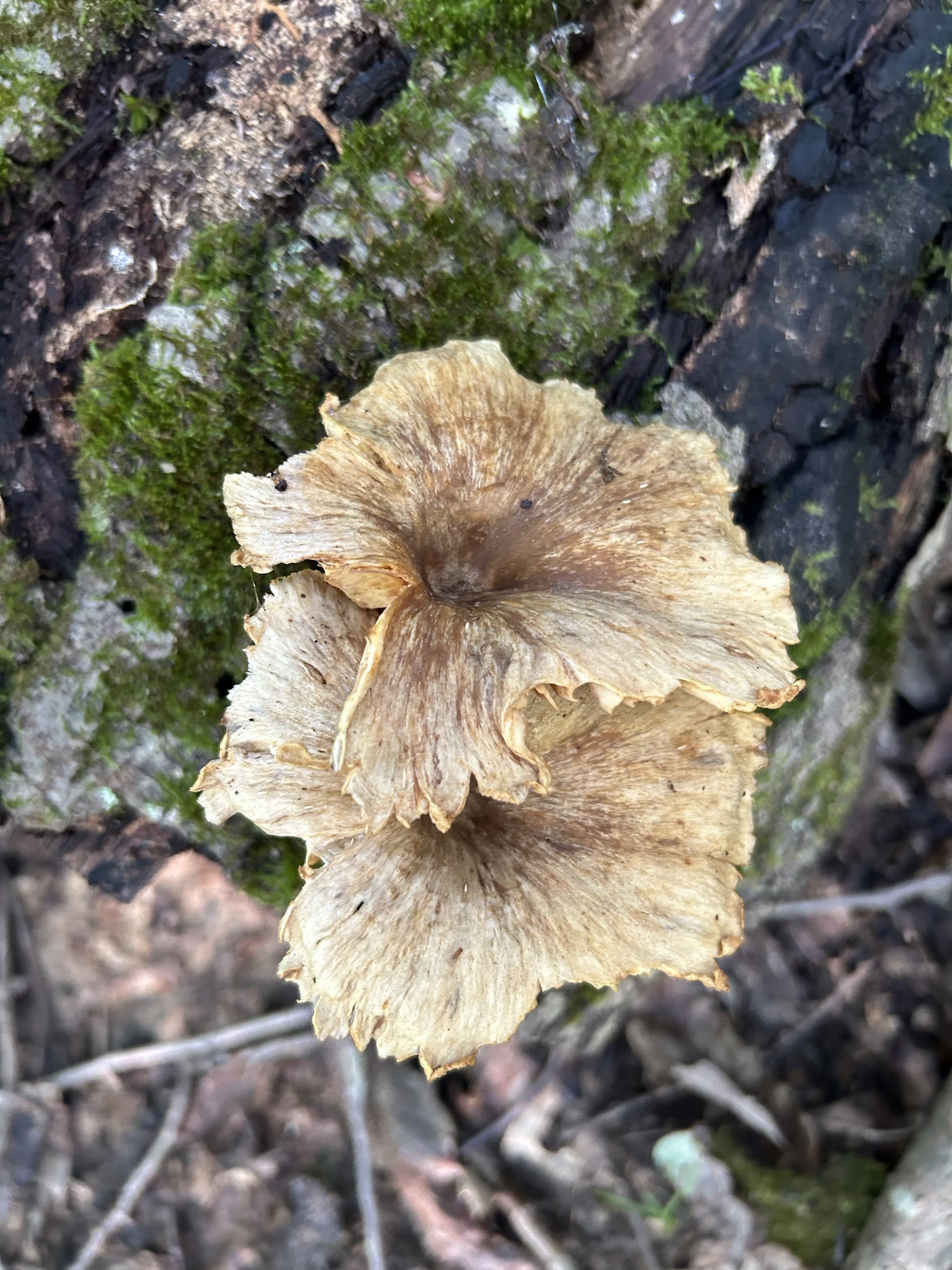
A close-up image of a brownish mushroom growing on a tree trunk, highlighting its textured surface and natural surroundings.
Flower-like fungi “blossoming” from fallen tree branch

The Power of Morning Stillness 😌

That early-morning observation turned meditation centered my day. It offered more than one lesson and served as a reminder that the morning placidity can bring a sense of calming clarity before the noise of the day. Making time for stillness in the morning, whether sipping coffee, walking a beloved pet, or sitting in prayer meditation—offers an opportunity for spaciousness at the day’s start. A moment to center, notice, reflect, and connect. Even a few minutes of stillness can offer us an opportunity to ground ourselves and recalibrate our perspective. If we grow quiet enough, we may remember that peace resides within us. That is not to say that peace is the absence of movement, purpose, or challenge, but rather it is a strong presence within us—much like the hidden strength within the delicate spider web. 

A close-up of a spider web adorned with dewdrops, creating a sparkling effect against a blurred green background.
Photo by Pixabay on Pexels.com

Lessons from the Web: Resilience and Renewal 🕸️

As I reflected on the morning jog through town, I realized that each web represented perseverance, fortitude, and tenacity–three key qualities essential for growth. Each morning, orb-weaving spiders consume their protein-rich webs to reclaim the silk for rebuilding. This ensures the new web they build in the evening is fresh, sticky, and strong enough to catch plenty of prey. Through practice, the spiders gain strength and instinctively how to rebuild after storms and strong wind.

The spiders’ resilience serves as a reminder that we, too, have the grit to rebuild after disappointments, setbacks, and loss. Like the spider, rebuilding our lives is often quiet work that begins only after we have nourished body, mind, and spirit. The spider’s persistence mirrors our own–delicate and determined–reconstructing through incremental, small steps. Life, like the spider’s web, is fragile, yet we too possess tensile strength—centered in faith—that guides us as we restore, renew, and rebuild. 

A close-up view of a spider web adorned with numerous droplets of dew, reflecting light and creating a sparkling effect against a dark background.

The Threads That Bind Us 🕷️

The spider’s web, where no thread stands alone, echoes the interconnectedness of our own lives. We are part of a collective. As the light shone through the webs, each dew drop caught the light, refracting color and seemingly creating miniature worlds. Just as the traffic/street lights played across the spider webs’ dew drops, our connected lives reflect multiple roles–friend, spouse/partner, worker, neighbor, parent, child, citizen . . . . Each strand of life possesses a quiet strength that is integral to the whole. In fact, the integrity of the web depends upon the strength and resiliency of every strand. Each facet of our lives holds and reveals meaning; together, the varied strands of our lives unite the whole, creating an array of meaningful relationships.

A close-up view of a beautifully intricate spider web adorned with dew droplets, creating a delicate display of nature's artistry in black and white.
Photo by don chowdhury on Pexels.com

Finding the Extraordinary in the Ordinary 🌃

In the end, the light changed, and I crossed the street as the sun rose, erasing the glimmer of those webs. Yet the image remains—reminding me to keep looking for the extraordinary in ordinary places. Perhaps it waits in the quietude before dawn, a pause at a red light, or the hush of nightfall. So many interlaced moments shimmer within the droplets of daily life, waiting for those willing to see. Those silky webs may vanish with daylight, but their pearls of wisdom still glimmer within me, reminding me that beauty often hides in ordinary light.  

May we all learn to look a little longer, to pause at life’s red lights, and to notice the silken threads of beauty connecting us in the quiet hours of dawn.

Discovering Daily Delights: Boost Your Happiness Practice

Right in the difficult we must have our joys, our happiness, our dreams: there against the depth of this background, they stand out, there for the first time we see how beautiful they are.” —Rainer Maria Rilke

A night sky filled with stars, with a shooting star streaking across the horizon, silhouetted by trees and distant hills.
Photo by Erike Fusiki on Pexels.com

A Spark in the Sky 💫

I was on an early morning run. Orion and his dogs, Canis Major and Canis Minor, were hunting above me in the eastern sky. As I ran, I periodically glanced upward, marveling at the stars’ movement. Suddenly, a star appeared to shoot sparkling light through the predawn sky. Was it a satellite, the Perseid meteor shower, or another heavenly body? I am not sure, but something inside me shifted. I felt delighted. That event was my daily delight.

A doe and her fawn walking together along a sandy path, surrounded by vegetation.
Photo by Mehmet Turgut Kirkgoz on Pexels.com

How Daily Delights Began 🤔

A few weeks before that shooting star sighting, I began my ‘daily delight’ practice in August. Numerous uncontrollable negative events were filling me with worry, anxiety, and fear. Despite taking proactive steps to reduce the negativity I was exposing myself to, it still found ways to seep in—almost as if it permeated the very air I breathed. Then, at first light on a quiet Saturday morning, a doe and her fawn strolled out of the woods alongside my running path. Pausing for a moment, I watched the mother nudge the little one across the trail and toward a nearly dry creek. It felt sacred. Later, I described it to my family as my daily delight, and the concept was born.

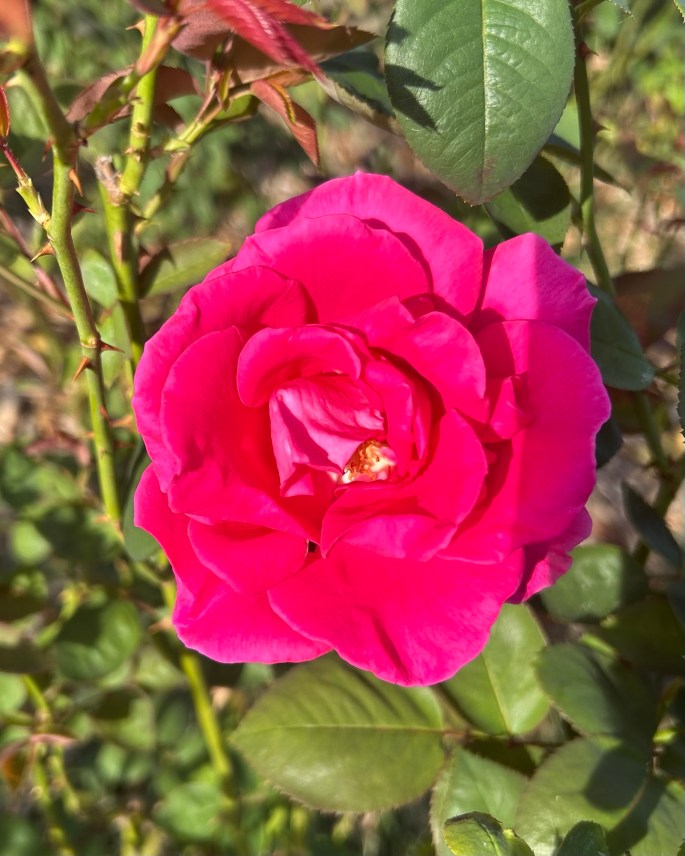
A close-up of a vibrant pink rose surrounded by green foliage, showcasing its full bloom and delicate petals.

Why This Practice Matters 😌

From that moment, I began cultivating an intentional practice of looking for at least one daily delight each day. As a result, I noticed that my mindset shifted, and my stress began to ease. More importantly, these little delights reminded me that goodness still exists—even on the darkest days.

A steaming cup of coffee rests on an open book, symbolizing a moment of warmth and reflection.
Photo by lil artsy on Pexels.com

What Counts as a Daily Delight? ☑️

To me, daily delights are moments that cost nothing, big or small, that spark joy or wonder. They might be a kind word from a stranger, the first sip of bargain coffee that tastes surprisingly better than the pricey brand you had been purchasing, the symmetry of flowers along a walking route, or the brilliant explosion of color as the sun rises over the Ohio River while driving to work. Ordinary moments are transformed and elevated simply by the act of paying attention.

A close-up of a vibrant red rose in full bloom, surrounded by green leaves, capturing the beauty and intricate details of the petals.
Photo by lil artsy on Pexels.com

How to Find Them 🔎

The practice begins in the morning by setting an intention to look for the daily delight. As the day unfolds, I keep my mind’s eye alert—like a scavenger hunt—for hidden treasures, knowing that some days require more searching than others. The daily delight could be birdsong during my run, the sprawling sunlight lighting up the grain of my old oak desk, or a video of my daughter’s friend’s baby babbling and giggling at her new-found ability to pretend to cough. The practice is accessible, requires no extra time, and costs nothing but intention.

A close-up of a pink and white rose blossom surrounded by green leaves.

The Science Behind It 📖

Our brains, as a survival mechanism, are hardwired to notice threats. They fixate on bad events to help us avoid future peril. Unfortunately, in a 24-hour news cycle, this tendency takes a mental toll. Our brains often can’t distinguish real threats from repeated media images, leaving us anxious, restless, or fearful.

Intentionally noticing delights, however small, helps counterbalance this wiring. It reduces stress, builds resilience, and—most importantly—fosters hope. Practiced regularly, it becomes a bridge to gratitude and a more grateful outlook.

A couple sitting on a couch, wrapped in a blanket, smiling and laughing while playing with a light-colored dog.
Photo by Andres Ayrton on Pexels.com

Low-barrier Maintenance ✅

Fostering a daily delight practice is accessible to anyone, anytime, almost anywhere. It’s what I call a low-barrier activity—it doesn’t require journaling, a special setting, or money (no hidden fees or price hikes here!). You might keep a journal of delights or share them with friends or family. Personally, I enjoy sharing mine with others when appropriate because it amplifies positive feelings within. However, there are no other requirements beyond noticing and savoring the event.

A person gently touching foreheads with a cat in a sunlit room filled with plants.
Photo by Yuliya kota on Pexels.com

Even on Hard Days 😓

Of course, some days are less than stellar, especially when hardships pile up. In those times, it’s tempting to slip into cynicism. Yet even then, finding one joy—however small—can ease our uneasiness and calm our agitation. While we cannot erase challenging circumstances, we can coexist with them and still find good.

Two men laughing together outdoors, enjoying a moment of joy in a natural setting.
Photo by Ketut Subiyanto on Pexels.com

The Ripple Effects ↝

The ripple effects of this practice are profound: reduced tension, greater resilience, increased gratitude, and more positive interactions with others. Sharing a delight can spark connection, deepening bonds, and spreading positivity. Over time, this simple practice trains us to notice light even in the darkest corners of our world.

A close-up of a garden sign reading 'JUMP FOR JOY' with the word 'Floribunda' beneath it, surrounded by dried leaves and grass.

Shining Light in a Dark World 🔦

Like those hidden picture games of childhood, simple joys abound; they just need us to notice and color them in. They’re free, accessible, and powerful in shifting perspectives. Daily delights don’t excuse us from facing hard truths, but they open our eyes to possibilities—even on the hardest days.

A close-up of a pink rose flower blooming among green leaves.

Your Turn

So, what daily delight will you notice today??

Running with Purpose: The Charleston Distance Classic and My Marathon Journey

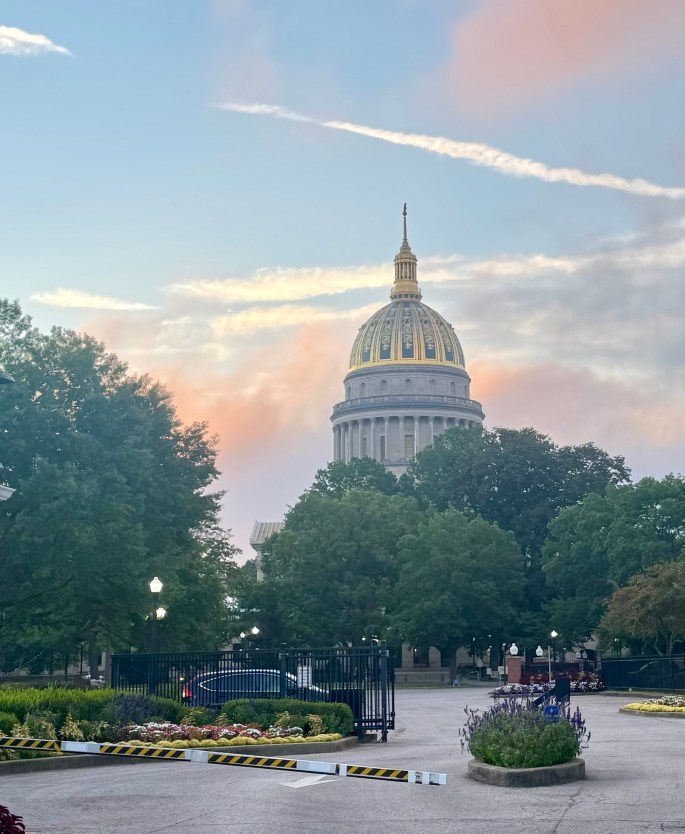
The West Virginia State Capitol building with a golden dome, surrounded by trees and a pastel sky at dawn.
The CDC starts in front of the state capitol of WV.

A Quote to Carry Me to the Start

Dean Karnazes is often credited with saying, “Run when you can, walk if you have to, crawl if you must; just never give up.” His words echoed in my mind while I was experiencing a case of collywobbles as my family and I drove to Charleston, WV, in the predawn hours of Labor Day weekend. Only weeks earlier, I had decided I had built enough base fitness to run the Charleston Distance Classic (CDC), “America’s 15-miler.”

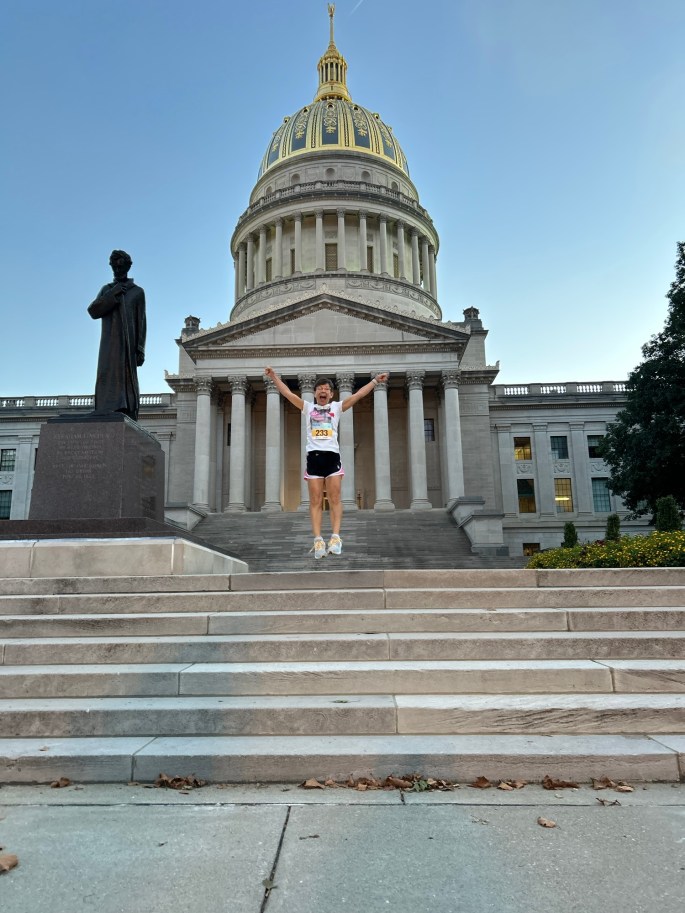
A joyful runner in a race, wearing a white shirt with a 13.1 badge and black shorts, excitedly posing with a water bottle while making a peace sign.
Ready to run the CDC!

Returning to the Classic After Ten Years

It had been more than ten years since I last ran it. In my previous two runs of the CDC, the weather was formidable, with the typical August heat wave bringing high heat and humidity. In fact, it wasn’t unusual to see runners collapse on the course—or cross the finish line only to collapse into the arms of medics from heat exhaustion.

Two women pose together smiling in front of a large government building with a golden dome, one wearing a race bib and athletic attire while the other is in casual sportswear.
My daughter was texting me messages of support throughout the race, so Siri could read them to me in my ear as I ran.

How Running Has Changed for Me

Life was different ten years ago. Besides being younger, I was fairly new to running and relied heavily on veteran runners for guidance. On one hand, I was fortunate to have others with whom to train; on the other hand, I didn’t yet have the aerobic base they had built over years. Plus, when I started running, I gave up strength and flexibility exercises, which I now know would have helped me. Instead, I focused on keeping up with others and hitting the weekly mileage goals.

Runner stands on a swing-shaped structure in front of the West Virginia State Capitol, smiling and wearing a race bib, under a clear sky.
Ready to swing into action.

Building Balance and Training for a MarathoN

Over the past decade, I’ve taken breaks from running—first from burnout, when I missed other forms of exercise. I rotated through strength training, yoga, walking, and cycling, always circling back to running. The pandemic brought running back to the forefront, as gyms and studios were closed.

Since then—and one major surgery later—I’ve learned to build a more balanced approach to exercise that includes a wide array of modalities, running among them. I exercise now for the joy of movement, as well as overall wellness. Still, I enjoy the discipline of a challenge. This year, in honor of another decade milestone, I’m training for the Marshall University Marathon (MUM)—the full 26.2 miles. Rather than follow a standard 16-week plan, I began in January, gradually building my aerobic base.

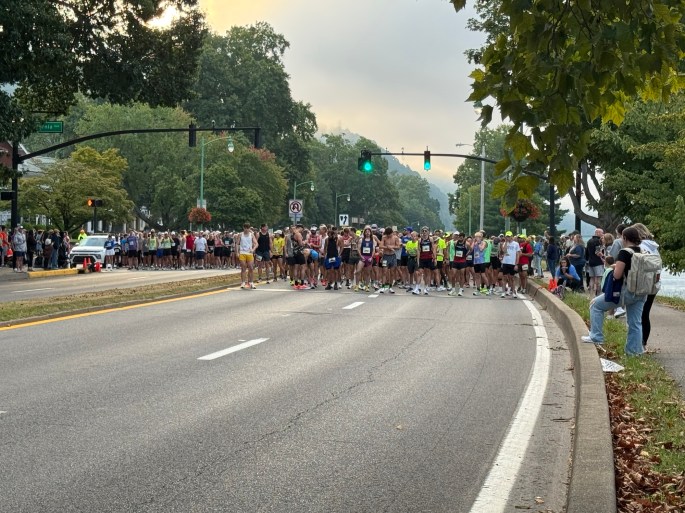
Runners lined up at the starting line of a race on a road, with traffic lights and spectators in the background.
The starting line for the CDC.

A Perfect Day to Race

It was this extended training that gave me confidence to run the CDC again. In addition, the weather worked in my favor. Temperatures were in the 50s when the race began in front of the state capitol. Running along the Kanawha River in the first mile, runners quickly spread out as paces varied.

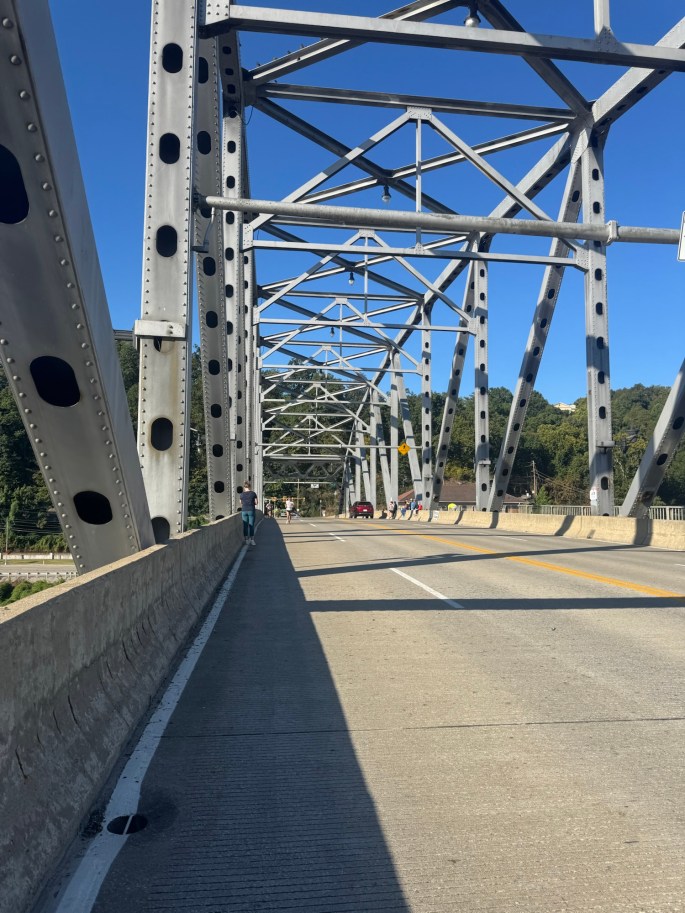
View of a bridge with steel beams and a roadway, featuring a few pedestrians in the distance.
The South Side bridge, which runners crossed twice–near mile 3 and again at mile 8.

“Capital Hill PUnishment” and the Course Challenge

Before long, we crossed the South Side Bridge and began the long trudge up Corridor G, aptly nicknamed “Capital Hill Punishment”—two miles of climbing. As if that weren’t enough, the course then wound through three hilly miles of Charleston’s South Hills neighborhoods. By the time we returned to the South Side Bridge, eight brutal miles were behind us. The final seven were mostly flat, except for one last incline near the end—just when our legs were good and toasted.

My Cheer Squad: John and Maddie

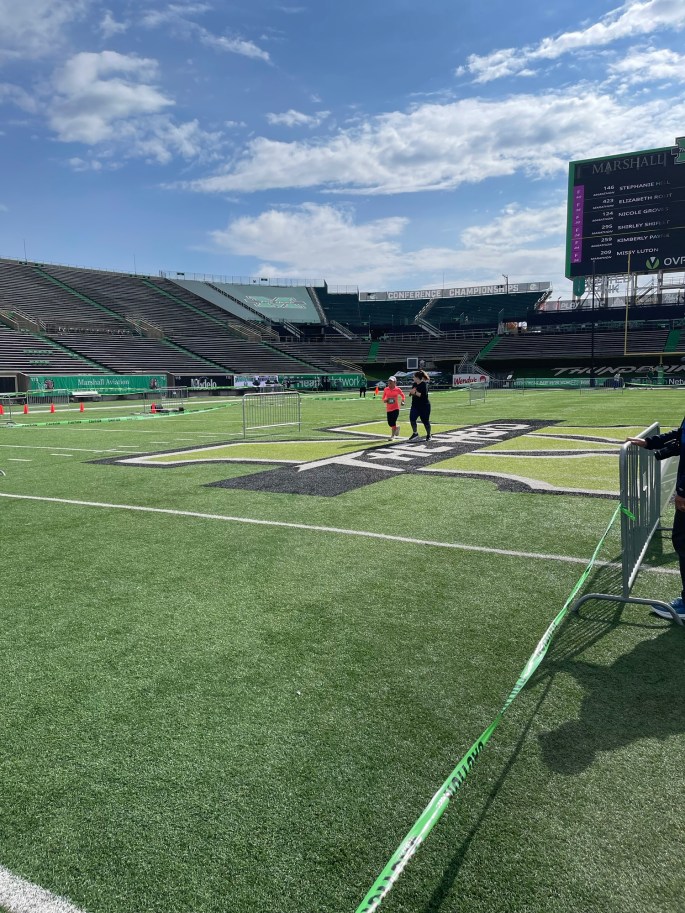
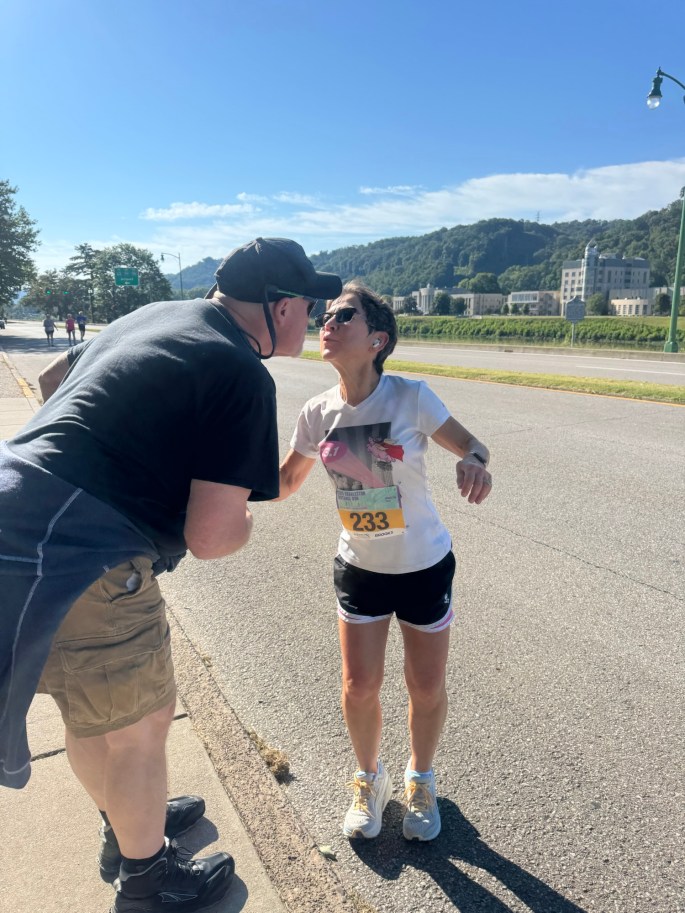
The CDC is a great spectator race, and I was lucky to have my husband, John, and daughter, Maddie, there. They were tireless cheerleaders, walking all over Charleston to encourage me. At the start, Maddie urged me on with excitement. At mile eight, as I crossed the South Side Bridge for the second time, she even ran alongside me for a short stretch, offering encouragement.

Between miles 11 and 12, they found me again, cheering and taking my empty handheld water bottle—by then more of an annoyance than a help. At Laidley Field, Maddie’s voice carried as soon as I stepped onto the track, her shouts of encouragement giving me the final push.

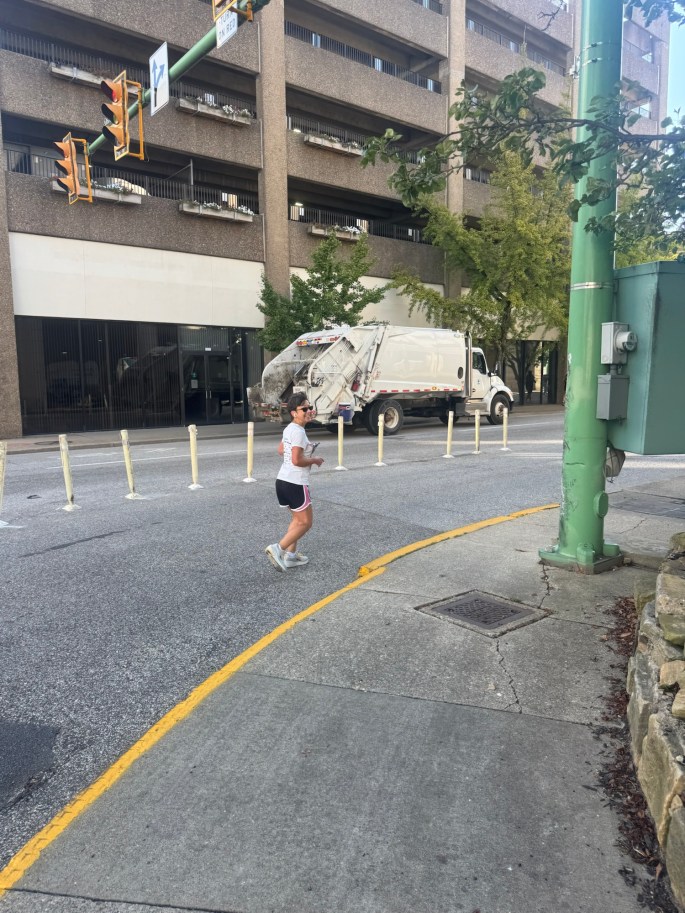
A person jogging on a city street with a garbage truck parked nearby and a multi-story building in the background.
This was mile 8. Afterwards, there was mostly flat course, EXCEPT for a last incline during the very last mile before the finish line. UGH!

Lessons from the Endless Last Mile

Honestly, that last mile seemed endless, and I learned a powerful lesson: even the final mile is still a mile long. My mental discipline slipped, and the fortitude that carried me there begged for rest. I grew whiny and irritable, which only amplified the aches and pains I had managed to ignore until then. It reminded me of my reaction in the last mile of a half marathon I ran this past spring in Asheville, NC.

Scenic view of a riverbank with lush greenery, walking path, and a bridge in the distance under a clear blue sky.
The beautiful Kanawha River that flows through Charleston, WV.

Strengthening My Fortitude

That last mile taught me what I must carry into the last weeks of marathon training: when the long runs get longest, I need to focus on strengthening my fortitude—especially at the very end. This, for me, is the hardest part. I try to follow the advice of Olympian Jeff Galloway (who is also credited with establishing the “Run-Walk-Run” method) to smile at each mile marker—since smiling releases those feel-good chemicals and helps relax the body. He also suggests repeating a mantra or power word. Perhaps I need to lean into this more.

Remembering My “Why”

I also need to remind myself of my “why” when the going gets tough. With the MUM, I hope to raise awareness for Branches Domestic Violence Shelter. Branches provides emergency shelter, legal assistance, counseling, case management, and even meal delivery for domestic violence survivors. Their work saves lives. If my miles can help encourage even a few people to support them, that will mean as much to me as crossing the finish line.

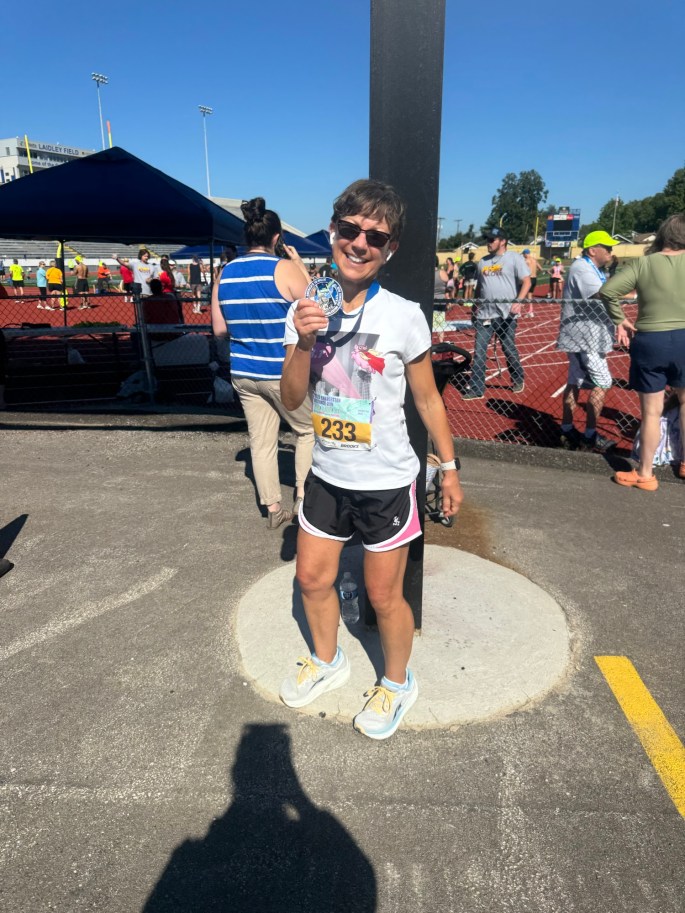
A smiling woman holding a medal, wearing athletic clothing, stands next to a post in a race finish area, with a crowd and tents in the background.

Feeling so grateful for my family, love, and support at the end of the CDC.

Running Differently, Running with Gratitude

Ten years later, I run differently. I take walk breaks when needed, and I’m grateful to still have my health. Running gives me energy, provides structure, and fills me with joy and purpose. Not every run is great, but each mile contributes to my community by keeping me connected to local races and to my own mental, physical, and spiritual well-being. Running also pulls me outdoors, connecting me with the Creator and with the delight of each season.

Never Give Up—In Running or in Life

Running the CDC reinforced the lesson of never giving up. I may be entering a new decade, but that doesn’t mean I have to give up striving for new goals—even if it means crawling to achieve them. Perhaps I’ll see you at the MUM. If not, I hope you’ll create your own journey. Either way, I invite you to celebrate with me—by supporting Branches or by committing to your own goal. Adjust as you must, but never give up. Step by step, with fortitude, tenacity, and a few deep breaths, you can do it.

A running event starting line with an inflatable arch labeled 'Appalachian Timing Group' on a red track, set against a clear blue sky and distant hills.
Never give up! You can cross whatever finish line in life you need to cross!

Navigating Life’s Construction Zones: A Path to Self-Improvement

Construction is a matter of optimism; it’s a matter of facing the future with optimism.”–Cesar Pelli

A construction site on a road featuring orange traffic barrels, traffic lights indicating a red signal, and a view of green hills in the background.
Photo by Robert So on Pexels.com

Summer Roads and Slowdowns: A Familiar Frustration 🚧

It’s the height of the summer travel season. This year, AAA projected that 61.6 million Americans will travel by car between June 28 and July 6. That’s a lot of drivers on the roads! And more likely than not, most of those drivers will encounter some sort of delays or rerouting due to construction. 

Those orange barrels, detour signs, and dusty, smoke-filled roads can wreak havoc on estimated times of arrival, impeding drivers’ progress. Traversing a construction-filled route recently, it occurred to me that just as roads need maintenance, upkeep, and improvement, our lives can also benefit from similar attention. In fact, summer road construction serves as an excellent reminder for how we, too, must assess, repair, and improve our own lives.

Like it or not, road repairs are a necessary part of travel. Winter and spring often ravage roads due to ice, snow, freeze, thaw, excessive rain and so forth.  Potholes, cracked pavement, faded lines, and broken shoulders or guardrails can reduce safety and severely damage tires, rims, alignment, suspension, and so forth. Thus, in order to function properly, roads require regular repair and upkeep. 

A woman in a pink blazer sitting at a table, looking stressed or overwhelmed while using a laptop.
Photo by Edward Jenner on Pexels.com

The Wear and Tear We Can’t Always See 😓

The same is true for our own lives; we, too, experience wear and tear, but it is expressed differently in each of us. Signs may include physical and/or mental fatigue, burn out, and/or incremental increase of poor habits.  Other signs might include unresolved conflict, a sense of drifting or lack of purpose; and/or for others, it could be increased feelings of anxiety, sadness, or indifference. Like potholes on a road, it is important to not ignore these symptoms and instead cultivate a sense of caring curiosity as if we were concerned for a child–only it is concern for ourself–and it begins with an honest self-assessment of our emotional, mental, physical, and even relational well-being.

A woman with red hair looks stressed while working on a laptop, resting her forehead on her hand, in a bright interior setting.
Photo by Alexander Dummer on Pexels.com

Reading the Signs: Time for a Personal Detour ↪️

As with construction, upon reflection we might discover that many of our difficulties and discomforts created ruts, broken shoulders and cracks in our own personal life. These impediments signal that we may need to reroute our own life in order to make internal repairs. In the same way construction zones temporarily create detours, rerouted traffic, and lane shifts, personal redirection can likewise be thought of as a temporary, but necessary setback for long-term improvement. 

A person sitting on a couch, resting their chin on their hand, looking thoughtfully at a laptop with papers and a pen on the table.
Photo by Keira Burton on Pexels.com

Detours with Purpose: Reframing Setbacks as Redirection ↩️

These life detours, be they physical-health and/or mental well-being crisis, a death, divorce, and so on, typically create obstacles–a change in what we think is “the plan.”  However, just as construction zones are there to repair the road, our healing, growth, and ability to move towards wholeness often begins as we experience these hurdles. Therefore, it is helpful to reframe our thinking around these life detours and obstacles as opportunities for not only healing, but also reflection, intervention, or a necessary challenge to a long-held personal perspective.

A woman sitting in a chair, looking contemplative and holding a pen near a notebook, with her hand resting on her forehead in a thoughtful manner.
Photo by cottonbro studio on Pexels.com

Grit, Heat, and Hard Work: The Labor of Self-Growth 🥵

Another important point to consider with regards to road construction is that the work crew must endure a wide array of weather conditions, including extreme heat and humidity that accompanies summer. A return to safe and smooth roads cannot occur without their effort, perseverance, sweat, and labor. Likewise, personal growth and/or physical healing often requires a similar level of grit. 

Whether we participate in therapy, work to improve or create beneficial habits, set clear–and perhaps new–boundaries, work to forgive, and/or learn a new skill or life lesson (or both), personal construction demands that we put in the work. Discomfort, like construction, is a necessity.  Growth and healing are not easy and rarely occur without challenge and effort.

Two women engaged in a conversation at a table in a modern office setting, with one woman wearing glasses and a blue dress, and the other facing away.
Photo by Christina Morillo on Pexels.com

Preventive Maintenance: Investing in Long-Term Well-Being 😃

Another important consideration to effective road repair is that maintenance should be ongoing, rather than deferred, as this can lead to greater road damage and travel hazard. By taking care of ongoing small issues as they arise, bigger problems can be prevented in the future. 

Similarly, our own “self-maintenance” is also a worthwhile investment in order to reduce the likelihood of a major life-repair. Taking time to invest in our own daily health through quality sleep, good nutrition, stress management, physical exercise, fostering healthy relationships, and even learning new things–can be thought of as small personal investments that pay dividends towards our own long term “infrastructure.”  

A woman and a man sitting on a couch engaged in a conversation, with a woman taking notes in the foreground. The room features plants and wall art.
Photo by Antoni Shkraba Studio on Pexels.com

Building a Support Crew: Don’t Travel Alone 😁

That said, sometimes personal maintenance can sometimes feel like “one more thing to do” especially when we’re in the midst of a life-storm. Therefore, it can be helpful to cultivate a “crew,” a few good people who can share our times of smooth sailing, encourage our development and/or maintenance of positive habits, and also support us during those bumpy passage days. Ultimately, with regular self-care maintenance and a good support crew, we can cultivate a strong inner foundation that is better able to withstand life’s pressures and storms.

Black and white image of a close embrace between a woman and a child, capturing a moment of warmth and connection.
Photo by Nataliya Vaitkevich on Pexels.com

Freshly Paved Paths: Signs of Inner Progress 🥹

One of the best parts of road construction occurs when it is finally completed. Routes are once more open, and the ease and smoothness of traveling these roads signals tangible progress. In fact, driving effortlessly over a direct route without detours, potholes, or bumps can be a liberating feeling. 

A smiling man with curly hair, laughing joyfully against a wooden background.
Photo by Pixabay on Pexels.com

Progress, Not Perfection: Life Is Always Under Construction 🦺

Unfortunately, it never lasts for long. Rainy season, freeze-thaw season, excessive travel, or 1,000 other scenarios means construction will once again occur, if not specifically on the newly refurbished route. It’s all part of the process of progress–one never attains perfection when it comes to infrastructure–there’s always room for improvement.

Equally, on the other side of our own personal repairs, detours, and/or maintenance, we gradually return to a sense of homeostasis.  Our rerouted life may possess a greater sense of clarity, restored confidence, better decision making skills, and perhaps even a deeper sense of joy. We, too, may feel the momentum to move forward in a renewed direction and embrace the possibilities that come with an unexpected, but freshly paved path.

Smiling woman wearing a cozy sweater, expressing joy and warmth.
Photo by Dellon Thomas on Pexels.com

Final Thoughts: Be the Engineer of Your Own Journey 👷

To be sure, summer construction can seem like a real drag on travel; however, it ultimately leads to new routes, expanded systems of travel that are safer and more efficient. However, even when the summer construction season comes to an end, the maintenance of these roads does not end, and that is worth remembering.

Likewise, summer construction reminds us that we are the engineers of our own lives. No, we cannot control everything that happens to us, but we can control our reactions AND we can also make repairs as needed as well as prevent some issues from arising. Therefore, let’s be as proactive as possible through regular sustainment of our own life-construction, so that when life’s storms create a pothole–or five–we are fortified with the strength our regular maintenance and upkeep provides us. In life, as in roads, it’s about progress, not perfection. 

I’ll see you out there on the road of life!

.

Running Beyond Age: Embracing Health and Freedom in Every Step

“Running is an act of creative self expression”–Lawrence van Lingen on Extramilest podcast

A Familiar Morning Scene: Defying the Stereotype 👟👟

Two older runners jogging together on a path surrounded by grass and wildflowers in a park during early morning.
Photo by Anastasia Shuraeva on Pexels.com

Picture this. It’s early on a warm Saturday morning in your local park. The sun is low on the horizon, and mist is rising above the grass and a meandering stream that runs alongside a crushed gravel path. The scent of a nearby rose garden is heady as two runners descend the hill following the path. Moving at a steady clip, one runner has a full head of white hair while the other is more salt than pepper. They are relaxed and chatting as they pass by.

This is a routine sighting for me on my weekend jogs. Numerous older runners, walkers, and run/walkers defying the stereotype through exercise, that aging equals physical decline. In fact, according to AARP, beginning in 2023, the average age of runners has risen. Some of the biggest gains are those 55 years and older, with numerous runners sticking to it well into their 60s, 70s, and 80s as witnessed in the ages of Boston Marathon finishers in recent years as well as other major marathons around the world. Of course, there’s no denying aging does change the body, so why do I see numbers of people my age and older consistently outside running and/or walking?

Running as Personal Ritual and Liberation 🏃‍♀️

Older man jogging outdoors in a gray hoodie and gloves, surrounded by tall grass with a calm sky in the background.
Photo by Barbara Olsen on Pexels.com

For many older individuals, like myself, running or run/walking becomes a personal manifestation of life–a ritualistic form of imaginative self expression that allows us to reconnect with our inner rhythm, identity, and self-determination. It creates a sense of freedom and play that we once had as a child. Additionally, running offers numerous benefits, including improved physical health, enhanced mental well-being, social connections, and a renewed sense of personal meaning, to name a few. 

The Science-Backed Physical Benefits of Running 🏃‍♂️

An older female runner smiling while participating in a race, wearing a bright pink tank top and bib number 12491, with greenery and other runners in the background.
Photo by khaoula Bkm on Pexels.com

I occasionally encounter critics who question the safety of running at “my age,” (a term used by my students); however, according to another 2023 AARP article, older runners just have to be “smart about it.” This is why many running groups often point beginners, including seniors, to using a run-walk-run method to establish a strong aerobic base. In fact, Cleveland Clinic, in a 2024 article, points to numerous physical health advantages to walking and/or running for all ages, but especially seniors. These advantages include:

  • Strengthens heart and improves circulation
  • Reduces risk of heart disease and stroke
  • Increases bone density, helping prevent osteoporosis 
  • Improves joint flexibility and maintains muscle function
  • Boosts metabolism and supports healthy aging
  • Improves blood sugar regulation and lowers risk for type 2 diabetes
  • Reduces risk of dementia and Alzheimer’s disease

Mental Health Gains: Silence the Inner Critic 🙉

An older woman running outdoors in a black hoodie and orange shirt, focused on her exercise, with a blurred background of benches and greenery.
Photo by Centre for Ageing Better on Pexels.com

Certainly, the physical health benefits of running are important to me; however, one of the greatest advantages is the feelings of improved mental health and well-being. I often refer to monkeys living in my mind, and running allows me to rise above the swirling negative chatter that often clouds my mind. On days when it seems everything goes sideways, if I have completed my morning run, I can take solace in the fact that I completed at least one positive act, thereby helping me to keep symptoms of depression and anxiety at arm’s length. 

I also find running clears my head, improves thinking, and increases memory, which is a bonus as I age. In fact, running–and exercise in general–is like meditation in motion because it deeply connects me to my breath. Plus, it is a great source of stress reduction.

The Artistry of Movement: Running as a Creative Outlet ✍️

An older man with a full head of gray hair is pouring water from a cup over his head while running in a sunny outdoor setting. He wears a bright red athletic shirt and a race bib number 757. In the background, other runners can be seen along a palm tree-lined street.
Photo by Jou00e3o Godoy on Pexels.com

Running is also a form of innovative self-expression, for young and old alike. Like crafting one’s own piece of art, running showcases the beauty of a body in motion. It offers time for inspiration and reflection. Each run, like a canvas, offers the opportunity to tell a story, footstep-by-footstep. Personally, time spent running also allows me to process life as well as difficult, often buried, emotions, and it even sparks inspiration. My running, albeit slow, feels like an act of liberation, hope, and a tribute to the many obstacles I have overcome along the way. It is a symbol of inner strength, resilience, and freedom to be me–in a world that has often felt as if it boxed me in.

Spirituality, Solitude, and Social Connection 🙏

An older man running on a path surrounded by tall grass and trees on a sunny day.
Photo by Thomas Shockey on Pexels.com

For many runners, older and young, running offers an opportunity to hang out with other runners and socialize. However, some find that running solo, instead, creates a sacred space in which they can connect to their Higher Power, feeling that sense of peace and ease. Still others appreciate the opportunity to spend time in nature, soaking up fresh air and the beauty of Mother Earth.

A Healthy Routine for a Vibrant Life 🙌

Two female runners in matching orange and red jerseys sprint together, holding hands as they approach the finish line. They display expressions of determination and joy during a race.
Photo by RUN 4 FFWPU on Pexels.com

Running, for many, including myself, forms a meaningful structure to the day, a time set aside for one’s personal well-being and health.  This is important because there are numerous obligations and responsibilities that life often demands, even as we age. By setting aside regular time to run, sleep typically improves, which can be so elusive in older adults. Furthermore, those who run typically tend to eat better and don’t tend to abuse substances in order to better support their ability to run.

Staying Safe and Smart with Age 🤔

An older woman running outdoors, wearing a bright yellow tank top with a blue logo, smiling and gesturing with her hands. The background features greenery and a sunlit path.
Photo by RUN 4 FFWPU on Pexels.com

Of course, as we age, we do have to be safe about our exercise habits, which often begins with checking-in with a health-care provider. Additionally, I highly recommend finding good footwear that works for your own personal gait/foot-type; a local running store expert can help with this. Furthermore, as AARP points out, older runners should not go from “zero to 60.” Warm-ups and cool-downs are essential, and for those wanting to start running, a good walk-run program like Run Your Butt Off or the Run-walk-run training plans are two great ways to start. (I have personally used both and can attest to their gentle nature.) 

Other considerations as we age include running less on concrete and asphalt, if possible, and spending more time on softer surfaces, like the paths at local parks. Treadmills also offer a more cushioned surface, and they are a great option when weather is too hot, too cold, or otherwise uncomfortable. If you run at night or early morning, it is important to wear a headlamp and reflective vest for safety’s sake. Additionally, if you run alone, it is a good idea to let someone know where you are running and for how long. 

Every Run Is a Story: Movement as Becoming 🏃

A runner with a confident expression points at the camera while sporting a black sleeveless shirt with 'RUN lovers' printed on it, a race bib, and a headband, during an event in a sporting field.
Photo by RUN 4 FFWPU on Pexels.com

Bottom line, each run or run/walk/run is an adventure. Sure, some runs are less adventurous than others, but those moments offer an opportunity to learn about ourselves if we remain open and curious. Running (and walking) is accessible and fairly low-cost, and it is an effective way for older (and even younger) adults to improve their mental, physical, emotional, and even spiritual well-being. 

Beyond these benefits, running, for me, continues to remain a quiet act of self-expression. With each step and stride I take, I am writing a story, reclaiming my space and time, and paying homage to The Creator, celebrating this gift that is life. In this way, running transcends exercise and becomes a personal journey of becoming, no matter my age. 

With the right approach and mindset, whether you run, run-walk-run, or mostly walk, moving our bodies regularly can create joy and empower older adults to age well—proving that vitality truly has no age limit!

An older man with white hair smiles while wearing a jacket and a medal, standing among a group of people in a blurred background.
Photo by Roman Biernacki on Pexels.com

The Spirograph Effect: Creativity in Life Design

“Not all who wander are lost”–J.R.R. Tolkien

Close-up of hands using drawing tools to create a spiral geometric design on paper.

A Student’s Doodle Sparks a Memory✍️

Months ago, I observed a student drawing spiraling circles over and over on a sheet of notebook paper while participating in our class discussion. For some reason, I was reminded of an old toy my siblings and I once enjoyed: the Spirograph. I can’t remember which one of us received it, but we would sit together for what seemed like hours at the kitchen table drawing colorful, eye-popping (at least to us) geometric shapes.

Four children gathered around a table, smiling and drawing colorful patterns on a large sheet of paper using various markers.

Lessons Hidden in a Childhood Toy ꩜

Reflecting upon that long-ago childhood toy, led to the realization that the Spirograph illustrates the significance of specific concepts when it comes to creating our own life design, such as the influence of structure, patience, persistence, and the importance of celebrating our own unique individuality. It also emphasizes the value of working through natural constraints and trusting the process of learning through repetition. What’s more, the Spirograph demonstrates the relevance of trial and error–which often includes failure–as well as accepting the beauty that can be found in our so-called “imperfections”.

The Spirograph’s Ingenious Origins 👨‍🔬

To appreciate the genius of the spirograph as a toy, requires understanding a bit of its history. Denys Fisher, a British engineer, created it as a child’s play thing based upon various iterations, beginning as early as 1827. At the time of its original conception, it was used for advancing mathematical and engineering concepts. Spirograph, the toy, wasn’t available until 1965, and it went on to win “Toy of the Year” in 1967. Unbelievably, it is still available today.

This classic geometric drawing toy originally came with two transparent rings, two transparent bars, 18 clear wheels of varying sizes, two colored ink pens, pushpins, putty, and paper. Using the various tools, my siblings and I could draw precise, and quite mesmerizing, mathematical curves known as hypotrochoids, epitrochoids, and cycloids. With the switch of any one part, we could vary the size, shape, and geometry of intricate and, at the time, mind-boggling patterns. Essentially, the Spirograph is operated on a balance of limitation and creative freedom, which reflects much of the human experience.

A box of the original Spirograph design set, featuring colorful geometric designs and detailing the contents, including pieces and tools for creating intricate patterns.

Art Through Limits: Creative Freedom Within Structure 🎨

When one is drawing with the Spirograph, one has to adapt to its restrictions. The designs made by using the Spirograph are limited by the size and shape of the wheels and whether you are using the rack or the ring, as well as the color of the chosen pen(s) used to design a figure. Additionally, there are rules for creating specific outcomes as described in its guide book.  While it isn’t necessary to follow the laid-out directions, if one desires it to create a specific shape or design, one has to follow the step-by-step instructions.

This is similar to life in many ways. Influences in life vary from person to person and from family to family, often dependent upon experiences, education, and available information. Many individuals have followed very specific guidelines provided by parents, religion, schools, and even societal norms while others may have fewer influences. For many of us, following a structured timeline is how we landed in our current field/career path.  However, there are just as many, who followed a winding path of their own creation, and still produce a meaningful life experience. Like the Spirograph, following guidelines creates remarkable results for some people, while for others, grabbing the gears and turning them their own darn way works just as well.

Black and white abstract spiral pattern created with lines and arrows, resembling a geometric design.

The Power of Patience and Trusting the Process 🙏

When working with the Spirograph, my siblings and I had to have faith in the process. We had to further learn that creating something meaningful takes time. The desired design outcome emerged slowly, turn by turn, and layer upon layer. In sum, the Spirograph required us to have patience, trust the process, and stay the course. 

Similarly, our life journey takes time as we, hopefully, continuously evolve and grow. We may have times we question the process, or we may waiver in our faith, patience, and persistence. However, rushing life outcomes usually ends up backfiring. Moreover, the time required for personal growth fosters resilience, a much needed companion to patience. We only have one precious life, and as our life design unfolds, with all of its curves and angles, it is never worth rushing. 

A colorful doodle featuring spiraling circles and geometric shapes, reminiscent of designs created with a Spirograph toy.

Failure, Play, and the Magic of Repetition 🖍️

With the Spirograph, I recall that we often learned through repetition and play. We might draw the same shape over and over, sometimes changing the color, or merely changing the size. Other times, we followed the guidelines, and somehow still managed to “fail”!  And, yet, many of those so-called failures ended up being unique and pretty creations–even if they did not come out as planned. Other times, we would just “mess around” to see what we could create. Some results were not so spectacular, but other times, the creations were fairly impressive or, at the very least, provided us with a new understanding for creating specific curves and/or angles. 

Life can often be the same way. How many of us have experienced times where we “followed the rules,” doing what we were “supposed to do,” and still somehow managed to fall flat on our face. Years later, however, we may look back and realize that those “failings” led to something far greater than we could have ever imagined. Other times, a bit of experimentation leads to a new life path or experience that brings unexpected joy we might not have otherwise known. Thus, like the Spirograph, a playful and experimental mindset can lead to untold delights and adventures.

A collection of hand-drawn spirals in varying sizes, arranged artistically on a blank background.

The Beauty of Uniqueness in Design—and in Life 🖼️

Learning to welcome individual uniqueness was another life lesson the Spirograph provided. It often intrigued my young mind how my siblings and I could make the same design, but with a switch of pen color or pressure, or switch of a gear wheel, we could make each drawing unique, despite the fact we were essentially using the same tools. 

Sometimes, we would be surprised when trying to make the exact same shape, because we accidentally missed one of the required steps. Skipping one step, tended to create an irregular shape. Nonetheless, our younger selves marveled at the unique loveliness of the design. Our child-size egos told us we were pioneering artists in those moments!

Marks of Authenticity: Irregular Paths, Unique Lives

What a powerful reminder of the importance of celebrating our own–and others’– idiosyncrasies, including any so-called irregular paths. These individual characteristics and traits, as well as any “irregular paths’ traveled, are all marks of authenticity–that one-of-a-kind spice in our life serving. As humans, our genetic material is vastly similar across all humanity. Yet, this same genetic material still manages to create unique DNA characteristics, such as varying eye color, height, body shapes, and so forth. Furthermore, despite our similar genetic makeup, our lived experiences vary. In a sense, we are pioneering artists of our own lives.

A colorful collection of intricate geometric patterns resembling designs created with a Spirograph. The spirals and mandalas feature vibrant colors and diverse shapes, showcasing creativity and uniqueness.

Embracing Life’s Curves and Imperfections 🌀

Like the Spirograph of my childhood, we all deal with life constraints, no matter what path we try to create for ourselves. These life designs often, and sometimes repeatedly, require practice, patience, perseverance. Life also requires us to accept the many so-called imperfections and irregularities that come as part of the creative process. However, those “flawed” experiences give our life meaning and purpose. Therefore, it is worth remembering we have the power to play and create with the pen we have. All those curved lines and angles that make up our lives, including the missteps, are what continues to compose and create our magnificent, one-of-a-kind life design. Let’s embrace the possibilities.

Who’s ready to draw? ✍️

Transform Your Mindset: Embrace New Experiences

“Your perspective is always limited by how much you know. Expand your knowledge and you will transform your mind.”–Bruce H. Lipton

A black background with the words 'open to new OPPORTUNITIES.' written in white chalk-like font.
Photo by Anna Tarazevich on Pexels.com

Dreams That Spark Reflection and awaken the Mind 🎆

Recently, I have been experiencing an active dream life. While I do go through periods when I don’t recall my dreams, lately my nights have been filled with vivid, frightful nightmares. In my dreamlike state, I try to “change the channel,” but my mind keeps slipping right back into the same harrowing scenario. These restless nights inspired me to think about how in life, similar to TV (or any current media platform for that matter) without deliberately changing the channel, our point of view can become limited.

From Antennas to Awareness: Early Lessons in Limits 📺

As a child, there were no cable or streaming platforms.  Our family, like the families around us, relied on a TV antenna on top of the house in order to watch local stations.  Theoretically, we should have been able to watch three to four local stations–ABC, CBS, NBC, and PBS.  However, we were surrounded by hills, and as a result, most days, NBC was the only  station we could clearly view. I’d hear classmates talk about shows on other networks, but unless we visited my grandparents, who had better reception, our viewing options were limited.

Books: Windows to the world 📚

A woman reading a book while sitting by a window, illuminated by warm natural light.
Photo by Rahul Shah on Pexels.com

Fortunately, we did not rely on TV as we had access to a wide array of books and magazines through school, the bookmobile, at the house of my grandparents as well as in  my own home.  Therefore, my viewpoint expanded beyond my small-town bubble through reading.

College as a Catalyst for Perspective 🤔

Later, when I attended Ohio University, in Athens, OH, my worldview was dramatically shifted. Though Athens is no metropolis, the diversity of students, professors, and wide-array of sources of information was striking compared to what I had known in the Tri-State area. This was especially true since I lived in an international dorm with students from around the world. Conversations in these halls opened my eyes to new ways of living, thinking, and even eating.

Cultural Conversations and Culinary Discoveries

Water droplets cascading from a fountain, surrounded by a blurred green background.
Photo by CocaKolaLips on Pexels.com

My roommate from Singapore opened my eyes to the water shortages her country was experiencing at the time. In her home apartment complex, water was available only during scheduled times—long showers were out of the question. Her story stuck with me as a concrete example of the finiteness of water.

 Meanwhile, students from Denmark and Sweden introduced me to cheeses that I never before heard of, much less tasted.  A French student was the first person to introduce me to espresso, while students from Vietnam and Korea introduced me to a wide array of spices that would not have been locally available at that time.

Voices from Different Lives 😃

I had a classmate named Annette, the daughter of a military family, who’d lived all over the world. Her life experiences, and the breadth of cultural understanding, was remarkable. She was heads and shoulders above the rest of us in global knowledge and awareness.

In contrast, another classmate, Jerry, grew up on a nearby family farm on the outskirts of campus. He illustrated, first-hand, the struggles of family-farming, the weight of the financial hardship often felt by these families, and the deep faith it takes to persevere.

Spiritual Exploration Through Diverse Worship 🙏

Also, while attending OU, I visited churches of different denominations around campus. This provided direct experience with other forms of worship different from my own upbringing. Each service challenged and broadened my appreciation of varying faith communities.

Travel: Expanding the Map of Understanding 🗺️

As an adult, my perspective has continued to unfold through travel. My husband, daughter, and I have explored various parts of the U.S. from coast to coast and visited several Canadian provinces. During these trips we meet people from all walks of life. These encounters demonstrate the common threads of living as well as the unique–and some not so unique–struggles all humans face. These conversations continue to deepen my empathy and allow me to see cultural events, governmental policies, and life experiences through the eyes of others.

The Environment: Witnessing Earth’s Fragility 🌲

Since most of our travels center around natural and historic sites, my perspective has been further stretched in two important ways. First, traveling reinforces my profound respect for the limited nature of Earth’s resources. Over the years I have witnessed firsthand miles of forests decimated by logging or (most recently) flooding/storms, walked along shores of a fragile coastline in a constant state of erosion, and visited places in which the air quality was at near unbreathable levels due to drought-related dust storms or fires. These expeditions serve as tangible reminders that our environment is not infinite, and it is urgent that we protect/care for it.

History: Lessons in Perspective and Relevance 🧑‍🏫

Second, by visiting historical landmarks, walking historical streets, or exploring museums, it helps me recognize the values, struggles, and limitations of the times in which people once lived and how relevant the past is to today’s world. These excursions (along with reading historical and historical fiction books) demonstrate that history is not just a collection of dates and events; rather, it’s an expansive, unlimited lens–filled with countless lessons–through which we can understand human behavior, social progress (or lack thereof), and cultural identity. 

Most of all, visiting natural and historic attractions repeatedly instructs that what we take for granted—whether a forest or a freedom—can disappear without an ever-expanding viewpoint.

Perspective Lost and Perspective Gained

Without an intentional commitment to varied life experiences, our perspective is restricted and narrowed. We may not see the value of managing natural resources. Likewise, we might not be empathetic to those with cultural differences, and we might have little-to-no context of history and its importance. Without going beyond our comfort zone, we may not see the vastness and inclusiveness of a God so great, we cannot possibly pretend to understand.

Intentional Curiosity: How to Keep Changing the Channel

Therefore, it is important to seek out new experiences that challenge our assumptions and broaden our horizons. There is indisputable value in engaging with people whose lives are different from our own.  By engaging and listening more, judging less, and asking more questions, we are less likely to jump to conclusions while also allowing our assumptions to be tested. Visiting a worship service different from our own current practice or simply visiting a new place–even if it’s just across town–can offer further insight to the world around us. Even reading books, fiction or nonfiction, can also offer unique and salient views of others.

Shift Your View, Shape the World 🌎

In closing, I challenge all of us to avoid getting stuck in life as if in a dream. Instead, let’s keep changing the channel. With each click out of our comfort zone, we gain a more nuanced understanding, broaden our perspective, and foster greater compassion for the world and humanity itself. In fact, by doing so, we might not only expand our viewpoint, but we may also alter the viewpoint of someone else we meet along the way.

A collection of blue sticky notes with handwritten motivational words: 'ACCEPT', 'LOVE', 'SUPPORT', 'ADVOCATE', 'EMPOWER', 'TEACH', 'HOPE'.
Photo by Polina u2800 on Pexels.com