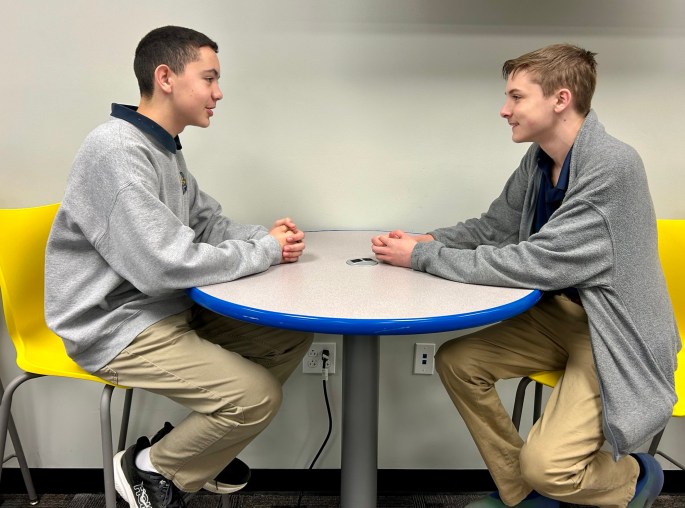
A Quieter Resolution for the New Year: Listening, Learning, and Loving Without Agreement

“When we listen, we offer with our attention an alms far more precious than anything else.”— Simone Weil

The Season of New Year’s Resolutions—and a Different Invitation

The ritual setting of resolutions for a new year is a ubiquitous January practice. Gym memberships flourish, trackers are checked and rechecked, meals are planned and prepped all in the hope of self-improvement. One quick scroll of social media offers a wide array of options for  workouts, diets, and methods of accountability. While health resolutions matter, our culture needs a quieter resolution–one that prioritizes listening deeply, learning humbly, and choosing neighborly love without agreement.

What We Miss When We Stop Listening

One cultural trend I have noticed–and am often guilty of myself–centers around listening, or a lack thereof. Many of us talk past one another, make snap judgments, and curate words of certainty. Conversations become overlapping monologues–ears present, but attention is elsewhere. In doing so, we miss the quieter forms of communication: facial expressions, postures, and the subtle cues that reveal complexity and lived experiences. When we rush past these, we lose the opportunity to understand another person, and we deny ourselves the opportunity to be changed, even slightly. Making time for focused listening does not mean we are agreeing with another person’s position.  It is choosing understanding over reflex.  

Learning to Listen as a Daily Practice

Learning to listen well is an acquired skill, at least for many of us, myself included, but it is attainable. Engaged listening requires more than ears; it requires intention. It asks us to pause before responding to another person, to consider what was said, and to ask a thoughtful question, rather than immediately offering a counterpoint. Asking a thoughtful question or two can increase understanding of another person, especially if we are willing to sit with discomfort if their viewpoint challenges or counters our own. This type of listening takes time and requires humility. If you are like me, you won’t be perfect–but it is a worthwhile endeavor.

Listening Without Agreement

Frankly, it is easier to relegate people based on our assumptions.  It is inconvenient to take time to ask questions that might alter our long-held beliefs.  However, by listening and respectfully seeking understanding, we incrementally begin to learn more about an alternate point of view without necessarily agreeing with it. 

Lessons from the Classroom About Understanding Others

 This is an ongoing practice for me as a veteran educator separated by generations from my students, and even many of my colleagues, in a high school setting. I have entered numerous conversations over the years in which either I had assumptions about a situation involving a student, parent, or peer or they had assumptions about me. Those conversations did not always lead to agreement, but they almost always led to greater understanding–and that is the difference that mattered most.

What It Means to Love Our Neighbor Today

By taking time to listen and ask questions, we are putting into practice a foundational belief of most world religions and philosophies: “Love your neighbor,” emphasizing respect, compassion, and doing non-harm to others. This Golden Rule practice is neither affectionate nor approving. It is also not remaining silent when faced with harm. In today’s world, “loving your neighbor” can be as simple as showing restraint in how we speak–refusing to reduce a person to a single action or belief. Practicing the Golden rule can also be as simple as not reducing a person to a single belief or action. Loving others is simply a daily choice. It is a posture that can feel costly, especially when it would be easier–or less stressful–to walk away or erupt into outrage. 

Small Ways to Practice Kindness in Everyday Life

Standing in neighborly love takes practice, and it doesn’t have to occur in grand, sweeping gestures. We can begin to put into practice in small, cumulative ways that can still have a bigger impact than we realize.  During gatherings of friends and/or family, try listening longer than feels comfortable to that contrarian relative/acquaintance.  During community, work, or church meetings, instead of immediately refuting a counter point-of-view, respond with curiosity rather than certainty. While interacting with online spaces, try choosing kindness when sharpness would be easier, even if the kind act is not to respond at all. We won’t always be perfect, but the more we practice, the more natural it becomes.

A Resolution That Doesn’t Fit on a Checklist

When setting resolutions, health coaches often ask clients to create goals that are SMART: specific, measurable, achievable/attainable, relevant/realistic, time-bound/timely. Setting a resolution to listen, learn, and “love” others may not, therefore, appear “SMART.” Nonetheless, it remains an attainable and relevant practice through small, incremental steps. 

What Might Change If We Listened First?

Consider what might change if we listened a little longer? If we attempted to learn more than we defended? If we treated others the way we would want to be treated? If we “loved” more than we proved?  

A Practice Worth Returning to All Year Long

These actions are not about “perfection” with a clear-cut checklist that offers overnight transformative results. Instead, they are more about presence and intention–the intention to listen, learn, and love others. It is a resolution that does not have to end with guilt in February; rather, it is a practice that can be picked up and practiced again and again throughout this year and years to come. 

“You don’t have to agree with someone to treat them with dignity.” 

As the year begins, may we all strive to engage in a more neighborly discourse and actions. 

Embracing Silence: The Owl’s Call to Mindful Listening

A wise old owl sat on an oak;
The more he saw the less he spoke;
The less he spoke the more he heard.” —old proverb

A wise-looking owl perched on a branch in a dark, wooded area, illuminated softly by moonlight.
Photo by Erik Karits on Pexels.com

Listening in the Dark 🌌

I am an early riser, typically awake before the sun. A few weeks ago, my ears perked at the haunting, penetrating call of an owl. Its “Hoo-hoo-hoo, hoo-hoo” echoed around our yard as I looked out into the murky dark. Since then, I intentionally listen for its steadfast call. It has become both a comfort and a mystery—an invitation to listen, reflect, and learn something new.

The owl’s call continues, I am certain, even when I am not listening; yet it requires my full attention in those predawn hours if I hope to notice it regularly. Its presence illustrates the importance of listening and discerning with care and purpose.

A grey and white owl perched on a branch with wings partially spread, showcasing its feathers and an alert expression against a green blurry background.
Photo by Petra Ryan on Pexels.com

What Owls Teach Us About Voice 🗣️

The autumnal hoots I hear, I learned after a bit of research, are used mostly to communicate territory and to call to potential mates. (It is worth noting that many owl species mate for life, finding another only if a partner dies or becomes separated.) Owls also use distinct calls to warn a mate, their nestlings, or even neighboring owls when danger is near. Only when the threat is imminent do they screech, hiss, or snap their beaks in defense of their young. Like the owl, we, too, can carefully choose when to use our voices amid the noise of the world, saving our own form of “screeching” for the rarest and most necessary moments.

Three barn owls perched on a branch in low light, showcasing their distinctive features against a dark background.
Photo by throughmylife_in_ INDIA on Pexels.com

Signals of Respect and Coexistence 🦉

As I read more, I couldn’t help admiring how owls communicate—practically, respectfully, almost as if to say, “I am here. You are there. Let us coexist with our shared resources and help ward off danger.” To be certain, I am personifying and simplifying their communication, but perhaps there is a lesson for us. In a world that often isn’t equitable in its distribution of resources, space, or power, maybe we can learn the art of signaling like owls—communicating truthfully and transparently without silencing others. What if we approached our conversations with presence, restraint, respect, and a shared awareness of the landscape we inhabit?

Holding Our Ground with Grace 🙏

Hearing the owl’s early morning “Hoo-hoo-hoo, hoo-hoo” reinforces the importance of holding our own ground—our principles, values, beliefs, and even compassions—without becoming loud or defensive. The owl does not insist on being seen; rather, it asserts its message with a reserved dignity. We, too, can claim our “territory” through composed conviction and fairness, standing firm without demeaning others. Faith in our tenets, like my unseen morning owl, calls us to trust what cannot be seen but can be discerned only in stillness.

A tall tree with orange leaves against a clear blue sky, surrounded by a grassy area and a house in the background.
Fall is a time of release and renewal.

Autumn’s Invitation to Adapt 🍂

Autumn is a season of release and preparation. Light softens, signaling leaves to fall as trees ready themselves for winter’s quiet work. Many creatures follow this rhythm, including the owl in my backyard adapting to the shifting season. We, too, are invited to adapt—to let go of what is no longer needed, recalibrate our priorities, and listen more deeply. The natural world thrives on balance, which is different from our human desire for “fairness.” It exists in a subtle harmony in which every being plays a role. I wonder what might happen if we focused more on harmony—the give-and-take of shared ecosystems and resources—paired with the wisdom of knowing when to listen and when to speak.

A woman in a pink hijab interacts playfully with a barn owl perched on her arm, pointing towards its face, with another owl visible in the background.
Photo by Rangga Aditya Armien on Pexels.com

The Harmony of Coexistence 🕊️

The autumn owl’s voice in my backyard is solitary, and yet it reflects community. It marks its presence while acknowledging the presence of others, including us. Coexistence, the owl teaches, requires more than hearing what others say; it requires listening to the silences. Of course, human coexistence is complicated, and life often isn’t what we would call fair.

Therefore, it becomes incumbent upon us to listen, act kindly, and withhold judgment—offering small or not-so-small acts of goodness to help restore balance. This may mean choosing gentleness, or even silence, over the need to be “right,” especially when a loved one, friend, or coworker says or posts something unkind or expresses an opinion we strongly oppose. Likewise, offering compassion instead of judgment when someone is rude or ill-behaved can shift a moment for the better, even if only because we have refused to be pulled into energy-sapping negativity.

A serene forest scene with tall trees bathed in soft rays of sunlight filtering through the branches, creating an ethereal atmosphere.
Photo by Atlantic Ambience on Pexels.com

Before the Light Returns 🌅

The owl still calls unseen in the dark predawn hours, reminding us that communication, connection, and hope often begin before the light returns. The owl does not question whether the sun will rise; it simply continues its call, trusting the rhythm of creation. Like my unseen neighbor, I pray we find the courage to speak fairly, listen deeply, and have faith in the unseen process—knowing that every voice lifted in love and fairness echoes far beyond what we can see.

Perhaps that is the heart of the owl’s lesson: when we listen more deeply, we create the conditions for fairness to grow. As I recently read, “Life isn’t fair. It isn’t, which is why people should endeavor to be more fair to one another, not less.” —Kate Quinn.

The Power of Mindful Listening: Enhancing Understanding

“I remind myself every morning:  Nothing I say this day will teach me anything. So if I am going to learn, I must do it by listening. I never learned anything while I was talking.”–Larry King

Photo by Pixabay on Pexels.com

Focused Listening 👂

I was recently engaged in conversation with a friend, Jan, sharing about a trip she took with her husband to the United Kingdom. Her descriptions kept me spellbound. While there were many points of interest and wondrous highlights of her trip, there was one item she repeated that planted a seed: She had to actively listen. 

Jan described how she could not allow her eyes to wander to paintings on a wall, people walking past, or other points of interest. Instead, in order to best understand the people she encountered, she had to, as she said, “really focus” on the person speaking. This was due to the unique dialects and word usage that varies from one part of the UK to another, much in the same way that dialects (accents) vary across the U.S. 

This idea of focused listening sounded quite similar to mindfulness: the ability to fully focus our awareness of the moment at hand. Jan was a visitor in another country participating in multiple new sensory experiences that vied for her attention.  However, when engaged in a conversation with a local, she had to remain focused in the present–in order to understand. By repeatedly practicing mindful listening, Jan and her husband were able to glean helpful tips and advice that fostered their successful navigation of the UK via The Tube and create memories of a lifetime. 

Photo by Christina Morillo on Pexels.com

Mindful Listening 🗣️

Mindful, or active, listening does not come naturally to many of us, and it is typically not taught. The good news is that we can learn to improve our listening skills. However, it does require practice, and it is often an ongoing process for which Jan’s story reminded me.

In a previous article, I explored the types of listening with emphasis on: listening to react/criticize, listening to respond, and listening to understand. Each of these types of listening can be appropriate for various situations. However, after talking with Jan, I wanted to examine the specifics of listening to understand via mindful listening, or what most business professionals call active listening.

Many of us know what it feels like to try to have a conversation, serious or otherwise, with another person who clearly isn’t listening. Likewise, we can most likely identify times in which someone was trying to have a conversation with us, but our attention was elsewhere. Both of these scenarios can be frustrating for both the listener and the speaker. Clearly, listening for understanding is often not as easy as it seems.

Photo by August de Richelieu on Pexels.com

Listening to understand 🤔

One way to increase listening skills, according to a 2023 Cleveland Clinic article, is to set an intention to listen. This may sound over-simplistic.  However, when we consider how good it can sometimes feel to talk or share entertaining tales, setting an intention to listen, rather than talk, makes sense. After all, if we want to improve our listening skills, we have to enter a conversation with the intent to listen more and talk less. 

Furthermore, when listening, it is important to focus on the speaker and set aside the phone or other distractions in order to be fully present with that person, especially when the conversation is important. My friend found that if she was going to navigate the UK successfully, she had to fully concentrate on the speaker when asking for directions or help.  When her mind wandered to the new environment around her, she had to nudge her attention back to the speaker.  

Photo by KATRIN BOLOVTSOVA on Pexels.com

Focus on speaker and the message 🔎

The same is true for us. It can be difficult to fully focus on what is being said, and this is where mindfulness comes in.  When we notice our mind has drifted, it is a matter of redirecting our attention back to the speaker. We may have to do this several times, especially for those of us with focus issues.

That said, one thing I am learning to do, when my mind wanders or becomes distracted, is to be honest.  I will tell the person if I become distracted and ask them to repeat what was just said.  Of course, I have to be careful not to do that too much because it can cause the speaker to get distracted. Nonetheless, I find, as a general rule, that asking someone to repeat what they said is overall beneficial to my focus and understanding of the speaker’s message.

An article by the British Heart Foundation, nevertheless supports the importance of listening with minimal interruptions in order to avoid distracting the speaker. The author does suggest occasionally repeating a person’s last few words or asking clarifying questions in order to increase the listener’s understanding of the message. Plus, it maintains the focus on the speaker and their message, rather than focusing on responding.

Photo by Vera Arsic on Pexels.com

“listen” to the Nonverbal cues 🙊

Furthermore, it is also important to “listen” to the speaker’s body language. A 2021 Harvard Business Review article suggests that those nonverbal cues can provide additional key information, especially with regard to the speaker’s emotion. 

Likewise, it is also important for the listener to be mindful of our own body language and eye contact. Making eye contact and nodding at key points, while also not crossing arms and maintaining a relaxed demeanor, can put the speaker at ease. In some situations, it may also be appropriate to ask if the speaker wants suggestions or just wants to be heard.

Photo by fauxels on Pexels.com

Connect to your breath 😮‍💨

Connecting to our breath as we listen can help us regulate our emotions, which can be vital if the conversation becomes difficult. It is easy to become dismissive, defensive, or argumentative if the topic is controversial or one with which there is disagreement.  In these situations, doing our best to take relaxing breaths can aid us in remaining non judgemental and avoid imposing our opinions or solutions. 

Ultimately, learning to be a mindful, fully engaged, active listener takes practice for many of us. And, if we walk away from a conversation thinking we could have been a better listener, it is important to practice self-compassion, learn from our mistakes, and try again in the next conversation. The key, I believe, is to stay committed.

Photo by cottonbro studio on Pexels.com

More Listening; less talking 👂

Our commitment to improving our listening benefits not only us, but those with whom we daily encounter. Learning to listen well increases empathy for others, fosters healthy relationships both at work and among family/friends, demonstrates respect, increases opportunities for understanding, which in turn can reduce, diffuse, or even avoid potential points of conflict. The more we are willing to listen mindfully, the more we can increase understanding.  And heaven knows, the world could surely benefit from the blessing of more listening and less talking!

Mastering the Art of Listening: Key Techniques

“Most people do not listen with the intent to understand; they listen with the intent to reply.”–Stephen R. Covey

Photo by Jopwell on Pexels.com

Listening is an Art 🎨

I listened to an acquaintance share a problem with me. I tried to fully listen, and then proceeded to offer my best advice.  Later, however, I reflected upon that conversation and wondered if I should have responded differently.  Was she really seeking advice, or did she just want someone to listen and empathize with her? Perhaps, I should have taken more time acknowledging her feelings, and then asked if she wanted advice, instead of assuming she wanted it.

Listening, really listening to others, is a skill and an art. I once heard a speaker say, “Hearing is uncontrollable; listening takes a special knack.” This is so true. We are constantly inundated, it seems, with an assortment of sounds, clamor, and all types of conversations.

 I was reminded of this quote in a past conversation with my daughter, Maddie. We were, ironically enough, talking about listening.  Specifically, I wondered aloud about ways to improve my own listening. She shared with me what a friend once taught her.

Photo by Andrea Piacquadio on Pexels.com

Three ways of listening 👂

According to Maddie’s friend, there are three types of listeners: Those who listen to respond; those who listen to react or criticize; and, those who listen to understand.  This stuck with me, and I decided to do a short bit of research into this topic. 

One quick internet search on “types of listening” resulted in hundreds of articles. Some pieces were geared more towards high school or college students taking communication classes.  Others were framed around mental health. However, based upon my informal searches, business/work implications seem to make up the largest number of “ways to listen” write-ups.

While I can’t claim to have done the deepest research dive, what I did find seemed to support the overall point of what Maddie shared with me–there are different types of listeners and a number of identifiable ways of listening.  It seems the biggest point of agreement is that most of us can, and would probably benefit from, improving our own listening skills.  What mostly varies, from article to article, is the identification of how many different listening types/styles there are.  

Photo by Andrea Piacquadio on Pexels.com

Two Other types of Listening 🎧

Two types of listening that Maddie’s friend did not identify were what several articles called “pseudo listening” and “appreciative listening.” Pseudo listening are those times when we pretend to listen, but we are not really absorbing the speaker’s information.  This can occur across a wide array of situations, from the classroom to the board room, and from having the TV or radio on in the background to a person droning on and on about a topic for which you have little interest, but don’t want to be rude.

Appreciative listening is the type of listening we engage in when listening to a favorite song or piece of music.  It can also occur when listening to a presentation or speaker talking about a favorite subject.  You are not, per se, learning anything new, just appreciating the appeal of the subject matter.

Photo by nappy on Pexels.com

Listening to Respond 🗣️

To the point of “listening to respond,” there are several key points.  First of all, in day-to-day life, there are numerous situations which require listening carefully and responding quickly. From minute tasks, such as ordering food, when the staff asks how you want a certain dish served to listening to a friend or loved one ask if you could lend a hand, there are moments that require listening and responding/acting accordingly.  

However, some situations require more than just a response. There are times when we need to analyze before responding. This action-oriented form of listening, requires dialed-in focus and a timely response in order to efficiently deliver information. Doctors, teachers, pharmacists, lawyers, and numerous other types of jobs require this type of listening, which analyzes the person’s problem from a neutral point of view in order to guide the patient, student, client, and so forth to what is, hopefully, an appropriate solution.  Although the listener is still responding, the listener is responding from a point of thoughtful consideration in order to best help the person solve the problem.

Photo by August de Richelieu on Pexels.com

Listening to react 🙎‍♂️

Another action-oriented form of listening focuses on the content of the message in order to react or criticize.  This type of listening is designed to judge the content of what is being said as well as the reliability of the source or speaker. Obviously, if you are an attorney, arguing before the court for your client, this type of listening is clearly a very important skill. However, in all walks of life there are times we must listen and react defensively to a given situation. Unfortunately, this type of listening can become aggressive quickly, especially when applied to a situation in which a less-reactive approach would have better benefitted the situation. 

Photo by cottonbro studio on Pexels.com

Listening to understand 🤔

  Finally, there are times when we need to truly focus on the person, listen closely to their content in order to understand, empathize, and perhaps even build connections. This is typically the hardest style of listening to develop, but it is worth fostering in order to build and sustain relationships. Listening to understand is a skill many of us need to improve, including myself. Due to our jobs or positions in life, a large number of us spend our work days quickly analyzing, and responding to others’ problems; and therefore, this type of listening, unfortunately, tends to become our default mode of listening even in situations where it would be better to remain quiet longer in order to connect with and fully understand the speaker.

Learning to listen to the underlying emotion conveyed in a person’s message requires active and participatory listening.  This may require clarifying questions, but other times, it simply means offering space–a safe, quiet space where a person can simply share their thoughts and feelings without judgment or interruptions.  

Photo by fauxels on Pexels.com

Space for listening 🤐

Sometimes, people just want to be heard and aren’t necessarily asking for a so-called “solution.”  This is where, Maddie suggested, I might need to ask, “Do you want advice or do you just want me to listen?”  It is such a simple concept, but this clarifying question clears up any confusion on the listener’s part as to what their role is. 

Reflecting back to that initial conversation with an acquaintance made me wish I had clarified whether or not the person wanted me to listen, offer advice, or both.  Unfortunately, I cannot go back in time, but moving forward, I can ask that in future conversations. Listening well and listening appropriately to the situation does indeed take a special knack, but even more so, it requires us to think before we choose whether to respond, react, or criticize.  It requires that we slow down our thoughts, listen deeply, and if needed, take time to clarify what the person speaking needs from us.  In the end, not only will those with whom we interact benefit from our awareness, but we may find that our own relationships, work settings, family- and even community-dynamics shift and may even benefit as well.

Photo by Oleksandr P on Pexels.com