Running Toward Hope: A Marathon of Movement and Love

Every run is a work of art, a drawing on each day’s canvas. Some runs are shouts and some runs are whispers. Some runs are eulogies and others celebrations.”—Dagny Scott Barrios
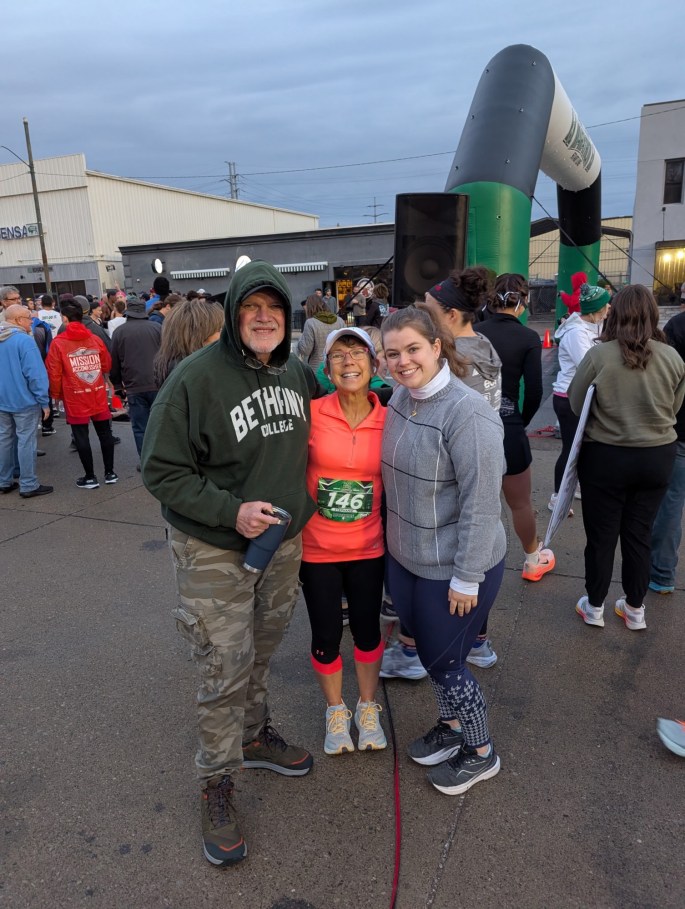
A group of three people, including a man in a green hoodie, a woman in a bright orange top with a running bib, and a woman in a gray sweater, gather smiling at a running event in an outdoor setting with other runners in the background.
Just before the start of the marathon I took time to get a hug from my two biggest supporters throughout the training process: my husband, L, and my daughter, R.

A Morning of Reflection and Gratitude 🌅

A light mist fell as an overcast gray morning began to chase away the night. I stood quietly in a throng of animated runners, taking deep breaths as reflection and gratitude washed over me. Months of preparation had led to this moment, and I felt thankful not only for my health but for the loving support that carried me here—to this celebration of movement, resilience, and connection.

Running as an Act of Hope ✨

It had been ten years since I last pinned on a bib for this distance, and my body hummed with anticipation, hope, and belief—the belief that movement is for everyone at every age, and that it is, in itself, an act of hope. I was about to embark on an emotional 26.2-mile trail of faith that became more about the people who supported me than the miles themselves.

Discovering Joy in Gentle Movement 😄

I came to running later in life, and it wasn’t easy at first. Only when I learned to approach running gently—to let go of preconceived (and societal) notions of what running “should” be—did I discover paths full of freedom, clarity, and renewal. Movement, whether running, walking, dancing, or stretching, benefits body, mind, and spirit. It brings a sense of structure to an often chaotic world and offers a feeling of accomplishment—if nothing else goes right in a day, at least I moved my body. Movement brings us alive to ourselves, our spirit, and, in turn, to the world around us.

The joy, I’ve learned, is in the doing—not in attaching to a pace, distance, or goal. Those things can be part of the experience, but they aren’t required.

A man and a woman embrace warmly in a crowded setting, both smiling in a moment of connection before a marathon.
Maddie’s, my daughter, boyfriend, Connor, flew all the way from Austin, TX to be part of this event. Together, with Maddie, he helped plan the marathon surprise of a lifetime!

Redefining What It Means to Age 🧓

As I neared my 60th birthday, I began to notice messaging that framed this decade as one of limitation. I decided instead to flip the narrative and celebrate the 60s as a decade of possibilities. Why not run into this new decade the way I ran into my 50s—with eyes and arms wide to adventure?

Training with Gentleness and Grace 😌

Since I was already running regularly, I committed to training for a marathon, but this time with gentleness. Instead of a traditional four-month build-up, I created a ten-month plan that encouraged patience, routine, and presence. Twice-weekly strength training and yoga joined the schedule, as did listening to my body and using the run-walk-run method as needed. I also focused on proper hydration and fueling before, during, and after runs. Most of all, my husband and daughter supported me from the very beginning—their quiet, everyday encouragement becoming a steady foundation of strength.

A woman running on a street wearing a bright pink long-sleeve top, black leggings, and a cap, displaying a race number on her waist.
Gentleness was a large part of the 10-month training block that led to this moment of hope and celebration.

Adapting Through Life’s Curveballs 😰

Training for a marathon brings rhythm and structure to daily life—the early morning runs, the long weekend miles that lengthen gradually, and the sweet evening stretches after dinner. But life, of course, has its curveballs: weather shifts, fatigue, scheduling conflicts, unexpected events, and bouts of self-doubt. With age, though, I’ve learned to adapt rather than resist these realities, co-creating a practical, flexible approach to progress.

As my weekend long runs grew longer, my husband and daughter often appeared—driving by, stopping to cheer, or jogging beside me for a short distance. These small bursts of love in action fueled my heart and kept me going. Training, I realized, was less about mileage and more about cultivating fortitude, flexibility, and gratitude—along with a dash of fierceness—all essential life skills carried from the road.

A group of enthusiastic spectators cheer on runners during a marathon, surrounded by autumn foliage and a partly cloudy sky.
Maddie, and my husband, John, often showed up during the last few miles of my Saturday long runs to cheer me on as Maddie is seen here doing during the actual event itself.

Race Day: A Celebration of Love 💖

As the marathon began, the city of Huntington vibrant in energy, rebelling against the lackluster sky. Rhythmic footfalls and nervous chatter surrounded me as runners jostled for position. Warmly dressed spectators cheered, waving handmade signs against a backdrop of burnished orange, crimson, and yellow autumn trees. Little did I know that my daughter had turned this event into an outpouring of love.

Surprises Along the Course 🫢

At the start, my husband, daughter, and her boyfriend—who had flown in from Texas to surprise me—stood cheering. But that was only the beginning. Every few miles along the route, my daughter had arranged for friends, family, and coworkers to appear, waving signs and calling my name. I didn’t realize the scope of her plan until near the end, but each familiar face filled me with renewed energy, gratitude, and joy.
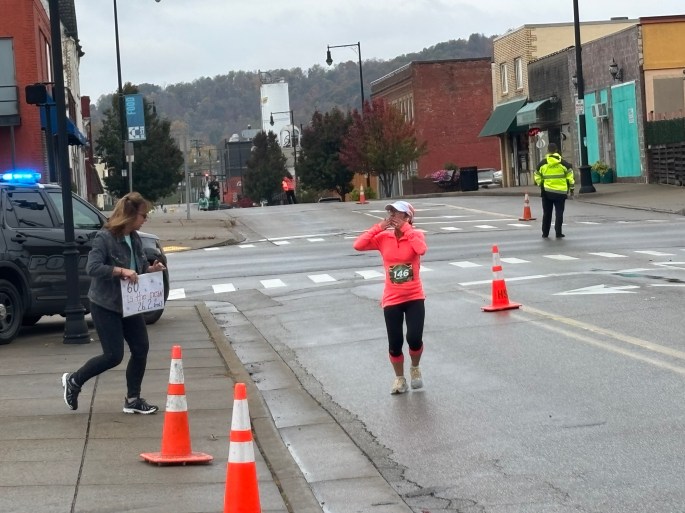
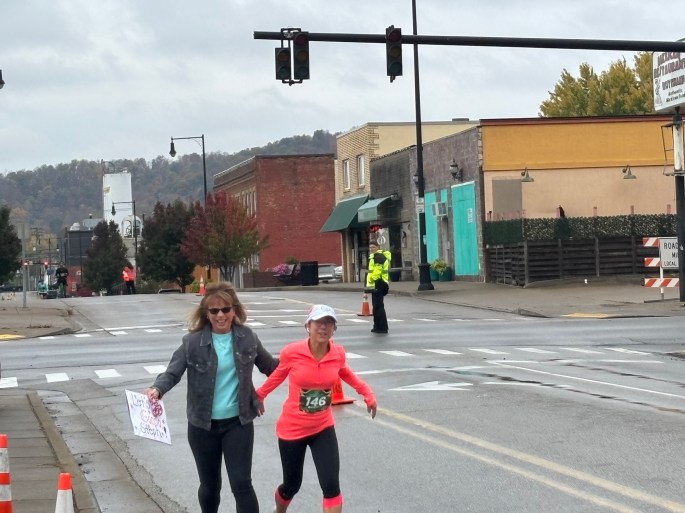
A female runner in a bright pink shirt crosses a street marked by traffic cones, while a supporter holds a sign nearby in a lively downtown setting.
The look of complete surprise when I see my sister, Traci, and her husband, David, around the 19-20 mile mark of the marathon. I had no idea they would show up along the route!
Two women running together on a city street during a marathon, with one holding a sign. They are surrounded by a lively atmosphere and shops in the background.
Of course, I had to veer off the path to give her hug, which helped uplift me over the next few miles.

Crossing the Finish Line 🏁

As I turned toward the final quarter mile, a group of race volunteers began singing “Happy Birthday” while my daughter’s boyfriend joined for a short burst of encouragement. My husband stood outside the stadium offering final words of encouragement, and my daughter met me at the bottom of the stadium ramp to run beside me as I approached the finish line. I wasn’t just completing a marathon; I was receiving the best birthday gift—a living reminder of love: a convergence of community, family, and friendship. It was a story of hope, purpose, generosity, and perseverance—the joy and power of a shared journey.

Two volunteers wearing bright reflective vests stand by a crosswalk in a park-like setting with blooming flowers and trees. In the background, a pathway leads towards a building under a cloudy sky.
This was the point, less than a quarter mile to go, when a group of race volunteers, led by an unknown female spectator and Conner, joined in to sing “Happy Birthday” to me as approached and rounded the corner to the finish line.

The Marathon as a Metaphor for Life 🪞

This journey mirrors life: we move forward by faith and grace, one step at a time, through both joy and challenge, supported by others who believe in us. That’s the power of movement—it connects us to our bodies, to others, and to something larger than ourselves. Choosing to move, to train, to keep going even when the path feels long, is an affirmation that with faith, growth and renewal are always possible—at any age.

Movement as a Lifelong Invitation 💌

Movement can take many forms: walking, stretching, dancing, or choosing to train for something big. The point is to move with intention and persistence, to embrace your own journey, and not attach to societal and social media messaging. Just move—and let movement open the door to new possibilities, both inner and outer.
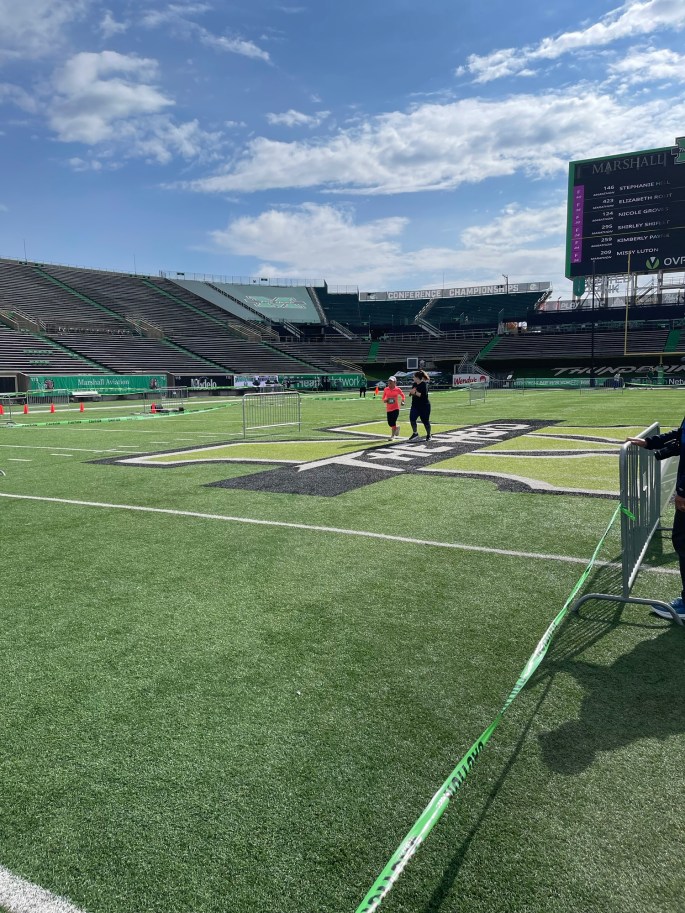
A runner crosses the finish line at a sports stadium, with spectators in the stands and a clear blue sky overhead.
Maddie runs alongside me for the last few feet, just as she did in 2015, to encourage across the finish line. Once I was close to the finish line, she dropped back behind the rope to let me finish alone. However, I really wasn’t alone. I was surrounded by a giant embrace of joy, hope, and love of family, friends, and community!!

The Joy Continues ☺️

The rhythm of footsteps, the smiles for miles, and the faces of loved ones along the route are forever imprinted in my heart—all reminders that every step matters. The marathon finish line was crossed, but the renewed sense of possibility and joy continues. Whatever your pace or path, keep moving forward—heart, mind, and spirit. You never know what acts of hope and love may be waiting for you along life’s path.
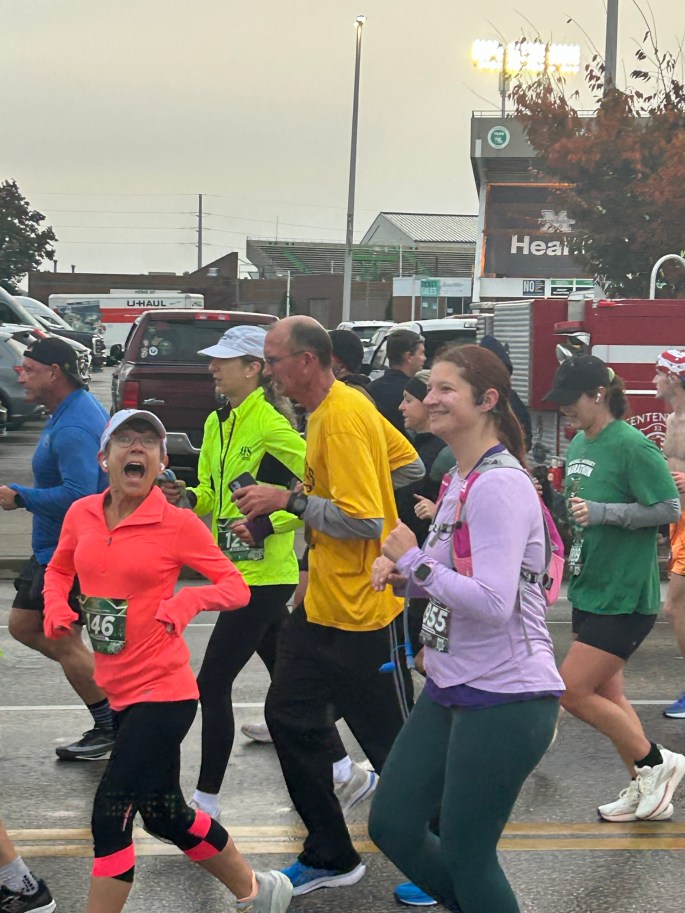
A group of runners participating in a marathon on an overcast morning, with diverse individuals wearing colorful athletic clothing and cheerful expressions.
The joy, and the journey of love and hope, continues . . .

A Grateful Heart 💜

P.S. Thank you to the countless and nameless MUM volunteers who invested hours of time to ensure the safety and success of runners, walkers, and those beloved spectators. And, an extra special heartfelt thank you to my friends and family who celebrated this milestone with me. And to Maddie and John, I love you to the moon and back.

A group of three smiling individuals taking a selfie on a subway or train, with a map visible in the background.
I wonder where the next path of adventure will lead?
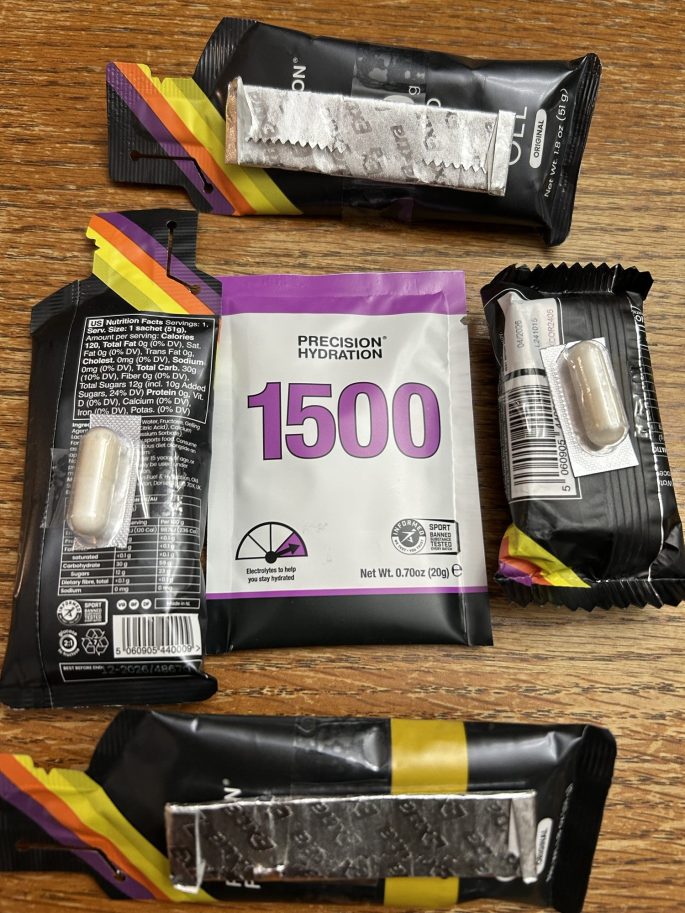
An assortment of hydration and energy products for runners, including electrolyte tablets and energy gels, arranged on a wooden surface.
Shout out to Precision Fuel and Hydration for the support during this training journey! I learned a lot from your team.

Running with Purpose: The Charleston Distance Classic and My Marathon Journey

The West Virginia State Capitol building with a golden dome, surrounded by trees and a pastel sky at dawn.
The CDC starts in front of the state capitol of WV.

A Quote to Carry Me to the Start

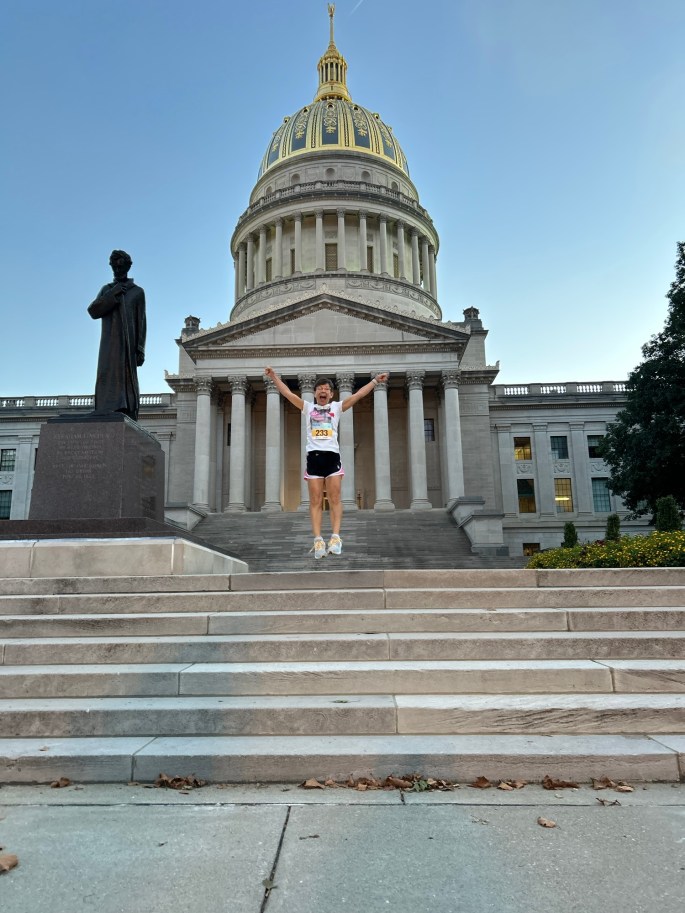
Dean Karnazes is often credited with saying, “Run when you can, walk if you have to, crawl if you must; just never give up.” His words echoed in my mind while I was experiencing a case of collywobbles as my family and I drove to Charleston, WV, in the predawn hours of Labor Day weekend. Only weeks earlier, I had decided I had built enough base fitness to run the Charleston Distance Classic (CDC), “America’s 15-miler.”

A joyful runner in a race, wearing a white shirt with a 13.1 badge and black shorts, excitedly posing with a water bottle while making a peace sign.
Ready to run the CDC!

Returning to the Classic After Ten Years

It had been more than ten years since I last ran it. In my previous two runs of the CDC, the weather was formidable, with the typical August heat wave bringing high heat and humidity. In fact, it wasn’t unusual to see runners collapse on the course—or cross the finish line only to collapse into the arms of medics from heat exhaustion.

Two women pose together smiling in front of a large government building with a golden dome, one wearing a race bib and athletic attire while the other is in casual sportswear.
My daughter was texting me messages of support throughout the race, so Siri could read them to me in my ear as I ran.

How Running Has Changed for Me

Life was different ten years ago. Besides being younger, I was fairly new to running and relied heavily on veteran runners for guidance. On one hand, I was fortunate to have others with whom to train; on the other hand, I didn’t yet have the aerobic base they had built over years. Plus, when I started running, I gave up strength and flexibility exercises, which I now know would have helped me. Instead, I focused on keeping up with others and hitting the weekly mileage goals.

Runner stands on a swing-shaped structure in front of the West Virginia State Capitol, smiling and wearing a race bib, under a clear sky.
Ready to swing into action.

Building Balance and Training for a MarathoN

Over the past decade, I’ve taken breaks from running—first from burnout, when I missed other forms of exercise. I rotated through strength training, yoga, walking, and cycling, always circling back to running. The pandemic brought running back to the forefront, as gyms and studios were closed.

Since then—and one major surgery later—I’ve learned to build a more balanced approach to exercise that includes a wide array of modalities, running among them. I exercise now for the joy of movement, as well as overall wellness. Still, I enjoy the discipline of a challenge. This year, in honor of another decade milestone, I’m training for the Marshall University Marathon (MUM)—the full 26.2 miles. Rather than follow a standard 16-week plan, I began in January, gradually building my aerobic base.

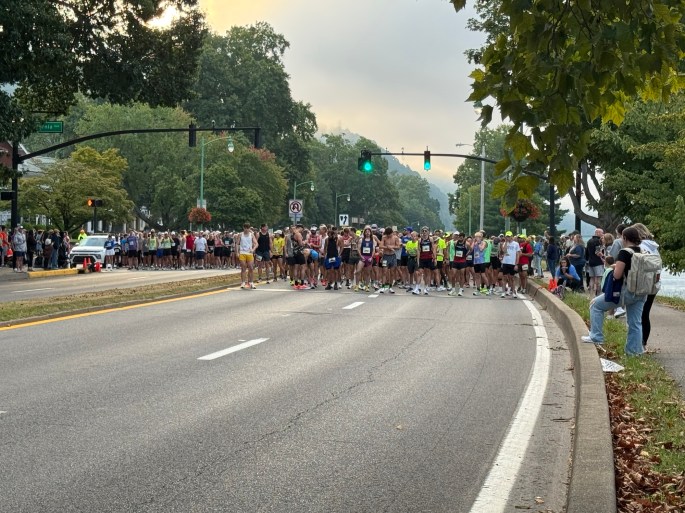
Runners lined up at the starting line of a race on a road, with traffic lights and spectators in the background.
The starting line for the CDC.

A Perfect Day to Race

It was this extended training that gave me confidence to run the CDC again. In addition, the weather worked in my favor. Temperatures were in the 50s when the race began in front of the state capitol. Running along the Kanawha River in the first mile, runners quickly spread out as paces varied.

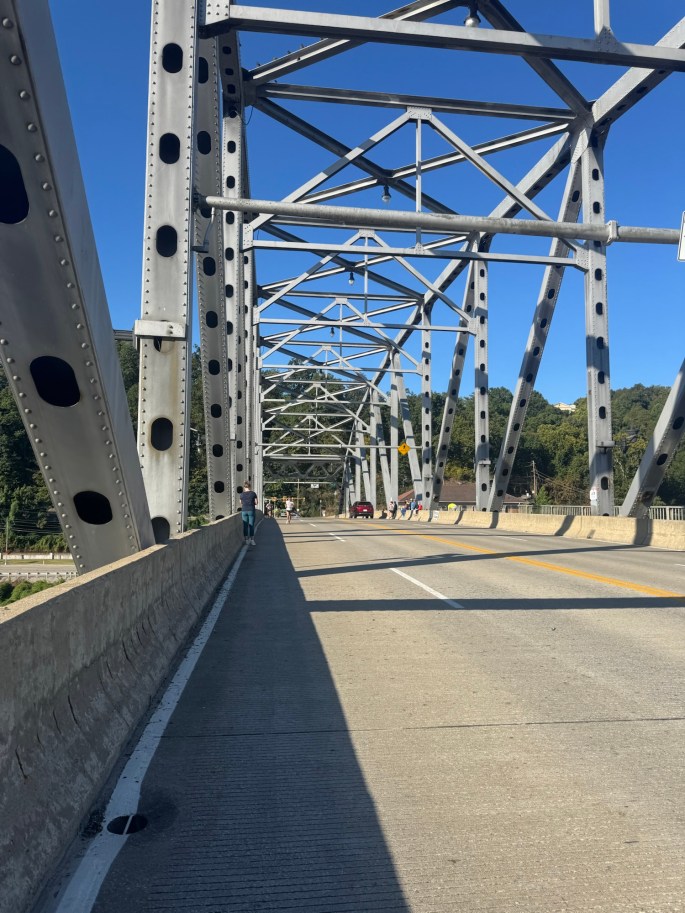
View of a bridge with steel beams and a roadway, featuring a few pedestrians in the distance.
The South Side bridge, which runners crossed twice–near mile 3 and again at mile 8.

“Capital Hill PUnishment” and the Course Challenge

Before long, we crossed the South Side Bridge and began the long trudge up Corridor G, aptly nicknamed “Capital Hill Punishment”—two miles of climbing. As if that weren’t enough, the course then wound through three hilly miles of Charleston’s South Hills neighborhoods. By the time we returned to the South Side Bridge, eight brutal miles were behind us. The final seven were mostly flat, except for one last incline near the end—just when our legs were good and toasted.

My Cheer Squad: John and Maddie

The CDC is a great spectator race, and I was lucky to have my husband, John, and daughter, Maddie, there. They were tireless cheerleaders, walking all over Charleston to encourage me. At the start, Maddie urged me on with excitement. At mile eight, as I crossed the South Side Bridge for the second time, she even ran alongside me for a short stretch, offering encouragement.

Between miles 11 and 12, they found me again, cheering and taking my empty handheld water bottle—by then more of an annoyance than a help. At Laidley Field, Maddie’s voice carried as soon as I stepped onto the track, her shouts of encouragement giving me the final push.

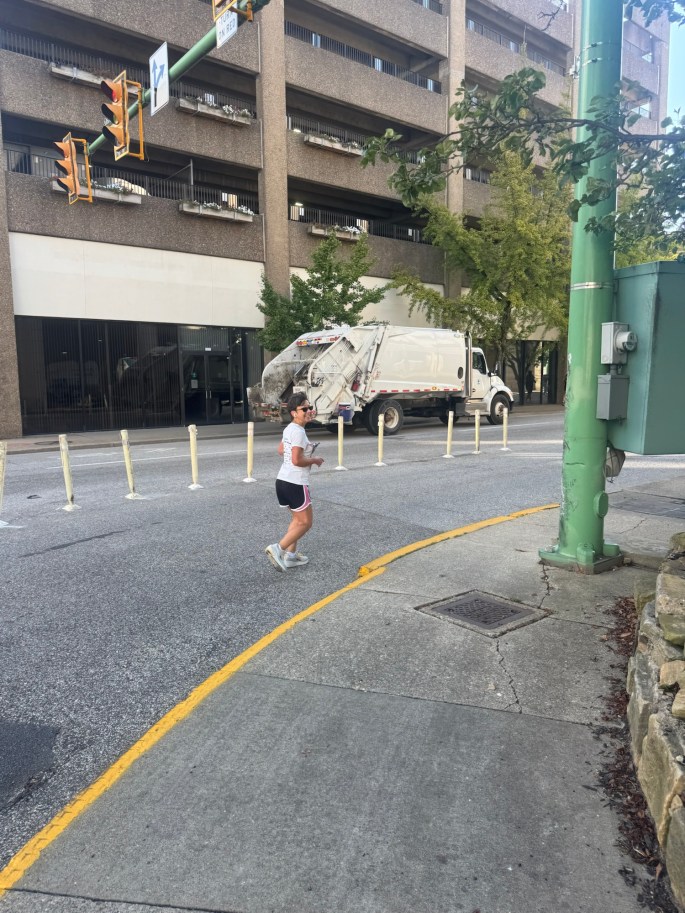
A person jogging on a city street with a garbage truck parked nearby and a multi-story building in the background.
This was mile 8. Afterwards, there was mostly flat course, EXCEPT for a last incline during the very last mile before the finish line. UGH!

Lessons from the Endless Last Mile

Honestly, that last mile seemed endless, and I learned a powerful lesson: even the final mile is still a mile long. My mental discipline slipped, and the fortitude that carried me there begged for rest. I grew whiny and irritable, which only amplified the aches and pains I had managed to ignore until then. It reminded me of my reaction in the last mile of a half marathon I ran this past spring in Asheville, NC.

Scenic view of a riverbank with lush greenery, walking path, and a bridge in the distance under a clear blue sky.
The beautiful Kanawha River that flows through Charleston, WV.

Strengthening My Fortitude

That last mile taught me what I must carry into the last weeks of marathon training: when the long runs get longest, I need to focus on strengthening my fortitude—especially at the very end. This, for me, is the hardest part. I try to follow the advice of Olympian Jeff Galloway (who is also credited with establishing the “Run-Walk-Run” method) to smile at each mile marker—since smiling releases those feel-good chemicals and helps relax the body. He also suggests repeating a mantra or power word. Perhaps I need to lean into this more.

Remembering My “Why”

I also need to remind myself of my “why” when the going gets tough. With the MUM, I hope to raise awareness for Branches Domestic Violence Shelter. Branches provides emergency shelter, legal assistance, counseling, case management, and even meal delivery for domestic violence survivors. Their work saves lives. If my miles can help encourage even a few people to support them, that will mean as much to me as crossing the finish line.

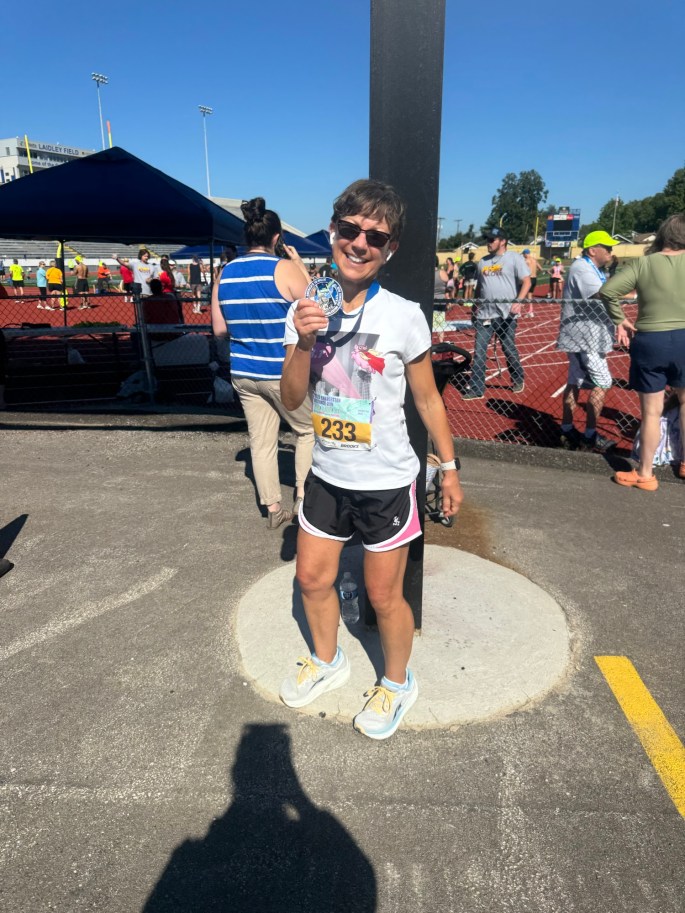
A smiling woman holding a medal, wearing athletic clothing, stands next to a post in a race finish area, with a crowd and tents in the background.
Feeling so grateful for my family, love, and support at the end of the CDC.

Running Differently, Running with Gratitude

Ten years later, I run differently. I take walk breaks when needed, and I’m grateful to still have my health. Running gives me energy, provides structure, and fills me with joy and purpose. Not every run is great, but each mile contributes to my community by keeping me connected to local races and to my own mental, physical, and spiritual well-being. Running also pulls me outdoors, connecting me with the Creator and with the delight of each season.

Never Give Up—In Running or in Life

Running the CDC reinforced the lesson of never giving up. I may be entering a new decade, but that doesn’t mean I have to give up striving for new goals—even if it means crawling to achieve them. Perhaps I’ll see you at the MUM. If not, I hope you’ll create your own journey. Either way, I invite you to celebrate with me—by supporting Branches or by committing to your own goal. Adjust as you must, but never give up. Step by step, with fortitude, tenacity, and a few deep breaths, you can do it.

A running event starting line with an inflatable arch labeled 'Appalachian Timing Group' on a red track, set against a clear blue sky and distant hills.
Never give up! You can cross whatever finish line in life you need to cross!

Movement as Medicine: Staying Active in Your Older Adult Years

“Movement is medicine for creating change in a person’s physical, emotional, and mental states.”–Carol Welch

Photo by Roman Biernacki on Pexels.com

Let’s get Ready to Move! 🏃‍♀️

By the time you read this, I will be close to one week out from running (ok, jogging, “slogging”, whatever you want to call it) the Marshall University Half-Marathon. This annual community event motivates and inspires hundreds of locals and nonlocals to train, improve their current fitness level, and participate in the 5K, the half-, or the full-marathon distance.  Plus, it brings together a whole host of volunteers who support participants along the way.

Each year that I’ve participated, I hear numerous stories about those who haven’t trained for MUM, still participate, and do well.  My hats off to them; I appreciate that they can do that.  However, I find the training, and the build-up to the event, are part of the excitement and joy of the journey that includes completing the event.

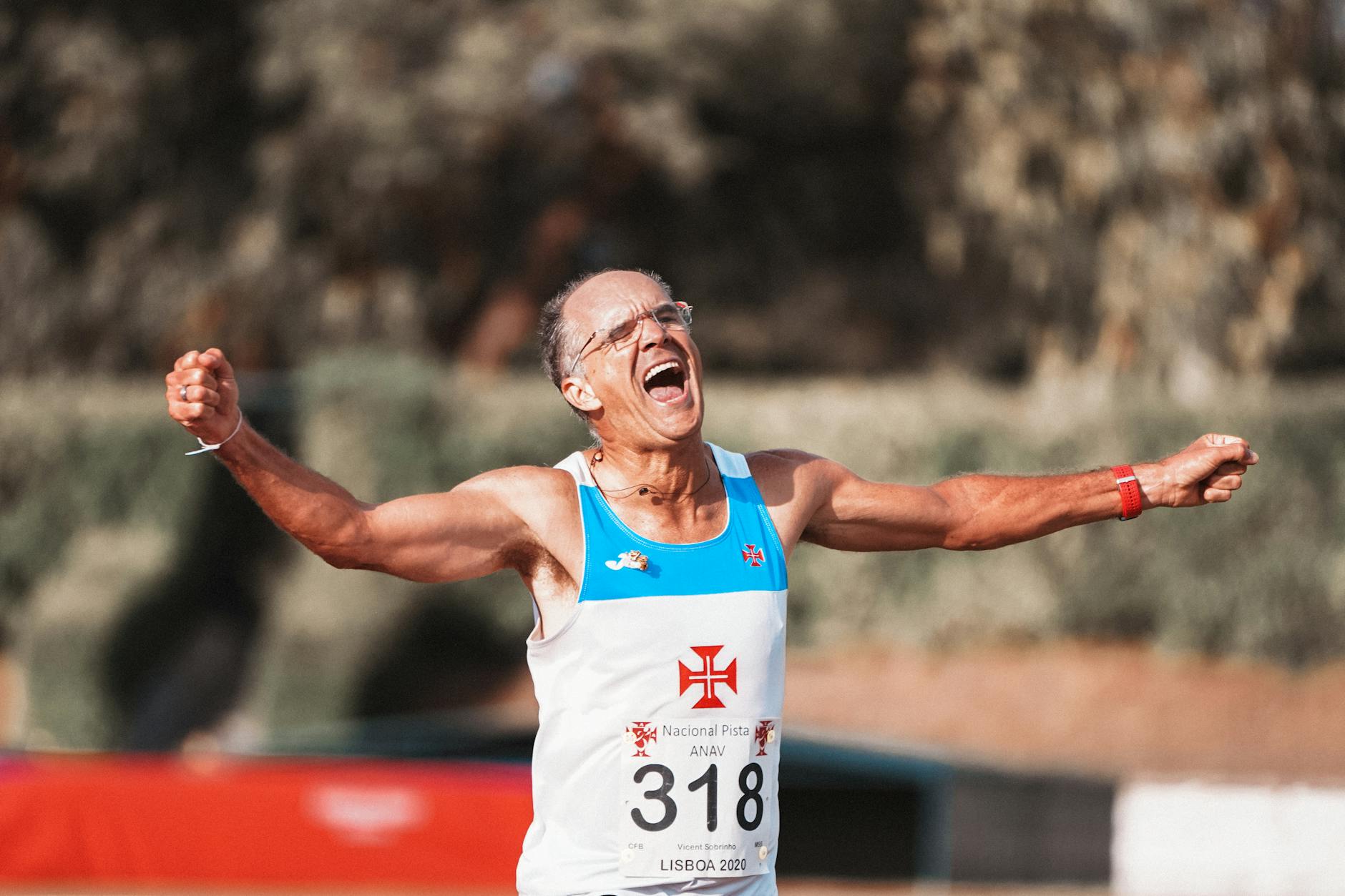
Photo by RUN 4 FFWPU on Pexels.com

Giving meaning and purpose to Exercise through signing up ✍️

It typically takes weeks, or even months, of deliberation before I decide to sign up for a running event–even an annual event such as the MUM. Therefore, once I make the decision to pay the entry fee for an event, I am fully committed to a training plan. This is not because I have any desire to place or set records, but because signing up for an event is the extra motivation that gives meaning and purpose to my exercise.  Plus, it keeps me simultaneously excited and nervous in a good way.

Photo by RUN 4 FFWPU on Pexels.com

Exercise at any age! 👵🏼

Still, I have those who ask me if running is still safe for someone at “my age.” News alert! There is no milestone-age at which you should cut-off exercise.  In fact, exercise and/or movement can, and probably should, be embraced across all ages, including those of us in the AARP years, which is anyone over the age of 50. That said, you do have to manage your expectations, but movement and/or structured exercise can be a healthy part of the “golden years.”

That said, of course, if you have had an injury or have certain health conditions, you must respect your body’s limits and boundaries, but it doesn’t mean you give up on exercise and/or purposeful movement forever.  By working with a healthcare professional, you can find ways to adapt, modify, and/or create your own exercise plan that fits your body’s unique needs.  

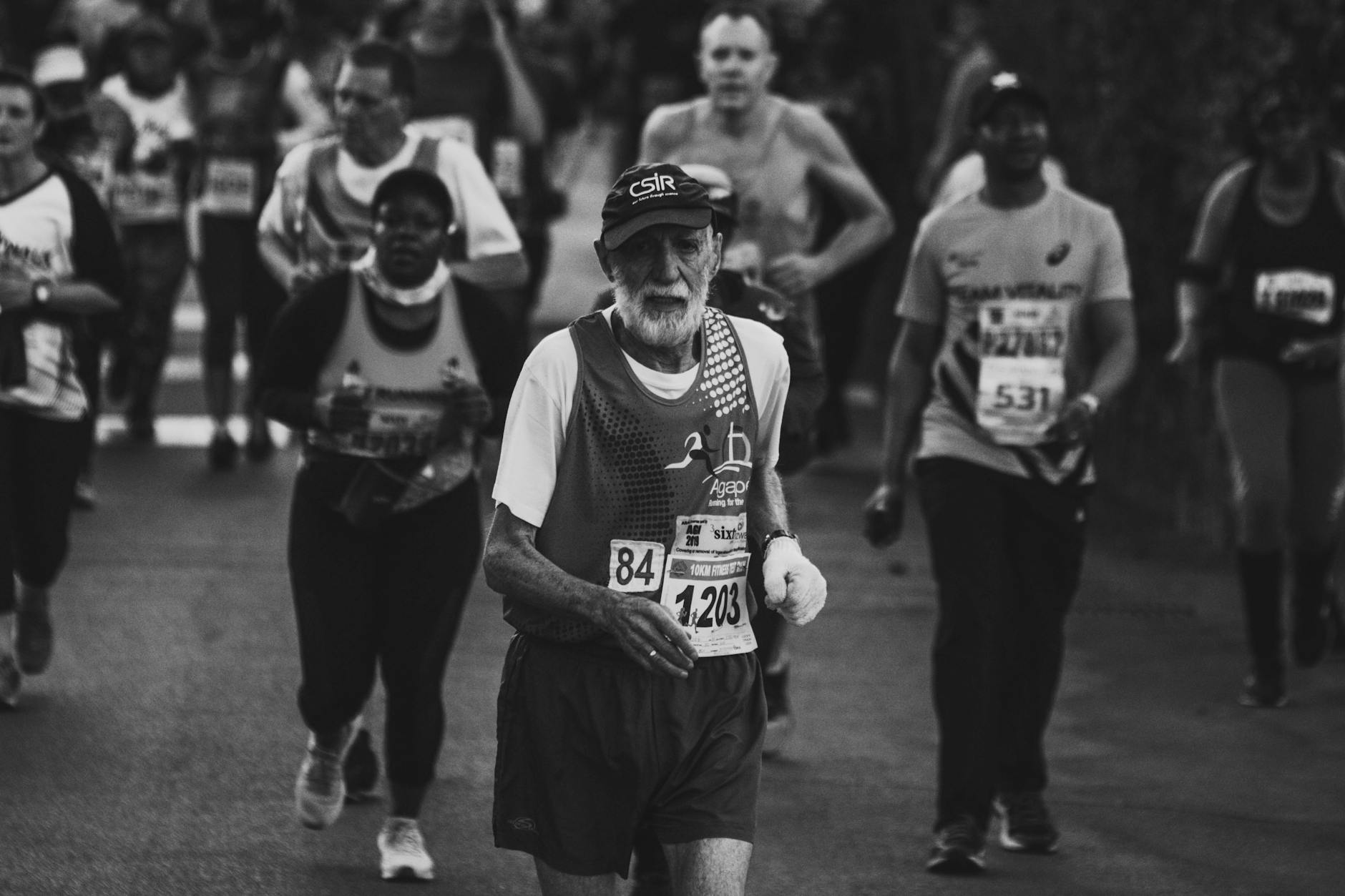
Photo by Vincent Peters on Pexels.com

Tips for moving through those senior years 🚶🏿‍♂️

Here are some key tips and pointers I’ve learned along the way, gathered from other senior exercisers, as well as a few I researched, when thinking about exercise/movement in the, a-hem, “senior” years.

  1. Establish meaningful AND realistic goals appropriate for where your body is now that motivate and excite you.  This is why I enjoy signing up for a half-marathon.  My mantra is: “Set your own pace, and run your race.”  I don’t put pressure on myself that running has to be or look a certain way.  No time is too slow, and I can take as many walk breaks as I need.  That said, you can approach ANY form of exercise in a similar manner 
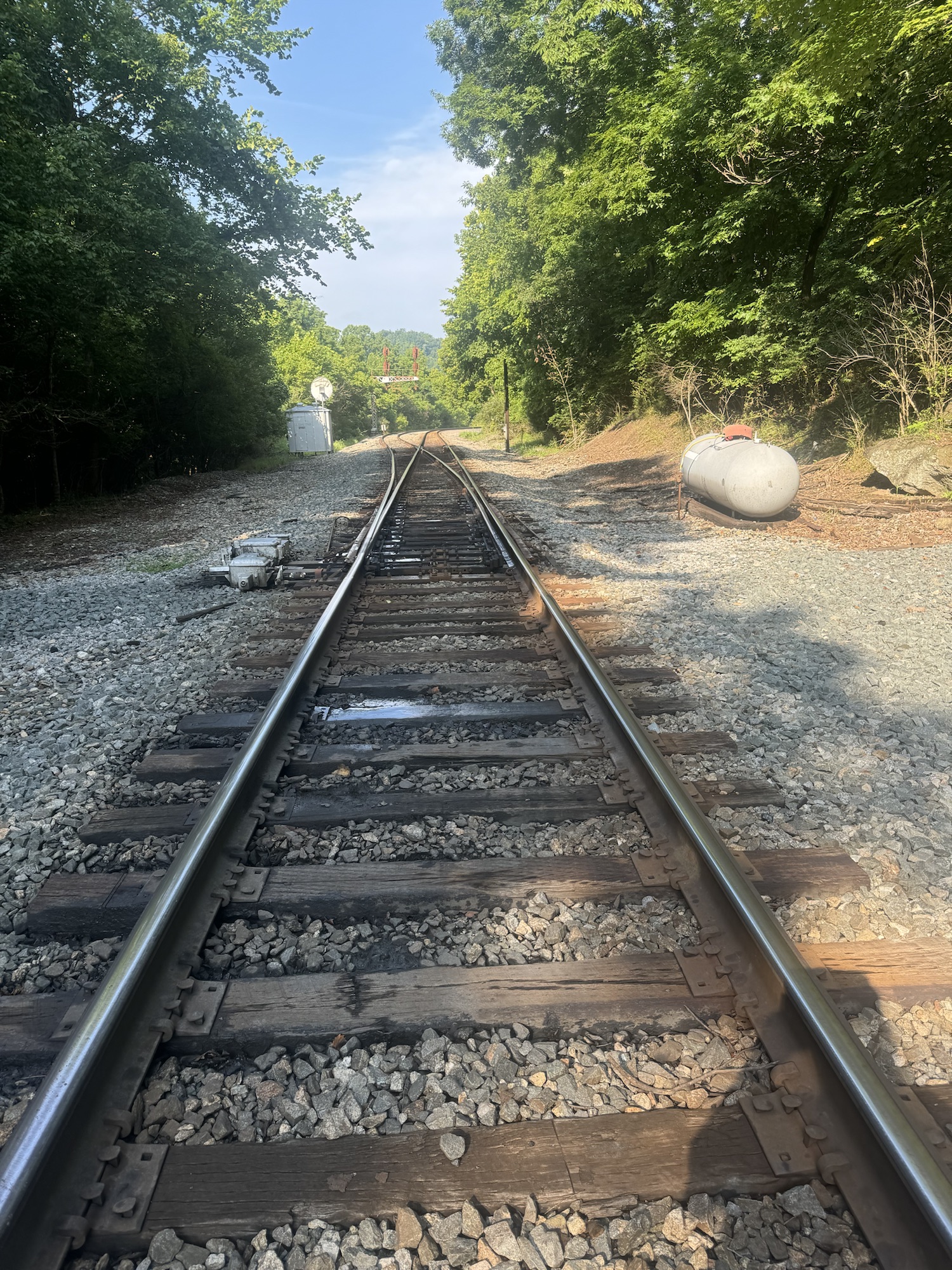
Set off in your own unique direction down the the tracks towards empowering your own health and fitness.
  1. Notice your narratives.  This is something that I have begun to notice more frequently. Reflect on how you talk/think about age with peers/friends/family AND self.  Is there often negative talk and thoughts associated with your current age and/or exercise?  Perhaps, you can begin to reframe those thoughts/chatter by leading by example.  Furthermore, look to role-models that motivate you to move more.  I personally often look at my Dad who still walks or hikes daily anywhere from 2-8 miles per day.
  1.  Find your edge. Whatever form of exercise we choose should challenge us, but not too much.  If something changes, and you sense you can do a little bit more, then do so.  But if doing a bit more causes serious discomfort, then back off, and try again another time. 
Map out your own fitness challenge.
  1. Strength train, stretch, and work on balance through practices such as yoga. The CDC in an article entitled,  “Older Adult Activity: An Overview,” states that in addition to cardiovascular exercise, such as jogging and walking, older adults also need to strength train and work on balance.  In fact, AARP offers a 10-minute, strength-training video that can be completed daily, seated or standing. 
  1. Manage your sleep and nutrition: There is a reason these two are often spoken/written about due to the fact both contribute positively, or negatively, towards your own health.  That said, one bad night’s sleep, one indulgent meal, or a day of eating very little, will not necessarily impact your overall health; however, consistently not getting enough sleep and not consuming proper nutrition will gradually, and negatively, begin to impact your physical and mental well-being. 
  1. Find your support or pave your own way.  There’s no one right fitness plan that works for everyone.  Find the type of movement/exercise that best suits your body and motivates you, which may mean exercising with a group, a friend, or at a club. That said, don’t be afraid to go it alone either and share the experience with others later.
Find your support!
  1. Exercise can be therapy. Personally, I know my mental health greatly benefits from movement. The National Institutes of Health, The Mayo Clinic, Mount Sinai, and numerous other institutions all point to the fact that exercise is a mood and mental health booster.
  1.  Tune in to your body’s needs with honesty and integrity. If you’re sick, tired, and/or run down, then maybe a day or two of rest may be what you need. If a joint, such as knee, elbow, wrist, or ankle begins to feel irritated.  Be curious about it.  Are you pushing a certain exercise too hard, too often? Or, are you not moving enough? Learning to listen to the signals our bodies send us is an important part of the exercise/movement journey.
Photo by RUN 4 FFWPU on Pexels.com

movement is medicine! 💊

When it comes to movement, no matter your age, focus on the positives of the experience–whether it is spending time with friends, benefiting your mental health, or feeling more overall strength, steadiness, and/or energy. To be sure, it is often hard to get started, but it is often that feeling of accomplishment you have afterwards that can keep you going. Finally, for those in the official AARP years, keep in mind, “older” doesn’t have to mean sitting on the sidelines. Becoming and staying active, however you define it, truly is medicine for imbuing well-being: socially, mentally, and emotionally. 

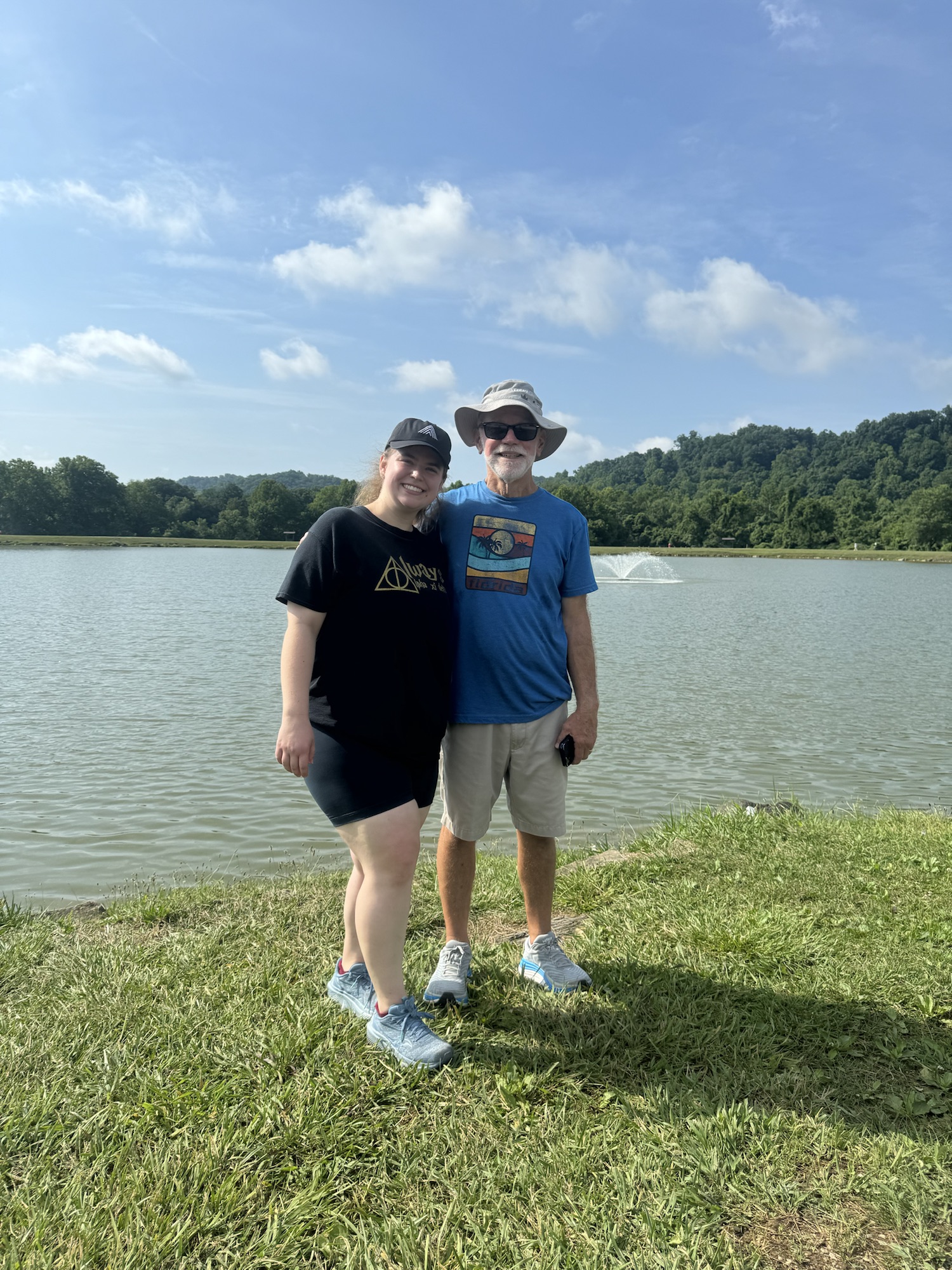
Dad and I pausing for a moment during hike this past summer at Barboursville Park.


Move into Health, Part 10: Create a fitness plan that meets you where you are

Photo by MART PRODUCTION on Pexels.com

I came across a quote only days after my recent ACDF surgery by Oprah Winfrey that read, “Challenges are gifts that force us to search for a new center of gravity. Don’t fight them. Just find a new way to stand.” It accurately summed up what I have been trying to do as I recover.  Find new ways to stand, sit, sleep, work, walk, etc. . . Of course, I am blessed that my surgery did not require more than one night’s stay in the hospital, and wasn’t more serious.  Nonetheless, surgery is no joke and recovery is for real.

My movement was limited for days following surgery.  I had to learn to turn at the waist, rather than use my neck. Additionally, I had to focus on using my stomach muscles to get in and out of bed to avoid straining my neck. And, all forms of exercise, except for walking, was eliminated per staunch medical advice that my family took to heart with frequent reminders. (They didn’t need to worry, I truly wasn’t feeling like doing much during those first few days.)

Photo by SHVETS production on Pexels.com

Walking, I was told by the release nurse, was to be completed every hour, even if it meant only completing one lap around the dining room table before I sat back down.  However, I was encouraged, once I got past what the nurse called the “recliner days”–days when swelling and inflammation (aka pain) was at the highest level–to try to walk 10-15 minutes each hour.  I had just completed a half-marathon, albeit slowly, only weeks earlier, and now this was my new fitness plan. What a shift!

So why was walking so important, even on those days when I didn’t feel like moving?  Well, it turns out there are numerous valid reasons according to my doctor and as described in countless studies out of the Mayo Clinic, University of Wisconsin, and in a 2020 US News and World Report article. Here are a few of the reasons cited:

  • Prevention of post-surgery complications
  • Enhances blood flow throughout the body
  • Increases the flow of oxygen throughout the body
  • Accelerates wound healing
  • Strengthens muscles and bones
  • Improves digestion (aka ability to poop) and the function of urinary tract while reducing bloating and gas
  • Reduces risk for blood clots, infections, and lung issues, such as pneumonia
  • Boosts mood and self-esteem  

Why do I share all of this?  To make the point that my old fitness plan was, and currently is, no longer appropriate for me.  I had to adopt a fitness plan that meets my body’s needs where it is.  Therefore, my current movement plan consists of short segments of walking completed throughout the day as I remain home recovering, which complies with medical advice from my doctor and best meets the needs of my body.  

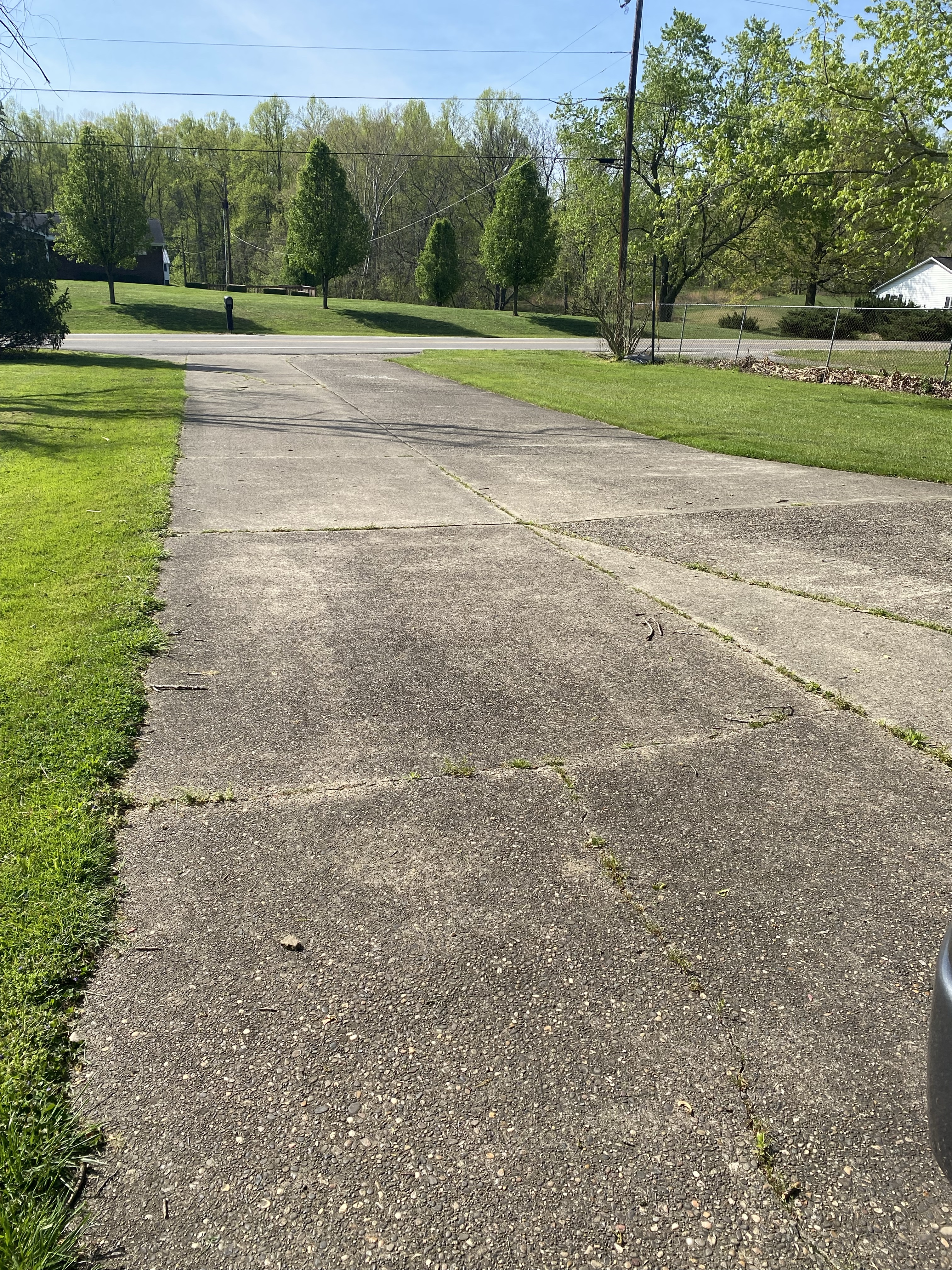
Gentle walking on my driveway or in my house is part of the slow and steady recovery plan.

At the time of writing this, I am entering my third week of recovery. After my two-week, post-operative appointment, I now have permission to begin to gently explore a few  strengthening exercises and stretches that can be completed without forward bending.  Additionally, I can begin to explore my neck range of motion with a few doctor approved neck stretches and strengthening exercises, but nothing more.  Slow and steady helps me find my new center of gravity.

Due to this experience, I want to continue to encourage you, Dear Reader, to carefully plan how you will enter, or reenter, your own exercise/movement plan this spring.  Create a plan that meets your needs, and commit to doing it–even if you don’t “feel like it.”  Personally speaking, I could feel angry and convince myself that if I can’t exercise the way I once did, then I won’t do anything at all. After all, it would be easy for me to sit around all day and use my surgery as an excuse to do nothing.  Conversely, I could try to push too hard with the delusion that, “The staff doesn’t really know ME,” and begin overdoing it with images of former, younger me dancing in my head

Instead, I have accepted the reality of my situation, rather than reject the medical advice I have been given.  They are the professionals, not me.  I have to meet my body where it’s at when it comes to fitness.  Sure, I have dreams of hiking again, walking (or jogging) the entire bike path of Ritter Park, and even practicing yoga with regularity, but none of those will ever happen if I don’t recover first.  And my first step in recovery is walking, so my body can focus on the miraculous work of healing.

Welcome walking into your life! You might be surprised by the benefits!

Therefore, no matter where you are, what shape you are in, or any other personal obstacles that you may be facing unbeknownst to me, I still encourage you to never give up on regularly incorporating movement into your day. Avoid the temptation to make excuses for yourself, but at the same time, don’t start off with a complicated plan.  Talk to your health care provider, and then start.

Start where you are.  If you don’t regularly move, then begin, like me, with short walks around your home, or up and down your driveway or sidewalk.  Do that 3-4 times per week.  The following week, add one more lap, or add five more minutes to your walk, and complete it 3-4 times per week.  Gradually, you will build up your time and the distance covered.  By keeping this up over several weeks, you will create the habit of moving.  Your body, lungs, and heart will be stronger, and I wouldn’t be surprised if you find you are reaping other unexpected benefits!

Think about this, my friends, if walking is scientifically established as one of the best tools for recovery after surgery, what can it do for you?  Don’t beat yourself up because you are no longer what you once were, you didn’t exercise over winter due to the cold weather, you’ve never really tried to exercise previously, or you’re somewhere in between, like me.  Start where you are at, and move one step at a time.  Rome wasn’t built in a day, and neither is fitness, but you have to take the first step, and spring is a great time to start.  

Here we go my friend, take my hand, let’s find that new center of gravity, and cross this bridge together, one healing step at a time.

Open the door to spring, and find your new center of gravity one small step at a time!

Move Into Health, Part 9: The Long Game

“ . . . To me, old age is always 15 years older than I am.”–Francis Bacon

I recently ran across an inspirational story that was being shared across a multitude of media outlets.  Jean Bailey, a 102-year old resident and fitness coach of Elk Ridge Senior Living in Omaha, Nebraska, has been leading fitness classes there, four times a week, for the past three years.  

 Bailey’s classes consist of exercises that go through a wide range of motion, designed to get every part of the body moving, including activities such as overhead reach, arm circles, neck rotations, and seated toes touches to name a few.  Her classes last about 30 minutes.  Bailey realizes that, like her, many of her fellow exercisers have mobility limitations or their bodies are different from day to day; however, she believes that everyone, including herself, can benefit from doing what they can do.  

102 year old Jean Bailey leading an exercise class at Elk Ridge Senior Living in Omaha, Nebraska.

Bailey is redefining what it means to age.  She proudly proclaimed in a recent interview, “If you don’t keep your mind and body busy, then why are you here?” Friendships have blossomed and flourished since she first began leading the classes during the pandemic when Bailey invited her neighbors to bring chairs into the hall and exercise with her at a socially safe distance.  

Since COVID restrictions were lifted, Bailey has also been known to treat fellow exercisers with baked goods after class, especially in honor of someone’s birthday.  This is because, as Bailey points out, birthdays at their age are noteworthy. When asked if she’ll ever quit, she replied, “When I get old, I’ll quit!”

I share this story as part of the 9th installment of the “Move Into Health” series. Bailey’s story serves as a direct contrast to those limiting beliefs, which can easily entrap any one of us, regarding adopting or changing certain healthy lifestyle habits as we age. However, even though our bodies change with age, according to numerous scientific studies, there is very little difference between an 18-year old brain and a 100-year old brain from a cerebrovascular perspective; thus establishing, we are never too old to mentally adopt new habits or overcome poor habits that may have crept in over the years.

Bailey is most likely an example of what scientists call SuperAgers, those living into their eighth decade, and beyond, who possess cognitive function similar to that of a middle-aged adult.  In fact, neuroscientists at Northwestern University in Chicago have identified four specific habits of SuperAgers. Adopting these four SuperAgers’ healthy habits may help slow down the aging process within the brain (and the body), potentially staving off Alzheimer’s disease or other forms of dementia, while boosting overall health; thereby, spending less time at the doctor’s office and more time doing the things you love.  

Photo by Wellness Gallery Catalyst Foundation on Pexels.com

The four habits of SuperAgers are listed below. While I am not a proponent of changing everything all at once, I do sincerely believe that taking small steps towards any of these habits can have a positive impact upon personal health.

Daily Movement/Activity. You know the old adage, “Move it or lose it.”  Incorporating daily movement increases oxygen and blood flow–both of which benefit the brain.  Regular bouts of exercise, even as few as twice per week, strengthen not only the heart and lungs but can also strengthen muscles required for stability to avoid falling, help maintain a healthy weight, and reduce the risk for Alzheimer’s disease. As an added bonus, exercise can reduce the symptoms of depression and anxiety and lower your risk for heart disease, type 2 diabetes, high blood pressure, and even some cancers.

Photo by Tirachard Kumtanom on Pexels.com

Challenge yourself. Adopt habits of reading, puzzle solving, and learning. Experiencing the mild to moderate stress that often accompanies learning a new skill is good for creating and/or maintaining healthy neural pathways. Take classes, learn a new language, or choose any number of activities that get you out of your comfort zone.  Mental challenges are good for you and your brain.

Photo by Mathias Reding on Pexels.com

Get social.  Meeting regularly with friends, engaging with others via group settings, or partaking in family gatherings allow for the maintenance of healthy social relationships.  In fact, autopsies of SuperAgers reveals that the attention area of their brain has four to five times the amount of neurons responsible for social processing and awareness, when compared to others who lived into their 80s or later.

Photo by Kampus Production on Pexels.com

Drink, but in moderation. Moderate drinkers are less likely to develop memory issues, including Alzheimer’s disease.  However, too much alcohol creates the opposite effect on memory as well as increased belly fat (the most dangerous type), increased blood pressure, and numerous other health conditions.

Photo by cottonbro studio on Pexels.com

Two other beneficial habits worth considering that are also associated with aging well:

Adopt a MIND diet.  MIND, in addition to being a huge buzz word in current medical research for the prevention of Alzheimer’s disease and cognitive delays, is an acronym for Mediterranean-DASH Intervention for Neurodegenerative Delay.  It is a plant-based diet that combines the Mediterranean Diet and the DASH Diets. The MIND diet encourages the daily consumption of plenty of fruits (specifically berries), and vegetables (especially leafy greens), whole grains, legumes, nuts, as well as limited amounts of poultry, fish, and olive oil.  Not only are these foods good for overall brain health and cognitive function, but they also reduce inflammation and oxidative stress, two actions strongly associated with chronic health illnesses and disease. 

Photo by Yaroslav Shuraev on Pexels.com

Quit smoking. While I cannot pretend to know how hard it is to stop this habit, I do remember a nurse telling my mother-in-law during an emergency room visit that within 24 hours of quitting smoking, she would begin to reduce her risk of a heart-attack by 50% or more.  It still took her several more years before she quit; however, I will forever admire the way in which she finally gave up the habit at age 71. Although health issues related to a lifetime of smoking remained with her until the end, because she did quit, she added years to her life.  

Photo by Irina Iriser on Pexels.com

Who among us will be the next SuperAger?  No one can know for sure. To be certain, any one of us could follow all the so-called rules, and still develop Alzheimer’s disease, cancer, or other detrimental condition.  Nonetheless, watching Jean Bailey lead her exercise classes on Youtube and Twitter videos certainly persuades me to keep moving into my own health, and her story further motivates me to continue to share this valuable information. Adopting any or all of these healthy habits can’t hurt any of us, and they just might add a bit more quality to the quantity of years we have remaining.  Here’s to your health!

Photo by Jessica Lewis Creative on Pexels.com

Mind Over Matter: Mental Strategies to Push Towards Your Movement Goals

“Put all excuses aside and remember this:  You are capable.”–Zig Ziglar

During my Saturday morning run this past week, there were numerous times I wanted to quit. It had taken me nearly two hours to complete, and it had not felt nearly as good as my last run at the exact same distance.  Nonetheless, I kept employing different mental strategies I’ve learned over the years and, ultimately, completed my goal.

Photo by Volker Meyer on Pexels.com

That run got me thinking about the importance of mindset and the mental strategies/techniques we sometimes need to employ to incorporate more movement and exercise into our lives.  Therefore, in this 8th installment of my “Move into Health” series, I will share several research based mental strategies for exercise/movement for those days when we “aren’t feeling it.”  Moreover, many of these tips can be applied to other areas of life, such as tackling difficult tasks.

The mind-body connection is powerful. Whether discussing exercise, or tackling a difficult/challenging project, it is important to recognize the influence of the mind-body connection.  From having a churning stomach in response to an upside routine change, such as shift workers, to coming down with a cold after prolonged exposure to a stressful event, our bodies respond to the changes in our mind.  Therefore, by understanding this connection, we can unleash its potential to positively influence our attitudes and choices, especially with regards to movement goals.

Photo by SHVETS production on Pexels.com

Be patient; remember the long game, and avoid comparison: As my decades continue to stack, the long-game is most often at the forefront of my thoughts.  By prioritizing the fact that I want to remain injury free, healthy, mentally engaged, and purpose-driven for years to come, I’ve had to slow down, make moderation a priority, and avoid comparisons to my past self, previous workouts, and definitely not to others.  It’s important to be clear on long-term life goals and determine how movement/exercise can benefit that plan.  When we see how exercise and movement can contribute to and enhance our bigger life picture, it provides a bit more motivation to get out there, even when we don’t “feel like it.”

  Let go of attachments, especially to perfection and the all or nothing mindset: Our mind can be a bit of a trickster and convince us that exercise and movement should feel, be, or look a certain way. That’s all nonsense. Sometimes, it doesn’t feel great, but if nothing is hurt or injured, we have to keep going.  Other times, we may have little in the tank or reduced time. Rather than throw in the towel, try another workout or shorten your workout time.  Some form of added movement is always better than nothing!

Photo by SHVETS production on Pexels.com

Embrace the unknown, including discomfort: Along with letting go of attachments to how exercise/movement should be, it is important to embrace the unknown.  Whether it is going to a new gym, a new exercise class, or walking in a new area, accept that it will feel uncomfortable and new for the first few times.  Likewise, it is important to understand that with muscle growth comes some discomfort, including sore muscles.  This is where it is important to discern the good pain from the “I-might-be injured” pain.  Most of our pain is the good kind, but we do need to pay attention to unusual or persistent pain.

Muscle has memory:  The more we exercise/move, the fitter we become, and the “easier” it is for the body to move.  This is important for those of us who are not “naturally” gifted athletes, or no longer spring chicks for that matter!  As our fitness levels increase, our likewise energy increases, making even everyday movement tasks feel easier.  Now that’s motivating!

Photo by Timothy on Pexels.com

Break “large” workouts into smaller tasks and start easy: When I am faced with a long run, I think about it in chunks, and I start slowly with a walk to build success.  With each successfully completed chunk, I mentally celebrate, “One-third down, only two-thirds left to go!”  I continue in this manner until I attain my goal mileage.  Additionally, I’ve applied this mindset across a multitude of workouts and projects unrelated to exercise.  

Visualize the feeling of success that comes with finishing, and don’t underestimate the potency of a smile:  This is a tool I employ before and during a workout.  I think about how good it will feel to know I accomplished whatever it is I set out to do.  By focusing on that feeling, I automatically smile.  Smiling starts a chain reaction of positive feelings coursing throughout my body, but especially my brain.  It is those good vibes that keep me going, and they can keep you going too!

Photo by Pixabay on Pexels.com

Adapt a “no-fail” mindset.  Since we do have that mind-body connection, we can harness the power of words to move our bodies. Create a mantra, or saying, for when your workout or movement gets tough.  I often talk to myself during, especially hard workouts.  I’ll use phrases like, “You can do this, Steph.”  “You’ve got this, Steph.” Other times, I use one word, such as, “Fortitude,” “Perseverance,” and “Tenacity,” which are a few of my favorites.  The key is finding the motivating word(s) that strengthen your resolve.

Power up with music and songs: Music doesn’t motivate everyone, but it certainly does a large number of us.  The right playlist can motivate and move you into action.  

Photo by Ketut Subiyanto on Pexels.com

Create a reward system: I call it the if-then principal.  If you do this, then you get to do this. Have some sort of reward system in place for yourself, and focus on it during those challenging workouts.

Have a purpose for your run:  I often have a prayer/meditation that I repeatedly say.  Other times, I run in honor of a veteran (Team Red White & Blue and Wear Blue) by writing the name of a veteran on my hand, or creating a list of several vets and tucking the list into a tiny pocket in my tights.  The point is that by adding a higher purpose to my workout, I attach greater meaning to a workout that increases my motivation.

Everyday may not offer ideal situations for movement; therefore, having a toolkit of mental “hacks” can help us push past our own resistance and/or excuses.  Exercise not only works only our muscles, but also our mental strength and, ultimately, our overall well-being. Combining the power of the mind-body connection, especially over time, improves both our physical well being and creates a more disciplined and determined mind.  So grab your toolbelt, and learn to attach and switch out any of these various tools to motivate you to move into health, so you never have a reason to give up.

Photo by RUN 4 FFWPU on Pexels.com

Find your own way to increased movement: SMART steady steps

“Set goals not for the outcome itself, but for who you get to become in the process.”–Jim Rohn

My husband and daughter recently gifted me with a popular, updated fitness watch to replace the one that I have worn for over ten years. The new watch has numerous bells and whistles that can be quite motivational to encourage movement, healthy sleep, heart health, and so forth.  However, the updated icon, consistent with the former version, tends to focus on unrealistic, outcome-based goals that are not necessarily appropriate for my unique age, gender, body type, and fitness level.  

The gadget, and its programmers, don’t know ME, the individual.  And therein lies the problem in these well-intended gadgets as well as the thousands of fitness plans found, not only on fitness watches, but also found on-line and in-print.  Therefore, in this seventh installment of my “Move into Health” series, my focus is about setting SMART movement goals that focus on your unique health needs and lifestyle.

Photo by Karolina Grabowska on Pexels.com

It is so easy and tempting to be swept away by programs with tantalizing titles such as, “9-weeks to a bikini bod,” or “8-weeks to your fastest 5-K,” or “Walk your way into a new jeans size,” and so forth, often made popular in January.  While there is nothing inherently wrong with any of these types of plans, I have personally found they tend to set us up for failure when our bodies don’t look like the 19-year old willowy model used in the workout plan, our running pace doesn’t match the 5-K plan designed by a former professional runner, or our jeans still fit the same in spite of all of our best efforts.  

Instead, there needs to be a way to personalize plans in order to adapt to individual health goals, interests, schedule, lifestyle, body type, age, and current health circumstances.  Thankfully, there is! 

This year, consider setting SMART goals that focus on the process of promoting your distinct health needs as a way to focus your movement/exercise habit, rather than predetermined outcomes. There’s no need to make outlandish New Year’s resolutions, despite what the exercise industry would have you believe.  We simply need to take steady, SMART steps.

Photo by Leeloo Thefirst on Pexels.com

SMART stands for Specific, Measureable, Achievable, Relevant, Time-bound processes.  

This acronym has been used for years across a wide array of disciplines and settings.  However, I find it just as useful as a tool for leaning into personal movement and health processes. Personally, I find far more joy, and little to no guilt-ridden feelings of failure, when I focus on the process of a goal, rather than a specific outcome of that goal. 

For example, I am currently training for a half-marathon in March; however, this year, I’ve adopted a SMART approach.  Completing the half-marathon in March is specific, measurable, and based on my own current level of fitness, is achievable within the 16-weeks for which I have been using to prepare for it.  What my plan is NOT attached to is a specific finish time or whether I will run, walk, skip, or even crawl across the finish line.  Instead, my focus is about the measure of fitness I will gain in the process.  

Photo by Ketut Subiyanto on Pexels.com

I am no longer worrying about the pace of my jogging or walking; instead, the focus is how I FEEL before, during, and after each workout with a close eye on how my heart rate is responding.  If it takes me twice as long as it takes others to complete a certain mileage, I am absolutely ok with that.  This journey is about the scenery along my path as well as improved cardiovascular health, better sleep, reduced anxiety/stress, and the gift of time to listen to great playlists, podcasts, and audiobooks.

Your goal may not look like mine, but that is not the point.  Rather, think about what process you want to embrace?  Increased movement throughout your day? Improved cardiovascular health? Increased flexibility and range of motion?  Maybe a little bit of all three, or maybe something completely different.  Once you have decided, work through the SMART process to develop your approach.  Take time to write it down or type it up.  There is something about the power of slowing down your thinking, and then putting your thoughts down in some form of print that brings clarity to your ideas.

Photo by Polina Zimmerman on Pexels.com

Begin first by simply reflecting on your current health status as well as current lifestyle.  What could YOU realistically do to move the needle towards a gentle process of increased health.  Be honest in your self assessment, but NOT judgemental.  Once your idea is clear, write/type your thoughts using the SMART steps:

  • Be specific:  Is your goal clear and defined?  For example, the ability to walk for ____ minutes without stopping, or increased stamina to finish a 5K, or the strength to carry ____ grocery bags into the house independently.
  • Measurable: Can it be tracked or measured? How do you know if you are making progress? If your goal is to walk without stopping for a certain amount of time, perhaps each week you dedicate three days per week to walking, starting with the length of time you can comfortably walk now, and increasing that time by one minute each successive week as long as your body is comfortably recovering.
  • Achievable: Will the process be challenging but attainable?  This is the sweet spot that only you can determine.  For example, given your age and health status, walking a 5K may not be realistic, but perhaps focusing on the process of walking 15-20 minutes may be attainable with small incremental increases in walking time over several weeks or months.
  • Realistic: Is your goal relevant to your life purpose?  For example, my life purpose is to remain mobile, heart healthy, and mentally agile in order to make a positive contribution to others for as long as I possibly can. Therefore, challenging myself with a process of increased cardiovascular health is one of a handful of processes I can realistically develop.
  • Timely: Can you set a date in order to hold yourself accountable to the process? This is why the process of training for half-marathons works for me.  I can choose an event that fits my schedule, and gradually build towards that goal.  Plus, I make a monetary commitment, which I know will hold me accountable.  Along the way, I find ways to celebrate, enjoy, and embrace each little step in the process.  Once the date has come and gone, I will consider my next SMART process that will further my health and ultimately, life purpose.

You do not have to run/walk a half-marathon like me to embrace the process of SMART goals.  The point is to let go of certain outcomes established by others who don’t know you nor have your same values.  Rather, get clear on your life purpose, then ask yourself what you can do to improve your own health towards achieving that goal.  Don’t beat yourself up with unrealistic expectations of others.  Get quiet, get honest, and get “smart.”  With this clarity, you will be able to come up with the best approach for you.

Here’s to your smart version of healthy in 2023.  May you continue to fulfill your own life purpose with vitality!  And, don’t hesitate to reach out, and let me know how it’s going!  I am cheering for you!

Photo by Andrea Piacquadio on Pexels.com

Exercise your right to JOY

“Around the world, people who are physically active are happier and more satisfied with their lives.”–Kelly McGonigal

“Movement awakes and activates many of our mental capacities.”–Carla Hannaford

Photo by Andrea Piacquadio on Pexels.com

I was going through the movements of getting ready for my work day half-heartedly listening to a podcast whose title had promised much.  Unfortunately, like many podcasts, it ended up being another interview designed to promote the sale of a book. My phone was off to the side, away from my point of focus, so I didn’t immediately stop the interview.  

Despite my lack of focus/interest, my ears perked up when I overhead a nugget of an idea.  Unfortunately, I cannot quote the idea precisely since I wasn’t fully focused.  However, the kernel of its intent resonated with me.  It was the idea that the main focus of exercise should not necessarily be to get “fit,” to maintain or lose weight, sleep better, or any of the other valid reasons.  Instead, the main goal of all exercise/movement should be to increase joy.

This was such an interesting thesis that I had to dive more into the topic, and it turns out science has quite a bit to say about this.  Of course, I nearly always feel better when I can integrate movement into my day.  Plus, I typically felt better after more “formal” exercise sessions.  However, this was all anecdotal.  

Photo by Pixabay on Pexels.com

Before diving into the research a few days later, my mind kept going back to the notion of reframing our relationship with exercise.  Dropping the typical exercise narratives–weight management, fitness goals, therapeutic/emotional release, better sleep and so forth was fascinating. Of course, exercise provides all of those goals and more, but the idea of letting those be the side dishes, and allowing joy to be the main course was intriguing.

After perusing numerous articles, I became super excited; I knew this information needed to be shared with my local community and beyond.  This felt especially important since I have previously written pieces fostering the notion that movement is for every unique body–even those with limitations, and it can be incorporated into daily life even on the busiest of days.  Armed with this information, I was ready to spread the word: More Movement = More Joy!  

Photo by Suzy Hazelwood on Pexels.com

Exercise, even in short bursts of time, improves one mood. A study conducted by West Virginia University found that middle school students who regularly exercise feel overall happier.  This was a no brainer! Ask any educator what their students’ behavior and mood is like on days they don’t have recess versus days they get it, and you’ll most likely get an earful.  Kids instinctively know they need movement, and if they can’t get it via the playground, athletics, dance, etc.–they are going to find ways to move more animatedly in the classroom.  Otherwise, if kept from moving, they become sullen, whiney, moody, or even combative/confrontational. And, this is also true for adults.

Interestingly, in one study, researchers determined specific movements that not only are associated with the feeling of joy, but also enhance the joy when completed.  These include: reaching, swaying, bouncing, shaking, jumping, and an action called, “celebration,” an action that mimics tossing confetti overhead with both hands. One researcher, Kelly McGonigal, writing for the New York Times, created, shared, and posted a video in the article, “The Joy Workout”, based upon these specific movements.  The video is approximately eight minutes long, and can be easily accessed through a quick click of keys.  (It is important to note, after giving it a try myself, not all movements are appropriate for those with limited mobility or injuries; however, movements could be modified or even completed while sitting.)  

Photo by Harsh Raj Gond on Pexels.com

Another interesting study I ran across stated that simply standing, sitting, or moving with a more open posture, as opposed to a closed posture, can likewise increase positive feelings.  Moreover, a smaller 2021 study focused on participants who were asked to go through a series of movements similar to those McGonigal studied.  Once more, movement, even those completed in a seated posture, increased feelings of happiness. Clearly, exercising with the goal of joy in mind is not a crazy notion.

My research continued, including studies from the University of Michigan, University of Iowa, University of Texas, and Northeastern University, just to name a few.  What I found was that scientists tended to agree that all forms of exercise/movement are beneficial when performed safely.  That said, aerobic exercise currently seems to have a slight edge overall in brain boosting potential, but that may be because it appears to be the most researched. However, all conclude that exercise and movement benefit the young, seniors, and all ages in between.  Whether a short burst of activity or a more formal workout, movement ameliorates the effects of depression and anxiety by boosting the production of serotonin, and other feel-good chemicals and decreasing stress-inducing hormones. 

Exercise your right to enJOY movement with friends and family.

When we move, we increase our heart rate, which, in turn, moves more oxygen to the brain. As numerous studies indicate, increased oxygen to the brain mitigates symptoms of anxiety and depression. Furthermore, movement/exercise, when repeated frequently enough, can give rise to new neurons in the hippocampus, the area of the brain responsible for not only emotions, but also memory and learning!  This means that movement/exercise not only affects your brain in the moment in which you are participating, but it also makes positive structural changes over time.

So back to “The Joy Workout.” Does it work?  Well, only you can decide that. I will say that I found it clever, cute, and definitely made me smile.  However, you do not have to do “The Joy Workout” in order to feel joy in movement.  I found multiple, what I like to call, “movement-snacks,” videos and apps that offer 10-minute or less movement breaks if that’s your thing, such as the 7-minute workout, available on-line and in app version.  

Joy can be increased through movement, step-by-step.

Of course, there are so many other ways to increase movement from taking short walk breaks, to parking farther away from your destination, from walking to another floor for a restroom break to simply stretching or walking/marching in place on commercial or pop-up breaks, and so much more. The important thing, researchers noted, is that you find ways to move and/or exercise that you enjoy, that can easily be incorporated into your daily routine, so that you will do them on a regular basis in order to reap all those joyful benefits.

Ultimately, who doesn’t want to feel more joy moving into the new year?  Help boost yourself towards that goal by determining ways you like to move.  The worst movement mistakes you can make are inactivity or repeatedly moving/exercise in a way in which you dread it.  Let’s keep it simple.  Focus on moving more, smiling more, and feeling more joy overall.  It doesn’t have to be any more complicated than that.

Take a leap of faith, move for joy!

Good Fitness Doesn’t Have to Cost an Arm and a Leg

To enjoy the glow of good health, you must exercise.”–Gene Tunney

For the past two months I have written a couple of pieces focused on the importance of incorporating movement into your life.  It is my belief that movement benefits everyone and can add years to your life and life to years.  Therefore, this month, I’d like to blow open the myth that fitness requires a gym or club membership and/or requires special, and often, expensive equipment.  Rather, I’d like to shed light on free, nearly free, and budget friendly ways to increase movement and exercise.

Remember, in a capitalistic society, corporations and businesses want to make money.  Not that there’s anything inherently wrong with that, but my point is that you do not have to buy into all the slick and pretty packaged marketing!  As a consumer, you DO have choice.  So when those social media pop-up ads try to convince you that you need this “exclusive, just-for-you, one-time only offer” for a studio/gym membership or the “latest, greatest, in-debt-til-die exercise equipment, you absolutely have my permission to walk away—for real.

Photo by Liliana Drew on Pexels.com

In fact, walking, according to both the Mayo Clinic and University Hospitals 

Network is considered, “just as good as any other form of exercise.”  Of course, walking at a steady pace for a given period of time is the best, but all forms of walking count towards your overall health.  Walking for exercise is free, all you need is a supportive, comfortable pair of shoes.  It can be completed solo or with friends.  Plus, it can be completed in a multitude of  indoor and outdoor sites.  However, walking isn’t the only inexpensive way to increase movement and exercise into your life.

You can do housework or yard work as a workout.  Cue your favorite up-tempo tunes, set a timer, if you’d like, and get to work.  Keep moving until the job is done or the timer rings–whichever works best for you. 

Photo by RODNAE Productions on Pexels.com

If you have younger kids or grandkids, play with them.  Take them to a park if you don’t have access to a yard.  Better yet, ask them to join you while you walk, bike, hike a trail, or jog.  Play soccer, shoot some hoops, throw frisbee, toss a baseball or softball.  Other options include, but are not limited to, volleyball, pickleball, tennis, golf (make sure you’re walking if you want the full workout), badminton, and so on.  There are so many ways to move, play, and enjoy your kids/grandkids and even get to know some of their friends. Of course, all of these activities can also be enjoyed with friends!

Free workout options include walking, pushups, planks and walking up and down the steps of your house.”–Joe Cannon, MS, certified strength and conditioning specialist, NSCA certified personal trainer

Photo by Nathan Cowley on Pexels.com

Make use of equipment at home and youtube videos (or other sites to which you may have access).  With just your body weight, a chair, and stool, you can get a whole body strength workout. You can even use canned goods and water bottles/jugs as “weights.”  Honestly, there are so many free workouts available online that require little to no equipment that can provide fantastic cardio and/or strength workouts.

Two worthwhile items I do regularly use are a quality yoga mat and athletic shoes.  Both of these are versatile and worthwhile investments.  The yoga mat not only can be used for yoga, but it can also be used for any type of exercise that requires time on one’s back, belly, hands, and/or knees.  This one time investment is portable; it can be used on a back deck or patio, carried to the park, or taken along when traveling.  Similarly, a pair of good-fitting shoes are just as versatile.  Personally, I am always willing to invest a bit more for personal service to determine a proper fit for a supportive workout shoe from my local neighborhood running/walking store. (Shout out to Robert’s Running and Walking Shop!) 

Photo by Tirachard Kumtanom on Pexels.com

Other pieces of inexpensive equipment to consider:

  • Exercise bands and/or tubing (love these inexpensive items!)
  • Free weights, kettlebells, and/or medicine ball (in light, medium, and “heavier” variations)
  • Jumprope
  • Step bench (can be used both for cardio and strength training)
  • Fitness ball (can be used for a variety of core exercises)
  • Exercise DVD or apps (many apps are free or a low-cost)

Learn to be a savvy shopper.  You don’t automatically have to buy from one place, nor do you need to purchase items all at once.  Gradually add pieces, and consider purchasing used items on Amazon, eBay, Facebook market, Goodwill, and consignment shops.  I am often amazed at what I find at both Goodwill and consignment shops for next to nothing.

Budget friendly pieces of exercise equipment can be gradually added to your collection. You can even build your own step bench.

Personally, I love to find free fitness plans on-line, and modify them to fit my age/fitness level.  There are so many good sites, many of which I outlined in a previous article.  Once you find a plan you like, there are no decisions to make.  Simply follow the outlined plan for the set-number of days/weeks.  Your heart, mind, and body will thank you.  One word of caution, however, be sure the plan is appropriate for your level of fitness.  You want to set yourself up for success, so choose wisely.

Other budget-friendly tips include:

  • Split a gym membership with a friend.  Many gyms offer a payment plan that allows you to bring a friend for “free” for x-number of workouts. 
  • Join walking or running clubs.  Many parks, walking/running shoe stores, and even some malls offer these for little to no cost
  •  Join community gyms.  Many religious centers and some communities offer gym memberships for little cost to no cost.
  • Try donation based classes.  Many yoga studios and community centers offer weekly donation classes that are paid as or if you can.

Bottom line, you absolutely do not have to pay much, if anything, for a quality workout.   Other than perhaps quality footwear, you can absolutely get an excellent workout without spending any of your hard earned money.  Therefore, don’t let budgetary restrictions keep you from putting a little pep in your step and vitality in your years. Exercise your right to ignore those money-mongering marketers, and take charge of your own health AND budget! 

Photo by Andres Ayrton on Pexels.com

Moving into health for every body: Tips for fitting additional movement into your routine

“Changing ‘exercise’ to ‘movement’ was a game changer for me . . ..” –@brittanilancaster (Tik Tok)

Last month, I wrote about the importance of rethinking exercise and the benefits of incorporating movement into your daily activity.  Nevertheless, it isn’t always easy to plan, begin, and stick with a program.  You may have the best of intentions, only to be derailed by life.  Don’t feel guilty or ashamed by this–many of us, including myself, have been there on more than one occasion. Consequently, I am not writing to preach or make you feel bad. Guilt is not, in my opinion, a sustainable motivator; however, as I have previously stated, mood does follow action.  Therefore, this month will focus on actionable steps to starting, or returning, to a routine plan of movement.  

Photo by Bich Tran on Pexels.com

 Honestly, the best form of movement is the one YOU will enjoy doing, but in case you’re not sure, here are a few considerations. 

  • Solo or buddy/group system. Personally, I think it’s important to know if you’re a solo-type of exerciser or one who would stick to a program better with a buddy or a group.  Some people prefer, and are more likely to follow through, with an exercise buddy or group.  While others tend to like more solo endeavors.  Knowing your preference may increase your chances of a more positive movement experience.
  • Choose an activity that you like.  It goes without saying, but I am going to state it again, if you dread exercise, you are probably not going to stick with it.  Ideally, find a form of exercise that makes you feel happy, empowered, and/or confident.  Do you love talking and/or sharing the latest juicy tidbits with a friend?  Then, choose an activity that allows you to do that while moving, such as walking.  Do you crave alone or quiet time?  There are many types of exercise that can lend you that much needed head-space for “me-time,” such as walking, biking, or strength training to name a few.  Are you motivated by instructors or group energy? Try one of the myriad of group fitness classes offered by gyms, fitness centers, or studios. And by all means, if you try one form of exercise, and you don’t like it, don’t throw in the proverbial sweat towel, try something else! 
  • Be realistic and start small.  In an ideal world, we would all follow the Department of Health and Human Services guidelines and exercise moderately 150 minutes per week–typically divided into five days for 30 minutes per day.  However, your schedule may only allow for three or four days and/or 15-20 minutes per day.  That’s okay.  Commit to a realistic routine and time.  Better to work within your schedule and be consistent with lesser amounts, than to do nothing at all.
  • Make it part of your weekly routine. Brainstorm ways to reduce or eliminate barriers.  Schedule exercise times into your smart calendar and set reminders, so nothing else can be scheduled during this time period. Schedule workouts with a friend in advance to build accountability, or use smart watches and/or fitness apps that allow you to link with friends, during workouts. Set out clothes, water bottles, equipment, snacks, and so forth, ahead of time. (I actually lay out all of my workout clothes for the week, set them in one stack by the bathroom, so I can grab and go quickly each morning.) 
  • Remember to reward yourself.   “If I do this, then I can do this.” Think about what really motivates you, and then set mini-goals towards that reward. It could be as simple as giving yourself permission to watch your favorite guilty-pleasure TV series for thirty minutes after completing a workout, or heading to your favorite local coffee or smoothie shop with a friend after completing a week’s worth of goal workouts. With consistency, health rewards will also naturally begin to occur, such as, sleeping better, greater sense of self-esteem, reduction of stress, lowered blood pressure, etc.
Photo by Polina Tankilevitch on Pexels.com

“Day 29 of exercising for mental health. Finally feeling like myself again.  I can’t believe I’ve gone my whole life without this.  Love watching my heart and lungs get stronger so quickly.  Getting my appetite for life back.”–@claraandherself (Tik Tok)

Barring any health issues, here are a few ideas for working around common obstacles that often occur when starting and/or maintaining an exercise program.

  • Have flexible expectations. Sure, we’d all like to look and move like a Marvel or DC superhero, but that’s not realistic, especially when first starting a new exercise routine or new form of exercise.  As the saying goes, “Rome wasn’t built in a day,” and any exercise program takes time.  However, little-by-little, improvements do occur, including moving with greater ease, less fatigue, feeling overall better/stronger, or even sleeping better.  It won’t happen overnight, but with a fair amount of consistency, improvements will occur.
  • Self-kindness and self-compassion always. Nobody is perfect. Kick ideas of perfection out of your head. Setbacks, illness, injuries, and other unplanned interruptions are going to happen.  If you miss a day here or there or if you have a time span in which your workout plan went out the window, don’t let it derail your overall goal of lifelong wellness. Offer yourself the same compassion and understanding that you would offer a friend.  Then, as soon as you can, get back to it–even if it means easing back into it or changing/adjusting your plan
  • Avoid the all or nothing attitude. You do not need to spend hours each day engaged in exercise to reap the benefits.  Even modest amounts of time will benefit your physical and mental well-being, and that could even include 5-10 minute movement breaks interspersed throughout your busy day!
  • Slide day mentality. Don’t get me wrong.  I am not giving you permission to let exercise slide.  Instead, while you may have certain days/time you prefer exercise, be willing to slide a workout to another time or day of the week in order to accommodate week to week schedule fluctuations.  Likewise, if you’re short on time, reduce your total workout time.  A short workout is still better than no workout at all!

I encourage you to banish those limiting beliefs about movement and exercise.  Ignore the toxic, guilt-inducing, body-shaming misinformation about exercise circulating on social media.  Exercise movement is all-inclusive and should be a positive experience for EVERY BODY.   

Photo by Mikhail Nilov on Pexels.com

Of course, I am not a medical professional, as such, it’s always best to talk to your family health provider before beginning a new movement program.  That said, as a so-called “non-athlete,” exercise has made a huge impact on my own physical and well-being, and I’ve watched it do the same for so many other dear ones in my life.  It is my hope that if you are not currently incorporating much movement into your life, you will consider starting today.  If you  already embrace exercise, keep it up, and while you’re at it, grab a friend to move with you!

Wishing you the best health, Dear Reader!

Banish any limiting beliefs you have about exercise.  Ignore the toxic perfect perfect body images of exercise as well as misinformation.  Exercise is all-inclusive and should be a positive experience for EVERY BODY!
Photo by PNW Production on Pexels.com