Embracing Silence: The Owl’s Call to Mindful Listening

A wise old owl sat on an oak;
The more he saw the less he spoke;
The less he spoke the more he heard.” —old proverb

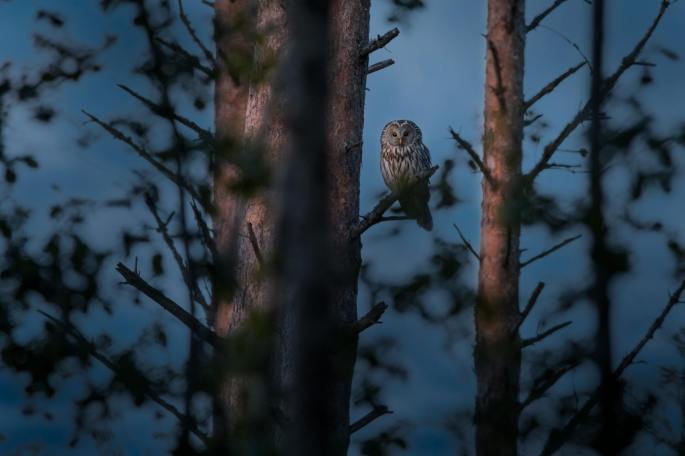
A wise-looking owl perched on a branch in a dark, wooded area, illuminated softly by moonlight.
Photo by Erik Karits on Pexels.com

Listening in the Dark 🌌

I am an early riser, typically awake before the sun. A few weeks ago, my ears perked at the haunting, penetrating call of an owl. Its “Hoo-hoo-hoo, hoo-hoo” echoed around our yard as I looked out into the murky dark. Since then, I intentionally listen for its steadfast call. It has become both a comfort and a mystery—an invitation to listen, reflect, and learn something new.

The owl’s call continues, I am certain, even when I am not listening; yet it requires my full attention in those predawn hours if I hope to notice it regularly. Its presence illustrates the importance of listening and discerning with care and purpose.
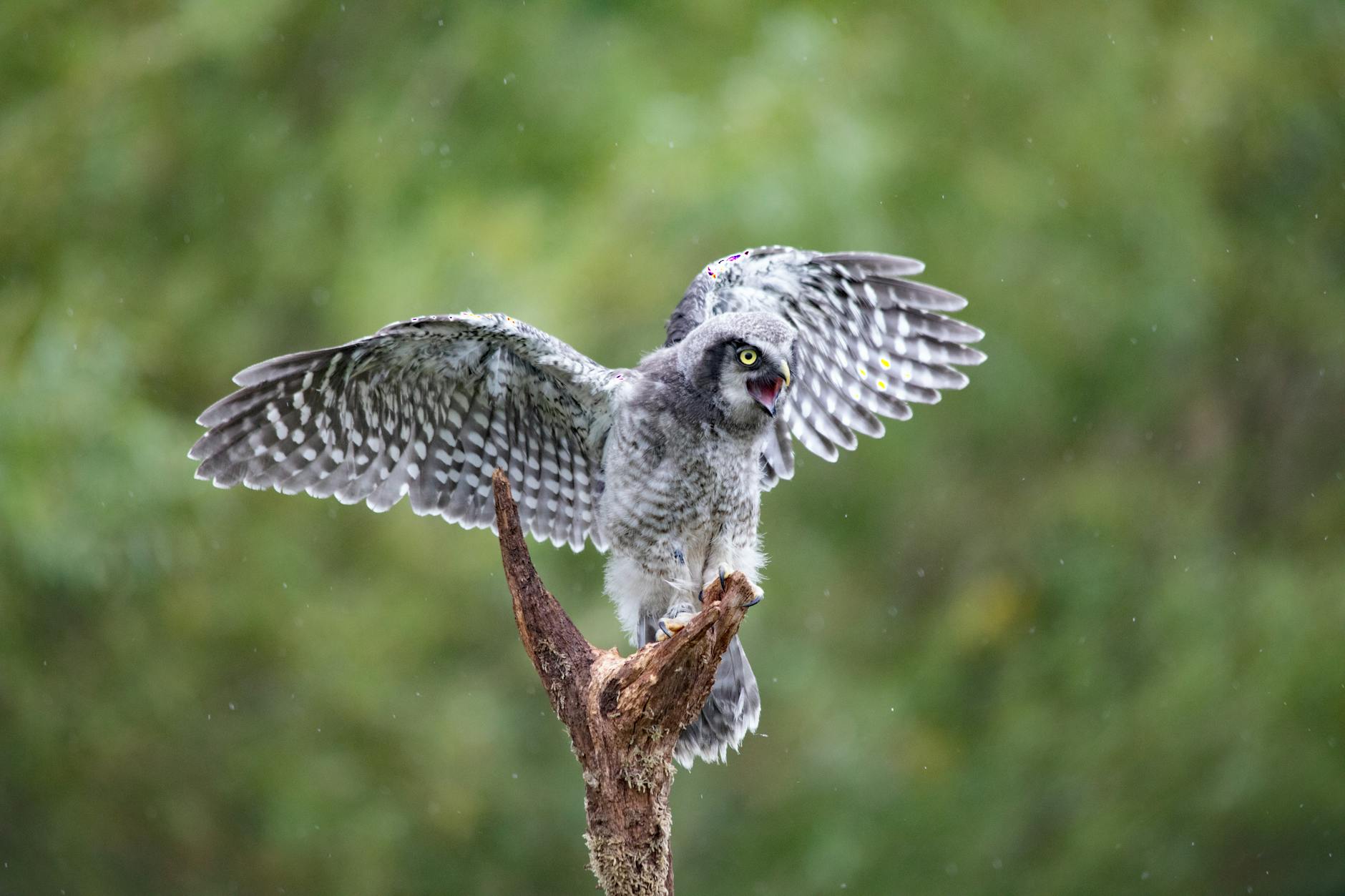
A grey and white owl perched on a branch with wings partially spread, showcasing its feathers and an alert expression against a green blurry background.
Photo by Petra Ryan on Pexels.com

What Owls Teach Us About Voice 🗣️

The autumnal hoots I hear, I learned after a bit of research, are used mostly to communicate territory and to call to potential mates. (It is worth noting that many owl species mate for life, finding another only if a partner dies or becomes separated.) Owls also use distinct calls to warn a mate, their nestlings, or even neighboring owls when danger is near. Only when the threat is imminent do they screech, hiss, or snap their beaks in defense of their young. Like the owl, we, too, can carefully choose when to use our voices amid the noise of the world, saving our own form of “screeching” for the rarest and most necessary moments.
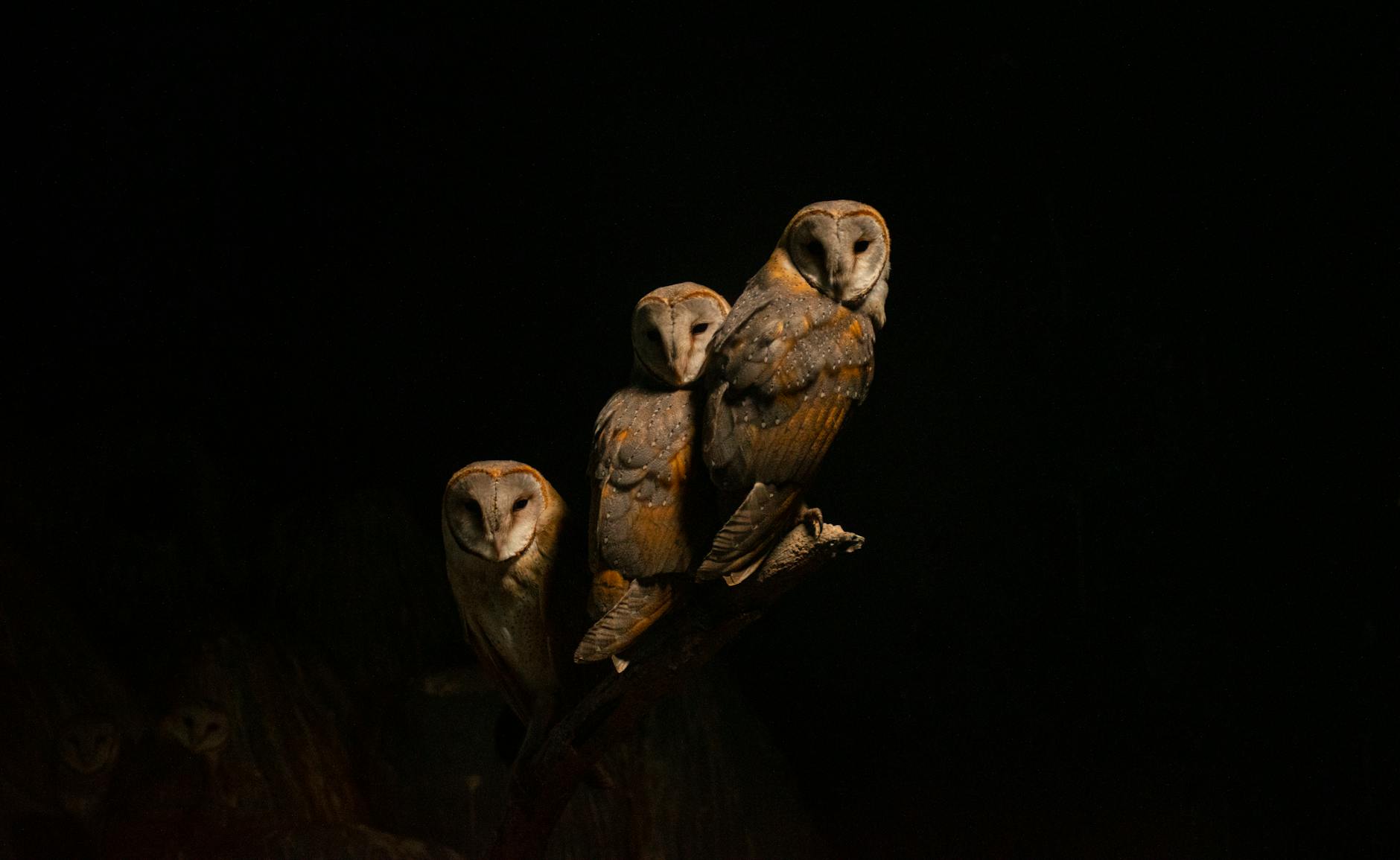
Three barn owls perched on a branch in low light, showcasing their distinctive features against a dark background.
Photo by throughmylife_in_ INDIA on Pexels.com

Signals of Respect and Coexistence 🦉

As I read more, I couldn’t help admiring how owls communicate—practically, respectfully, almost as if to say, “I am here. You are there. Let us coexist with our shared resources and help ward off danger.” To be certain, I am personifying and simplifying their communication, but perhaps there is a lesson for us. In a world that often isn’t equitable in its distribution of resources, space, or power, maybe we can learn the art of signaling like owls—communicating truthfully and transparently without silencing others. What if we approached our conversations with presence, restraint, respect, and a shared awareness of the landscape we inhabit?

Holding Our Ground with Grace 🙏

Hearing the owl’s early morning “Hoo-hoo-hoo, hoo-hoo” reinforces the importance of holding our own ground—our principles, values, beliefs, and even compassions—without becoming loud or defensive. The owl does not insist on being seen; rather, it asserts its message with a reserved dignity. We, too, can claim our “territory” through composed conviction and fairness, standing firm without demeaning others. Faith in our tenets, like my unseen morning owl, calls us to trust what cannot be seen but can be discerned only in stillness.

A tall tree with orange leaves against a clear blue sky, surrounded by a grassy area and a house in the background.
Fall is a time of release and renewal.

Autumn’s Invitation to Adapt 🍂

Autumn is a season of release and preparation. Light softens, signaling leaves to fall as trees ready themselves for winter’s quiet work. Many creatures follow this rhythm, including the owl in my backyard adapting to the shifting season. We, too, are invited to adapt—to let go of what is no longer needed, recalibrate our priorities, and listen more deeply. The natural world thrives on balance, which is different from our human desire for “fairness.” It exists in a subtle harmony in which every being plays a role. I wonder what might happen if we focused more on harmony—the give-and-take of shared ecosystems and resources—paired with the wisdom of knowing when to listen and when to speak.

A woman in a pink hijab interacts playfully with a barn owl perched on her arm, pointing towards its face, with another owl visible in the background.
Photo by Rangga Aditya Armien on Pexels.com

The Harmony of Coexistence 🕊️

The autumn owl’s voice in my backyard is solitary, and yet it reflects community. It marks its presence while acknowledging the presence of others, including us. Coexistence, the owl teaches, requires more than hearing what others say; it requires listening to the silences. Of course, human coexistence is complicated, and life often isn’t what we would call fair.

Therefore, it becomes incumbent upon us to listen, act kindly, and withhold judgment—offering small or not-so-small acts of goodness to help restore balance. This may mean choosing gentleness, or even silence, over the need to be “right,” especially when a loved one, friend, or coworker says or posts something unkind or expresses an opinion we strongly oppose. Likewise, offering compassion instead of judgment when someone is rude or ill-behaved can shift a moment for the better, even if only because we have refused to be pulled into energy-sapping negativity.

A serene forest scene with tall trees bathed in soft rays of sunlight filtering through the branches, creating an ethereal atmosphere.
Photo by Atlantic Ambience on Pexels.com

Before the Light Returns 🌅

The owl still calls unseen in the dark predawn hours, reminding us that communication, connection, and hope often begin before the light returns. The owl does not question whether the sun will rise; it simply continues its call, trusting the rhythm of creation. Like my unseen neighbor, I pray we find the courage to speak fairly, listen deeply, and have faith in the unseen process—knowing that every voice lifted in love and fairness echoes far beyond what we can see.

Perhaps that is the heart of the owl’s lesson: when we listen more deeply, we create the conditions for fairness to grow. As I recently read, “Life isn’t fair. It isn’t, which is why people should endeavor to be more fair to one another, not less.” —Kate Quinn.

Sawubona: How this one word could change the world

“Every individual matters. Every individual has a role to play. Every individual makes a difference.”–Jane Goodall

Photo by Savvas Stavrinos on Pexels.com

Listening to a podcast recently, a word piqued my curiosity.  Sawubona.  The speaker stated that this term had a moment of notoriety in the 1990s in the business world based upon a book written to encourage companies to solve group problems through various systems of learning.  This may explain why I never heard of it up until now as I was, and still am, in the field of education as opposed to business.

As I understand it, at its most basic level, it is a Zulu expression of greeting, another way of saying “hello.”  However, as heard in the podcast, and confirmed in later reading, its meaning is far from a common greeting.

Depending upon the source read, Sawubona, means “I see you,” or “We see you.”  In response–again, depending upon the source–the other person greets, “Yebo, Sawubona,” (Yes, I/we see you too), or “Shiboka” (I exist for you).  Regardless, it is the seeing of the other person and acknowledgement of existing to help the other, that most stood out to me. 

Photo by Sora Shimazaki on Pexels.com

Quite often, in our morning rush, our greetings and responses are typically short, polite, and given with a smile as we promptly move on to our work and/or day at hand.  Certainly, there are occasions when we pause long enough to ask about a specific event or person, but as our schedule often demands, we listen, long enough to be polite before moving quickly on, without really looking.  

I know I do this, and I feel fairly certain that I am not the only one.  Therefore, I do not want the thesis of this piece to be interpreted as finger wagging or shaming.  Instead, I hope to provoke some thought regarding the importance of seeing our shared humanity in one another and existing in a state of respect –even if we don’t see eye-to-eye with everyone with whom we meet.

Photo by Yan Krukau on Pexels.com

Respect, according to Merriam-Webster, is derived from the Latin root, respectus, which means, looking back (at), refuge, regard, and consideration. The beauty, to me, of Sawubona is in the underlying message of regard for the other person. I SEE you is such a powerful acknowledgement. It is a way of communicating that I SEE (regard/consider) your uniqueness, your talents, and your gifts, no matter the differences we may have.

I once heard a story of a farmer who espoused hate towards a certain political figure.  As it turned out, the politician asked to visit the farmer for a conversation.  The farmer told the politician’s team that he felt reluctant for the politician’s visit because the farmer espoused a certain faith, and given the public servant’s political status, the farmer assumed the politician could not possibly have a faith affiliation.  Nevertheless, a meeting was arranged, and the two men of opposing sides walked the farmer’s land together as the farmer talked and shared his concerns about his way of living.  The political figure looked and listened. 

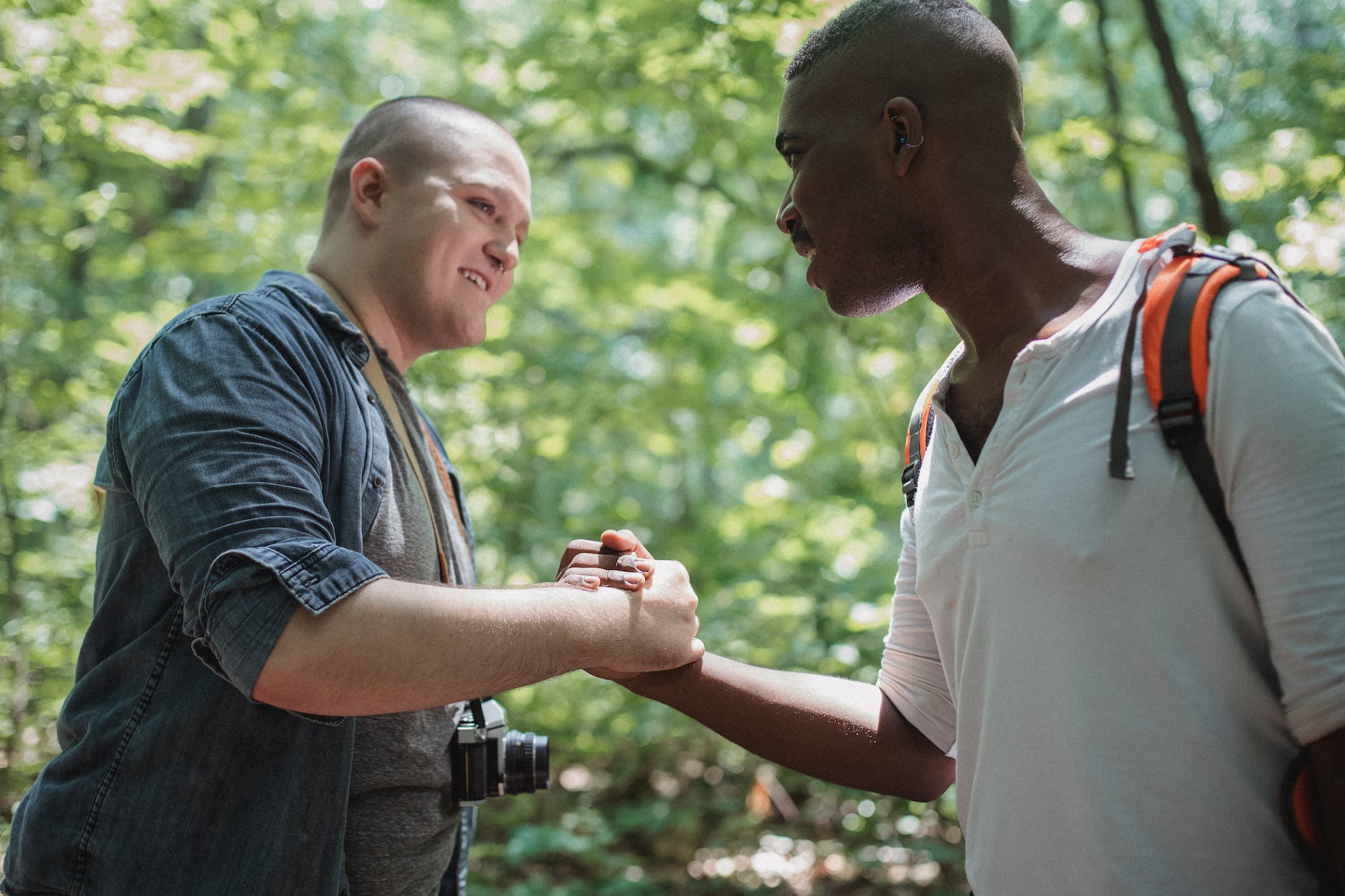
Later, as the conversation progressed, the two men ended up in the farmer’s house, drinking coffee and learning more about one another.  When the farmer realized that he, indeed, shared the same faith practices as the politician, he called a few of his friends to join in the conversation.  As the story goes, upon the politician’s departure, the two men shook hands, but the farmer made it clear that he still would not vote for this political figure.  However, he added that he was surprised to learn the two of them had more in common than he realized.  He further invited the politician to return to his home at a later date, so that they could continue their conversation.

Photo by Kamaji Ogino on Pexels.com

Some might ask what is the point of the story if the farmer was not convinced to vote for the politician. Instead, I think it makes a case for the idea of Sawubona. Two men, on opposite sides of the political fence, spending time with one another, asking questions, listening, learning, and finding some common ground in their shared human experience is a way of conveying consideration or regard for one another. They didn’t have to agree on all points in order to respectfully get along.  In fact, as it turned out, the politician would later reach out to the same farmer when certain legislation was being considered that would have affected the farmer and his community in order to gain a greater understanding of the potential impact.

Reflecting on Sawubona is a lesson of seeing others and being seen by others. It is understanding that we do exist together for one another.  We may have our differences, but it is those collective differences that can create a community of support.  Each individual has their own gifts and talents that we bring to the proverbial community table.  And, thank heavens, because there are so many skill sets of others upon which I rely in order to live, work, and participate in many other daily activities. 

When we truly take time to see others, we can see the common struggles, celebrations, and life experiences. We can feel compassion for another’s suffering, and we can feel the joy of their milestone celebrations. Furthermore, we can appreciate the gifts and talents of others, even those with whom we may disagree on certain subjects. 

Photo by fauxels on Pexels.com

In the end, I am not suggesting that the idea behind Sawubona is easy. Instead, I encourage us to think of Sawubona as a practice. A practice in which we take time to look others in the eye more frequently when greeting in order to make others feel seen.  Additionally, it is a practice for when we find ourselves feeling angry or incensed by an opinion different from our own, to challenge us to pause, and look more closely for the common human thread shared with that person of opposition.  

One word cannot solve all problems, but if we begin to look for more Sawubona moments, it might allow for more opportunities–like the farmer and the politician–for listening, learning, and finding common ground.  When we feel seen/heard by another person, it makes us feel respected, and that feels good.  Therefore, imagine the positive reverberations that could be created within our own local communities if we began to offer that same Sawubona feeling to even one person per day.  It is certainly worth considering. 

Photo by Pixabay on Pexels.com